How To Write Effective Case Scenarios

Loading...

Flash Player 9 (or above) is needed to view presentations.
We have detected that you do not have it on your computer. To install it, go here.

0 comments

Post a comment

    Post a comment
    Embed Video
    Edit your comment Cancel

    Favorites, Groups & Events

    How To Write Effective Case Scenarios - Presentation Transcript

    1. Justina Sharma
    2. What is a Case Scenario? A case scenario is a detailed report of a  company, industry, person, or a project over a particular time period Case studies tell the story of a great product or service and a happy customer. Often the customer is interviewed and quoted in the article. 4/30/2009 2
    3. Why case scenario? Cases are used as a basic tool for group discussion which enables the participating student to take up the roles of key players in actual business situations. The case method describes real management issues in real companies 4/30/2009 3
    4. What to be included in a case scenario? Basic information about the company  An analysis of the company's history and growth  A summary of the company's strengths and weaknesses  Responses and results of the company's current business  Recommendations or solutions for future development  4/30/2009 4
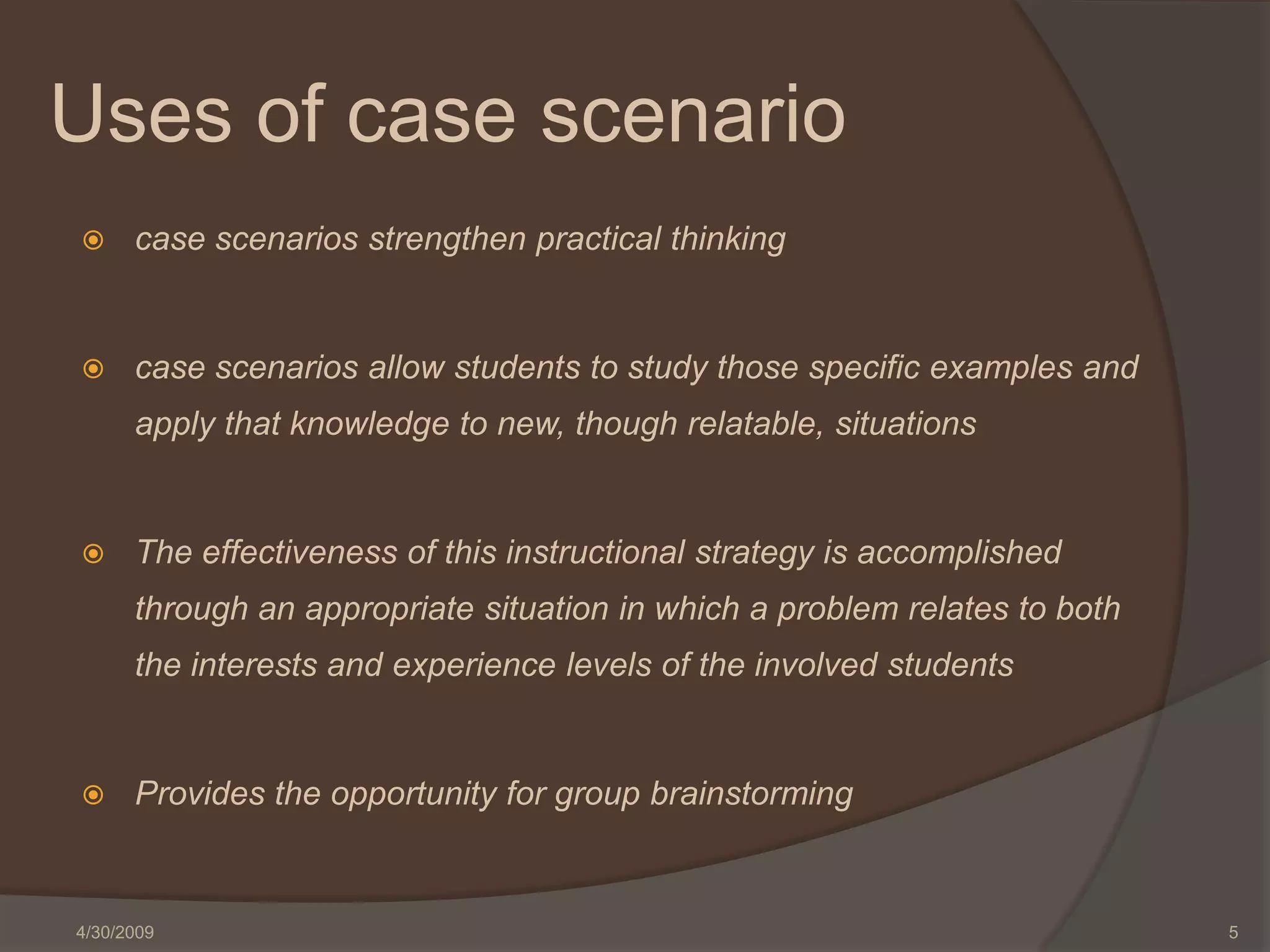
    5. Uses of case scenario case scenarios strengthen practical thinking  case scenarios allow students to study those specific examples and  apply that knowledge to new, though relatable, situations The effectiveness of this instructional strategy is accomplished  through an appropriate situation in which a problem relates to both the interests and experience levels of the involved students Provides the opportunity for group brainstorming  4/30/2009 5
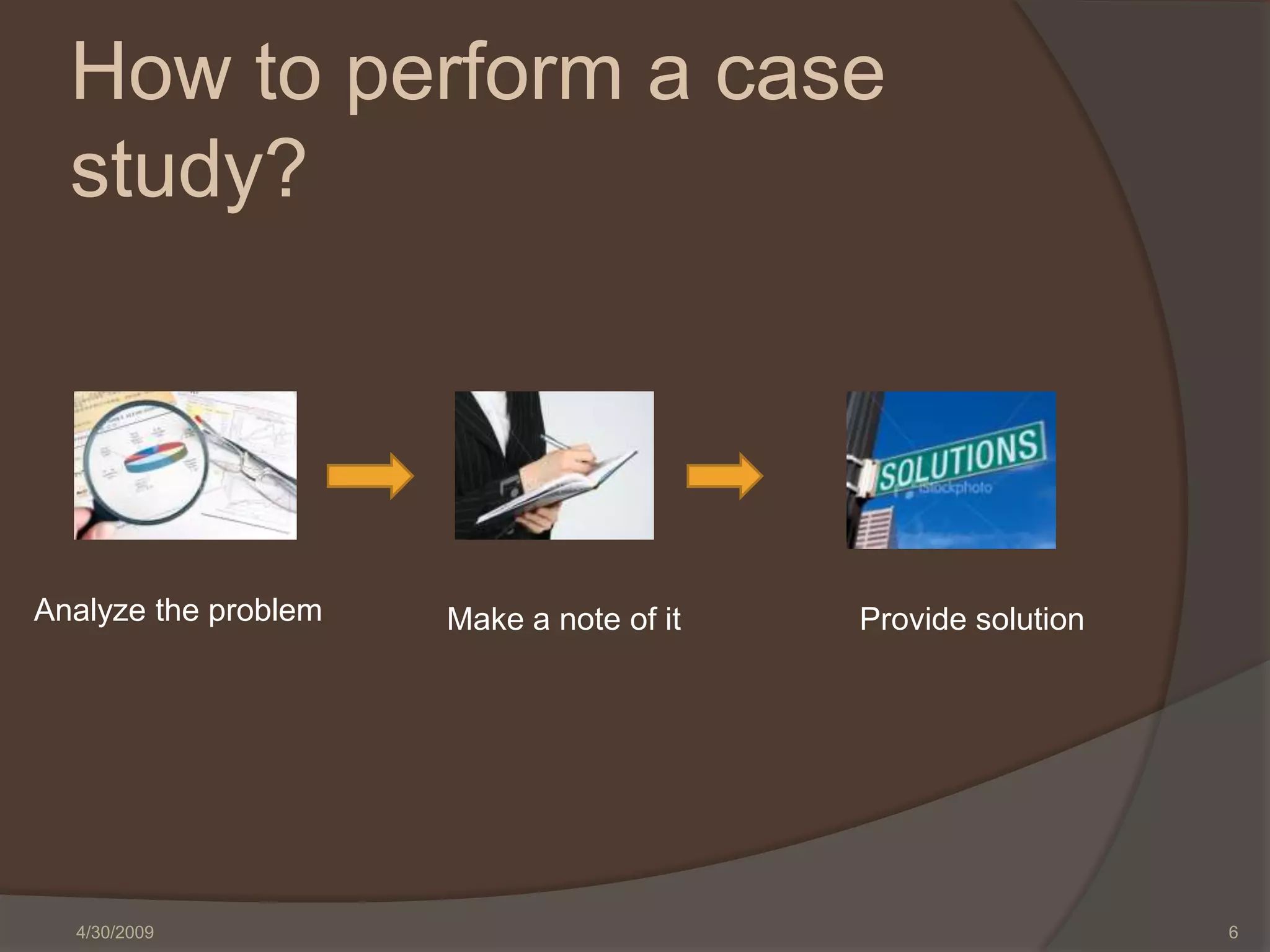
    6. How to perform a case study? Analyze the problem Make a note of it Provide solution 4/30/2009 6
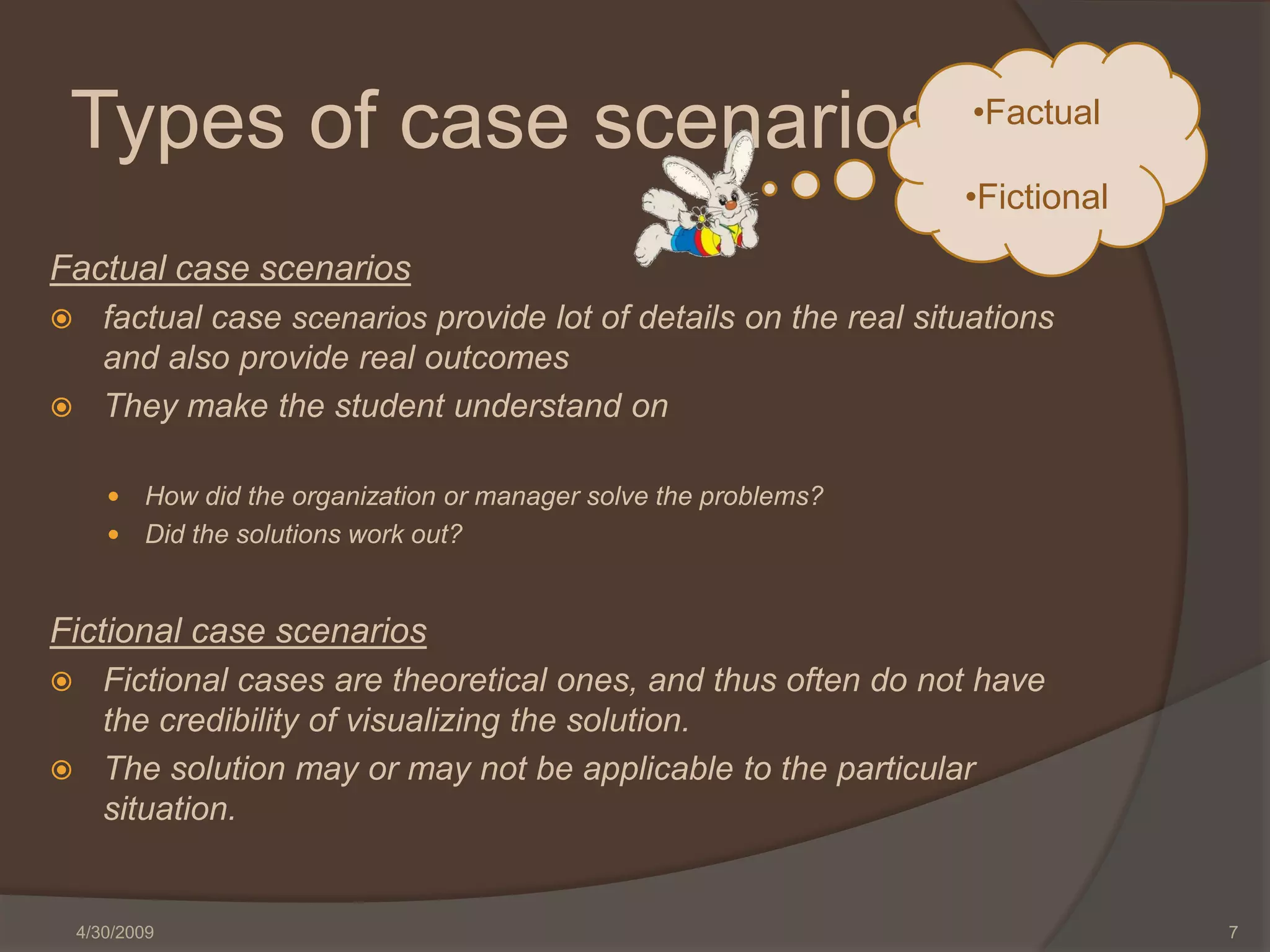
    7. Types of case scenarios •Factual •Fictional Factual case scenarios factual case scenarios provide lot of details on the real situations  and also provide real outcomes  They make the student understand on  How did the organization or manager solve the problems?  Did the solutions work out? Fictional case scenarios Fictional cases are theoretical ones, and thus often do not have  the credibility of visualizing the solution.  The solution may or may not be applicable to the particular situation. 4/30/2009 7
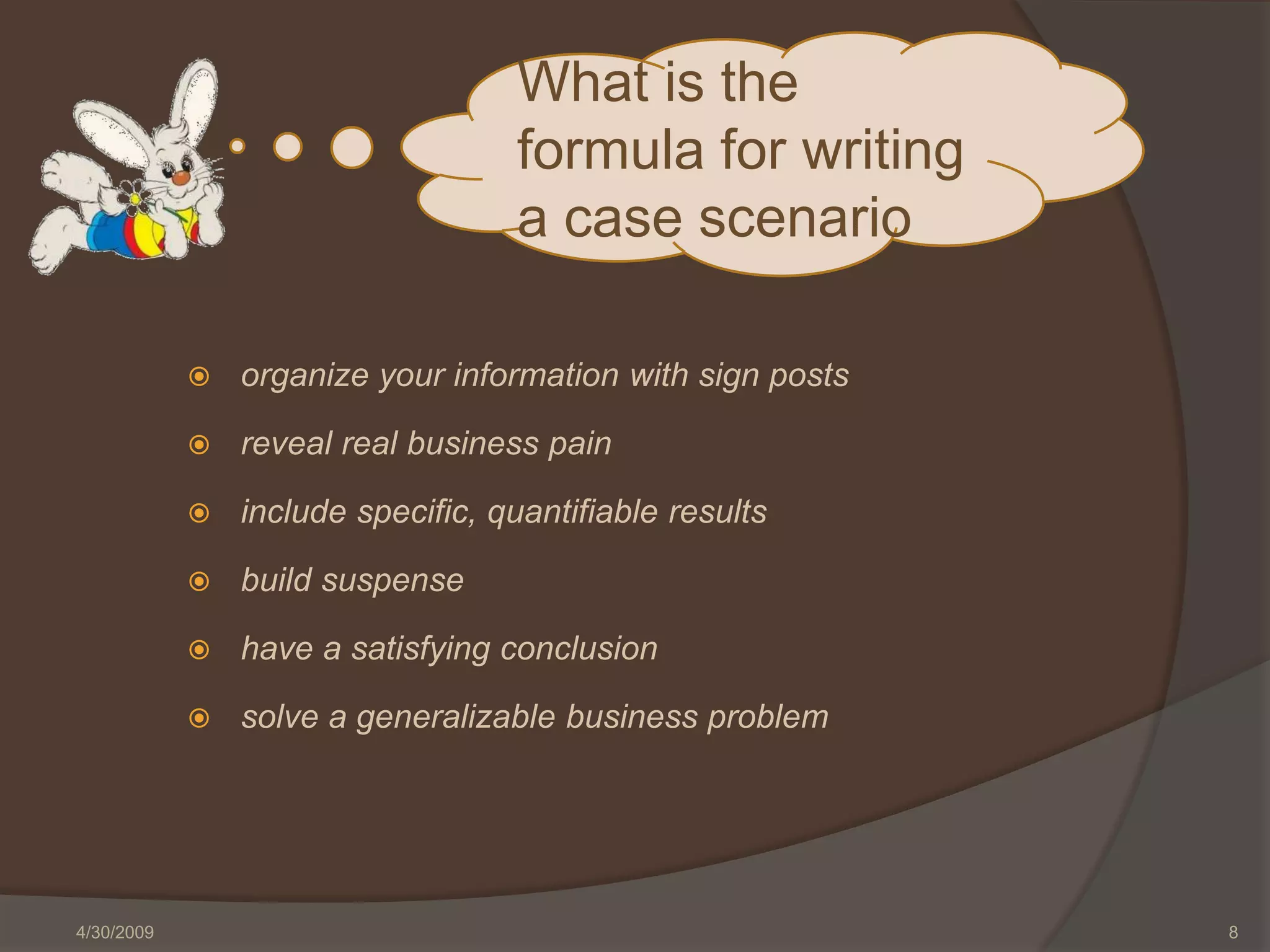
    8. What is the formula for writing a case scenario organize your information with sign posts  reveal real business pain  include specific, quantifiable results  build suspense  have a satisfying conclusion  solve a generalizable business problem  4/30/2009 8
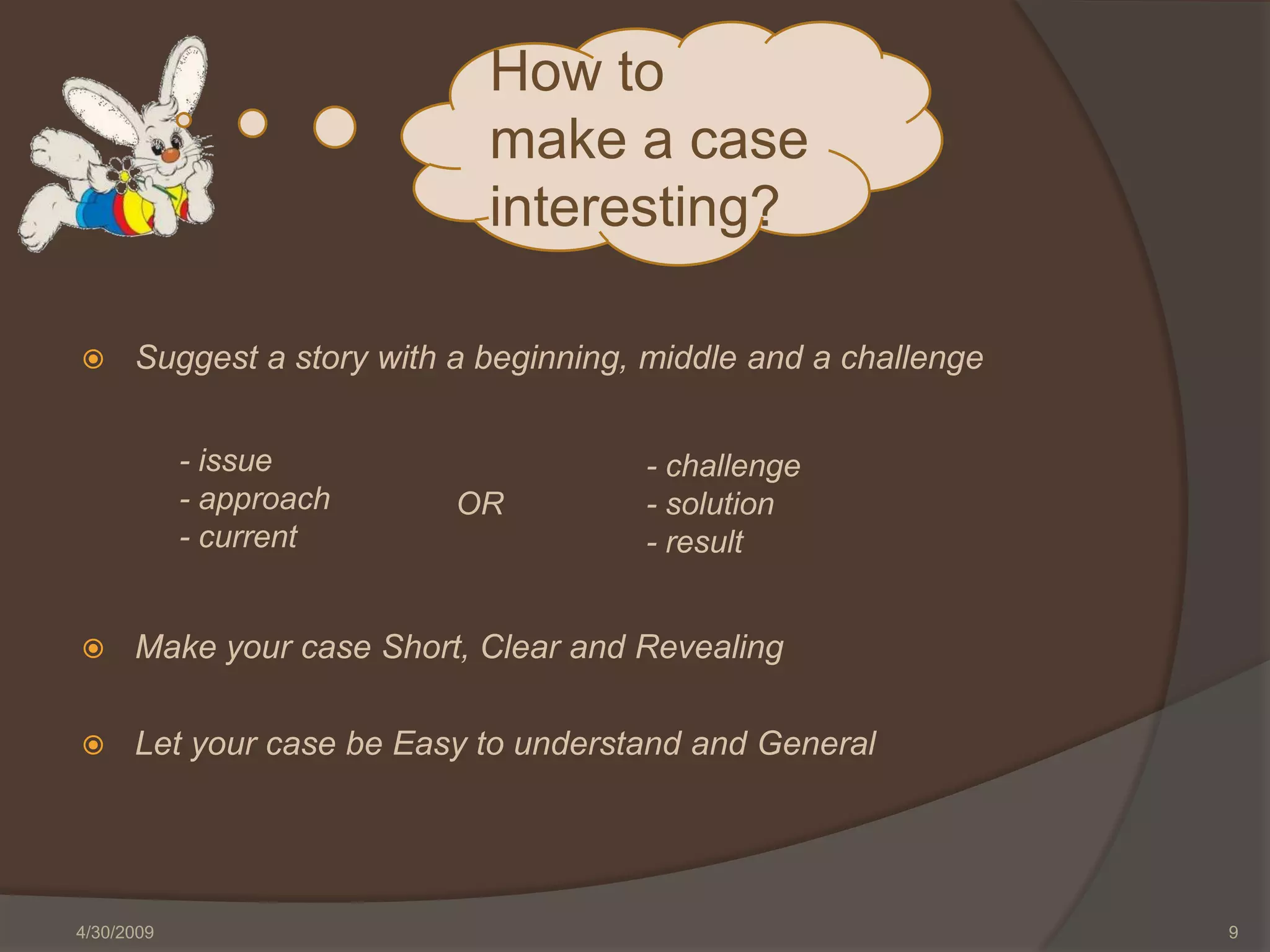
    9. How to make a case interesting? Suggest a story with a beginning, middle and a challenge  - issue - challenge - approach OR - solution - current - result Make your case Short, Clear and Revealing  Let your case be Easy to understand and General  4/30/2009 9
    10. How long should a case be? Unlike a press release, there is no standardized format for writing a case scenario. They can be as short as a single paragraph, or as complex as a four-page document with sidebars, summaries and charts. A business school case may be brief or extensive. The length of a case study will usually depend on the topic, as well as the author of the case. 4/30/2009 10
    11. Check list on writing a case scenario Keep your audience in mind: Keep jargon to a minimum.  Know the case: Understand the case completely before you present it.  Use a short-story: Each story element should move the narrative  forward. Be analytical, not descriptive: Do not write more than 300 words for  one illustration. Grab the attention: Present a character facing his or her biggest  problem at the beginning. 4/30/2009 11
    12. Check list on writing a case scenario Present the situation: Do not give any signals that one solution  might be preferred. Provide relevant details: provide relevant details about  goals, strategies, dilemmas, issues, conflicts, roadblocks, appropri ate research, relevant financial information, people, and relationships. Use dialogues: Make the characters come alive with dialogue.  Straight narrative is boring. Challenge: Leave the reader with a clear picture of the major  problems--either ask or imply \"what is to be done now?\" 4/30/2009 12
    13. Further references Caseplace.org  Webspiders.com  4/30/2009 13
    14. Justina Sharma justisharma@gmail.com 4/30/2009 14
    SlideShare Zeitgeist 2009

    + justisharmajustisharma Nominate

    custom

    1329 views, 0 favs, 0 embeds more stats

    More info about this document

    © All Rights Reserved

    Go to text version

    • Total Views 1329
      • 1329 on SlideShare
      • 0 from embeds
    • Comments 0
    • Favorites 0
    • Downloads 18
    Most viewed embeds

    more

    All embeds

    less

    Flagged as inappropriate Flag as inappropriate
    Flag as inappropriate

    Select your reason for flagging this presentation as inappropriate. If needed, use the feedback form to let us know more details.

    Cancel
    File a copyright complaint
    Having problems? Go to our helpdesk?

    Categories