A Framework for Social Innovation Frances Westley [email_address] University of Waterloo November, 2008
What is social innovation? . Social innovation is an initiative, product or process which profoundly changes the basic  routines ,  resource and authority flows  or  beliefs  of any social system. Successful social innovations are therefore  disruptive  and  have durability, impact and scale. The role of: Social Innovation Generation (SiG) [email_address]

Key messages Social innovation is complex: understanding the difference between  complicated  and  complex  is important in understanding the dynamics of social innovation  Market/diffusion models of social innovation should be complimented by complex system models which see change as discontinuous and focus on cross scale dynamics. Agency and opportunity are both important. Agency is defined not only by social entrepreneurship but by institutional entrepreneurship Institutional entrepreneurs tailor strategies to particular opportunity contexts.
Santropol Roulant Eva’s Phoenix The Working Center Innovations abound….
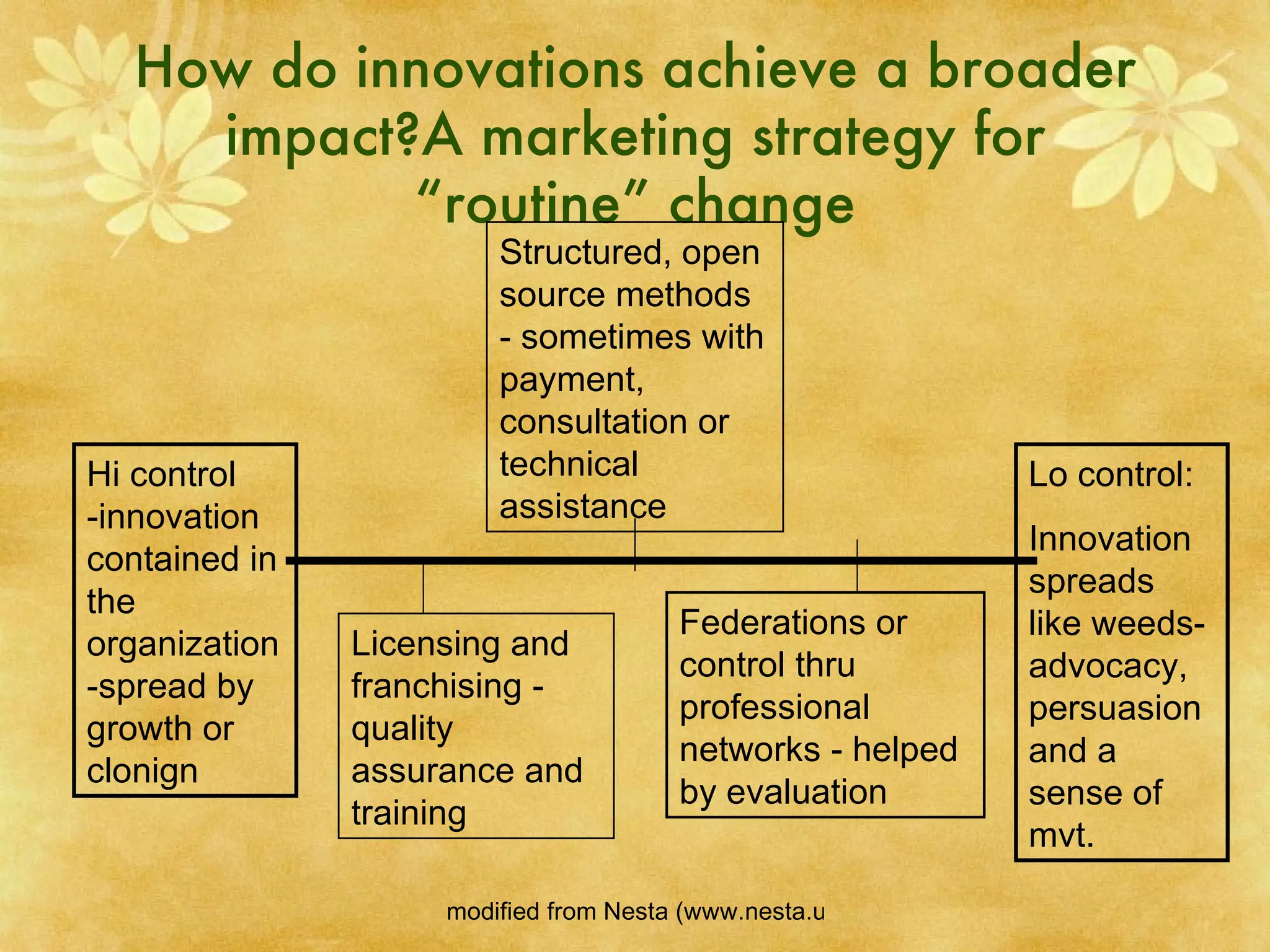
How do innovations achieve a broader impact?A marketing strategy for “routine” change Hi control -innovation contained in the organization-spread by growth or clonign Lo control: Innovation spreads like weeds- advocacy, persuasion and a sense of mvt. Licensing and franchising - quality assurance and training Structured, open source methods - sometimes with payment, consultation or technical assistance Federations or control thru professional networks - helped by evaluation
 
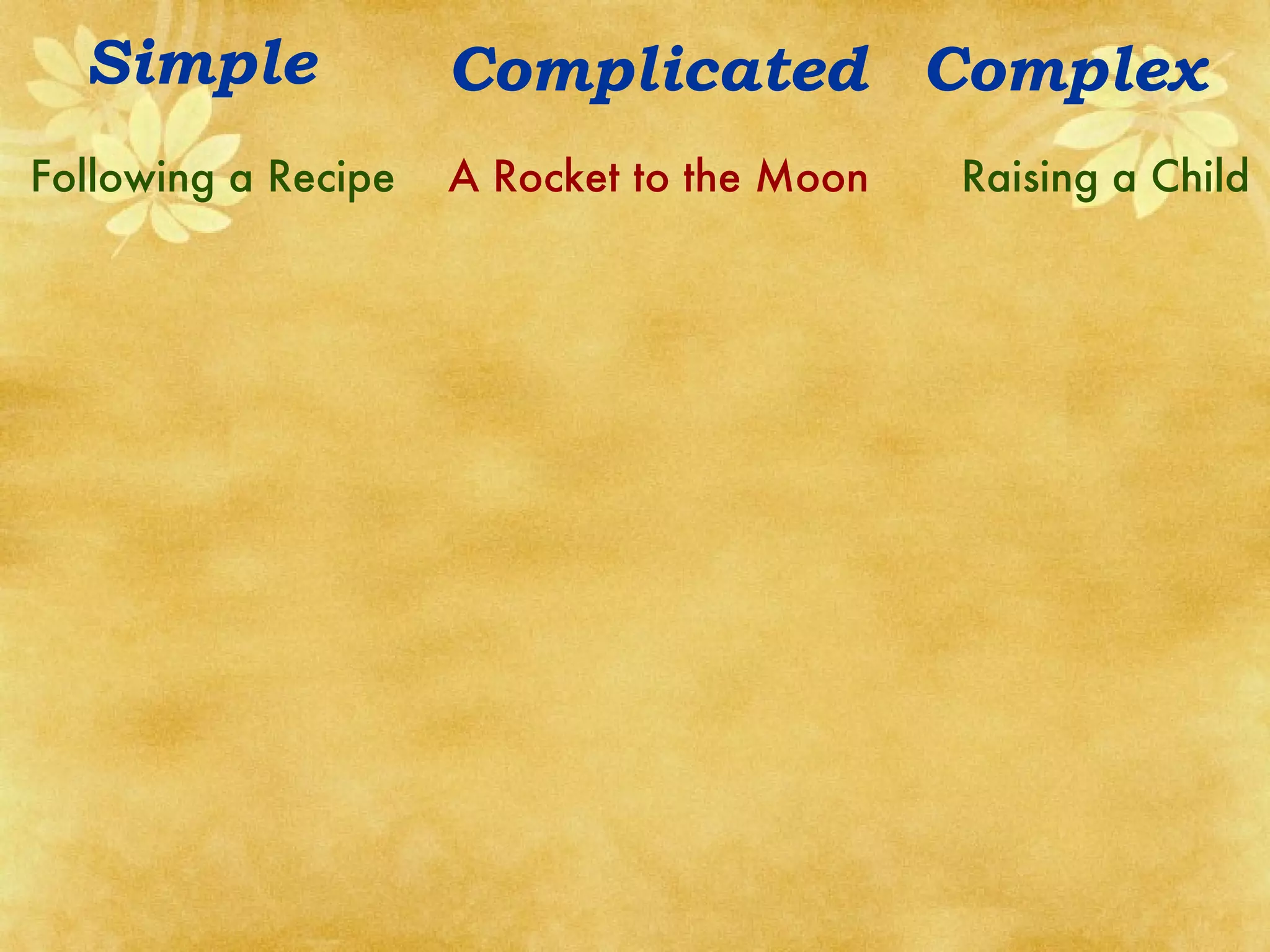
Following a Recipe  A Rocket to the Moon   Raising a Child Complicated Complex Simple
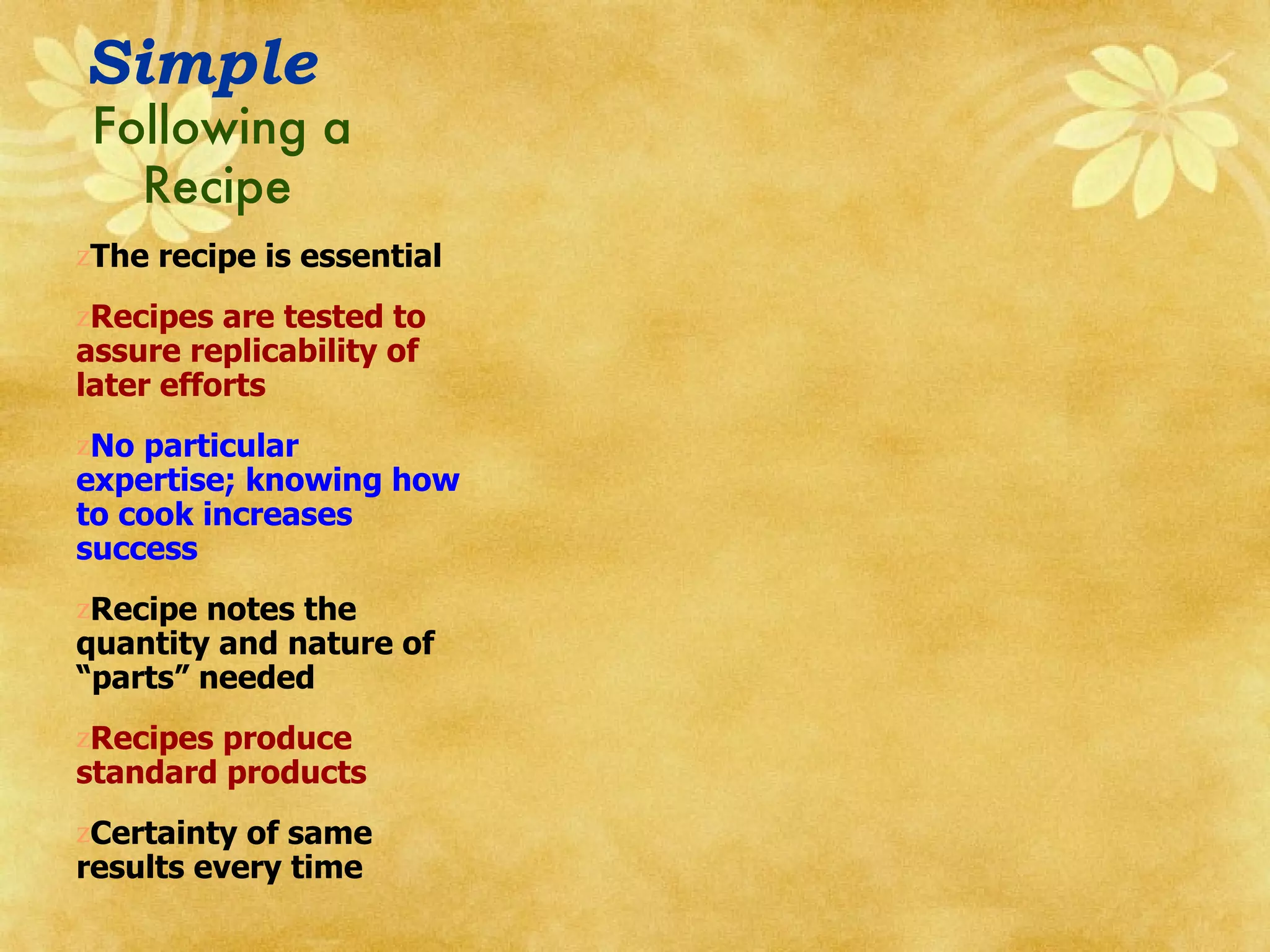
Following a Recipe The recipe is essential  Recipes are tested to assure replicability of later efforts No particular expertise; knowing how to cook increases success Recipe notes the quantity and nature of “parts” needed Recipes produce standard products Certainty of same results every time Simple
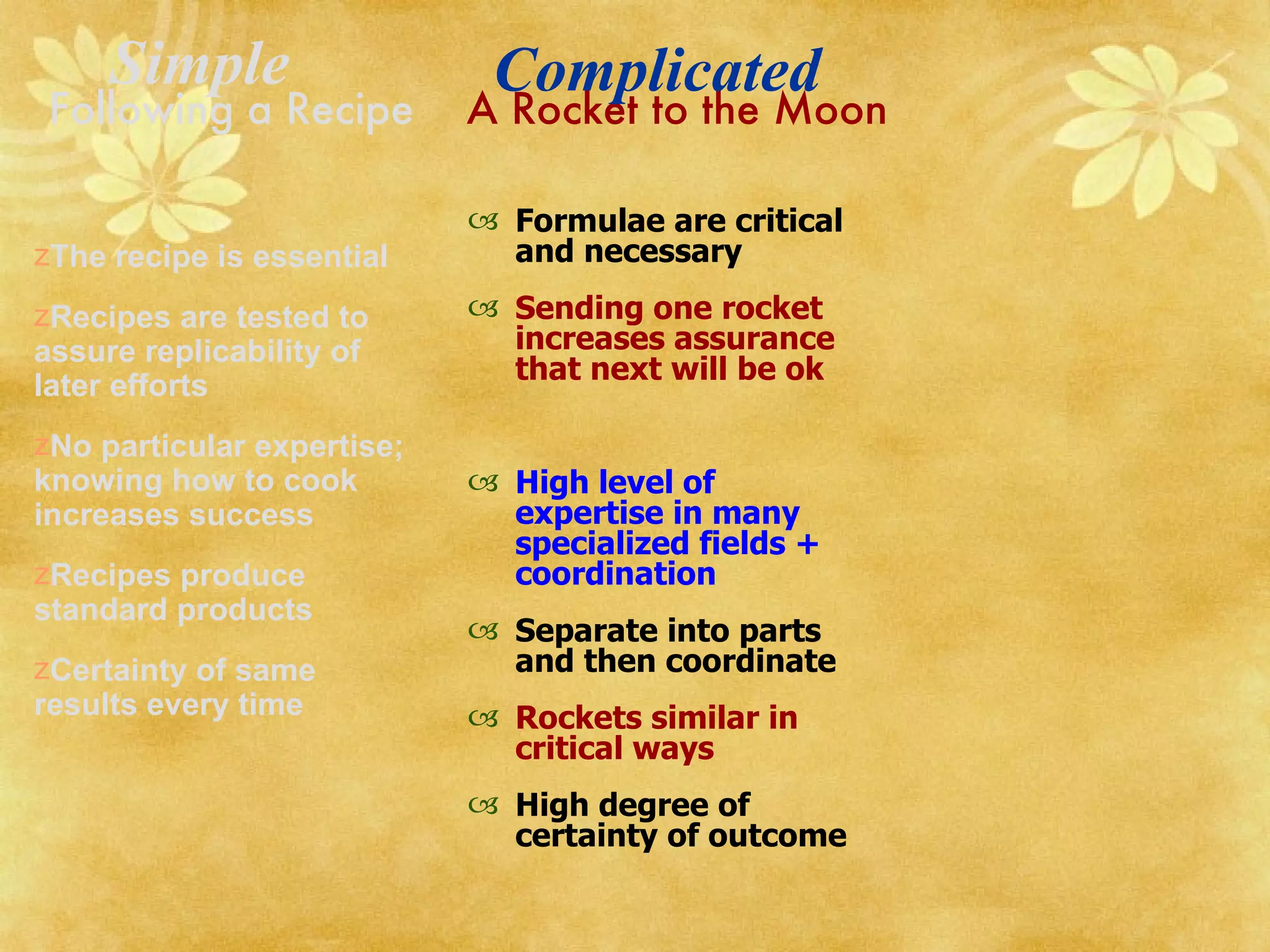
Following a Recipe   A Rocket to the Moon   Formulae are critical and necessary Sending one rocket increases assurance that next will be ok High level of expertise in many specialized fields + coordination   Separate into parts and then coordinate Rockets similar in critical ways  High degree of certainty of outcome Complicated The recipe is essential  Recipes are tested to assure replicability of later efforts No particular expertise; knowing how to cook increases success Recipes produce standard products Certainty of same results every time Simple
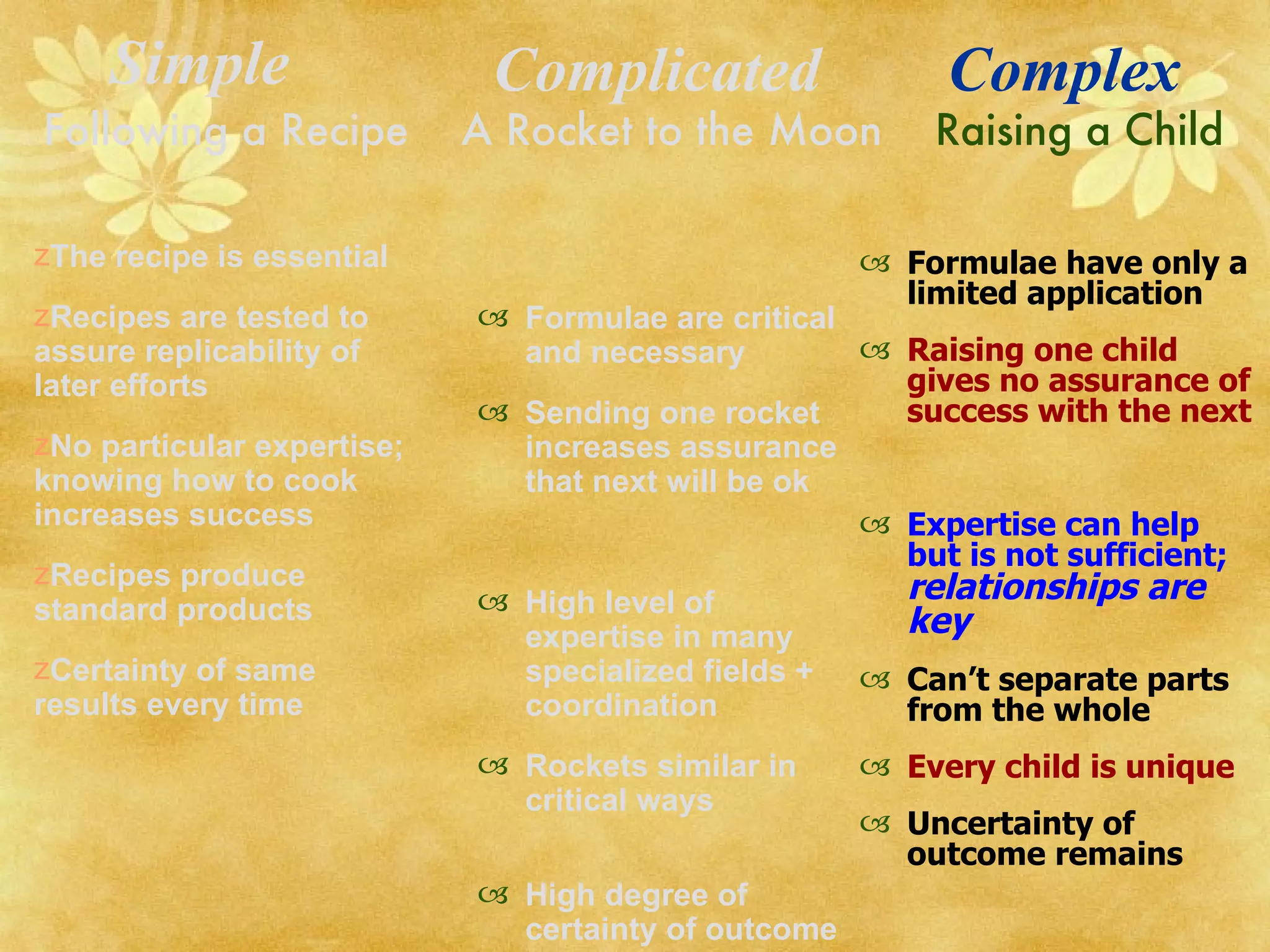
Following a Recipe  A Rocket to the Moon   Raising a Child  Formulae are critical and necessary Sending one rocket increases assurance that next will be ok High level of expertise in many specialized fields + coordination  Rockets similar in critical ways  High degree of certainty of outcome Formulae have only a limited application Raising one child gives no assurance of success with the next Expertise can help but is not sufficient;  relationships are key Can’t separate parts from the whole Every child is unique Uncertainty of outcome remains   Complicated Complex The recipe is essential  Recipes are tested to assure replicability of later efforts No particular expertise; knowing how to cook increases success Recipes produce standard products Certainty of same results every time Simple
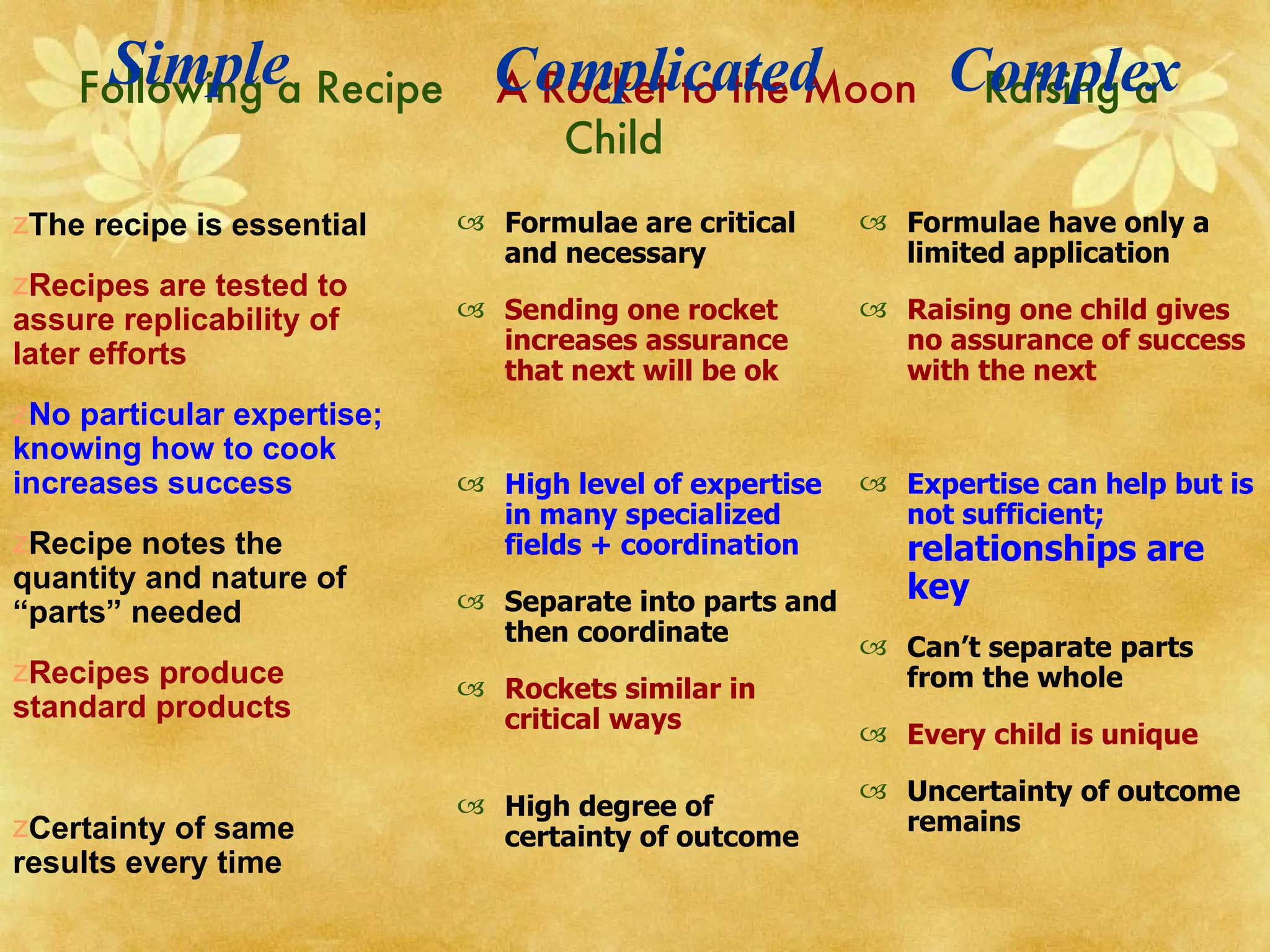
Following a Recipe  A Rocket to the Moon   Raising a Child Formulae are critical and necessary Sending one rocket increases assurance that next will be ok High level of expertise in many specialized fields + coordination   Separate into parts and then coordinate Rockets similar in critical ways  High degree of certainty of outcome Formulae have only a limited application Raising one child gives no assurance of success with the next Expertise can help but is not sufficient;  relationships are key Can’t separate parts from the whole Every child is unique Uncertainty of outcome remains   Complicated Complex The recipe is essential  Recipes are tested to assure replicability of later efforts No particular expertise; knowing how to cook increases success Recipe notes the quantity and nature of “parts” needed Recipes produce standard products Certainty of same results every time Simple
Complicated  – “ complicare ”- folded Verb  - to fold Complex  – “ complexus ” – woven Verb – to embrace or comprehend a pattern
 
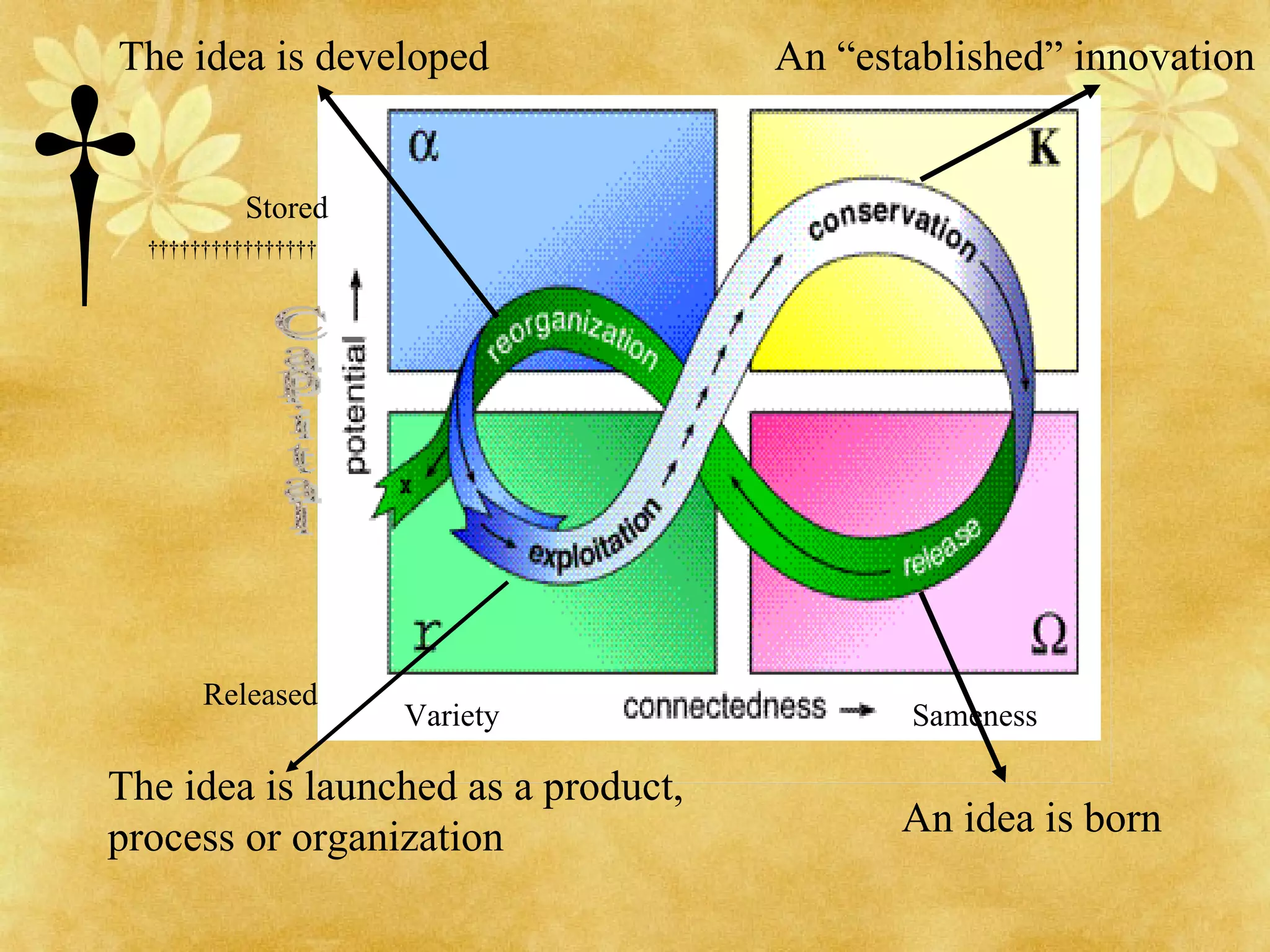
                                                                                         Capital Stored Released Variety Sameness An idea is born The idea is developed The idea is launched as a product, process or organization An “established” innovation
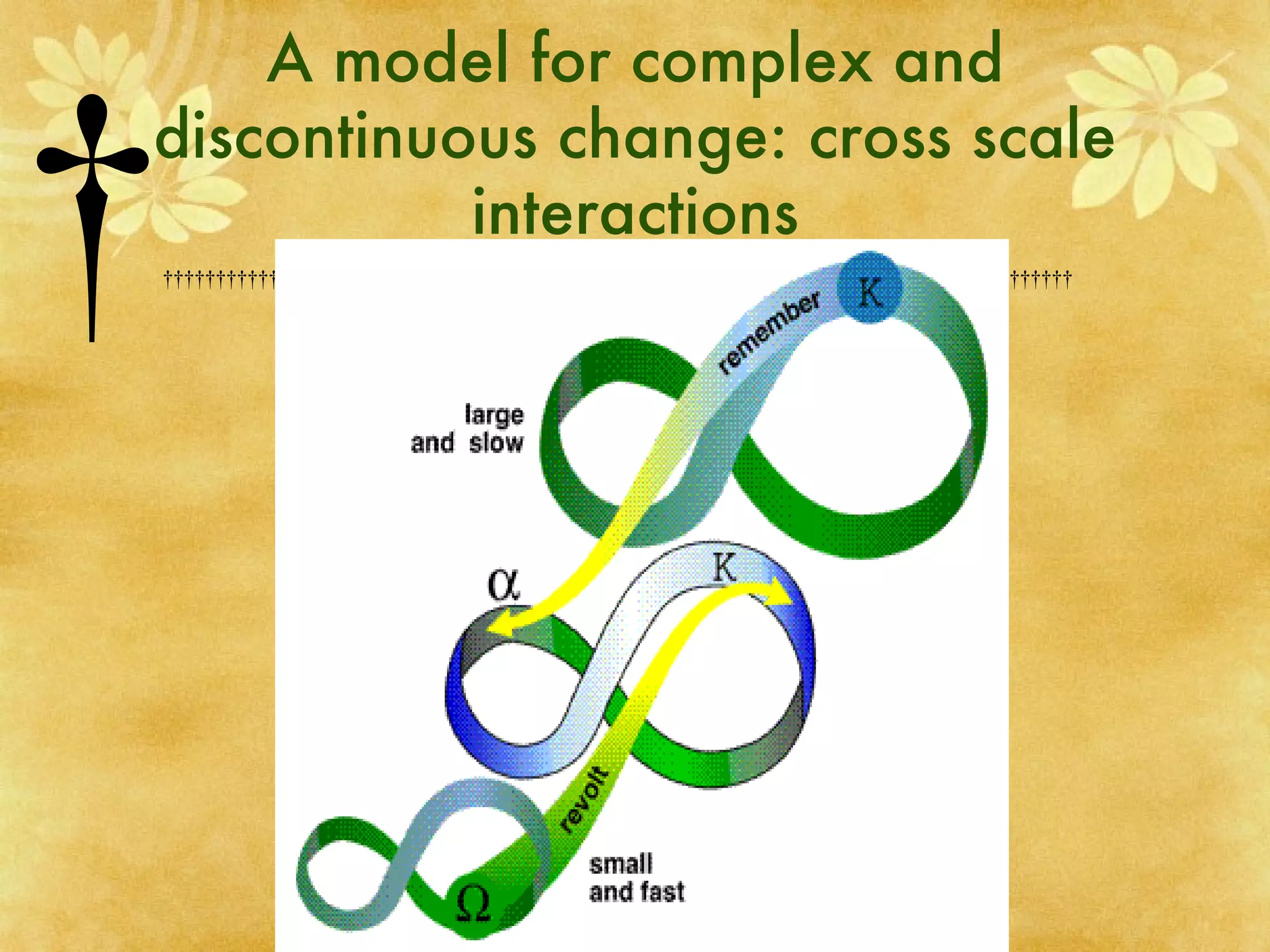
A model for complex and discontinuous change: cross scale interactions                                                                                         
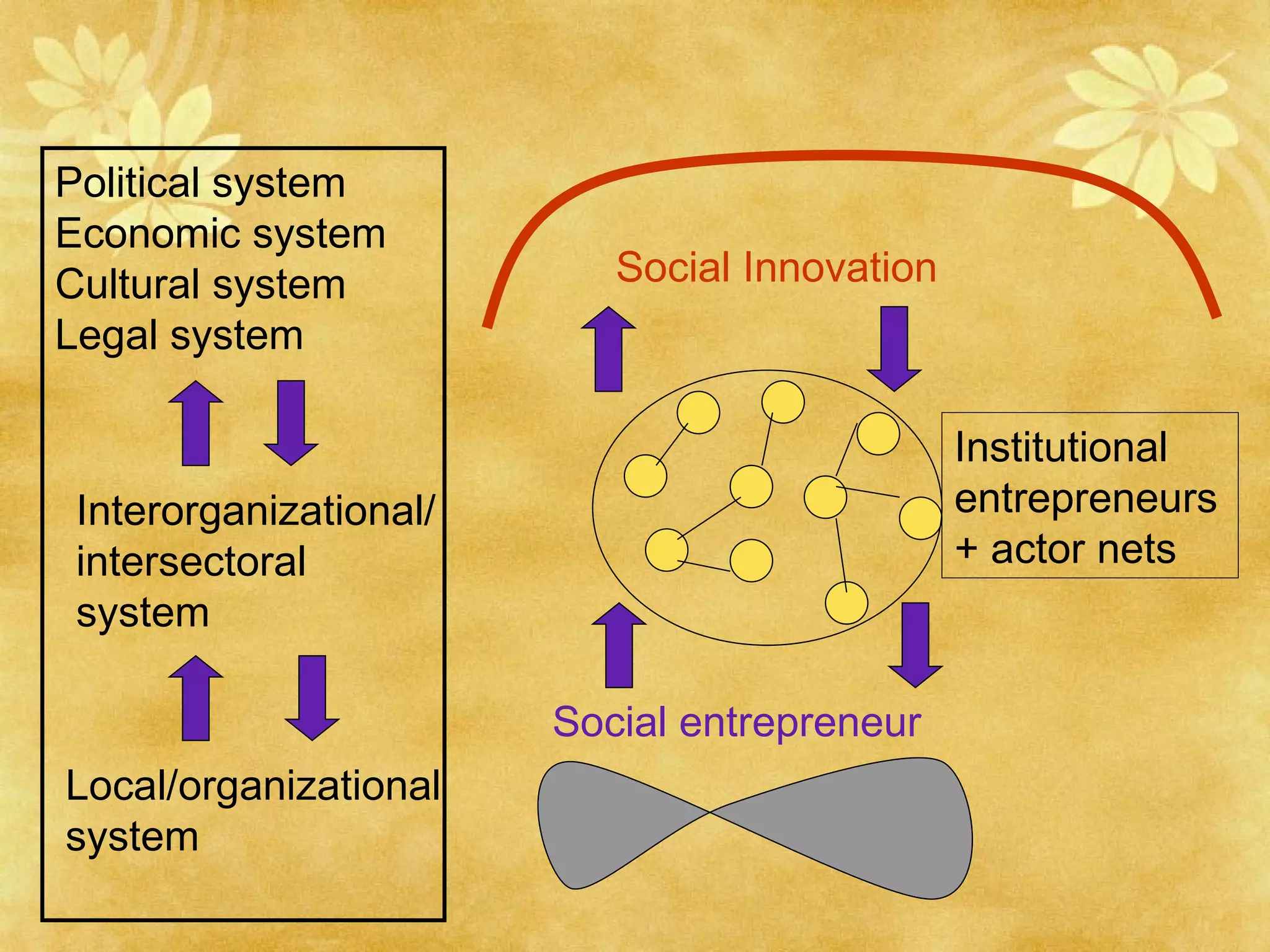
Social Innovation Political system Economic system Cultural system Legal system Social entrepreneur Institutional entrepreneurs + actor nets Interorganizational/ intersectoral  system Local/organizational system
What is an institution “ A patterned set of behaviors and meanings which structure social behavior over time” Embedded in our language and our understandings Embedded in our rules for social behavior; including in our laws. Embedded in our economy, including resource distribution
What is the role of the institutional entrepreneur To change the ideas, discourse, knowledge, social interactions, resource expenditures, and policies/laws which support environmental destruction to a new pattern which supports a particular innovation. To work across scales and boundaries and with multiple agents (agent net) in the “institutional field”
Institutional entrepreneurs tune strategies of resource mobilization to different opportunity contexts of social innovation :
 
 
Designing strategies for cross scale impact when change opportunity is opaque : “ up-down strategies”   Innovation occurs in the community in the context of organizations/coalitions addressing specific issues - where problems are solved in real time Social innovators/institutional entrepreneurs key role is to: question  the strategic context/directions of decision makers in all sectors at the community level and beyond. frame  (explain) the context for community identify  key innovations at the community level (those most pertinent to the strategies) sell  these to the key strategic decision makers (finding the right moment to introduce the key innovation)
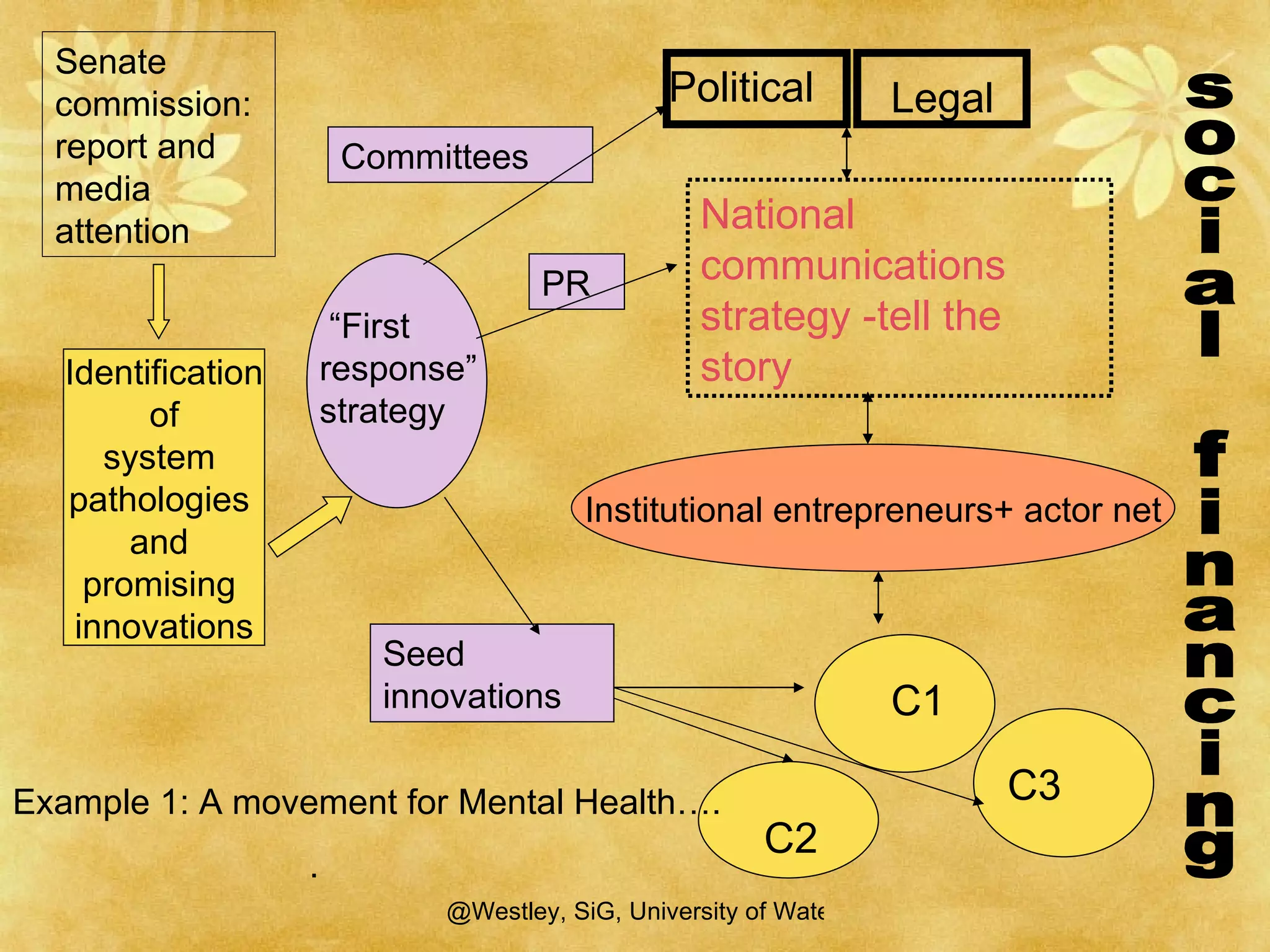
National communications strategy -tell the story Political C1 C2 C3 social financing Senate commission: report and media attention Legal Identification of  system  pathologies  and  promising  innovations “ First response” strategy Committees PR Seed innovations Institutional entrepreneurs+ actor net Example 1: A movement for Mental Health…. .
 
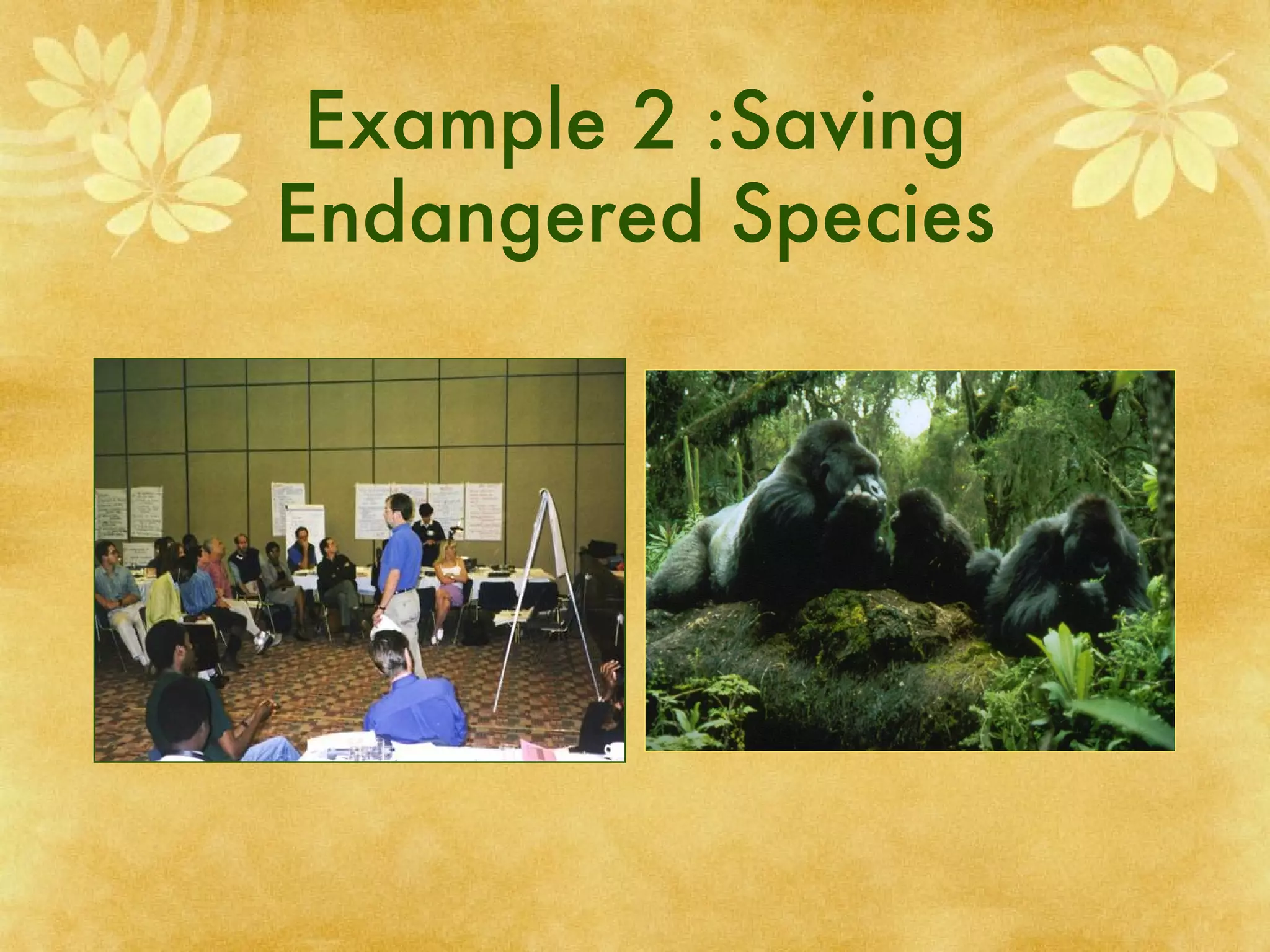
Example 2 :Saving Endangered Species
Interpersonal and knowledge management competencies required Interpersonal Convening Conflict management Facilitation Knowledge management Creating a common vision Enhancing sensemaking
 
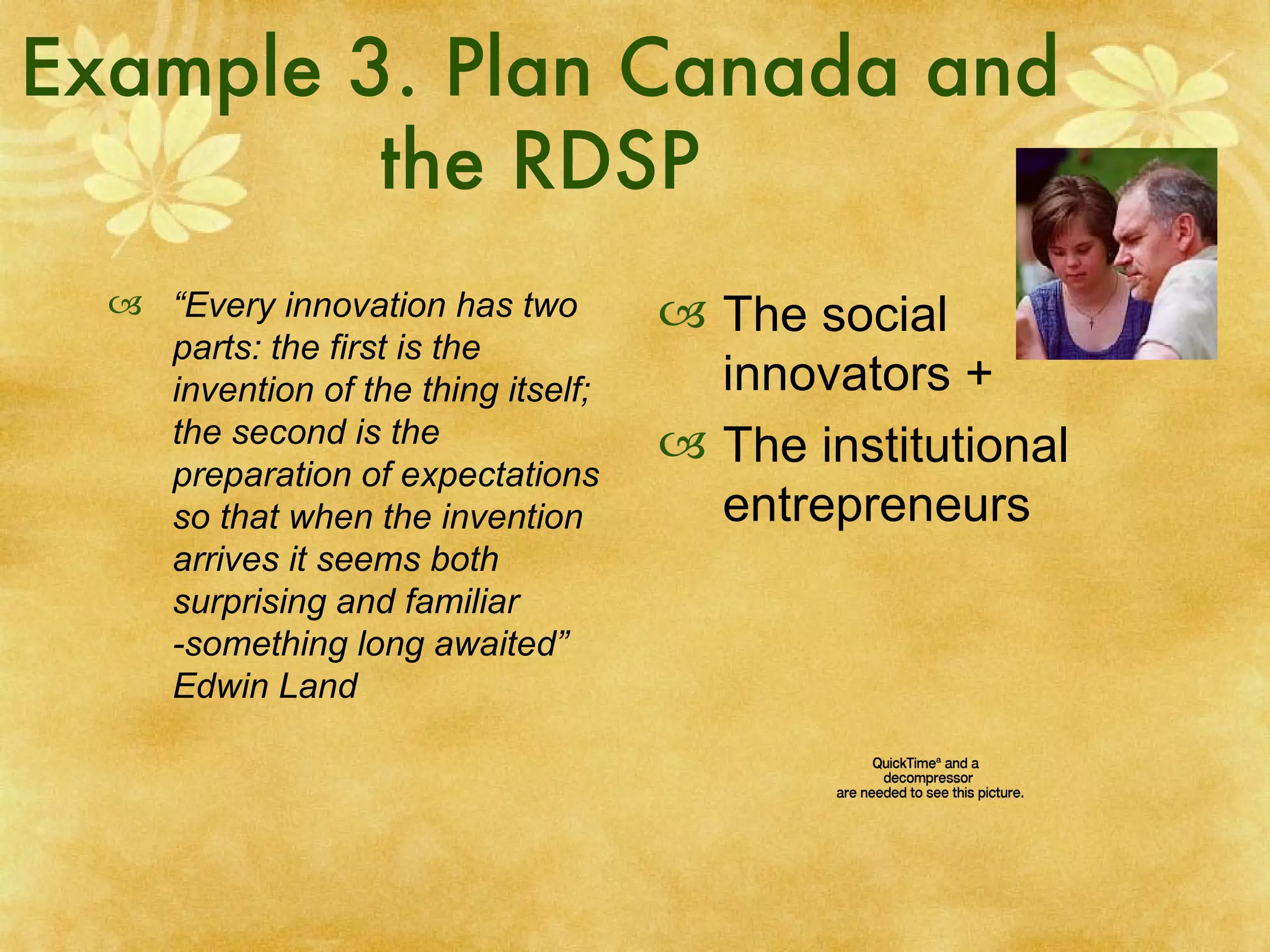
Example 3. Plan Canada and the RDSP “ Every innovation has two parts: the first is the invention of the thing itself; the second is the preparation of expectations so that when the invention arrives it seems both surprising and familiar -something long awaited” Edwin Land The social innovators + The institutional entrepreneurs
Interpersonal and Knowledge skills required Building social capital and mobilizing it in support of novelty Building intellectual/cultural  capital and mobilizing it in support Building financial capital and mobilizing it in support Recognizing and championing innovative idea Connecting the idea to “windows of opportunity” at multiple scales System understanding and emerging pattern recognition
 
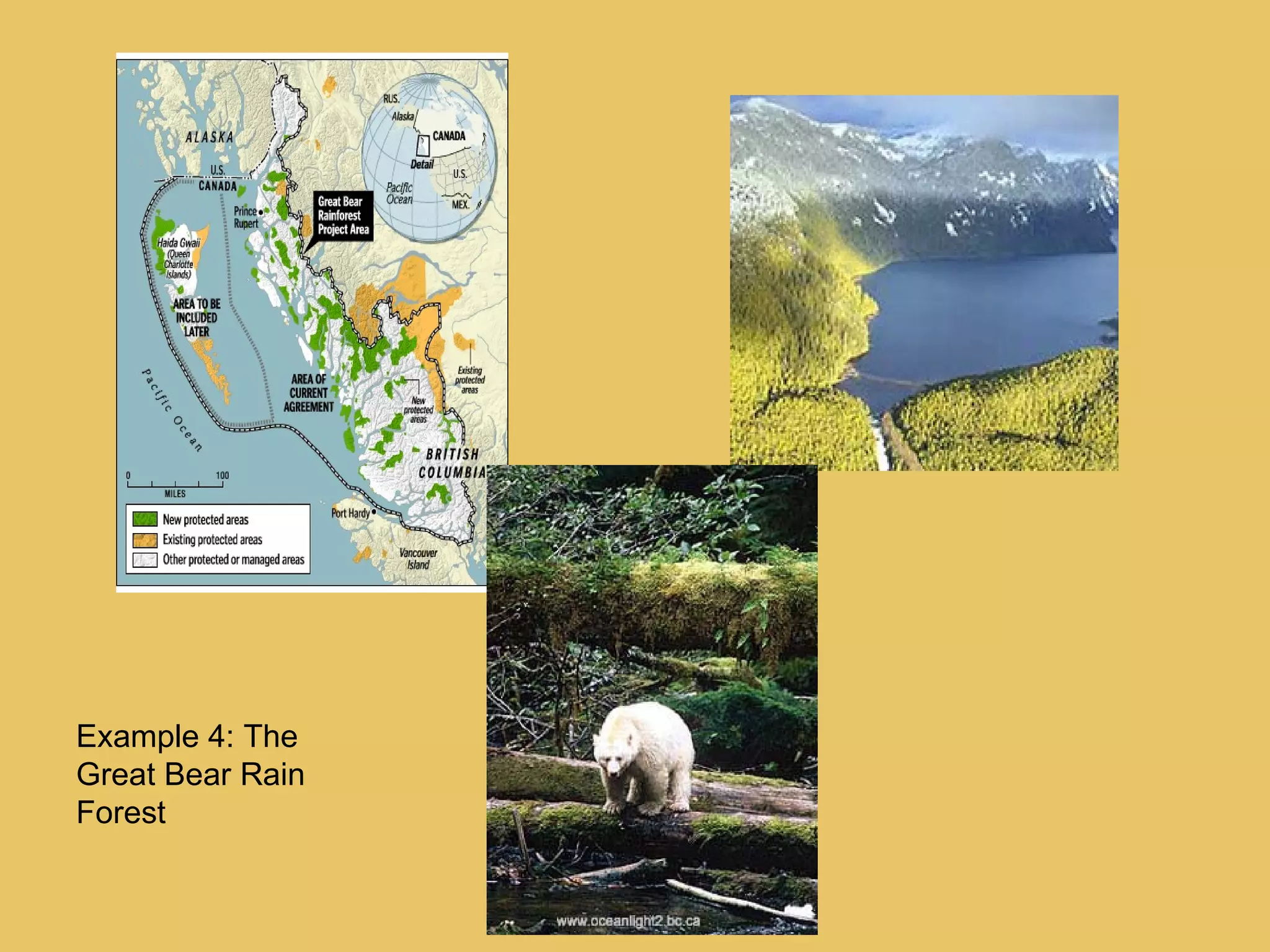
Example 4: The Great Bear Rain Forest
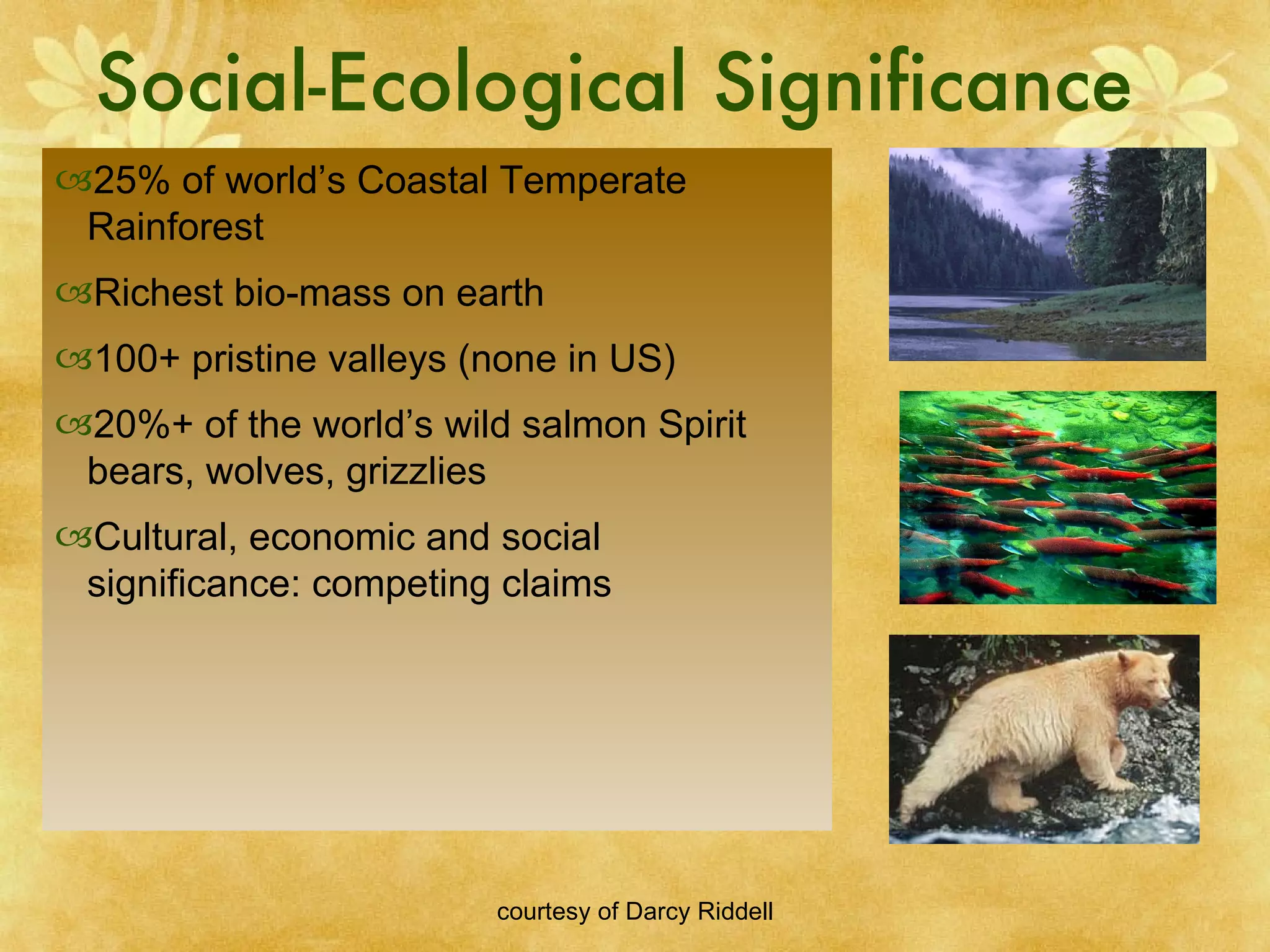
Social-Ecological Significance 25% of world’s Coastal Temperate Rainforest Richest bio-mass on earth 100+ pristine valleys (none in US) 20%+ of the world’s wild salmon Spirit bears, wolves, grizzlies Cultural, economic and social significance: competing claims
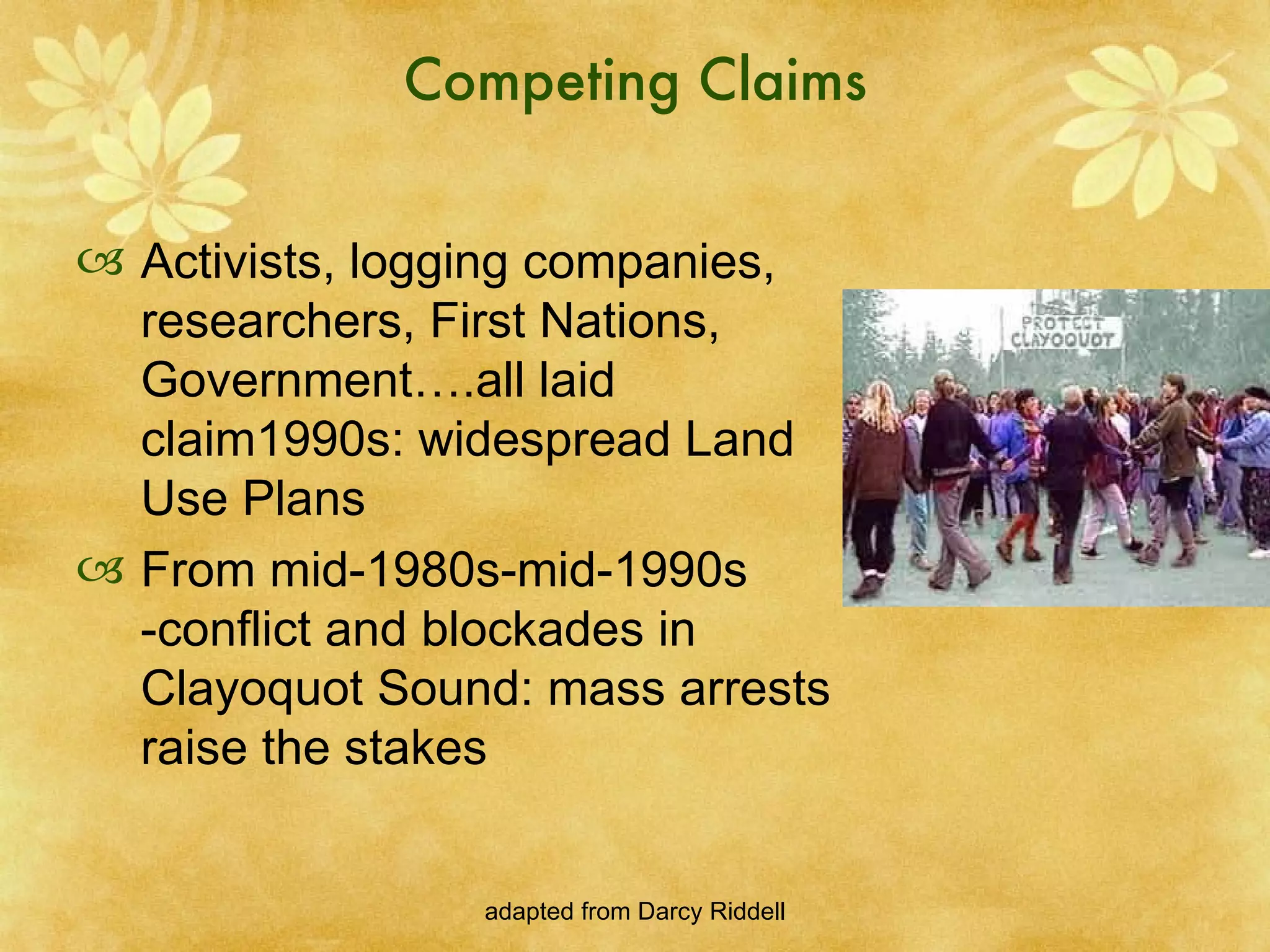
Competing Claims Activists, logging companies, researchers, First Nations, Government….all laid claim1990s: widespread Land Use Plans From mid-1980s-mid-1990s -conflict and blockades in Clayoquot Sound: mass arrests raise the stakes
Final Agreements Permanent protection  – 5 million acres New parks  - 3.3 million acres Previous parks  - 1 million acres New no-logging zones  - 736,000 acres EBM  – 21 million acres $35 million mitigation package  for forest workers $120 Million  for conservation economy  First Nations  approve all plans International Marketplace shift Model  used in Chile, Boreal, USA
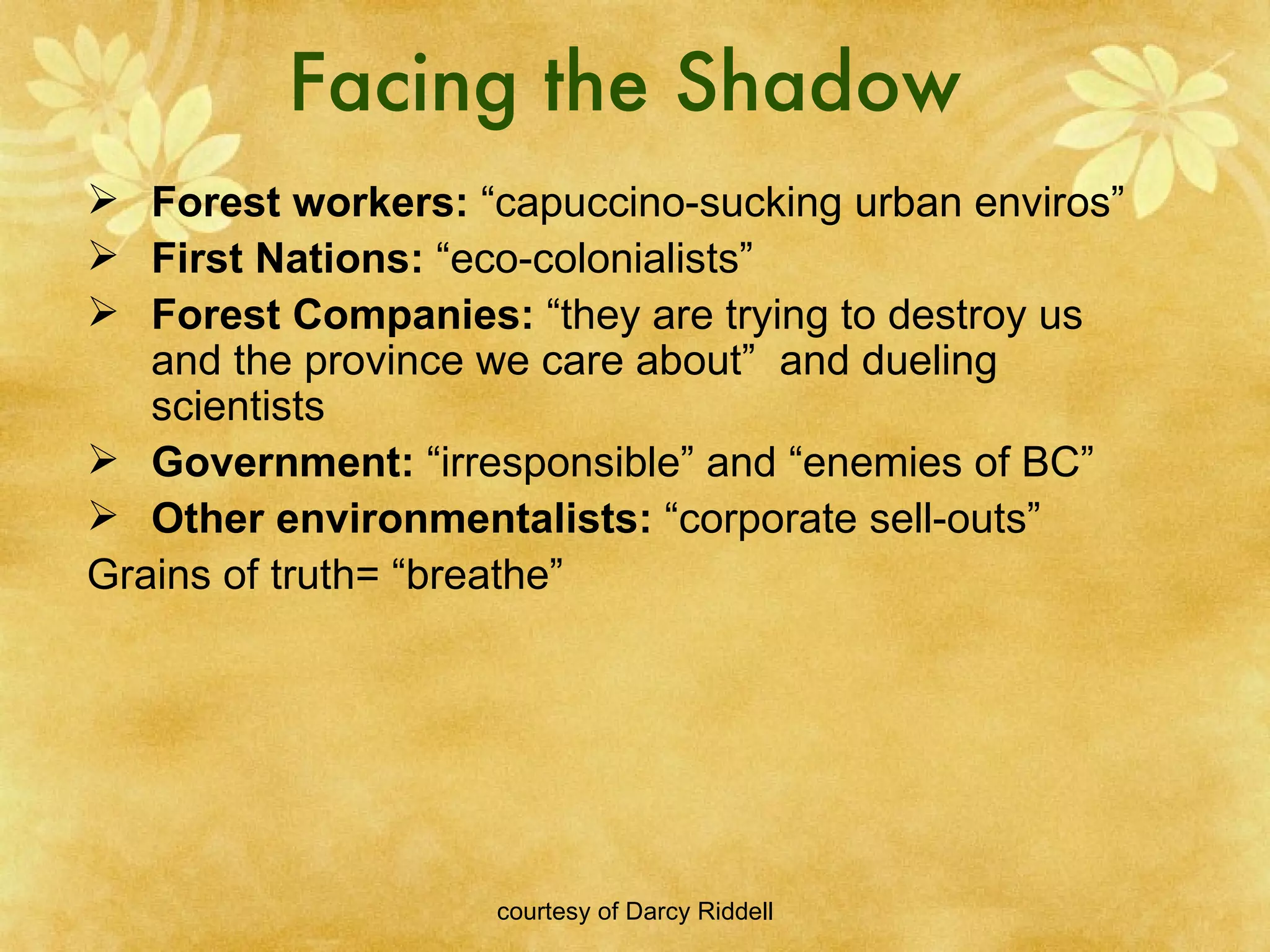
Facing the Shadow Forest workers:  “capuccino-sucking urban enviros” First Nations:  “eco-colonialists” Forest Companies:  “they are trying to destroy us and the province we care about”  and dueling scientists Government:  “irresponsible” and “enemies of BC” Other environmentalists:  “corporate sell-outs” Grains of truth= “breathe”
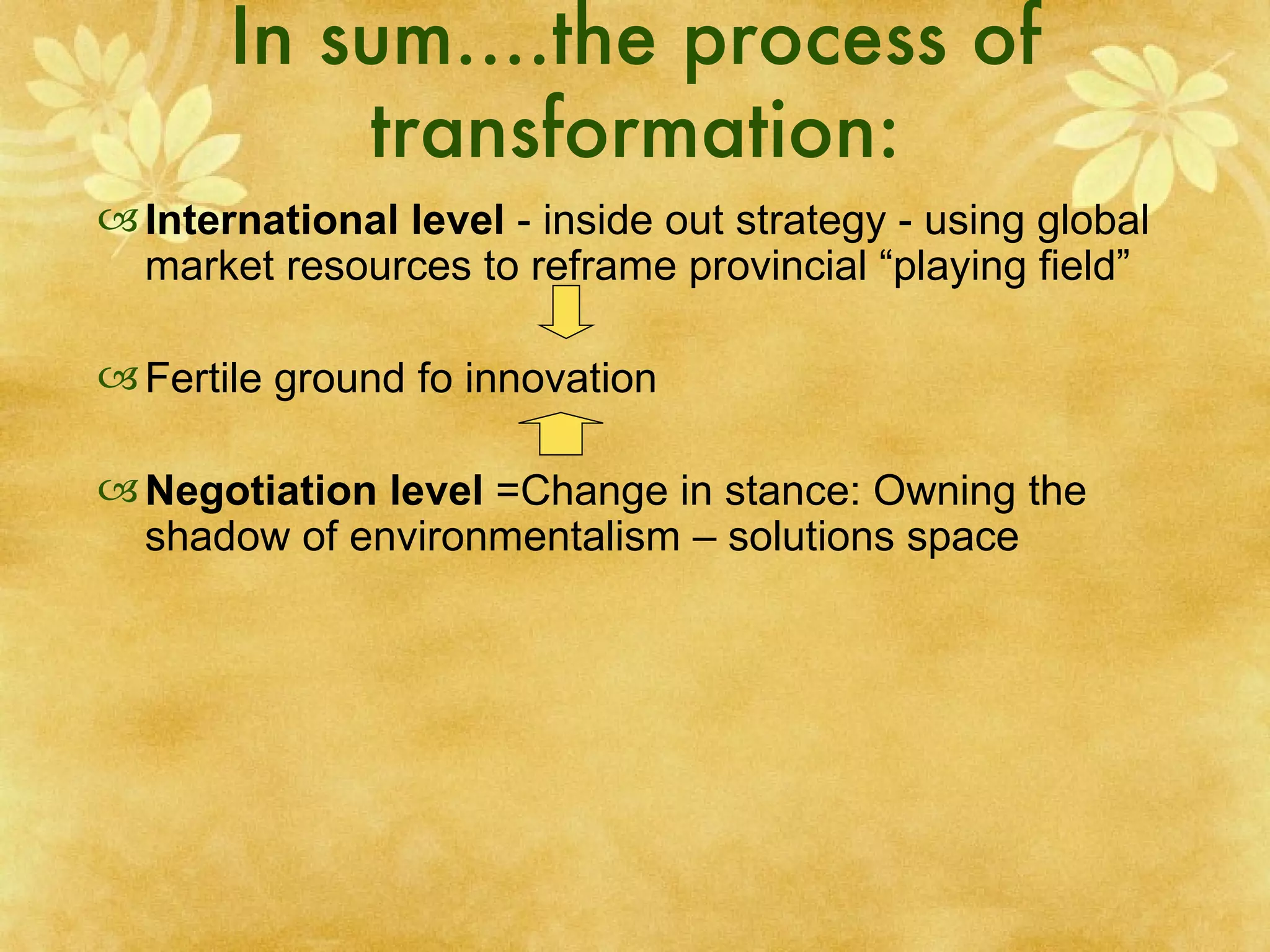
In sum….the process of transformation: International level  - inside out strategy - using global market resources to reframe provincial “playing field”  Fertile ground fo innovation Negotiation level  =Change in stance: Owning the shadow of environmentalism – solutions space
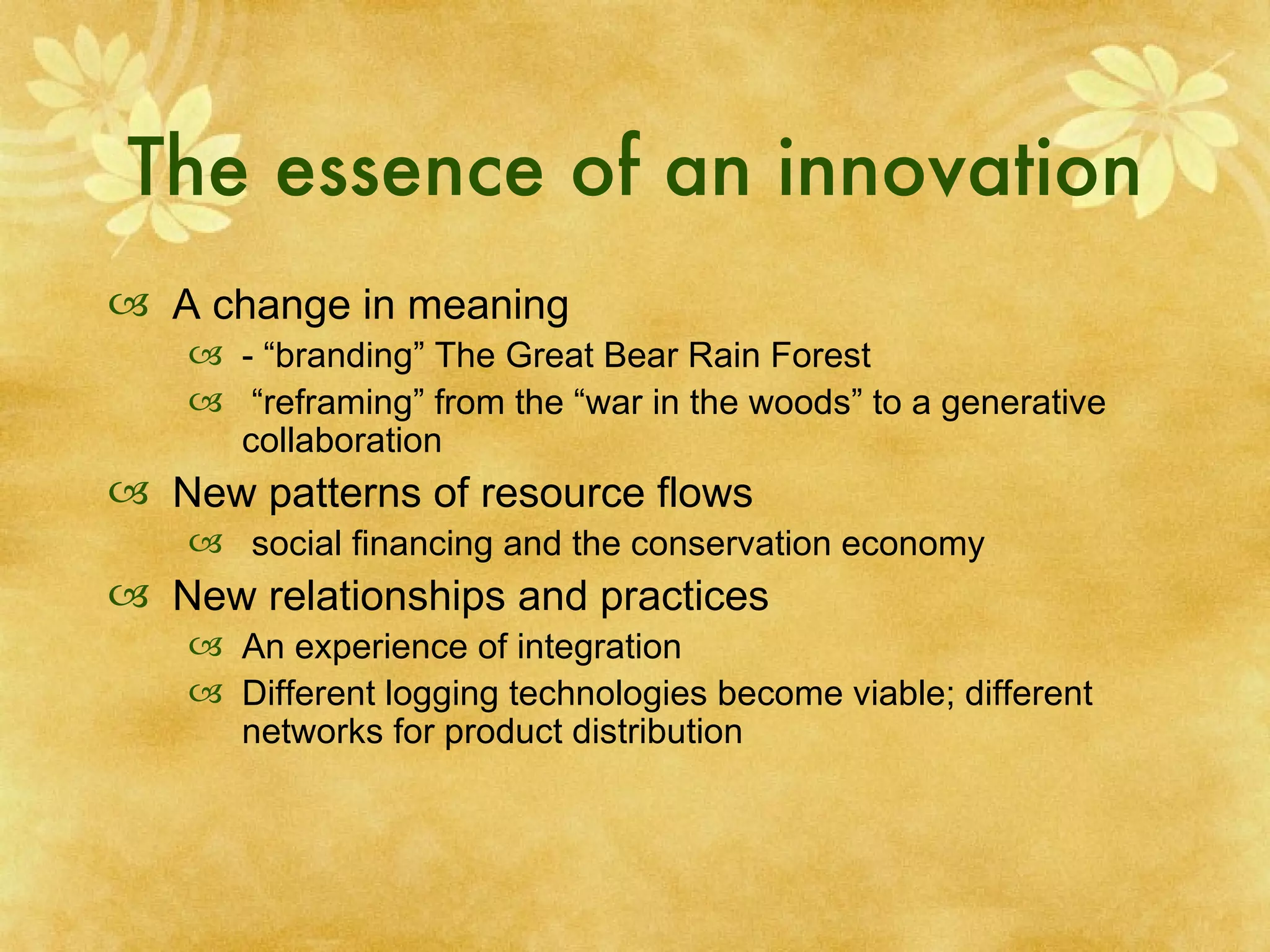
The essence of an innovation A change in meaning - “branding” The Great Bear Rain Forest “ reframing” from the “war in the woods” to a generative collaboration New patterns of resource flows social financing and the conservation economy New relationships and practices  An experience of integration Different logging technologies become viable; different networks for product distribution
Continues to stimulate Market demands for “Ancient Forest Friendly” papers Additional innovations: the “conservation economy” takes hold New forms of social financing - Coastal Opportunities funds, First Nations forestry companies
Interpersonal and knowledge skills needed Building coalitions Managing conflict Securing capital for a focused momentum Building vertical commitments Social Marketing Bridging perspectives and kinds of knowledge Owning the shadow
Summary To understand social innovation demands a complexity perspective To understand how social inventions have a broad impact, marketing models can only tell part of the story Cross-scale dynamics are key and institutional entrepreneurs + actor nets are as important for impact as are social entrepreneurs.  Institutional entrepreneurs draw on a range of transactional and translational skills and competencies to manage different phases of social innovation for greater impact.
“ Farmers don’t grow crops.  They create the conditions for crops to grow.”   - Gareth Morgan

A framework for understanding social innovation

  • 1.
    A Framework forSocial Innovation Frances Westley [email_address] University of Waterloo November, 2008
  • 2.
    What is socialinnovation? . Social innovation is an initiative, product or process which profoundly changes the basic routines , resource and authority flows or beliefs of any social system. Successful social innovations are therefore disruptive and have durability, impact and scale. The role of: Social Innovation Generation (SiG) [email_address]
  • 3.
    Key messages Socialinnovation is complex: understanding the difference between complicated and complex is important in understanding the dynamics of social innovation Market/diffusion models of social innovation should be complimented by complex system models which see change as discontinuous and focus on cross scale dynamics. Agency and opportunity are both important. Agency is defined not only by social entrepreneurship but by institutional entrepreneurship Institutional entrepreneurs tailor strategies to particular opportunity contexts.
  • 4.
    Santropol Roulant Eva’sPhoenix The Working Center Innovations abound….
  • 5.
    How do innovationsachieve a broader impact?A marketing strategy for “routine” change Hi control -innovation contained in the organization-spread by growth or clonign Lo control: Innovation spreads like weeds- advocacy, persuasion and a sense of mvt. Licensing and franchising - quality assurance and training Structured, open source methods - sometimes with payment, consultation or technical assistance Federations or control thru professional networks - helped by evaluation
  • 6.
  • 7.
    Following a Recipe A Rocket to the Moon Raising a Child Complicated Complex Simple
  • 8.
    Following a RecipeThe recipe is essential Recipes are tested to assure replicability of later efforts No particular expertise; knowing how to cook increases success Recipe notes the quantity and nature of “parts” needed Recipes produce standard products Certainty of same results every time Simple
  • 9.
    Following a Recipe A Rocket to the Moon Formulae are critical and necessary Sending one rocket increases assurance that next will be ok High level of expertise in many specialized fields + coordination Separate into parts and then coordinate Rockets similar in critical ways High degree of certainty of outcome Complicated The recipe is essential Recipes are tested to assure replicability of later efforts No particular expertise; knowing how to cook increases success Recipes produce standard products Certainty of same results every time Simple
  • 10.
    Following a Recipe A Rocket to the Moon Raising a Child Formulae are critical and necessary Sending one rocket increases assurance that next will be ok High level of expertise in many specialized fields + coordination Rockets similar in critical ways High degree of certainty of outcome Formulae have only a limited application Raising one child gives no assurance of success with the next Expertise can help but is not sufficient; relationships are key Can’t separate parts from the whole Every child is unique Uncertainty of outcome remains Complicated Complex The recipe is essential Recipes are tested to assure replicability of later efforts No particular expertise; knowing how to cook increases success Recipes produce standard products Certainty of same results every time Simple
  • 11.
    Following a Recipe A Rocket to the Moon Raising a Child Formulae are critical and necessary Sending one rocket increases assurance that next will be ok High level of expertise in many specialized fields + coordination Separate into parts and then coordinate Rockets similar in critical ways High degree of certainty of outcome Formulae have only a limited application Raising one child gives no assurance of success with the next Expertise can help but is not sufficient; relationships are key Can’t separate parts from the whole Every child is unique Uncertainty of outcome remains Complicated Complex The recipe is essential Recipes are tested to assure replicability of later efforts No particular expertise; knowing how to cook increases success Recipe notes the quantity and nature of “parts” needed Recipes produce standard products Certainty of same results every time Simple
  • 12.
    Complicated –“ complicare ”- folded Verb - to fold Complex – “ complexus ” – woven Verb – to embrace or comprehend a pattern
  • 13.
  • 14.
                                                                                             CapitalStored Released Variety Sameness An idea is born The idea is developed The idea is launched as a product, process or organization An “established” innovation
  • 15.
    A model forcomplex and discontinuous change: cross scale interactions                                                                                         
  • 16.
    Social Innovation Politicalsystem Economic system Cultural system Legal system Social entrepreneur Institutional entrepreneurs + actor nets Interorganizational/ intersectoral system Local/organizational system
  • 17.
    What is aninstitution “ A patterned set of behaviors and meanings which structure social behavior over time” Embedded in our language and our understandings Embedded in our rules for social behavior; including in our laws. Embedded in our economy, including resource distribution
  • 18.
    What is therole of the institutional entrepreneur To change the ideas, discourse, knowledge, social interactions, resource expenditures, and policies/laws which support environmental destruction to a new pattern which supports a particular innovation. To work across scales and boundaries and with multiple agents (agent net) in the “institutional field”
  • 19.
    Institutional entrepreneurs tunestrategies of resource mobilization to different opportunity contexts of social innovation :
  • 20.
  • 21.
  • 22.
    Designing strategies forcross scale impact when change opportunity is opaque : “ up-down strategies” Innovation occurs in the community in the context of organizations/coalitions addressing specific issues - where problems are solved in real time Social innovators/institutional entrepreneurs key role is to: question the strategic context/directions of decision makers in all sectors at the community level and beyond. frame (explain) the context for community identify key innovations at the community level (those most pertinent to the strategies) sell these to the key strategic decision makers (finding the right moment to introduce the key innovation)
  • 23.
    National communications strategy-tell the story Political C1 C2 C3 social financing Senate commission: report and media attention Legal Identification of system pathologies and promising innovations “ First response” strategy Committees PR Seed innovations Institutional entrepreneurs+ actor net Example 1: A movement for Mental Health…. .
  • 24.
  • 25.
    Example 2 :SavingEndangered Species
  • 26.
    Interpersonal and knowledgemanagement competencies required Interpersonal Convening Conflict management Facilitation Knowledge management Creating a common vision Enhancing sensemaking
  • 27.
  • 28.
    Example 3. PlanCanada and the RDSP “ Every innovation has two parts: the first is the invention of the thing itself; the second is the preparation of expectations so that when the invention arrives it seems both surprising and familiar -something long awaited” Edwin Land The social innovators + The institutional entrepreneurs
  • 29.
    Interpersonal and Knowledgeskills required Building social capital and mobilizing it in support of novelty Building intellectual/cultural capital and mobilizing it in support Building financial capital and mobilizing it in support Recognizing and championing innovative idea Connecting the idea to “windows of opportunity” at multiple scales System understanding and emerging pattern recognition
  • 30.
  • 31.
    Example 4: TheGreat Bear Rain Forest
  • 32.
    Social-Ecological Significance 25%of world’s Coastal Temperate Rainforest Richest bio-mass on earth 100+ pristine valleys (none in US) 20%+ of the world’s wild salmon Spirit bears, wolves, grizzlies Cultural, economic and social significance: competing claims
  • 33.
    Competing Claims Activists,logging companies, researchers, First Nations, Government….all laid claim1990s: widespread Land Use Plans From mid-1980s-mid-1990s -conflict and blockades in Clayoquot Sound: mass arrests raise the stakes
  • 34.
    Final Agreements Permanentprotection – 5 million acres New parks - 3.3 million acres Previous parks - 1 million acres New no-logging zones - 736,000 acres EBM – 21 million acres $35 million mitigation package for forest workers $120 Million for conservation economy First Nations approve all plans International Marketplace shift Model used in Chile, Boreal, USA
  • 35.
    Facing the ShadowForest workers: “capuccino-sucking urban enviros” First Nations: “eco-colonialists” Forest Companies: “they are trying to destroy us and the province we care about” and dueling scientists Government: “irresponsible” and “enemies of BC” Other environmentalists: “corporate sell-outs” Grains of truth= “breathe”
  • 36.
    In sum….the processof transformation: International level - inside out strategy - using global market resources to reframe provincial “playing field” Fertile ground fo innovation Negotiation level =Change in stance: Owning the shadow of environmentalism – solutions space
  • 37.
    The essence ofan innovation A change in meaning - “branding” The Great Bear Rain Forest “ reframing” from the “war in the woods” to a generative collaboration New patterns of resource flows social financing and the conservation economy New relationships and practices An experience of integration Different logging technologies become viable; different networks for product distribution
  • 38.
    Continues to stimulateMarket demands for “Ancient Forest Friendly” papers Additional innovations: the “conservation economy” takes hold New forms of social financing - Coastal Opportunities funds, First Nations forestry companies
  • 39.
    Interpersonal and knowledgeskills needed Building coalitions Managing conflict Securing capital for a focused momentum Building vertical commitments Social Marketing Bridging perspectives and kinds of knowledge Owning the shadow
  • 40.
    Summary To understandsocial innovation demands a complexity perspective To understand how social inventions have a broad impact, marketing models can only tell part of the story Cross-scale dynamics are key and institutional entrepreneurs + actor nets are as important for impact as are social entrepreneurs. Institutional entrepreneurs draw on a range of transactional and translational skills and competencies to manage different phases of social innovation for greater impact.
  • 41.
    “ Farmers don’tgrow crops. They create the conditions for crops to grow.” - Gareth Morgan