Basics and Breakdowns from the SCEA perspective
Speaker Information Joe Riego, PMP, Certified Scrum Master, Certified Scrum Product Owner Sr. Technical Project Manager, SCEA Working as Project Manager/Business Systems Analyst since 1999 Last 3 years at SCEA  SDLC and IT Project Management SOX Audit SDLC Project Management Consulting Blog and Social Networking Site http://rcubedprojectmanagement.blogspot.com/ http://pmi-sdchapter.ning.com/
Working Agreements An attitude of what could be… Suspend what you know One Conversation at a time Start and Finish On Time Stay on Topic
Who are you… and What do you Do? Name Role Organization Favorite Comic Book Super Hero -
Purpose of the Workshop To provide a primer on Agile Project Management using SCRUM and to show how Agile and SCRUM address scheduling, planning, estimating, and risk management.
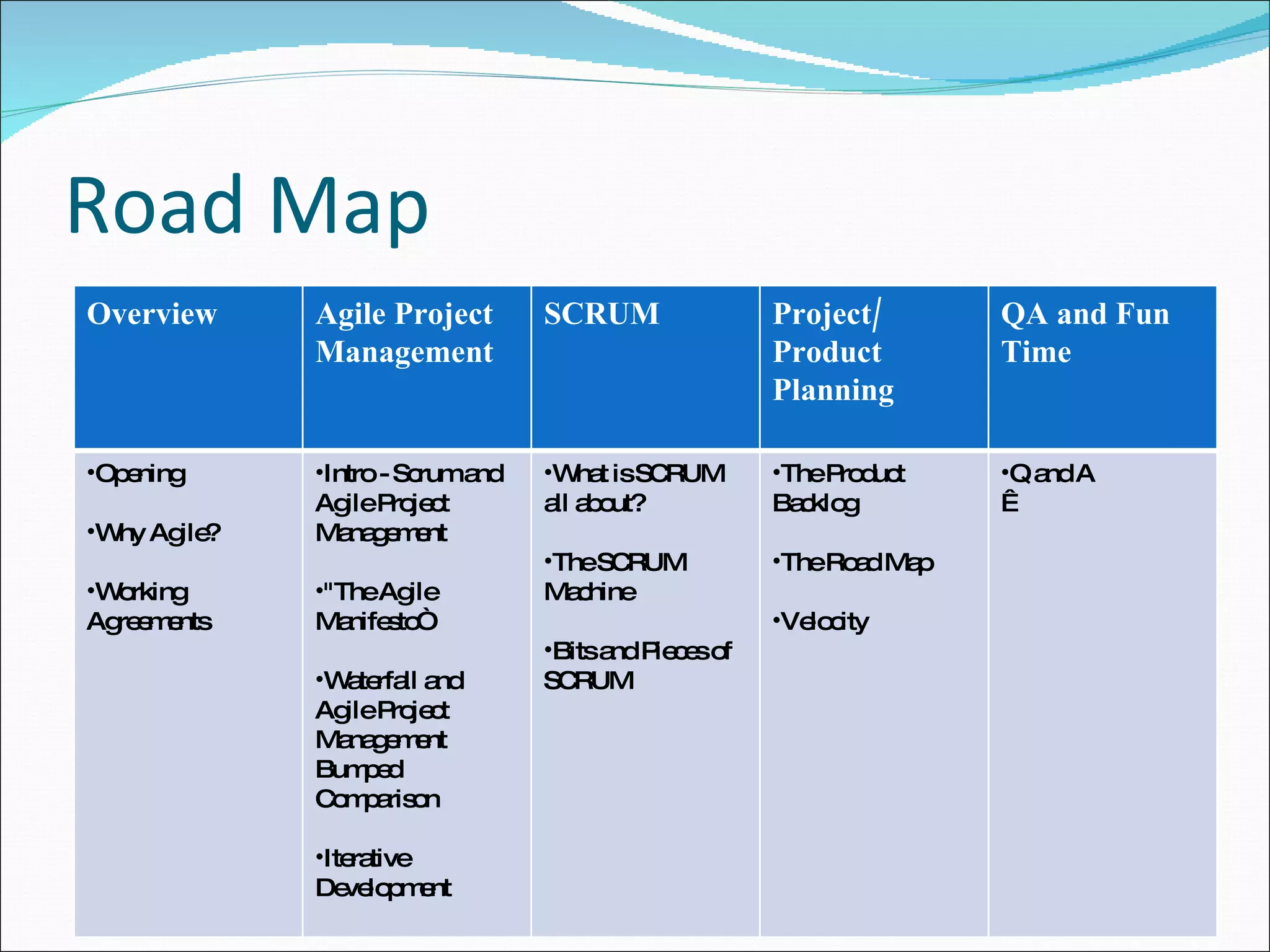
Road Map Overview Agile Project Management SCRUM Project/ Product Planning QA and Fun Time Opening Why Agile? Working Agreements Intro - Scrum and Agile Project Management "The Agile Manifesto“ Waterfall and Agile Project Management Bumped Comparison Iterative Development What is SCRUM all about? The SCRUM Machine Bits and Pieces of SCRUM The Product Backlog The Road Map Velocity Q and A  
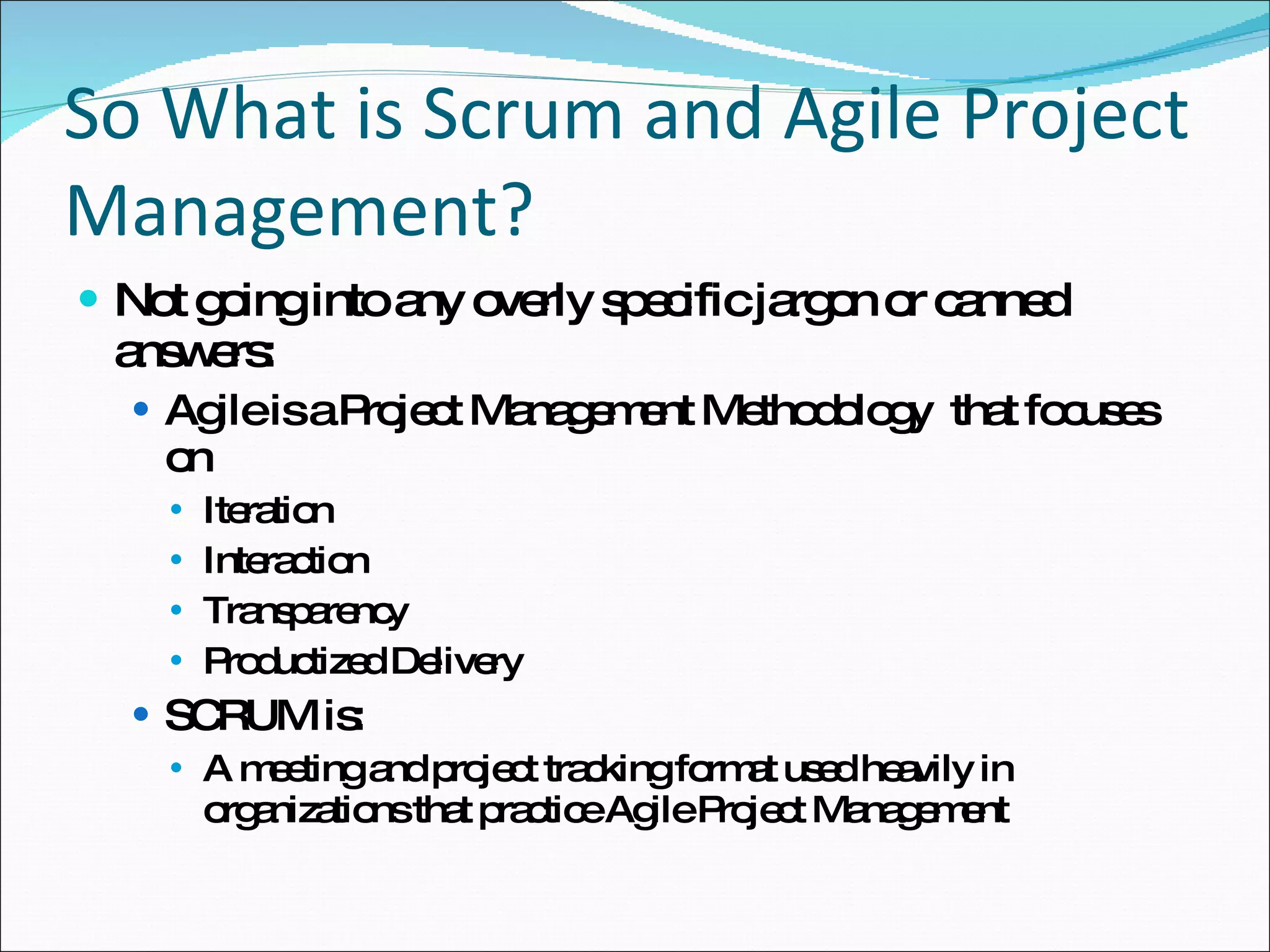
So What is Scrum and Agile Project Management? Not going into any overly specific jargon or canned answers: Agile is a Project Management Methodology  that focuses on Iteration Interaction Transparency Productized Delivery SCRUM is: A meeting and project tracking format used heavily in organizations that practice Agile Project Management
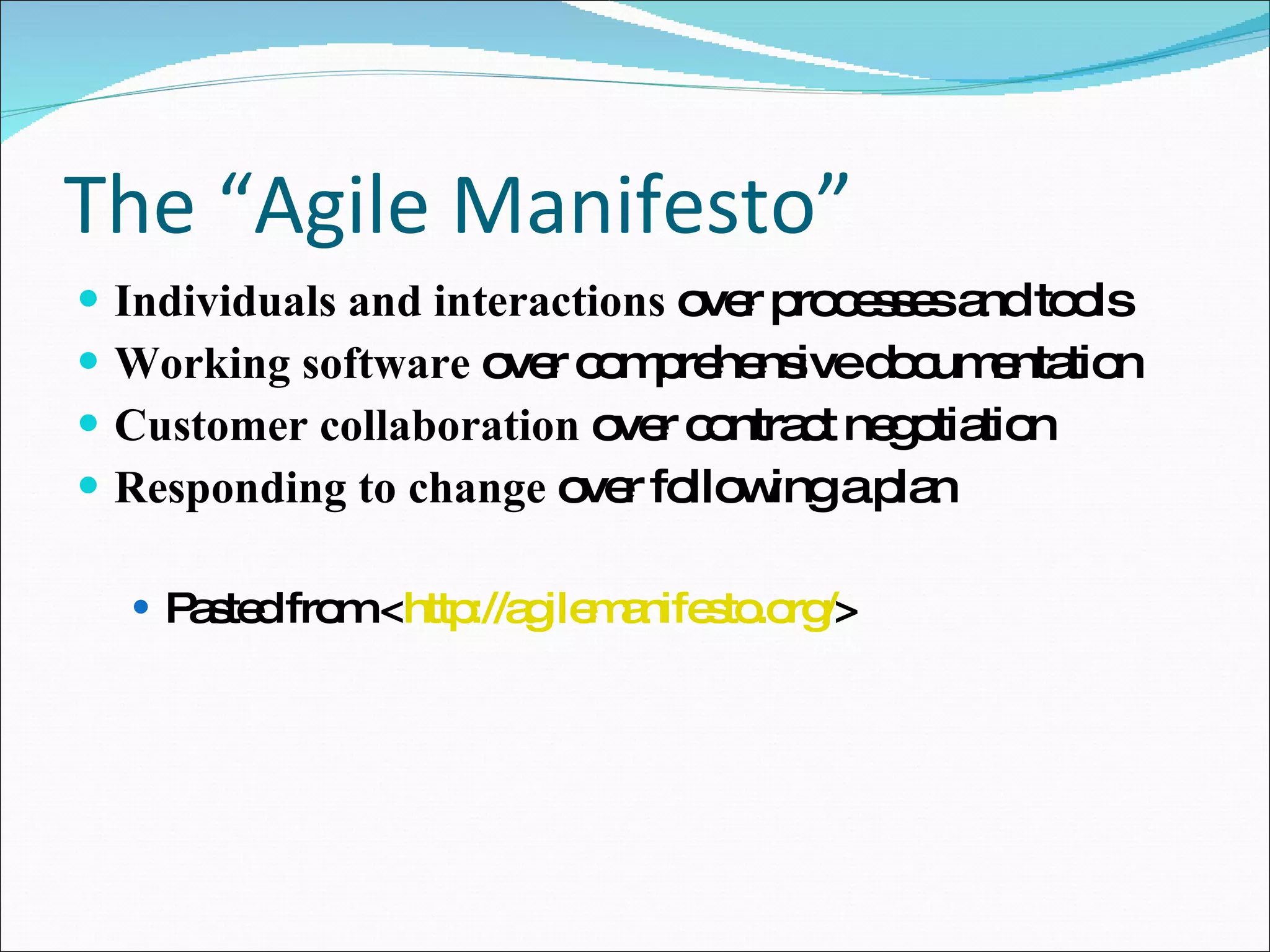
The “Agile Manifesto” Individuals and interactions  over processes and tools  Working software  over comprehensive documentation  Customer collaboration  over contract negotiation  Responding to change  over following a plan  Pasted from < http://agilemanifesto.org/ >
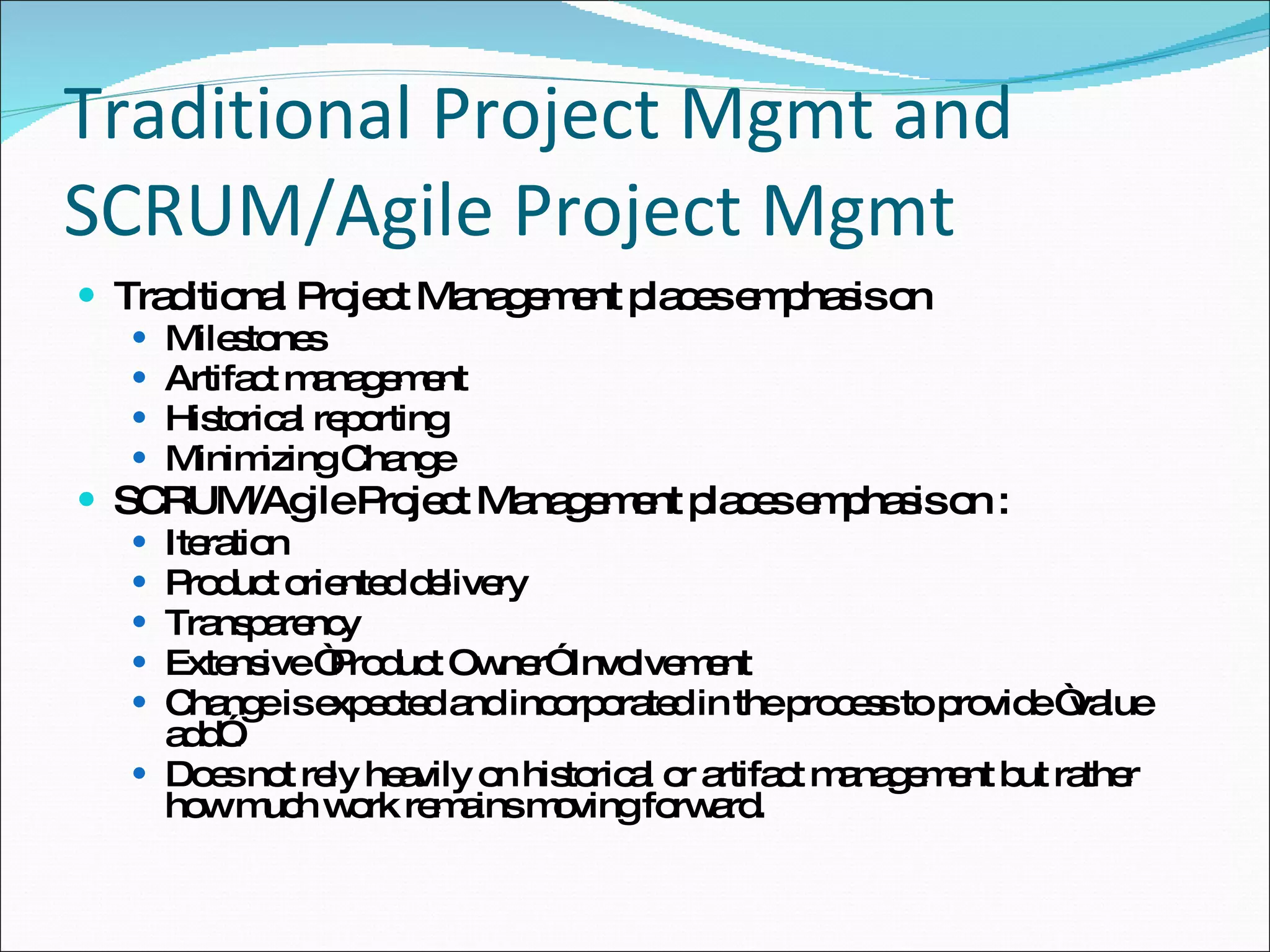
Traditional Project Mgmt and SCRUM/Agile Project Mgmt Traditional Project Management places emphasis on Milestones Artifact management Historical reporting Minimizing Change  SCRUM/Agile Project Management places emphasis on : Iteration Product oriented delivery Transparency Extensive “Product Owner” Involvement Change is expected and incorporated in the process to provide “value add”. Does not rely heavily on historical or artifact management but rather how much work remains moving forward.
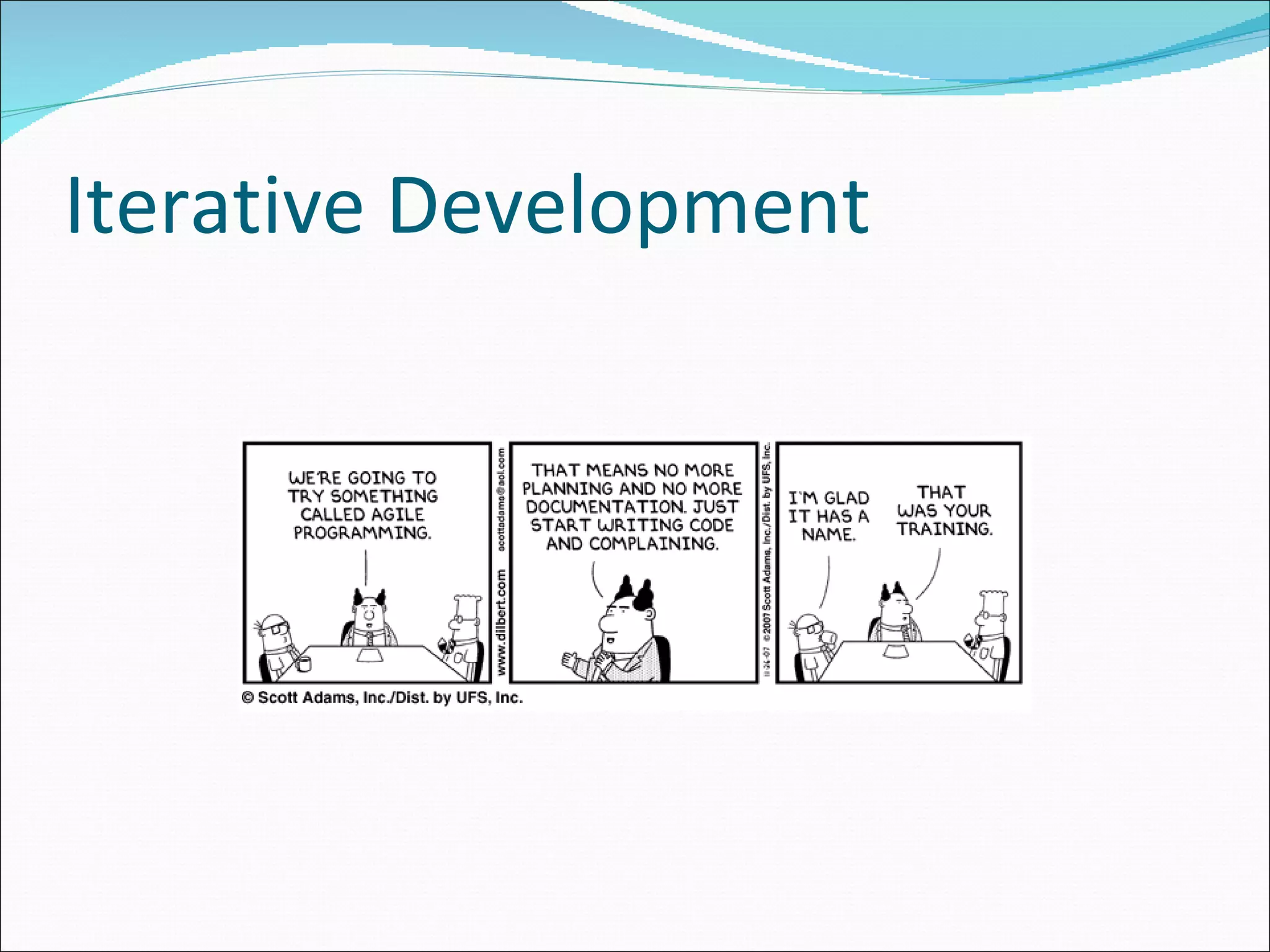
Iterative Development
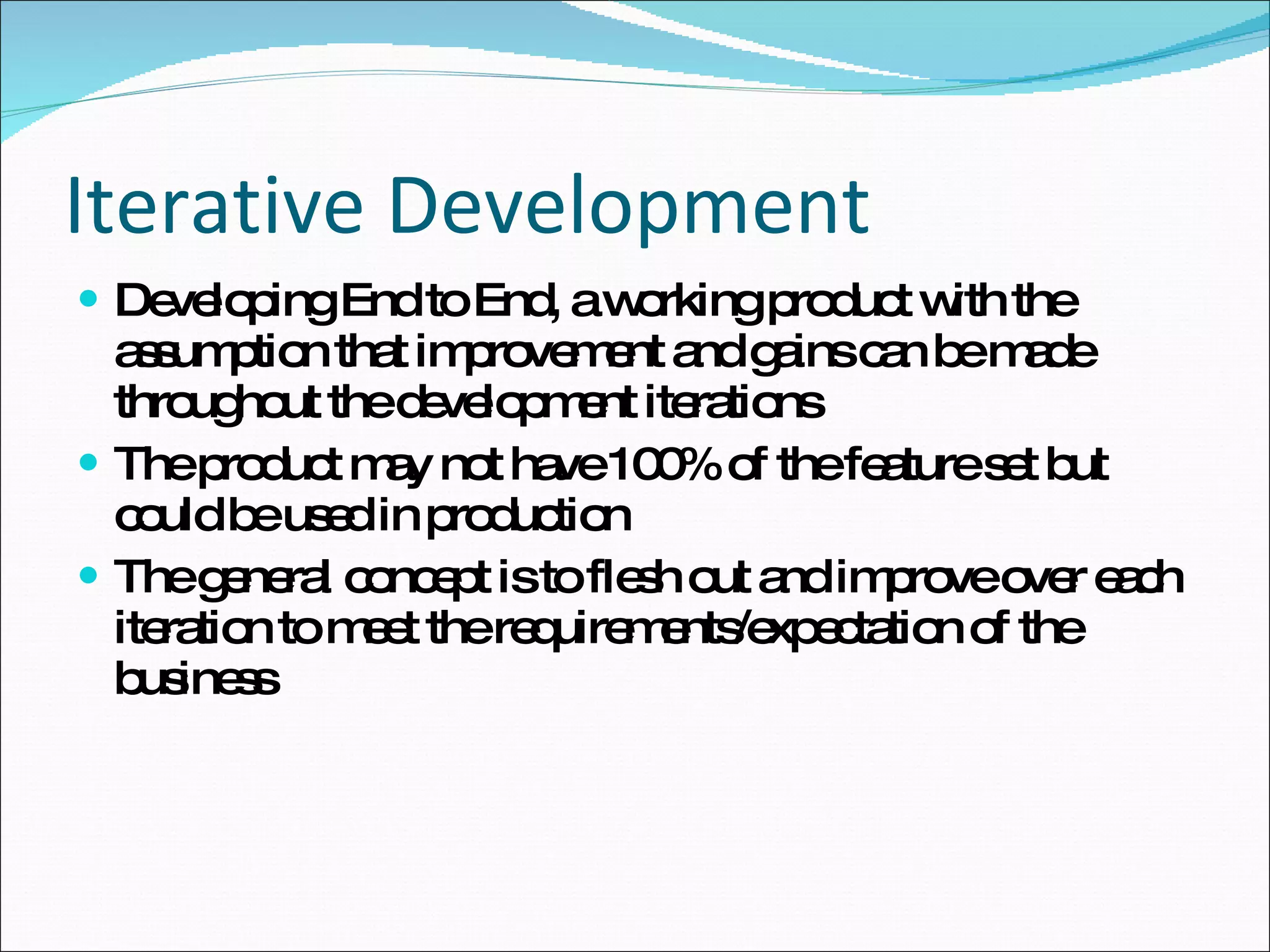
Iterative Development Developing End to End, a working product with the assumption that improvement and gains can be made throughout the development iterations The product may not have 100% of the feature set but could be used in production The general concept is to flesh out and improve over each iteration to meet the requirements/expectation of the business
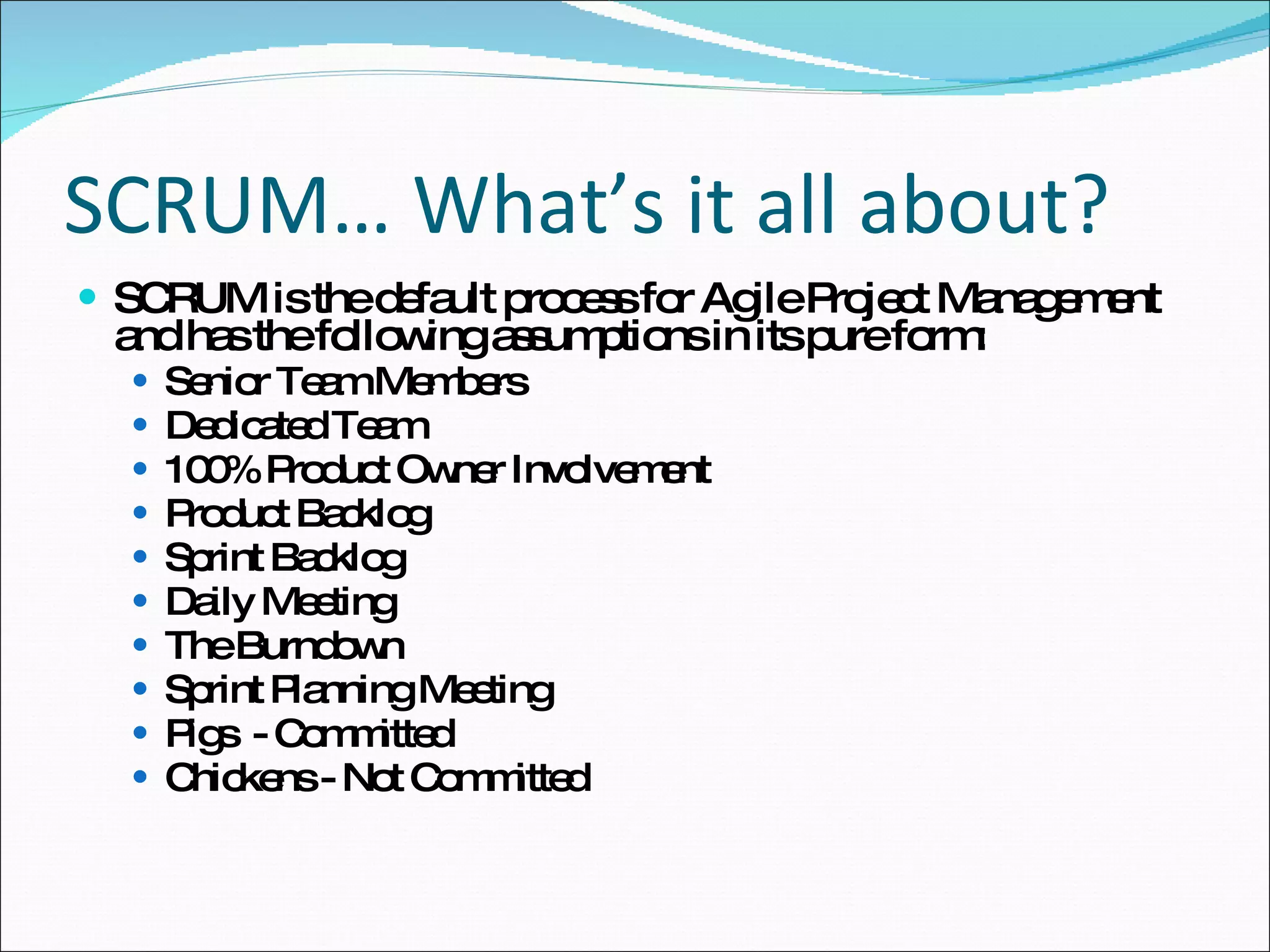
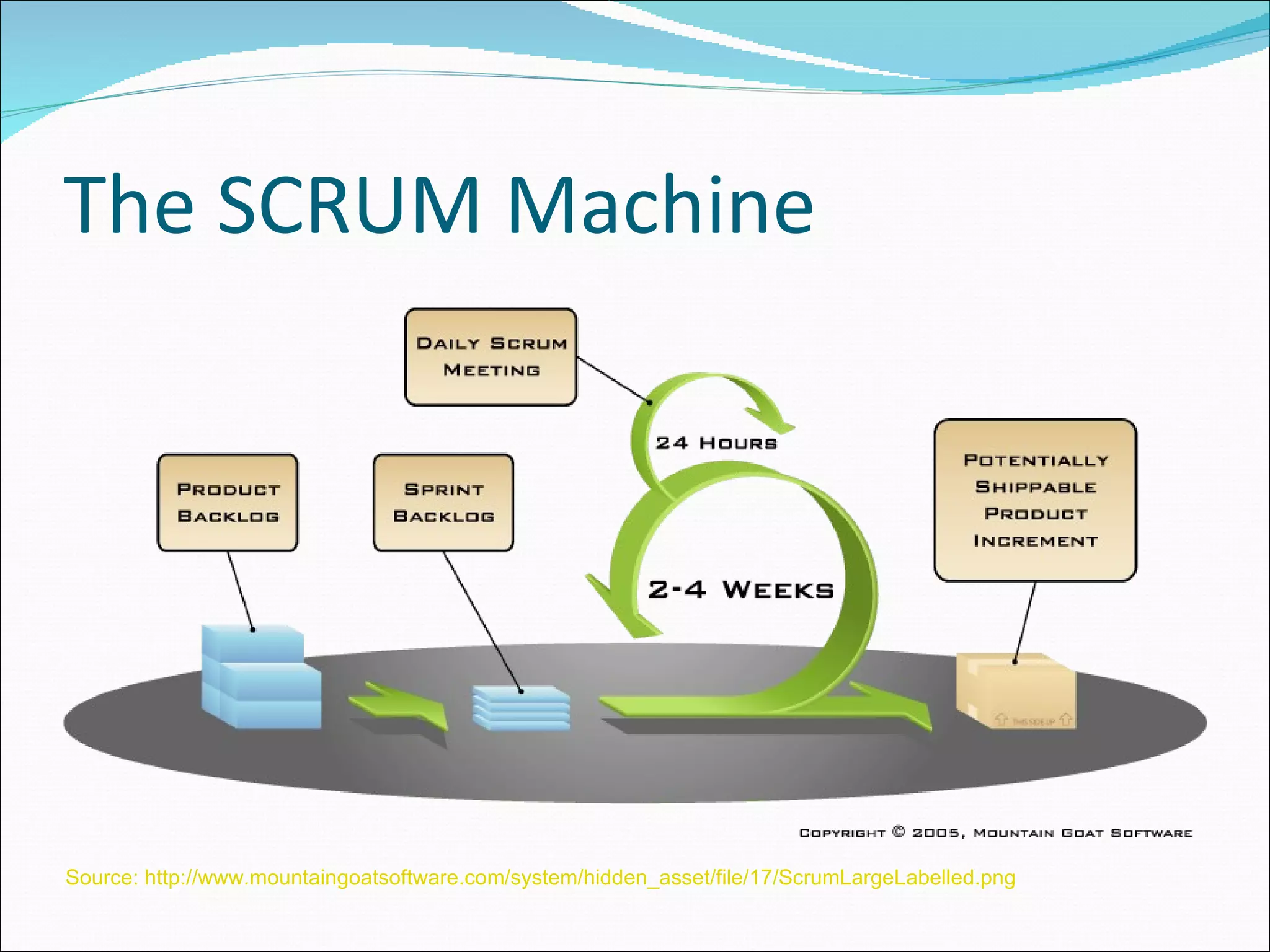
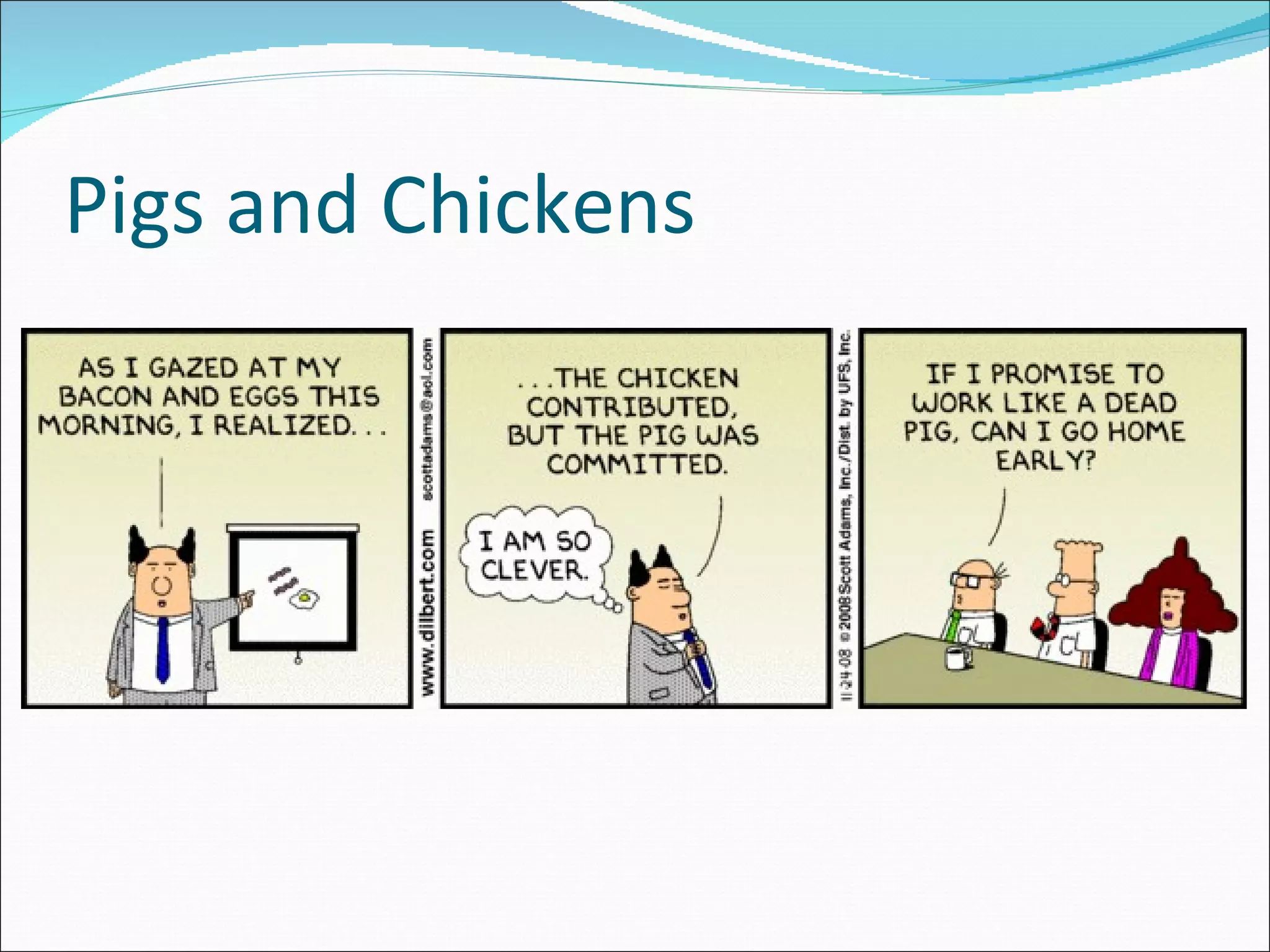
SCRUM… What’s it all about? SCRUM is the default process for Agile Project Management and has the following assumptions in its pure form: Senior Team Members  Dedicated Team 100% Product Owner Involvement Product Backlog Sprint Backlog Daily Meeting The Burndown Sprint Planning Meeting Pigs  - Committed Chickens - Not Committed
The SCRUM Machine Source: http://www.mountaingoatsoftware.com/system/hidden_asset/file/17/ScrumLargeLabelled.png
Pigs and Chickens
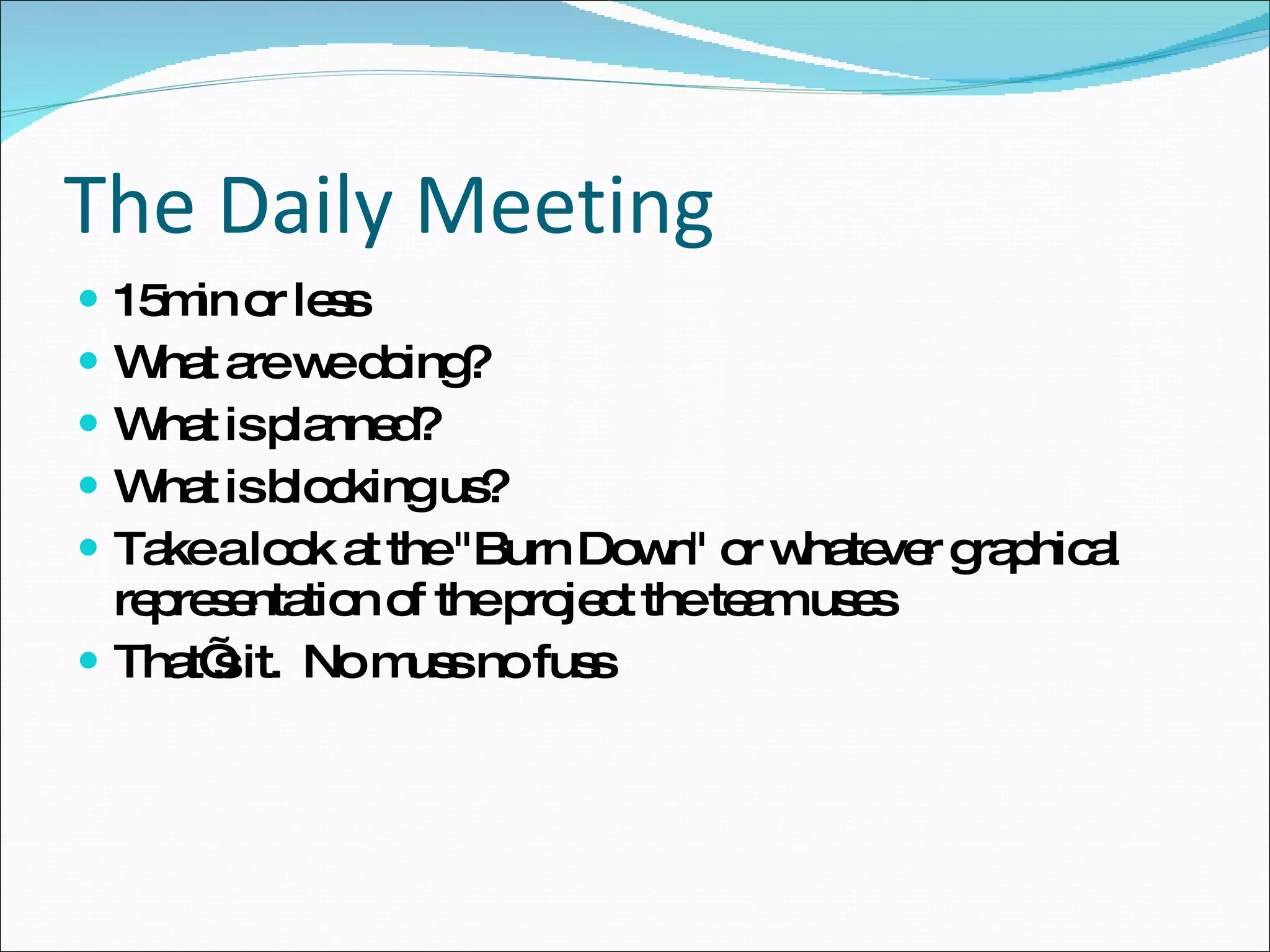
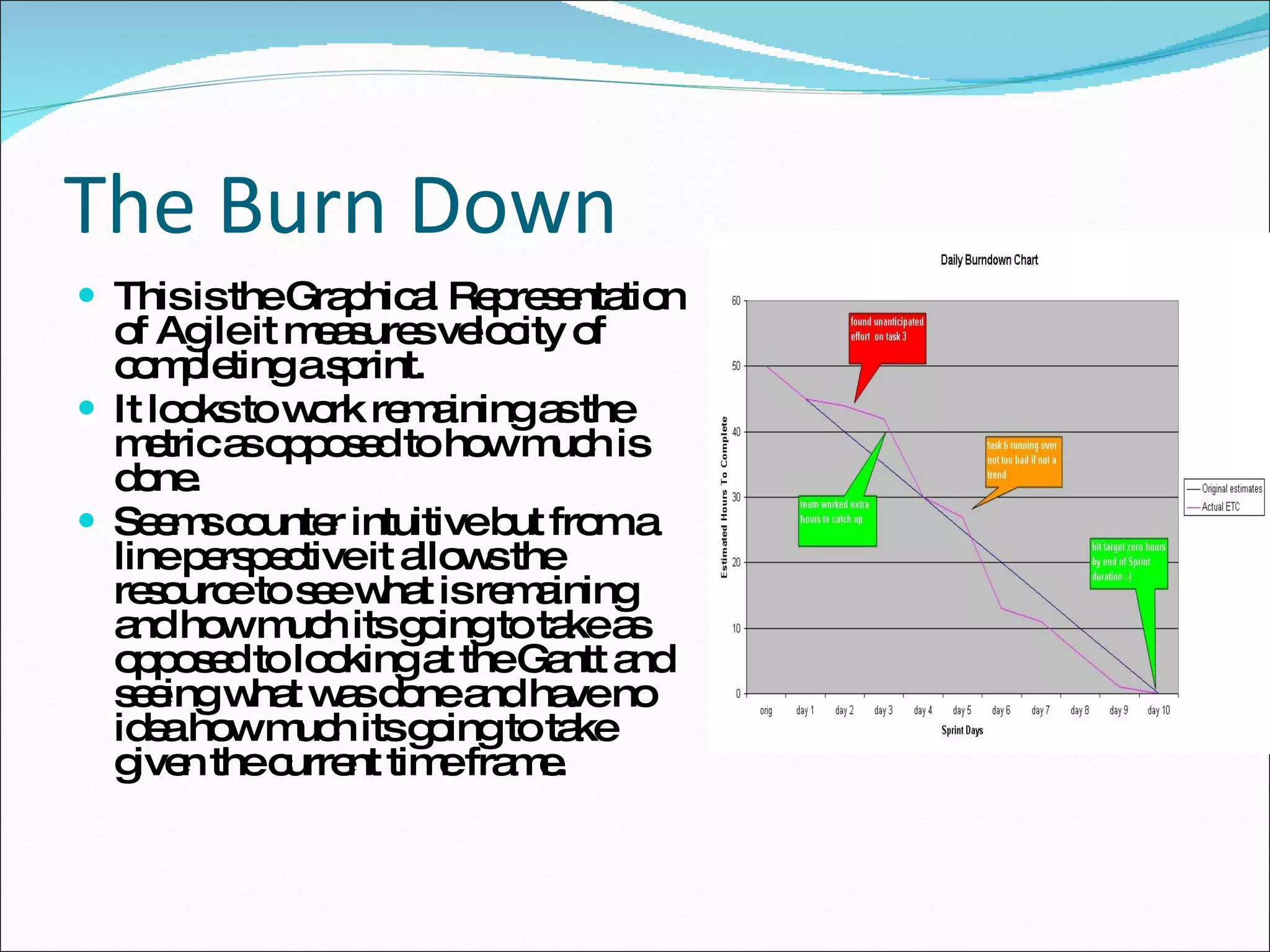
The Daily Meeting 15min or less What are we doing? What is planned?  What is blocking us? Take a look at the &quot;Burn Down&quot; or whatever graphical representation of the project the team uses That’s it.  No muss no fuss
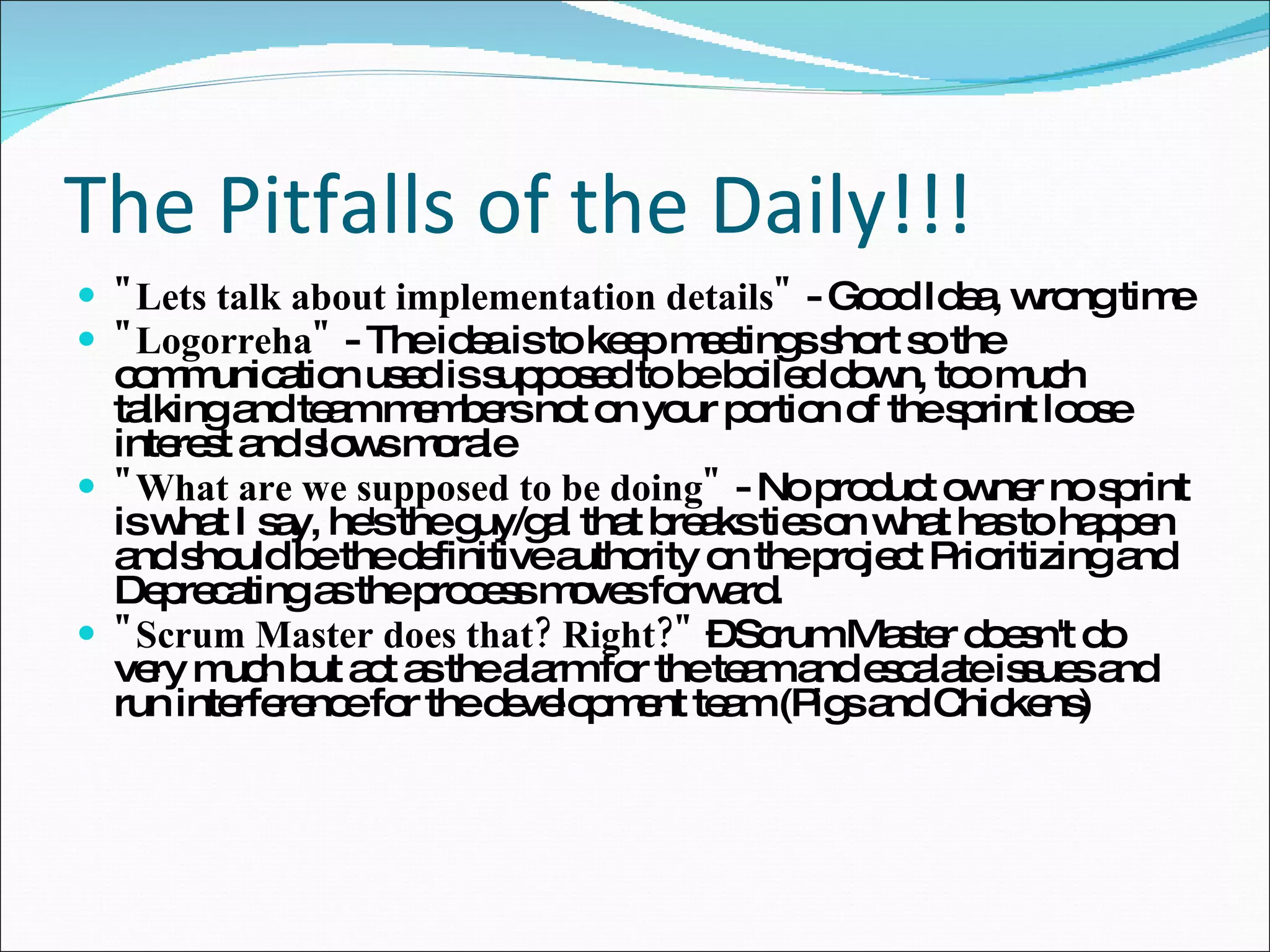
The Pitfalls of the Daily!!! &quot;Lets talk about implementation details&quot;  - Good Idea, wrong time &quot;Logorreha&quot;  - The idea is to keep meetings short so the communication used is supposed to be boiled down, too much talking and team members not on your portion of the sprint loose interest and slows morale &quot;What are we supposed to be doing&quot;  - No product owner no sprint is what I say, he's the guy/gal that breaks ties on what has to happen and should be the definitive authority on the project Prioritizing and Deprecating as the process moves forward. &quot;Scrum Master does that? Right?&quot;  – Scrum Master doesn't do very much but act as the alarm for the team and escalate issues and run interference for the development team (Pigs and Chickens)
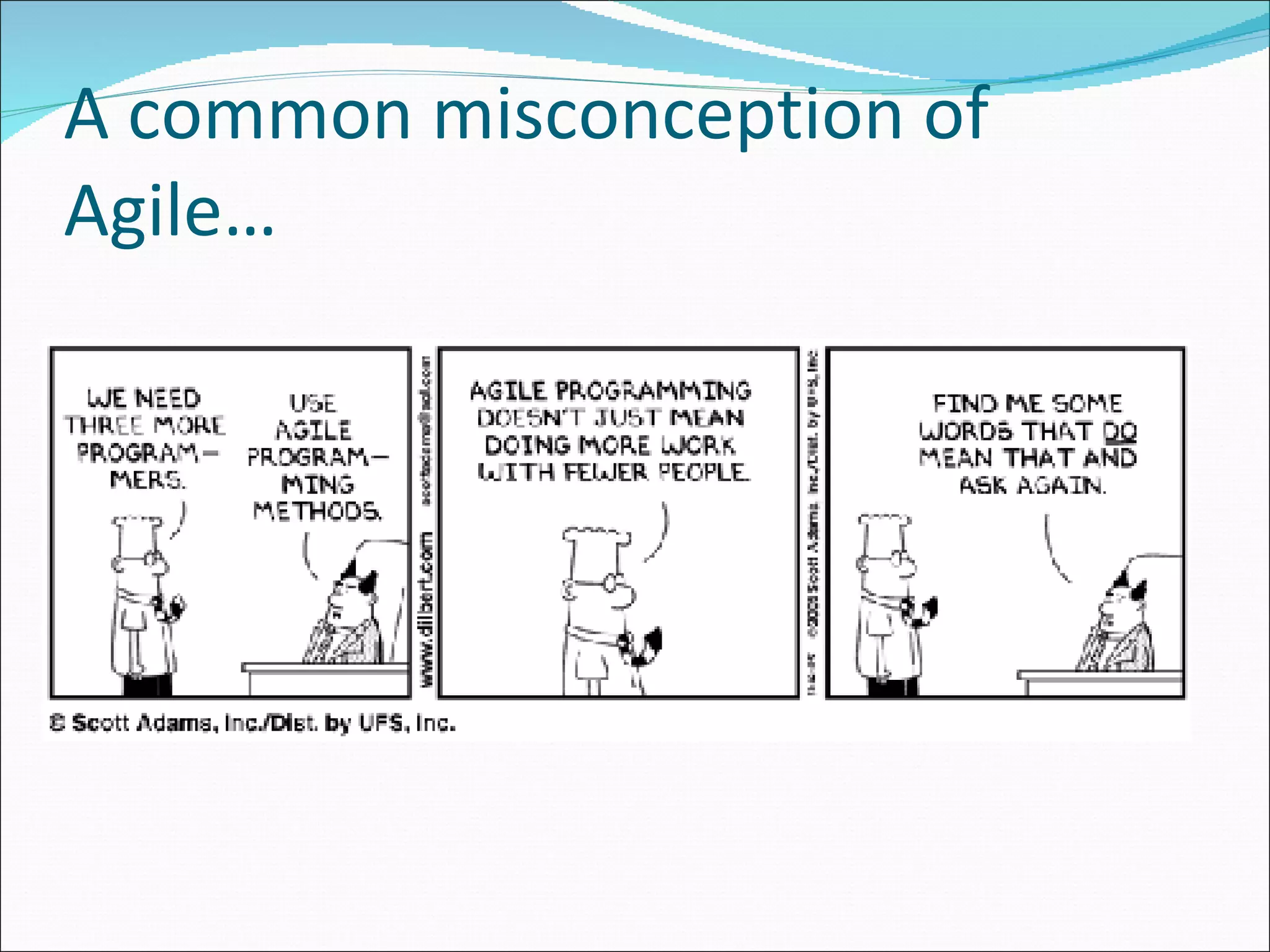
A common misconception of Agile…
More Common Misconceptions Not a Silver Bullet Does not mean no oversight There is no plan nor a schedule It’s easy - its actually pretty hard It can’t scale Teams Self Manage so that means they don’t need managers
The Burn Down This is the Graphical Representation of Agile it measures velocity of completing a sprint.  It looks to work remaining as the metric as opposed to how much is done.  Seems counter intuitive but from a line perspective it allows the resource to see what is remaining and how much its going to take as opposed to looking at the Gantt and seeing what was done and have no idea how much its going to take given the current time frame.
The Product Backlog Analogous to WBS Continually Pruned and managed  Priority Business Value Size
The Roadmap Fuzzy Estimates the Further we get out The Product Backlog stretched over time Thematic and High level
Velocity – When will we be done? Planning Points Complexity, Effort, Difficulty How many Points can Be done over an Ite.ration/Sprint = a teams velocity How many points are in the Backlog Given current Velocity the remaining work in back log will take X# of iterations.  What about time? – Time Boxing = 1 month = 160h no matter what. Or whatever  iteration duration.
Agile Resources Rally Dev –  www.agilecommons.com Blog - The Agile Executive –  www.theagileexecutive.com Blog – Agile Game Development –  www.agilegamedevelopmen.com Mountain Goat Software –  www.mountaingoatsoftware.com Agile (Like Ninjas) Project Management Group –  www.pmi-sdchapter.ning.com
Question 1: Are Unplanned items usually unexpected production support related issues? What else is unplanned? Well from the SCEA perspective we prioritize the production issues and weigh them against the constraints to hitting the sprint as negotiated by the product owner. If the product owner says this product support issue trumps a feature; the issue gets the appropriate development effort and the feature gets pushed to the product backlog for reallocation to a future sprint.  Remember because of the Transparency (in this case finite resources and product owner involvement) Delivery expectations match what the product owner wants.  Note : As soon as the Product Owner assigns the task to a sprint and gives it a priority it stops being unplanned.
Question 2: If we determine part of the way into a sprint that existing code (Created before the Sprint) needs refactoring, should that be included as an unplanned item In the sprint the, User Story should take into account potential unplanned tasks and reflect it in the Complexity Points (If you use them). This should at the very least be brought up as a blocker in the Daily for discussion on inclusion into the sprint and requiring Product Owner resolution.
Question 3: If we start work on a story and realize the initial estimate of the story was way off, do we modify the total number of points in the sprint?  I wouldn't.  This should be brought up in the daily that the sprint  as it currently sits is in jeopardy and that the product owner needs to re-assess the Sprint as a whole and reprioritize the Tasks/User Stories approriately.
Question 4: If we start work on a sprint and the product owner decides he/she doesn’t want a story anymore do we modify the number of points in the sprint?  Yes.  However it's been my experience that the Product Owner never wants to take things off without adding more. The reason is typically to assign more work.
Question 5: What sort of requirement gathering process do you go through before you start a new sprint? I have a pre-planning meeting: Attending Product Owner Lead Engineer(s),  We review the product backlog, and then pick the brains to identify additional work.
Question 6: If we have a project that is only 1-2 weeks worth of work would you recommend setting this up as a sprint? If not how would you choose to handle it? I would assess is it really an independent initiative or if  I could roll it up as a User Story in the forthcoming sprint.

Primer on Agile Project Management and SCRUM

  • 1.
    Basics and Breakdownsfrom the SCEA perspective
  • 2.
    Speaker Information JoeRiego, PMP, Certified Scrum Master, Certified Scrum Product Owner Sr. Technical Project Manager, SCEA Working as Project Manager/Business Systems Analyst since 1999 Last 3 years at SCEA SDLC and IT Project Management SOX Audit SDLC Project Management Consulting Blog and Social Networking Site http://rcubedprojectmanagement.blogspot.com/ http://pmi-sdchapter.ning.com/
  • 3.
    Working Agreements Anattitude of what could be… Suspend what you know One Conversation at a time Start and Finish On Time Stay on Topic
  • 4.
    Who are you…and What do you Do? Name Role Organization Favorite Comic Book Super Hero -
  • 5.
    Purpose of theWorkshop To provide a primer on Agile Project Management using SCRUM and to show how Agile and SCRUM address scheduling, planning, estimating, and risk management.
  • 6.
    Road Map OverviewAgile Project Management SCRUM Project/ Product Planning QA and Fun Time Opening Why Agile? Working Agreements Intro - Scrum and Agile Project Management &quot;The Agile Manifesto“ Waterfall and Agile Project Management Bumped Comparison Iterative Development What is SCRUM all about? The SCRUM Machine Bits and Pieces of SCRUM The Product Backlog The Road Map Velocity Q and A  
  • 7.
    So What isScrum and Agile Project Management? Not going into any overly specific jargon or canned answers: Agile is a Project Management Methodology that focuses on Iteration Interaction Transparency Productized Delivery SCRUM is: A meeting and project tracking format used heavily in organizations that practice Agile Project Management
  • 8.
    The “Agile Manifesto”Individuals and interactions over processes and tools Working software over comprehensive documentation Customer collaboration over contract negotiation Responding to change over following a plan Pasted from < http://agilemanifesto.org/ >
  • 9.
    Traditional Project Mgmtand SCRUM/Agile Project Mgmt Traditional Project Management places emphasis on Milestones Artifact management Historical reporting Minimizing Change SCRUM/Agile Project Management places emphasis on : Iteration Product oriented delivery Transparency Extensive “Product Owner” Involvement Change is expected and incorporated in the process to provide “value add”. Does not rely heavily on historical or artifact management but rather how much work remains moving forward.
  • 10.
  • 11.
    Iterative Development DevelopingEnd to End, a working product with the assumption that improvement and gains can be made throughout the development iterations The product may not have 100% of the feature set but could be used in production The general concept is to flesh out and improve over each iteration to meet the requirements/expectation of the business
  • 12.
    SCRUM… What’s itall about? SCRUM is the default process for Agile Project Management and has the following assumptions in its pure form: Senior Team Members Dedicated Team 100% Product Owner Involvement Product Backlog Sprint Backlog Daily Meeting The Burndown Sprint Planning Meeting Pigs - Committed Chickens - Not Committed
  • 13.
    The SCRUM MachineSource: http://www.mountaingoatsoftware.com/system/hidden_asset/file/17/ScrumLargeLabelled.png
  • 14.
  • 15.
    The Daily Meeting15min or less What are we doing? What is planned? What is blocking us? Take a look at the &quot;Burn Down&quot; or whatever graphical representation of the project the team uses That’s it. No muss no fuss
  • 16.
    The Pitfalls ofthe Daily!!! &quot;Lets talk about implementation details&quot; - Good Idea, wrong time &quot;Logorreha&quot; - The idea is to keep meetings short so the communication used is supposed to be boiled down, too much talking and team members not on your portion of the sprint loose interest and slows morale &quot;What are we supposed to be doing&quot; - No product owner no sprint is what I say, he's the guy/gal that breaks ties on what has to happen and should be the definitive authority on the project Prioritizing and Deprecating as the process moves forward. &quot;Scrum Master does that? Right?&quot; – Scrum Master doesn't do very much but act as the alarm for the team and escalate issues and run interference for the development team (Pigs and Chickens)
  • 17.
  • 18.
    More Common MisconceptionsNot a Silver Bullet Does not mean no oversight There is no plan nor a schedule It’s easy - its actually pretty hard It can’t scale Teams Self Manage so that means they don’t need managers
  • 19.
    The Burn DownThis is the Graphical Representation of Agile it measures velocity of completing a sprint. It looks to work remaining as the metric as opposed to how much is done. Seems counter intuitive but from a line perspective it allows the resource to see what is remaining and how much its going to take as opposed to looking at the Gantt and seeing what was done and have no idea how much its going to take given the current time frame.
  • 20.
    The Product BacklogAnalogous to WBS Continually Pruned and managed Priority Business Value Size
  • 21.
    The Roadmap FuzzyEstimates the Further we get out The Product Backlog stretched over time Thematic and High level
  • 22.
    Velocity – Whenwill we be done? Planning Points Complexity, Effort, Difficulty How many Points can Be done over an Ite.ration/Sprint = a teams velocity How many points are in the Backlog Given current Velocity the remaining work in back log will take X# of iterations. What about time? – Time Boxing = 1 month = 160h no matter what. Or whatever iteration duration.
  • 23.
    Agile Resources RallyDev – www.agilecommons.com Blog - The Agile Executive – www.theagileexecutive.com Blog – Agile Game Development – www.agilegamedevelopmen.com Mountain Goat Software – www.mountaingoatsoftware.com Agile (Like Ninjas) Project Management Group – www.pmi-sdchapter.ning.com
  • 24.
    Question 1: AreUnplanned items usually unexpected production support related issues? What else is unplanned? Well from the SCEA perspective we prioritize the production issues and weigh them against the constraints to hitting the sprint as negotiated by the product owner. If the product owner says this product support issue trumps a feature; the issue gets the appropriate development effort and the feature gets pushed to the product backlog for reallocation to a future sprint. Remember because of the Transparency (in this case finite resources and product owner involvement) Delivery expectations match what the product owner wants. Note : As soon as the Product Owner assigns the task to a sprint and gives it a priority it stops being unplanned.
  • 25.
    Question 2: Ifwe determine part of the way into a sprint that existing code (Created before the Sprint) needs refactoring, should that be included as an unplanned item In the sprint the, User Story should take into account potential unplanned tasks and reflect it in the Complexity Points (If you use them). This should at the very least be brought up as a blocker in the Daily for discussion on inclusion into the sprint and requiring Product Owner resolution.
  • 26.
    Question 3: Ifwe start work on a story and realize the initial estimate of the story was way off, do we modify the total number of points in the sprint? I wouldn't. This should be brought up in the daily that the sprint as it currently sits is in jeopardy and that the product owner needs to re-assess the Sprint as a whole and reprioritize the Tasks/User Stories approriately.
  • 27.
    Question 4: Ifwe start work on a sprint and the product owner decides he/she doesn’t want a story anymore do we modify the number of points in the sprint? Yes. However it's been my experience that the Product Owner never wants to take things off without adding more. The reason is typically to assign more work.
  • 28.
    Question 5: Whatsort of requirement gathering process do you go through before you start a new sprint? I have a pre-planning meeting: Attending Product Owner Lead Engineer(s), We review the product backlog, and then pick the brains to identify additional work.
  • 29.
    Question 6: Ifwe have a project that is only 1-2 weeks worth of work would you recommend setting this up as a sprint? If not how would you choose to handle it? I would assess is it really an independent initiative or if I could roll it up as a User Story in the forthcoming sprint.