Insecurity
          Insight                                  Data on People in Danger

Security Facts for Humanitarian Aid Agencies
Comparing Urban and Rural Security Incidents
Christina Wille & Larissa Fast

How do security events affecting humanitarian agencies differ
between urban and rural environments?
Is it more dangerous for aid agencies to operate in urban or non-urban environments? What are
the characteristics of typical events that happen in densely populated places and those that occur
in small towns and villages? To help agencies anticipate what kind of events may affect their staff
or their operations depending on where they work, Insecurity Insight used its Security in Numbers
Database (SiND) to analyse and describe differences in the patterns of events that occur in places
with more than 100,000 inhabitants (urban), and in places with fewer than 100,000 people living
closely together (rural) using the 963 security events in the database. The description of the “six
Ws” - who did what, to whom, where, when and with what weapon – are compiled from aid
agency reports (56.8% of the total reports) and collected from media and other public sources
over a period of 24 months, between 1 July 2008 and 30 June 2010.

The European Interagency Security Forum (EISF) identified the issue of differences in security
contexts, and specifically the differences between urban and rural environments, as the subject
of its bi-annual meeting in September 2010. EISF asked Insecurity Insight to provide an analysis
of these environments using the SiND data. Christina Wille and Larissa Fast thank Oliver Behn and
Madeleine Kingston for their valuable input in the preparation of this paper.


Are rural environments more dangerous for INGOs than urban
settlements?
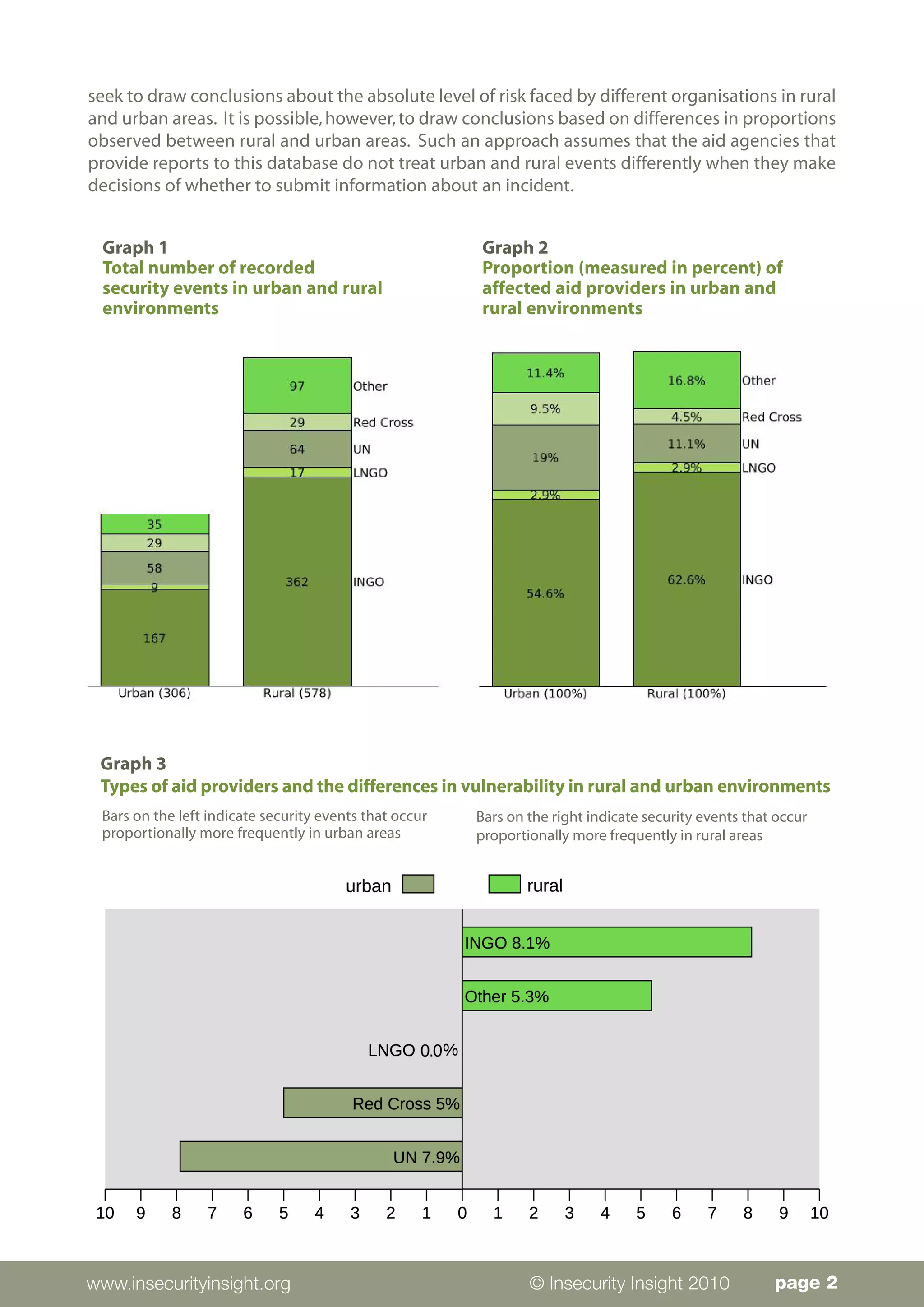
Aid agencies report more security events from rural areas than urban centres. As of 30 June 2010,
the SiND contained 306 urban and 578 rural events (Graph 1). The nature of humanitarian aid
delivery, which tends to focus more on operations in rural rather than urban areas, may explain the
difference in number of events per category. Unfortunately, there are no data on the location of all
aid operations carried out that are sufficiently disaggregated by urban and rural locations, which
would permit an assessment of the relative danger of rural and urban environments. However, it
is possible to compare the characteristics of security events in urban and rural locations in order
to gain insight into the nature of risk and threats in these different localities.

Graphs 1 and 2 highlight the extent to which different aid providers were affected in urban and
rural areas. In our sample, international NGOs (INGOs) reported the highest number of incidents
followed by UN agencies. This should not be taken as an indicator that INGOs are particularly at
risk, because the possibility that INGOs oprate more programmes, or that INGOs are more likely
to report security events could both explain the finding. In the face of this uncertainty we do not


www.insecurityinsight.org                                 © Insecurity Insight 2010        page 1
seek to draw conclusions about the absolute level of risk faced by different organisations in rural
and urban areas. It is possible, however, to draw conclusions based on differences in proportions
observed between rural and urban areas. Such an approach assumes that the aid agencies that
provide reports to this database do not treat urban and rural events differently when they make
decisions of whether to submit information about an incident.


 Graph 1                                                Graph 2
 Total number of recorded                               Proportion (measured in percent) of
 security events in urban and rural                     affected aid providers in urban and
 environments                                           rural environments


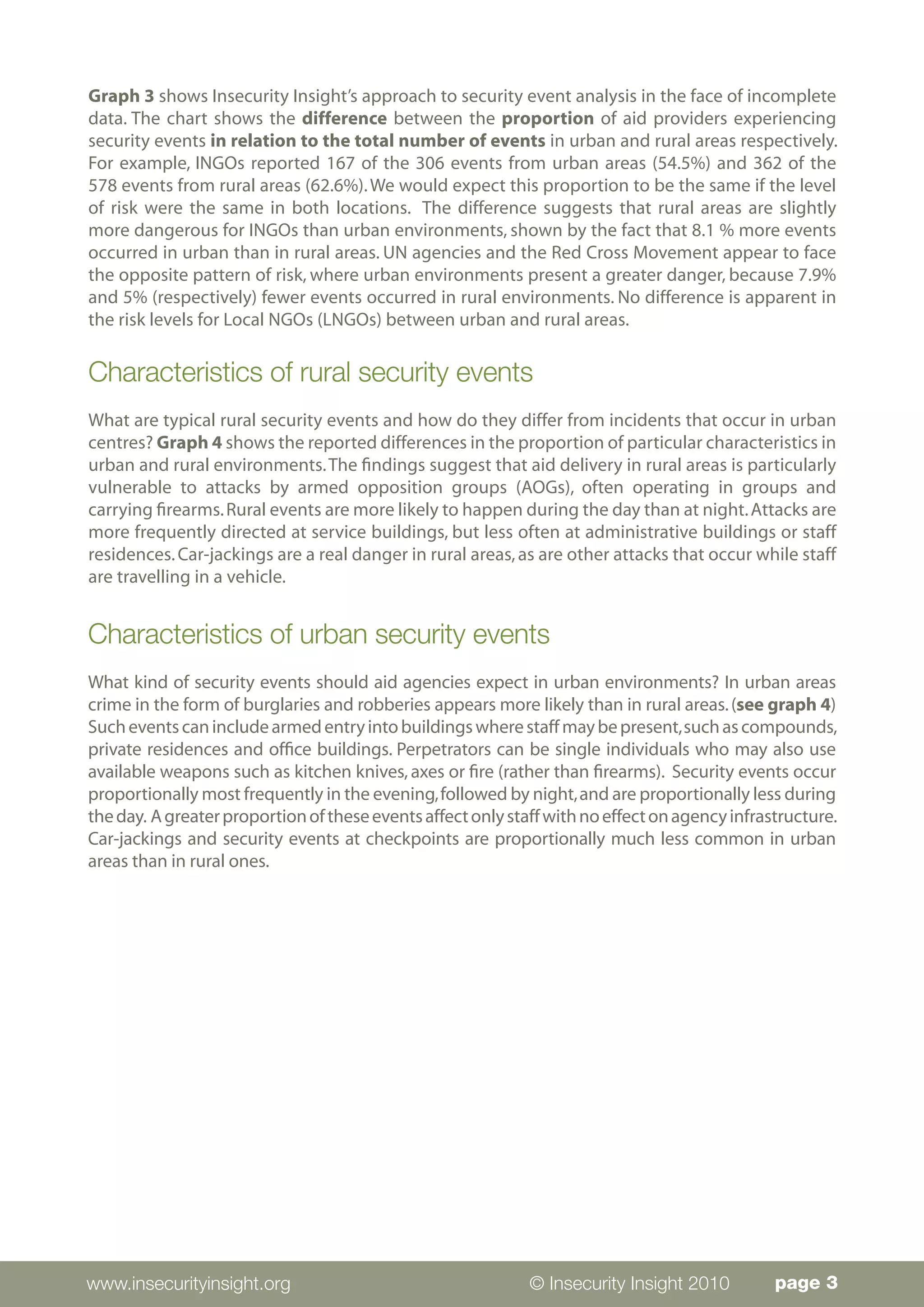
 Graph 3
 Types of aid providers and the differences in vulnerability in rural and urban environments
 Bars on the left indicate security events that occur   Bars on the right indicate security events that occur
 proportionally more frequently in urban areas          proportionally more frequently in rural areas


www.insecurityinsight.org                                       © Insecurity Insight 2010              page 2
Graph 3 shows Insecurity Insight’s approach to security event analysis in the face of incomplete
data. The chart shows the difference between the proportion of aid providers experiencing
security events in relation to the total number of events in urban and rural areas respectively.
For example, INGOs reported 167 of the 306 events from urban areas (54.5%) and 362 of the
578 events from rural areas (62.6%). We would expect this proportion to be the same if the level
of risk were the same in both locations. The difference suggests that rural areas are slightly
more dangerous for INGOs than urban environments, shown by the fact that 8.1 % more events
occurred in urban than in rural areas. UN agencies and the Red Cross Movement appear to face
the opposite pattern of risk, where urban environments present a greater danger, because 7.9%
and 5% (respectively) fewer events occurred in rural environments. No difference is apparent in
the risk levels for Local NGOs (LNGOs) between urban and rural areas.


Characteristics of rural security events
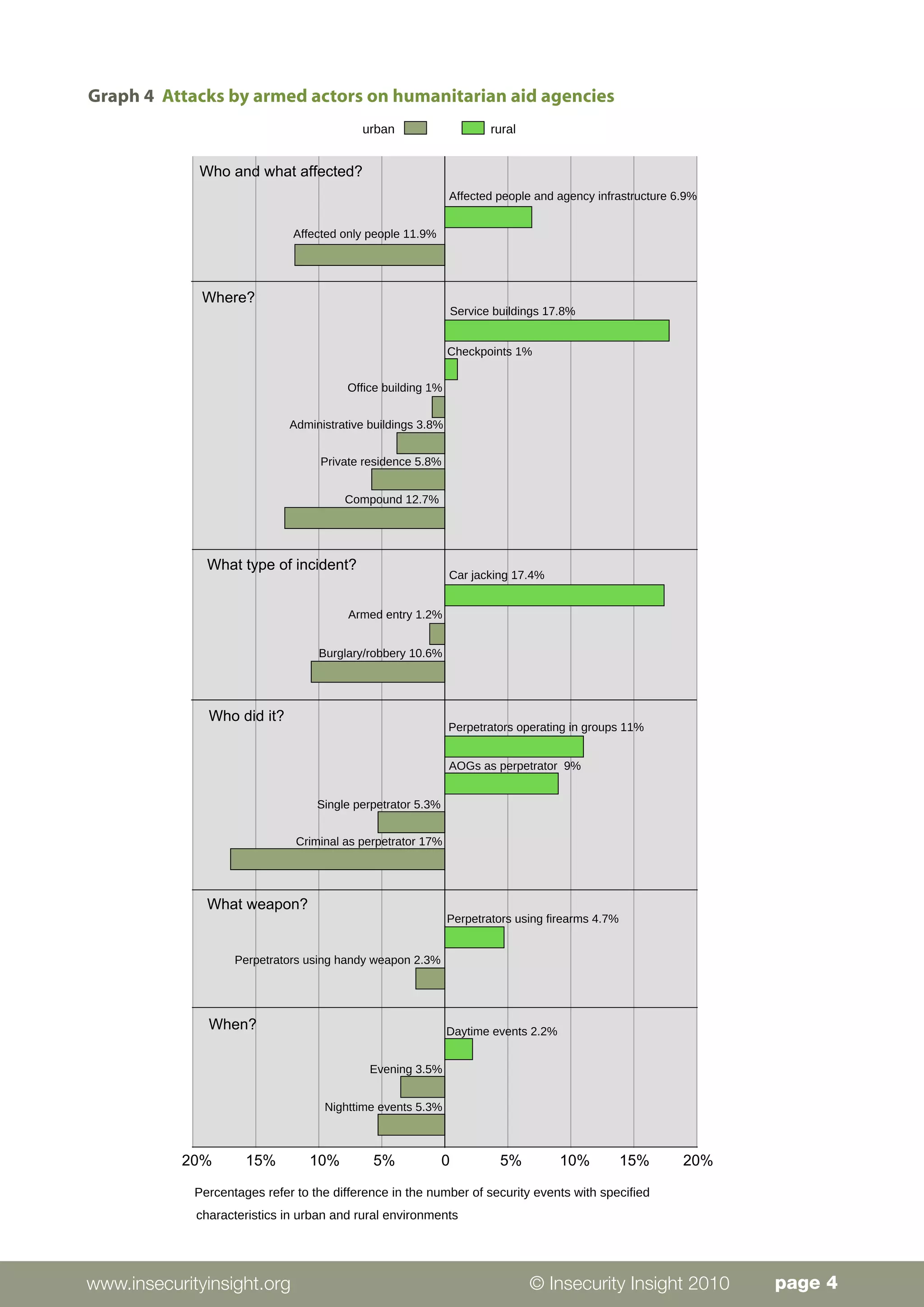
What are typical rural security events and how do they differ from incidents that occur in urban
centres? Graph 4 shows the reported differences in the proportion of particular characteristics in
urban and rural environments. The findings suggest that aid delivery in rural areas is particularly
vulnerable to attacks by armed opposition groups (AOGs), often operating in groups and
carrying firearms. Rural events are more likely to happen during the day than at night. Attacks are
more frequently directed at service buildings, but less often at administrative buildings or staff
residences. Car-jackings are a real danger in rural areas, as are other attacks that occur while staff
are travelling in a vehicle.


Characteristics of urban security events
What kind of security events should aid agencies expect in urban environments? In urban areas
crime in the form of burglaries and robberies appears more likely than in rural areas. (see graph 4)
Such events can include armed entry into buildings where staff may be present, such as compounds,
private residences and office buildings. Perpetrators can be single individuals who may also use
available weapons such as kitchen knives, axes or fire (rather than firearms). Security events occur
proportionally most frequently in the evening, followed by night, and are proportionally less during
the day. A greater proportion of these events affect only staff with no effect on agency infrastructure.
Car-jackings and security events at checkpoints are proportionally much less common in urban
areas than in rural ones.


www.insecurityinsight.org                                    © Insecurity Insight 2010         page 3
Graph 4 Attacks by armed actors on humanitarian aid agencies


www.insecurityinsight.org                         © Insecurity Insight 2010   page 4
What does this mean?
Security events of all types can occur everywhere and agencies need to be prepared. However, the
particular characteristics of events do appear to vary between urban and rural areas, in perhaps
expected ways. This report provides empirical data to support anecdotal impressions and security
management measures that many organizations already have in place. While the analysis does
not provide hard and fast rules, it presents a general profile against which to compare to your
organization’s reported incidents and specific vulnerabilities.

The characteristic of rural events suggest that rural areas in which AOGs are not operating are
comparably safer.

    l   	 Does this overall profile fit with the reports received in your organization? If not entirely,
          it might signal the need to look more closely at the particular context. Is the situation
          different? Does your organization have adequate measures already in place? Is the full
          picture reported within your organization?
    l   	 For those agencies operating programmes in rural environments where AOGs are known
          to operate, this comparison highlights the particular vulnerabilities for warehouses and
          other service (as supposed to administrative or residential) buildings, as well as staff
          movement on open roads. This analysis suggests the need to devote extra attention to
          security management measures for these situations.

The characteristics of urban events suggest that urban areas are prone to crime, especially
burglaries directed at people, compounds and residences during hours of darkness.

    l   	 Does this overall profile fit with the reports received in your organization? If not entirely,
          it might signal the need to look more closely at the particular context. Is the situation
          different? Does your organization have adequate measures already in place? Is the full
          picture reported within your organization?
    l   	 For agencies implementing programmes in urban areas or with local or regional
          headquarters in capital cities, this comparison highlights the particular vulnerability for
          staff and agency assets to crime, and the need to tailor security management to general
          crime awareness based on the profile of criminal behavior in different urban areas.


www.insecurityinsight.org                                     © Insecurity Insight 2010        page 5

How do security events affecting humanitarian agencies differ between rural and urban environments?

  • 1.
    Insecurity Insight Data on People in Danger Security Facts for Humanitarian Aid Agencies Comparing Urban and Rural Security Incidents Christina Wille & Larissa Fast How do security events affecting humanitarian agencies differ between urban and rural environments? Is it more dangerous for aid agencies to operate in urban or non-urban environments? What are the characteristics of typical events that happen in densely populated places and those that occur in small towns and villages? To help agencies anticipate what kind of events may affect their staff or their operations depending on where they work, Insecurity Insight used its Security in Numbers Database (SiND) to analyse and describe differences in the patterns of events that occur in places with more than 100,000 inhabitants (urban), and in places with fewer than 100,000 people living closely together (rural) using the 963 security events in the database. The description of the “six Ws” - who did what, to whom, where, when and with what weapon – are compiled from aid agency reports (56.8% of the total reports) and collected from media and other public sources over a period of 24 months, between 1 July 2008 and 30 June 2010. The European Interagency Security Forum (EISF) identified the issue of differences in security contexts, and specifically the differences between urban and rural environments, as the subject of its bi-annual meeting in September 2010. EISF asked Insecurity Insight to provide an analysis of these environments using the SiND data. Christina Wille and Larissa Fast thank Oliver Behn and Madeleine Kingston for their valuable input in the preparation of this paper. Are rural environments more dangerous for INGOs than urban settlements? Aid agencies report more security events from rural areas than urban centres. As of 30 June 2010, the SiND contained 306 urban and 578 rural events (Graph 1). The nature of humanitarian aid delivery, which tends to focus more on operations in rural rather than urban areas, may explain the difference in number of events per category. Unfortunately, there are no data on the location of all aid operations carried out that are sufficiently disaggregated by urban and rural locations, which would permit an assessment of the relative danger of rural and urban environments. However, it is possible to compare the characteristics of security events in urban and rural locations in order to gain insight into the nature of risk and threats in these different localities. Graphs 1 and 2 highlight the extent to which different aid providers were affected in urban and rural areas. In our sample, international NGOs (INGOs) reported the highest number of incidents followed by UN agencies. This should not be taken as an indicator that INGOs are particularly at risk, because the possibility that INGOs oprate more programmes, or that INGOs are more likely to report security events could both explain the finding. In the face of this uncertainty we do not www.insecurityinsight.org © Insecurity Insight 2010 page 1
  • 2.
    seek to drawconclusions about the absolute level of risk faced by different organisations in rural and urban areas. It is possible, however, to draw conclusions based on differences in proportions observed between rural and urban areas. Such an approach assumes that the aid agencies that provide reports to this database do not treat urban and rural events differently when they make decisions of whether to submit information about an incident. Graph 1 Graph 2 Total number of recorded Proportion (measured in percent) of security events in urban and rural affected aid providers in urban and environments rural environments Graph 3 Types of aid providers and the differences in vulnerability in rural and urban environments Bars on the left indicate security events that occur Bars on the right indicate security events that occur proportionally more frequently in urban areas proportionally more frequently in rural areas www.insecurityinsight.org © Insecurity Insight 2010 page 2
  • 3.
    Graph 3 showsInsecurity Insight’s approach to security event analysis in the face of incomplete data. The chart shows the difference between the proportion of aid providers experiencing security events in relation to the total number of events in urban and rural areas respectively. For example, INGOs reported 167 of the 306 events from urban areas (54.5%) and 362 of the 578 events from rural areas (62.6%). We would expect this proportion to be the same if the level of risk were the same in both locations. The difference suggests that rural areas are slightly more dangerous for INGOs than urban environments, shown by the fact that 8.1 % more events occurred in urban than in rural areas. UN agencies and the Red Cross Movement appear to face the opposite pattern of risk, where urban environments present a greater danger, because 7.9% and 5% (respectively) fewer events occurred in rural environments. No difference is apparent in the risk levels for Local NGOs (LNGOs) between urban and rural areas. Characteristics of rural security events What are typical rural security events and how do they differ from incidents that occur in urban centres? Graph 4 shows the reported differences in the proportion of particular characteristics in urban and rural environments. The findings suggest that aid delivery in rural areas is particularly vulnerable to attacks by armed opposition groups (AOGs), often operating in groups and carrying firearms. Rural events are more likely to happen during the day than at night. Attacks are more frequently directed at service buildings, but less often at administrative buildings or staff residences. Car-jackings are a real danger in rural areas, as are other attacks that occur while staff are travelling in a vehicle. Characteristics of urban security events What kind of security events should aid agencies expect in urban environments? In urban areas crime in the form of burglaries and robberies appears more likely than in rural areas. (see graph 4) Such events can include armed entry into buildings where staff may be present, such as compounds, private residences and office buildings. Perpetrators can be single individuals who may also use available weapons such as kitchen knives, axes or fire (rather than firearms). Security events occur proportionally most frequently in the evening, followed by night, and are proportionally less during the day. A greater proportion of these events affect only staff with no effect on agency infrastructure. Car-jackings and security events at checkpoints are proportionally much less common in urban areas than in rural ones. www.insecurityinsight.org © Insecurity Insight 2010 page 3
  • 4.
    Graph 4 Attacksby armed actors on humanitarian aid agencies www.insecurityinsight.org © Insecurity Insight 2010 page 4
  • 5.
    What does thismean? Security events of all types can occur everywhere and agencies need to be prepared. However, the particular characteristics of events do appear to vary between urban and rural areas, in perhaps expected ways. This report provides empirical data to support anecdotal impressions and security management measures that many organizations already have in place. While the analysis does not provide hard and fast rules, it presents a general profile against which to compare to your organization’s reported incidents and specific vulnerabilities. The characteristic of rural events suggest that rural areas in which AOGs are not operating are comparably safer. l Does this overall profile fit with the reports received in your organization? If not entirely, it might signal the need to look more closely at the particular context. Is the situation different? Does your organization have adequate measures already in place? Is the full picture reported within your organization? l For those agencies operating programmes in rural environments where AOGs are known to operate, this comparison highlights the particular vulnerabilities for warehouses and other service (as supposed to administrative or residential) buildings, as well as staff movement on open roads. This analysis suggests the need to devote extra attention to security management measures for these situations. The characteristics of urban events suggest that urban areas are prone to crime, especially burglaries directed at people, compounds and residences during hours of darkness. l Does this overall profile fit with the reports received in your organization? If not entirely, it might signal the need to look more closely at the particular context. Is the situation different? Does your organization have adequate measures already in place? Is the full picture reported within your organization? l For agencies implementing programmes in urban areas or with local or regional headquarters in capital cities, this comparison highlights the particular vulnerability for staff and agency assets to crime, and the need to tailor security management to general crime awareness based on the profile of criminal behavior in different urban areas. www.insecurityinsight.org © Insecurity Insight 2010 page 5