False. Seat belts in the 1950s served the same purpose as they do now - to restrain occupants in vehicles during accidents or sudden stops to prevent injury.
An Introduction tothe Past
During the 1950’s, a lot of big things were happening; from the royal family, to the safety of
vehicles, colour TV, to DNA. Overall, it was an interesting decade, with plenty of information
ready for us in the 21st century to explore and take in. Some say ‘what’s the point of learning
about the past while we live in the present’, but what they don’t understand, is that if we
didn’t know anything about before we were born, some things may not be that easy to solve.
For example, say there was a massive problem, and it had happened once before, instead of
having to try and try again until you can end it, a good thing to do would to find out how
people stopped it the first time. Grandparents are likely to have said to you ‘we had none of
this when we were children’ time and time again, so read on to find out what was happening
when some of them were children in the 1950’s.
3.
First modern creditcard
In 1949, Frank X. McNamara thought of a way for customers to have
just one credit card that they could use at multiple stores. McNamara
discussed the idea with two colleagues and the three pooled some
money and started a new company in 1950 which they called the
Diners Club.
The first Diners Club credit cards were given out in 1950 to 200
people (most were friends and acquaintances of McNamara) and
accepted by 14 restaurants in New York. Amazingly, by the end of
1950, 20,000 people were using the Diners Club credit card.
Considered the first modern credit card, the Diners club card was not
originally made of plastic, but a paper stock with the accepting
locations printed on the back.
4.
Colour Television
On June25th 1921, CBS broadcasted the very first commercial colour television
program; simply called Premiere. Unfortunately, not many people were able to
watch it, for their black and white television sets couldn’t show the colour.
Despite early successes with color programming, the adoption to color television
was a slow one. It wasn't until the 1960s that the public began buying color TVs in
earnest and in the 1970s the public finally started purchasing more color TV sets
than black-and-white ones. However, sales of new black-and-white TV sets lingered
on even into the 1980s.
6.
DNA DISCOVERY
DNA isa long molecule made up of twisted strands of the
bases A, T, C and G. Genes are sections of the DNA and
each gene has the code for creating a specific protein. The
sequence of bases in the gene controls which amino acids
are created and joined to make a specific new protein or
enzyme molecule.
Discovered by James Watson and Francis Crick, this is a
molecule that encodes the genetic instructions used in the
development and functioning of all known living organisms
and many viruses.
8.
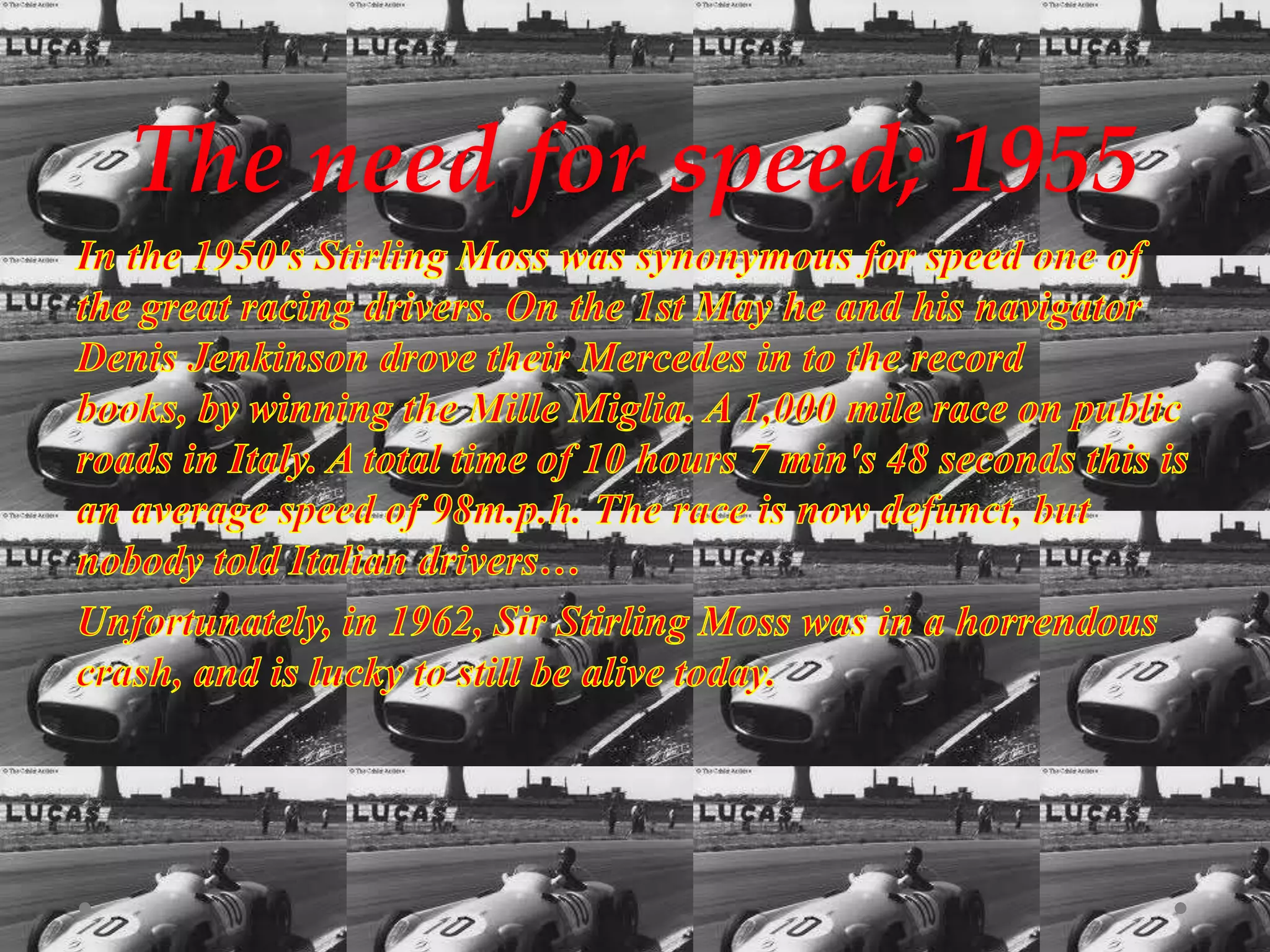
Sputnik
Incredibly, history changedon the 4th October
1957, when the Soviet union successfully launched
Sputnik, the worlds first artificial satellite, into orbit.
Amazed I am, that something around the size of a beach
ball could actually become something as important as
what it was; only 58cm (22.8 inches) in diameter, and
83.6kg (183.9 pounds) in weight. This amazing
launch, marked the start of the space age yet to
come, and the race between the U.S and the U.S.S.R
(Union of Soviet Socialist Republics).
My Grandma looksback at her
teen days
“A big story in my day was the coronation of Queen Elizabeth the second; a
member of my family, although I can’t quite remember who it was, specially rented
a television set to watch our queen crowned. I spent most of my time playing out
on the road, there was little traffic so it was safe enough, and there wasn’t all of the
electronic gadgets that are around today. During 1953 there were massive floods
along the east coast of England, resulting in sea walls being breached, and a few
people lost there lives in that devastation. Steam trains were our holiday
vehicles, we would travel down to the south of England with the gentle chugging of
the trains filling your ears. Also, during the war there had been a lot of
rationing, which all stopped in the 1950’s; me and my family loved baking
cakes, but while people were still rationing we had to use vinegar instead of eggs –
surprisingly they tasted exactly the same, so even when it stopped I carried on
using vinegar. At the time restaurants were too expensive, but as we got to the
later 50’s, more affordable Indian and Chinese eateries were opening.
Top of thecharts!
The fifties was home to a lot of people that many of us have heard of today; Nat
King Cole, Elvis Presley, and Frank Sinatra. The most popular genres of music back
then were: rock, blues, early pop, and country. Leading pop was the black Nat King
Cole, an American singer and musician who was first known for being a jazz pianist.
Most of us now have heard of Elvis Presley, and he was just as famous back
then, with his rock and roll music. Not many people today listen to country music, but
it was popular back in the 50’s; people like Hank Williams, and Johnny Cash.
Finally, Frank Sinatra was in the early pop too, and you still hear his name now and
again in the present time because he was so famous. Dean Martin was another famous
singer, an Italian/American film producer, comedian, actor, and musician.
13.
+
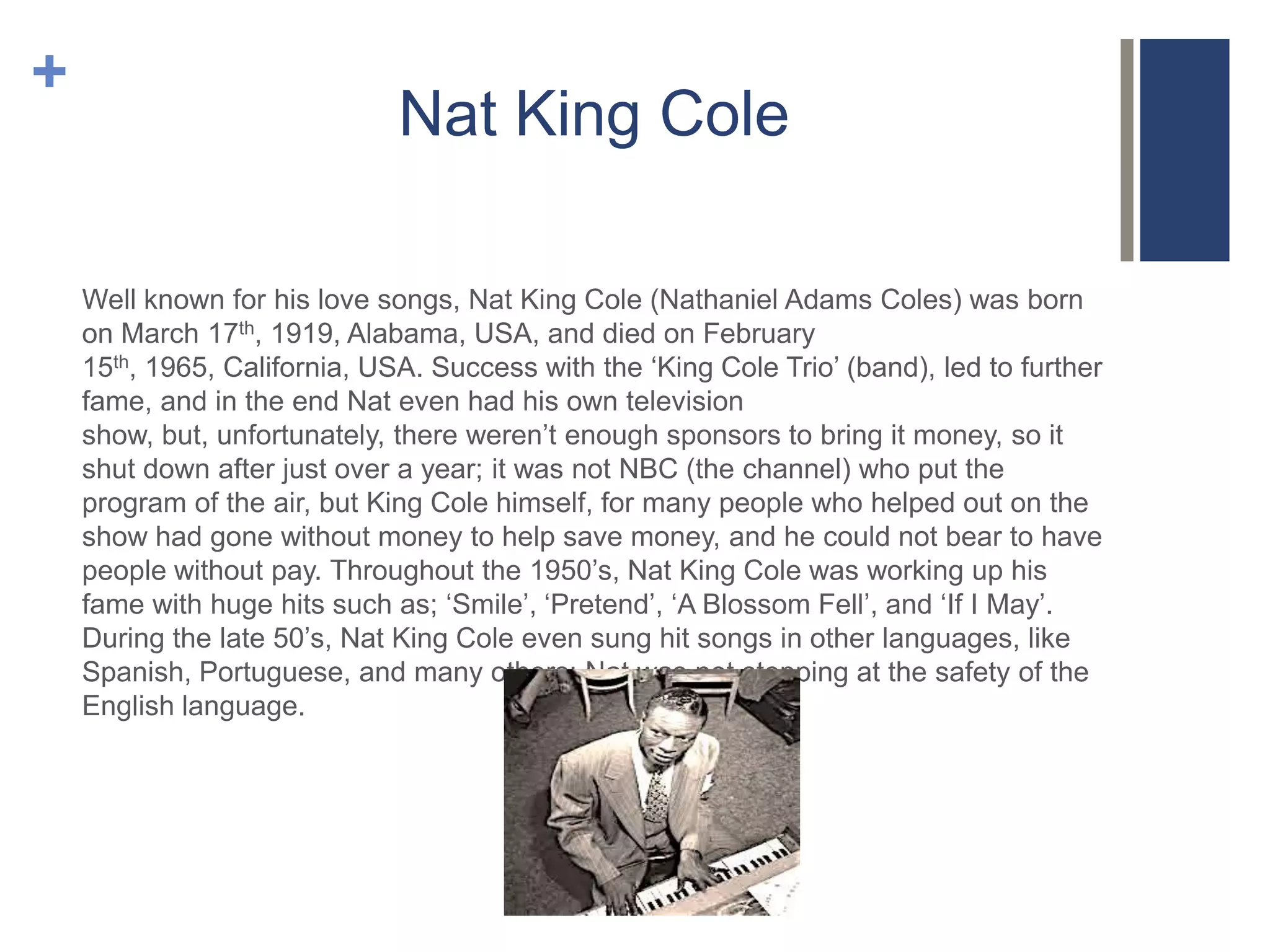
Nat King Cole
Wellknown for his love songs, Nat King Cole (Nathaniel Adams Coles) was born
on March 17th, 1919, Alabama, USA, and died on February
15th, 1965, California, USA. Success with the ‘King Cole Trio’ (band), led to further
fame, and in the end Nat even had his own television
show, but, unfortunately, there weren’t enough sponsors to bring it money, so it
shut down after just over a year; it was not NBC (the channel) who put the
program of the air, but King Cole himself, for many people who helped out on the
show had gone without money to help save money, and he could not bear to have
people without pay. Throughout the 1950’s, Nat King Cole was working up his
fame with huge hits such as; ‘Smile’, ‘Pretend’, ‘A Blossom Fell’, and ‘If I May’.
During the late 50’s, Nat King Cole even sung hit songs in other languages, like
Spanish, Portuguese, and many others; Nat was not stopping at the safety of the
English language.
14.
+
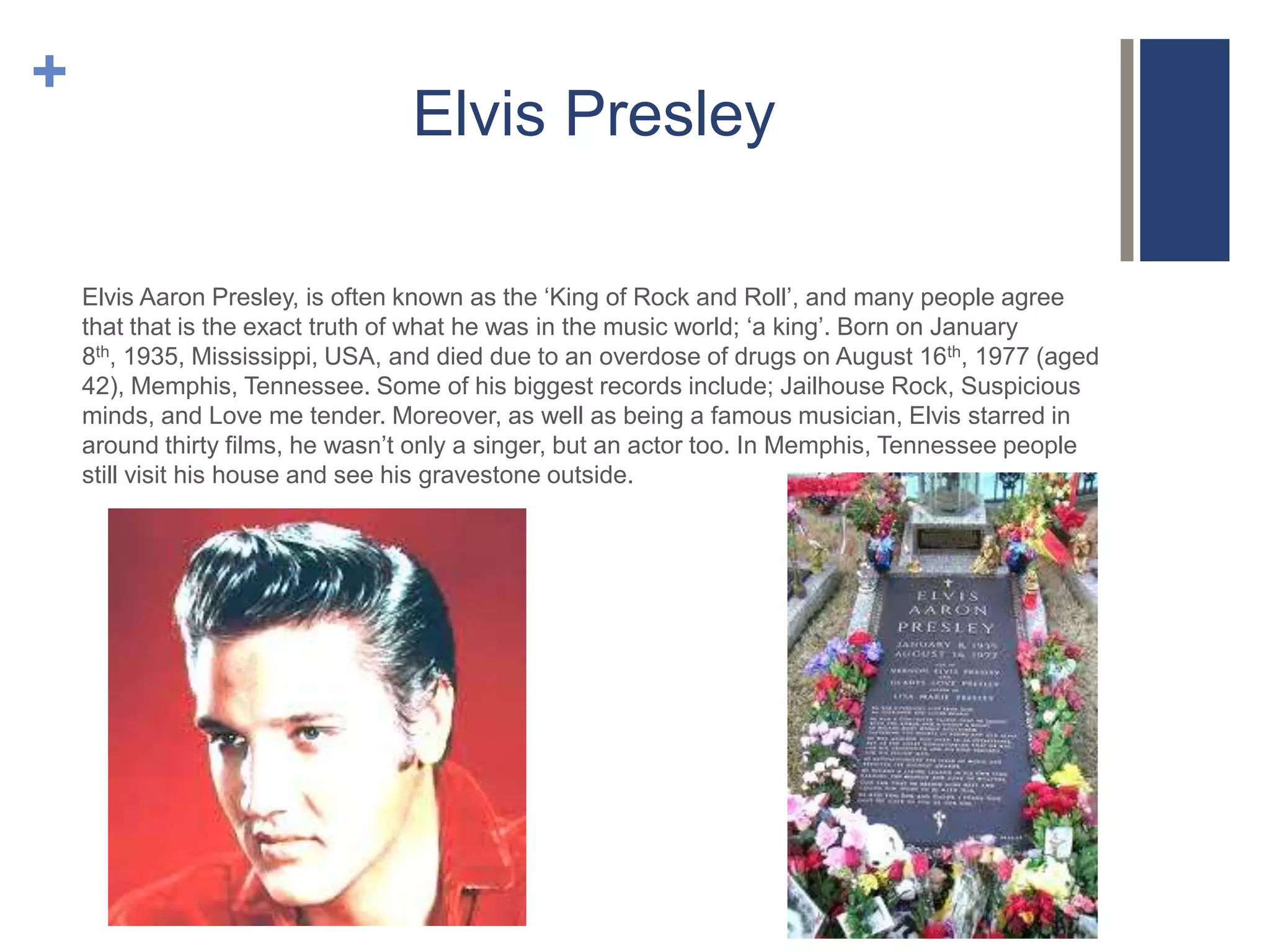
Elvis Presley
Elvis AaronPresley, is often known as the ‘King of Rock and Roll’, and many people agree
that that is the exact truth of what he was in the music world; ‘a king’. Born on January
8th, 1935, Mississippi, USA, and died due to an overdose of drugs on August 16th, 1977 (aged
42), Memphis, Tennessee. Some of his biggest records include; Jailhouse Rock, Suspicious
minds, and Love me tender. Moreover, as well as being a famous musician, Elvis starred in
around thirty films, he wasn’t only a singer, but an actor too. In Memphis, Tennessee people
still visit his house and see his gravestone outside.
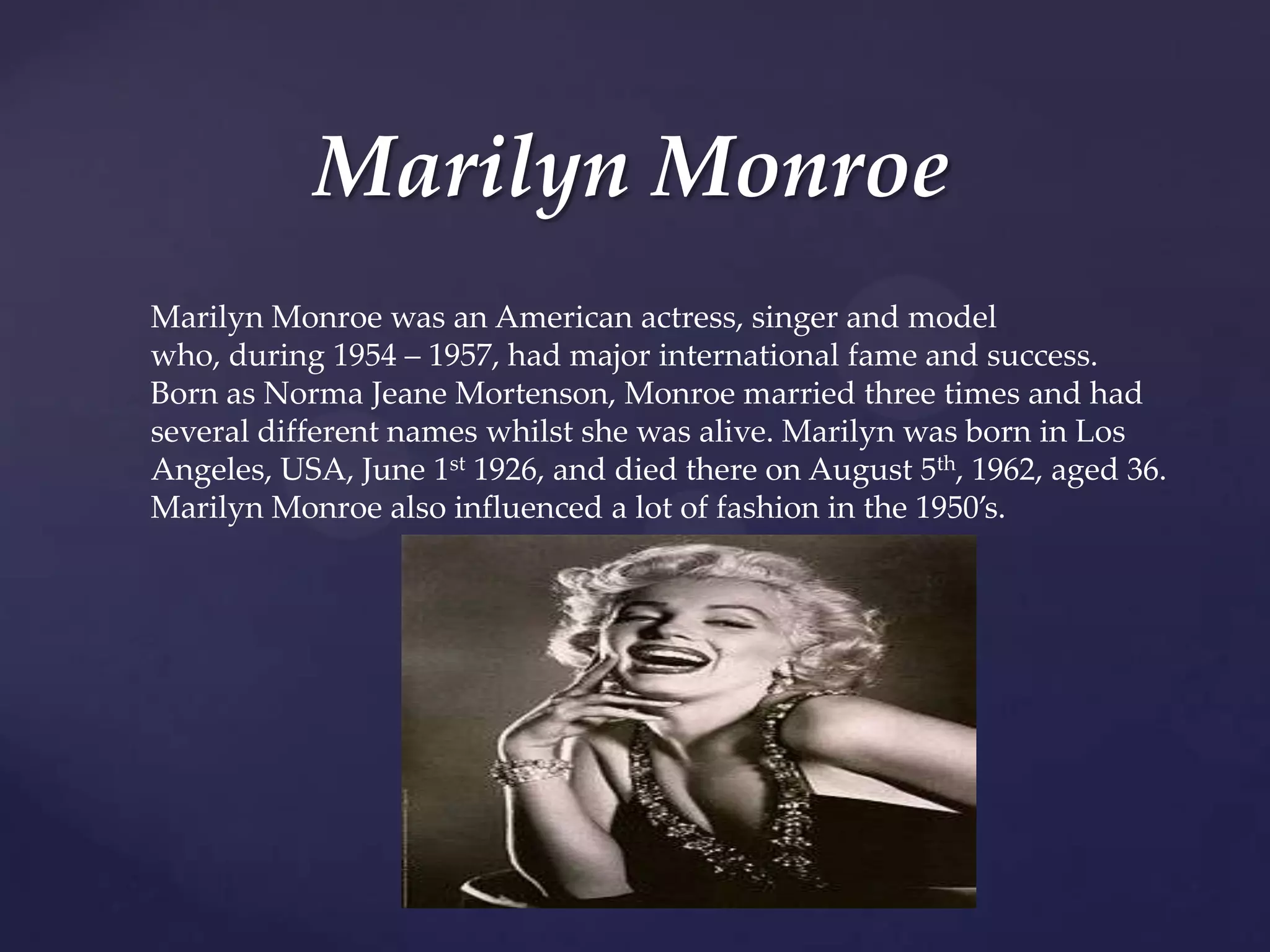
Marilyn Monroe
Marilyn Monroewas an American actress, singer and model
who, during 1954 – 1957, had major international fame and success.
Born as Norma Jeane Mortenson, Monroe married three times and had
several different names whilst she was alive. Marilyn was born in Los
Angeles, USA, June 1st 1926, and died there on August 5th, 1962, aged 36.
Marilyn Monroe also influenced a lot of fashion in the 1950’s.
17.
Grace Kelly
Grace PatriciaKelly was an American actress and Princess
of Monaco as wife of Rainer III, Prince of Monaco. Born in
Philadelphia, USA, November 12th, 1929, Grace Kelly died
as a result of a horrific car crash due to serious injury,
September 14th, 1962, aged 52. During the 1950’s, Grace
influenced the women’s fashion world.
Young Women’s Fashionin the 50’s
Teenagers were the driving force behind fashion in the 1950s. Up until that time, clothing
trends had largely been set by fashion houses that catered to the adult market and the
dress style of young people had simply followed adult fashions. As cinema, television and
rock 'n' roll swept the world, however, the youth market clambered to copy the 'style of
the stars’ as some still do now. Teenage fashion quickly developed into a huge industry in
its own right.
Throughout the 1950s, young women's clothing was also influenced by the rock 'n' roll
craze. Full skirts in bright colours become popular for dancing and skirts and pants were
pinched in at the waist to emphasise the waist. Young women also wore tight-fitting
blouses tucked into slim-line calf length trousers called 'Capri' pants or 'pedal pushers'.
Short ankle socks, scarves tied around the neck and cropped cardigans were also
popular.
20.
Fashion all round
BigFilm stars in the 1950’s influenced women’s fashion
choices just as much as the music stars influenced the
teenagers. Meanwhile, men were sticking to the suits as
the fifties went on, along with the occasional sports
coats, sweaters, and normal casual wear. During those
times, teenagers became a bit more ‘rebellious’ with their
clothing (that is, in the 1950’s style); tighter and shorter
dresses came around, partnering with leather jackets and
more rock’n’roll styles of clothing.
Fifties fashion also helped to define a women’s place in
society, especially for wives. For the first time there were
different styles of clothing for women to wear; some for
lounging around the house, some for going shopping and
running errands.
At the end of the 1950's, we started to see less traditional
styles appear. Tighter skirts, shirts and dresses start to
show up for women. Rebellious looks for men also emerge
with leather motorcycle jackets, studded boots, and bolder
patterned shirts and sweaters becoming popular at the
latter end of the decade. Girls and women start to get more
clothing options in terms of pants and shorts with pedal
pushers, Bermuda shorts, and tapered leggings featuring
prominently in style trends.
21.
What Changed Sincethe
War?
During World War II and the 1940s, clothing was greatly
influenced by rationing and limited quantities of
fabrics, threads and needles, so the most popular look was a
simple outfit using as little of these much in demand resources
as possible. Once World War II and rationing ended, a new
availability of different types of fabrics and larger quantities of
these fabrics allowed a new type of fashion to bloom during the
fifties, especially in the United States. Women's dresses in
particular exploded with excess fabric, showing off intricate
gatherings, a multitude of pleats, poofy petticoats, and fabulous
collars, all made of the best taffeta, nylon, rayon, wool and
leather in the brightest and boldest patterns and colours.
Stylish clothing became an important part of culture in the
1950s, with the country going through many societal and
cultural changes. It would showcase one's place in society more
so than ever before and became a way to express conformity
and individual identity.
22.
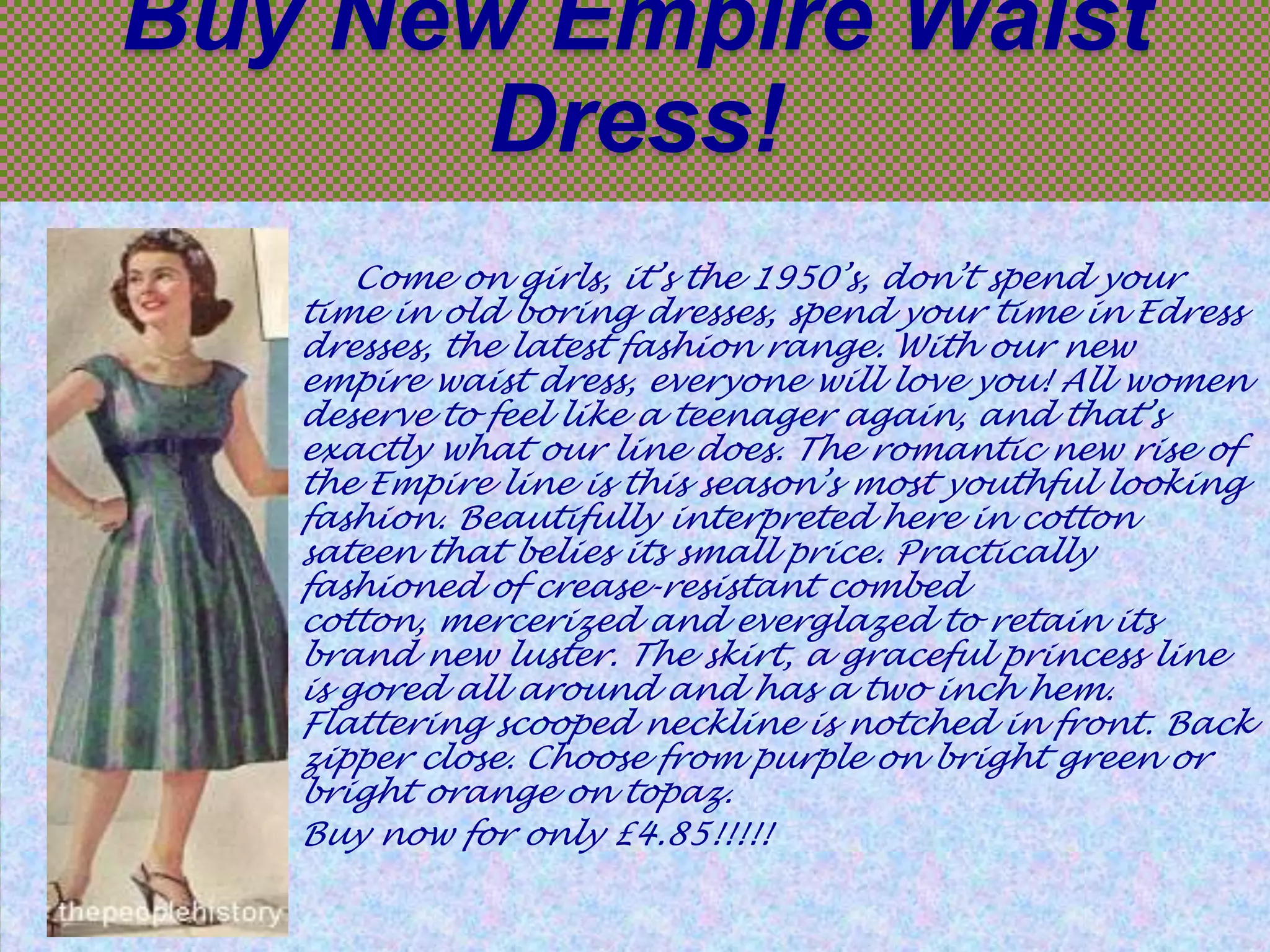
Buy New EmpireWaist
Dress!
Come on girls, it’s the 1950’s, don’t spend your
time in old boring dresses, spend your time in Edress
dresses, the latest fashion range. With our new
empire waist dress, everyone will love you! All women
deserve to feel like a teenager again, and that’s
exactly what our line does. The romantic new rise of
the Empire line is this season’s most youthful looking
fashion. Beautifully interpreted here in cotton
sateen that belies its small price. Practically
fashioned of crease-resistant combed
cotton, mercerized and everglazed to retain its
brand new luster. The skirt, a graceful princess line
is gored all around and has a two inch hem.
Flattering scooped neckline is notched in front. Back
zipper close. Choose from purple on bright green or
bright orange on topaz.
Buy now for only £4.85!!!!!
24.
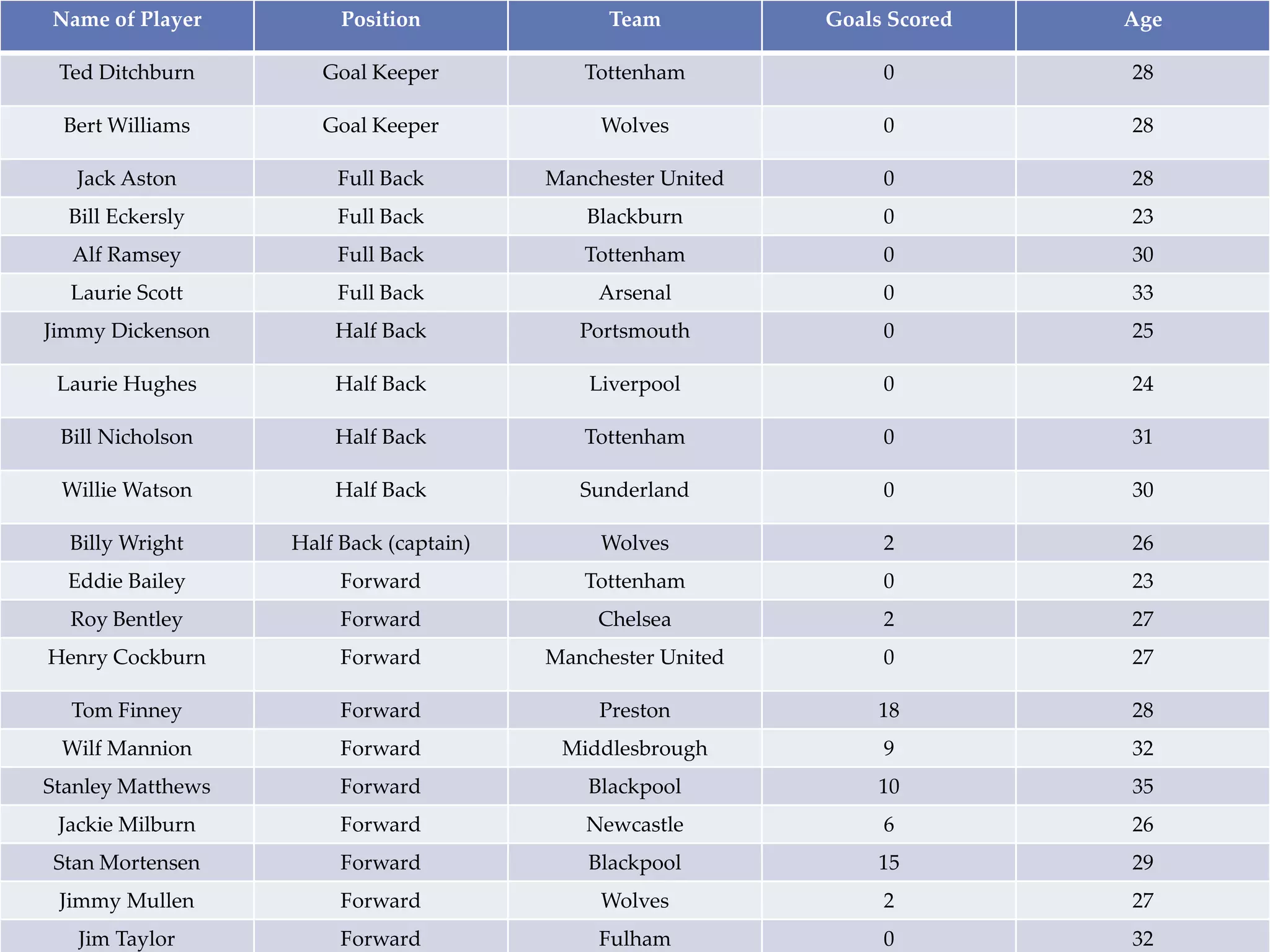
1950’s world cup
1950saw the start of the world cup for England: although it wasn’t a great start;
England was knocked out by America.
Turn to the next slide to see a table of the players, their positions, goals, age, and
teams:
The mean average age of the England football team for the 1950 world cup was
28 years of age.
The median average was 28 years of age
The range was 12
The mode was 28 years of age
25.
Name of Player
Position
Team
GoalsScored
Age
Ted Ditchburn
Goal Keeper
Tottenham
0
28
Bert Williams
Goal Keeper
Wolves
0
28
Jack Aston
Full Back
Manchester United
0
28
Bill Eckersly
Full Back
Blackburn
0
23
Alf Ramsey
Full Back
Tottenham
0
30
Laurie Scott
Full Back
Arsenal
0
33
Jimmy Dickenson
Half Back
Portsmouth
0
25
Laurie Hughes
Half Back
Liverpool
0
24
Bill Nicholson
Half Back
Tottenham
0
31
Willie Watson
Half Back
Sunderland
0
30
Billy Wright
Half Back (captain)
Wolves
2
26
Eddie Bailey
Forward
Tottenham
0
23
Roy Bentley
Forward
Chelsea
2
27
Henry Cockburn
Forward
Manchester United
0
27
Tom Finney
Forward
Preston
18
28
Wilf Mannion
Forward
Middlesbrough
9
32
Stanley Matthews
Forward
Blackpool
10
35
Jackie Milburn
Forward
Newcastle
6
26
Stan Mortensen
Forward
Blackpool
15
29
Jimmy Mullen
Forward
Wolves
2
27
Jim Taylor
Forward
Fulham
0
32
26.
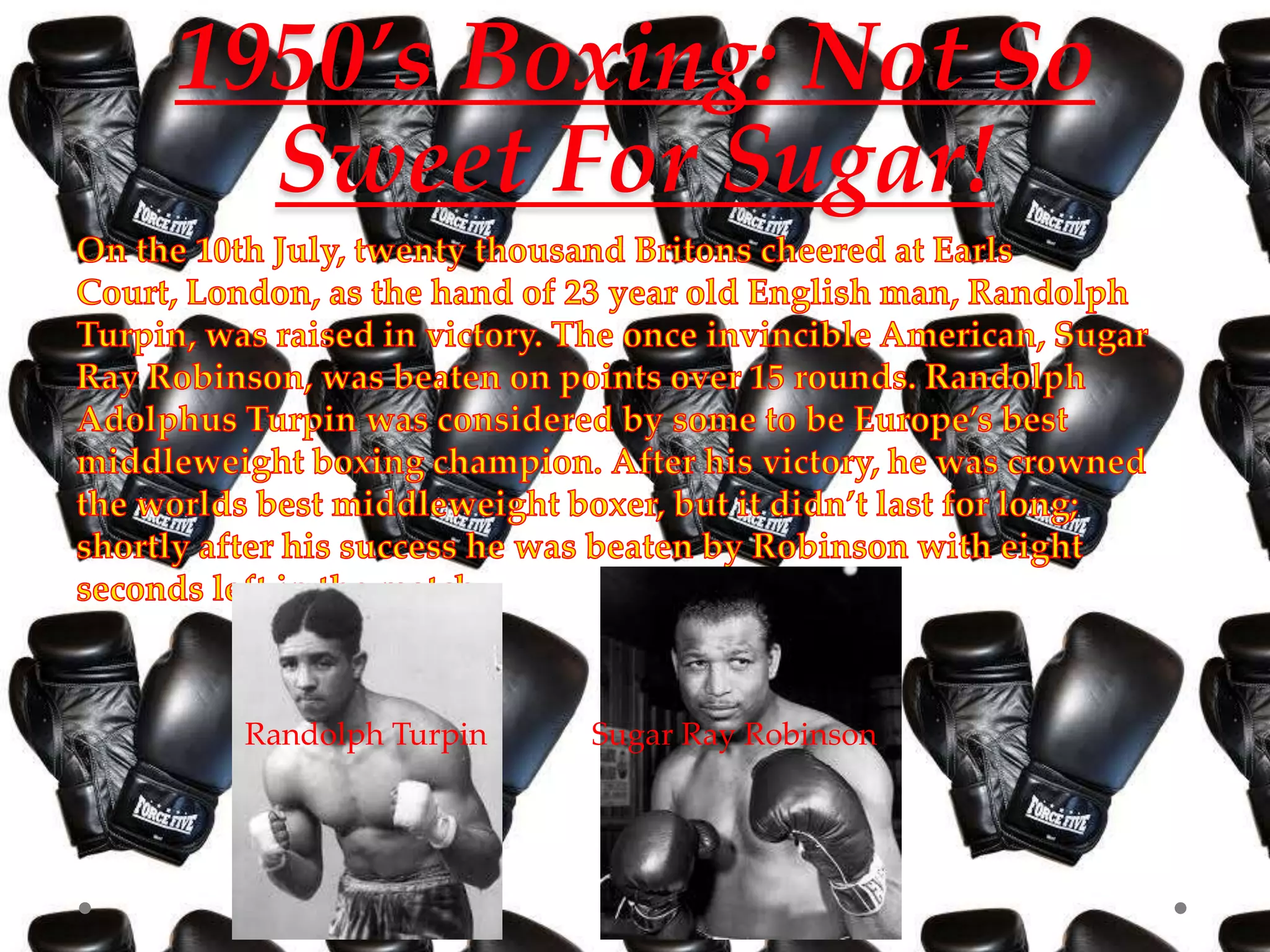
1950’s Boxing: NotSo
Sweet For Sugar!
Randolph Turpin
Sugar Ray Robinson
27.
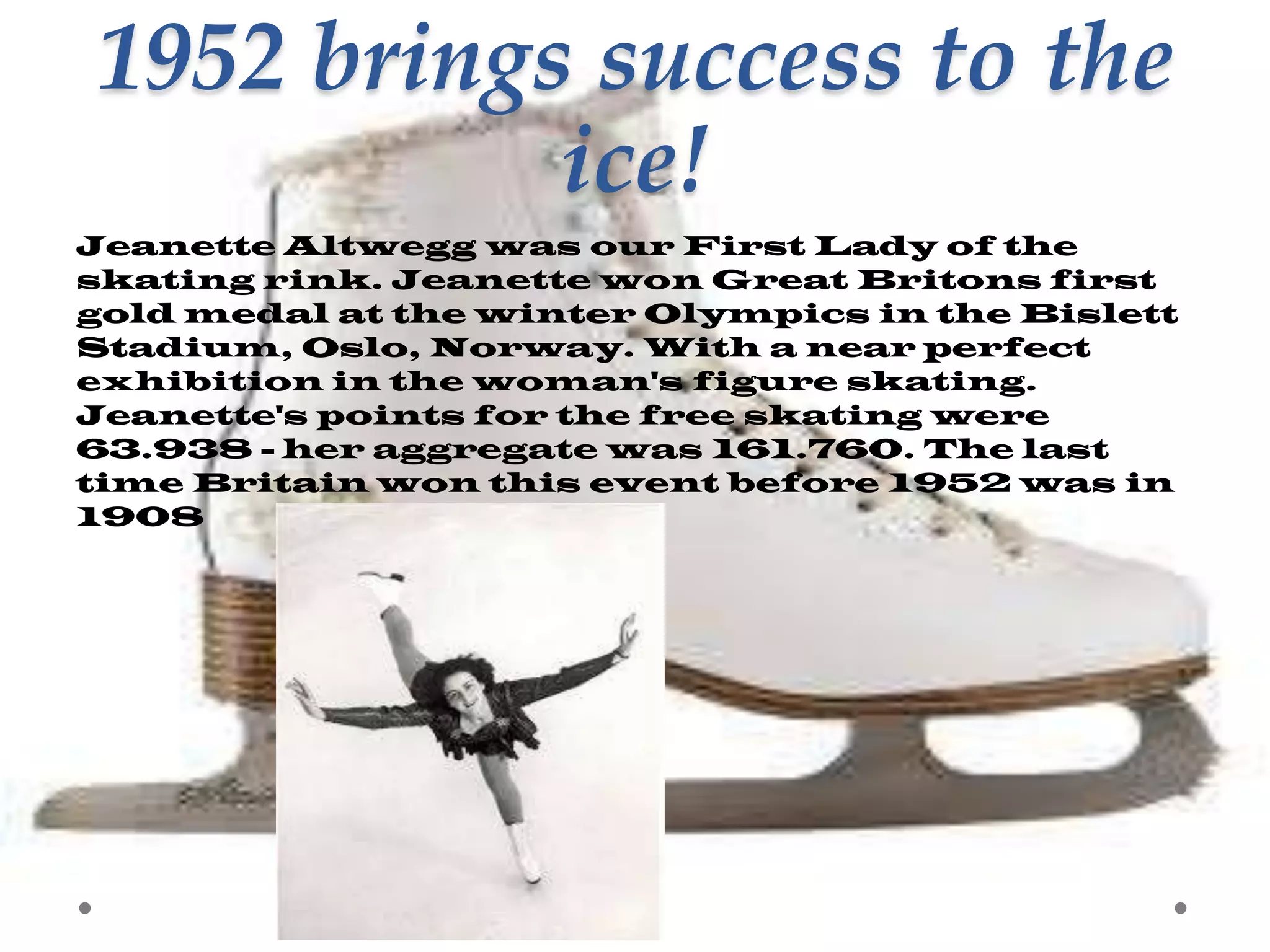
1952 brings successto the
ice!
Jeanette Altwegg was our First Lady of the
skating rink. Jeanette won Great Britons first
gold medal at the winter Olympics in the Bislett
Stadium, Oslo, Norway. With a near perfect
exhibition in the woman's figure skating.
Jeanette's points for the free skating were
63.938 - her aggregate was 161.760. The last
time Britain won this event before 1952 was in
1908
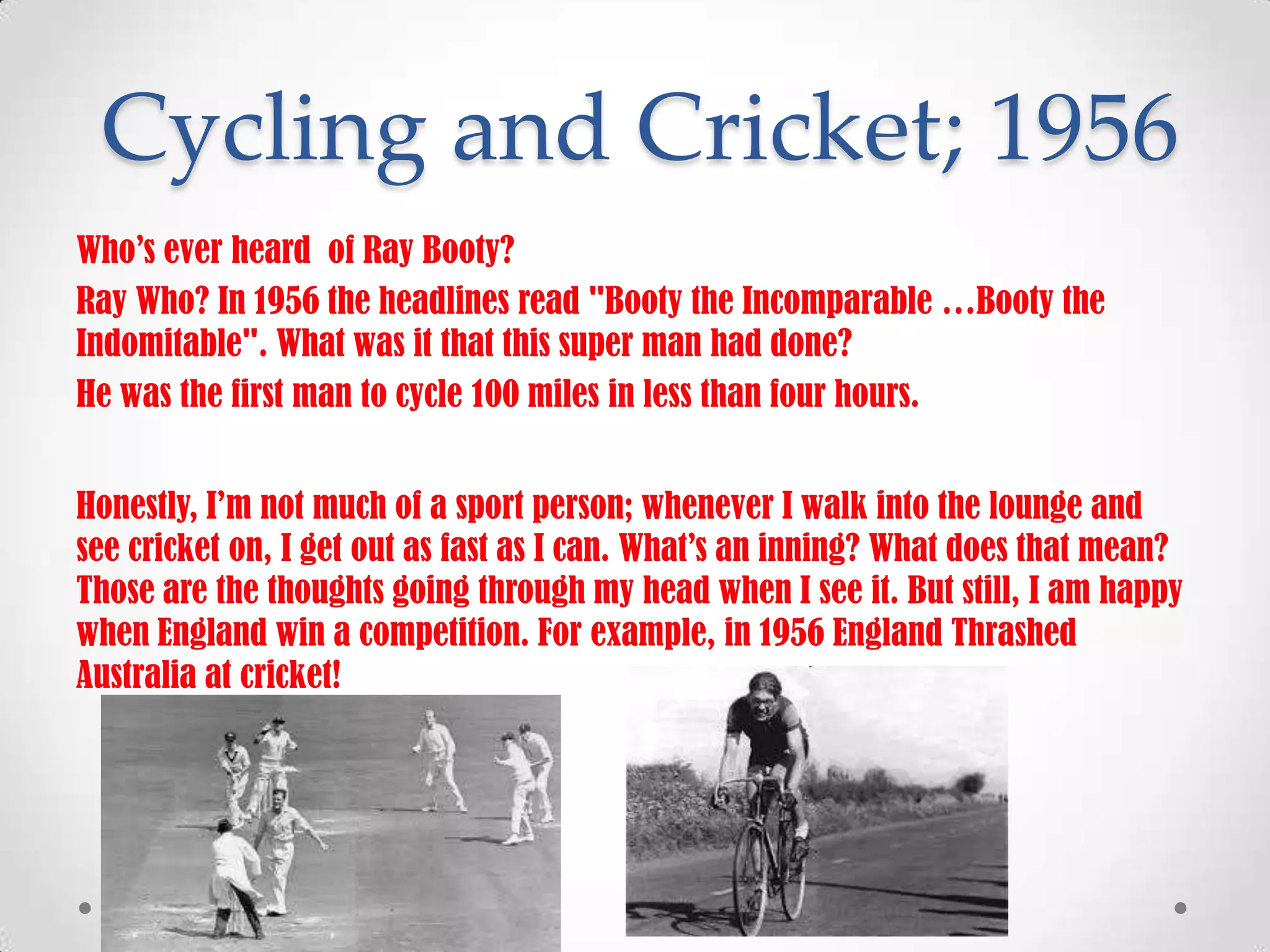
Cycling and Cricket;1956
Who’s ever heard of Ray Booty?
Ray Who? In 1956 the headlines read "Booty the Incomparable …Booty the
Indomitable". What was it that this super man had done?
He was the first man to cycle 100 miles in less than four hours.
Honestly, I’m not much of a sport person; whenever I walk into the lounge and
see cricket on, I get out as fast as I can. What’s an inning? What does that mean?
Those are the thoughts going through my head when I see it. But still, I am happy
when England win a competition. For example, in 1956 England Thrashed
Australia at cricket!
32.
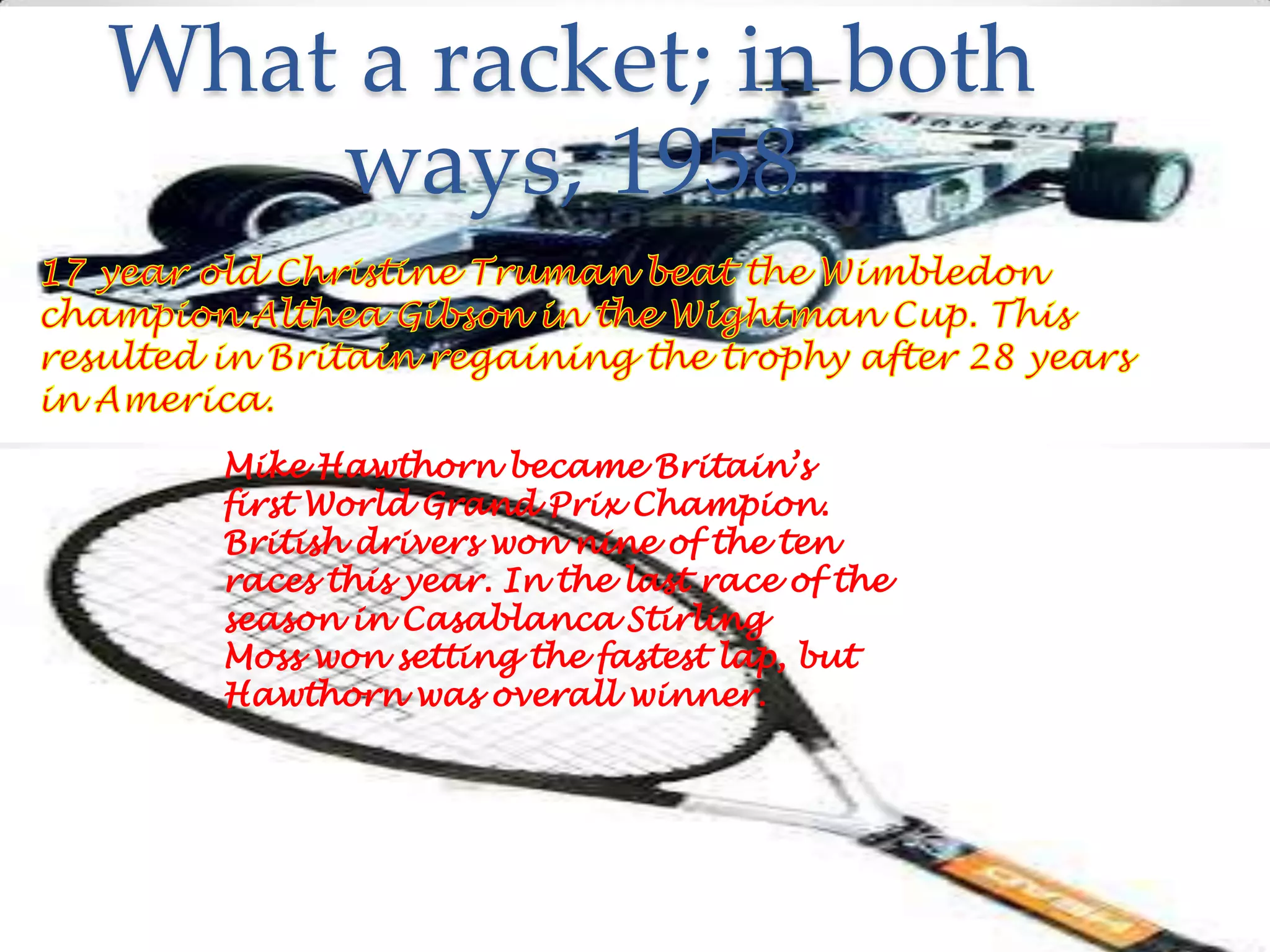
What a racket;in both
ways, 1958
Mike Hawthorn became Britain’s
first World Grand Prix Champion.
British drivers won nine of the ten
races this year. In the last race of the
season in Casablanca Stirling
Moss won setting the fastest lap, but
Hawthorn was overall winner.
34.
True or False?
1)Seat belts were the complete opposite 9) Marilyn Monroe was called Sophia Jane
of what they are now?
Mortenson?
2) The strands of DNA are A, B, C, D?
10) Grace Kelly was a famous singer?
3) Sputnik was very small?
11) Teenagers were leaders when it came
to fashion?
4) Laika was a Chihuahua
5) Some cakes were made with vinegar?
6) The streets were as quiet as anything?
7) Nat King Cole was African?
8) Elvis Presley died when he was fourty
two?
12) There wasn’t much fabric left after
WW2 due to rationing?
13)Randolph Turpin beat Sugar Rush
Robinson?
14) Stirling Ross suffered a horrific crash
during his career?
35.
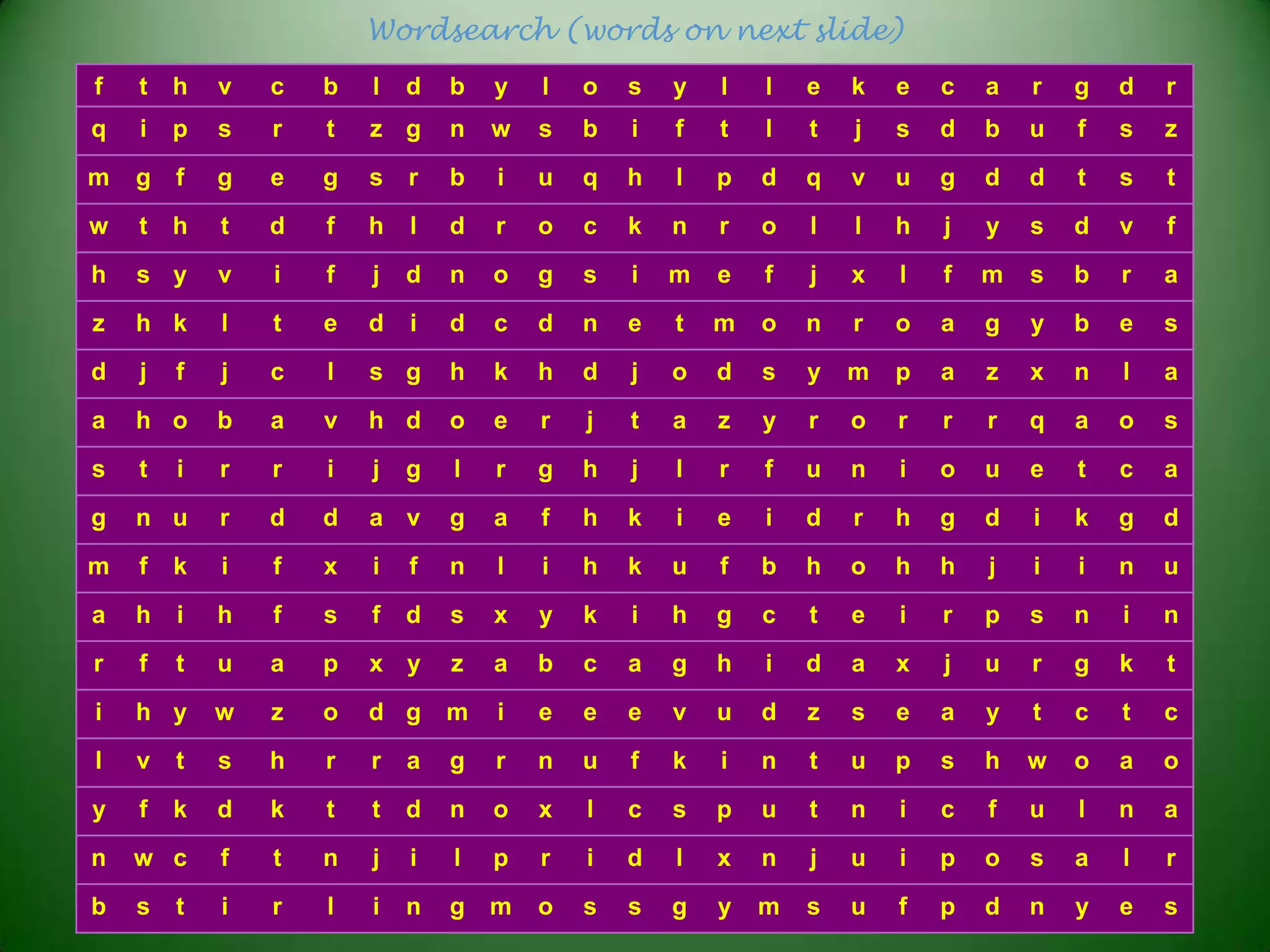
Wordsearch (words onnext slide)
f
t
h
v
c
b
l
d
b
y
l
o
s
y
l
l
e
k
e
c
a
r
g
d
r
q
i
p
s
r
t
z g
n
w
s
b
i
f
t
l
t
j
s
d
b
u
f
s
z
m
g
f
g
e
g
s
r
b
i
u
q
h
l
p
d
q
v
u
g
d
d
t
s
t
w
t
h
t
d
f
h
l
d
r
o
c
k
n
r
o
l
l
h
j
y
s
d
v
f
h
s y
v
i
f
j
d
n
o
g
s
i
m
e
f
j
x
l
f
m
s
b
r
a
z
h k
l
t
e
d
i
d
c
d
n
e
t
m
o
n
r
o
a
g
y
b
e
s
d
j
f
j
c
l
s g
h
k
h
d
j
o
d
s
y
m
p
a
z
x
n
l
a
a
h o
b
a
v
h d
o
e
r
j
t
a
z
y
r
o
r
r
r
q
a
o
s
s
t
i
r
r
i
j
g
l
r
g
h
j
l
r
f
u
n
i
o
u
e
t
c
a
g
n u
r
d
d
a v
g
a
f
h
k
i
e
i
d
r
h
g
d
i
k
g
d
m
f
k
i
f
x
i
f
n
l
i
h
k
u
f
b
h
o
h
h
j
i
i
n
u
a
h
i
h
f
s
f
d
s
x
y
k
i
h
g
c
t
e
i
r
p
s
n
i
n
r
f
t
u
a
p
x y
z
a
b
c
a
g
h
i
d
a
x
j
u
r
g
k
t
i
h y
w
z
o
d g
m
i
e
e
e
v
u
d
z
s
e
a
y
t
c
t
c
l
v
t
s
h
r
r
a
g
r
n
u
f
k
i
n
t
u
p
s
h
w
o
a
o
y
f
k
d
k
t
t
d
n
o
x
l
c
s
p
u
t
n
i
c
f
u
l
n
a
n
w c
f
t
n
j
i
l
p
r
i
d
l
x
n
j
u
i
p
o
s
a
l
r
b
s
i
r
l
i
n
g
m
o
s
s
g
y
m
s
u
f
p
d
n
y
e
s
t
36.
Words for thewordsearch:
Fifties
Sputnik
Stirling Moss
Marilyn
DNA
Monroe
Credit card
Nat King Cole
Premiere
Elvis
Seatbelt
Grace Kelly
Laika
Rock ‘n’ roll