About me :)
●   Computer Programmer,
●   Coding in Python for last 3 years,
●   Part of the Team at HP that developed an early
    warning software that parses over 40+TB of
    data annually to find problems before they
    happen, (Coded in Python)
●   Skills in Django, PyQt,
●   Http://uptosomething.in [ Homepage ]
Python Performance 101

   Performance : Why it matters ?

   Performance : Measurement

   Performance : Low hanging fruits

   Python Performance : Interpreter

   Python Performance : Outsourcing to C/C++
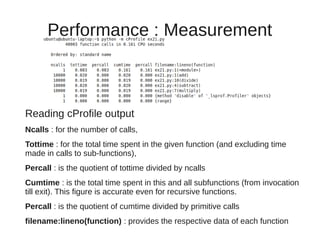
Performance : Measurement


Reading cProfile output
Ncalls : for the number of calls,
Tottime : for the total time spent in the given function (and excluding time
made in calls to sub-functions),
Percall : is the quotient of tottime divided by ncalls
Cumtime : is the total time spent in this and all subfunctions (from invocation
till exit). This figure is accurate even for recursive functions.
Percall : is the quotient of cumtime divided by primitive calls
filename:lineno(function) : provides the respective data of each function
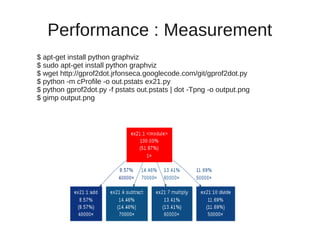
Performance : Measurement
$ apt-get install python graphviz
$ sudo apt-get install python graphviz
$ wget http://gprof2dot.jrfonseca.googlecode.com/git/gprof2dot.py
$ python -m cProfile -o out.pstats ex21.py
$ python gprof2dot.py -f pstats out.pstats | dot -Tpng -o output.png
$ gimp output.png
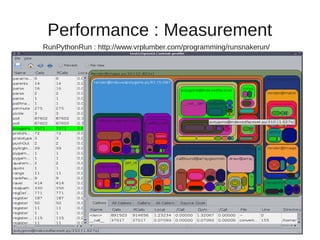
Performance : Measurement
RunPythonRun : http://www.vrplumber.com/programming/runsnakerun/
Python Performance : Low Hanging Fruits
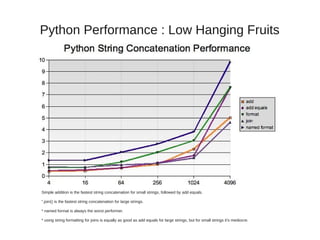
●   String concatenation Benchmark ( http://sprocket.io/blog/2007/10/string-concatenation-performance-in-
    python/ )
    add: a + b + c + d

    add equals: a += b; a += c; a += d

    format strings: ‘%s%s%s%s’ % (a, b, c, d)

    named format strings:‘%(a)s%(b)s%(c)s%(d)s’ % {‘a’: a, ‘b’: b, ‘c’: c, ‘d’: d}”

    join: ”.join([a,b,c,d])

    #!/usr/bin/python
    # benchmark various string concatenation methods. Run each 5*1,000,000 times
    # and pick the best time out of the 5. Repeats for string lengths of
    # 4, 16, 64, 256, 1024, and 4096. Outputs in CSV format via stdout.
    import timeit
     
    tests = {
      'add': "x = a + b + c + d",
      'join': "x = ''.join([a,b,c,d])",
      'addequals': "x = a; x += b; x += c; x += d",
      'format': "x = '%s%s%s%s' % (a, b, c, d)",
      'full_format': "x = '%(a)s%(b)s%(c)s%(d)s' % {'a': a, 'b': b, 'c': c, 'd': d}"
    }
     
    count = 1
    for i in range(6):
      count = count * 4
      init = "a = '%s'; b = '%s'; c = '%s'; d = '%s'" % 
             ('a' * count, 'b' * count, 'c' * count, 'd' * count)
     
      for test in tests:
        t = timeit.Timer(tests[test], init)
        best = min(t.repeat(5, 1000000))
        print "'%s',%s,%s" % (test, count, best)
Python Performance : Low Hanging Fruits


Simple addition is the fastest string concatenation for small strings, followed by add equals.

”.join() is the fastest string concatenation for large strings.

* named format is always the worst performer.

* using string formatting for joins is equally as good as add equals for large strings, but for small strings it’s mediocre.
Python Performance : Low Hanging Fruits
newlist = []                                                                newlist = map(str.upper, oldlist)
for word in oldlist:
    newlist.append(word.upper())


                                   newlist = [s.upper() for s in oldlist]


upper = str.upper
newlist = []
append = newlist.append
                                                                              I wouldn't do this
for word in oldlist:
    append(upper(word))


                              Exception for branching
                                                                              wdict = {}
wdict = {}
                                                                              for word in words:
for word in words:
                                                                                  try:
    if word not in wdict:
                                                                                      wdict[word] += 1
        wdict[word] = 0
                                                                                  except KeyError:
    wdict[word] += 1
                                                                                      wdict[word] = 1
Python Performance : Low Hanging Fruits

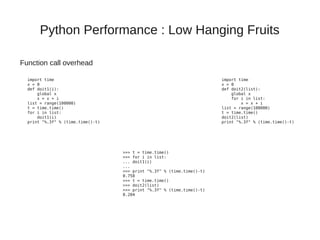
Function call overhead

  import time                                                           import time
  x = 0                                                                 x = 0
  def doit1(i):                                                         def doit2(list):
      global x                                                              global x
      x = x + i                                                             for i in list:
  list = range(100000)                                                          x = x + i
  t = time.time()                                                       list = range(100000)
  for i in list:                                                        t = time.time()
      doit1(i)                                                          doit2(list)
  print "%.3f" % (time.time()-t)                                        print "%.3f" % (time.time()-t)


                                   >>> t = time.time()
                                   >>> for i in list:
                                   ... doit1(i)
                                   ...
                                   >>> print "%.3f" % (time.time()-t)
                                   0.758
                                   >>> t = time.time()
                                   >>> doit2(list)
                                   >>> print "%.3f" % (time.time()-t)
                                   0.204
Python Performance : Low Hanging Fruits

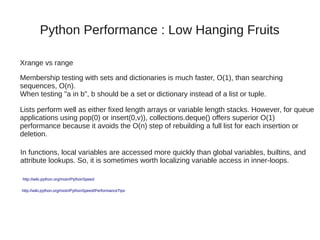
Xrange vs range

Membership testing with sets and dictionaries is much faster, O(1), than searching
sequences, O(n).
When testing "a in b", b should be a set or dictionary instead of a list or tuple.

Lists perform well as either fixed length arrays or variable length stacks. However, for queue
applications using pop(0) or insert(0,v)), collections.deque() offers superior O(1)
performance because it avoids the O(n) step of rebuilding a full list for each insertion or
deletion.

In functions, local variables are accessed more quickly than global variables, builtins, and
attribute lookups. So, it is sometimes worth localizing variable access in inner-loops.

http://wiki.python.org/moin/PythonSpeed

http://wiki.python.org/moin/PythonSpeed/PerformanceTips
Python : Multi-core Architecture
●   In CPython, the global interpreter lock, or GIL, is a mutex that prevents multiple native threads from
    executing Python bytecodes at once. This lock is necessary mainly because CPython's memory
    management is not thread-safe. (However, since the GIL exists, other features have grown to depend on the
    guarantees that it enforces.) More here http://wiki.python.org/moin/GlobalInterpreterLock
●   Use Multi Processing to overcome GIL

    from multiprocessing import Process, Queue

    def f(iq,oq):
     if not iq.empty():
       values = iq.get()
       oq.put(sum(values))

    if __name__ == '__main__':
      inputQueue = Queue()
      outputQueue = Queue()
      values = range(0,1000000)
      processOne = Process(target=f, args=(inputQueue,outputQueue))
      processTwo = Process(target=f, args=(inputQueue,outputQueue))
      inputQueue.put(values[0:len(values)/2])
      inputQueue.put(values[len(values)/2:])
      processOne.start()
      processTwo.start()
      processOne.join()
      processTwo.join()
      outputOne = outputQueue.get()
      outputTwo = outputQueue.get()
      print sum([outputOne, outputTwo])
Python : Multi-core Architecture
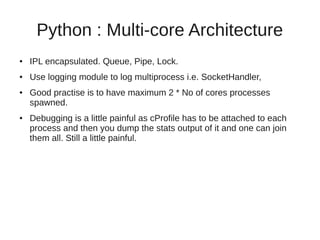
●   IPL encapsulated. Queue, Pipe, Lock.
●   Use logging module to log multiprocess i.e. SocketHandler,
●   Good practise is to have maximum 2 * No of cores processes
    spawned.
●   Debugging is a little painful as cProfile has to be attached to each
    process and then you dump the stats output of it and one can join
    them all. Still a little painful.
Python : Interpreter
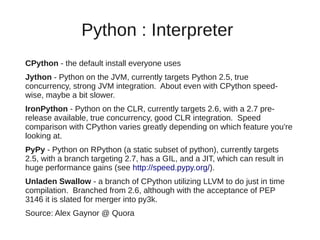
CPython - the default install everyone uses
Jython - Python on the JVM, currently targets Python 2.5, true
concurrency, strong JVM integration. About even with CPython speed-
wise, maybe a bit slower.
IronPython - Python on the CLR, currently targets 2.6, with a 2.7 pre-
release available, true concurrency, good CLR integration. Speed
comparison with CPython varies greatly depending on which feature you're
looking at.
PyPy - Python on RPython (a static subset of python), currently targets
2.5, with a branch targeting 2.7, has a GIL, and a JIT, which can result in
huge performance gains (see http://speed.pypy.org/).
Unladen Swallow - a branch of CPython utilizing LLVM to do just in time
compilation. Branched from 2.6, although with the acceptance of PEP
3146 it is slated for merger into py3k.
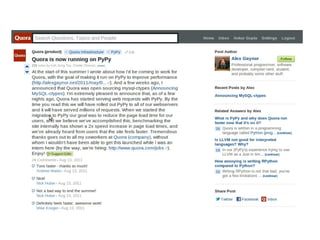
Source: Alex Gaynor @ Quora
Python : Interpreter

PyPy
Http://pypy.org
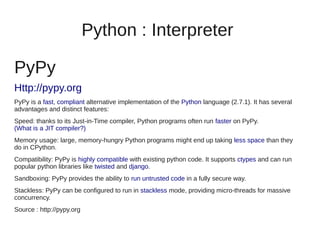
PyPy is a fast, compliant alternative implementation of the Python language (2.7.1). It has several
advantages and distinct features:
Speed: thanks to its Just-in-Time compiler, Python programs often run faster on PyPy.
(What is a JIT compiler?)
Memory usage: large, memory-hungry Python programs might end up taking less space than they
do in CPython.
Compatibility: PyPy is highly compatible with existing python code. It supports ctypes and can run
popular python libraries like twisted and django.
Sandboxing: PyPy provides the ability to run untrusted code in a fully secure way.
Stackless: PyPy can be configured to run in stackless mode, providing micro-threads for massive
concurrency.
Source : http://pypy.org
Python : Interpreter
●   Unladen swallow
    An optimization branch of CPython, intended to
    be fully compatible and significantly faster.
    http://code.google.com/p/unladen-swallow/
●   Mandate is to merge the codebase with Python
    3.x series.
●   It's a google sponsered project.
●   Know to be used @ Youtube which is in Python.
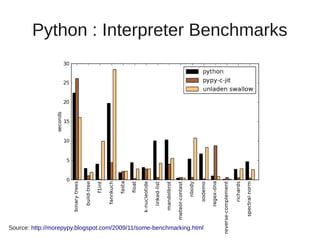
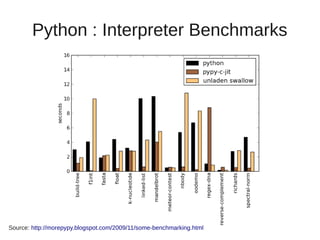
Python : Interpreter Benchmarks


Source: http://morepypy.blogspot.com/2009/11/some-benchmarking.html
Python : Interpreter Benchmarks


Source: http://morepypy.blogspot.com/2009/11/some-benchmarking.html
Python : Outsourcing to C/C++
●   Ctypes
●   SWIG
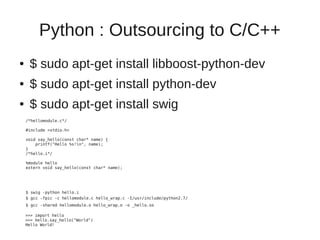
Python : Outsourcing to C/C++
●    $ sudo apt-get install libboost-python-dev
●    $ sudo apt-get install python-dev
●    $ sudo apt-get install swig
    /*hellomodule.c*/

    #include <stdio.h>

    void say_hello(const char* name) {
        printf("Hello %s!n", name);
    }
    /*hello.i*/

    %module hello
    extern void say_hello(const char* name);


    $ swig -python hello.i
    $ gcc -fpic -c hellomodule.c hello_wrap.c -I/usr/include/python2.7/
    $ gcc -shared hellomodule.o hello_wrap.o -o _hello.so

    >>> import hello
    >>> hello.say_hello("World")
    Hello World!

Python Performance 101

  • 1.
    About me :) ● Computer Programmer, ● Coding in Python for last 3 years, ● Part of the Team at HP that developed an early warning software that parses over 40+TB of data annually to find problems before they happen, (Coded in Python) ● Skills in Django, PyQt, ● Http://uptosomething.in [ Homepage ]
  • 2.
    Python Performance 101  Performance : Why it matters ?  Performance : Measurement  Performance : Low hanging fruits  Python Performance : Interpreter  Python Performance : Outsourcing to C/C++
  • 3.
    Performance : Measurement ReadingcProfile output Ncalls : for the number of calls, Tottime : for the total time spent in the given function (and excluding time made in calls to sub-functions), Percall : is the quotient of tottime divided by ncalls Cumtime : is the total time spent in this and all subfunctions (from invocation till exit). This figure is accurate even for recursive functions. Percall : is the quotient of cumtime divided by primitive calls filename:lineno(function) : provides the respective data of each function
  • 4.
    Performance : Measurement $apt-get install python graphviz $ sudo apt-get install python graphviz $ wget http://gprof2dot.jrfonseca.googlecode.com/git/gprof2dot.py $ python -m cProfile -o out.pstats ex21.py $ python gprof2dot.py -f pstats out.pstats | dot -Tpng -o output.png $ gimp output.png
  • 5.
    Performance : Measurement RunPythonRun: http://www.vrplumber.com/programming/runsnakerun/
  • 6.
    Python Performance :Low Hanging Fruits ● String concatenation Benchmark ( http://sprocket.io/blog/2007/10/string-concatenation-performance-in- python/ ) add: a + b + c + d add equals: a += b; a += c; a += d format strings: ‘%s%s%s%s’ % (a, b, c, d) named format strings:‘%(a)s%(b)s%(c)s%(d)s’ % {‘a’: a, ‘b’: b, ‘c’: c, ‘d’: d}” join: ”.join([a,b,c,d]) #!/usr/bin/python # benchmark various string concatenation methods. Run each 5*1,000,000 times # and pick the best time out of the 5. Repeats for string lengths of # 4, 16, 64, 256, 1024, and 4096. Outputs in CSV format via stdout. import timeit   tests = { 'add': "x = a + b + c + d", 'join': "x = ''.join([a,b,c,d])", 'addequals': "x = a; x += b; x += c; x += d", 'format': "x = '%s%s%s%s' % (a, b, c, d)", 'full_format': "x = '%(a)s%(b)s%(c)s%(d)s' % {'a': a, 'b': b, 'c': c, 'd': d}" }   count = 1 for i in range(6): count = count * 4 init = "a = '%s'; b = '%s'; c = '%s'; d = '%s'" % ('a' * count, 'b' * count, 'c' * count, 'd' * count)   for test in tests: t = timeit.Timer(tests[test], init) best = min(t.repeat(5, 1000000)) print "'%s',%s,%s" % (test, count, best)
  • 7.
    Python Performance :Low Hanging Fruits Simple addition is the fastest string concatenation for small strings, followed by add equals. ”.join() is the fastest string concatenation for large strings. * named format is always the worst performer. * using string formatting for joins is equally as good as add equals for large strings, but for small strings it’s mediocre.
  • 8.
    Python Performance :Low Hanging Fruits newlist = [] newlist = map(str.upper, oldlist) for word in oldlist: newlist.append(word.upper()) newlist = [s.upper() for s in oldlist] upper = str.upper newlist = [] append = newlist.append I wouldn't do this for word in oldlist: append(upper(word)) Exception for branching wdict = {} wdict = {} for word in words: for word in words: try: if word not in wdict: wdict[word] += 1 wdict[word] = 0 except KeyError: wdict[word] += 1 wdict[word] = 1
  • 9.
    Python Performance :Low Hanging Fruits Function call overhead import time import time x = 0 x = 0 def doit1(i): def doit2(list): global x global x x = x + i for i in list: list = range(100000) x = x + i t = time.time() list = range(100000) for i in list: t = time.time() doit1(i) doit2(list) print "%.3f" % (time.time()-t) print "%.3f" % (time.time()-t) >>> t = time.time() >>> for i in list: ... doit1(i) ... >>> print "%.3f" % (time.time()-t) 0.758 >>> t = time.time() >>> doit2(list) >>> print "%.3f" % (time.time()-t) 0.204
  • 10.
    Python Performance :Low Hanging Fruits Xrange vs range Membership testing with sets and dictionaries is much faster, O(1), than searching sequences, O(n). When testing "a in b", b should be a set or dictionary instead of a list or tuple. Lists perform well as either fixed length arrays or variable length stacks. However, for queue applications using pop(0) or insert(0,v)), collections.deque() offers superior O(1) performance because it avoids the O(n) step of rebuilding a full list for each insertion or deletion. In functions, local variables are accessed more quickly than global variables, builtins, and attribute lookups. So, it is sometimes worth localizing variable access in inner-loops. http://wiki.python.org/moin/PythonSpeed http://wiki.python.org/moin/PythonSpeed/PerformanceTips
  • 11.
    Python : Multi-coreArchitecture ● In CPython, the global interpreter lock, or GIL, is a mutex that prevents multiple native threads from executing Python bytecodes at once. This lock is necessary mainly because CPython's memory management is not thread-safe. (However, since the GIL exists, other features have grown to depend on the guarantees that it enforces.) More here http://wiki.python.org/moin/GlobalInterpreterLock ● Use Multi Processing to overcome GIL from multiprocessing import Process, Queue def f(iq,oq): if not iq.empty(): values = iq.get() oq.put(sum(values)) if __name__ == '__main__': inputQueue = Queue() outputQueue = Queue() values = range(0,1000000) processOne = Process(target=f, args=(inputQueue,outputQueue)) processTwo = Process(target=f, args=(inputQueue,outputQueue)) inputQueue.put(values[0:len(values)/2]) inputQueue.put(values[len(values)/2:]) processOne.start() processTwo.start() processOne.join() processTwo.join() outputOne = outputQueue.get() outputTwo = outputQueue.get() print sum([outputOne, outputTwo])
  • 12.
    Python : Multi-coreArchitecture ● IPL encapsulated. Queue, Pipe, Lock. ● Use logging module to log multiprocess i.e. SocketHandler, ● Good practise is to have maximum 2 * No of cores processes spawned. ● Debugging is a little painful as cProfile has to be attached to each process and then you dump the stats output of it and one can join them all. Still a little painful.
  • 13.
    Python : Interpreter CPython- the default install everyone uses Jython - Python on the JVM, currently targets Python 2.5, true concurrency, strong JVM integration. About even with CPython speed- wise, maybe a bit slower. IronPython - Python on the CLR, currently targets 2.6, with a 2.7 pre- release available, true concurrency, good CLR integration. Speed comparison with CPython varies greatly depending on which feature you're looking at. PyPy - Python on RPython (a static subset of python), currently targets 2.5, with a branch targeting 2.7, has a GIL, and a JIT, which can result in huge performance gains (see http://speed.pypy.org/). Unladen Swallow - a branch of CPython utilizing LLVM to do just in time compilation. Branched from 2.6, although with the acceptance of PEP 3146 it is slated for merger into py3k. Source: Alex Gaynor @ Quora
  • 14.
    Python : Interpreter PyPy Http://pypy.org PyPyis a fast, compliant alternative implementation of the Python language (2.7.1). It has several advantages and distinct features: Speed: thanks to its Just-in-Time compiler, Python programs often run faster on PyPy. (What is a JIT compiler?) Memory usage: large, memory-hungry Python programs might end up taking less space than they do in CPython. Compatibility: PyPy is highly compatible with existing python code. It supports ctypes and can run popular python libraries like twisted and django. Sandboxing: PyPy provides the ability to run untrusted code in a fully secure way. Stackless: PyPy can be configured to run in stackless mode, providing micro-threads for massive concurrency. Source : http://pypy.org
  • 15.
    Python : Interpreter ● Unladen swallow An optimization branch of CPython, intended to be fully compatible and significantly faster. http://code.google.com/p/unladen-swallow/ ● Mandate is to merge the codebase with Python 3.x series. ● It's a google sponsered project. ● Know to be used @ Youtube which is in Python.
  • 16.
    Python : InterpreterBenchmarks Source: http://morepypy.blogspot.com/2009/11/some-benchmarking.html
  • 17.
    Python : InterpreterBenchmarks Source: http://morepypy.blogspot.com/2009/11/some-benchmarking.html
  • 19.
    Python : Outsourcingto C/C++ ● Ctypes ● SWIG
  • 20.
    Python : Outsourcingto C/C++ ● $ sudo apt-get install libboost-python-dev ● $ sudo apt-get install python-dev ● $ sudo apt-get install swig /*hellomodule.c*/ #include <stdio.h> void say_hello(const char* name) { printf("Hello %s!n", name); } /*hello.i*/ %module hello extern void say_hello(const char* name); $ swig -python hello.i $ gcc -fpic -c hellomodule.c hello_wrap.c -I/usr/include/python2.7/ $ gcc -shared hellomodule.o hello_wrap.o -o _hello.so >>> import hello >>> hello.say_hello("World") Hello World!