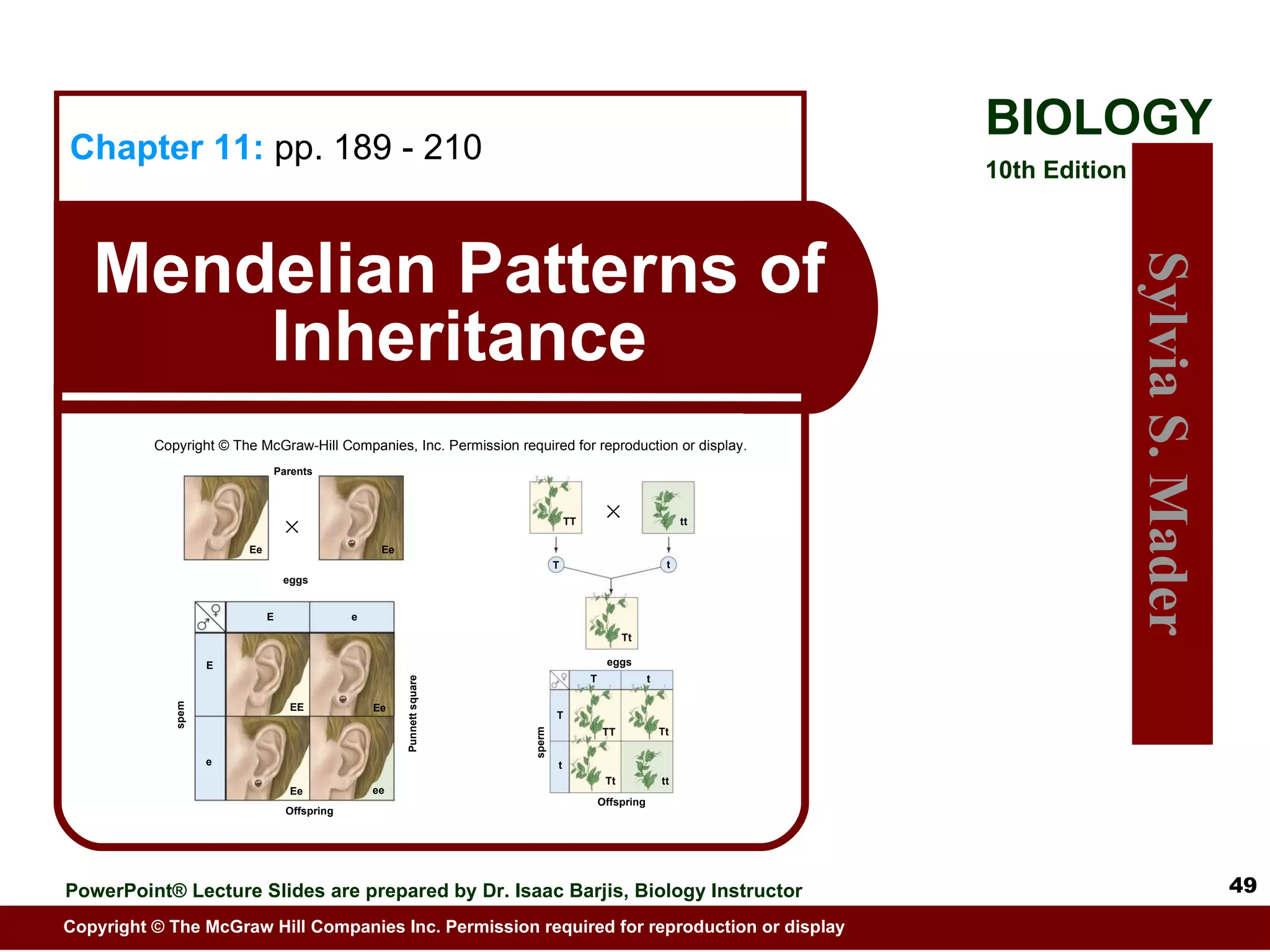
The document summarizes key concepts in genetics discovered by Gregor Mendel through his experiments with pea plants, including:
- Mendel performed breeding experiments with pea plants and discovered the laws of segregation and independent assortment.
- He found that traits are passed from parents to offspring through discrete factors (now known as genes and alleles) that sort independently during gamete formation and fertilization.
- Mendel's work laid the foundation for modern genetics concepts such as genotypes, phenotypes, dominance, and the use of Punnett squares to predict offspring ratios.
- The document also discusses how Mendel's principles can be applied to understand human genetic disorders and inheritance patterns such as autosomal and
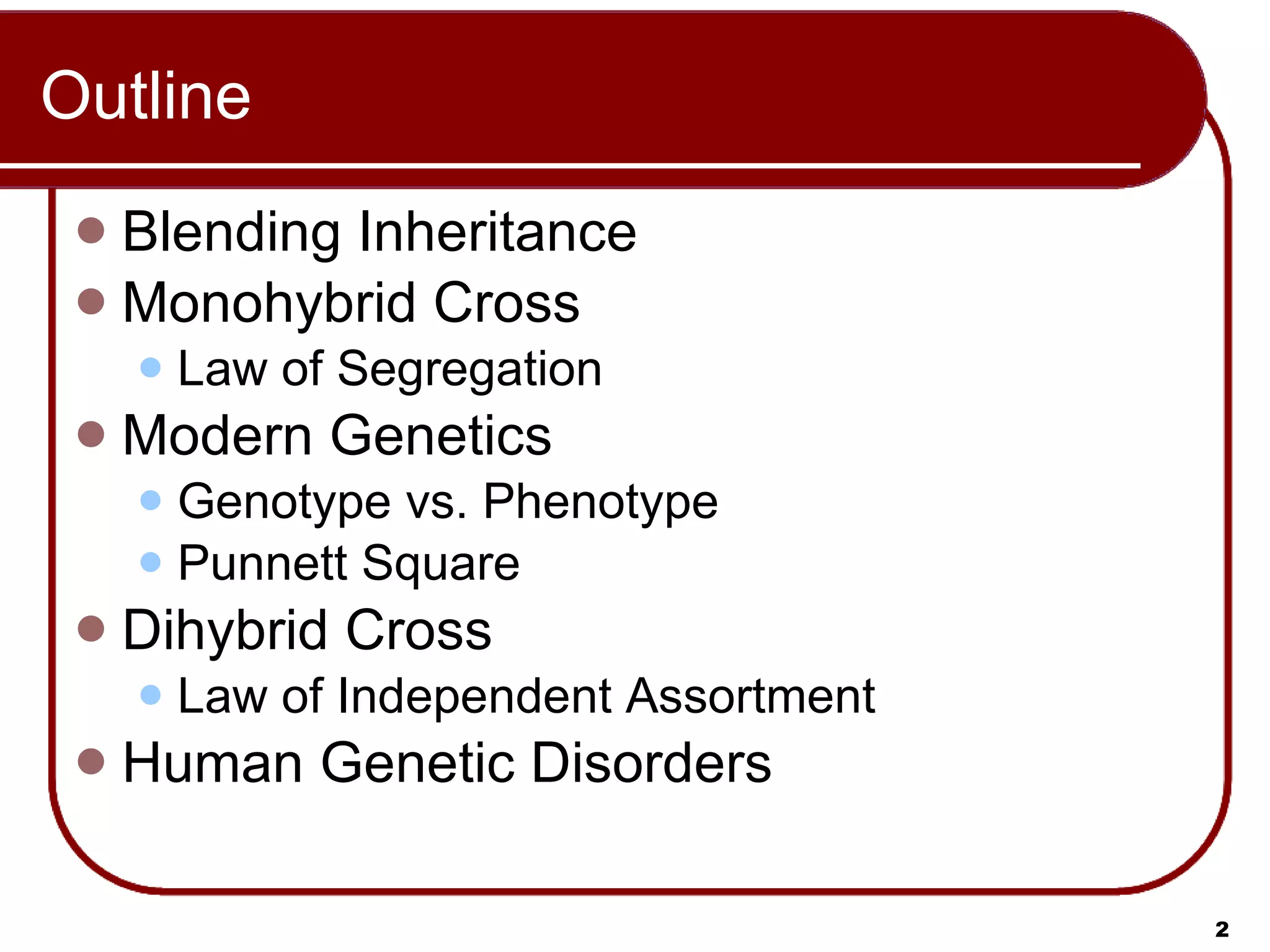
Outline Blending InheritanceMonohybrid Cross Law of Segregation Modern Genetics Genotype vs. Phenotype Punnett Square Dihybrid Cross Law of Independent Assortment Human Genetic Disorders
3.
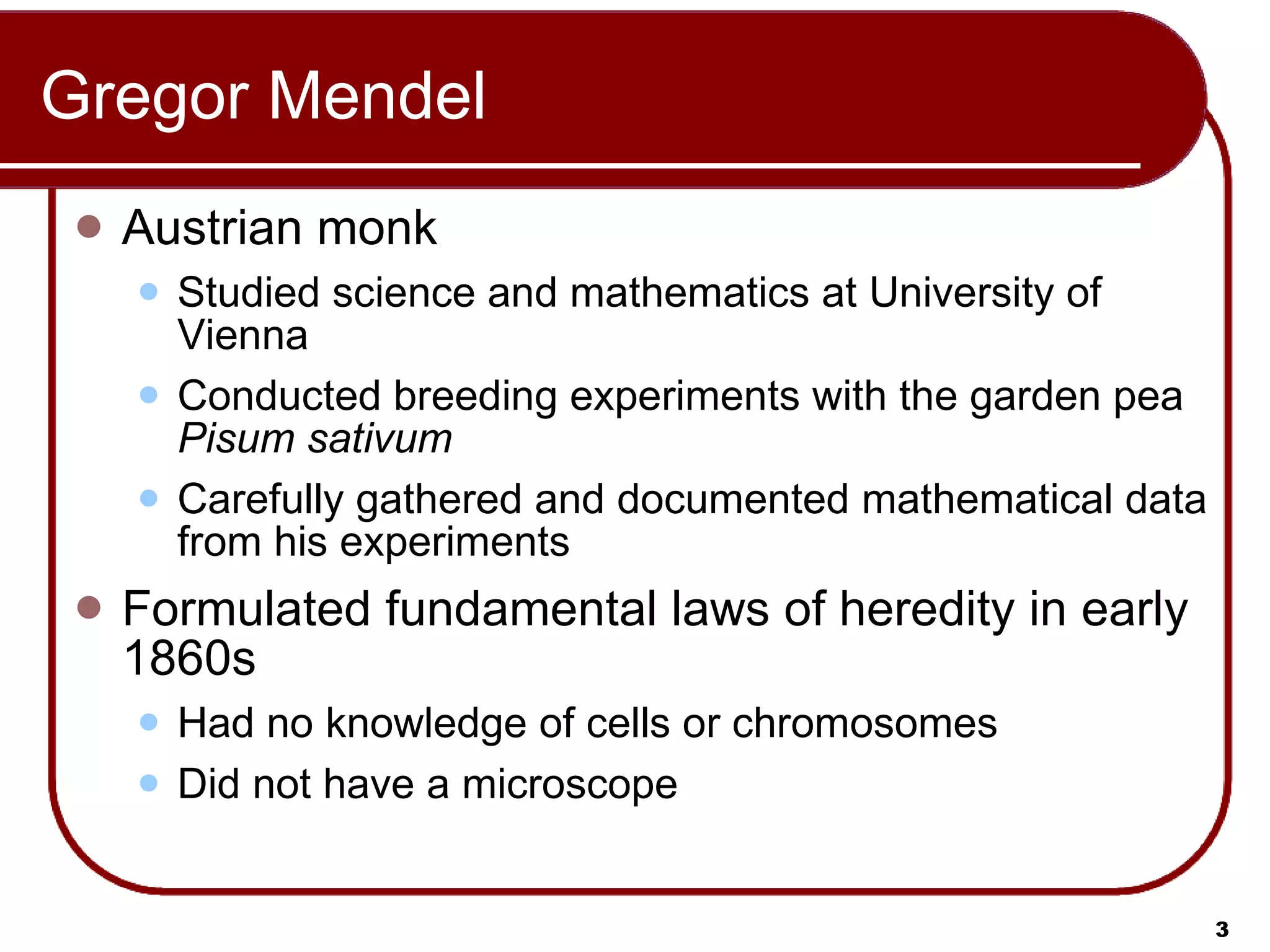
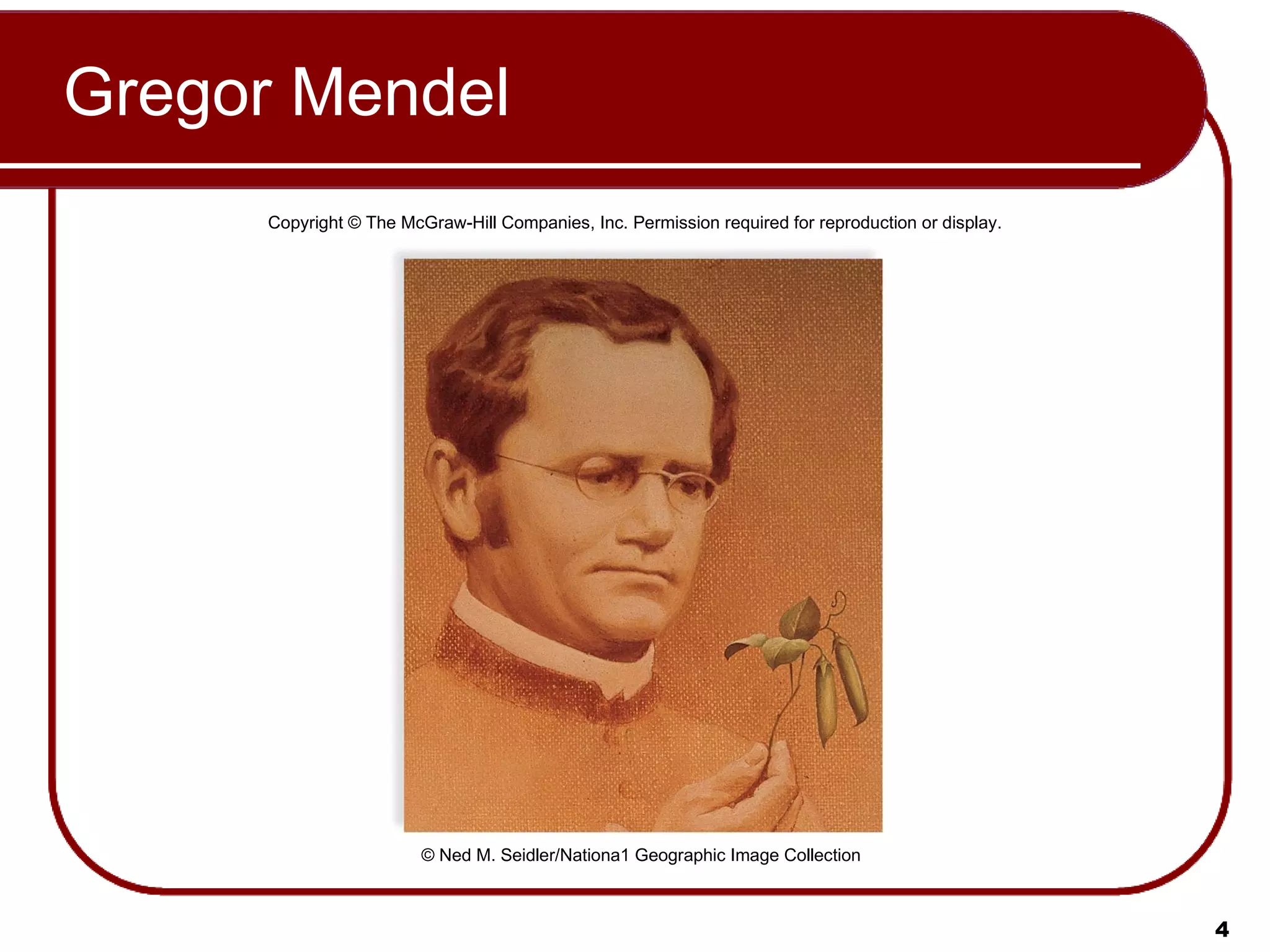
Gregor Mendel Austrianmonk Studied science and mathematics at University of Vienna Conducted breeding experiments with the garden pea Pisum sativum Carefully gathered and documented mathematical data from his experiments Formulated fundamental laws of heredity in early 1860s Had no knowledge of cells or chromosomes Did not have a microscope
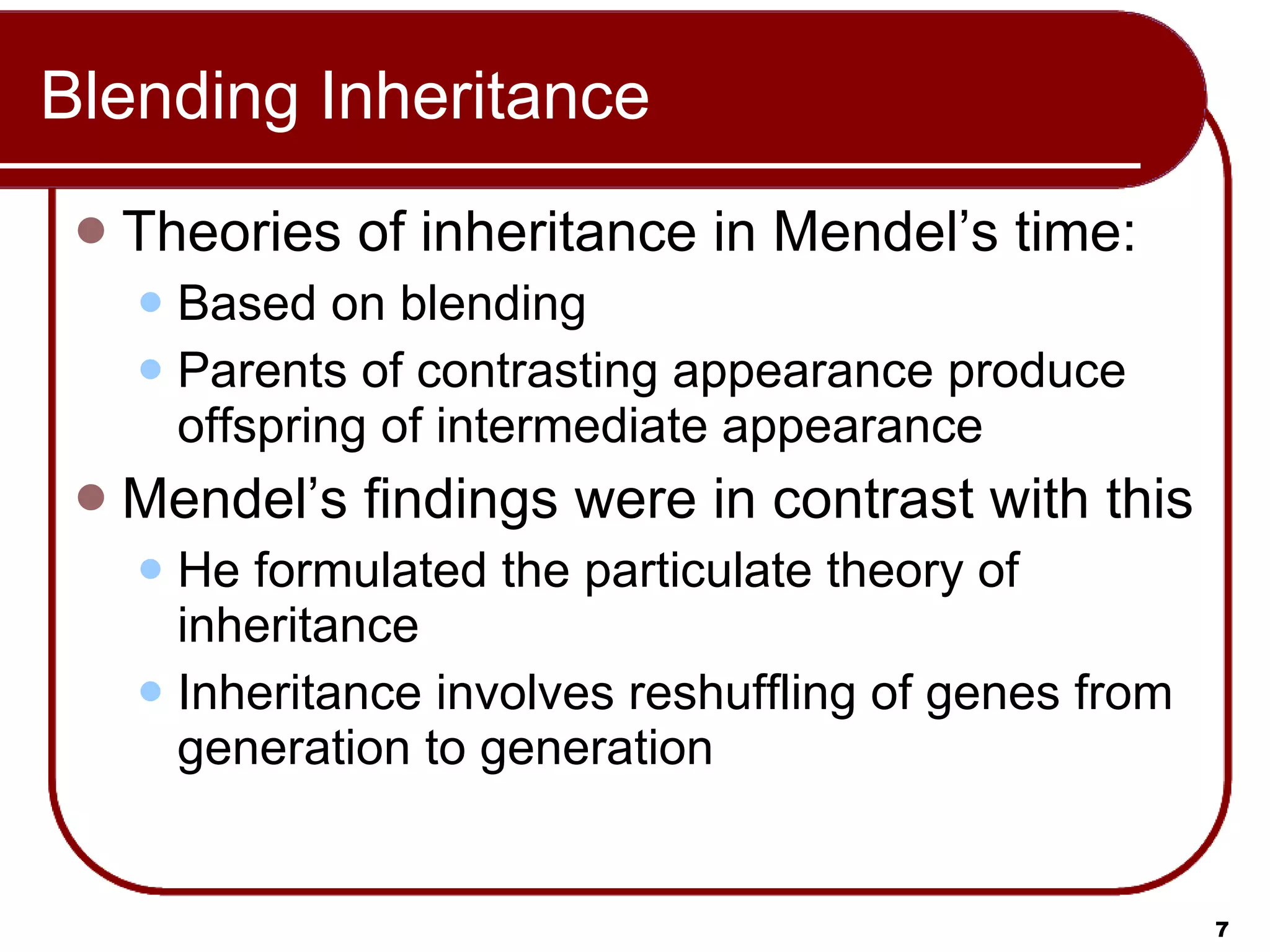
Blending Inheritance Theoriesof inheritance in Mendel’s time: Based on blending Parents of contrasting appearance produce offspring of intermediate appearance Mendel’s findings were in contrast with this He formulated the particulate theory of inheritance Inheritance involves reshuffling of genes from generation to generation
8.
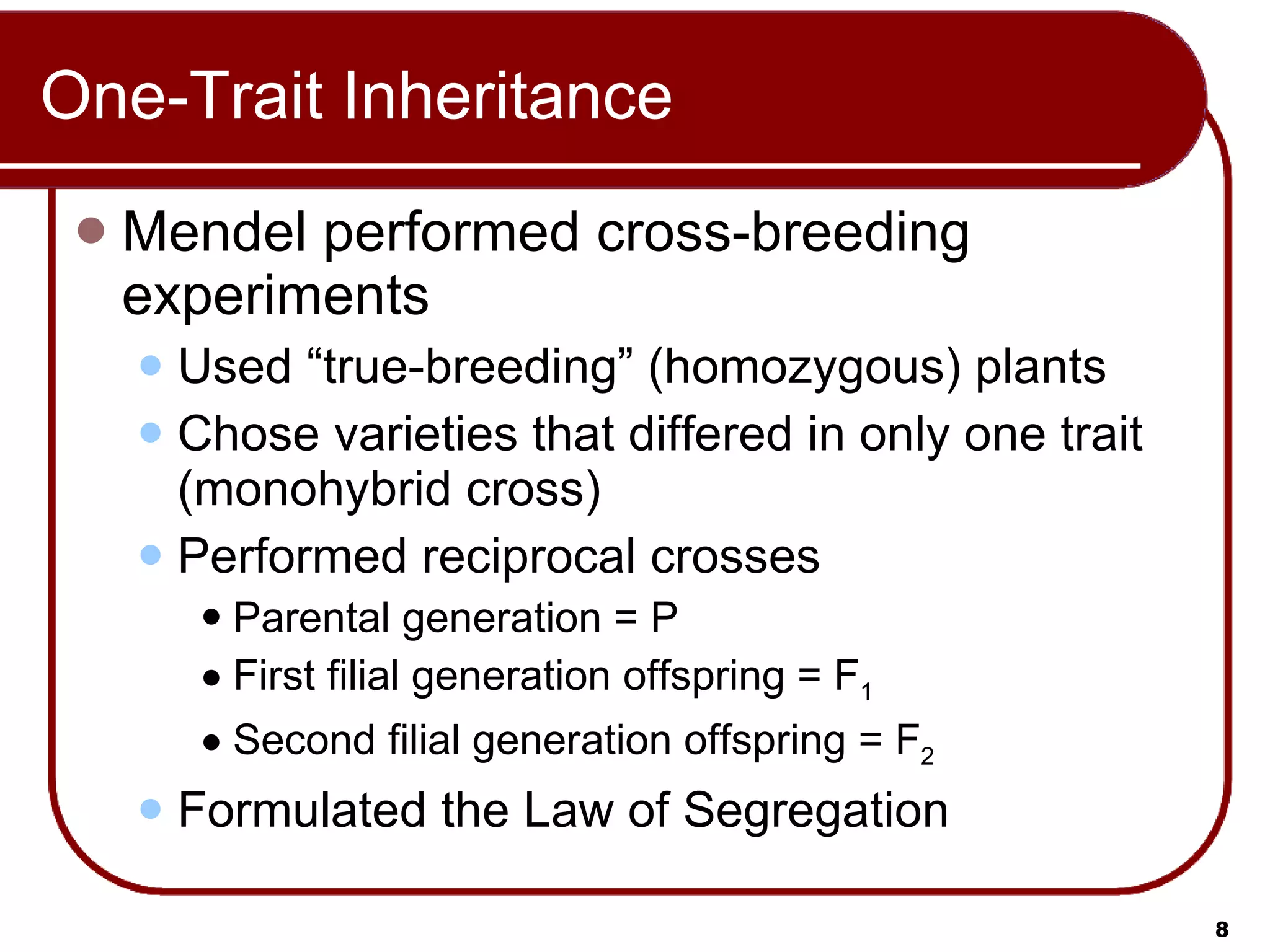
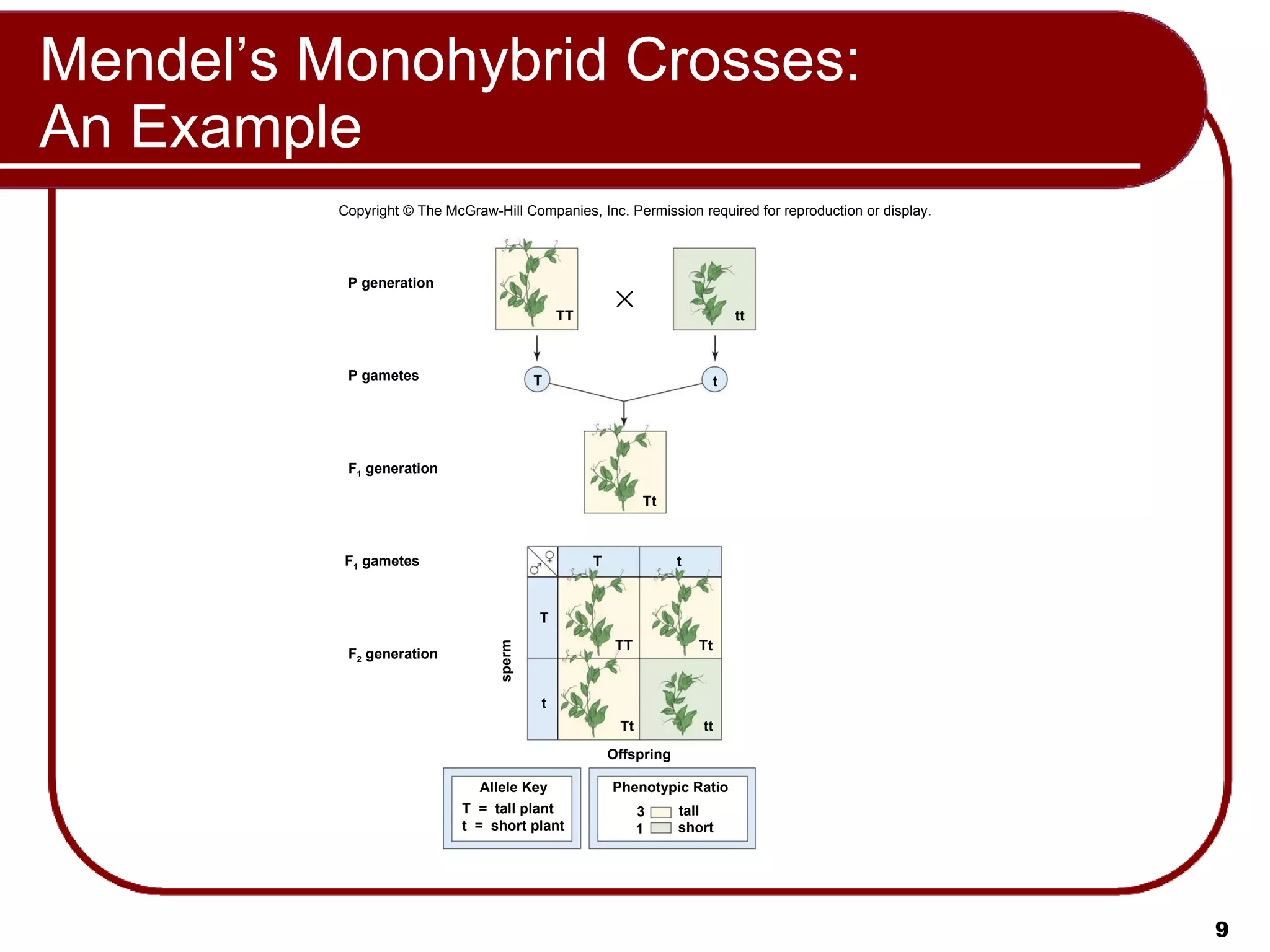
One-Trait Inheritance Mendelperformed cross-breeding experiments Used “true-breeding” (homozygous) plants Chose varieties that differed in only one trait (monohybrid cross) Performed reciprocal crosses Parental generation = P First filial generation offspring = F 1 Second filial generation offspring = F 2 Formulated the Law of Segregation
Law of SegregationEach individual has a pair of factors (alleles) for each trait The factors (alleles) segregate (separate) during gamete (sperm & egg) formation Each gamete contains only one factor (allele) from each pair Fertilization gives the offspring two factors for each trait
11.
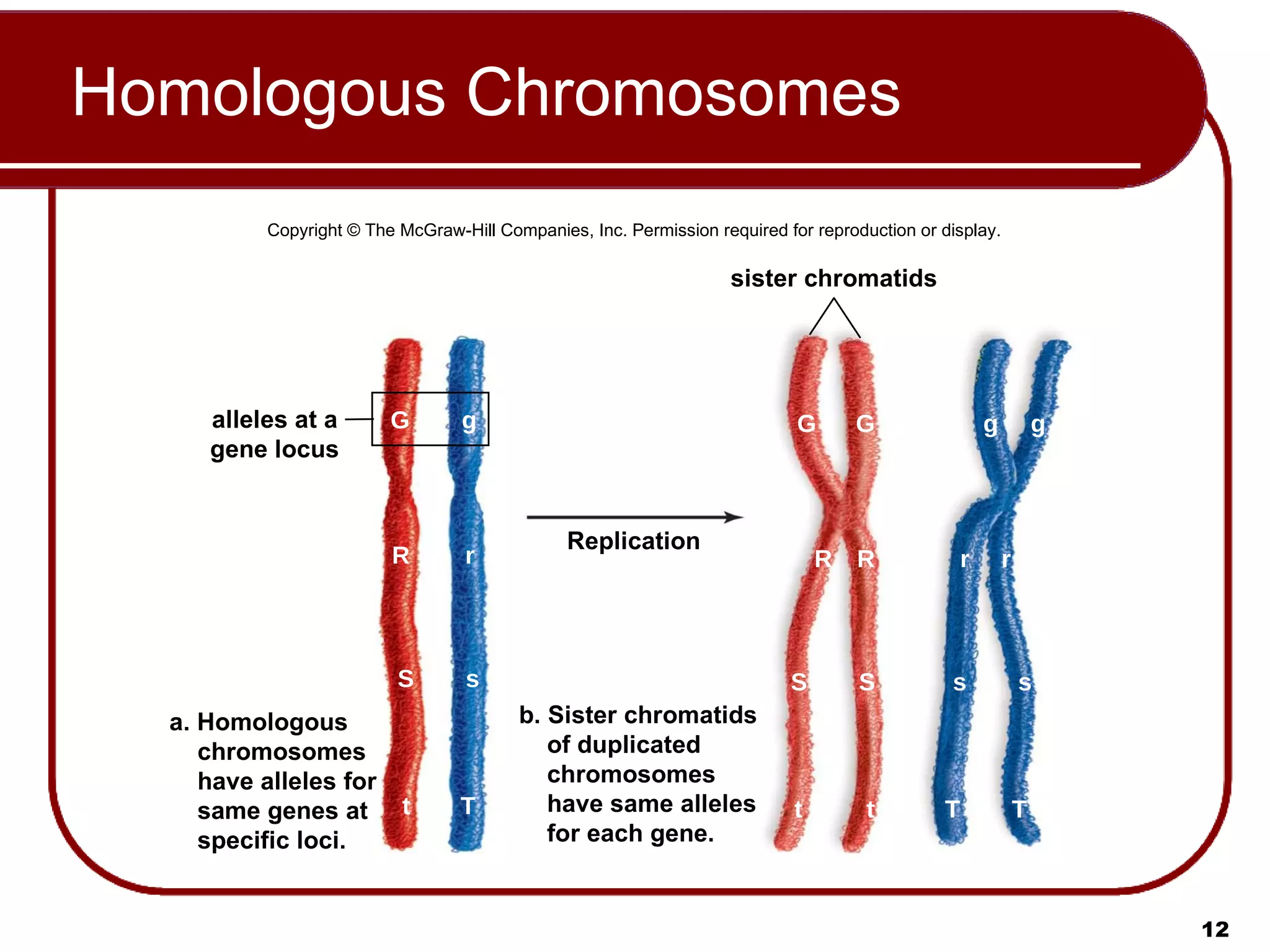
Modern Genetics ViewEach trait in a pea plant is controlled by two alleles (alternate forms of a gene) Dominant allele (capital letter) masks the expression of the recessive allele (lower-case) Alleles occur on a homologous pair of chromosomes at a particular gene locus Homozygous = identical alleles Heterozygous = different alleles
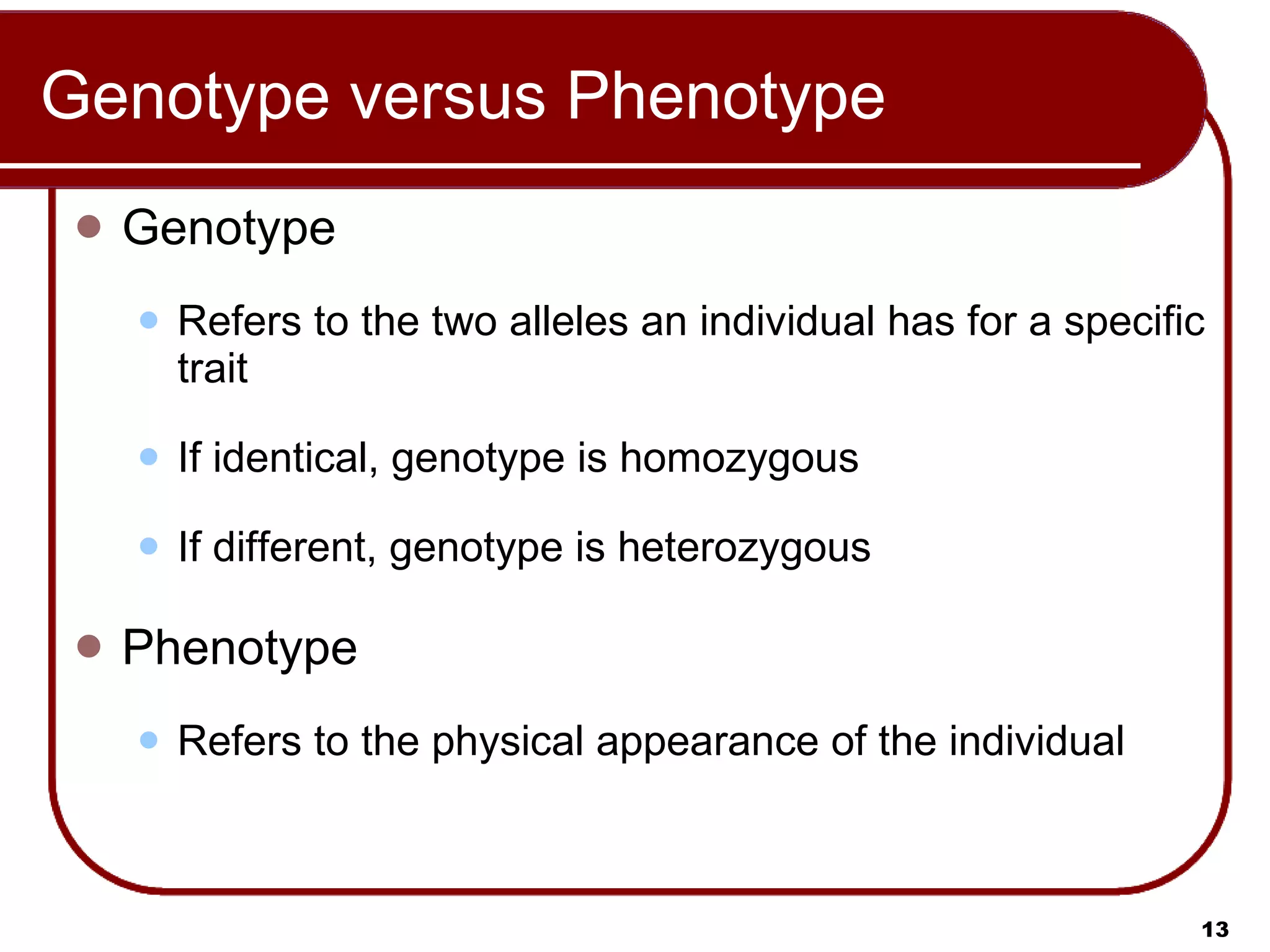
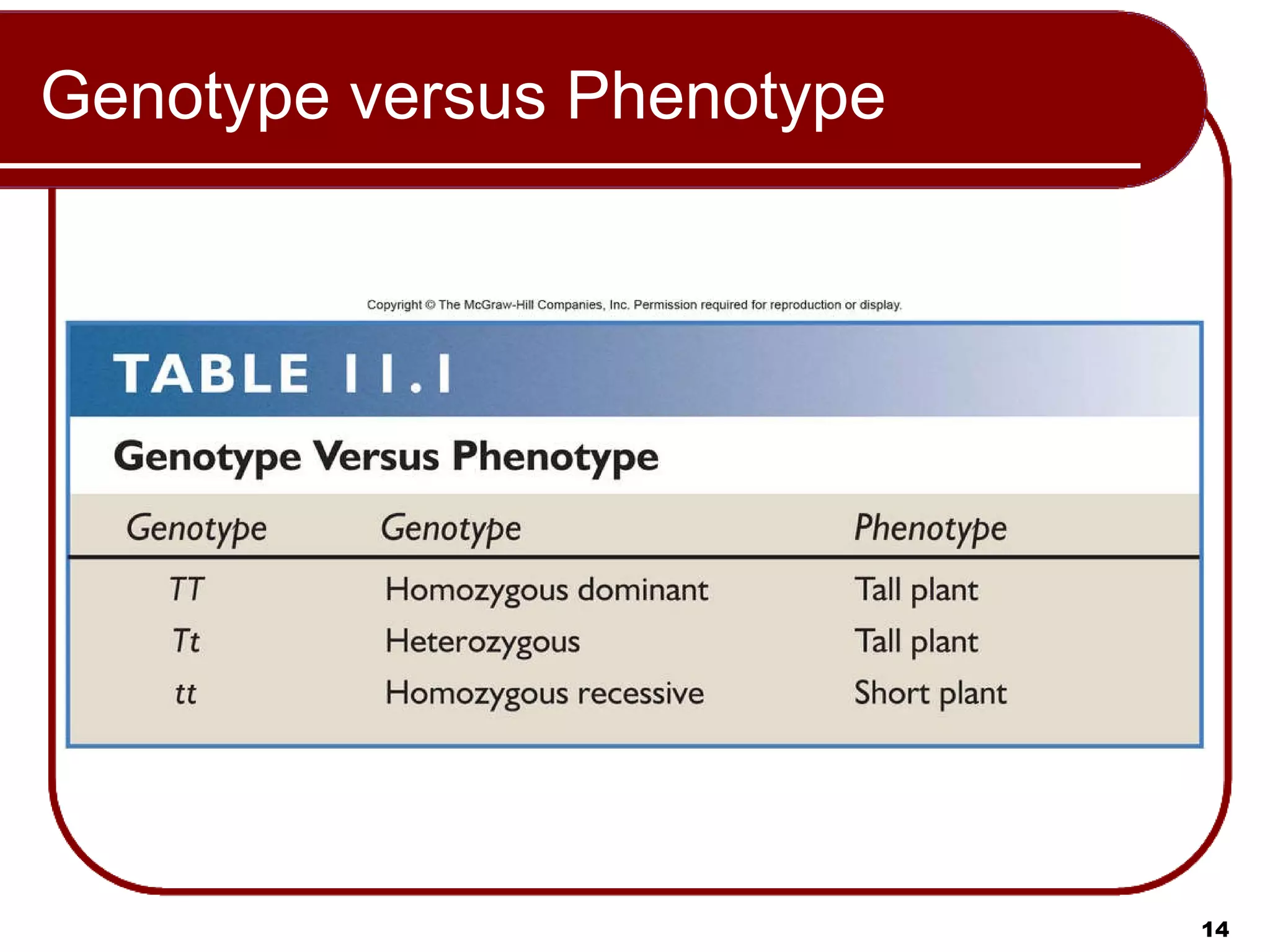
Genotype versus PhenotypeGenotype Refers to the two alleles an individual has for a specific trait If identical, genotype is homozygous If different, genotype is heterozygous Phenotype Refers to the physical appearance of the individual
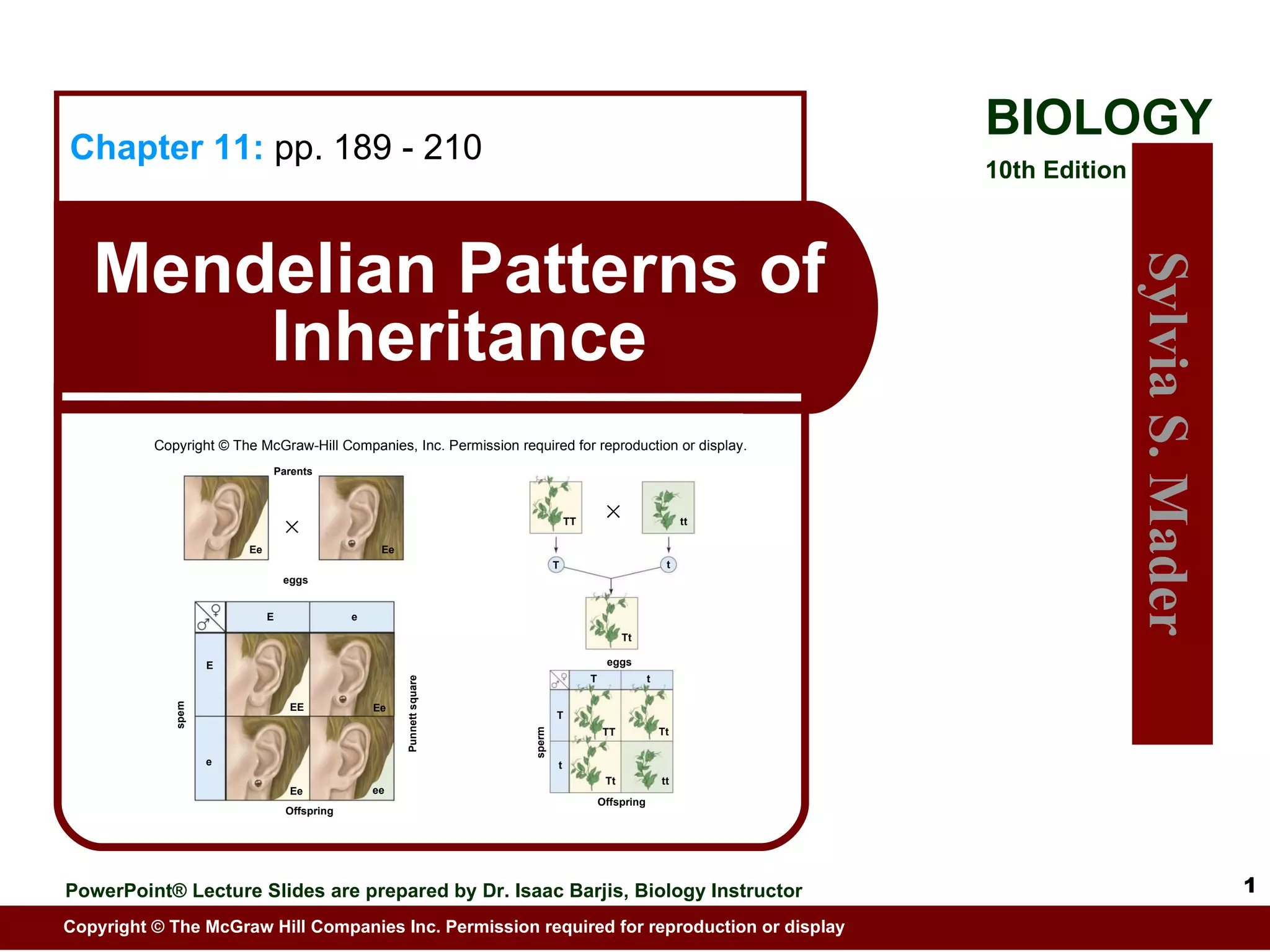
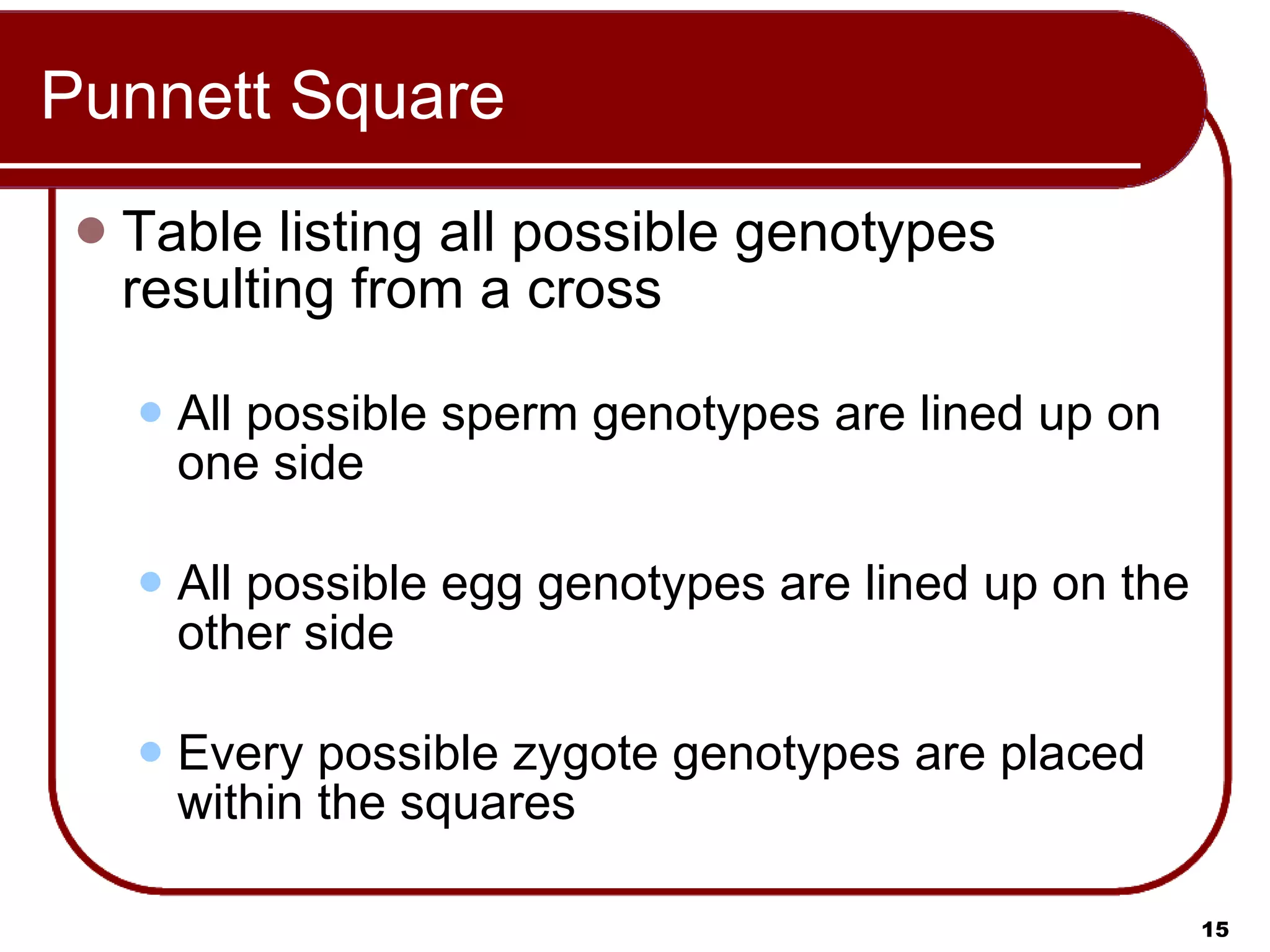
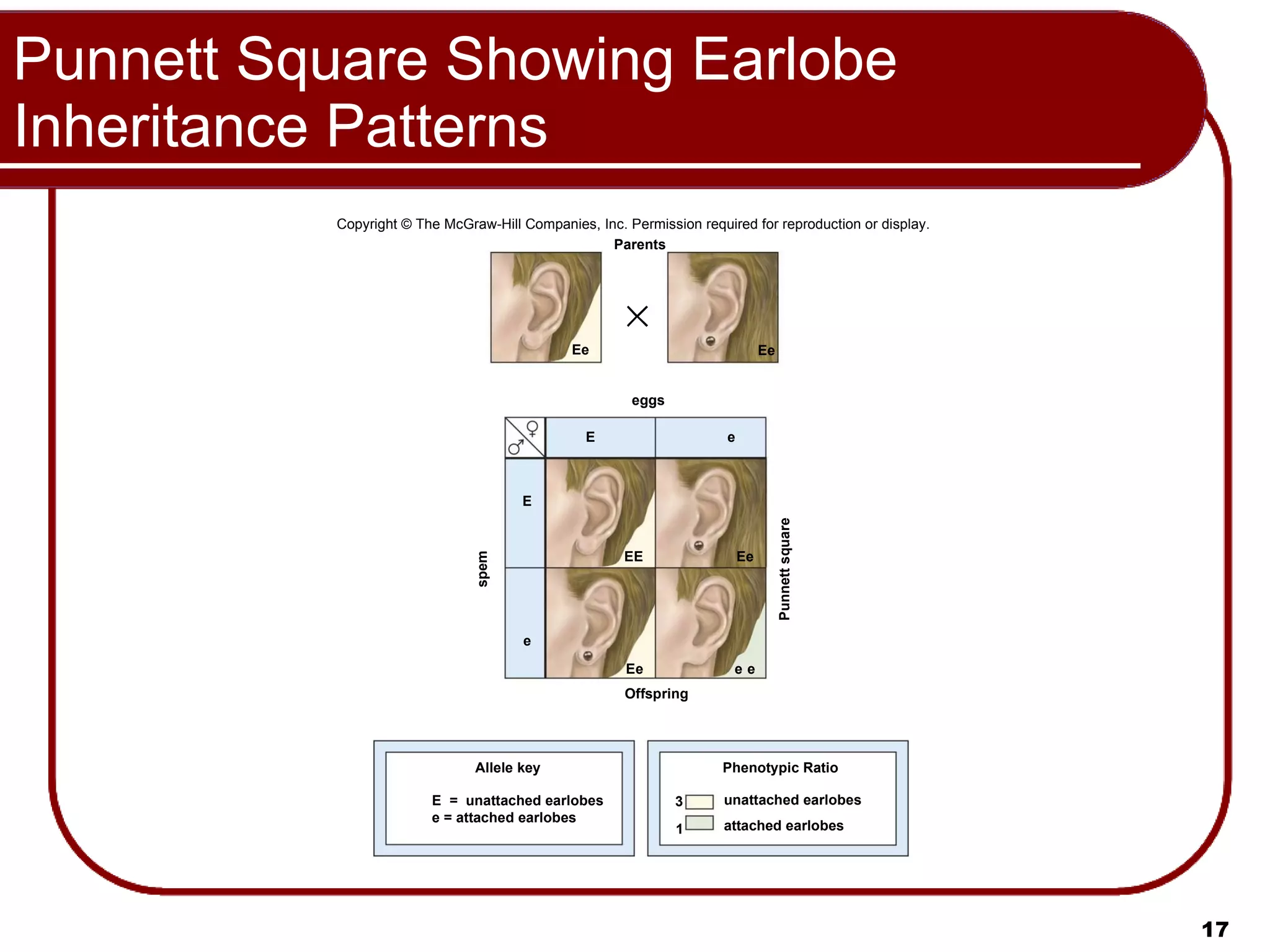
Punnett Square Tablelisting all possible genotypes resulting from a cross All possible sperm genotypes are lined up on one side All possible egg genotypes are lined up on the other side Every possible zygote genotypes are placed within the squares
16.
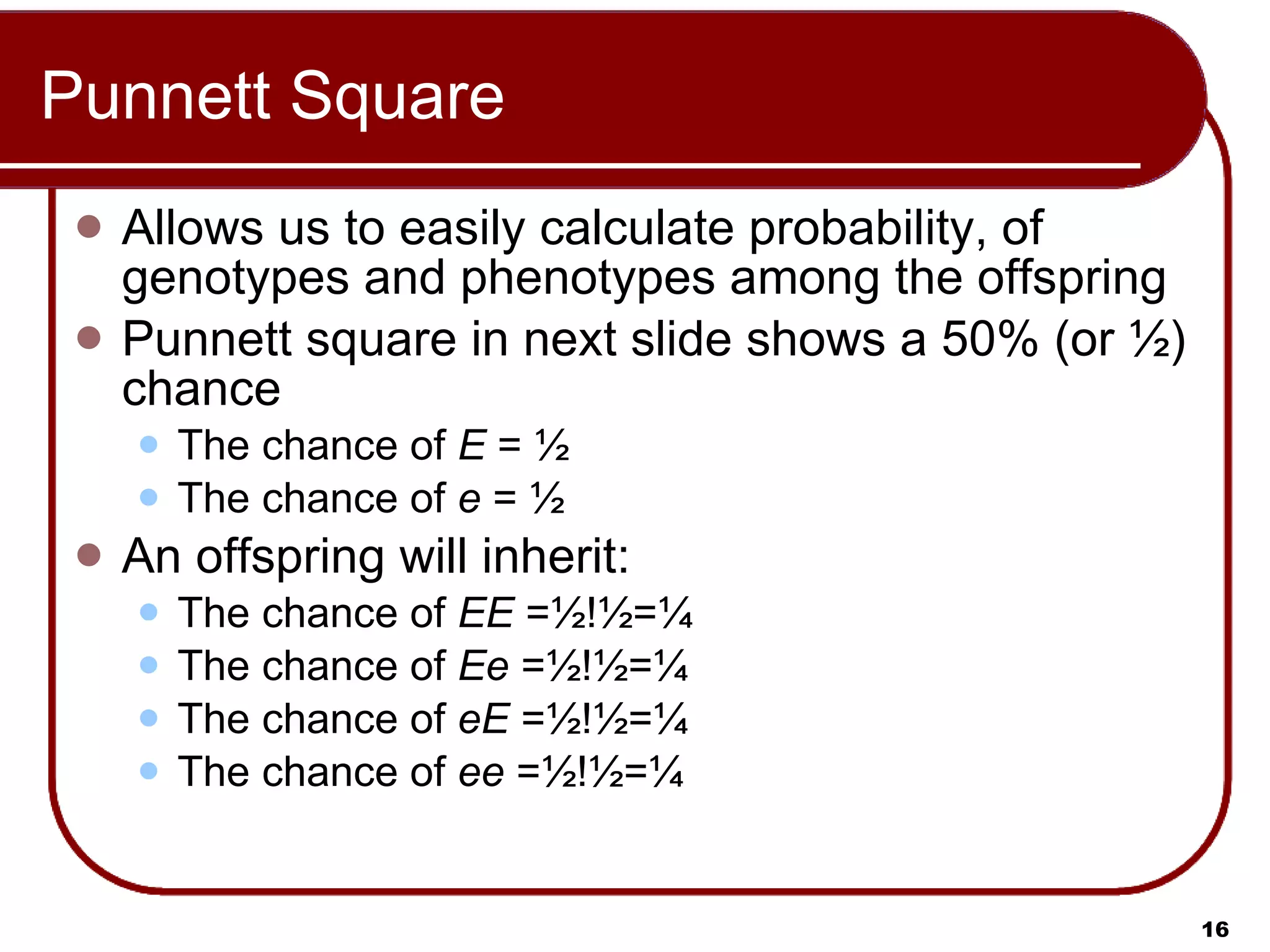
Punnett Square Allowsus to easily calculate probability, of genotypes and phenotypes among the offspring Punnett square in next slide shows a 50% (or ½) chance The chance of E = ½ The chance of e = ½ An offspring will inherit: The chance of EE =½!½=¼ The chance of Ee =½!½=¼ The chance of eE =½!½=¼ The chance of ee =½!½=¼
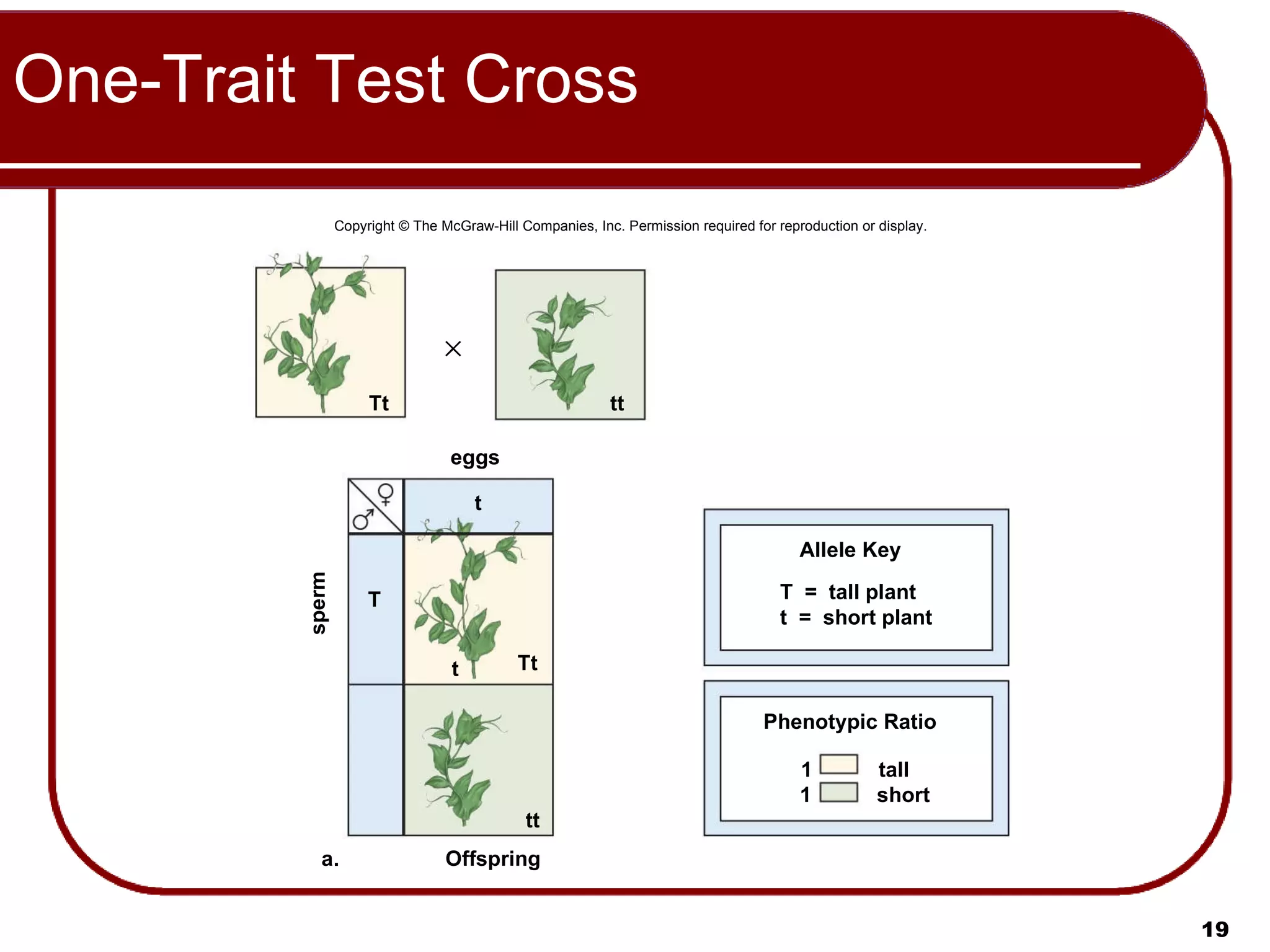
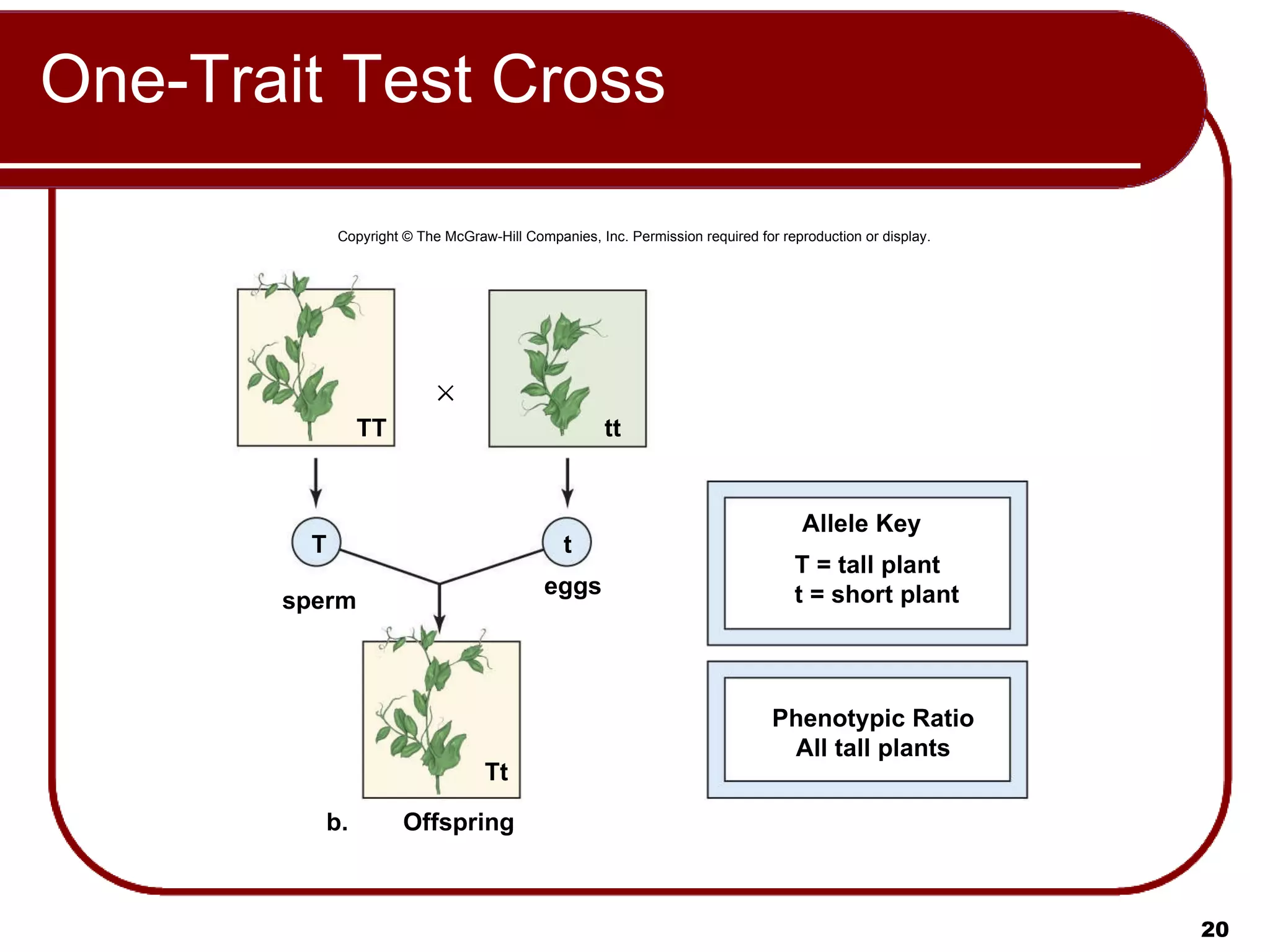
Monohybrid Test crossIndividuals with recessive phenotype always have the homozygous recessive genotype However, individuals with dominant phenotype have indeterminate genotype May be homozygous dominant, or Heterozygous Test cross determines genotype of individual having dominant phenotype
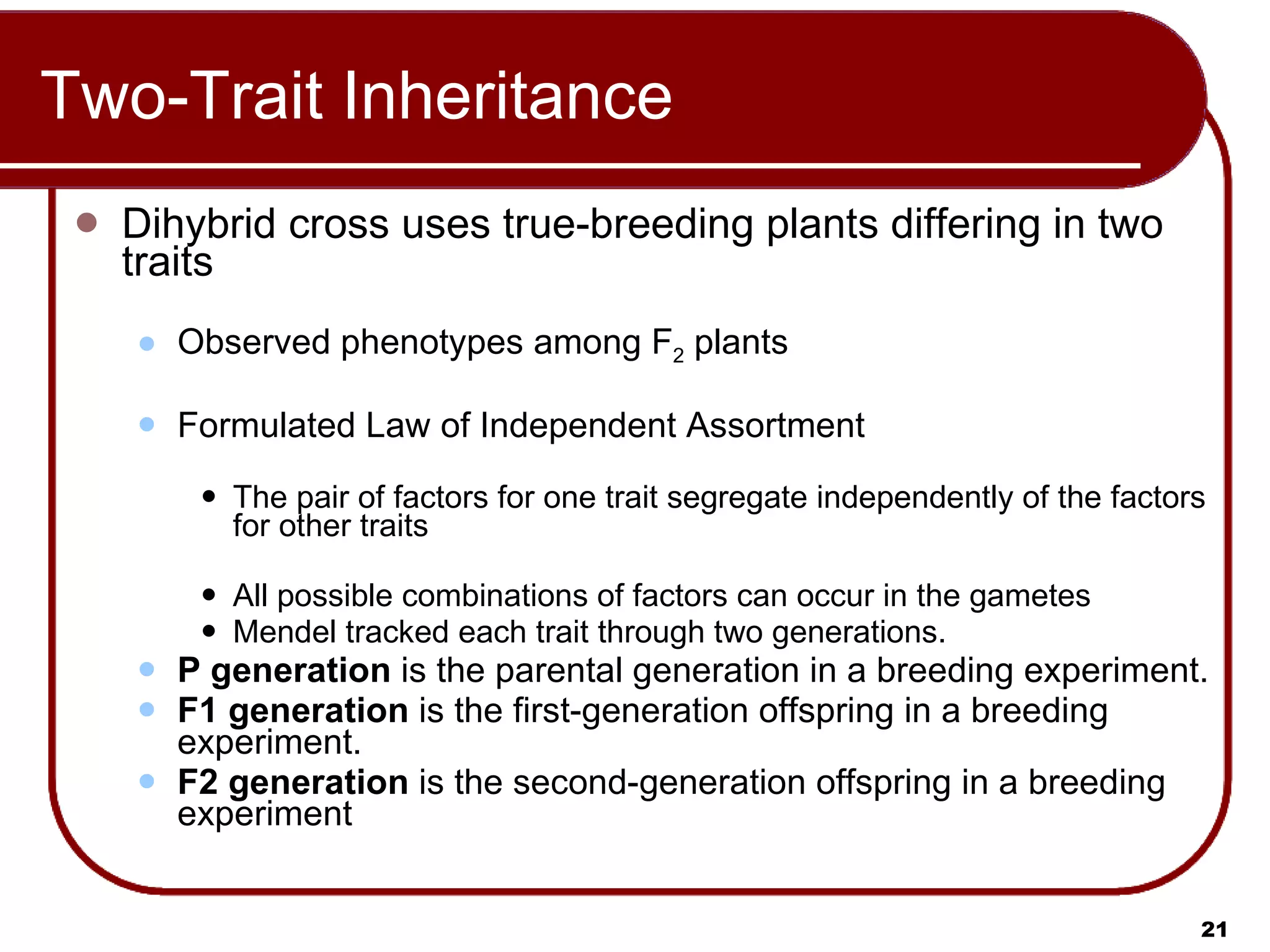
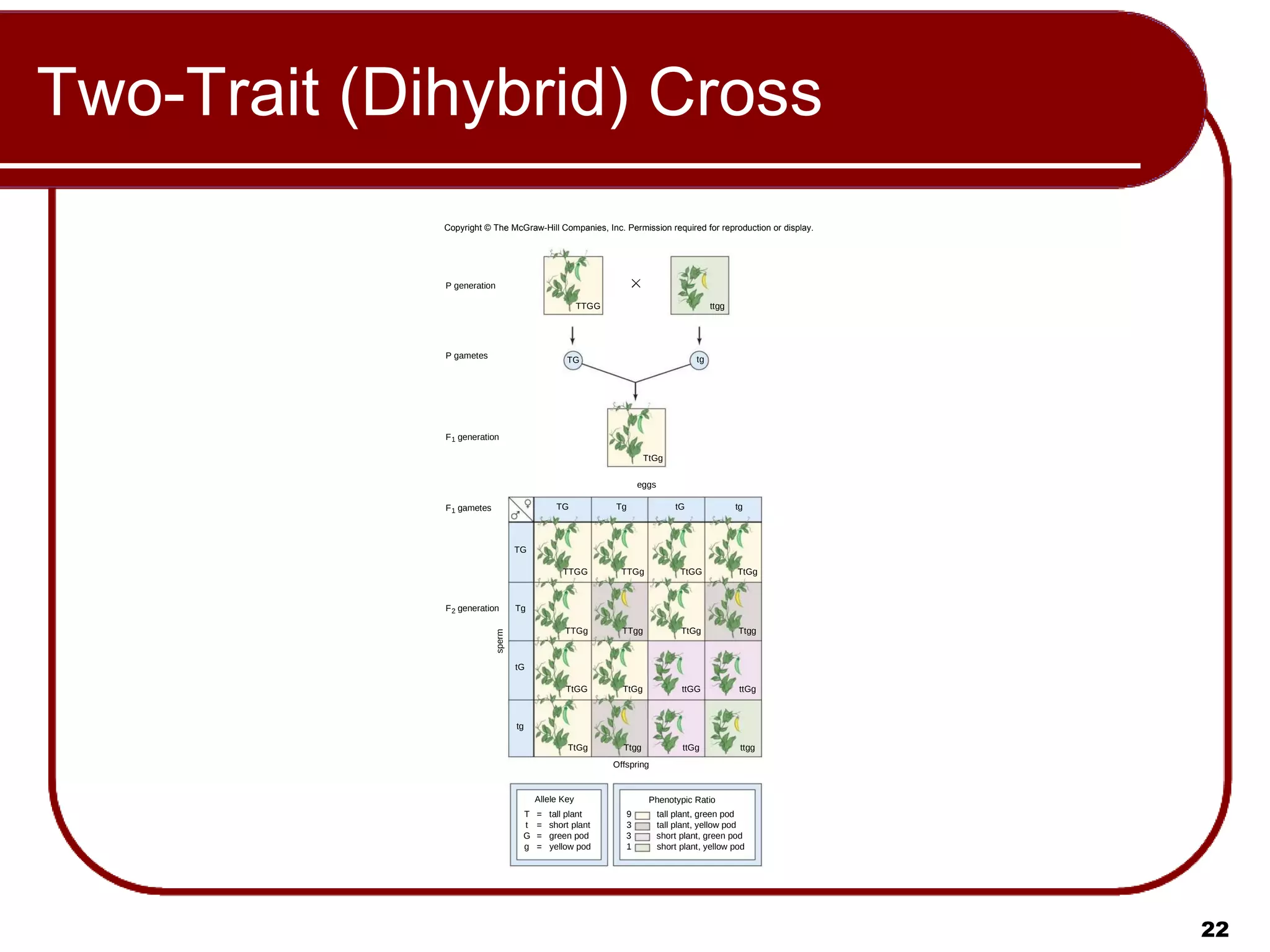
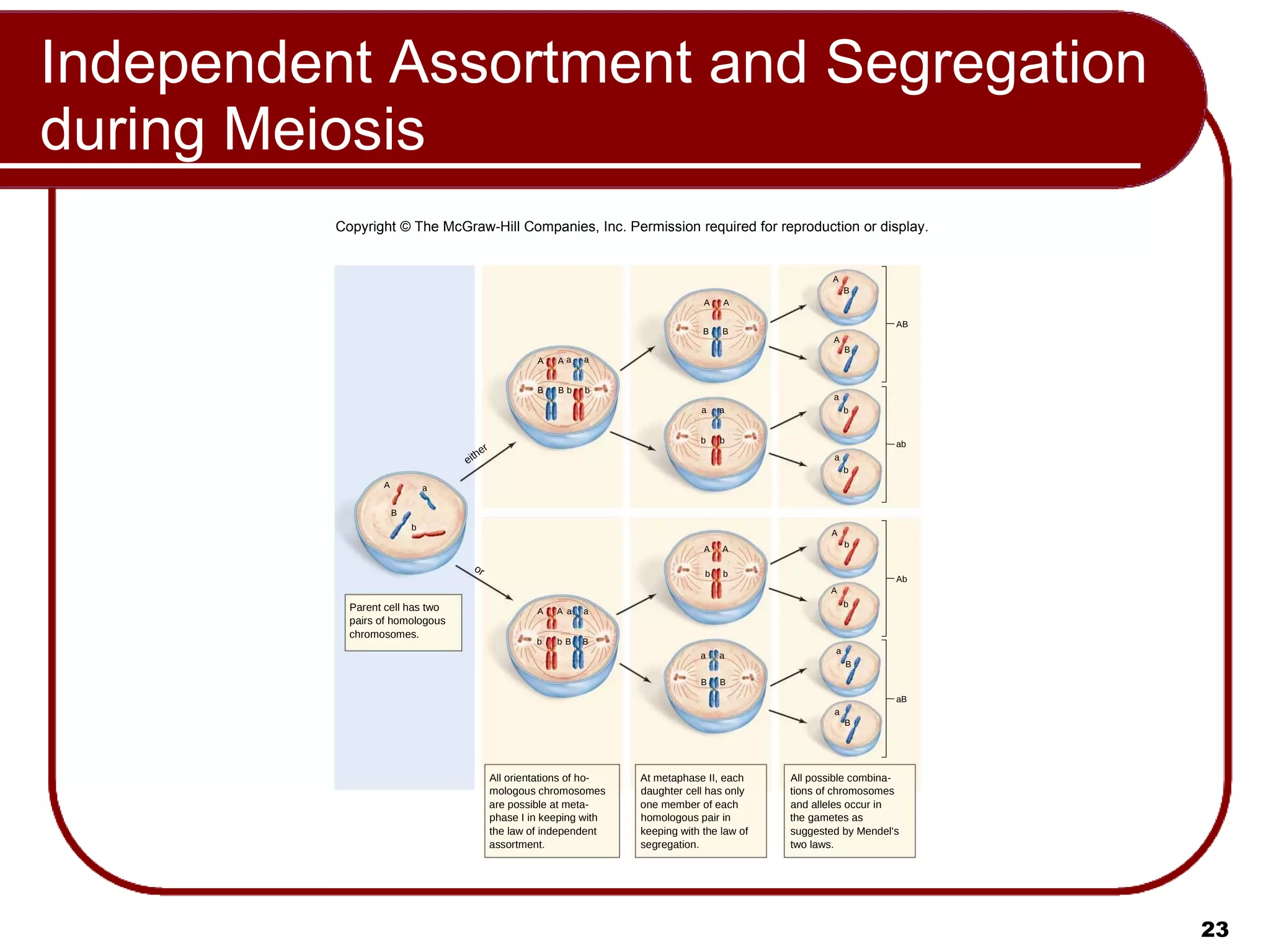
Two-Trait Inheritance Dihybridcross uses true-breeding plants differing in two traits Observed phenotypes among F 2 plants Formulated Law of Independent Assortment The pair of factors for one trait segregate independently of the factors for other traits All possible combinations of factors can occur in the gametes Mendel tracked each trait through two generations. P generation is the parental generation in a breeding experiment. F1 generation is the first-generation offspring in a breeding experiment. F2 generation is the second-generation offspring in a breeding experiment
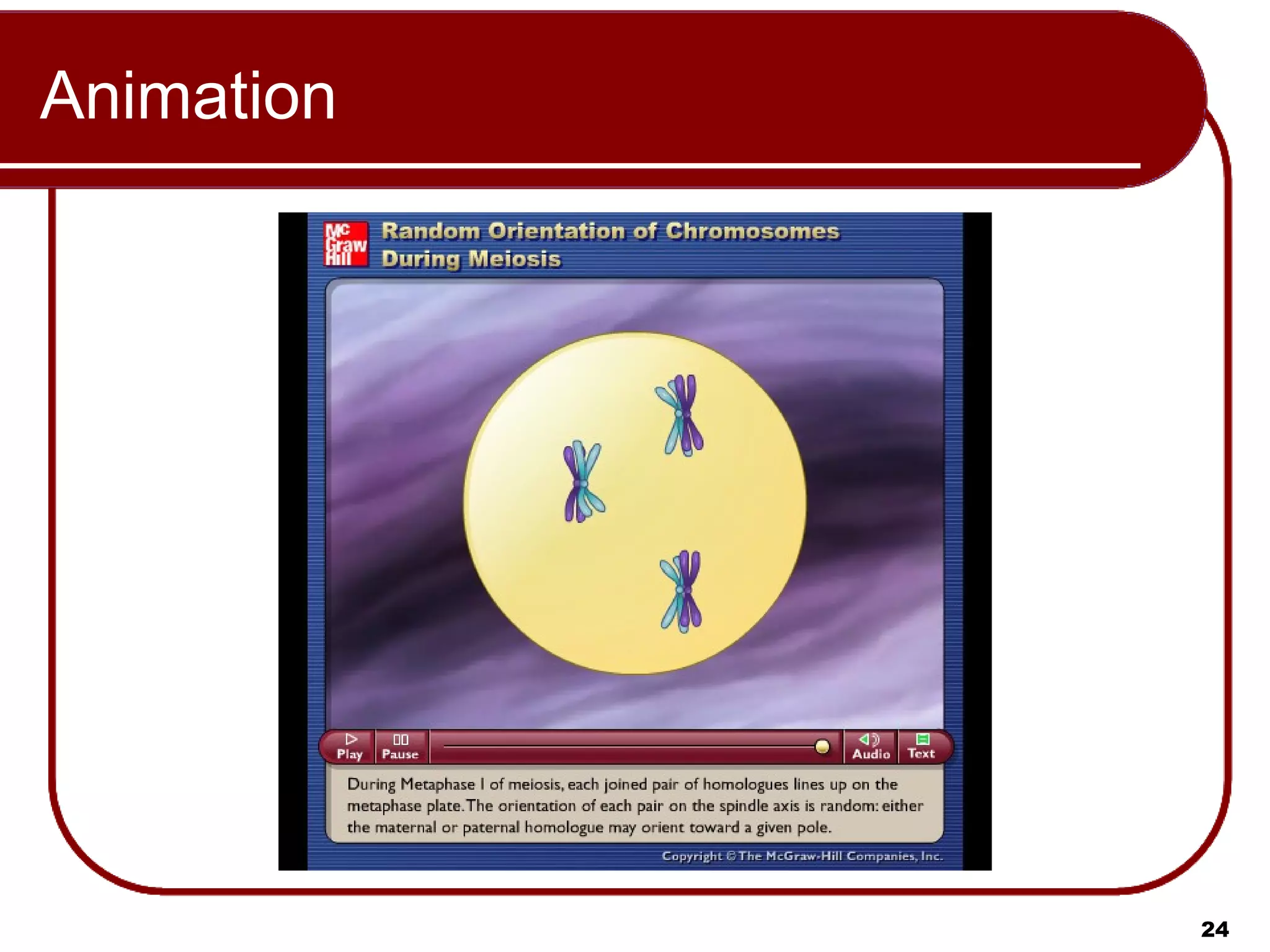
Animation Please notethat due to differing operating systems, some animations will not appear until the presentation is viewed in Presentation Mode (Slide Show view). You may see blank slides in the “Normal” or “Slide Sorter” views. All animations will appear after viewing in Presentation Mode and playing each animation. Most animations will require the latest version of the Flash Player, which is available at http://get.adobe.com/flashplayer.
25.
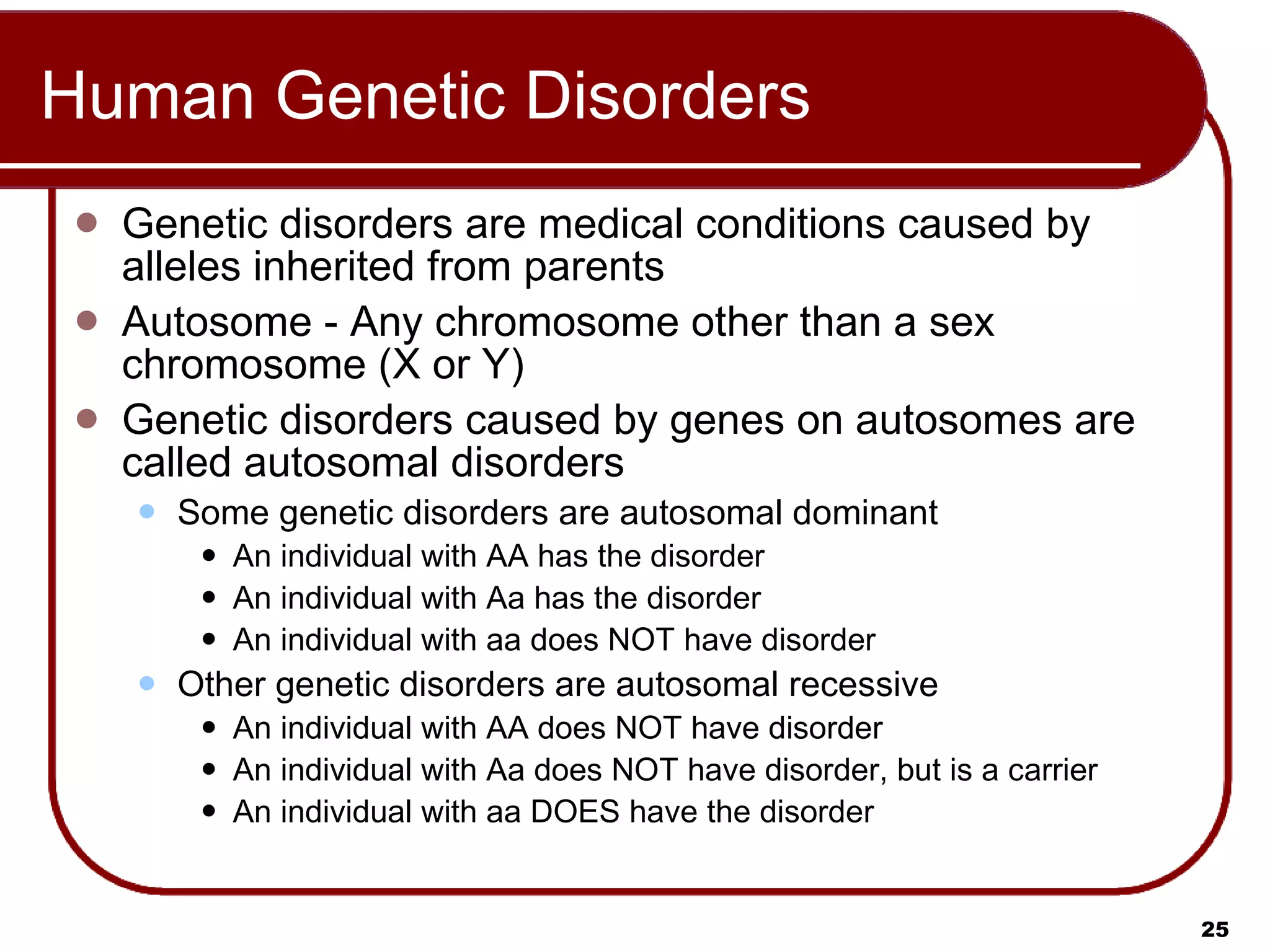
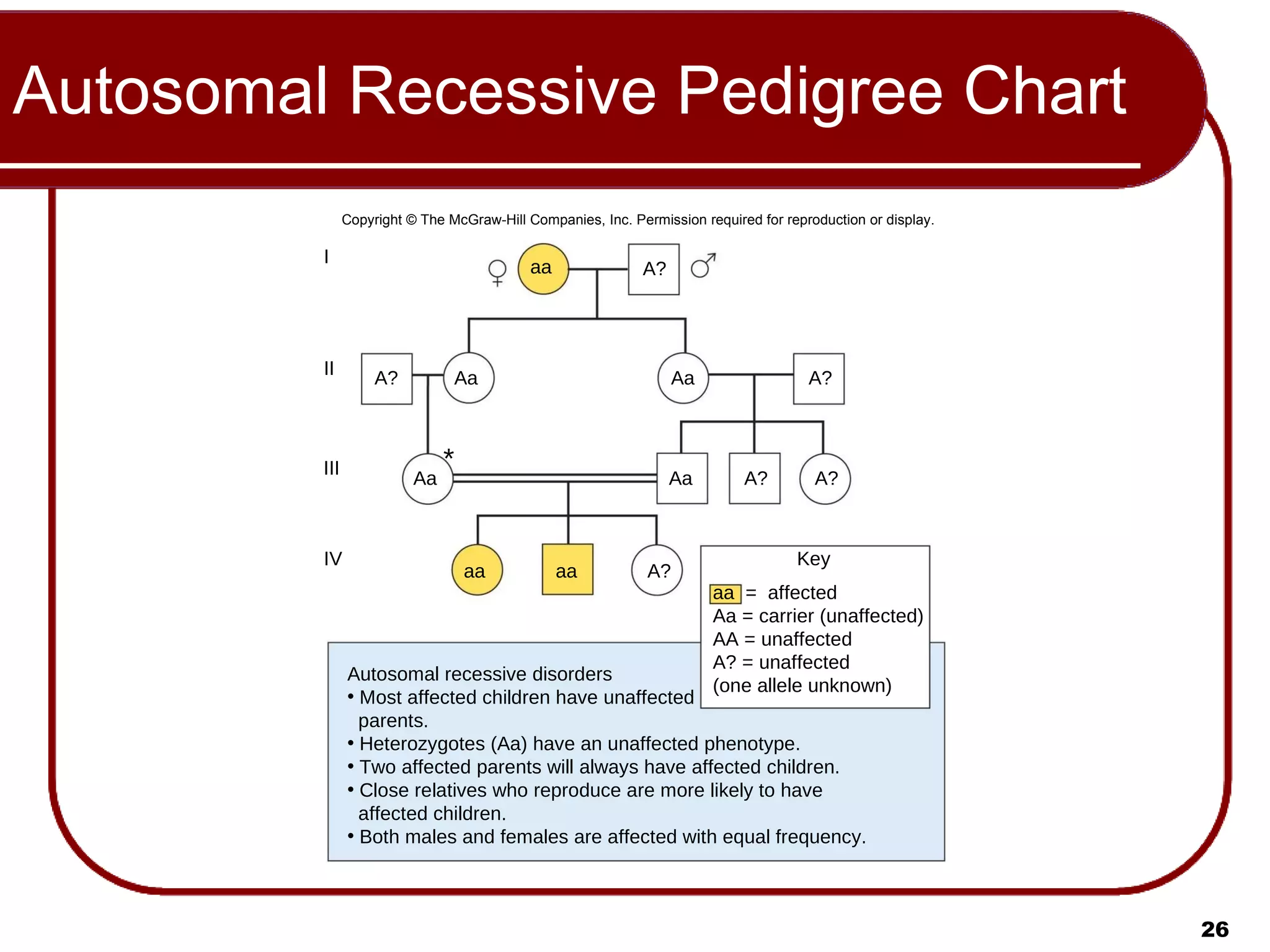
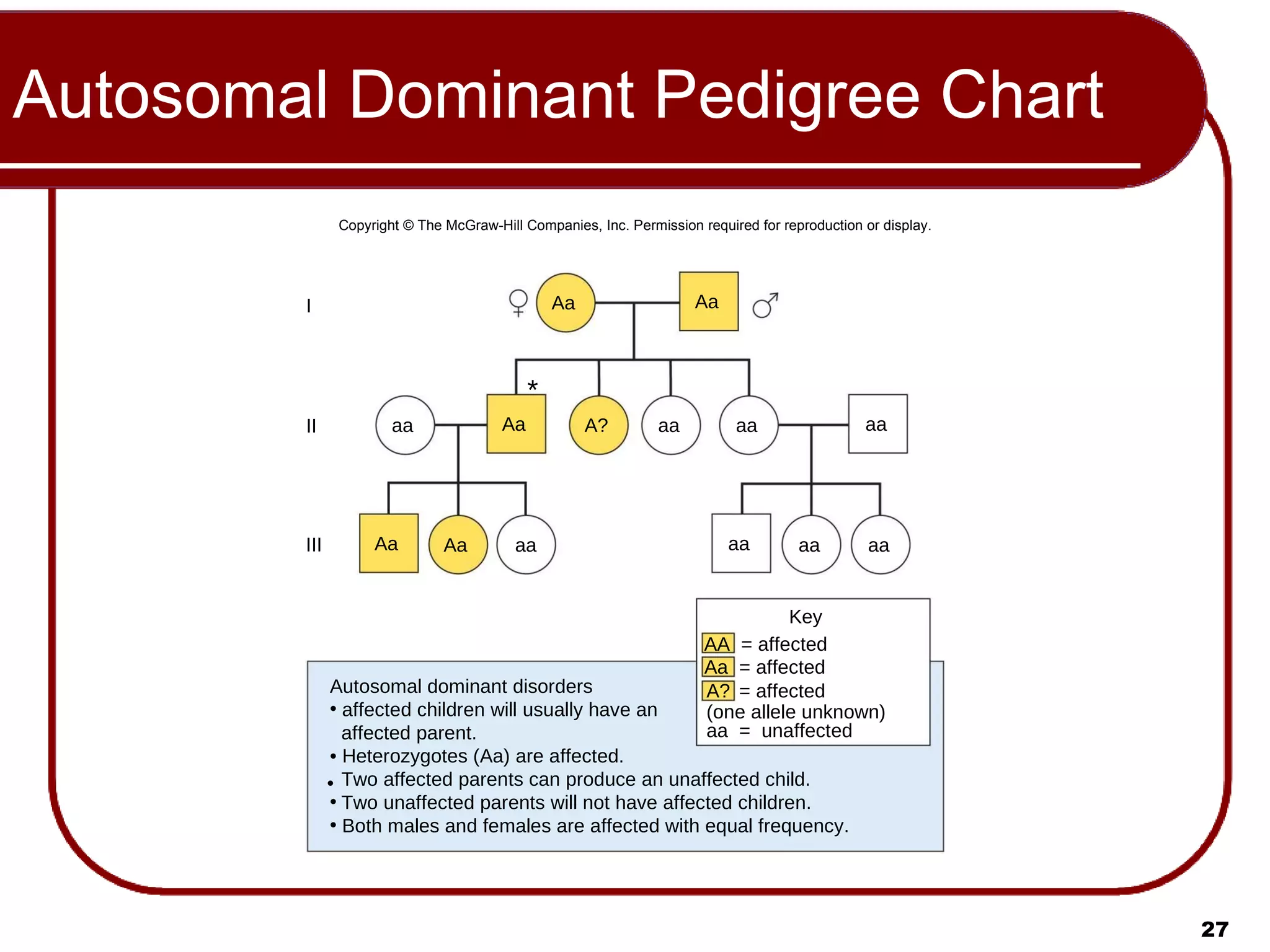
Human Genetic DisordersGenetic disorders are medical conditions caused by alleles inherited from parents Autosome - Any chromosome other than a sex chromosome (X or Y) Genetic disorders caused by genes on autosomes are called autosomal disorders Some genetic disorders are autosomal dominant An individual with AA has the disorder An individual with Aa has the disorder An individual with aa does NOT have disorder Other genetic disorders are autosomal recessive An individual with AA does NOT have disorder An individual with Aa does NOT have disorder, but is a carrier An individual with aa DOES have the disorder
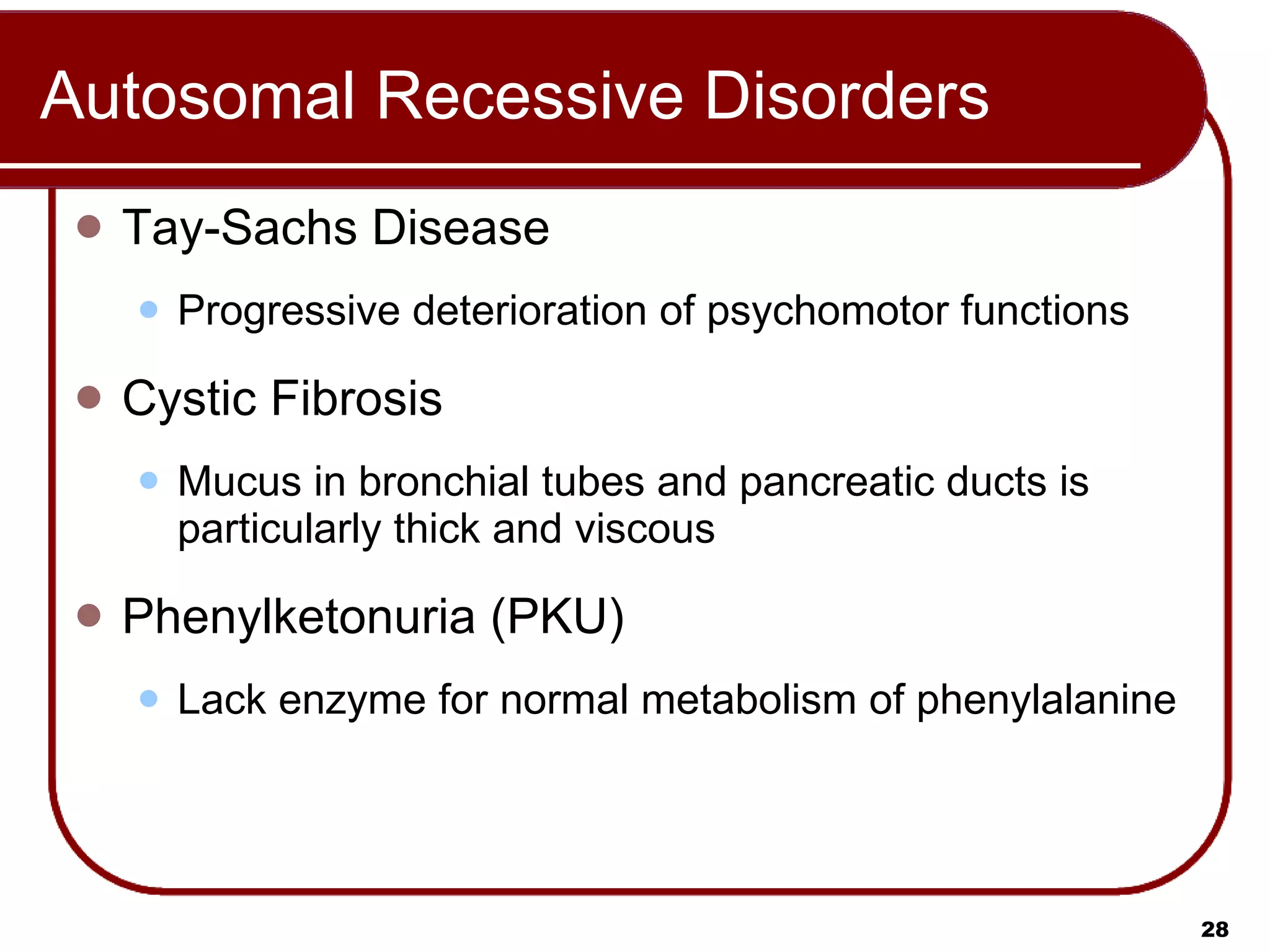
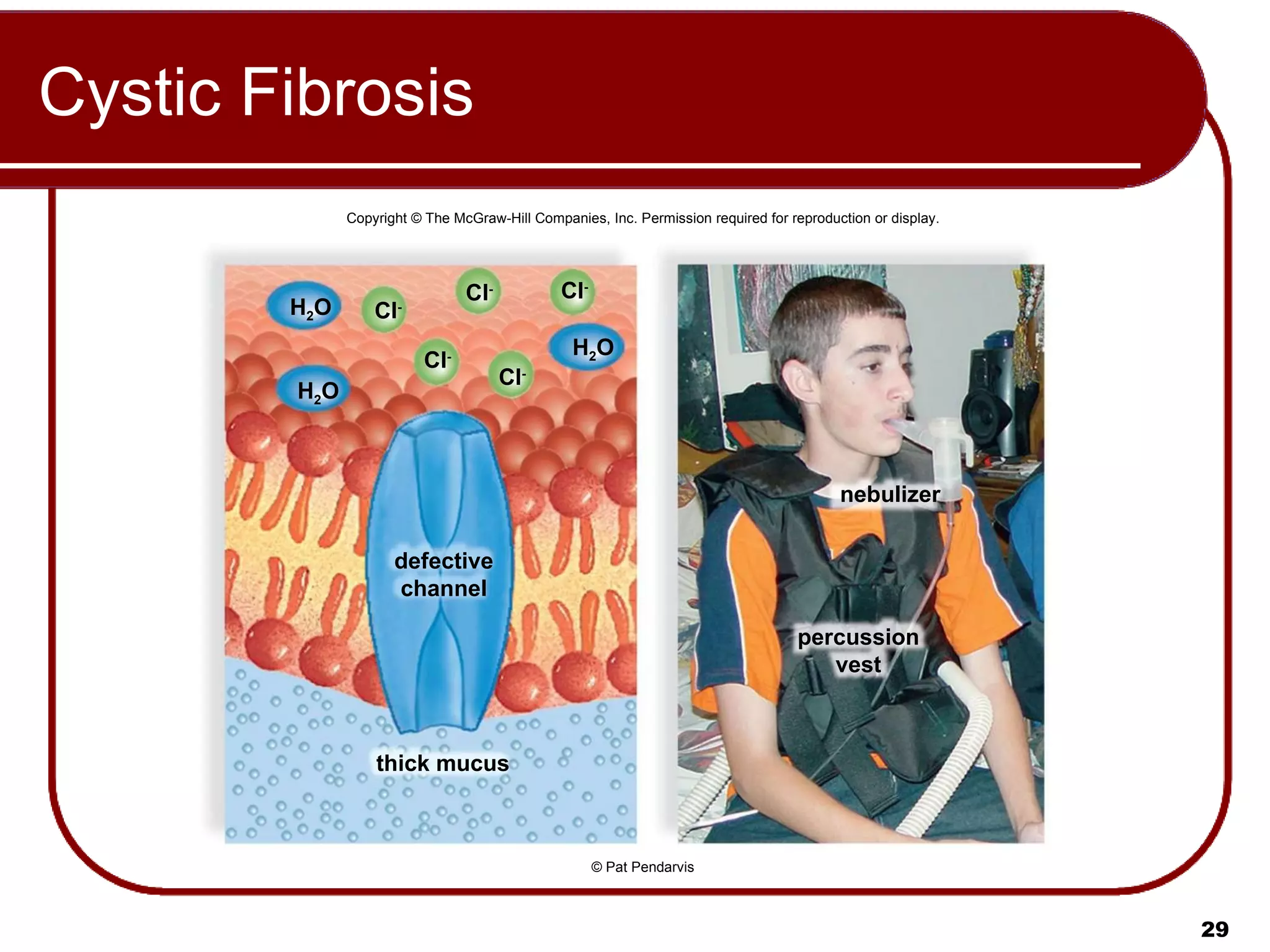
Autosomal Recessive DisordersTay-Sachs Disease Progressive deterioration of psychomotor functions Cystic Fibrosis Mucus in bronchial tubes and pancreatic ducts is particularly thick and viscous Phenylketonuria (PKU) Lack enzyme for normal metabolism of phenylalanine
Animation Please notethat due to differing operating systems, some animations will not appear until the presentation is viewed in Presentation Mode (Slide Show view). You may see blank slides in the “Normal” or “Slide Sorter” views. All animations will appear after viewing in Presentation Mode and playing each animation. Most animations will require the latest version of the Flash Player, which is available at http://get.adobe.com/flashplayer.
32.
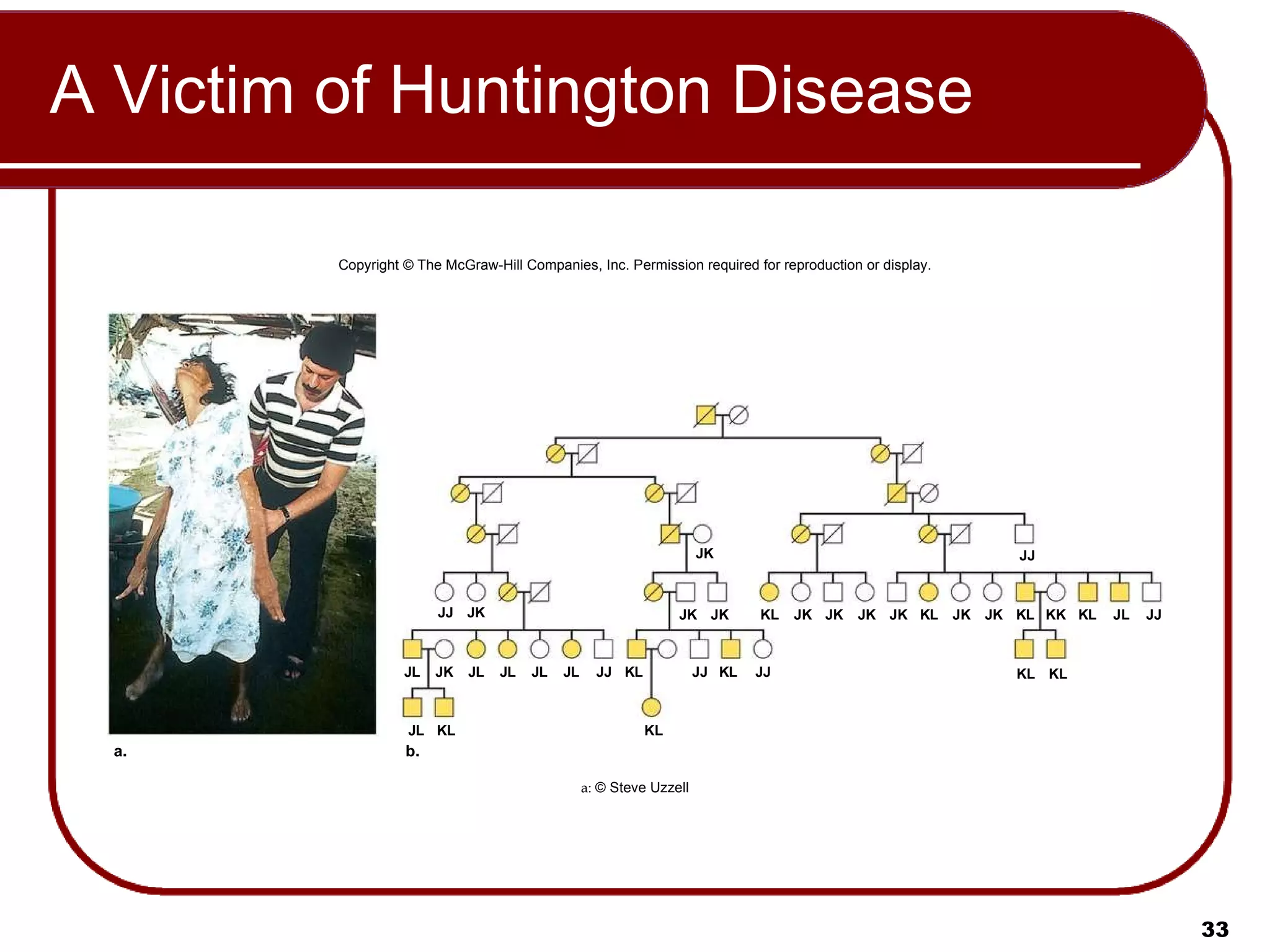
Autosomal Dominant DisordersNeurofibromatosis Tan or dark spots develop on skin and darken Small, benign tumors may arise from fibrous nerve coverings Huntington Disease Neurological disorder Progressive degeneration of brain cells Severe muscle spasms Personality disorders
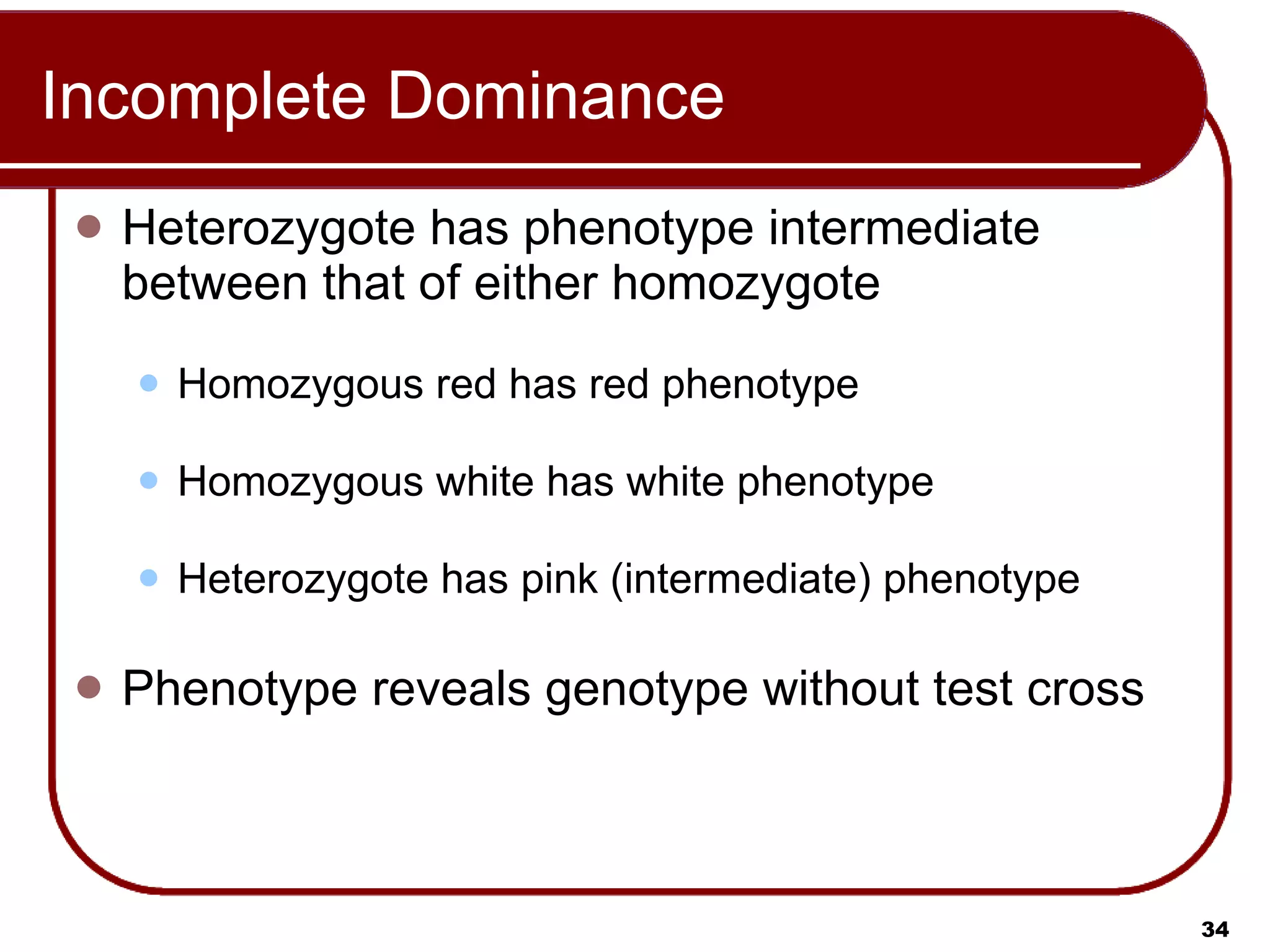
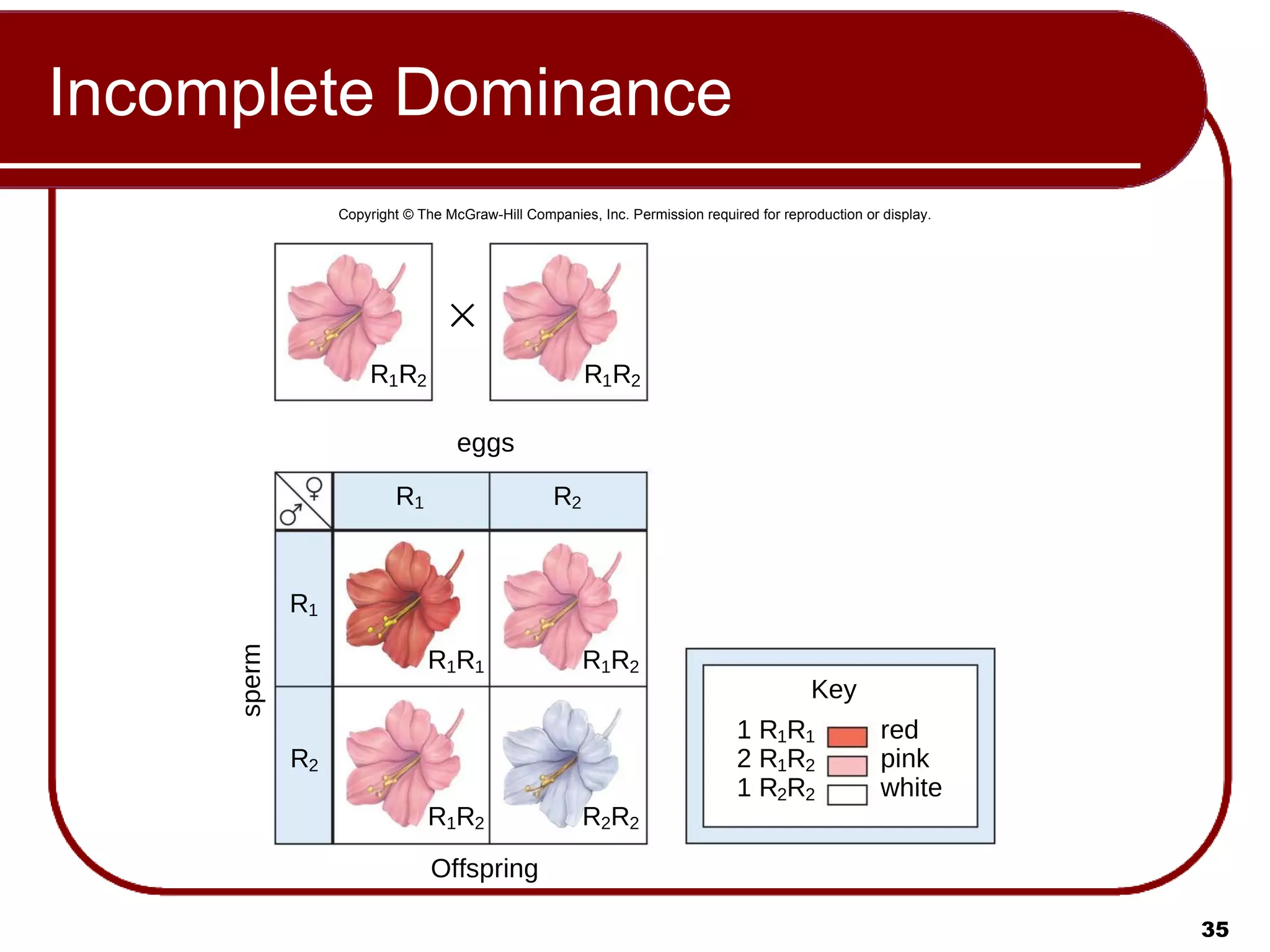
Incomplete Dominance Heterozygotehas phenotype intermediate between that of either homozygote Homozygous red has red phenotype Homozygous white has white phenotype Heterozygote has pink (intermediate) phenotype Phenotype reveals genotype without test cross
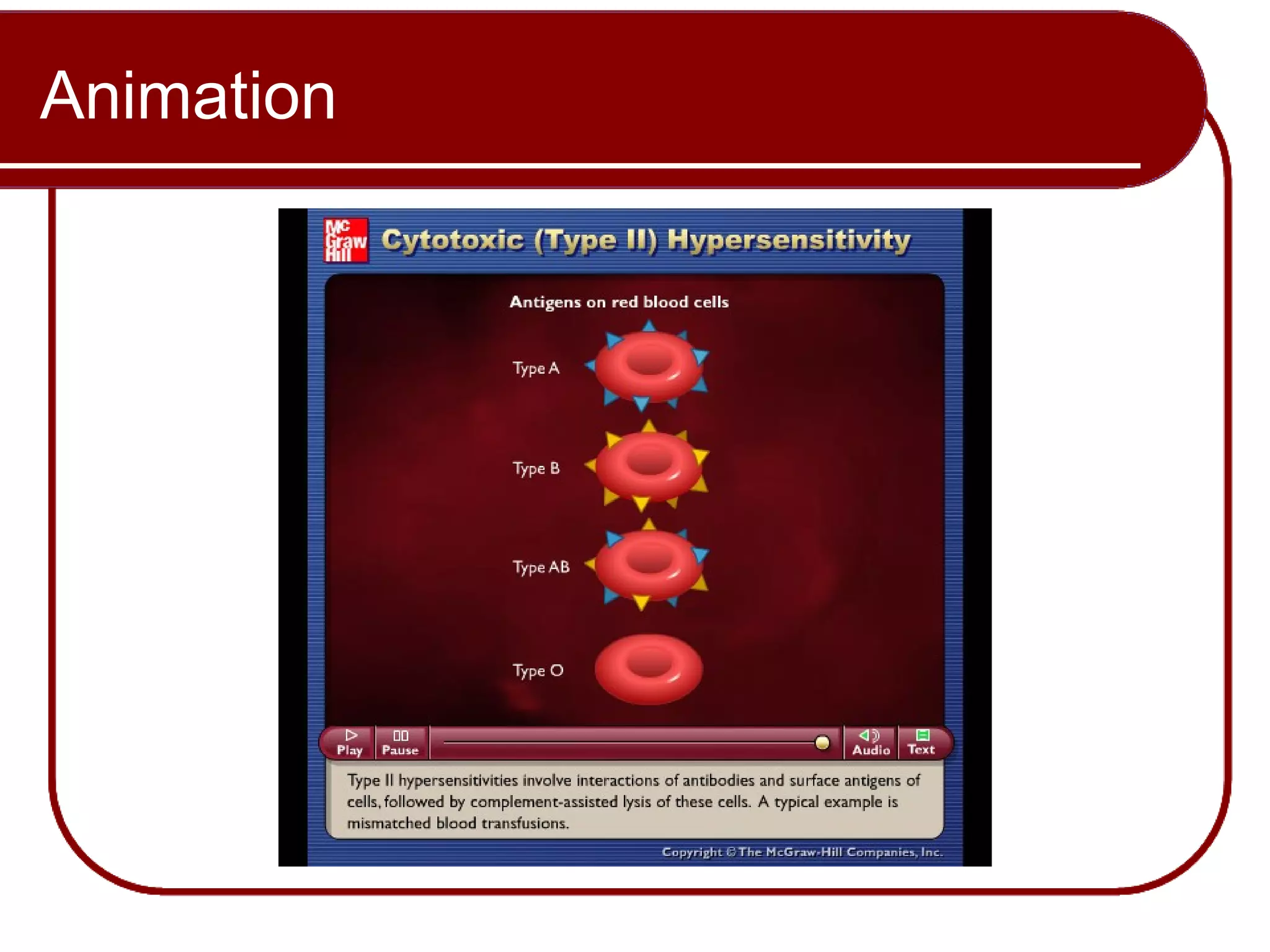
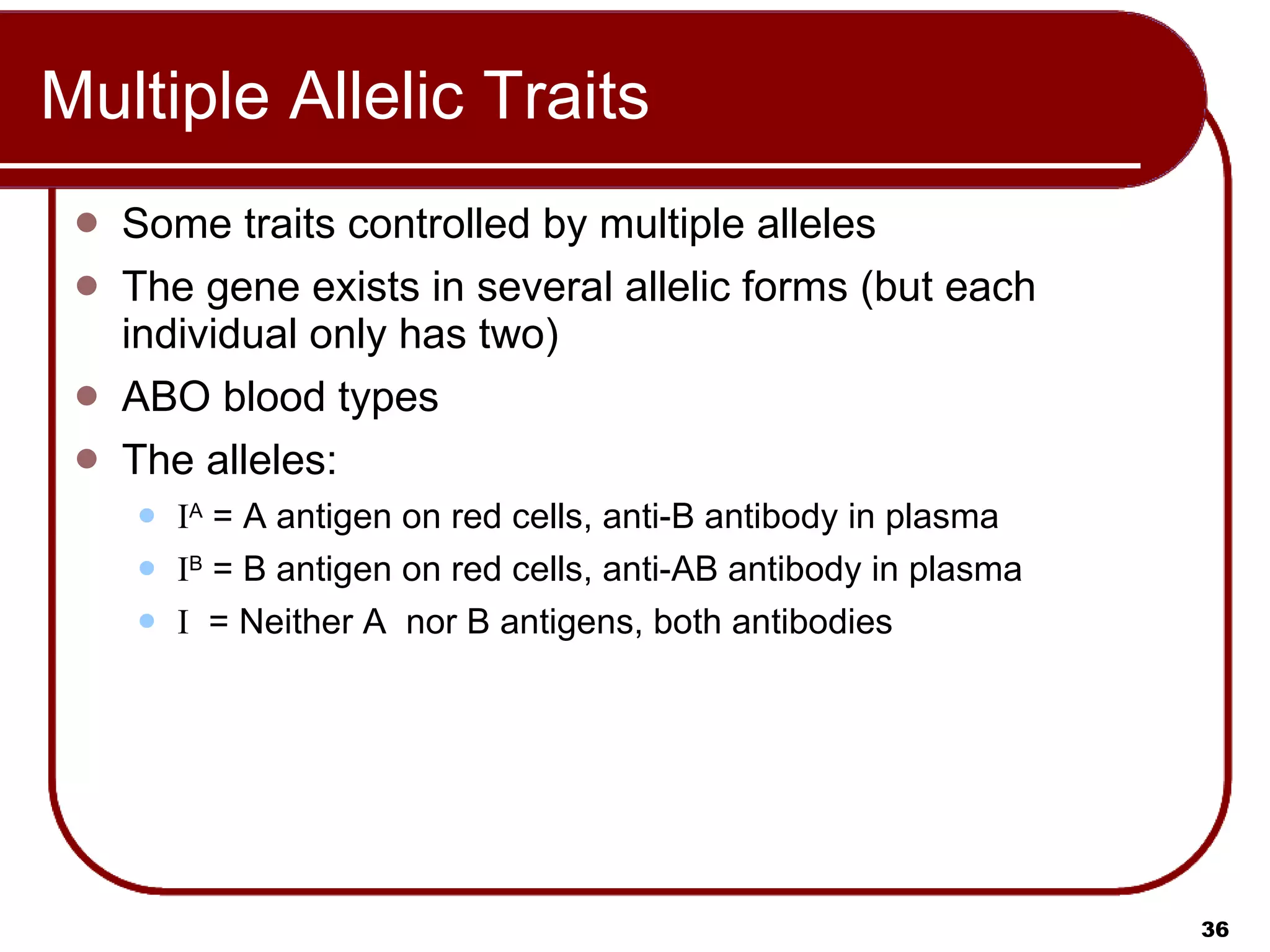
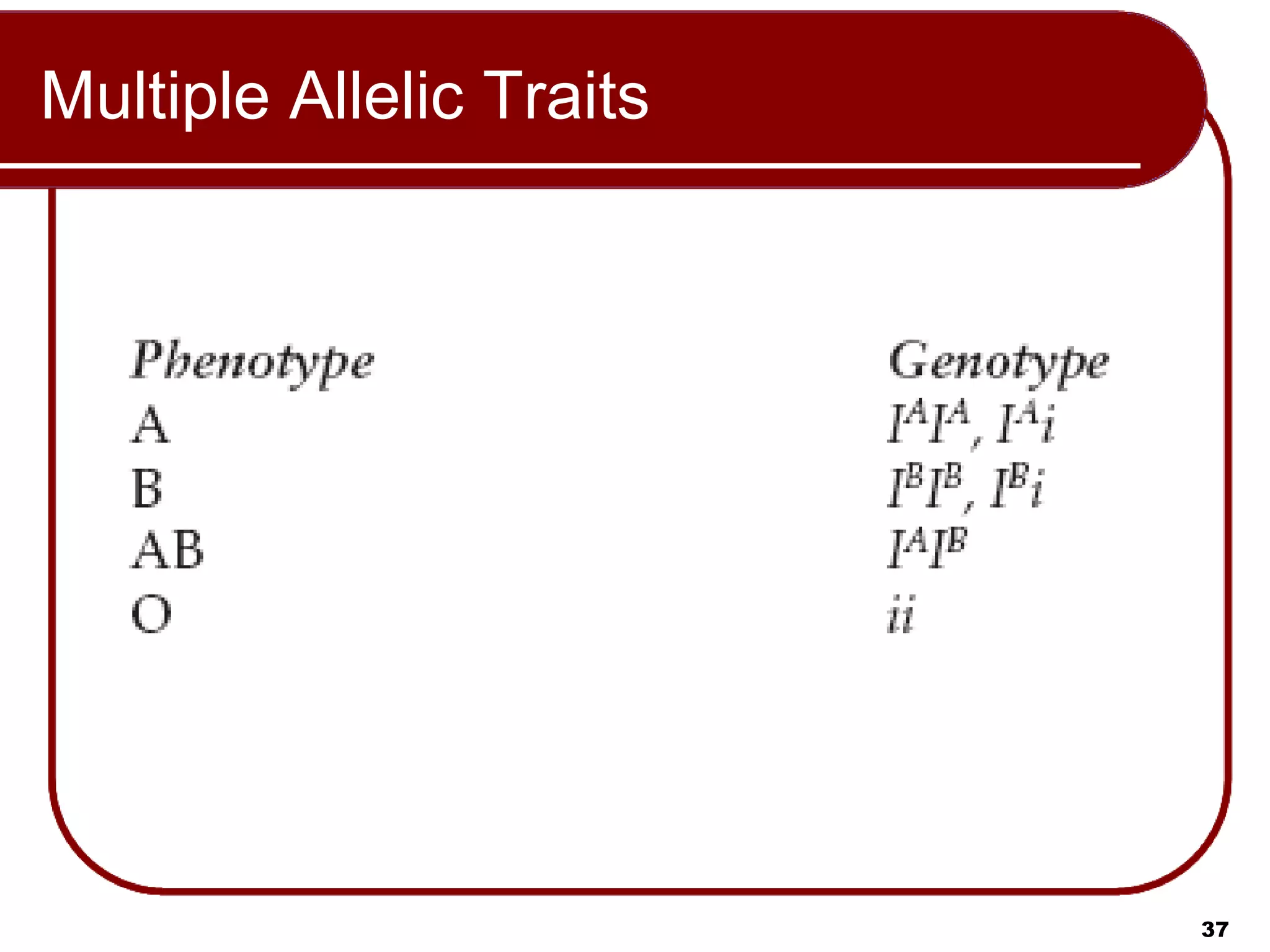
Multiple Allelic TraitsSome traits controlled by multiple alleles The gene exists in several allelic forms (but each individual only has two) ABO blood types The alleles: I A = A antigen on red cells, anti-B antibody in plasma I B = B antigen on red cells, anti-AB antibody in plasma I = Neither A nor B antigens, both antibodies
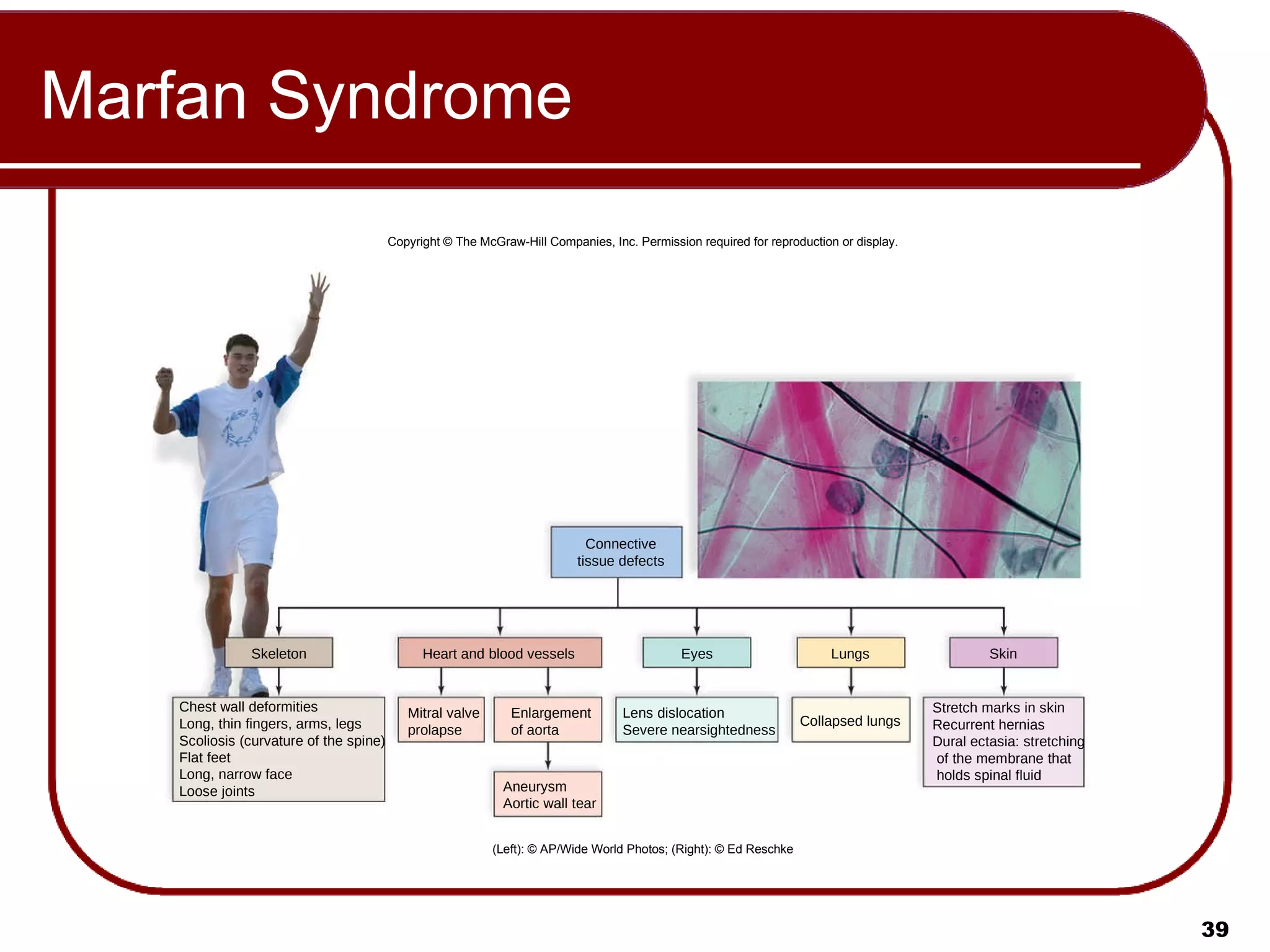
Pleioptropic Effects Pleiotropy occurs when a single mutant gene affects two or more distinct and seemingly unrelated traits. Marfan syndrome have disproportionately long arms, legs, hands, and feet; a weakened aorta; poor eyesight
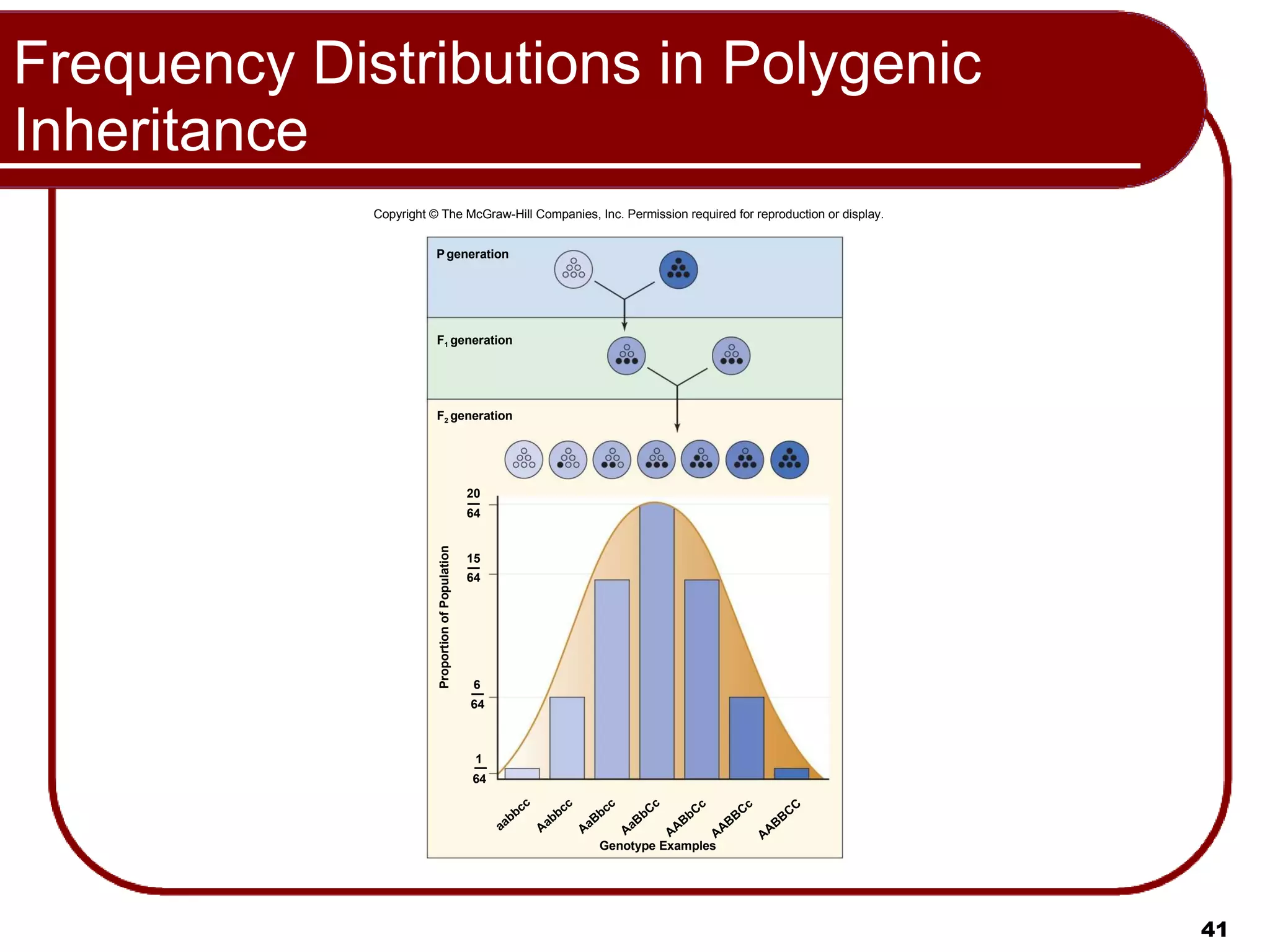
Polygenic Inheritance Occurswhen a trait is governed by two or more genes having different alleles Each dominant allele has a quantitative effect on the phenotype These effects are additive Result in continuous variation of phenotypes
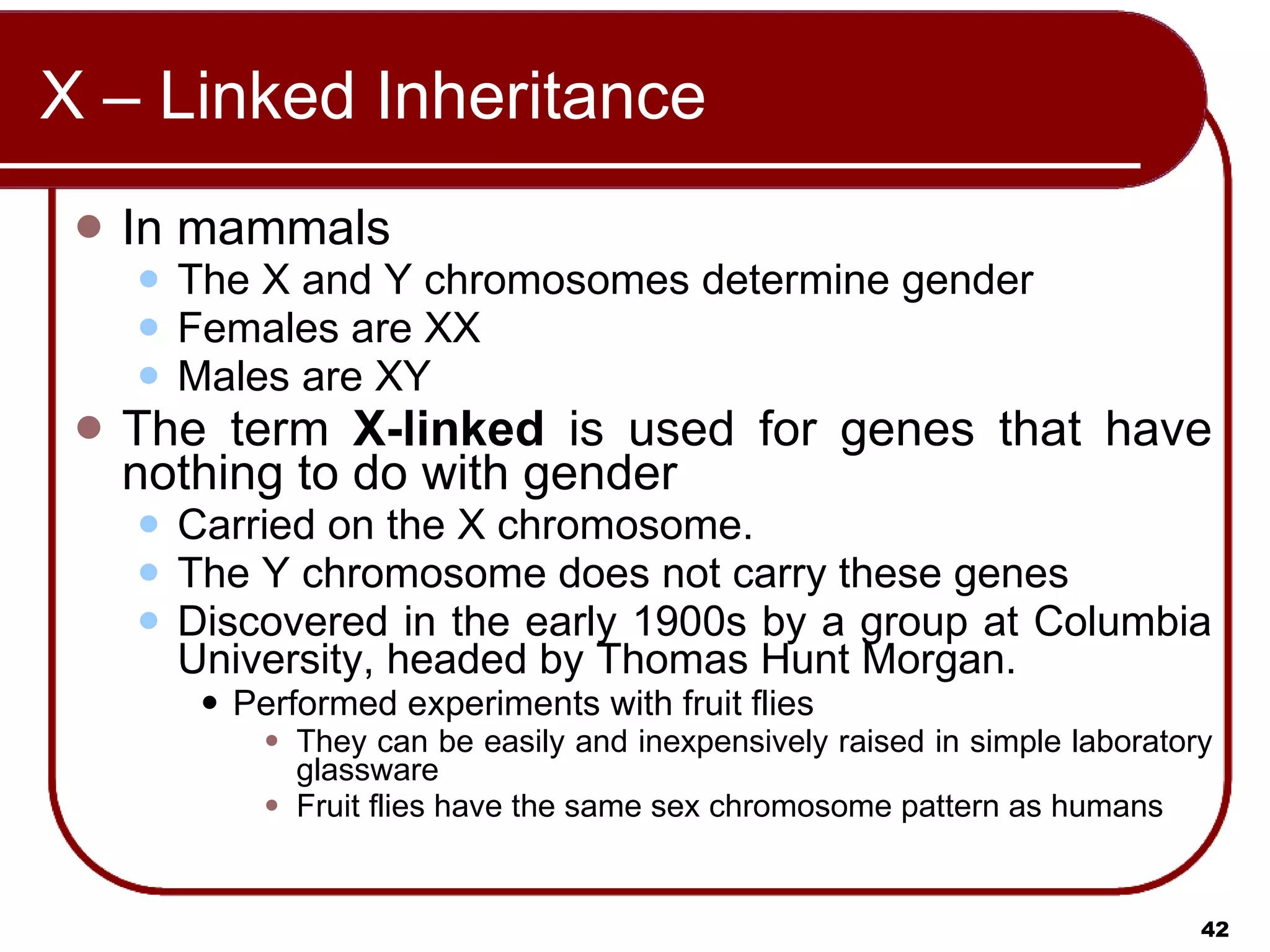
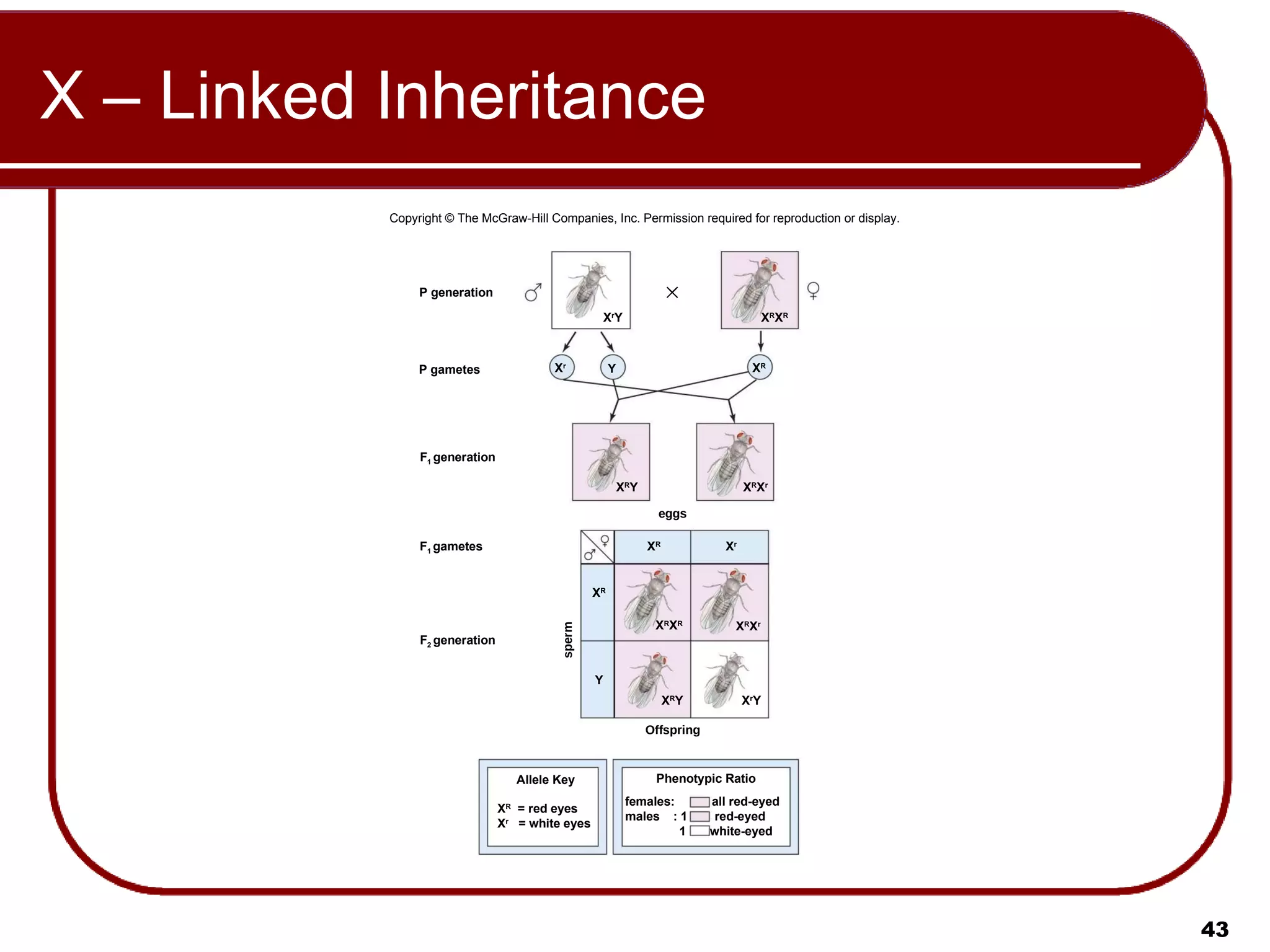
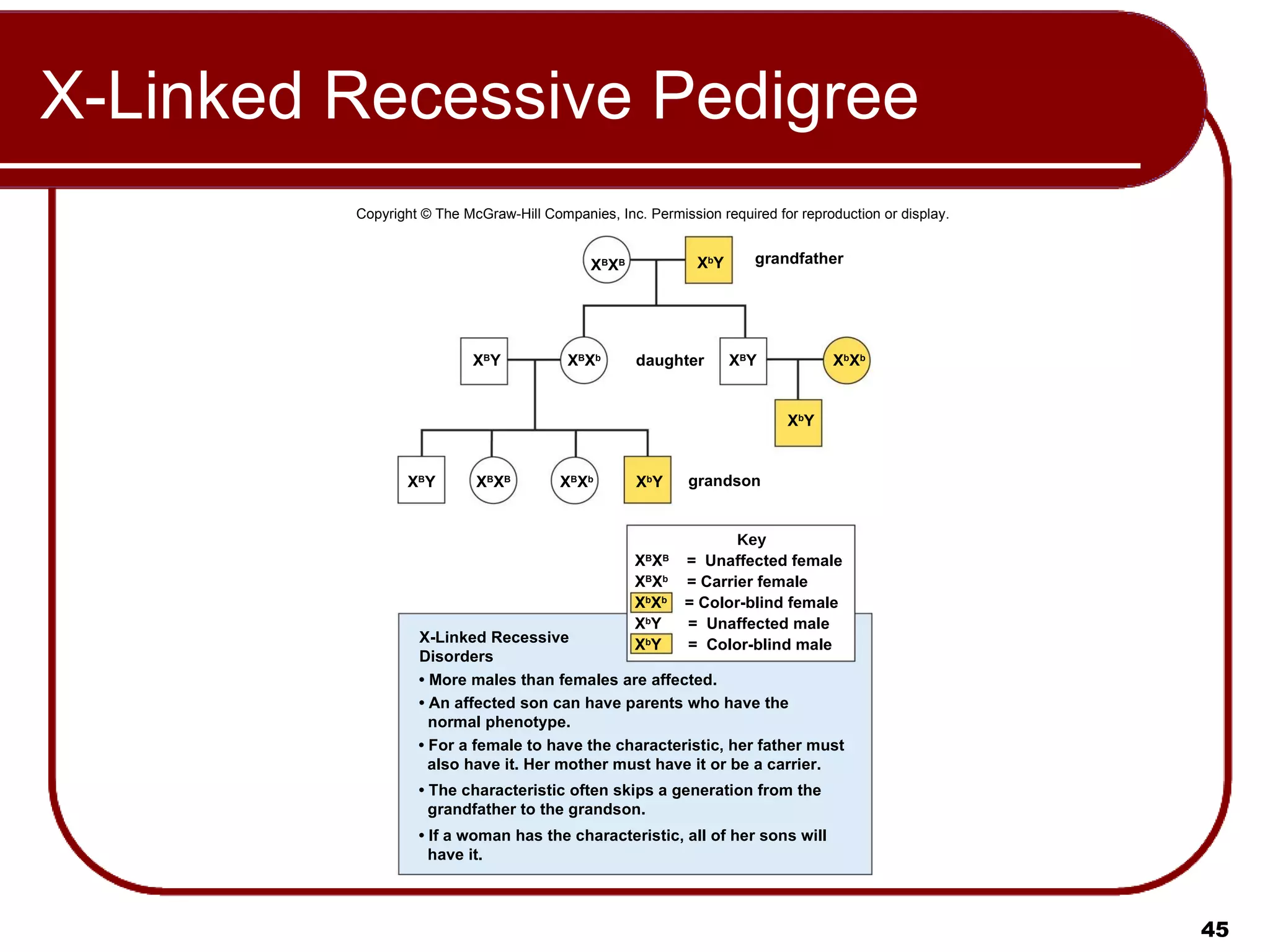
X – LinkedInheritance In mammals The X and Y chromosomes determine gender Females are XX Males are XY The term X-linked is used for genes that have nothing to do with gender Carried on the X chromosome. The Y chromosome does not carry these genes Discovered in the early 1900s by a group at Columbia University, headed by Thomas Hunt Morgan. Performed experiments with fruit flies They can be easily and inexpensively raised in simple laboratory glassware Fruit flies have the same sex chromosome pattern as humans
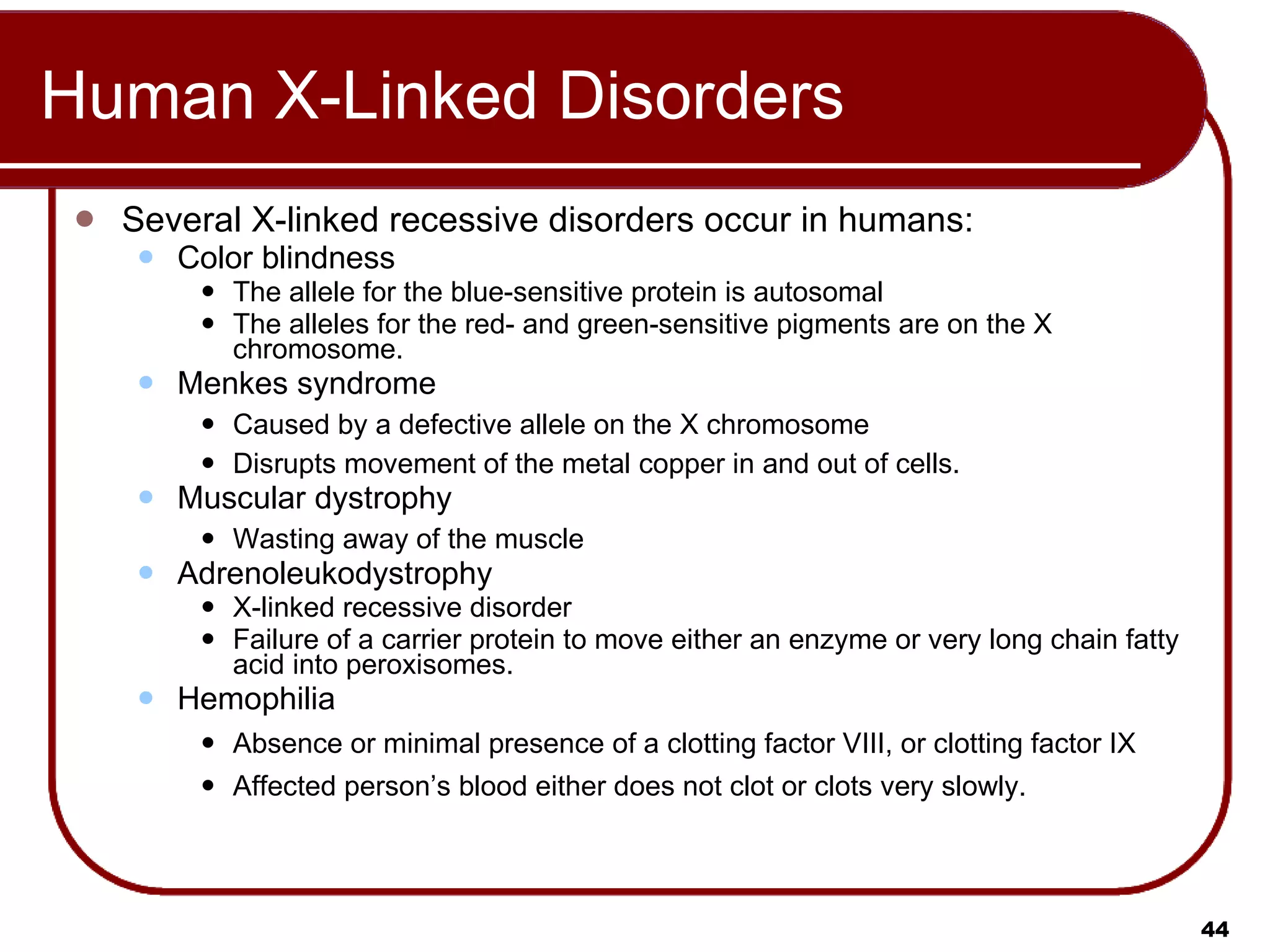
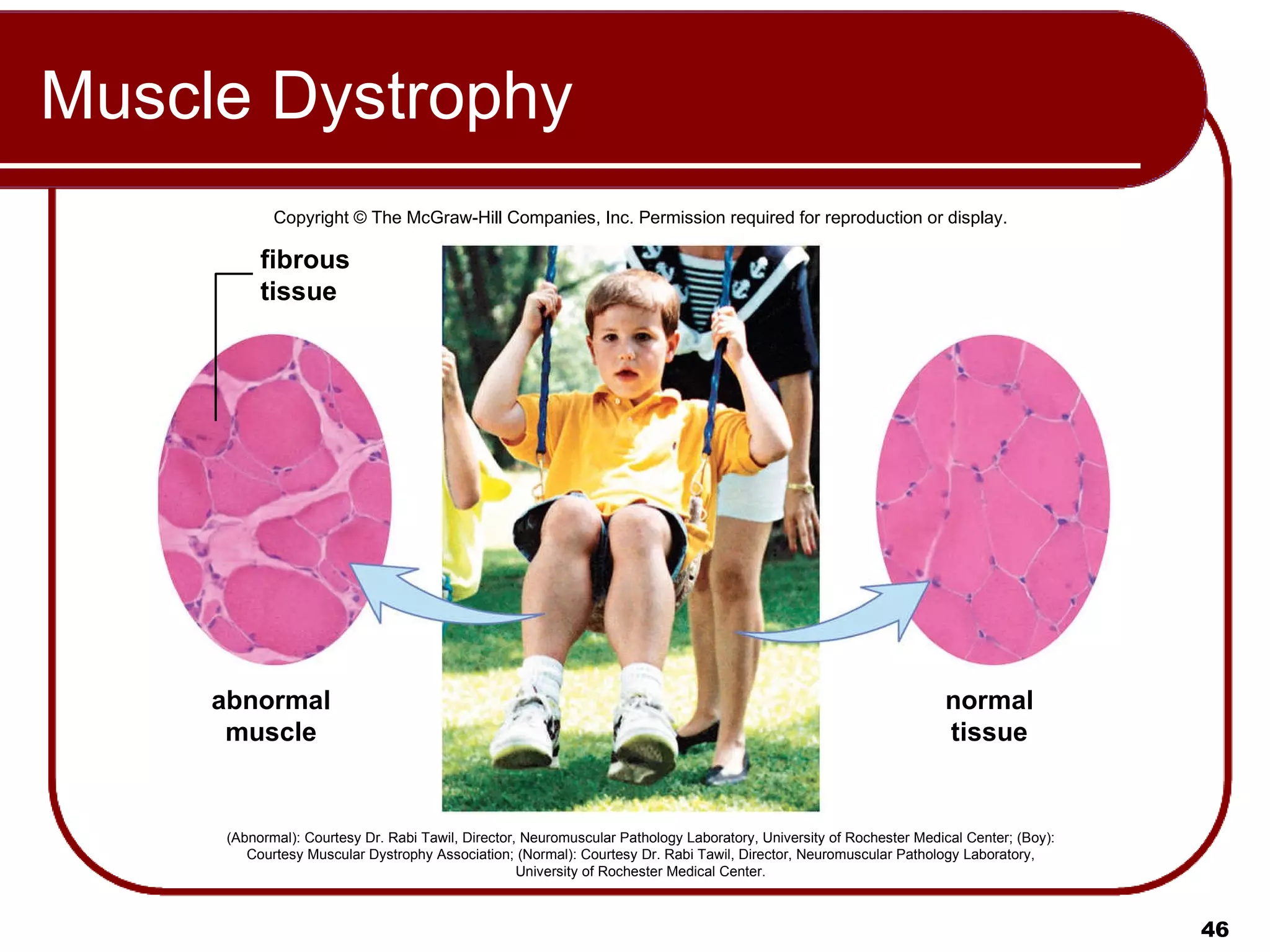
Human X-Linked DisordersSeveral X-linked recessive disorders occur in humans: Color blindness The allele for the blue-sensitive protein is autosomal The alleles for the red- and green-sensitive pigments are on the X chromosome. Menkes syndrome Caused by a defective allele on the X chromosome Disrupts movement of the metal copper in and out of cells. Muscular dystrophy Wasting away of the muscle Adrenoleukodystrophy X-linked recessive disorder Failure of a carrier protein to move either an enzyme or very long chain fatty acid into peroxisomes. Hemophilia Absence or minimal presence of a clotting factor VIII, or clotting factor IX Affected person’s blood either does not clot or clots very slowly.
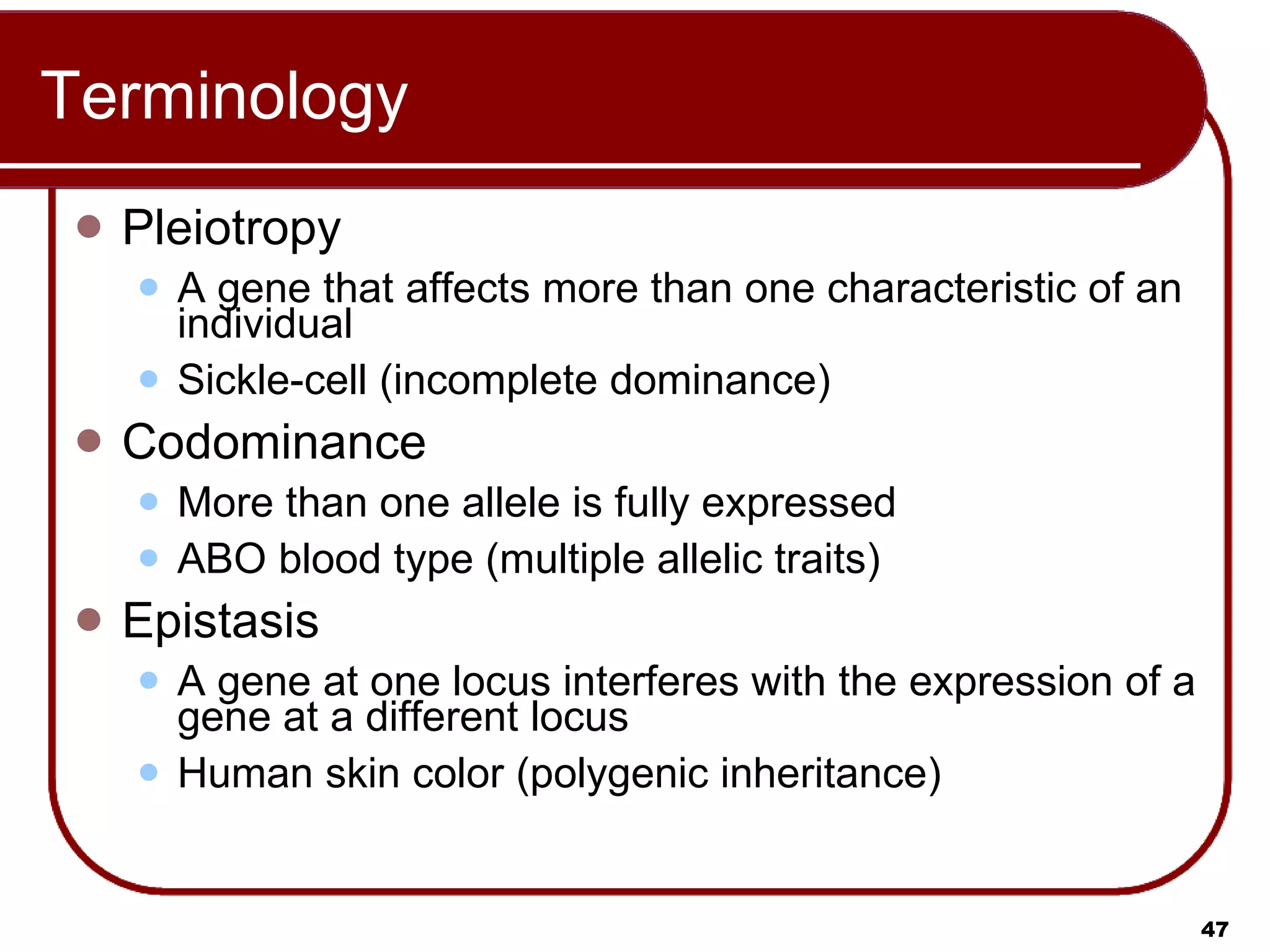
Terminology Pleiotropy Agene that affects more than one characteristic of an individual Sickle-cell (incomplete dominance) Codominance More than one allele is fully expressed ABO blood type (multiple allelic traits) Epistasis A gene at one locus interferes with the expression of a gene at a different locus Human skin color (polygenic inheritance)
48.
Review Blending InheritanceMonohybrid Cross Law of Segregation Modern Genetics Genotype vs. Phenotype Punnett Square Dihybrid Cross Law of Independent Assortment Human Genetic Disorders