User Stories Applied:
For Agile Software Development
                –
   Ch 4. Gathering Stories &
Ch 7. Guidelines for Good Stories

       Chen Jing Fung @iii
           2011/6/14

            Reference: Ch2. Writing Stories,
            http://fungsiong.blogspot.com/2011/06/agile.html
How to gather stories
• Problem: elicit & capture all requirements
  (user real needs) are very difficult !!
  – Solution: ask the right types of questions
     • A little is enough. (the advantage of Agile)
     • After several iterations, will gather whole picture of
       customer real needs.
  – Techniques
     •   User interviews
     •   Questionnaires
     •   Observation
     •   Story-writing workshops
User interviews
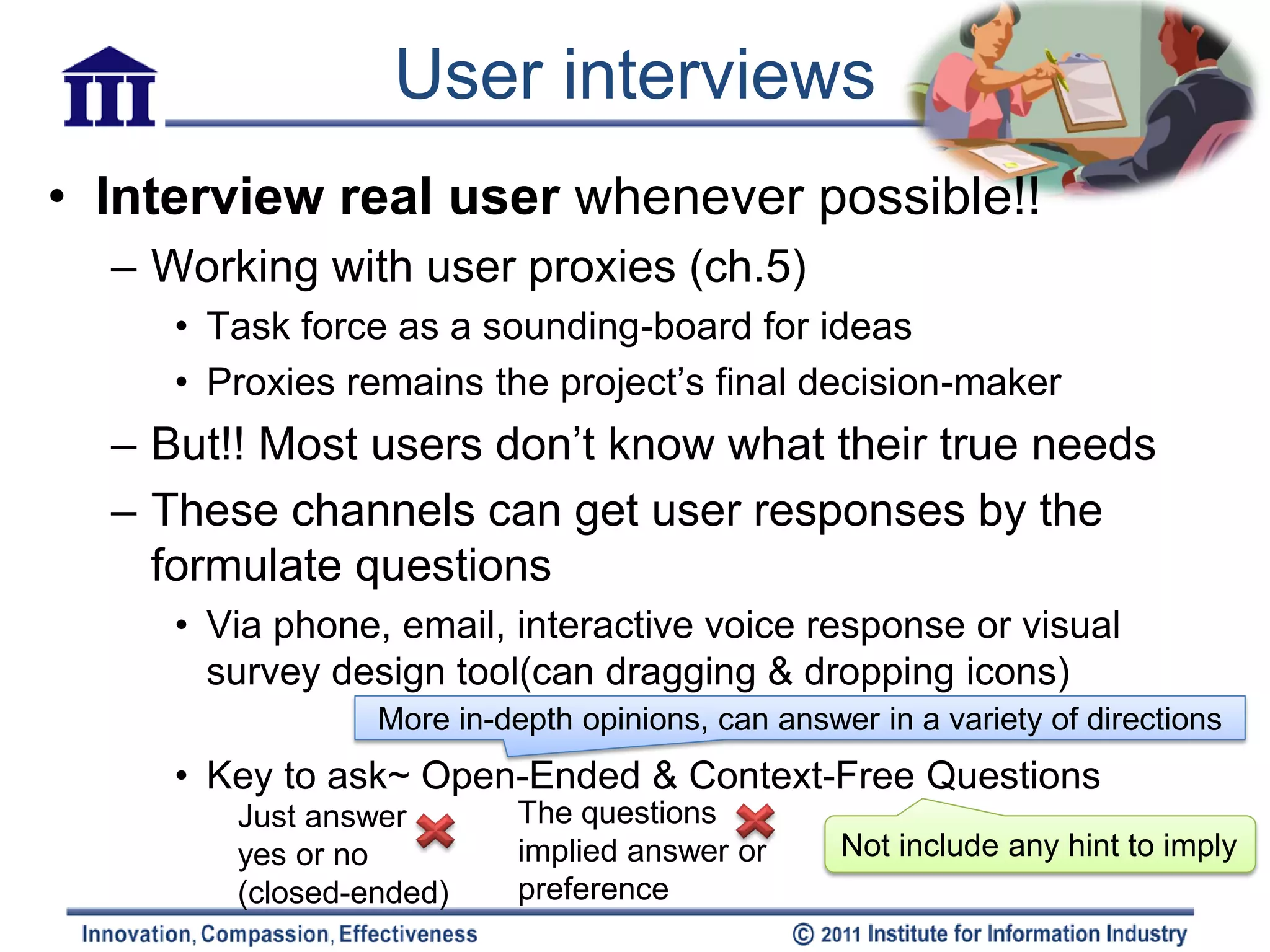
• Interview real user whenever possible!!
  – Working with user proxies (ch.5)
     • Task force as a sounding-board for ideas
     • Proxies remains the project’s final decision-maker
  – But!! Most users don’t know what their true needs
  – These channels can get user responses by the
    formulate questions
     • Via phone, email, interactive voice response or visual
       survey design tool(can dragging & dropping icons)
                 More in-depth opinions, can answer in a variety of directions
     • Key to ask~ Open-Ended & Context-Free Questions
        Just answer        The questions
        yes or no          implied answer or      Not include any hint to imply
        (closed-ended)     preference
Elicit stories - techniques
                                                                    watch

  Questionnaires                  Observation

• Gather info. About stories      • Observing users interact
  you already have                  with your software is a
   – Have a large number of         good way
     users                           – Avoid your software build
   – Want to know what trend           exactly, but it’s not user
   – Collecting might time-lag         want
      • Ask: not using some          – Get the rapid and direct
        feature more? …                feedback
      • May wait one or several      – Join time: as early and
        iterations                     often as possible
      • On-line questionnaires
                                     – Track the decisions made
        may well !!
                                       by user
   – One-way communication
Story-writing workshops
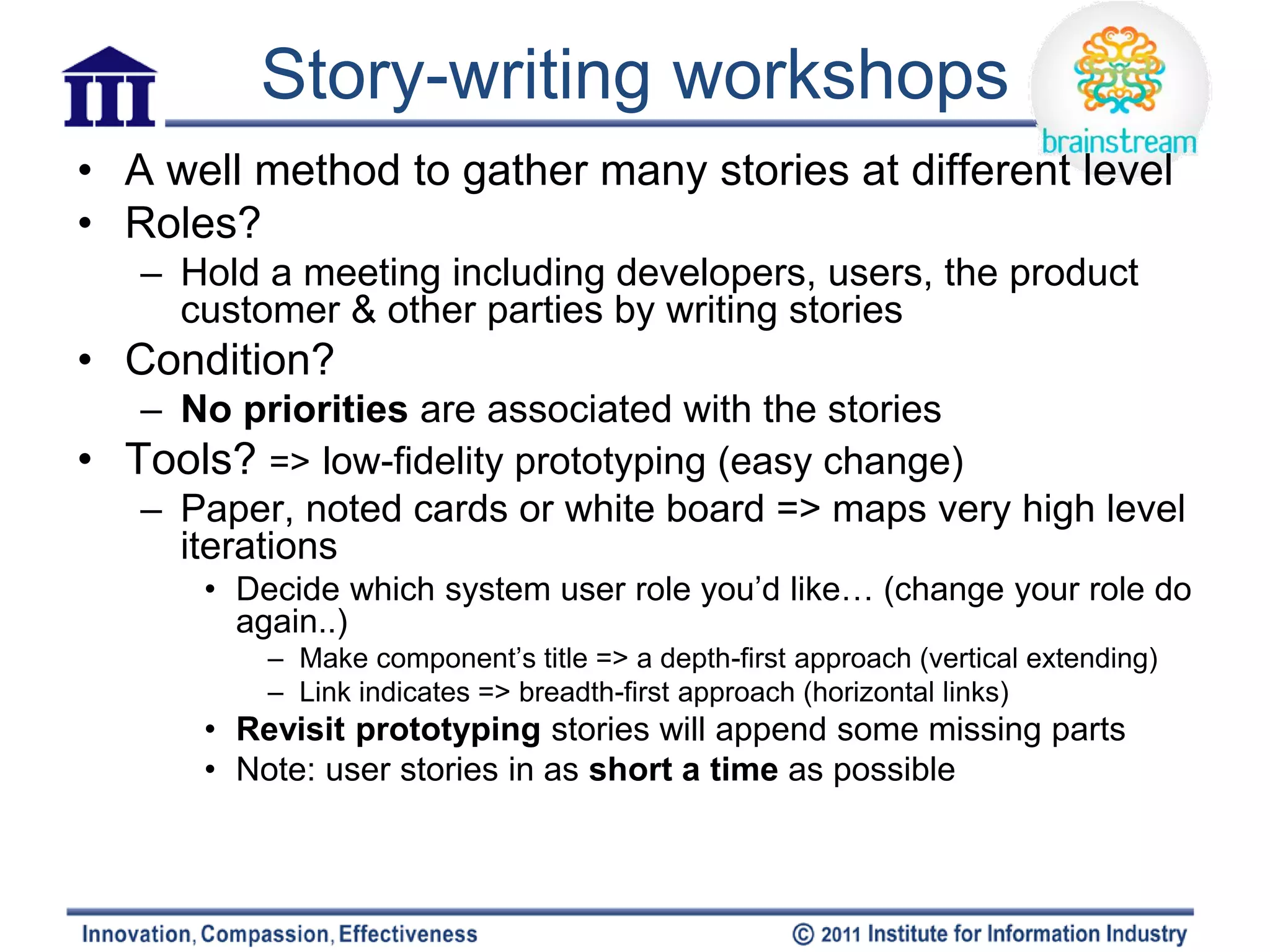
• A well method to gather many stories at different level
• Roles?
   – Hold a meeting including developers, users, the product
     customer & other parties by writing stories
• Condition?
   – No priorities are associated with the stories
• Tools? => low-fidelity prototyping (easy change)
   – Paper, noted cards or white board => maps very high level
     iterations
       • Decide which system user role you’d like… (change your role do
         again..)
           – Make component’s title => a depth-first approach (vertical extending)
           – Link indicates => breadth-first approach (horizontal links)
       • Revisit prototyping stories will append some missing parts
       • Note: user stories in as short a time as possible
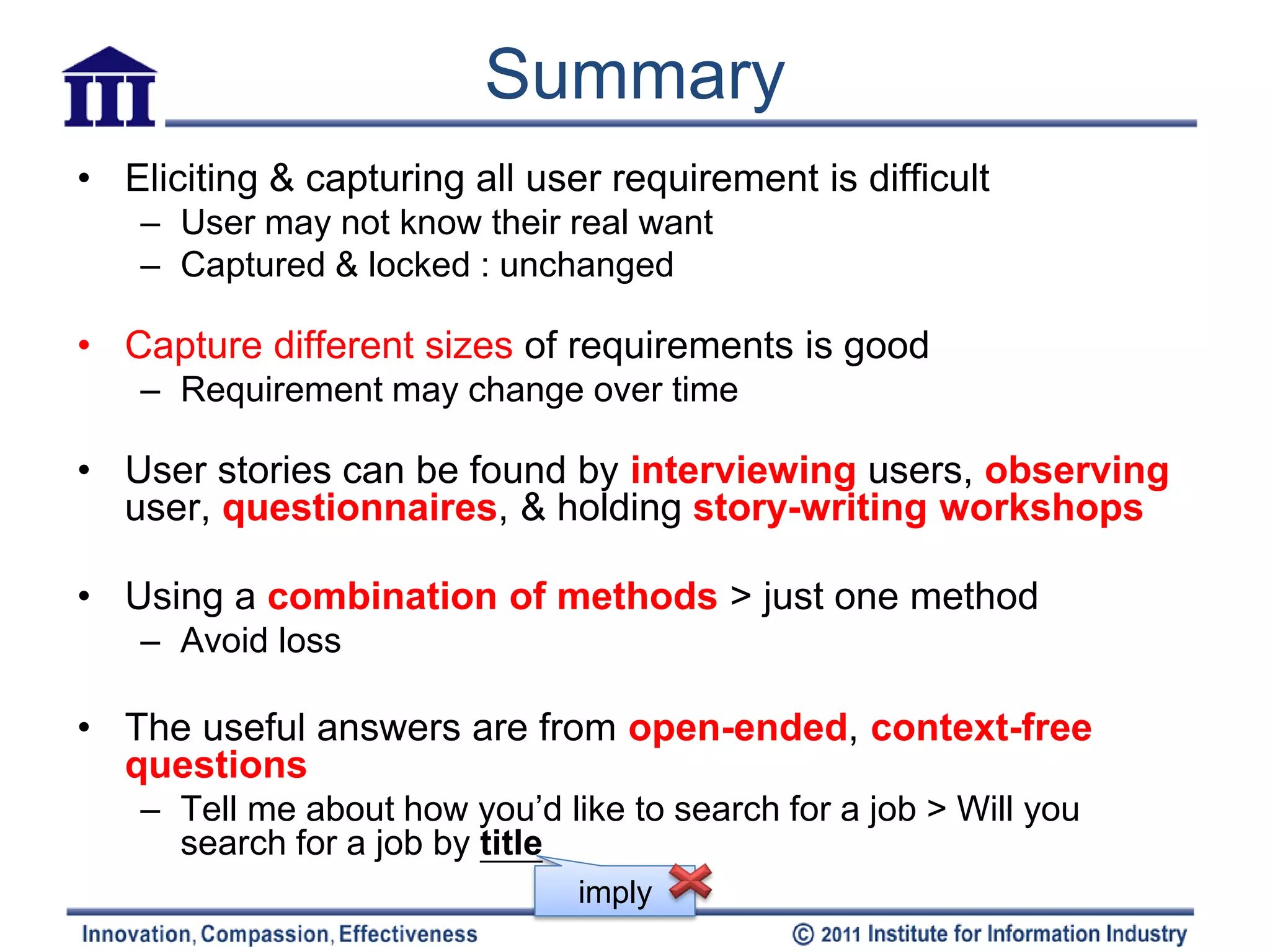
Summary
• Eliciting & capturing all user requirement is difficult
   – User may not know their real want
   – Captured & locked : unchanged

• Capture different sizes of requirements is good
   – Requirement may change over time

• User stories can be found by interviewing users, observing
  user, questionnaires, & holding story-writing workshops

• Using a combination of methods > just one method
   – Avoid loss

• The useful answers are from open-ended, context-free
  questions
   – Tell me about how you’d like to search for a job > Will you
     search for a job by title
                               imply
Chapter 7. Guidelines for Good
            Stories
  How to gather for write stories
  How to identify key user roles &
  the roles of acceptance testing
            Reference: Ch2. Writing Stories,
            http://fungsiong.blogspot.com/2011/06/agile.html
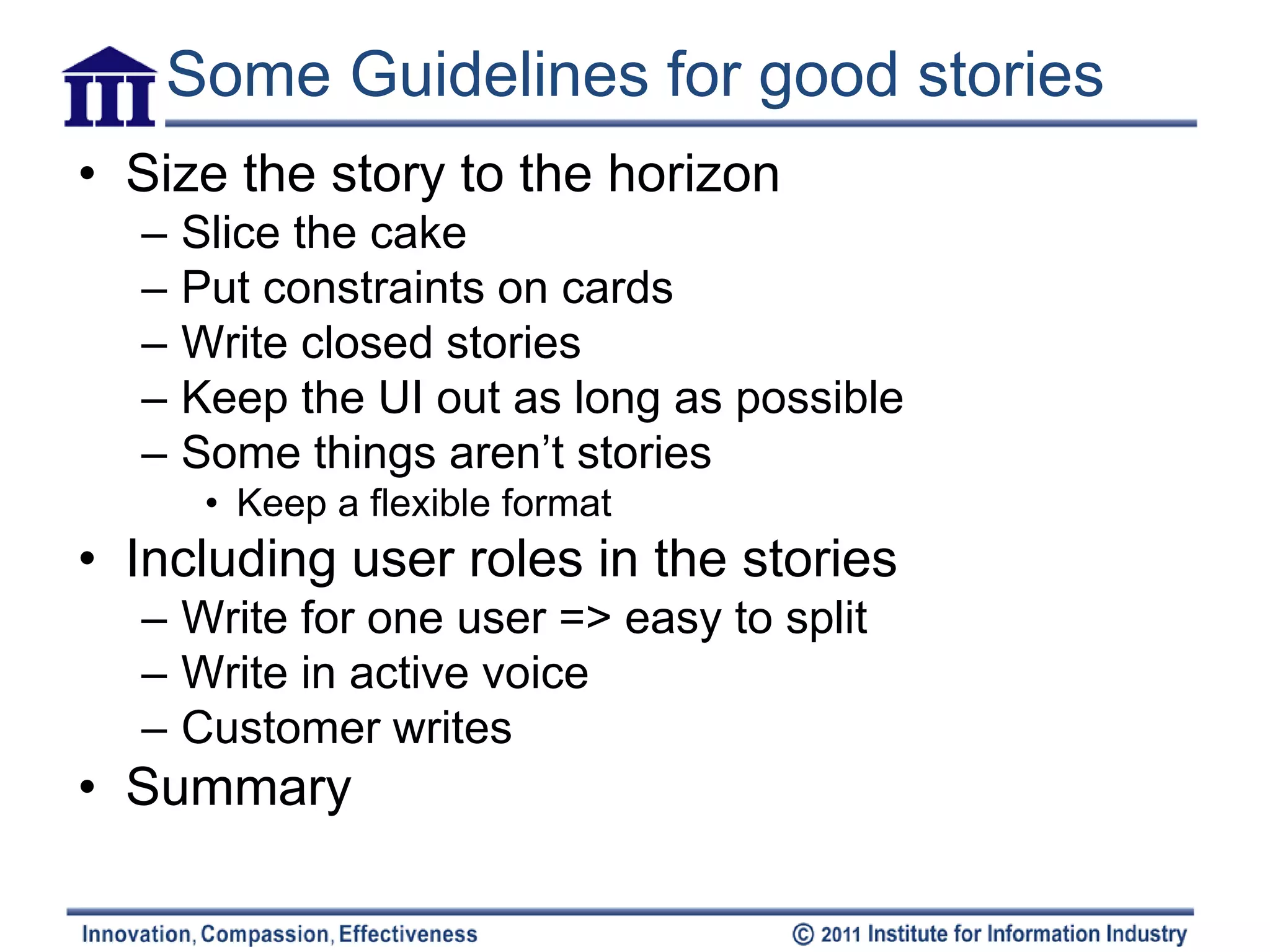
Some Guidelines for good stories
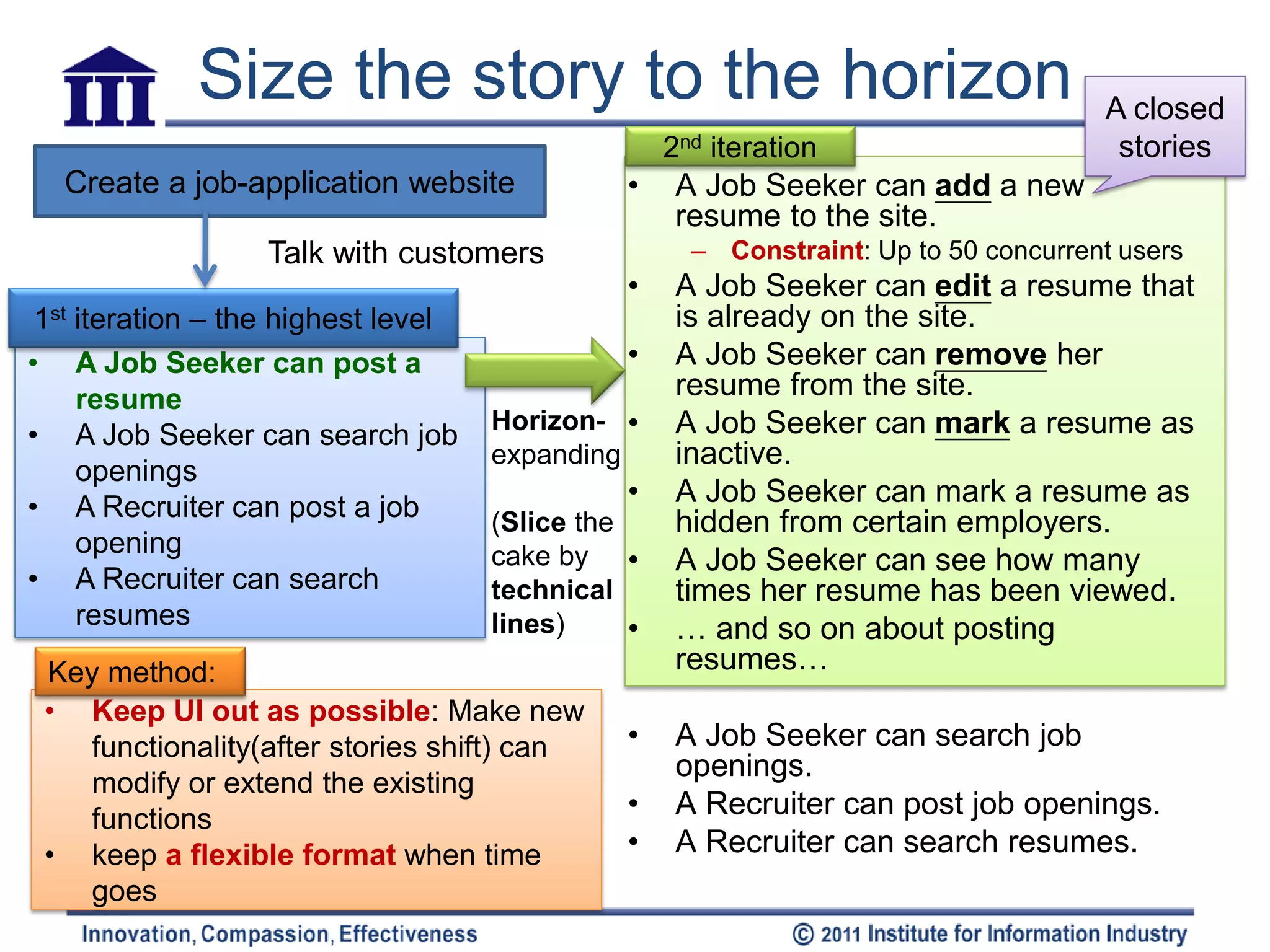
• Size the story to the horizon
  –   Slice the cake
  –   Put constraints on cards
  –   Write closed stories
  –   Keep the UI out as long as possible
  –   Some things aren’t stories
       • Keep a flexible format
• Including user roles in the stories
  – Write for one user => easy to split
  – Write in active voice
  – Customer writes
• Summary
Size the story to the horizon                                            A closed
                                                    2nd iteration                      stories
  Create a job-application website              •    A Job Seeker can add a new
                                                     resume to the site.
                  Talk with customers                 – Constraint: Up to 50 concurrent users
                                                •    A Job Seeker can edit a resume that
 1st iteration – the highest level                   is already on the site.
• A Job Seeker can post a                       •    A Job Seeker can remove her
     resume                                          resume from the site.
                                     Horizon- •      A Job Seeker can mark a resume as
• A Job Seeker can search job
                                     expanding       inactive.
     openings
• A Recruiter can post a job
                                                •    A Job Seeker can mark a resume as
                                     (Slice the      hidden from certain employers.
     opening                         cake by •       A Job Seeker can see how many
• A Recruiter can search             technical       times her resume has been viewed.
     resumes                         lines)     •    … and so on about posting
 Key method:                                         resumes…
 • Keep UI out as possible: Make new
   functionality(after stories shift) can       •    A Job Seeker can search job
                                                     openings.
   modify or extend the existing
   functions                                    •    A Recruiter can post job openings.
 • keep a flexible format when time             •    A Recruiter can search resumes.
   goes
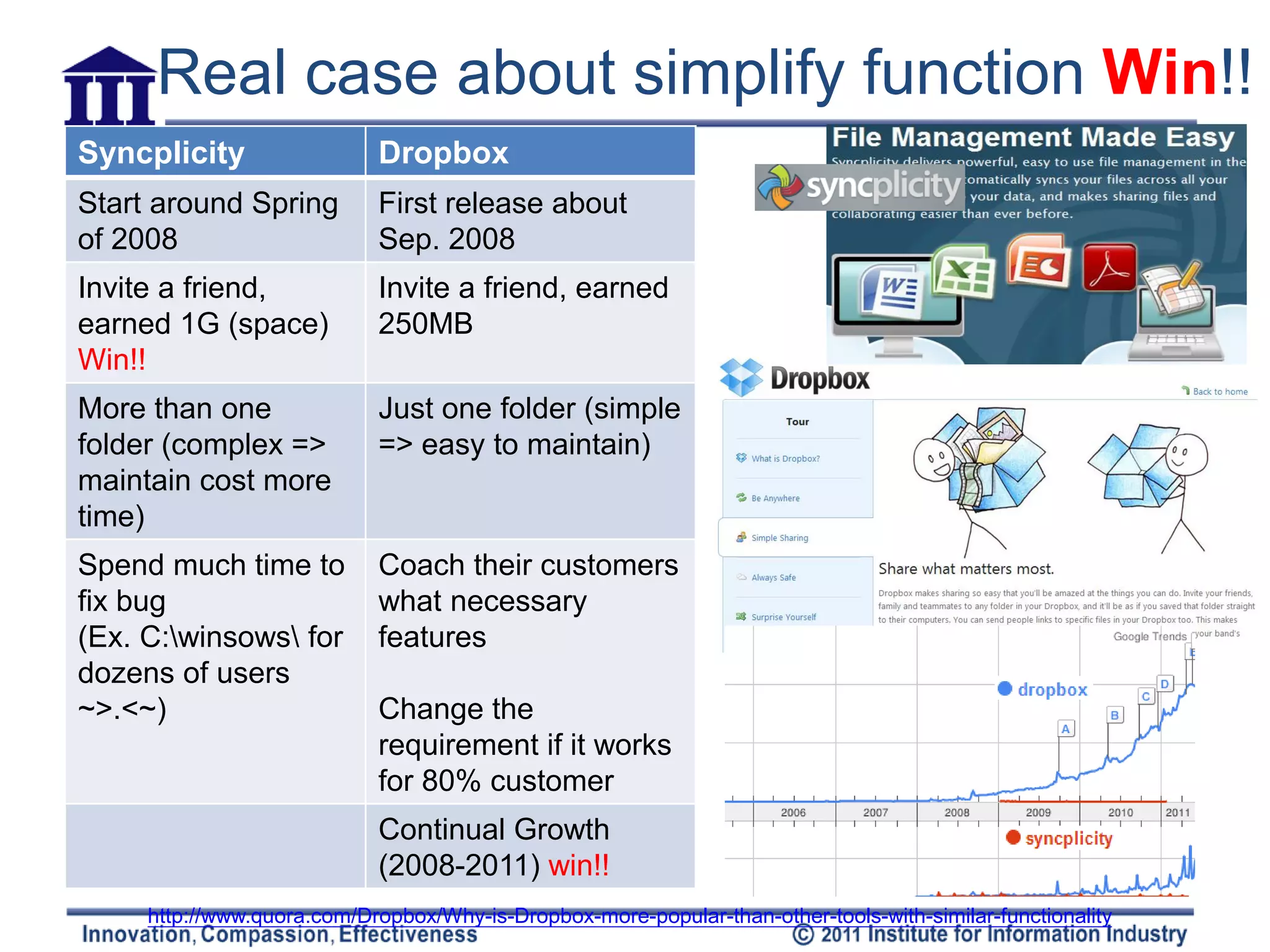
Real case about simplify function Win!!
Syncplicity                 Dropbox
Start around Spring         First release about
of 2008                     Sep. 2008
Invite a friend,            Invite a friend, earned
earned 1G (space)           250MB
Win!!
More than one               Just one folder (simple
folder (complex =>          => easy to maintain)
maintain cost more
time)
Spend much time to          Coach their customers
fix bug                     what necessary
(Ex. C:winsows for        features
dozens of users
~>.<~)                      Change the
                            requirement if it works
                            for 80% customer
                            Continual Growth
                            (2008-2011) win!!
     http://www.quora.com/Dropbox/Why-is-Dropbox-more-popular-than-other-tools-with-similar-functionality
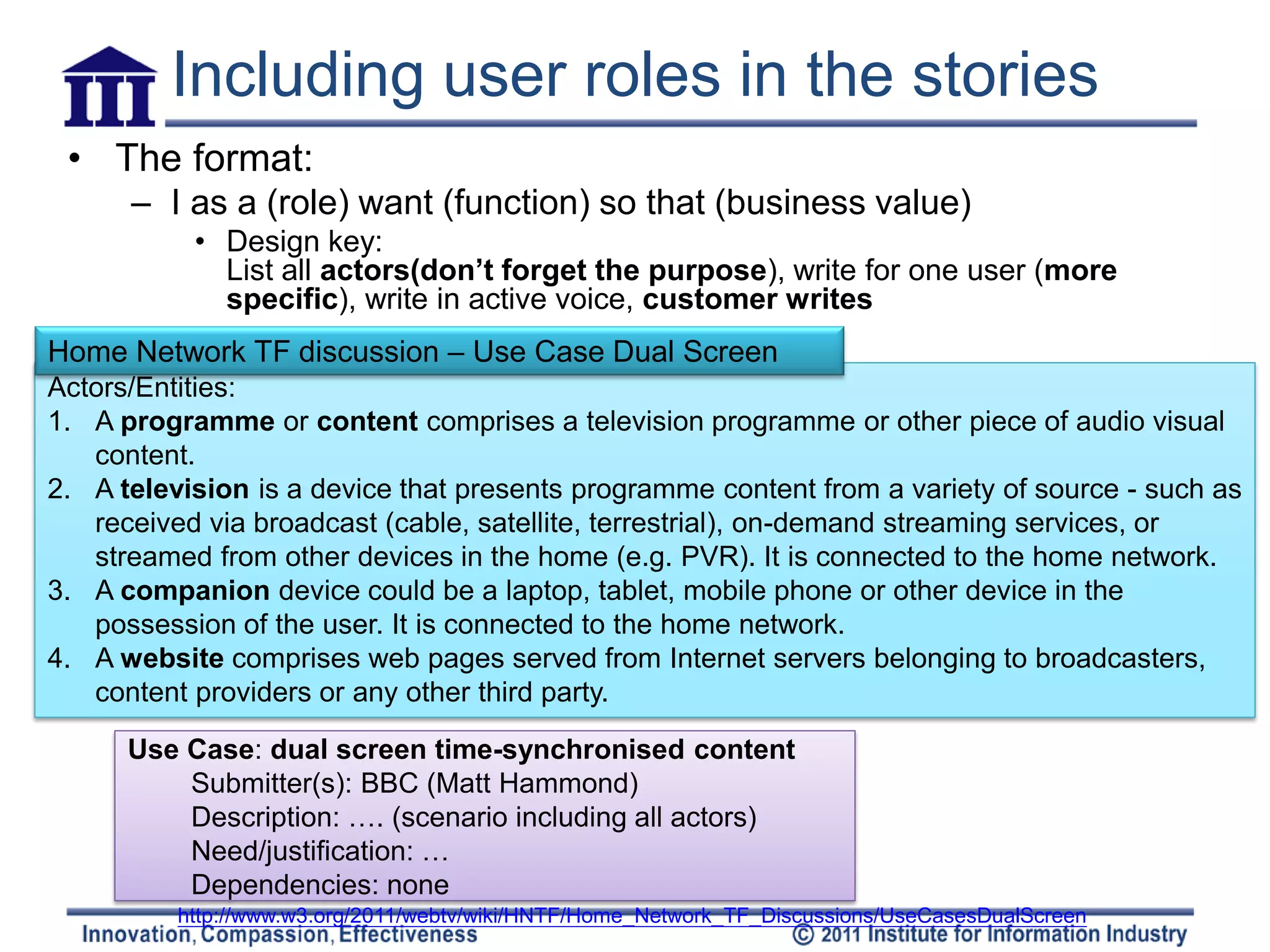
Including user roles in the stories
 • The format:
      – I as a (role) want (function) so that (business value)
           • Design key:
             List all actors(don’t forget the purpose), write for one user (more
             specific), write in active voice, customer writes
Home Network TF discussion – Use Case Dual Screen
Actors/Entities:
1. A programme or content comprises a television programme or other piece of audio visual
   content.
2. A television is a device that presents programme content from a variety of source - such as
   received via broadcast (cable, satellite, terrestrial), on-demand streaming services, or
   streamed from other devices in the home (e.g. PVR). It is connected to the home network.
3. A companion device could be a laptop, tablet, mobile phone or other device in the
   possession of the user. It is connected to the home network.
4. A website comprises web pages served from Internet servers belonging to broadcasters,
   content providers or any other third party.

      Use Case: dual screen time-synchronised content
          Submitter(s): BBC (Matt Hammond)
          Description: …. (scenario including all actors)
          Need/justification: …
          Dependencies: none
          http://www.w3.org/2011/webtv/wiki/HNTF/Home_Network_TF_Discussions/UseCasesDualScreen
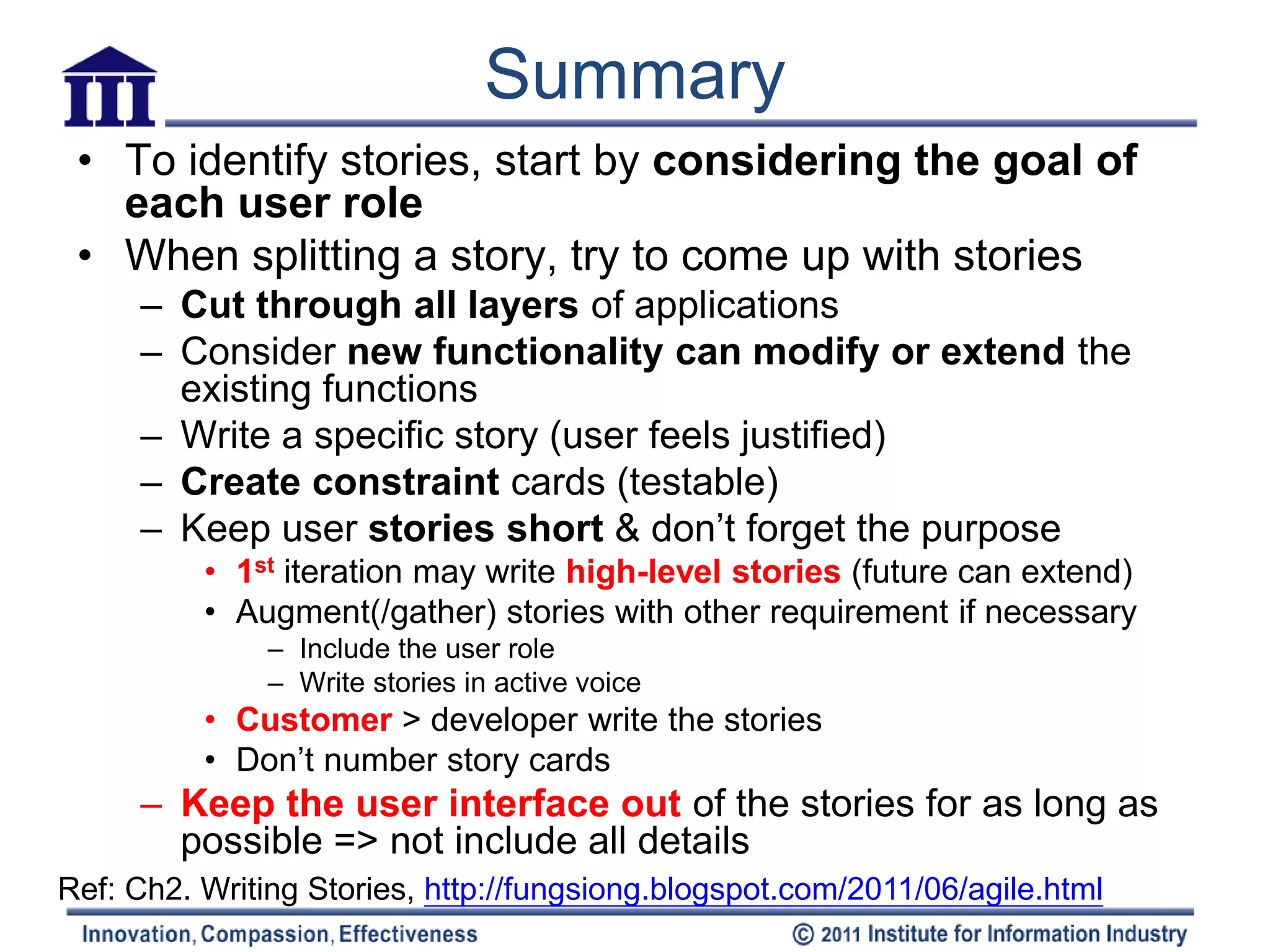
Summary
 • To identify stories, start by considering the goal of
   each user role
 • When splitting a story, try to come up with stories
     – Cut through all layers of applications
     – Consider new functionality can modify or extend the
       existing functions
     – Write a specific story (user feels justified)
     – Create constraint cards (testable)
     – Keep user stories short & don’t forget the purpose
          • 1st iteration may write high-level stories (future can extend)
          • Augment(/gather) stories with other requirement if necessary
               – Include the user role
               – Write stories in active voice
          • Customer > developer write the stories
          • Don’t number story cards
     – Keep the user interface out of the stories for as long as
       possible => not include all details
Ref: Ch2. Writing Stories, http://fungsiong.blogspot.com/2011/06/agile.html

Agile gathering + guidelines stories

  • 1.
    User Stories Applied: ForAgile Software Development – Ch 4. Gathering Stories & Ch 7. Guidelines for Good Stories Chen Jing Fung @iii 2011/6/14 Reference: Ch2. Writing Stories, http://fungsiong.blogspot.com/2011/06/agile.html
  • 2.
    How to gatherstories • Problem: elicit & capture all requirements (user real needs) are very difficult !! – Solution: ask the right types of questions • A little is enough. (the advantage of Agile) • After several iterations, will gather whole picture of customer real needs. – Techniques • User interviews • Questionnaires • Observation • Story-writing workshops
  • 3.
    User interviews • Interviewreal user whenever possible!! – Working with user proxies (ch.5) • Task force as a sounding-board for ideas • Proxies remains the project’s final decision-maker – But!! Most users don’t know what their true needs – These channels can get user responses by the formulate questions • Via phone, email, interactive voice response or visual survey design tool(can dragging & dropping icons) More in-depth opinions, can answer in a variety of directions • Key to ask~ Open-Ended & Context-Free Questions Just answer The questions yes or no implied answer or Not include any hint to imply (closed-ended) preference
  • 4.
    Elicit stories -techniques watch Questionnaires Observation • Gather info. About stories • Observing users interact you already have with your software is a – Have a large number of good way users – Avoid your software build – Want to know what trend exactly, but it’s not user – Collecting might time-lag want • Ask: not using some – Get the rapid and direct feature more? … feedback • May wait one or several – Join time: as early and iterations often as possible • On-line questionnaires – Track the decisions made may well !! by user – One-way communication
  • 5.
    Story-writing workshops • Awell method to gather many stories at different level • Roles? – Hold a meeting including developers, users, the product customer & other parties by writing stories • Condition? – No priorities are associated with the stories • Tools? => low-fidelity prototyping (easy change) – Paper, noted cards or white board => maps very high level iterations • Decide which system user role you’d like… (change your role do again..) – Make component’s title => a depth-first approach (vertical extending) – Link indicates => breadth-first approach (horizontal links) • Revisit prototyping stories will append some missing parts • Note: user stories in as short a time as possible
  • 6.
    Summary • Eliciting &capturing all user requirement is difficult – User may not know their real want – Captured & locked : unchanged • Capture different sizes of requirements is good – Requirement may change over time • User stories can be found by interviewing users, observing user, questionnaires, & holding story-writing workshops • Using a combination of methods > just one method – Avoid loss • The useful answers are from open-ended, context-free questions – Tell me about how you’d like to search for a job > Will you search for a job by title imply
  • 7.
    Chapter 7. Guidelinesfor Good Stories How to gather for write stories How to identify key user roles & the roles of acceptance testing Reference: Ch2. Writing Stories, http://fungsiong.blogspot.com/2011/06/agile.html
  • 8.
    Some Guidelines forgood stories • Size the story to the horizon – Slice the cake – Put constraints on cards – Write closed stories – Keep the UI out as long as possible – Some things aren’t stories • Keep a flexible format • Including user roles in the stories – Write for one user => easy to split – Write in active voice – Customer writes • Summary
  • 9.
    Size the storyto the horizon A closed 2nd iteration stories Create a job-application website • A Job Seeker can add a new resume to the site. Talk with customers – Constraint: Up to 50 concurrent users • A Job Seeker can edit a resume that 1st iteration – the highest level is already on the site. • A Job Seeker can post a • A Job Seeker can remove her resume resume from the site. Horizon- • A Job Seeker can mark a resume as • A Job Seeker can search job expanding inactive. openings • A Recruiter can post a job • A Job Seeker can mark a resume as (Slice the hidden from certain employers. opening cake by • A Job Seeker can see how many • A Recruiter can search technical times her resume has been viewed. resumes lines) • … and so on about posting Key method: resumes… • Keep UI out as possible: Make new functionality(after stories shift) can • A Job Seeker can search job openings. modify or extend the existing functions • A Recruiter can post job openings. • keep a flexible format when time • A Recruiter can search resumes. goes
  • 10.
    Real case aboutsimplify function Win!! Syncplicity Dropbox Start around Spring First release about of 2008 Sep. 2008 Invite a friend, Invite a friend, earned earned 1G (space) 250MB Win!! More than one Just one folder (simple folder (complex => => easy to maintain) maintain cost more time) Spend much time to Coach their customers fix bug what necessary (Ex. C:winsows for features dozens of users ~>.<~) Change the requirement if it works for 80% customer Continual Growth (2008-2011) win!! http://www.quora.com/Dropbox/Why-is-Dropbox-more-popular-than-other-tools-with-similar-functionality
  • 11.
    Including user rolesin the stories • The format: – I as a (role) want (function) so that (business value) • Design key: List all actors(don’t forget the purpose), write for one user (more specific), write in active voice, customer writes Home Network TF discussion – Use Case Dual Screen Actors/Entities: 1. A programme or content comprises a television programme or other piece of audio visual content. 2. A television is a device that presents programme content from a variety of source - such as received via broadcast (cable, satellite, terrestrial), on-demand streaming services, or streamed from other devices in the home (e.g. PVR). It is connected to the home network. 3. A companion device could be a laptop, tablet, mobile phone or other device in the possession of the user. It is connected to the home network. 4. A website comprises web pages served from Internet servers belonging to broadcasters, content providers or any other third party. Use Case: dual screen time-synchronised content Submitter(s): BBC (Matt Hammond) Description: …. (scenario including all actors) Need/justification: … Dependencies: none http://www.w3.org/2011/webtv/wiki/HNTF/Home_Network_TF_Discussions/UseCasesDualScreen
  • 12.
    Summary • Toidentify stories, start by considering the goal of each user role • When splitting a story, try to come up with stories – Cut through all layers of applications – Consider new functionality can modify or extend the existing functions – Write a specific story (user feels justified) – Create constraint cards (testable) – Keep user stories short & don’t forget the purpose • 1st iteration may write high-level stories (future can extend) • Augment(/gather) stories with other requirement if necessary – Include the user role – Write stories in active voice • Customer > developer write the stories • Don’t number story cards – Keep the user interface out of the stories for as long as possible => not include all details Ref: Ch2. Writing Stories, http://fungsiong.blogspot.com/2011/06/agile.html