Technology at digg.com Elliott White III -  Eli Tim Ellis -  Time
What's all this then? History of Tech at Digg Standard Setup Memcached Purpose Driven MySQL Server Pools Sharding Other MySQL details
History of Tech at Digg Initially one Linux server with Apache 1.3 and PHP 4.x MySQL 4.0 and myisam tables & MySQL full-text search Started with as many open source packages as possible for rapid development. ImageMagick, Ispell, prototype/scriptaculous, etc Grew quick.  One server became two.  myisam become innodb.  We moved to 3 servers, Apache 2.x, MySQL master-slave replication, started using memcached, moved to PHP 5.x & hired a dba And then the pace picked up yet again...
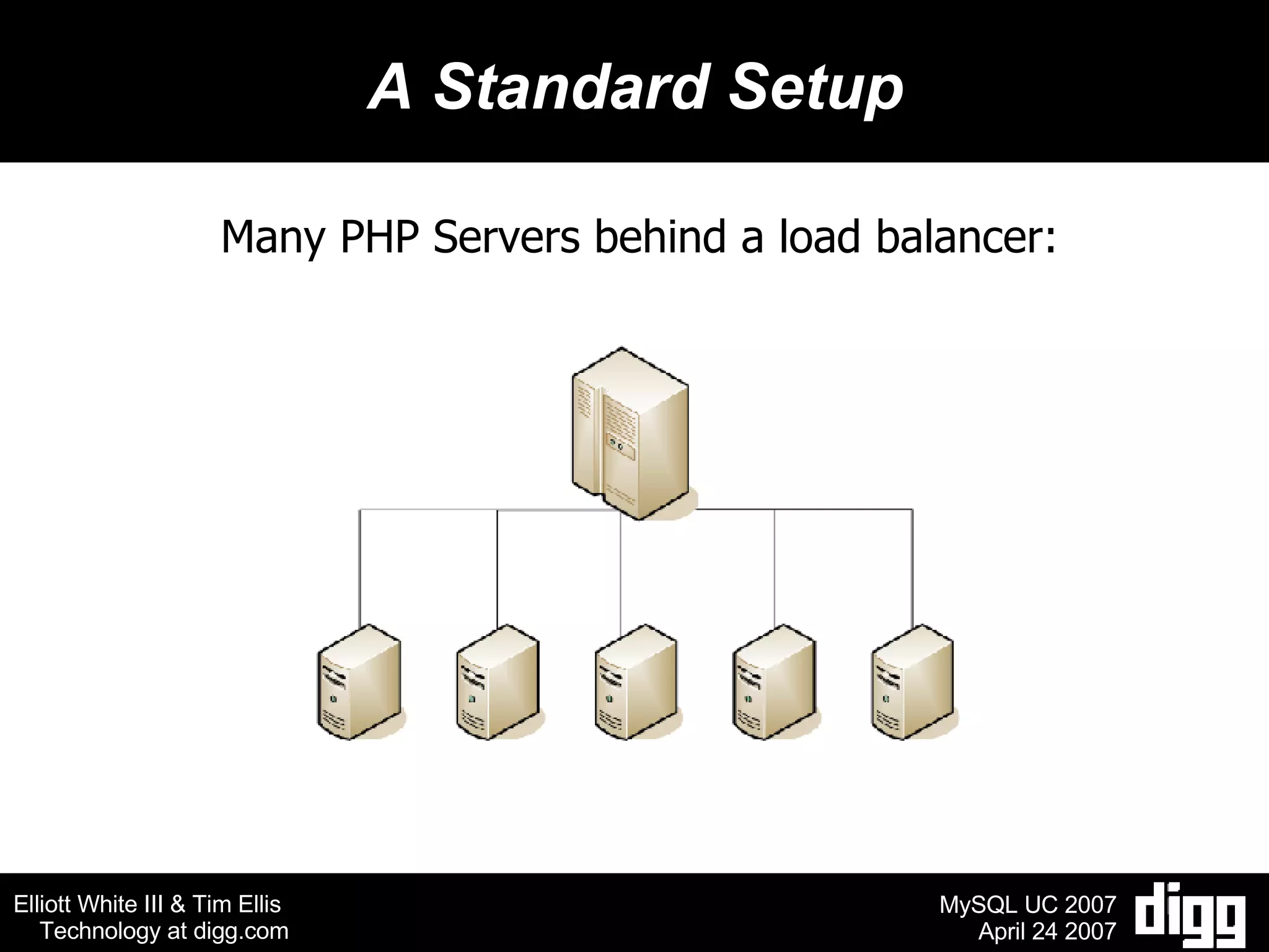
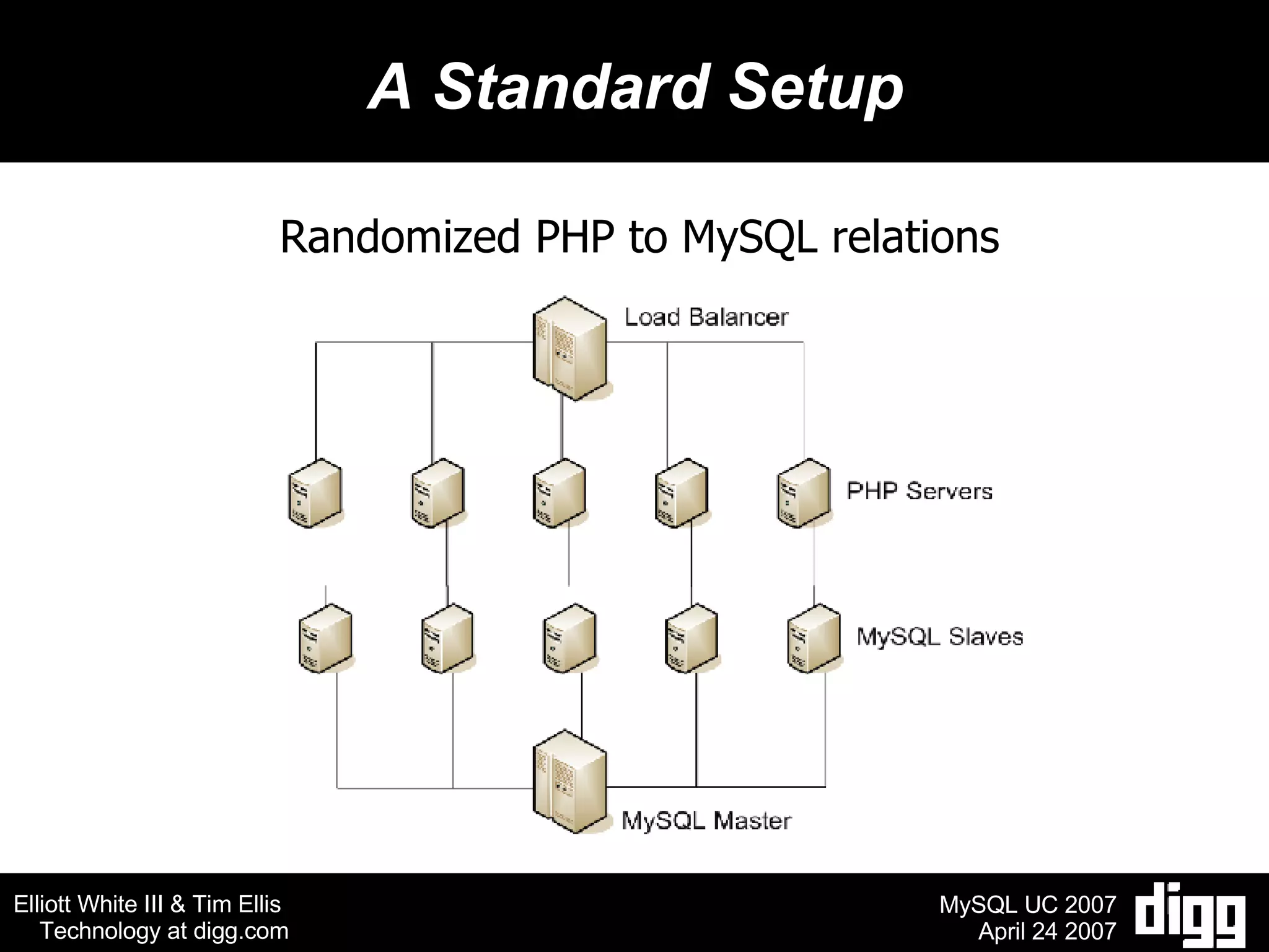
A Standard Setup Many PHP Servers behind a load balancer:
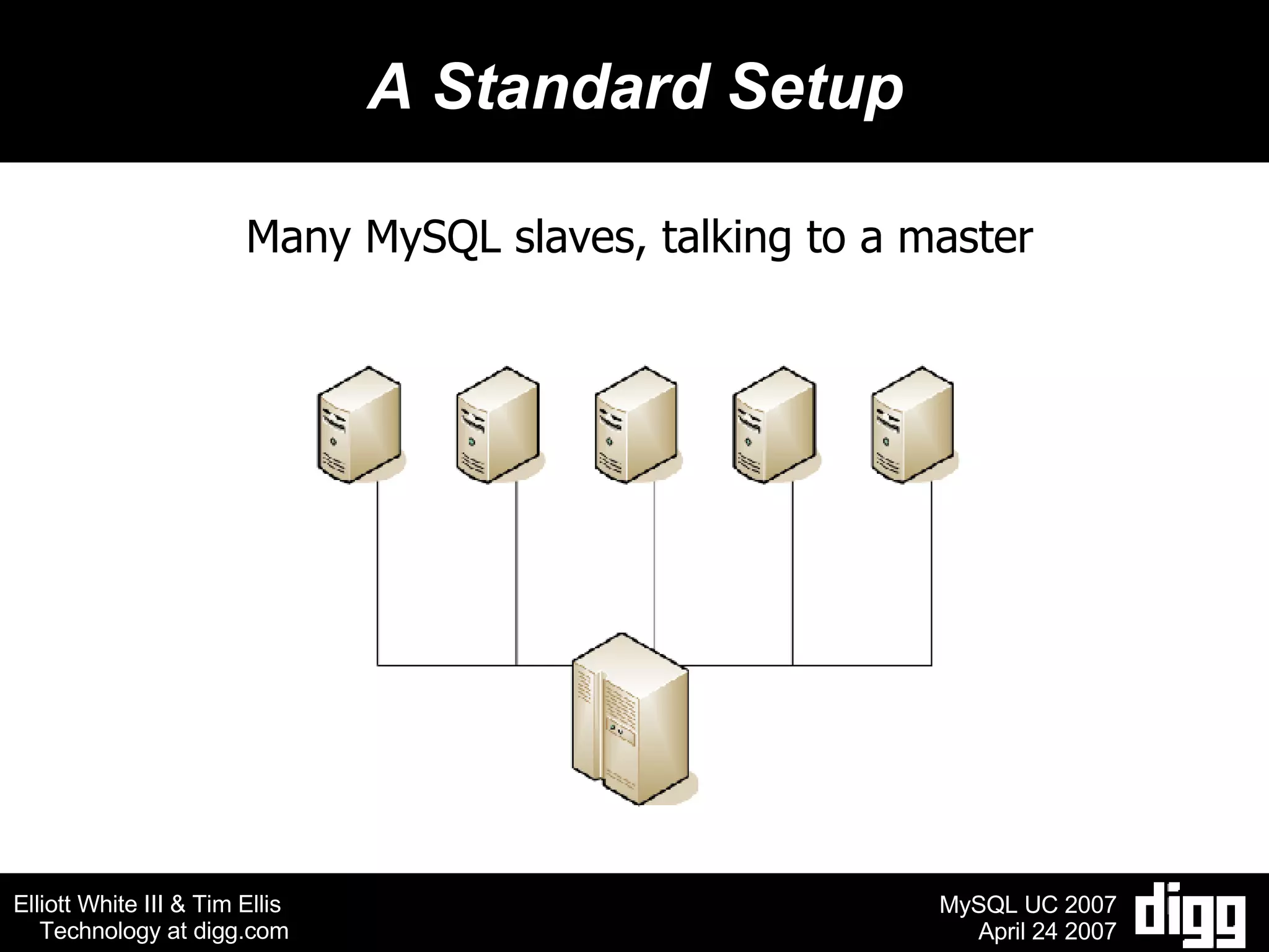
A Standard Setup Many MySQL slaves, talking to a master
A Standard Setup Randomized PHP to MySQL relations
Memcached What is it & Why use it? Why not just pregenerate pages of content? Performance gains: Caching certain chunks of data that may be used on many different pages.  From that, still being able to dynamically create the page, but using cached data.
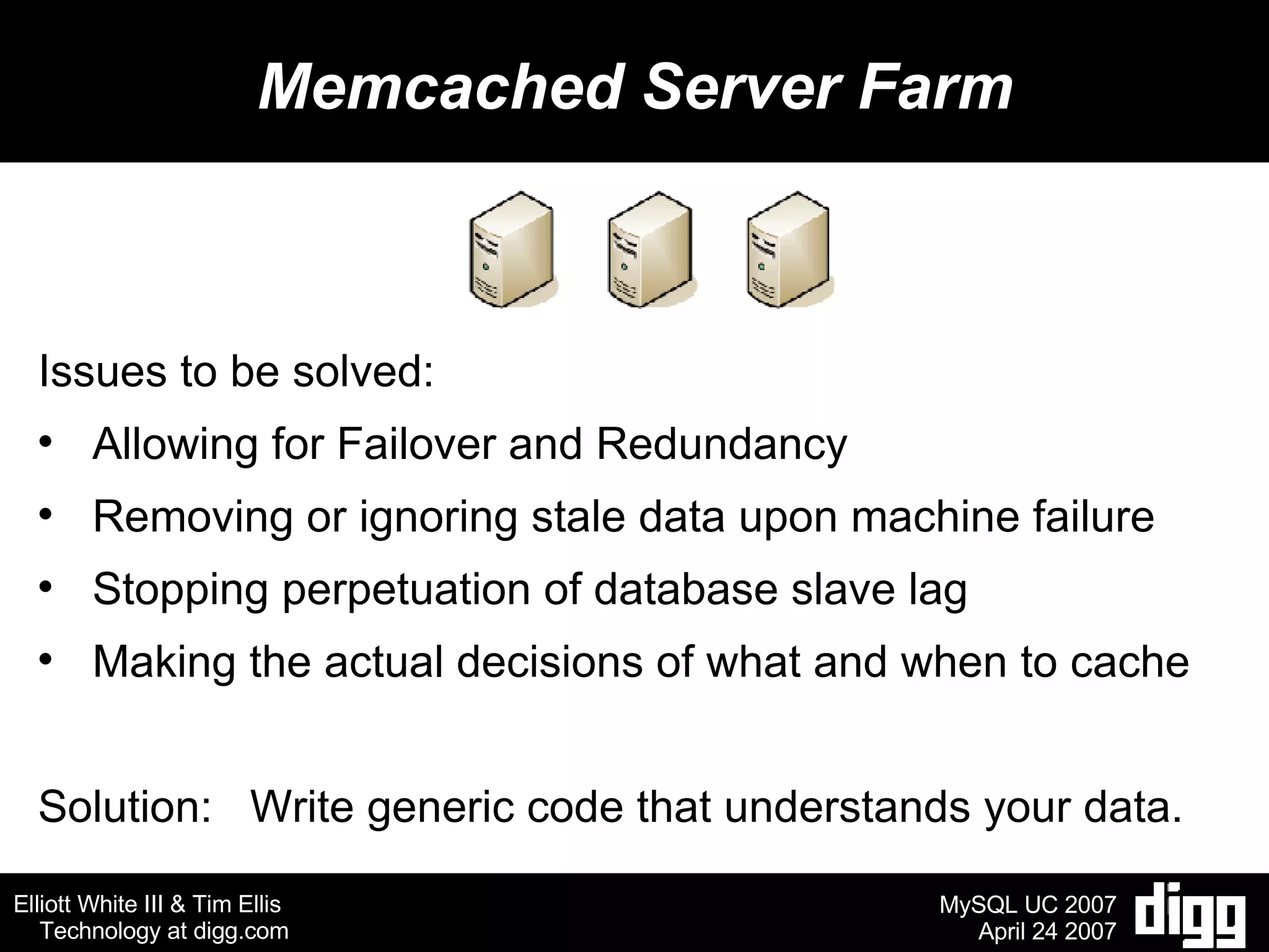
Memcached Server Farm Issues to be solved: Allowing for Failover and Redundancy Removing or ignoring stale data upon machine failure Stopping perpetuation of database slave lag Making the actual decisions of what and when to cache Solution:  Write generic code that understands your data.
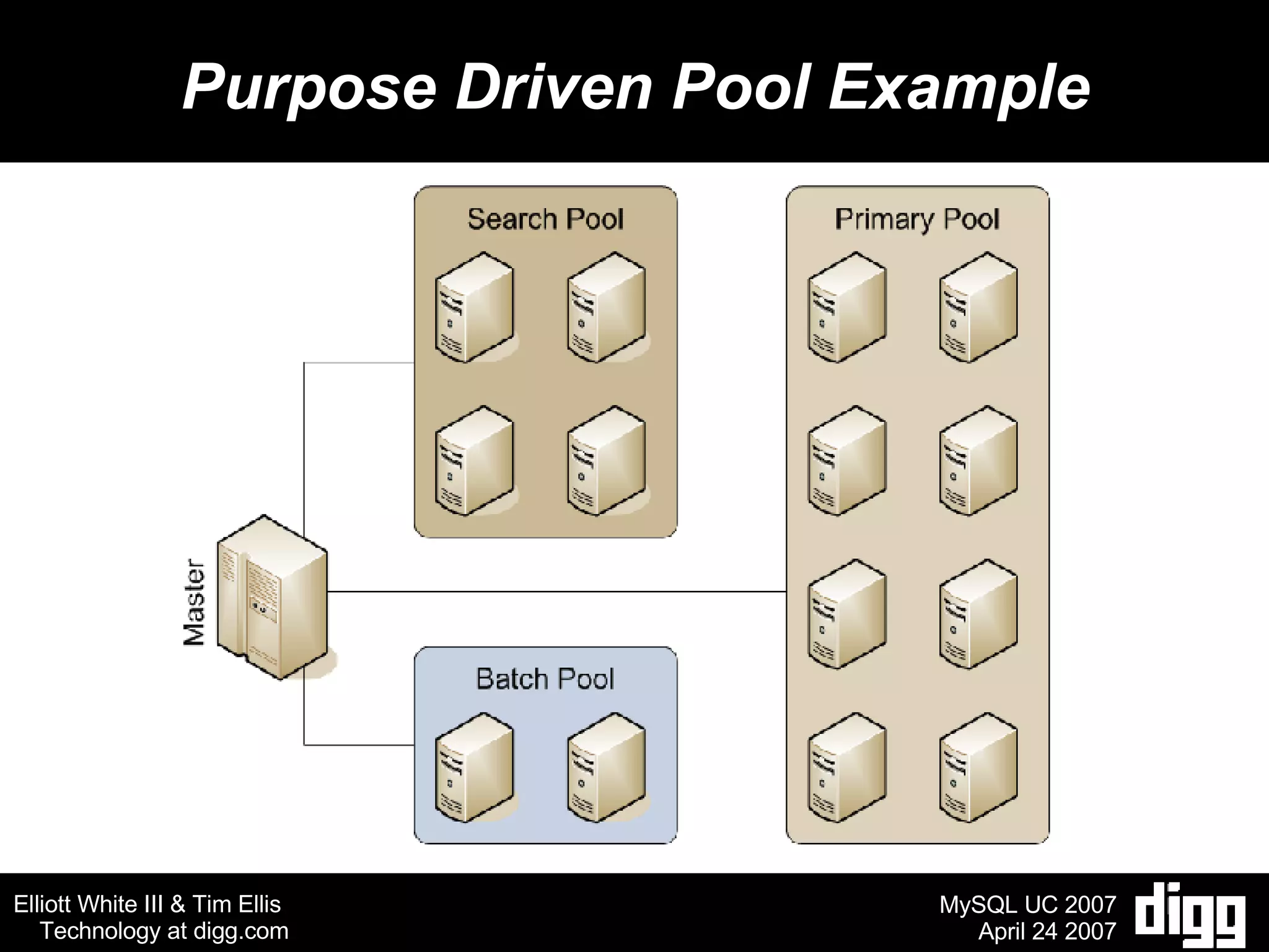
Purpose Driven MySQL Pools Creating separate slave pools, that are close to identical in order to isolate high database load.
Purpose Driven Pool Example
Sharding Simplest Definition: Breaking up your database into a number of smaller ones. Pros Greater performance Tweakable / Scalable Cons Loss of SQL support (JOIN) Increased PHP load Complicated programming
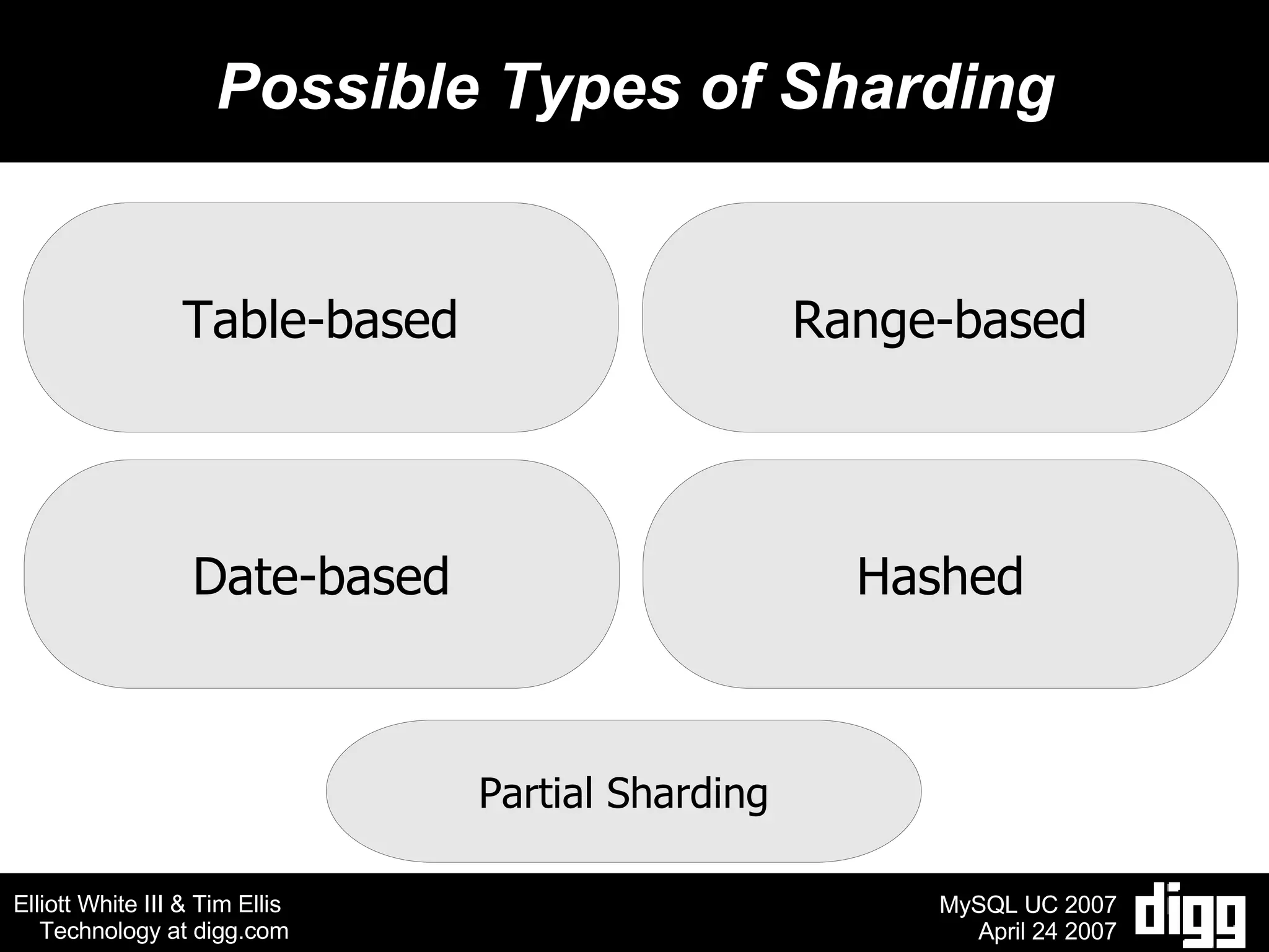
Possible Types of Sharding Table-based Range-based Date-based Hashed Partial Sharding
How MySQL Can Do Sharding Partition tables Federated tables MySQL Cluster (NDB) Which of these technologies does Digg use? None of them  They weren't ready when we needed them
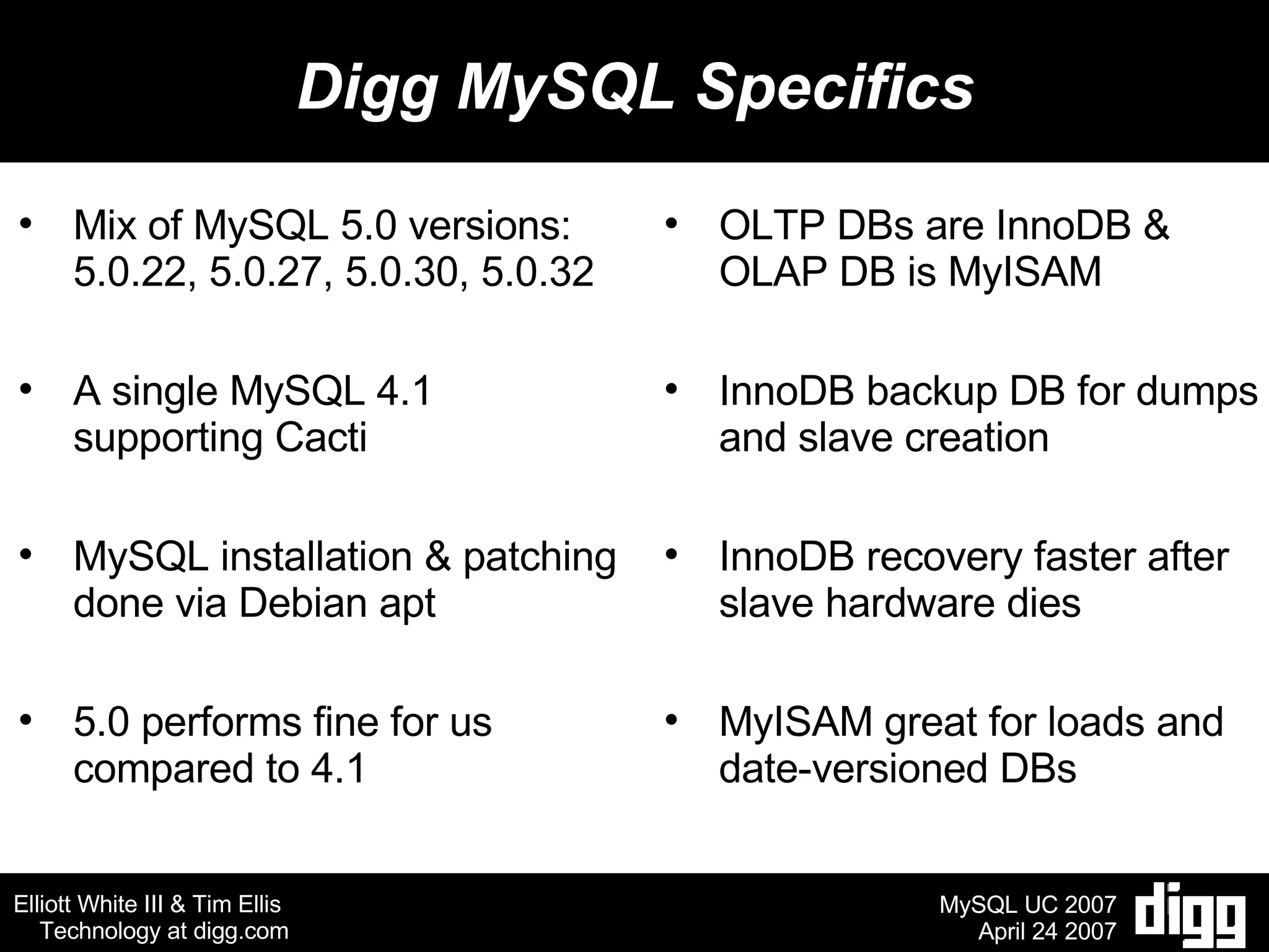
Digg MySQL Specifics Mix of MySQL 5.0 versions: 5.0.22, 5.0.27, 5.0.30, 5.0.32 A single MySQL 4.1 supporting Cacti MySQL installation & patching done via Debian apt 5.0 performs fine for us compared to 4.1 OLTP DBs are InnoDB & OLAP DB is MyISAM InnoDB backup DB for dumps and slave creation InnoDB recovery faster after slave hardware dies MyISAM great for loads and date-versioned DBs
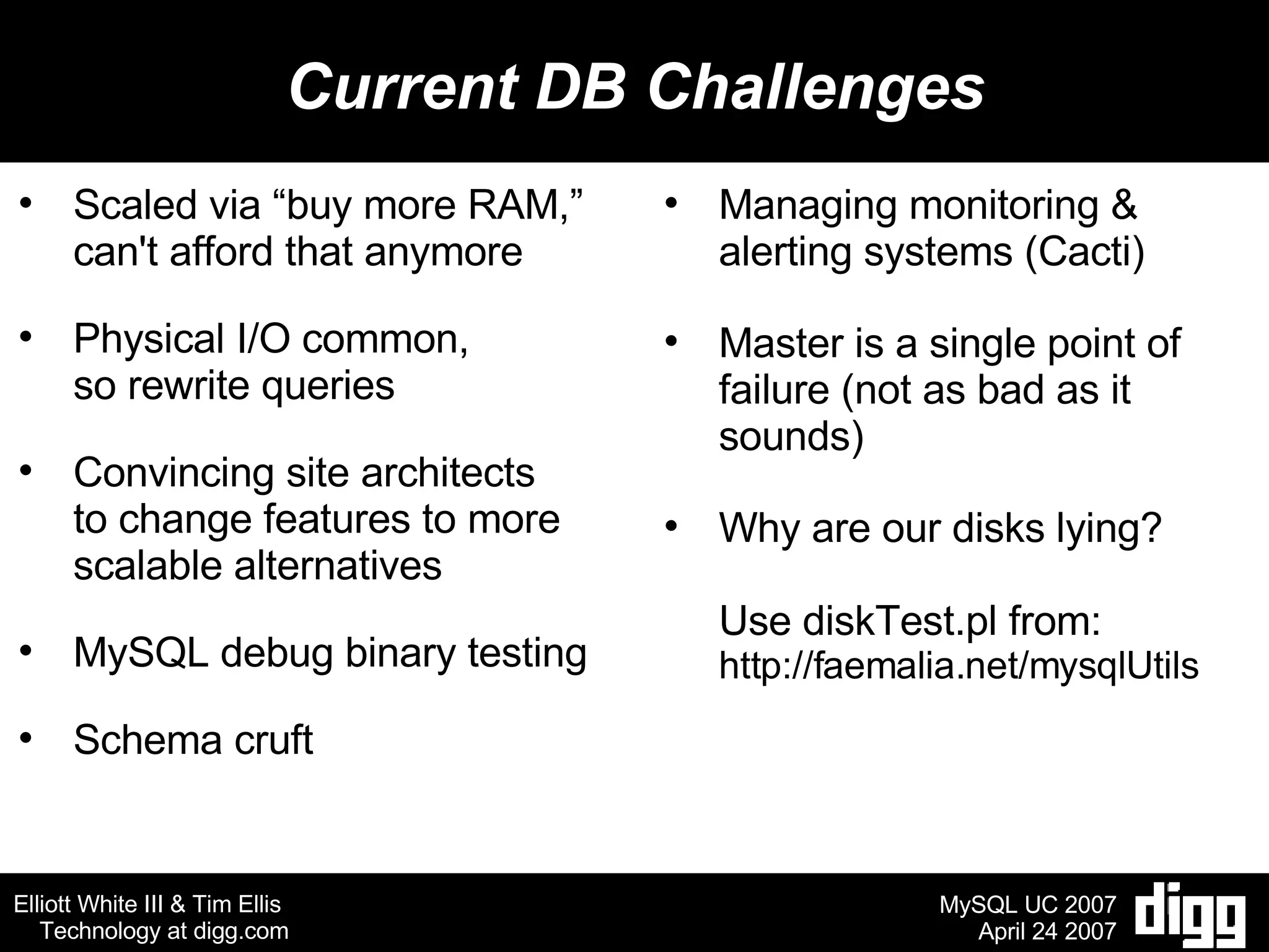
Current DB Challenges Scaled via “buy more RAM,” can't afford that anymore Physical I/O common,  so rewrite queries Convincing site architects to change features to more scalable alternatives MySQL debug binary testing Schema cruft Managing monitoring & alerting systems (Cacti) Master is a single point of failure (not as bad as it sounds) Why are our disks lying? Use diskTest.pl from: http://faemalia.net/mysqlUtils
Any Questions? For this presentation and more: http://eliw.com/ Visit  http://digg.com/

Mysql 2007 Tech At Digg V3

  • 1.
    Technology at digg.comElliott White III - Eli Tim Ellis - Time
  • 2.
    What's all thisthen? History of Tech at Digg Standard Setup Memcached Purpose Driven MySQL Server Pools Sharding Other MySQL details
  • 3.
    History of Techat Digg Initially one Linux server with Apache 1.3 and PHP 4.x MySQL 4.0 and myisam tables & MySQL full-text search Started with as many open source packages as possible for rapid development. ImageMagick, Ispell, prototype/scriptaculous, etc Grew quick. One server became two. myisam become innodb. We moved to 3 servers, Apache 2.x, MySQL master-slave replication, started using memcached, moved to PHP 5.x & hired a dba And then the pace picked up yet again...
  • 4.
    A Standard SetupMany PHP Servers behind a load balancer:
  • 5.
    A Standard SetupMany MySQL slaves, talking to a master
  • 6.
    A Standard SetupRandomized PHP to MySQL relations
  • 7.
    Memcached What isit & Why use it? Why not just pregenerate pages of content? Performance gains: Caching certain chunks of data that may be used on many different pages. From that, still being able to dynamically create the page, but using cached data.
  • 8.
    Memcached Server FarmIssues to be solved: Allowing for Failover and Redundancy Removing or ignoring stale data upon machine failure Stopping perpetuation of database slave lag Making the actual decisions of what and when to cache Solution: Write generic code that understands your data.
  • 9.
    Purpose Driven MySQLPools Creating separate slave pools, that are close to identical in order to isolate high database load.
  • 10.
  • 11.
    Sharding Simplest Definition:Breaking up your database into a number of smaller ones. Pros Greater performance Tweakable / Scalable Cons Loss of SQL support (JOIN) Increased PHP load Complicated programming
  • 12.
    Possible Types ofSharding Table-based Range-based Date-based Hashed Partial Sharding
  • 13.
    How MySQL CanDo Sharding Partition tables Federated tables MySQL Cluster (NDB) Which of these technologies does Digg use? None of them They weren't ready when we needed them
  • 14.
    Digg MySQL SpecificsMix of MySQL 5.0 versions: 5.0.22, 5.0.27, 5.0.30, 5.0.32 A single MySQL 4.1 supporting Cacti MySQL installation & patching done via Debian apt 5.0 performs fine for us compared to 4.1 OLTP DBs are InnoDB & OLAP DB is MyISAM InnoDB backup DB for dumps and slave creation InnoDB recovery faster after slave hardware dies MyISAM great for loads and date-versioned DBs
  • 15.
    Current DB ChallengesScaled via “buy more RAM,” can't afford that anymore Physical I/O common, so rewrite queries Convincing site architects to change features to more scalable alternatives MySQL debug binary testing Schema cruft Managing monitoring & alerting systems (Cacti) Master is a single point of failure (not as bad as it sounds) Why are our disks lying? Use diskTest.pl from: http://faemalia.net/mysqlUtils
  • 16.
    Any Questions? Forthis presentation and more: http://eliw.com/ Visit http://digg.com/