A systematic succession planning is a component of a good HR practice that provides a plan to manage the changes that will occur when a person on key position leaves the organization.
Why Succession Planning?
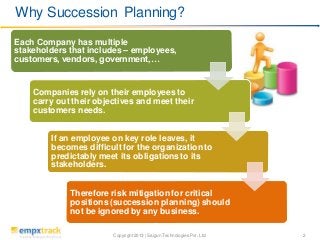
EachCompany has multiple
stakeholders that includes – employees,
customers, vendors, government,…
Companies rely on their employees to
carry out their objectives and meet their
customers needs.
If an employee on key role leaves, it
becomes difficult for the organization to
predictably meet its obligations to its
stakeholders.
Therefore risk mitigation for critical
positions (succession planning) should
not be ignored by any business.
Copyright 2013 | Saigun Technologies Pvt. Ltd.
2
3.
A Scenario: Needof Succession Planning
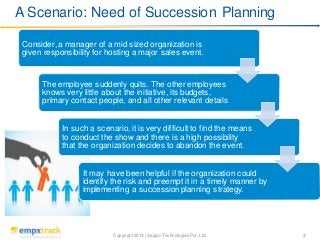
Consider, a manager of a mid sized organization is
given responsibility for hosting a major sales event.
The employee suddenly quits. The other employees
knows very little about the initiative, its budgets,
primary contact people, and all other relevant details
In such a scenario, it is very difficult to find the means
to conduct the show and there is a high possibility
that the organization decides to abandon the event.
It may have been helpful if the organization could
identify the risk and preempt it in a timely manner by
implementing a succession planning strategy.
Copyright 2013 | Saigun Technologies Pvt. Ltd.
3
4.
Implementing Succession Planning
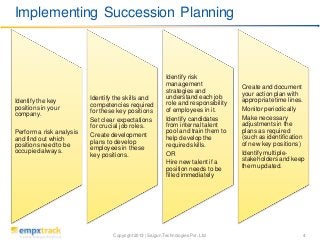
Identifythe key
positions in your
company.
Perform a risk analysis
and find out which
positions need to be
occupied always.
Identify the skills and
competencies required
for these key positions
Set clear expectations
for crucial job roles.
Create development
plans to develop
employees in these
key positions.
Identify risk
management
strategies and
understand each job
role and responsibility
of employees in it.
Identify candidates
from internal talent
pool and train them to
help develop the
required skills.
OR
Hire new talent if a
position needs to be
filled immediately
Copyright 2013 | Saigun Technologies Pvt. Ltd.
Create and document
your action plan with
appropriate time lines.
Monitor periodically
Make necessary
adjustments in the
plans as required
(such as identification
of new key positions)
Identify multiplestakeholders and keep
them updated.
4
5.
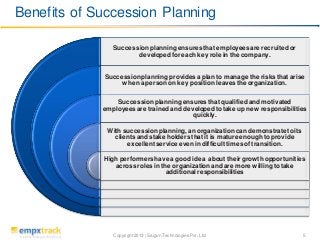
Benefits of SuccessionPlanning
Succession planning ensures that employees are recruited or
developed for each key role in the company.
Succession planning provides a plan to manage the risks that arise
when a person on key position leaves the organization.
Succession planning ensures that qualified and motivated
employees are trained and developed to take up new responsibilities
quickly.
With succession planning, an organization can demonstrate to its
clients and stake holders that it is mature enough to provide
excellent service even in difficult times of transition.
High performers have a good idea about their growth opportunities
across roles in the organization and are more willing to take
additional responsibilities
Copyright 2013 | Saigun Technologies Pvt. Ltd.
5