Open Access +
Preprints for Scholars
and Journals
Presented by:
About the Creators
2
Scholastica
Scholastica is a web-based software
platform for managing academic
journals with integrated peer review
and open access publishing tools.
Over 400 journals across disciplines
use Scholastica to easily manage their
peer review and publishing process at
a price they can afford.
scholasticahq.com
Authorea
Authorea is the leading collaborative
platform to write, cite, collaborate,
host, and publish research. Founded
by two physicists out of CERN,
Authorea aims to accelerate the
entire research cycle, from writing to
publishing, creating a new platform
for researchers and scientists.
authorea.com
Open Access +
Preprints: Journals
and scholars take
action
3
For more information
on how scholars and
journals can use
preprints for OA
research dissemination
download Scholastica &
Authorea’s free eBook.
resources.scholasticahq.com/open-access-publishing-preprints/
Let’s talk about
research
dissemination
How has access to scholarship changed
in the last 350 years?
4
Origin of the Formal Scholarly
Record
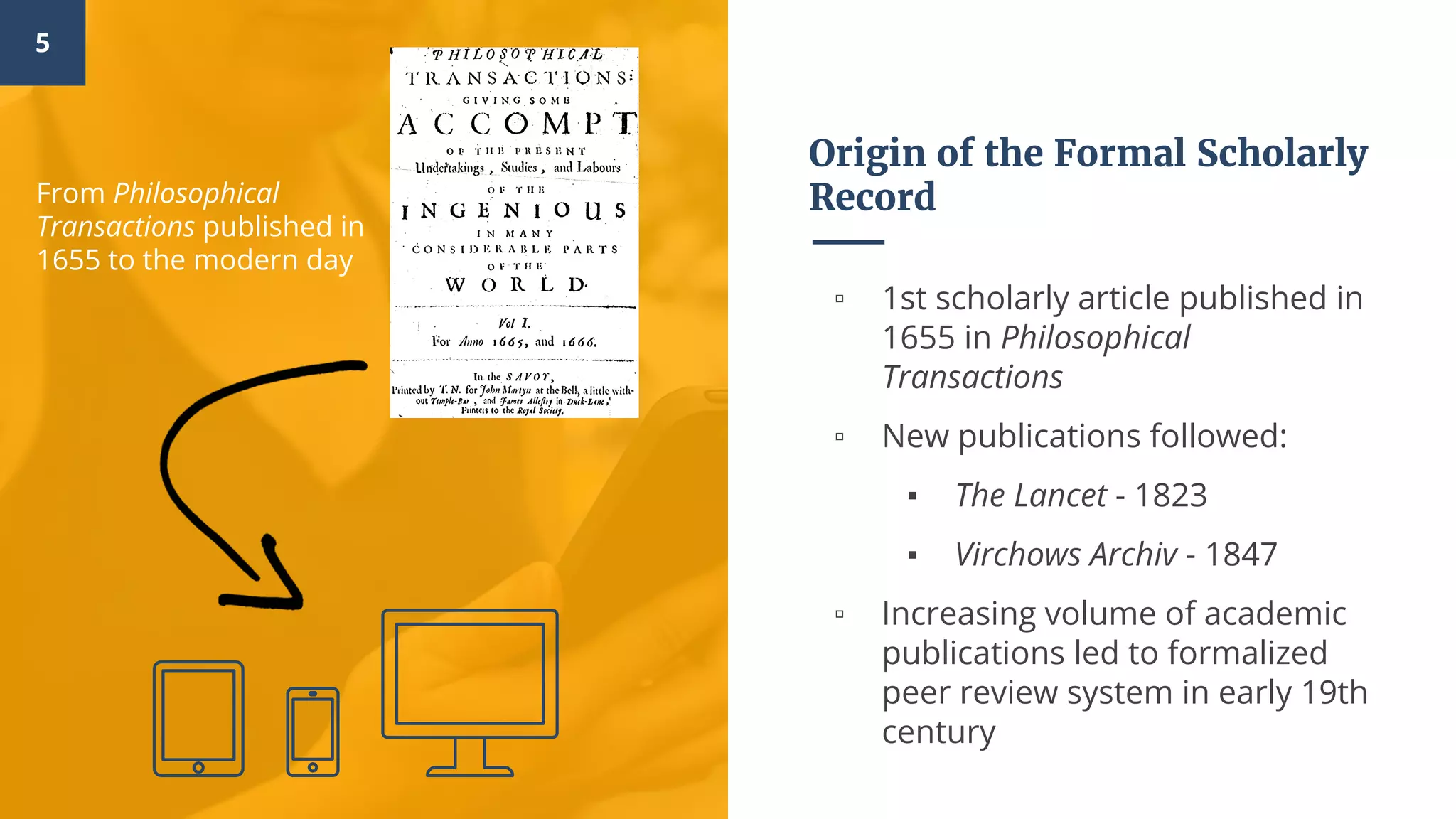
▫ 1st scholarly article published in
1655 in Philosophical
Transactions
▫ New publications followed:
▪ The Lancet - 1823
▪ Virchows Archiv - 1847
▫ Increasing volume of academic
publications led to formalized
peer review system in early 19th
century
5
From Philosophical
Transactions published in
1655 to the modern day
Primary research
access model 350+
years to present
6
Scholars freely submit
research to journals
Accepted articles are published
in print and/or online journal
issues
Academics volunteer to peer
review research
Scholars freely submitted
research to journals
Manuscripts were vetted
during an editing process
(precursor to formal peer
review)
Accepted articles were
published in print issues
1655... 2016
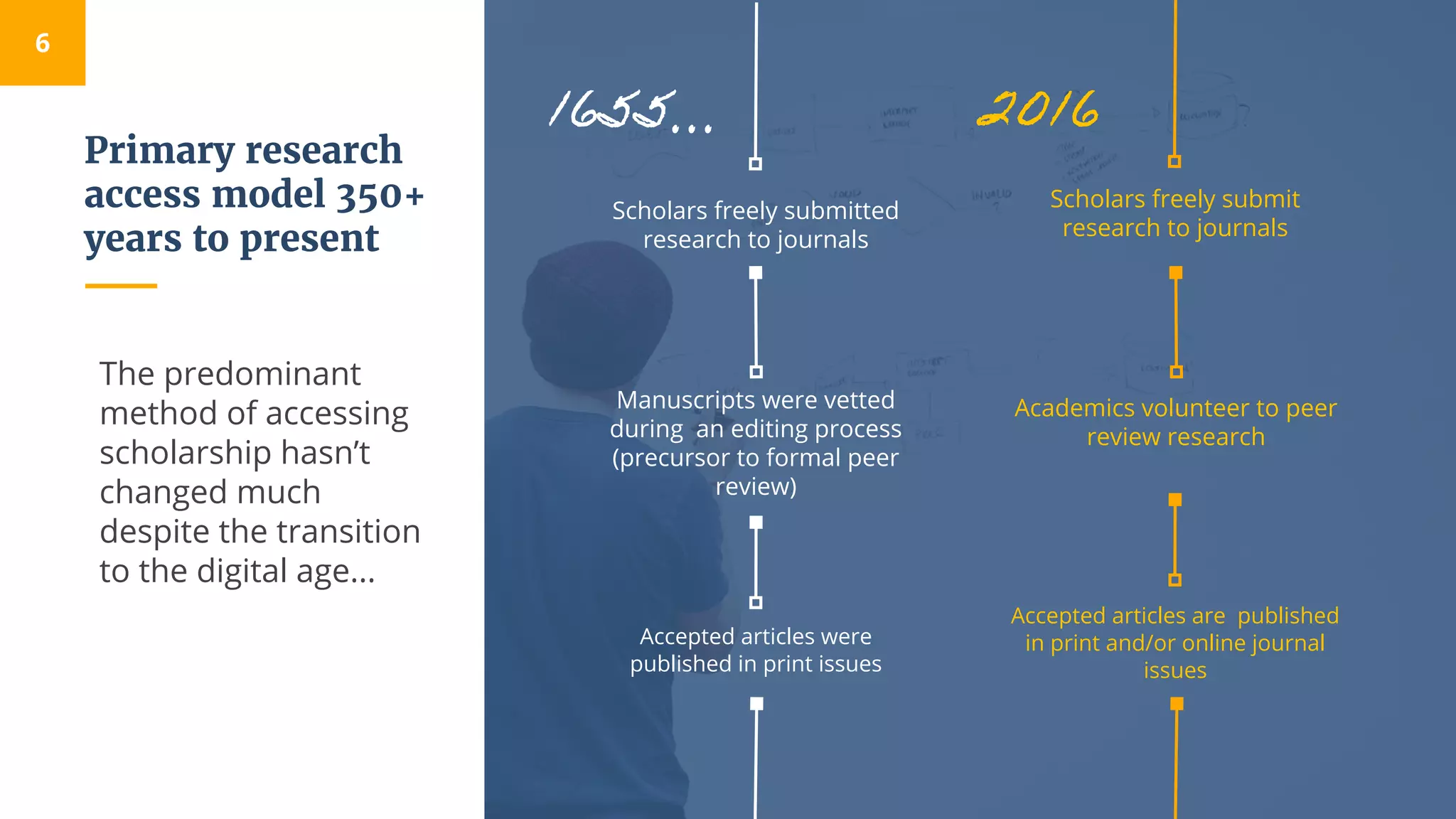
The predominant
method of accessing
scholarship hasn’t
changed much
despite the transition
to the digital age...
7
BUT the cost of
access is going up...
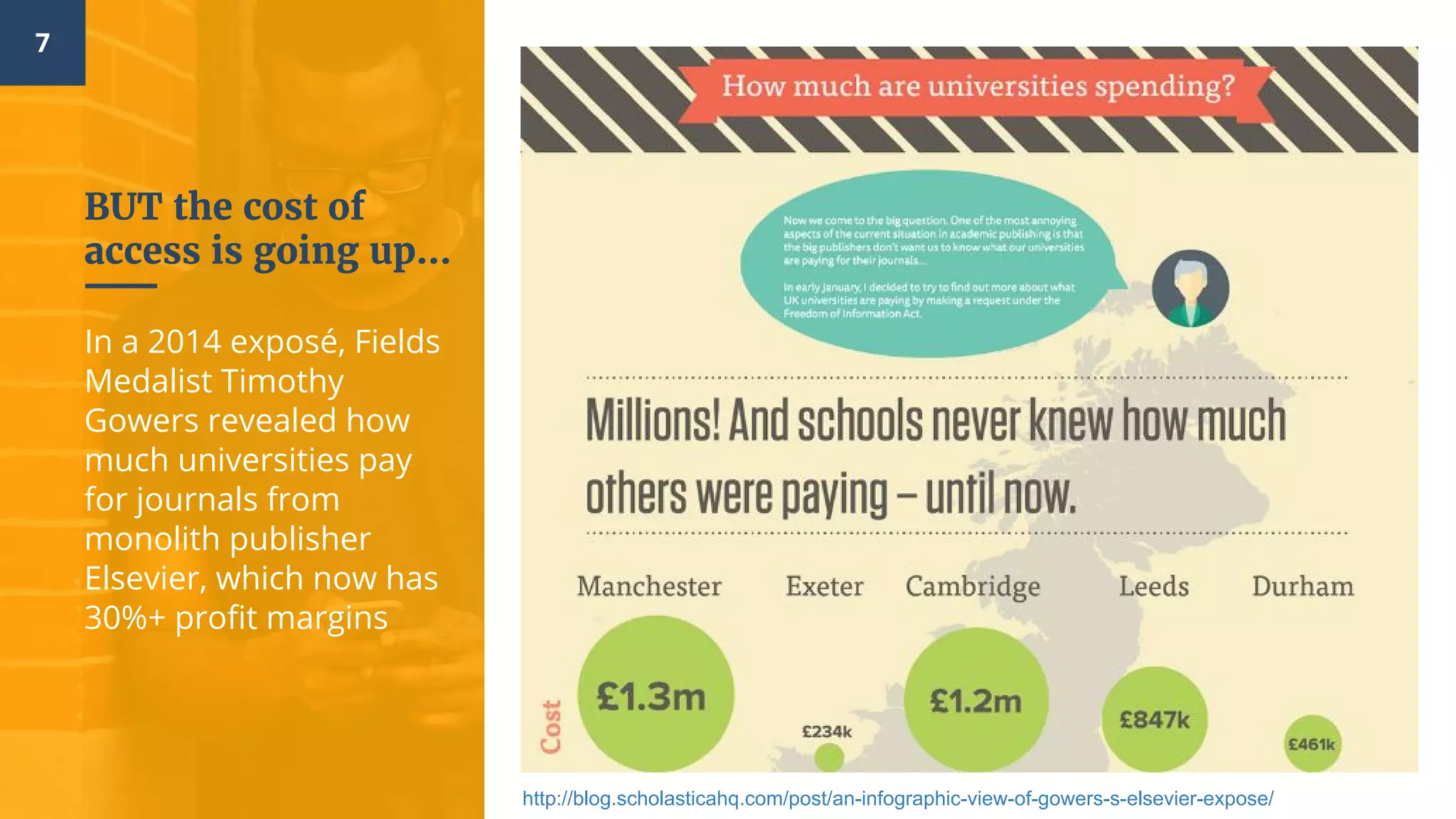
In a 2014 exposé, Fields
Medalist Timothy
Gowers revealed how
much universities pay
for journals from
monolith publisher
Elsevier, which now has
30%+ profit margins
http://blog.scholasticahq.com/post/an-infographic-view-of-gowers-s-elsevier-expose/
Revelations of the true cost of access to research, which is often
publicly funded, have caused scholars, institutions, and funding
bodies to call for open access.
Some Highlights:
Cost of Knowledge (2012)
Inspired by Timothy Gowers’
exposé of Elsevier, over 16k
scholars started an author,
editor, and reviewer boycott of
Elsevier journals.
http://www.thecostofknowledge.com/
EU Announces New OA Policy
(2016)
Science ministers from across the EU
called for open access to all research
by 2020.
http://www.sciencemag.org/news/2016/05/dra
matic-statement-european-leaders-call-immedi
ate-open-access-all-scientific-papers
U.S. Policy for Taxpayer-Funded
Research (2013)
The U.S. government announced
publications from taxpayer-funded
research should be free to read after
no more than a year’s delay.
http://blogs.nature.com/news/2013/02/us-whit
e-house-announces-open-access-policy.html
Funders Call for OA (2016)
The Wellcome Trust, Bill & Melinda
Gates Foundation, and others urged
journals and funding agencies to
pledge to make papers on Zika OA.
http://www.sciencemag.org/news/2016
/02/plea-open-science-zika
8
Things Are Changing
As scholars, institutions, and funding bodies speak
up we are seeing more open access research
9
“
The number of OA research
articles published annually is
growing at double the rate of
the complete spectrum of
research articles.
10
Open Access Journal Publishing 2016-2020, Simba
http://www.prnewswire.com/news-releases/simba-information-open-access-articles-grow-at-twice-the-rate
-of-all-published-research-300340548.html
But there’s still work to do...
65 of world’s 100 most cited
papers still behind a paywall
Authorea blog:
https://www.authorea.com/users/8850/articles/125400/_show_article
11
12
What steps can
scholars and academic
journal publishers take
to make research more
open?
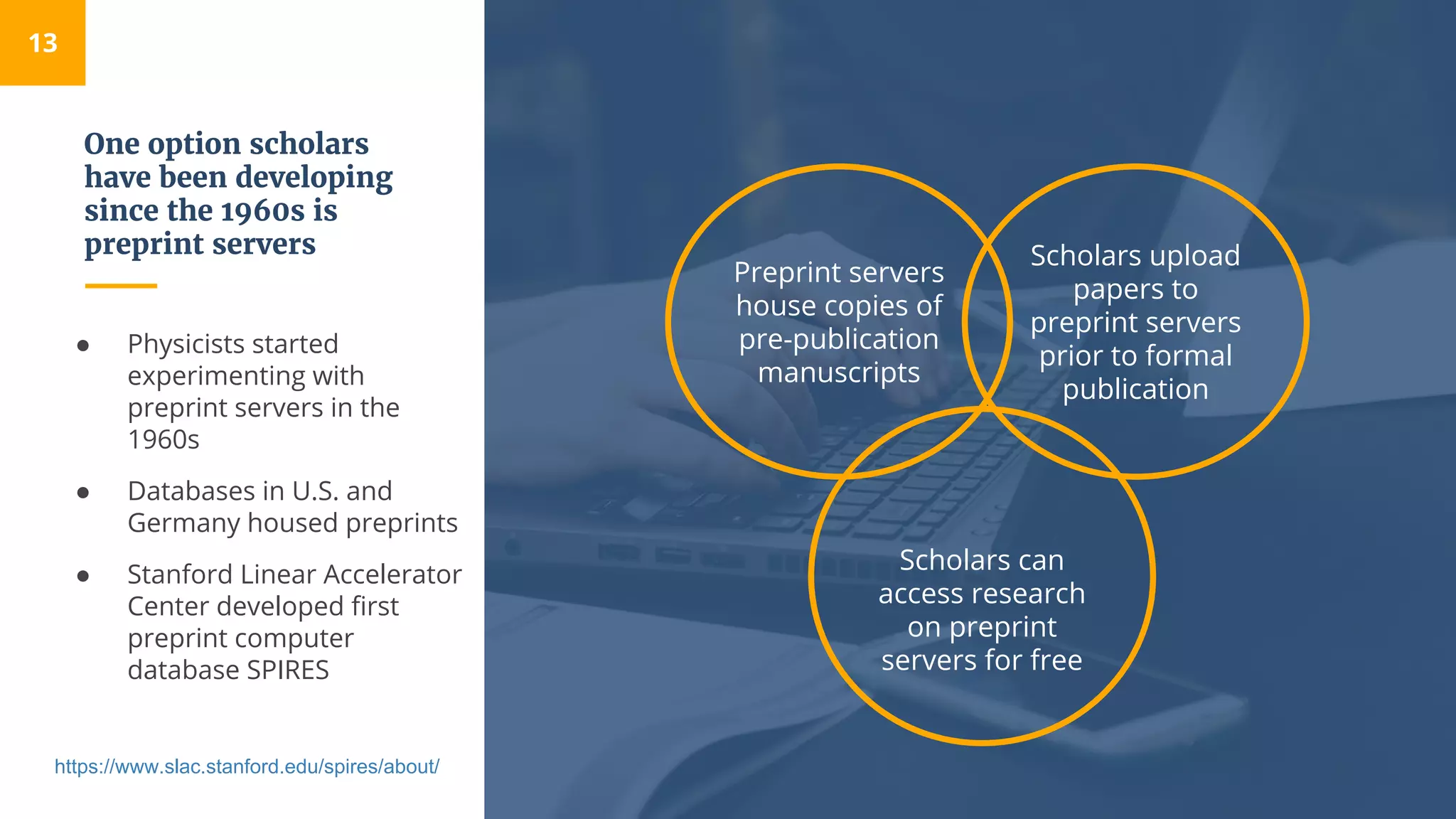
One option scholars
have been developing
since the 1960s is
preprint servers
Preprint servers
house copies of
pre-publication
manuscripts
Scholars can
access research
on preprint
servers for free
Scholars upload
papers to
preprint servers
prior to formal
publication
13
● Physicists started
experimenting with
preprint servers in the
1960s
● Databases in U.S. and
Germany housed preprints
● Stanford Linear Accelerator
Center developed first
preprint computer
database SPIRES
https://www.slac.stanford.edu/spires/about/
Preprints in the
Internet Age
14
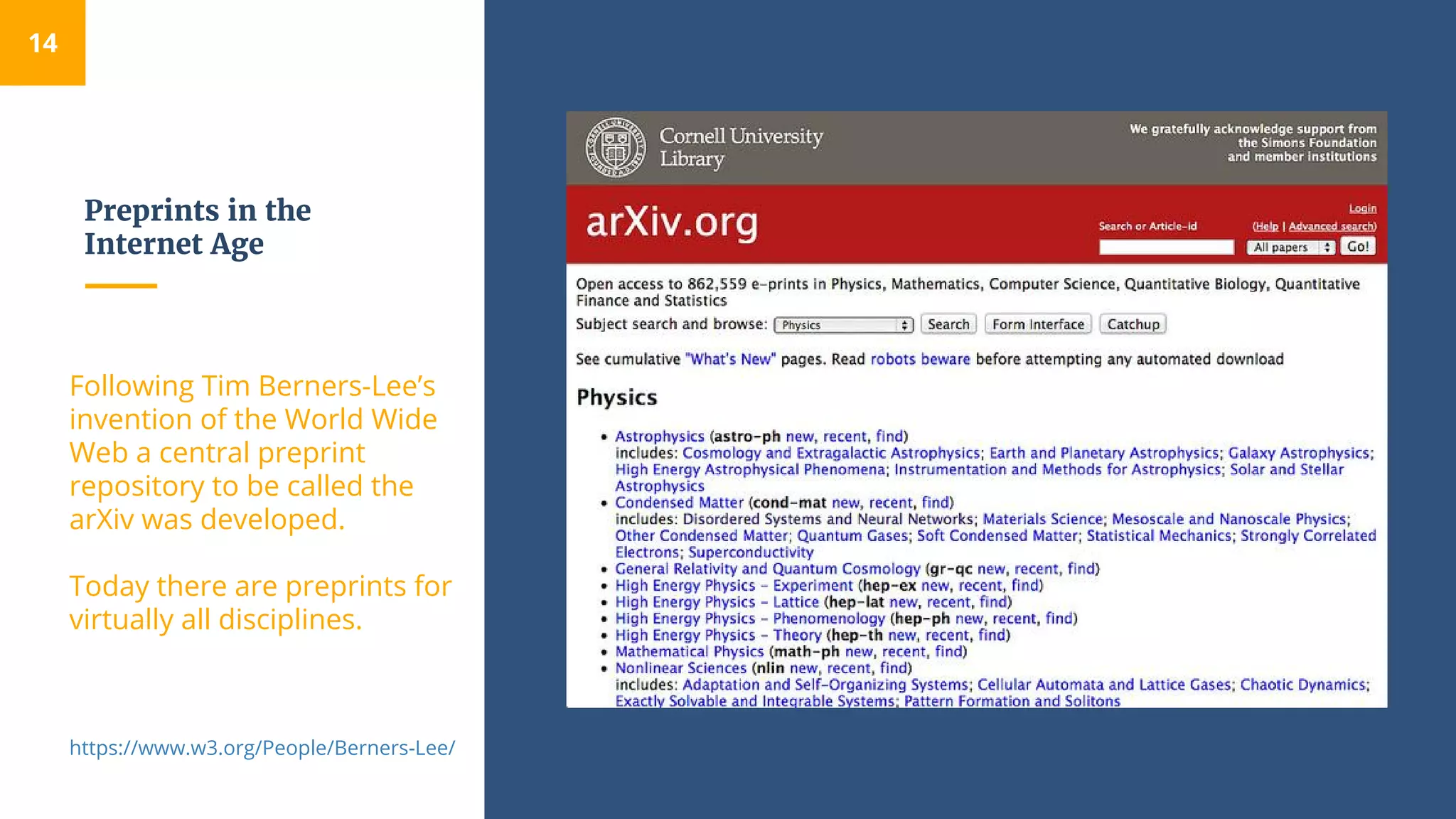
Following Tim Berners-Lee’s
invention of the World Wide
Web a central preprint
repository to be called the
arXiv was developed.
Today there are preprints for
virtually all disciplines.
https://www.w3.org/People/Berners-Lee/
Preprints facilitate
Green OA around the
world
15
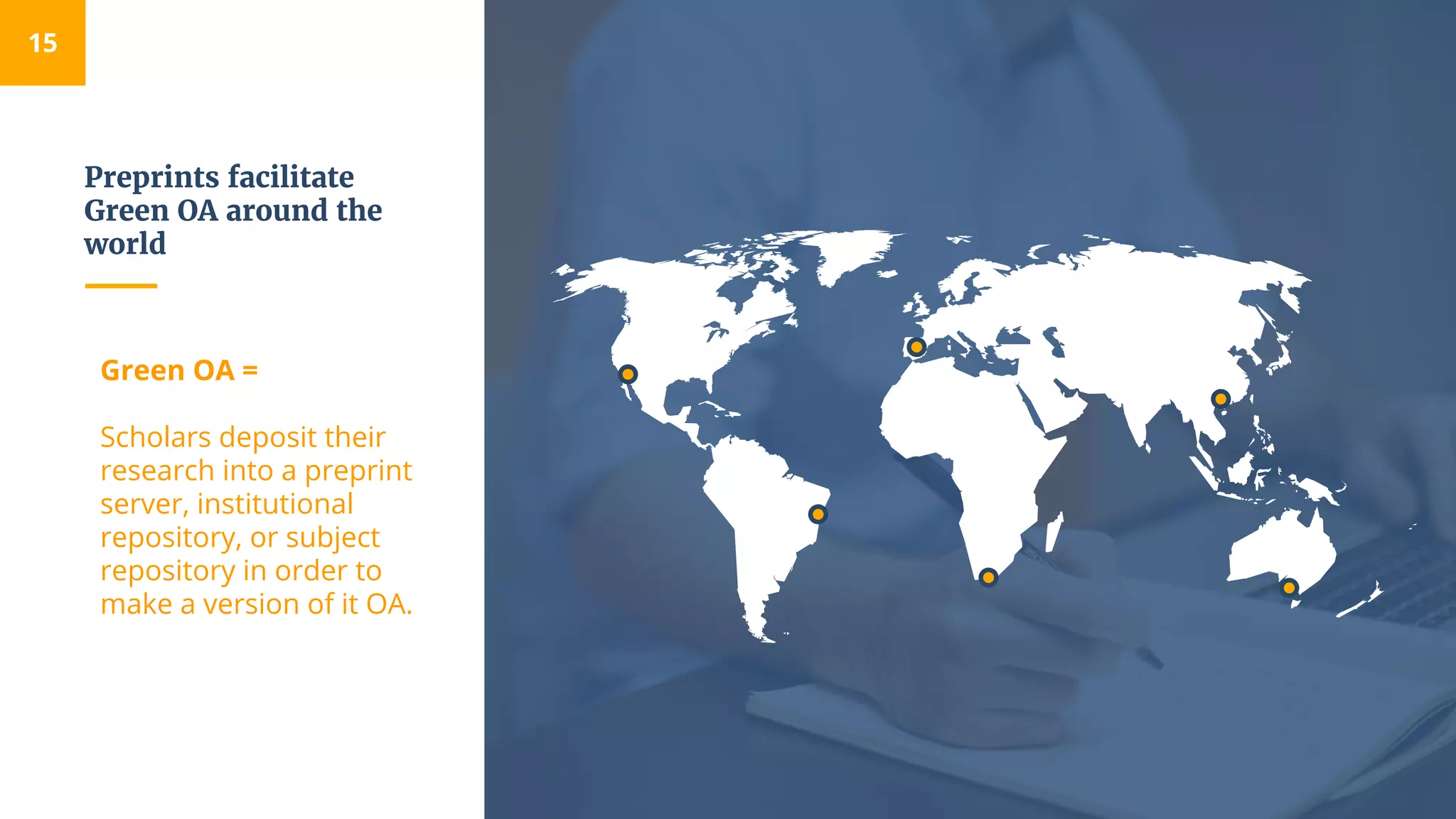
Green OA =
Scholars deposit their
research into a preprint
server, institutional
repository, or subject
repository in order to
make a version of it OA.
Benefits of preprints for scholars
▫ Give scholars working on time-sensitive
projects a way to communicate their
research while undergoing peer review
▫ Can serve as a way for scholars to
establish priority over a particular
research discovery or method
▫ Ensure that an OA version of scholars’
work will be available regardless of
where they formally publish
16
5 Ways to Use Preprints to Make
Research OA
17
1. Check preprint policies at
journals to which you’re
considering submitting
2. Use collaborative writing
tools like Authorea to write
and post preprints
3. Share your preprints with
colleagues via social media
and email to solicit feedback
4. Educate and encourage
others to share their work
openly
Authorea article draft view
18
How do preprints fit
into the academic
journal publishing
landscape?
Journals can facilitate research
access by encouraging Green OA
via preprints
▫ Make clear OA policies accessible on
journal website
▫ Provide specific preprint policies that
meet funder requirements and are
reasonable to the academic community
▫ Apply Digital Object Identifiers (DOIs) to
all articles, so scholars can link the
different versions of their work
▫ Provide journal and article level OA
licensing terms to clarify any
differences at either level
19
Journals developing
preprint publishing
models
20
21
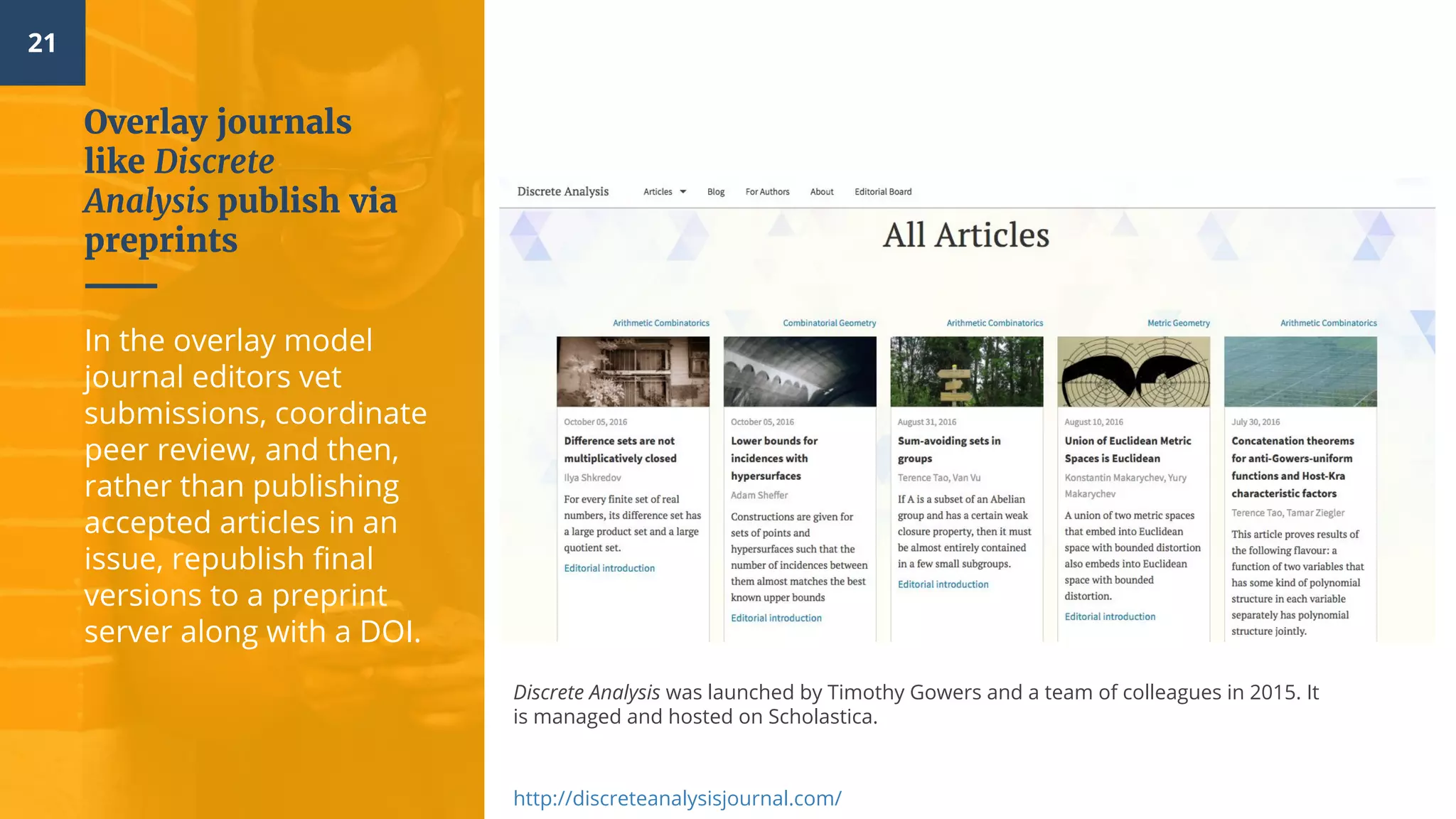
Overlay journals
like Discrete
Analysis publish via
preprints
In the overlay model
journal editors vet
submissions, coordinate
peer review, and then,
rather than publishing
accepted articles in an
issue, republish final
versions to a preprint
server along with a DOI.
Discrete Analysis was launched by Timothy Gowers and a team of colleagues in 2015. It
is managed and hosted on Scholastica.
http://discreteanalysisjournal.com/
22
Discrete Analysis offers readers a modern journal browsing experience by
connecting a user-friendly website hosted on Scholastica to arXiv. The journal
accepts arXiv submissions and coordinate peer review via Scholastica.
Article show page: http://discreteanalysisjournal.com/
What’s next for preprints?
We’d love to hear what you think! Reach us on
Twitter at:
23
@scholasticahq @authorea

Open Access + Preprints for Scholars and Journals

  • 1.
    Open Access + Preprintsfor Scholars and Journals Presented by:
  • 2.
    About the Creators 2 Scholastica Scholasticais a web-based software platform for managing academic journals with integrated peer review and open access publishing tools. Over 400 journals across disciplines use Scholastica to easily manage their peer review and publishing process at a price they can afford. scholasticahq.com Authorea Authorea is the leading collaborative platform to write, cite, collaborate, host, and publish research. Founded by two physicists out of CERN, Authorea aims to accelerate the entire research cycle, from writing to publishing, creating a new platform for researchers and scientists. authorea.com
  • 3.
    Open Access + Preprints:Journals and scholars take action 3 For more information on how scholars and journals can use preprints for OA research dissemination download Scholastica & Authorea’s free eBook. resources.scholasticahq.com/open-access-publishing-preprints/
  • 4.
    Let’s talk about research dissemination Howhas access to scholarship changed in the last 350 years? 4
  • 5.
    Origin of theFormal Scholarly Record ▫ 1st scholarly article published in 1655 in Philosophical Transactions ▫ New publications followed: ▪ The Lancet - 1823 ▪ Virchows Archiv - 1847 ▫ Increasing volume of academic publications led to formalized peer review system in early 19th century 5 From Philosophical Transactions published in 1655 to the modern day
  • 6.
    Primary research access model350+ years to present 6 Scholars freely submit research to journals Accepted articles are published in print and/or online journal issues Academics volunteer to peer review research Scholars freely submitted research to journals Manuscripts were vetted during an editing process (precursor to formal peer review) Accepted articles were published in print issues 1655... 2016 The predominant method of accessing scholarship hasn’t changed much despite the transition to the digital age...
  • 7.
    7 BUT the costof access is going up... In a 2014 exposé, Fields Medalist Timothy Gowers revealed how much universities pay for journals from monolith publisher Elsevier, which now has 30%+ profit margins http://blog.scholasticahq.com/post/an-infographic-view-of-gowers-s-elsevier-expose/
  • 8.
    Revelations of thetrue cost of access to research, which is often publicly funded, have caused scholars, institutions, and funding bodies to call for open access. Some Highlights: Cost of Knowledge (2012) Inspired by Timothy Gowers’ exposé of Elsevier, over 16k scholars started an author, editor, and reviewer boycott of Elsevier journals. http://www.thecostofknowledge.com/ EU Announces New OA Policy (2016) Science ministers from across the EU called for open access to all research by 2020. http://www.sciencemag.org/news/2016/05/dra matic-statement-european-leaders-call-immedi ate-open-access-all-scientific-papers U.S. Policy for Taxpayer-Funded Research (2013) The U.S. government announced publications from taxpayer-funded research should be free to read after no more than a year’s delay. http://blogs.nature.com/news/2013/02/us-whit e-house-announces-open-access-policy.html Funders Call for OA (2016) The Wellcome Trust, Bill & Melinda Gates Foundation, and others urged journals and funding agencies to pledge to make papers on Zika OA. http://www.sciencemag.org/news/2016 /02/plea-open-science-zika 8
  • 9.
    Things Are Changing Asscholars, institutions, and funding bodies speak up we are seeing more open access research 9
  • 10.
    “ The number ofOA research articles published annually is growing at double the rate of the complete spectrum of research articles. 10 Open Access Journal Publishing 2016-2020, Simba http://www.prnewswire.com/news-releases/simba-information-open-access-articles-grow-at-twice-the-rate -of-all-published-research-300340548.html
  • 11.
    But there’s stillwork to do... 65 of world’s 100 most cited papers still behind a paywall Authorea blog: https://www.authorea.com/users/8850/articles/125400/_show_article 11
  • 12.
    12 What steps can scholarsand academic journal publishers take to make research more open?
  • 13.
    One option scholars havebeen developing since the 1960s is preprint servers Preprint servers house copies of pre-publication manuscripts Scholars can access research on preprint servers for free Scholars upload papers to preprint servers prior to formal publication 13 ● Physicists started experimenting with preprint servers in the 1960s ● Databases in U.S. and Germany housed preprints ● Stanford Linear Accelerator Center developed first preprint computer database SPIRES https://www.slac.stanford.edu/spires/about/
  • 14.
    Preprints in the InternetAge 14 Following Tim Berners-Lee’s invention of the World Wide Web a central preprint repository to be called the arXiv was developed. Today there are preprints for virtually all disciplines. https://www.w3.org/People/Berners-Lee/
  • 15.
    Preprints facilitate Green OAaround the world 15 Green OA = Scholars deposit their research into a preprint server, institutional repository, or subject repository in order to make a version of it OA.
  • 16.
    Benefits of preprintsfor scholars ▫ Give scholars working on time-sensitive projects a way to communicate their research while undergoing peer review ▫ Can serve as a way for scholars to establish priority over a particular research discovery or method ▫ Ensure that an OA version of scholars’ work will be available regardless of where they formally publish 16
  • 17.
    5 Ways toUse Preprints to Make Research OA 17 1. Check preprint policies at journals to which you’re considering submitting 2. Use collaborative writing tools like Authorea to write and post preprints 3. Share your preprints with colleagues via social media and email to solicit feedback 4. Educate and encourage others to share their work openly Authorea article draft view
  • 18.
    18 How do preprintsfit into the academic journal publishing landscape?
  • 19.
    Journals can facilitateresearch access by encouraging Green OA via preprints ▫ Make clear OA policies accessible on journal website ▫ Provide specific preprint policies that meet funder requirements and are reasonable to the academic community ▫ Apply Digital Object Identifiers (DOIs) to all articles, so scholars can link the different versions of their work ▫ Provide journal and article level OA licensing terms to clarify any differences at either level 19
  • 20.
  • 21.
    21 Overlay journals like Discrete Analysispublish via preprints In the overlay model journal editors vet submissions, coordinate peer review, and then, rather than publishing accepted articles in an issue, republish final versions to a preprint server along with a DOI. Discrete Analysis was launched by Timothy Gowers and a team of colleagues in 2015. It is managed and hosted on Scholastica. http://discreteanalysisjournal.com/
  • 22.
    22 Discrete Analysis offersreaders a modern journal browsing experience by connecting a user-friendly website hosted on Scholastica to arXiv. The journal accepts arXiv submissions and coordinate peer review via Scholastica. Article show page: http://discreteanalysisjournal.com/
  • 23.
    What’s next forpreprints? We’d love to hear what you think! Reach us on Twitter at: 23 @scholasticahq @authorea