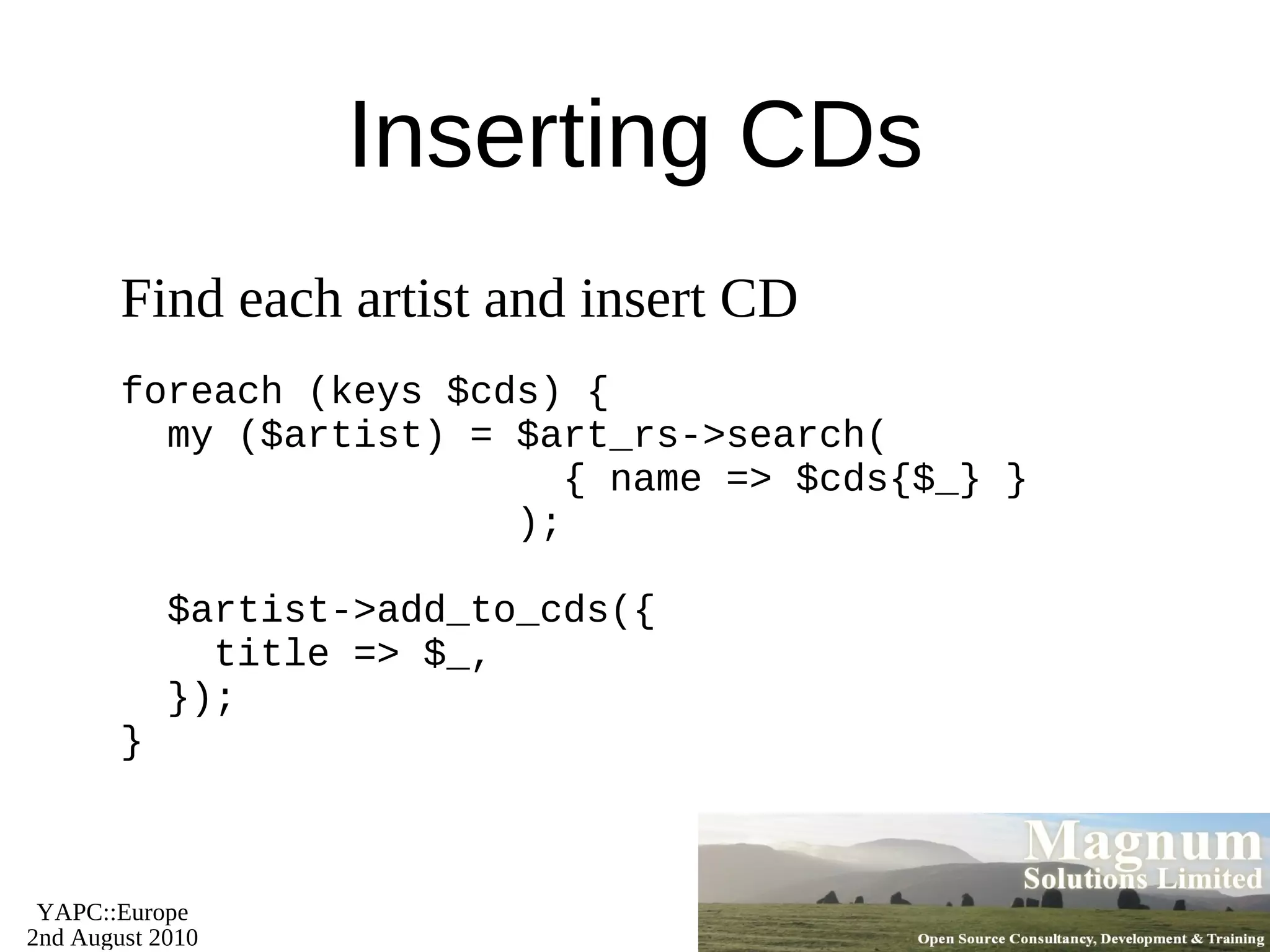
avoronovslide 47: maybe 'foreach (keys $cds) { ' should be 'foreach (keys %cds) {'?2 years ago
Are you sure you want to
Nadine de Pantenac, Branch of Human Resources/ Assistante DRH at -Congratulations !!! This is an excellent work.Thank you for sharing. We have selected your presentation for the reference in our group Slideshare 'BANK OF KNOWLEDGE'. We would be honored by your support through your membership. You are invited to join us ! I wish you a nice day. Greetings from France. Nadine
http://www.slideshare.net/group/bank-of-knowledge2 years ago
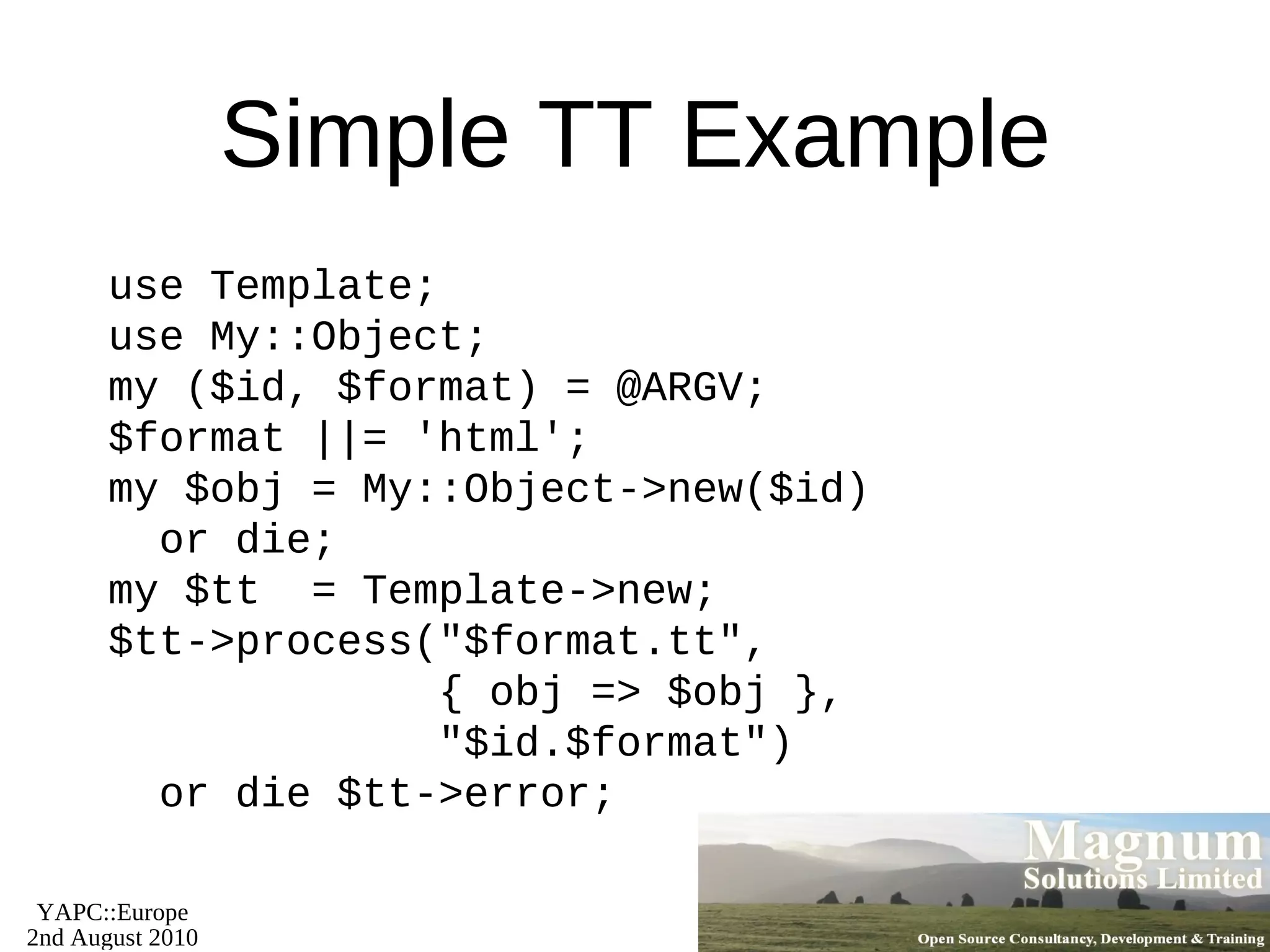
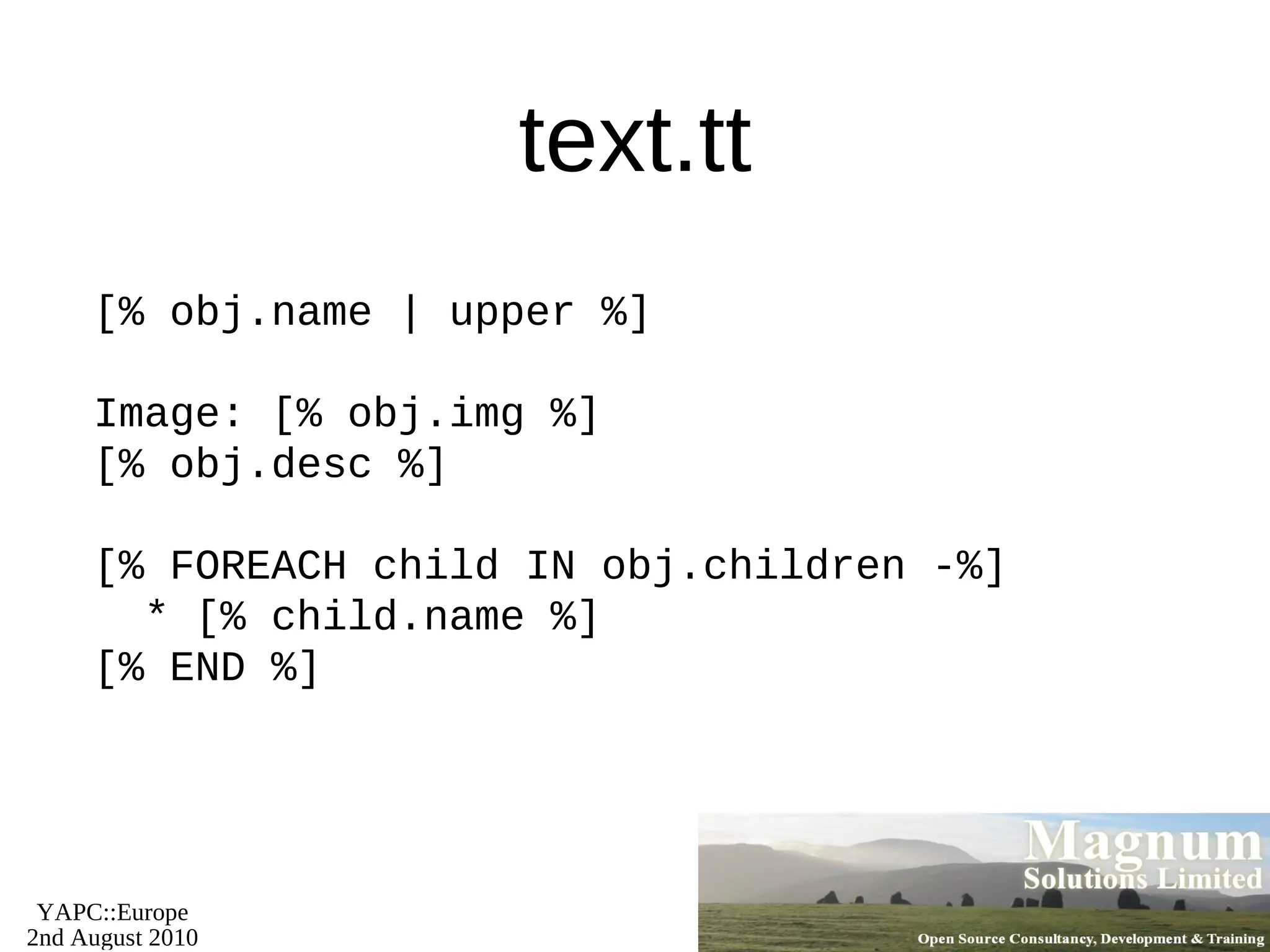
use Template; use My::Object; my ($id, $format) = @ARGV; $format ||= 'html'; my $obj = My::Object->new($id) or die; my $tt = Template->new; $tt->process("$format.tt", { obj => $obj }, "$id.$format") or die $tt->error;
"The DateTime family of modules present a unified way to handle dates and times in Perl"
"unified" is good
Dozens of modules that work together in a consistent fashion
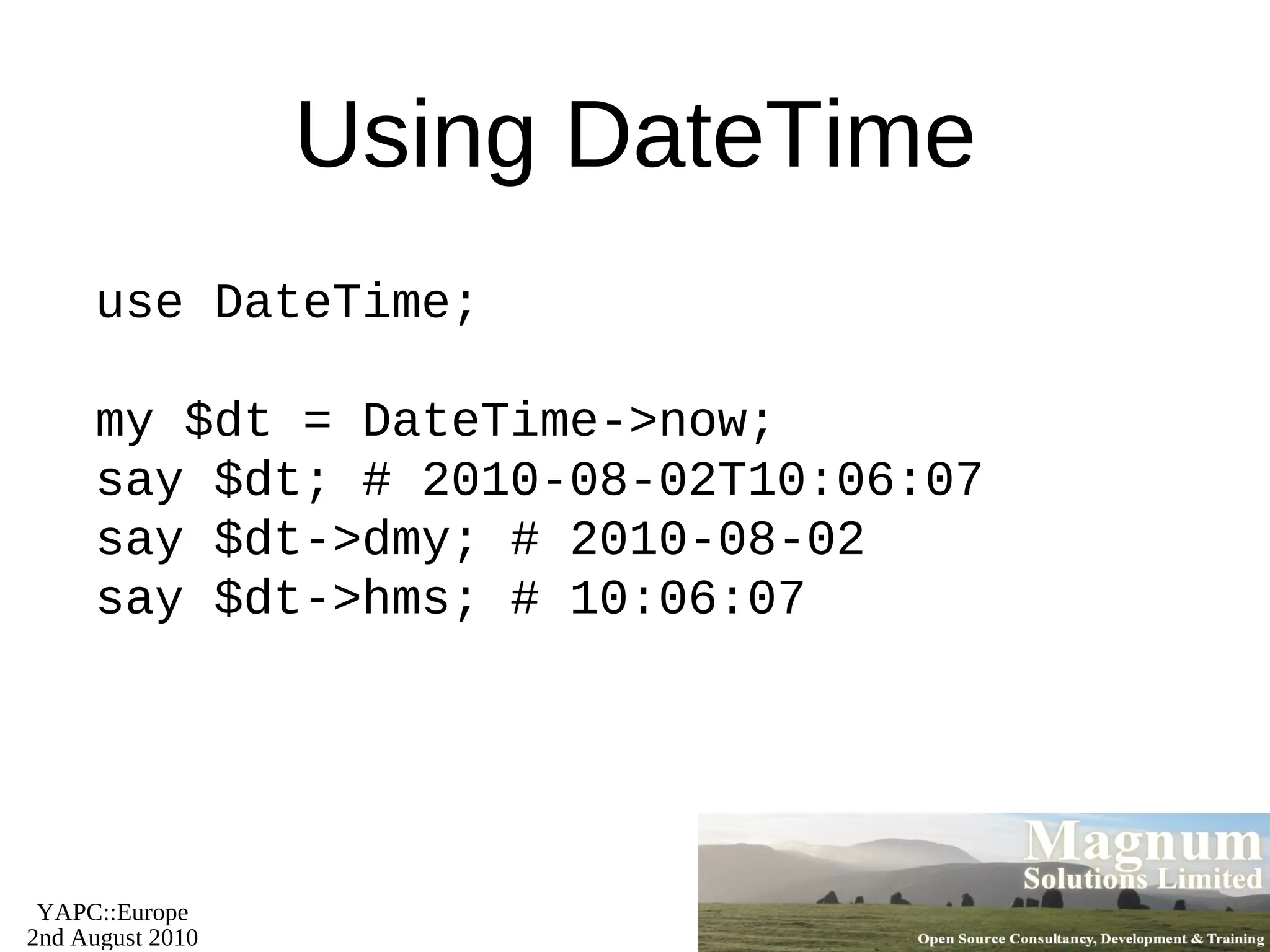
Using DateTime
use DateTime; my $dt = DateTime->now; say $dt; # 2010-08-02T10:06:07 say $dt->dmy; # 2010-08-02 say $dt->hms; # 10:06:07
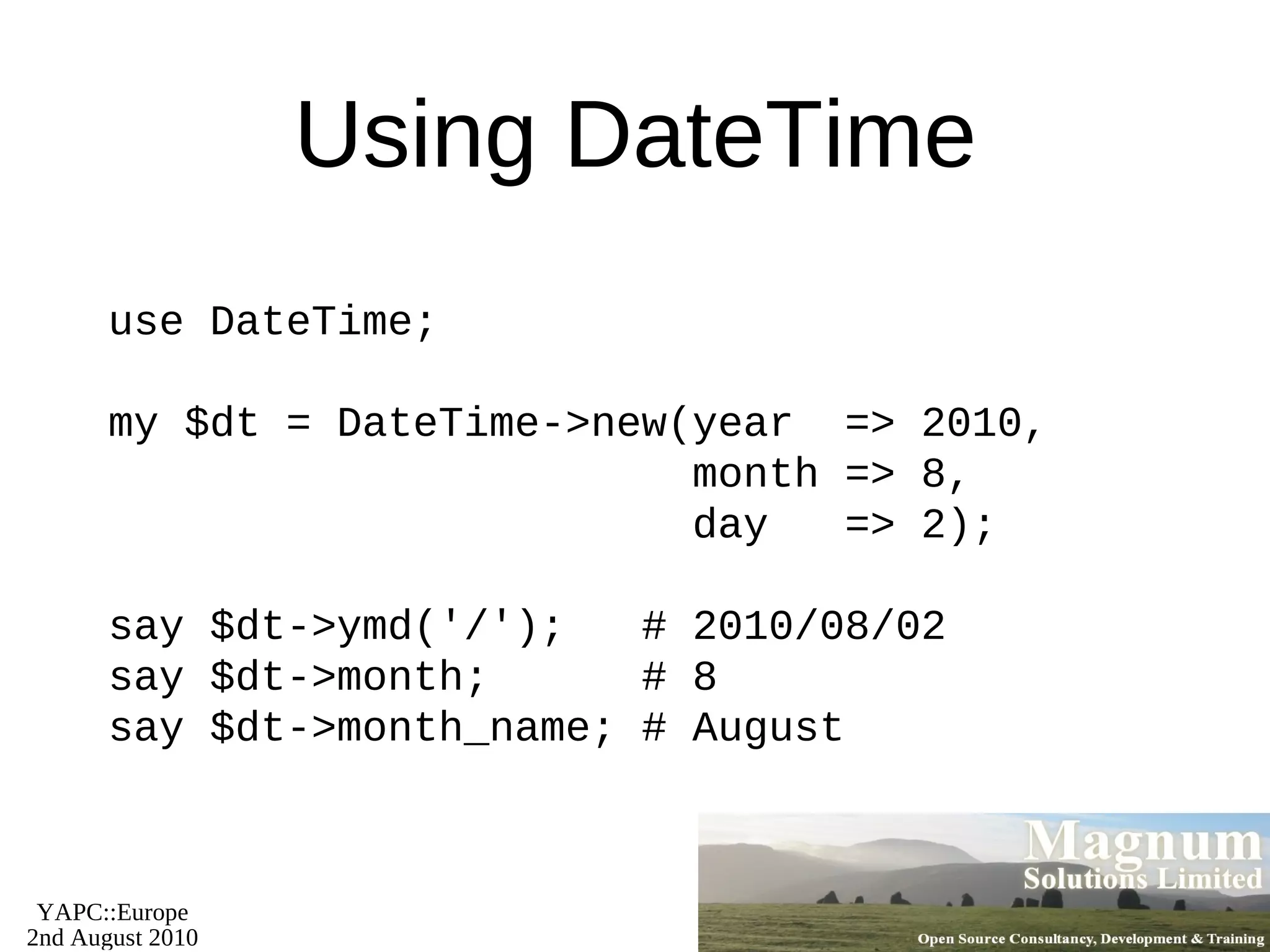
Using DateTime
use DateTime; my $dt = DateTime->new(year => 2010, month => 8, day => 2); say $dt->ymd('/'); # 2010/08/02 say $dt->month; # 8 say $dt->month_name; # August
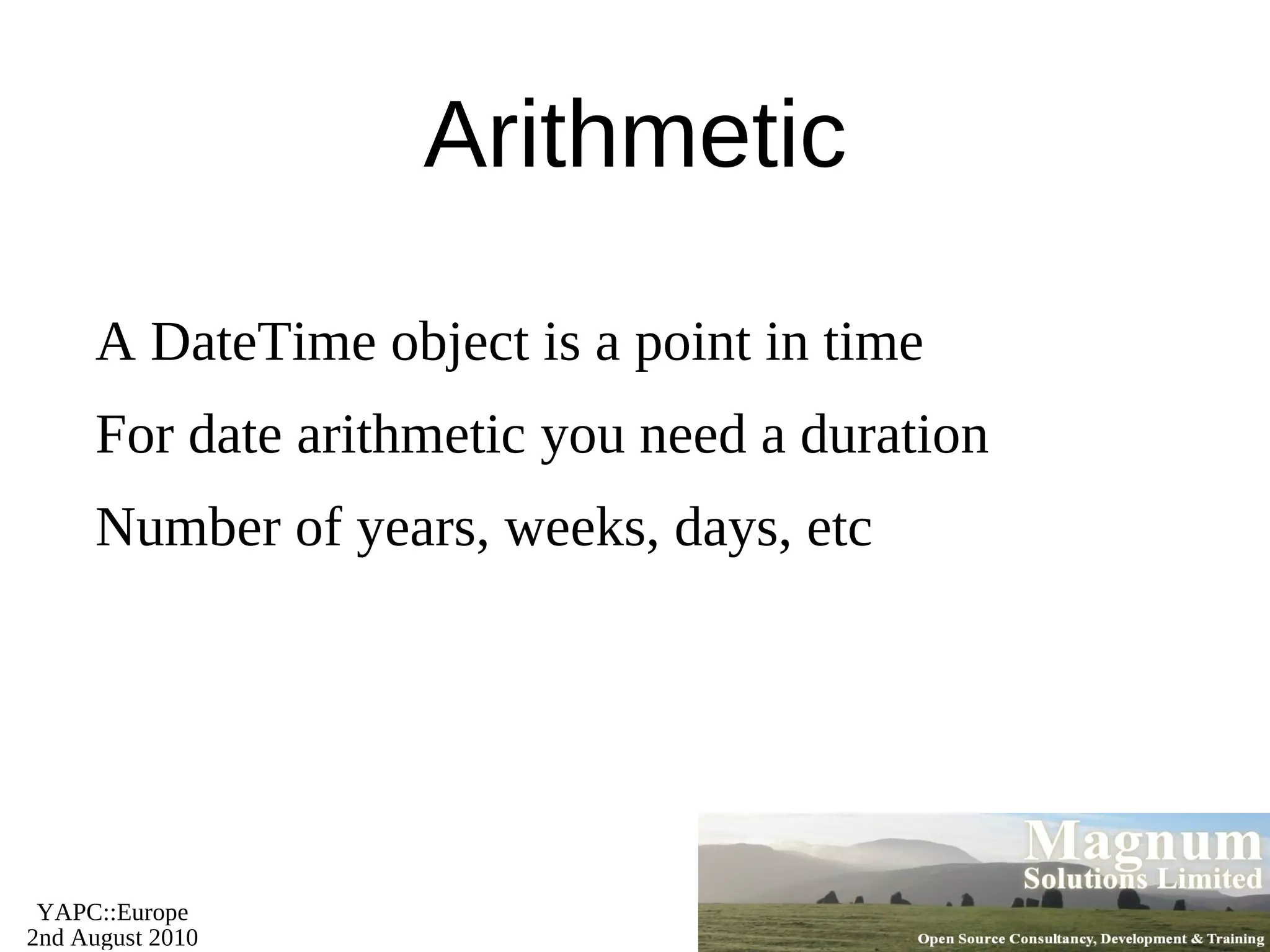
Arithmetic
A DateTime object is a point in time
For date arithmetic you need a duration
Number of years, weeks, days, etc
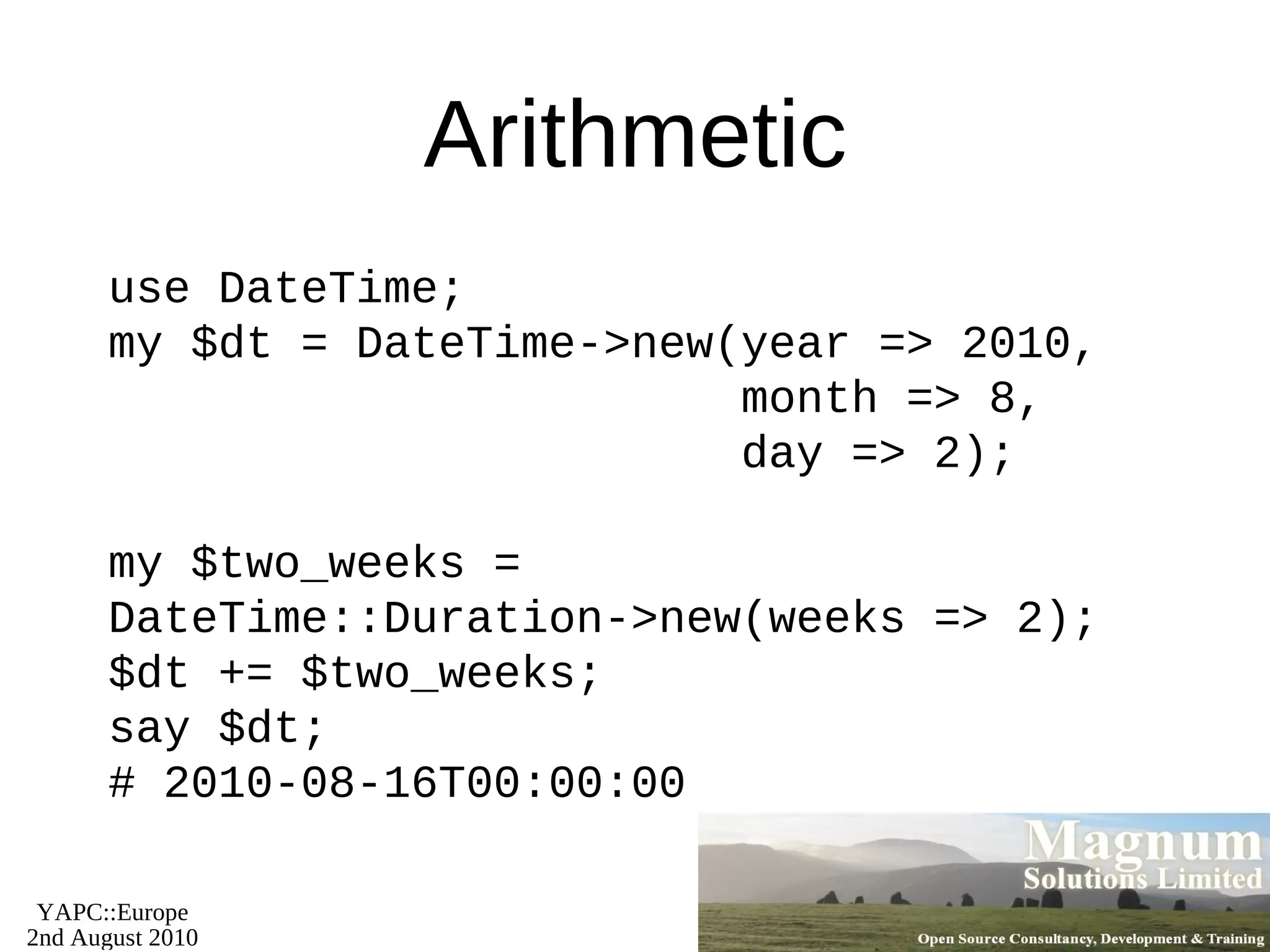
Arithmetic
use DateTime; my $dt = DateTime->new(year => 2010, month => 8, day => 2); my $two_weeks = DateTime::Duration->new(weeks => 2); $dt += $two_weeks; say $dt; # 2010-08-16T00:00:00
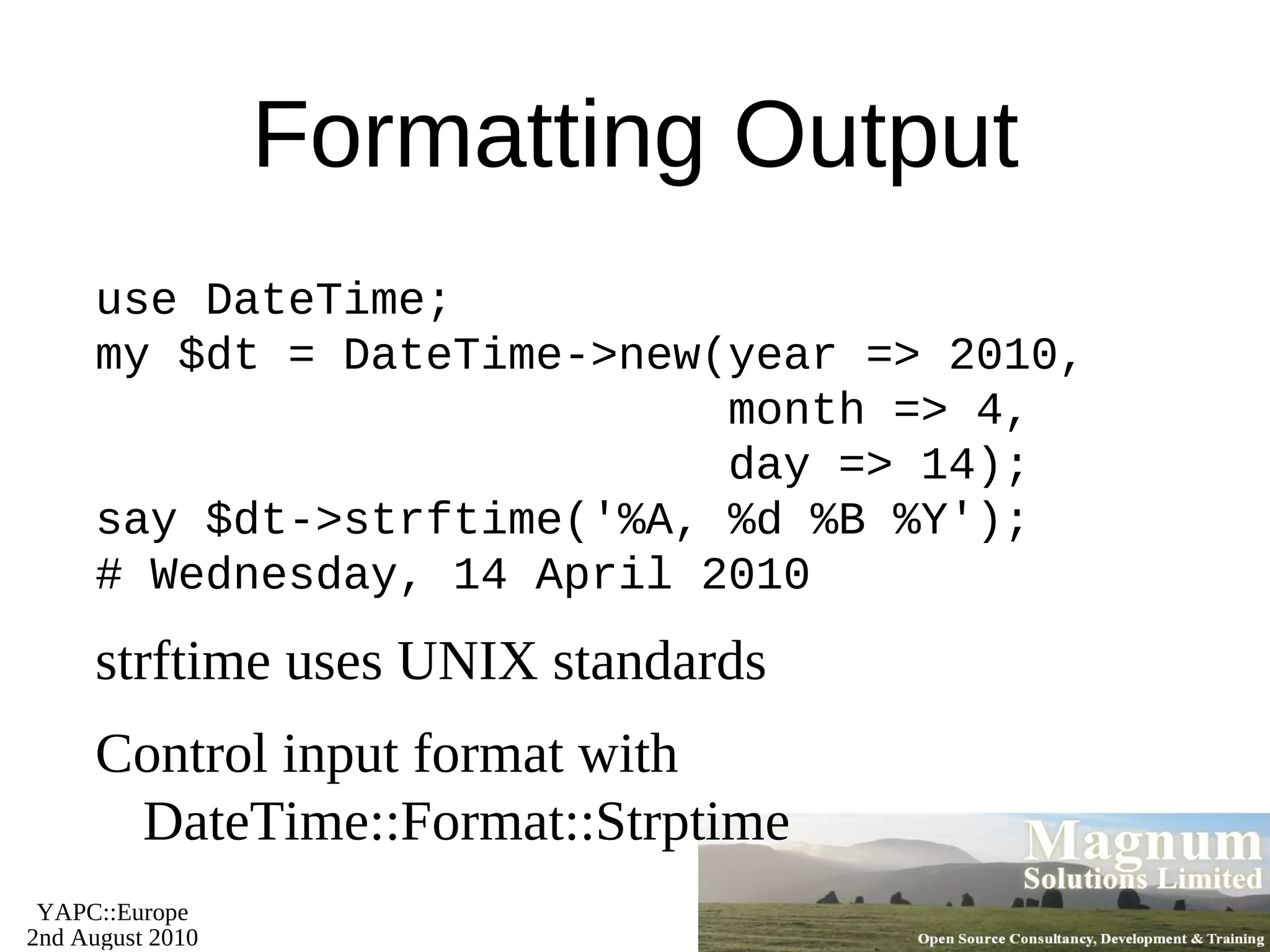
Formatting Output
use DateTime; my $dt = DateTime->new(year => 2010, month => 4, day => 14); say $dt->strftime('%A, %d %B %Y'); # Wednesday, 14 April 2010
strftime uses UNIX standards
Control input format with DateTime::Format::Strptime
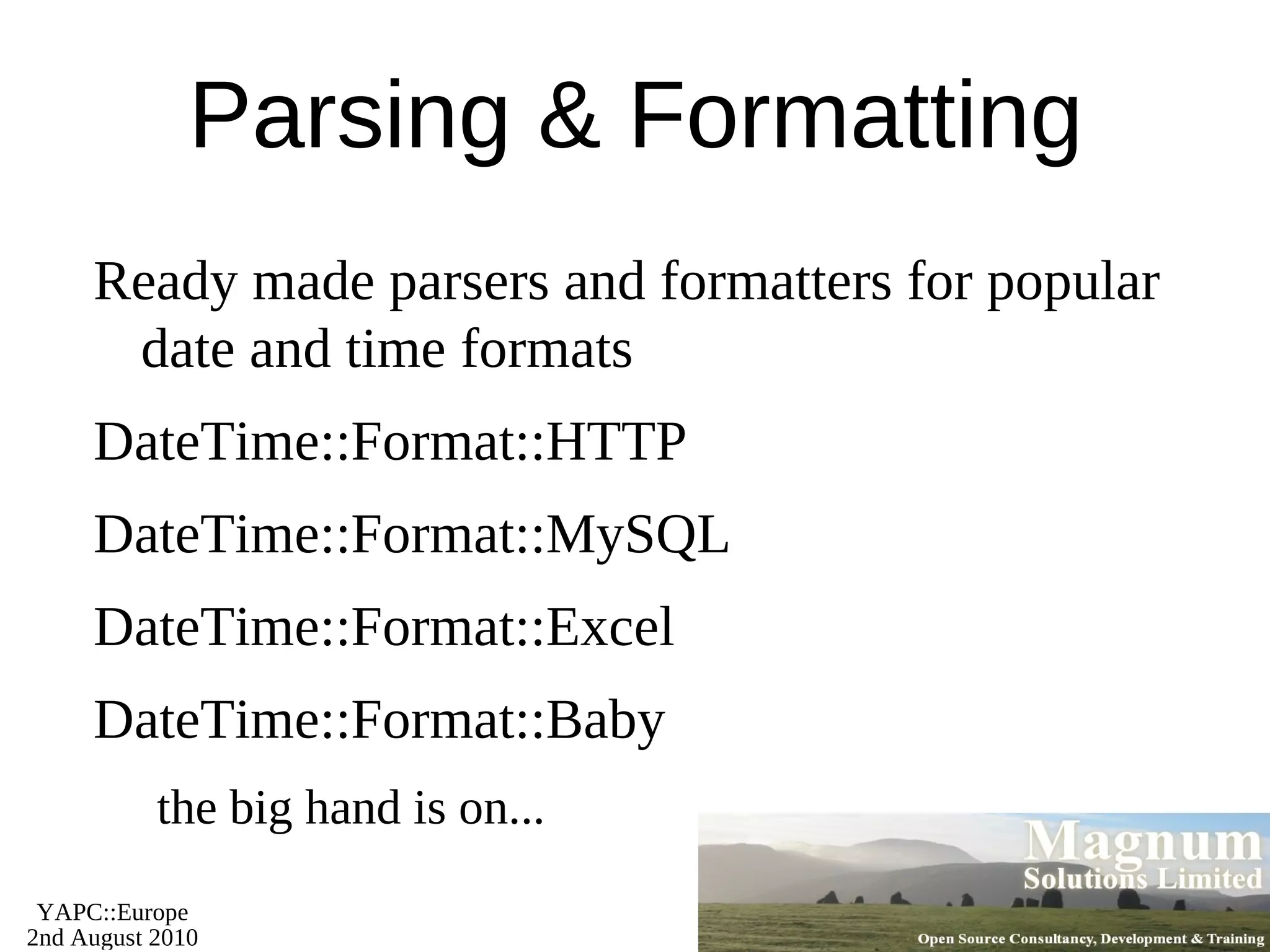
Parsing & Formatting
Ready made parsers and formatters for popular date and time formats
DateTime::Format::HTTP
DateTime::Format::MySQL
DateTime::Format::Excel
DateTime::Format::Baby
the big hand is on...
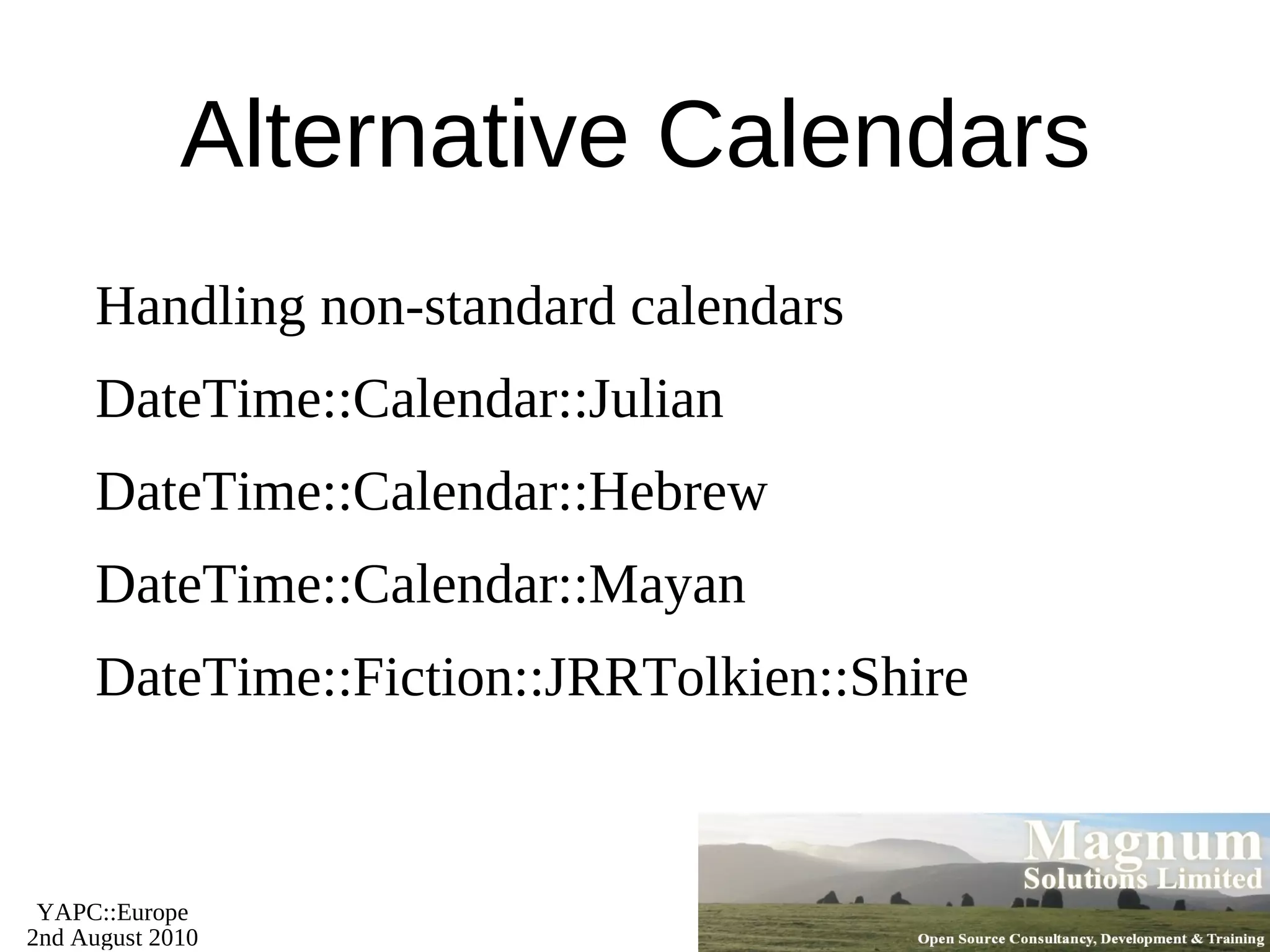
Alternative Calendars
Handling non-standard calendars
DateTime::Calendar::Julian
DateTime::Calendar::Hebrew
DateTime::Calendar::Mayan
DateTime::Fiction::JRRTolkien::Shire
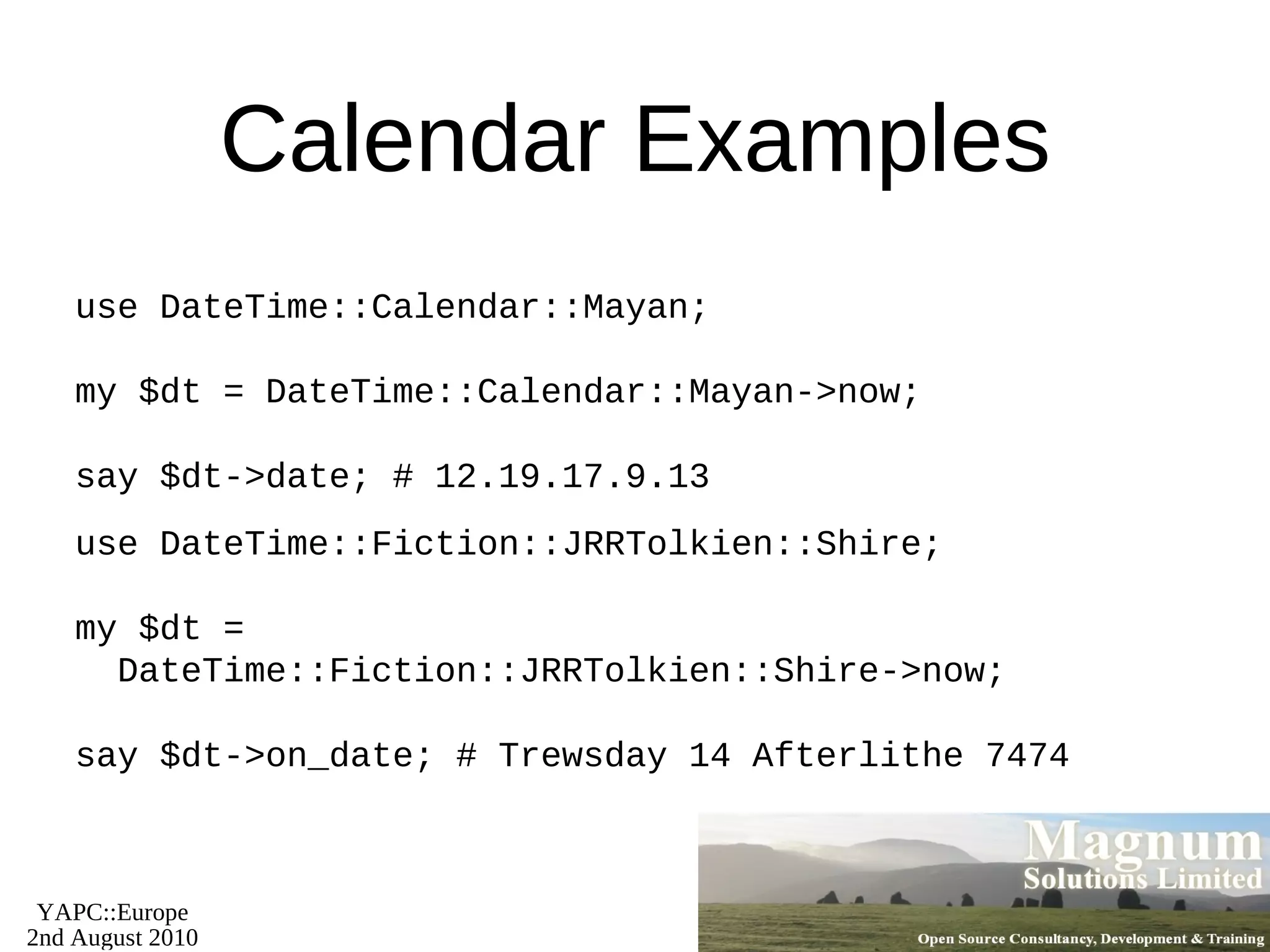
Calendar Examples
use DateTime::Calendar::Mayan; my $dt = DateTime::Calendar::Mayan->now; say $dt->date; # 12.19.17.9.13
use DateTime::Fiction::JRRTolkien::Shire; my $dt = DateTime::Fiction::JRRTolkien::Shire->now; say $dt->on_date; # Trewsday 14 Afterlithe 7474
DBIx::Class
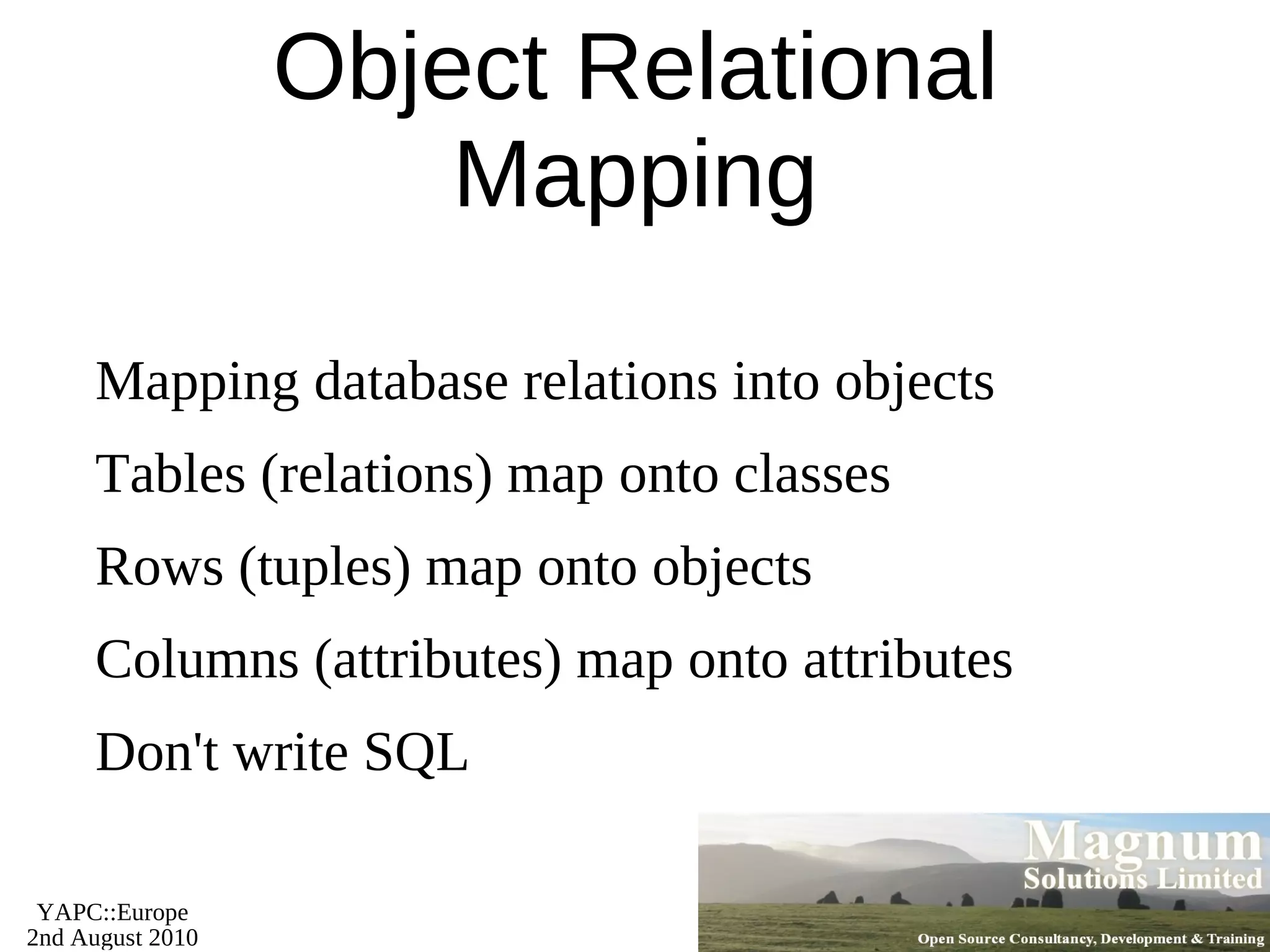
Object Relational Mapping
Mapping database relations into objects
Tables (relations) map onto classes
Rows (tuples) map onto objects
Columns (attributes) map onto attributes
Don't write SQL
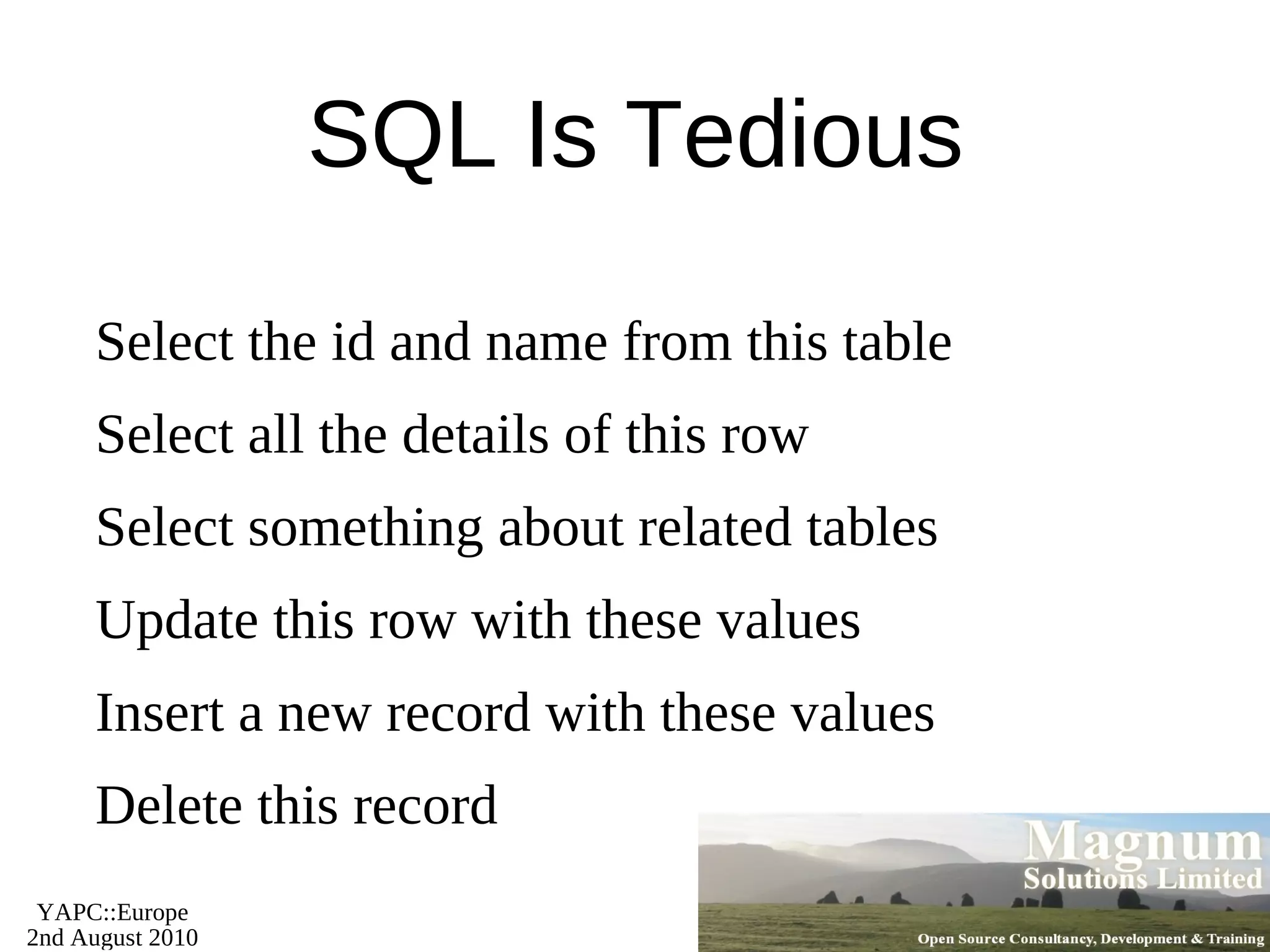
SQL Is Tedious
Select the id and name from this table
Select all the details of this row
Select something about related tables
Update this row with these values
Insert a new record with these values
Delete this record
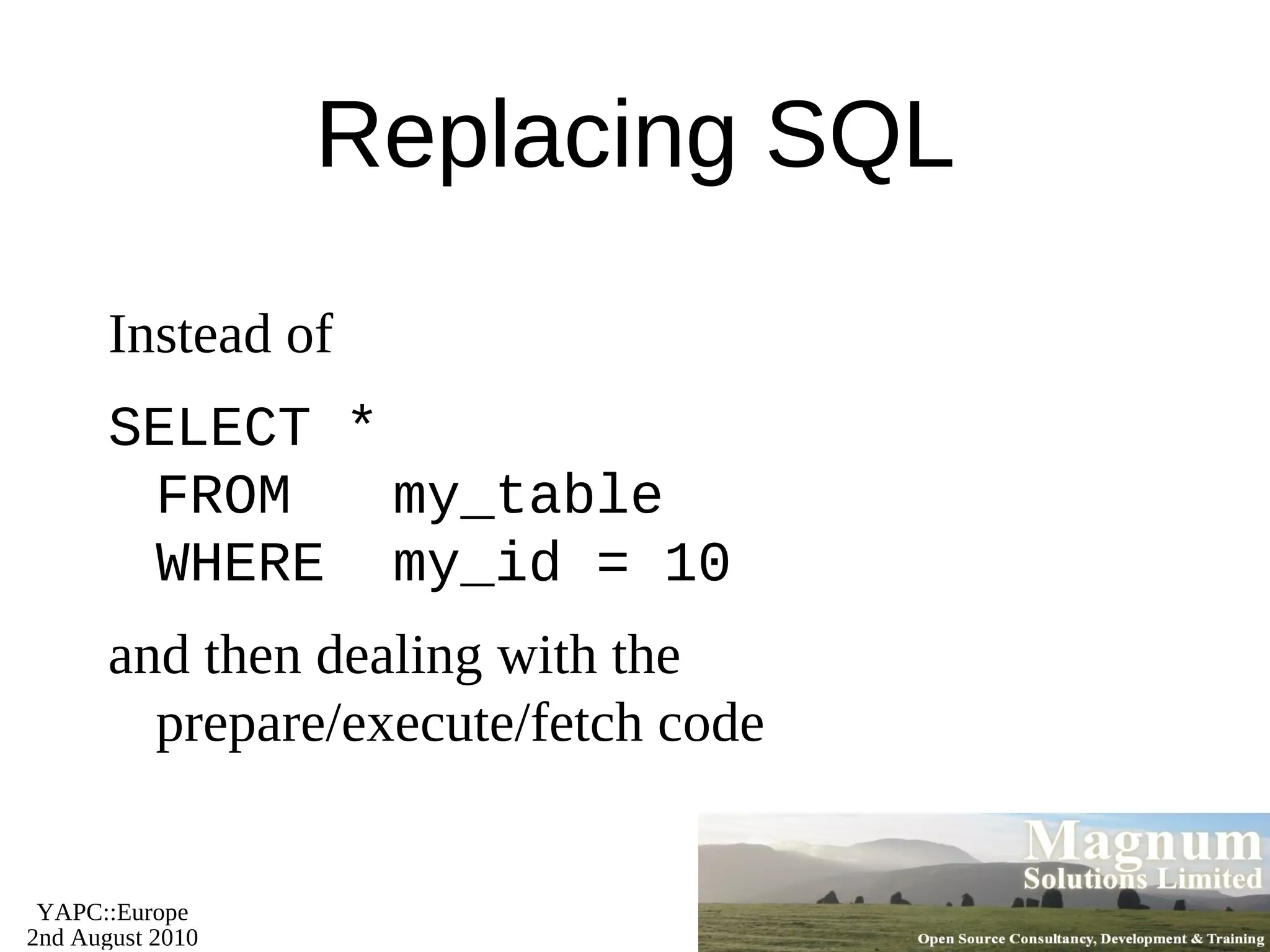
Replacing SQL
Instead of
SELECT * FROM my_table WHERE my_id = 10
and then dealing with the prepare/execute/fetch code
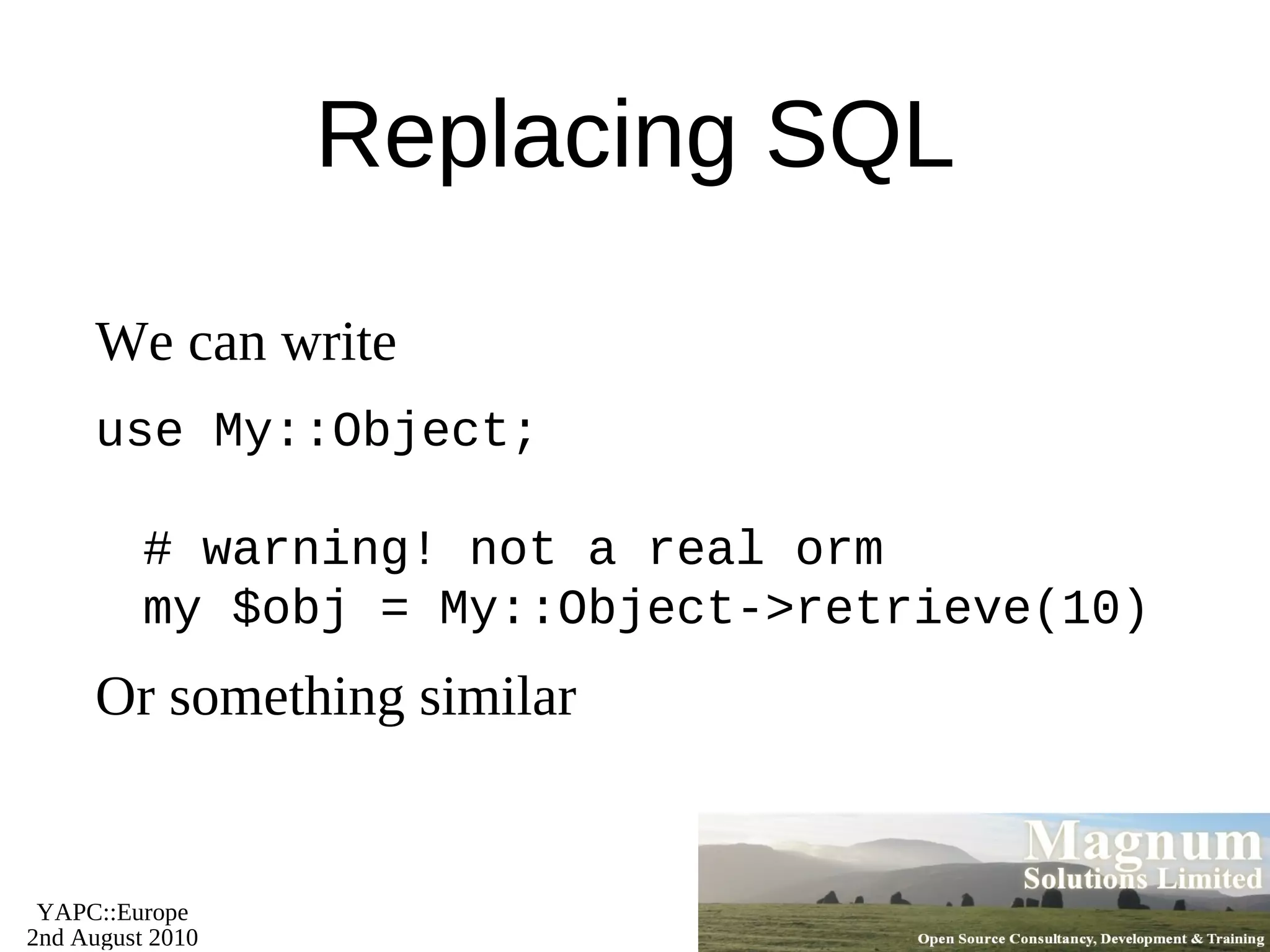
Replacing SQL
We can write
use My::Object; # warning! not a real orm my $obj = My::Object->retrieve(10)
Or something similar
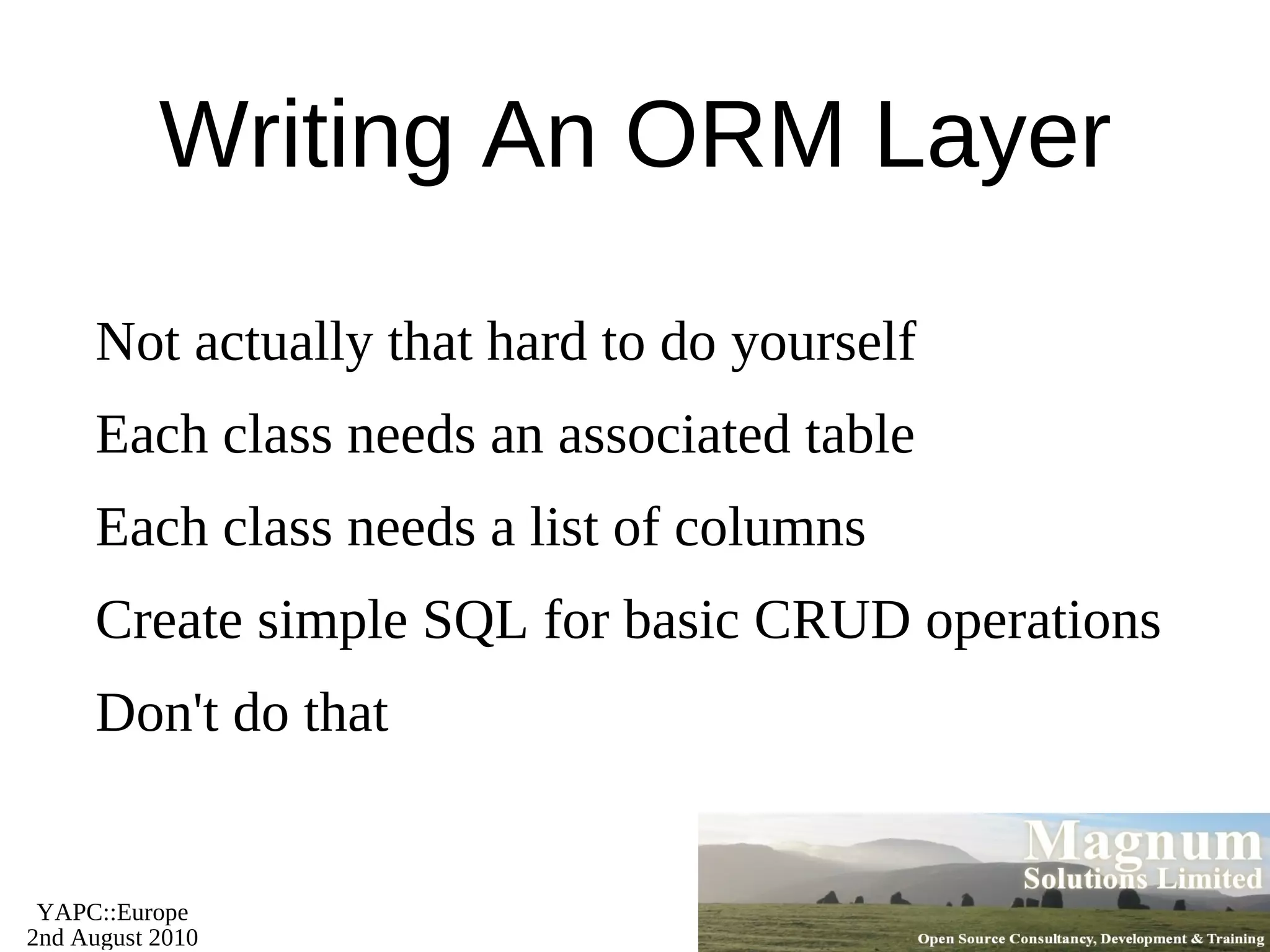
Writing An ORM Layer
Not actually that hard to do yourself
Each class needs an associated table
Each class needs a list of columns
Create simple SQL for basic CRUD operations
Don't do that
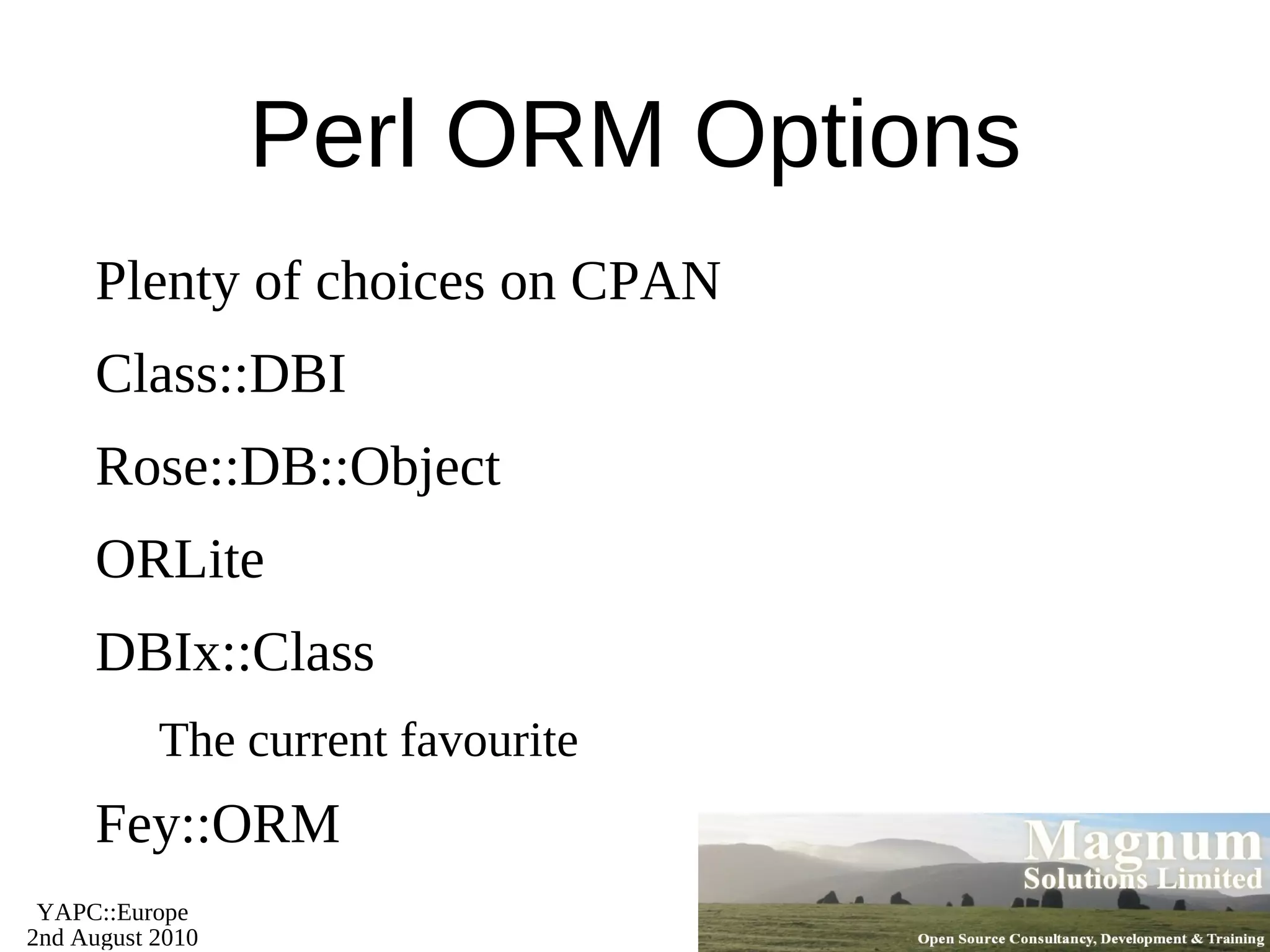
Perl ORM Options
Plenty of choices on CPAN
Class::DBI
Rose::DB::Object
ORLite
DBIx::Class
The current favourite
Fey::ORM
DBIx::Class
Standing on the shoulders of giants
Learning from problems in Class::DBI
More flexible
More powerful
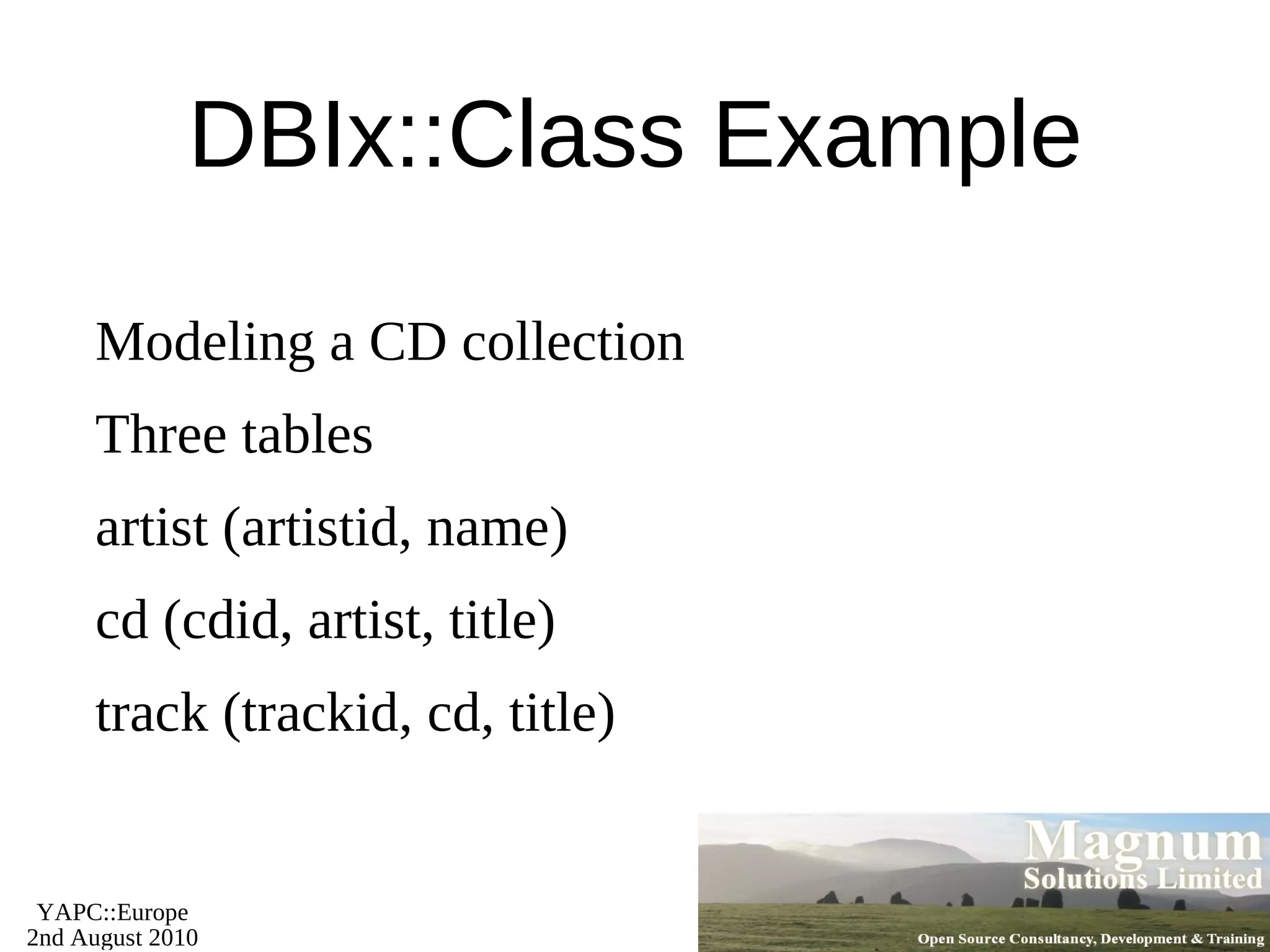
DBIx::Class Example
Modeling a CD collection
Three tables
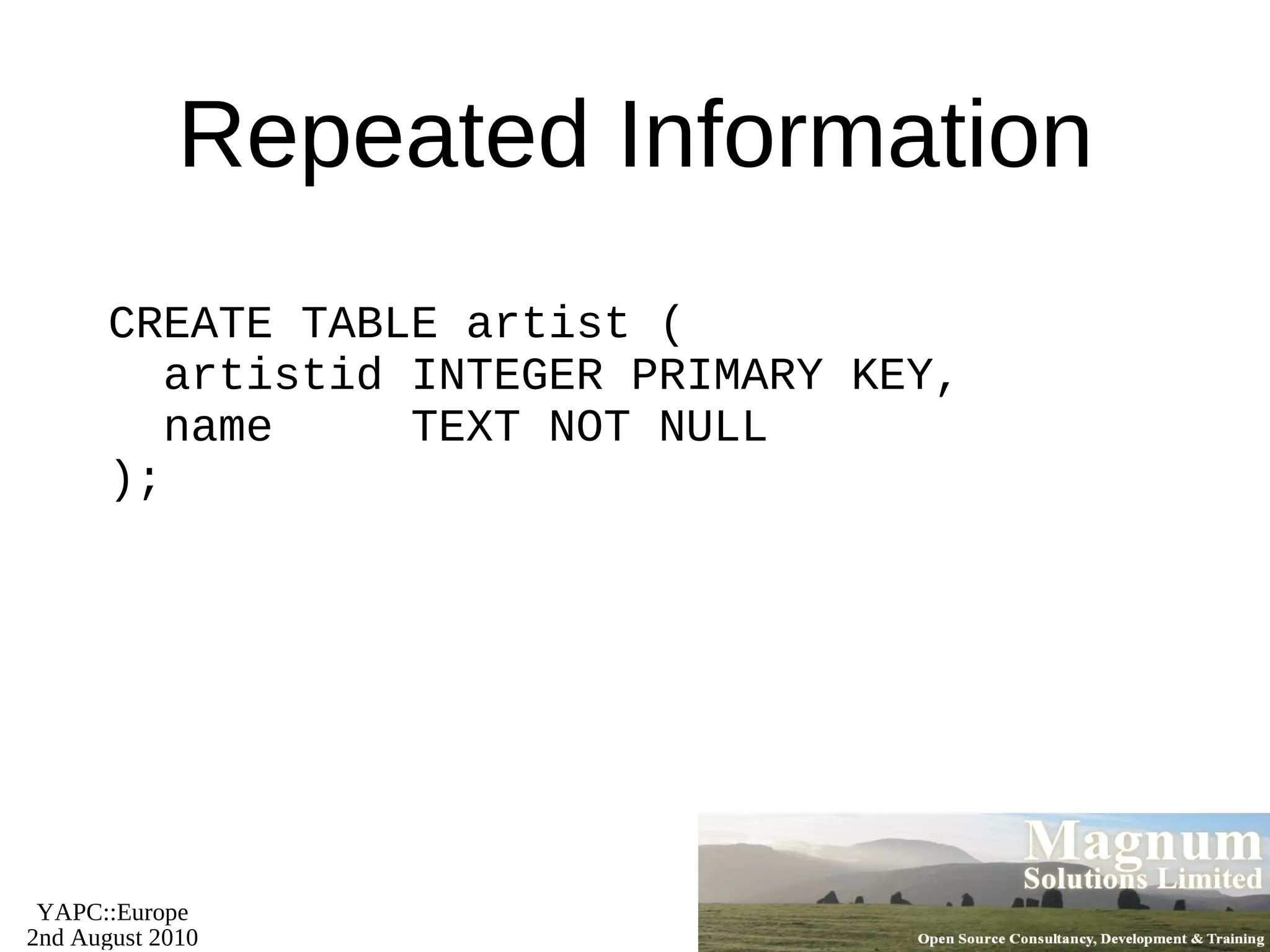
artist (artistid, name)
cd (cdid, artist, title)
track (trackid, cd, title)
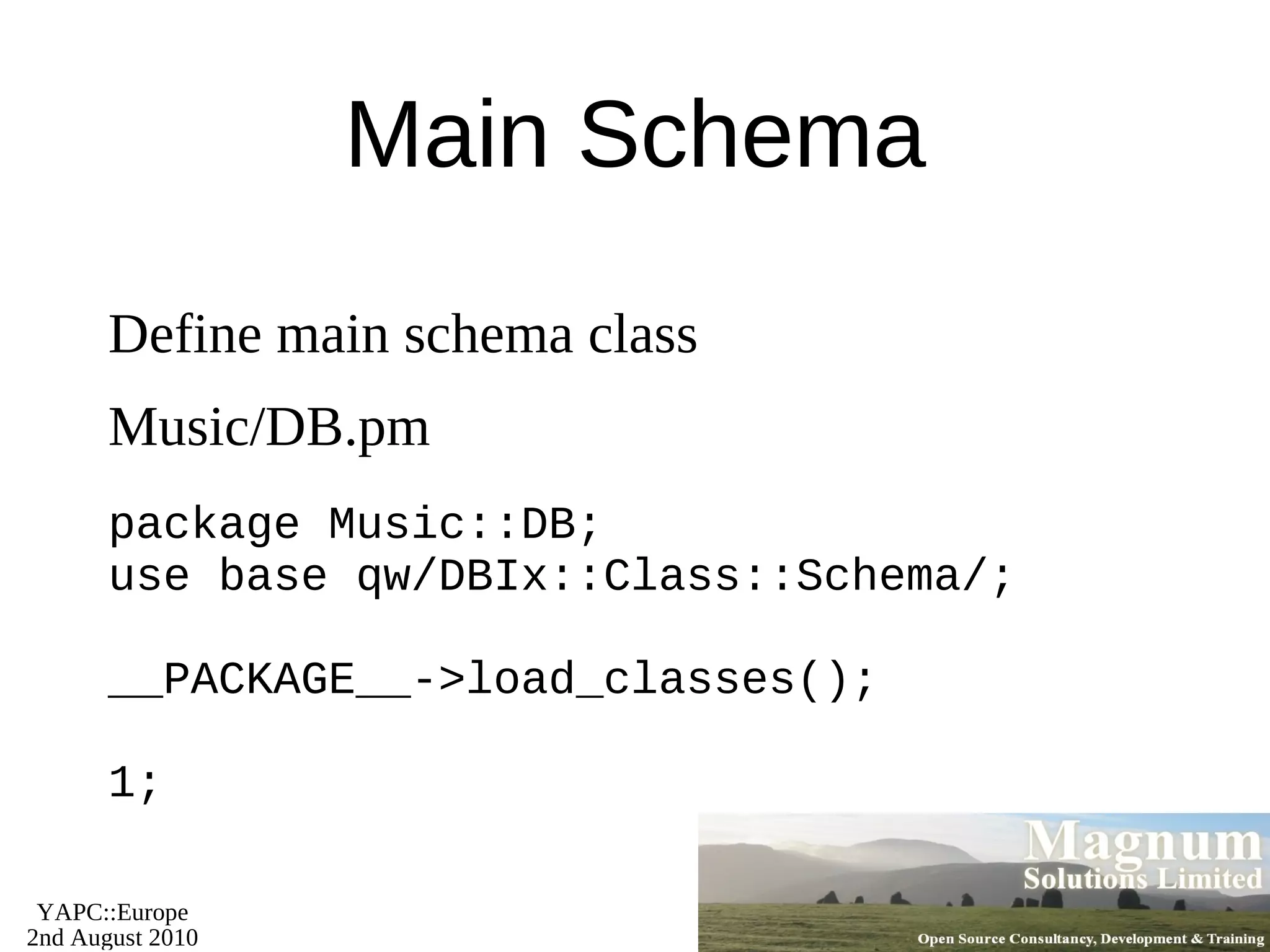
Main Schema
Define main schema class
Music/DB.pm
package Music::DB; use base qw/DBIx::Class::Schema/; __PACKAGE__->load_classes(); 1;
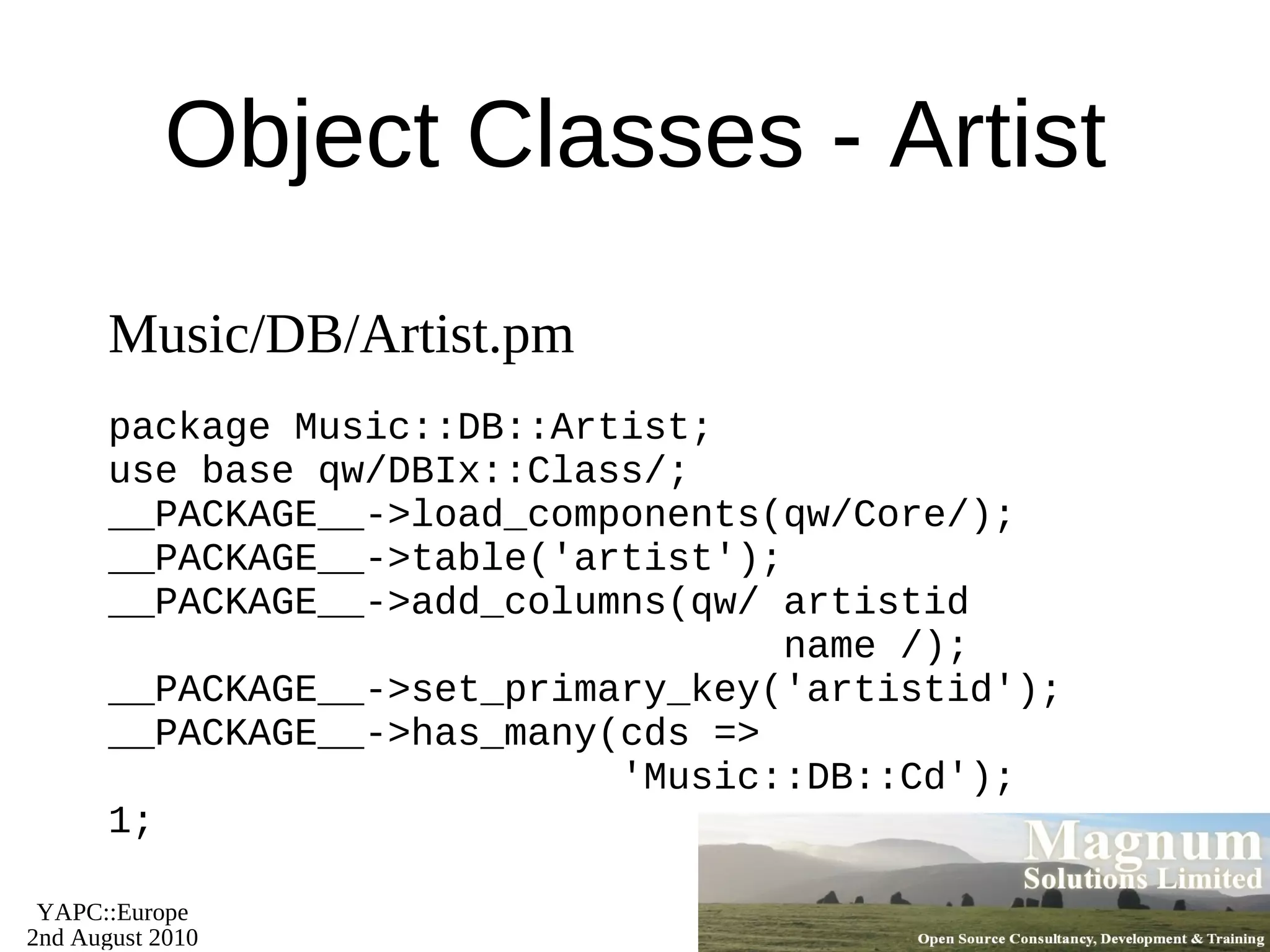
Object Classes - Artist
Music/DB/Artist.pm
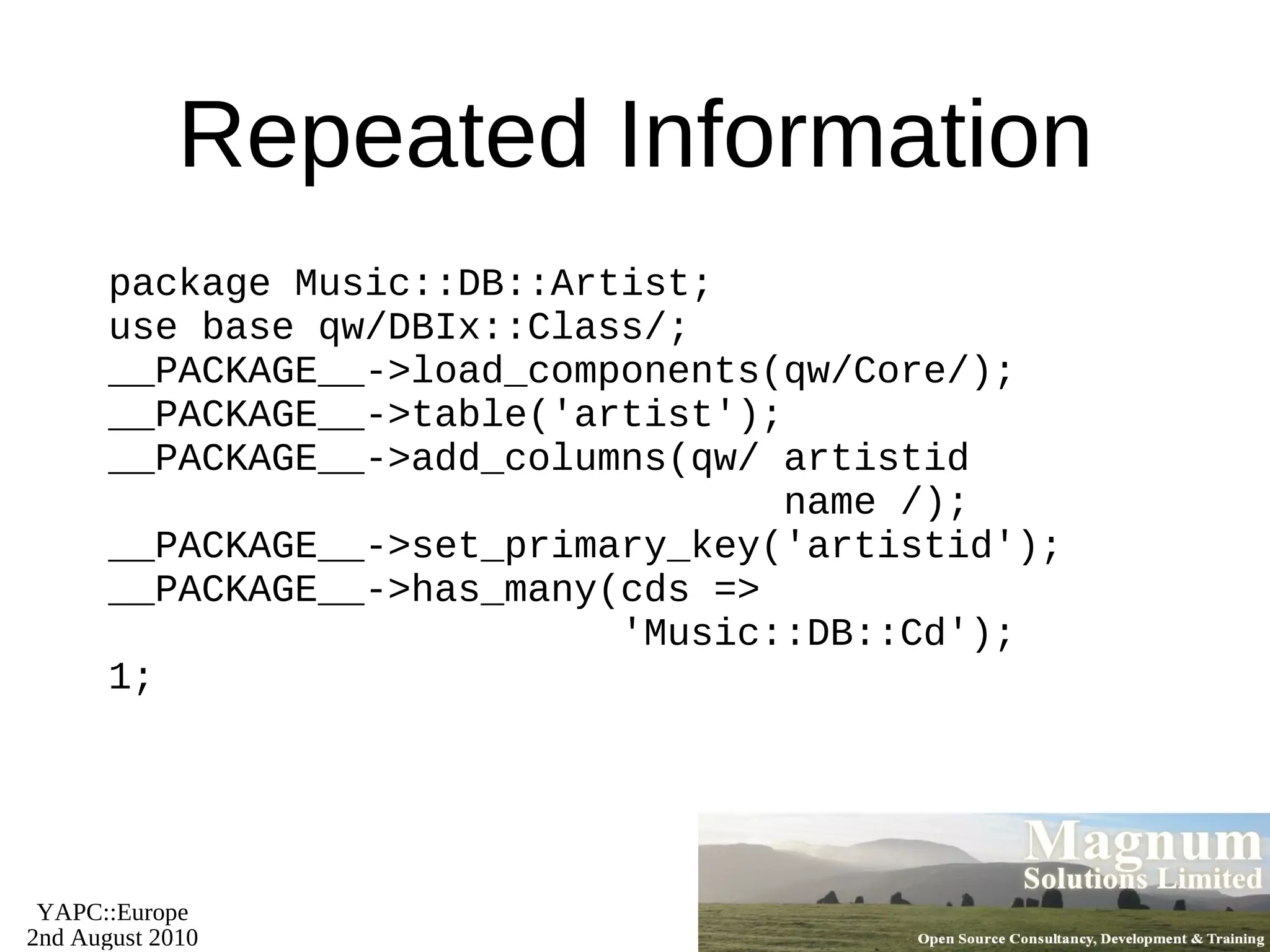
package Music::DB::Artist; use base qw/DBIx::Class/; __PACKAGE__->load_components(qw/Core/); __PACKAGE__->table('artist'); __PACKAGE__->add_columns(qw/ artistid name /); __PACKAGE__->set_primary_key('artistid'); __PACKAGE__->has_many(cds => 'Music::DB::Cd'); 1;
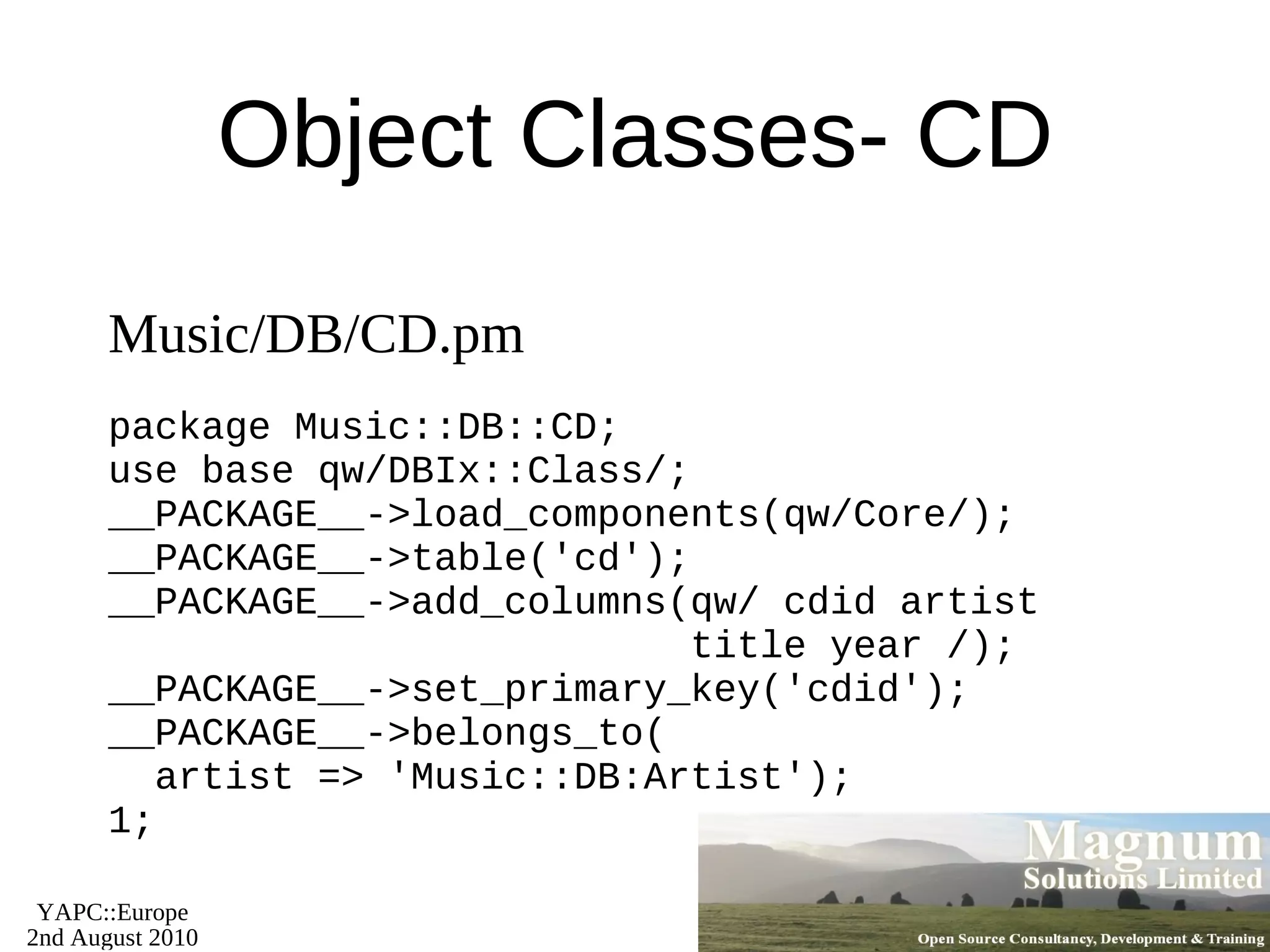
Object Classes- CD
Music/DB/CD.pm
package Music::DB::CD; use base qw/DBIx::Class/; __PACKAGE__->load_components(qw/Core/); __PACKAGE__->table('cd'); __PACKAGE__->add_columns(qw/ cdid artist title year /); __PACKAGE__->set_primary_key('cdid'); __PACKAGE__->belongs_to( artist => 'Music::DB:Artist'); 1;
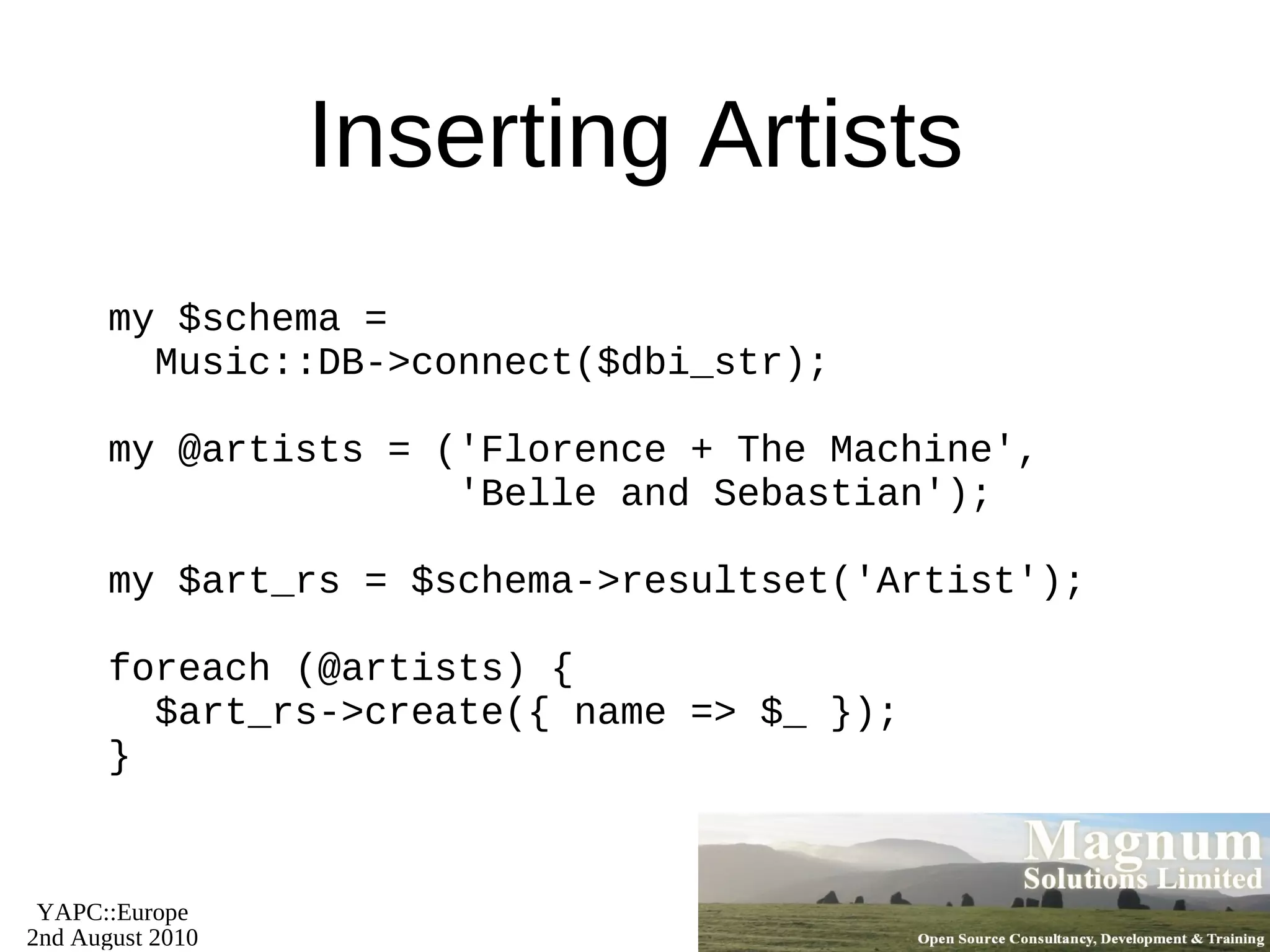
Inserting Artists
my $schema = Music::DB->connect($dbi_str); my @artists = ('Florence + The Machine', 'Belle and Sebastian'); my $art_rs = $schema->resultset('Artist'); foreach (@artists) { $art_rs->create({ name => $_ }); }
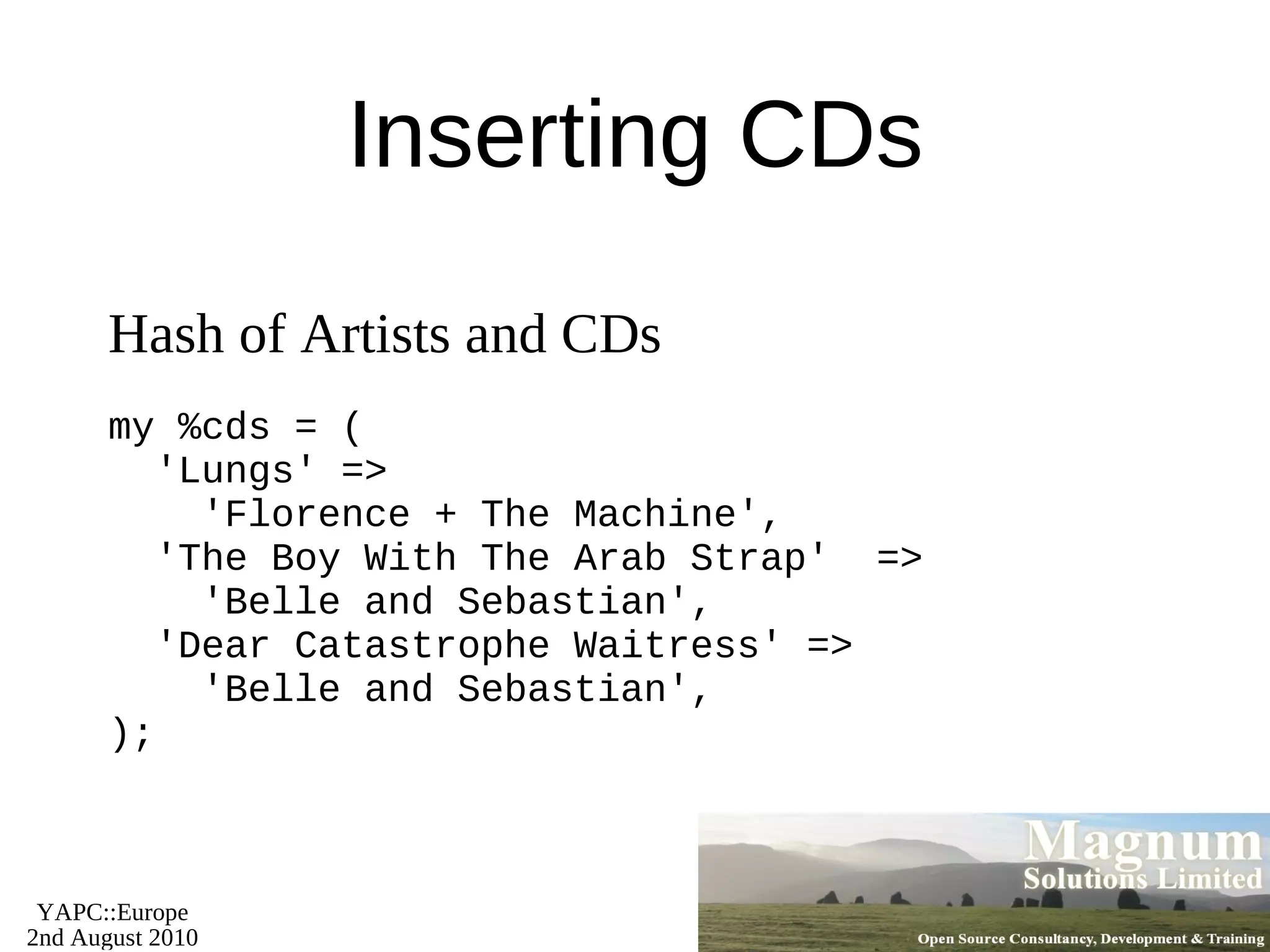
Inserting CDs
Hash of Artists and CDs
my %cds = ( 'Lungs' => 'Florence + The Machine', 'The Boy With The Arab Strap' => 'Belle and Sebastian', 'Dear Catastrophe Waitress' => 'Belle and Sebastian', );
Inserting CDs
Find each artist and insert CD
foreach (keys $cds) { my ($artist) = $art_rs->search( { name => $cds{$_} } ); $artist->add_to_cds({ title => $_, }); }
Retrieving Data
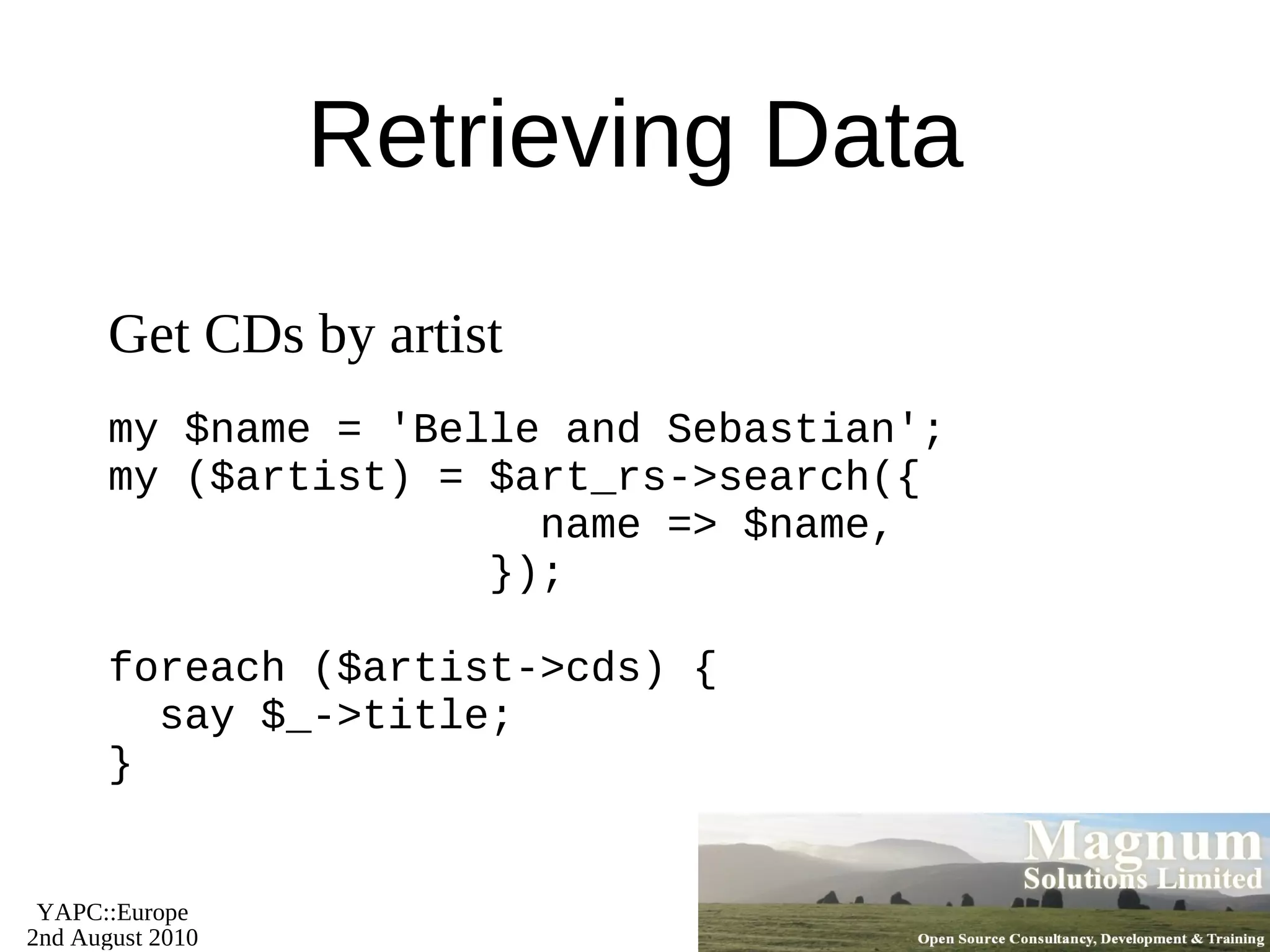
Get CDs by artist
my $name = 'Belle and Sebastian'; my ($artist) = $art_rs->search({ name => $name, }); foreach ($artist->cds) { say $_->title; }
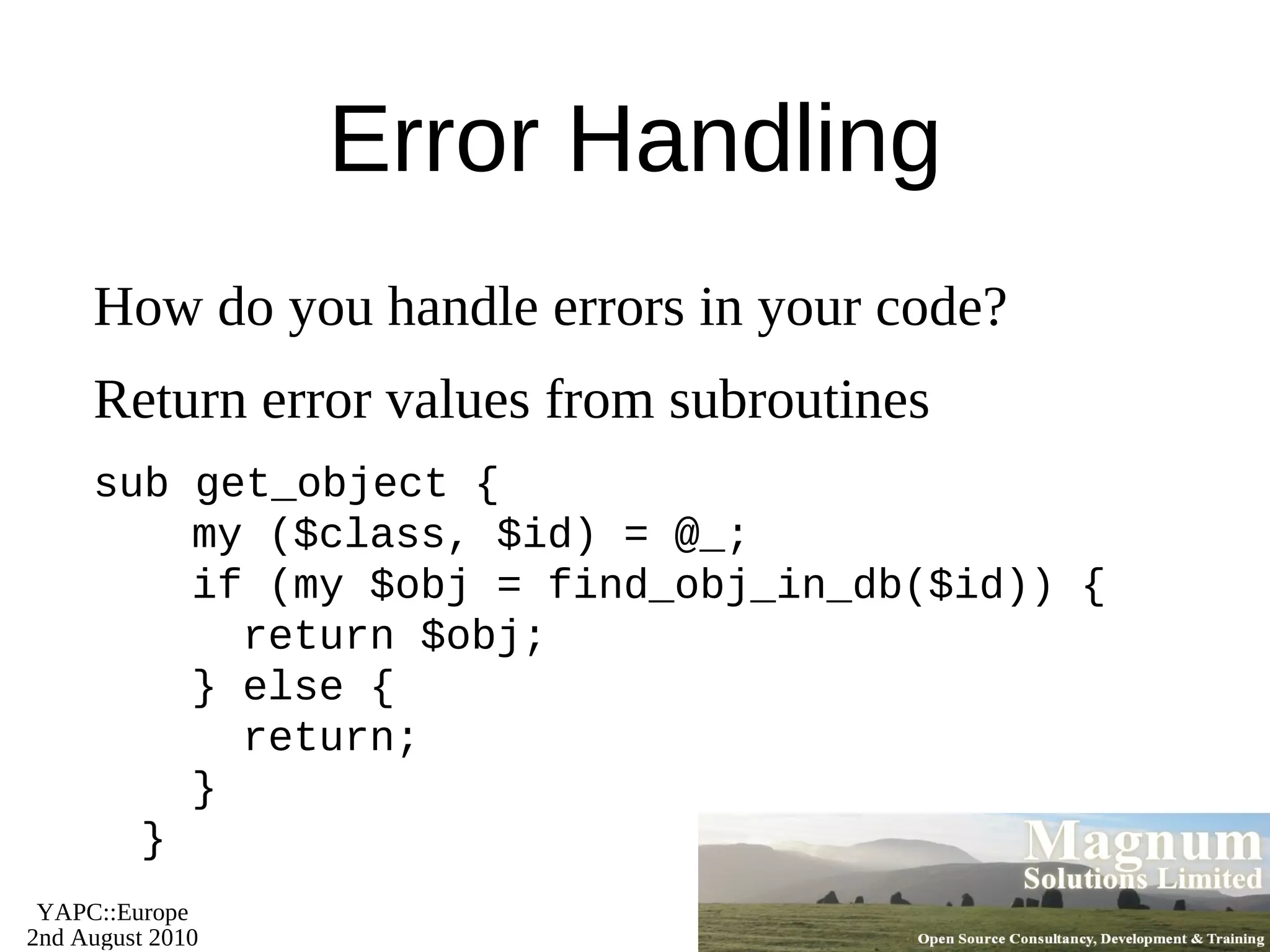
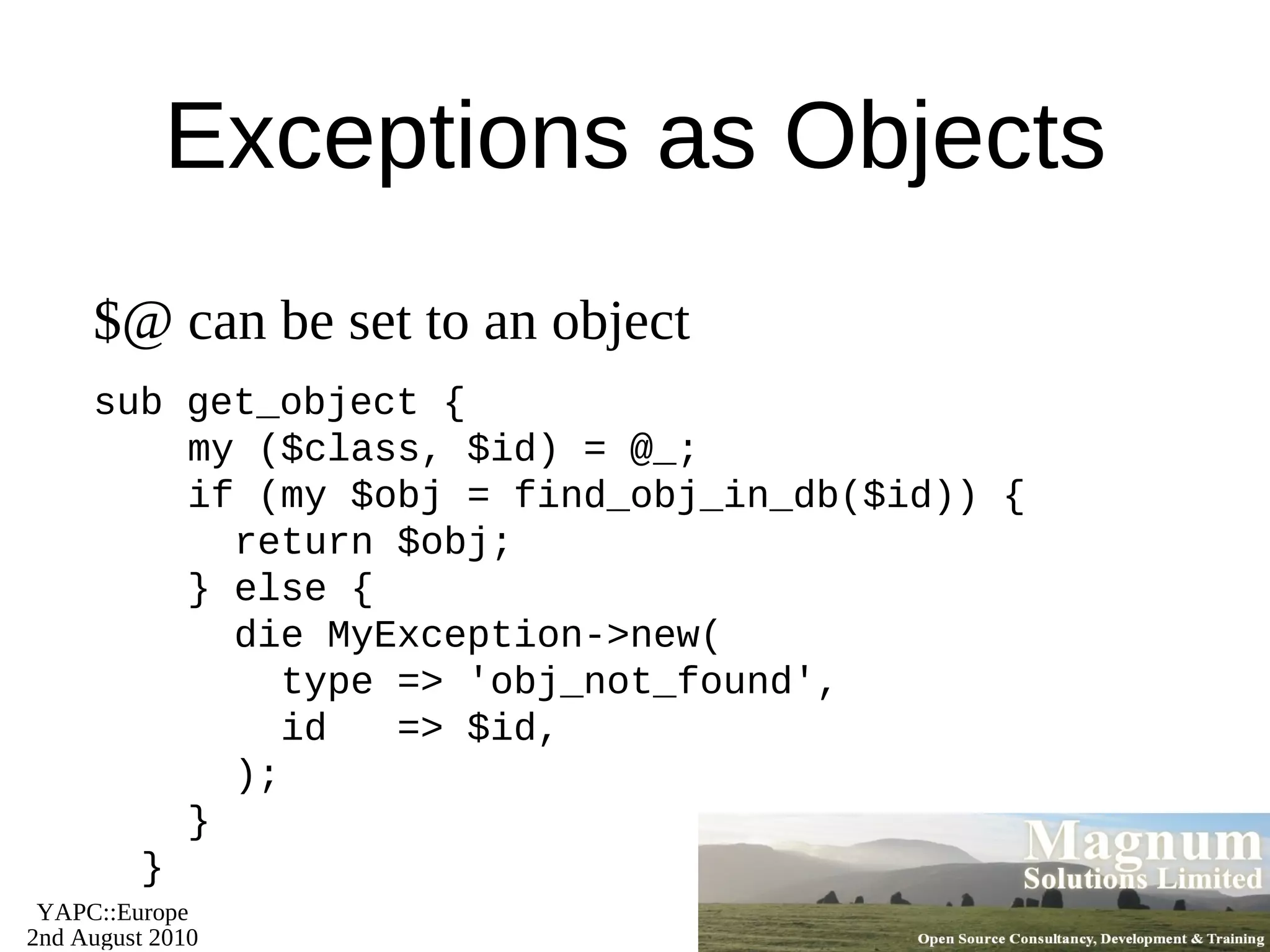
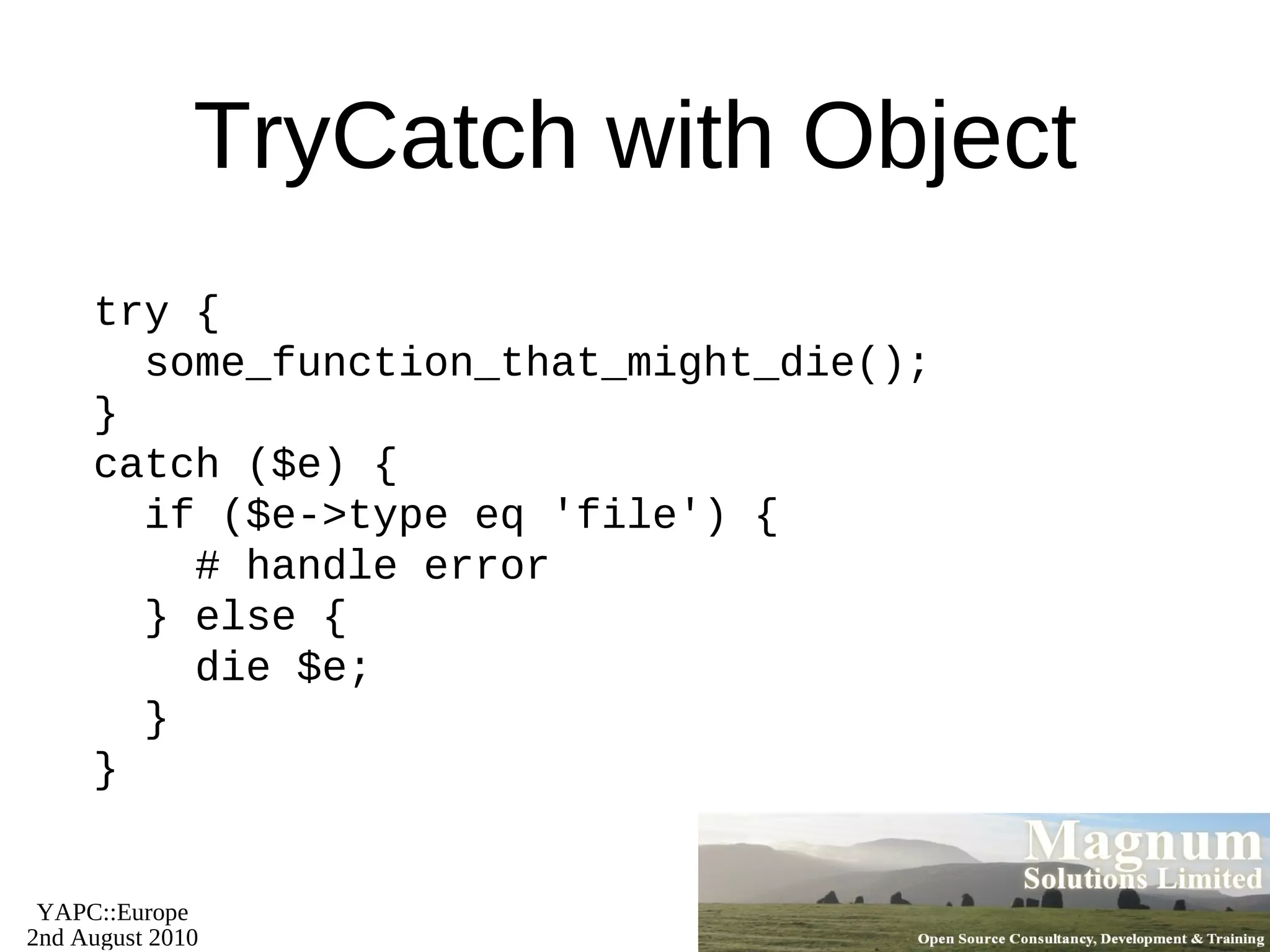
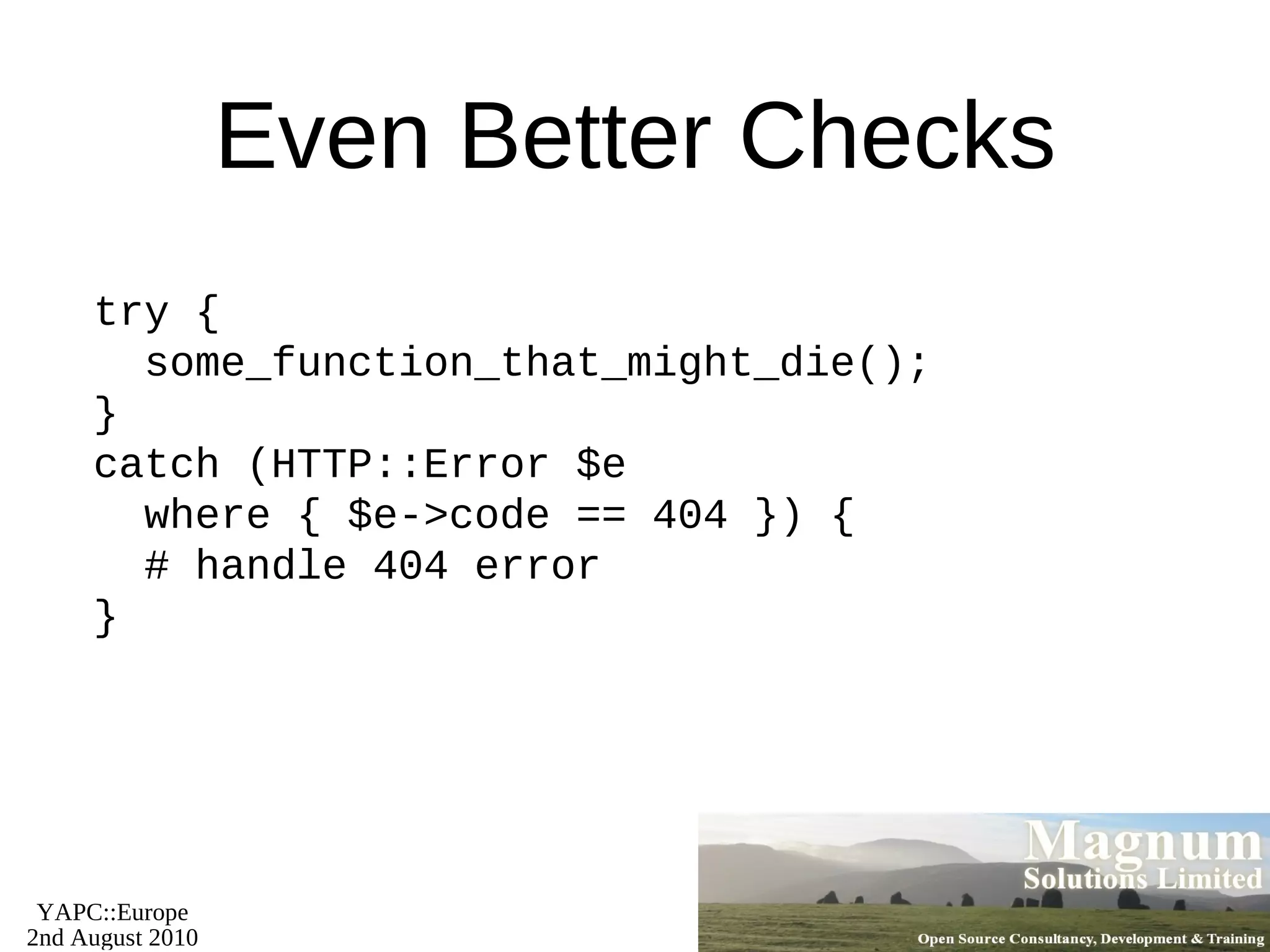
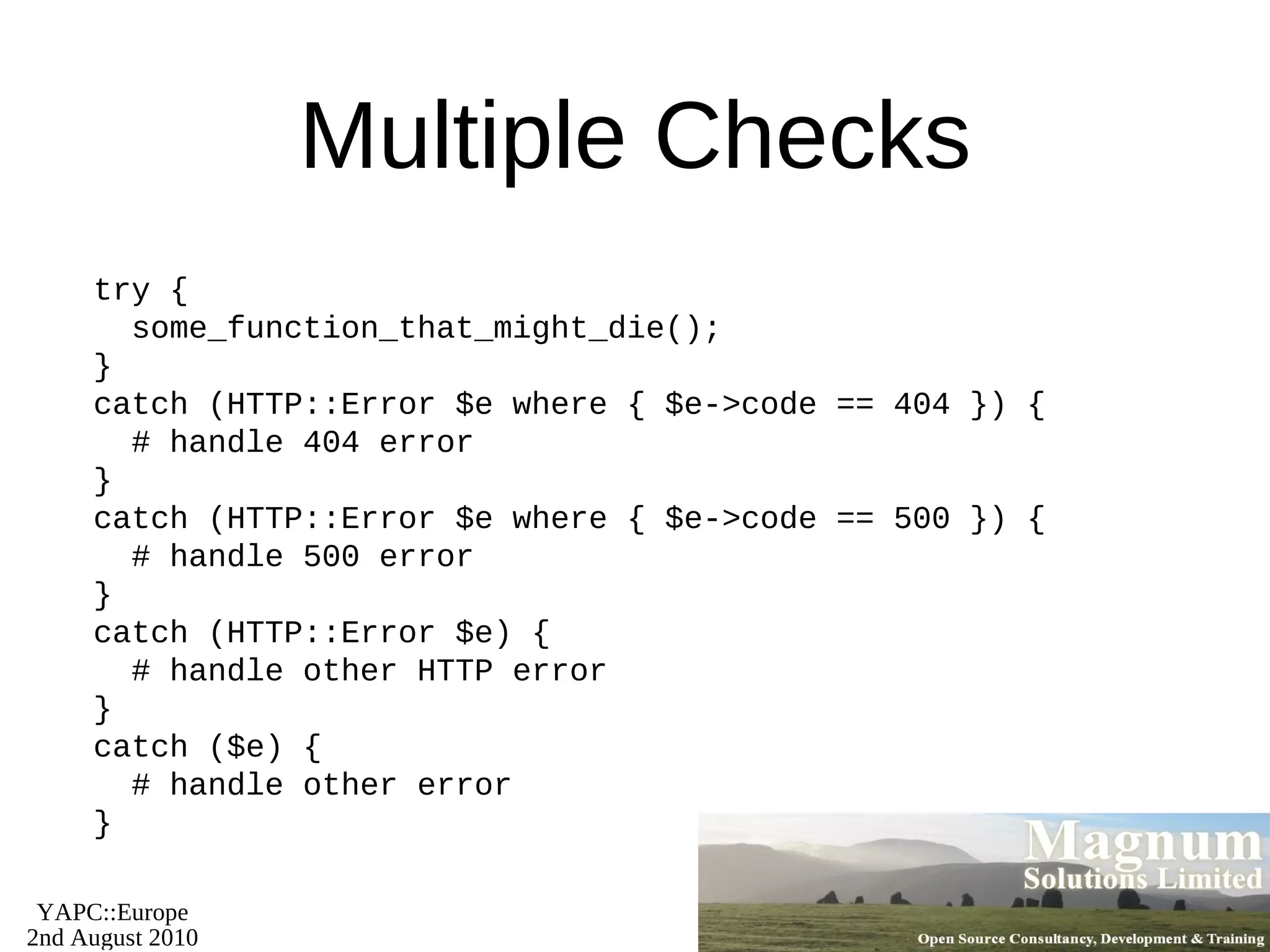
sub get_object { my ($class, $id) = @_; if (my $obj = find_obj_in_db($id)) { return $obj; } else { die MyException->new( type => 'obj_not_found', id => $id, ); } }
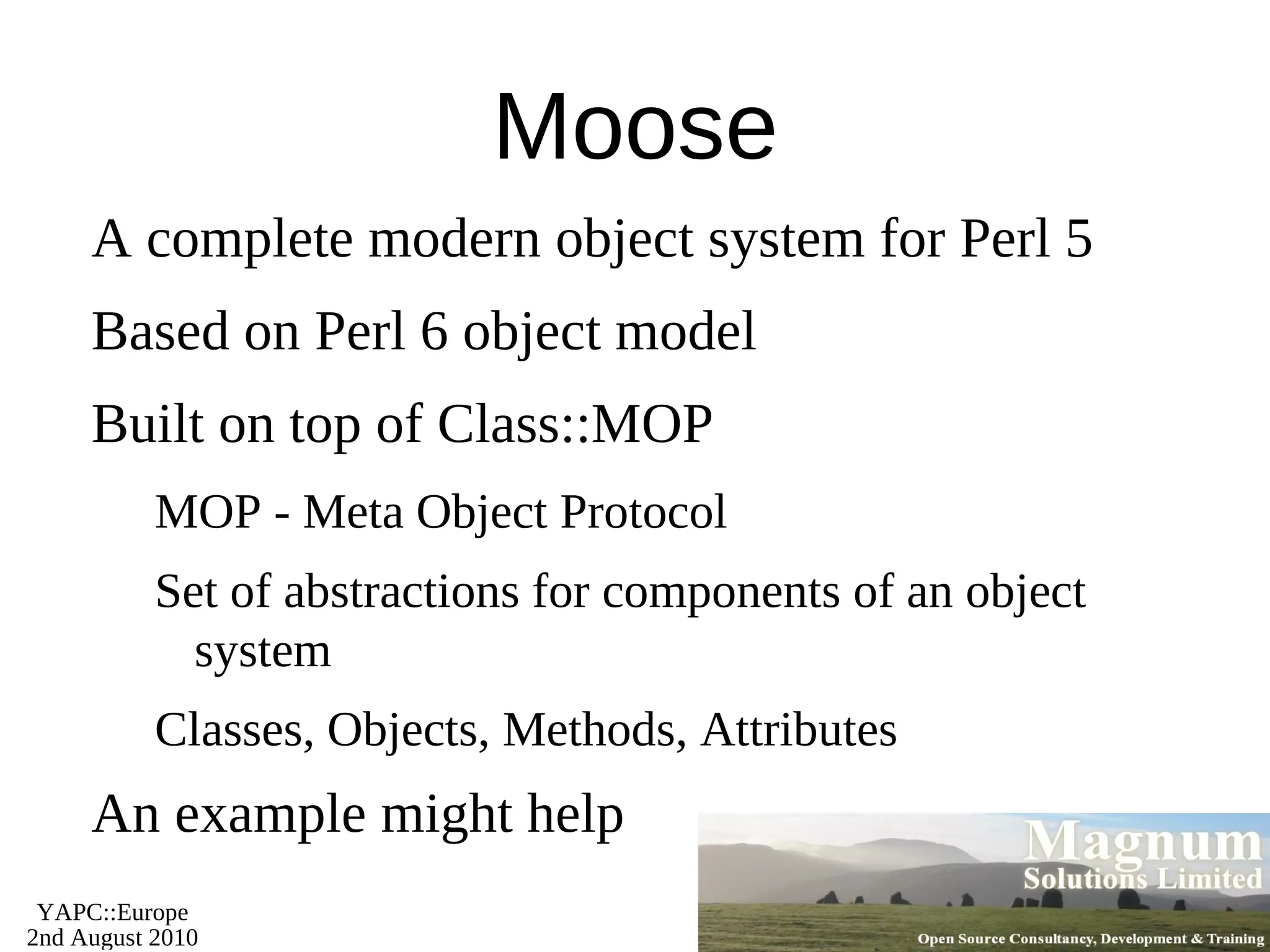
Set of abstractions for components of an object system
Classes, Objects, Methods, Attributes
An example might help
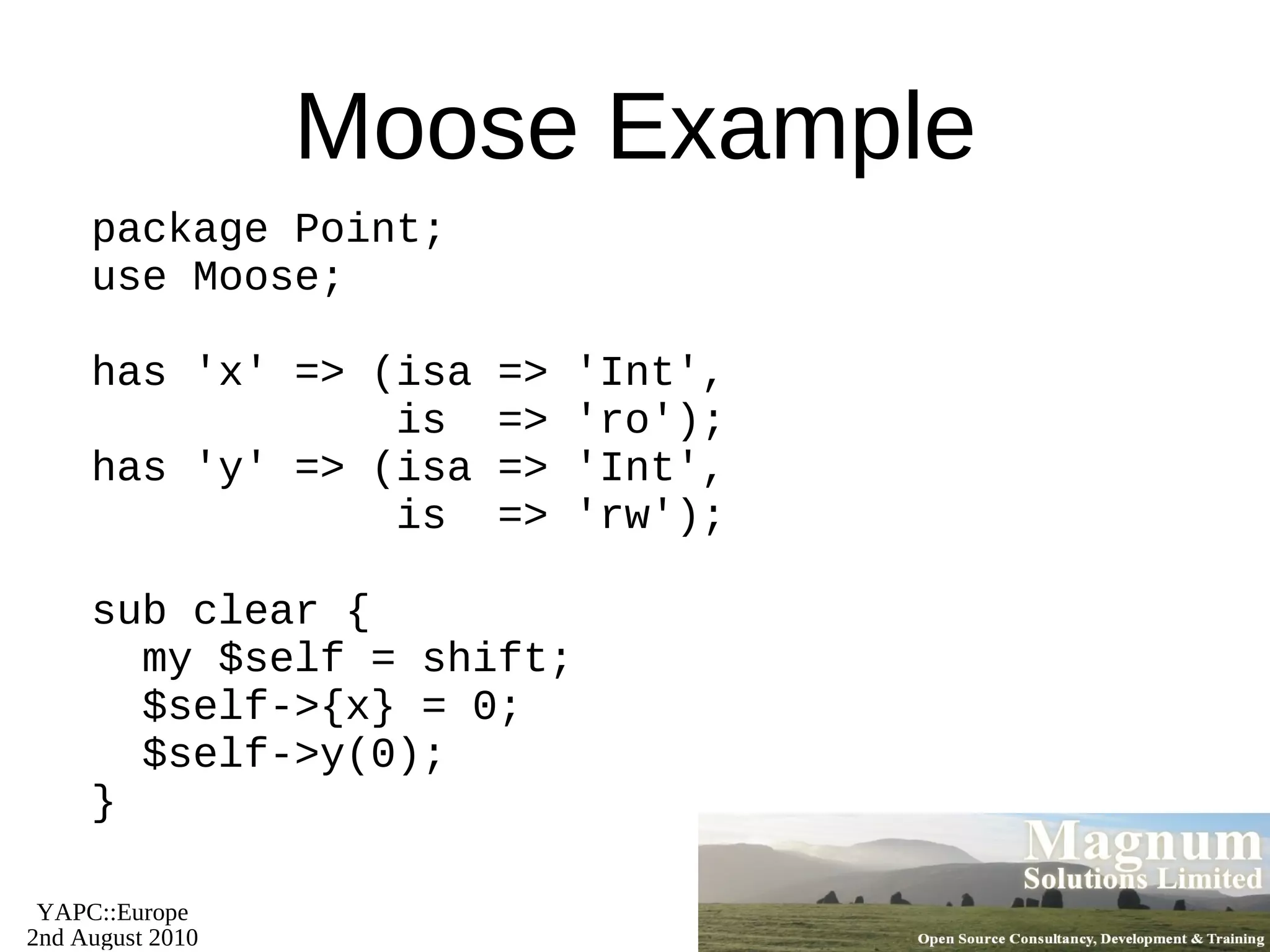
Moose Example
package Point; use Moose; has 'x' => (isa => 'Int', is => 'ro'); has 'y' => (isa => 'Int', is => 'rw'); sub clear { my $self = shift; $self->{x} = 0; $self->y(0); }
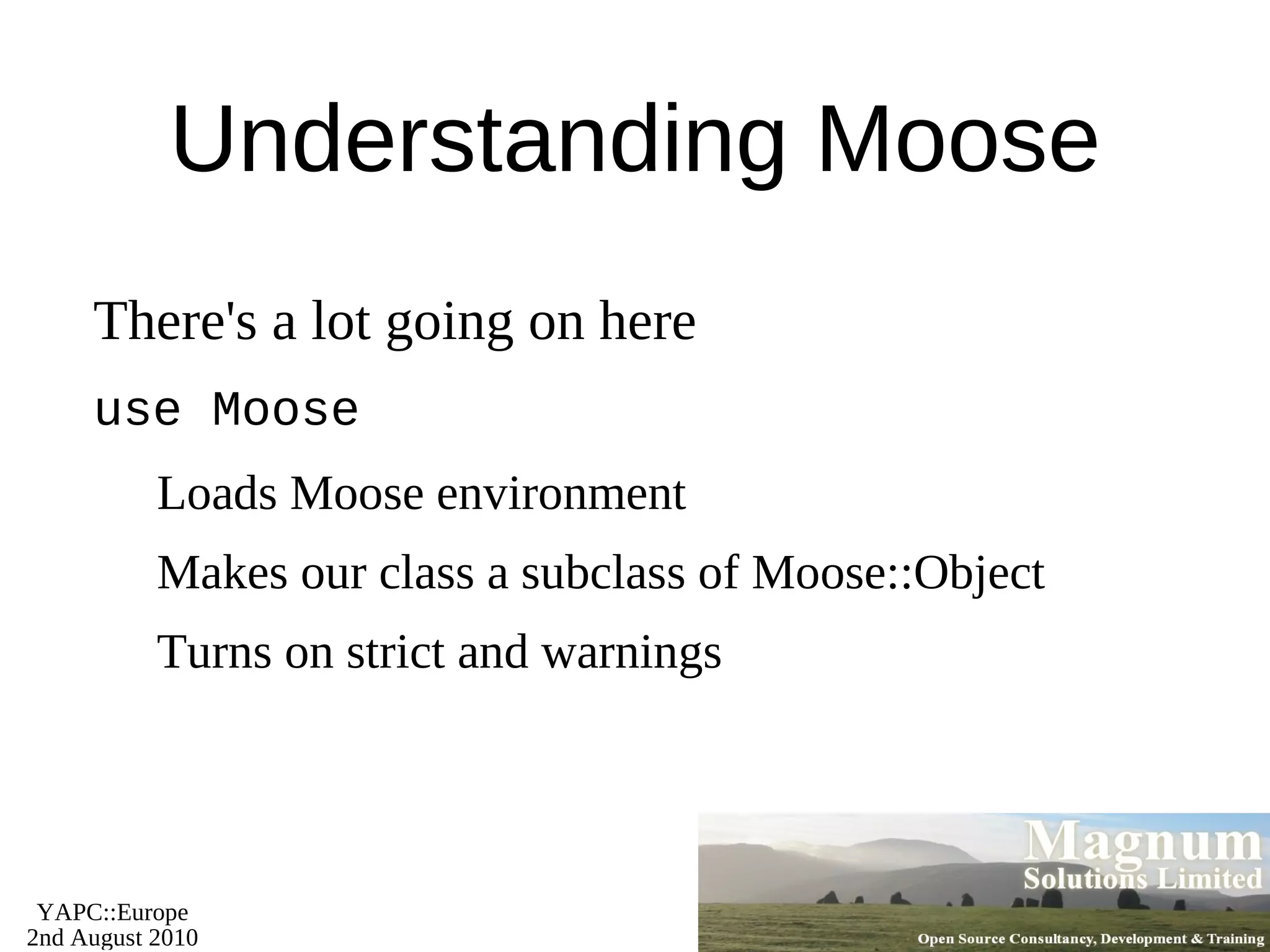
Understanding Moose
There's a lot going on here
use Moose
Loads Moose environment
Makes our class a subclass of Moose::Object
Turns on strict and warnings
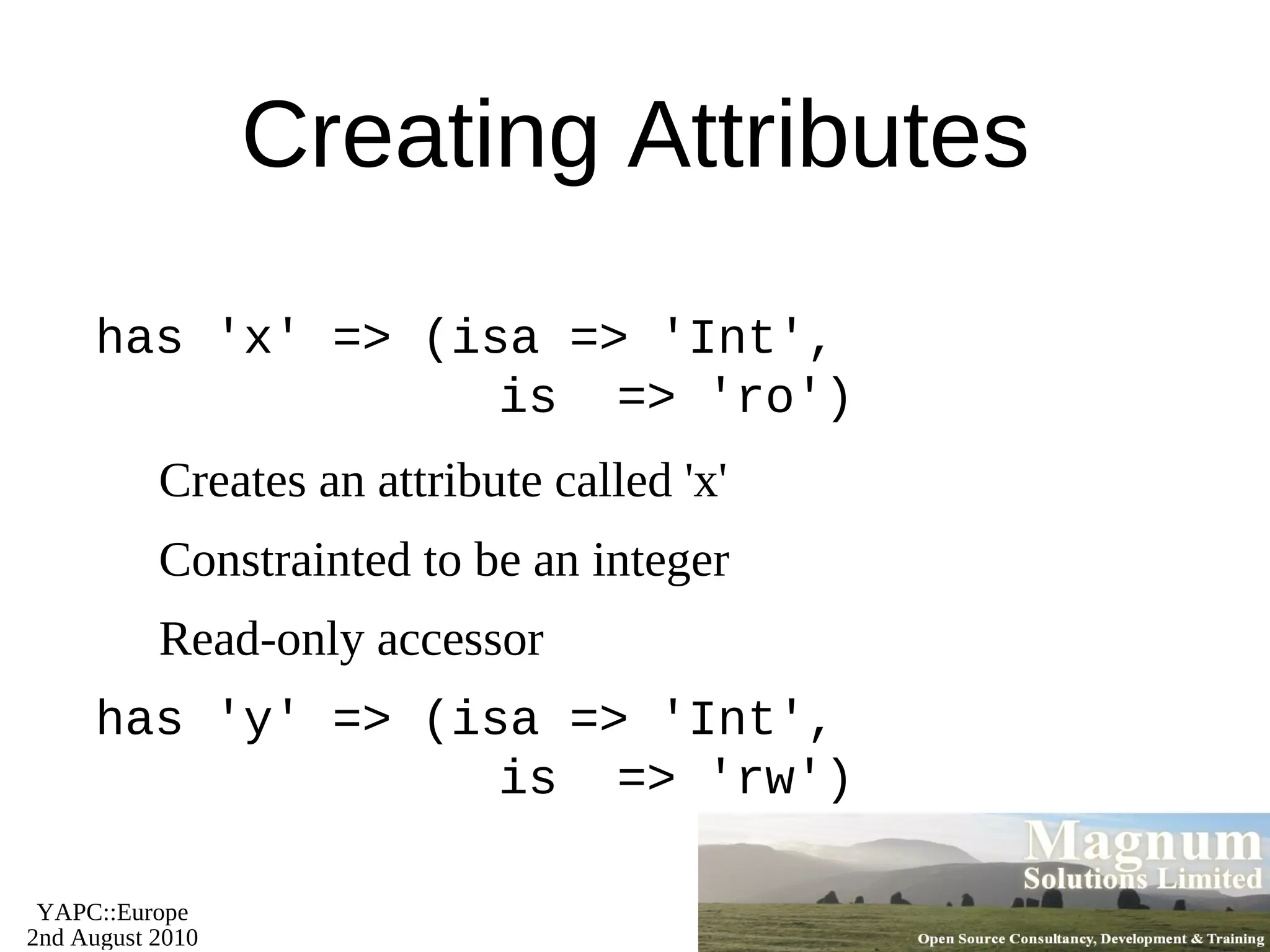
Creating Attributes
has 'x' => (isa => 'Int', is => 'ro')
Creates an attribute called 'x'
Constrainted to be an integer
Read-only accessor
has 'y' => (isa => 'Int', is => 'rw')
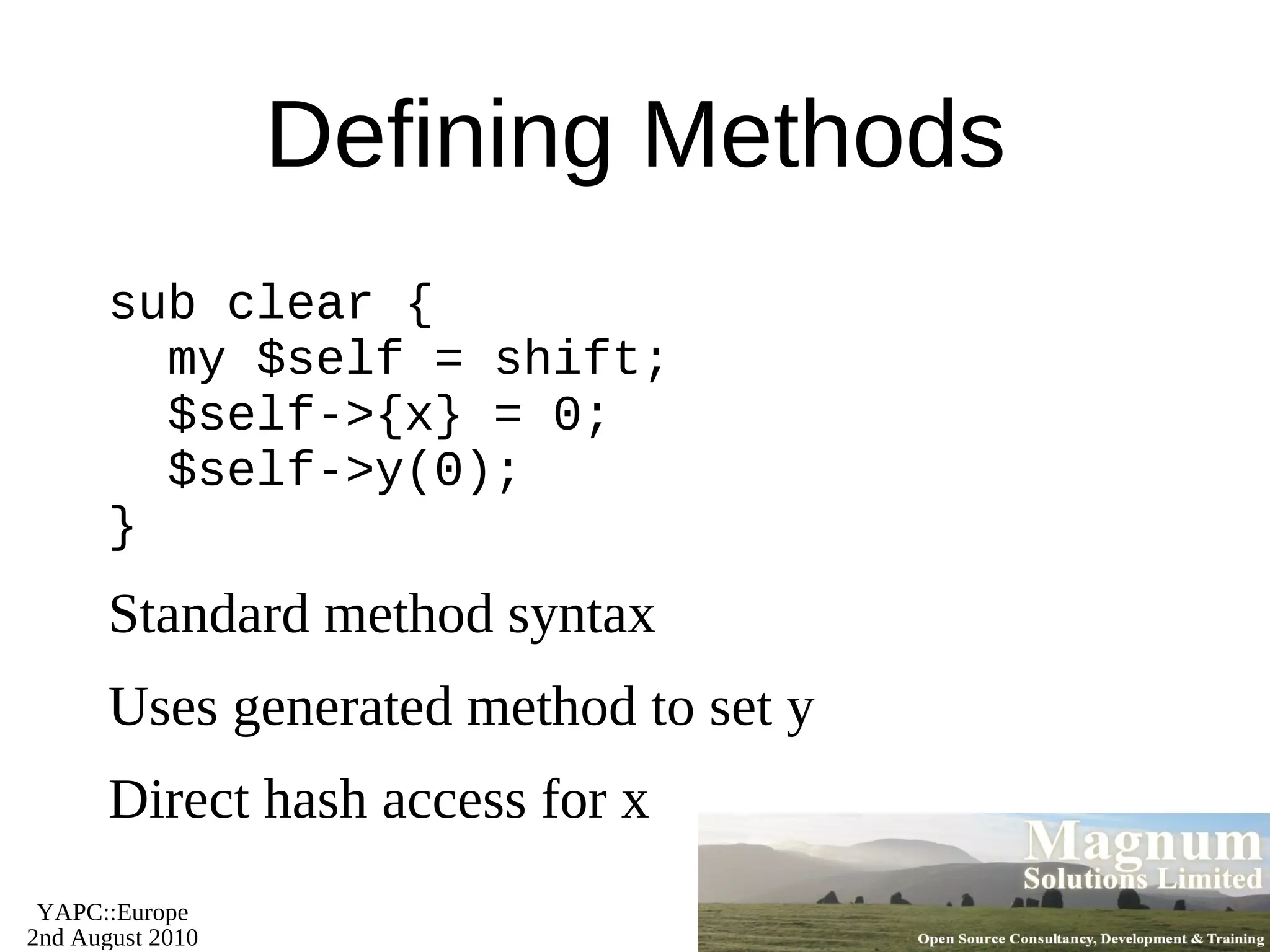
Defining Methods
sub clear { my $self = shift; $self->{x} = 0; $self->y(0); }
Standard method syntax
Uses generated method to set y
Direct hash access for x
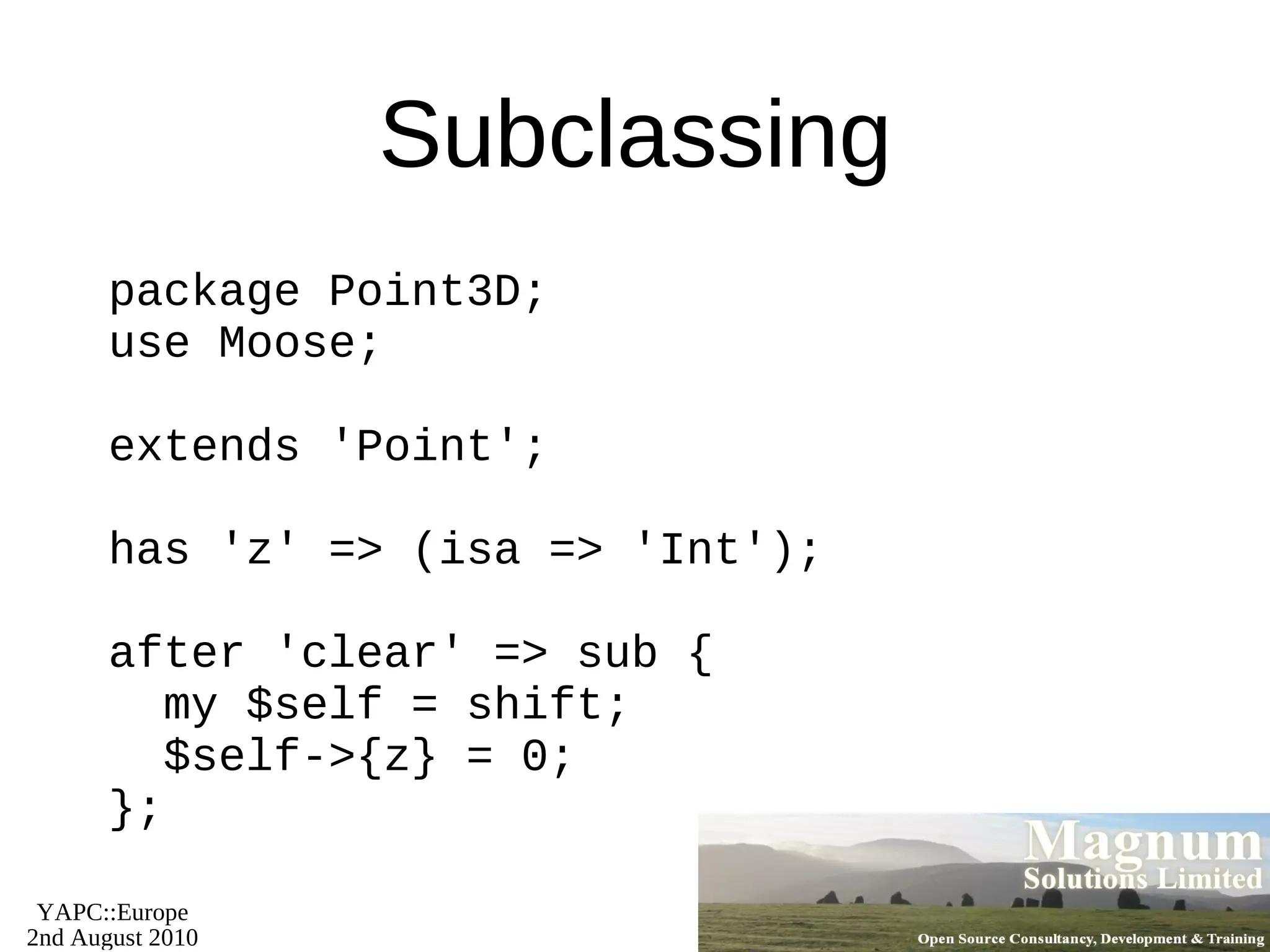
Subclassing
package Point3D; use Moose; extends 'Point'; has 'z' => (isa => 'Int'); after 'clear' => sub { my $self = shift; $self->{z} = 0; };
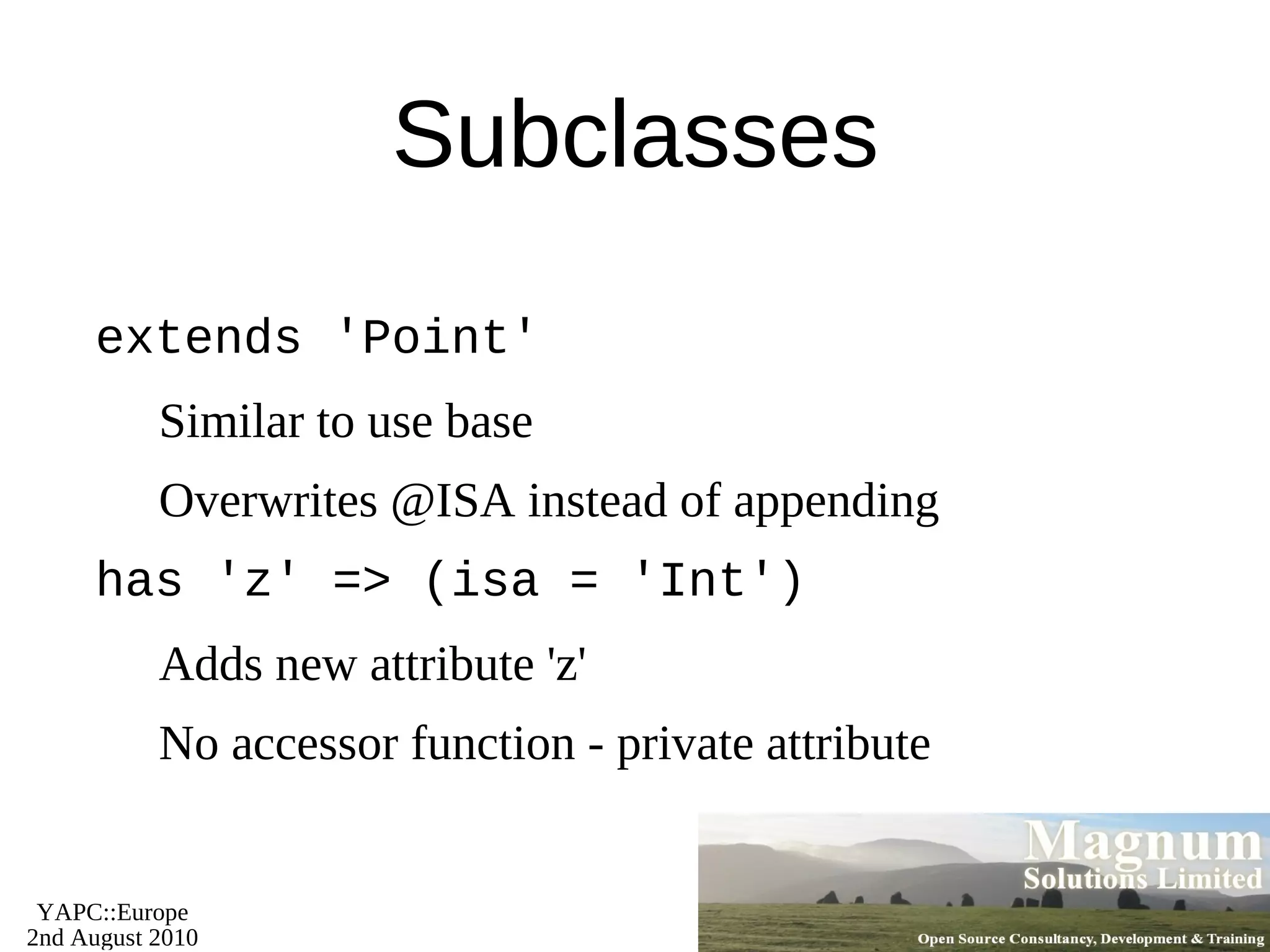
Subclasses
extends 'Point'
Similar to use base
Overwrites @ISA instead of appending
has 'z' => (isa = 'Int')
Adds new attribute 'z'
No accessor function - private attribute
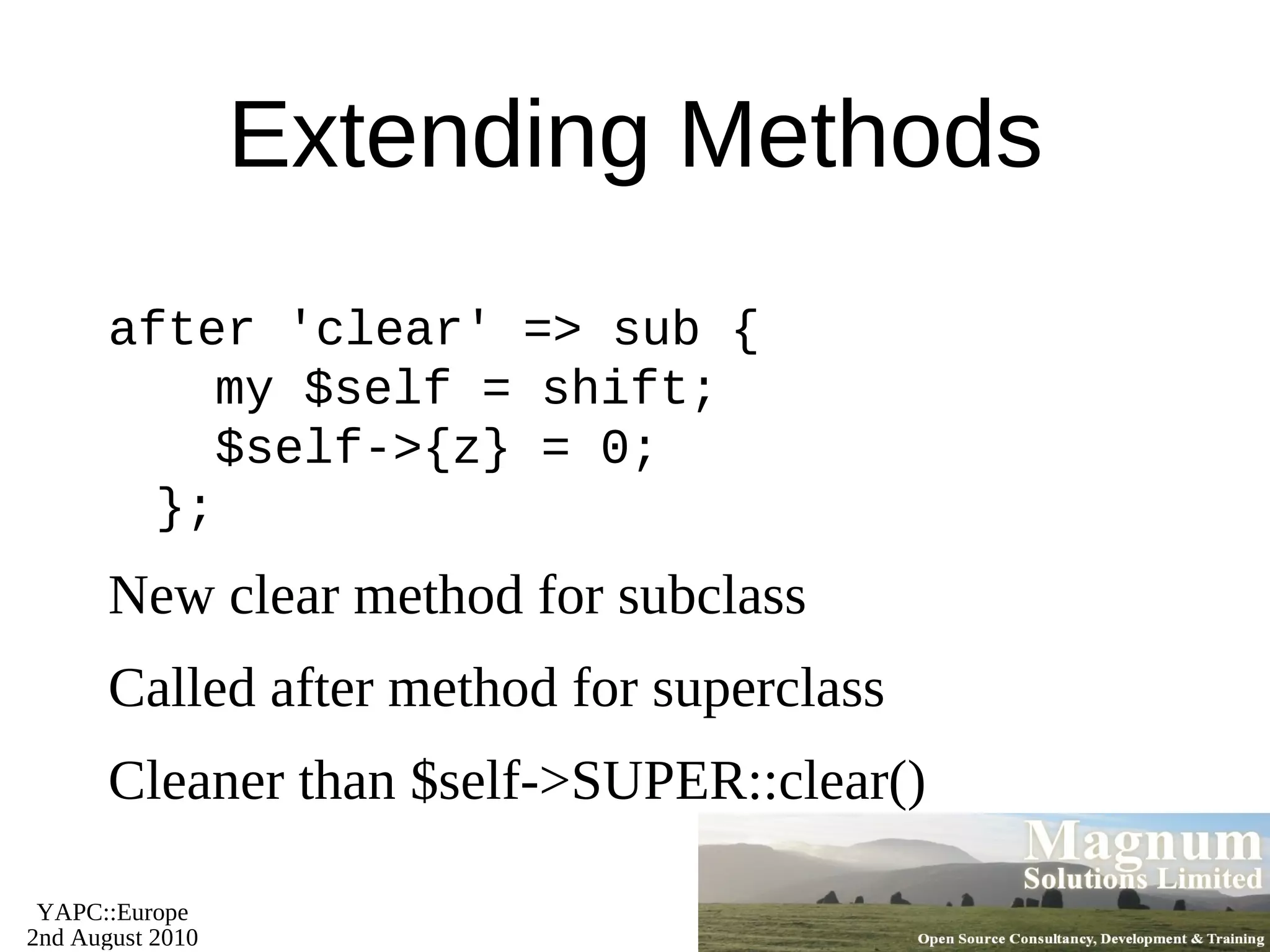
Extending Methods
after 'clear' => sub { my $self = shift; $self->{z} = 0; };
New clear method for subclass
Called after method for superclass
Cleaner than $self->SUPER::clear()
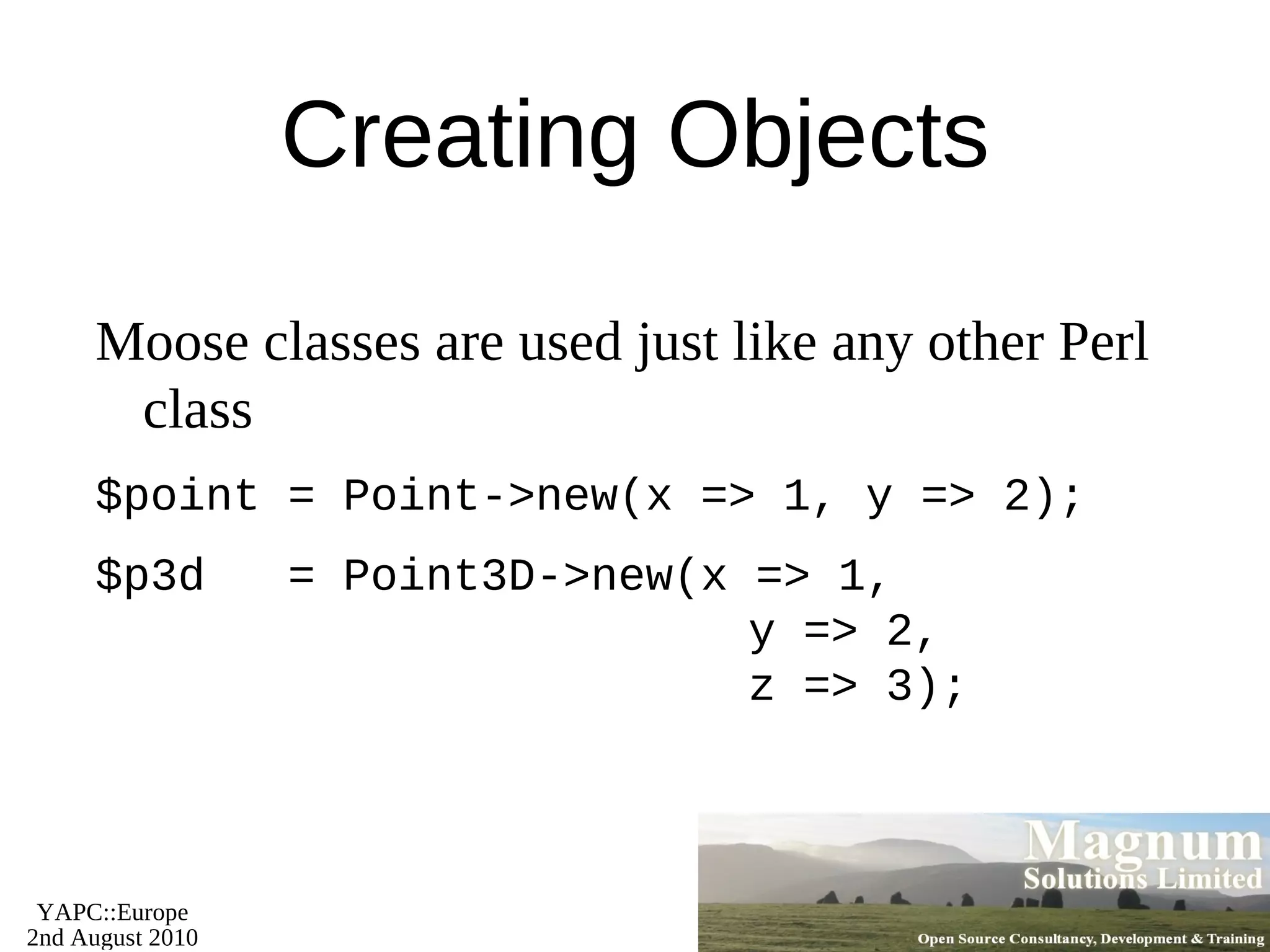
Creating Objects
Moose classes are used just like any other Perl class
$point = Point->new(x => 1, y => 2);
$p3d = Point3D->new(x => 1, y => 2, z => 3);
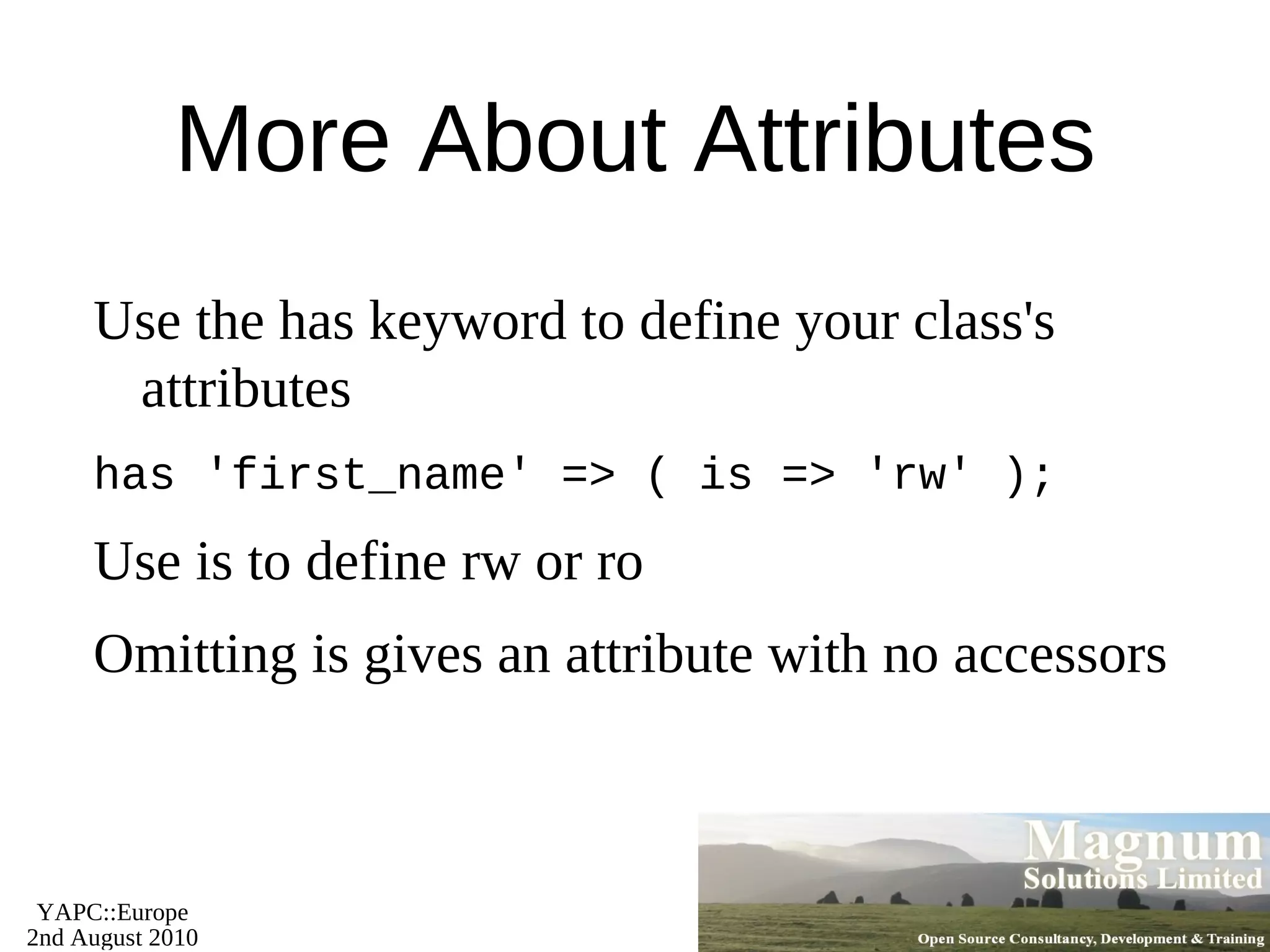
More About Attributes
Use the has keyword to define your class's attributes
has 'first_name' => ( is => 'rw' );
Use is to define rw or ro
Omitting is gives an attribute with no accessors
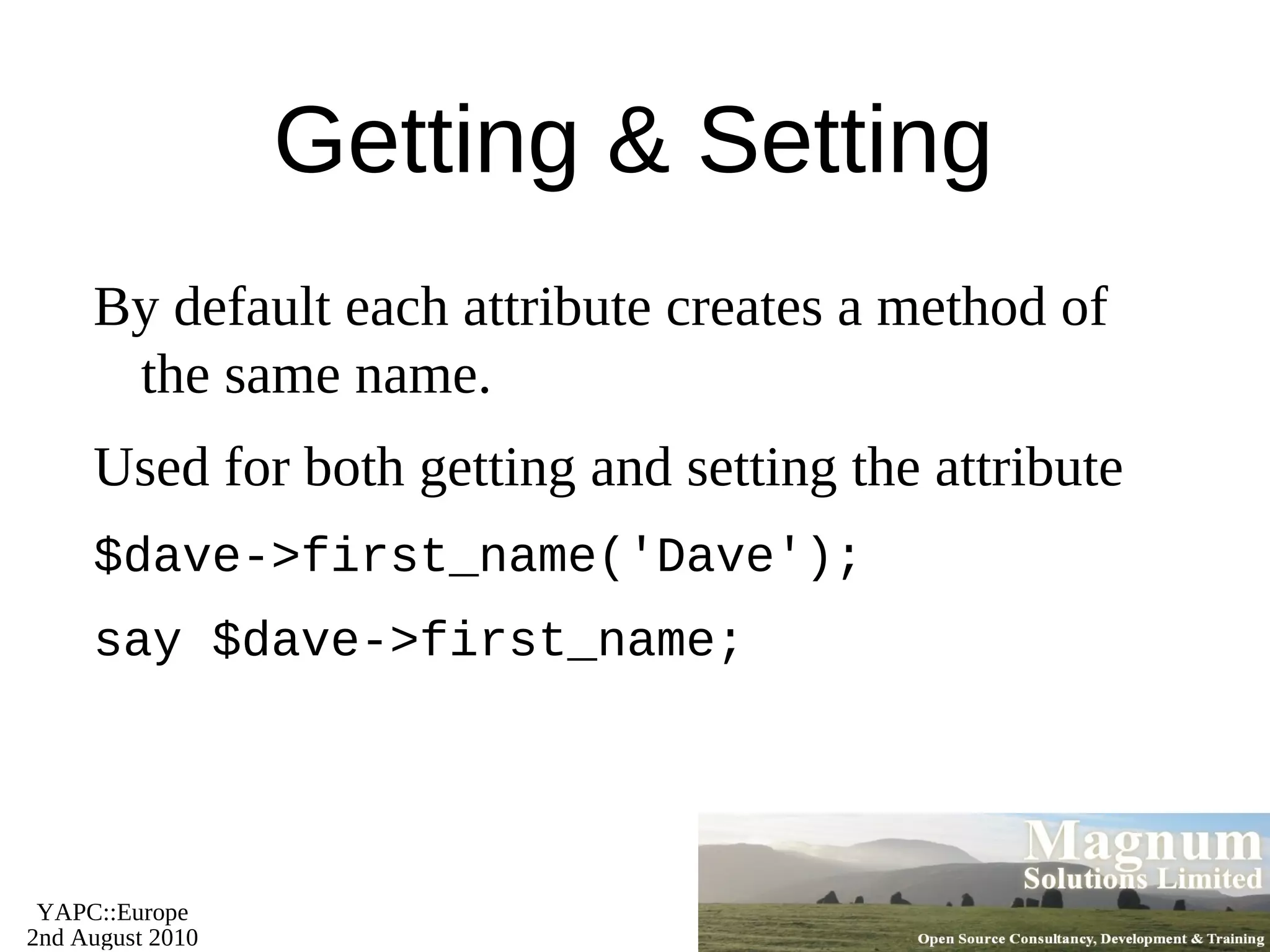
Getting & Setting
By default each attribute creates a method of the same name.
Used for both getting and setting the attribute
$dave->first_name('Dave');
say $dave->first_name;
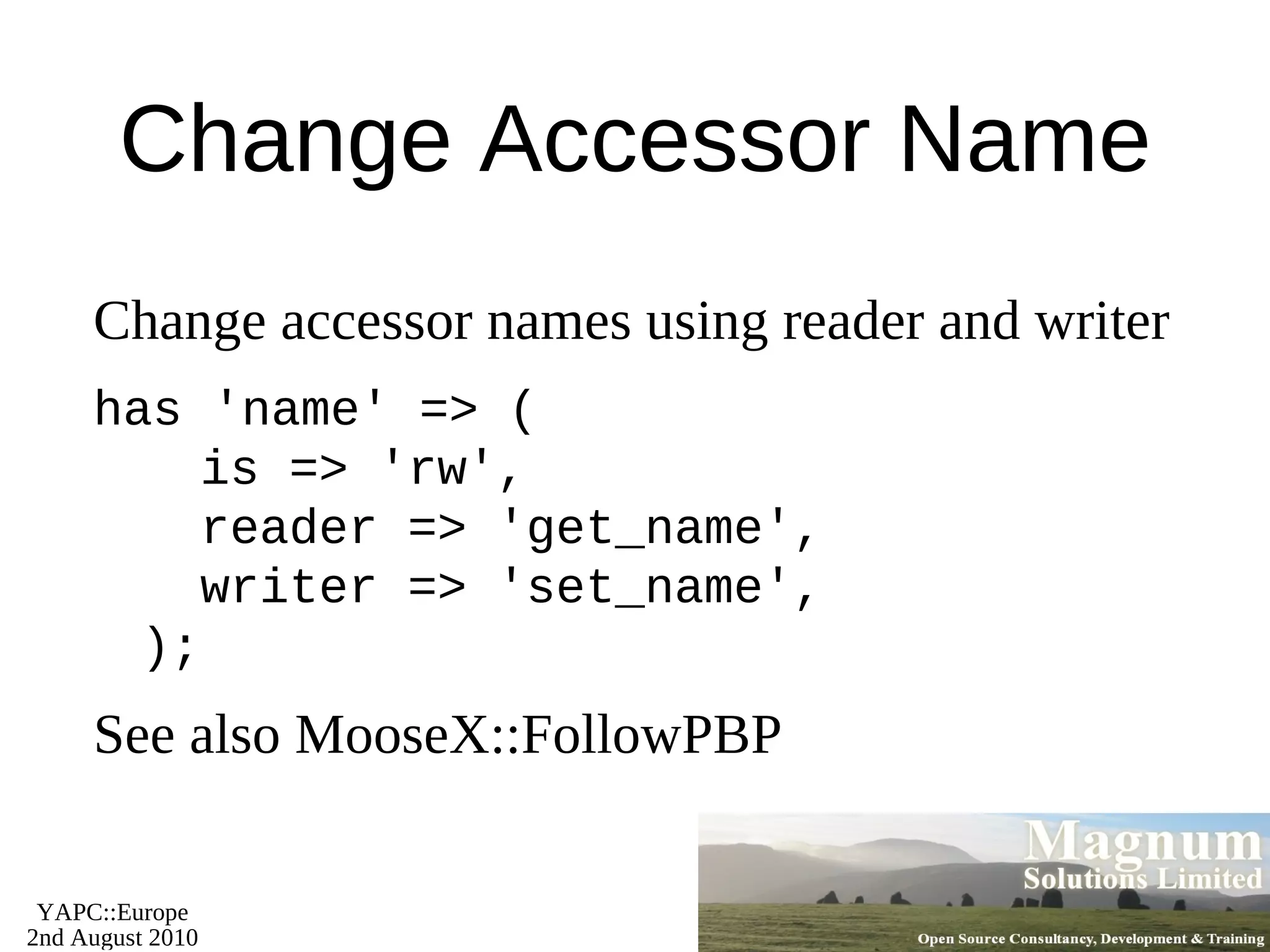
Change Accessor Name
Change accessor names using reader and writer
has 'name' => ( is => 'rw', reader => 'get_name', writer => 'set_name', );
See also MooseX::FollowPBP
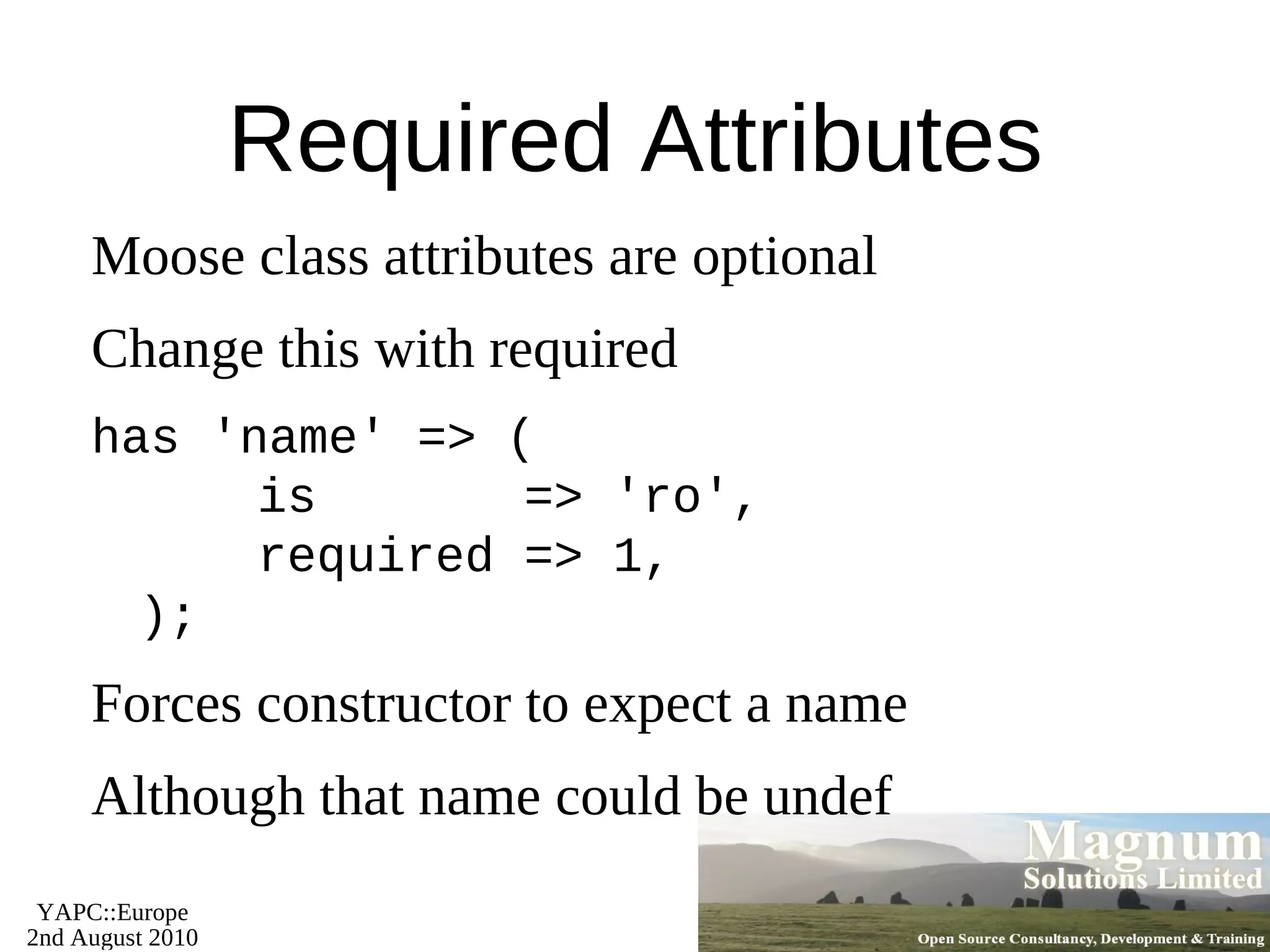
Required Attributes
Moose class attributes are optional
Change this with required
has 'name' => ( is => 'ro', required => 1, );
Forces constructor to expect a name
Although that name could be undef
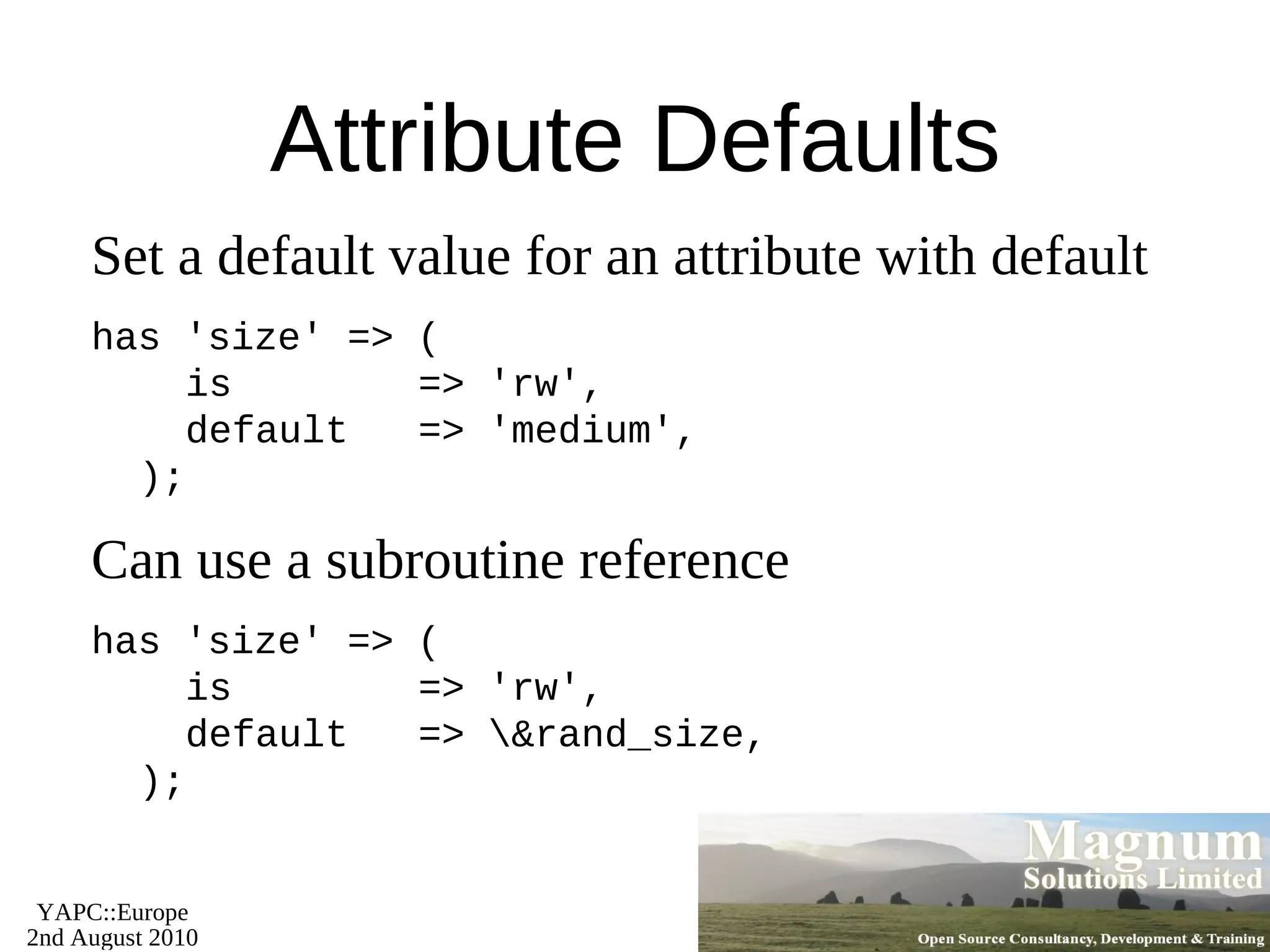
Attribute Defaults
Set a default value for an attribute with default
has 'size' => ( is => 'rw', default => 'medium', );
Can use a subroutine reference
has 'size' => ( is => 'rw', default => &rand_size, );
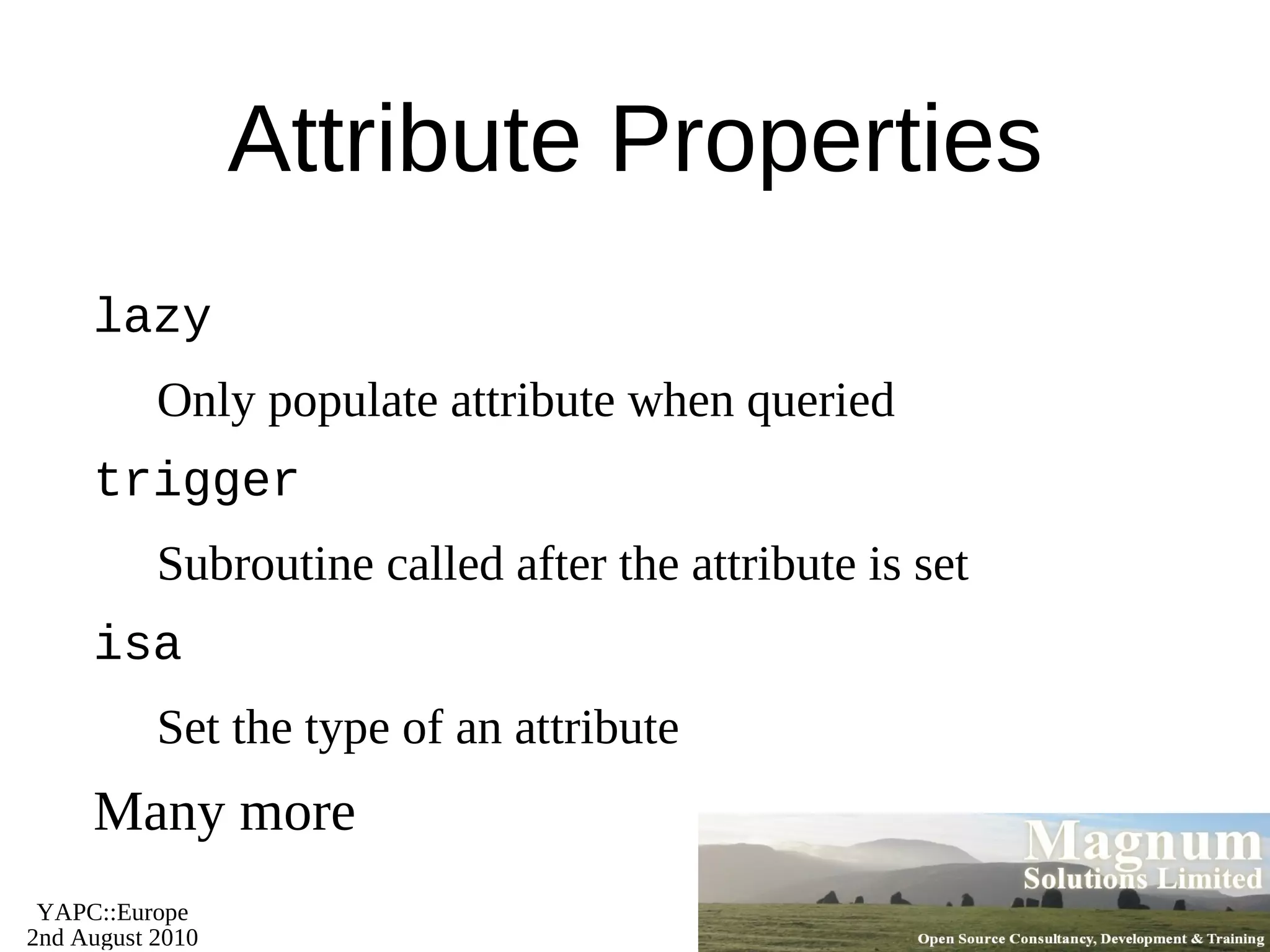
Attribute Properties
lazy
Only populate attribute when queried
trigger
Subroutine called after the attribute is set
isa
Set the type of an attribute
Many more
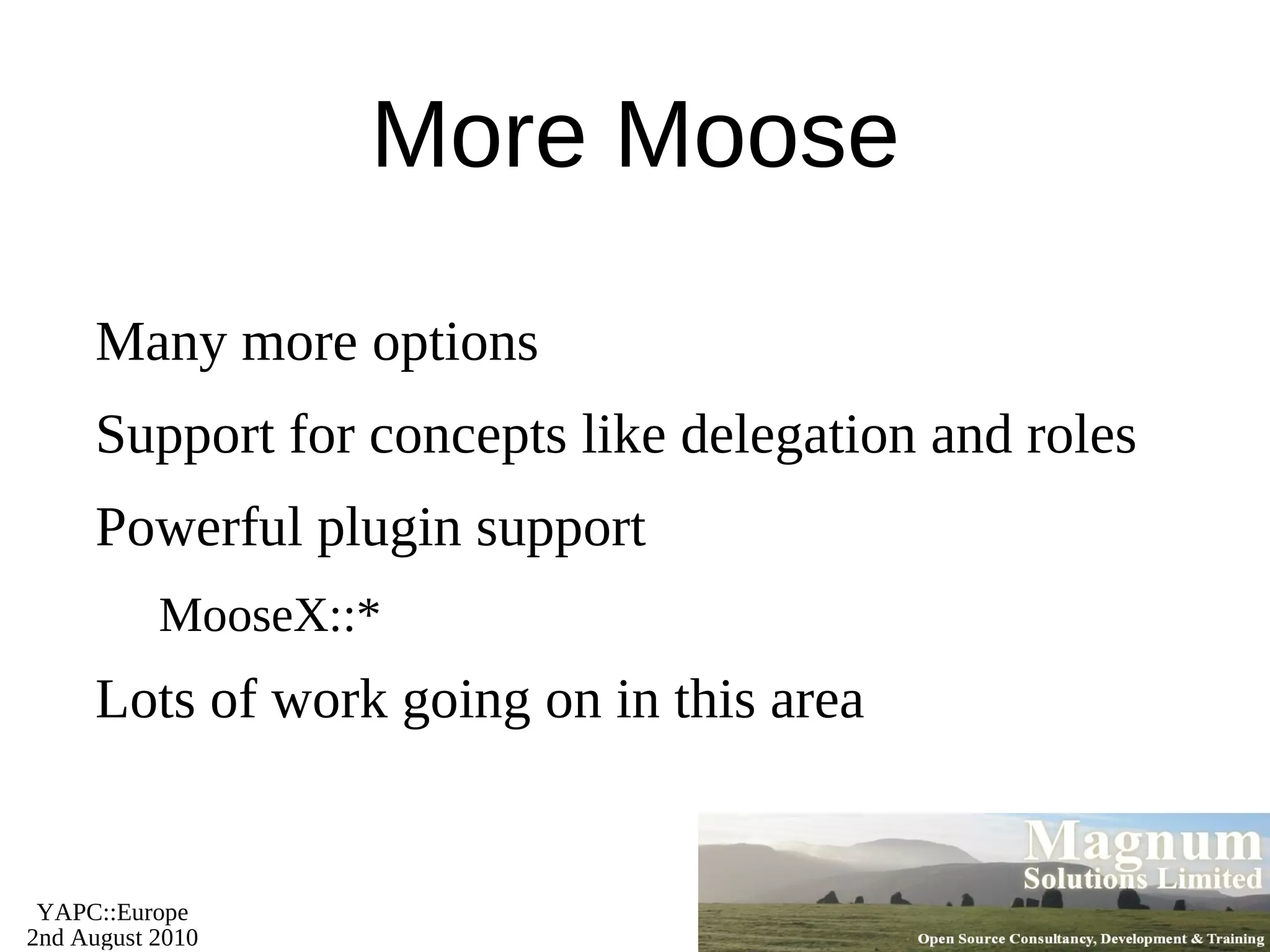
More Moose
Many more options
Support for concepts like delegation and roles
Powerful plugin support
MooseX::*
Lots of work going on in this area
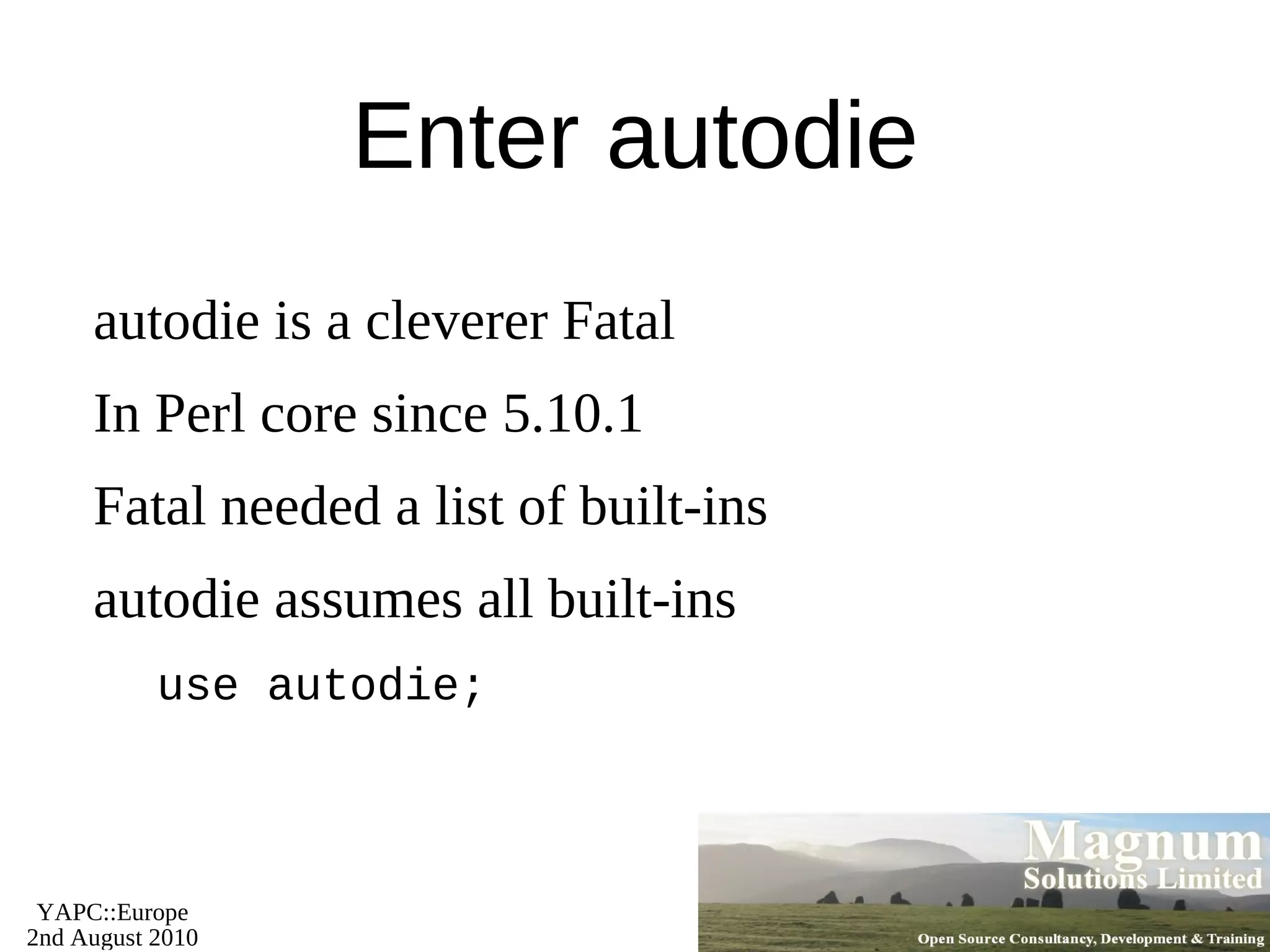
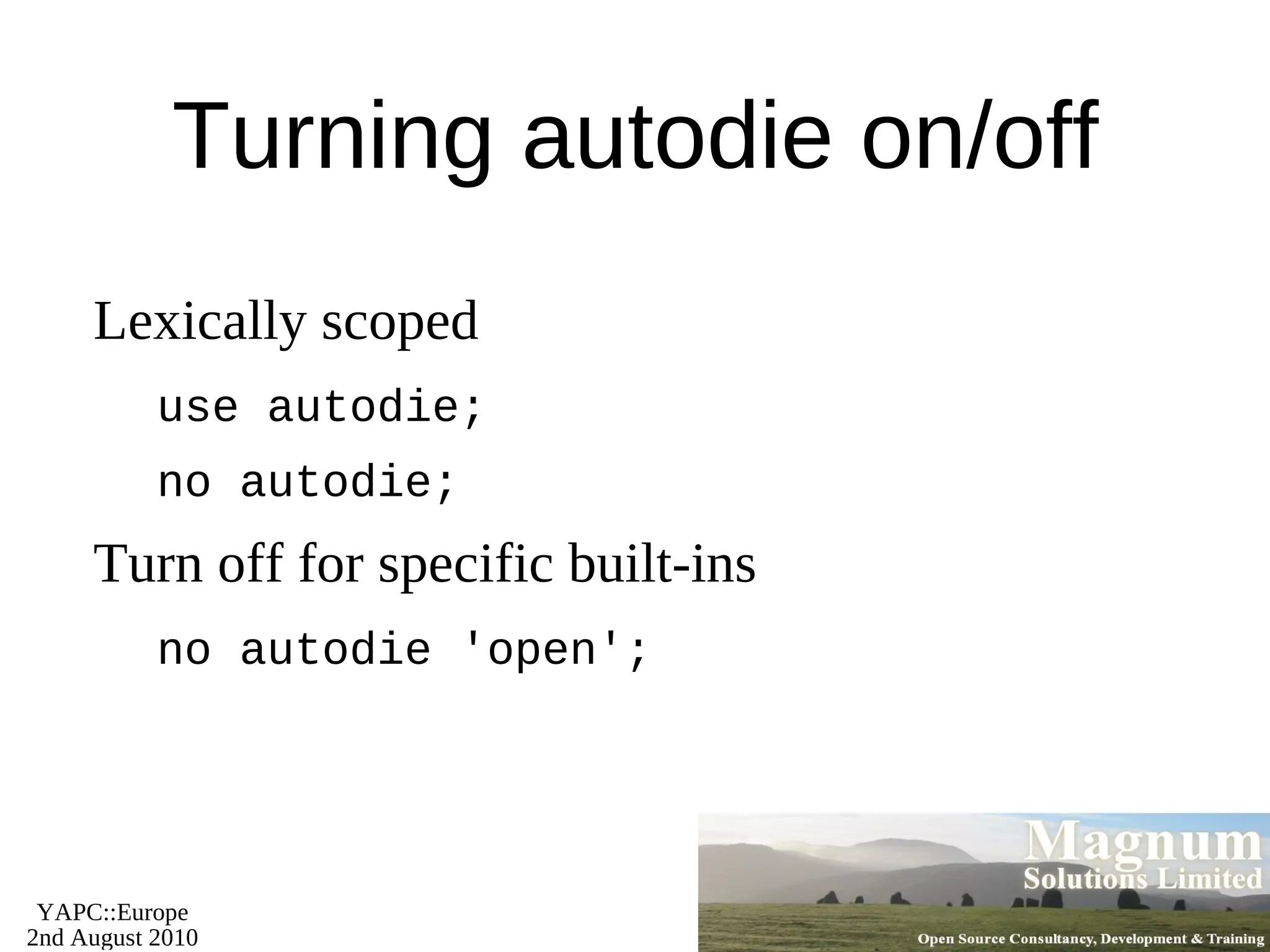
autodie
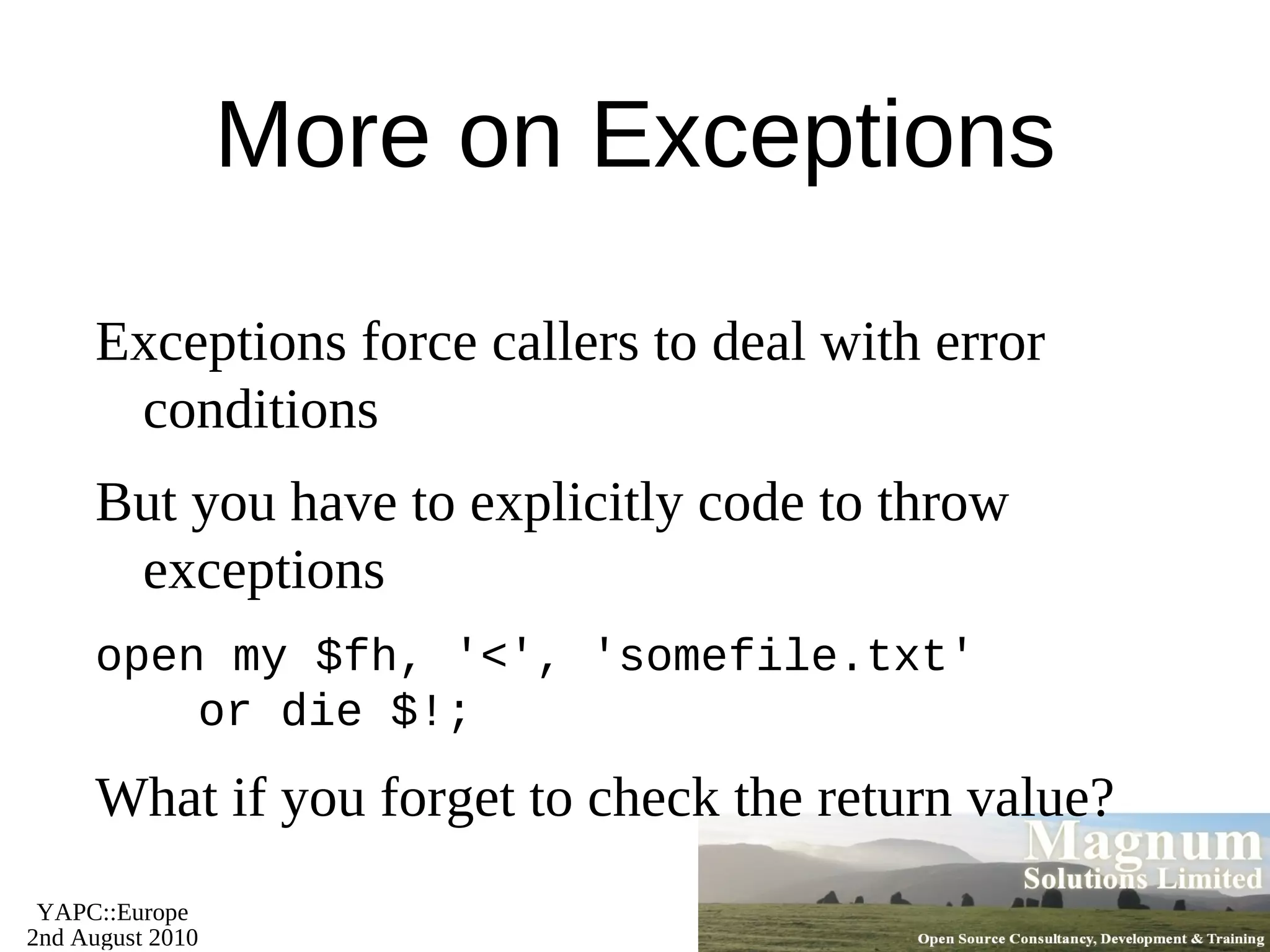
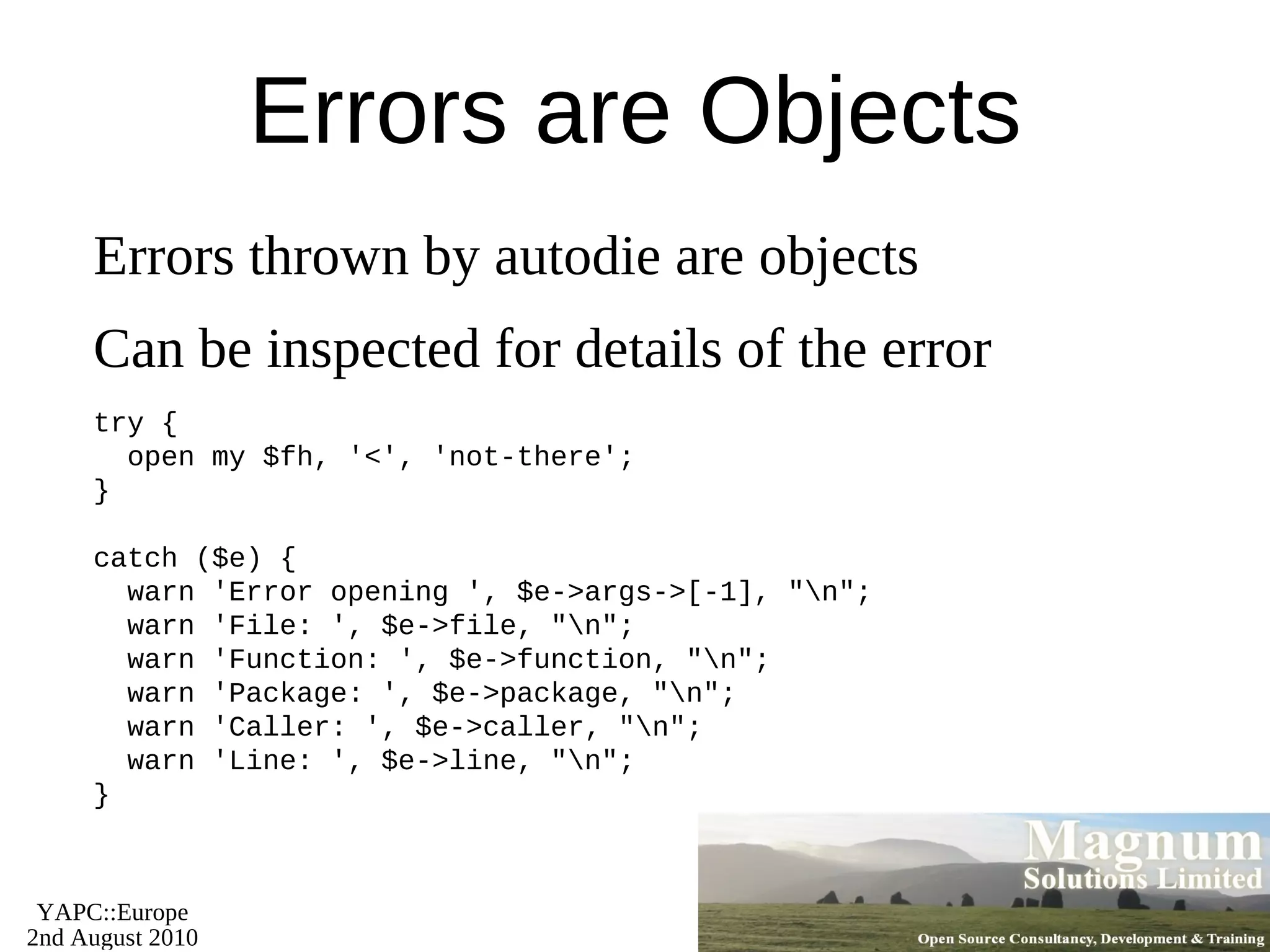
More on Exceptions
Exceptions force callers to deal with error conditions
But you have to explicitly code to throw exceptions
open my $fh, '<', 'somefile.txt' or die $!;
What if you forget to check the return value?
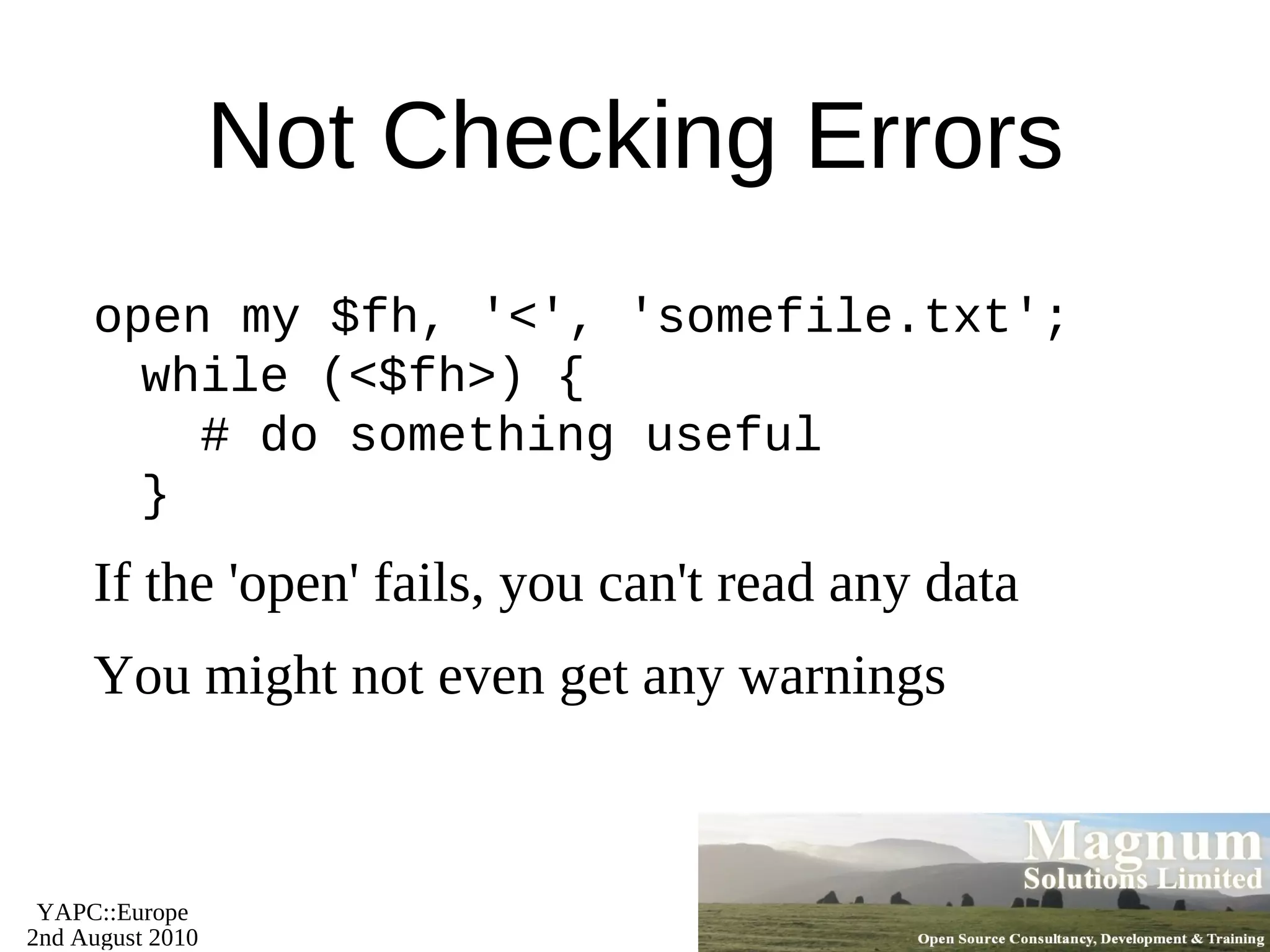
Not Checking Errors
open my $fh, '<', 'somefile.txt'; while (<$fh>) { # do something useful }
If the 'open' fails, you can't read any data
You might not even get any warnings
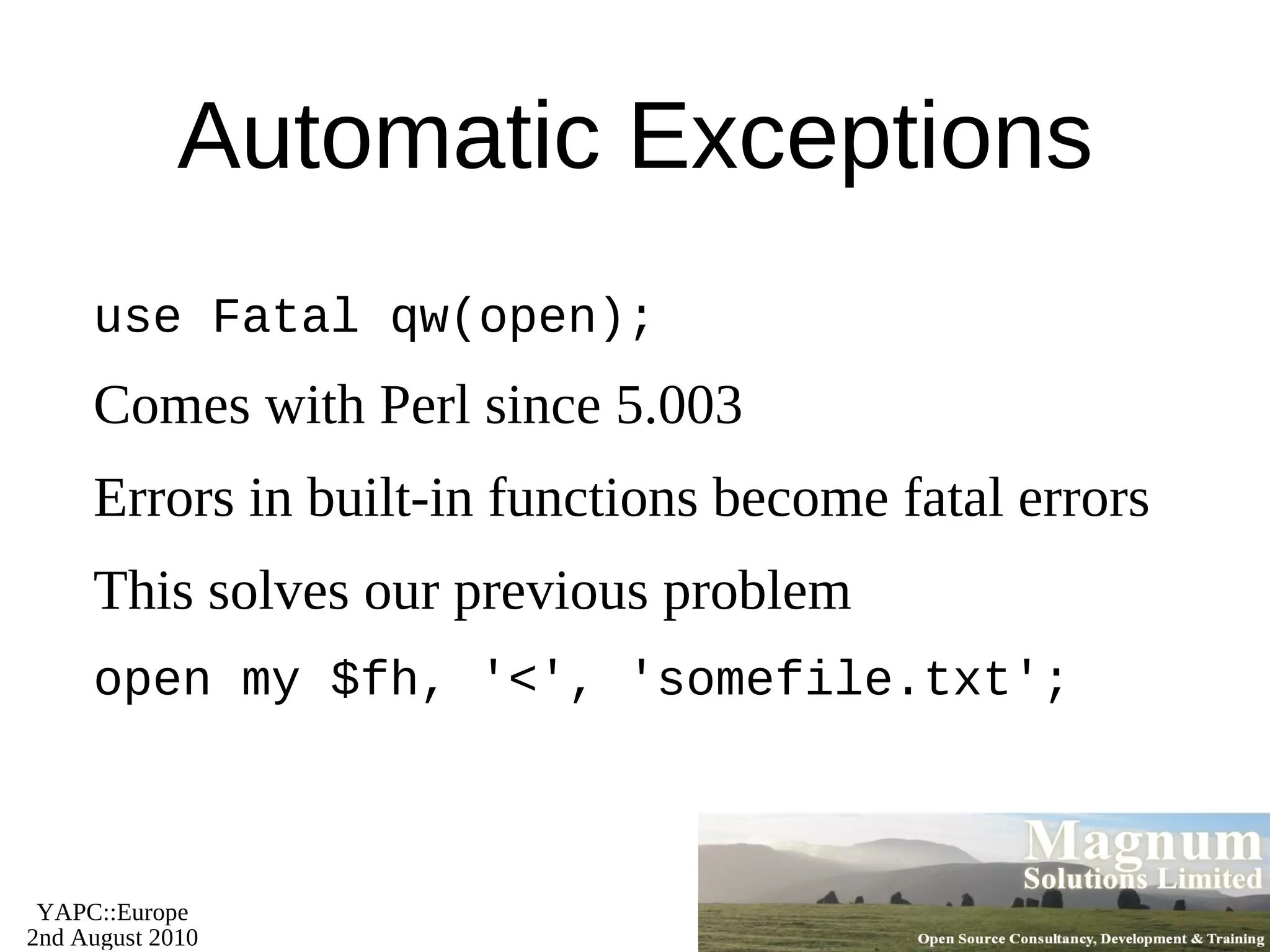
Automatic Exceptions
use Fatal qw(open);
Comes with Perl since 5.003
Errors in built-in functions become fatal errors
This solves our previous problem
open my $fh, '<', 'somefile.txt';
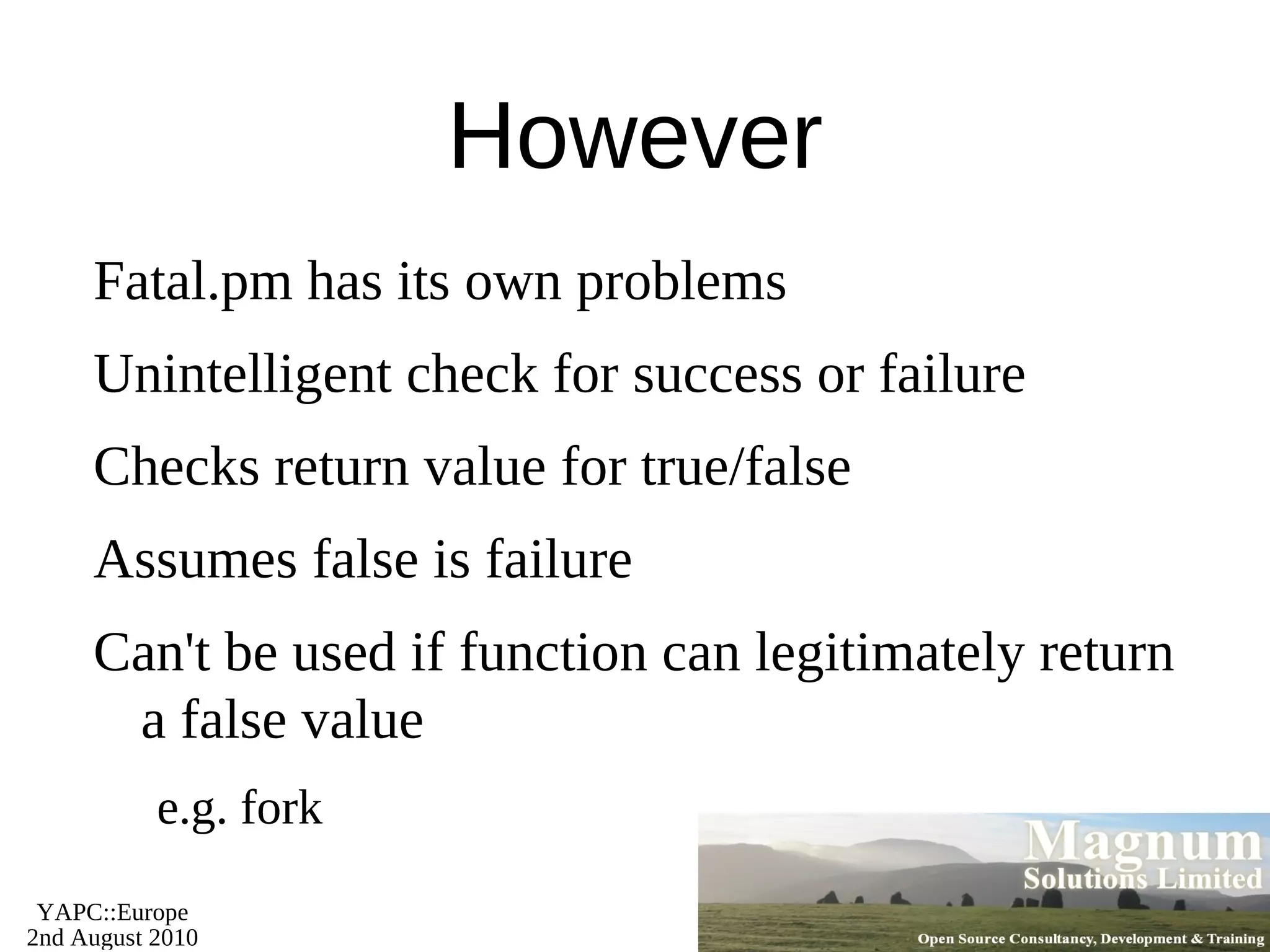
However
Fatal.pm has its own problems
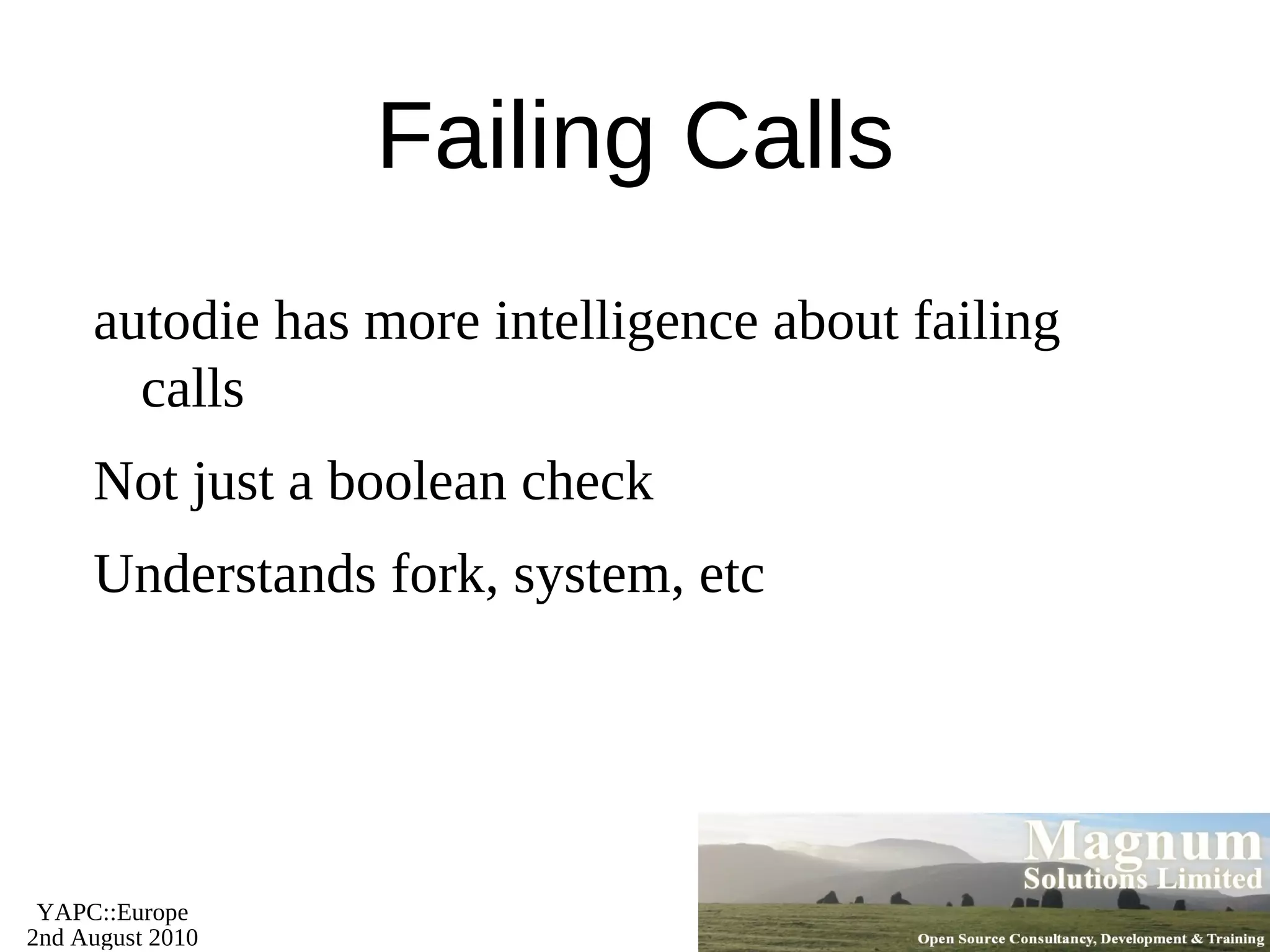
Unintelligent check for success or failure
Checks return value for true/false
Assumes false is failure
Can't be used if function can legitimately return a false value
e.g. fork
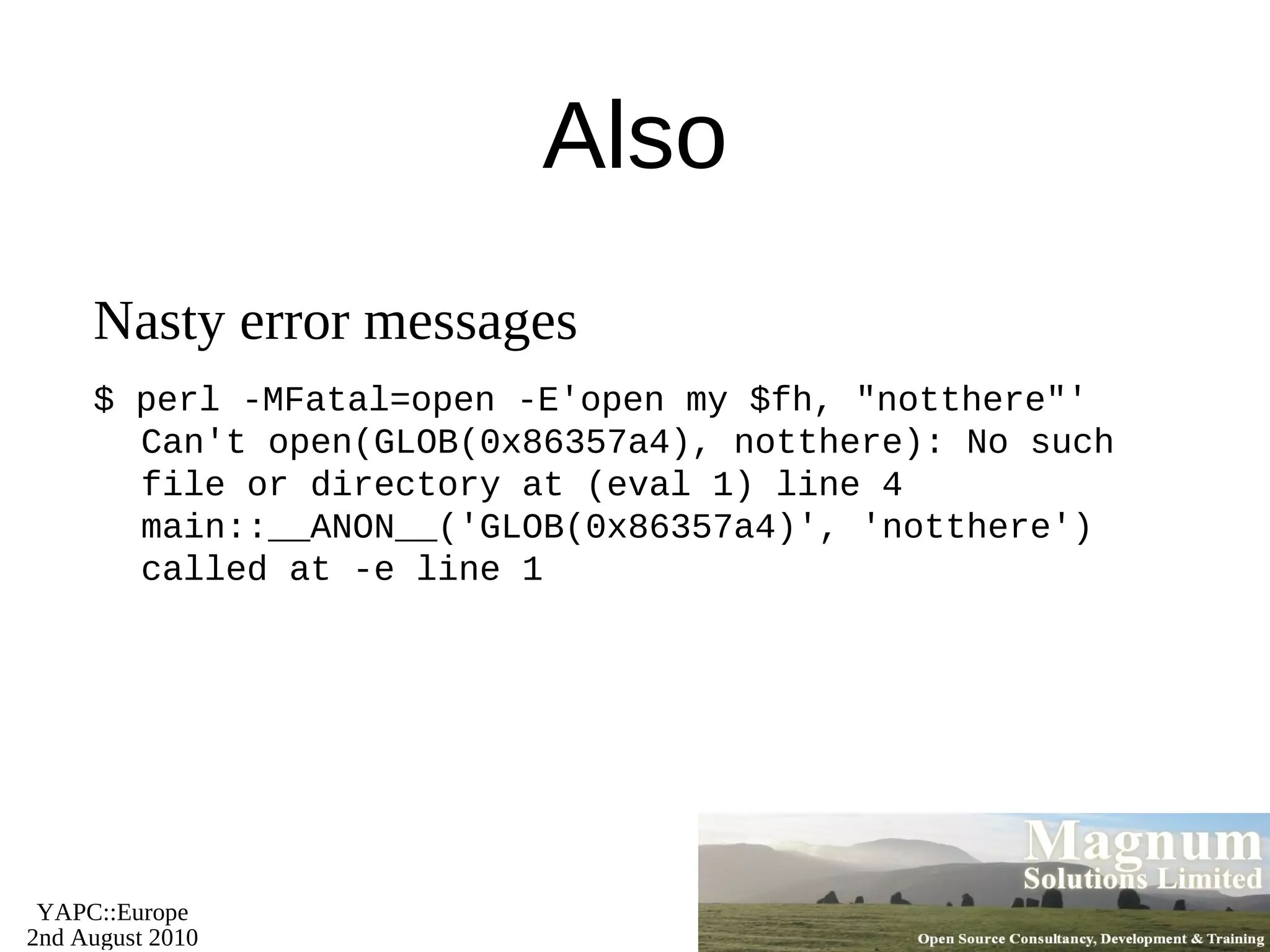
Also
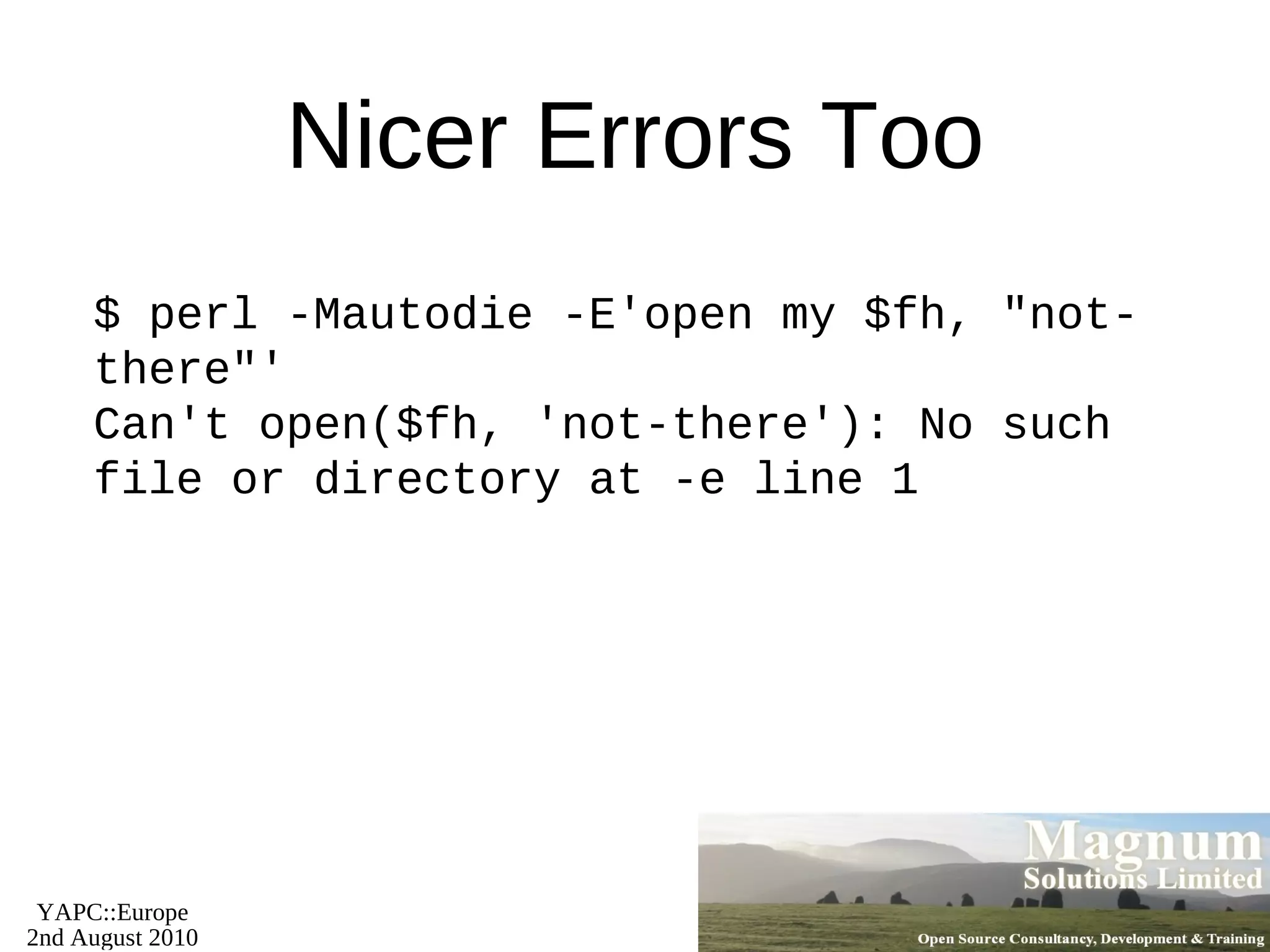
Nasty error messages
$ perl -MFatal=open -E'open my $fh, "notthere"' Can't open(GLOB(0x86357a4), notthere): No such file or directory at (eval 1) line 4 main::__ANON__('GLOB(0x86357a4)', 'notthere') called at -e line 1
$ perl -Mautodie -E'open my $fh, "not-there"' Can't open($fh, 'not-there'): No such file or directory at -e line 1
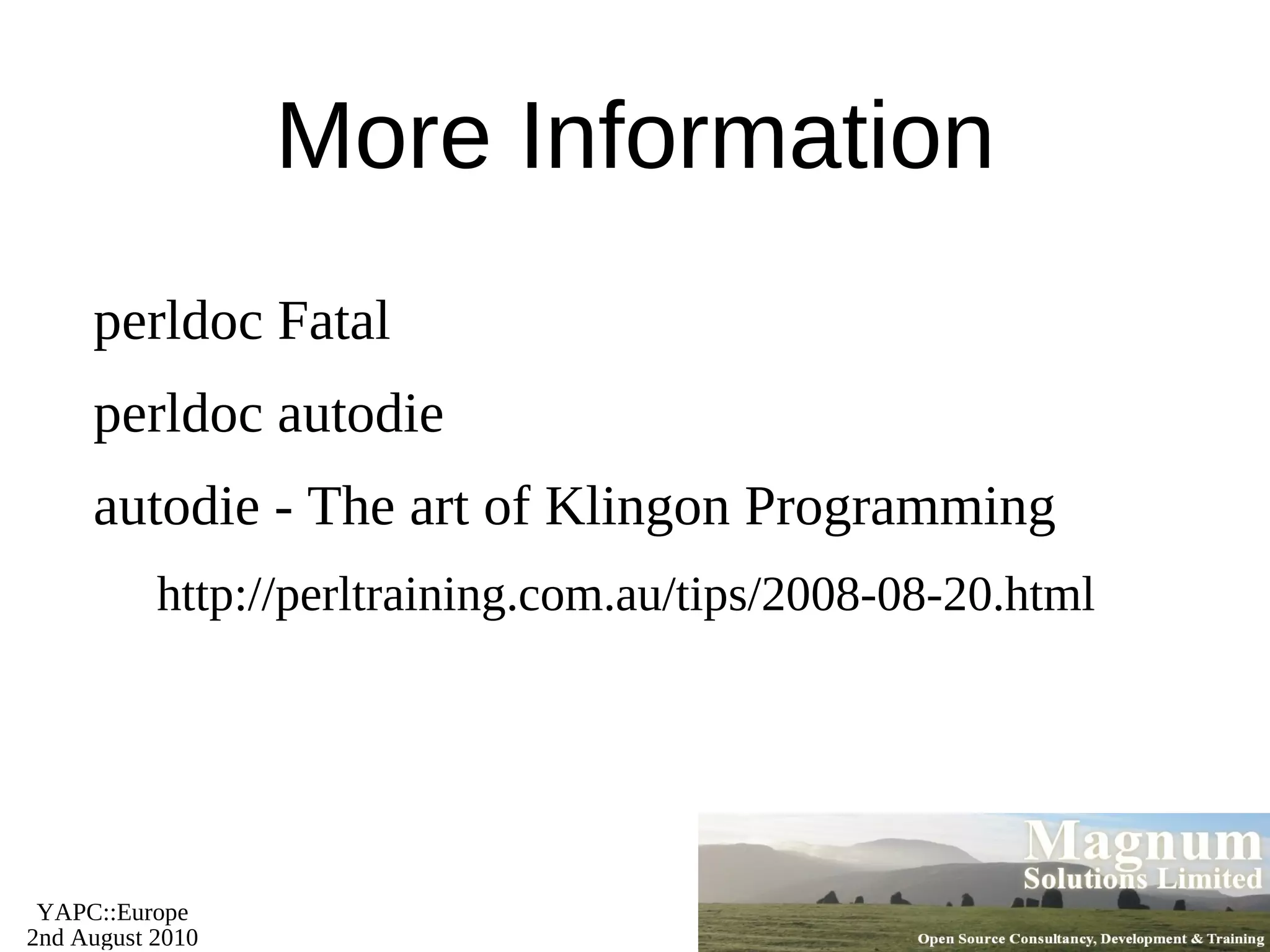
More Information
perldoc Fatal
perldoc autodie
autodie - The art of Klingon Programming
http://perltraining.com.au/tips/2008-08-20.html
Catalyst
MVC Frameworks
MVC frameworks are a popular way to write applications
Particularly web applications
M, V and C
Model
Data storage & data access
View
Data presentation layer
Controller
Business logic to glue it all together
MVC Examples
Ruby on Rails
Django (Python)
Struts (Java)
CakePHP
Many examples in most languages
Perl has many options
MVC in Perl
Maypole
The original Perl MVC framework
CGI::Application
Simple MVC for CGI programming
Jifty
Developed and used by Best Practical
Catalyst
Currently the popular choice
Newer MVC in Perl
Dancer
Squatting
Mojolicious
Catalyst
MVC framework in Perl
Building on other heavily-used tools
Model uses DBIx::Class
View uses Template Toolkit
These are just defaults
Can use anything you want
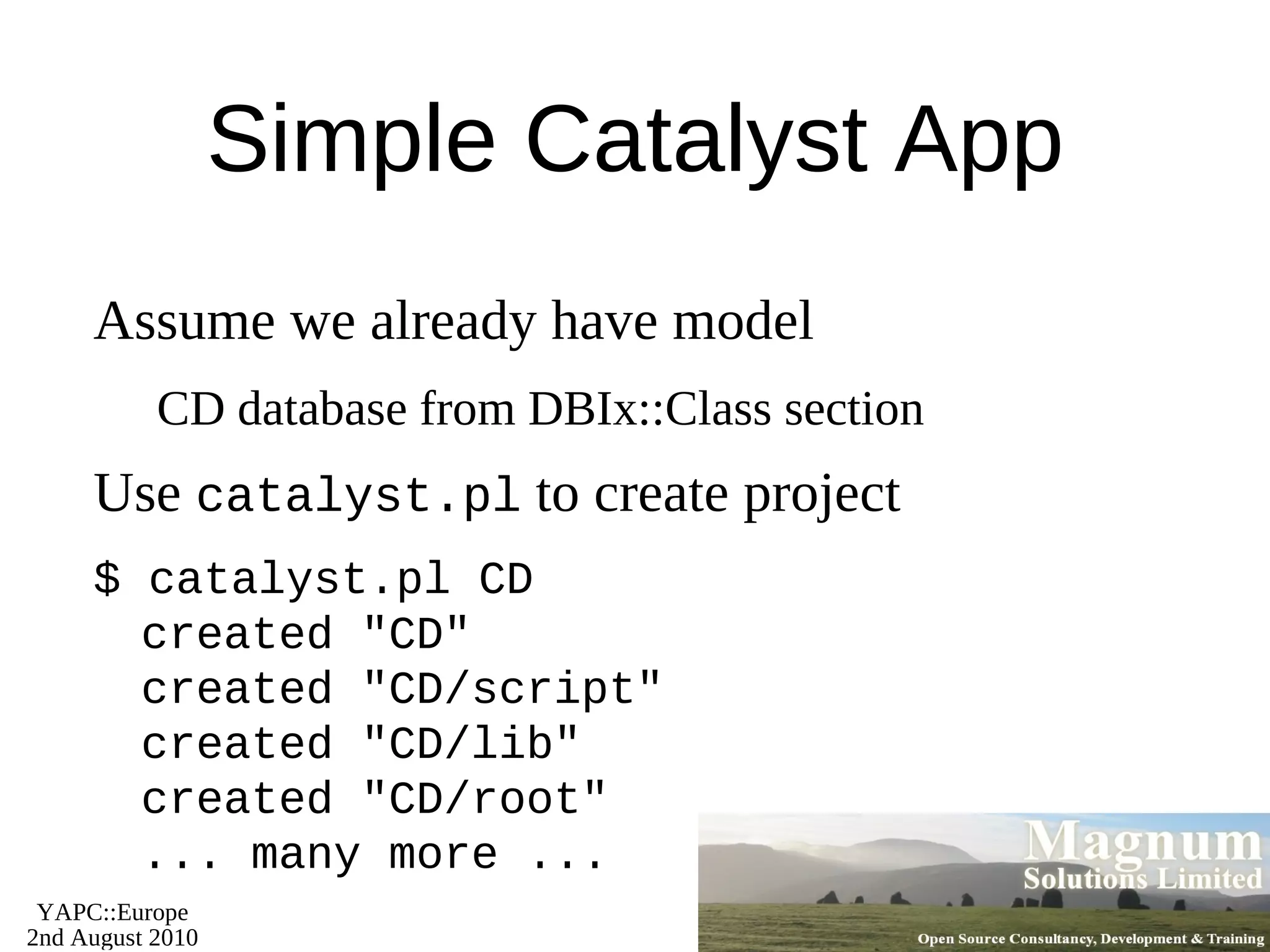
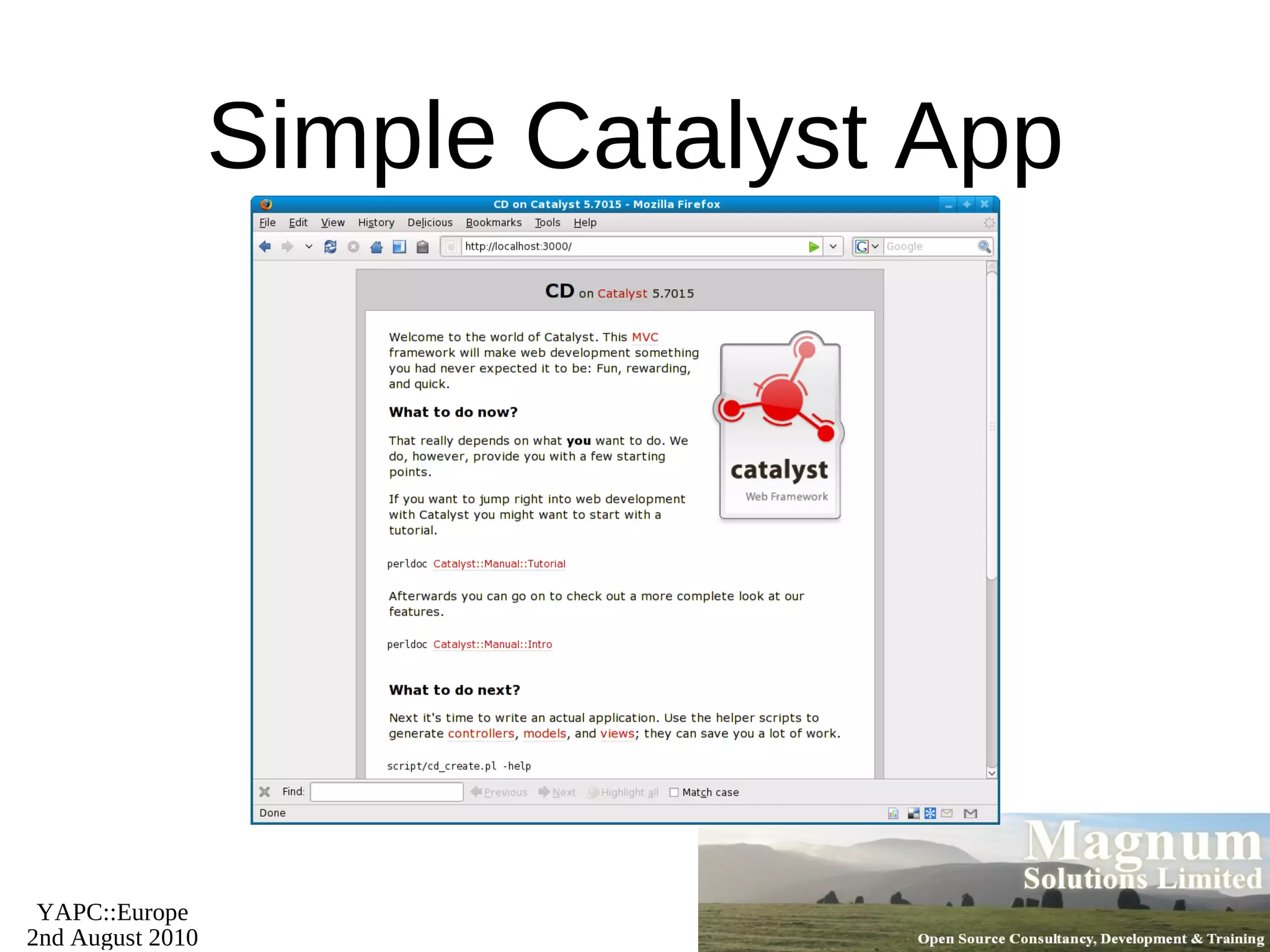
Simple Catalyst App
Assume we already have model
CD database from DBIx::Class section
Use catalyst.pl to create project
$ catalyst.pl CD created "CD" created "CD/script" created "CD/lib" created "CD/root" ... many more ...
What Just Happened?
Catalyst just generated a lot of useful stuff for us
Test web servers
Standalone and FastCGI
Configuration files
Test stubs
Helpers for creating models, views and controllers
A Working Application
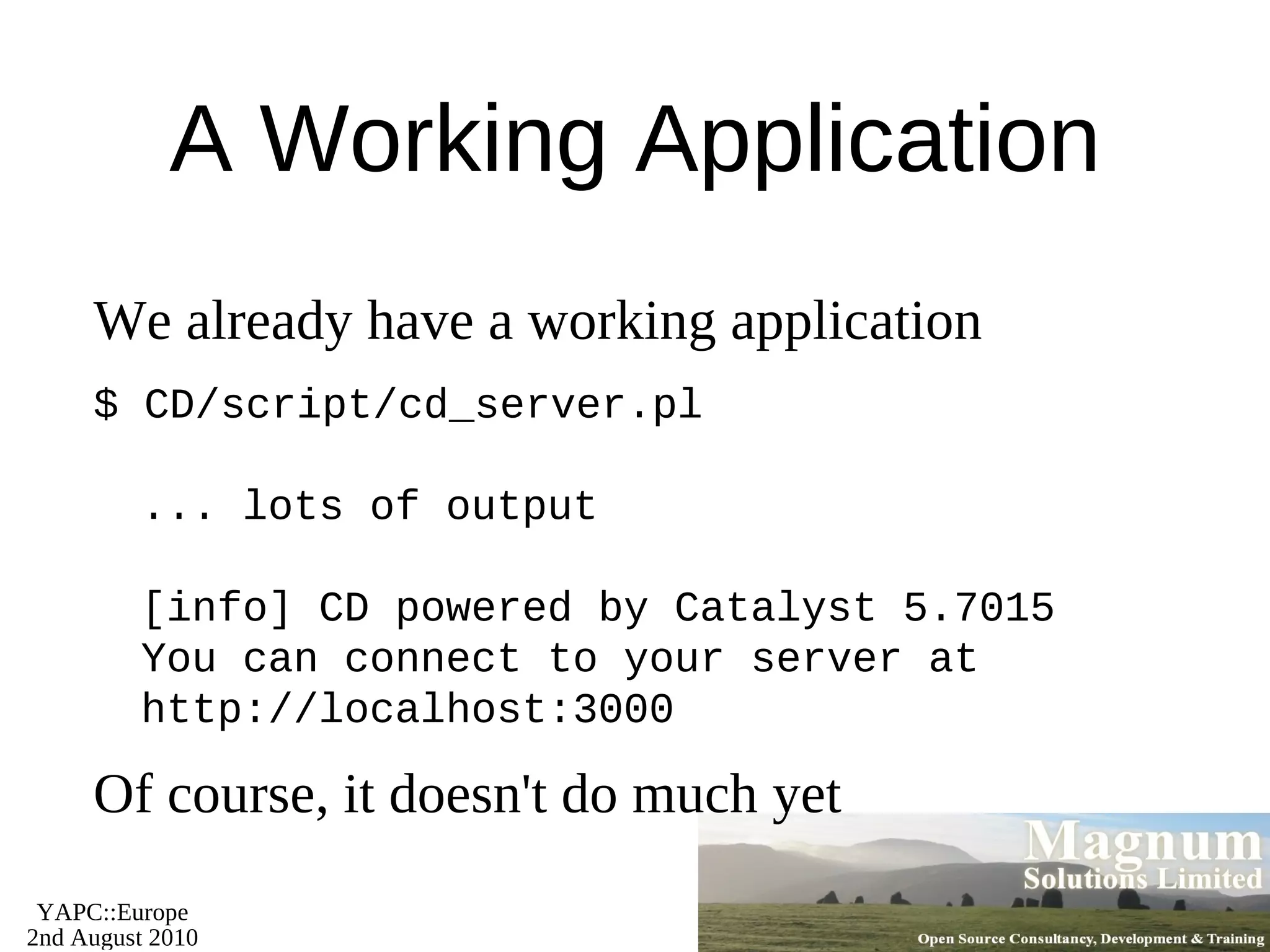
We already have a working application
$ CD/script/cd_server.pl ... lots of output [info] CD powered by Catalyst 5.7015 You can connect to your server at http://localhost:3000
Of course, it doesn't do much yet
Simple Catalyst App
Next Steps
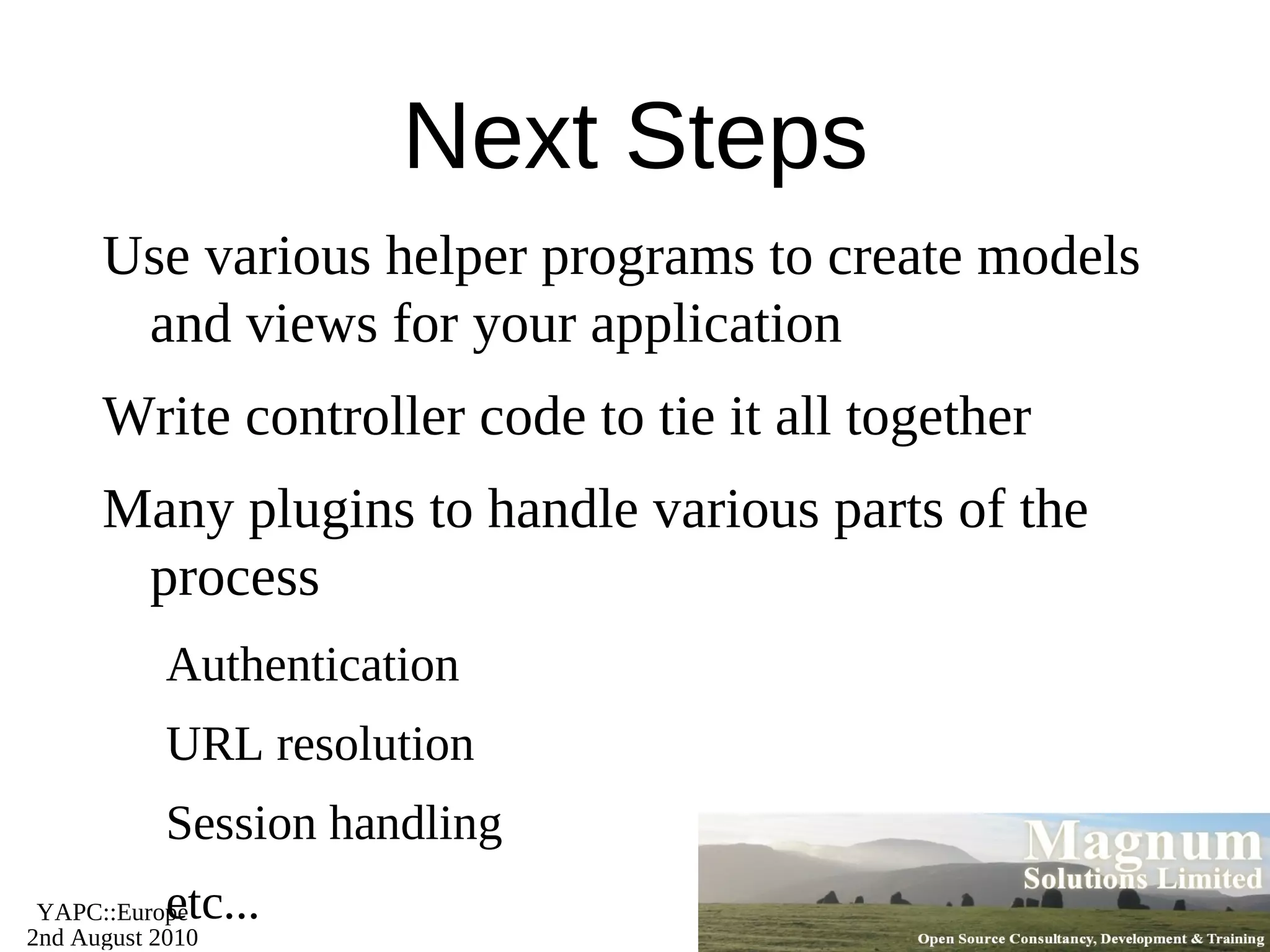
Use various helper programs to create models and views for your application
Write controller code to tie it all together
Many plugins to handle various parts of the process
Authentication
URL resolution
Session handling
etc...
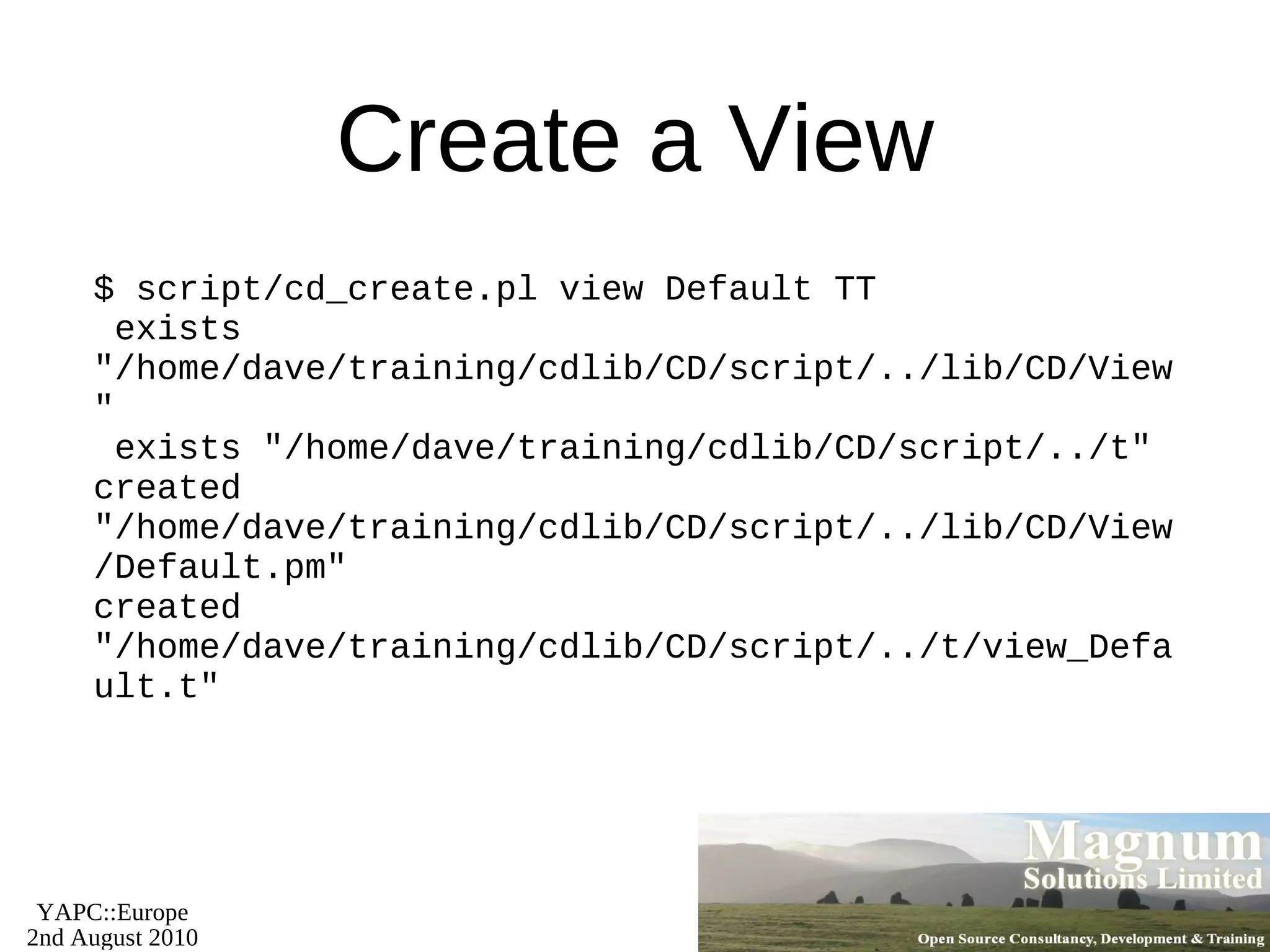
Create a View
$ script/cd_create.pl view Default TT exists "/home/dave/training/cdlib/CD/script/../lib/CD/View" exists "/home/dave/training/cdlib/CD/script/../t" created "/home/dave/training/cdlib/CD/script/../lib/CD/View/Default.pm" created "/home/dave/training/cdlib/CD/script/../t/view_Default.t"
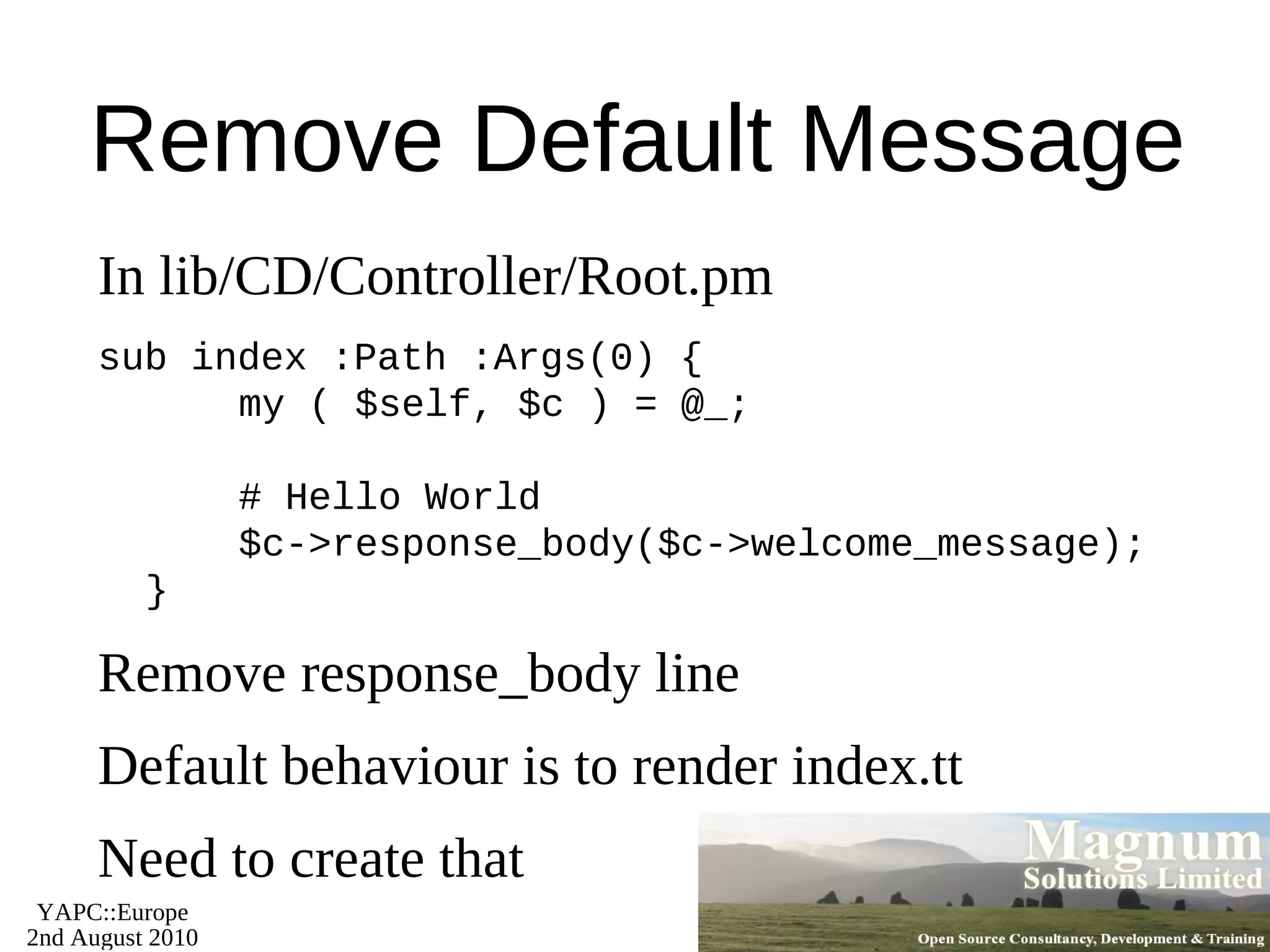
Remove Default Message
In lib/CD/Controller/Root.pm
sub index :Path :Args(0) { my ( $self, $c ) = @_; # Hello World $c->response_body($c->welcome_message); }
Remove response_body line
Default behaviour is to render index.tt
Need to create that
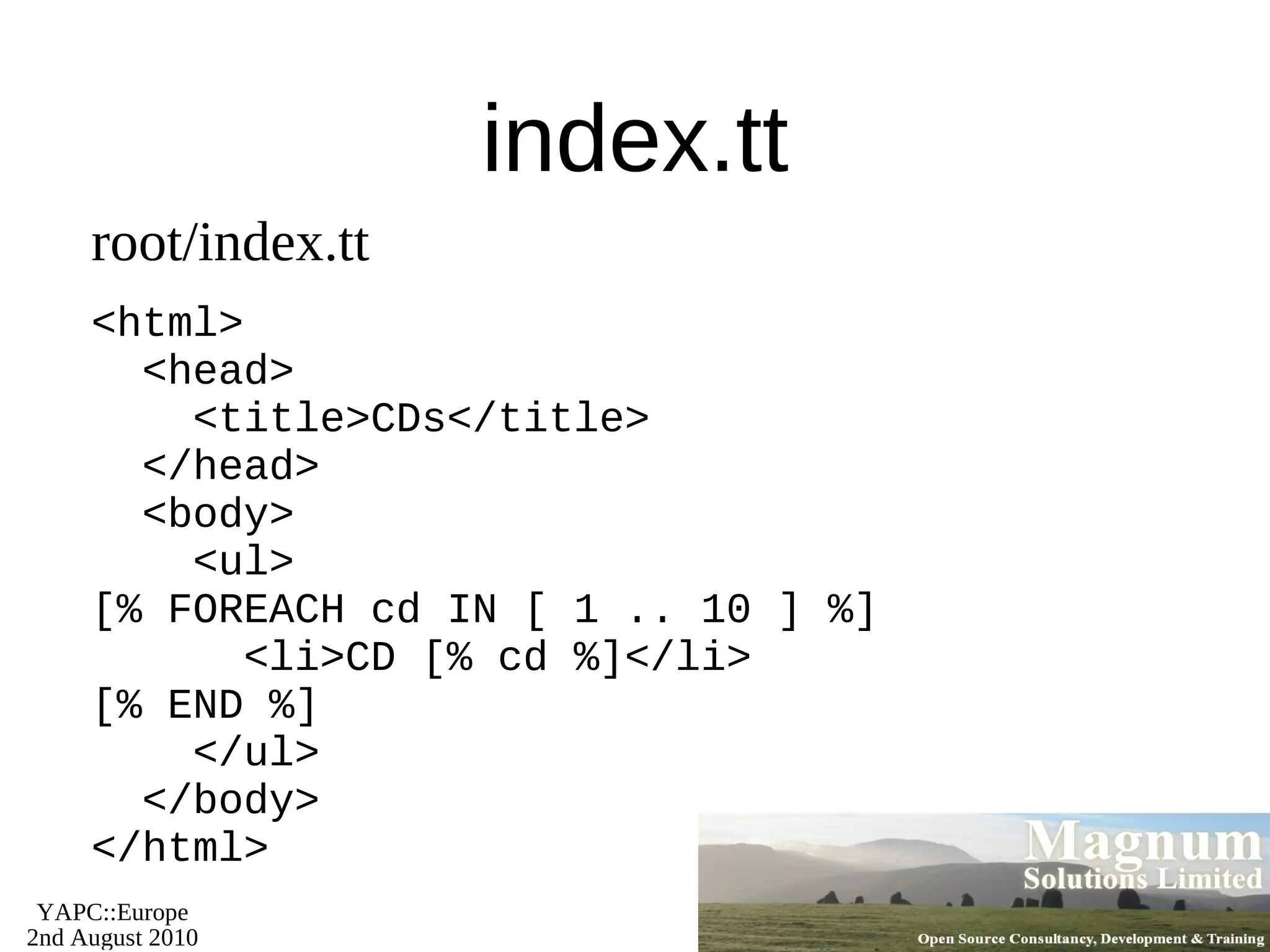
index.tt
root/index.tt
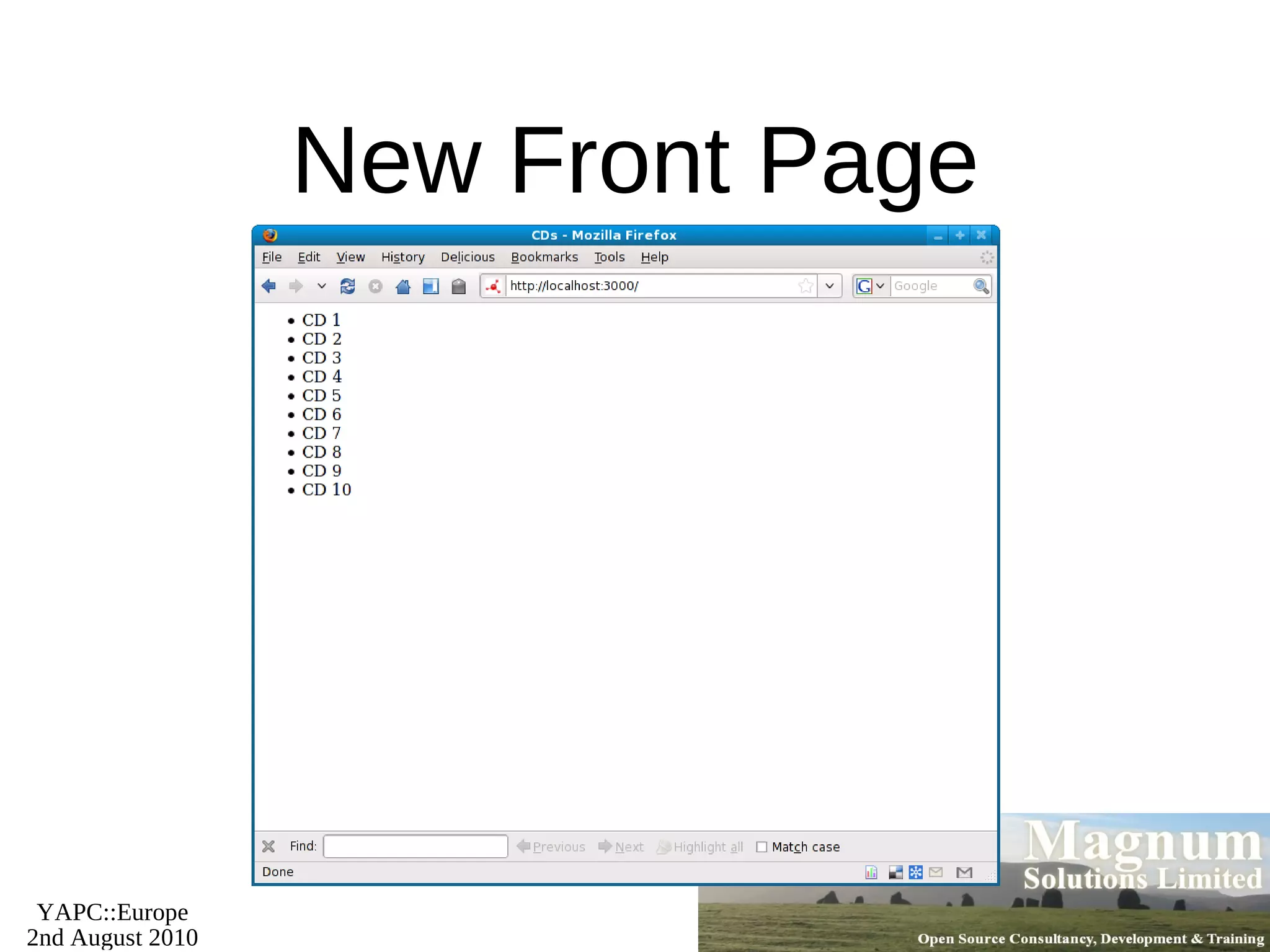
<html> <head> <title>CDs</title> </head> <body> <ul> [% FOREACH cd IN [ 1 .. 10 ] %] <li>CD [% cd %]</li> [% END %] </ul> </body> </html>
New Front Page
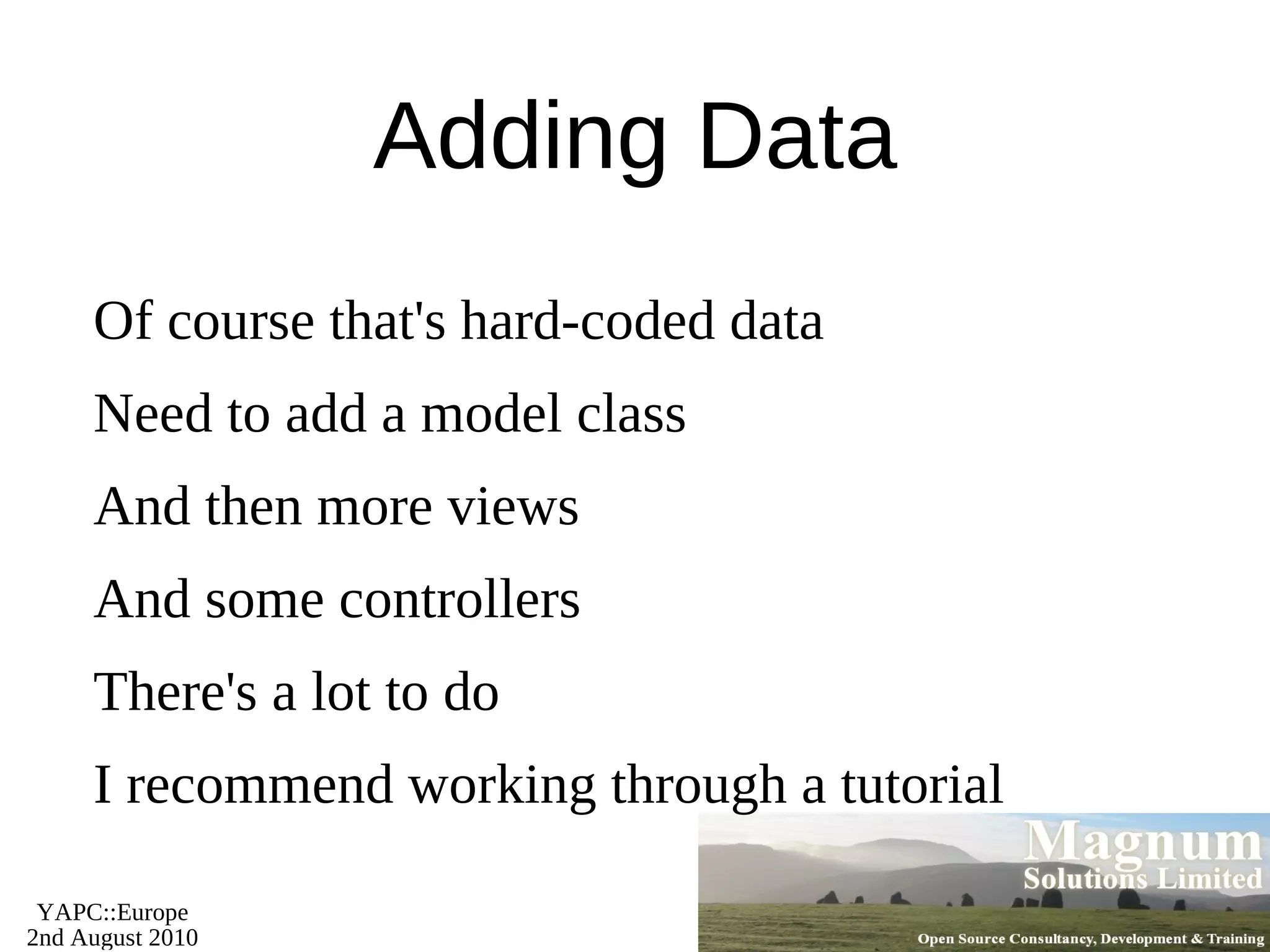
Adding Data
Of course that's hard-coded data
Need to add a model class
And then more views
And some controllers
There's a lot to do
I recommend working through a tutorial
Easier Catalyst
A lot of web applications do similar things
Given a database
Produce screens to edit the data
Surely most of this can be automated
It's called Catalyst::Plugin::AutoCRUD
(Demo)
Cat::Plugin::AutoCRUD
Does a lot of work
On the fly
For every request
No security on table updates
So it's not right for every project
Very impressive though
Conclusions
There's a lot to bear in mind when writing a web app
Using the right framework can help
Catalyst is the most popular Perl framework
As powerful as any other framework
In any language
Lots of work still going on
Large team, active development
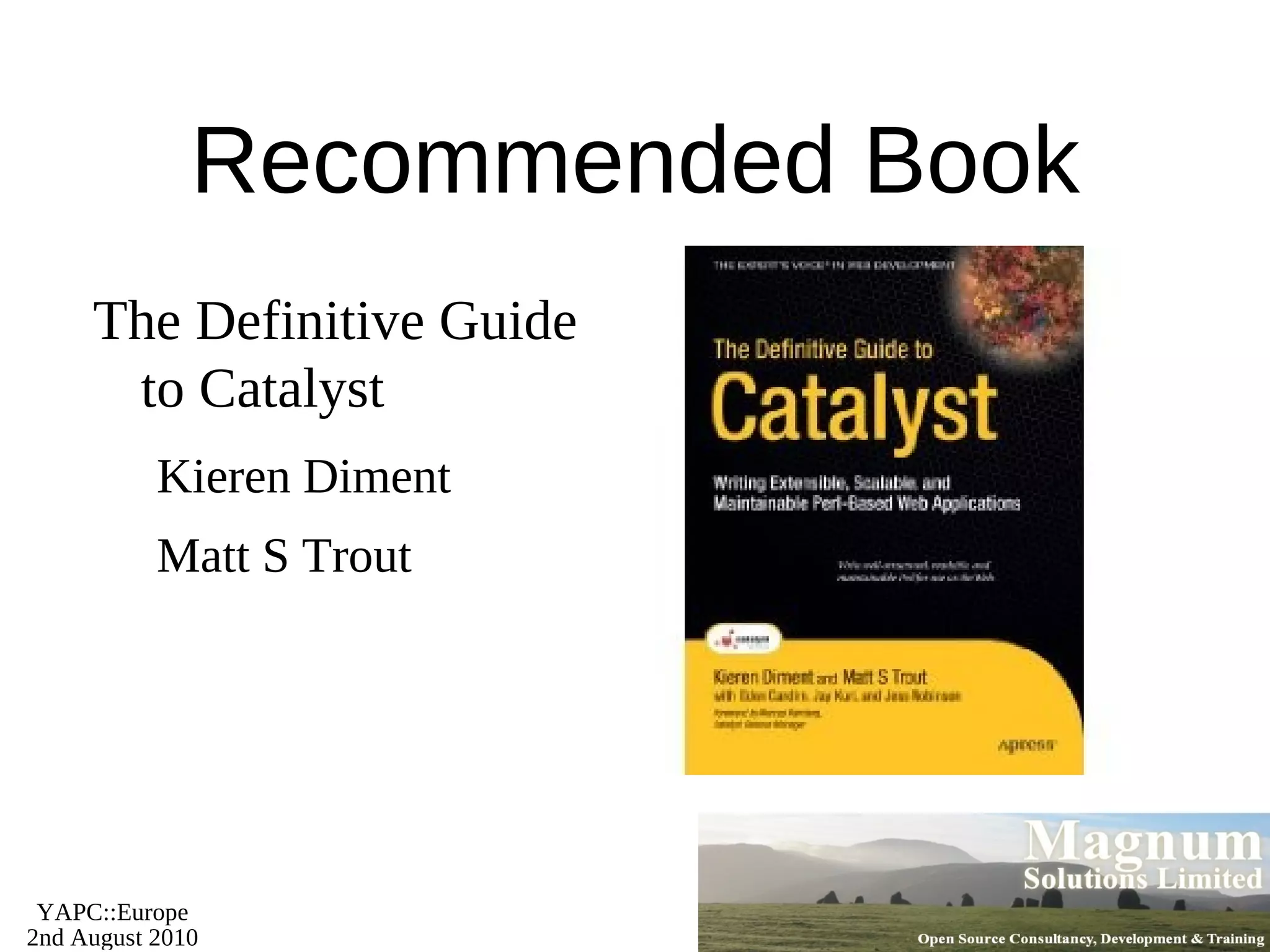
Recommended Book
The Definitive Guide to Catalyst
Kieren Diment
Matt S Trout
PSGI/Plack
PSGI/Plack
“ PSGI is an interface between Perl web applications and web servers, and Plack is a Perl module and toolkit that contains PSGI middleware, helpers and adapters to web servers.”
http://plackperl.org/
PSGI/Plack
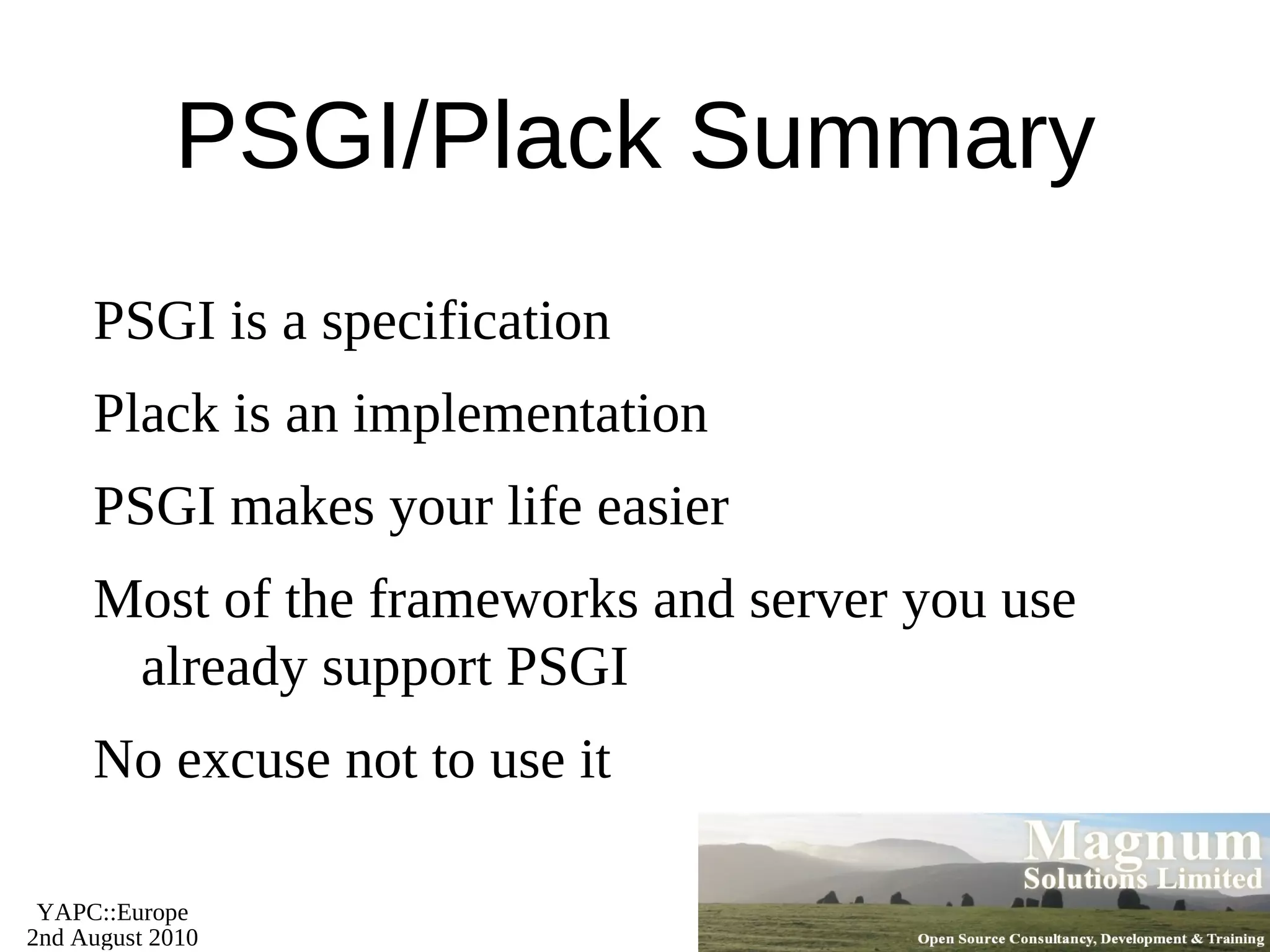
PSGI is a specification (based on Python's WSGI)
Plack is a reference implementation (based on Ruby's Rack)
The Problem
There are many ways to write web applications
There are many ways to write web applications in Perl
Each is subtly different
Hard to move an application between server architectures
Server Architectures
CGI
FastCGI
mod_perl
etc...
Frameworks
There are many Perl web application frameworks
Each creates applications in subtly different ways
Hard to port applications between them
The Goal
What if we had a specification that allowed us to easily move web applications between server architectures and frameworks
PSGI is that specification
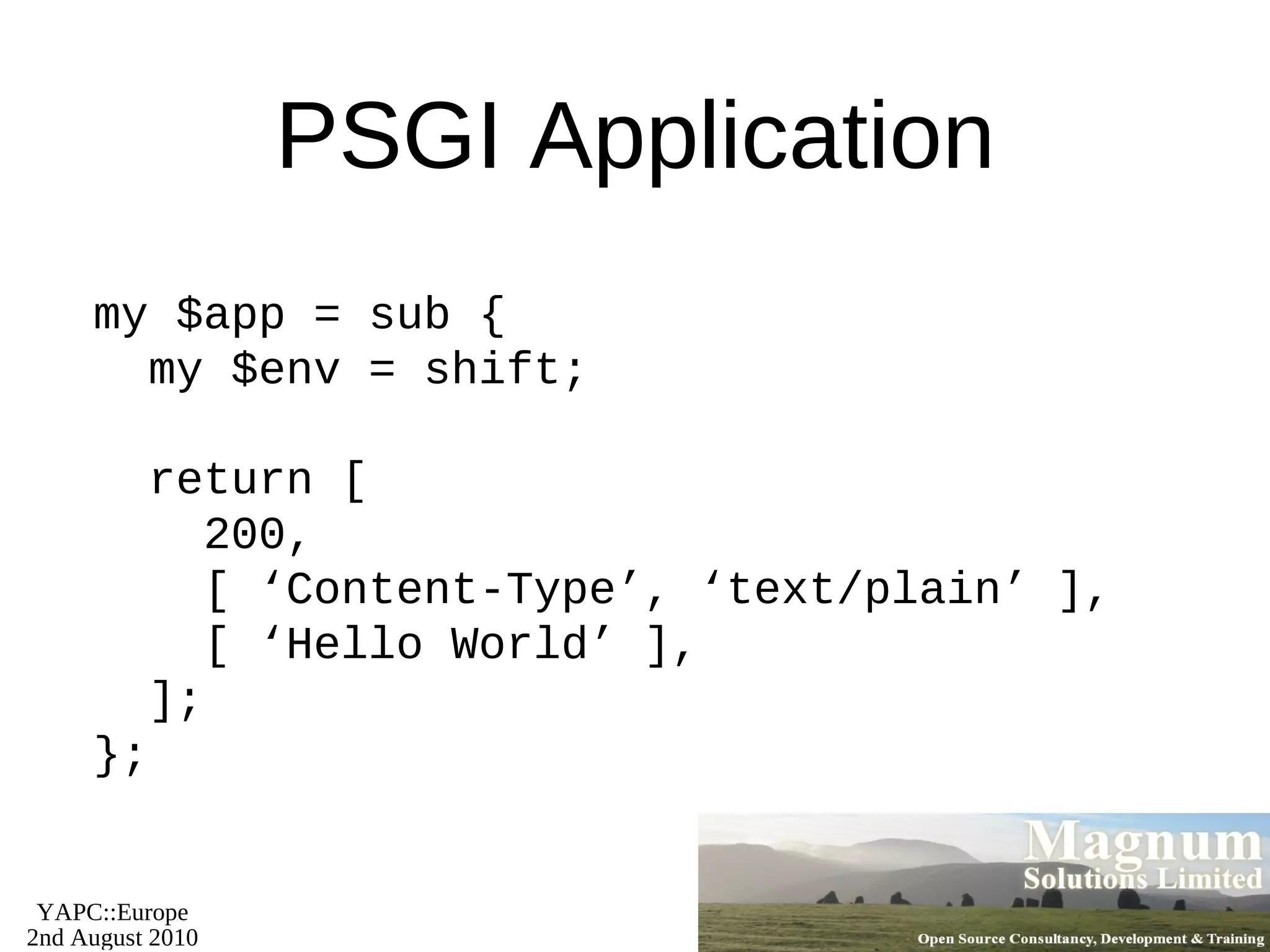
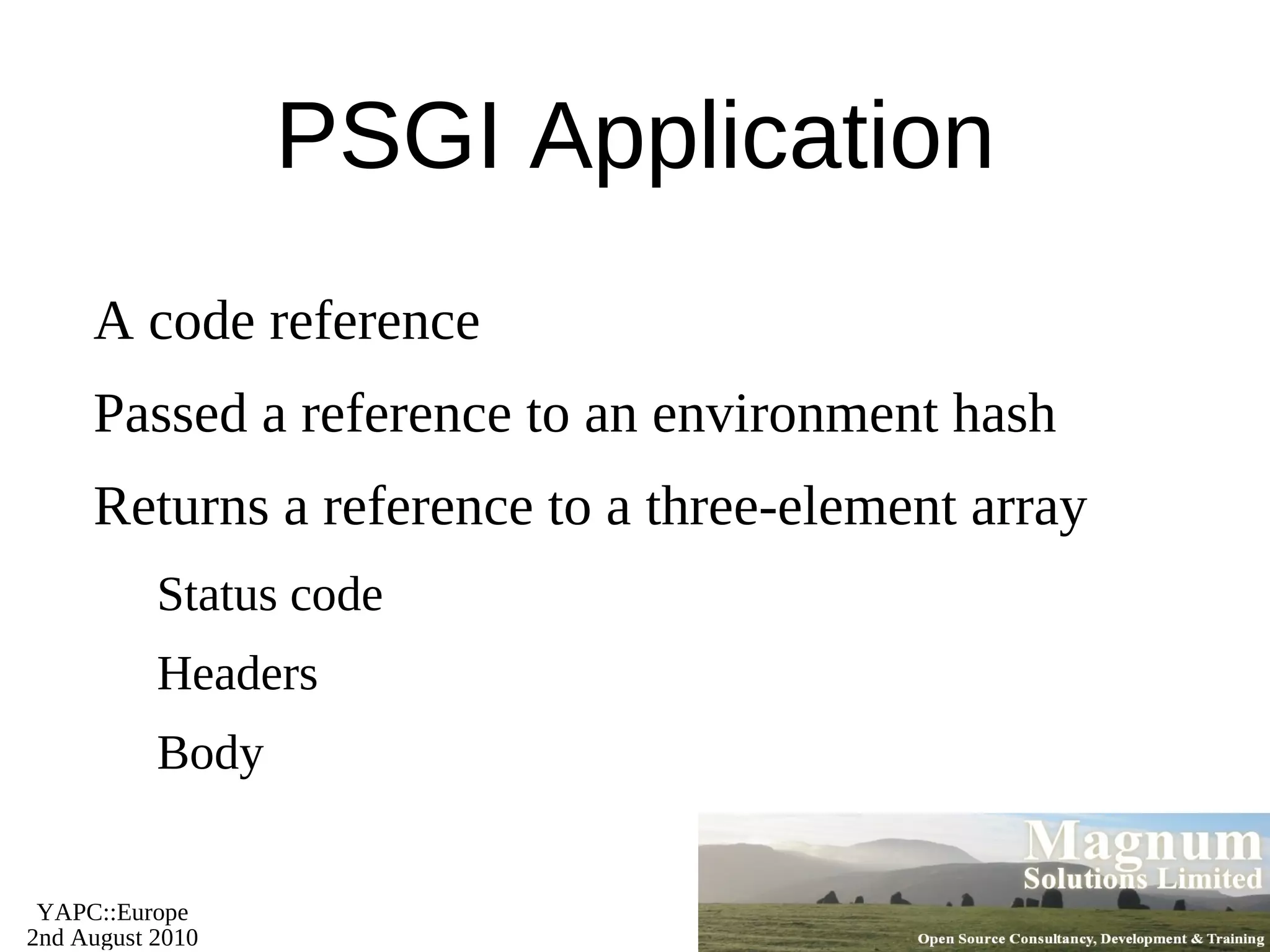
PSGI Application
my $app = sub { my $env = shift; return [ 200, [ ‘Content-Type’, ‘text/plain’ ], [ ‘Hello World’ ], ]; };
PSGI Application
A code reference
Passed a reference to an environment hash
Returns a reference to a three-element array
Status code
Headers
Body
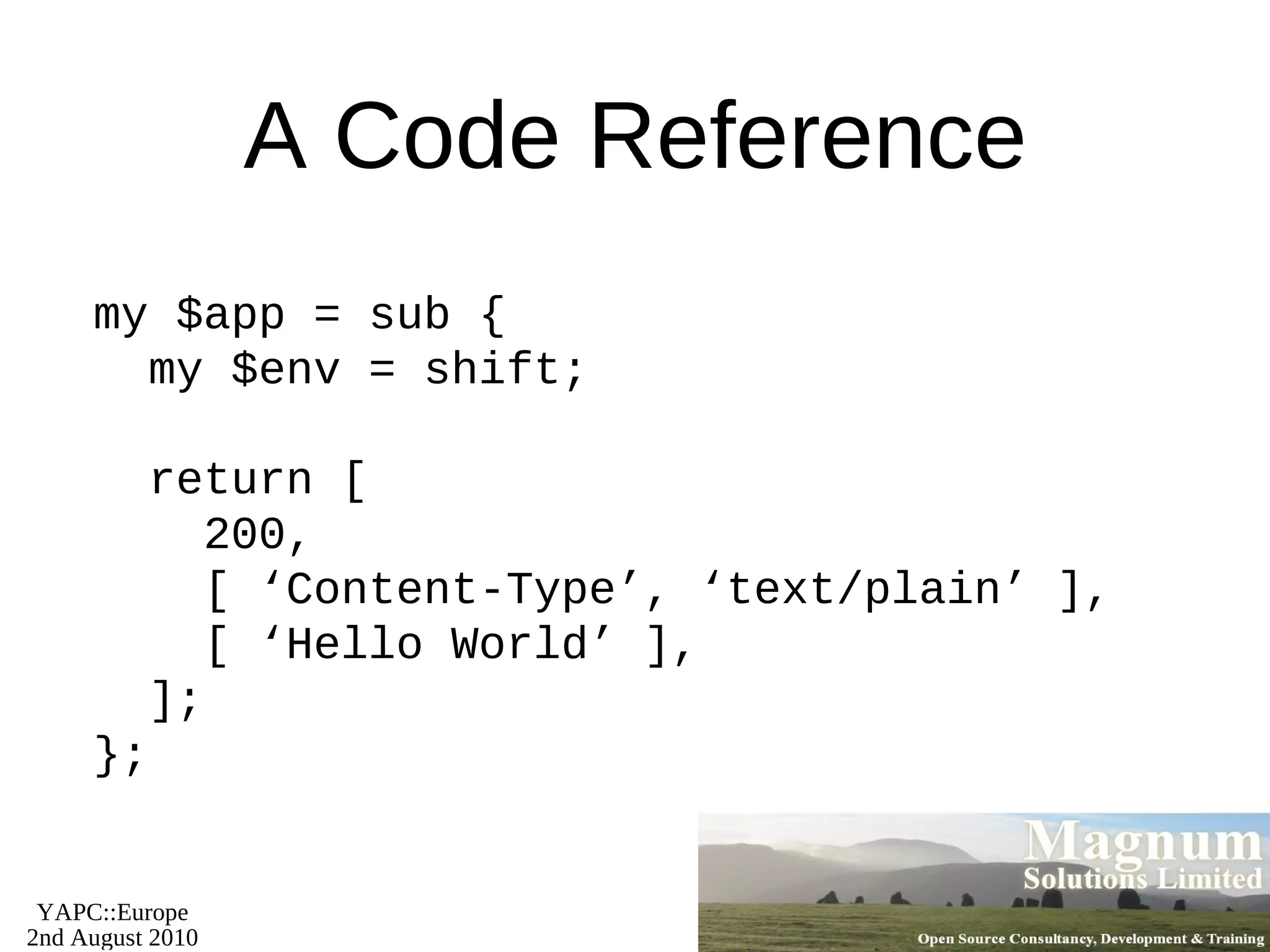
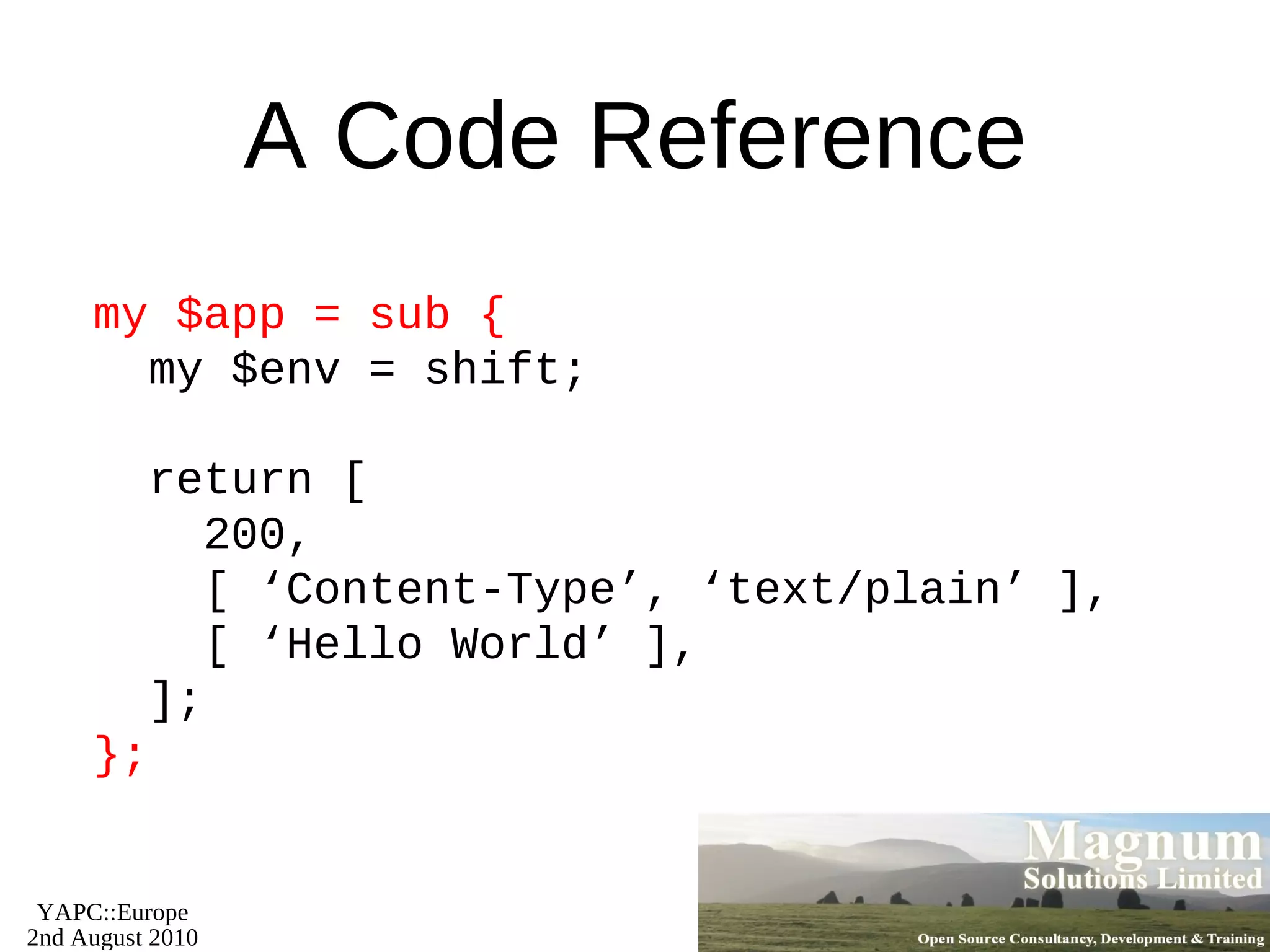
A Code Reference
my $app = sub { my $env = shift; return [ 200, [ ‘Content-Type’, ‘text/plain’ ], [ ‘Hello World’ ], ]; };
A Code Reference
my $app = sub { my $env = shift; return [ 200, [ ‘Content-Type’, ‘text/plain’ ], [ ‘Hello World’ ], ]; };
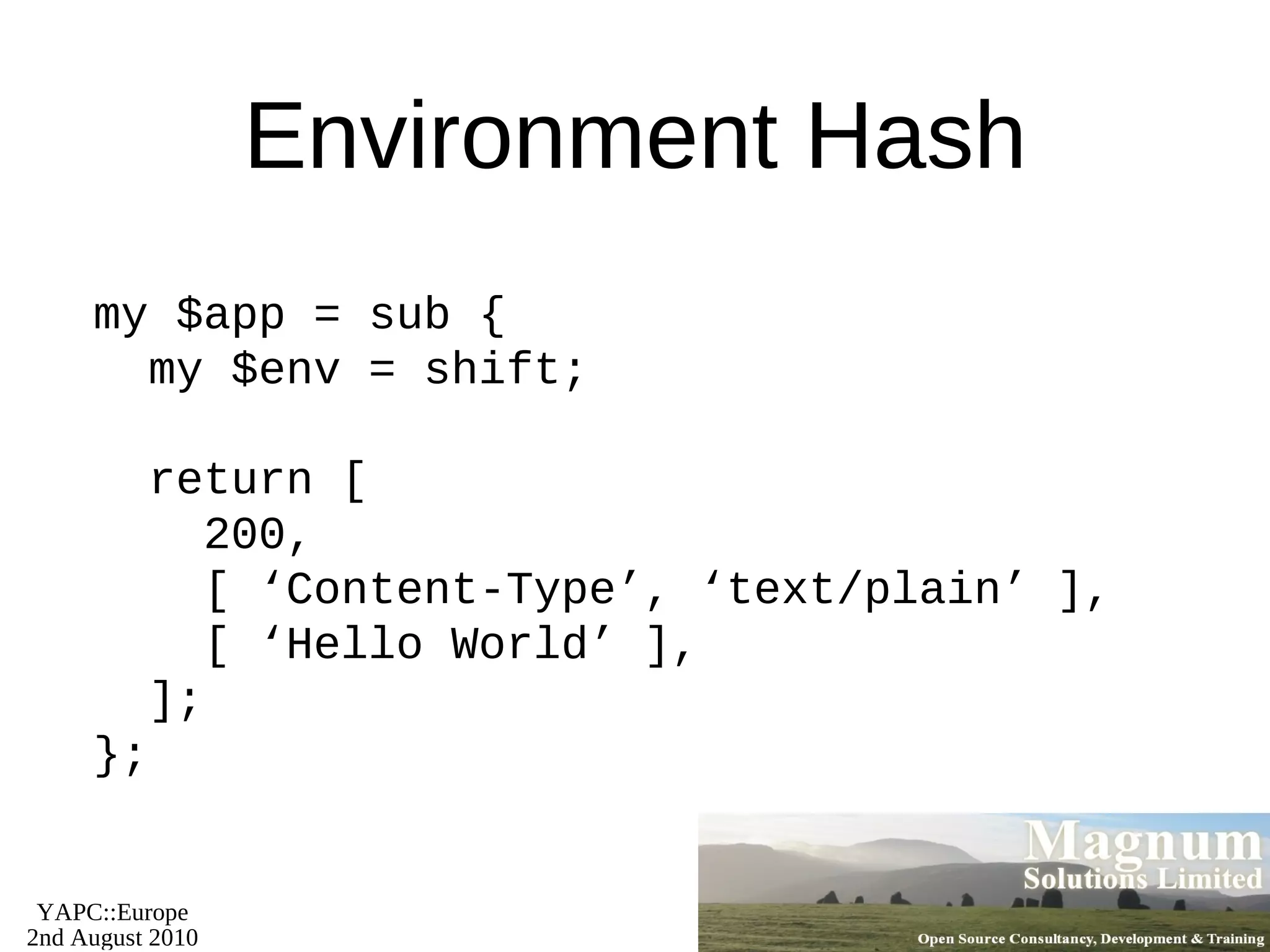
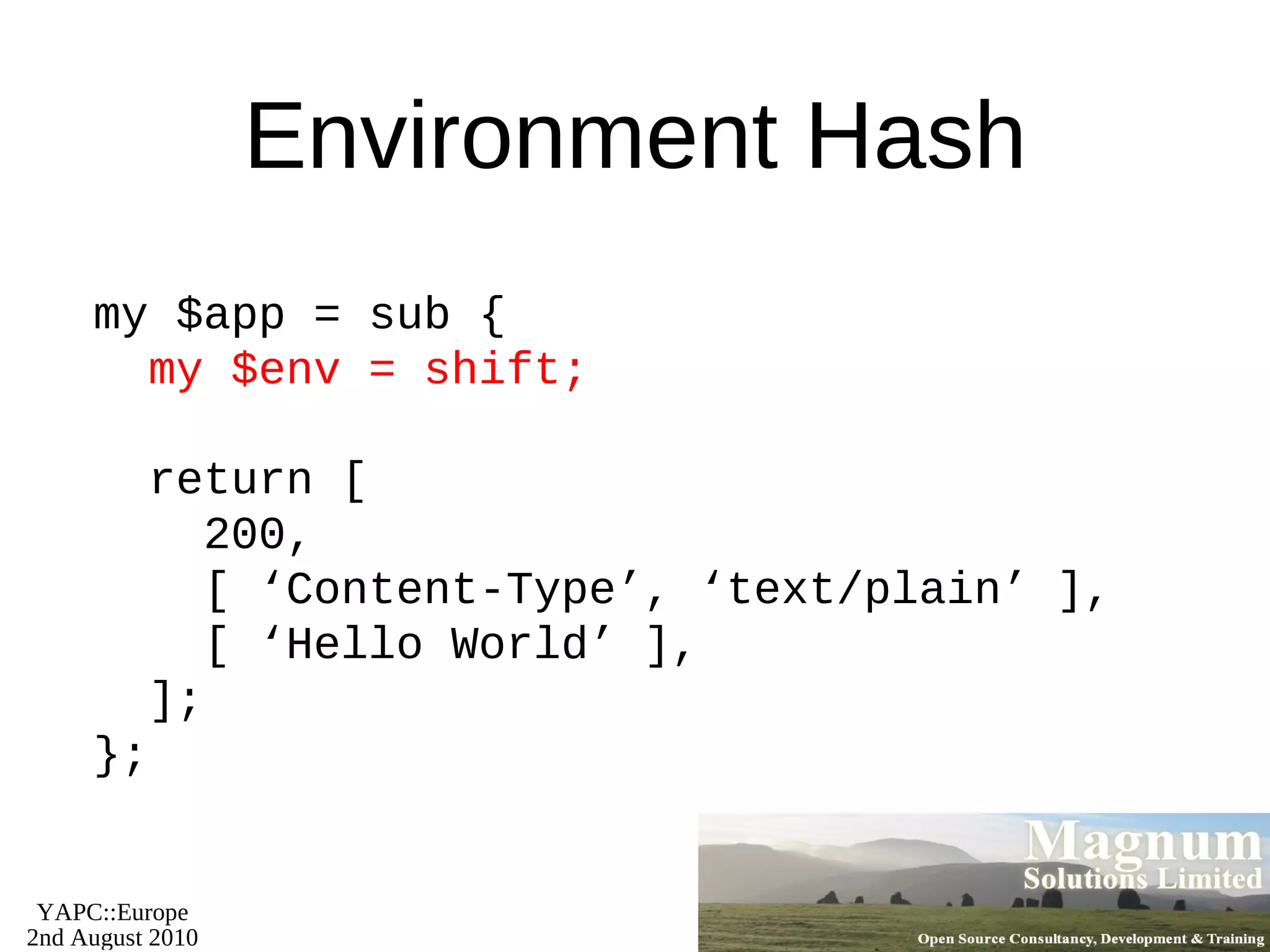
Environment Hash
my $app = sub { my $env = shift; return [ 200, [ ‘Content-Type’, ‘text/plain’ ], [ ‘Hello World’ ], ]; };
Environment Hash
my $app = sub { my $env = shift; return [ 200, [ ‘Content-Type’, ‘text/plain’ ], [ ‘Hello World’ ], ]; };
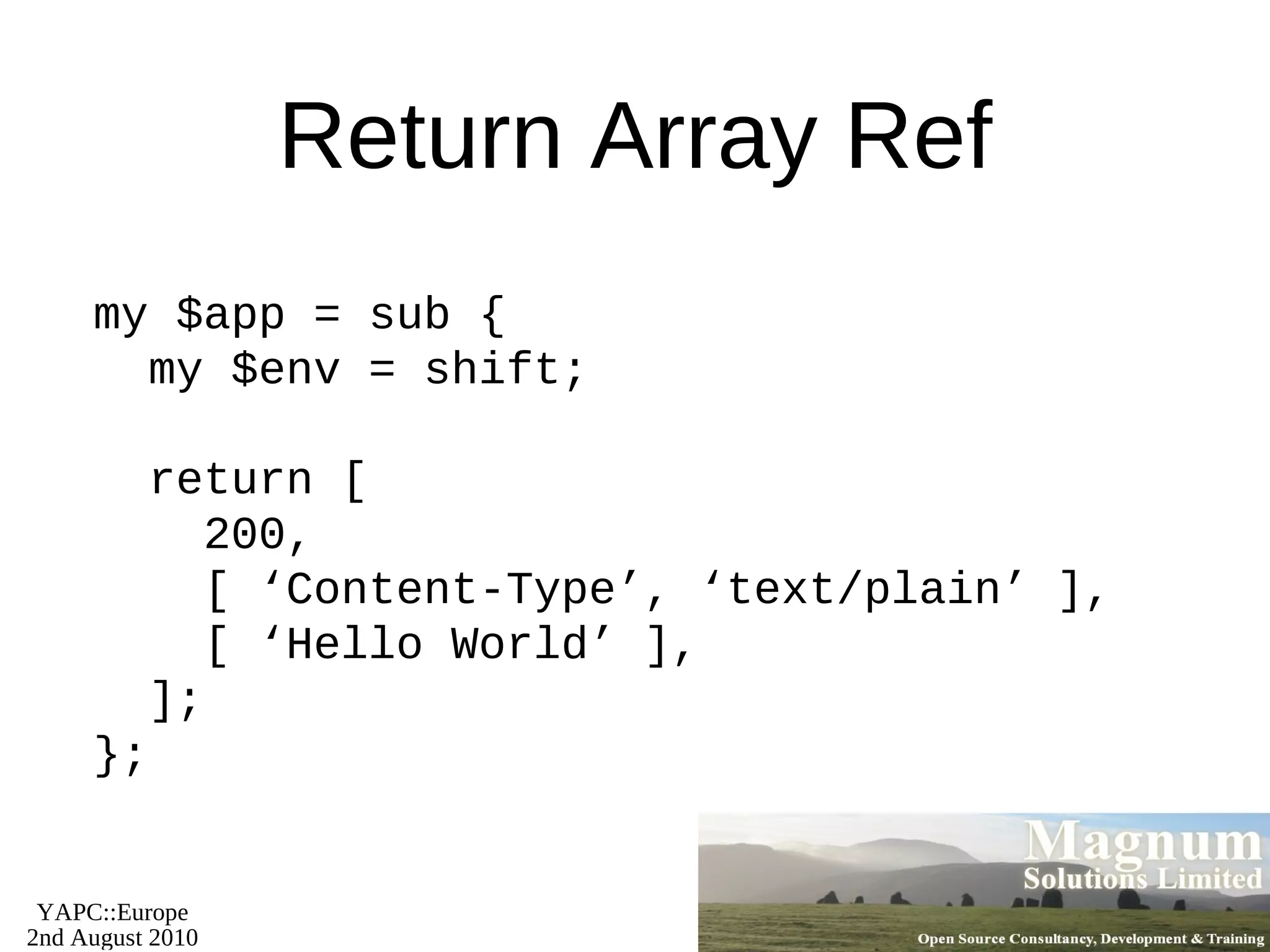
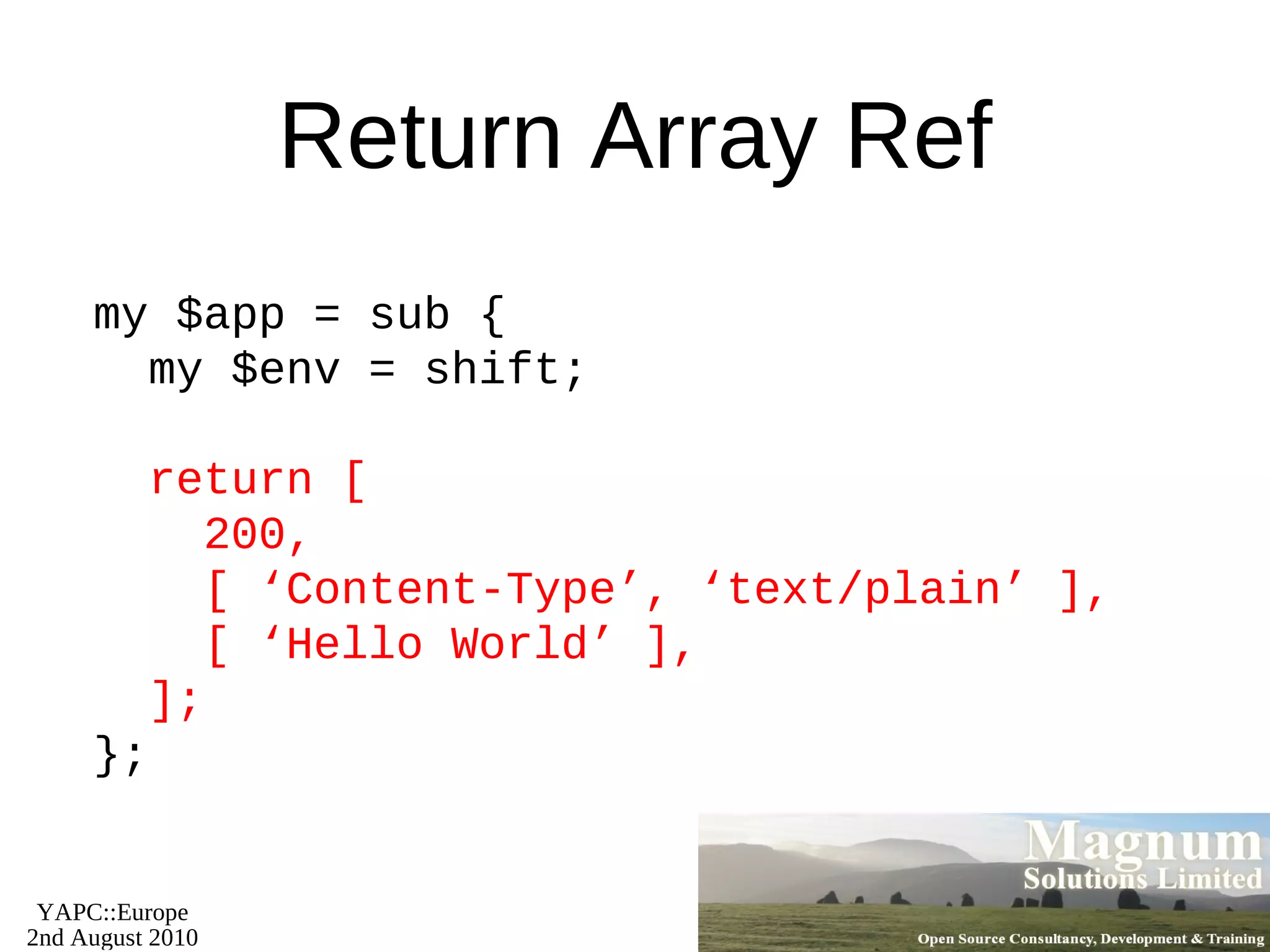
Return Array Ref
my $app = sub { my $env = shift; return [ 200, [ ‘Content-Type’, ‘text/plain’ ], [ ‘Hello World’ ], ]; };
Return Array Ref
my $app = sub { my $env = shift; return [ 200, [ ‘Content-Type’, ‘text/plain’ ], [ ‘Hello World’ ], ]; };
Running PSGI App
Put code in app.psgi
Drop in into a configured PSGI-aware web server
Browse to URL
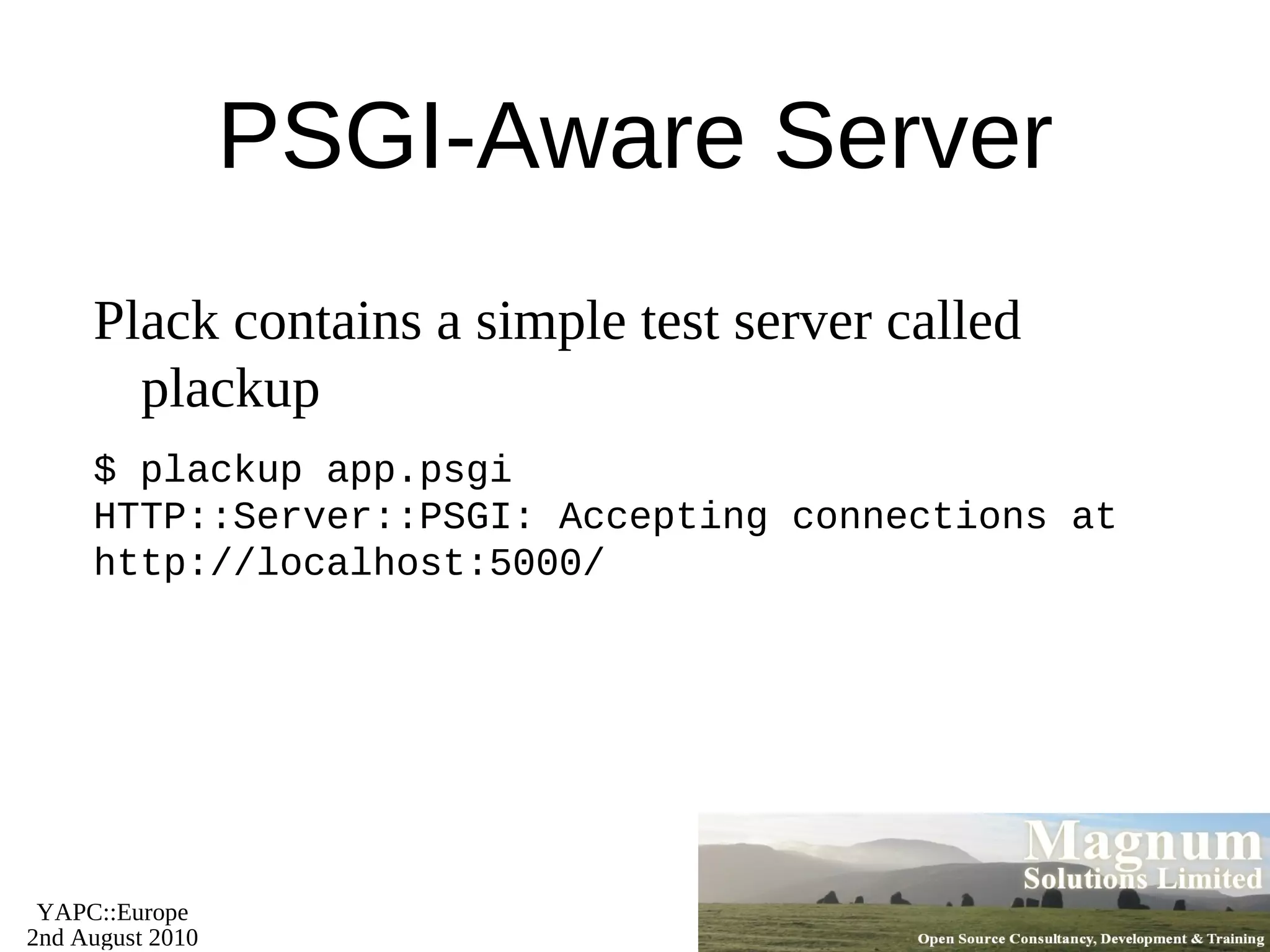
PSGI-Aware Server
Plack contains a simple test server called plackup
$ plackup app.psgi HTTP::Server::PSGI: Accepting connections at http://localhost:5000/
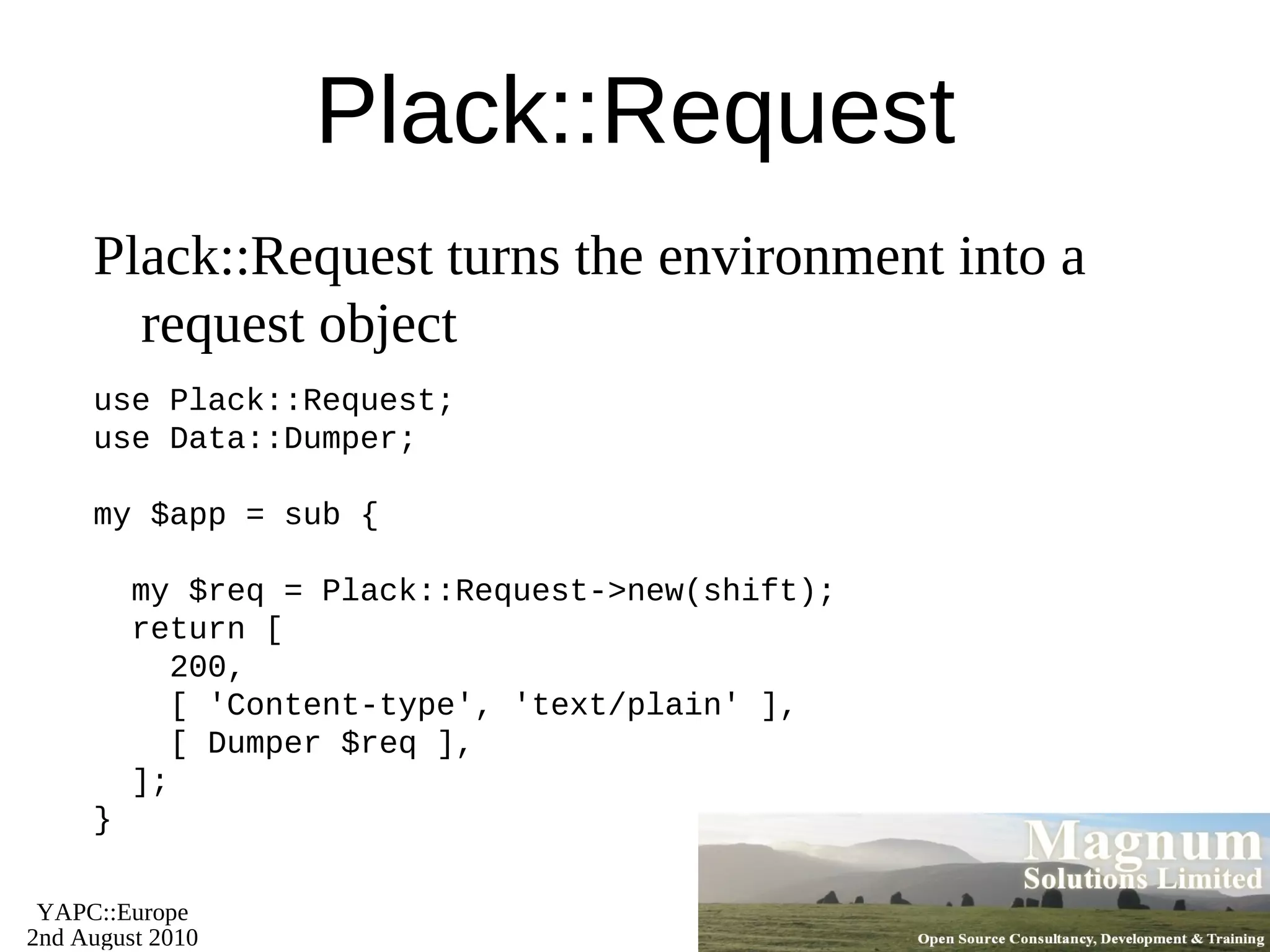
Plack::Request
Plack::Request turns the environment into a request object
use Plack::Request; use Data::Dumper; my $app = sub { my $req = Plack::Request->new(shift); return [ 200, [ 'Content-type', 'text/plain' ], [ Dumper $req ], ]; }
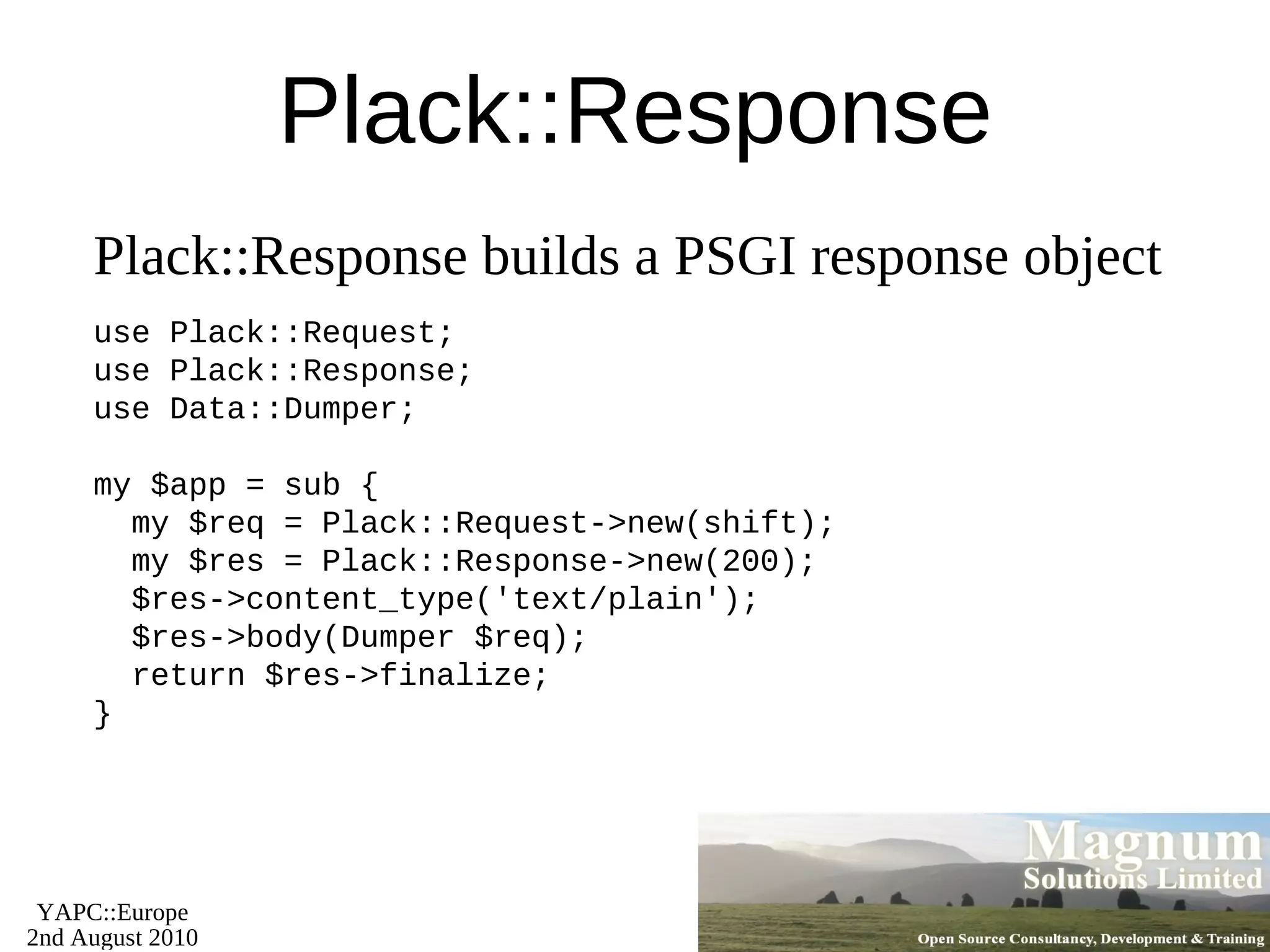
Plack::Response
Plack::Response builds a PSGI response object
use Plack::Request; use Plack::Response; use Data::Dumper; my $app = sub { my $req = Plack::Request->new(shift); my $res = Plack::Response->new(200); $res->content_type('text/plain'); $res->body(Dumper $req); return $res->finalize; }
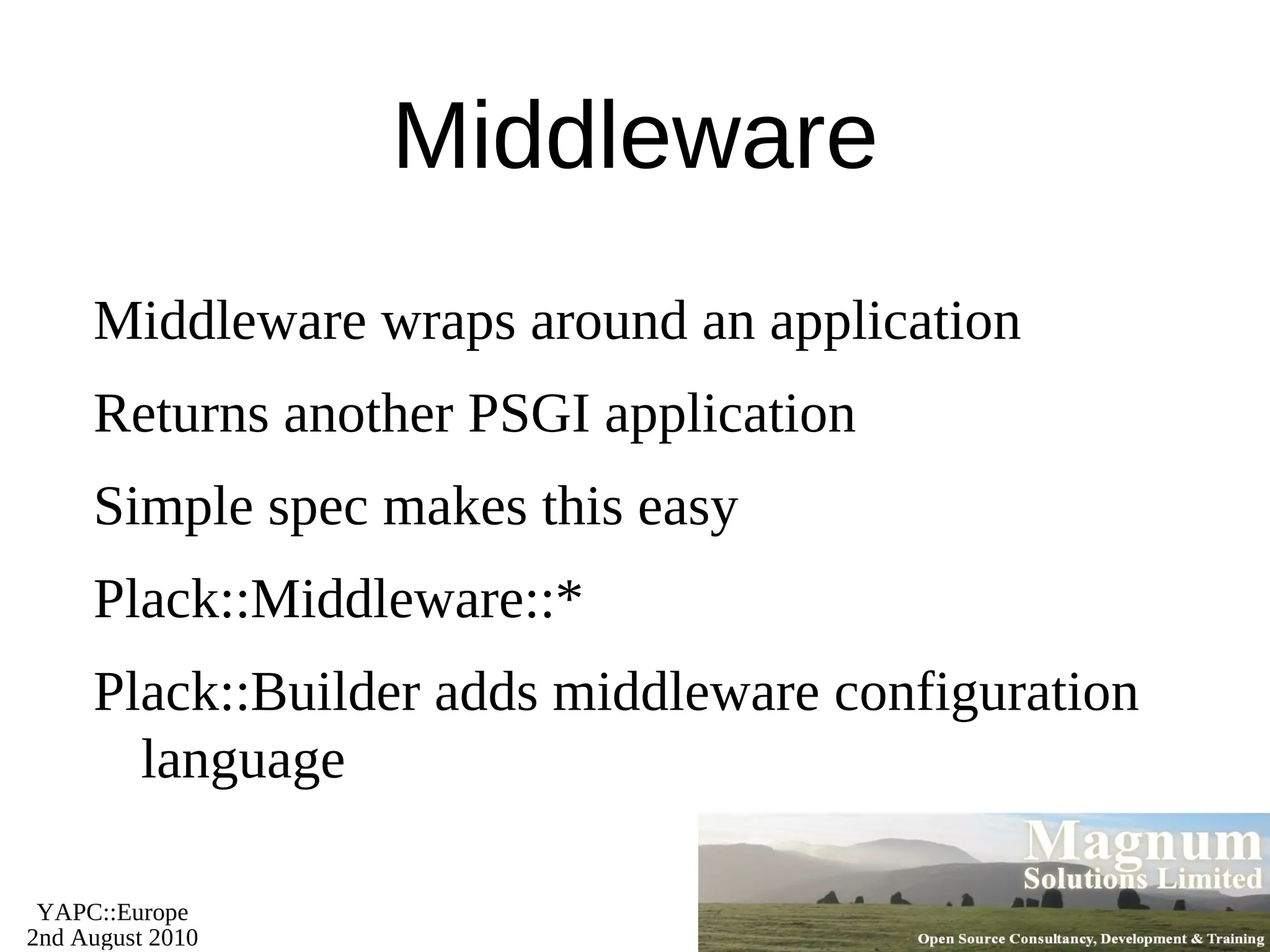
Middleware
Middleware wraps around an application
Returns another PSGI application
Simple spec makes this easy
Plack::Middleware::*
Plack::Builder adds middleware configuration language
Middleware Example
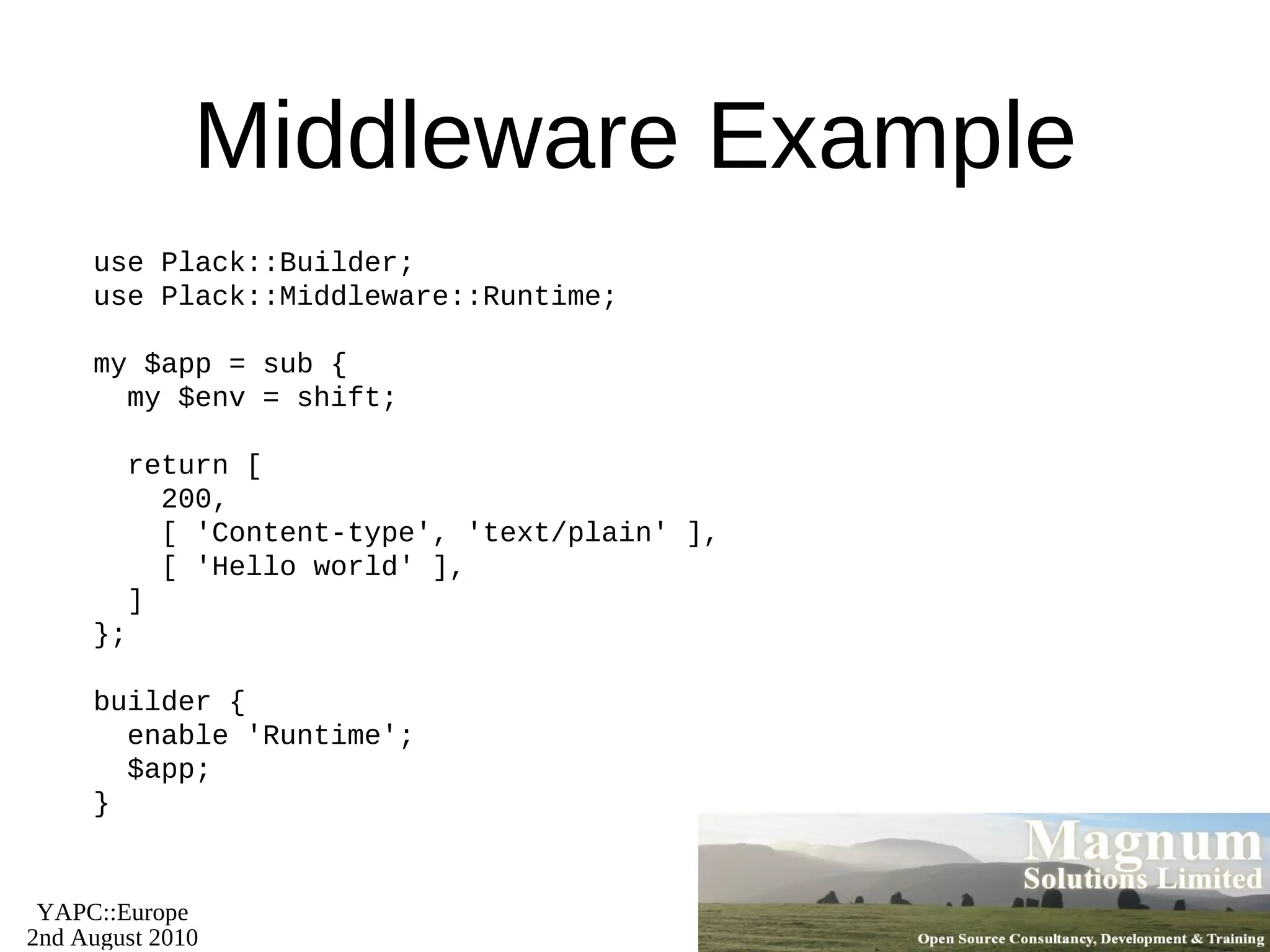
use Plack::Builder; use Plack::Middleware::Runtime; my $app = sub { my $env = shift; return [ 200, [ 'Content-type', 'text/plain' ], [ 'Hello world' ], ] }; builder { enable 'Runtime'; $app; }
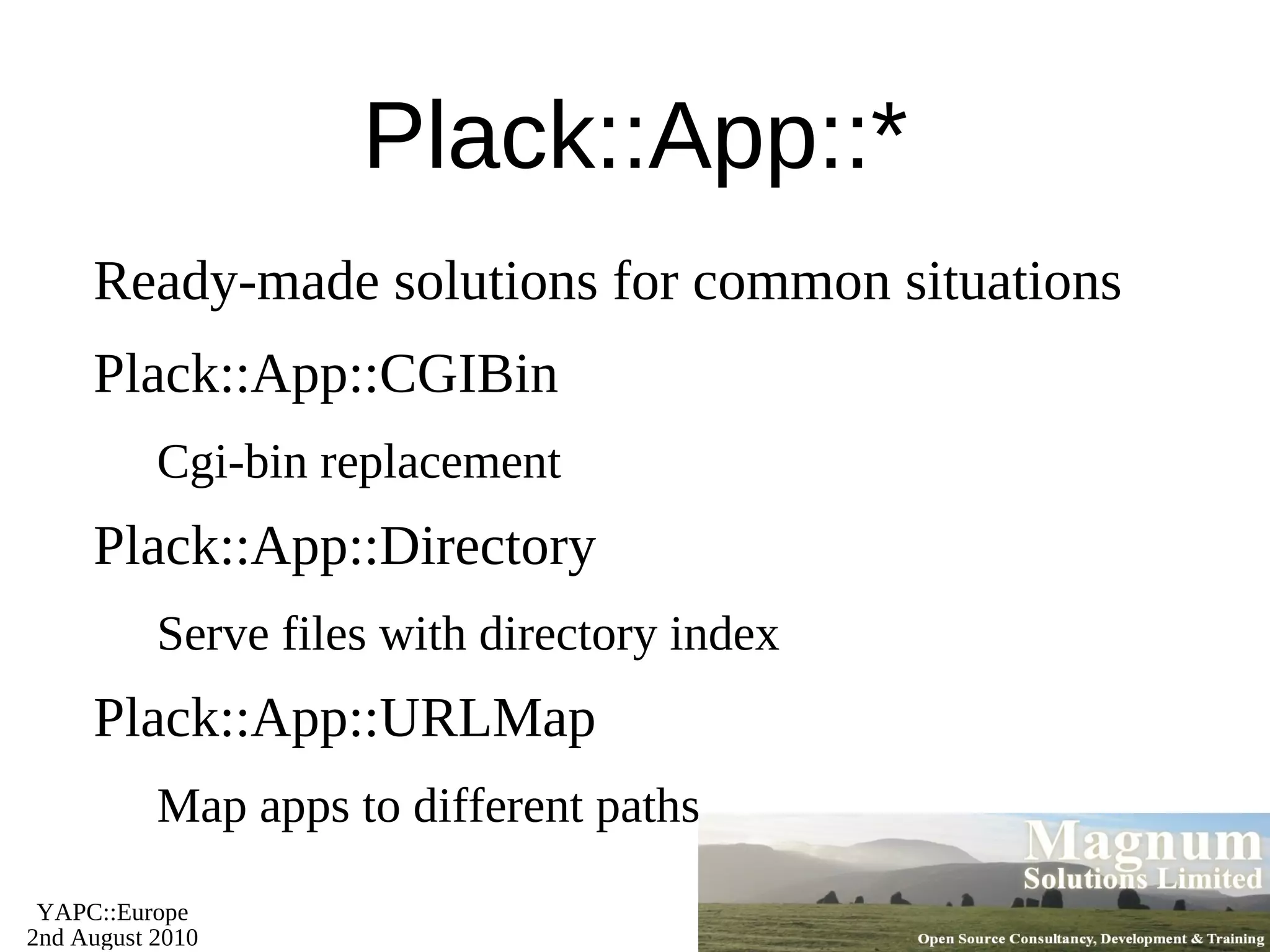
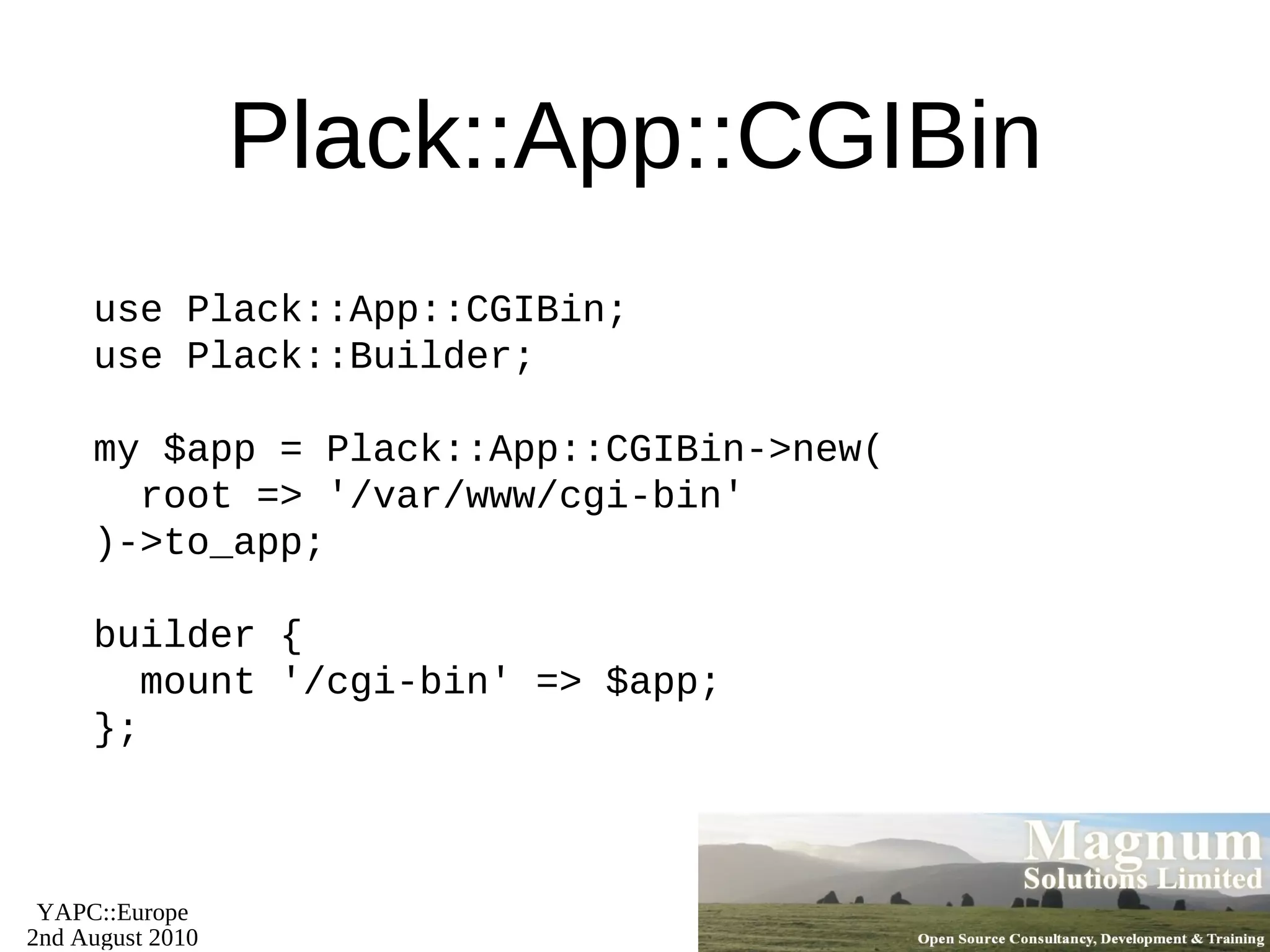
use Plack::App::CGIBin; use Plack::Builder; my $app = Plack::App::CGIBin->new( root => '/var/www/cgi-bin' )->to_app; builder { mount '/cgi-bin' => $app; };
Plack::App::Directory
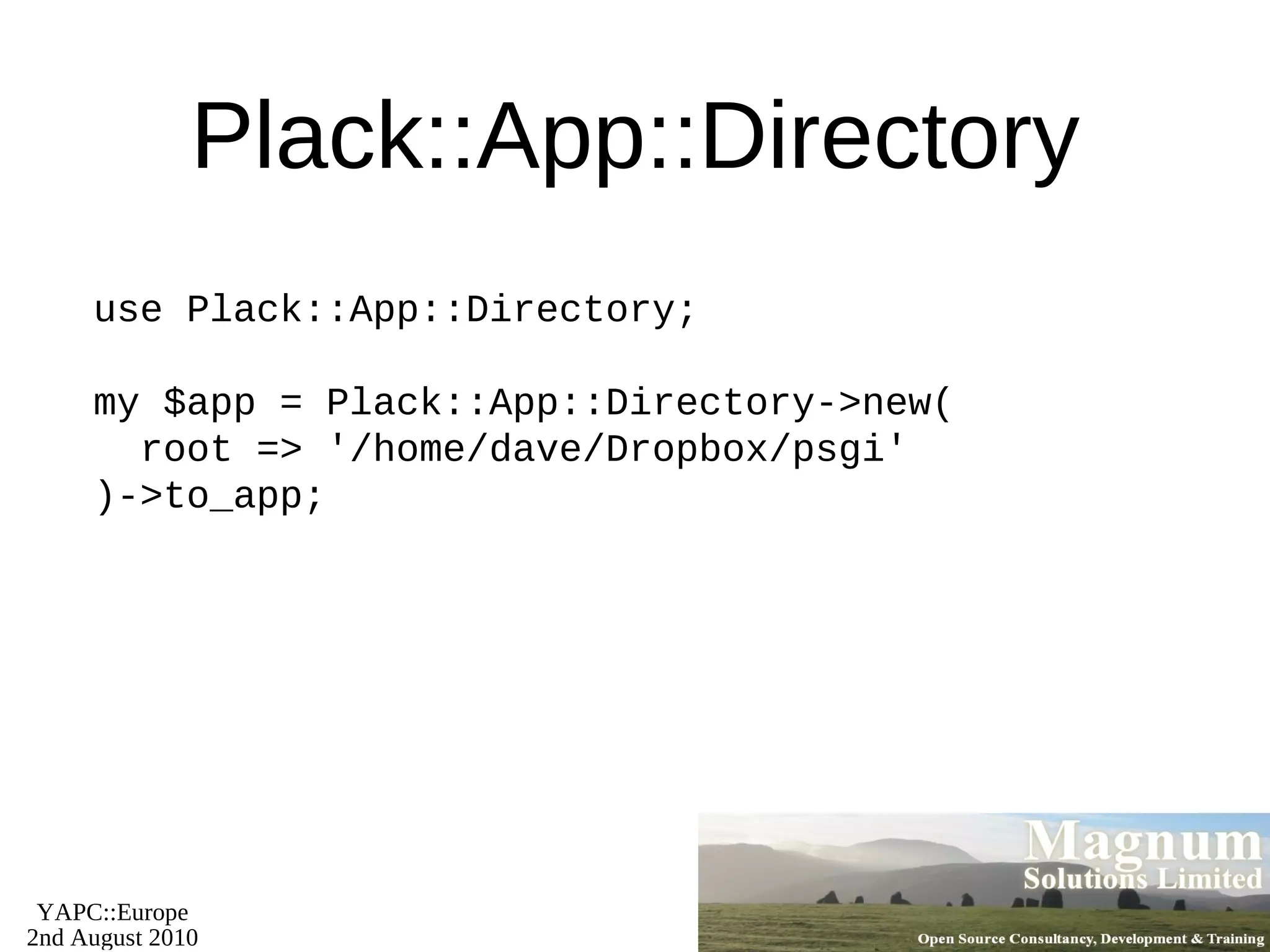
use Plack::App::Directory; my $app = Plack::App::Directory->new( root => '/home/dave/Dropbox/psgi' )->to_app;
Framework Support
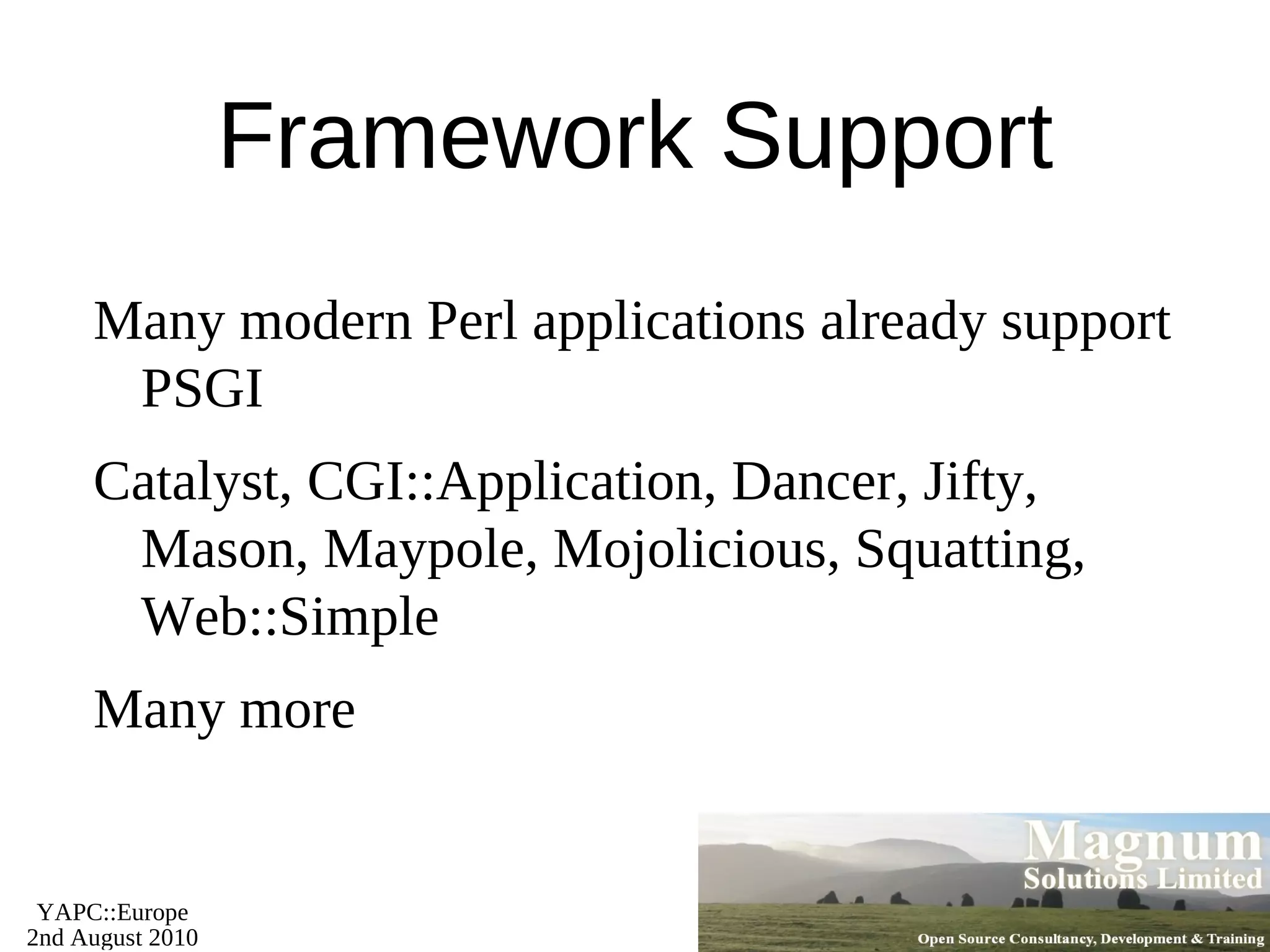
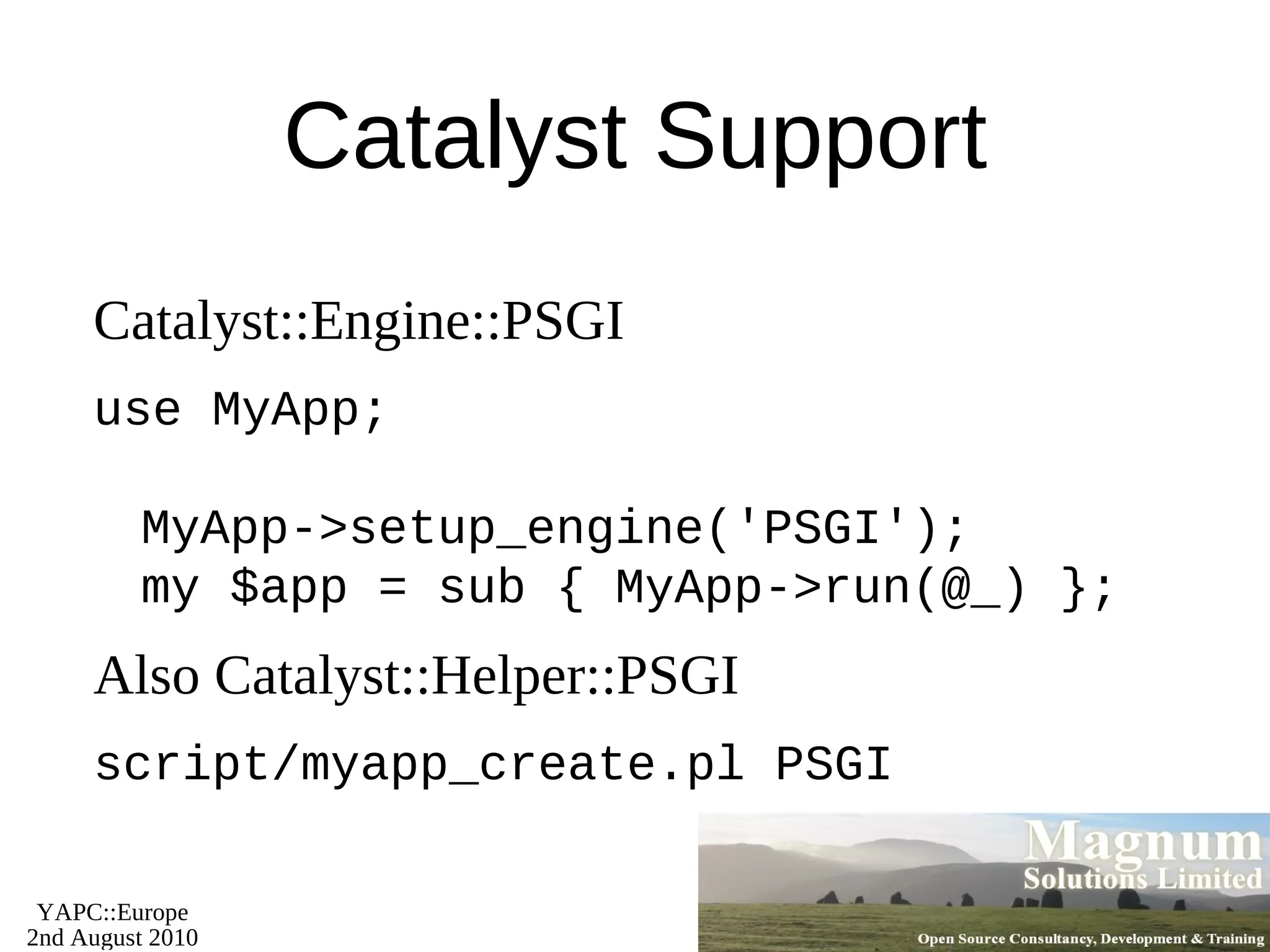
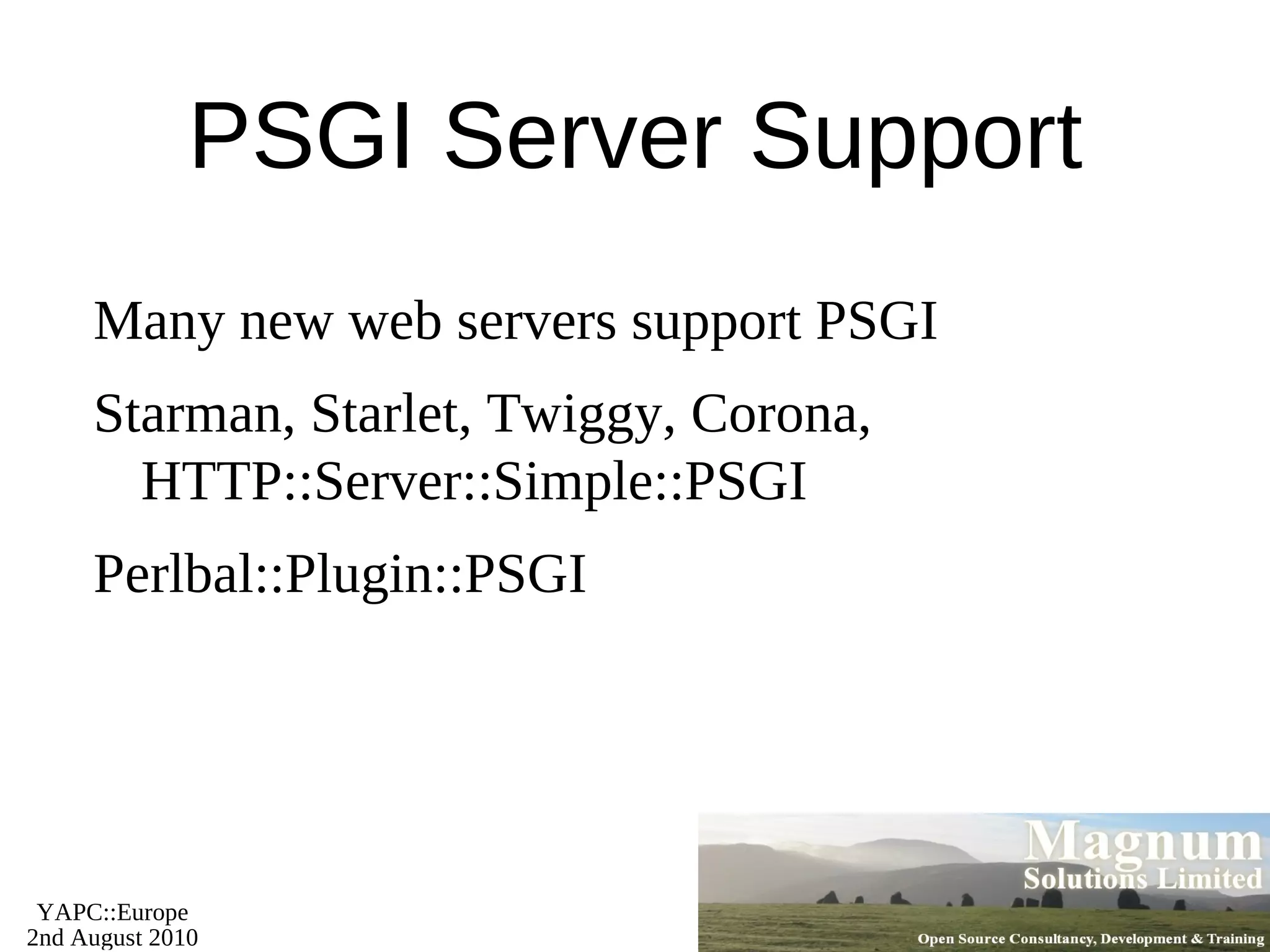
Many modern Perl applications already support PSGI
http://www.slideshare.net/group/bank-of-knowledge 2 years ago