Interfacing with Virtual Worlds An Introduction to MPEG-V Christian Timmerer Klagenfurt University (UNIKLU)    Faculty of Technical Sciences (TEWI) Department of Information Technology (ITEC)    Multimedia Communication (MMC) http://research.timmerer.com    http://blog.timmerer.com    mailto:christian.timmerer@itec.uni-klu.ac.at Authors : Christian Timmerer, Jean Gelissen, Markus Waltl, and Hermann Hellwagner Slides available at http://www.slideshare.net/christian.timmerer
Outline Introduction Part 1: System Architecture Overview of MPEG-V Parts 2 and 4 Part 3: Sensory Information Concept Sensory Effect Description Language Sensory Effect Vocabulary + Usage Examples (cf. paper) Conclusions (Demo Video) 2009/09/30 Christian Timmerer, Klagenfurt University, Austria
Introduction Multi-user online virtual worlds  (NVE, MMOG) reached mainstream popularity e.g., World of Warcraft, Second Life, Lineage Boost real world economy by connecting virtual and real world?  – Not only Gaming Entertainment, education, training, getting information, social interaction, work, virtual tourism, etc. For  fast adoption  of virtual worlds we need a better  understanding  of their  internal economics ,  rules  and  regulations 2009/09/30 Christian Timmerer, Klagenfurt University, Austria
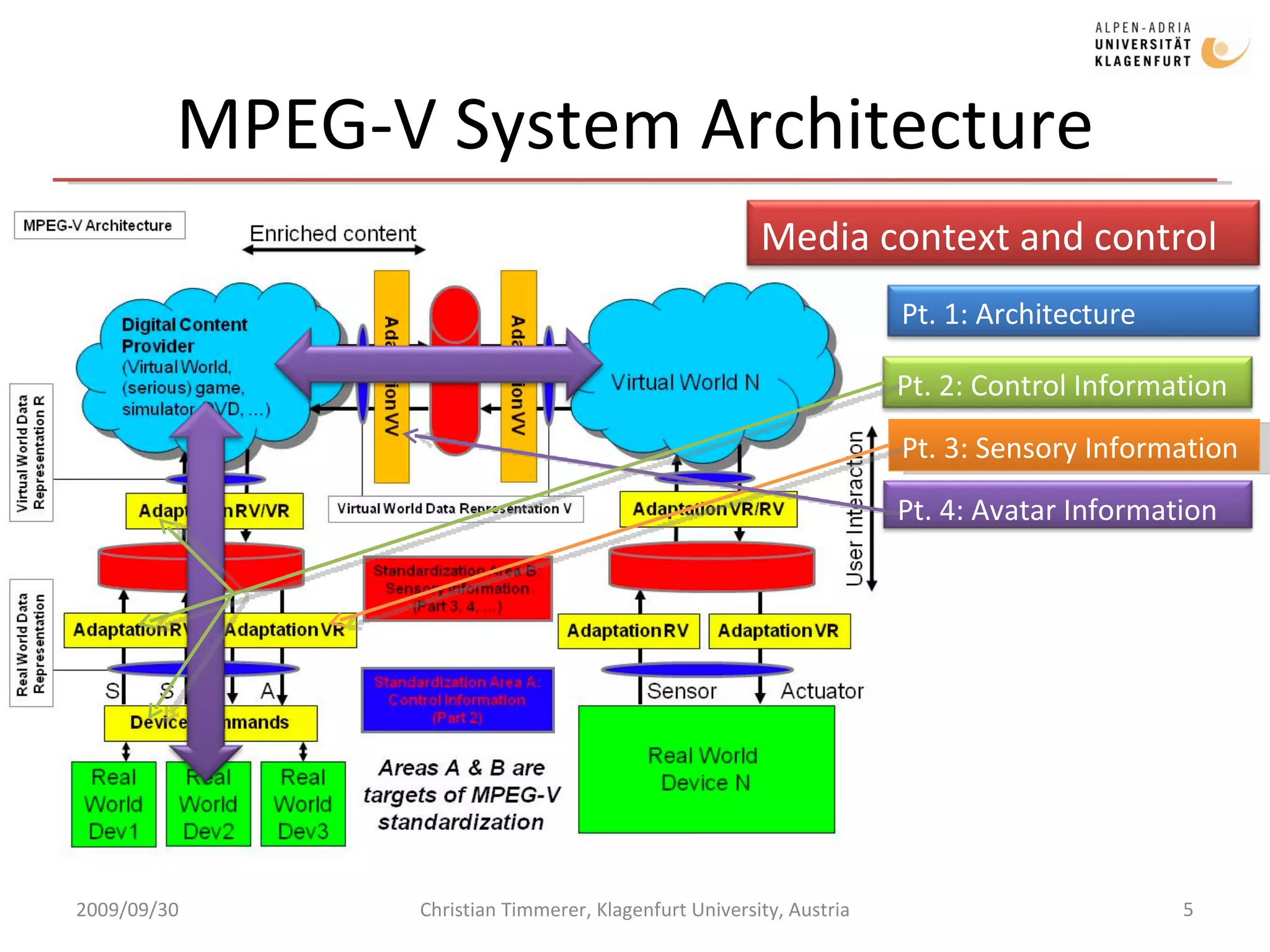
Introduction  (cont’d) Finally,  interoperability  achieved through standardization MPEG-V (ISO/IEC 23005)  :==  system architecture  +  associated information representations Interoperability  between virtual worlds E.g., digital content provider of a virtual world (serious) gaming, simulation, DVD And  real world E.g., sensors, actuators, vision and rendering, robotics (e.g. for revalidation), (support for) independent living, social and welfare systems, banking, insurance, travel, real estate, rights management 2009/09/30 Christian Timmerer, Klagenfurt University, Austria
MPEG-V System Architecture 2009/09/30 Christian Timmerer, Klagenfurt University, Austria Media context and control Pt. 1: Architecture Pt. 3: Sensory Information Pt. 4: Avatar Information Pt. 2: Control Information
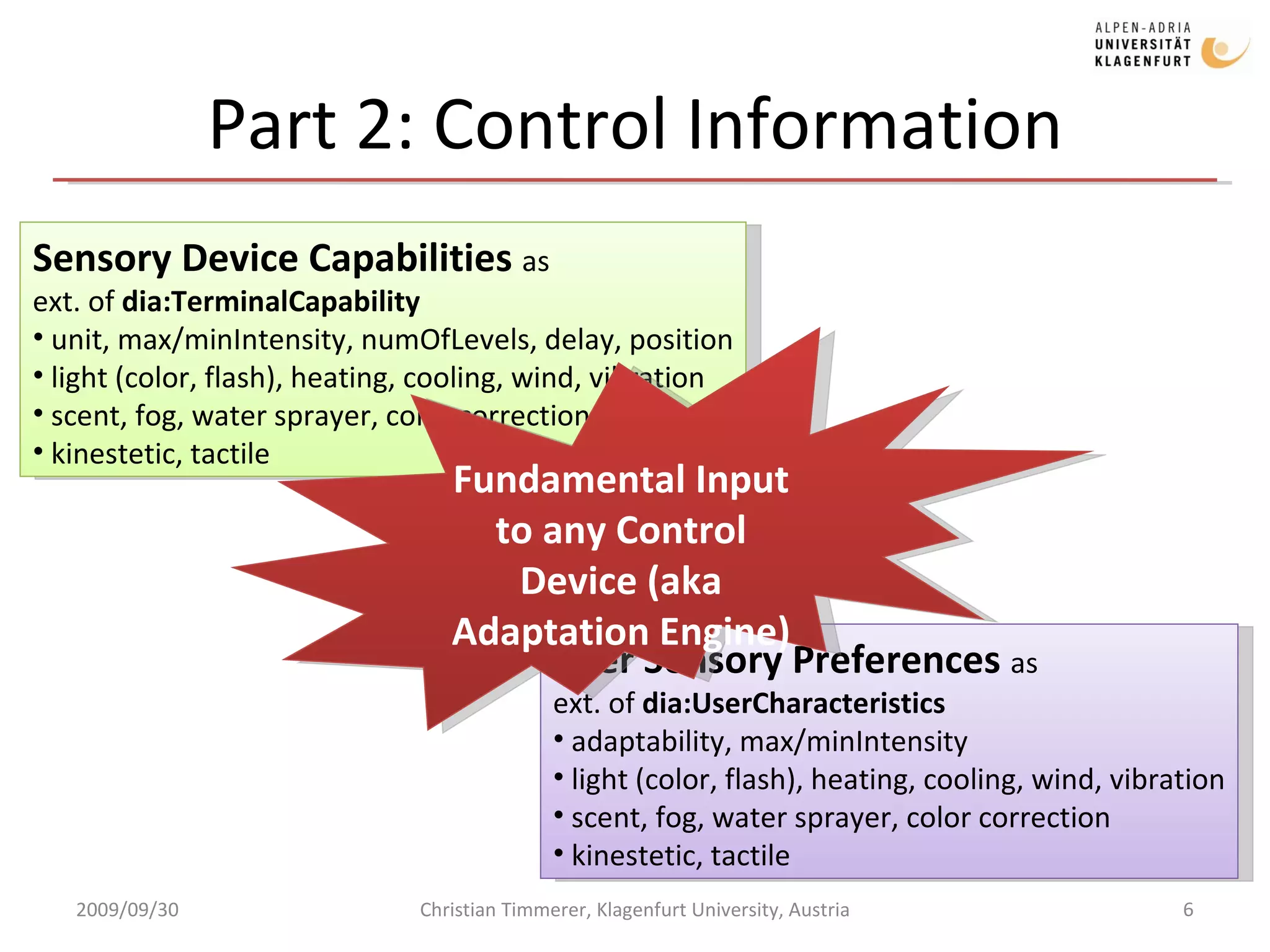
Part 2: Control Information 2009/09/30 Christian Timmerer, Klagenfurt University, Austria Sensory Device Capabilities  as ext. of  dia:TerminalCapability unit, max/minIntensity, numOfLevels, delay, position light (color, flash), heating, cooling, wind, vibration scent, fog, water sprayer, color correction kinestetic, tactile User Sensory Preferences  as ext. of  dia:UserCharacteristics adaptability, max/minIntensity light (color, flash), heating, cooling, wind, vibration scent, fog, water sprayer, color correction kinestetic, tactile Fundamental Input to any Control Device (aka Adaptation Engine)
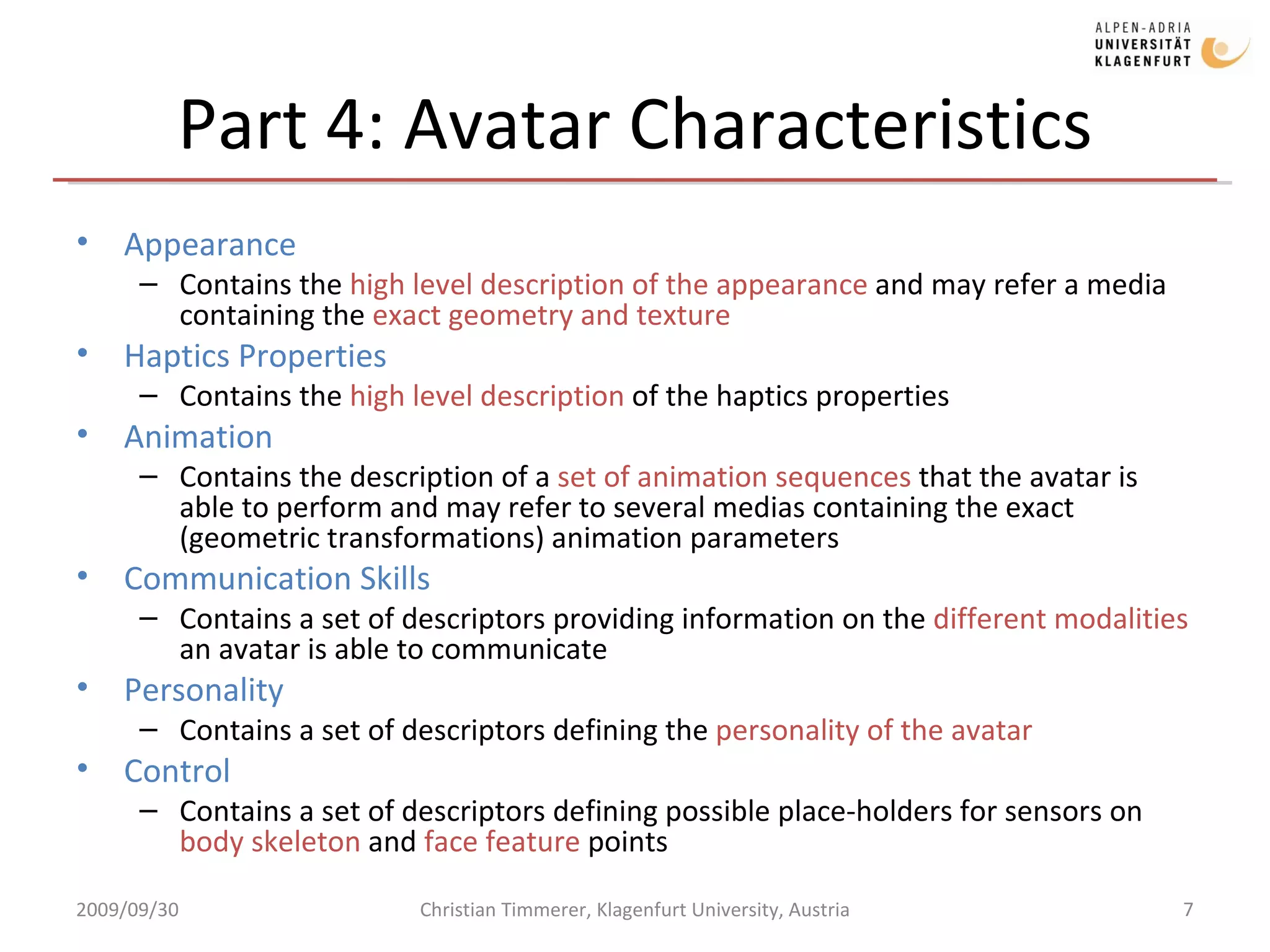
Part 4: Avatar Characteristics Appearance Contains the  high level description of the appearance  and may refer a media containing the  exact geometry and texture Haptics Properties Contains the  high level description  of the haptics properties Animation Contains the description of a  set of animation sequences  that the avatar is able to perform and may refer to several medias containing the exact (geometric transformations) animation parameters Communication Skills Contains a set of descriptors providing information on the  different modalities  an avatar is able to communicate Personality Contains a set of descriptors defining the  personality of the avatar Control Contains a set of descriptors defining possible place-holders for sensors on  body skeleton  and  face feature  points  2009/09/30 Christian Timmerer, Klagenfurt University, Austria
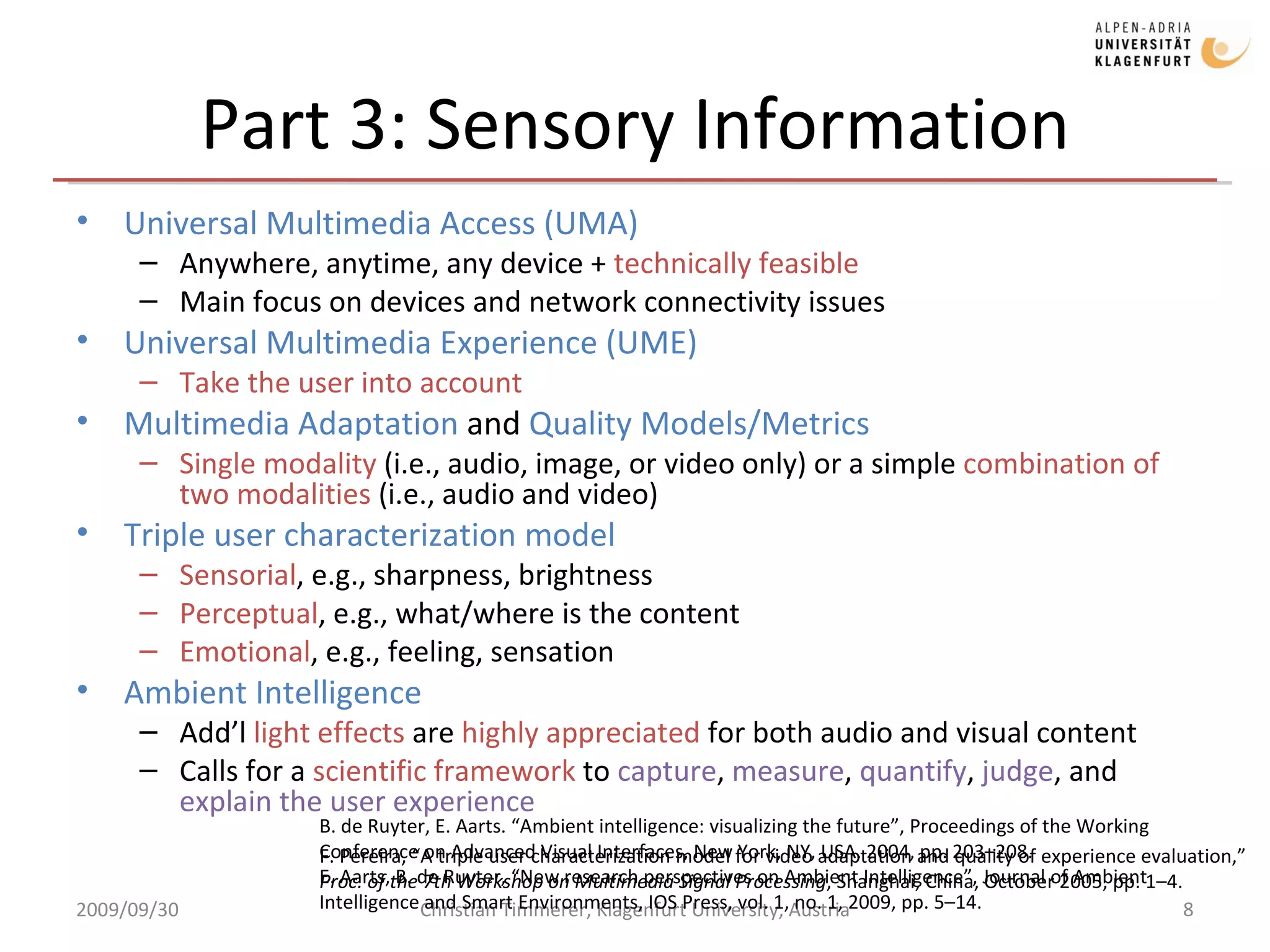
Part 3: Sensory Information Universal Multimedia Access (UMA) Anywhere, anytime, any device +  technically feasible Main focus on devices and network connectivity issues Universal Multimedia Experience (UME) Take the user into account Multimedia Adaptation  and  Quality Models/Metrics Single modality  (i.e., audio, image, or video only) or a simple  combination of two modalities  (i.e., audio and video) Triple user characterization model Sensorial , e.g., sharpness, brightness Perceptual , e.g., what/where is the content Emotional , e.g., feeling, sensation Ambient Intelligence Add’l  light effects  are  highly appreciated  for both audio and visual content Calls for a  scientific framework  to  capture ,  measure ,  quantify ,  judge , and  explain the user experience  2009/09/30 Christian Timmerer, Klagenfurt University, Austria F. Pereira, “A triple user characterization model for video adaptation and quality of experience evaluation,”  Proc. of the 7th Workshop on Multimedia Signal Processing , Shanghai, China, October 2005, pp. 1 – 4.   B. de Ruyter, E. Aarts. “Ambient intelligence: visualizing the future”, Proceedings of the Working Conference on Advanced Visual Interfaces, New York, NY, USA, 2004, pp. 203–208. E. Aarts, B. de Ruyter, “New research perspectives on Ambient Intelligence”, Journal of Ambient Intelligence and Smart Environments, IOS Press, vol. 1, no. 1, 2009, pp. 5–14.
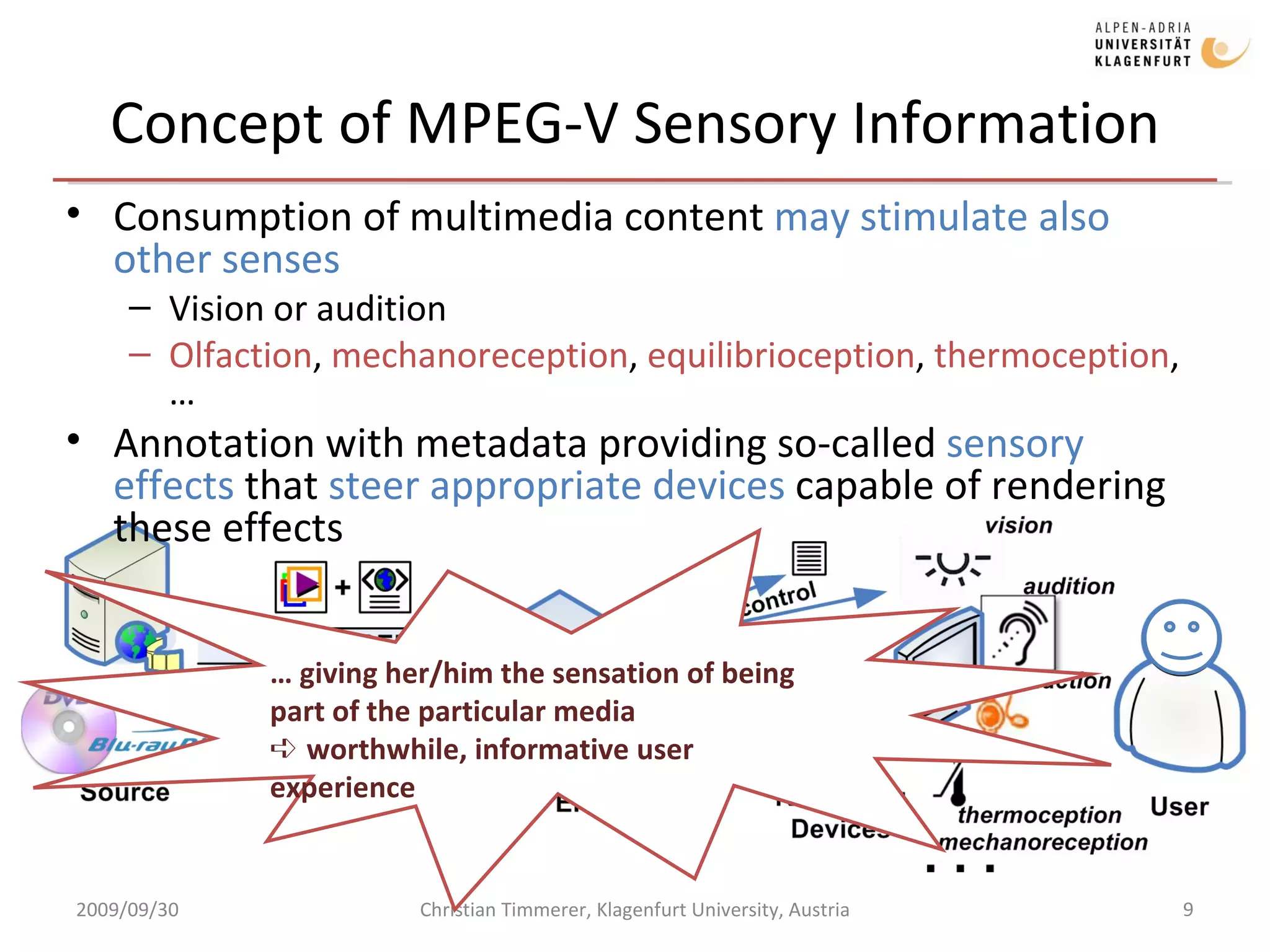
Concept of MPEG-V Sensory Information Consumption of multimedia content  may stimulate also other senses Vision or audition Olfaction ,  mechanoreception ,  equilibrioception ,  thermoception , … Annotation with metadata providing so-called  sensory effects  that  steer appropriate devices  capable of rendering these effects 2009/09/30 Christian Timmerer, Klagenfurt University, Austria …  giving her/him the sensation of being part of the particular media ➪  worthwhile, informative user experience
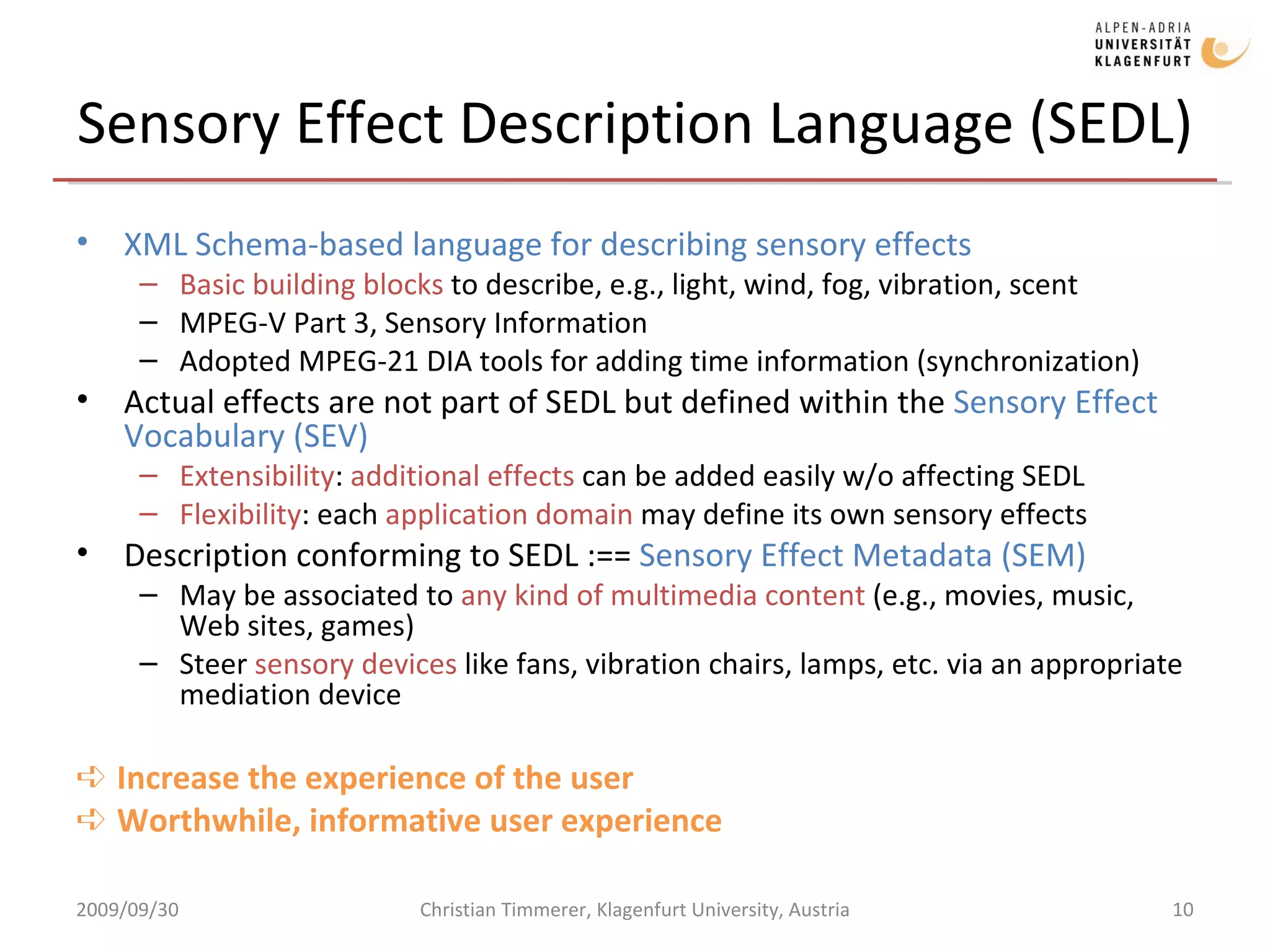
Sensory Effect Description Language (SEDL) XML Schema-based language for describing sensory effects Basic building blocks  to describe, e.g., light, wind, fog, vibration, scent MPEG-V Part 3, Sensory Information Adopted MPEG-21 DIA tools for adding time information (synchronization) Actual effects are not part of SEDL but defined within the  Sensory Effect Vocabulary (SEV) Extensibility :  additional effects  can be added easily w/o affecting SEDL Flexibility : each  application domain  may define its own sensory effects Description conforming to SEDL :==  Sensory Effect Metadata (SEM) May be associated to  any kind of multimedia content  (e.g., movies, music, Web sites, games) Steer  sensory devices  like fans, vibration chairs, lamps, etc. via an appropriate mediation device ➪  Increase the experience of the user ➪  Worthwhile, informative user experience 2009/09/30 Christian Timmerer, Klagenfurt University, Austria
Sensory Effect Description Language  (cont’d) 2009/09/30 Christian Timmerer, Klagenfurt University, Austria EffectDefinition ::= [activate][duration][fade][alt]   [priority][intensity][position] [adaptability] SEM ::=[DescriptionMetadata](Declarations|GroupOfEffects|   Effect|ReferenceEffect)+ Declarations ::= (GroupOfEffects|Effect|Parameter)+ GroupOfEffects ::= timestamp EffectDefinition   EffectDefinition (EffectDefinition)* Effect ::= timestamp EffectDefinition
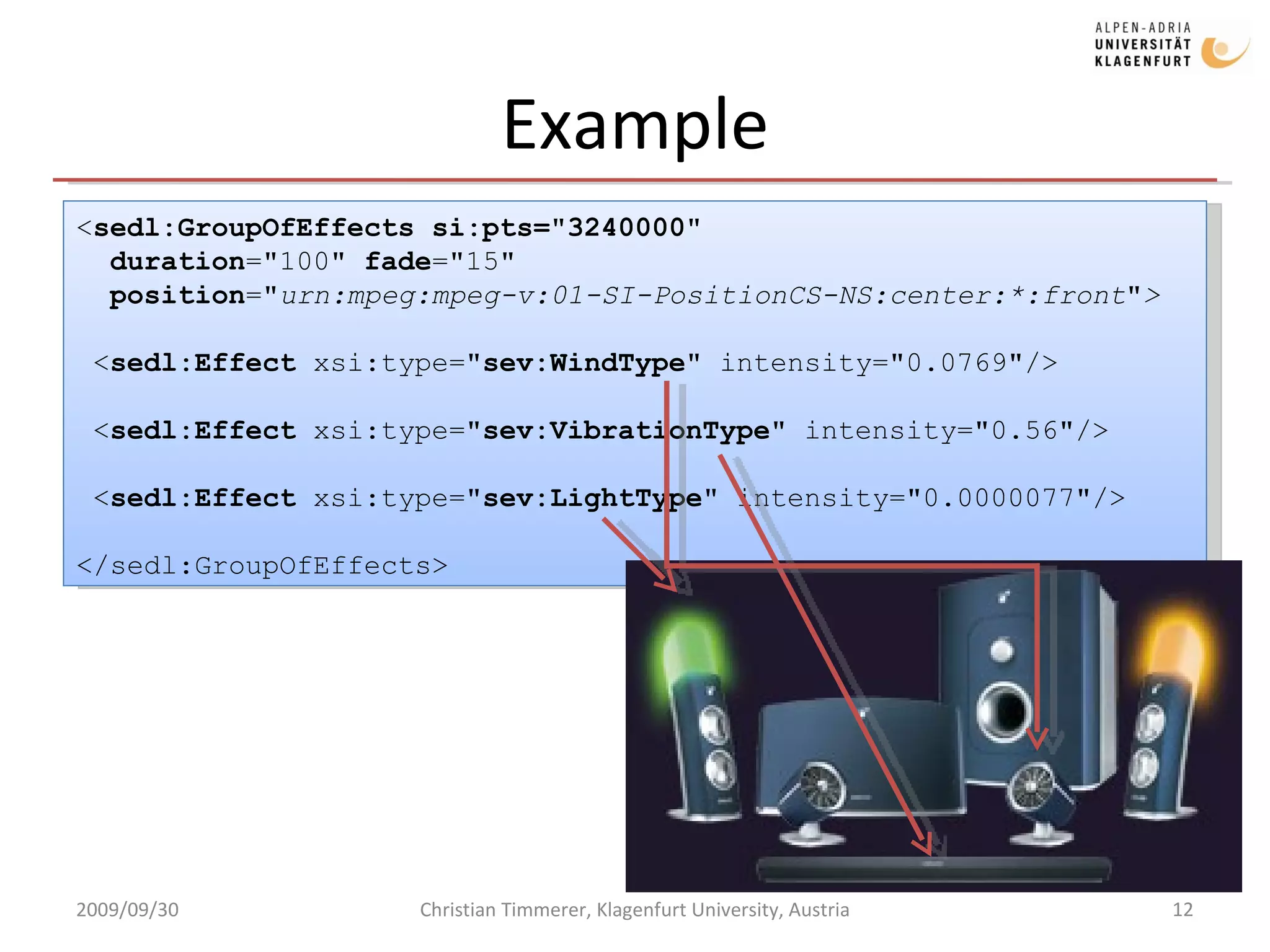
Example 2009/09/30 Christian Timmerer, Klagenfurt University, Austria < sedl:GroupOfEffects si:pts=&quot;3240000&quot; duration =&quot;100&quot;  fade =&quot;15&quot; position =&quot; urn:mpeg:mpeg-v:01-SI-PositionCS-NS:center:*:front &quot; > < sedl:Effect  xsi:type=&quot; sev:WindType&quot;  intensity=&quot;0.0769&quot;/> < sedl:Effect  xsi:type=&quot; sev:VibrationType &quot; intensity=&quot;0.56&quot;/> < sedl:Effect  xsi:type=&quot; sev:LightType&quot;  intensity=&quot;0.0000077&quot;/> </sedl:GroupOfEffects>
Conclusions MPEG-V: Media Context and Control Information exchange  between Virtual Worlds Information exchange  between Virtual and Real Worlds Currently comprises  four parts  (more to come, e.g., refsw, conf) MPEG-V Part 3: Sensory Information Annotation with metadata providing so-called  sensory effects  that  steer appropriate devices  capable of rendering these effects ➪  enhanced ,  worthwhile , and  informative user experience , giving the user the  sensation of being part  of the actual media Future work Standardization: currently at  CD level  &  going to FCD  in October 2009 Research & Development: Optimized  and  efficient delivery framework  for MPEG-V enabled content New  Quality of Service/Experience  metrics  Mechanism for  (semi-)automatic generation  of MPEG-V metadata End-to-end  reference implementation of MPEG-V 2009/09/30 Christian Timmerer, Klagenfurt University, Austria
References M. Waltl, C. Timmerer, and H. Hellwagner, “A Test-Bed for Quality of Multimedia Experience Evaluation of Sensory Effects”,  Proceedings of the First International Workshop on Quality of Multimedia Experience (QoMEX 2009) , San Diego, USA, July 29-31, 2009. C. Timmerer, J. Gelissen, M. Waltl, and H. Hellwagner, “Interfacing with Virtual Worlds”,  accepted for publication in the Proceedings of the 2009 NEM Summit , Saint-Malo, France, September 28-30, 2009. C. Timmerer, “MPEG-V: Media Context and Control”,  89th ISO/IEC JTC 1/SC 29/WG 11 (MPEG) Meeting , London, UK, June 2009.  https://www-itec.uni-klu.ac.at/mmc/blog/2009/07/08/mpeg-v-media-context-and-control/ MPEG-V:  http://www.chiariglione.org/mpeg/working_documents.htm#MPEG-V MPEG-V reflector:  http://lists.uni-klu.ac.at/mailman/listinfo/metaverse 2009/09/30 Christian Timmerer, Klagenfurt University, Austria
2009/09/30 Christian Timmerer, Klagenfurt University, Austria Demo & Video
Thank you for your attention ... questions, comments, etc. are welcome … Ass.-Prof. Dipl.-Ing. Dr. Christian Timmerer Klagenfurt University, Department of Information Technology (ITEC) Universitätsstrasse 65-67, A-9020 Klagenfurt, AUSTRIA [email_address] http://research.timmerer.com/ Tel: +43/463/2700 3621 Fax: +43/463/2700 3699 © Copyright: Christian Timmerer 2009/09/30 Christian Timmerer, Klagenfurt University, Austria

Interfacing with Virtual Worlds

  • 1.
    Interfacing with VirtualWorlds An Introduction to MPEG-V Christian Timmerer Klagenfurt University (UNIKLU)  Faculty of Technical Sciences (TEWI) Department of Information Technology (ITEC)  Multimedia Communication (MMC) http://research.timmerer.com  http://blog.timmerer.com  mailto:christian.timmerer@itec.uni-klu.ac.at Authors : Christian Timmerer, Jean Gelissen, Markus Waltl, and Hermann Hellwagner Slides available at http://www.slideshare.net/christian.timmerer
  • 2.
    Outline Introduction Part1: System Architecture Overview of MPEG-V Parts 2 and 4 Part 3: Sensory Information Concept Sensory Effect Description Language Sensory Effect Vocabulary + Usage Examples (cf. paper) Conclusions (Demo Video) 2009/09/30 Christian Timmerer, Klagenfurt University, Austria
  • 3.
    Introduction Multi-user onlinevirtual worlds (NVE, MMOG) reached mainstream popularity e.g., World of Warcraft, Second Life, Lineage Boost real world economy by connecting virtual and real world? – Not only Gaming Entertainment, education, training, getting information, social interaction, work, virtual tourism, etc. For fast adoption of virtual worlds we need a better understanding of their internal economics , rules and regulations 2009/09/30 Christian Timmerer, Klagenfurt University, Austria
  • 4.
    Introduction (cont’d)Finally, interoperability achieved through standardization MPEG-V (ISO/IEC 23005) :== system architecture + associated information representations Interoperability between virtual worlds E.g., digital content provider of a virtual world (serious) gaming, simulation, DVD And real world E.g., sensors, actuators, vision and rendering, robotics (e.g. for revalidation), (support for) independent living, social and welfare systems, banking, insurance, travel, real estate, rights management 2009/09/30 Christian Timmerer, Klagenfurt University, Austria
  • 5.
    MPEG-V System Architecture2009/09/30 Christian Timmerer, Klagenfurt University, Austria Media context and control Pt. 1: Architecture Pt. 3: Sensory Information Pt. 4: Avatar Information Pt. 2: Control Information
  • 6.
    Part 2: ControlInformation 2009/09/30 Christian Timmerer, Klagenfurt University, Austria Sensory Device Capabilities as ext. of dia:TerminalCapability unit, max/minIntensity, numOfLevels, delay, position light (color, flash), heating, cooling, wind, vibration scent, fog, water sprayer, color correction kinestetic, tactile User Sensory Preferences as ext. of dia:UserCharacteristics adaptability, max/minIntensity light (color, flash), heating, cooling, wind, vibration scent, fog, water sprayer, color correction kinestetic, tactile Fundamental Input to any Control Device (aka Adaptation Engine)
  • 7.
    Part 4: AvatarCharacteristics Appearance Contains the high level description of the appearance and may refer a media containing the exact geometry and texture Haptics Properties Contains the high level description of the haptics properties Animation Contains the description of a set of animation sequences that the avatar is able to perform and may refer to several medias containing the exact (geometric transformations) animation parameters Communication Skills Contains a set of descriptors providing information on the different modalities an avatar is able to communicate Personality Contains a set of descriptors defining the personality of the avatar Control Contains a set of descriptors defining possible place-holders for sensors on body skeleton and face feature points 2009/09/30 Christian Timmerer, Klagenfurt University, Austria
  • 8.
    Part 3: SensoryInformation Universal Multimedia Access (UMA) Anywhere, anytime, any device + technically feasible Main focus on devices and network connectivity issues Universal Multimedia Experience (UME) Take the user into account Multimedia Adaptation and Quality Models/Metrics Single modality (i.e., audio, image, or video only) or a simple combination of two modalities (i.e., audio and video) Triple user characterization model Sensorial , e.g., sharpness, brightness Perceptual , e.g., what/where is the content Emotional , e.g., feeling, sensation Ambient Intelligence Add’l light effects are highly appreciated for both audio and visual content Calls for a scientific framework to capture , measure , quantify , judge , and explain the user experience 2009/09/30 Christian Timmerer, Klagenfurt University, Austria F. Pereira, “A triple user characterization model for video adaptation and quality of experience evaluation,” Proc. of the 7th Workshop on Multimedia Signal Processing , Shanghai, China, October 2005, pp. 1 – 4. B. de Ruyter, E. Aarts. “Ambient intelligence: visualizing the future”, Proceedings of the Working Conference on Advanced Visual Interfaces, New York, NY, USA, 2004, pp. 203–208. E. Aarts, B. de Ruyter, “New research perspectives on Ambient Intelligence”, Journal of Ambient Intelligence and Smart Environments, IOS Press, vol. 1, no. 1, 2009, pp. 5–14.
  • 9.
    Concept of MPEG-VSensory Information Consumption of multimedia content may stimulate also other senses Vision or audition Olfaction , mechanoreception , equilibrioception , thermoception , … Annotation with metadata providing so-called sensory effects that steer appropriate devices capable of rendering these effects 2009/09/30 Christian Timmerer, Klagenfurt University, Austria … giving her/him the sensation of being part of the particular media ➪ worthwhile, informative user experience
  • 10.
    Sensory Effect DescriptionLanguage (SEDL) XML Schema-based language for describing sensory effects Basic building blocks to describe, e.g., light, wind, fog, vibration, scent MPEG-V Part 3, Sensory Information Adopted MPEG-21 DIA tools for adding time information (synchronization) Actual effects are not part of SEDL but defined within the Sensory Effect Vocabulary (SEV) Extensibility : additional effects can be added easily w/o affecting SEDL Flexibility : each application domain may define its own sensory effects Description conforming to SEDL :== Sensory Effect Metadata (SEM) May be associated to any kind of multimedia content (e.g., movies, music, Web sites, games) Steer sensory devices like fans, vibration chairs, lamps, etc. via an appropriate mediation device ➪ Increase the experience of the user ➪ Worthwhile, informative user experience 2009/09/30 Christian Timmerer, Klagenfurt University, Austria
  • 11.
    Sensory Effect DescriptionLanguage (cont’d) 2009/09/30 Christian Timmerer, Klagenfurt University, Austria EffectDefinition ::= [activate][duration][fade][alt] [priority][intensity][position] [adaptability] SEM ::=[DescriptionMetadata](Declarations|GroupOfEffects| Effect|ReferenceEffect)+ Declarations ::= (GroupOfEffects|Effect|Parameter)+ GroupOfEffects ::= timestamp EffectDefinition EffectDefinition (EffectDefinition)* Effect ::= timestamp EffectDefinition
  • 12.
    Example 2009/09/30 ChristianTimmerer, Klagenfurt University, Austria < sedl:GroupOfEffects si:pts=&quot;3240000&quot; duration =&quot;100&quot; fade =&quot;15&quot; position =&quot; urn:mpeg:mpeg-v:01-SI-PositionCS-NS:center:*:front &quot; > < sedl:Effect xsi:type=&quot; sev:WindType&quot; intensity=&quot;0.0769&quot;/> < sedl:Effect xsi:type=&quot; sev:VibrationType &quot; intensity=&quot;0.56&quot;/> < sedl:Effect xsi:type=&quot; sev:LightType&quot; intensity=&quot;0.0000077&quot;/> </sedl:GroupOfEffects>
  • 13.
    Conclusions MPEG-V: MediaContext and Control Information exchange between Virtual Worlds Information exchange between Virtual and Real Worlds Currently comprises four parts (more to come, e.g., refsw, conf) MPEG-V Part 3: Sensory Information Annotation with metadata providing so-called sensory effects that steer appropriate devices capable of rendering these effects ➪ enhanced , worthwhile , and informative user experience , giving the user the sensation of being part of the actual media Future work Standardization: currently at CD level & going to FCD in October 2009 Research & Development: Optimized and efficient delivery framework for MPEG-V enabled content New Quality of Service/Experience metrics Mechanism for (semi-)automatic generation of MPEG-V metadata End-to-end reference implementation of MPEG-V 2009/09/30 Christian Timmerer, Klagenfurt University, Austria
  • 14.
    References M. Waltl,C. Timmerer, and H. Hellwagner, “A Test-Bed for Quality of Multimedia Experience Evaluation of Sensory Effects”, Proceedings of the First International Workshop on Quality of Multimedia Experience (QoMEX 2009) , San Diego, USA, July 29-31, 2009. C. Timmerer, J. Gelissen, M. Waltl, and H. Hellwagner, “Interfacing with Virtual Worlds”, accepted for publication in the Proceedings of the 2009 NEM Summit , Saint-Malo, France, September 28-30, 2009. C. Timmerer, “MPEG-V: Media Context and Control”, 89th ISO/IEC JTC 1/SC 29/WG 11 (MPEG) Meeting , London, UK, June 2009. https://www-itec.uni-klu.ac.at/mmc/blog/2009/07/08/mpeg-v-media-context-and-control/ MPEG-V: http://www.chiariglione.org/mpeg/working_documents.htm#MPEG-V MPEG-V reflector: http://lists.uni-klu.ac.at/mailman/listinfo/metaverse 2009/09/30 Christian Timmerer, Klagenfurt University, Austria
  • 15.
    2009/09/30 Christian Timmerer,Klagenfurt University, Austria Demo & Video
  • 16.
    Thank you foryour attention ... questions, comments, etc. are welcome … Ass.-Prof. Dipl.-Ing. Dr. Christian Timmerer Klagenfurt University, Department of Information Technology (ITEC) Universitätsstrasse 65-67, A-9020 Klagenfurt, AUSTRIA [email_address] http://research.timmerer.com/ Tel: +43/463/2700 3621 Fax: +43/463/2700 3699 © Copyright: Christian Timmerer 2009/09/30 Christian Timmerer, Klagenfurt University, Austria