Whatiswrongwithscholarlypublishingtoday?Björn Brembs, Freie Universität Berlinhttp://brembs.nethttp://www.slideshare.net/brembs/whats-wrong-with-scholarly-publishing-today-ii
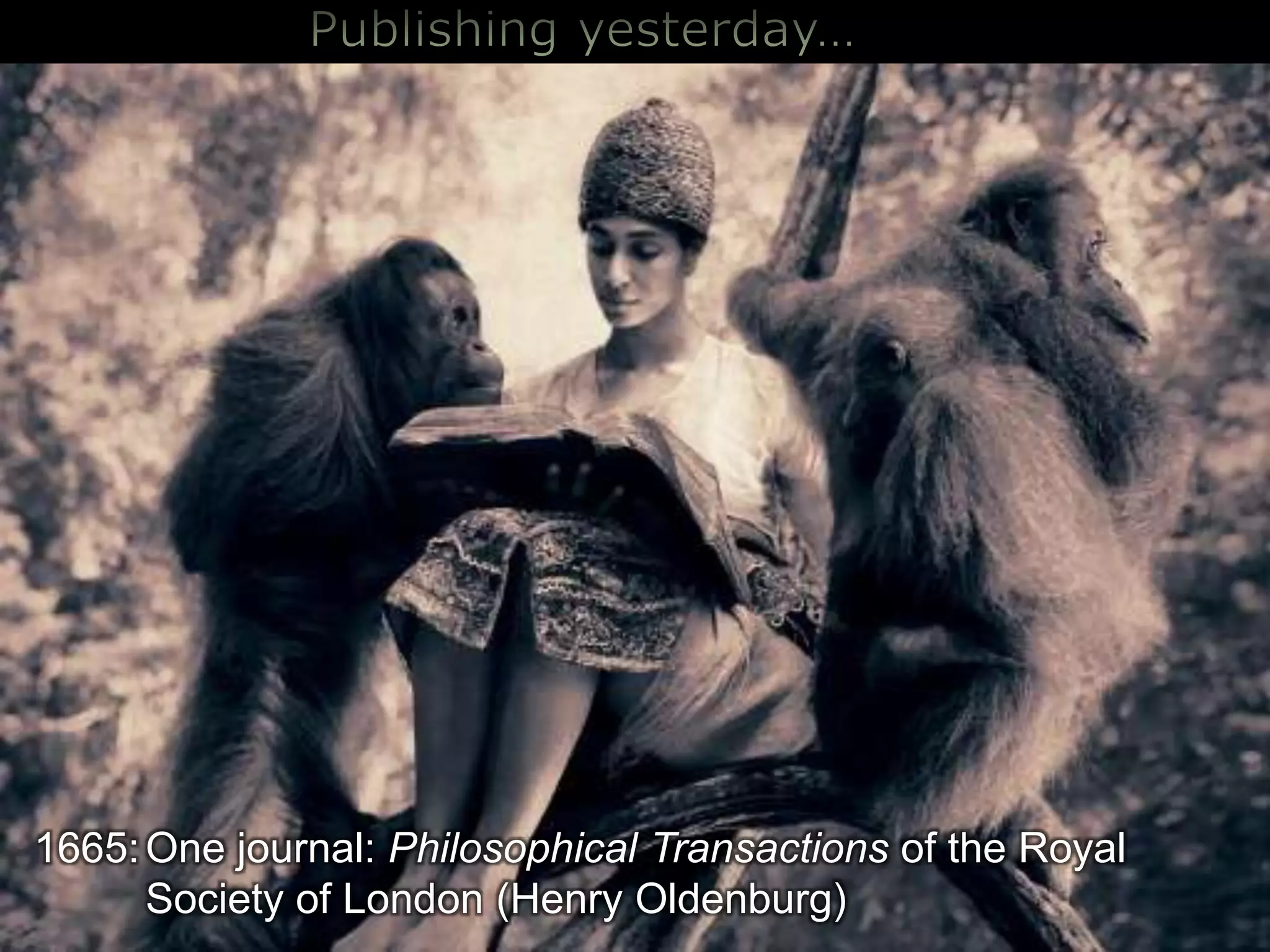
Publishing yesterday…1665:	Onejournal: Philosophical Transactionsofthe Royal Society of London (Henry Oldenburg)
Publishing Today24,000 scholarlyjournals
1.5 millionpublications/year
3% annualgrowth
1 millionauthors
10-15 millionreadersat >10,000 institutions
1.5 billiondownloads/yearSource: Mabe MA (2009): Scholarly Publishing. European Review 17(1): 3-22
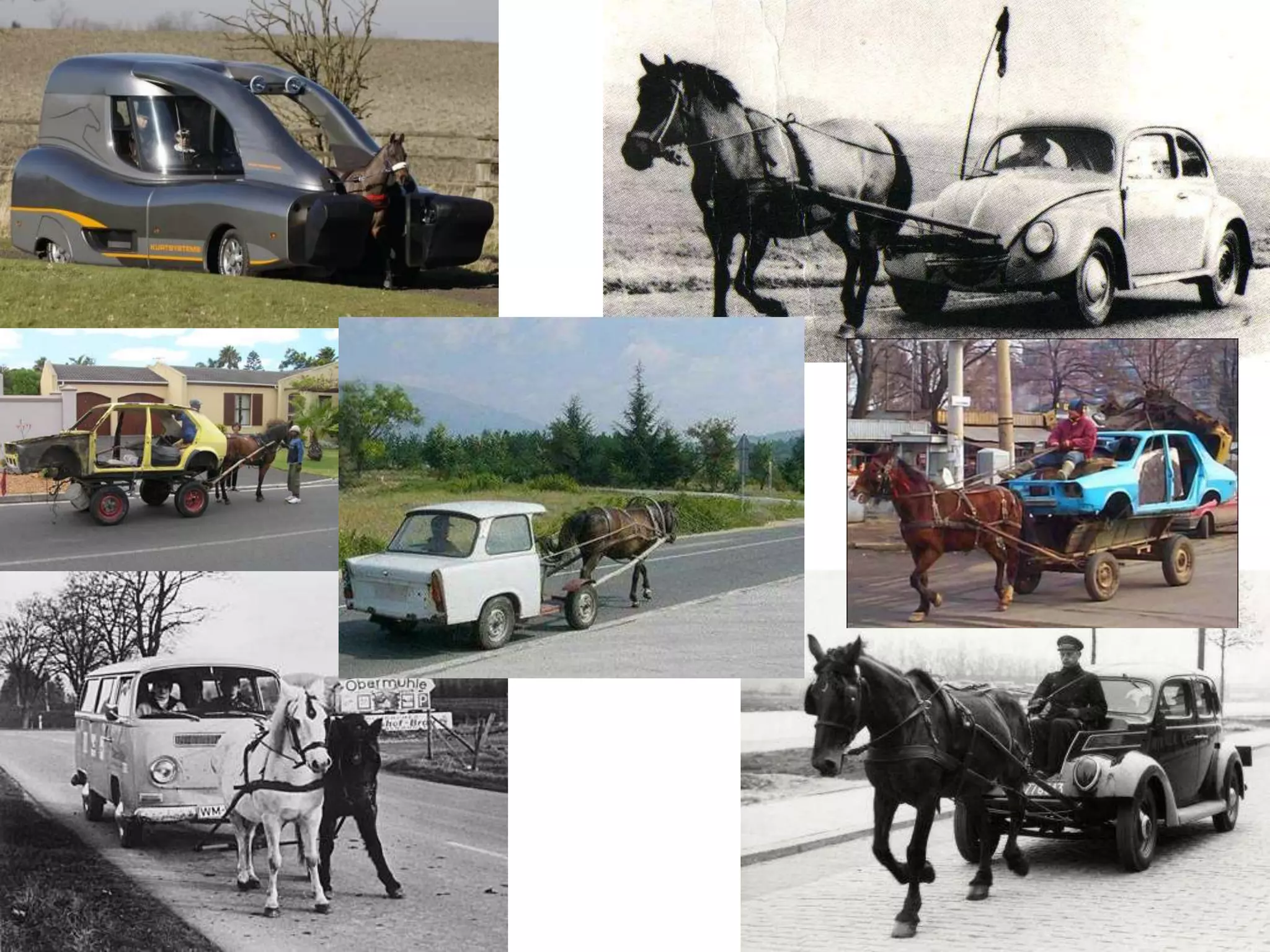
Functionality19thcenturypublishingfor a 21stcenturyscientificcommunity
FunctionalityAt least four different searchtoolstobesure not to miss any relevant literature?
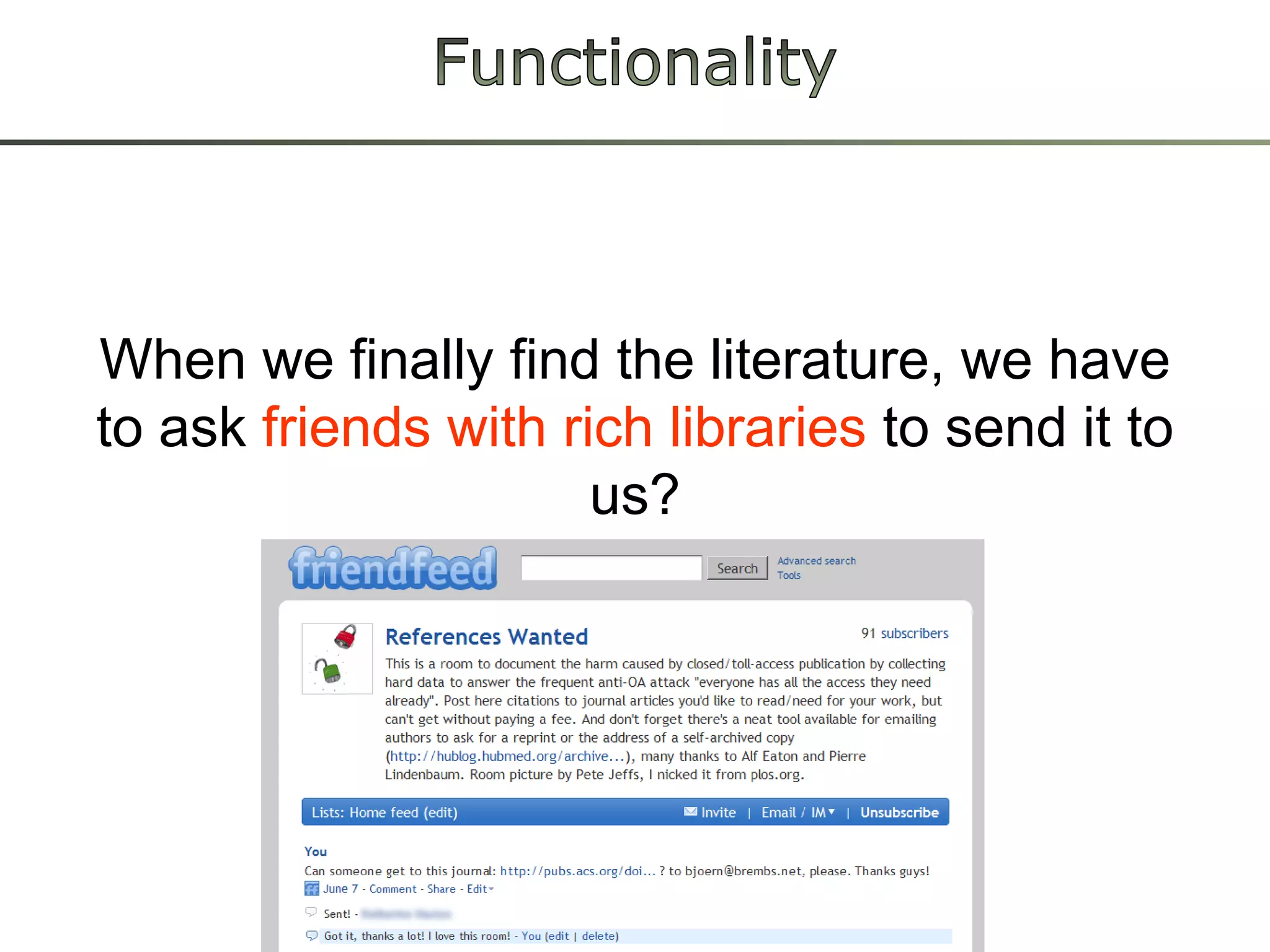
FunctionalityWhen we finally find the literature, we have to ask friends with rich libraries to send it to us?
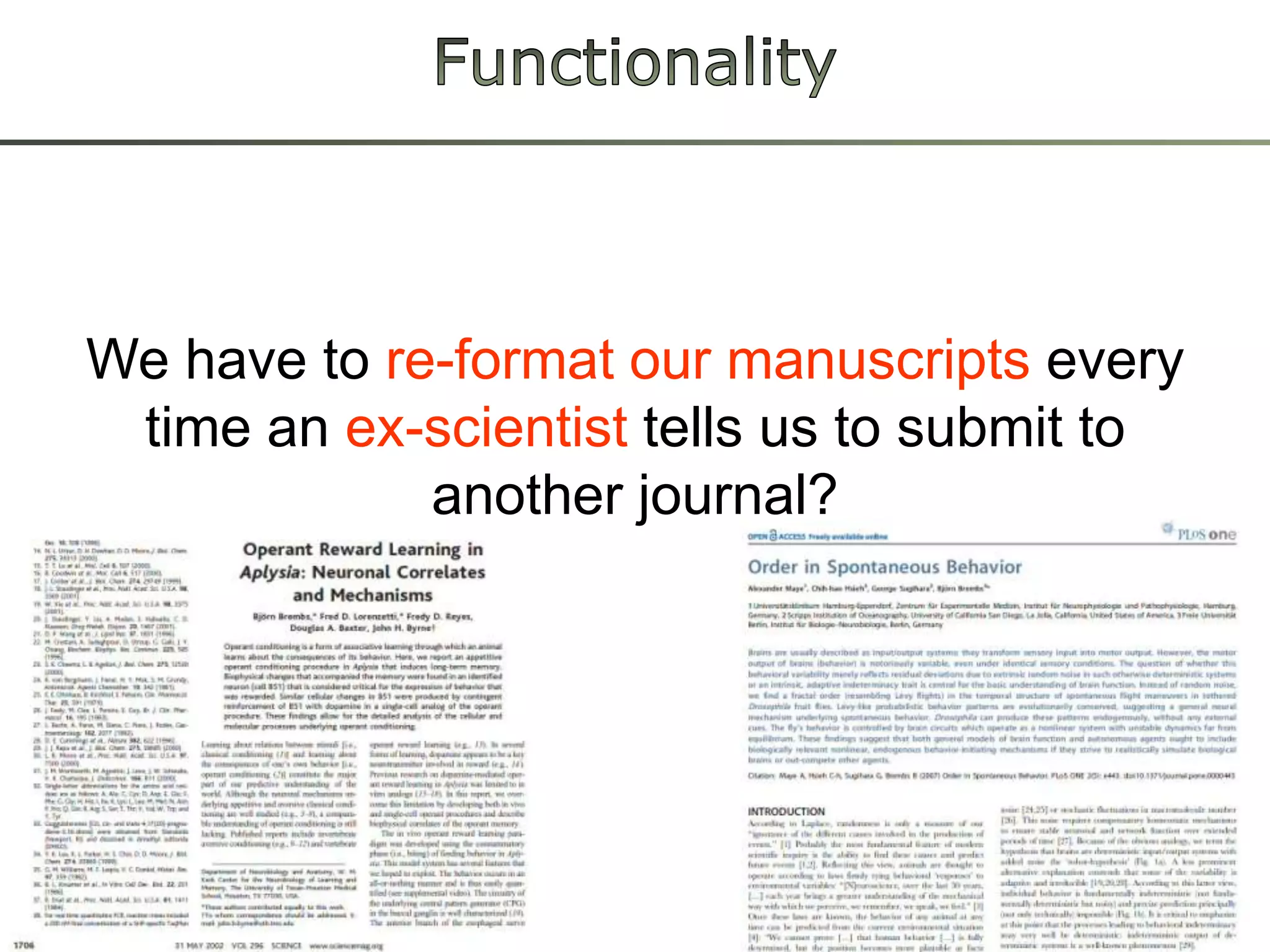
FunctionalityWe have to re-format our manuscripts every time an ex-scientist tells us to submit to another journal?
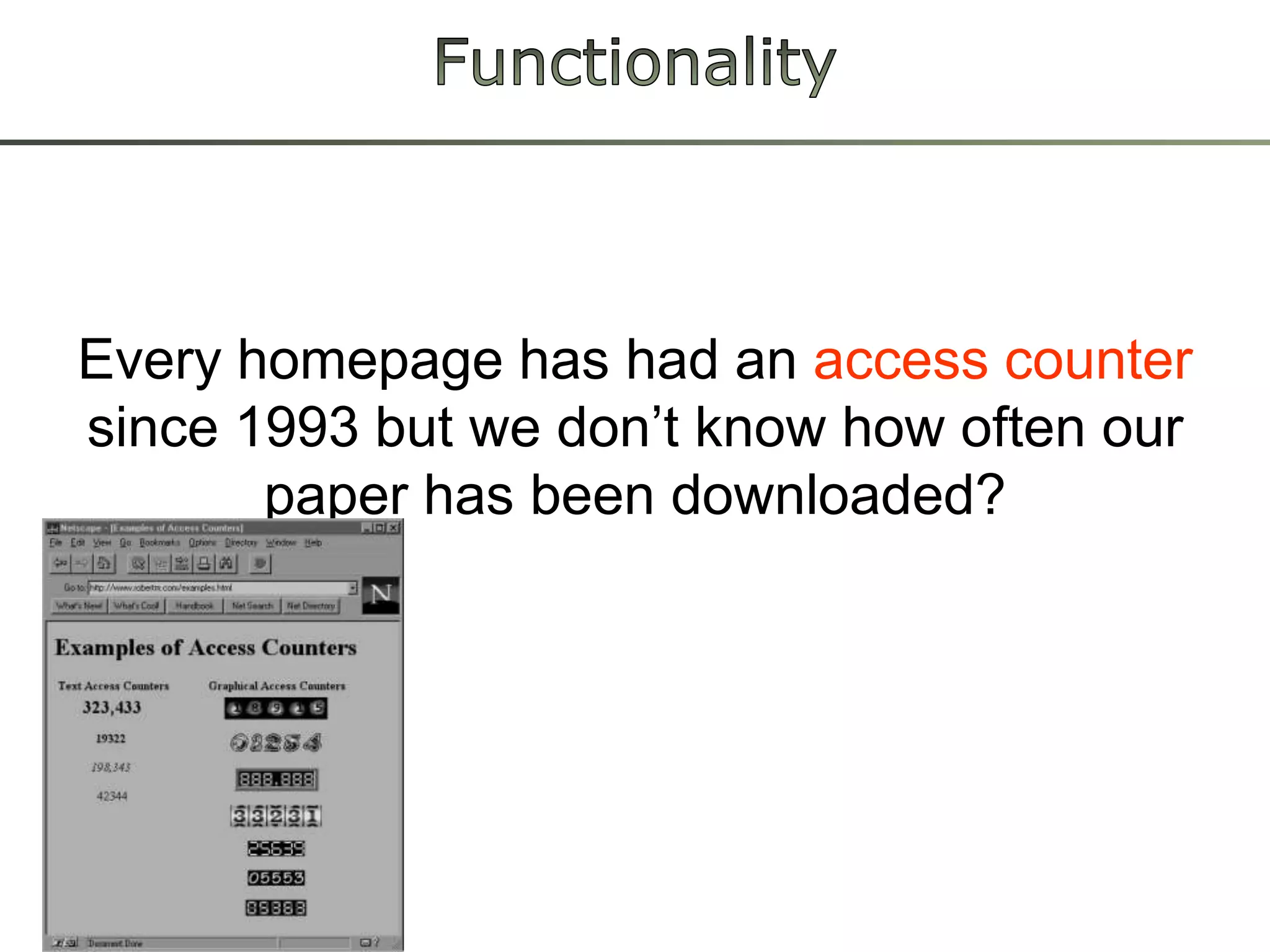
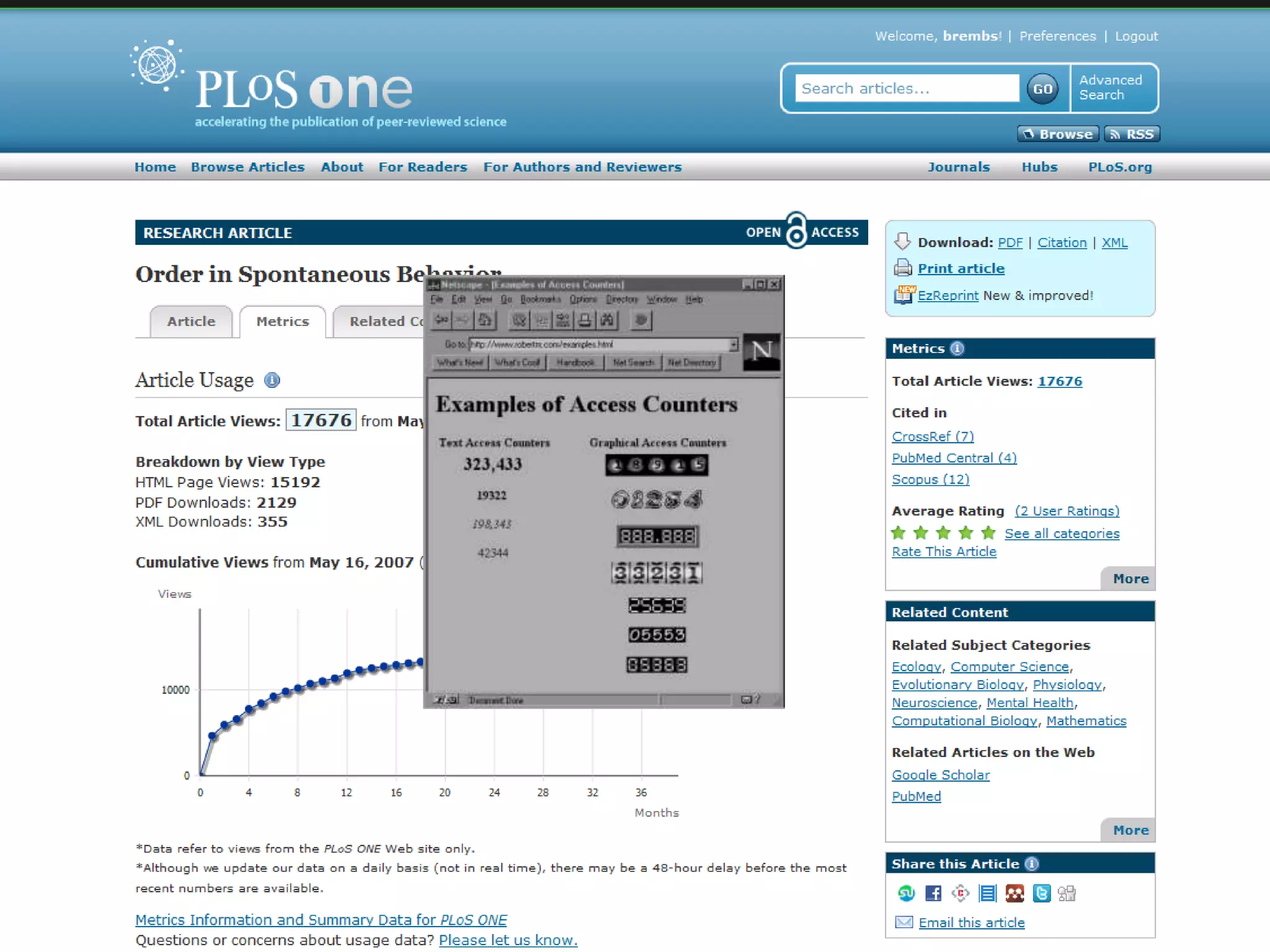
FunctionalityEvery homepage has had an access counter since 1993 but we don’t know how often our paper has been downloaded?
FunctionalityNothing happens when we click on the reference after "we performed the experiments as described previously"?
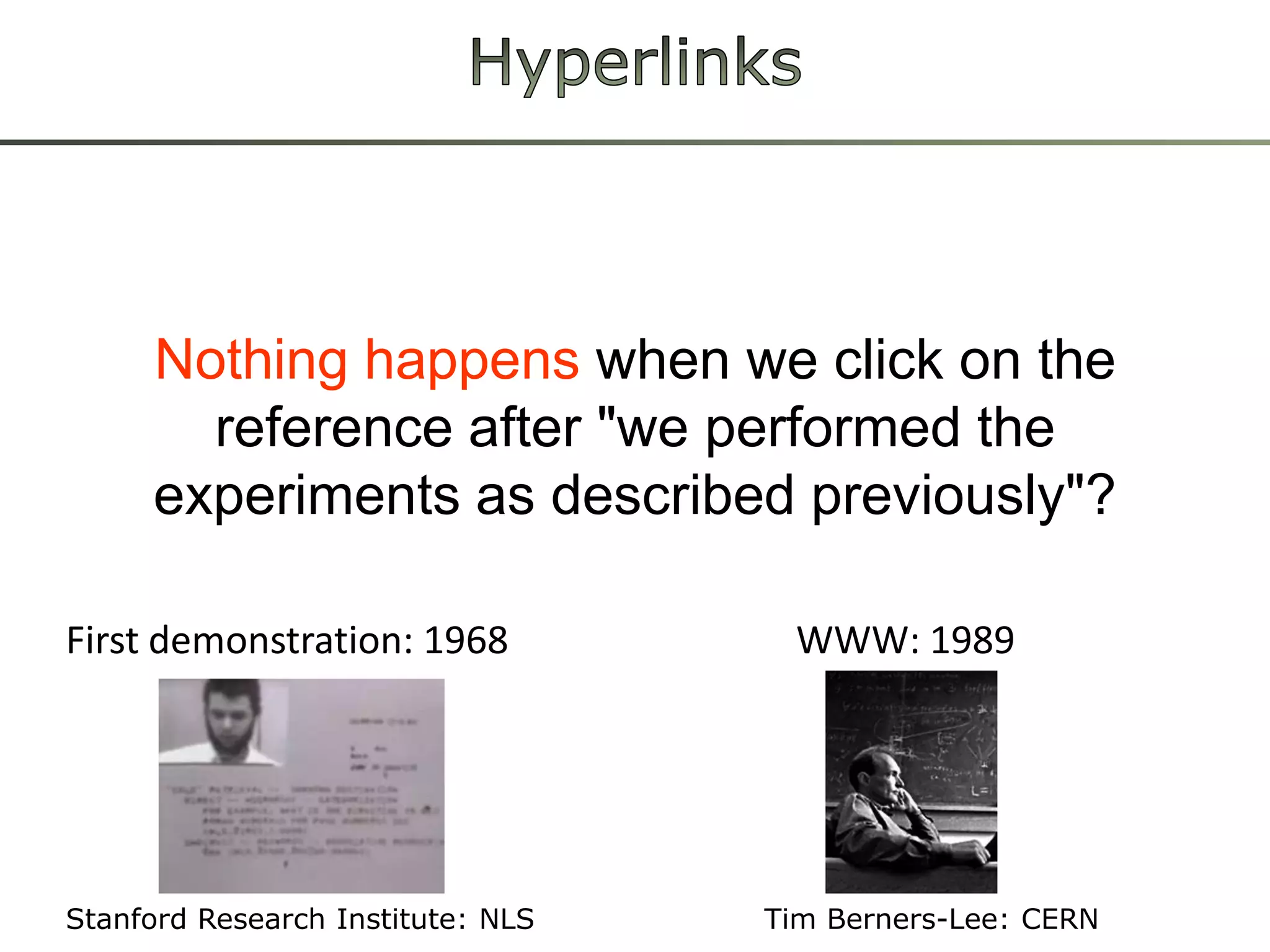
HyperlinksNothing happens when we click on the reference after "we performed the experiments as described previously"?First demonstration: 1968WWW: 1989Stanford Research Institute: NLSTim Berners-Lee: CERN
Think…
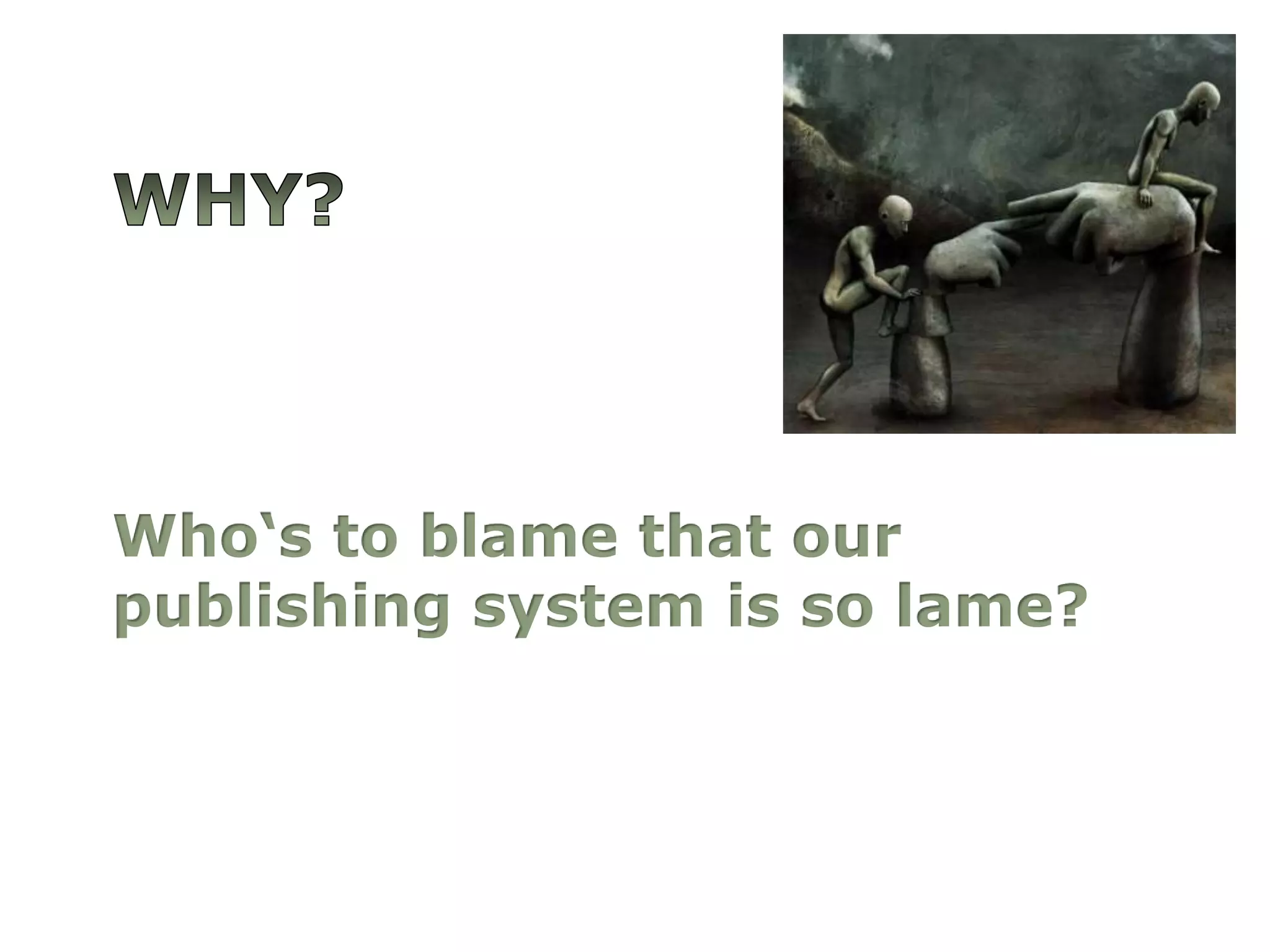
Why?Who‘stoblamethatourpublishingsystemis so lame?
We, thescientists!We decide how and where to publish
We, thescientists!We are producers and consumers in personal union
We, thescientists!We chose to outsource scientific communication to publishers
PublishersA publicgood in private hands
ElsevierName from Dutch publisher (1580): “House of Elzevir”250,000 articles per year in 2000 journals7,000 journal editors, 70,000 editorial board members and 300,000 reviewers are working for ElsevierPart of Reed Elsevier group
Elsevier
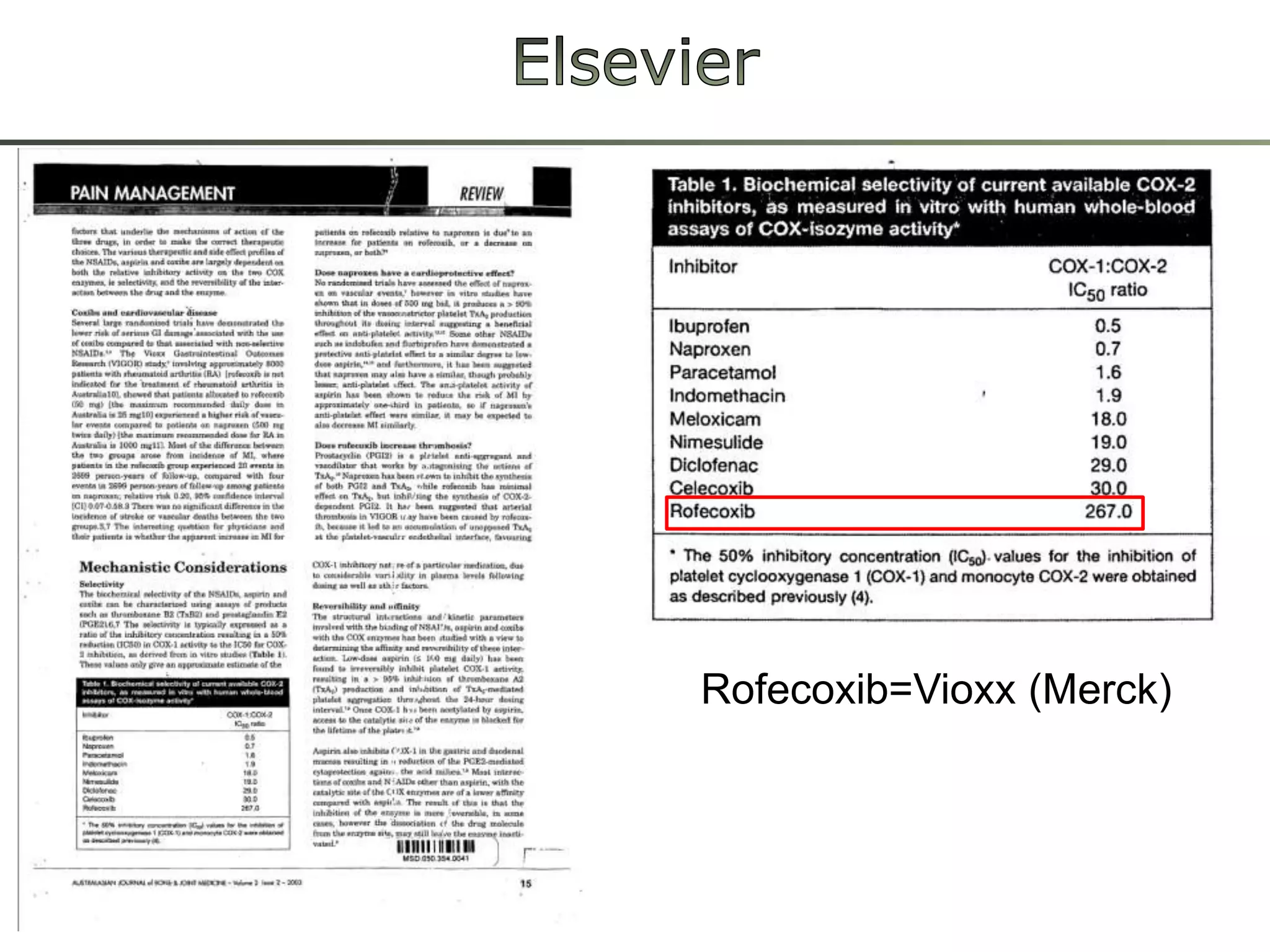
ElsevierRofecoxib=Vioxx (Merck)
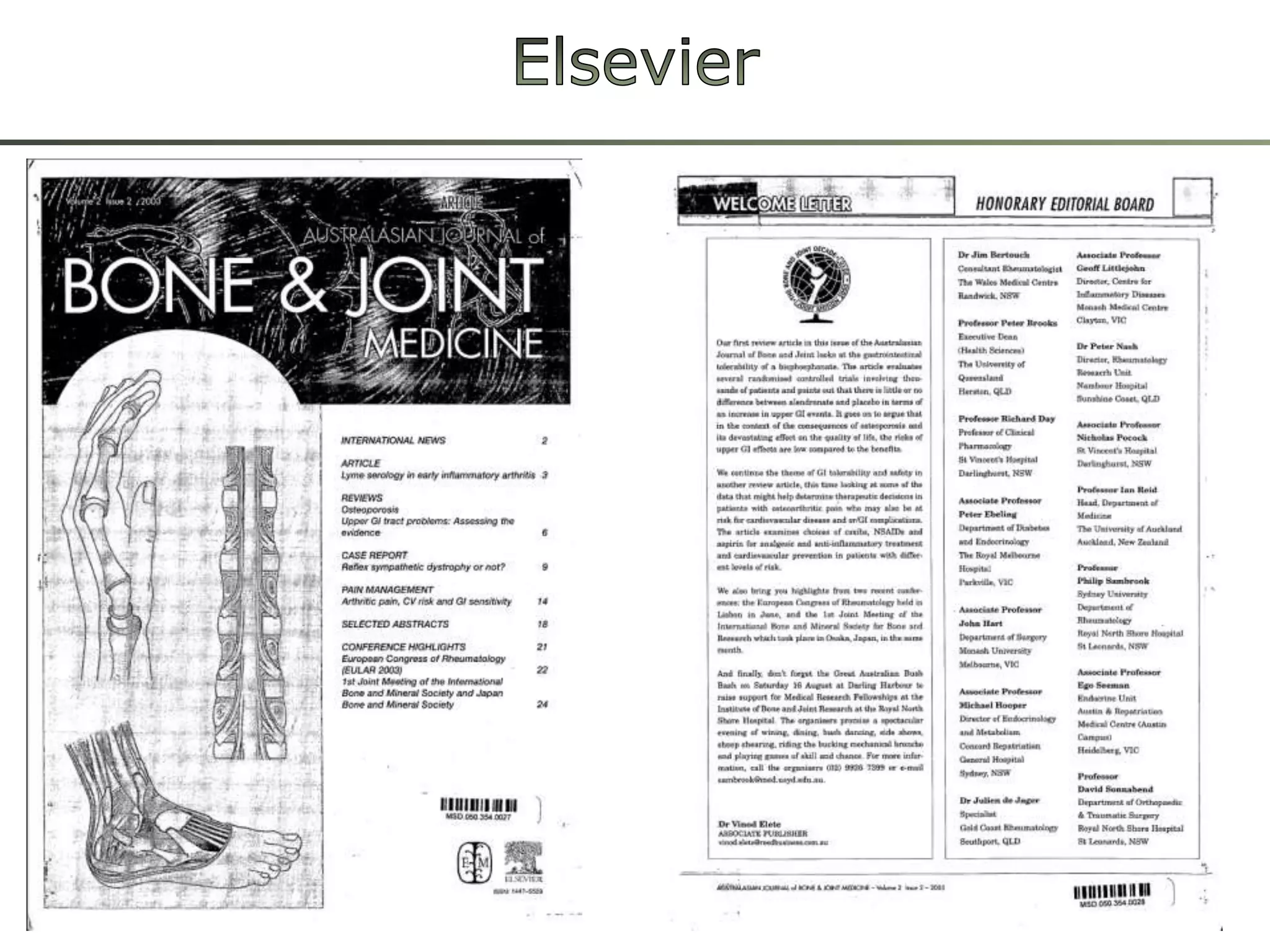
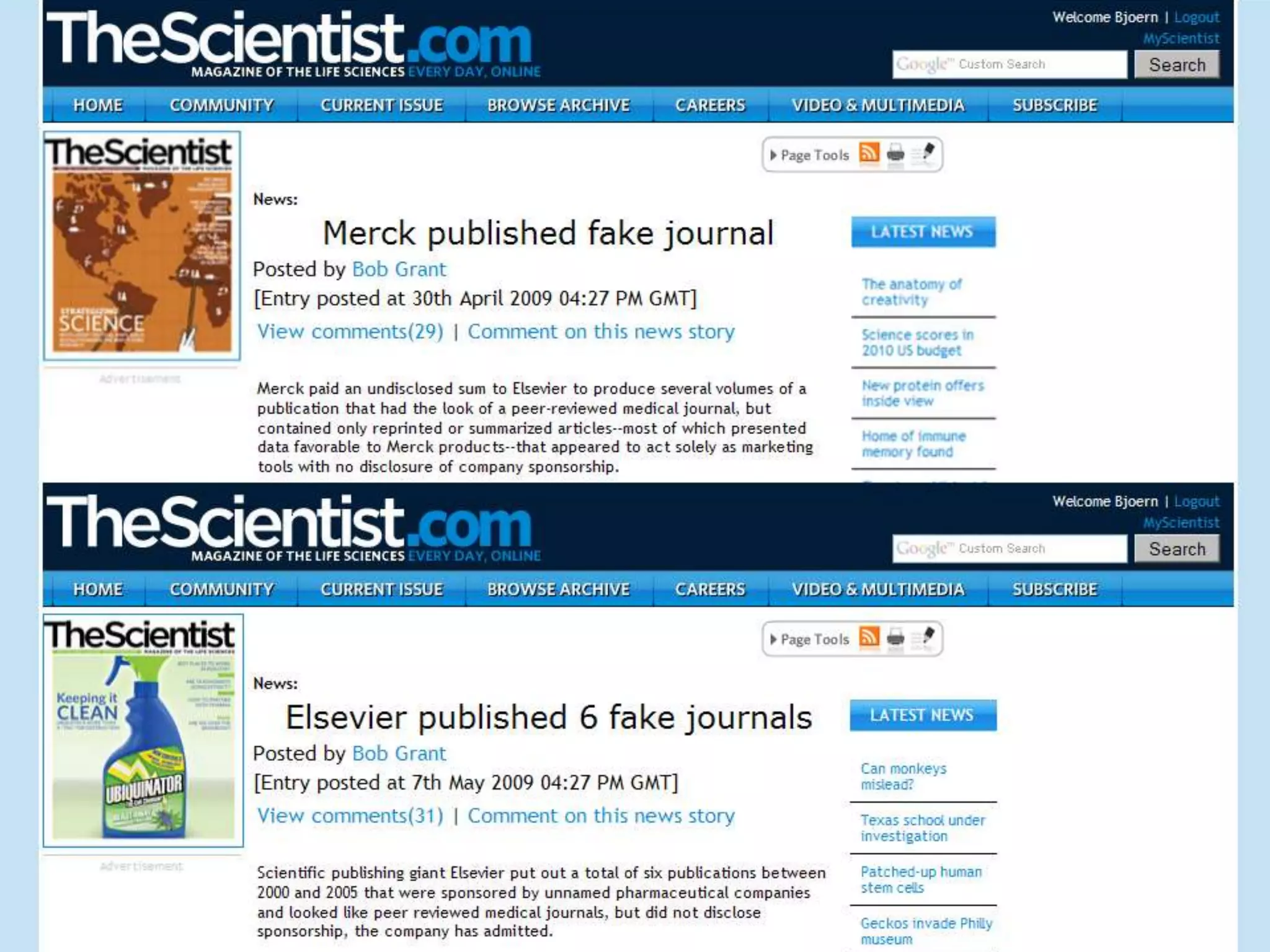
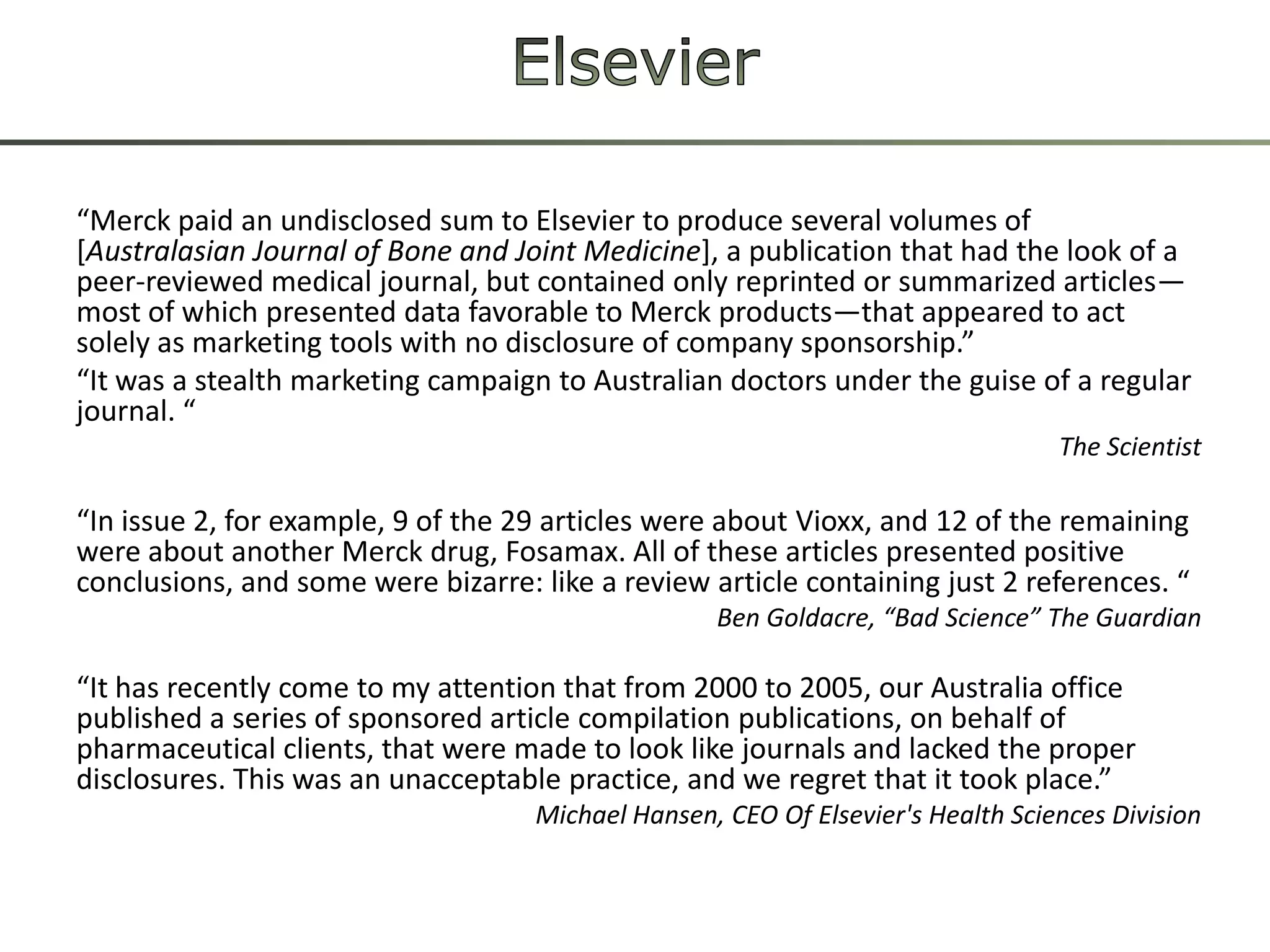
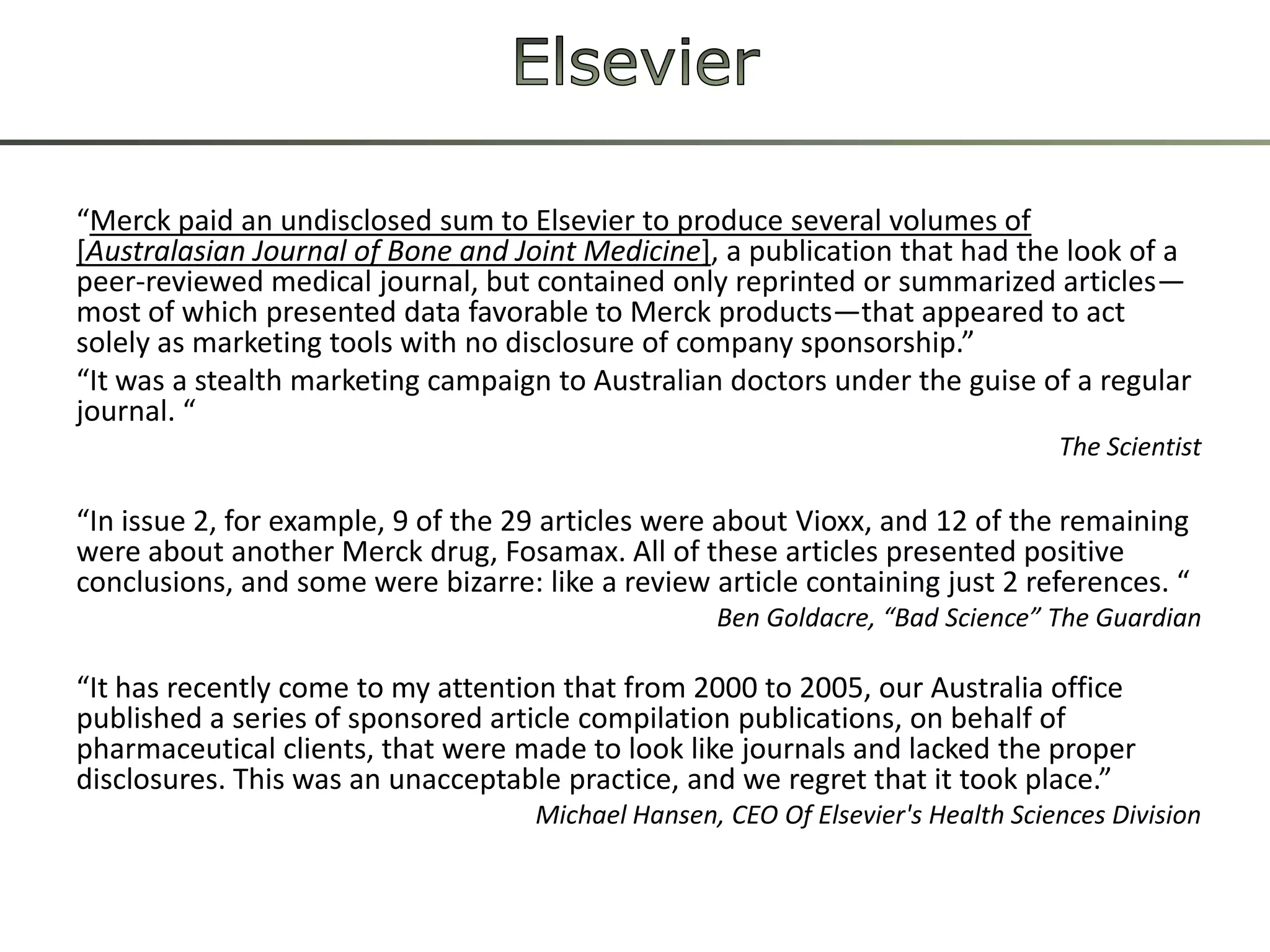
Elsevier“Merck paid an undisclosed sum to Elsevier to produce several volumes of [Australasian Journal of Bone and Joint Medicine], a publication that had the look of a peer-reviewed medical journal, but contained only reprinted or summarized articles—most of which presented data favorable to Merck products—that appeared to act solely as marketing tools with no disclosure of company sponsorship.”“It was a stealth marketing campaign to Australian doctors under the guise of a regular journal. “The Scientist“In issue 2, for example, 9 of the 29 articles were about Vioxx, and 12 of the remaining were about another Merck drug, Fosamax. All of these articles presented positive conclusions, and some were bizarre: like a review article containing just 2 references. “Ben Goldacre, “Bad Science” The Guardian“It has recently come to my attention that from 2000 to 2005, our Australia office published a series of sponsored article compilation publications, on behalf of pharmaceutical clients, that were made to look like journals and lacked the proper disclosures. This was an unacceptable practice, and we regret that it took place.”Michael Hansen, CEO Of Elsevier's Health Sciences Division
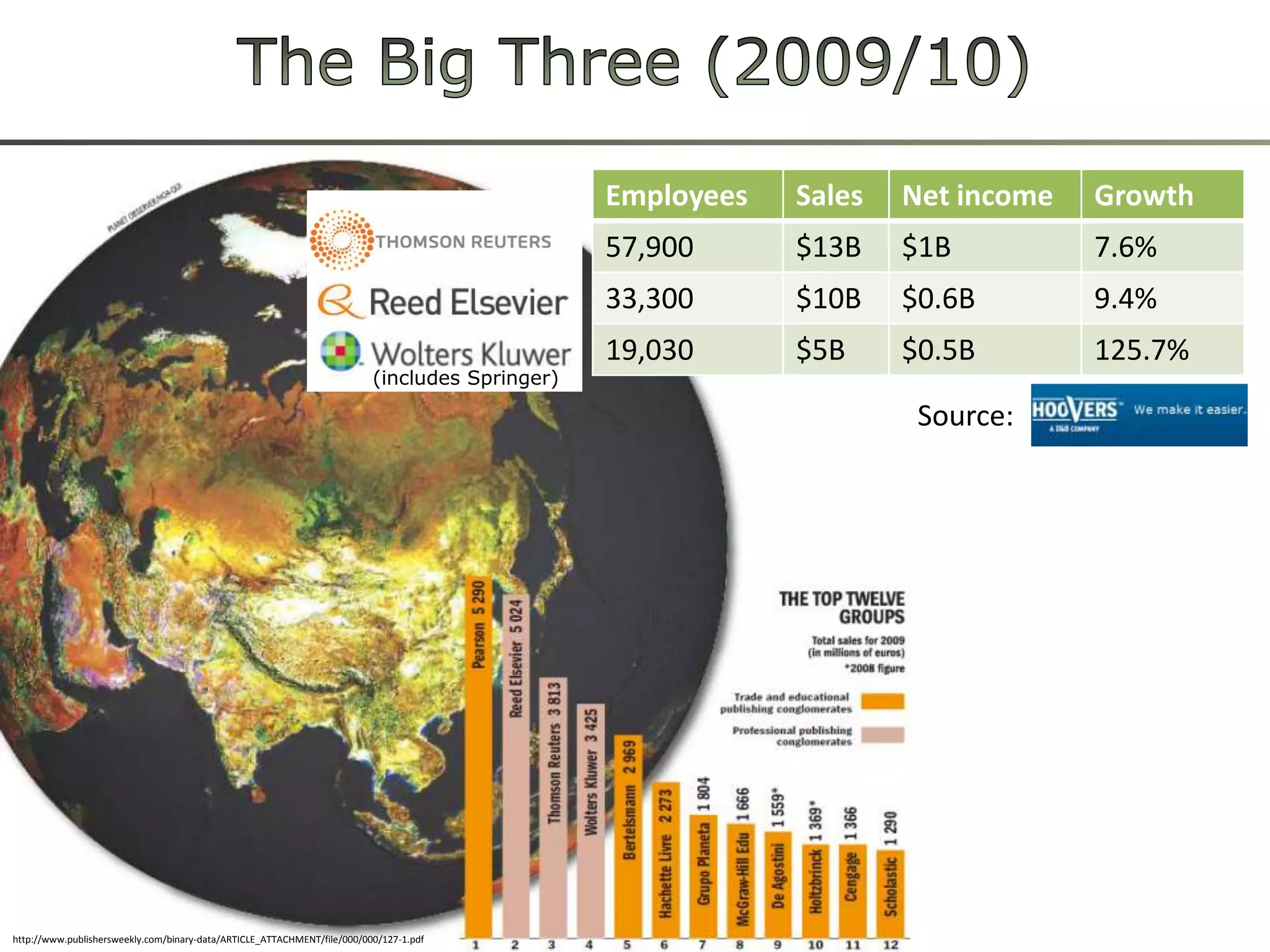
The Big Three (2009/10)(includes Springer)Source:http://www.publishersweekly.com/binary-data/ARTICLE_ATTACHMENT/file/000/000/127-1.pdf
Profits
Journals Crisis (not just Elsevier!)% ChangeModifiedfrom ARL: http://www.arl.org/bm~doc/arlstats06.pdf, http://www.arl.org/bm~doc/arlstat08.pdf
Subscription PricingKIT Library10 Most expensive journal subscriptions 2010/11http://www.bibliothek.kit.edu/cms/teuerste-zeitschriften.php
Subscription PricingSOURCE:LJ PERIODICALS PRICE SURVEY 2010
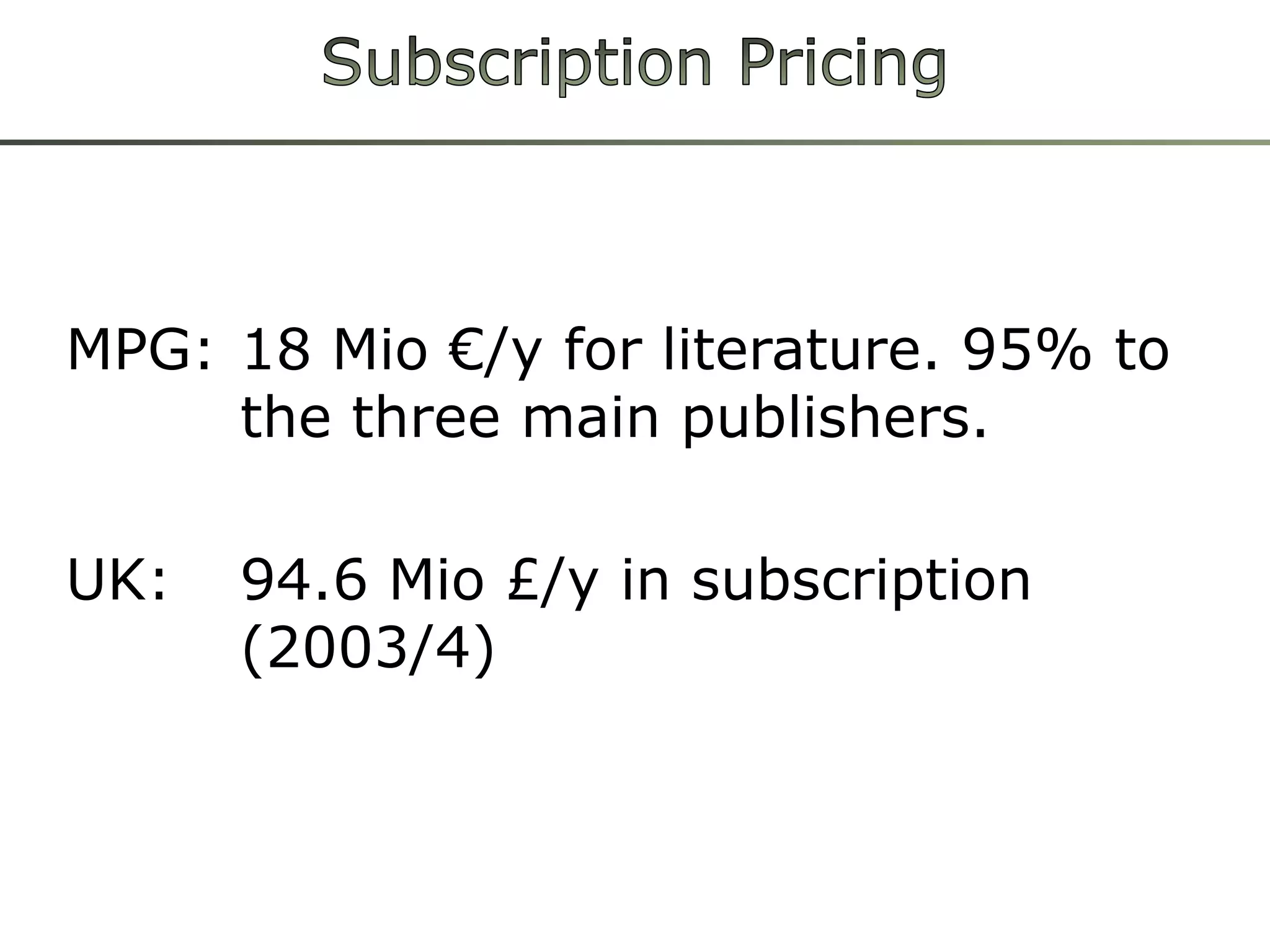
Subscription PricingMPG:	18 Mio €/y forliterature. 95% tothethreemainpublishers.UK:	94.6 Mio £/y in subscription (2003/4)
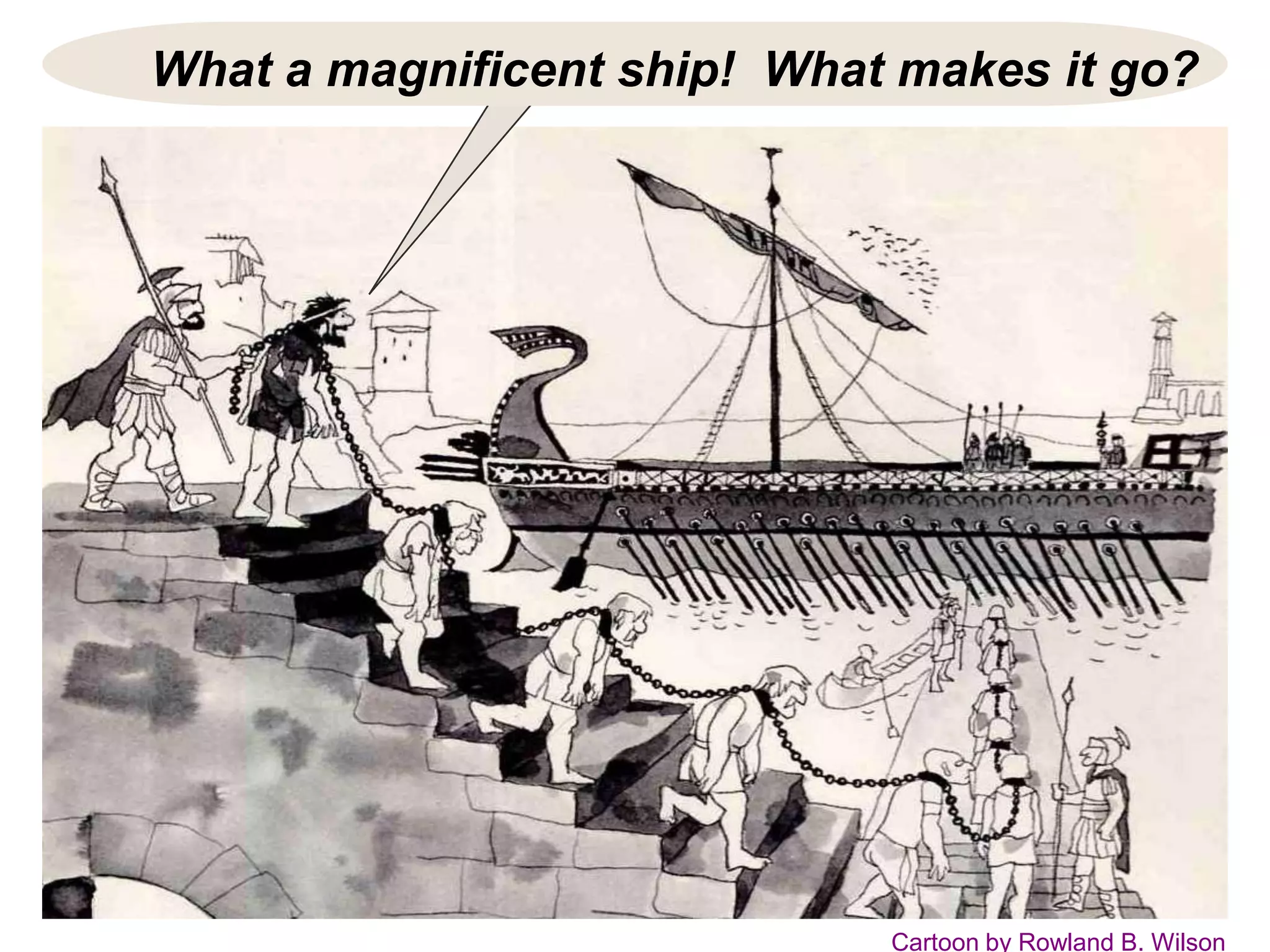
What a magnificent ship!  What makes it go?Cartoon by Rowland B. Wilson
Library responsesRequest increased budgetsCut subscriptionsCollective purchase of electronic journalsRely on document delivery or ILLUC: boycott NPG!Ray English
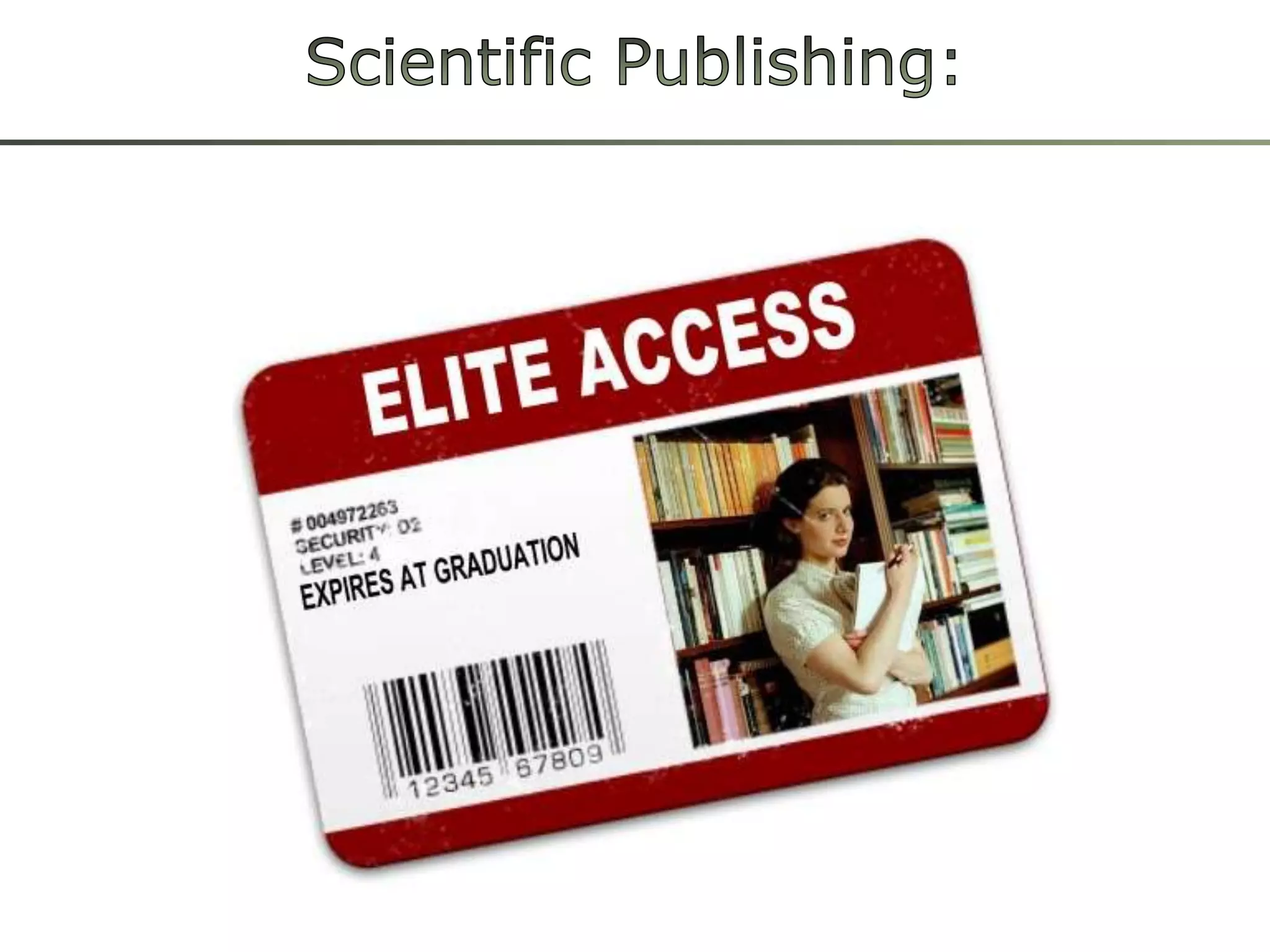
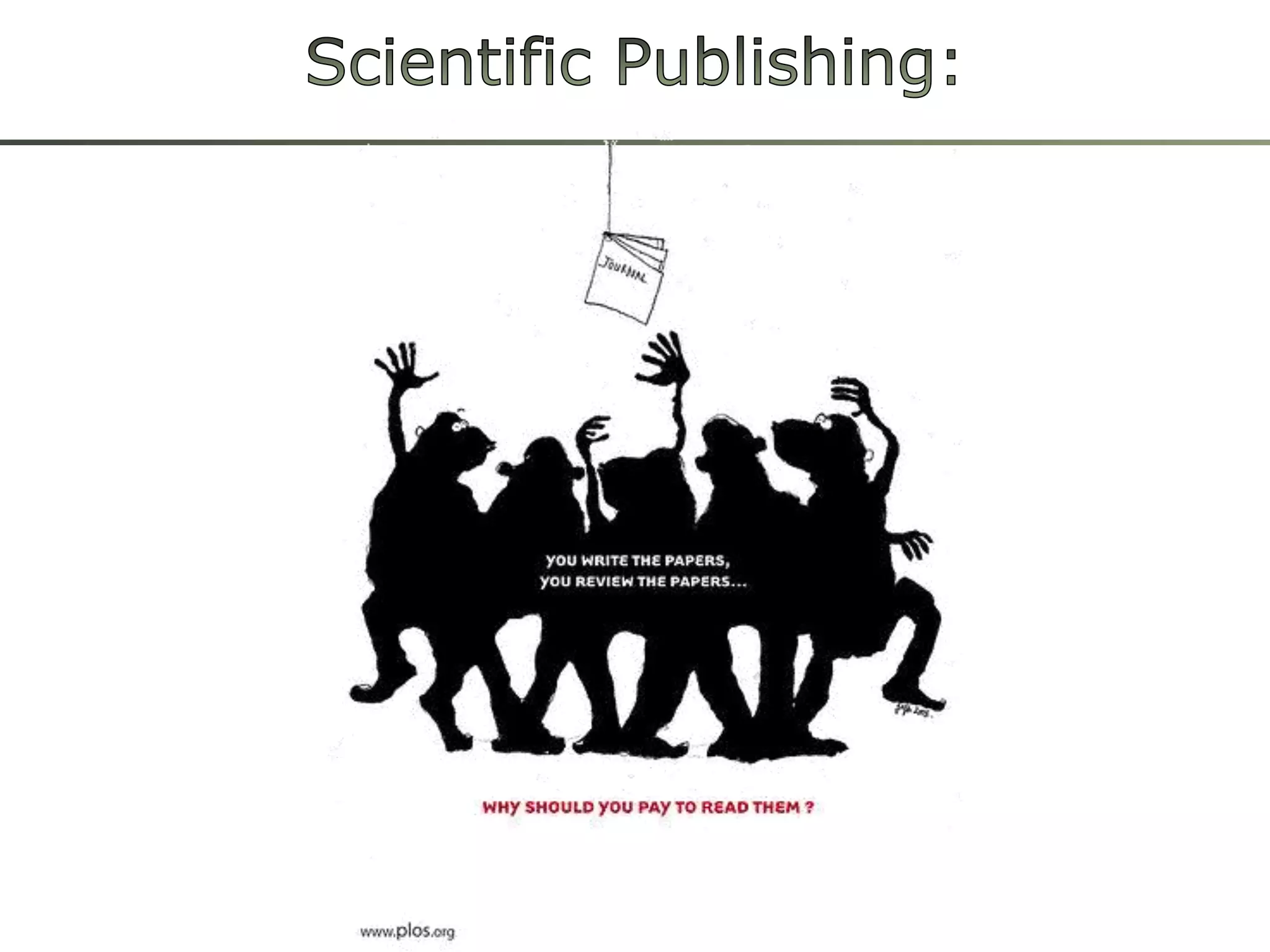
Scientific Publishing:
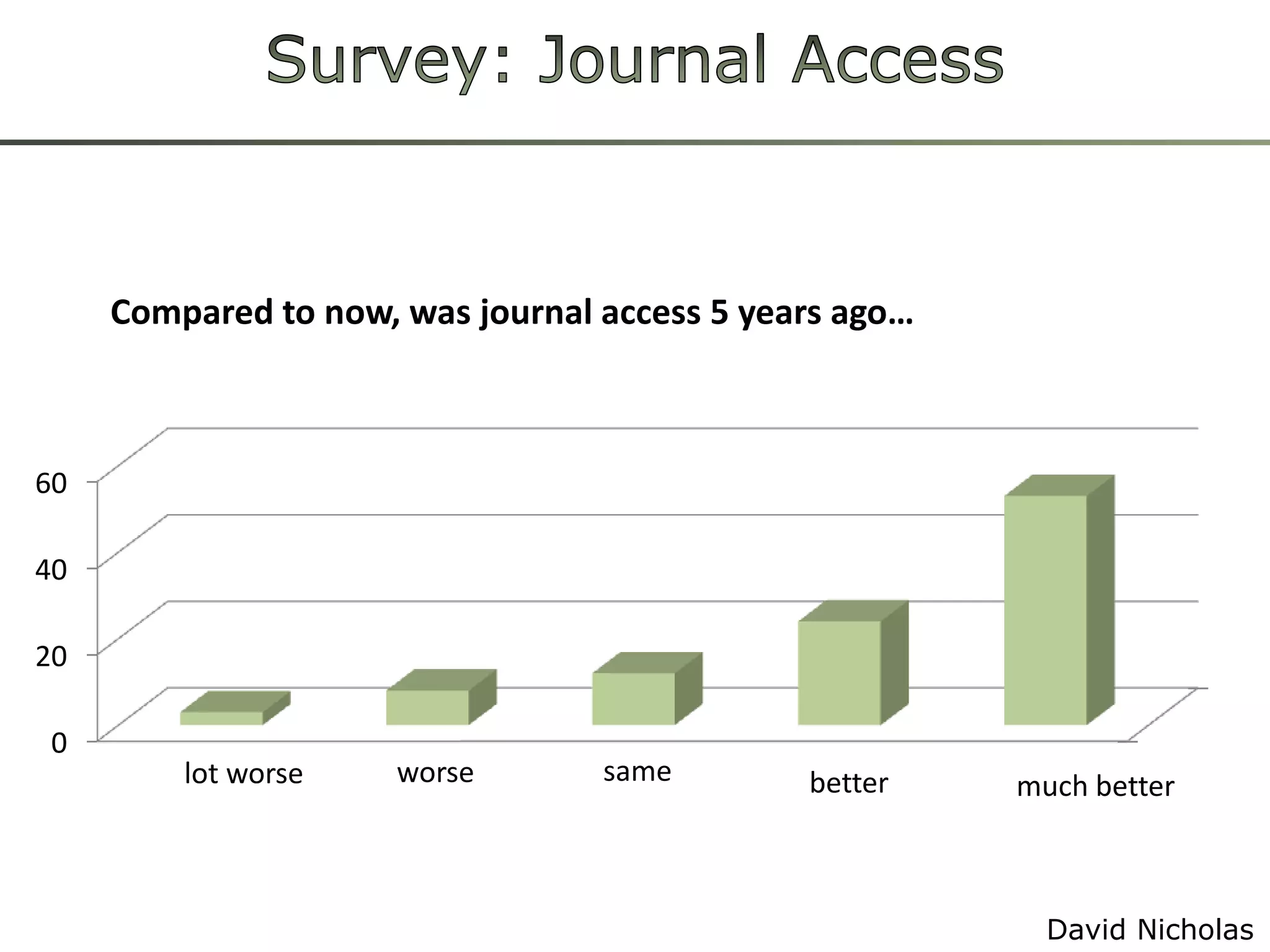
Survey: Journal AccessDavid Nicholas
Publishing yesterday…
Scholarship as a Public Good Funded by Taxpayers
Scholarship as a Public Good Supported publicly
Scholarship as a Public Good Created in the non-profit sector
Scholarship as a Public Good No profit for article authors
Scholarship as a Public Good Profit for corporate publishers
ScholarshipA Public Good in Private Hands
Scientific Publishing:
Think…
Onesolution: Open Access“Open-access (OA) literature is digital, online, free of charge, and free of most copyright and licensing restrictions.” Peter Suber
Open AccessGold OAPublishing in an Open Access journalCurrently 6722peer-reviewed open access journals listed in the Lund Directory of Open Access Journals doaj.org Green OASelf-archiving in an institutional repository or PubMed CentralOver 1400 open repositories already established world-wide
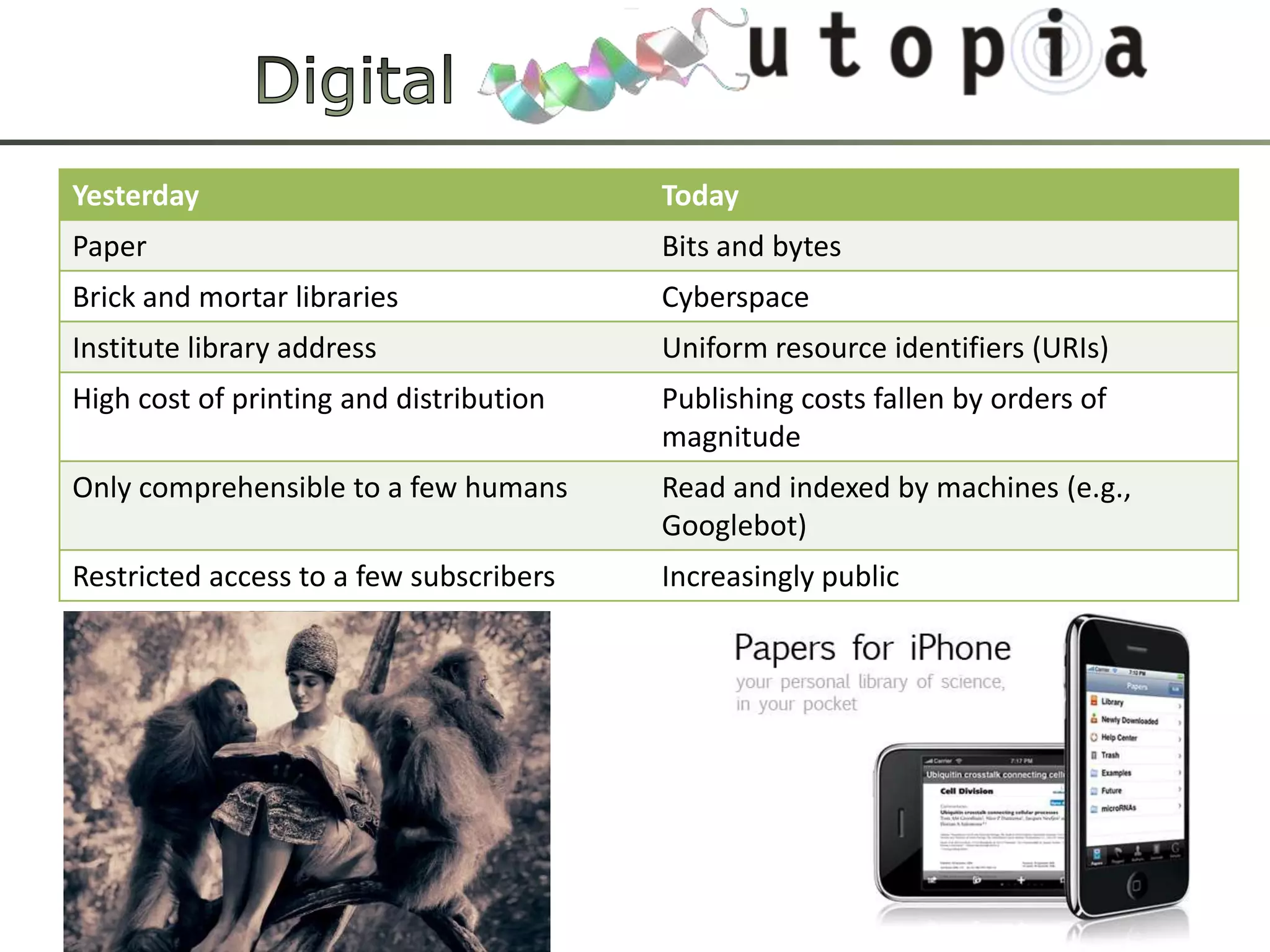
Digital
But: Everything’s Gone Digital! www.scopus.comwww.pubmed.govhttp://ukpmc.ac.ukisiknowledge.comscholar.google.comDuncan Hull
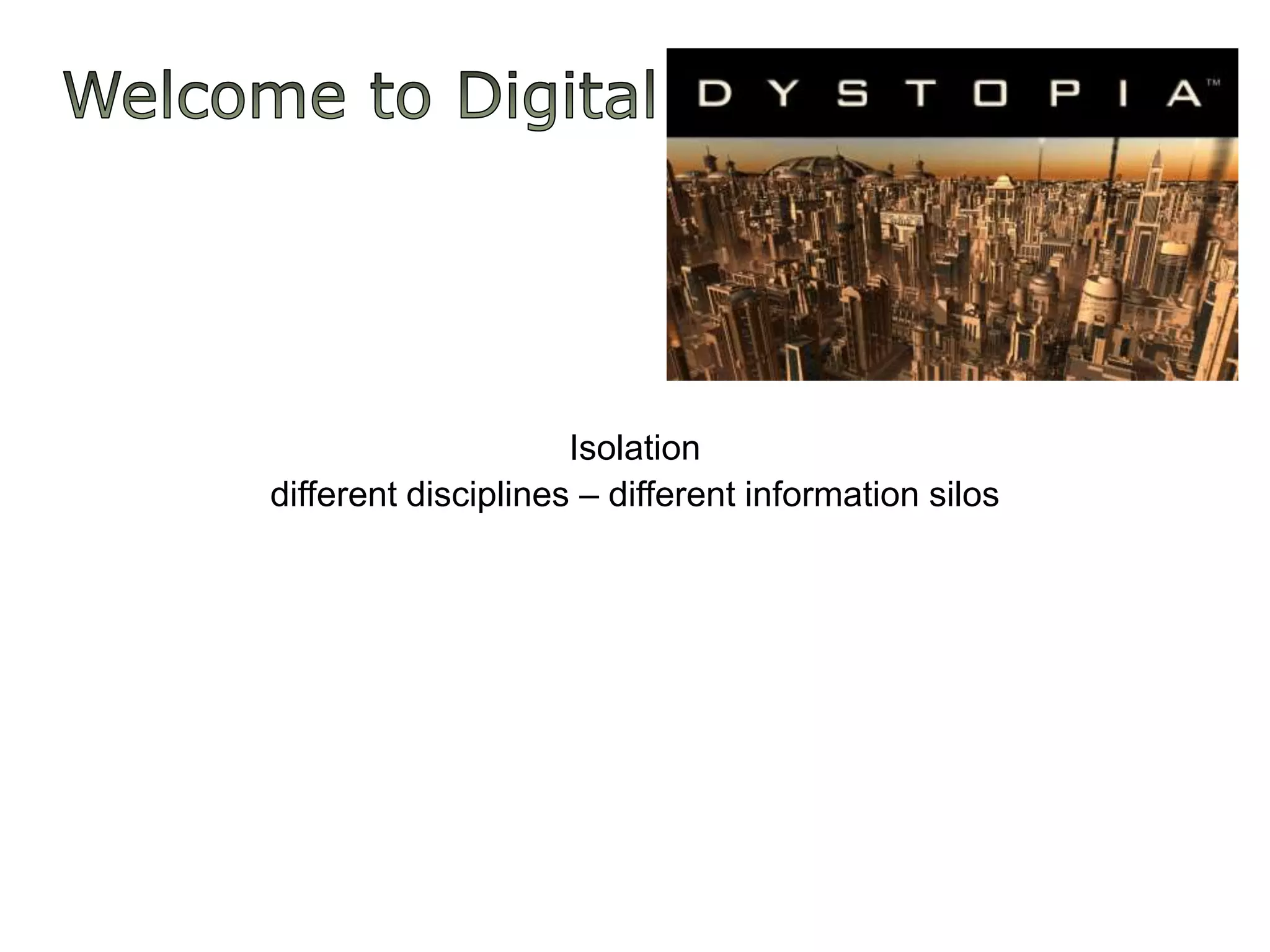
Welcome to Digital Isolationdifferent disciplines – different information silos
Welcome to Digital Impersonal and unsociable“who the hell are you”?Where are “my” papers?What are my friends and colleagues reading?What are the experts reading?What is popular this week / month / year?
Welcome to Digital Obsolete models of publicationNot everything fits publication-sized holesMicro-attributionMega-attributionDigital contributions (databases, software, wikis/blogs?)
Welcome to Digital ColdIdentity of publications and authors is inadequate
Open AccessIdentity CrisisHowcan I find anything?
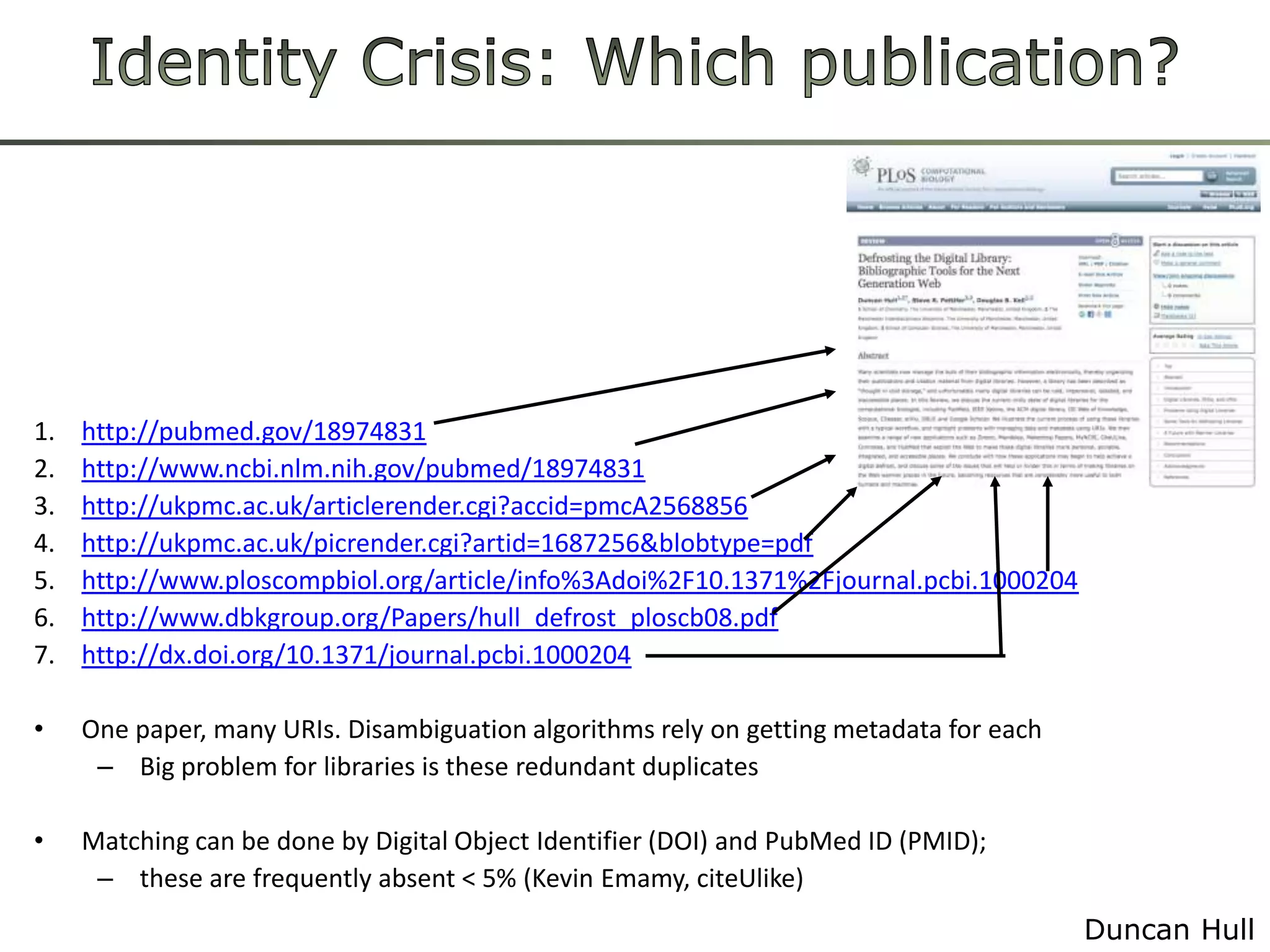
Identity Crisis: Which publication?http://pubmed.gov/18974831http://www.ncbi.nlm.nih.gov/pubmed/18974831http://ukpmc.ac.uk/articlerender.cgi?accid=pmcA2568856http://ukpmc.ac.uk/picrender.cgi?artid=1687256&blobtype=pdfhttp://www.ploscompbiol.org/article/info%3Adoi%2F10.1371%2Fjournal.pcbi.1000204http://www.dbkgroup.org/Papers/hull_defrost_ploscb08.pdfhttp://dx.doi.org/10.1371/journal.pcbi.1000204One paper, many URIs. Disambiguation algorithms rely on getting metadata for eachBig problem for libraries is these redundant duplicatesMatching can be done by Digital Object Identifier (DOI) and PubMed ID (PMID); these are frequently absent < 5% (Kevin Emamy, citeUlike)Duncan Hull
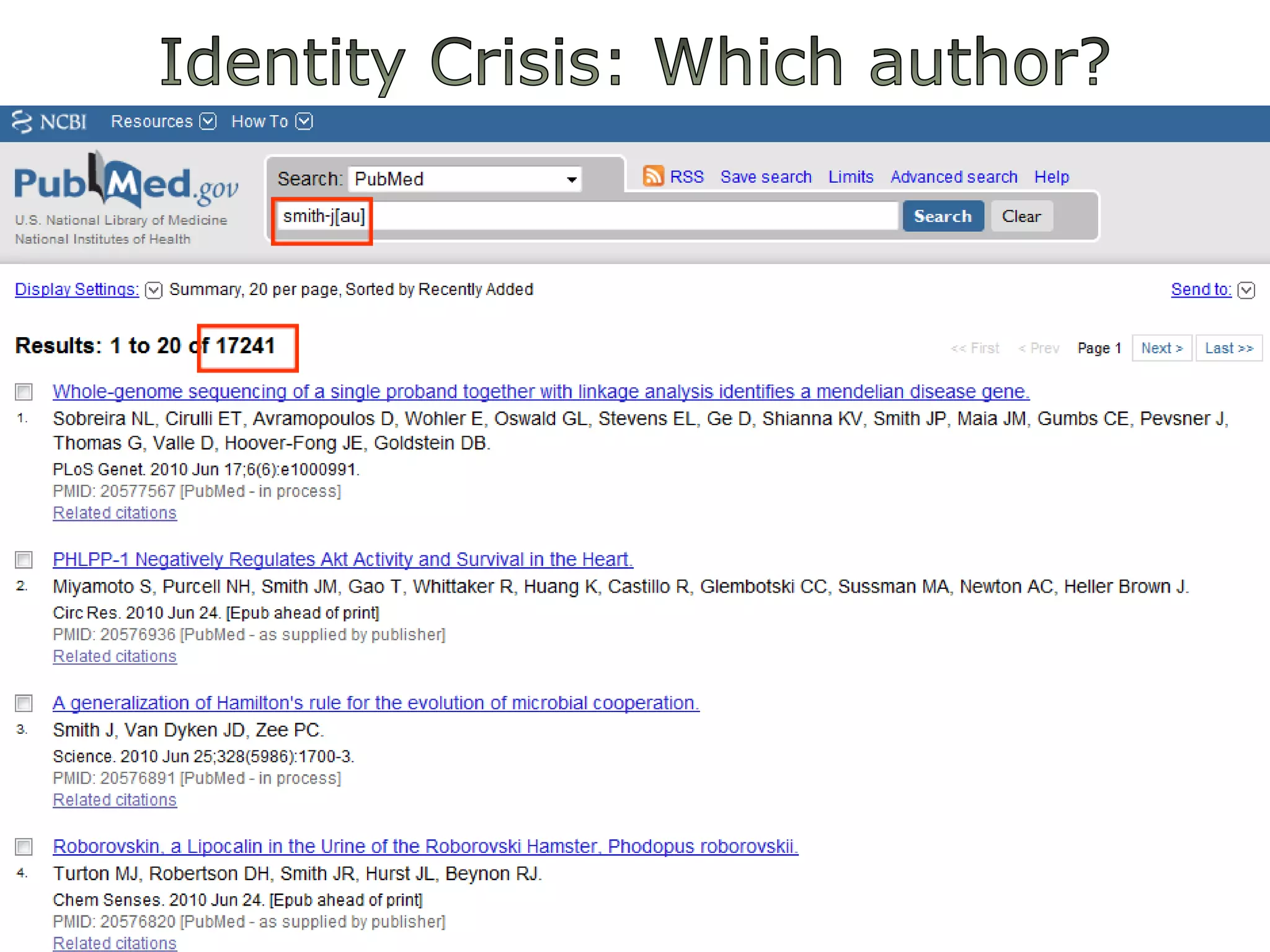
Identity Crisis: Whichauthor?
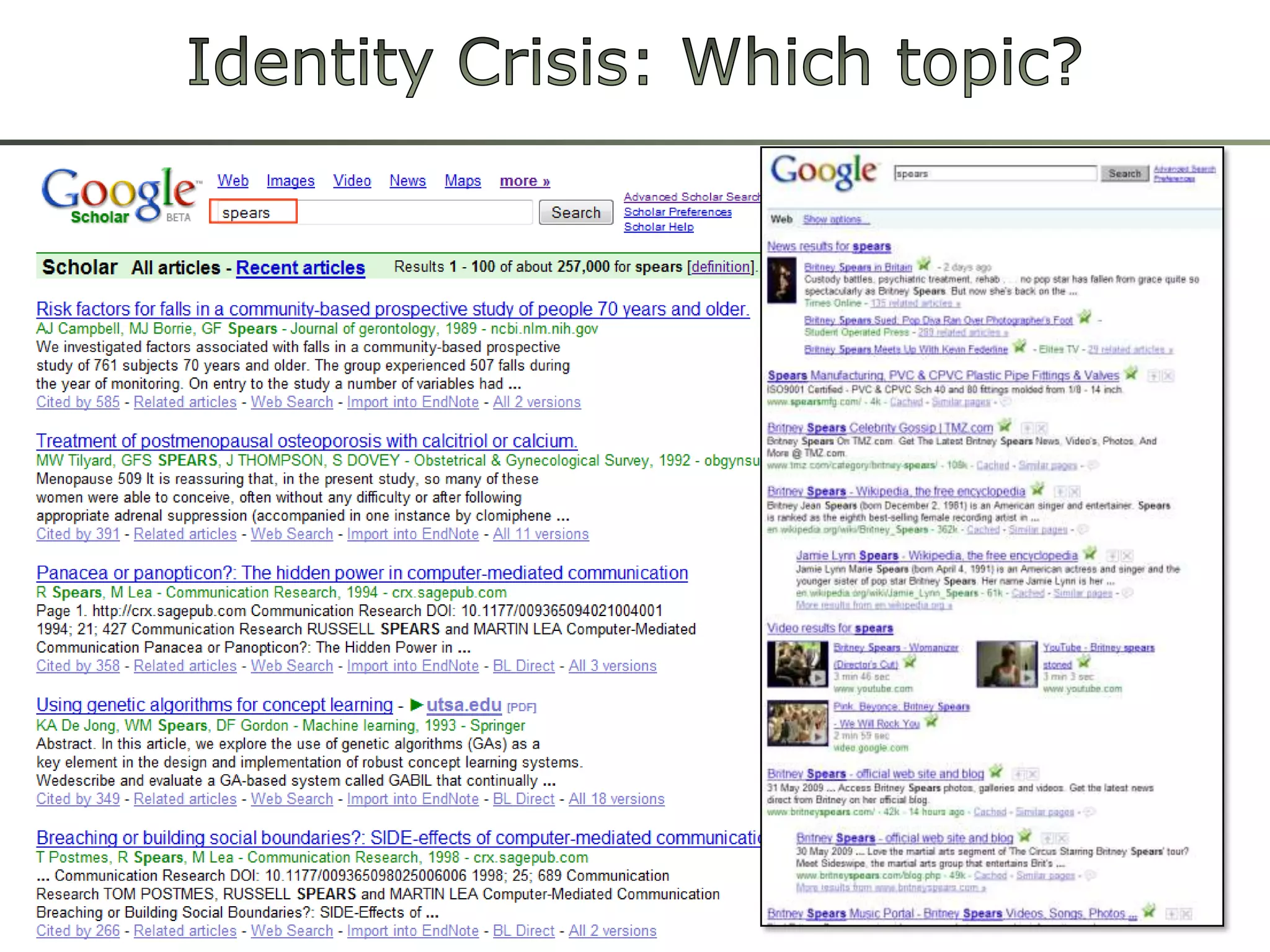
Identity Crisis: Whichtopic?
Think…
Onesolution: Unique identifiersDifficult with fragmented information silos
Onesolution: Unique identifiersSeveral initiatives
Onesolution: Unique identifiersExamples: PubMedID, DOI, ORCID, Semantic Web
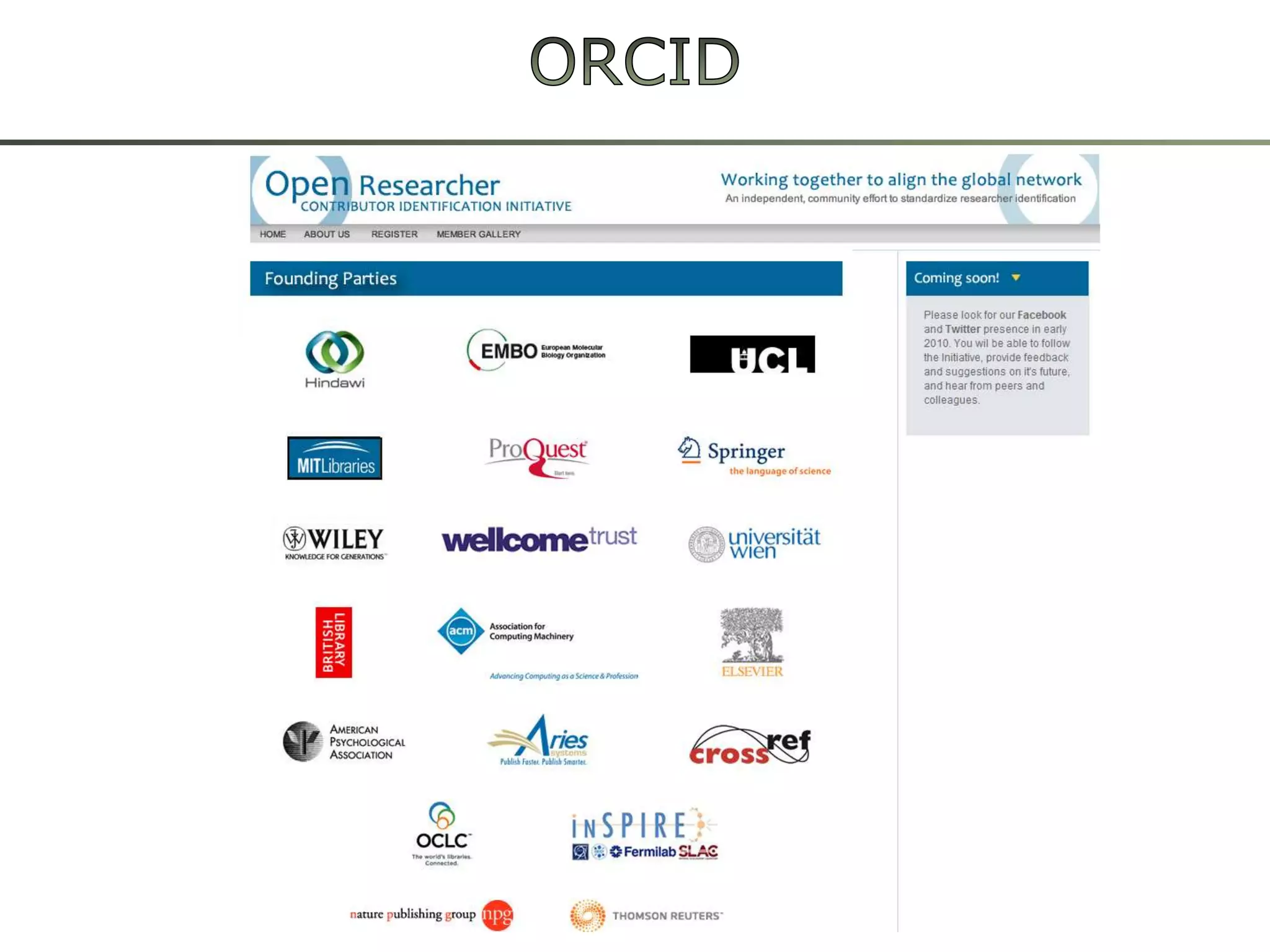
ORCID
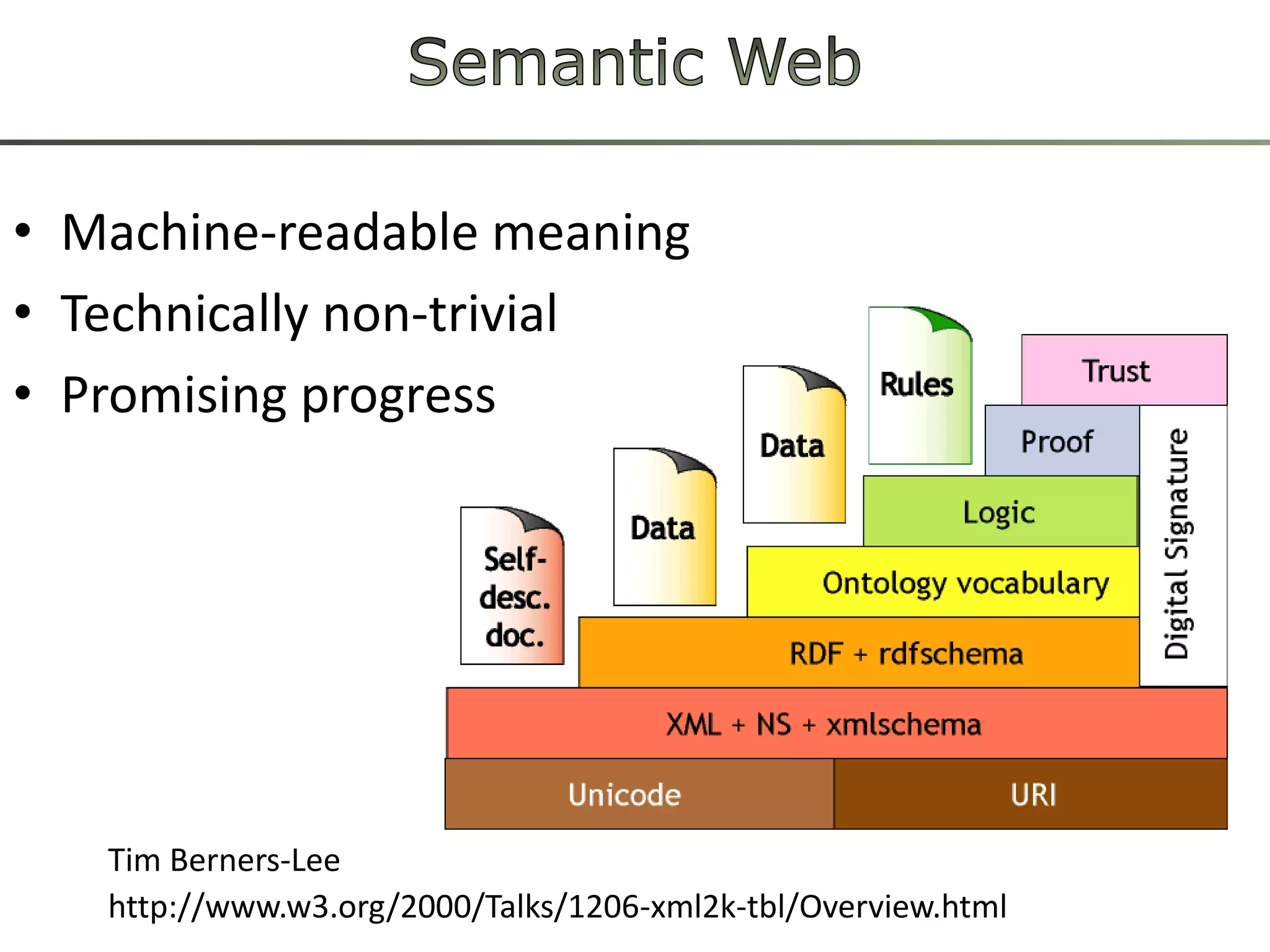
Semantic WebMachine-readablemeaningTechnically non-trivialPromising progressTim Berners-Leehttp://www.w3.org/2000/Talks/1206-xml2k-tbl/Overview.html
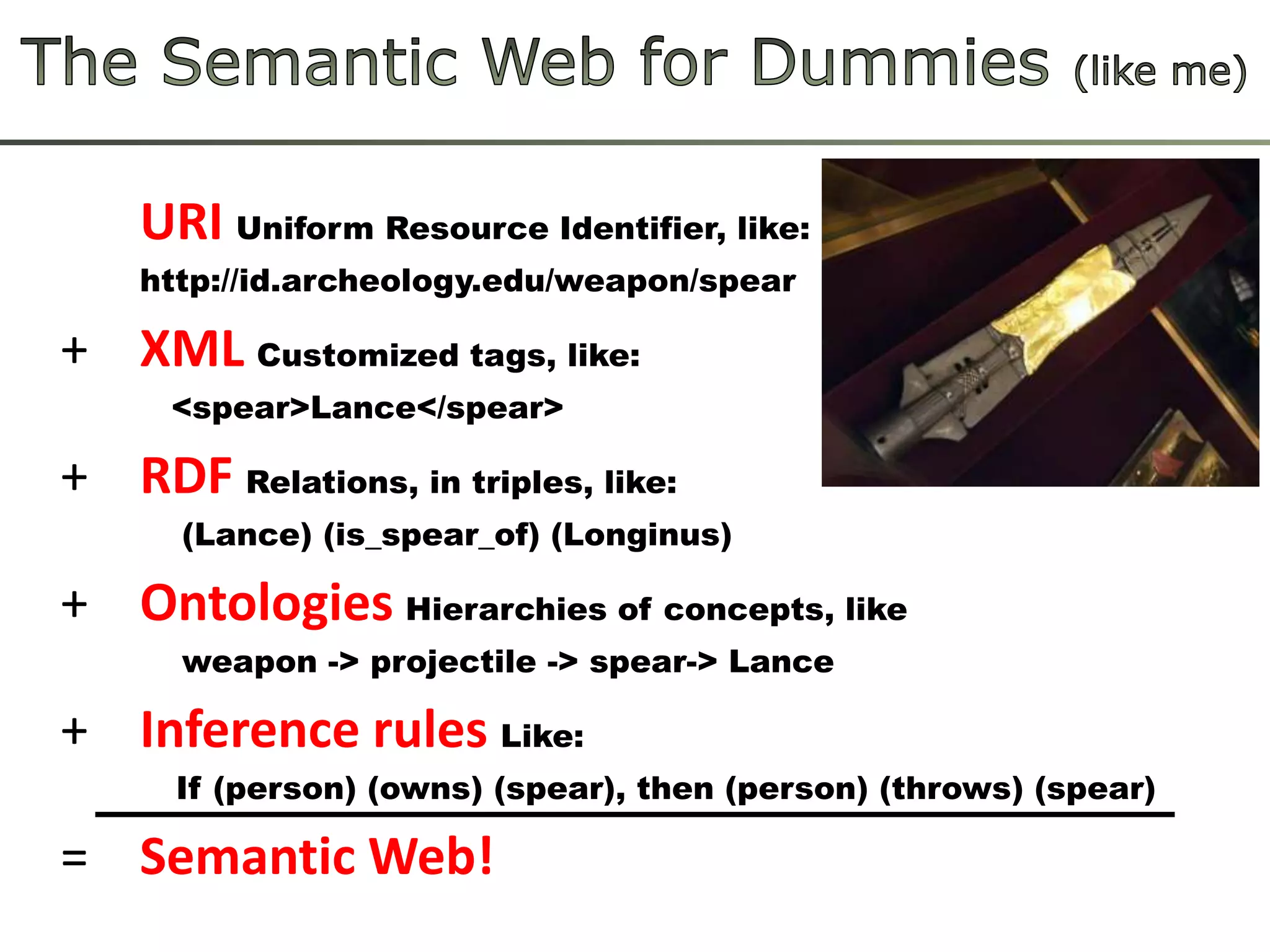
The Semantic Web for Dummies (like me)URIUniform Resource Identifier, like:		http://id.archeology.edu/weapon/spear	+	XMLCustomized tags, like:<spear>Lance</spear>	+	RDFRelations, in triples, like: (Lance) (is_spear_of) (Longinus)	+	OntologiesHierarchies of concepts, likeweapon -> projectile -> spear-> Lance	+	Inference rulesLike:If (person) (owns) (spear), then (person) (throws) (spear)	=	Semantic Web!
Digital dystopiaInformation (Overload) CrisisOr filter failure?
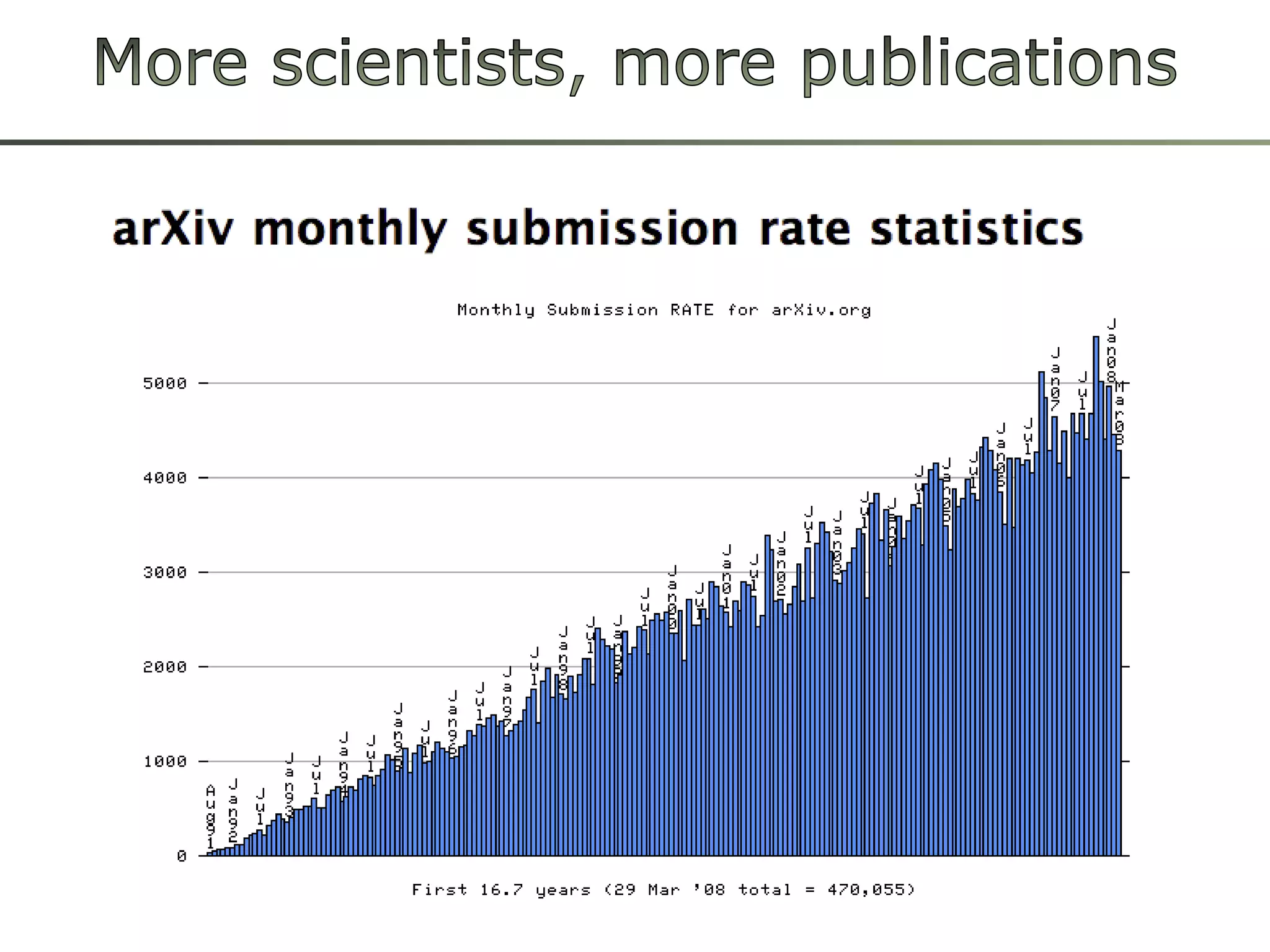
More scientists, morepublications
Information Crisis1.5 millionpublications per year in 24,000 journals
Information CrisisFinding ‘my’ publications is impossible!
Information CrisisPublishorPerish: numberofpublications
Information Crisis60-300 applicants per tenure-trackposition
Information CrisisReading enoughpublicationsisimpossible!
Think…
Onesolution: JournalRankSource Normalized Impact per PaperThomson Reuters: Impact FactorEigenfactor (now Thomson Reuters)ScImago JournalRank (SJR)Scopus: SNIP, SJR
Onesolution: JournalRankOnlyreadpublicationsfromhigh-rankingjournals
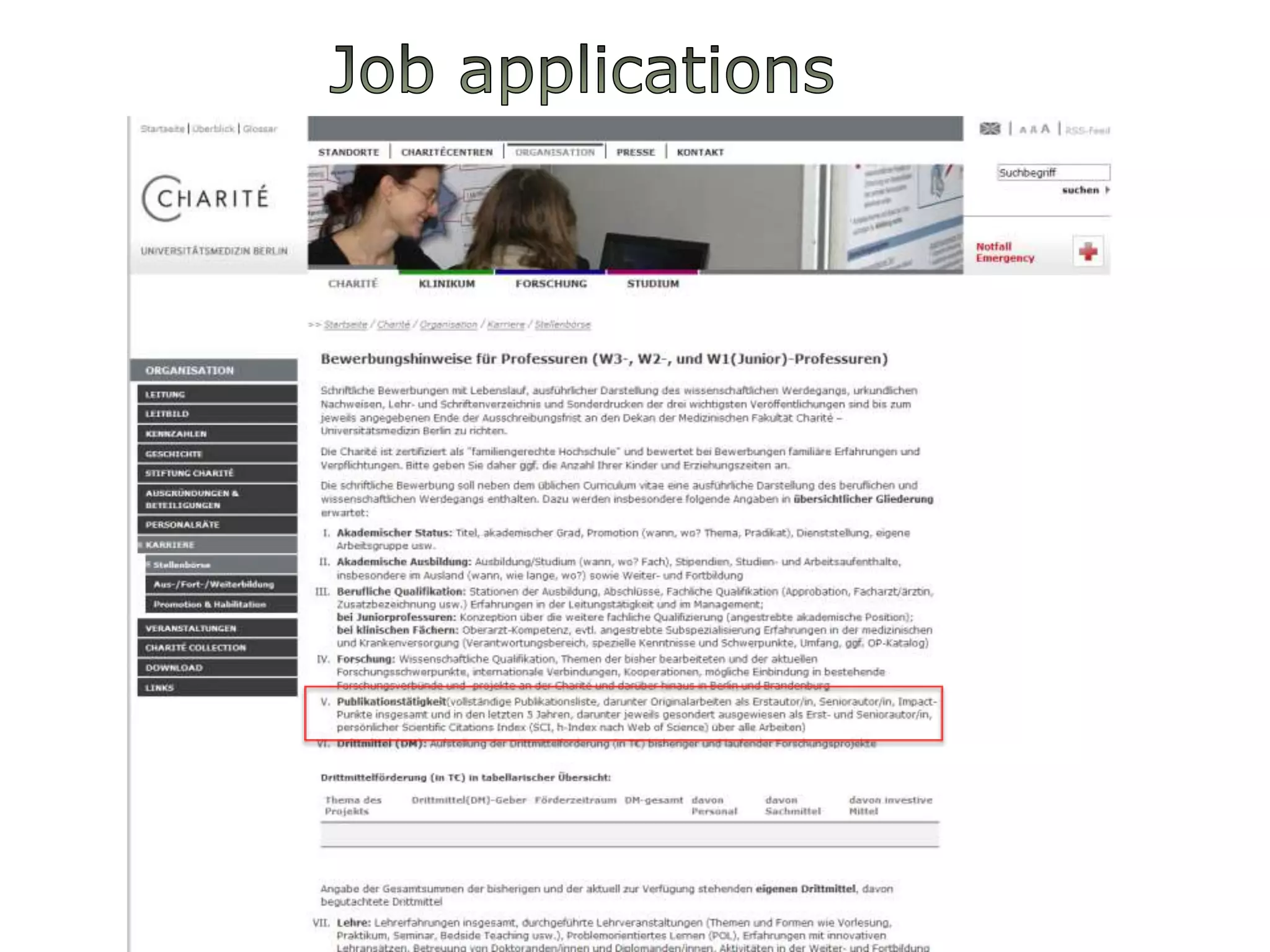
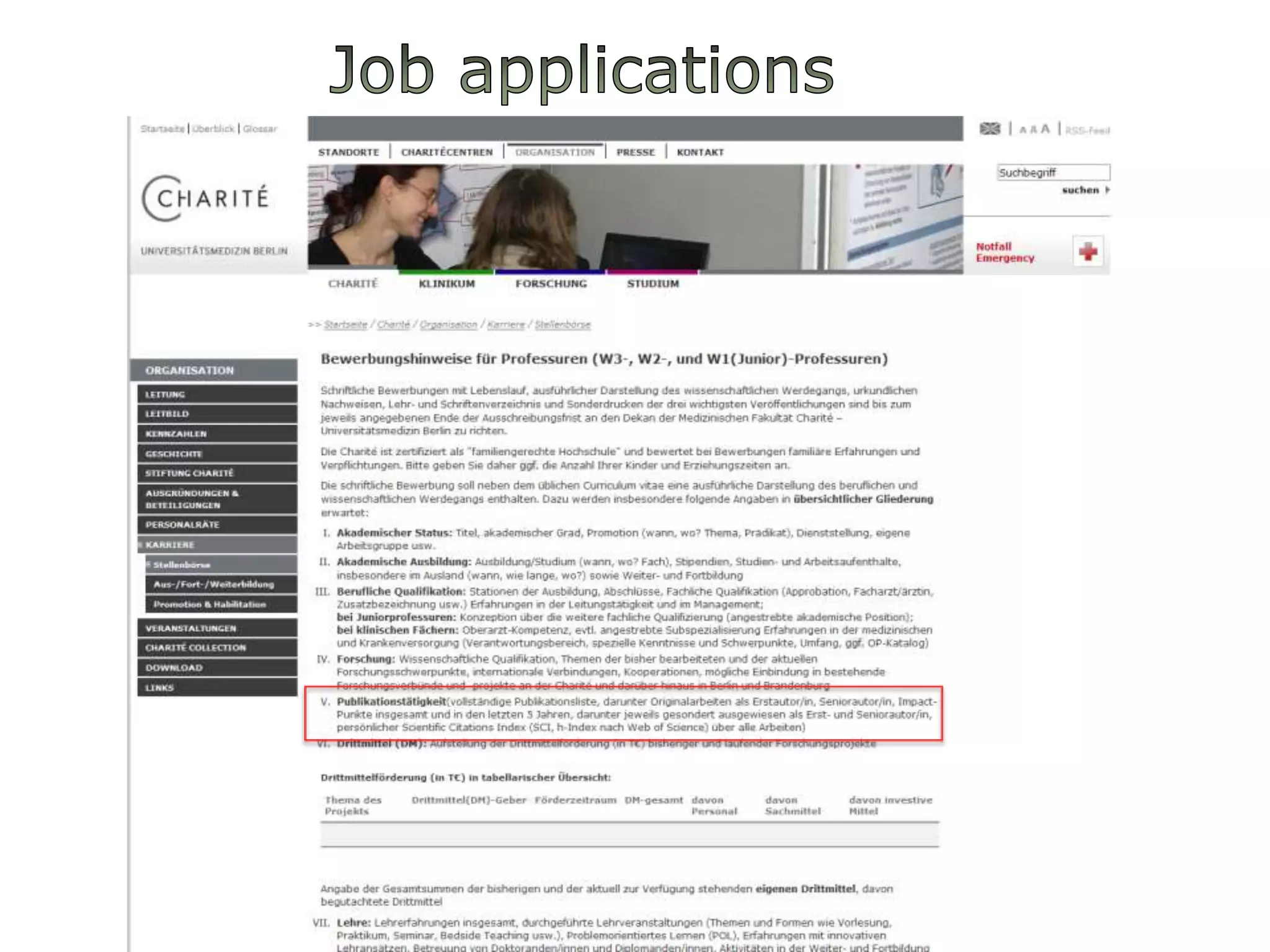
Job applications
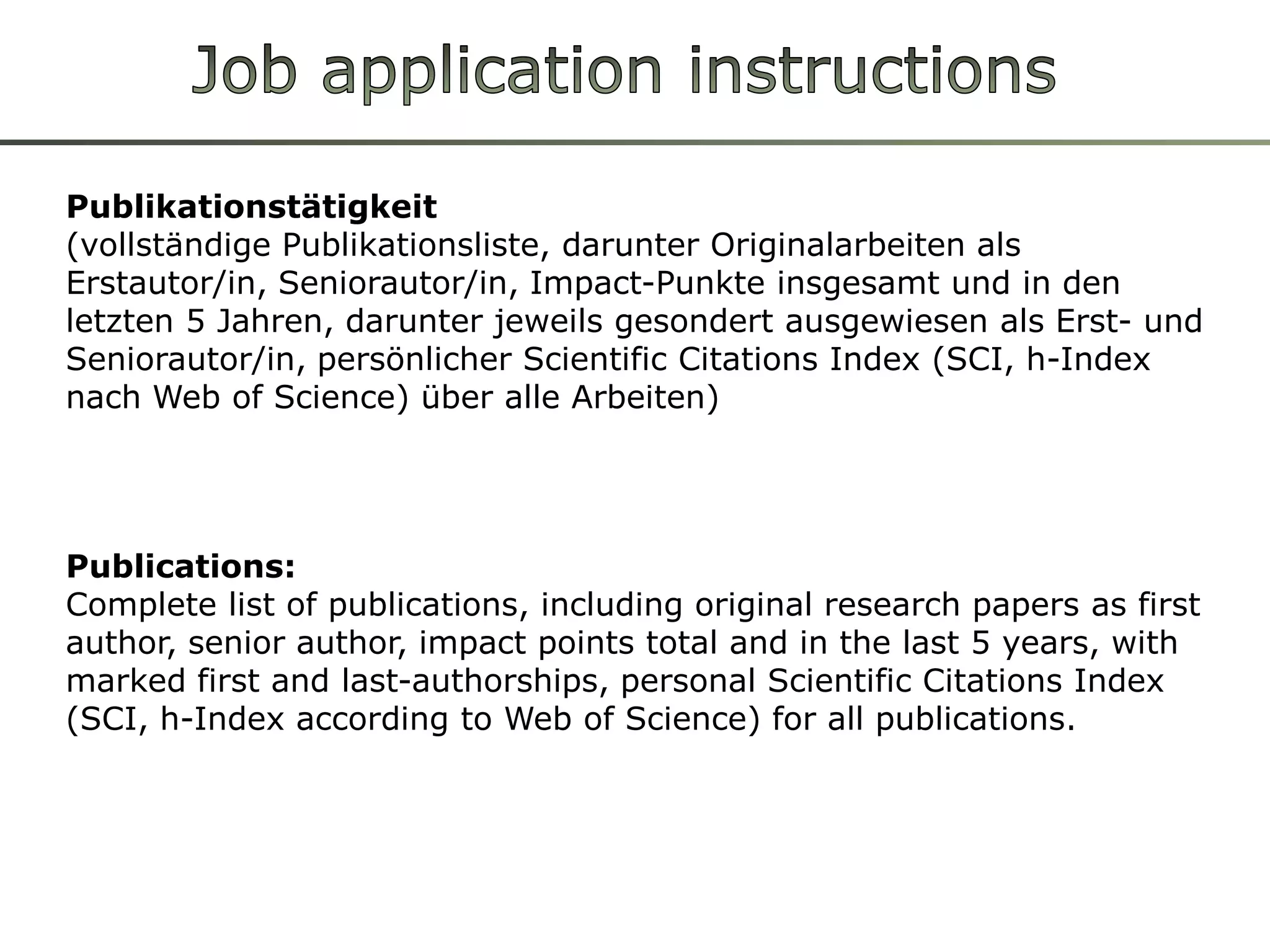
Job applicationinstructionsPublikationstätigkeit(vollständige Publikationsliste, darunter Originalarbeiten als Erstautor/in, Seniorautor/in, Impact-Punkte insgesamt und in den letzten 5 Jahren, darunter jeweils gesondert ausgewiesen als Erst- und Seniorautor/in, persönlicher Scientific Citations Index (SCI, h-Index nach Web of Science) über alle Arbeiten)Publications:Completelistofpublications, including original researchpapersasfirstauthor, seniorauthor, impactpoints total and in the last 5 years, withmarkedfirstand last-authorships, personal Scientific Citations Index (SCI, h-Index accordingto Web of Science) for all publications.
MetricsLies, damn lies andbibliometrics
Show of hands:Who knows what the IF is?Who uses the IF to pick a journal (rate a candidate, etc.)?Who knows how the IF is calculated and from what data?
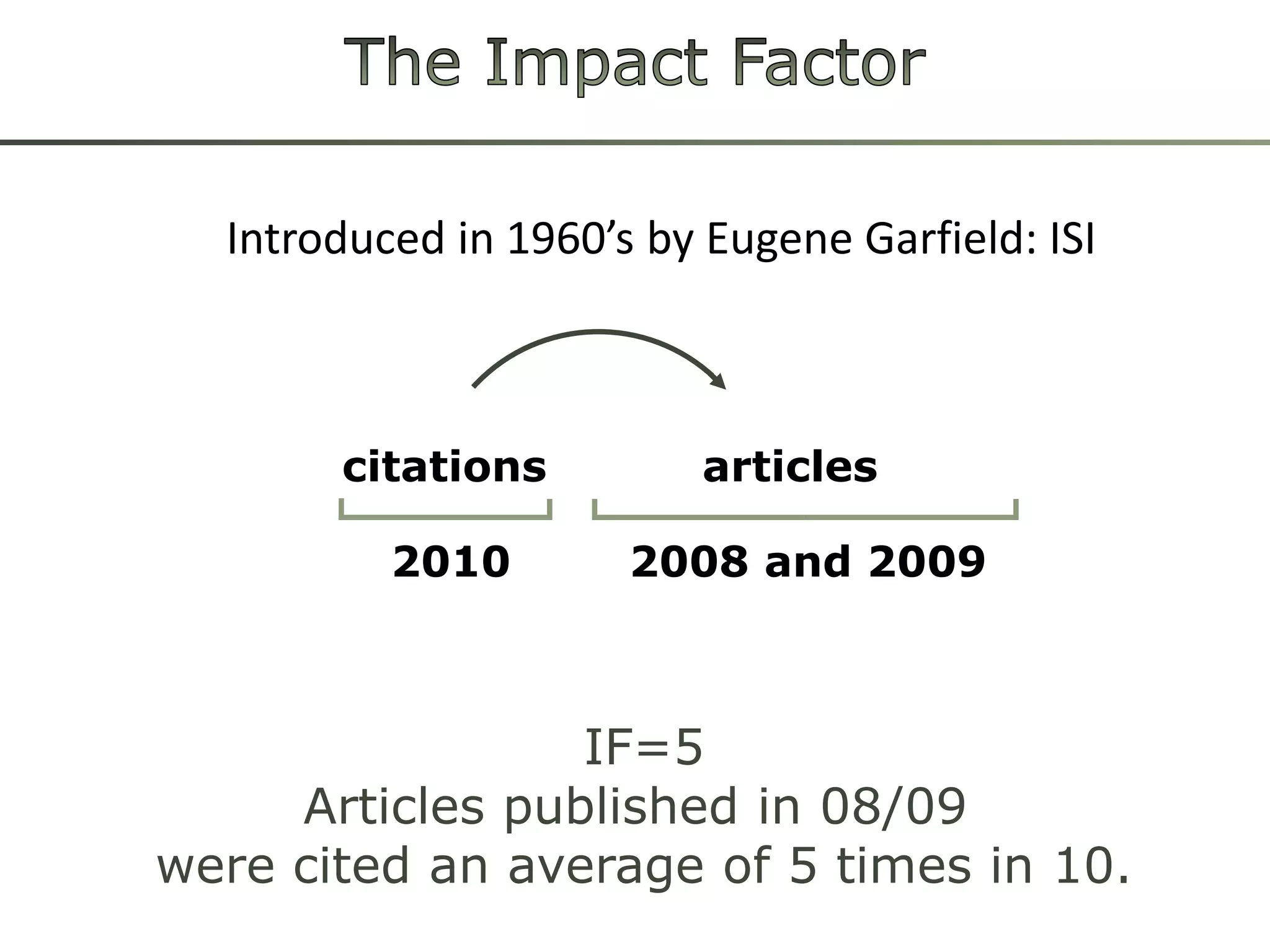
The Impact FactorIntroduced in 1960’s by Eugene Garfield: ISIcitationsarticles2008 and 20092010IF=5Articles published in 08/09 were cited an average of 5 times in 10.
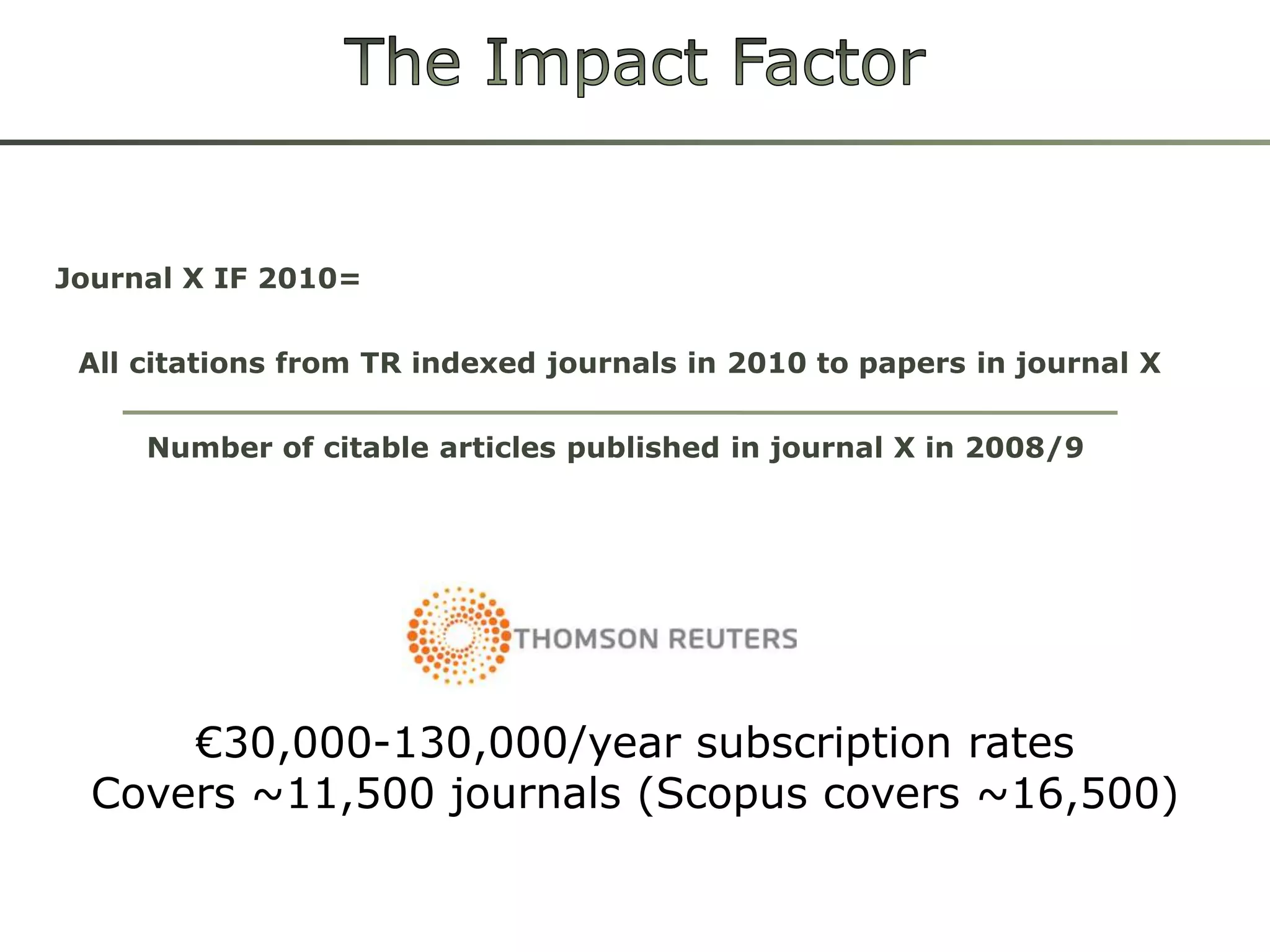
The Impact FactorJournal X IF 2010=All citationsfromTR indexedjournalsin 2010 topapers in journal XNumberofcitablearticlespublished in journal X in 2008/9€30,000-130,000/yearsubscriptionratesCovers ~11,500 journals (Scopuscovers ~16,500)
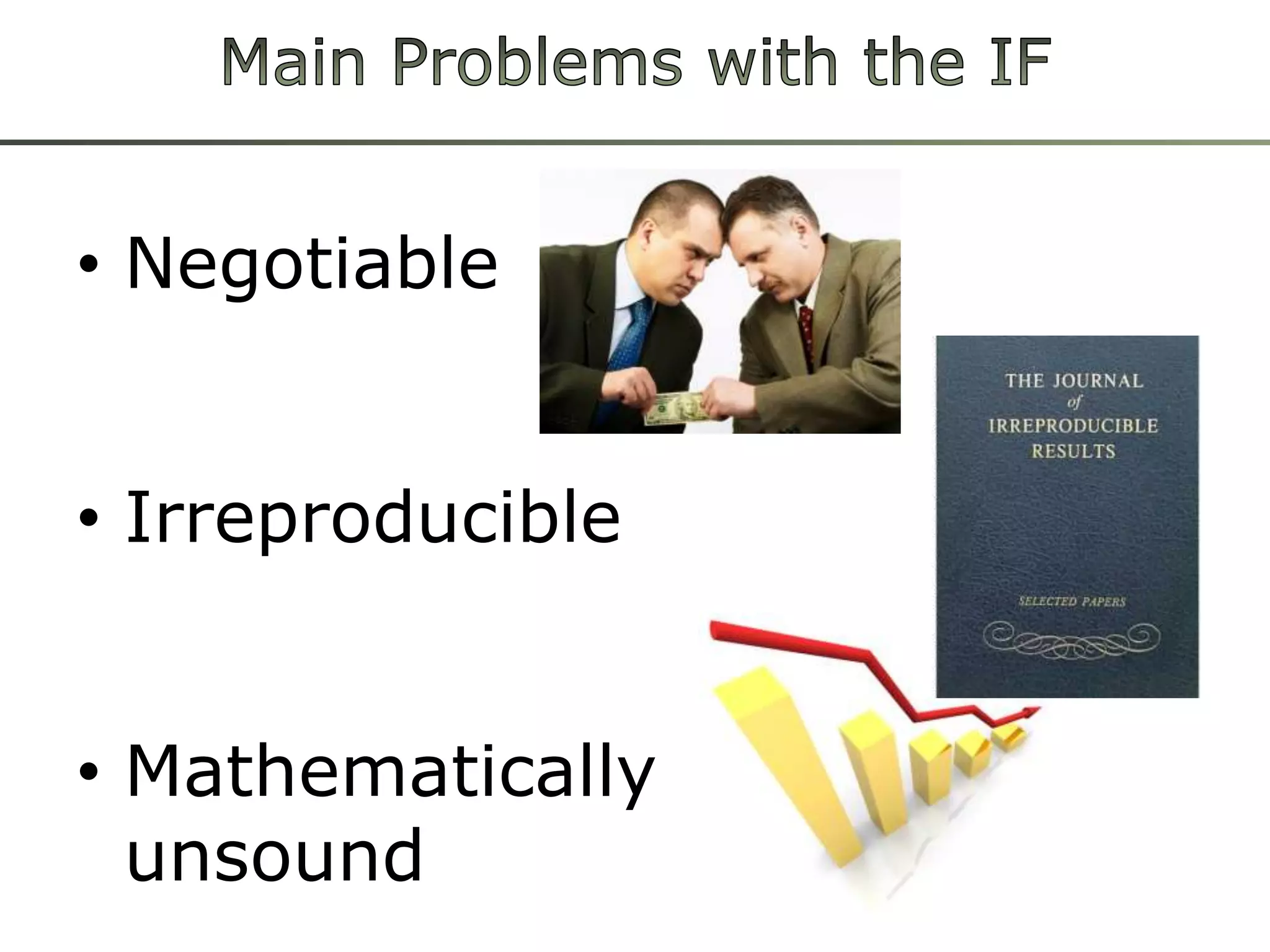
Main Problems withthe IFNegotiableIrreproducibleMathematicallyunsound
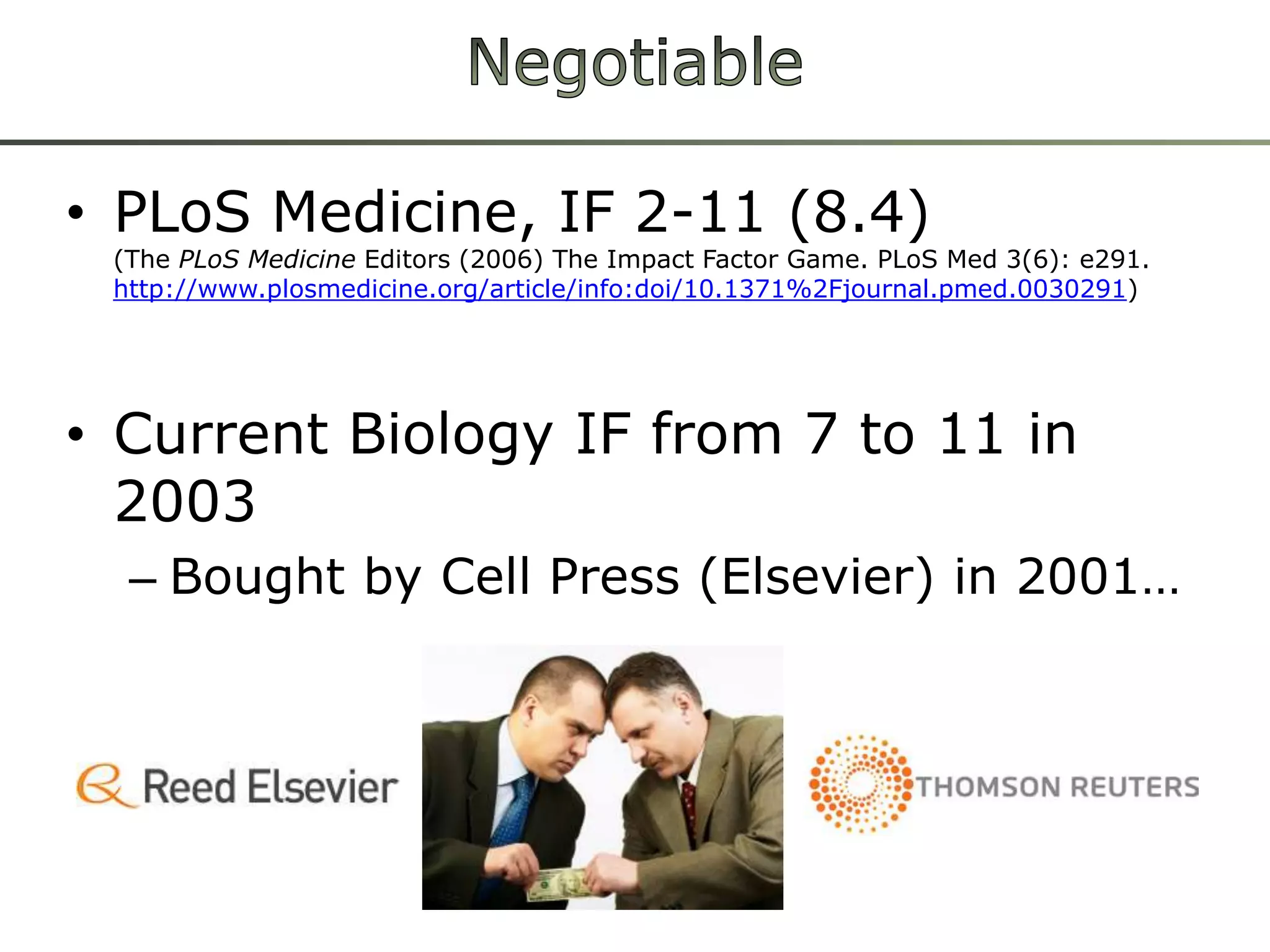
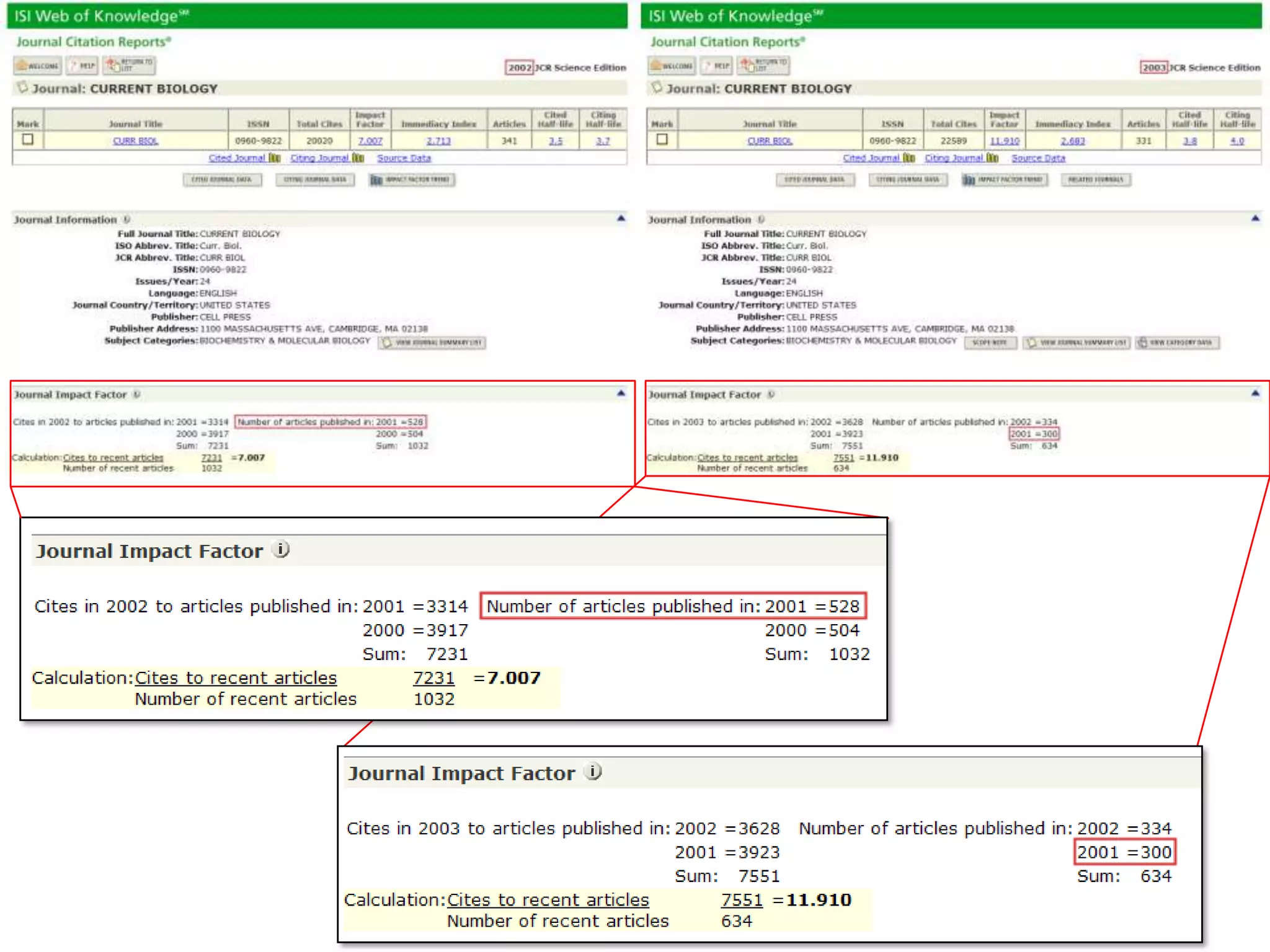
NegotiablePLoSMedicine, IF 2-11 (8.4)(The PLoS Medicine Editors (2006) The Impact Factor Game. PLoS Med 3(6): e291. http://www.plosmedicine.org/article/info:doi/10.1371%2Fjournal.pmed.0030291)CurrentBiology IF from 7 to 11 in 2003BoughtbyCell Press (Elsevier) in 2001…
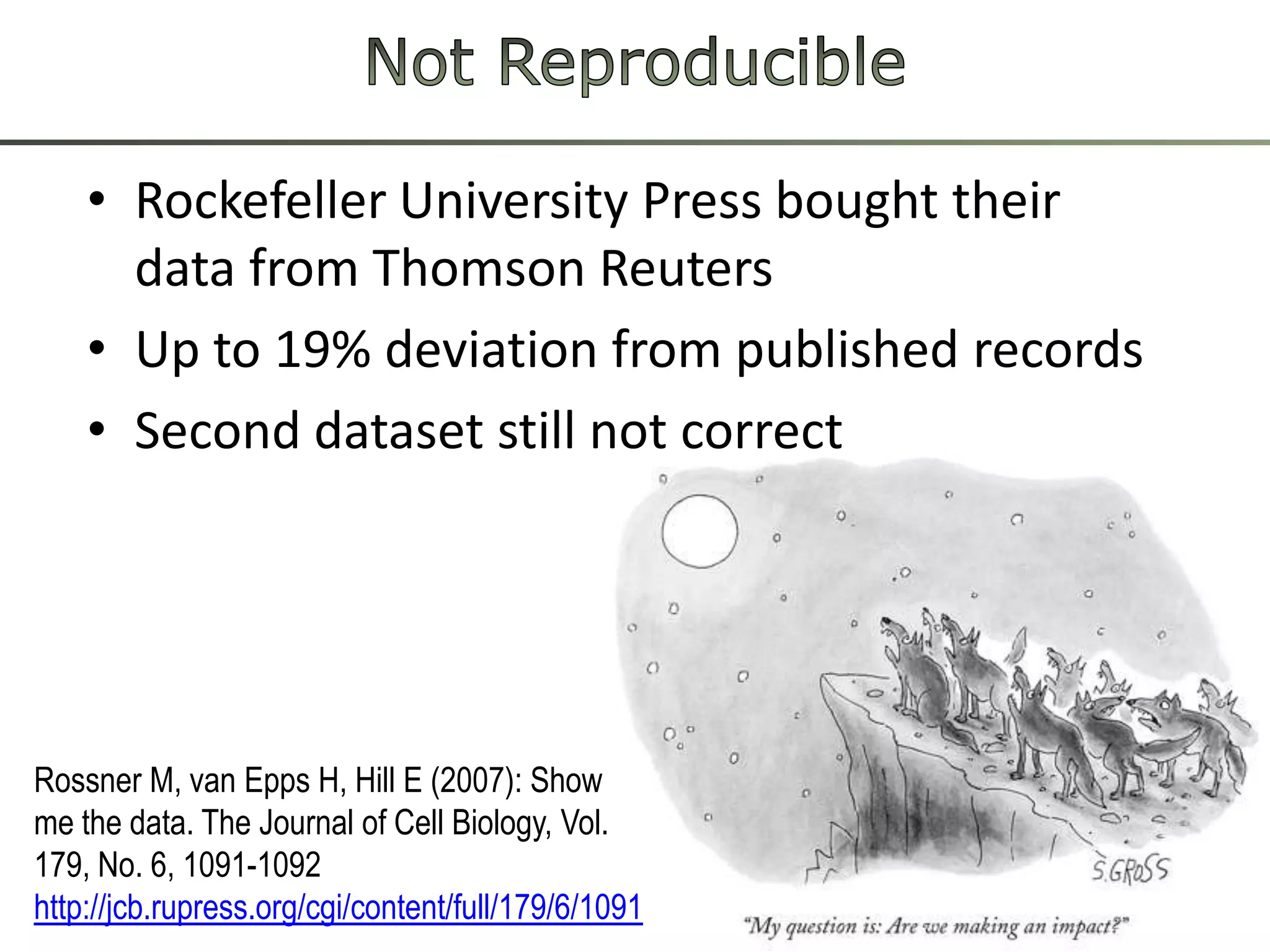
Not ReproducibleRockefeller University Press boughttheirdatafrom Thomson ReutersUpto 19% deviationfrompublishedrecordsSecond dataset still not correctRossner M, van Epps H, Hill E (2007): Show me the data. The Journal of Cell Biology, Vol. 179, No. 6, 1091-1092 http://jcb.rupress.org/cgi/content/full/179/6/1091
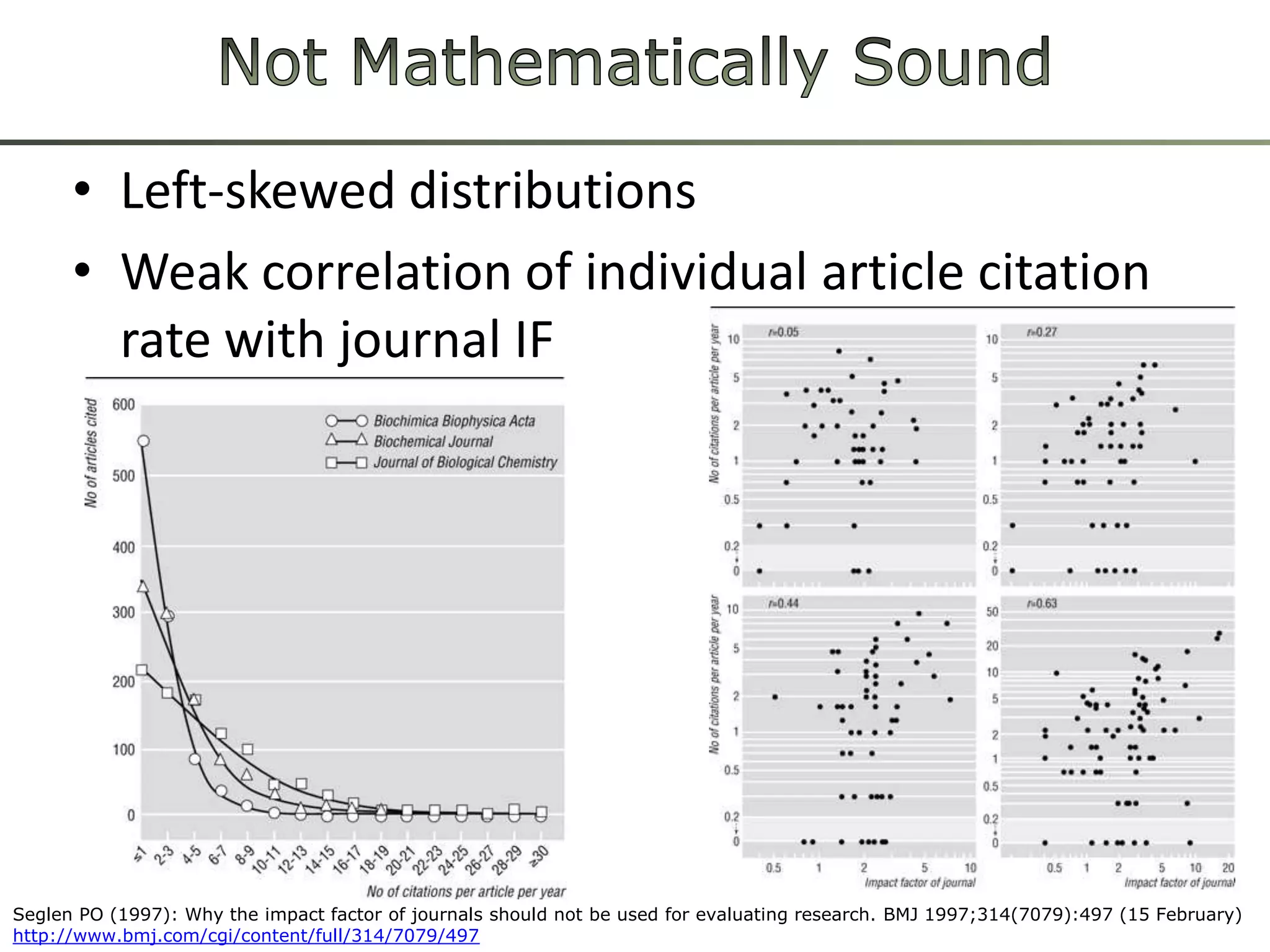
Not MathematicallySoundLeft-skeweddistributionsWeakcorrelationof individual articlecitation rate withjournal IFSeglen PO (1997): Why the impact factor of journals should not be used for evaluating research. BMJ 1997;314(7079):497 (15 February)http://www.bmj.com/cgi/content/full/314/7079/497
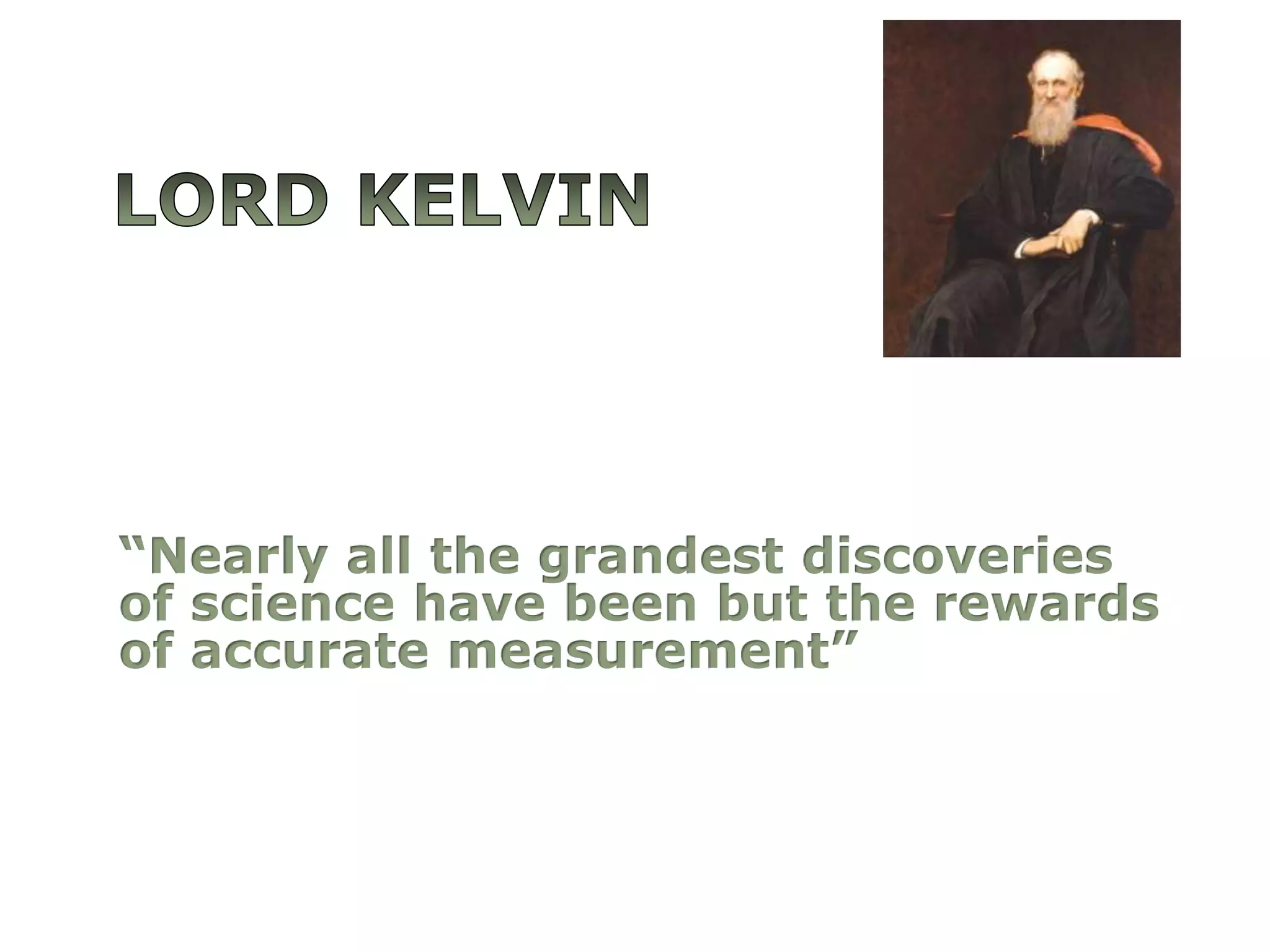
Lord Kelvin“Nearly all the grandest discoveries of science have been but the rewards of accurate measurement”
Job applications
Message:Where you publish is more important to us than what you publish!
Think…
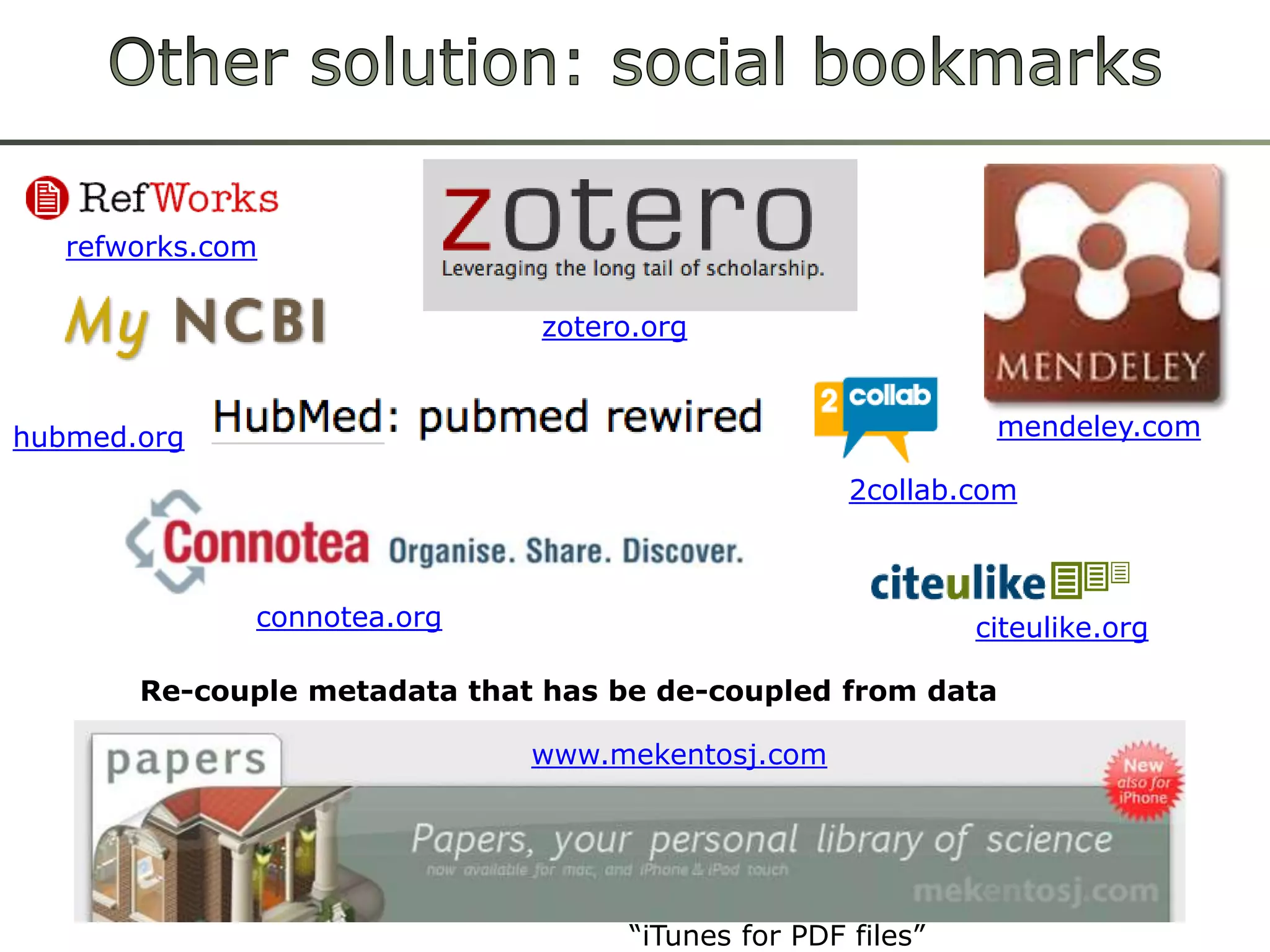
Other solution: social bookmarksrefworks.comzotero.orgmendeley.comhubmed.org2collab.comconnotea.orgciteulike.orgRe-couple metadata that has be de-coupled from datawww.mekentosj.com“iTunes for PDF files”
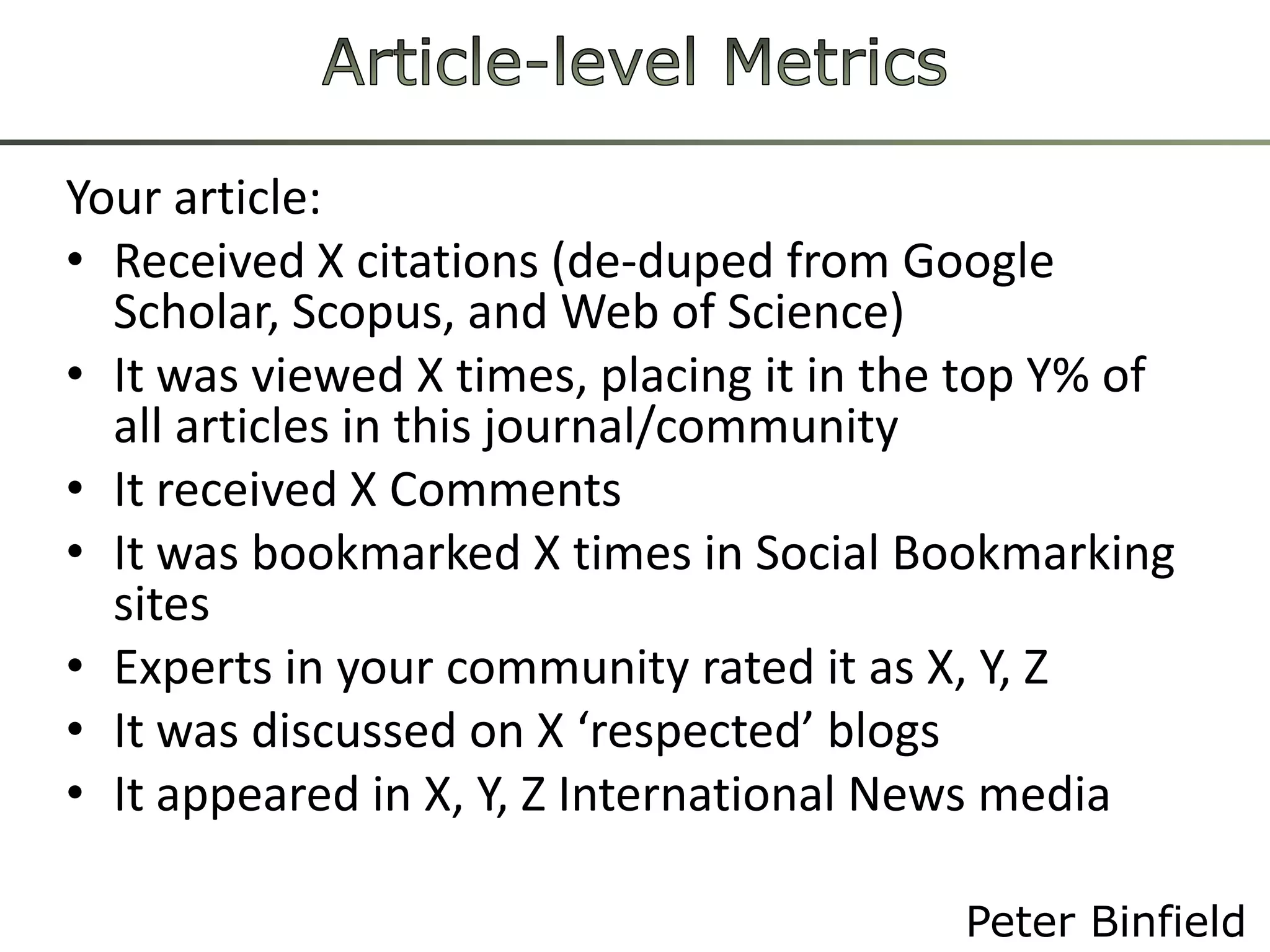
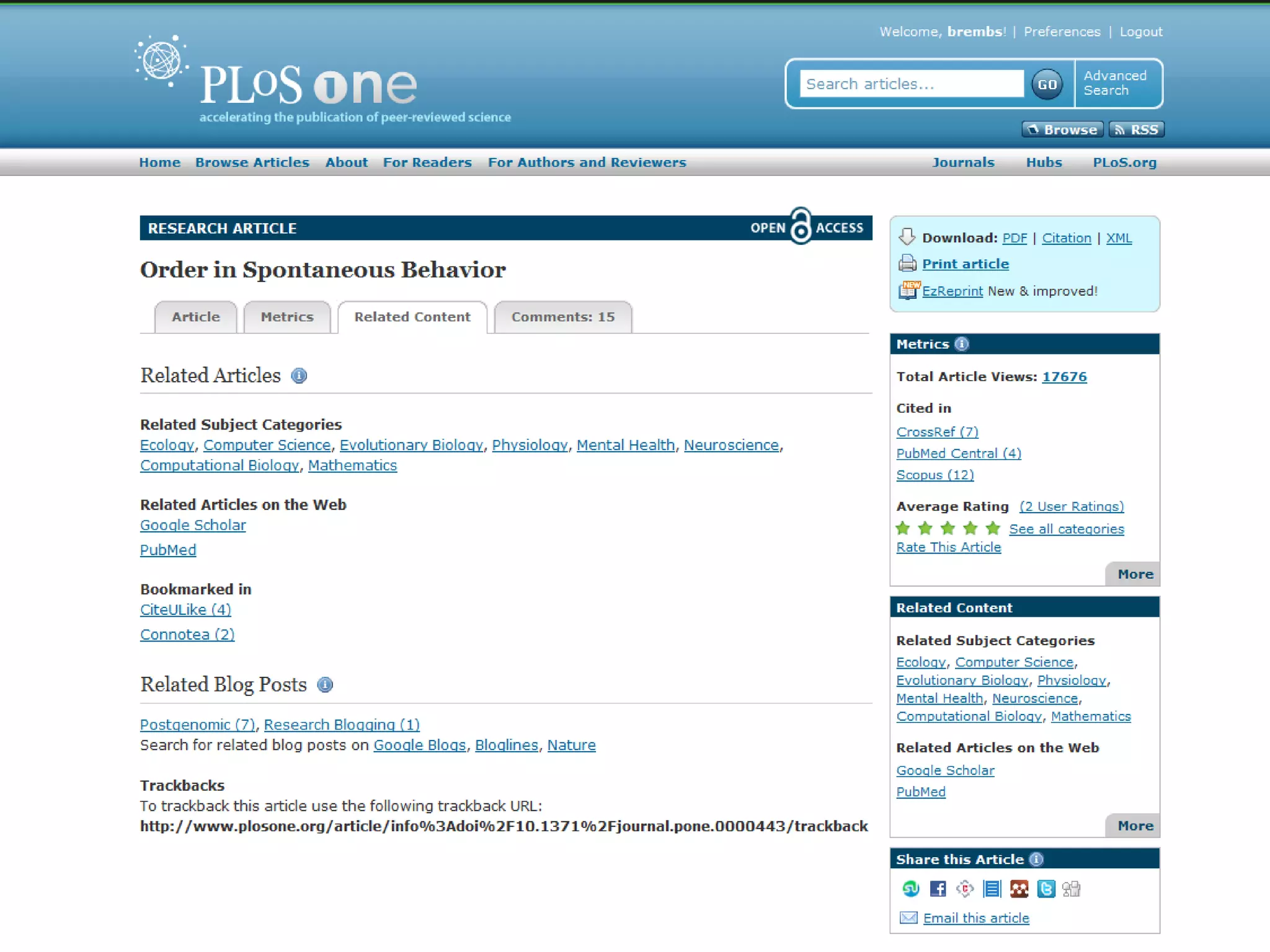
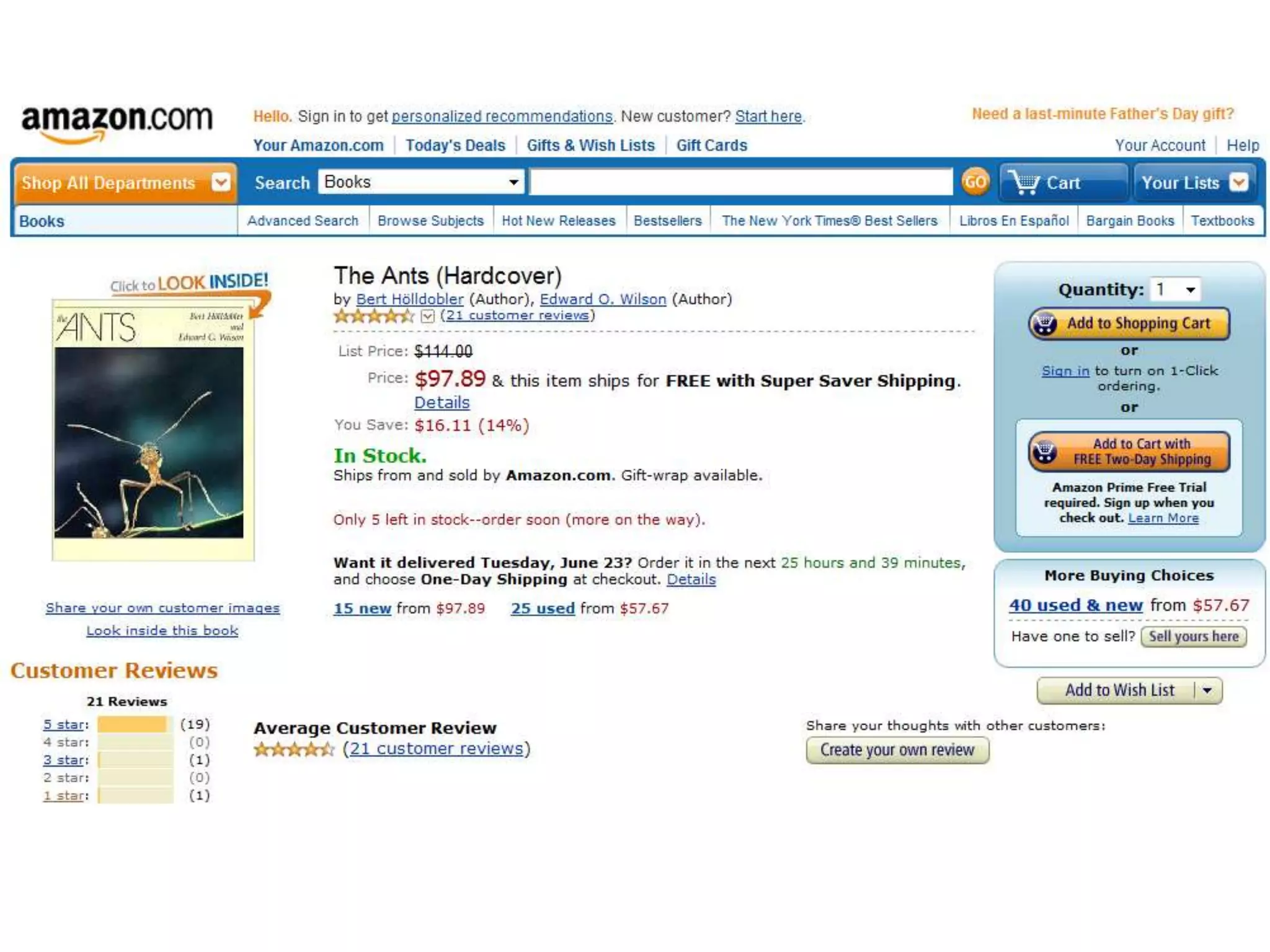
Article-level MetricsYour article:Received X citations (de-duped from Google Scholar, Scopus, and Web of Science)It was viewed X times, placing it in the top Y% of all articles in this journal/communityIt received X CommentsIt was bookmarked X times in Social Bookmarking sitesExperts in your community rated it as X, Y, ZIt was discussed on X ‘respected’ blogs It appeared in X, Y, Z International News mediaPeter Binfield
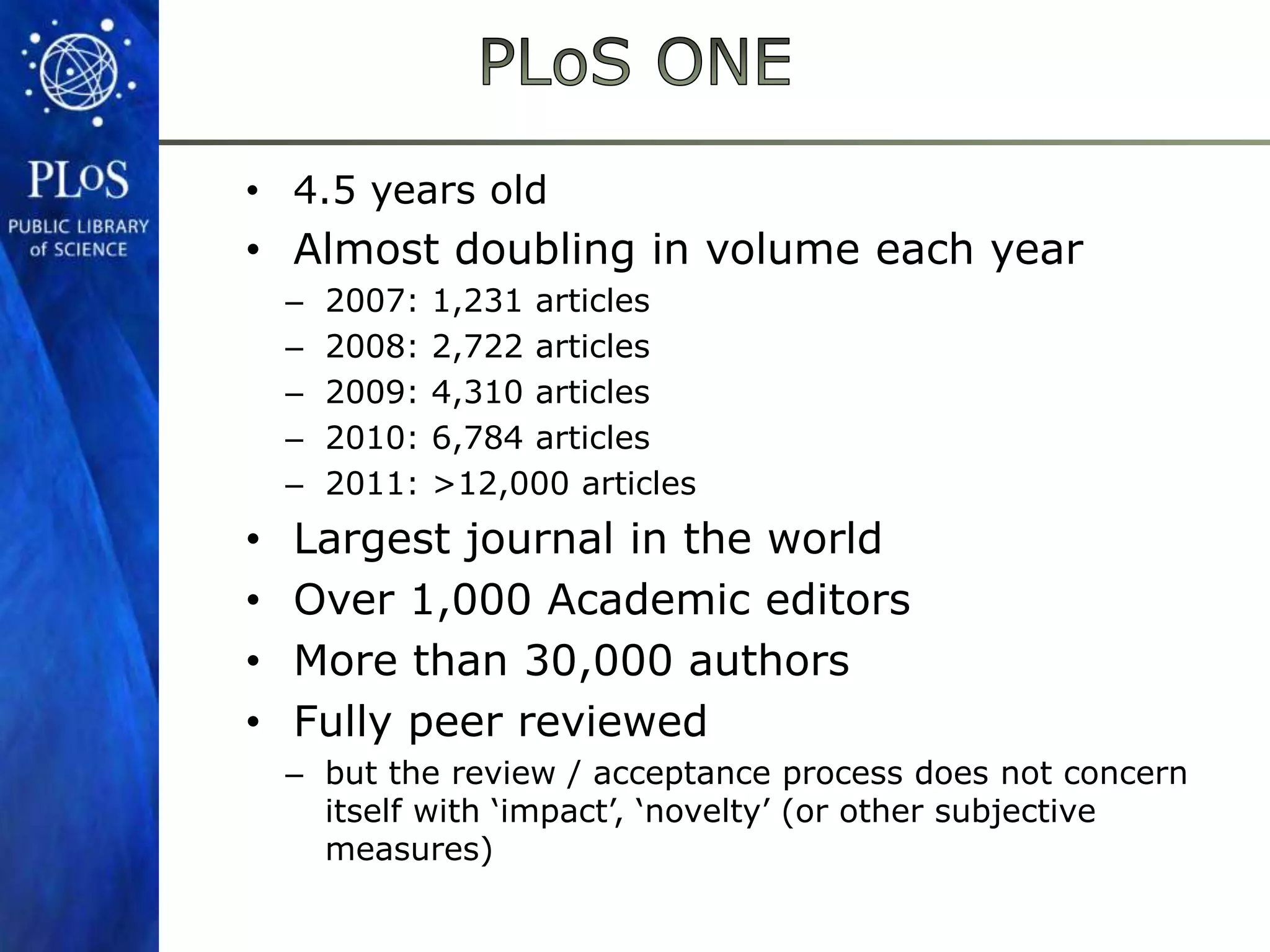
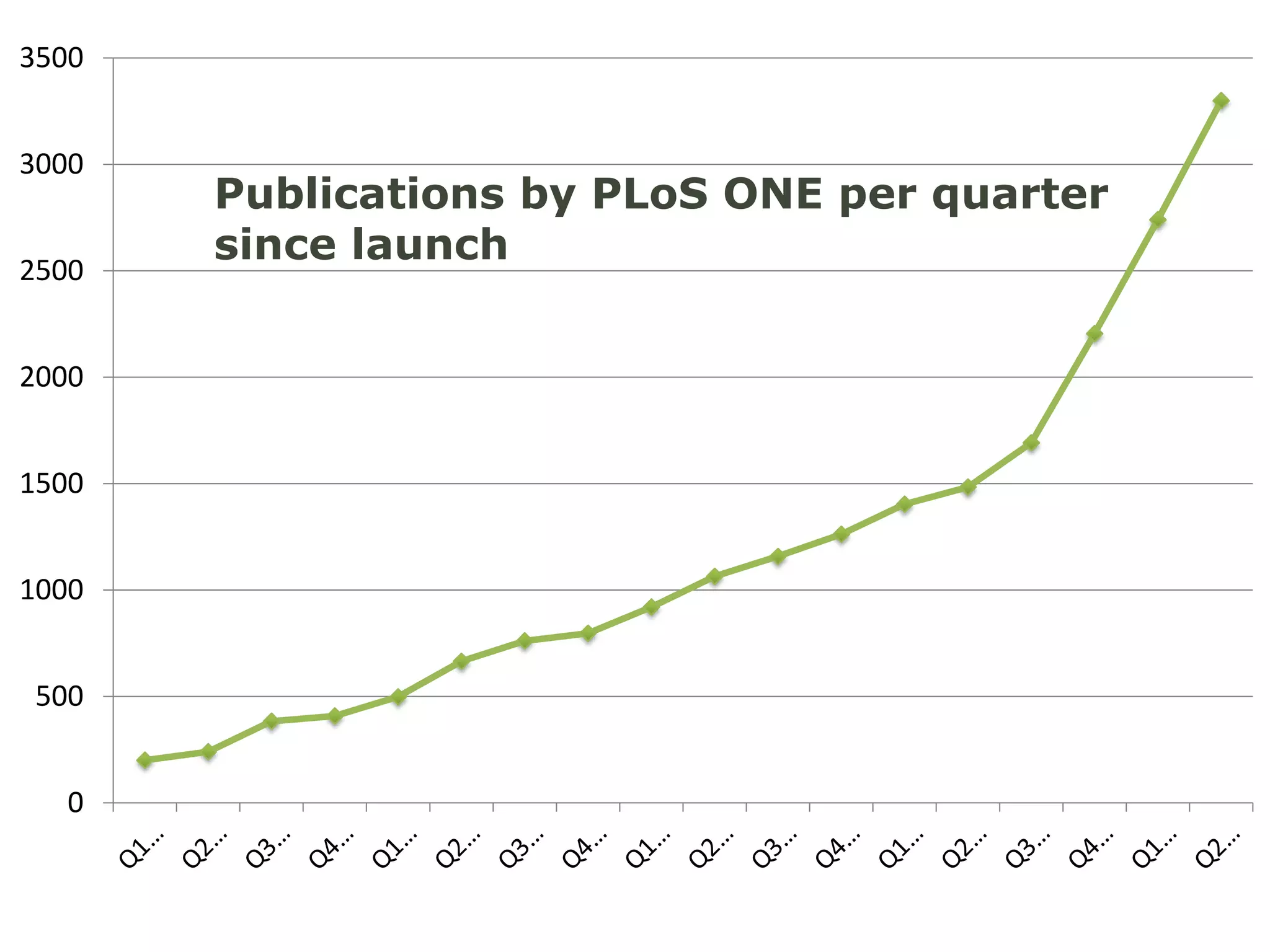
PLoS ONE4.5 years oldAlmost doubling in volume each year2007: 1,231 articles2008: 2,722 articles2009: 4,310 articles2010: 6,784 articles2011: >12,000 articlesLargest journal in the worldOver 1,000 Academic editorsMore than 30,000 authorsFully peer reviewed but the review / acceptance process does not concern itself with ‘impact’, ‘novelty’ (or other subjective measures)

What's wrong with scholarly publishing today? II

  • 1.
    Whatiswrongwithscholarlypublishingtoday?Björn Brembs, FreieUniversität Berlinhttp://brembs.nethttp://www.slideshare.net/brembs/whats-wrong-with-scholarly-publishing-today-ii
  • 2.
    Publishing yesterday…1665: Onejournal: PhilosophicalTransactionsofthe Royal Society of London (Henry Oldenburg)
  • 3.
  • 4.
  • 5.
  • 6.
  • 7.
  • 8.
    1.5 billiondownloads/yearSource: MabeMA (2009): Scholarly Publishing. European Review 17(1): 3-22
  • 9.
  • 10.
    FunctionalityAt least fourdifferent searchtoolstobesure not to miss any relevant literature?
  • 11.
    FunctionalityWhen we finallyfind the literature, we have to ask friends with rich libraries to send it to us?
  • 12.
    FunctionalityWe have tore-format our manuscripts every time an ex-scientist tells us to submit to another journal?
  • 13.
    FunctionalityWe have tore-format our manuscripts every time an ex-scientist tells us to submit to another journal?
  • 14.
    FunctionalityEvery homepage hashad an access counter since 1993 but we don’t know how often our paper has been downloaded?
  • 15.
    FunctionalityNothing happens whenwe click on the reference after "we performed the experiments as described previously"?
  • 16.
    HyperlinksNothing happens whenwe click on the reference after "we performed the experiments as described previously"?First demonstration: 1968WWW: 1989Stanford Research Institute: NLSTim Berners-Lee: CERN
  • 17.
  • 18.
  • 19.
    We, thescientists!We decidehow and where to publish
  • 20.
    We, thescientists!We areproducers and consumers in personal union
  • 21.
    We, thescientists!We choseto outsource scientific communication to publishers
  • 22.
  • 23.
    ElsevierName from Dutchpublisher (1580): “House of Elzevir”250,000 articles per year in 2000 journals7,000 journal editors, 70,000 editorial board members and 300,000 reviewers are working for ElsevierPart of Reed Elsevier group
  • 24.
  • 25.
  • 27.
    Elsevier“Merck paid anundisclosed sum to Elsevier to produce several volumes of [Australasian Journal of Bone and Joint Medicine], a publication that had the look of a peer-reviewed medical journal, but contained only reprinted or summarized articles—most of which presented data favorable to Merck products—that appeared to act solely as marketing tools with no disclosure of company sponsorship.”“It was a stealth marketing campaign to Australian doctors under the guise of a regular journal. “The Scientist“In issue 2, for example, 9 of the 29 articles were about Vioxx, and 12 of the remaining were about another Merck drug, Fosamax. All of these articles presented positive conclusions, and some were bizarre: like a review article containing just 2 references. “Ben Goldacre, “Bad Science” The Guardian“It has recently come to my attention that from 2000 to 2005, our Australia office published a series of sponsored article compilation publications, on behalf of pharmaceutical clients, that were made to look like journals and lacked the proper disclosures. This was an unacceptable practice, and we regret that it took place.”Michael Hansen, CEO Of Elsevier's Health Sciences Division
  • 28.
    Elsevier“Merck paid anundisclosed sum to Elsevier to produce several volumes of [Australasian Journal of Bone and Joint Medicine], a publication that had the look of a peer-reviewed medical journal, but contained only reprinted or summarized articles—most of which presented data favorable to Merck products—that appeared to act solely as marketing tools with no disclosure of company sponsorship.”“It was a stealth marketing campaign to Australian doctors under the guise of a regular journal. “The Scientist“In issue 2, for example, 9 of the 29 articles were about Vioxx, and 12 of the remaining were about another Merck drug, Fosamax. All of these articles presented positive conclusions, and some were bizarre: like a review article containing just 2 references. “Ben Goldacre, “Bad Science” The Guardian“It has recently come to my attention that from 2000 to 2005, our Australia office published a series of sponsored article compilation publications, on behalf of pharmaceutical clients, that were made to look like journals and lacked the proper disclosures. This was an unacceptable practice, and we regret that it took place.”Michael Hansen, CEO Of Elsevier's Health Sciences Division
  • 29.
    Elsevier“Merck paid anundisclosed sum to Elsevier to produce several volumes of [Australasian Journal of Bone and Joint Medicine], a publication that had the look of a peer-reviewed medical journal, but contained only reprinted or summarized articles—most of which presented data favorable to Merck products—that appeared to act solely as marketing tools with no disclosure of company sponsorship.”“It was a stealth marketing campaign to Australian doctors under the guise of a regular journal. “The Scientist“In issue 2, for example, 9 of the 29 articles were about Vioxx, and 12 of the remaining were about another Merck drug, Fosamax. All of these articles presented positive conclusions, and some were bizarre: like a review article containing just 2 references. “Ben Goldacre, “Bad Science” The Guardian“It has recently come to my attention that from 2000 to 2005, our Australia office published a series of sponsored article compilation publications, on behalf of pharmaceutical clients, that were made to look like journals and lacked the proper disclosures. This was an unacceptable practice, and we regret that it took place.”Michael Hansen, CEO Of Elsevier's Health Sciences Division
  • 30.
    Elsevier“Merck paid anundisclosed sum to Elsevier to produce several volumes of [Australasian Journal of Bone and Joint Medicine], a publication that had the look of a peer-reviewed medical journal, but contained only reprinted or summarized articles—most of which presented data favorable to Merck products—that appeared to act solely as marketing tools with no disclosure of company sponsorship.”“It was a stealth marketing campaign to Australian doctors under the guise of a regular journal. “The Scientist“In issue 2, for example, 9 of the 29 articles were about Vioxx, and 12 of the remaining were about another Merck drug, Fosamax. All of these articles presented positive conclusions, and some were bizarre: like a review article containing just 2 references. “Ben Goldacre, “Bad Science” The Guardian“It has recently come to my attention that from 2000 to 2005, our Australia office published a series of sponsored article compilation publications, on behalf of pharmaceutical clients, that were made to look like journals and lacked the proper disclosures. This was an unacceptable practice, and we regret that it took place.”Michael Hansen, CEO Of Elsevier's Health Sciences Division
  • 31.
    The Big Three(2009/10)(includes Springer)Source:http://www.publishersweekly.com/binary-data/ARTICLE_ATTACHMENT/file/000/000/127-1.pdf
  • 32.
  • 33.
    Journals Crisis (notjust Elsevier!)% ChangeModifiedfrom ARL: http://www.arl.org/bm~doc/arlstats06.pdf, http://www.arl.org/bm~doc/arlstat08.pdf
  • 34.
    Subscription PricingKIT Library10Most expensive journal subscriptions 2010/11http://www.bibliothek.kit.edu/cms/teuerste-zeitschriften.php
  • 35.
  • 36.
    Subscription PricingMPG: 18 Mio€/y forliterature. 95% tothethreemainpublishers.UK: 94.6 Mio £/y in subscription (2003/4)
  • 37.
    What a magnificentship! What makes it go?Cartoon by Rowland B. Wilson
  • 38.
    Library responsesRequest increasedbudgetsCut subscriptionsCollective purchase of electronic journalsRely on document delivery or ILLUC: boycott NPG!Ray English
  • 39.
  • 40.
  • 41.
  • 42.
    Scholarship as aPublic Good Funded by Taxpayers
  • 43.
    Scholarship as aPublic Good Supported publicly
  • 44.
    Scholarship as aPublic Good Created in the non-profit sector
  • 45.
    Scholarship as aPublic Good No profit for article authors
  • 46.
    Scholarship as aPublic Good Profit for corporate publishers
  • 47.
    ScholarshipA Public Goodin Private Hands
  • 48.
  • 49.
  • 50.
    Onesolution: Open Access“Open-access(OA) literature is digital, online, free of charge, and free of most copyright and licensing restrictions.” Peter Suber
  • 51.
    Open AccessGold OAPublishingin an Open Access journalCurrently 6722peer-reviewed open access journals listed in the Lund Directory of Open Access Journals doaj.org Green OASelf-archiving in an institutional repository or PubMed CentralOver 1400 open repositories already established world-wide
  • 52.
  • 53.
    But: Everything’s GoneDigital! www.scopus.comwww.pubmed.govhttp://ukpmc.ac.ukisiknowledge.comscholar.google.comDuncan Hull
  • 54.
    Welcome to DigitalIsolationdifferent disciplines – different information silos
  • 55.
    Welcome to DigitalImpersonal and unsociable“who the hell are you”?Where are “my” papers?What are my friends and colleagues reading?What are the experts reading?What is popular this week / month / year?
  • 56.
    Welcome to DigitalObsolete models of publicationNot everything fits publication-sized holesMicro-attributionMega-attributionDigital contributions (databases, software, wikis/blogs?)
  • 57.
    Welcome to DigitalColdIdentity of publications and authors is inadequate
  • 58.
  • 59.
    Identity Crisis: Whichpublication?http://pubmed.gov/18974831http://www.ncbi.nlm.nih.gov/pubmed/18974831http://ukpmc.ac.uk/articlerender.cgi?accid=pmcA2568856http://ukpmc.ac.uk/picrender.cgi?artid=1687256&blobtype=pdfhttp://www.ploscompbiol.org/article/info%3Adoi%2F10.1371%2Fjournal.pcbi.1000204http://www.dbkgroup.org/Papers/hull_defrost_ploscb08.pdfhttp://dx.doi.org/10.1371/journal.pcbi.1000204One paper, many URIs. Disambiguation algorithms rely on getting metadata for eachBig problem for libraries is these redundant duplicatesMatching can be done by Digital Object Identifier (DOI) and PubMed ID (PMID); these are frequently absent < 5% (Kevin Emamy, citeUlike)Duncan Hull
  • 60.
  • 61.
  • 62.
  • 63.
    Onesolution: Unique identifiersDifficultwith fragmented information silos
  • 64.
  • 65.
    Onesolution: Unique identifiersExamples:PubMedID, DOI, ORCID, Semantic Web
  • 66.
  • 67.
    Semantic WebMachine-readablemeaningTechnically non-trivialPromisingprogressTim Berners-Leehttp://www.w3.org/2000/Talks/1206-xml2k-tbl/Overview.html
  • 68.
    The Semantic Webfor Dummies (like me)URIUniform Resource Identifier, like: http://id.archeology.edu/weapon/spear + XMLCustomized tags, like:<spear>Lance</spear> + RDFRelations, in triples, like: (Lance) (is_spear_of) (Longinus) + OntologiesHierarchies of concepts, likeweapon -> projectile -> spear-> Lance + Inference rulesLike:If (person) (owns) (spear), then (person) (throws) (spear) = Semantic Web!
  • 69.
  • 70.
  • 71.
  • 72.
    Information CrisisFinding ‘my’publications is impossible!
  • 73.
  • 74.
    Information Crisis60-300 applicantsper tenure-trackposition
  • 75.
  • 76.
  • 77.
    Onesolution: JournalRankSource NormalizedImpact per PaperThomson Reuters: Impact FactorEigenfactor (now Thomson Reuters)ScImago JournalRank (SJR)Scopus: SNIP, SJR
  • 78.
  • 79.
  • 80.
    Job applicationinstructionsPublikationstätigkeit(vollständige Publikationsliste,darunter Originalarbeiten als Erstautor/in, Seniorautor/in, Impact-Punkte insgesamt und in den letzten 5 Jahren, darunter jeweils gesondert ausgewiesen als Erst- und Seniorautor/in, persönlicher Scientific Citations Index (SCI, h-Index nach Web of Science) über alle Arbeiten)Publications:Completelistofpublications, including original researchpapersasfirstauthor, seniorauthor, impactpoints total and in the last 5 years, withmarkedfirstand last-authorships, personal Scientific Citations Index (SCI, h-Index accordingto Web of Science) for all publications.
  • 81.
    MetricsLies, damn liesandbibliometrics
  • 82.
    Show of hands:Whoknows what the IF is?Who uses the IF to pick a journal (rate a candidate, etc.)?Who knows how the IF is calculated and from what data?
  • 83.
    The Impact FactorIntroducedin 1960’s by Eugene Garfield: ISIcitationsarticles2008 and 20092010IF=5Articles published in 08/09 were cited an average of 5 times in 10.
  • 84.
    The Impact FactorJournalX IF 2010=All citationsfromTR indexedjournalsin 2010 topapers in journal XNumberofcitablearticlespublished in journal X in 2008/9€30,000-130,000/yearsubscriptionratesCovers ~11,500 journals (Scopuscovers ~16,500)
  • 85.
    Main Problems withtheIFNegotiableIrreproducibleMathematicallyunsound
  • 86.
    NegotiablePLoSMedicine, IF 2-11(8.4)(The PLoS Medicine Editors (2006) The Impact Factor Game. PLoS Med 3(6): e291. http://www.plosmedicine.org/article/info:doi/10.1371%2Fjournal.pmed.0030291)CurrentBiology IF from 7 to 11 in 2003BoughtbyCell Press (Elsevier) in 2001…
  • 88.
    Not ReproducibleRockefeller UniversityPress boughttheirdatafrom Thomson ReutersUpto 19% deviationfrompublishedrecordsSecond dataset still not correctRossner M, van Epps H, Hill E (2007): Show me the data. The Journal of Cell Biology, Vol. 179, No. 6, 1091-1092 http://jcb.rupress.org/cgi/content/full/179/6/1091
  • 89.
    Not MathematicallySoundLeft-skeweddistributionsWeakcorrelationof individualarticlecitation rate withjournal IFSeglen PO (1997): Why the impact factor of journals should not be used for evaluating research. BMJ 1997;314(7079):497 (15 February)http://www.bmj.com/cgi/content/full/314/7079/497
  • 90.
    Lord Kelvin“Nearly allthe grandest discoveries of science have been but the rewards of accurate measurement”
  • 91.
  • 92.
    Message:Where you publishis more important to us than what you publish!
  • 93.
  • 94.
    Other solution: socialbookmarksrefworks.comzotero.orgmendeley.comhubmed.org2collab.comconnotea.orgciteulike.orgRe-couple metadata that has be de-coupled from datawww.mekentosj.com“iTunes for PDF files”
  • 95.
    Article-level MetricsYour article:ReceivedX citations (de-duped from Google Scholar, Scopus, and Web of Science)It was viewed X times, placing it in the top Y% of all articles in this journal/communityIt received X CommentsIt was bookmarked X times in Social Bookmarking sitesExperts in your community rated it as X, Y, ZIt was discussed on X ‘respected’ blogs It appeared in X, Y, Z International News mediaPeter Binfield
  • 99.
    PLoS ONE4.5 yearsoldAlmost doubling in volume each year2007: 1,231 articles2008: 2,722 articles2009: 4,310 articles2010: 6,784 articles2011: >12,000 articlesLargest journal in the worldOver 1,000 Academic editorsMore than 30,000 authorsFully peer reviewed but the review / acceptance process does not concern itself with ‘impact’, ‘novelty’ (or other subjective measures)
  • 100.
    Publications by PLoSONE per quarter since launch
  • 101.
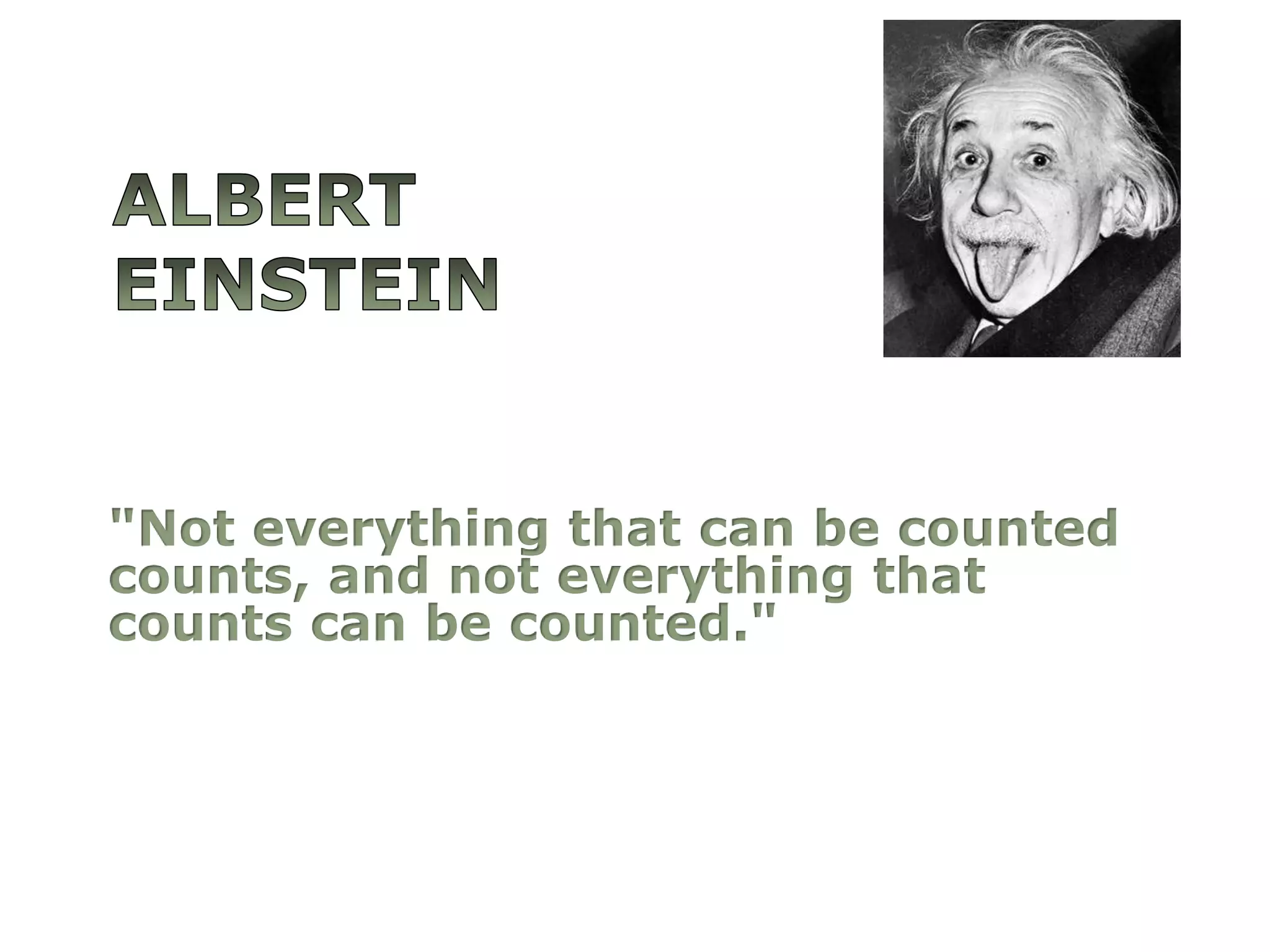
    Albert Einstein"Not everythingthat can be counted counts, and not everything that counts can be counted."
  • 102.
    MetricsWon‘tgoawayShouldalwaysbe a lastresortTheyaremuchtoovaluabletobesatisfiedwiththecurrentpitifulstateofaffairsLet‘smakethemasgoodaswepossiblycan!
  • 103.
    My Digital Utopia:Nomore publishers – libraries archive everything according to a world-wide standardSingle semantic, decentralized database of literature and dataPersonalized filteringPeer-review administrated by an independent bodyLink typology for text/text, data/data and text/data links (“citations”)Semantic Text/DataminingAll the metrics you (don’t) want (but need)Tagging, bookmarking, etc.Unique contributor IDs with attribution/reputation system (teaching, reviewing, curating, blogging, etc.)Technically feasible today (almost)http://www.slideshare.net/brembs/whats-wrong-with-scholarly-publishing-today-ii