Pistoia Alliance App Strategy:
Apps for life sciences R&D

                                                  Dr. Alex M. Clark
                                                           April 2013


   © 2013 Molecular Materials Informatics, Inc.
     http://molmatinf.com
2


                Mobile apps
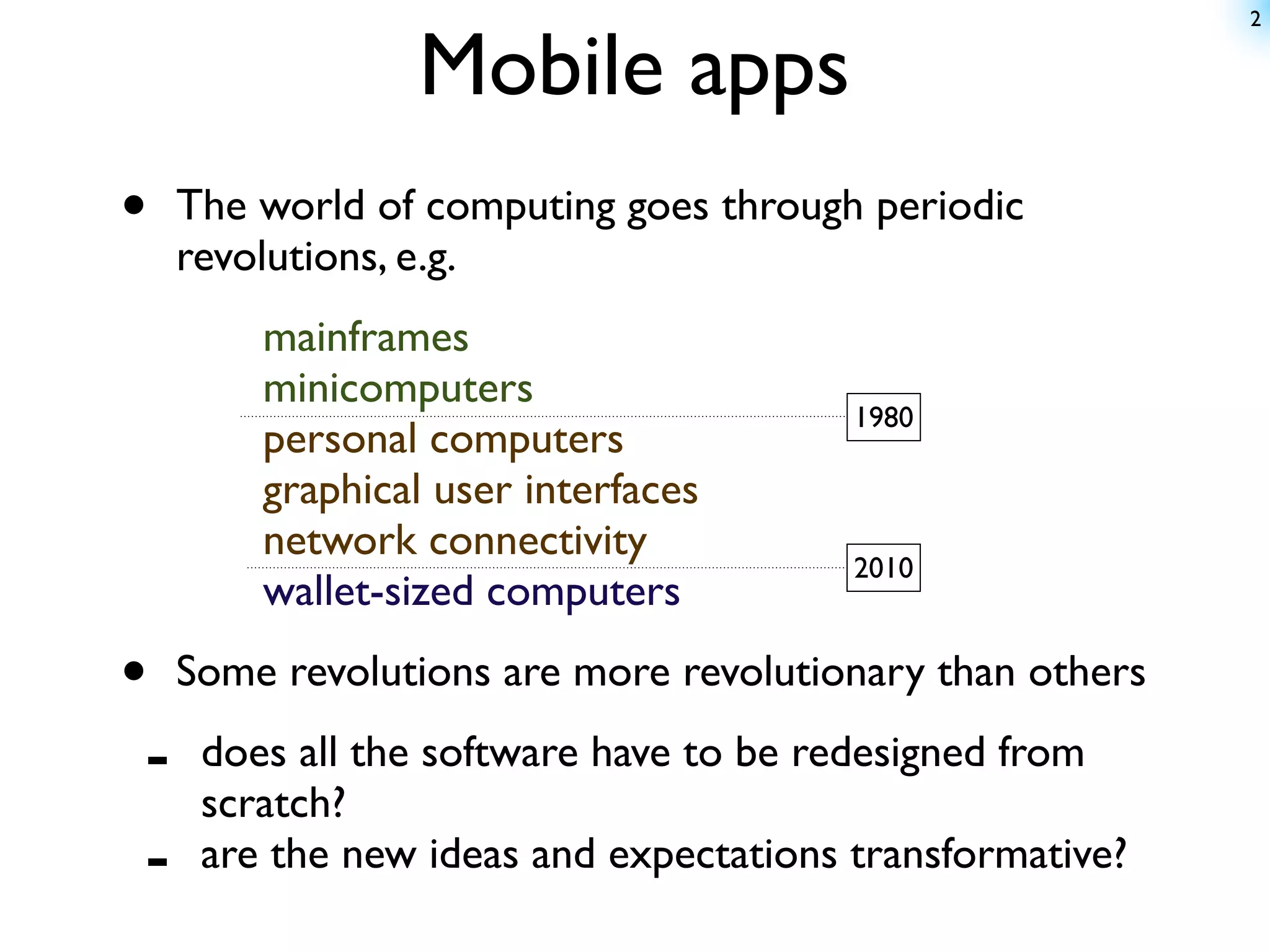
•   The world of computing goes through periodic
    revolutions, e.g.
        mainframes
        minicomputers
                                       1980
        personal computers
        graphical user interfaces
        network connectivity
                                       2010
        wallet-sized computers

• Some revolutions are more revolutionary than others
 - does all the software have to be redesigned from
   scratch?
 - are the new ideas and expectations transformative?
3


           The future is mobile
•   In case you haven't noticed...
    ... people live their lives on their phones and tablets.

•   Applicable functionality keeps growing: email, browsing,
    scheduling, games, presentations, word processing...
    ... and thousands of useful apps that have no equivalent in
    the desktop realm.


•   Q: Why would somebody waste their time trying to do
    chemistry on a mobile device?

•   A: Because if you can do everything else on mobile, do you
    really want to keep a PC around only for chemistry?
4


               Chemistry apps
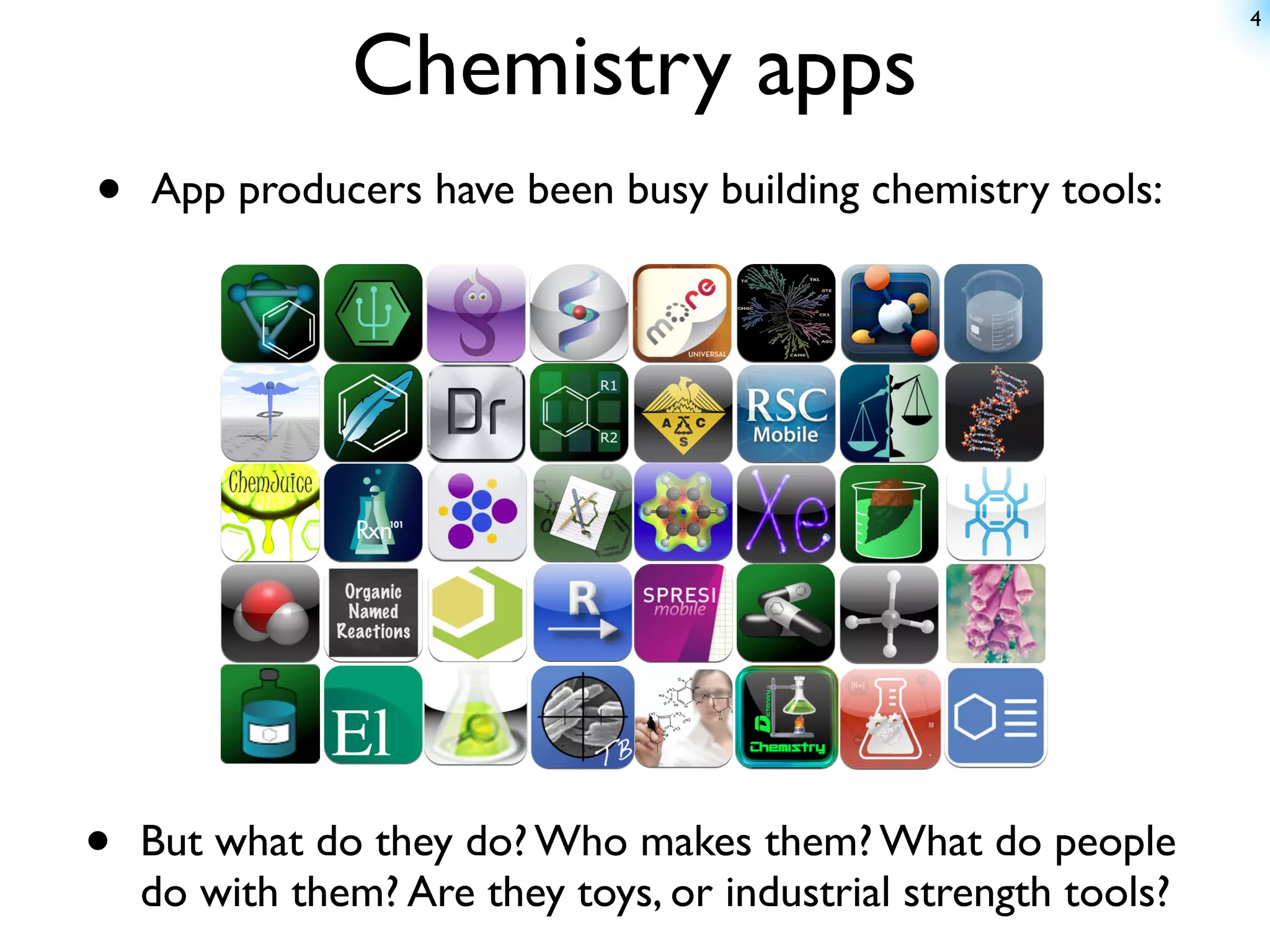
•   App producers have been busy building chemistry tools:


•   But what do they do? Who makes them? What do people
    do with them? Are they toys, or industrial strength tools?
5


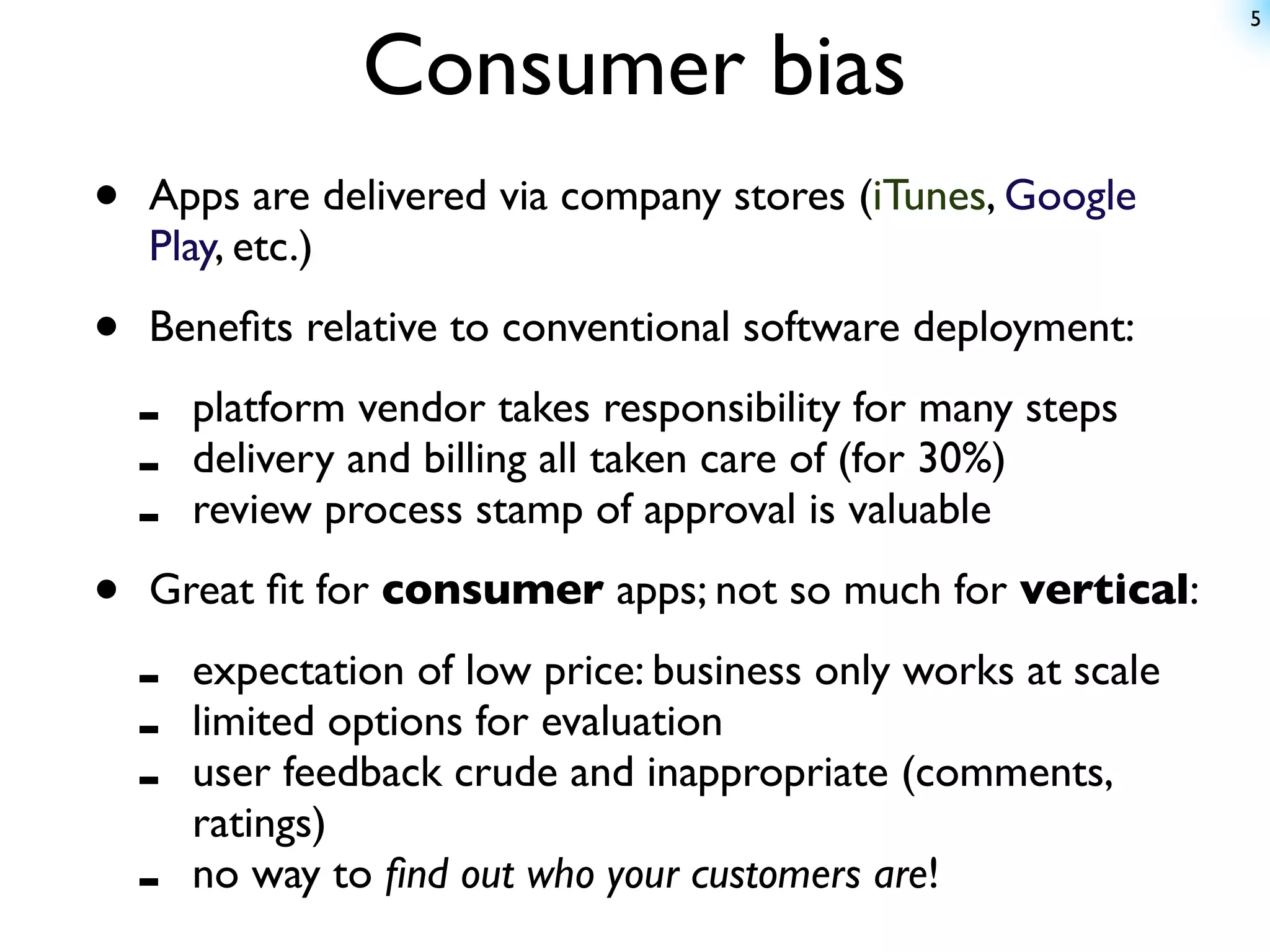
                 Consumer bias
•   Apps are delivered via company stores (iTunes, Google
    Play, etc.)

•   Benefits relative to conventional software deployment:

    -   platform vendor takes responsibility for many steps
    -   delivery and billing all taken care of (for 30%)
    -   review process stamp of approval is valuable

•   Great fit for consumer apps; not so much for vertical:

    -   expectation of low price: business only works at scale
    -   limited options for evaluation
    -   user feedback crude and inappropriate (comments,
        ratings)
    -   no way to find out who your customers are!
6


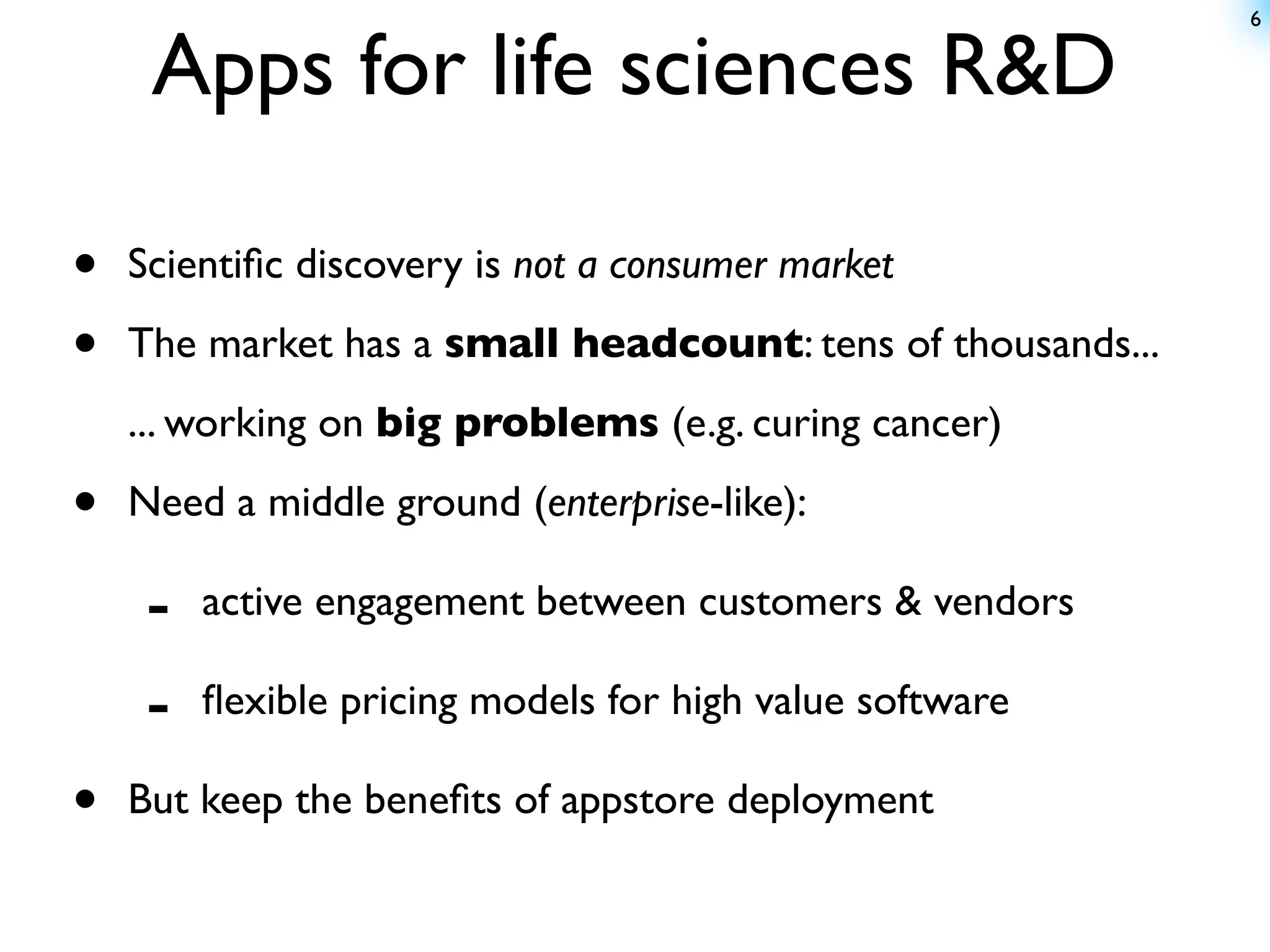
     Apps for life sciences R&D

•   Scientific discovery is not a consumer market

•   The market has a small headcount: tens of thousands...
    ... working on big problems (e.g. curing cancer)

•   Need a middle ground (enterprise-like):

     -   active engagement between customers & vendors

     -   flexible pricing models for high value software

•   But keep the benefits of appstore deployment
7


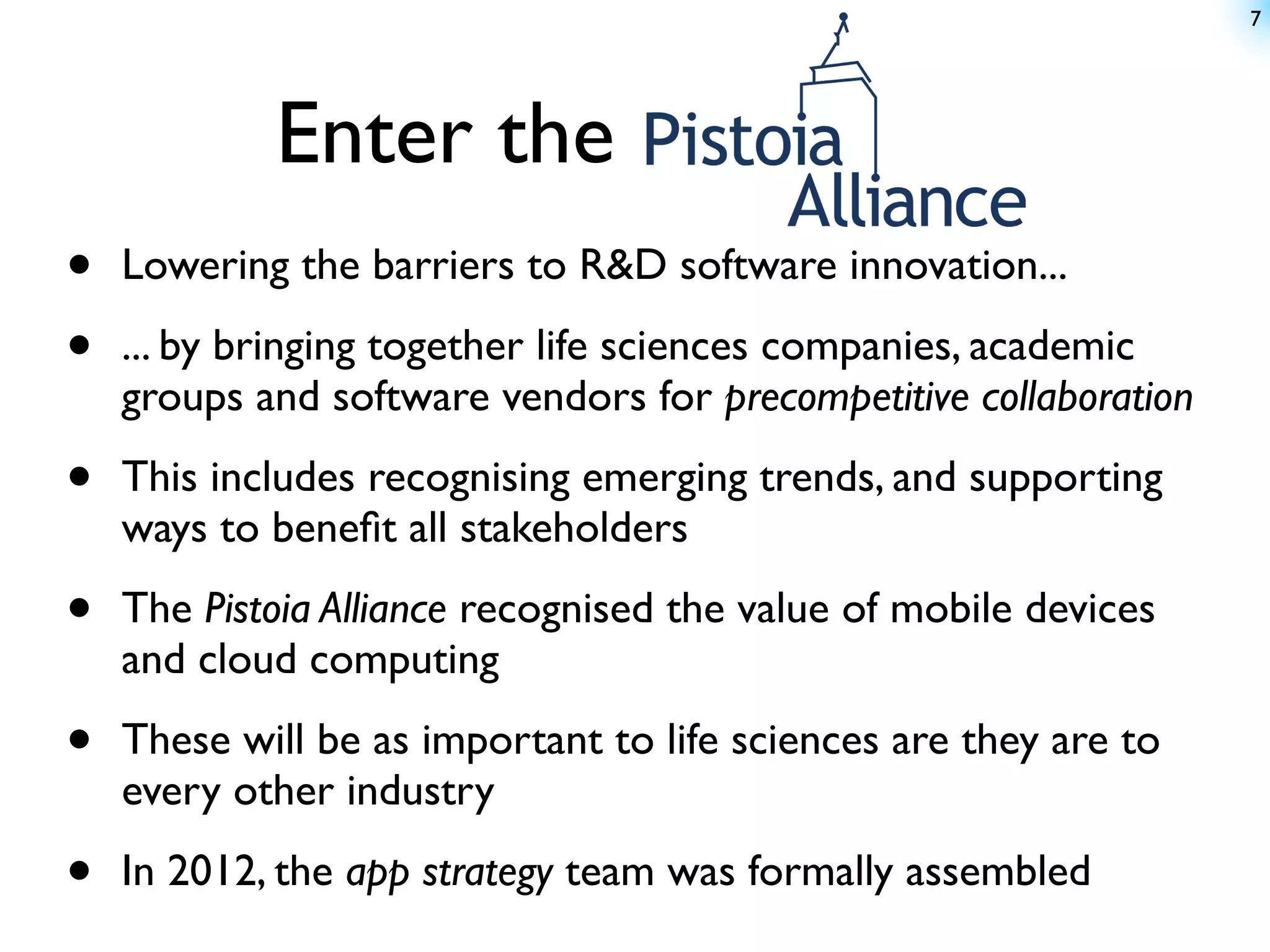
            Enter the
•   Lowering the barriers to R&D software innovation...

•   ... by bringing together life sciences companies, academic
    groups and software vendors for precompetitive collaboration

•   This includes recognising emerging trends, and supporting
    ways to benefit all stakeholders

•   The Pistoia Alliance recognised the value of mobile devices
    and cloud computing

•   These will be as important to life sciences are they are to
    every other industry

•   In 2012, the app strategy team was formally assembled
8


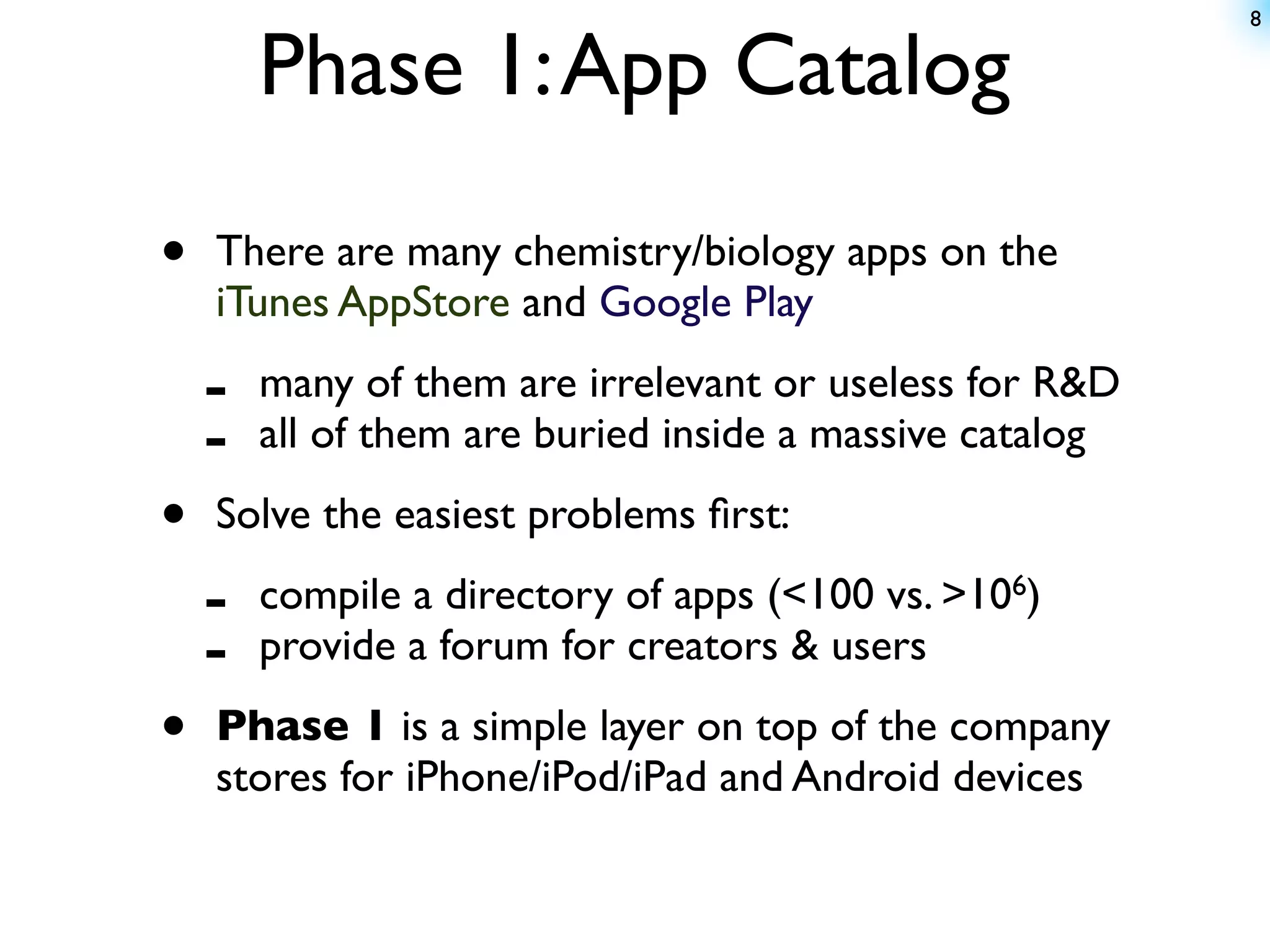
        Phase 1: App Catalog

•   There are many chemistry/biology apps on the
    iTunes AppStore and Google Play

    -   many of them are irrelevant or useless for R&D
    -   all of them are buried inside a massive catalog

•   Solve the easiest problems first:

    -   compile a directory of apps (<100 vs. >106)
    -   provide a forum for creators & users

•   Phase 1 is a simple layer on top of the company
    stores for iPhone/iPod/iPad and Android devices
9


         The AirWatch platform


•   Partnered with Air Watch, the leading provider of
    enterprise app catalogs and device management
    tools

•   We use their hosted service to make the Pistoia
    Alliance App Catalog available to the public
10


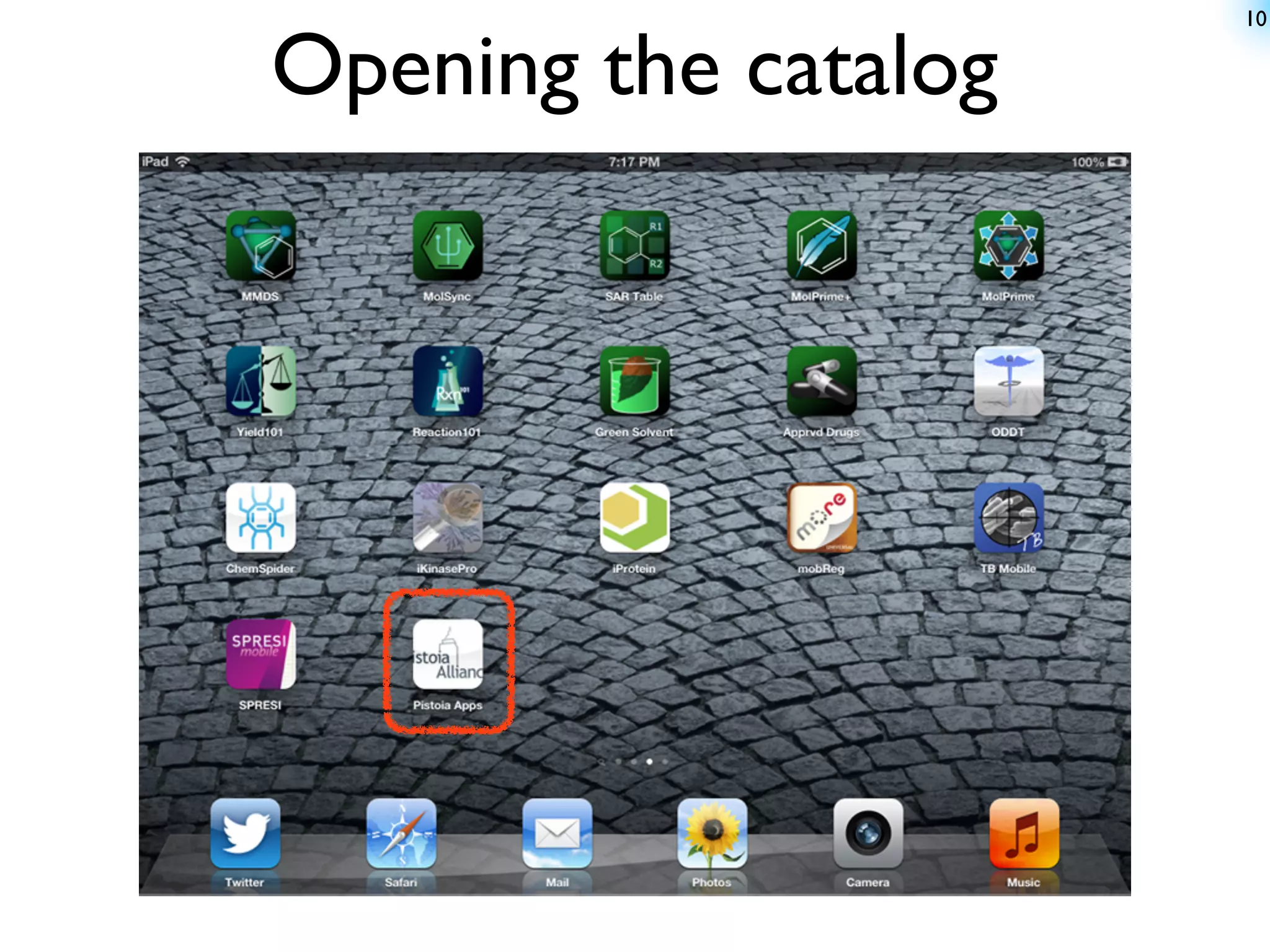
Opening the catalog
11


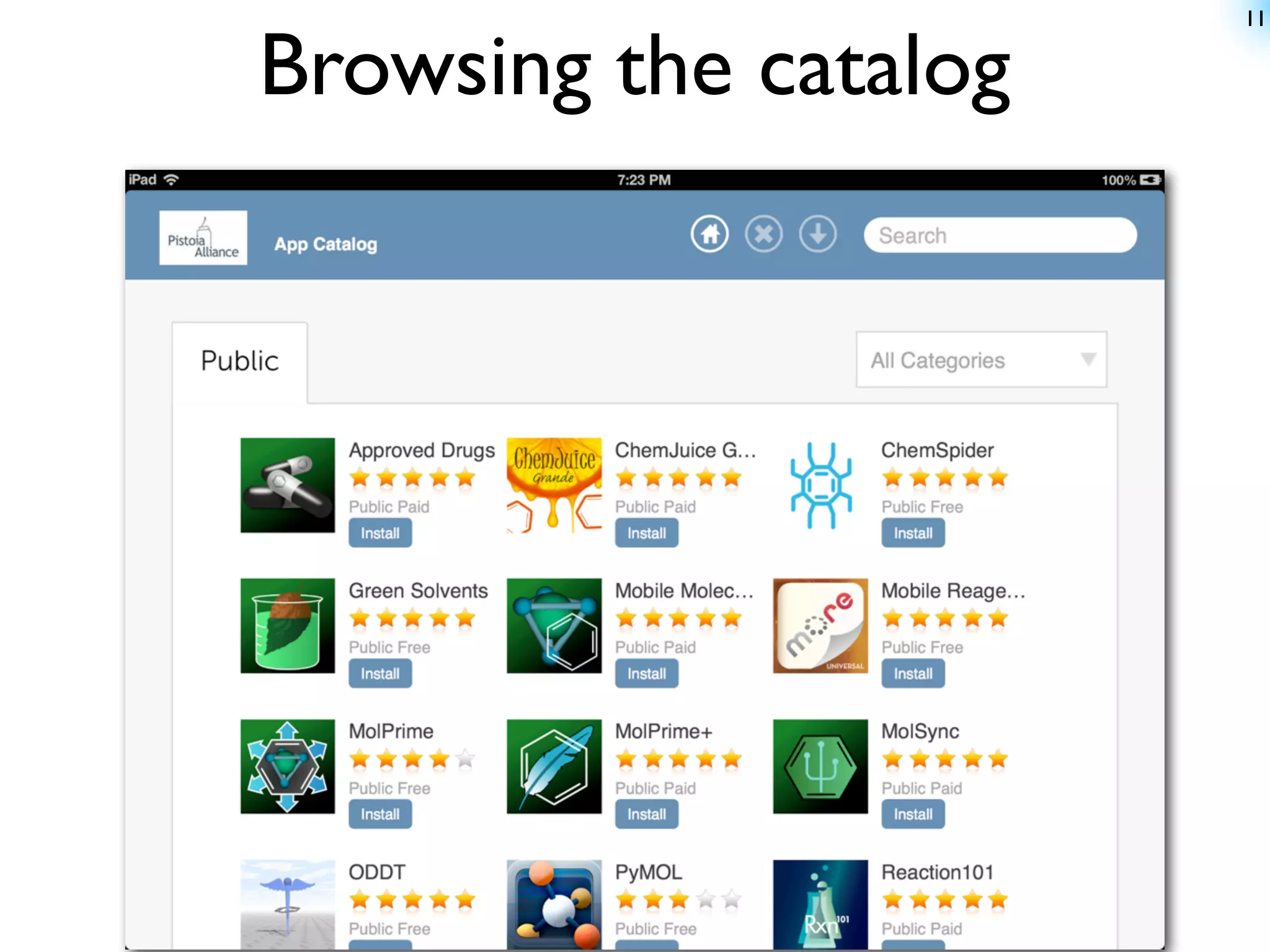
Browsing the catalog
12


                     Signing up
•   If you have an iPhone/iPod/iPad, or an Android device:
              http://apps.pistoiaalliance.org
•   Gain access to the catalog

•   We only list apps that are useful and relevant

•   Installation of apps is done by the company store

     -   some free, some paid

•   Participate in discussions about existing apps:

     -   everyone else is also a scientist, with similar interests
     -   the app creators are actively involved: they want to
         know about your experiences
     -   you can contact them/they can contact you offline
13


         Submitting an app
•   Must already be listed on the company store
    (Google, Apple)

•   Must be directly relevant to lifesciences R&D (broadly
    defined)

•   App creators are expected to participate in
    discussions

•   Anyone can submit:

http://www.pistoiaalliance.org/submitapp.html

•   Screening done by Pistoia members
14


    Further developments

•   Open to more apps!

•   More advanced discussion forum features
    (expected mid-late 2013)

•   Encourage discussion of new app ideas, as well as
    comments on existing products

•   Continued stimulation of new ideas at meetings,
    e.g. the Pistoia Dragon's Den (inspired the Open
    Drug Discovery Teams project)
15


           Phase 2: Deployment

•   The biggest problems with vertical market apps relate to
    deployment:

    -   traditional software is delivered by mailing a CD-ROM
    -   web software is deployed by sending out a URL
    -   apps have to be submitted & reviewed by a single
        authority

•   There is no guarantee that an app will be allowed!

•   There is only one price, and the vig is always 30%

•   Sales are always perpetual, no control
16


        Deployment possibilities
•   Android:

    -   direct loading of apps is permitted
    -   can use the AirWatch platform to deliver Pistoia-
        mediated apps directly onto users' devices

•   Apple (iPhone, iPod, iPad)

    -   alternatives to the iTunes AppStore extremely restricted:
        directly circumventing the company store is not allowed
    -   companies can setup their own Enterprise AppStore
    -   the Pistoia AppStore could be used as a placeholder for
        non-public apps
    -   private installation opens up many more deployment
        options
17


        Phase 3: Cloud computing

•   Mobile devices are quite powerful, but:

    -   not suitable for grinding through long calculations
    -   not recommended for storing large collections of data

•   Many mobile apps use webservices to provide
    functionality, e.g.

    -   database search (ChemSpider, SPRESI, Mobile Reagents)
    -   property calculation (MolPrime+, SAR Table, MMDS)
    -   real time newsfeeds (ODDT, RSC Mobile)
    -   sharing data (MolSync, Reaction101,Yield101)
18
                                                                19


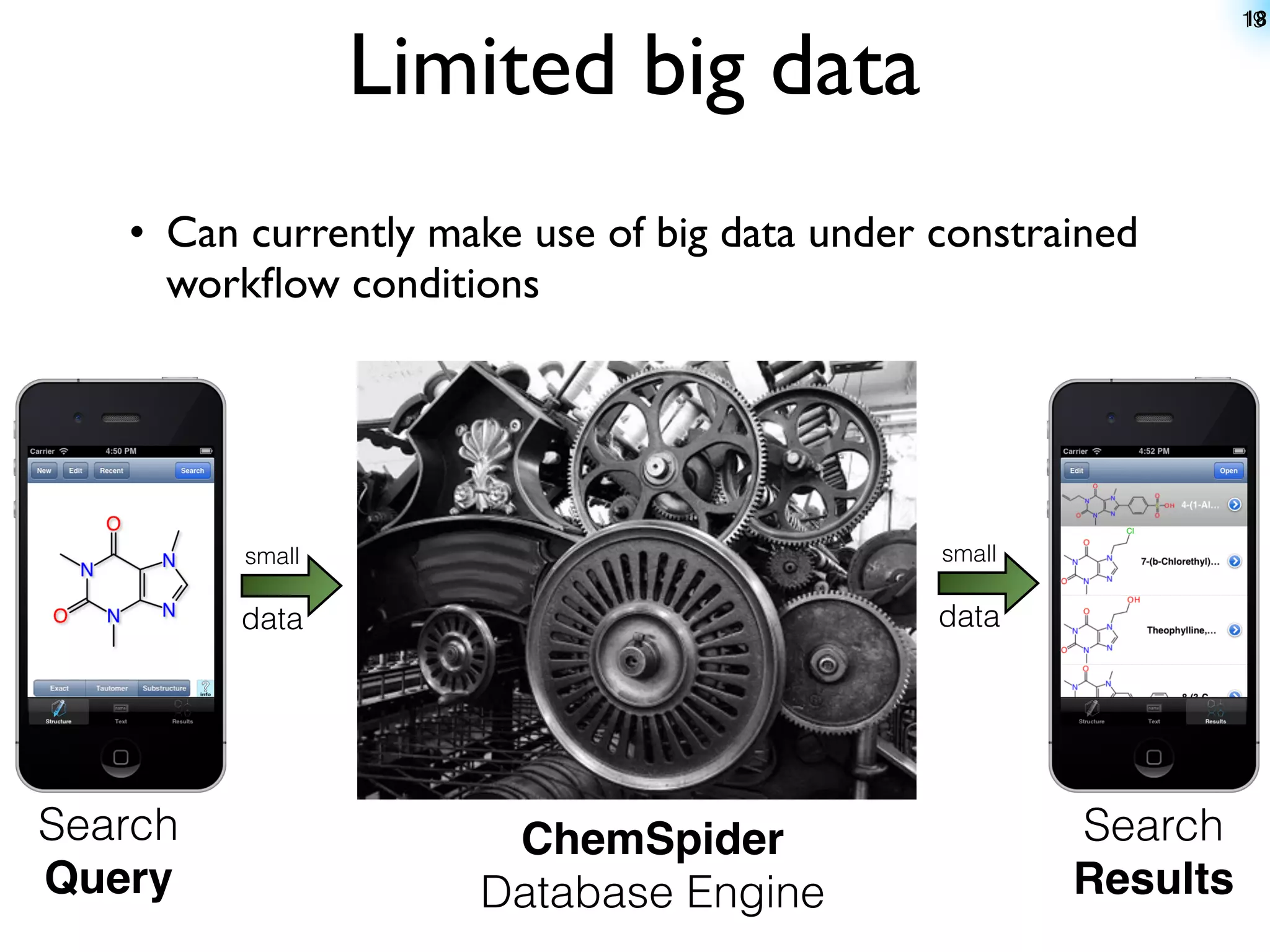
                 Limited big data
   • Can currently make use of big data under constrained
     workflow conditions


         small                                small

         data                                 data


Search                ChemSpider                      Search
Query                Database Engine                  Results
19


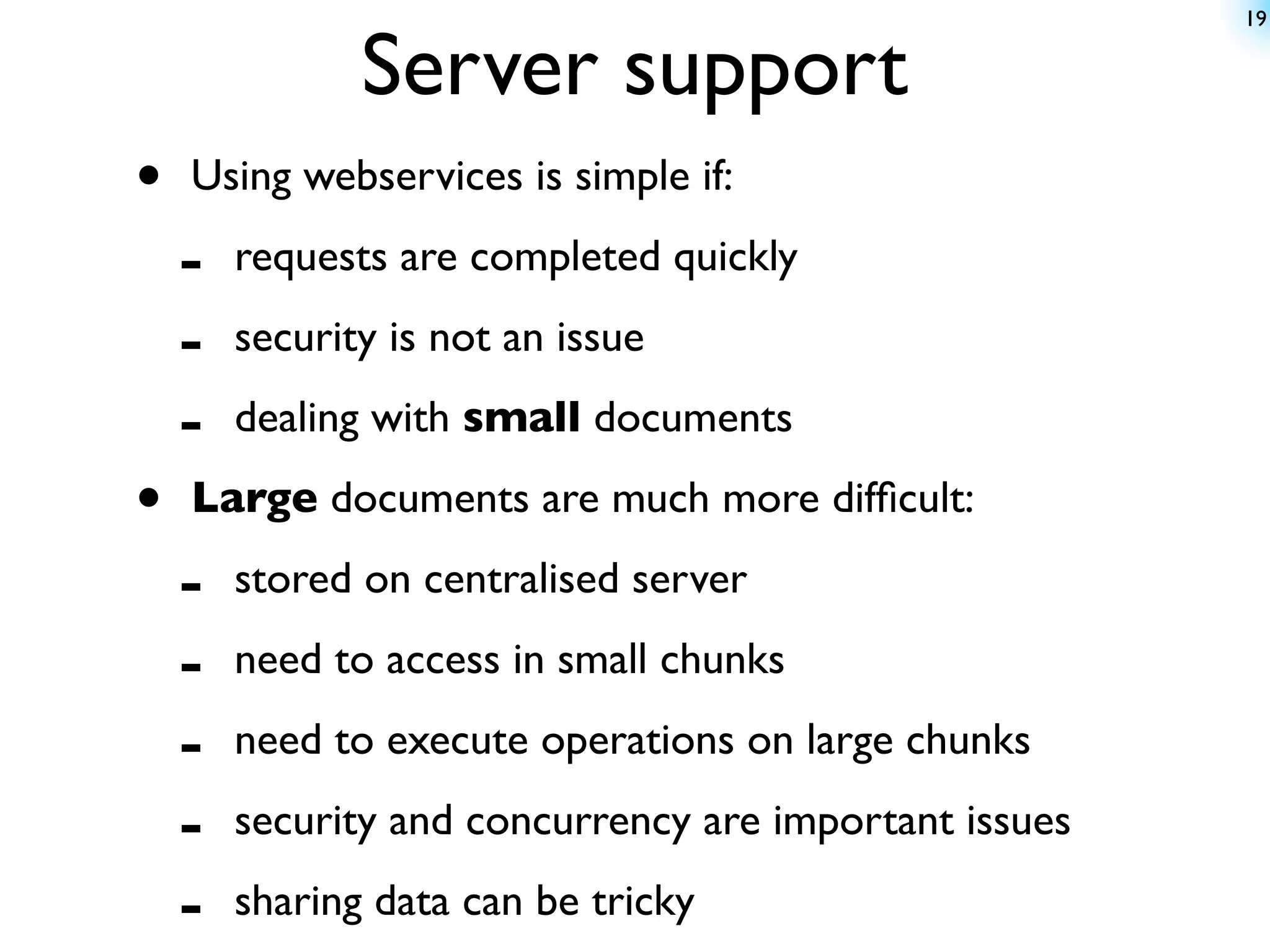
               Server support
•   Using webservices is simple if:

    -   requests are completed quickly

    -   security is not an issue

    -   dealing with small documents

•   Large documents are much more difficult:

    -   stored on centralised server

    -   need to access in small chunks

    -   need to execute operations on large chunks

    -   security and concurrency are important issues

    -   sharing data can be tricky
20


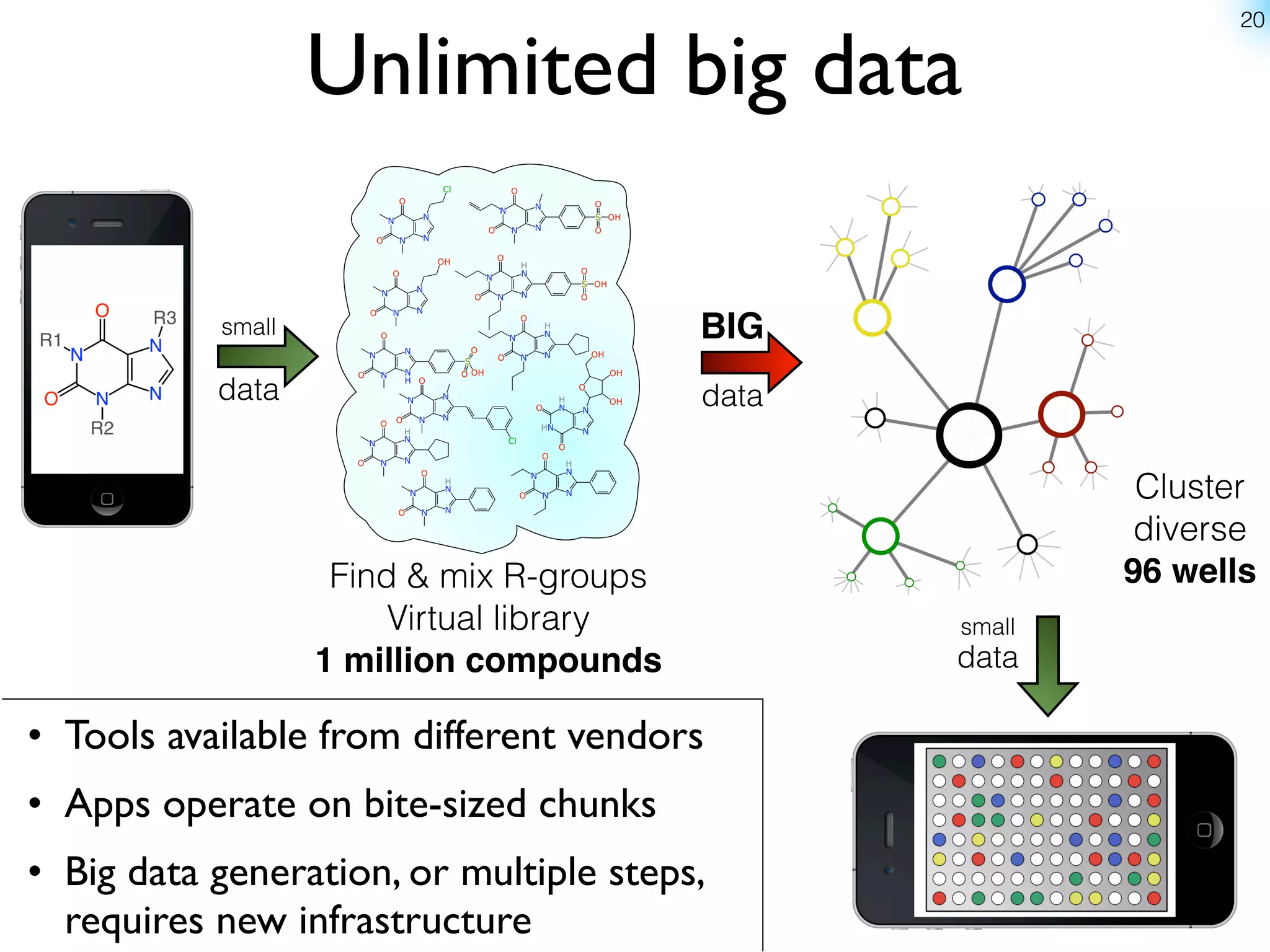
                   Unlimited big data

           small                          BIG
           data                           data

                                                          Cluster
                                                          diverse
                    Find & mix R-groups                  96 wells
                        Virtual library          small
                   1 million compounds           data

• Tools available from different vendors
• Apps operate on bite-sized chunks
• Big data generation, or multiple steps,
  requires new infrastructure
21


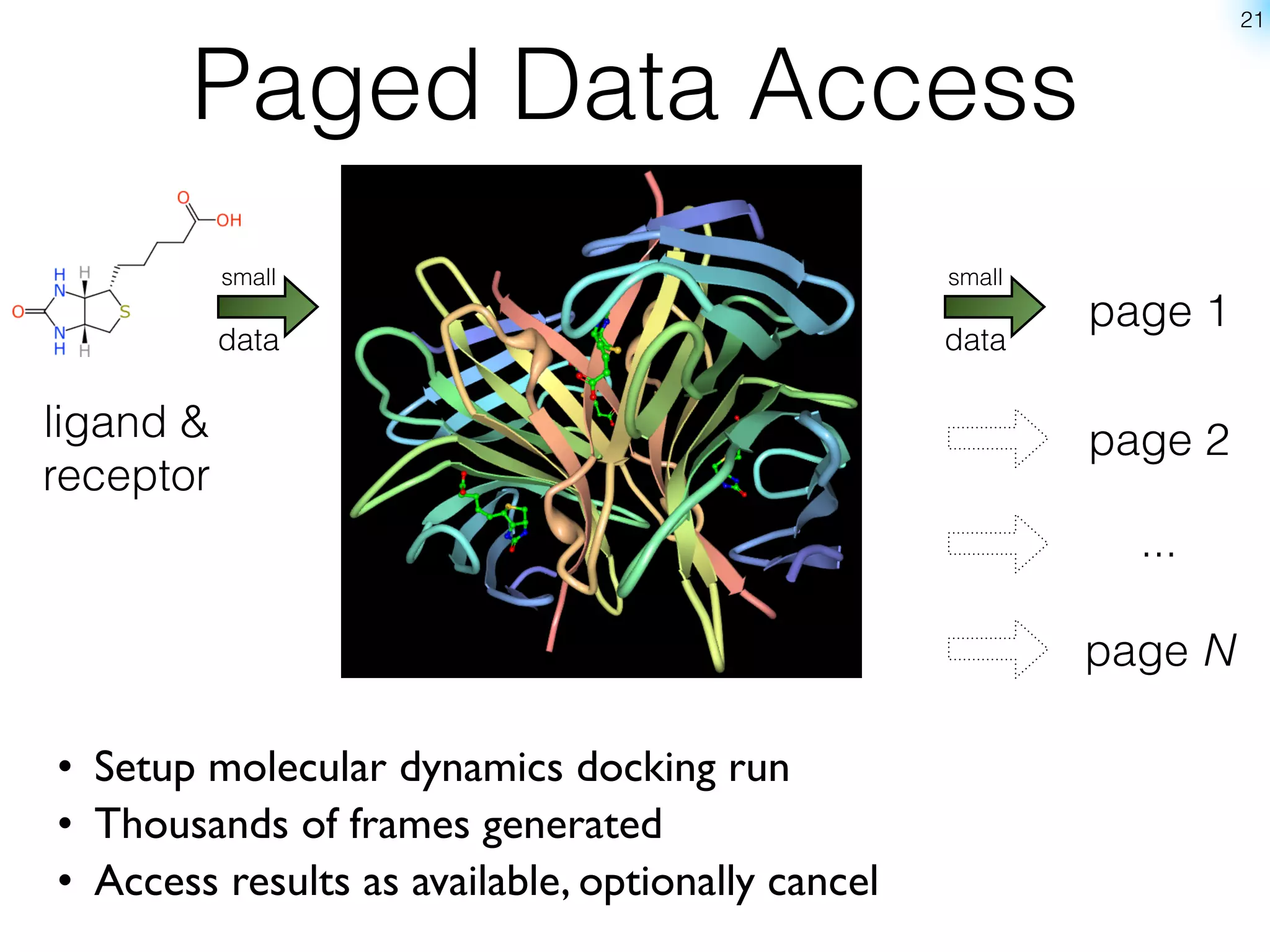
       Paged Data Access
           small                                   small
                                                           page 1
           data                                    data

ligand &                                                   page 2
receptor
                                                             ...

                                                           page N

• Setup molecular dynamics docking run
• Thousands of frames generated
• Access results as available, optionally cancel
22


               Proposed solution
•   Working with TM Forum and its member organisations


•   Propose to create a cloud-hosted server platform for:

    -   large datasets & scalable calculations
    -   cheminformatics/bioinformatics tools
    -   an API for accessing data & executable tasks

•   By providing a single platform with a common API, multiple
    software products can be hosted on the same environment

•   A many-to-many relationship between apps & data &
    computation
Conclusion

•   The Pistoia Alliance has executed Phase 1 of its App
    Strategy:

    -   curated catalog of relevant lifesciences R&D apps

    -   bringing app creators & app users together

•   Phase 2 will address deployment issues

•   Phase 3 will provide a cloud-based support framework
Acknowledgments
• The App Strategy team:

• John Wise, Ingrid Akerblom, Sean Ekins,
  Ashley George, Michael Braxenthaler, Ramesh
  Durvasula, Martyn Wilkins, Nick Lynch

• AirWatch, TM Forum
                                  http://pistoiaalliance.org
                                  http://molmatinf.com
• Inquiries to                    http://cheminf20.org
 alex.clark@pistoiaalliance.org
                                  @aclarkxyz

Pistoia Alliance App Strategy

  • 1.
    Pistoia Alliance AppStrategy: Apps for life sciences R&D Dr. Alex M. Clark April 2013 © 2013 Molecular Materials Informatics, Inc. http://molmatinf.com
  • 2.
    2 Mobile apps • The world of computing goes through periodic revolutions, e.g. mainframes minicomputers 1980 personal computers graphical user interfaces network connectivity 2010 wallet-sized computers • Some revolutions are more revolutionary than others - does all the software have to be redesigned from scratch? - are the new ideas and expectations transformative?
  • 3.
    3 The future is mobile • In case you haven't noticed... ... people live their lives on their phones and tablets. • Applicable functionality keeps growing: email, browsing, scheduling, games, presentations, word processing... ... and thousands of useful apps that have no equivalent in the desktop realm. • Q: Why would somebody waste their time trying to do chemistry on a mobile device? • A: Because if you can do everything else on mobile, do you really want to keep a PC around only for chemistry?
  • 4.
    4 Chemistry apps • App producers have been busy building chemistry tools: • But what do they do? Who makes them? What do people do with them? Are they toys, or industrial strength tools?
  • 5.
    5 Consumer bias • Apps are delivered via company stores (iTunes, Google Play, etc.) • Benefits relative to conventional software deployment: - platform vendor takes responsibility for many steps - delivery and billing all taken care of (for 30%) - review process stamp of approval is valuable • Great fit for consumer apps; not so much for vertical: - expectation of low price: business only works at scale - limited options for evaluation - user feedback crude and inappropriate (comments, ratings) - no way to find out who your customers are!
  • 6.
    6 Apps for life sciences R&D • Scientific discovery is not a consumer market • The market has a small headcount: tens of thousands... ... working on big problems (e.g. curing cancer) • Need a middle ground (enterprise-like): - active engagement between customers & vendors - flexible pricing models for high value software • But keep the benefits of appstore deployment
  • 7.
    7 Enter the • Lowering the barriers to R&D software innovation... • ... by bringing together life sciences companies, academic groups and software vendors for precompetitive collaboration • This includes recognising emerging trends, and supporting ways to benefit all stakeholders • The Pistoia Alliance recognised the value of mobile devices and cloud computing • These will be as important to life sciences are they are to every other industry • In 2012, the app strategy team was formally assembled
  • 8.
    8 Phase 1: App Catalog • There are many chemistry/biology apps on the iTunes AppStore and Google Play - many of them are irrelevant or useless for R&D - all of them are buried inside a massive catalog • Solve the easiest problems first: - compile a directory of apps (<100 vs. >106) - provide a forum for creators & users • Phase 1 is a simple layer on top of the company stores for iPhone/iPod/iPad and Android devices
  • 9.
    9 The AirWatch platform • Partnered with Air Watch, the leading provider of enterprise app catalogs and device management tools • We use their hosted service to make the Pistoia Alliance App Catalog available to the public
  • 10.
  • 11.
  • 12.
    12 Signing up • If you have an iPhone/iPod/iPad, or an Android device: http://apps.pistoiaalliance.org • Gain access to the catalog • We only list apps that are useful and relevant • Installation of apps is done by the company store - some free, some paid • Participate in discussions about existing apps: - everyone else is also a scientist, with similar interests - the app creators are actively involved: they want to know about your experiences - you can contact them/they can contact you offline
  • 13.
    13 Submitting an app • Must already be listed on the company store (Google, Apple) • Must be directly relevant to lifesciences R&D (broadly defined) • App creators are expected to participate in discussions • Anyone can submit: http://www.pistoiaalliance.org/submitapp.html • Screening done by Pistoia members
  • 14.
    14 Further developments • Open to more apps! • More advanced discussion forum features (expected mid-late 2013) • Encourage discussion of new app ideas, as well as comments on existing products • Continued stimulation of new ideas at meetings, e.g. the Pistoia Dragon's Den (inspired the Open Drug Discovery Teams project)
  • 15.
    15 Phase 2: Deployment • The biggest problems with vertical market apps relate to deployment: - traditional software is delivered by mailing a CD-ROM - web software is deployed by sending out a URL - apps have to be submitted & reviewed by a single authority • There is no guarantee that an app will be allowed! • There is only one price, and the vig is always 30% • Sales are always perpetual, no control
  • 16.
    16 Deployment possibilities • Android: - direct loading of apps is permitted - can use the AirWatch platform to deliver Pistoia- mediated apps directly onto users' devices • Apple (iPhone, iPod, iPad) - alternatives to the iTunes AppStore extremely restricted: directly circumventing the company store is not allowed - companies can setup their own Enterprise AppStore - the Pistoia AppStore could be used as a placeholder for non-public apps - private installation opens up many more deployment options
  • 17.
    17 Phase 3: Cloud computing • Mobile devices are quite powerful, but: - not suitable for grinding through long calculations - not recommended for storing large collections of data • Many mobile apps use webservices to provide functionality, e.g. - database search (ChemSpider, SPRESI, Mobile Reagents) - property calculation (MolPrime+, SAR Table, MMDS) - real time newsfeeds (ODDT, RSC Mobile) - sharing data (MolSync, Reaction101,Yield101)
  • 18.
    18 19 Limited big data • Can currently make use of big data under constrained workflow conditions small small data data Search ChemSpider Search Query Database Engine Results
  • 19.
    19 Server support • Using webservices is simple if: - requests are completed quickly - security is not an issue - dealing with small documents • Large documents are much more difficult: - stored on centralised server - need to access in small chunks - need to execute operations on large chunks - security and concurrency are important issues - sharing data can be tricky
  • 20.
    20 Unlimited big data small BIG data data Cluster diverse Find & mix R-groups 96 wells Virtual library small 1 million compounds data • Tools available from different vendors • Apps operate on bite-sized chunks • Big data generation, or multiple steps, requires new infrastructure
  • 21.
    21 Paged Data Access small small page 1 data data ligand & page 2 receptor ... page N • Setup molecular dynamics docking run • Thousands of frames generated • Access results as available, optionally cancel
  • 22.
    22 Proposed solution • Working with TM Forum and its member organisations • Propose to create a cloud-hosted server platform for: - large datasets & scalable calculations - cheminformatics/bioinformatics tools - an API for accessing data & executable tasks • By providing a single platform with a common API, multiple software products can be hosted on the same environment • A many-to-many relationship between apps & data & computation
  • 23.
    Conclusion • The Pistoia Alliance has executed Phase 1 of its App Strategy: - curated catalog of relevant lifesciences R&D apps - bringing app creators & app users together • Phase 2 will address deployment issues • Phase 3 will provide a cloud-based support framework
  • 24.
    Acknowledgments • The AppStrategy team: • John Wise, Ingrid Akerblom, Sean Ekins, Ashley George, Michael Braxenthaler, Ramesh Durvasula, Martyn Wilkins, Nick Lynch • AirWatch, TM Forum http://pistoiaalliance.org http://molmatinf.com • Inquiries to http://cheminf20.org alex.clark@pistoiaalliance.org @aclarkxyz