21Icebreakers &
Meeting Exercises
Working Well Solutions Ltd
Have you ever been invited to a conference or
meeting and cringed as the leader brings out the big
ball and asks you stand in a circle or, even worse,
brings out the coloured paper and scissors? No?
Well you are lucky.
Icebreakers can be brilliant. But if mishandled or
applied at the wrong time to the wrong group cause
a disaster and alienate the audience before you
start on the day’s agenda.
I have been to good and bad meetings and the
icebreaker or the first exercise often sets the tone
for the whole day.
Icebreakers
Here are 21 icebreakers. Use them as
they stand or pick out some elements
to make your meetings go with a
swing.
• Help relax team members
making them ready to
listening and contribute
• Create a “team atmosphere”
• Motivate attendees to work
in a cooperative manner
• The most popular and
effective are those that
promote interaction, sharing,
and team building.
Purpose
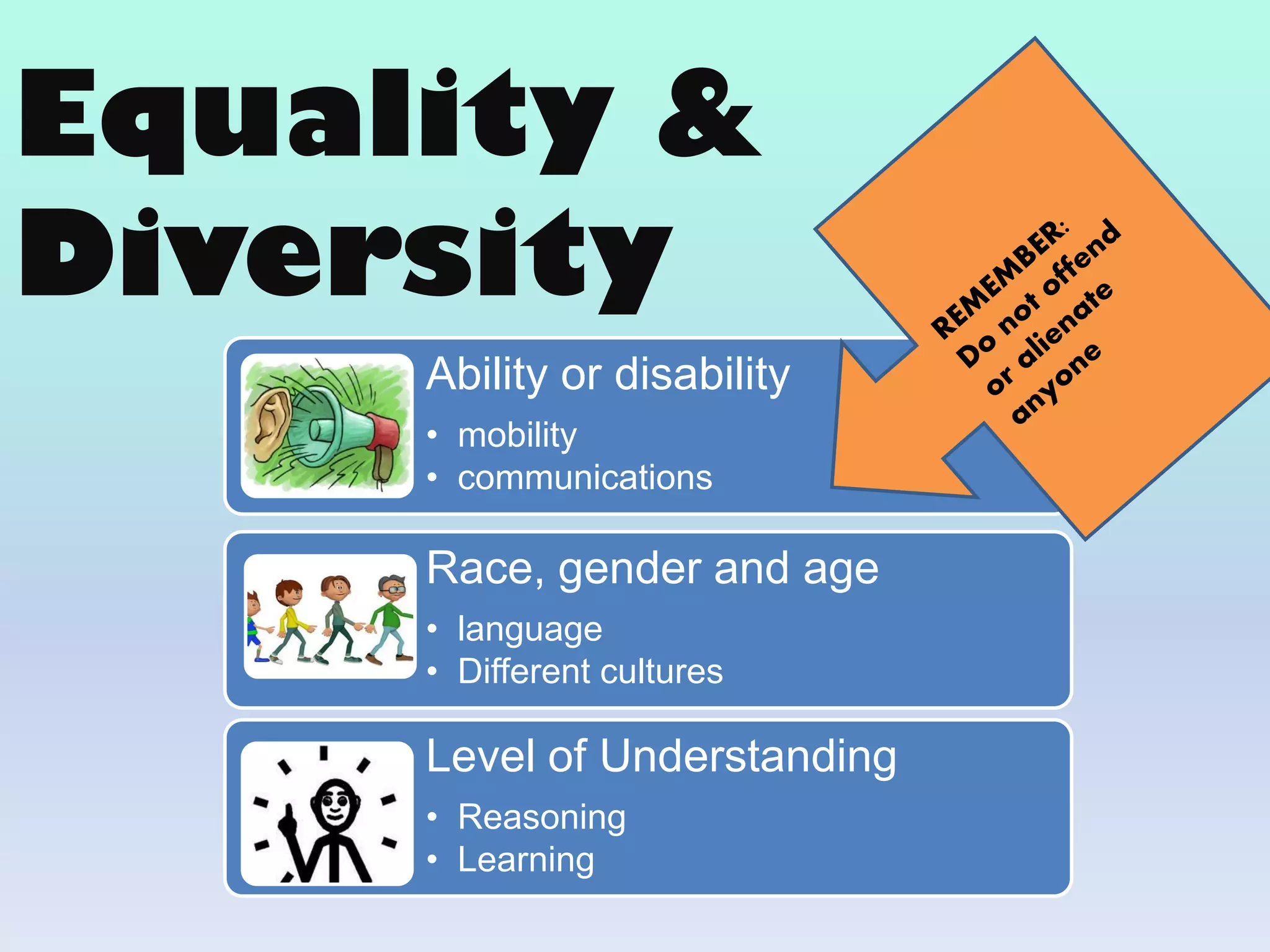
Ability or disability
• mobility
• communications
Race, gender and age
• language
• Different cultures
Level of Understanding
• Reasoning
• Learning
Equality &
Diversity
1. Have a clear purpose
2. Simplicity is important. Explain and present easily
3. Time your ice breakers and exercises for the best effect
4. Make it humorous…nothing sets the tone better than laughter
6. Practice until it’s perfect
7. Link it to a point in your presentation.
Design your own
Let’sGo
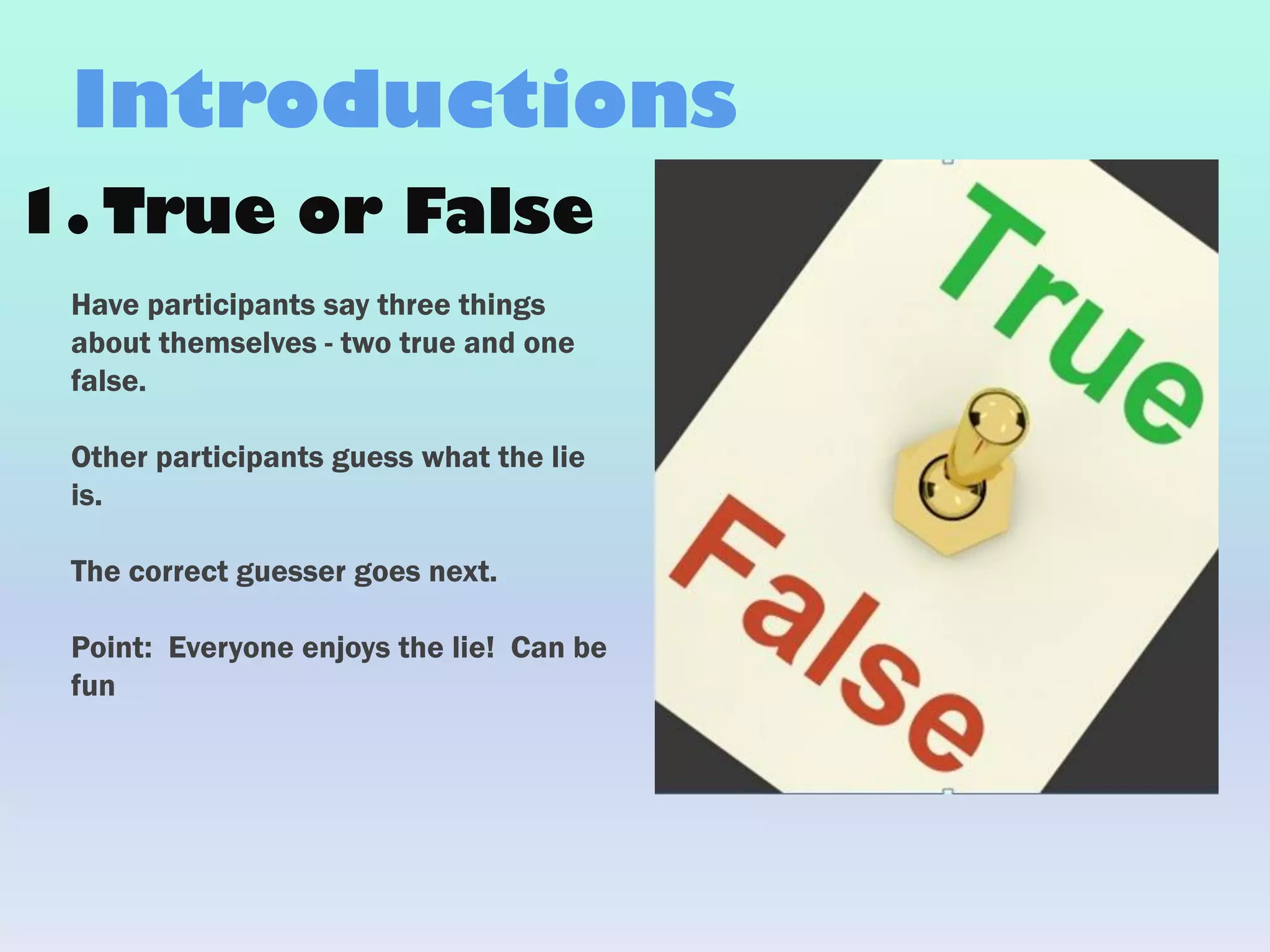
1. True or False
Have participants say three things
about themselves - two true and one
false.
Other participants guess what the lie
is.
The correct guesser goes next.
Point: Everyone enjoys the lie! Can be
fun
Introductions
Choices
2. If you could be in the movie of your choice,
what movie would you choose and what
character would you play?
Introductions
3. If you could choose your age forever, what
age would you choose and why?
4. If you woke up tomorrow as an animal,
what animal would you choose to be and
why?
Point: Easy to do, most
will have an opinion, no
threat to participants,
often funny answers
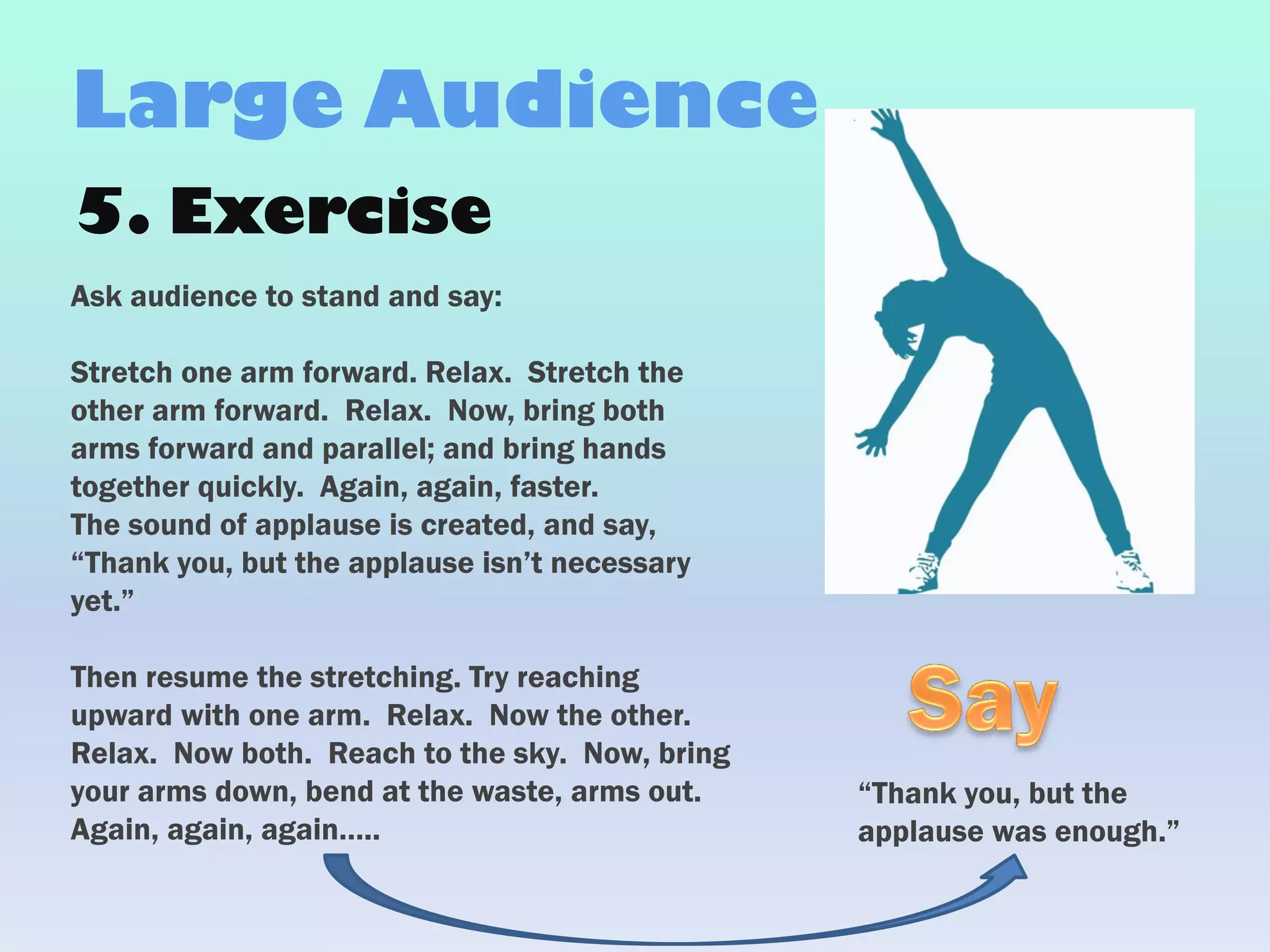
5. Exercise
Ask audience to stand and say:
Stretch one arm forward. Relax. Stretch the
other arm forward. Relax. Now, bring both
arms forward and parallel; and bring hands
together quickly. Again, again, faster.
The sound of applause is created, and say,
“Thank you, but the applause isn’t necessary
yet.”
Then resume the stretching. Try reaching
upward with one arm. Relax. Now the other.
Relax. Now both. Reach to the sky. Now, bring
your arms down, bend at the waste, arms out.
Again, again, again…..
Large Audience
“Thank you, but the
applause was enough.”
6. The Wave
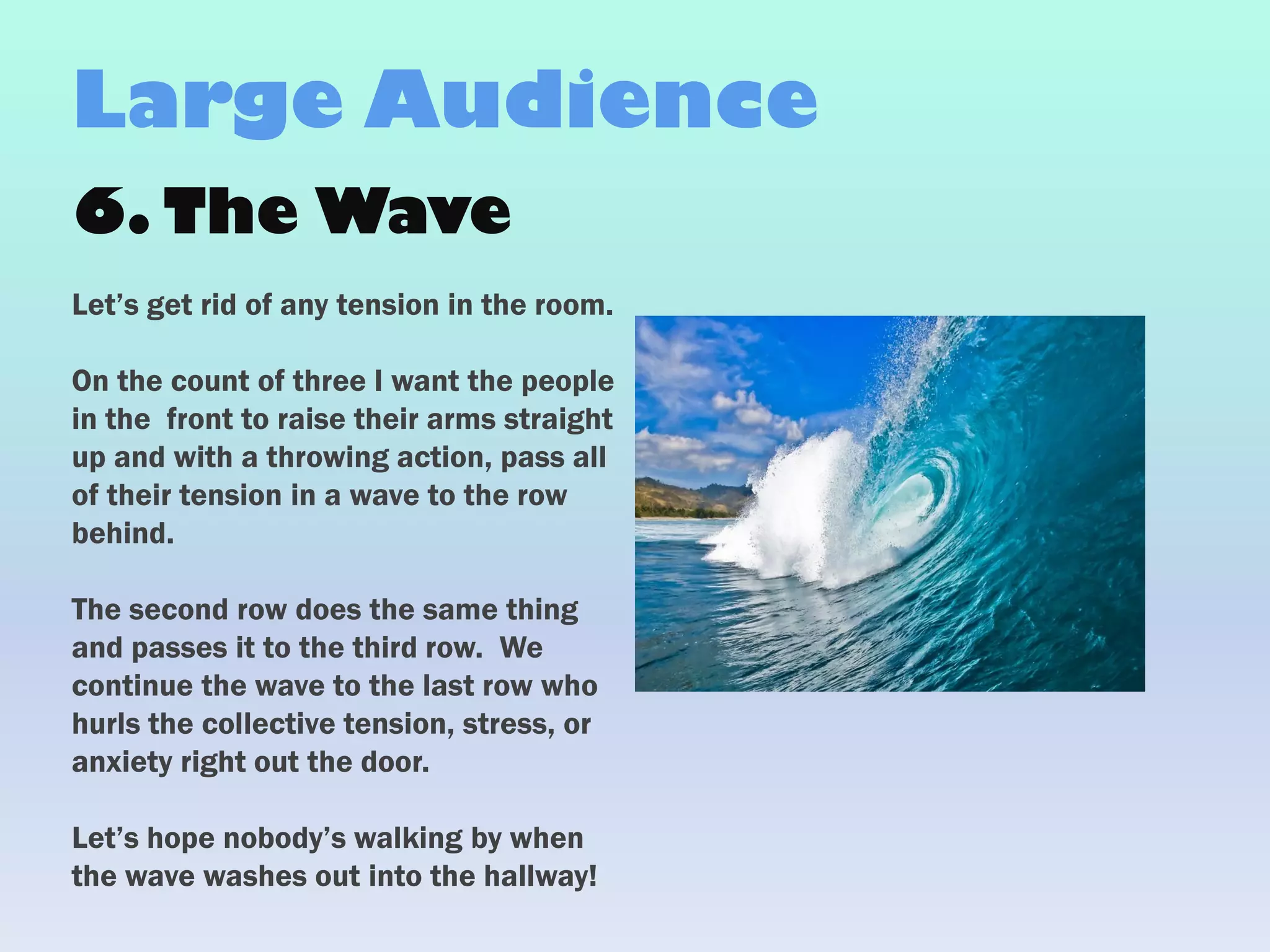
Let’s get rid of any tension in the room.
On the count of three I want the people
in the front to raise their arms straight
up and with a throwing action, pass all
of their tension in a wave to the row
behind.
The second row does the same thing
and passes it to the third row. We
continue the wave to the last row who
hurls the collective tension, stress, or
anxiety right out the door.
Let’s hope nobody’s walking by when
the wave washes out into the hallway!
Large Audience
7. Communications
Each participant has a sheet of identical plain
paper. Explain everyone follow instructions
precisely, no questions and eyes closed
The instructions:
1. Fold the paper in half
2. Rip off a corner
3. Fold in half again
4. Rip off a corner
5. Fold again
6. Rip off a corner.
Now open your eyes and compare each design
with others or find a similar design in the group
Point: One-way communication is never
as effective as two-way; it gives
different results.
Large Audience
8. Perception
Instruct your audience to count the number of “F’s” in a sentence.
Place this sentence on the board or screen:
FINISHED FILES ARE THE RESULT OF YEARS OF SCIENTIFIC
STUDY COMBINED WITH THE EXPERIENCE OF YEARS.
Allow 15 seconds.
On average, most people will only spot 3 or 4 of the F’s in the
sentence. There are actually six. The brain tends to skip the word
“of,” or perceive it as “versus.”
Point: One’s perception may not always be correct.
Large Audience
9. Order Please
Ask all the members of the group to place
themselves in line in alphabetical order.
A variation on this is the order of the date
(month and day only) when their birthday
occurs
Large Audience
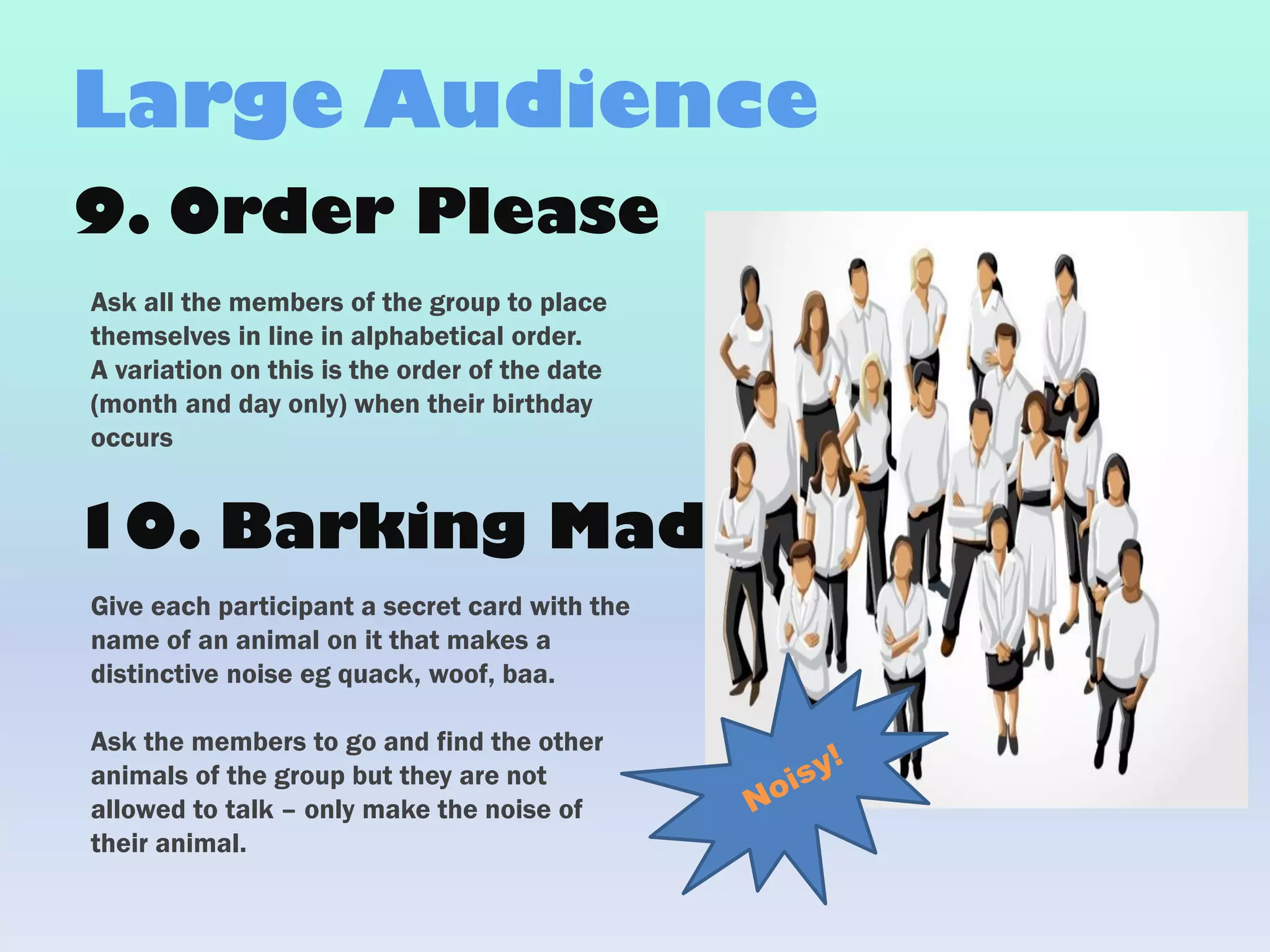
Give each participant a secret card with the
name of an animal on it that makes a
distinctive noise eg quack, woof, baa.
Ask the members to go and find the other
animals of the group but they are not
allowed to talk – only make the noise of
their animal.
10. Barking Mad
11. Getting to KnowYou
Find ten things that you have in common
with one stranger in the group (body parts
not allowed.)
Large Audience
Each person (in couples or threes)
takes a penny or other coin out of their
pocket and looks at the date.
On their turn they recall something
spectacular that happened that year
either to themselves or in the world
and tell the others in the group about it
12. Lucky Penny
13. Name Game
Participants introduce themselves
positively with two adjectives
beginning with the same letter as the
initial of their first name.
For example, Motivating, Moneybags
Malcolm
Short and Sweet
Well folks, lets start with everyone saying
the word, “Ha.” Now say it a little louder.
Say it again, again, again. Now, that’s what
I call a cheap laugh!
14. Ha Ha
Game
15. One word
Ask a newly formed group to share with their
group the one word that describes X (for
example, culture, leadership, health, safety,
sales)
Point: A way of introducing the topic of the
meeting or training class and giving an
understanding of current thinking of the
group about the subject
Break Out Sessions
16. Sales
Participants are asked to select an object that they
have on their persons.
In a small group, everyone is asked to introduce
themselves and sell the object to the group.
In a large group, individuals are paired and try to sell
the object to one another, or “volunteers” are
brought to the front to sell the object to the
audience. Some of the people will be enthusiastic
and creative, others might be reluctant and shy.
Point: How a person approaches a topic often
determines how the topic is perceived.
Break out Sessions
17. Desert Island
You are marooned on a island. What five
(you can use a different number, such as
seven, depending upon the size of each
team) items would you take with you
Choose five items per team, not per person.
Write the items on a flip chart and discuss
and defend your choices with the larger
group after.
Point: Gives insight into other's
values and problem solving styles
and promotes teamwork.
Break out Sessions
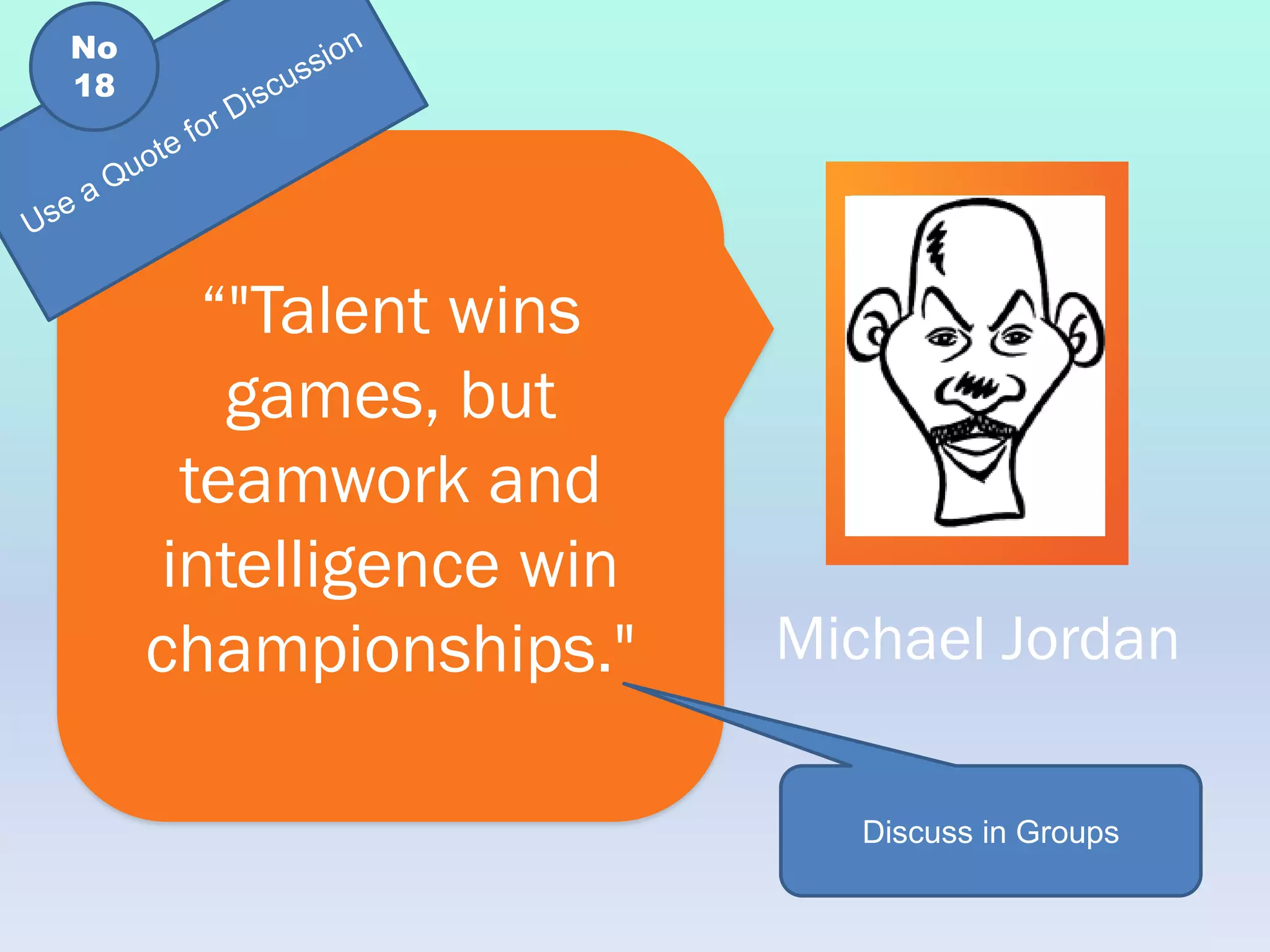
“"Talent wins
games, but
teamwork and
intelligence win
championships." Michael Jordan
Discuss in Groups
No
18
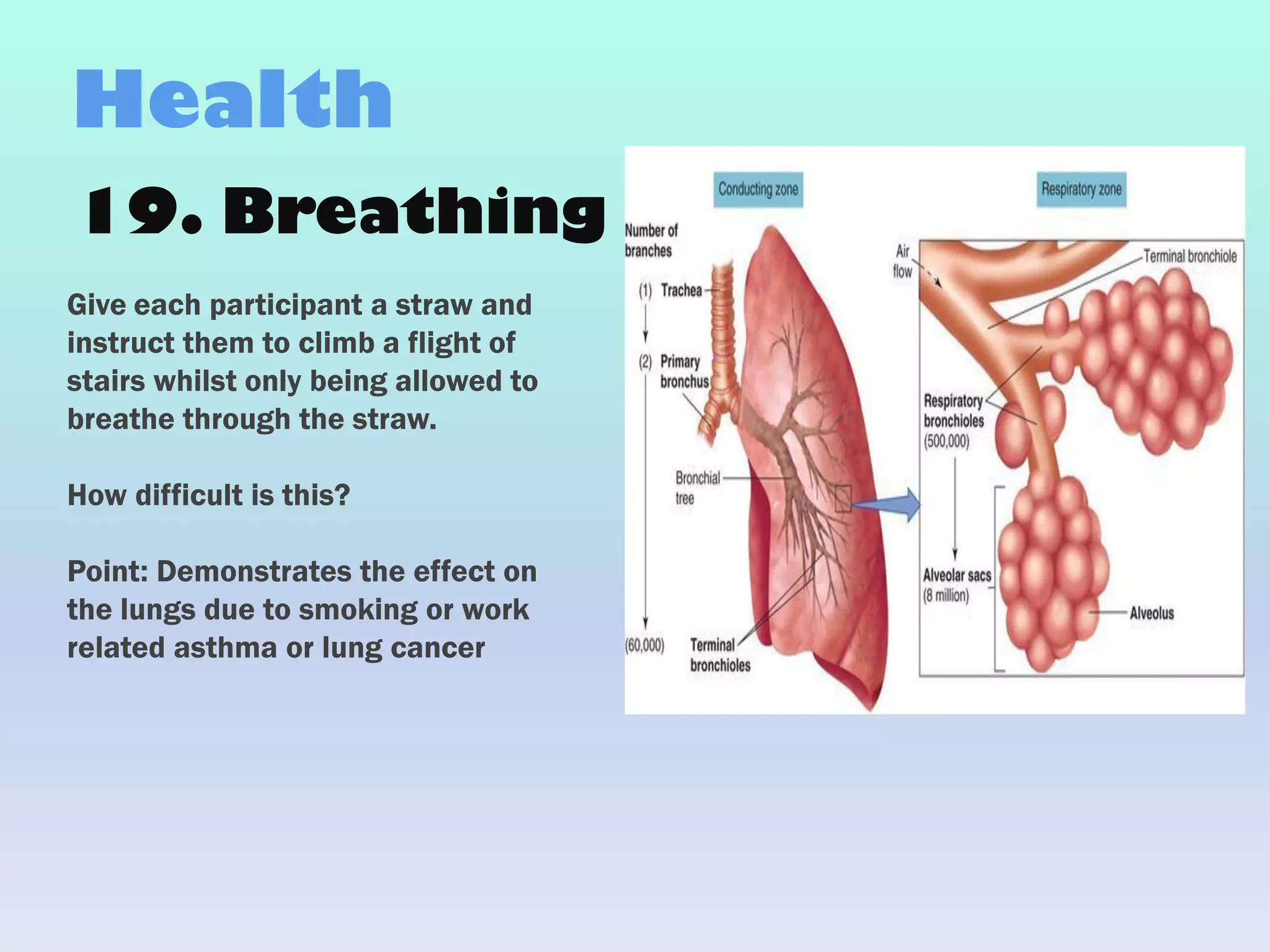
19. Breathing
Give each participant a straw and
instruct them to climb a flight of
stairs whilst only being allowed to
breathe through the straw.
How difficult is this?
Point: Demonstrates the effect on
the lungs due to smoking or work
related asthma or lung cancer
Health
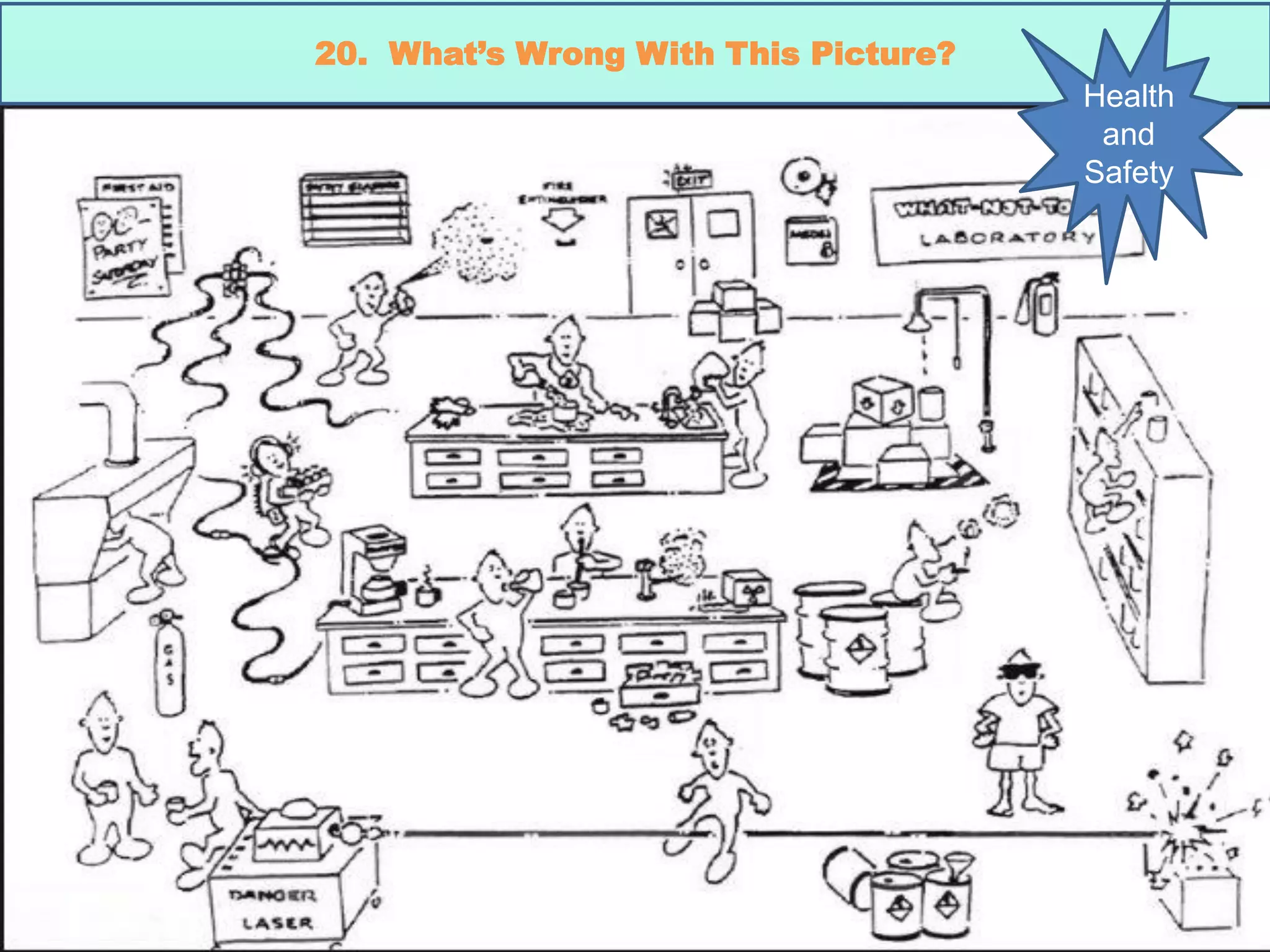
20. What’s Wrong With This Picture?
Health
and
Safety
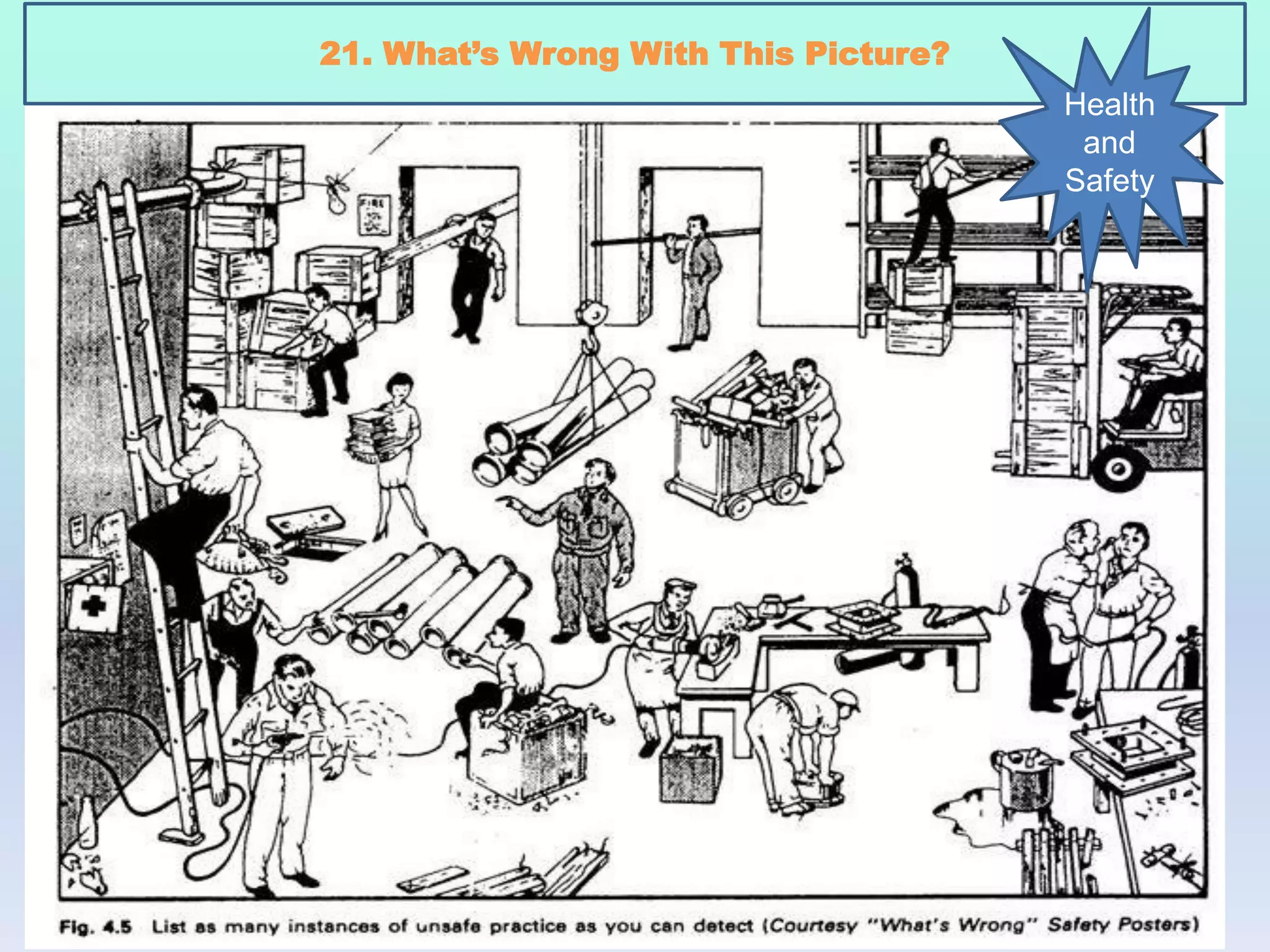
21. What’s Wrong With This Picture?
Health
and
Safety
Should be
• An activity where the leader can
be seen by everyone in
attendance.
• Sends participants away with
critical information or reminders
of upcoming activities.
• Allows the leader to express
appreciation to participants and
others
• End on a Positive Note
The Finale
Jane Coombs
Follow me on Twitter - @WWSOccHealth
Appreciate a ‘like’ on Facebook

My Top 21 Icebreakers and Meeting exercises

  • 1.
  • 2.
    Have you everbeen invited to a conference or meeting and cringed as the leader brings out the big ball and asks you stand in a circle or, even worse, brings out the coloured paper and scissors? No? Well you are lucky. Icebreakers can be brilliant. But if mishandled or applied at the wrong time to the wrong group cause a disaster and alienate the audience before you start on the day’s agenda. I have been to good and bad meetings and the icebreaker or the first exercise often sets the tone for the whole day. Icebreakers Here are 21 icebreakers. Use them as they stand or pick out some elements to make your meetings go with a swing.
  • 3.
    • Help relaxteam members making them ready to listening and contribute • Create a “team atmosphere” • Motivate attendees to work in a cooperative manner • The most popular and effective are those that promote interaction, sharing, and team building. Purpose
  • 4.
    Ability or disability •mobility • communications Race, gender and age • language • Different cultures Level of Understanding • Reasoning • Learning Equality & Diversity
  • 5.
    1. Have aclear purpose 2. Simplicity is important. Explain and present easily 3. Time your ice breakers and exercises for the best effect 4. Make it humorous…nothing sets the tone better than laughter 6. Practice until it’s perfect 7. Link it to a point in your presentation. Design your own Let’sGo
  • 6.
    1. True orFalse Have participants say three things about themselves - two true and one false. Other participants guess what the lie is. The correct guesser goes next. Point: Everyone enjoys the lie! Can be fun Introductions
  • 7.
    Choices 2. If youcould be in the movie of your choice, what movie would you choose and what character would you play? Introductions 3. If you could choose your age forever, what age would you choose and why? 4. If you woke up tomorrow as an animal, what animal would you choose to be and why? Point: Easy to do, most will have an opinion, no threat to participants, often funny answers
  • 8.
    5. Exercise Ask audienceto stand and say: Stretch one arm forward. Relax. Stretch the other arm forward. Relax. Now, bring both arms forward and parallel; and bring hands together quickly. Again, again, faster. The sound of applause is created, and say, “Thank you, but the applause isn’t necessary yet.” Then resume the stretching. Try reaching upward with one arm. Relax. Now the other. Relax. Now both. Reach to the sky. Now, bring your arms down, bend at the waste, arms out. Again, again, again….. Large Audience “Thank you, but the applause was enough.”
  • 9.
    6. The Wave Let’sget rid of any tension in the room. On the count of three I want the people in the front to raise their arms straight up and with a throwing action, pass all of their tension in a wave to the row behind. The second row does the same thing and passes it to the third row. We continue the wave to the last row who hurls the collective tension, stress, or anxiety right out the door. Let’s hope nobody’s walking by when the wave washes out into the hallway! Large Audience
  • 10.
    7. Communications Each participanthas a sheet of identical plain paper. Explain everyone follow instructions precisely, no questions and eyes closed The instructions: 1. Fold the paper in half 2. Rip off a corner 3. Fold in half again 4. Rip off a corner 5. Fold again 6. Rip off a corner. Now open your eyes and compare each design with others or find a similar design in the group Point: One-way communication is never as effective as two-way; it gives different results. Large Audience
  • 11.
    8. Perception Instruct youraudience to count the number of “F’s” in a sentence. Place this sentence on the board or screen: FINISHED FILES ARE THE RESULT OF YEARS OF SCIENTIFIC STUDY COMBINED WITH THE EXPERIENCE OF YEARS. Allow 15 seconds. On average, most people will only spot 3 or 4 of the F’s in the sentence. There are actually six. The brain tends to skip the word “of,” or perceive it as “versus.” Point: One’s perception may not always be correct. Large Audience
  • 12.
    9. Order Please Askall the members of the group to place themselves in line in alphabetical order. A variation on this is the order of the date (month and day only) when their birthday occurs Large Audience Give each participant a secret card with the name of an animal on it that makes a distinctive noise eg quack, woof, baa. Ask the members to go and find the other animals of the group but they are not allowed to talk – only make the noise of their animal. 10. Barking Mad
  • 13.
    11. Getting toKnowYou Find ten things that you have in common with one stranger in the group (body parts not allowed.) Large Audience Each person (in couples or threes) takes a penny or other coin out of their pocket and looks at the date. On their turn they recall something spectacular that happened that year either to themselves or in the world and tell the others in the group about it 12. Lucky Penny
  • 14.
    13. Name Game Participantsintroduce themselves positively with two adjectives beginning with the same letter as the initial of their first name. For example, Motivating, Moneybags Malcolm Short and Sweet Well folks, lets start with everyone saying the word, “Ha.” Now say it a little louder. Say it again, again, again. Now, that’s what I call a cheap laugh! 14. Ha Ha Game
  • 15.
    15. One word Aska newly formed group to share with their group the one word that describes X (for example, culture, leadership, health, safety, sales) Point: A way of introducing the topic of the meeting or training class and giving an understanding of current thinking of the group about the subject Break Out Sessions
  • 16.
    16. Sales Participants areasked to select an object that they have on their persons. In a small group, everyone is asked to introduce themselves and sell the object to the group. In a large group, individuals are paired and try to sell the object to one another, or “volunteers” are brought to the front to sell the object to the audience. Some of the people will be enthusiastic and creative, others might be reluctant and shy. Point: How a person approaches a topic often determines how the topic is perceived. Break out Sessions
  • 17.
    17. Desert Island Youare marooned on a island. What five (you can use a different number, such as seven, depending upon the size of each team) items would you take with you Choose five items per team, not per person. Write the items on a flip chart and discuss and defend your choices with the larger group after. Point: Gives insight into other's values and problem solving styles and promotes teamwork. Break out Sessions
  • 18.
    “"Talent wins games, but teamworkand intelligence win championships." Michael Jordan Discuss in Groups No 18
  • 19.
    19. Breathing Give eachparticipant a straw and instruct them to climb a flight of stairs whilst only being allowed to breathe through the straw. How difficult is this? Point: Demonstrates the effect on the lungs due to smoking or work related asthma or lung cancer Health
  • 20.
    20. What’s WrongWith This Picture? Health and Safety
  • 21.
    21. What’s WrongWith This Picture? Health and Safety
  • 22.
    Should be • Anactivity where the leader can be seen by everyone in attendance. • Sends participants away with critical information or reminders of upcoming activities. • Allows the leader to express appreciation to participants and others • End on a Positive Note The Finale
  • 23.
    Jane Coombs Follow meon Twitter - @WWSOccHealth Appreciate a ‘like’ on Facebook