Global Health Education—Global Health Programs: Nicholas Comninellis

Loading...

Flash Player 9 (or above) is needed to view presentations.
We have detected that you do not have it on your computer. To install it, go here.

0 comments

Post a comment

    Post a comment
    Embed Video
    Edit your comment Cancel

    Notes on slide 1

    Title: Fighting the Diseases of Poverty Learning Objectives: At the completion of this presentation, participants will be able to more effectively: • Advocate economic development as it relates to health • Advocate for ending military conflict • Advocate for effective disease interventions Abstract: The academic community laudably continues to respond to international health concerns. A growing number of institutions now offer students opportunities to augment their understanding through didactic exercises and study abroad. Encouragingly, research demonstrates that such students are more likely to incorporate international service into their careers. But enormous deficiencies remain. Nursing schools, for example, seldom give academic credit for study abroad. Of 159 schools of medicine and osteopathy in the U.S., only some 40 percent report study opportunities in developing nations. Of 446 family medicine residencies, only about 20 percent actively participate in international service. Why such deficiencies? Significant reasons stems from the concerns of educators to assure academic excellence and verify that students are achieving defined learning objectives. This forces educators to define essential elements of global health education, with attention to the needs of low-resource communities. The core knowledge especially germane to the field includes 1. Determinants of Health - An orientation to the main factors influencing health; including nutrition, contraception and obstetric care, infectious diseases prevention, injury prevention, and provision of medical care. 2. Diseases of Poverty – An understanding of those medical conditions most frequently associated with low-resource communities, including their epidemiology, prevention and management. 3. Cross-Cultural Skills – Those tools necessary to work effectively with people of diverse values and world-views. 4. Health Leadership - How healthcare professionals can work in cooperation with communities to design and lead effective health systems. Mastery of this core knowledge is essential for effective study of and service within such communities. Discussion Questions: • What are the most important health problems in poorer nations? • Why are poverty and economic status so closely linked together? • What happens to a nation’s health when war breaks out?

    1 Event

    Global Health Education—Global Health Programs: Nicholas Comninellis - Presentation Transcript

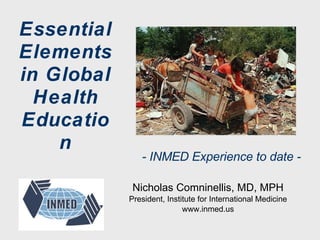
    1. Essential Elements in Global Health Education Nicholas Comninellis, MD, MPH President, Institute for International Medicine www.inmed.us - INMED Experience to date -
    2. Presentation Objective
      • At the completion of this presentation, participants will be able to d esign a more effective global health program
    3. Ours Is A Very Needy World Sudan 1993
    4. Tom Dooley in Vietnam, 1955
    5. Clinica Evangelica Morava Eastern Honduras Dr. Sam Marx hosted over 150 medical students during his 40 year career in Honduras.
    6. Comninellis at Shanghai Charity Hospital,1981-83 Challenges: Water and air borne illnesses, TB, rheumatic fever, schistosomiasis
    7. Comninellis at Shanghai Charity Hospital,1981-83 Challenges: Language, world-view, concepts of health and diseases
    8. Comninellis in Angola, Africa, 1989-91 Measles, malaria, malnutrition, land mines
    9. Comninellis at the University of Missouri-Kansas City To revive the International Medicine program at UMKC
    10. “ We want to get personally involved!”
      • Record Interest Among
      • Health Care Profession Students
    11. “ But…
      • … We Don’t Know Where To Begin”
    12. “ We Don’t Know Where To Begin”
      • Where could I train?
      • What organization to go with?
      • How can I become familiar with those diseases?
      • How can I get ready to get along in a different culture?
      • How to work the finances?
    13. Institute for International Medicine Equipping healthcare professional students to serve in medical missions
    14. International Medicine Certificate: Essential Considerations
        • • What is global health/international medicine?
        • • What are the desired learning outcomes/competencies?
        • • What are the desired career outcomes?
        • • What are the educational elements to achieve these outcomes?
    15. What is global health/ international medicine?
      • • It is useful to study health, especially health policy, in other developed nations
      • • But most people interested in global health focus on developing nations or low-resource communities
      Working Definition: Promoting health in low-resource communities Albert Schweitzer
    16. What are the desired learning outcomes/competencies?
      • At completion of the International Medicine Diploma students in the context of a low-resource community will be able to:
      • • Assess community health status based on the leading determinants of health
      • • Prevent, diagnose and treat the leading diseases of poverty
      • • Assure that health interventions are culturally appropriate
      • • Design effective health interventions as part of a health leadership team
      • • Successfully adapt one's lifestyle to a new cultural context
    17. What are the desired career outcomes?
      • That graduates would incorporate into their careers:
      • • Primarily: Service in developing nations
      • • Secondarily: Service to culturally diverse and low-income people in their home nation
      Lani Ackerman Antoinette Brown
    18. What are the educational elements achieve these outcomes?
      • Didactic
      • Curriculum that addresses:
        • • Determinants of health
        • • Diseases of poverty
        • • Cross-cultural skills
        • • Health leadership
        • • Personal skills for international living
        • Taught via online courses and …
    19. 25 renowned faculty Joe LeMaster MPH Nancy Crigger PhD, RN Daniel Hinthorn MD
    20. What are the educational elements achieve these outcomes?
      • Experiential
      • 4-8 weeks working in ongoing community health, primary care or hospital medicine in a developing nation
      Belize Guatemala Uganda Kenya Ecuador Cameroon India Papua New Guinea Honduras Ghana Angola Zambia Jordan China Macau South Africa
    21. Preceptorships – Not Group Trips With faculty who live on-site and have US-recognized credentials
    22. What are the educational elements achieve these outcomes?
      • Reflective
      • • Each student gives a presentation at the training site to enhance skills of the staff
      • • Each student writes a structured essay concerning application of his or her experience
      • • Each student attends a debriefing after return from overseas
    23. Who has completed the INMED International Medicine Certificate to date?
      • • Between 2004-09 128 health profession students completed the 2-week course in international medicine and 4-8 weeks service experience in a developing nation
      • • 38 resident physicians
      • • 69 medical students
      • • 4 public health students
      • • 8 physician assistant students
      • • 5 pharmacy students
      • • 4 nurse practitioner students
      • • Representing 64 universities and residencies
    24. Population-Based, Public Health Emphasis
      • Women DO Live Longer Than Men!
    25. What are the realized career outcomes to date?
      • Service In Developing Nations:
      • • As of March, 2009, 32% (41) had completed formal training (mean of 1-3 years)
      • • Of those with completed training, 28% (12) had since returned to serve in a low-income nation for at least one month (mean of 7 weeks)
      • • Of those with completed training, 100% reported interest in serving in a developing nation in the future
    26. What are the realized career outcomes to date?
      • Comparative experience:
      • • Drew University medical students given 2 weeks classroom on major tropical diseases and int’l health issues, and 4 weeks clinical experience in a developing nation
      • • Published results in 2001: 52 participants from 1987-1998 returned a survey
      • • 66% “had joined national or int’l relief organizations”
      • • 80% “had travelled several times to the area of their original elective”
    27. What are the major program challenges?
      • Looking to the future:
      • • Identification of new training sites and faculty
      • • Assuring continued superb logistic support
      • • Providing fellowship level opportunities for those who desire more training
    28. Conclusion
      • Global health/international medicine education can significantly influence career choices towards service in developing nations
    29. Institute for International Medicine
      • 6700 Troost, Suite 224 Kansas City MO 64131-4410 816-520-6900 [email_address]
      www.inmed.us Nicholas Comninellis, MD, MPH
    SlideShare Zeitgeist 2009

    + UWGlobalHealthUWGlobalHealth Nominate

    custom

    552 views, 0 favs, 0 embeds more stats

    Essential Elements of Global Health Education

    N more

    More info about this document

    © All Rights Reserved

    Go to text version

    • Total Views 552
      • 552 on SlideShare
      • 0 from embeds
    • Comments 0
    • Favorites 0
    • Downloads 0
    Most viewed embeds

    more

    All embeds

    less

    Flagged as inappropriate Flag as inappropriate
    Flag as inappropriate

    Select your reason for flagging this presentation as inappropriate. If needed, use the feedback form to let us know more details.

    Cancel
    File a copyright complaint
    Having problems? Go to our helpdesk?

    Categories