Citizen Journalism Dr Axel Bruns KCB201 Virtual Cultures [email_address]
1999 “Battle of Seattle” Emergence of  Indymedia : World Trade Organisation meeting in Seattle, 1999 large ‘alternative globalisation’ protests by broad coalition of activists fear that mainstream media (MSM) would focus only on riots and unrest development of DIY journalism projects – “become the media” established as  Independent Media Center  (IMC,  Indymedia ) based on software built for activist group in Sydney key features: DIY media content: stories, images, video sourced from activists open publishing: all stories made available immediately public discussion: strong role for comments, adding further information
Citizen Journalism Part of a longer trend: hand-printed and photocopied pamphlets and newsletters as old as the printing press itself but boosted by simplicity and reach of online publishing Emergence of key citizen journalism sites: Indymedia  – political activism, alternative globalisation Slashdot  – technology news, privacy, governance, legal issues Kuro5hin ,  Plastic  – politics and  Zeitgeist OhmyNews  –  South Korean  politics, now also  International  and  Japan Wikipedia   and  Wikinews  – general news (but  problems  with the latter) Current.tv  – video news and documentaries news blogs – more or less consistent news coverage and discussion
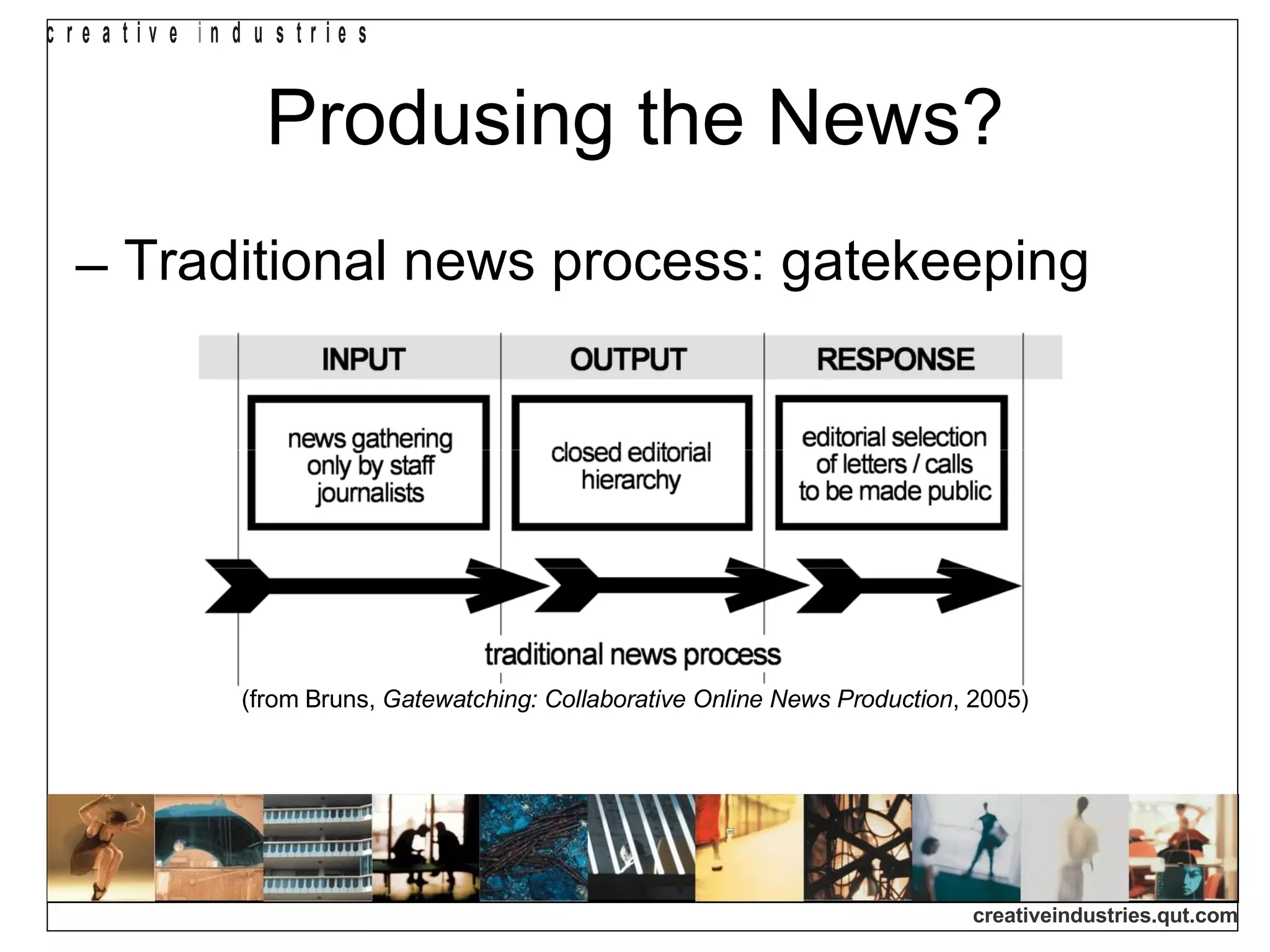
Produsing the News? Traditional news process: gatekeeping (from Bruns,  Gatewatching: Collaborative Online News Production , 2005)
Gatewatching Citizen journalism news process: gatewatching content generated by ‘average’ users, not professional journalists and editors CJs watching the output gates of news publications and other sources, in order to identify important material as it becomes available limited editorial oversight:  very basic checking of stories (e.g.  Slashdot ), or immediate posting for commentary, rating, and voting by wider community repurposing, recombining, recontextualising, reinterpreting mainstream news discussing, debating, deliberating on the news continuous update of stories after publication – through comments or revisions collaborative content creation model, harnessing community knowledge providing multiperspectival insight and commentary acting as a corrective to the mainstream
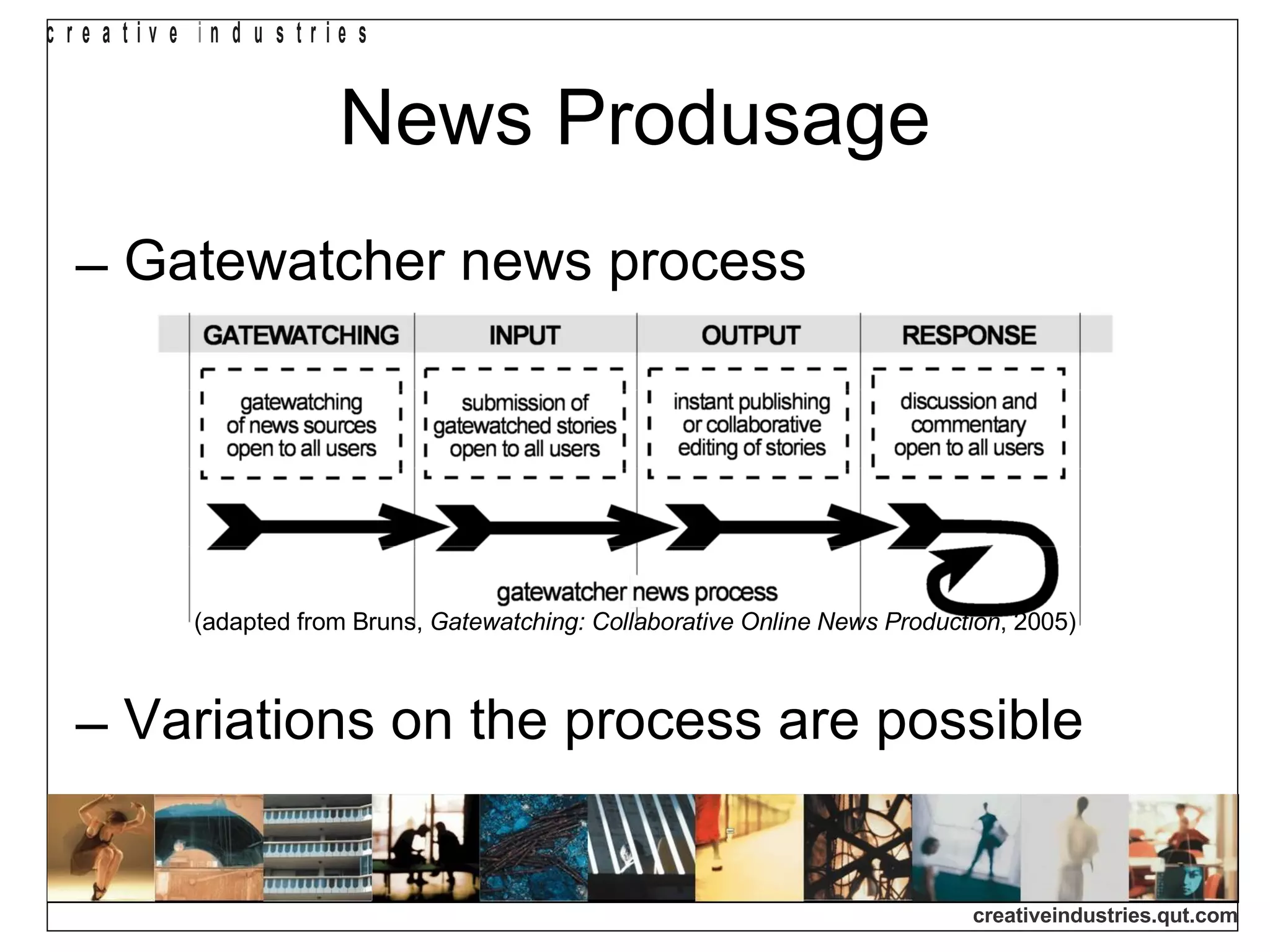
News Produsage Gatewatcher news process (adapted from Bruns,  Gatewatching: Collaborative Online News Production , 2005) Variations on the process are possible
Open Source Journalism Strong similarities between citizen journalism and open source: opening out production process to all participants belief that cream will rise to the top – through ‘power of eyeballs’ reconceptualisation and acceptance of content as always unfinished, constantly updated application of alternative licencing schemes to enable flexible update and distribution of products But need for effective systems and methodologies: Indymedia  problem: lack of open editing tools to enable collaborative quality control Wikinews  problem: failure to offer space for debate and deliberation to facilitate the development and update of stories
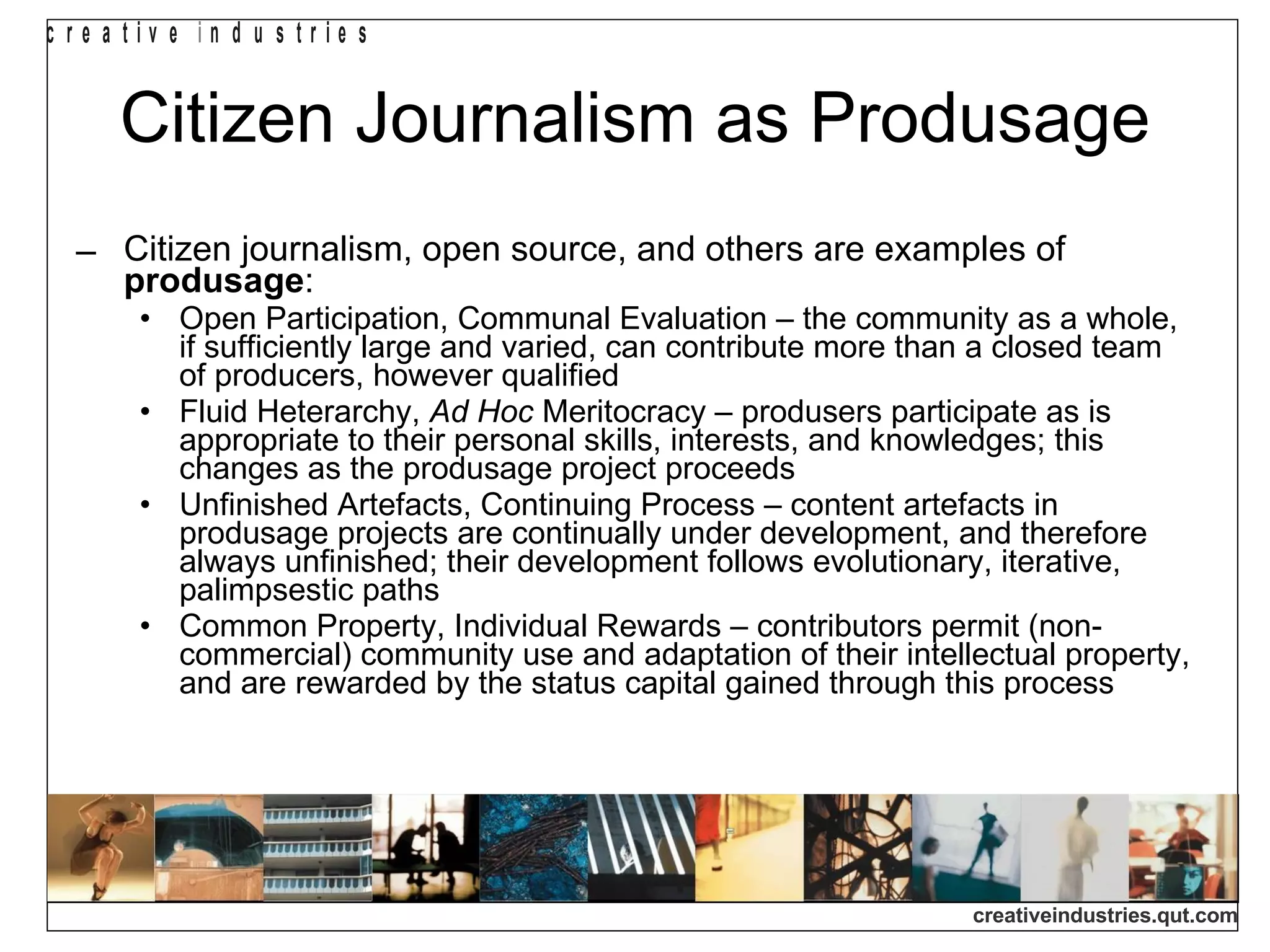
Citizen Journalism as Produsage Citizen journalism, open source, and others are examples of  produsage : Open Participation, Communal Evaluation – the community as a whole, if sufficiently large and varied, can contribute more than a closed team of producers, however qualified  Fluid Heterarchy,  Ad Hoc  Meritocracy – produsers participate as is appropriate to their personal skills, interests, and knowledges; this changes as the produsage project proceeds  Unfinished Artefacts, Continuing Process – content artefacts in produsage projects are continually under development, and therefore always unfinished; their development follows evolutionary, iterative, palimpsestic paths  Common Property, Individual Rewards – contributors permit (non-commercial) community use and adaptation of their intellectual property, and are rewarded by the status capital gained through this process
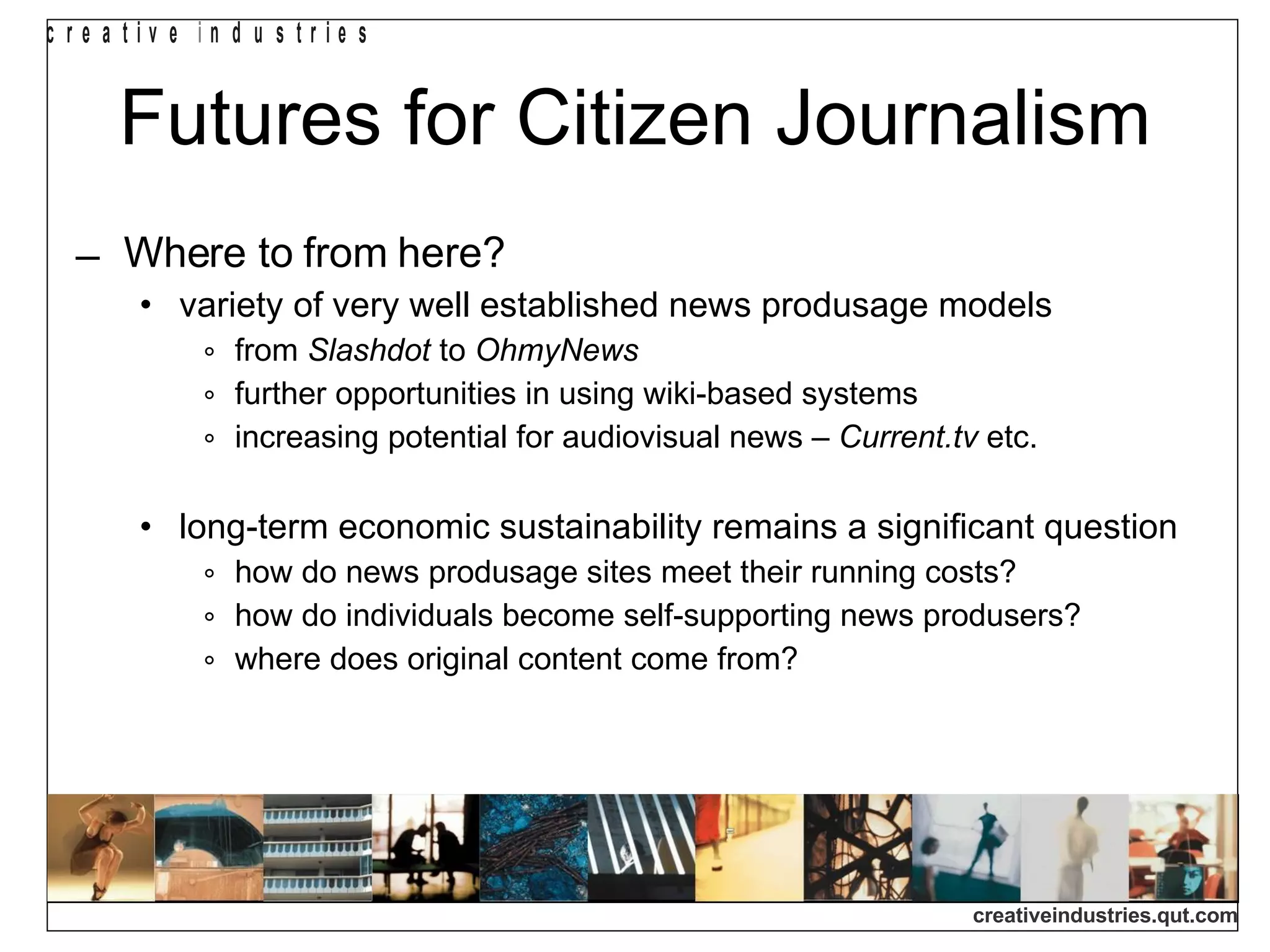
Futures for Citizen Journalism Where to from here? variety of very well established news produsage models from  Slashdot  to  OhmyNews further opportunities in using wiki-based systems increasing potential for audiovisual news –  Current.tv  etc. long-term economic sustainability remains a significant question how do news produsage sites meet their running costs? how do individuals become self-supporting news produsers? where does original content come from?

KCB201 Week 10 Slidecast: Citizen Journalism

  • 1.
    Citizen Journalism DrAxel Bruns KCB201 Virtual Cultures [email_address]
  • 2.
    1999 “Battle ofSeattle” Emergence of Indymedia : World Trade Organisation meeting in Seattle, 1999 large ‘alternative globalisation’ protests by broad coalition of activists fear that mainstream media (MSM) would focus only on riots and unrest development of DIY journalism projects – “become the media” established as Independent Media Center (IMC, Indymedia ) based on software built for activist group in Sydney key features: DIY media content: stories, images, video sourced from activists open publishing: all stories made available immediately public discussion: strong role for comments, adding further information
  • 3.
    Citizen Journalism Partof a longer trend: hand-printed and photocopied pamphlets and newsletters as old as the printing press itself but boosted by simplicity and reach of online publishing Emergence of key citizen journalism sites: Indymedia – political activism, alternative globalisation Slashdot – technology news, privacy, governance, legal issues Kuro5hin , Plastic – politics and Zeitgeist OhmyNews – South Korean politics, now also International and Japan Wikipedia and Wikinews – general news (but problems with the latter) Current.tv – video news and documentaries news blogs – more or less consistent news coverage and discussion
  • 4.
    Produsing the News?Traditional news process: gatekeeping (from Bruns, Gatewatching: Collaborative Online News Production , 2005)
  • 5.
    Gatewatching Citizen journalismnews process: gatewatching content generated by ‘average’ users, not professional journalists and editors CJs watching the output gates of news publications and other sources, in order to identify important material as it becomes available limited editorial oversight: very basic checking of stories (e.g. Slashdot ), or immediate posting for commentary, rating, and voting by wider community repurposing, recombining, recontextualising, reinterpreting mainstream news discussing, debating, deliberating on the news continuous update of stories after publication – through comments or revisions collaborative content creation model, harnessing community knowledge providing multiperspectival insight and commentary acting as a corrective to the mainstream
  • 6.
    News Produsage Gatewatchernews process (adapted from Bruns, Gatewatching: Collaborative Online News Production , 2005) Variations on the process are possible
  • 7.
    Open Source JournalismStrong similarities between citizen journalism and open source: opening out production process to all participants belief that cream will rise to the top – through ‘power of eyeballs’ reconceptualisation and acceptance of content as always unfinished, constantly updated application of alternative licencing schemes to enable flexible update and distribution of products But need for effective systems and methodologies: Indymedia problem: lack of open editing tools to enable collaborative quality control Wikinews problem: failure to offer space for debate and deliberation to facilitate the development and update of stories
  • 8.
    Citizen Journalism asProdusage Citizen journalism, open source, and others are examples of produsage : Open Participation, Communal Evaluation – the community as a whole, if sufficiently large and varied, can contribute more than a closed team of producers, however qualified Fluid Heterarchy, Ad Hoc Meritocracy – produsers participate as is appropriate to their personal skills, interests, and knowledges; this changes as the produsage project proceeds Unfinished Artefacts, Continuing Process – content artefacts in produsage projects are continually under development, and therefore always unfinished; their development follows evolutionary, iterative, palimpsestic paths Common Property, Individual Rewards – contributors permit (non-commercial) community use and adaptation of their intellectual property, and are rewarded by the status capital gained through this process
  • 9.
    Futures for CitizenJournalism Where to from here? variety of very well established news produsage models from Slashdot to OhmyNews further opportunities in using wiki-based systems increasing potential for audiovisual news – Current.tv etc. long-term economic sustainability remains a significant question how do news produsage sites meet their running costs? how do individuals become self-supporting news produsers? where does original content come from?