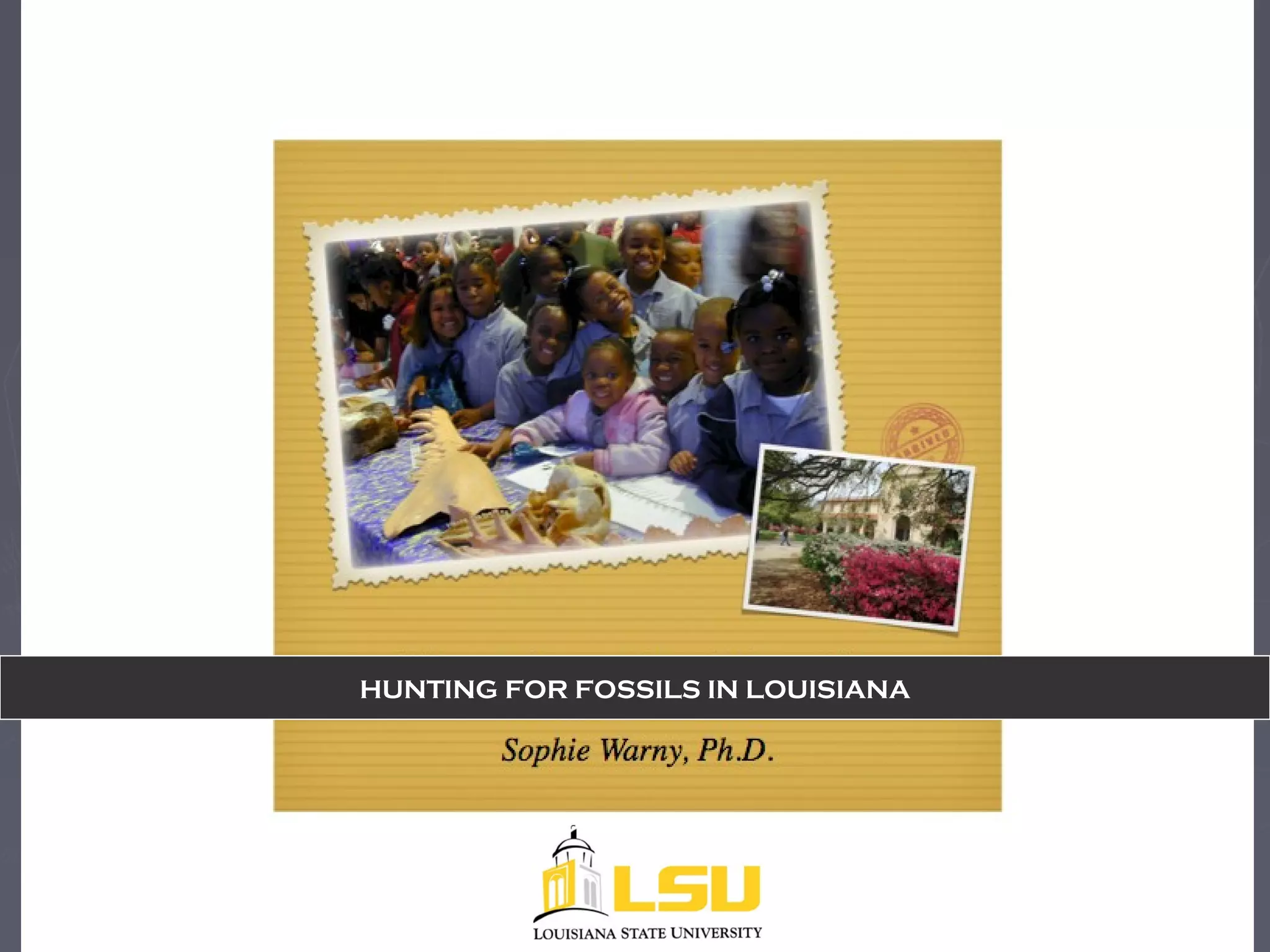
HUNTING FOR FOSSILS IN LOUISIANA
The Mission of theThe Mission of the
LSU Museum of Natural ScienceLSU Museum of Natural Science
 Acquisition,Acquisition,
 Preservation, andPreservation, and
 StudyStudy
of research collections to generate knowledge of:of research collections to generate knowledge of:
 Regional and global biodiversity,Regional and global biodiversity,
 Geological history, andGeological history, and
 Human history and prehistoryHuman history and prehistory
for the benefit of the people of the state, the nation, and the world.for the benefit of the people of the state, the nation, and the world.
Divisions of the LSU MNSDivisions of the LSU MNS
 7 main fields of RESEARCH7 main fields of RESEARCH
 Ornithology (Birds)Ornithology (Birds)
 GeneticsGenetics
 Ichthyology (Fishes)Ichthyology (Fishes)
 MammalogyMammalogy
 Herpetology (Reptiles and Amphibians)Herpetology (Reptiles and Amphibians)
 PaleontologyPaleontology
 Anthropology (Archaeology and Ethnography)Anthropology (Archaeology and Ethnography)
 EDUCATIONEDUCATION
1.1.THE PALEONTOLOGYTHE PALEONTOLOGY
COLLECTIONSCOLLECTIONS
What is palynology?What is palynology?
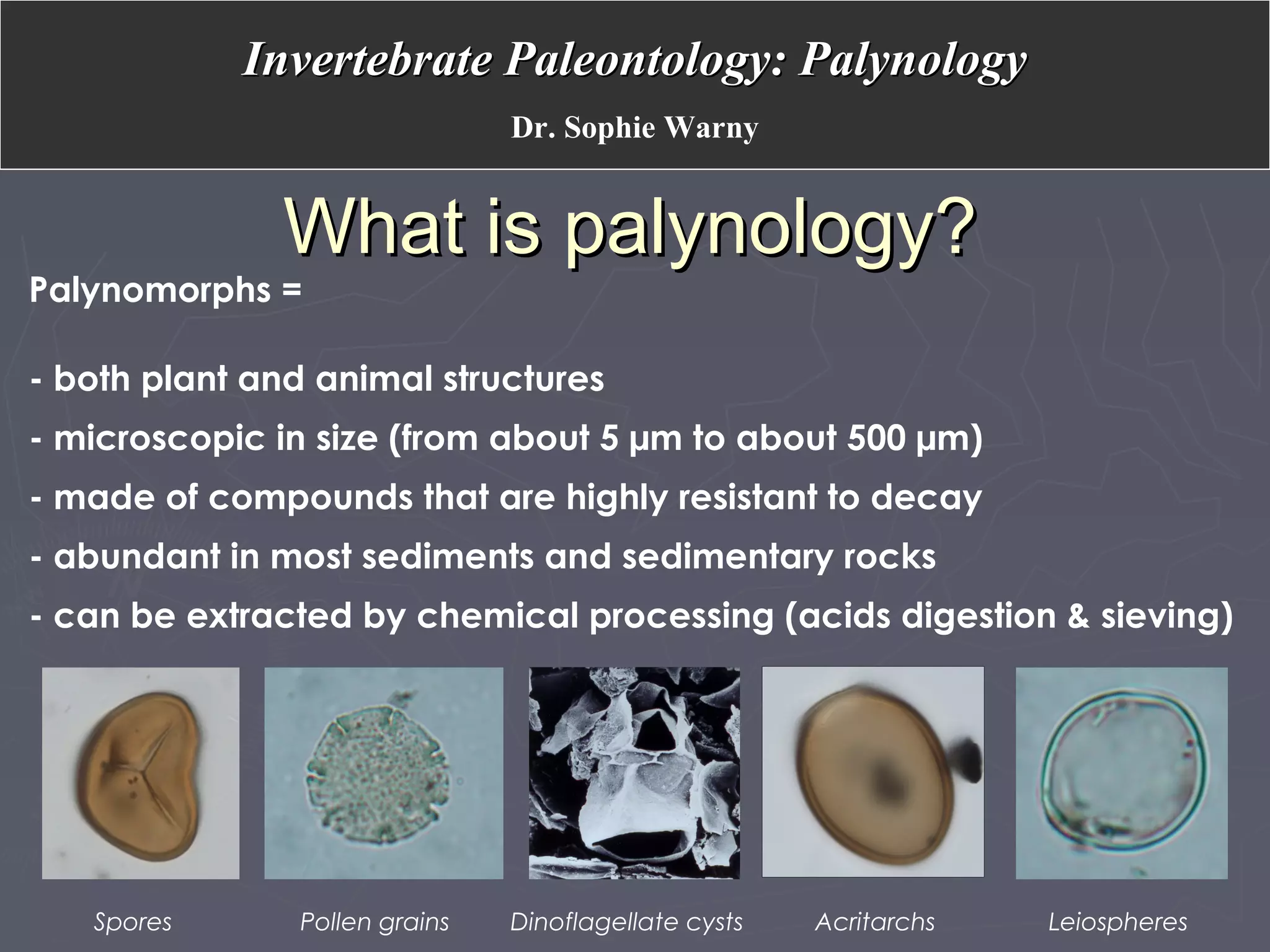
Palynomorphs =
- both plant and animal structures
- microscopic in size (from about 5 µm to about 500 µm)
- made of compounds that are highly resistant to decay
- abundant in most sediments and sedimentary rocks
- can be extracted by chemical processing (acids digestion & sieving)
Spores Pollen grains Dinoflagellate cysts Acritarchs Leiospheres
Invertebrate Paleontology: PalynologyInvertebrate Paleontology: Palynology
Dr. Sophie Warny
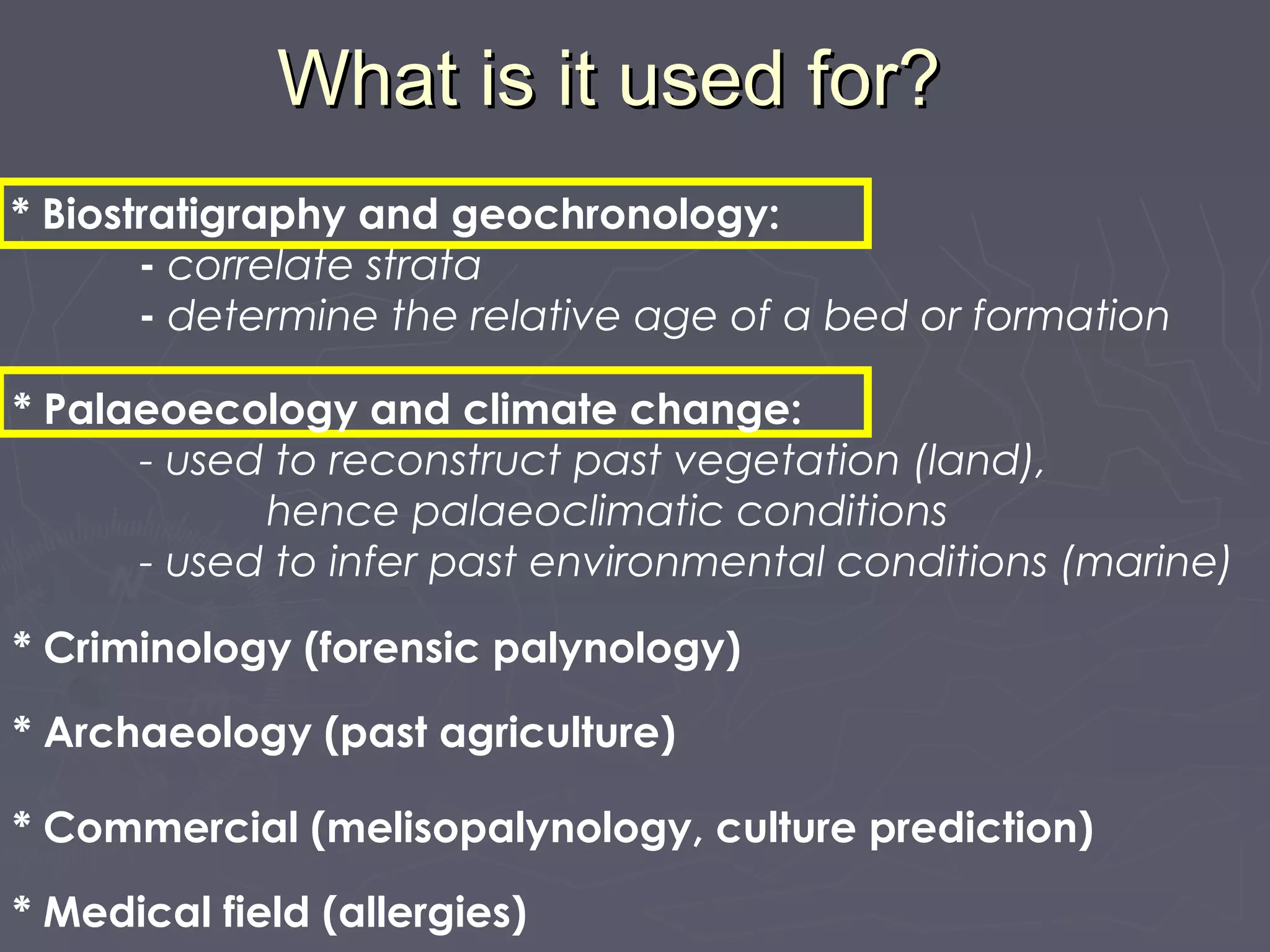
* Biostratigraphy and geochronology:
- correlate strata
- determine the relative age of a bed or formation
What is it used for?What is it used for?
* Palaeoecology and climate change:
- used to reconstruct past vegetation (land),
hence palaeoclimatic conditions
- used to infer past environmental conditions (marine)
* Criminology (forensic palynology)
* Archaeology (past agriculture)
* Commercial (melisopalynology, culture prediction)
* Medical field (allergies)
Collections:
- Over 17,000 specimens from over 1000 localities with
emphasis on Louisiana. 
Research statement: Dr. Schiebout's focus is on:
♦ Paleoecology
♦ Biostratigraphy and paleogeography of southern North
America and China in the Tertiary
♦ Early and middle Tertiary mammals
♦ The Cretaceous-Tertiary and Paleocene-Eocene transition
♦ Louisiana fossil vertebrates, particularly in the Miocene
Vertebrate PaleontologyVertebrate Paleontology
Dr. Judith Schiebout
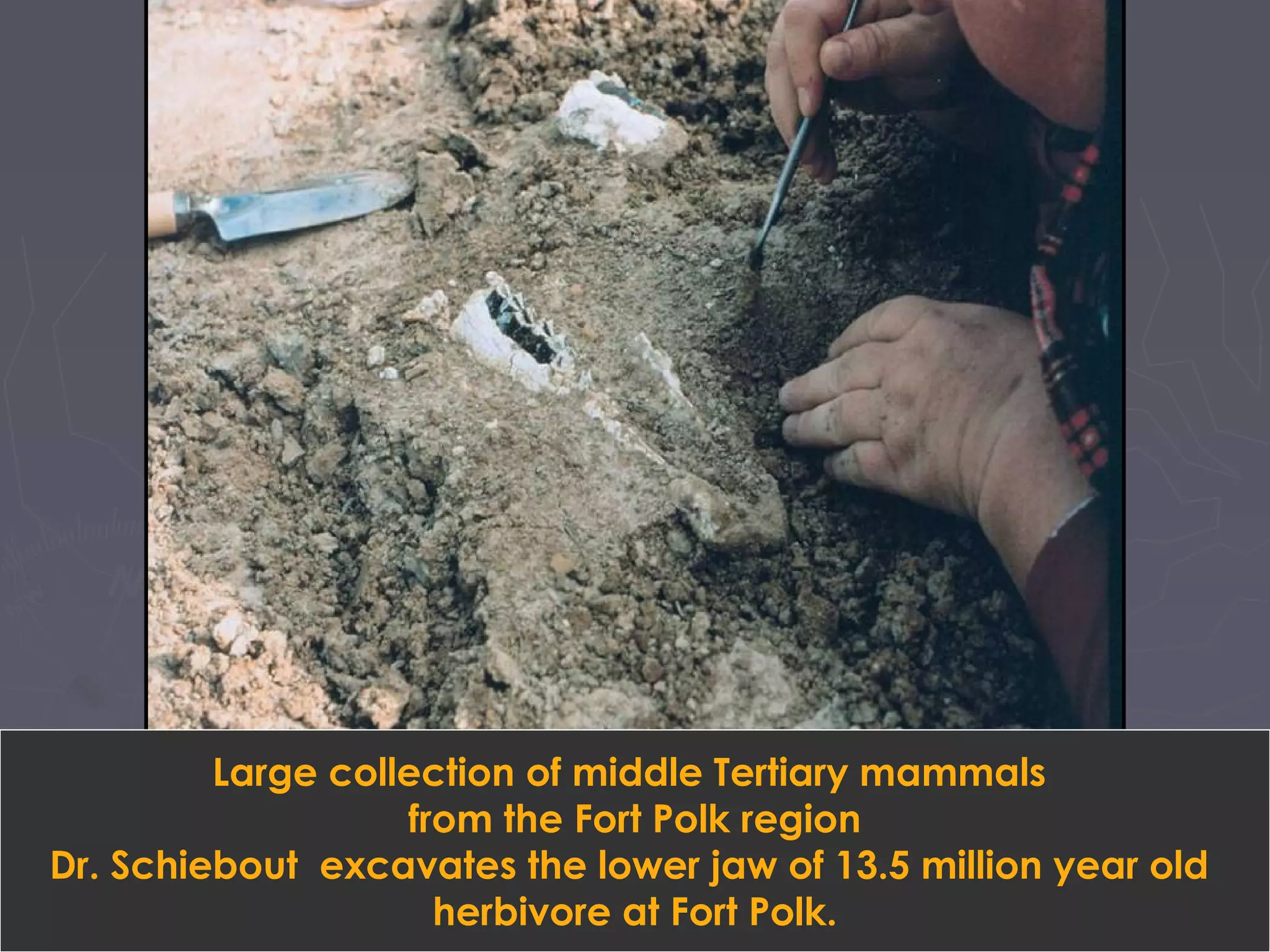
Large collection of middle Tertiary mammals
from the Fort Polk region
Dr. Schiebout excavates the lower jaw of 13.5 million year old
herbivore at Fort Polk.
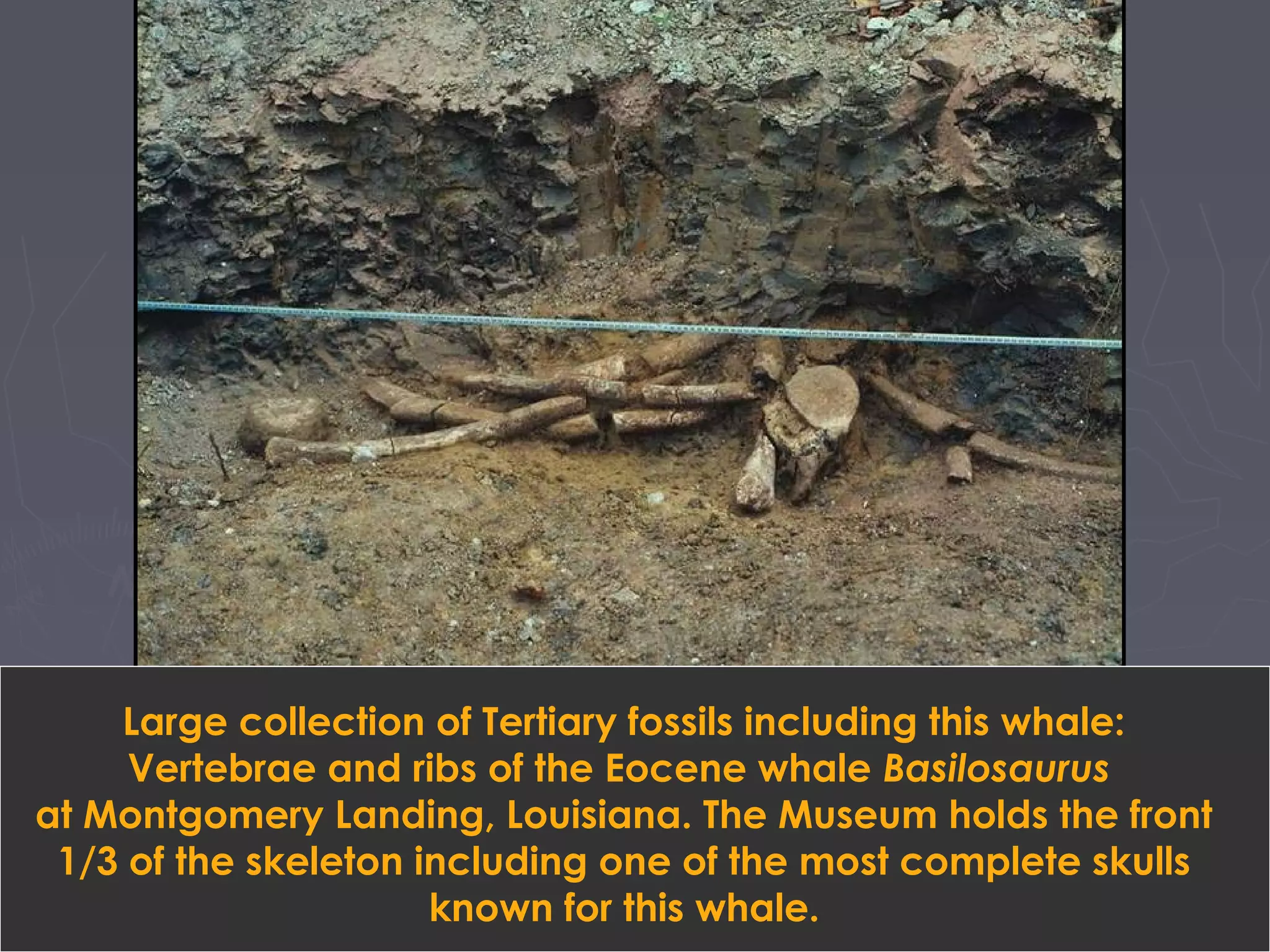
Large collection of Tertiary fossils including this whale:
Vertebrae and ribs of the Eocene whale Basilosaurus
at Montgomery Landing, Louisiana. The Museum holds the front
1/3 of the skeleton including one of the most complete skulls
known for this whale.
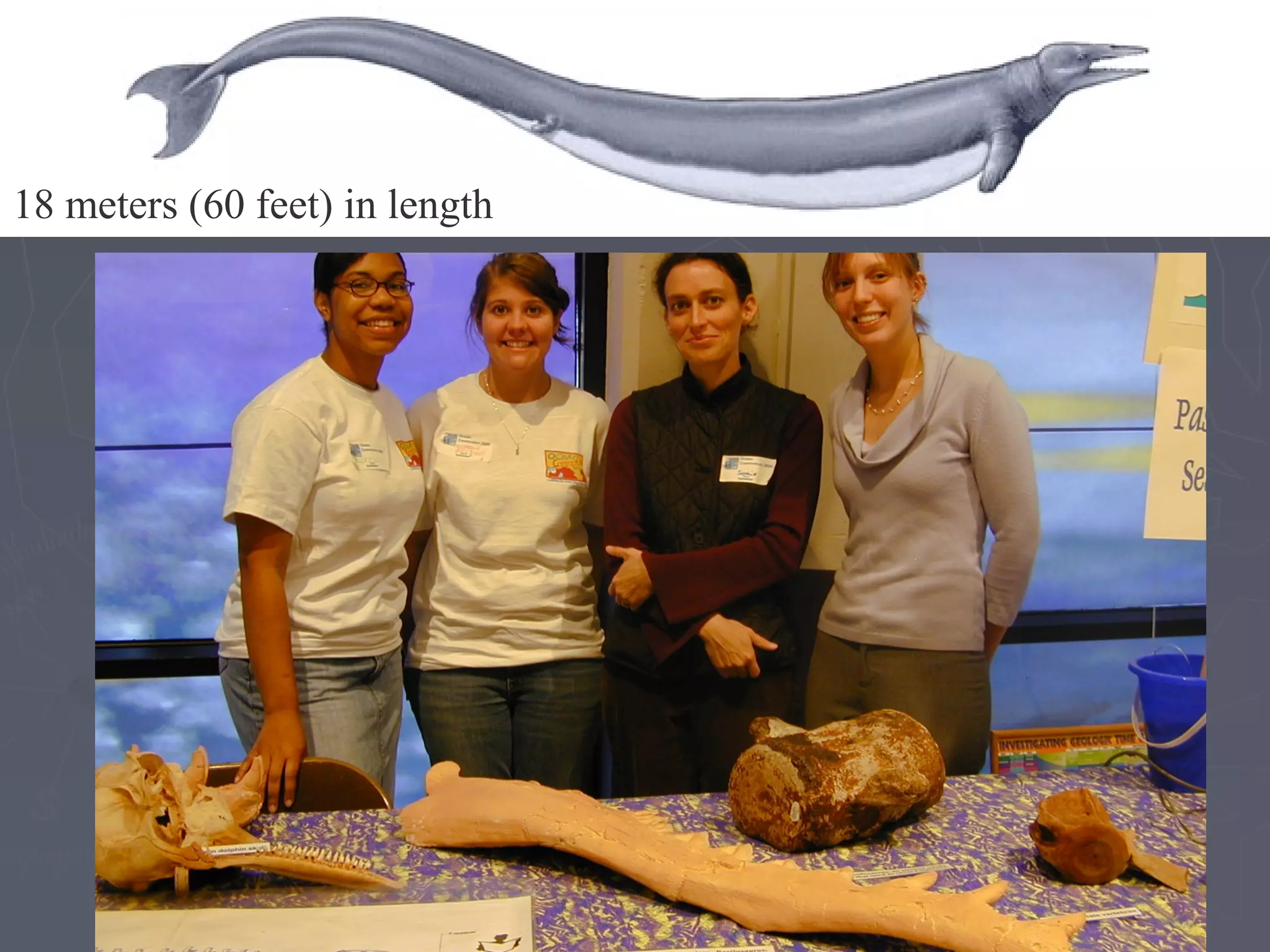
18 meters (60 feet) in length
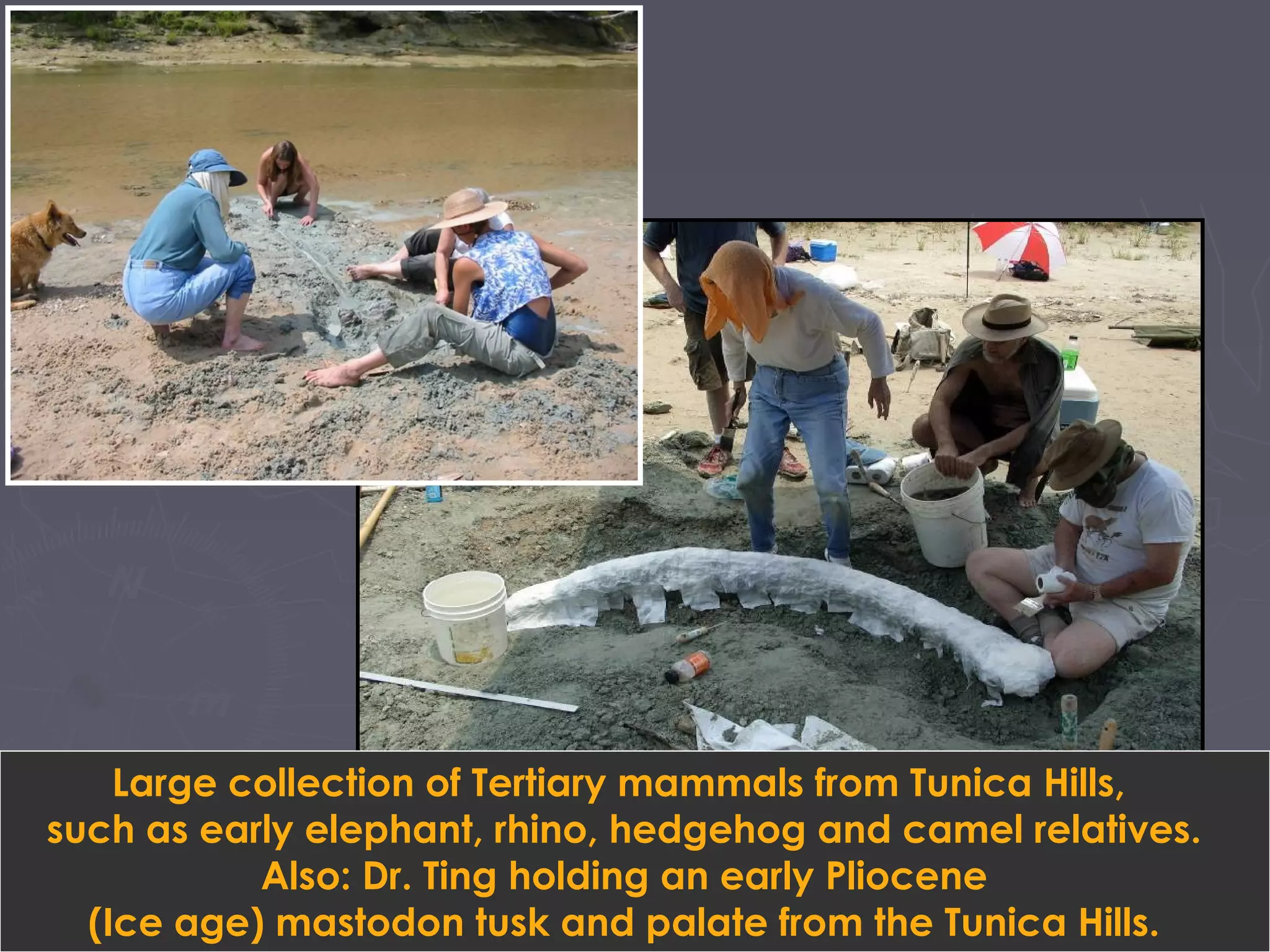
Large collection of Tertiary mammals from Tunica Hills,
such as early elephant, rhino, hedgehog and camel relatives.
Also: Dr. Ting holding an early Pliocene
(Ice age) mastodon tusk and palate from the Tunica Hills.
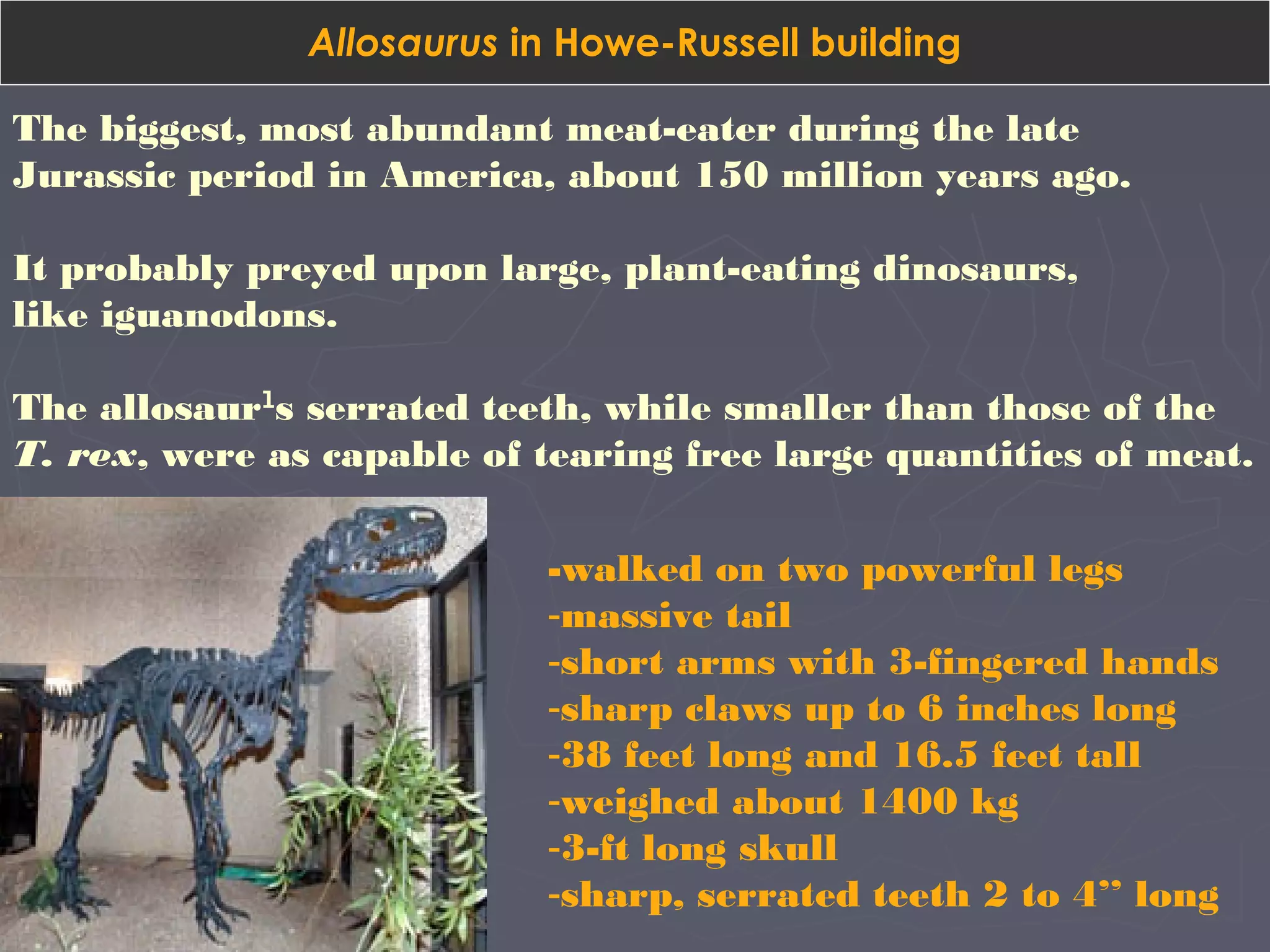
Allosaurus in Howe-Russell building
The biggest, most abundant meat-eater during the late
Jurassic period in America, about 150 million years ago.
It probably preyed upon large, plant-eating dinosaurs,
like iguanodons.
The allosaur¹s serrated teeth, while smaller than those of the
T. rex, were as capable of tearing free large quantities of meat.
-walked on two powerful legs
-massive tail
-short arms with 3-fingered hands
-sharp claws up to 6 inches long
-38 feet long and 16.5 feet tall
-weighed about 1400 kg
-3-ft long skull
-sharp, serrated teeth 2 to 4’’ long
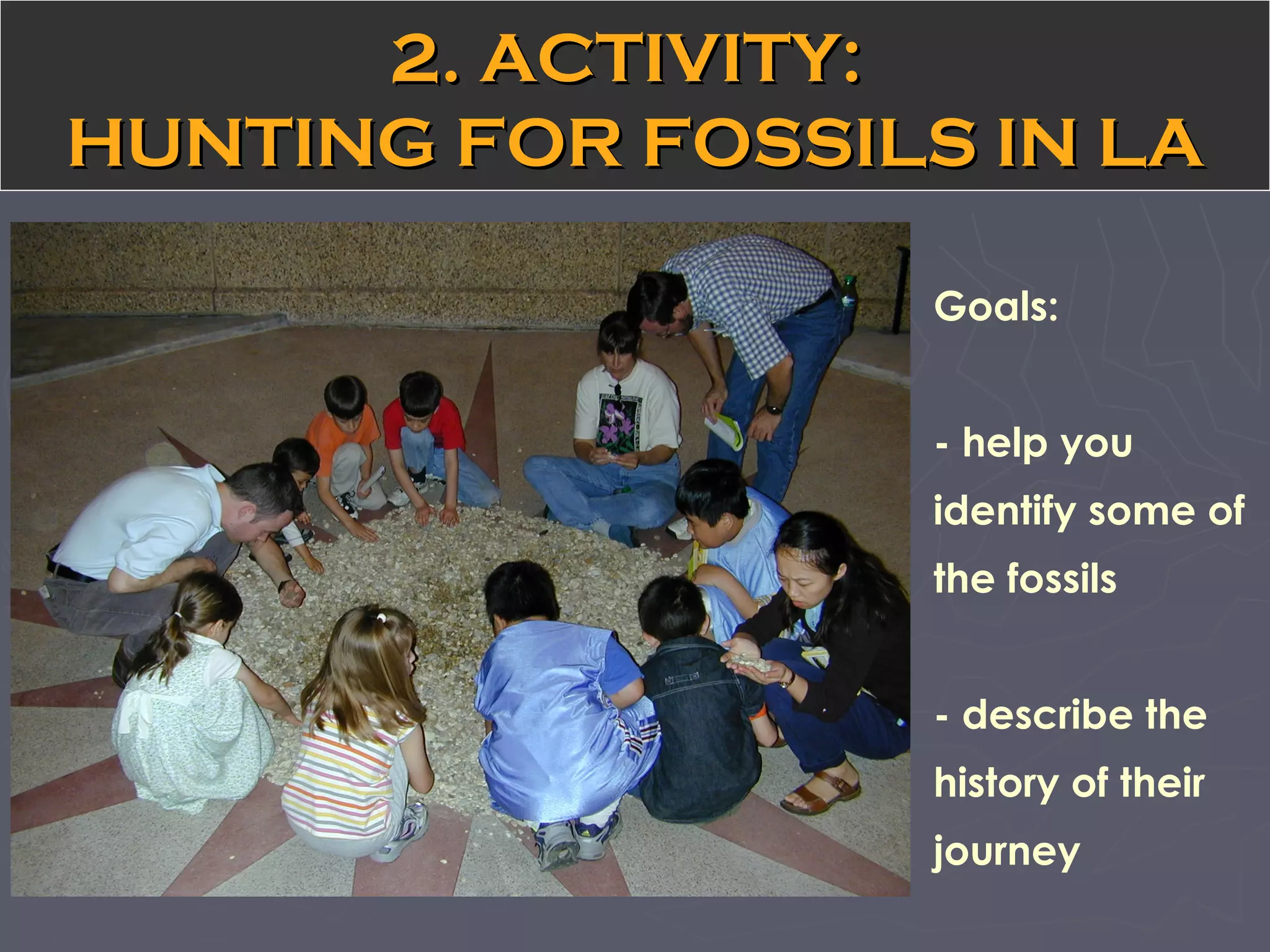
Goals:
- help you
identify some of
the fossils
- describe the
history of their
journey
2. ACTIVITY:2. ACTIVITY:
HUNTING FOR FOSSILS IN LAHUNTING FOR FOSSILS IN LA
1 Gravel can be found in many places in Louisiana
2 It occurs naturally in stream and river banks
3 Gravel is just a loose mixture of rock fragments
4 We rarely wonder where it came from…
5 We don’t often sit down and look for unusual shapes or colors
6 But… LA gravel is made up of rocks formed millions of years ago
7 On the sea bottom
8 If we look closely, we can often find distinct impressions
of ancient marine life
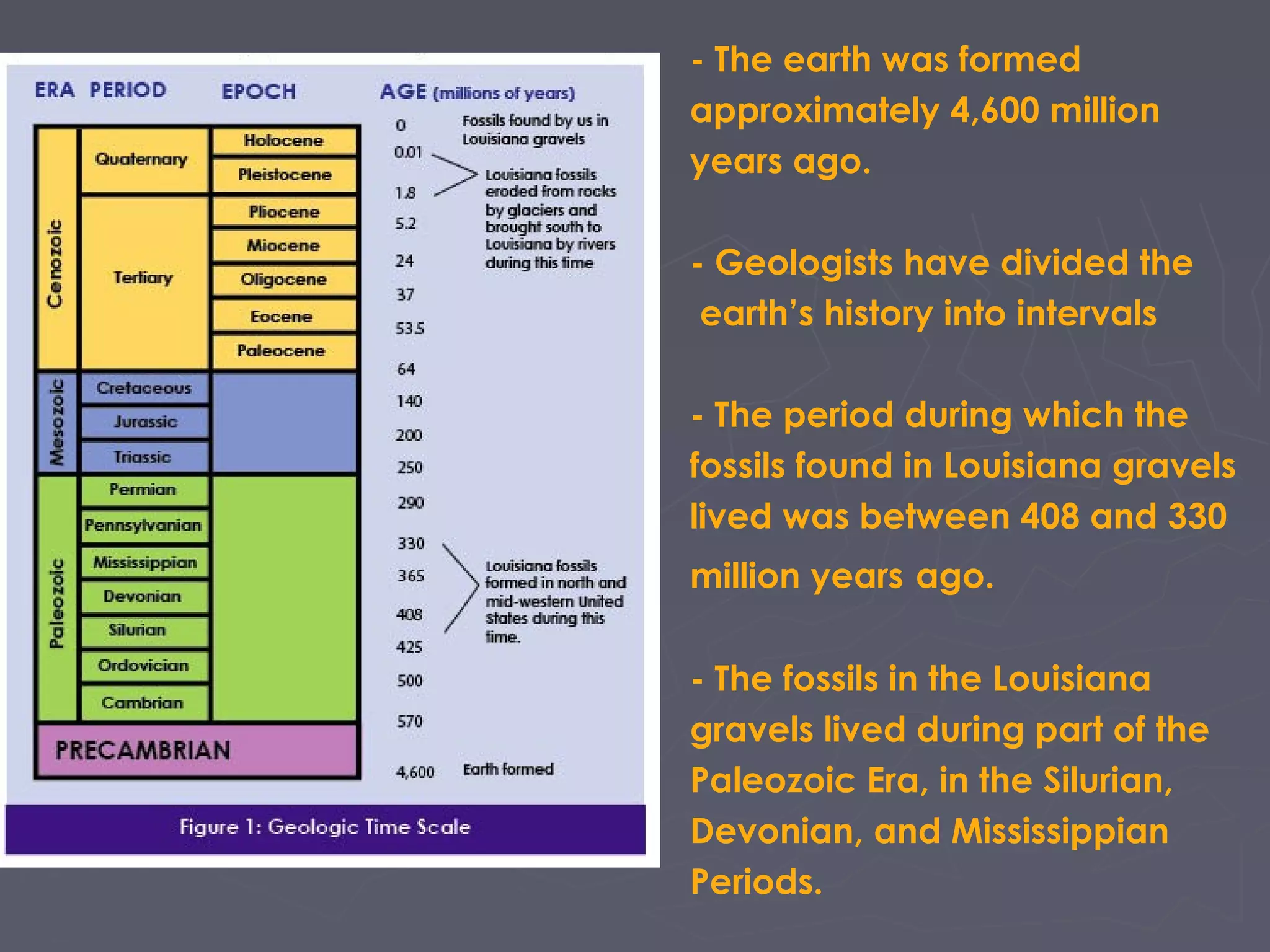
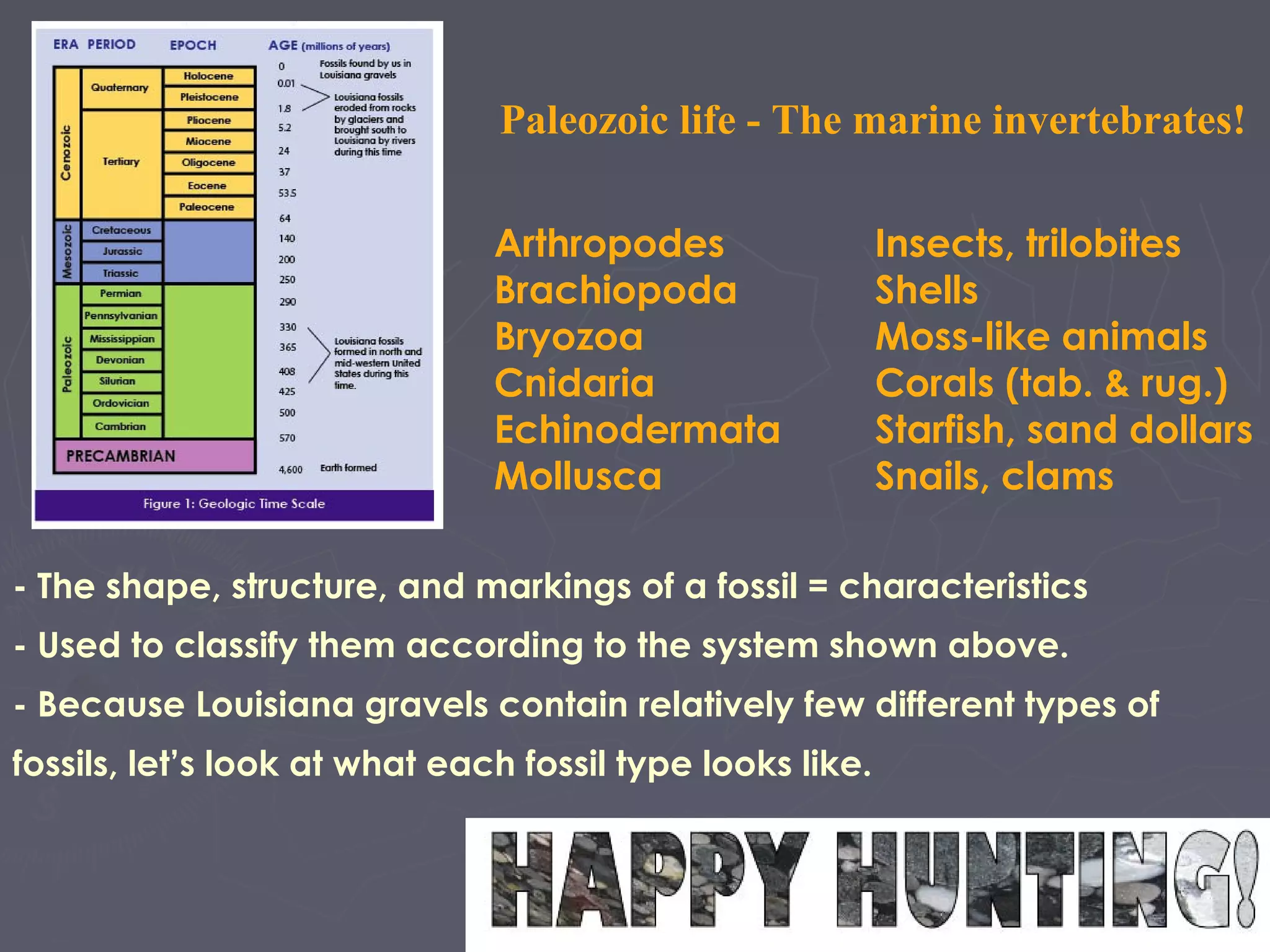
- The earth was formed
approximately 4,600 million
years ago.
- Geologists have divided the
earth’s history into intervals
- The period during which the
fossils found in Louisiana gravels
lived was between 408 and 330
million years ago.
- The fossils in the Louisiana
gravels lived during part of the
Paleozoic Era, in the Silurian,
Devonian, and Mississippian
Periods.
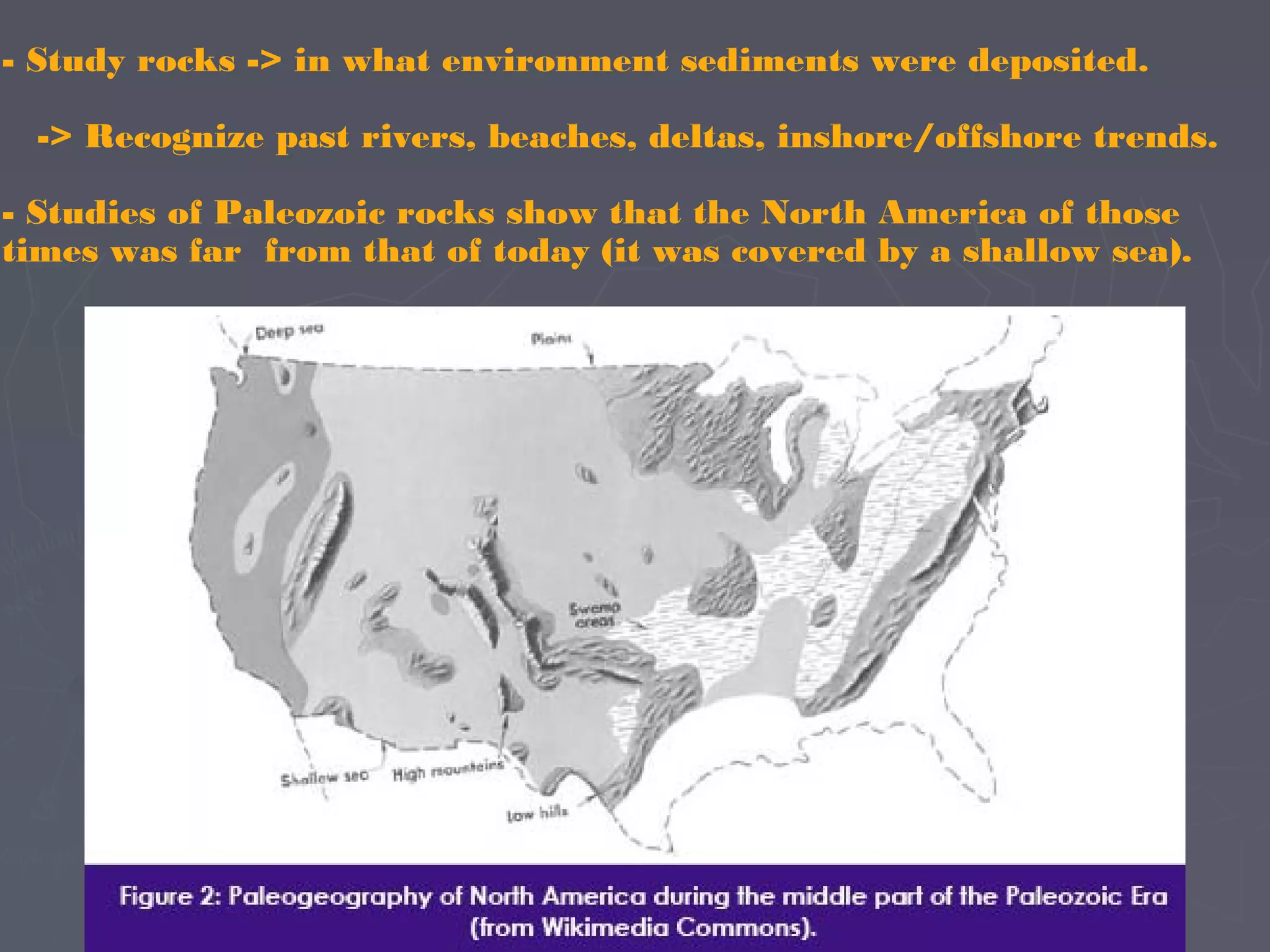
- Study rocks -> in what environment sediments were deposited.
-> Recognize past rivers, beaches, deltas, inshore/offshore trends.
- Studies of Paleozoic rocks show that the North America of those
times was far from that of today (it was covered by a shallow sea).
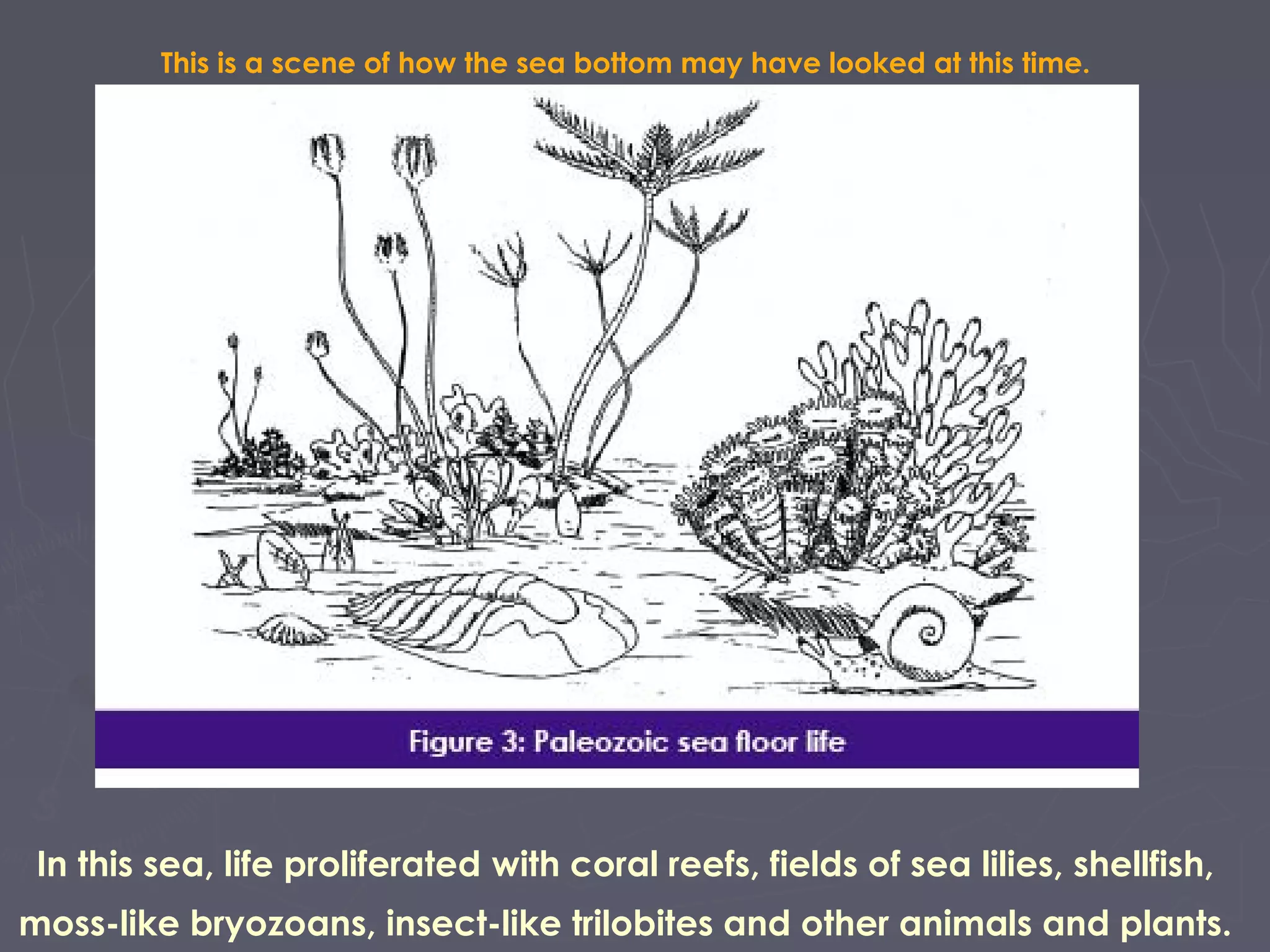
This is a scene of how the sea bottom may have looked at this time.
In this sea, life proliferated with coral reefs, fields of sea lilies, shellfish,
moss-like bryozoans, insect-like trilobites and other animals and plants.
How did these fossils, buried hundreds of
millions of years ago in the North, arrived as
gravels in Louisiana today?
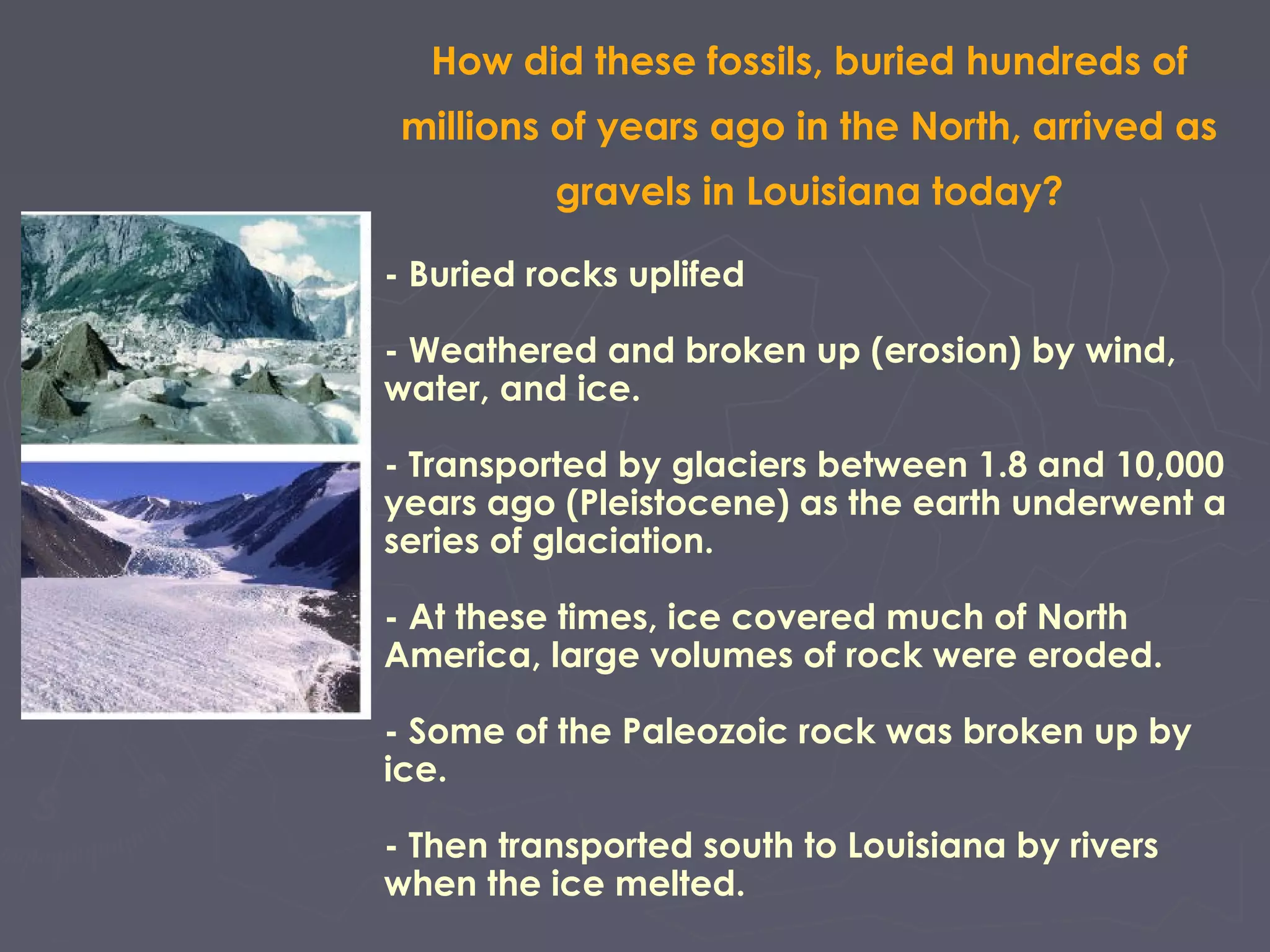
- Buried rocks uplifed
- Weathered and broken up (erosion) by wind,
water, and ice.
- Transported by glaciers between 1.8 and 10,000
years ago (Pleistocene) as the earth underwent a
series of glaciation.
- At these times, ice covered much of North
America, large volumes of rock were eroded.
- Some of the Paleozoic rock was broken up by
ice.
- Then transported south to Louisiana by rivers
when the ice melted.
- The shape, structure, and markings of a fossil = characteristics
- Used to classify them according to the system shown above.
- Because Louisiana gravels contain relatively few different types of
fossils, let’s look at what each fossil type looks like.
Paleozoic life - The marine invertebrates!
Arthropodes Insects, trilobites
Brachiopoda Shells
Bryozoa Moss-like animals
Cnidaria Corals (tab. & rug.)
Echinodermata Starfish, sand dollars
Mollusca Snails, clams
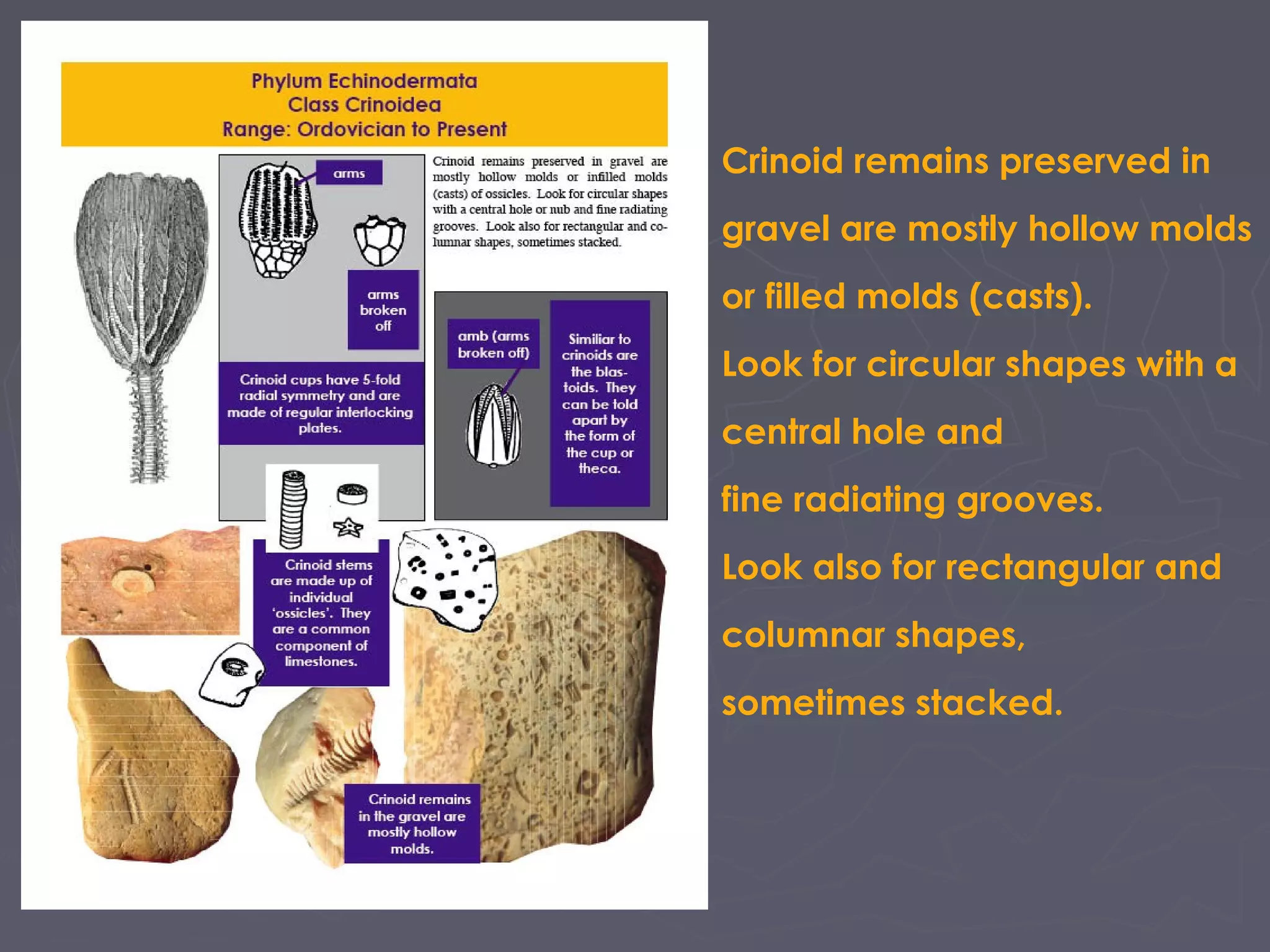
Crinoid remains preserved in
gravel are mostly hollow molds
or filled molds (casts).
Look for circular shapes with a
central hole and
fine radiating grooves.
Look also for rectangular and
columnar shapes,
sometimes stacked.
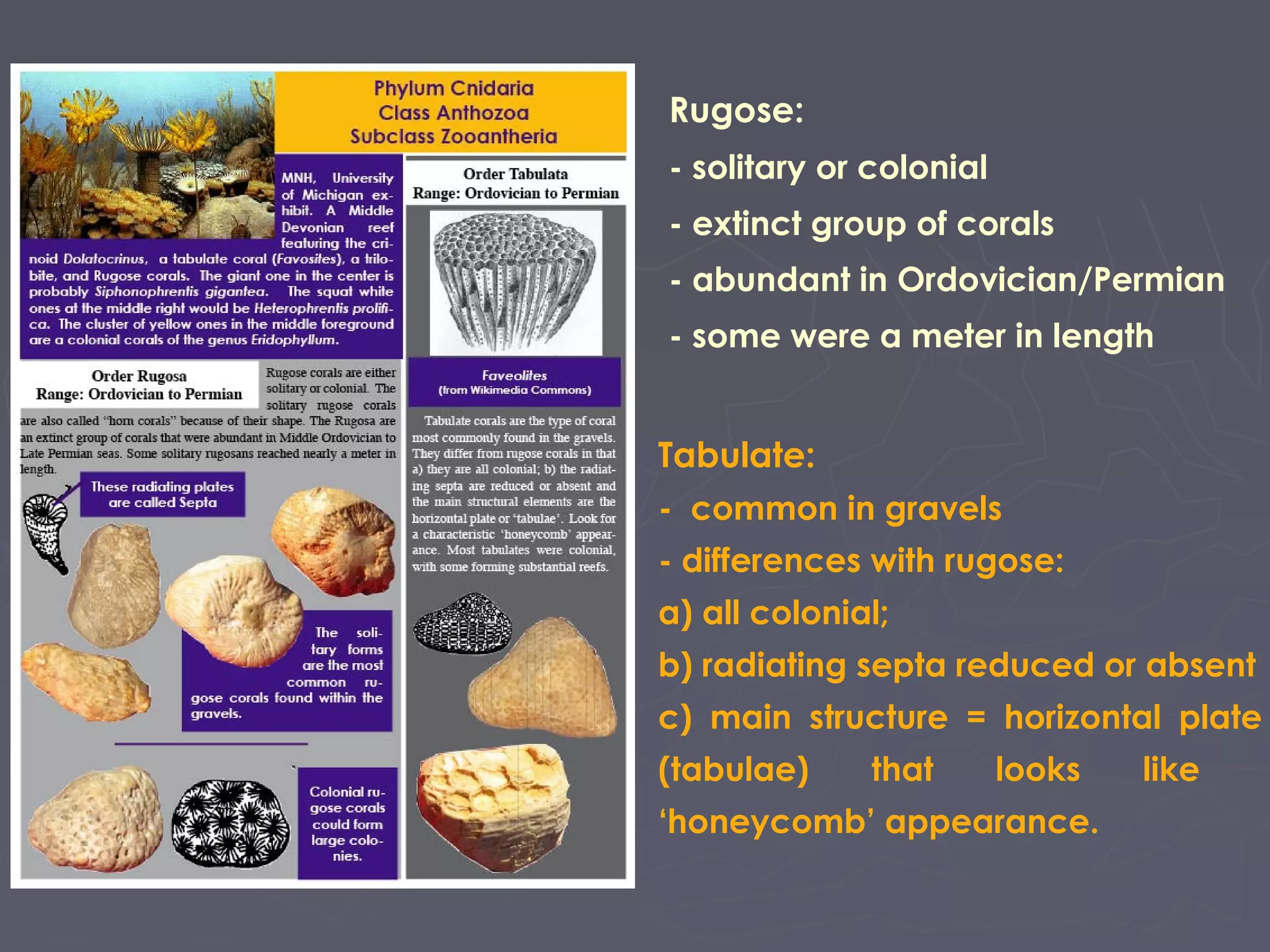
Rugose:
- solitary or colonial
- extinct group of corals
- abundant in Ordovician/Permian
- some were a meter in length
Tabulate:
- common in gravels
- differences with rugose:
a) all colonial;
b) radiating septa reduced or absent
c) main structure = horizontal plate
(tabulae) that looks like
‘honeycomb’ appearance.
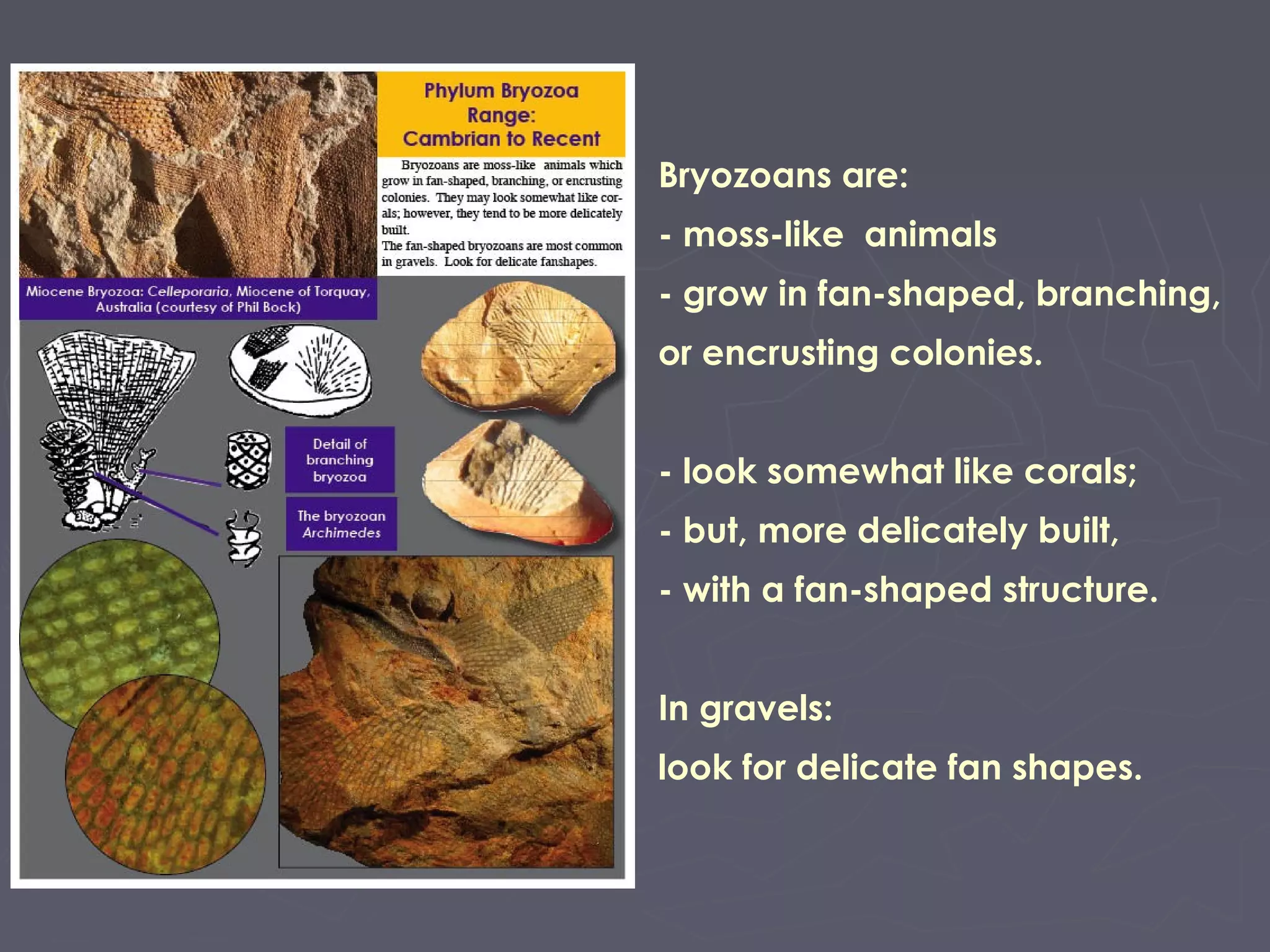
Bryozoans are:
- moss-like animals
- grow in fan-shaped, branching,
or encrusting colonies.
- look somewhat like corals;
- but, more delicately built,
- with a fan-shaped structure.
In gravels:
look for delicate fan shapes.
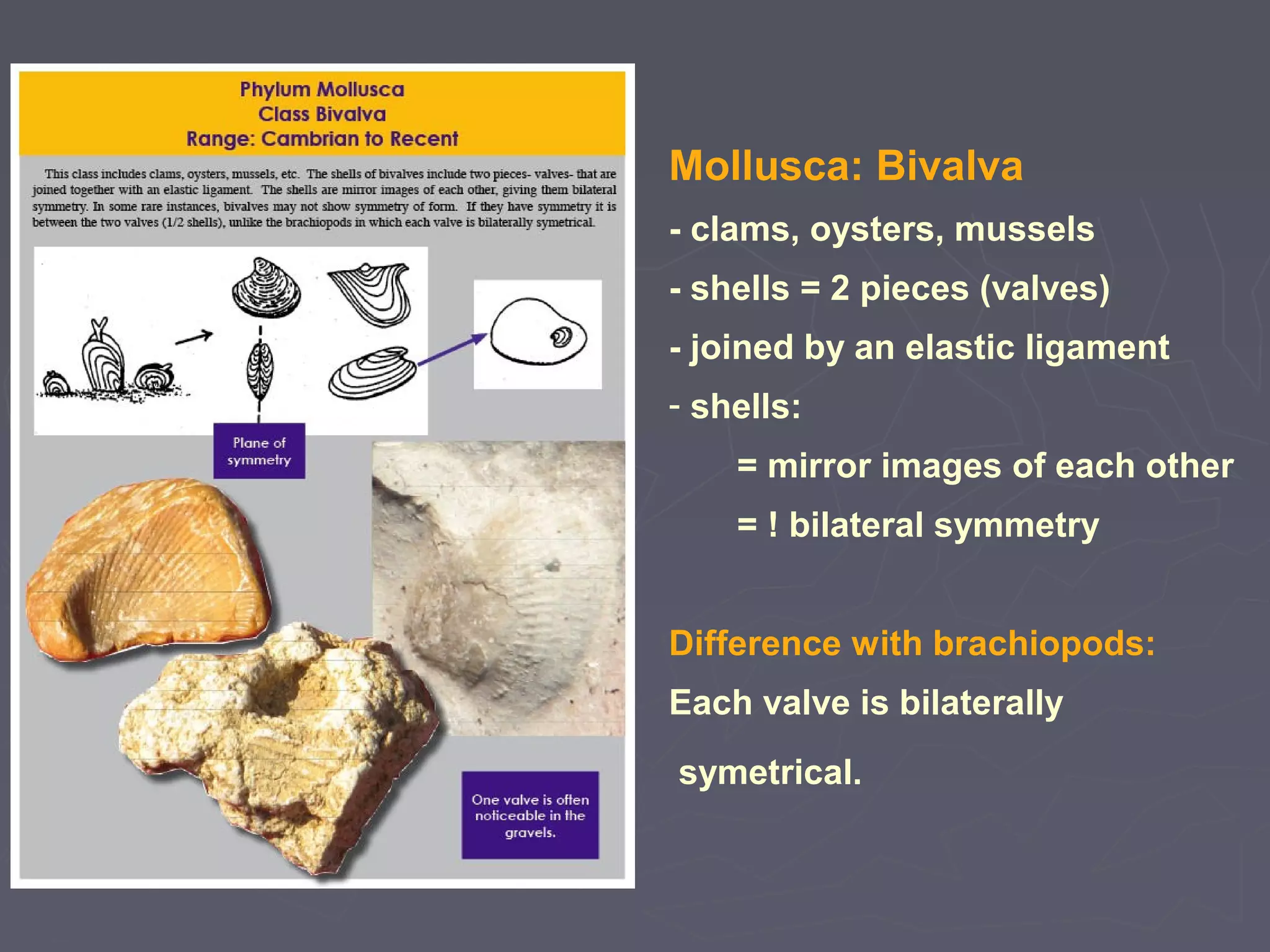
Mollusca: Bivalva
- clams, oysters, mussels
- shells = 2 pieces (valves)
- joined by an elastic ligament
- shells:
= mirror images of each other
= ! bilateral symmetry
Difference with brachiopods:
Each valve is bilaterally
symetrical.
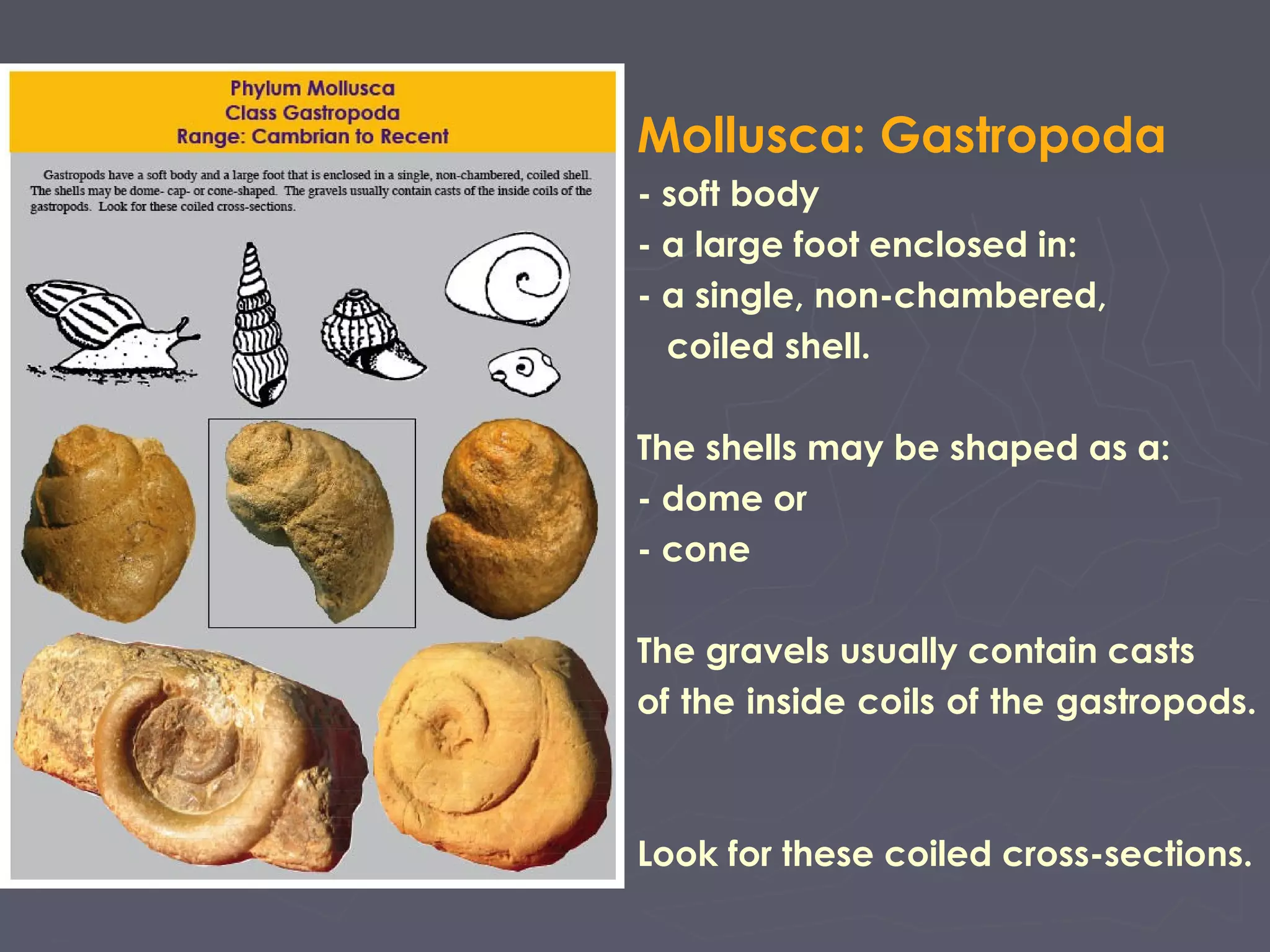
Mollusca: Gastropoda
- soft body
- a large foot enclosed in:
- a single, non-chambered,
coiled shell.
The shells may be shaped as a:
- dome or
- cone
The gravels usually contain casts
of the inside coils of the gastropods.
Look for these coiled cross-sections.
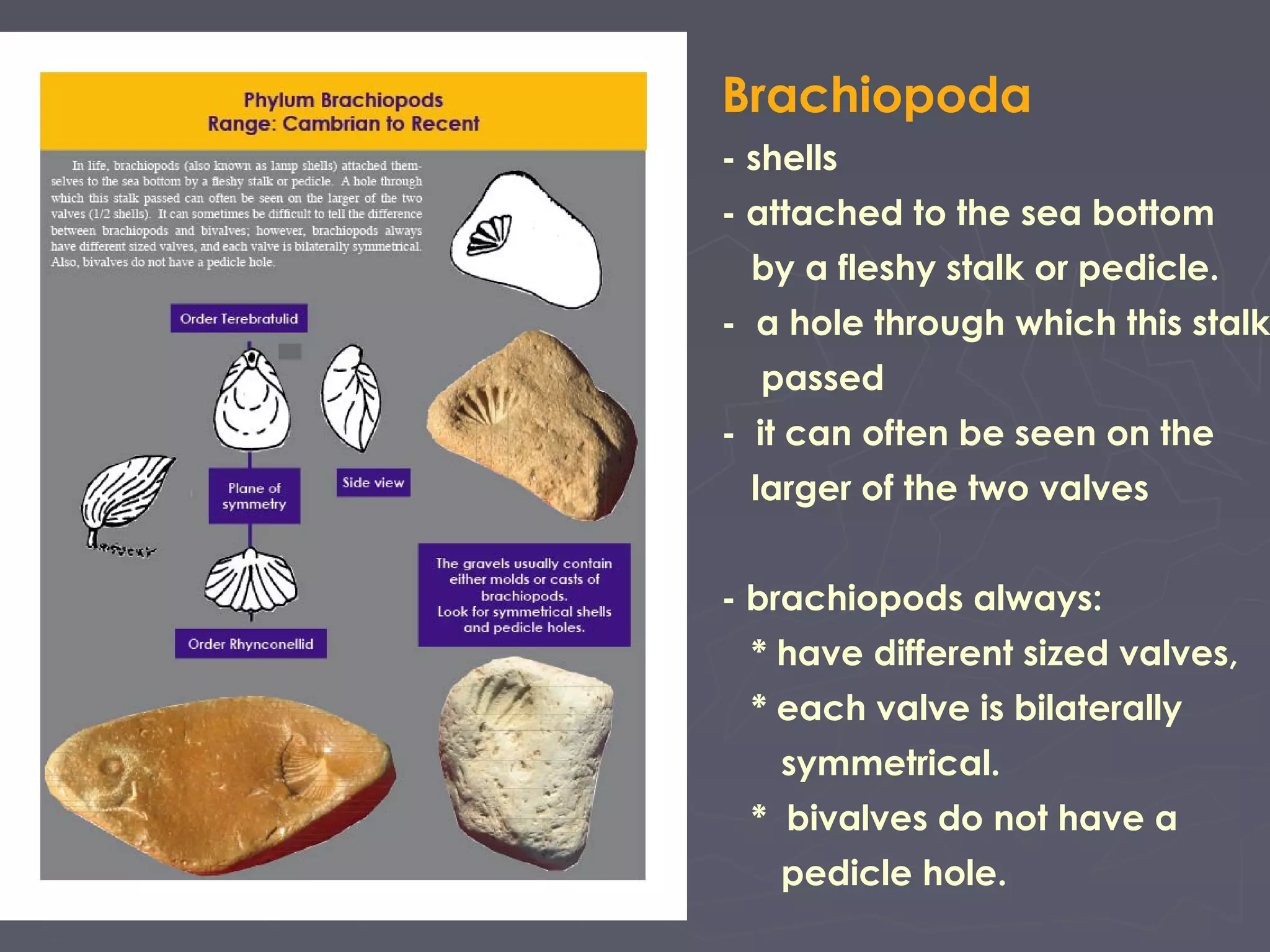
Brachiopoda
- shells
- attached to the sea bottom
by a fleshy stalk or pedicle.
- a hole through which this stalk
passed
- it can often be seen on the
larger of the two valves
- brachiopods always:
* have different sized valves,
* each valve is bilaterally
symmetrical.
* bivalves do not have a
pedicle hole.
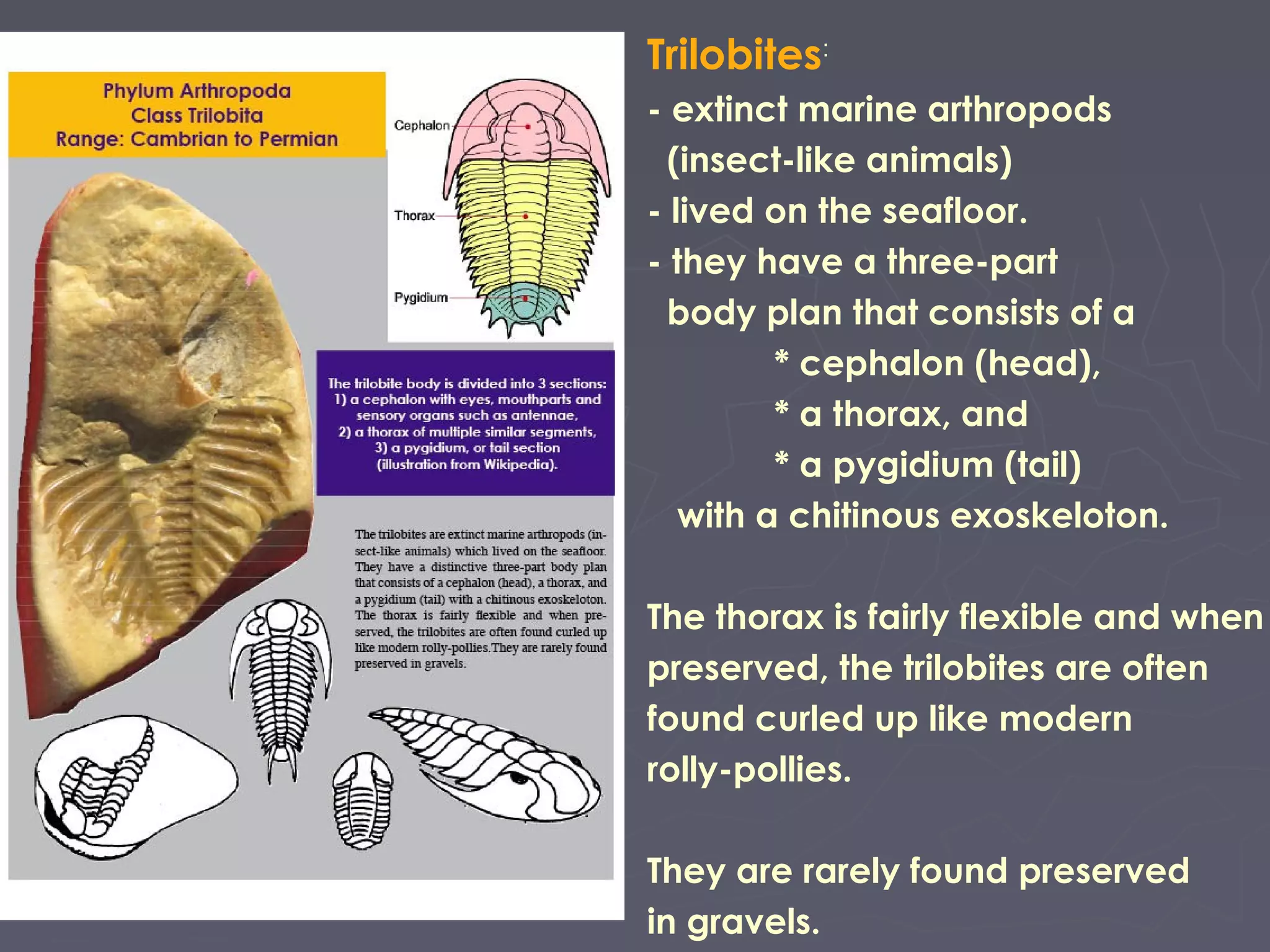
Trilobites:
- extinct marine arthropods
(insect-like animals)
- lived on the seafloor.
- they have a three-part
body plan that consists of a
* cephalon (head),
* a thorax, and
* a pygidium (tail)
with a chitinous exoskeloton.
The thorax is fairly flexible and when
preserved, the trilobites are often
found curled up like modern
rolly-pollies.
They are rarely found preserved
in gravels.
3. FIELD TRIP: PRACTICAL DETAILS3. FIELD TRIP: PRACTICAL DETAILS
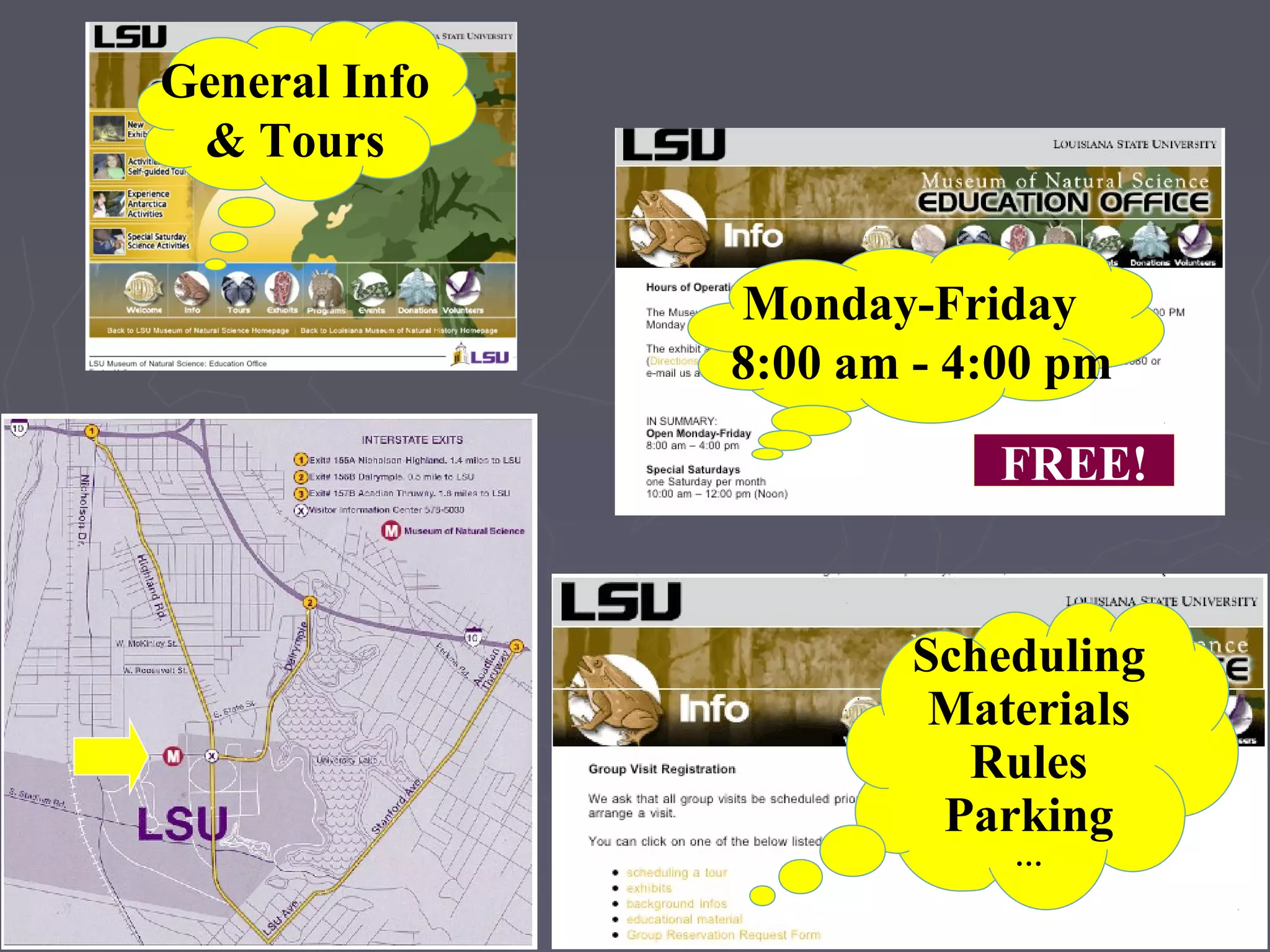
General Info
& Tours
Monday-Friday
8:00 am - 4:00 pm
FREE!
Scheduling
Materials
Rules
Parking
…
4. MNS ACTIVITY BOOKLET4. MNS ACTIVITY BOOKLET
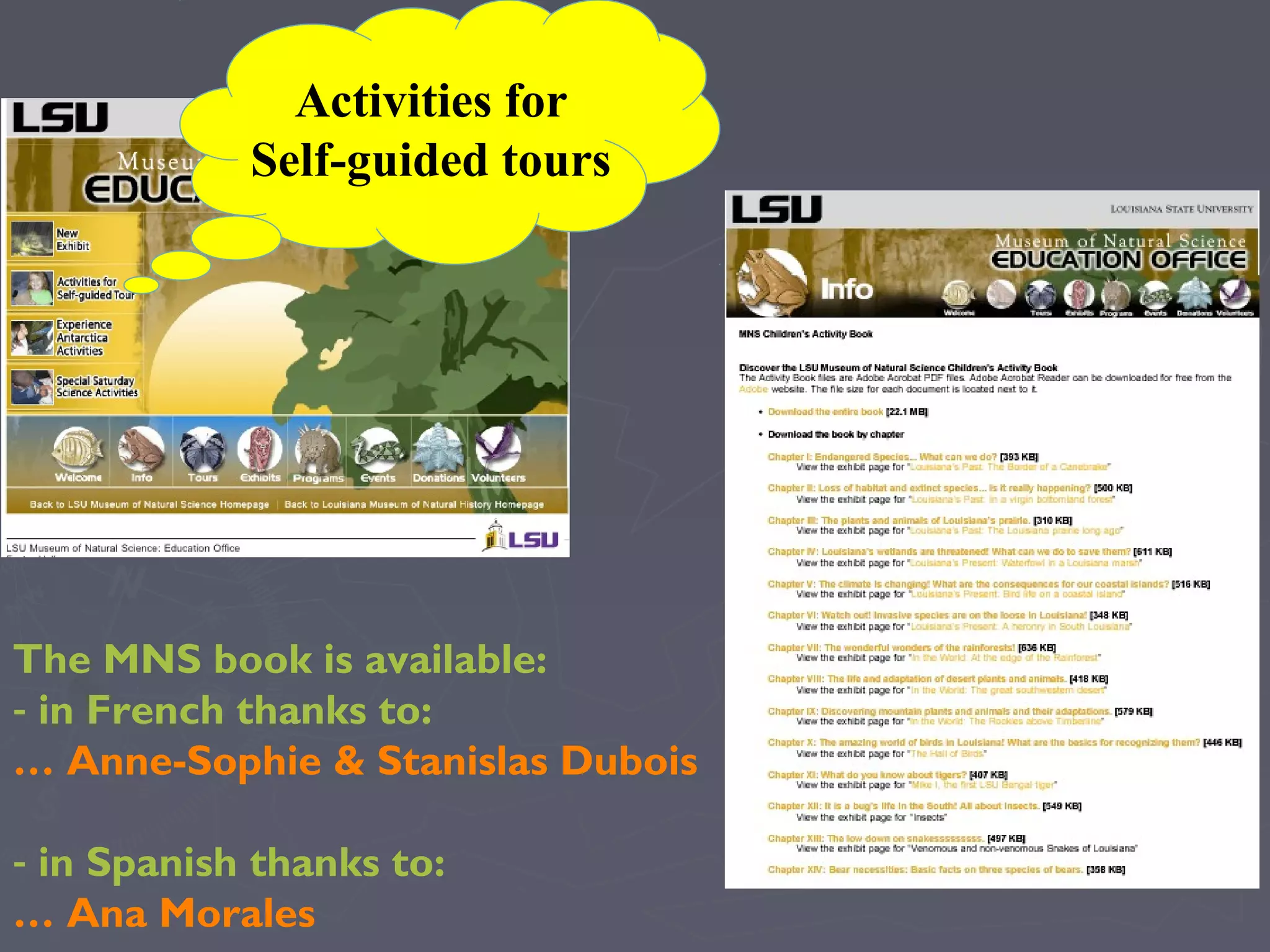
Activities for
Self-guided tours
The MNS book is available:
- in French thanks to:
… Anne-Sophie & Stanislas Dubois
- in Spanish thanks to:
… Ana Morales
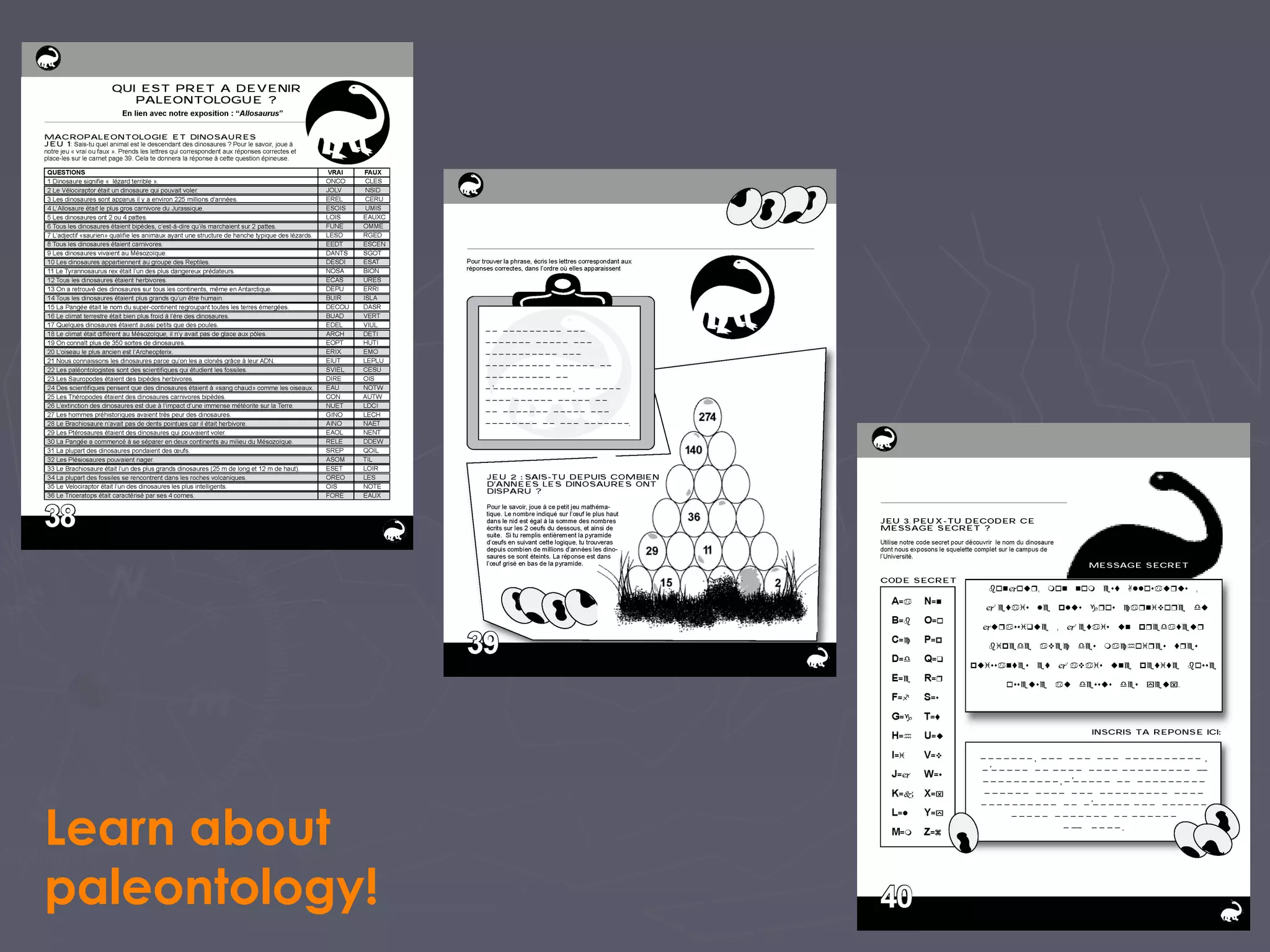
Learn about
paleontology!
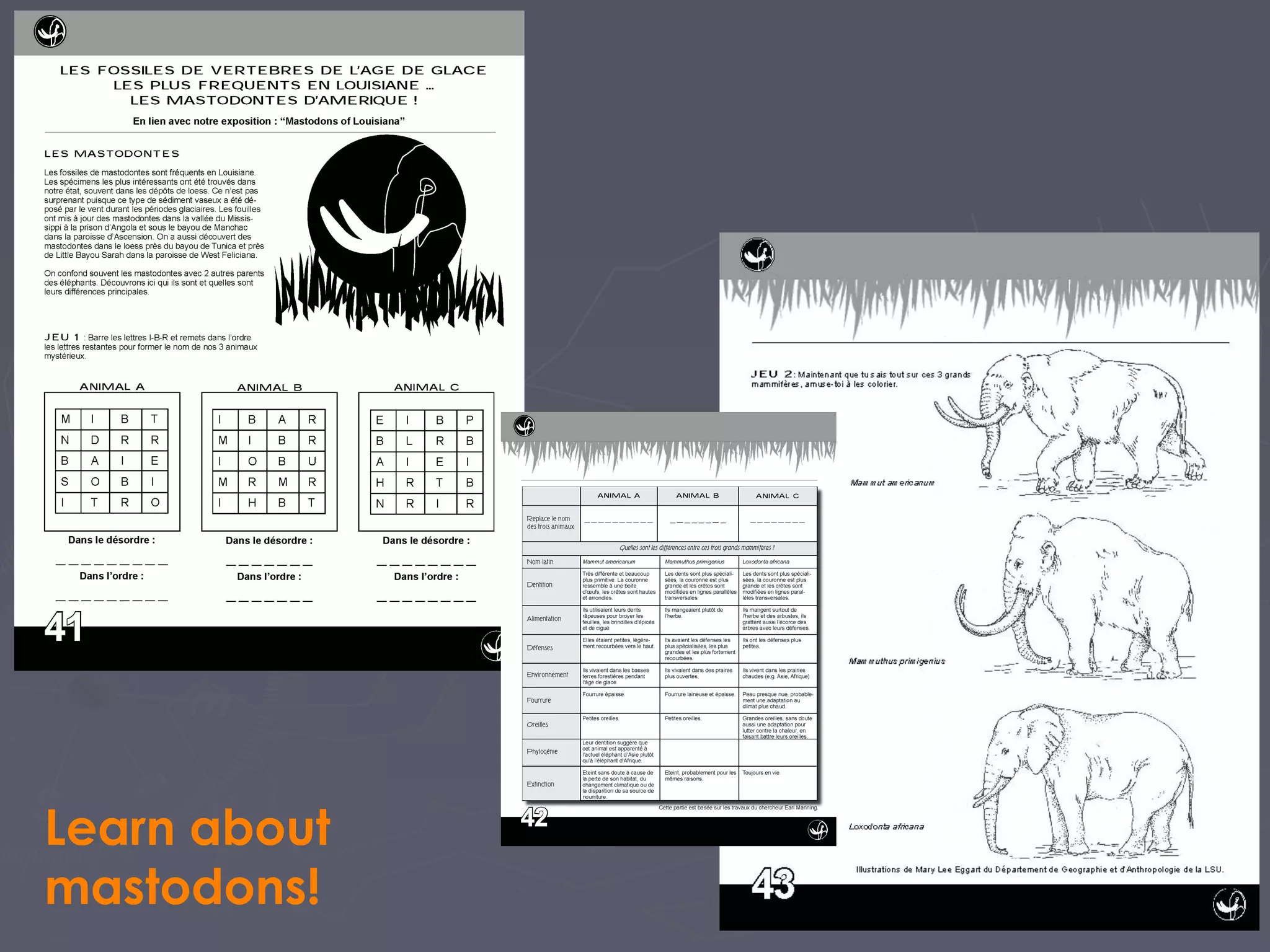
Learn about
mastodons!
5. HANDS ON ACTIVITIES5. HANDS ON ACTIVITIES
Learn about
the different
types of fossils

LSU MNS hunting for fossils in gravels

  • 1.
    HUNTING FOR FOSSILSIN LOUISIANA
  • 2.
    The Mission oftheThe Mission of the LSU Museum of Natural ScienceLSU Museum of Natural Science  Acquisition,Acquisition,  Preservation, andPreservation, and  StudyStudy of research collections to generate knowledge of:of research collections to generate knowledge of:  Regional and global biodiversity,Regional and global biodiversity,  Geological history, andGeological history, and  Human history and prehistoryHuman history and prehistory for the benefit of the people of the state, the nation, and the world.for the benefit of the people of the state, the nation, and the world.
  • 3.
    Divisions of theLSU MNSDivisions of the LSU MNS  7 main fields of RESEARCH7 main fields of RESEARCH  Ornithology (Birds)Ornithology (Birds)  GeneticsGenetics  Ichthyology (Fishes)Ichthyology (Fishes)  MammalogyMammalogy  Herpetology (Reptiles and Amphibians)Herpetology (Reptiles and Amphibians)  PaleontologyPaleontology  Anthropology (Archaeology and Ethnography)Anthropology (Archaeology and Ethnography)  EDUCATIONEDUCATION
  • 4.
  • 5.
    What is palynology?Whatis palynology? Palynomorphs = - both plant and animal structures - microscopic in size (from about 5 µm to about 500 µm) - made of compounds that are highly resistant to decay - abundant in most sediments and sedimentary rocks - can be extracted by chemical processing (acids digestion & sieving) Spores Pollen grains Dinoflagellate cysts Acritarchs Leiospheres Invertebrate Paleontology: PalynologyInvertebrate Paleontology: Palynology Dr. Sophie Warny
  • 6.
    * Biostratigraphy andgeochronology: - correlate strata - determine the relative age of a bed or formation What is it used for?What is it used for? * Palaeoecology and climate change: - used to reconstruct past vegetation (land), hence palaeoclimatic conditions - used to infer past environmental conditions (marine) * Criminology (forensic palynology) * Archaeology (past agriculture) * Commercial (melisopalynology, culture prediction) * Medical field (allergies)
  • 7.
    Collections: - Over 17,000specimens from over 1000 localities with emphasis on Louisiana.  Research statement: Dr. Schiebout's focus is on: ♦ Paleoecology ♦ Biostratigraphy and paleogeography of southern North America and China in the Tertiary ♦ Early and middle Tertiary mammals ♦ The Cretaceous-Tertiary and Paleocene-Eocene transition ♦ Louisiana fossil vertebrates, particularly in the Miocene Vertebrate PaleontologyVertebrate Paleontology Dr. Judith Schiebout
  • 8.
    Large collection ofmiddle Tertiary mammals from the Fort Polk region Dr. Schiebout excavates the lower jaw of 13.5 million year old herbivore at Fort Polk.
  • 9.
    Large collection ofTertiary fossils including this whale: Vertebrae and ribs of the Eocene whale Basilosaurus at Montgomery Landing, Louisiana. The Museum holds the front 1/3 of the skeleton including one of the most complete skulls known for this whale.
  • 10.
    18 meters (60feet) in length
  • 11.
    Large collection ofTertiary mammals from Tunica Hills, such as early elephant, rhino, hedgehog and camel relatives. Also: Dr. Ting holding an early Pliocene (Ice age) mastodon tusk and palate from the Tunica Hills.
  • 12.
    Allosaurus in Howe-Russellbuilding The biggest, most abundant meat-eater during the late Jurassic period in America, about 150 million years ago. It probably preyed upon large, plant-eating dinosaurs, like iguanodons. The allosaur¹s serrated teeth, while smaller than those of the T. rex, were as capable of tearing free large quantities of meat. -walked on two powerful legs -massive tail -short arms with 3-fingered hands -sharp claws up to 6 inches long -38 feet long and 16.5 feet tall -weighed about 1400 kg -3-ft long skull -sharp, serrated teeth 2 to 4’’ long
  • 13.
    Goals: - help you identifysome of the fossils - describe the history of their journey 2. ACTIVITY:2. ACTIVITY: HUNTING FOR FOSSILS IN LAHUNTING FOR FOSSILS IN LA
  • 14.
    1 Gravel canbe found in many places in Louisiana 2 It occurs naturally in stream and river banks 3 Gravel is just a loose mixture of rock fragments 4 We rarely wonder where it came from… 5 We don’t often sit down and look for unusual shapes or colors 6 But… LA gravel is made up of rocks formed millions of years ago 7 On the sea bottom 8 If we look closely, we can often find distinct impressions of ancient marine life
  • 15.
    - The earthwas formed approximately 4,600 million years ago. - Geologists have divided the earth’s history into intervals - The period during which the fossils found in Louisiana gravels lived was between 408 and 330 million years ago. - The fossils in the Louisiana gravels lived during part of the Paleozoic Era, in the Silurian, Devonian, and Mississippian Periods.
  • 16.
    - Study rocks-> in what environment sediments were deposited. -> Recognize past rivers, beaches, deltas, inshore/offshore trends. - Studies of Paleozoic rocks show that the North America of those times was far from that of today (it was covered by a shallow sea).
  • 17.
    This is ascene of how the sea bottom may have looked at this time. In this sea, life proliferated with coral reefs, fields of sea lilies, shellfish, moss-like bryozoans, insect-like trilobites and other animals and plants.
  • 18.
    How did thesefossils, buried hundreds of millions of years ago in the North, arrived as gravels in Louisiana today? - Buried rocks uplifed - Weathered and broken up (erosion) by wind, water, and ice. - Transported by glaciers between 1.8 and 10,000 years ago (Pleistocene) as the earth underwent a series of glaciation. - At these times, ice covered much of North America, large volumes of rock were eroded. - Some of the Paleozoic rock was broken up by ice. - Then transported south to Louisiana by rivers when the ice melted.
  • 19.
    - The shape,structure, and markings of a fossil = characteristics - Used to classify them according to the system shown above. - Because Louisiana gravels contain relatively few different types of fossils, let’s look at what each fossil type looks like. Paleozoic life - The marine invertebrates! Arthropodes Insects, trilobites Brachiopoda Shells Bryozoa Moss-like animals Cnidaria Corals (tab. & rug.) Echinodermata Starfish, sand dollars Mollusca Snails, clams
  • 20.
    Crinoid remains preservedin gravel are mostly hollow molds or filled molds (casts). Look for circular shapes with a central hole and fine radiating grooves. Look also for rectangular and columnar shapes, sometimes stacked.
  • 21.
    Rugose: - solitary orcolonial - extinct group of corals - abundant in Ordovician/Permian - some were a meter in length Tabulate: - common in gravels - differences with rugose: a) all colonial; b) radiating septa reduced or absent c) main structure = horizontal plate (tabulae) that looks like ‘honeycomb’ appearance.
  • 22.
    Bryozoans are: - moss-likeanimals - grow in fan-shaped, branching, or encrusting colonies. - look somewhat like corals; - but, more delicately built, - with a fan-shaped structure. In gravels: look for delicate fan shapes.
  • 23.
    Mollusca: Bivalva - clams,oysters, mussels - shells = 2 pieces (valves) - joined by an elastic ligament - shells: = mirror images of each other = ! bilateral symmetry Difference with brachiopods: Each valve is bilaterally symetrical.
  • 24.
    Mollusca: Gastropoda - softbody - a large foot enclosed in: - a single, non-chambered, coiled shell. The shells may be shaped as a: - dome or - cone The gravels usually contain casts of the inside coils of the gastropods. Look for these coiled cross-sections.
  • 25.
    Brachiopoda - shells - attachedto the sea bottom by a fleshy stalk or pedicle. - a hole through which this stalk passed - it can often be seen on the larger of the two valves - brachiopods always: * have different sized valves, * each valve is bilaterally symmetrical. * bivalves do not have a pedicle hole.
  • 26.
    Trilobites: - extinct marinearthropods (insect-like animals) - lived on the seafloor. - they have a three-part body plan that consists of a * cephalon (head), * a thorax, and * a pygidium (tail) with a chitinous exoskeloton. The thorax is fairly flexible and when preserved, the trilobites are often found curled up like modern rolly-pollies. They are rarely found preserved in gravels.
  • 27.
    3. FIELD TRIP:PRACTICAL DETAILS3. FIELD TRIP: PRACTICAL DETAILS
  • 28.
    General Info & Tours Monday-Friday 8:00am - 4:00 pm FREE! Scheduling Materials Rules Parking …
  • 29.
    4. MNS ACTIVITYBOOKLET4. MNS ACTIVITY BOOKLET
  • 30.
    Activities for Self-guided tours TheMNS book is available: - in French thanks to: … Anne-Sophie & Stanislas Dubois - in Spanish thanks to: … Ana Morales
  • 31.
  • 32.
  • 33.
    5. HANDS ONACTIVITIES5. HANDS ON ACTIVITIES Learn about the different types of fossils

Editor's Notes

  • #12 - An ice age is a period of long-term reduction in the temperature of Earth's climate, resulting in an expansion of the continental ice sheets, polar ice sheets and mountain glaciers ("glaciation"). Glaciologically, ice age is often used to mean a period of ice sheets in the northern and southern hemispheres; by this definition we are still in an ice age (because the Greenland and Antarctic ice sheets still exist). More colloquially, when speaking of the last few million years, ice age is used to refer to colder periods with extensive ice sheets over the North American and Eurasian continents: in this sense, the most recent ice age ended about 10,000 years ago - The American mastodon (scientific name Mammut americanum) roamed North America from at least 3.75 million to 11,000 years ago. Mastodons, along with mammoths and modern elephants, are members of the order Proboscidea.
  • #16 Stage of Devonian are Eifelian, Givetian, Frasnian, Famenian, etc. Stage of early Carbornifere (Epock Mississipian) are Tournaisien and Visean. Last glaciation 20,000 (end of Pleistocene) - LGM 120,000, 240,000 all spaced about 100,000 years apart. Apes-Hominids: 3.5 Ma, first hominids: 1 Ma.
  • #17 - LA was submerged (probably deep water)
  • #18 We know that, because when studying these in situ rocks, we find fossils that tell us how this environment looked like. But how are these creatures still found today? They are fossilized…
  • #19 - Periodic movements of the earth’s crust lifted buried rocks. - Once at the surface, these rocks were subject to weathering and breakup (erosion) by wind, water, and ice. - Glaciers (ice) are very effective in breaking up rocks between about 1.8 and 10,000 years ago (Pleistocene),the earth underwent a number of periods of very cold climate. - At these times, ice covered much of North America - Large volumes of rock were eroded and some of the Paleozoic rock of the northern and midwestern states was broken up by ice. -Then transported south to Louisiana by rivers when the ice melted.
  • #21 They have a mouth on the top surface that is surrounded by feeding arms. They have a U-shaped gut, and their anus is located next to the mouth. Although the basic echinoderm pattern of five-fold symmetry can be recognized, they have many branches. Both where “flotation/filtering” feeders. Each one of the 5 ambulacrum had many long, thin, fine structures called brachioles, which were used to trap food particles and bring them to the mouth.
  • #22 The solitary rugose corals are also called “horn corals” because of their shape.
  • #23 Bryozoans are considered nuisances by some: over 125 species are known to grow and encrust the bottoms of ships, causing drag and reducing the efficiency and maneuverability of the fouled ships. Bryozoans may also foul pilings, piers, and docks.