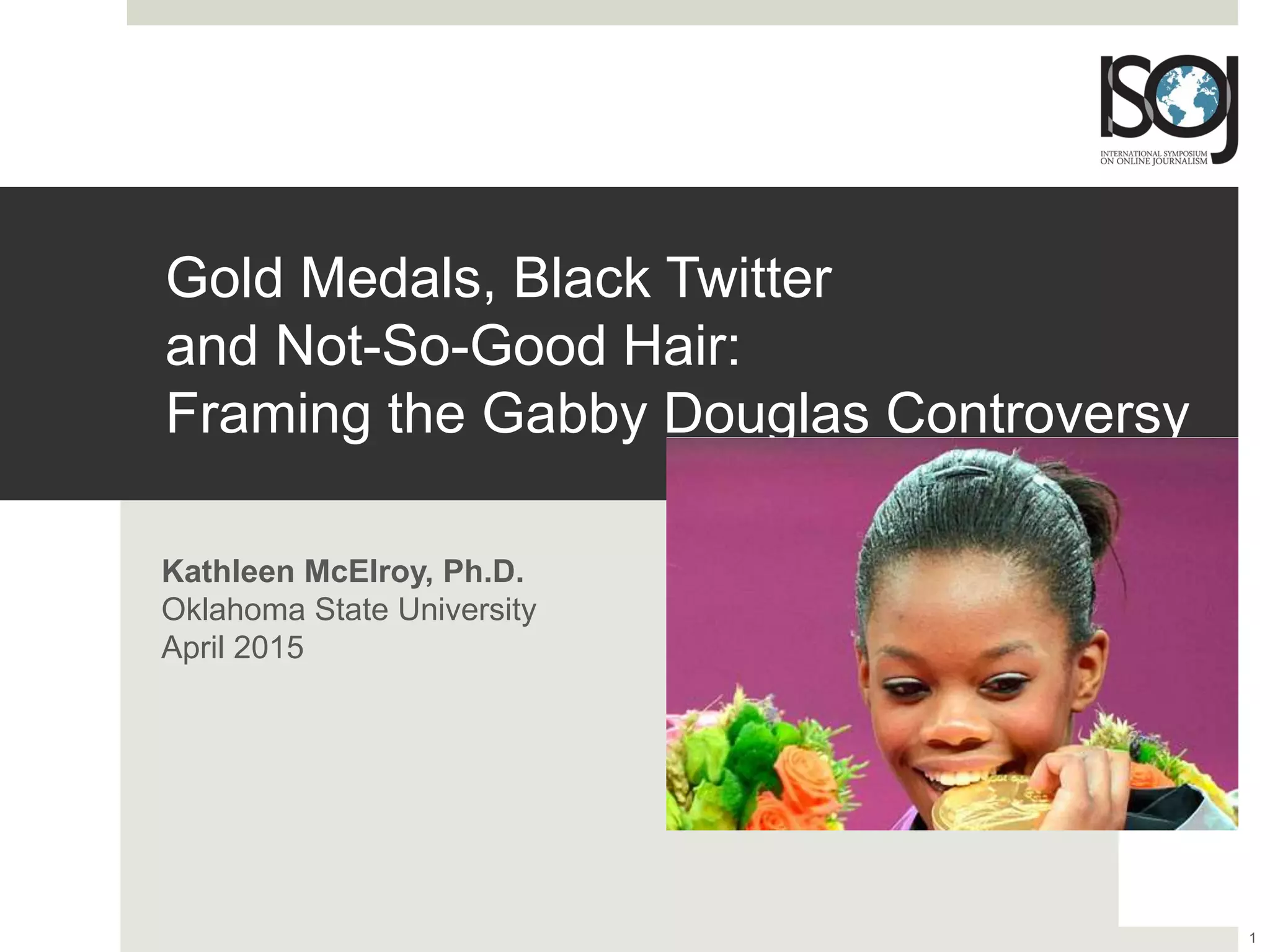
Gold Medals, Black Twitter
and Not-So-Good Hair:
Framing the Gabby Douglas Controversy
Kathleen McElroy, Ph.D.
Oklahoma State University
April 2015
1
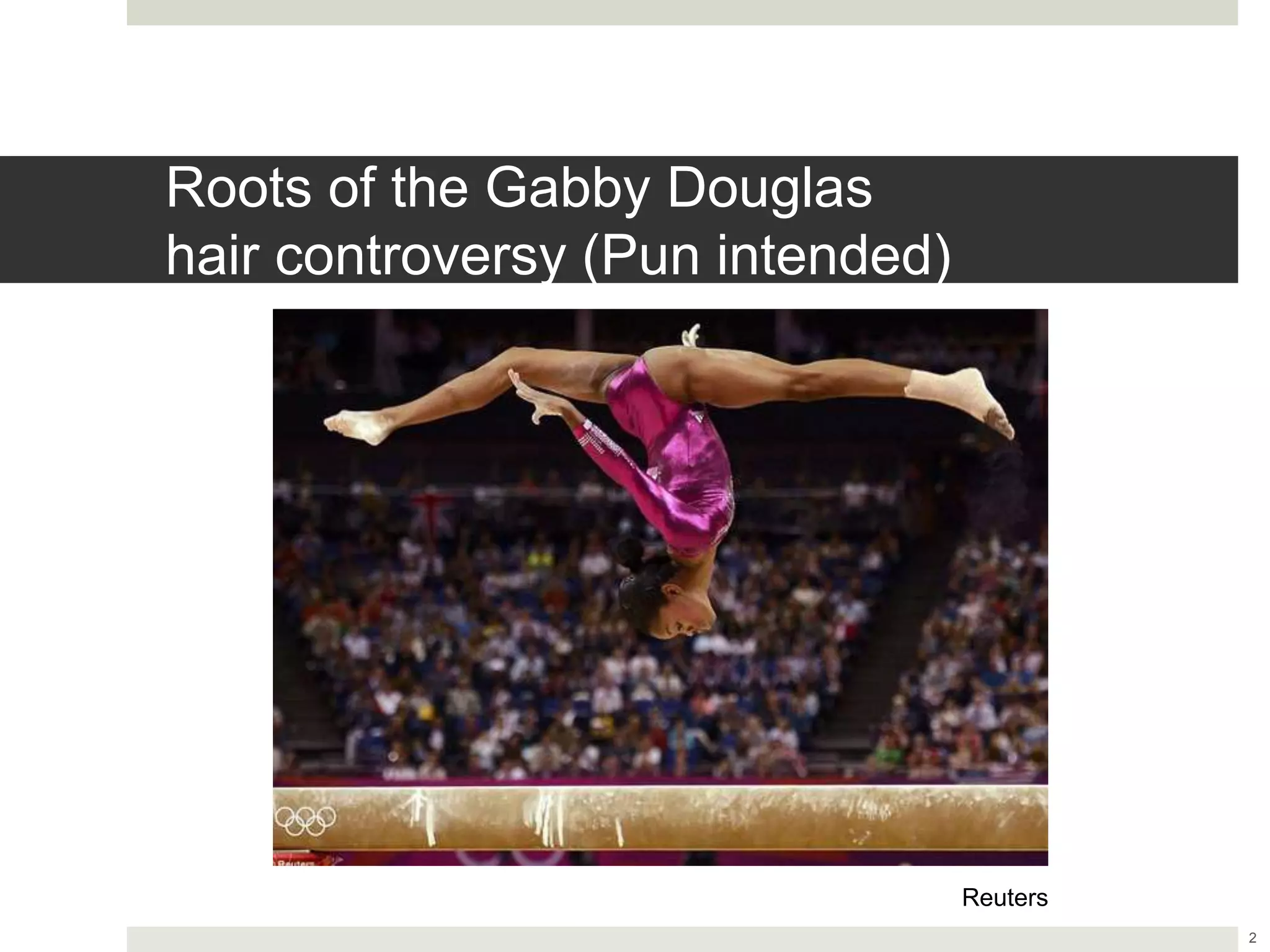
Roots of the Gabby Douglas
hair controversy (Pun intended)
2
Reuters
3
4
Theories/Concepts
 Diffusion of news, or patterns of news
circulation (Anderson, 2010)
 Black Twitter as a social public, “a
community constructed through their use of
social media by outsiders and insides alike”
(Brock, 2012)
5
Theories/Concepts
 Intersectionality analyzes “signifiers of
exclusion and domination work,” including
race, class, and gender (Meyers, 2004).
 Frames identify how power and ideology
use texts to construct a social reality
(Carragee & Roefs, 2004; Durham, 2001;
Entman, 2010; Gitlin, 1980).
6
Methodology
 Qualitative textual analysis
 Pieces published 8/1 through 8/9.
 Websites, traditional mainstream
publications; political, feminist, sports
 56 articles, 51 commentary
 1,500 Tweets on topsy.com
7
Writers
 29 black women (academics, journalists):
biographical authority; racial history
 15 white women:
defend Douglas as feminist cause
7 black men: disgusted
 2 white men: befuddled
 1 Latino: some solidarity
 2 unidentified by gender or race
8/2 Individual gold
8
Watching her victory on tape delay afforded Black
America the opportunity to use “a real-time medium
(Twitter) to share spontaneous thoughts about a non-
scripted event where most of us already know the
outcome. Aside from some commentary about her
hair, the ‘Tweeting About Gabby Douglas’ experience
was also notable because it was almost completely
devoid of Twitter’s lifeblood, snark.” – Damon Young,
Ebony
Thomas Coex/AFP/Getty Images
Hair judges on Black Twitter
9
Timeline of controversy
10
AUGUST 1
August 1
11
Randolph paraphrased 3
unidentified tweets as
evidence:
• “She needs some gel
and a brush”
• “Someone needs to
give her a hair
intervention”
• “She has to represent”
August 1
12
Randolph asked, “When in history
did it become a hobby for Black
women to heavily criticize one
another?”
August 1
13
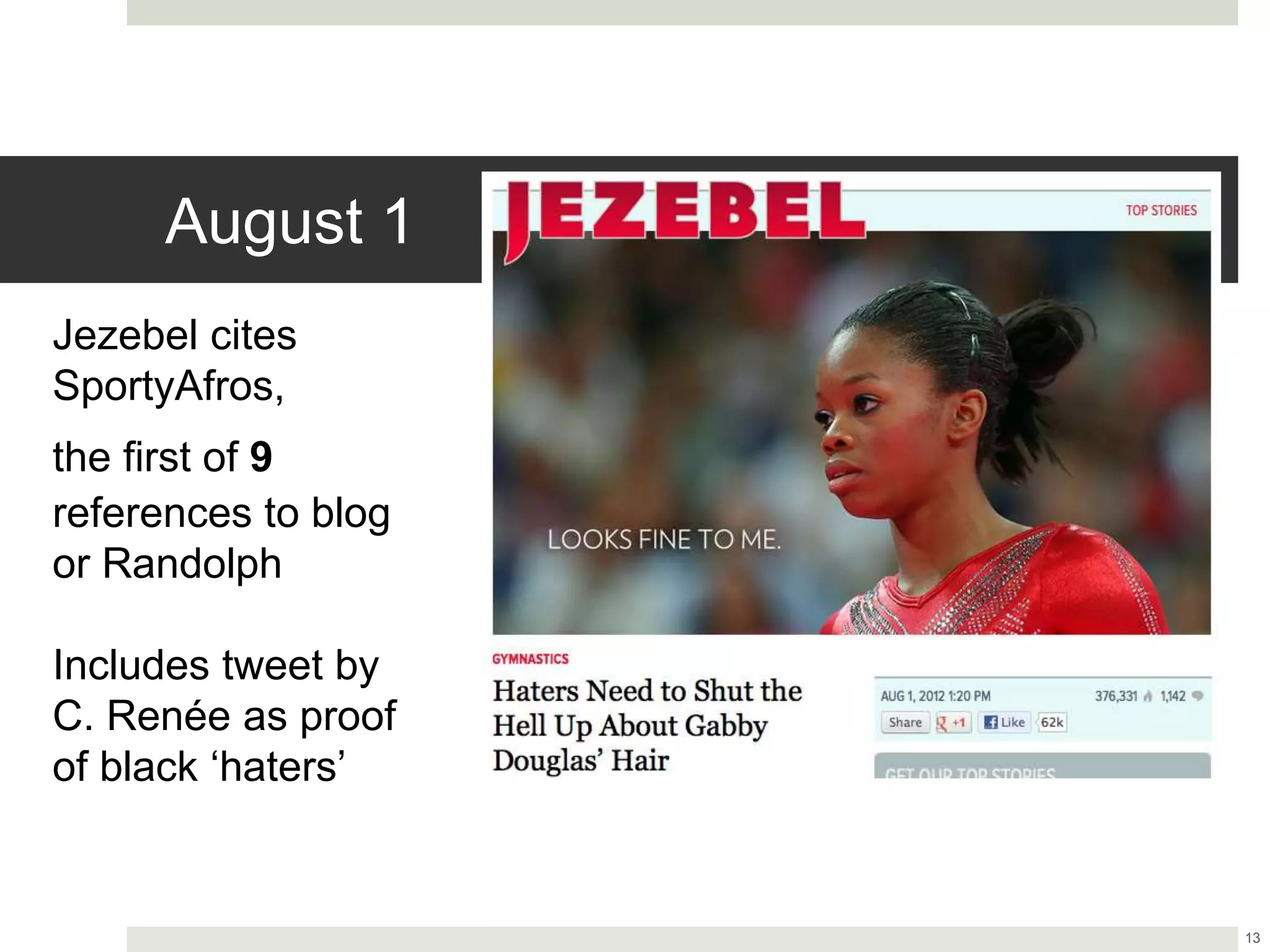
Jezebel cites
SportyAfros,
the first of 9
references to blog
or Randolph
Includes tweet by
C. Renée as proof
of black ‘haters’
C. Renée
14
August 1
15
Five hours later,
Huffington Post Black Voices
commentary also criticizes C. Renée
9 articles refer to C. Renée’s tweet as
proof of bad Black Twitter
16
Let the backlash begin
17
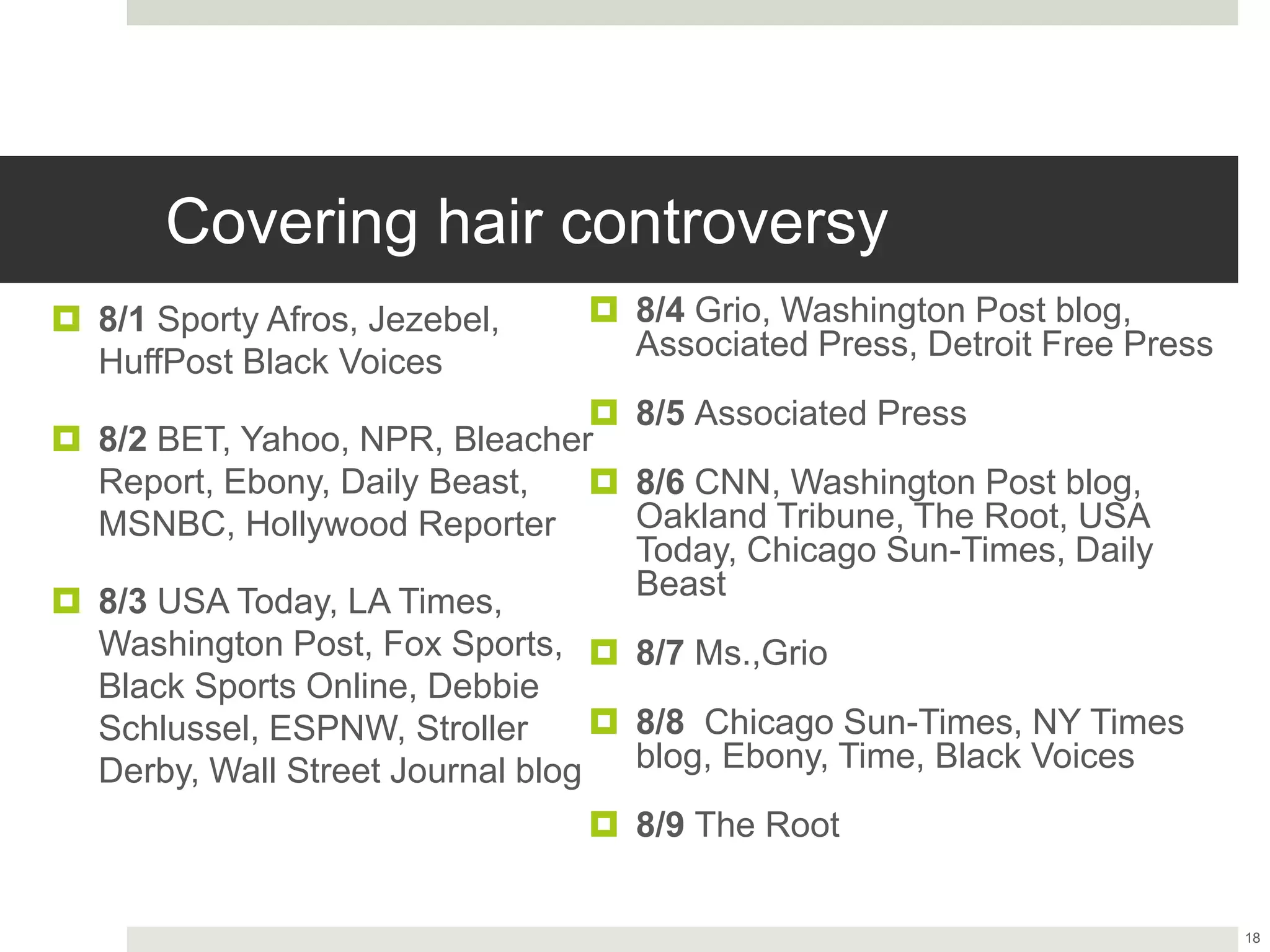
Covering hair controversy
 8/1 Sporty Afros, Jezebel,
HuffPost Black Voices
 8/2 BET, Yahoo, NPR, Bleacher
Report, Ebony, Daily Beast,
MSNBC, Hollywood Reporter
 8/3 USA Today, LA Times,
Washington Post, Fox Sports,
Black Sports Online, Debbie
Schlussel, ESPNW, Stroller
Derby, Wall Street Journal blog
 8/4 Grio, Washington Post blog,
Associated Press, Detroit Free Press
 8/5 Associated Press
 8/6 CNN, Washington Post blog,
Oakland Tribune, The Root, USA
Today, Chicago Sun-Times, Daily
Beast
 8/7 Ms.,Grio
 8/8 Chicago Sun-Times, NY Times
blog, Ebony, Time, Black Voices
 8/9 The Root
18
Never talk to journalists
(8/2) interviews Latisha Jenkins, who loves
how Douglas “doing her thing and winning. But I just
hate the way her hair looks with all those pins and gel.
I wish someone could have helped her make it look
better since she’s being seen all over the world. She
representing for black women everywhere.”
19
Later commentary (including Chicago Sun-Times and
Wall Street Journal) criticizes Jenkins
20
There are people out there criticizing gold-medal-winning Olympic gymnast
Gabby Douglas for not paying more attention to her hair.
Most of them appear to be black women.
For them, I have but one question: Are y’all crazy?
Nevermind that Douglas has made history by winning two gold medals:
some are complaining that she didn’t get her hair permed before she made
it.
A Detroit woman named Latisha Jenkins reportedly told The Daily Beast
online newspaper “I love how she’s doing her thing and winning, … but I just
hate the way her hair looks with all those pins and gel. I wish someone could
have helped her make it look better since she’s being seen all over the
world. She representing for black women everywhere.”
Oy. Someone buy that woman a verb.
AUGUST 6
August 8
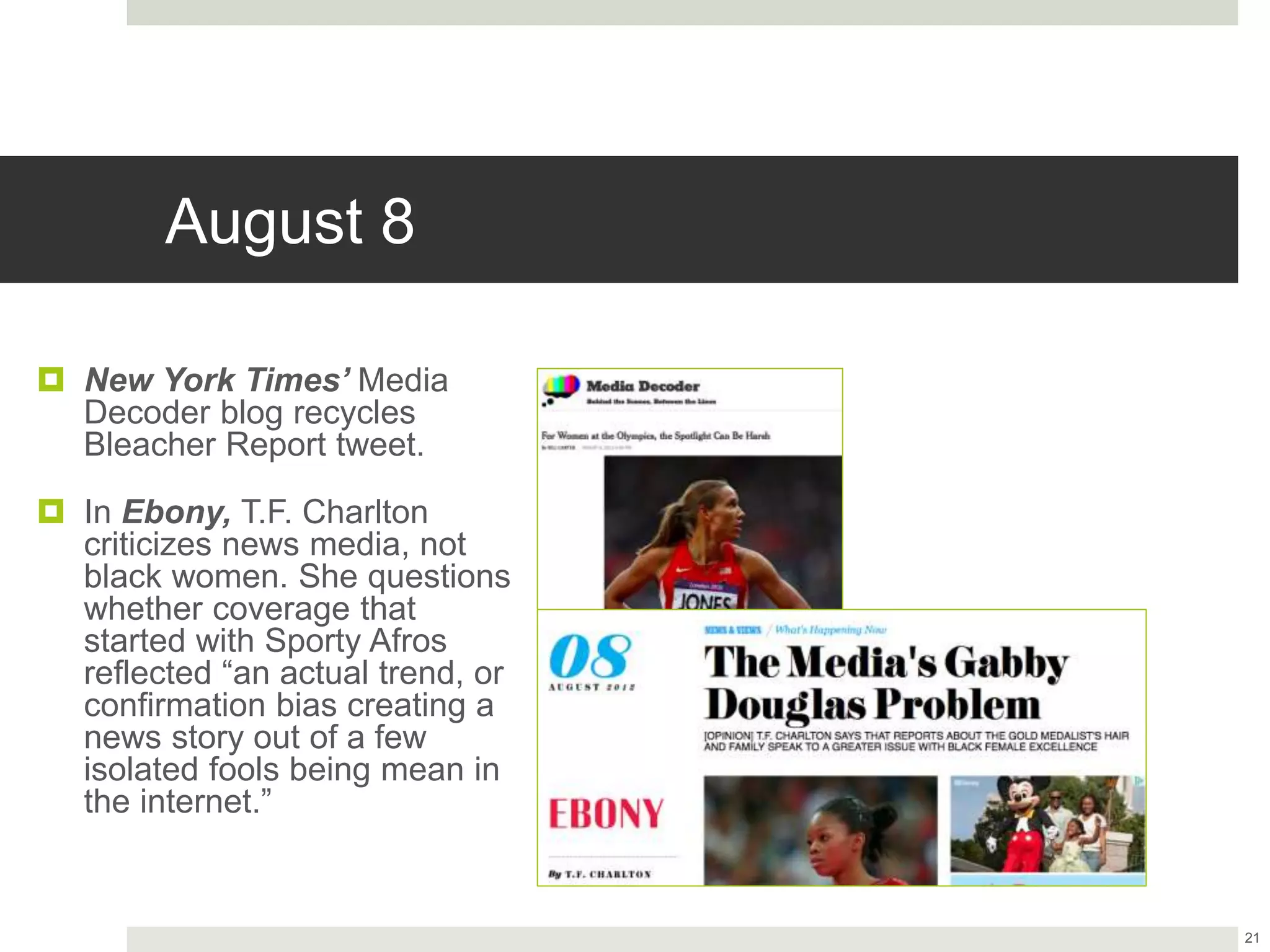
 New York Times’ Media
Decoder blog recycles
Bleacher Report tweet.
 In Ebony, T.F. Charlton
criticizes news media, not
black women. She questions
whether coverage that
started with Sporty Afros
reflected “an actual trend, or
confirmation bias creating a
news story out of a few
isolated fools being mean in
the internet.”
21
August 8
 In Ebony, T.F. Charlton
criticizes the news media, not
black women. She questioned
whether coverage that started
with Sporty Afros reflected “an
actual trend, or confirmation
bias creating a news story out
of a few isolated fools being
mean in the internet.”
 The Huffington Post’s
Black Voices links to
Ebony and asks in its
headline: “How Did
Olympic History
Turn Into A Hair
Debate?”
22
23
Frames within coverage
 ‘How low can we sink?’:
Black women – we have longstanding
problem. Whites and black men –
black women have a problem.
 ‘All y’all got is weaves and envy’:
Class war in which women with
straightened hair are framed as lower-
class and racially unenlightened
24
Frames within coverage
 ‘Far too young’ and ‘can’t win for
losing’: Douglas as child and yet another
problematic black woman
 Frame’s solution:
move Douglas away from blackness
“The time has now come when all women—and men—should
be judged by the content of their character, not the texture of
their hair” (Chicago Sun-Times, 2012)
Discussion and conclusion
25
TV and sports journalists were not eyewitnesses.
“Story” unfolded from ground up: Black Twitter to
blogs/websites to traditional publications.
Content was produced and shared by the audience,
new media and traditional outlets.
Discussion and conclusion
26
Online media represent a new forum for black women’s
empowerment (Collins, 2000)
Coverage was reminder that while traditional black
press has lost visibility and influence, gaining strength
is a black-powered digital press
But how was news diffused?
Intersectionality
27
With black pride upstaged by black shame,
African American commentators tacitly agreed with
reactionary tweets describing original complainers as
“whores,” “on welfare” and “broke”
Black women with a platform distanced themselves from
black women imagined to stand at the margins of
society
Digital ‘man on the street’?
28
For better or worse, Black Twitter is a stakeholder in
black discourse
Black Twitter falls short as reliable space for
rhetorical discussion about African-American
experience when subjected to incomplete
eavesdropping
Whither Black Twitter
29
Thank you
Kathleen McElroy, Ph.D.
School of Media and Strategic Communications
Oklahoma State University
kathleen.mcelroy@okstate.edu
917-693-0548
Research interests: Racial representation in news content
Go-to theories: media sociology, collective memory
30

Mc elroy

  • 1.
    Gold Medals, BlackTwitter and Not-So-Good Hair: Framing the Gabby Douglas Controversy Kathleen McElroy, Ph.D. Oklahoma State University April 2015 1
  • 2.
    Roots of theGabby Douglas hair controversy (Pun intended) 2 Reuters
  • 3.
  • 4.
    4 Theories/Concepts  Diffusion ofnews, or patterns of news circulation (Anderson, 2010)  Black Twitter as a social public, “a community constructed through their use of social media by outsiders and insides alike” (Brock, 2012)
  • 5.
    5 Theories/Concepts  Intersectionality analyzes“signifiers of exclusion and domination work,” including race, class, and gender (Meyers, 2004).  Frames identify how power and ideology use texts to construct a social reality (Carragee & Roefs, 2004; Durham, 2001; Entman, 2010; Gitlin, 1980).
  • 6.
    6 Methodology  Qualitative textualanalysis  Pieces published 8/1 through 8/9.  Websites, traditional mainstream publications; political, feminist, sports  56 articles, 51 commentary  1,500 Tweets on topsy.com
  • 7.
    7 Writers  29 blackwomen (academics, journalists): biographical authority; racial history  15 white women: defend Douglas as feminist cause 7 black men: disgusted  2 white men: befuddled  1 Latino: some solidarity  2 unidentified by gender or race
  • 8.
    8/2 Individual gold 8 Watchingher victory on tape delay afforded Black America the opportunity to use “a real-time medium (Twitter) to share spontaneous thoughts about a non- scripted event where most of us already know the outcome. Aside from some commentary about her hair, the ‘Tweeting About Gabby Douglas’ experience was also notable because it was almost completely devoid of Twitter’s lifeblood, snark.” – Damon Young, Ebony Thomas Coex/AFP/Getty Images
  • 9.
    Hair judges onBlack Twitter 9
  • 10.
  • 11.
    August 1 11 Randolph paraphrased3 unidentified tweets as evidence: • “She needs some gel and a brush” • “Someone needs to give her a hair intervention” • “She has to represent”
  • 12.
    August 1 12 Randolph asked,“When in history did it become a hobby for Black women to heavily criticize one another?”
  • 13.
    August 1 13 Jezebel cites SportyAfros, thefirst of 9 references to blog or Randolph Includes tweet by C. Renée as proof of black ‘haters’
  • 14.
  • 15.
    August 1 15 Five hourslater, Huffington Post Black Voices commentary also criticizes C. Renée
  • 16.
    9 articles referto C. Renée’s tweet as proof of bad Black Twitter 16
  • 17.
  • 18.
    Covering hair controversy 8/1 Sporty Afros, Jezebel, HuffPost Black Voices  8/2 BET, Yahoo, NPR, Bleacher Report, Ebony, Daily Beast, MSNBC, Hollywood Reporter  8/3 USA Today, LA Times, Washington Post, Fox Sports, Black Sports Online, Debbie Schlussel, ESPNW, Stroller Derby, Wall Street Journal blog  8/4 Grio, Washington Post blog, Associated Press, Detroit Free Press  8/5 Associated Press  8/6 CNN, Washington Post blog, Oakland Tribune, The Root, USA Today, Chicago Sun-Times, Daily Beast  8/7 Ms.,Grio  8/8 Chicago Sun-Times, NY Times blog, Ebony, Time, Black Voices  8/9 The Root 18
  • 19.
    Never talk tojournalists (8/2) interviews Latisha Jenkins, who loves how Douglas “doing her thing and winning. But I just hate the way her hair looks with all those pins and gel. I wish someone could have helped her make it look better since she’s being seen all over the world. She representing for black women everywhere.” 19 Later commentary (including Chicago Sun-Times and Wall Street Journal) criticizes Jenkins
  • 20.
    20 There are peopleout there criticizing gold-medal-winning Olympic gymnast Gabby Douglas for not paying more attention to her hair. Most of them appear to be black women. For them, I have but one question: Are y’all crazy? Nevermind that Douglas has made history by winning two gold medals: some are complaining that she didn’t get her hair permed before she made it. A Detroit woman named Latisha Jenkins reportedly told The Daily Beast online newspaper “I love how she’s doing her thing and winning, … but I just hate the way her hair looks with all those pins and gel. I wish someone could have helped her make it look better since she’s being seen all over the world. She representing for black women everywhere.” Oy. Someone buy that woman a verb. AUGUST 6
  • 21.
    August 8  NewYork Times’ Media Decoder blog recycles Bleacher Report tweet.  In Ebony, T.F. Charlton criticizes news media, not black women. She questions whether coverage that started with Sporty Afros reflected “an actual trend, or confirmation bias creating a news story out of a few isolated fools being mean in the internet.” 21
  • 22.
    August 8  InEbony, T.F. Charlton criticizes the news media, not black women. She questioned whether coverage that started with Sporty Afros reflected “an actual trend, or confirmation bias creating a news story out of a few isolated fools being mean in the internet.”  The Huffington Post’s Black Voices links to Ebony and asks in its headline: “How Did Olympic History Turn Into A Hair Debate?” 22
  • 23.
    23 Frames within coverage ‘How low can we sink?’: Black women – we have longstanding problem. Whites and black men – black women have a problem.  ‘All y’all got is weaves and envy’: Class war in which women with straightened hair are framed as lower- class and racially unenlightened
  • 24.
    24 Frames within coverage ‘Far too young’ and ‘can’t win for losing’: Douglas as child and yet another problematic black woman  Frame’s solution: move Douglas away from blackness “The time has now come when all women—and men—should be judged by the content of their character, not the texture of their hair” (Chicago Sun-Times, 2012)
  • 25.
    Discussion and conclusion 25 TVand sports journalists were not eyewitnesses. “Story” unfolded from ground up: Black Twitter to blogs/websites to traditional publications. Content was produced and shared by the audience, new media and traditional outlets.
  • 26.
    Discussion and conclusion 26 Onlinemedia represent a new forum for black women’s empowerment (Collins, 2000) Coverage was reminder that while traditional black press has lost visibility and influence, gaining strength is a black-powered digital press But how was news diffused?
  • 27.
    Intersectionality 27 With black prideupstaged by black shame, African American commentators tacitly agreed with reactionary tweets describing original complainers as “whores,” “on welfare” and “broke” Black women with a platform distanced themselves from black women imagined to stand at the margins of society
  • 28.
    Digital ‘man onthe street’? 28 For better or worse, Black Twitter is a stakeholder in black discourse Black Twitter falls short as reliable space for rhetorical discussion about African-American experience when subjected to incomplete eavesdropping
  • 29.
  • 30.
    Thank you Kathleen McElroy,Ph.D. School of Media and Strategic Communications Oklahoma State University kathleen.mcelroy@okstate.edu 917-693-0548 Research interests: Racial representation in news content Go-to theories: media sociology, collective memory 30