Download to read offline
![Jisc Digital Festival 2014
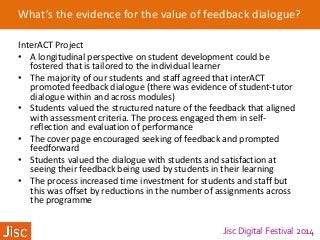
What’s the evidence for the value of feedback dialogue?
InterACT quotes
• “[interACT] did force my reflective process in the end to have one last look
without changing anything on my self-evaluation, it is not something that I
think I would have naturally done, I think I would have just said, Ok, I have
worked this as much as I can possibly do right now, I will just hand it over.”
Interview Student 3
• “I have been able to engage in more of a dialogue with whoever has
graded it, which has allowed a little more personality exchange and a little
more support, when you feel that there is someone at the other end
actually looking at what you are working so hard at and treating you as a
person.” Interview Student 4
• “[Before interACT dialogue] was just not a built in thing, so I think if you
were rushed or timid or maybe even insecure about the work that you
were doing, it would have been a little more intimidating [to email the
tutor] … I like this better, as there is an element of expectation that there
will be some dialogue.” Interview student 3
• “It’s certainly improved my feedback in terms of definitely quantity and
hopefully quality as well so I’m giving more information now because I’m
being constantly prompted.” Interview Tutor 3](https://image.slidesharecdn.com/h11atue1430complete-140311100233-phpapp02/85/Promoting-feedback-dialogue-using-technology-Rola-Ajjawi-Gunter-Saunders-and-Peter-Chatterton-Jisc-Digital-Festival-2014-9-320.jpg?cb=1394604849)
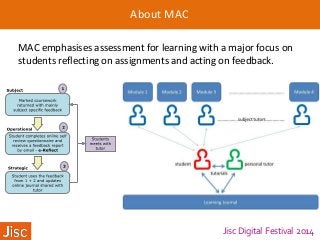
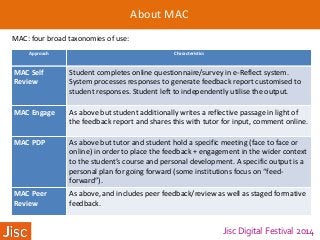
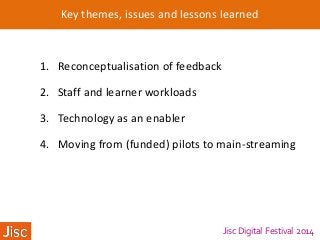
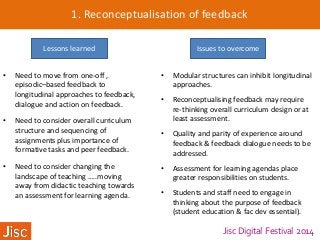
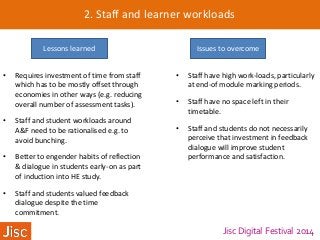

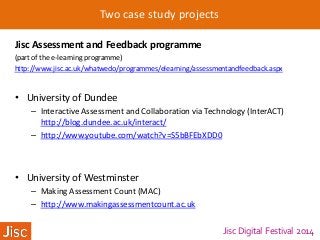
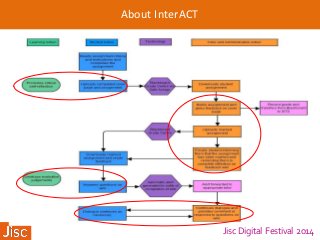
Simply providing feedback does not ensure that students have read it, understood it or engaged and learned from it. This is one of the reasons that feedback dialogue is gaining recognition as an important principle of effective feedback 1 and assessment for learning 2. In this workshop participants will: 1) discuss the value of feedback dialogue to student learning and the student experience and 2) compare and contrast two Jisc funded projects aiming to promote feedback dialogue. Case study 1 Interactive Assessment and Collaboration via Technology (interACT): involved the redesign of feedback practices across an online distance learning postgraduate programme in medical education using cover pages and dialogue wikis to promote self-evaluation and student-tutor dialogue. Case study 2 Making Assessment Count (MAC) has developed a flexible process centred around online self-review questionnaires that students can use to either think about an assignment they are about to address or reflect on an assignment they have completed and received feedback on. We discuss the two approaches to promoting feedback dialogue including: why, how, evidence and lessons learned.


