Smart  Grid  Gotland
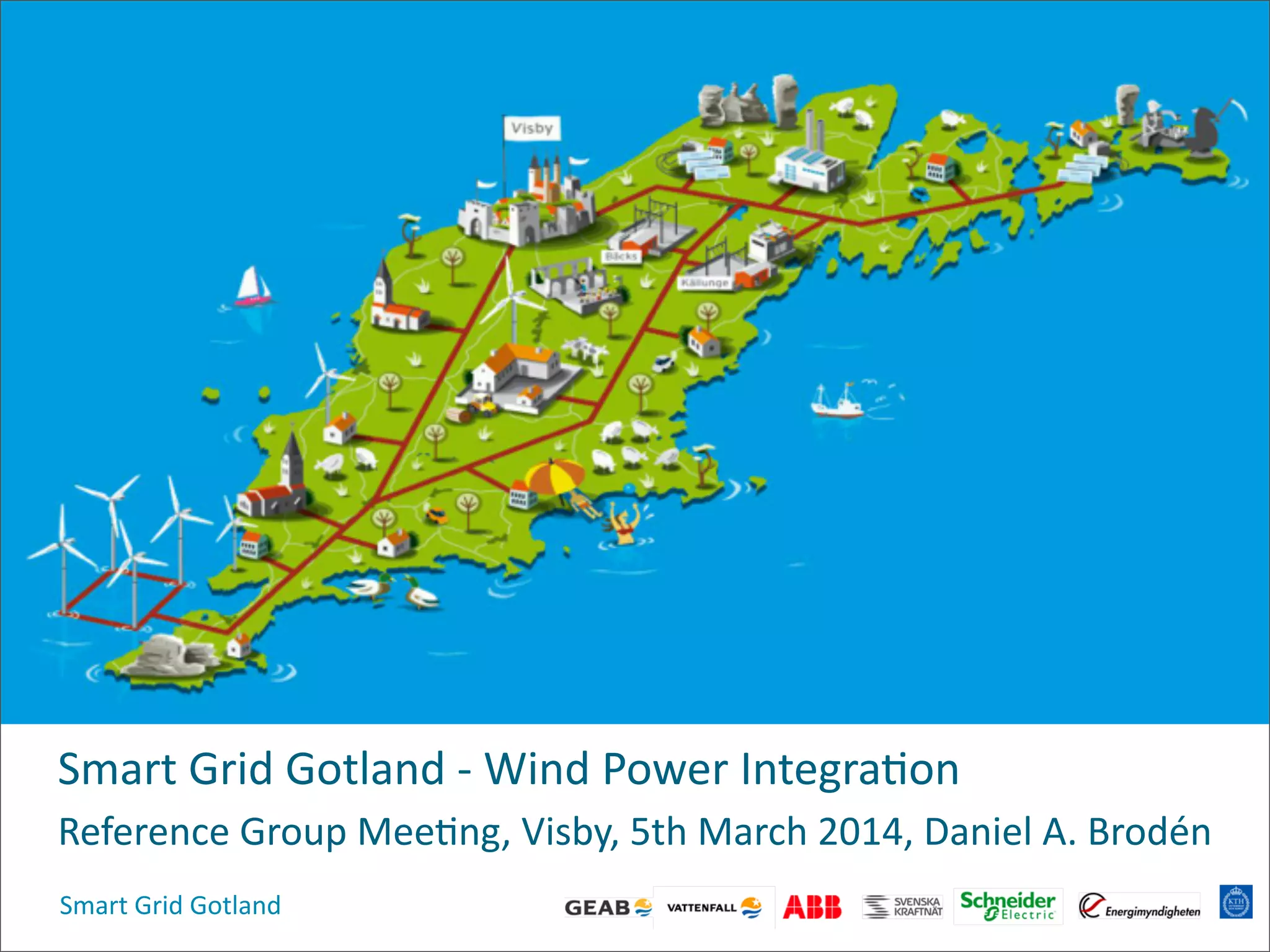
Smart  Grid  Gotland  -­‐  Wind  Power  Integra4on
Reference  Group  Mee4ng,  Visby,  5th  March  2014,  Daniel  A.  Brodén
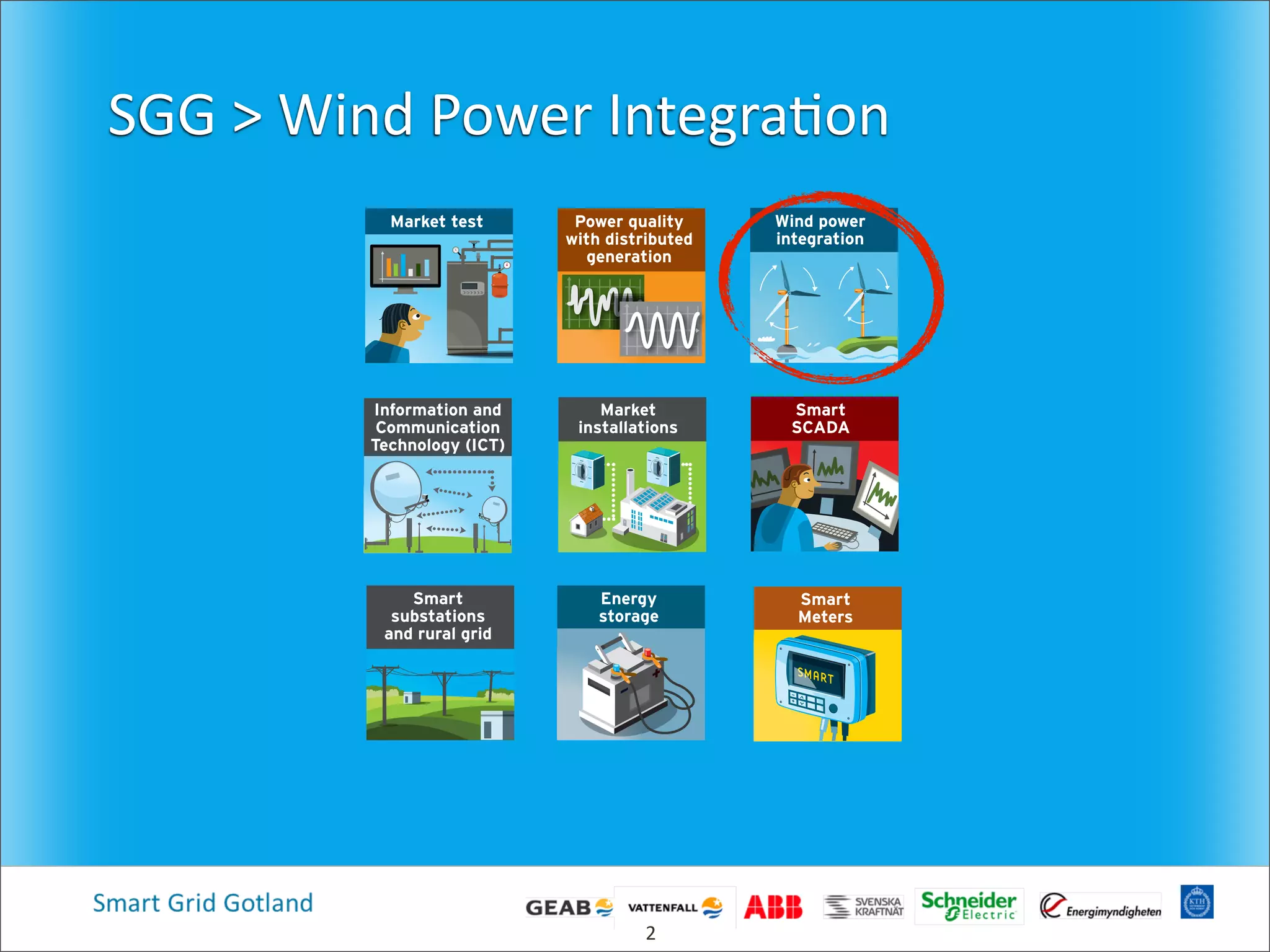
SGG  >  Wind  Power  Integra4on
Power quality
with distributed
generation
Smart
SCADA
Smart
Meters
Energy
storage
Market
installations
Information and
Communication
Technology (ICT)
Wind power
integration
Market test
Smart
substations
and rural grid
2
Situa4on  on  Gotland
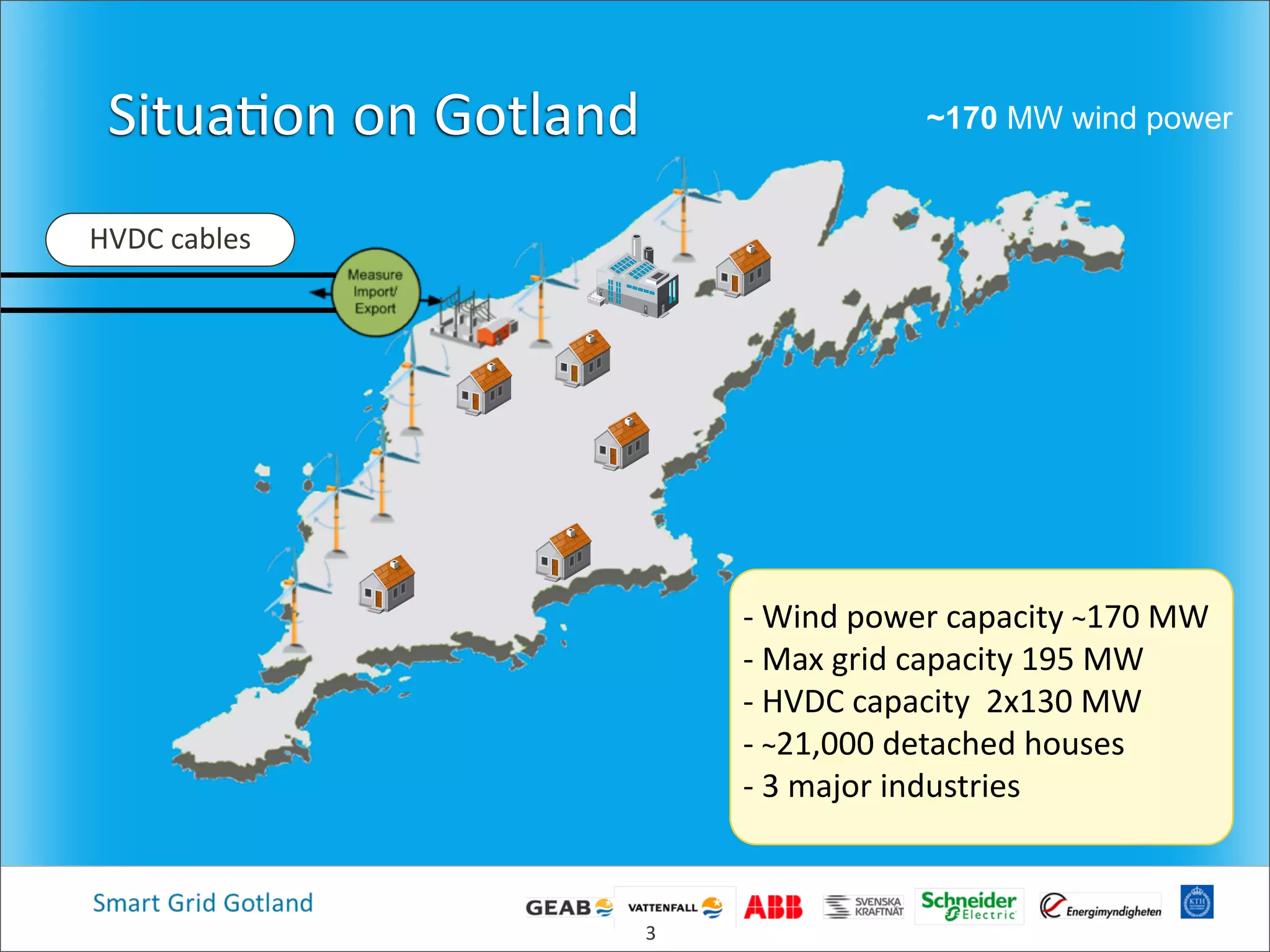
-­‐  Wind  power  capacity  ~170  MW
-­‐  Max  grid  capacity  195  MW
-­‐  HVDC  capacity    2x130  MW
-­‐  ~21,000  detached  houses
-­‐  3  major  industries
HVDC  cables
3
~170 MW wind power
Situa4on  on  Gotland
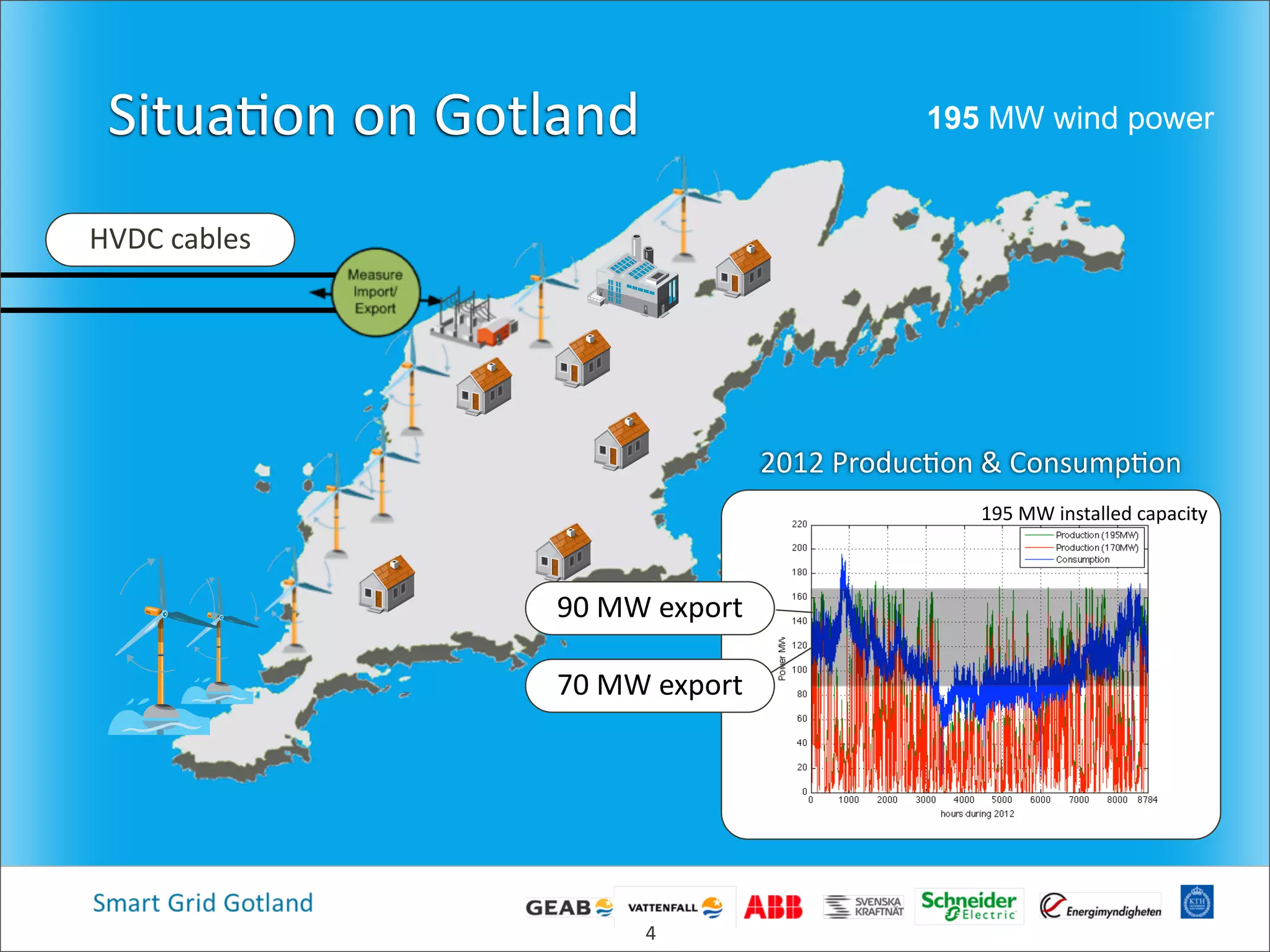
2012  Produc4on  &  Consump4on
HVDC  cables
170  MW  installed  capacity195  MW  installed  capacity
70  MW  export
90  MW  export
195 MW wind power
4
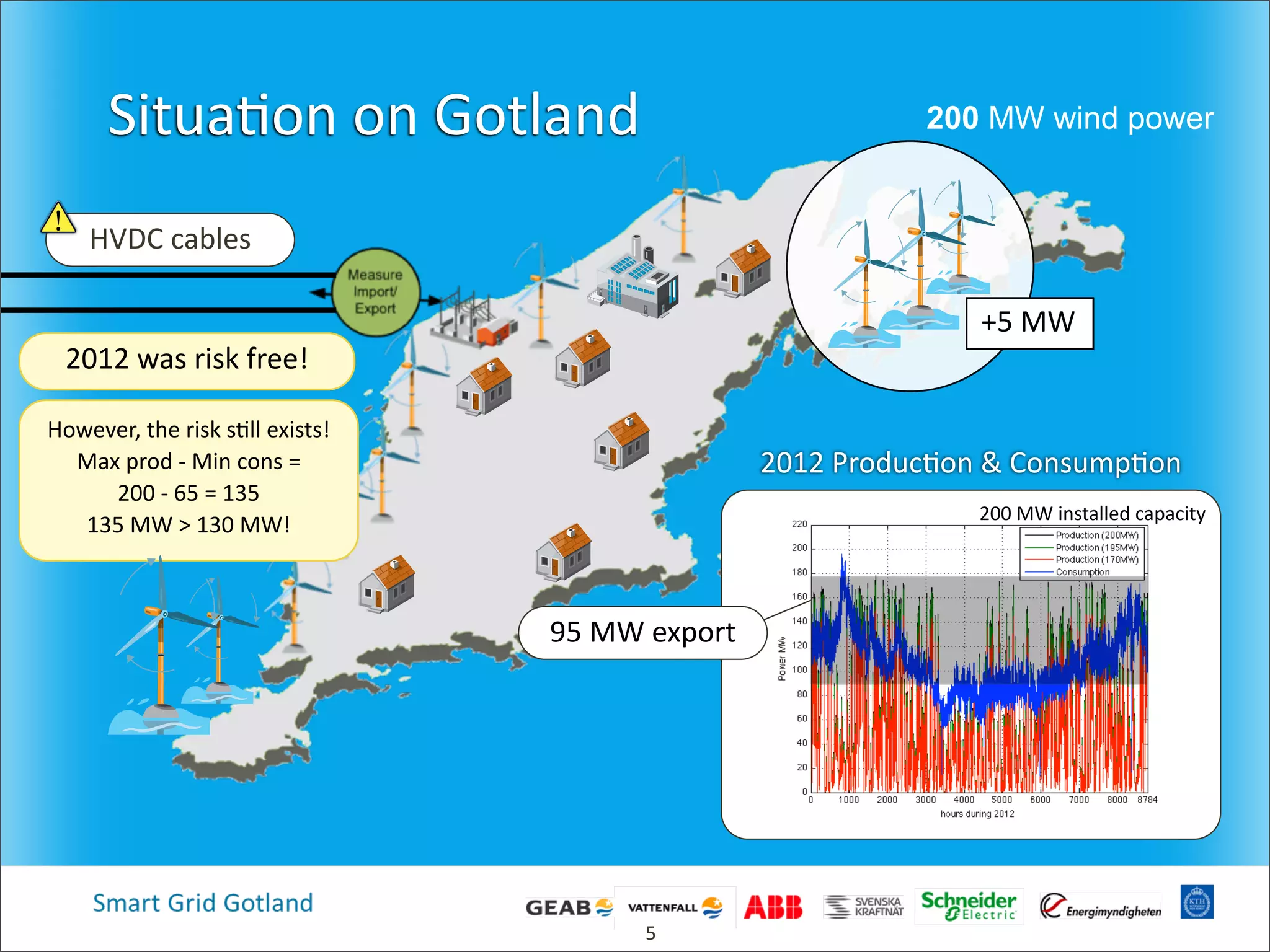
Situa4on  on  Gotland
HVDC  cables
+5  MW  
2012  Produc4on  &  Consump4on
200  MW  installed  capacity
95  MW  export
However,  the  risk  s4ll  exists!
Max  prod  -­‐  Min  cons  =  
200  -­‐  65  =  135  
135  MW  >  130  MW!
2012  was  risk  free!
5
200 MW wind power
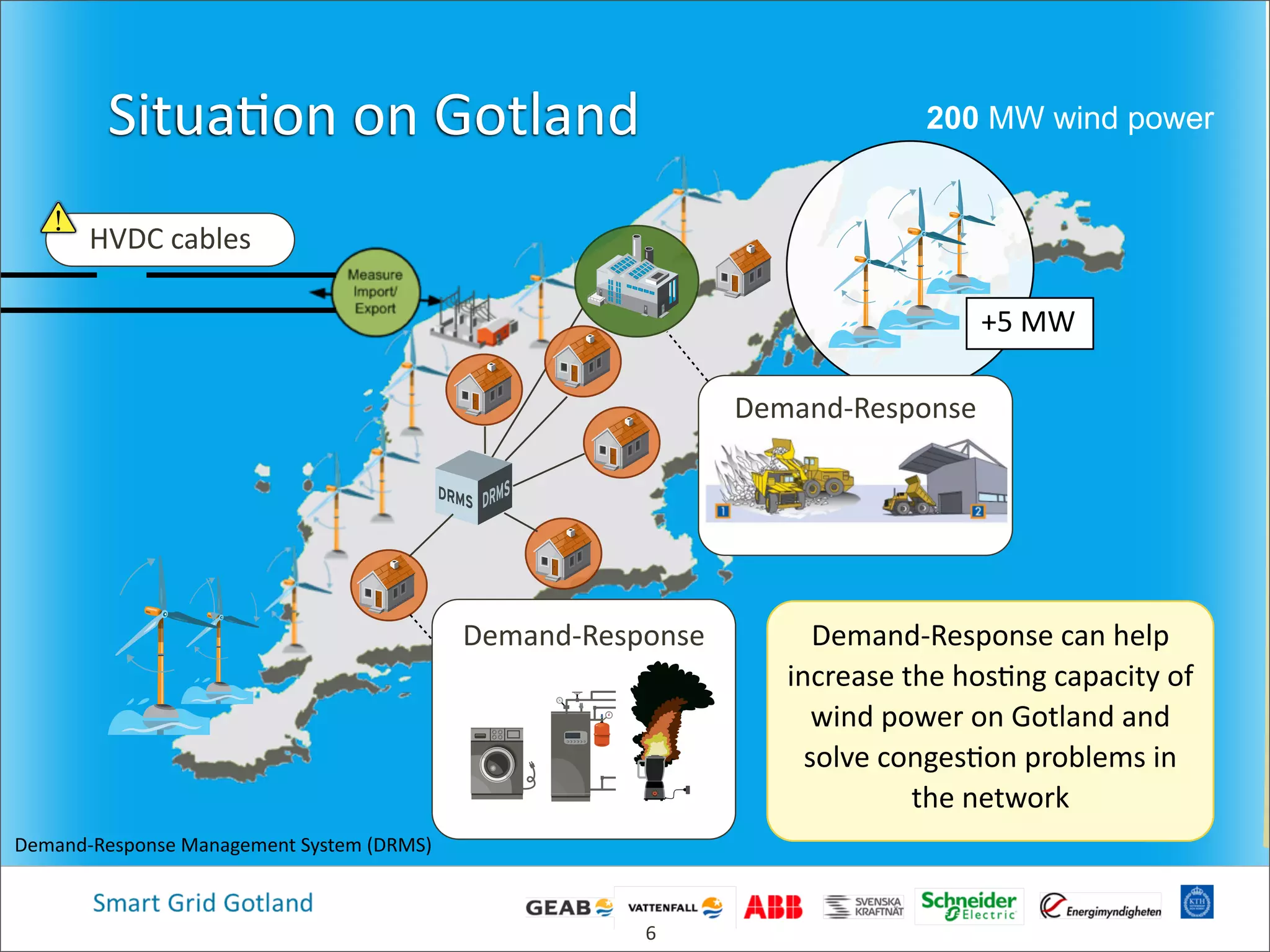
Situa4on  on  Gotland
Demand-­‐Response
HVDC  cables
+5  MW  
Demand-­‐Response
Demand-­‐Response  can  help  
increase  the  hos4ng  capacity  of  
wind  power  on  Gotland  and  
solve  conges4on  problems  in  
the  network
Demand-­‐Response  Management  System  (DRMS)
200 MW wind power
6
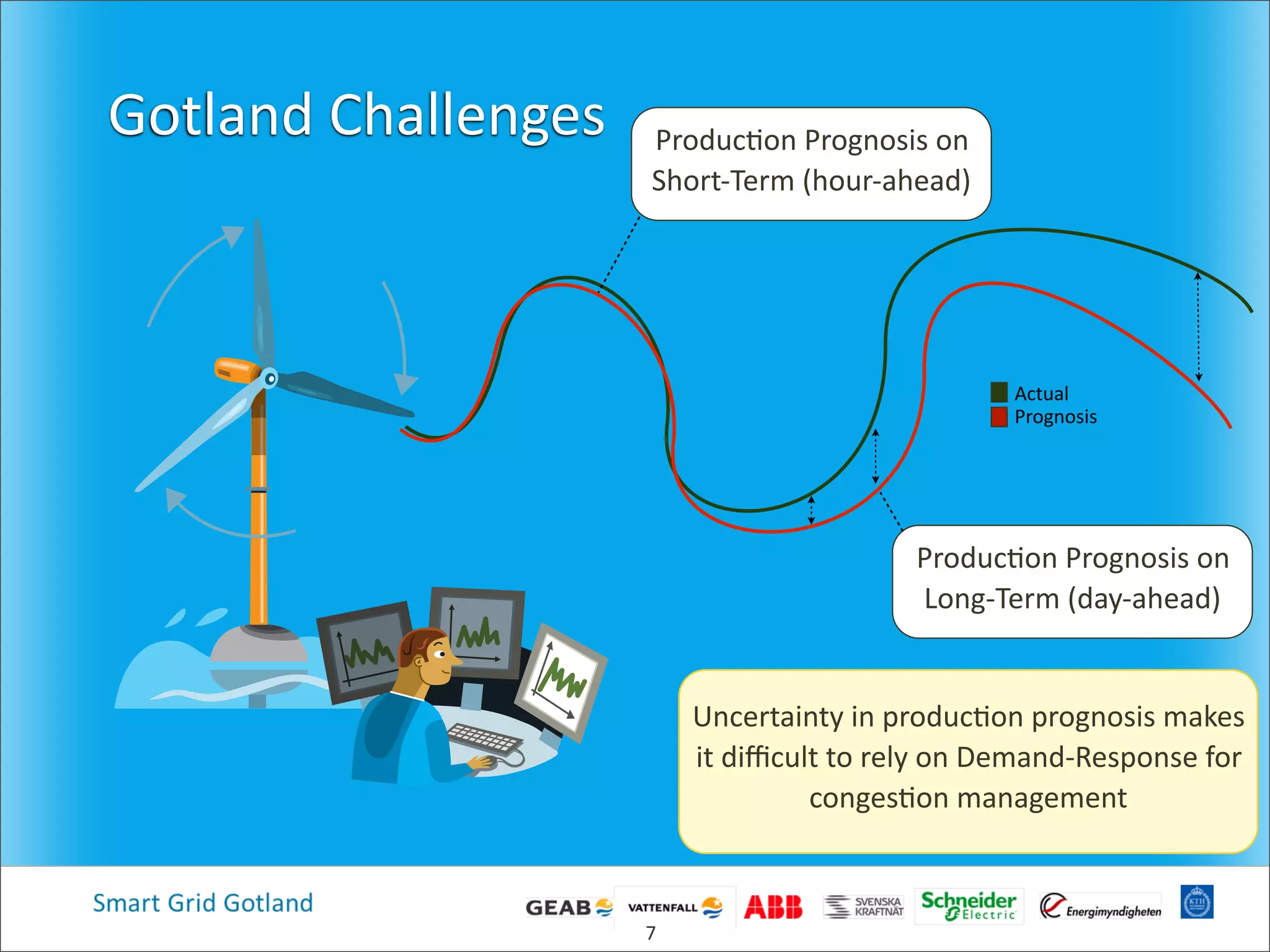
Gotland  Challenges Produc4on  Prognosis  on  
Short-­‐Term  (hour-­‐ahead)
Produc4on  Prognosis  on  
Long-­‐Term  (day-­‐ahead)
Actual
Prognosis
Uncertainty  in  produc4on  prognosis  makes  
it  difficult  to  rely  on  Demand-­‐Response  for  
conges4on  management
7
Research
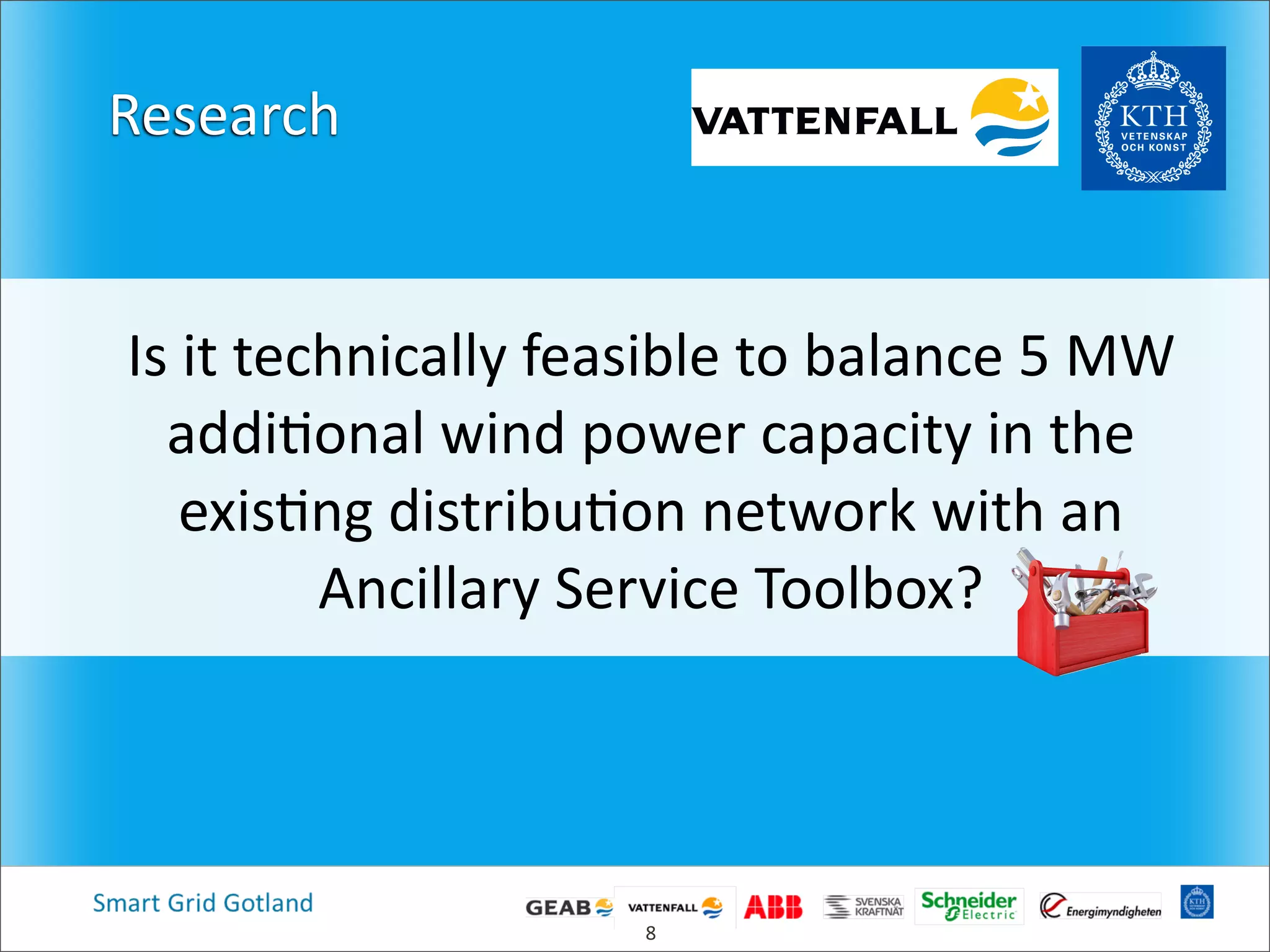
Is  it  technically  feasible  to  balance  5  MW  
addi4onal  wind  power  capacity  in  the  
exis4ng  distribu4on  network  with  an  
Ancillary  Service  Toolbox?
8
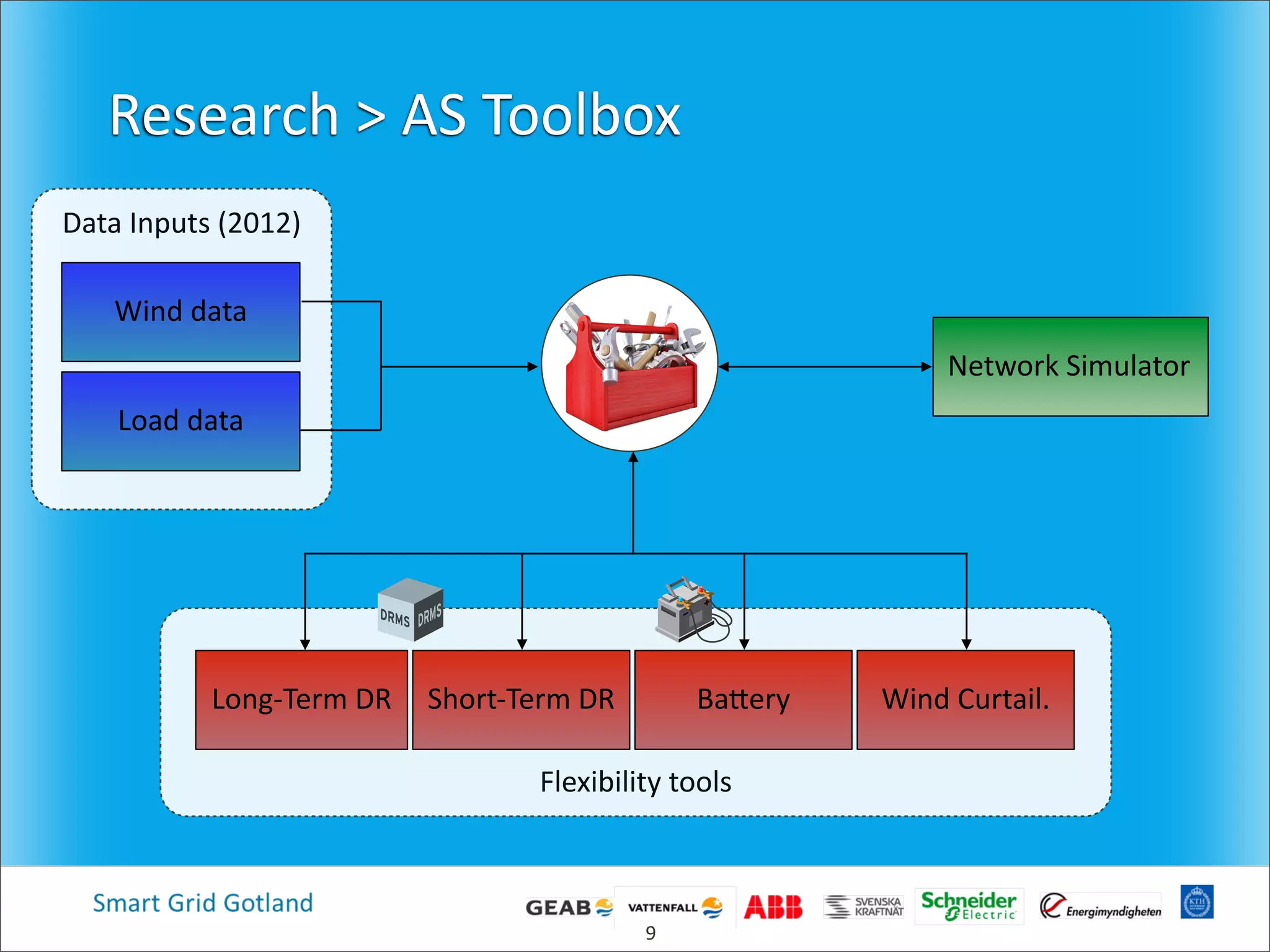
Data  Inputs  (2012)
Research  >  AS  Toolbox
Wind  data
Load  data
Network  Simulator
Flexibility  tools
Long-­‐Term  DR Short-­‐Term  DR Bacery Wind  Curtail.
9
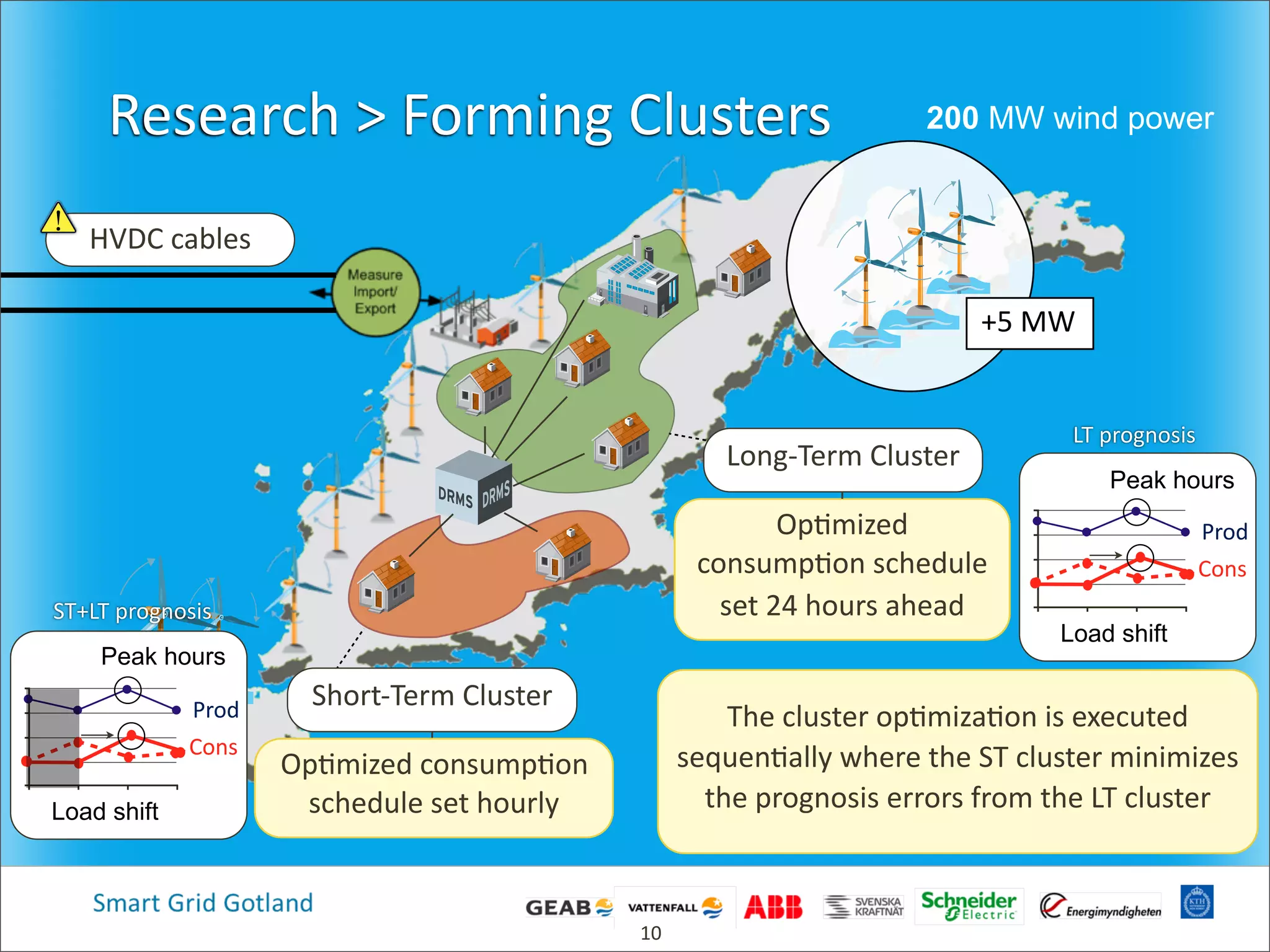
Research  >  Forming  Clusters
HVDC  cables
The  cluster  op4miza4on  is  executed  
sequen4ally  where  the  ST  cluster  minimizes  
the  prognosis  errors  from  the  LT  cluster
Long-­‐Term  Cluster
Op4mized  
consump4on  schedule  
set  24  hours  ahead
Op4mized  consump4on  
schedule  set  hourly
+5  MW  
Short-­‐Term  Cluster
10
Prod
Cons
Peak hours
Load shift
Prod
Cons
Load shift
LT  prognosis
Peak hours
ST+LT  prognosis
200 MW wind power
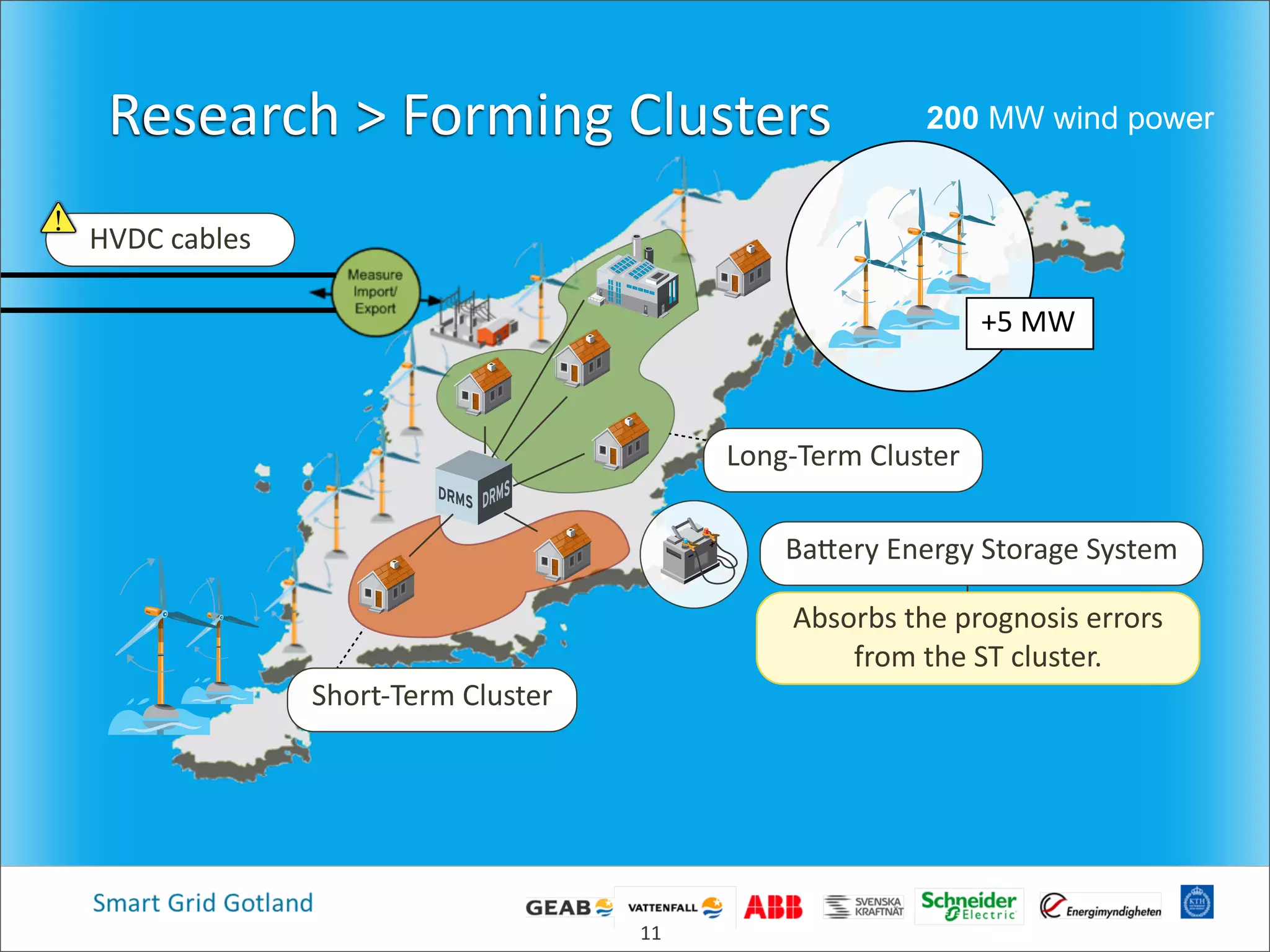
Research  >  Forming  Clusters
HVDC  cables
Long-­‐Term  Cluster
Short-­‐Term  Cluster
+5  MW  
Bacery  Energy  Storage  System
Absorbs  the  prognosis  errors  
from  the  ST  cluster.  
11
200 MW wind power
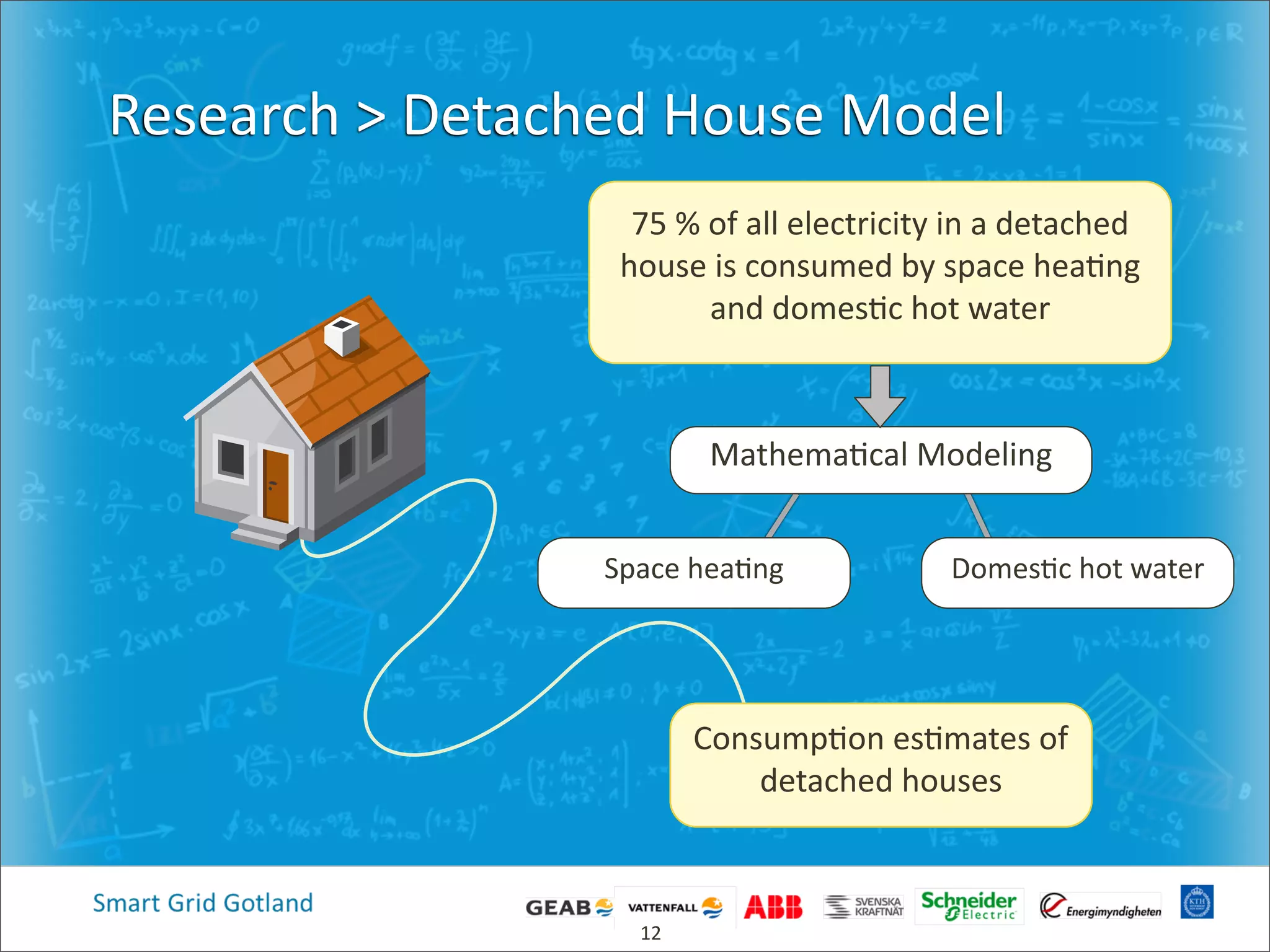
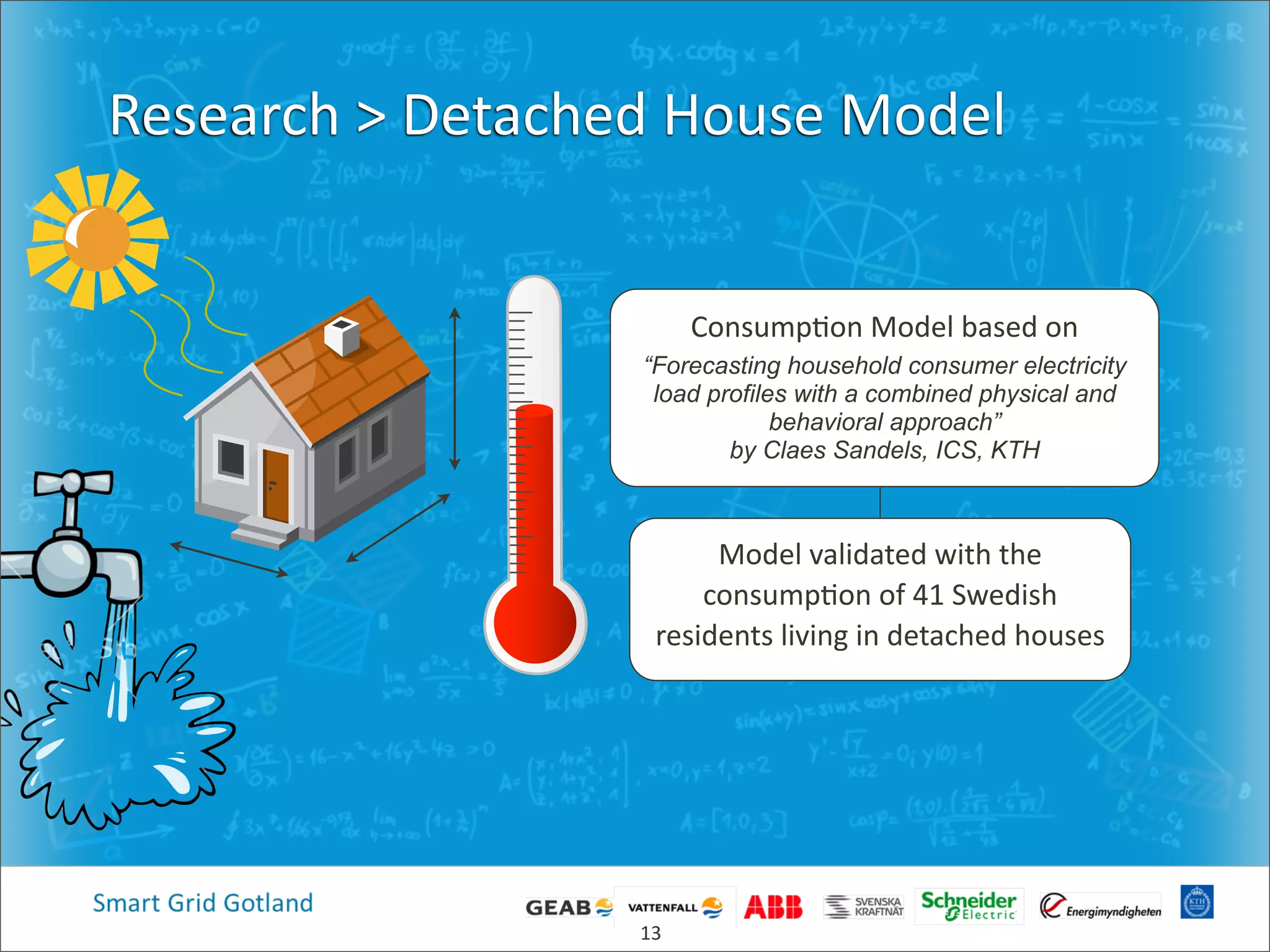
Research  >  Detached  House  Model
12
Mathema4cal  Modeling
Domes4c  hot  waterSpace  hea4ng
75  %  of  all  electricity  in  a  detached  
house  is  consumed  by  space  hea4ng  
and  domes4c  hot  water
Consump4on  es4mates  of  
detached  houses
Research  >  Detached  House  Model
Consump4on  Model  based  on  
“Forecasting household consumer electricity
load profiles with a combined physical and
behavioral approach”
by Claes Sandels, ICS, KTH
Model  validated  with  the  
consump4on  of  41  Swedish  
residents  living  in  detached  houses
13
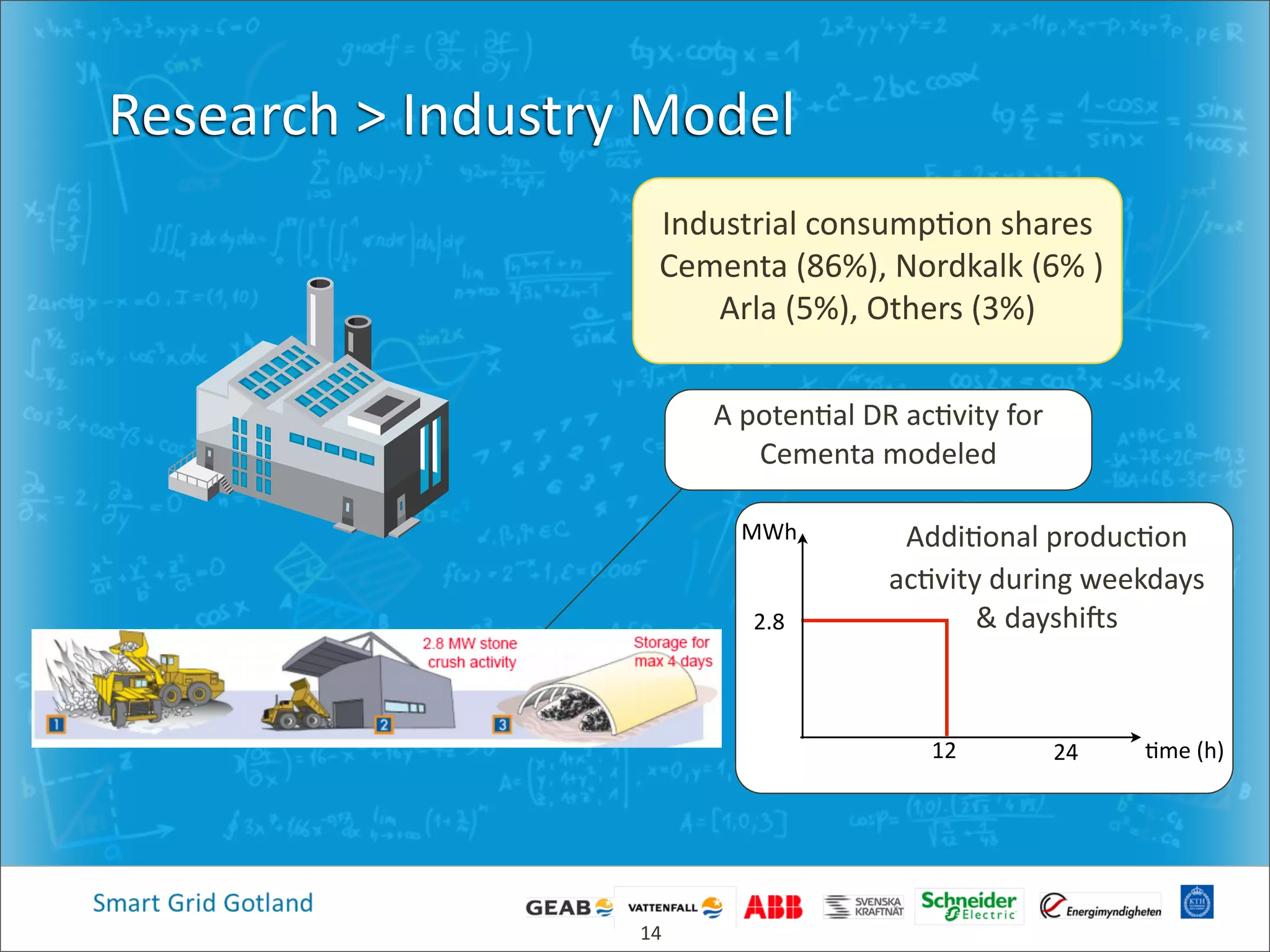
Research  >  Industry  Model
4me  (h)12 24
MWh
2.8
14
Industrial  consump4on  shares
  Cementa  (86%),  Nordkalk  (6%  )
Arla  (5%),  Others  (3%)
A  poten4al  DR  ac4vity  for  
Cementa  modeled
Addi4onal  produc4on  
ac4vity  during  weekdays  
&  dayshijs
Research  >  Simula4on  Setup
17%
20%
23%
-­‐  3  day  periods  simulated  
-­‐  Considering  seasonal  varia4on
-­‐  2012  data  in  hourly  granularity
-­‐  Data  adjusted  to  provoke  export  problem
15
Required  cluster  
size  (w/o  Cementa)
x  1900
x  1600  (LT)
x  300  (ST)
Research  >  Results  &  Findings
Total power to balance per day and scenario
0,00
5,00
10,00
15,00
20,00
25,00
30,00
35,00
40,00
Scenario 1: Winter days Scenario 2:Spring days Scenario 3: Summer days Scenario 4: Autumn days
Scenarios
Power[MW]
day 1
day 2
day 3
Total number of hourly export problems per day and scenario
6
7
8
Scenario 1: Winter
Scenario 2: Spring
Scenario 3: Summer
Scenario 4: Autumn
17%
20%
23%
16
The  minimum  number  of  par4cipants  required  to  
solve  all  export  problems  for  all  scenarios
1300
1500
1700
1100
1000
900
900
1000
1500
1000
900
1700
Minimum  
cluster  size/day
h
0 12 24 36 48 60 72
16
Time [hours]
Indoor  temperature
Less  than  +/-­‐  1°C  
varia4on  for  all  
seasonal  scenarios.  
Comfort  level  is  kept!
Research  >  Results  &  Findings
17%
20%
23%
17
0 12 24 36 48 60 72
16
17
18
19
20
21
22
23
24
25
Time [hours]
Temperature[degeesC]
Indoor temperature change for a LT household participant
Winter
Spring
Summer
Autumn
0 12 24 36 48 60 72
16
Time [hours]
Tank  temperature
Varia4ons  are  
within  the  
boundaries  
for  all  scenarios.  
Comfort  level  is  kept!
Research  >  Results  &  Findings
18
Autumn
Summer
Spring
Winter
Tank temperature change for LT household participant
Tanktemperature[degeesC]
Time [hours]
0 12 24 36 48 60 72
40
50
60
70
80
90
100
110
120
130
Figure 12:
17%
20%
23%
BESS  opera4on
(winter  scenario)
No  wind  curtailment  
needed  in  this  
scenario
Research  >  Results  &  Findings
17%
20%
23%
19
Max BESS capacity
Wind curtailment
BESS level
Power[kW]
Time [hours]
0 12 24 36 48 60 72
0
50
100
150
200
250
300
h
BESS  charges  to  account  for  prognosis  errors  not  
accounted  by  the  DR  par4cipants
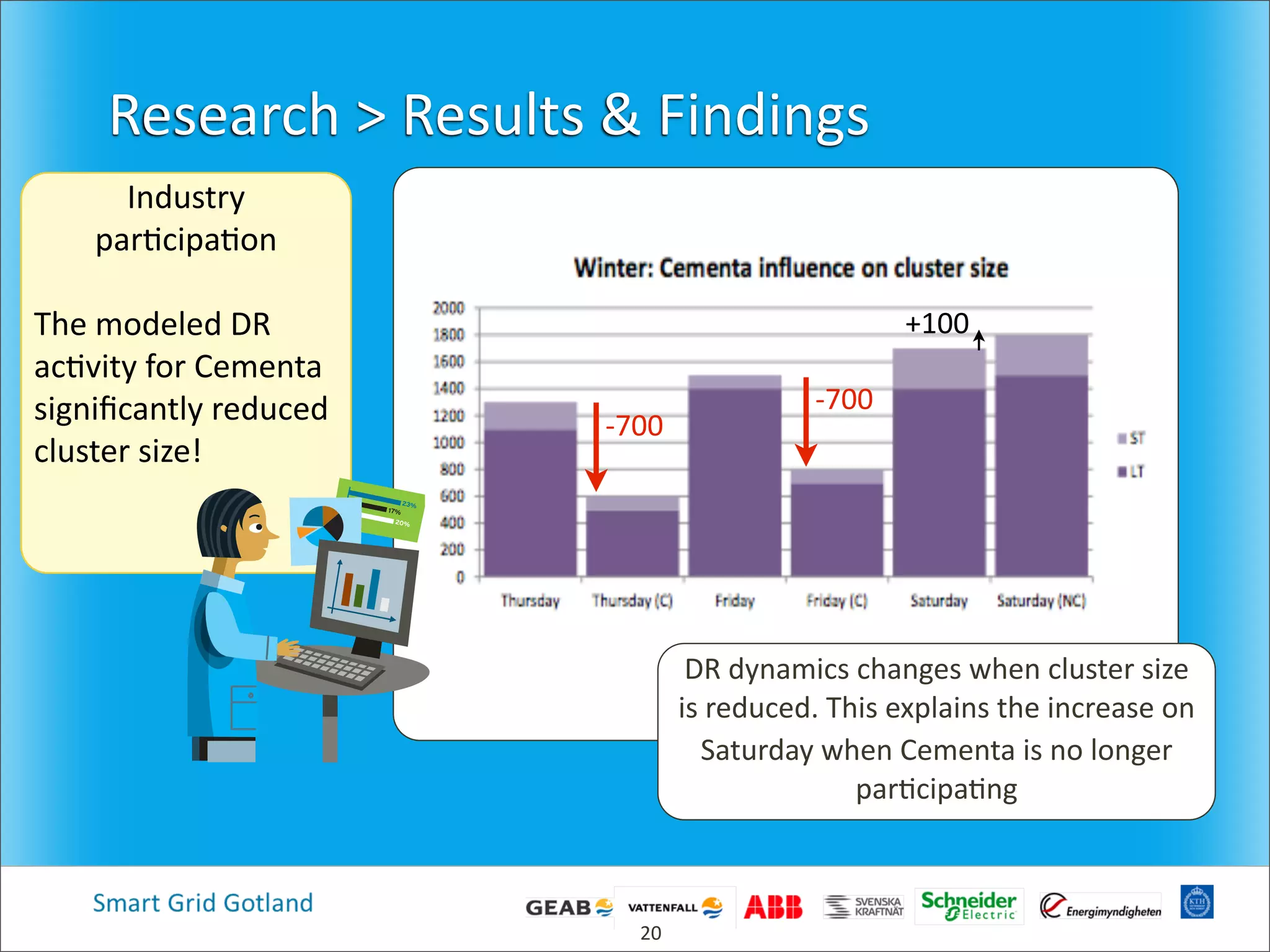
Industry  
par4cipa4on
The  modeled  DR  
ac4vity  for  Cementa  
significantly  reduced  
cluster  size!
Research  >  Results  &  Findings
17%
20%
23%
-­‐700
+100
20
-­‐700
DR  dynamics  changes  when  cluster  size  
is  reduced.  This  explains  the  increase  on  
Saturday  when  Cementa  is  no  longer  
par4cipa4ng
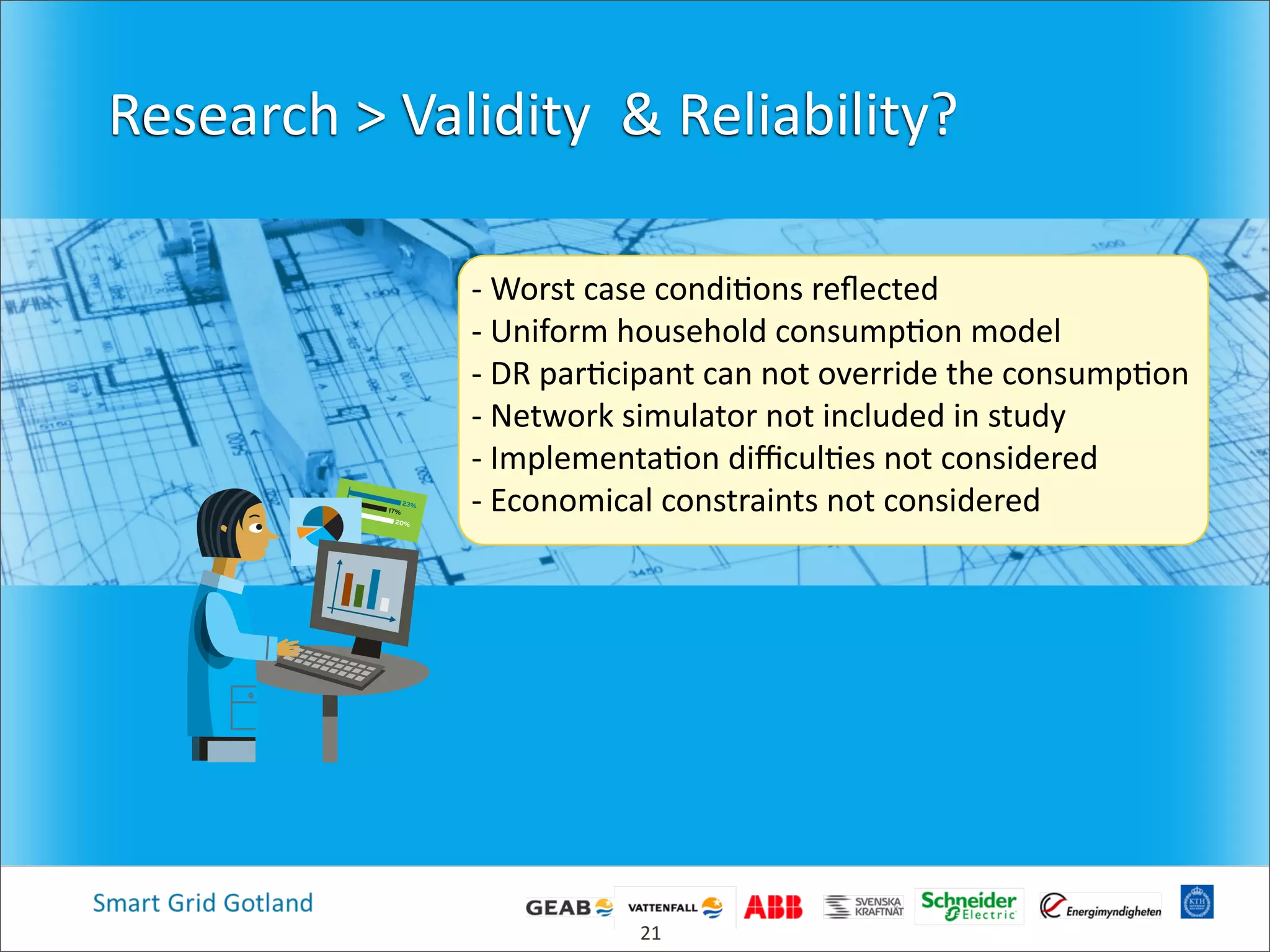
Research  >  Validity    &  Reliability?
21
-­‐  Worst  case  condi4ons  reflected
-­‐  Uniform  household  consump4on  model
-­‐  DR  par4cipant  can  not  override  the  consump4on
-­‐  Network  simulator  not  included  in  study
-­‐  Implementa4on  difficul4es  not  considered
-­‐  Economical  constraints  not  considered17%
20%
23%
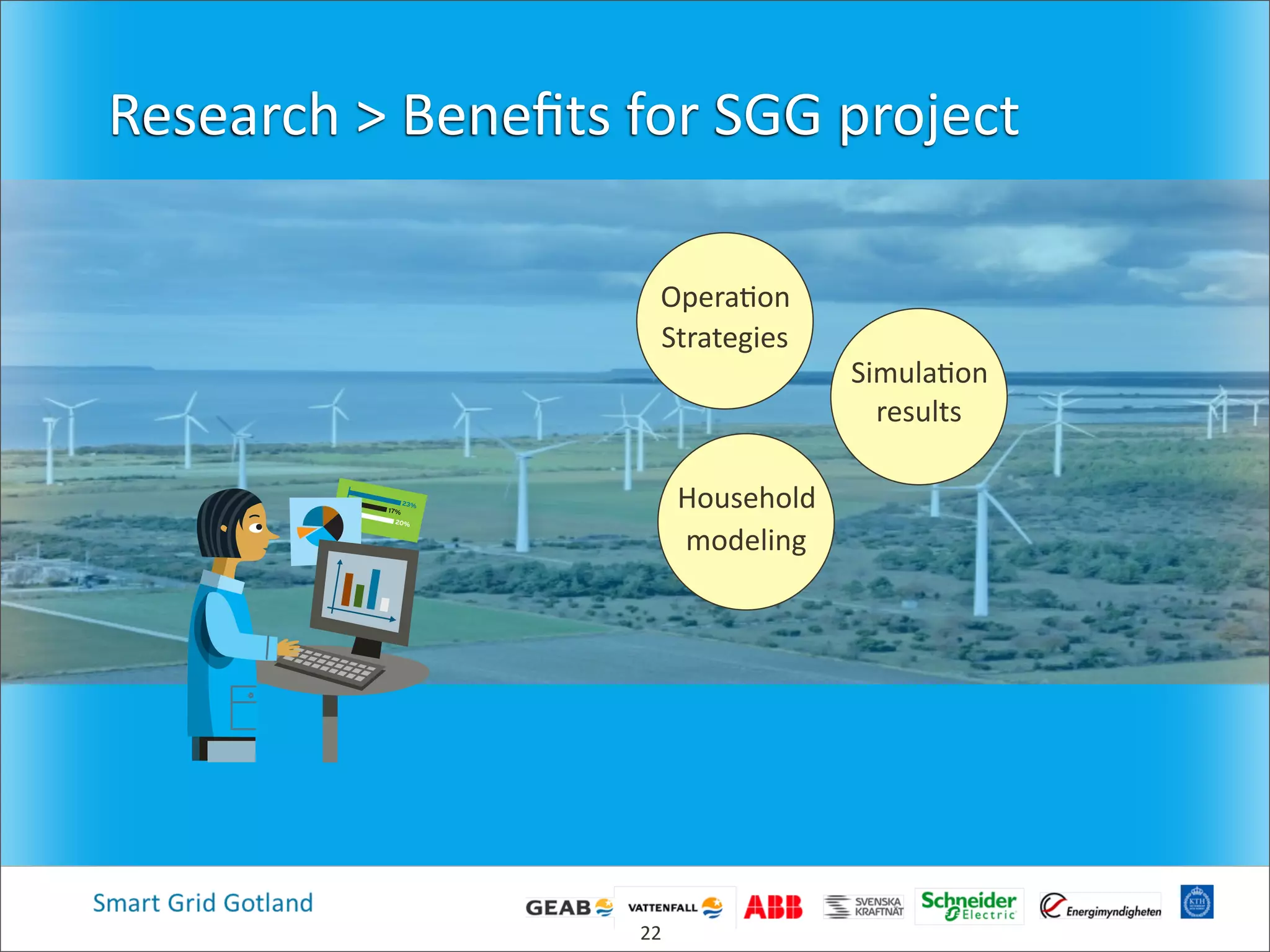
Research  >  Benefits  for  SGG  project
22
17%
20%
23%
Opera4on  
Strategies
Simula4on  
results
Household  
modeling
Research  >  From  Model  to  Reality?
23
17%
20%
23%
Ongoing  collabora4on  with  VENTYX  on  
development  &  implementa4on
Smart  Grid  Gotland
Thank  you  for  your  acen4on
Daniel  A.  Brodén,  +46  762185980
daniel.broden1@vacenfall.com
24

Smart Grid Gotland - Wind Power Integration

  • 1.
    Smart  Grid  Gotland Smart Grid  Gotland  -­‐  Wind  Power  Integra4on Reference  Group  Mee4ng,  Visby,  5th  March  2014,  Daniel  A.  Brodén
  • 2.
    SGG  >  Wind Power  Integra4on Power quality with distributed generation Smart SCADA Smart Meters Energy storage Market installations Information and Communication Technology (ICT) Wind power integration Market test Smart substations and rural grid 2
  • 3.
    Situa4on  on  Gotland -­‐ Wind  power  capacity  ~170  MW -­‐  Max  grid  capacity  195  MW -­‐  HVDC  capacity    2x130  MW -­‐  ~21,000  detached  houses -­‐  3  major  industries HVDC  cables 3 ~170 MW wind power
  • 4.
    Situa4on  on  Gotland 2012 Produc4on  &  Consump4on HVDC  cables 170  MW  installed  capacity195  MW  installed  capacity 70  MW  export 90  MW  export 195 MW wind power 4
  • 5.
    Situa4on  on  Gotland HVDC cables +5  MW   2012  Produc4on  &  Consump4on 200  MW  installed  capacity 95  MW  export However,  the  risk  s4ll  exists! Max  prod  -­‐  Min  cons  =   200  -­‐  65  =  135   135  MW  >  130  MW! 2012  was  risk  free! 5 200 MW wind power
  • 6.
    Situa4on  on  Gotland Demand-­‐Response HVDC cables +5  MW   Demand-­‐Response Demand-­‐Response  can  help   increase  the  hos4ng  capacity  of   wind  power  on  Gotland  and   solve  conges4on  problems  in   the  network Demand-­‐Response  Management  System  (DRMS) 200 MW wind power 6
  • 7.
    Gotland  Challenges Produc4on Prognosis  on   Short-­‐Term  (hour-­‐ahead) Produc4on  Prognosis  on   Long-­‐Term  (day-­‐ahead) Actual Prognosis Uncertainty  in  produc4on  prognosis  makes   it  difficult  to  rely  on  Demand-­‐Response  for   conges4on  management 7
  • 8.
    Research Is  it  technically feasible  to  balance  5  MW   addi4onal  wind  power  capacity  in  the   exis4ng  distribu4on  network  with  an   Ancillary  Service  Toolbox? 8
  • 9.
    Data  Inputs  (2012) Research >  AS  Toolbox Wind  data Load  data Network  Simulator Flexibility  tools Long-­‐Term  DR Short-­‐Term  DR Bacery Wind  Curtail. 9
  • 10.
    Research  >  Forming Clusters HVDC  cables The  cluster  op4miza4on  is  executed   sequen4ally  where  the  ST  cluster  minimizes   the  prognosis  errors  from  the  LT  cluster Long-­‐Term  Cluster Op4mized   consump4on  schedule   set  24  hours  ahead Op4mized  consump4on   schedule  set  hourly +5  MW   Short-­‐Term  Cluster 10 Prod Cons Peak hours Load shift Prod Cons Load shift LT  prognosis Peak hours ST+LT  prognosis 200 MW wind power
  • 11.
    Research  >  Forming Clusters HVDC  cables Long-­‐Term  Cluster Short-­‐Term  Cluster +5  MW   Bacery  Energy  Storage  System Absorbs  the  prognosis  errors   from  the  ST  cluster.   11 200 MW wind power
  • 12.
    Research  >  Detached House  Model 12 Mathema4cal  Modeling Domes4c  hot  waterSpace  hea4ng 75  %  of  all  electricity  in  a  detached   house  is  consumed  by  space  hea4ng   and  domes4c  hot  water Consump4on  es4mates  of   detached  houses
  • 13.
    Research  >  Detached House  Model Consump4on  Model  based  on   “Forecasting household consumer electricity load profiles with a combined physical and behavioral approach” by Claes Sandels, ICS, KTH Model  validated  with  the   consump4on  of  41  Swedish   residents  living  in  detached  houses 13
  • 14.
    Research  >  Industry Model 4me  (h)12 24 MWh 2.8 14 Industrial  consump4on  shares  Cementa  (86%),  Nordkalk  (6%  ) Arla  (5%),  Others  (3%) A  poten4al  DR  ac4vity  for   Cementa  modeled Addi4onal  produc4on   ac4vity  during  weekdays   &  dayshijs
  • 15.
    Research  >  Simula4on Setup 17% 20% 23% -­‐  3  day  periods  simulated   -­‐  Considering  seasonal  varia4on -­‐  2012  data  in  hourly  granularity -­‐  Data  adjusted  to  provoke  export  problem 15
  • 16.
    Required  cluster   size (w/o  Cementa) x  1900 x  1600  (LT) x  300  (ST) Research  >  Results  &  Findings Total power to balance per day and scenario 0,00 5,00 10,00 15,00 20,00 25,00 30,00 35,00 40,00 Scenario 1: Winter days Scenario 2:Spring days Scenario 3: Summer days Scenario 4: Autumn days Scenarios Power[MW] day 1 day 2 day 3 Total number of hourly export problems per day and scenario 6 7 8 Scenario 1: Winter Scenario 2: Spring Scenario 3: Summer Scenario 4: Autumn 17% 20% 23% 16 The  minimum  number  of  par4cipants  required  to   solve  all  export  problems  for  all  scenarios 1300 1500 1700 1100 1000 900 900 1000 1500 1000 900 1700 Minimum   cluster  size/day h
  • 17.
    0 12 2436 48 60 72 16 Time [hours] Indoor  temperature Less  than  +/-­‐  1°C   varia4on  for  all   seasonal  scenarios.   Comfort  level  is  kept! Research  >  Results  &  Findings 17% 20% 23% 17 0 12 24 36 48 60 72 16 17 18 19 20 21 22 23 24 25 Time [hours] Temperature[degeesC] Indoor temperature change for a LT household participant Winter Spring Summer Autumn
  • 18.
    0 12 2436 48 60 72 16 Time [hours] Tank  temperature Varia4ons  are   within  the   boundaries   for  all  scenarios.   Comfort  level  is  kept! Research  >  Results  &  Findings 18 Autumn Summer Spring Winter Tank temperature change for LT household participant Tanktemperature[degeesC] Time [hours] 0 12 24 36 48 60 72 40 50 60 70 80 90 100 110 120 130 Figure 12: 17% 20% 23%
  • 19.
    BESS  opera4on (winter  scenario) No wind  curtailment   needed  in  this   scenario Research  >  Results  &  Findings 17% 20% 23% 19 Max BESS capacity Wind curtailment BESS level Power[kW] Time [hours] 0 12 24 36 48 60 72 0 50 100 150 200 250 300 h BESS  charges  to  account  for  prognosis  errors  not   accounted  by  the  DR  par4cipants
  • 20.
    Industry   par4cipa4on The  modeled DR   ac4vity  for  Cementa   significantly  reduced   cluster  size! Research  >  Results  &  Findings 17% 20% 23% -­‐700 +100 20 -­‐700 DR  dynamics  changes  when  cluster  size   is  reduced.  This  explains  the  increase  on   Saturday  when  Cementa  is  no  longer   par4cipa4ng
  • 21.
    Research  >  Validity   &  Reliability? 21 -­‐  Worst  case  condi4ons  reflected -­‐  Uniform  household  consump4on  model -­‐  DR  par4cipant  can  not  override  the  consump4on -­‐  Network  simulator  not  included  in  study -­‐  Implementa4on  difficul4es  not  considered -­‐  Economical  constraints  not  considered17% 20% 23%
  • 22.
    Research  >  Benefits for  SGG  project 22 17% 20% 23% Opera4on   Strategies Simula4on   results Household   modeling
  • 23.
    Research  >  From Model  to  Reality? 23 17% 20% 23% Ongoing  collabora4on  with  VENTYX  on   development  &  implementa4on
  • 24.
    Smart  Grid  Gotland Thank you  for  your  acen4on Daniel  A.  Brodén,  +46  762185980 daniel.broden1@vacenfall.com 24