Presented by Group 6
Political
Actors
Agenda of Presentation
1. Political Parties
2. Party Functions
3. Party Systems
4. Kinds of Parties
5. Left-wing and
Right- wing Parties
6. Forming parties
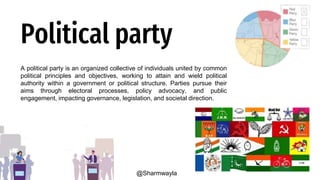
Political party
A political party is an organized collective of individuals united by common
political principles and objectives, working to attain and wield political
authority within a government or political structure. Parties pursue their
aims through electoral processes, policy advocacy, and public
engagement, impacting governance, legislation, and societal direction.
@Sharmwayla
Historical Evolution of Political Parties
1. Ancient Origins
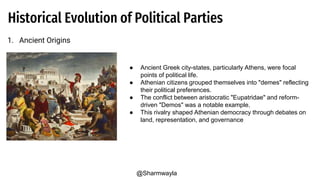
● Ancient Greek city-states, particularly Athens, were focal
points of political life.
● Athenian citizens grouped themselves into "demes" reflecting
their political preferences.
● The conflict between aristocratic "Eupatridae" and reform-
driven "Demos" was a notable example.
● This rivalry shaped Athenian democracy through debates on
land, representation, and governance
@Sharmwayla
Historical Evolution of Political Parties
2. Factions and Political Influence in Ancient Rome:
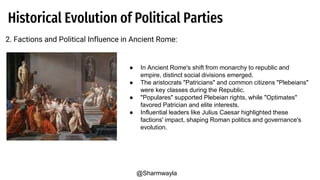
● In Ancient Rome's shift from monarchy to republic and
empire, distinct social divisions emerged.
● The aristocrats "Patricians" and common citizens "Plebeians"
were key classes during the Republic.
● "Populares" supported Plebeian rights, while "Optimates"
favored Patrician and elite interests.
● Influential leaders like Julius Caesar highlighted these
factions' impact, shaping Roman politics and governance's
evolution.
@Sharmwayla
Modern Foundations
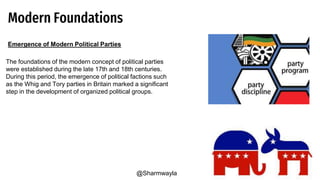
Emergence of Modern Political Parties
The foundations of the modern concept of political parties
were established during the late 17th and 18th centuries.
During this period, the emergence of political factions such
as the Whig and Tory parties in Britain marked a significant
step in the development of organized political groups.
@Sharmwayla
Whig Party's Emergence and Influence
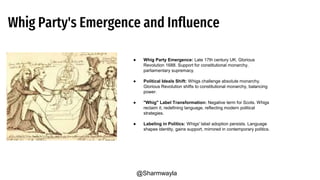
● Whig Party Emergence: Late 17th century UK. Glorious
Revolution 1688. Support for constitutional monarchy,
parliamentary supremacy.
● Political Ideals Shift: Whigs challenge absolute monarchy.
Glorious Revolution shifts to constitutional monarchy, balancing
power.

● "Whig" Label Transformation: Negative term for Scots. Whigs
reclaim it, redefining language, reflecting modern political
strategies.
● Labeling in Politics: Whigs' label adoption persists. Language
shapes identity, gains support, mirrored in contemporary politics.
@Sharmwayla
POLITICAL PARTY SYSTEMS
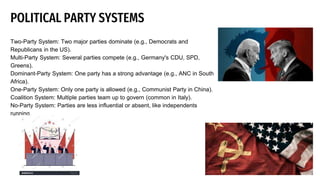
Two-Party System: Two major parties dominate (e.g., Democrats and
Republicans in the US).
Multi-Party System: Several parties compete (e.g., Germany's CDU, SPD,
Greens).
Dominant-Party System: One party has a strong advantage (e.g., ANC in South
Africa).
One-Party System: Only one party is allowed (e.g., Communist Party in China).
Coalition System: Multiple parties team up to govern (common in Italy).
No-Party System: Parties are less influential or absent, like independents
running.
Party Functions
● Bring people together to achieve control of the government
● Develop policies favorable to their interests or the groups that support them
● Organize and persuade voters to elect their candidates to office
● The basic purpose of political parties is to nominate candidates for public
office and to get as many of them elected as possible
@Thelmontheint
Representing groups of interests
● The people represented by elected officials are called constituents
● Constituents make their concerns known to their representatives
● Political parties represent groups as well as individuals
● These interest groups have special concerns
Competitive elections
● Members of the political parties choose their candidates who fight for them in
elections
● Candidates are selected either by all party members or only by top party
officials.
@Thelmontheint
Simplifying choices
● The two main political parties in the United States appeal to as many different
groups as possible
● Stating their goals in a general way so that voters are attracted to a broad
philosophy without necessarily focusing on every specific issue
Making policy
● not policy making organizations
● When in power, a party attempts to put its philosophy into practice through
legislation
@Thelmontheint
Party Systems
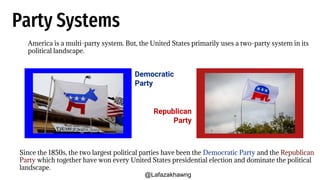
America is a multi-party system. But, the United States primarily uses a two-party system in its
political landscape.
Since the 1850s, the two largest political parties have been the Democratic Party and the Republican
Party which together have won every United States presidential election and dominate the political
landscape.
Democratic
Party
Republican
Party
@Lafazakhawng
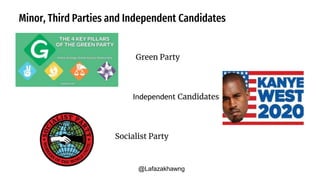
Minor, Third Parties and Independent Candidates
Green Party
Independent Candidates
Socialist Party
@Lafazakhawng
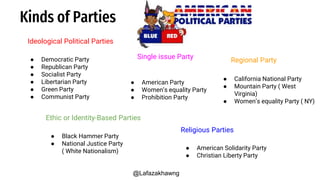
Kinds of Parties
@Lafazakhawng
Ideological Political Parties
● Democratic Party
● Republican Party
● Socialist Party
● Libertarian Party
● Green Party
● Communist Party
Single issue Party
● American Party
● Women’s equality Party
● Prohibition Party
Regional Party
● California National Party
● Mountain Party ( West
Virginia)
● Women’s equality Party ( NY)
Ethic or Identity-Based Parties
● Black Hammer Party
● National Justice Party
( White Nationalism)
Religious Parties
● American Solidarity Party
● Christian Liberty Party
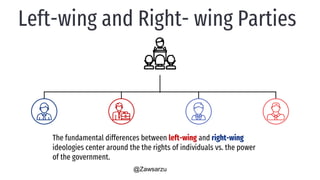
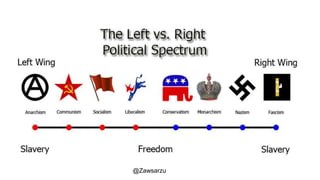
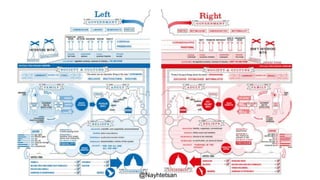
Left-wing and Right- wing Parties
The fundamental differences between left-wing and right-wing
ideologies center around the the rights of individuals vs. the power
of the government.
@Zawsarzu
@Zawsarzu
Left-Wing Parties
Left-wing parties are political groups
that generally advocate for social
equality, economic intervention by
the government, and progressive
social policies. They are often
associated with the following key
principles and policy positions:
@Zawsarzu
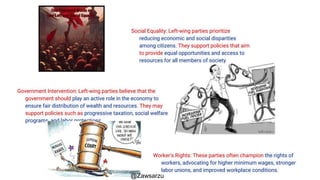
Social Equality: Left-wing parties prioritize
reducing economic and social disparities
among citizens. They support policies that aim
to provide equal opportunities and access to
resources for all members of society
Government Intervention: Left-wing parties believe that the
government should play an active role in the economy to
ensure fair distribution of wealth and resources. They may
support policies such as progressive taxation, social welfare
programs, and labor protections.
Worker's Rights: These parties often champion the rights of
workers, advocating for higher minimum wages, stronger
labor unions, and improved workplace conditions.
@Zawsarzu
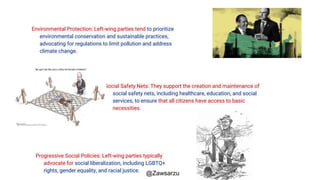
Environmental Protection: Left-wing parties tend to prioritize
environmental conservation and sustainable practices,
advocating for regulations to limit pollution and address
climate change.
Social Safety Nets: They support the creation and maintenance of
social safety nets, including healthcare, education, and social
services, to ensure that all citizens have access to basic
necessities.
Progressive Social Policies: Left-wing parties typically
advocate for social liberalization, including LGBTQ+
rights, gender equality, and racial justice.
@Zawsarzu
Right-Wing Parties
Right-wing parties are political groups
that generally emphasize individualism,
limited government intervention, and
traditional values. They are often
associated with the following key
principles and policy positions:
@Zawsarzu
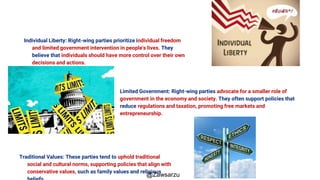
Individual Liberty: Right-wing parties prioritize individual freedom
and limited government intervention in people's lives. They
believe that individuals should have more control over their own
decisions and actions.
Limited Government: Right-wing parties advocate for a smaller role of
government in the economy and society. They often support policies that
reduce regulations and taxation, promoting free markets and
entrepreneurship.
Traditional Values: These parties tend to uphold traditional
social and cultural norms, supporting policies that align with
conservative values, such as family values and religious
@Zawsarzu
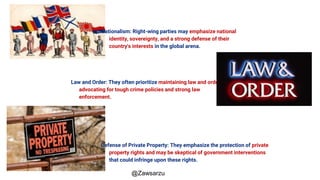
Nationalism: Right-wing parties may emphasize national
identity, sovereignty, and a strong defense of their
country's interests in the global arena.
Law and Order: They often prioritize maintaining law and order,
advocating for tough crime policies and strong law
enforcement.
Defense of Private Property: They emphasize the protection of private
property rights and may be skeptical of government interventions
that could infringe upon these rights.
@Zawsarzu
● The Continental
Congress adopted the
Articles of
Confederation, the first
constitution of the
United States, on
November 15, 1777
● But the states did not
ratify them until March
1, 1781.
● Nationalists, led by
James Madison,
George Washington,
Alexander Hamilton,
John Jay, and James
Wilson
Forming Parties
@Nayhtetsan
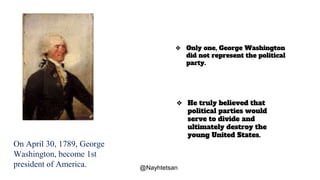
On April 30, 1789, George
Washington, become 1st
president of America.
❖ Only one, George Washington
did not represent the political
party.
❖ He truly believed that
political parties would
serve to divide and
ultimately destroy the
young United States.
@Nayhtetsan
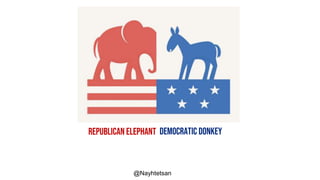
Democratic Donkey
Republican Elephant
@Nayhtetsan
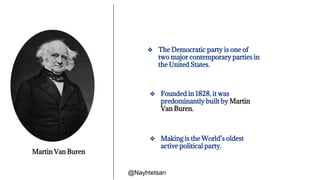
❖ The Democratic party is one of
two major contemporary parties in
the United States.
❖ Founded in 1828, it was
predominantly built by Martin
Van Buren.
❖ Making is the World’s oldest
active political party.
Martin Van Buren
@Nayhtetsan
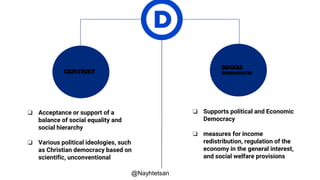
CENTRIST
SOCIAL
DEMOCRATIC
❏ Acceptance or support of a
balance of social equality and
social hierarchy
❏ Various political ideologies, such
as Christian democracy based on
scientific, unconventional
❏ Supports political and Economic
Democracy
❏ measures for income
redistribution, regulation of the
economy in the general interest,
and social welfare provisions
@Nayhtetsan
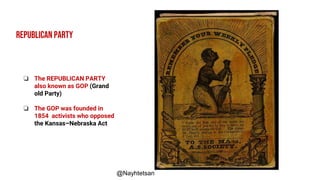
Republican party
❏ The REPUBLICAN PARTY
also known as GOP (Grand
old Party)
❏ The GOP was founded in
1854 activists who opposed
the Kansas–Nebraska Act
@Nayhtetsan
❖ The Republican Party's ideological
and historical predecessor is
considered to be Northern members
of the conservative Whig Party and
based on Conservatism.
❖ Conservatism is a cultural, social,
and political philosophy that seeks
to promote and to preserve
traditional institutions, practices,
and values
@Nayhtetsan
@Nayhtetsan
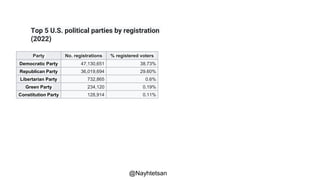
Party No. registrations % registered voters
Democratic Party 47,130,651 38.73%
Republican Party 36,019,694 29.60%
Libertarian Party 732,865 0.6%
Green Party 234,120 0.19%
Constitution Party 128,914 0.11%
Top 5 U.S. political parties by registration
(2022)
@Nayhtetsan
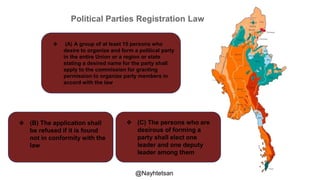
Political Parties Registration Law
❖ (A) A group of at least 15 persons who
desire to organize and form a political party
in the entire Union or a region or state
stating a desired name for the party shall
apply to the commission for granting
permission to organize party members in
accord with the law
❖ (B) The application shall
be refused if it is found
not in conformity with the
law
❖ (C) The persons who are
desirous of forming a
party shall elect one
leader and one deputy
leader among them
@Nayhtetsan
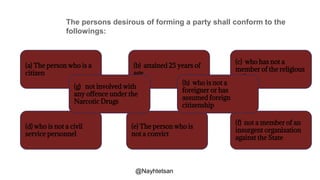
The persons desirous of forming a party shall conform to the
followings:
(a) The person who is a
citizen
(b) attained 25 years of
age
(e) The person who is
not a convict
(d) who is not a civil
service personnel
(f) not a member of an
insurgent organization
against the State
(c) who has not a
member of the religious
order
(g) not involved with
any offence under the
Narcotic Drugs
(h) who is not a
foreigner or has
assumed foreign
citizenship
@Nayhtetsan
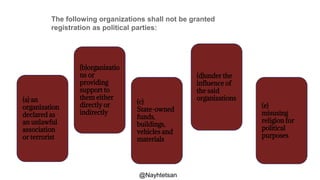
The following organizations shall not be granted
registration as political parties:
(a) an
organization
declared as
an unlawful
association
or terrorist
(b)organizatio
ns or
providing
support to
them either
directly or
indirectly
(c)
State-owned
funds,
buildings,
vehicles and
materials
(d)under the
influence of
the said
organizations
(e)
misusing
religion for
political
purposes
@Nayhtetsan
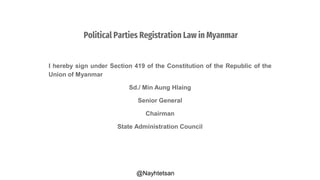
Political Parties Registration Law in Myanmar
I hereby sign under Section 419 of the Constitution of the Republic of the
Union of Myanmar
Sd./ Min Aung Hlaing
Senior General
Chairman
State Administration Council
@Nayhtetsan
References:
1. The impact of COVID-19 on vulnerable populations. Frontiers. (n.d.). https://www.frontiersin.org/research-
topics/30821/the-impact-of-covid-19-on-vulnerable-populations
2. Khan Academy. (n.d.). The Greek Polis (article) | classical Greece. Khan Academy.
https://www.khanacademy.org/humanities/world-history/ancient-medieval/classical-greece/a/the-greek-polis
3. Encyclopædia Britannica, inc. (2023, August 14). Political Party. Encyclopædia Britannica.
https://www.britannica.com/topic/political-party
4. Encyclopædia Britannica, inc. (2023a, June 20). Whig Party. Encyclopædia Britannica.
https://www.britannica.com/topic/Whig-Party
5. Political parties : the Presidential Election process : elections : classroom materials at the Library of Congress
: library of Congress. The Library of Congress. (n.d.). https://www.loc.gov/classroom-
materials/elections/presidential-election-process/political-parties
Thank you for your attention!
Don’t hesitate to ask if questions!

Politcal Actors

  • 1.
    Presented by Group6 Political Actors
  • 2.
    Agenda of Presentation 1.Political Parties 2. Party Functions 3. Party Systems 4. Kinds of Parties 5. Left-wing and Right- wing Parties 6. Forming parties
  • 3.
    Political party A politicalparty is an organized collective of individuals united by common political principles and objectives, working to attain and wield political authority within a government or political structure. Parties pursue their aims through electoral processes, policy advocacy, and public engagement, impacting governance, legislation, and societal direction. @Sharmwayla
  • 4.
    Historical Evolution ofPolitical Parties 1. Ancient Origins ● Ancient Greek city-states, particularly Athens, were focal points of political life. ● Athenian citizens grouped themselves into "demes" reflecting their political preferences. ● The conflict between aristocratic "Eupatridae" and reform- driven "Demos" was a notable example. ● This rivalry shaped Athenian democracy through debates on land, representation, and governance @Sharmwayla
  • 5.
    Historical Evolution ofPolitical Parties 2. Factions and Political Influence in Ancient Rome: ● In Ancient Rome's shift from monarchy to republic and empire, distinct social divisions emerged. ● The aristocrats "Patricians" and common citizens "Plebeians" were key classes during the Republic. ● "Populares" supported Plebeian rights, while "Optimates" favored Patrician and elite interests. ● Influential leaders like Julius Caesar highlighted these factions' impact, shaping Roman politics and governance's evolution. @Sharmwayla
  • 6.
    Modern Foundations Emergence ofModern Political Parties The foundations of the modern concept of political parties were established during the late 17th and 18th centuries. During this period, the emergence of political factions such as the Whig and Tory parties in Britain marked a significant step in the development of organized political groups. @Sharmwayla
  • 7.
    Whig Party's Emergenceand Influence ● Whig Party Emergence: Late 17th century UK. Glorious Revolution 1688. Support for constitutional monarchy, parliamentary supremacy. ● Political Ideals Shift: Whigs challenge absolute monarchy. Glorious Revolution shifts to constitutional monarchy, balancing power. ● "Whig" Label Transformation: Negative term for Scots. Whigs reclaim it, redefining language, reflecting modern political strategies. ● Labeling in Politics: Whigs' label adoption persists. Language shapes identity, gains support, mirrored in contemporary politics. @Sharmwayla
  • 8.
    POLITICAL PARTY SYSTEMS Two-PartySystem: Two major parties dominate (e.g., Democrats and Republicans in the US). Multi-Party System: Several parties compete (e.g., Germany's CDU, SPD, Greens). Dominant-Party System: One party has a strong advantage (e.g., ANC in South Africa). One-Party System: Only one party is allowed (e.g., Communist Party in China). Coalition System: Multiple parties team up to govern (common in Italy). No-Party System: Parties are less influential or absent, like independents running.
  • 9.
    Party Functions ● Bringpeople together to achieve control of the government ● Develop policies favorable to their interests or the groups that support them ● Organize and persuade voters to elect their candidates to office ● The basic purpose of political parties is to nominate candidates for public office and to get as many of them elected as possible @Thelmontheint
  • 10.
    Representing groups ofinterests ● The people represented by elected officials are called constituents ● Constituents make their concerns known to their representatives ● Political parties represent groups as well as individuals ● These interest groups have special concerns Competitive elections ● Members of the political parties choose their candidates who fight for them in elections ● Candidates are selected either by all party members or only by top party officials. @Thelmontheint
  • 11.
    Simplifying choices ● Thetwo main political parties in the United States appeal to as many different groups as possible ● Stating their goals in a general way so that voters are attracted to a broad philosophy without necessarily focusing on every specific issue Making policy ● not policy making organizations ● When in power, a party attempts to put its philosophy into practice through legislation @Thelmontheint
  • 12.
    Party Systems America isa multi-party system. But, the United States primarily uses a two-party system in its political landscape. Since the 1850s, the two largest political parties have been the Democratic Party and the Republican Party which together have won every United States presidential election and dominate the political landscape. Democratic Party Republican Party @Lafazakhawng
  • 13.
    Minor, Third Partiesand Independent Candidates Green Party Independent Candidates Socialist Party @Lafazakhawng
  • 14.
    Kinds of Parties @Lafazakhawng IdeologicalPolitical Parties ● Democratic Party ● Republican Party ● Socialist Party ● Libertarian Party ● Green Party ● Communist Party Single issue Party ● American Party ● Women’s equality Party ● Prohibition Party Regional Party ● California National Party ● Mountain Party ( West Virginia) ● Women’s equality Party ( NY) Ethic or Identity-Based Parties ● Black Hammer Party ● National Justice Party ( White Nationalism) Religious Parties ● American Solidarity Party ● Christian Liberty Party
  • 15.
    Left-wing and Right-wing Parties The fundamental differences between left-wing and right-wing ideologies center around the the rights of individuals vs. the power of the government. @Zawsarzu
  • 16.
  • 17.
    Left-Wing Parties Left-wing partiesare political groups that generally advocate for social equality, economic intervention by the government, and progressive social policies. They are often associated with the following key principles and policy positions: @Zawsarzu
  • 18.
    Social Equality: Left-wingparties prioritize reducing economic and social disparities among citizens. They support policies that aim to provide equal opportunities and access to resources for all members of society Government Intervention: Left-wing parties believe that the government should play an active role in the economy to ensure fair distribution of wealth and resources. They may support policies such as progressive taxation, social welfare programs, and labor protections. Worker's Rights: These parties often champion the rights of workers, advocating for higher minimum wages, stronger labor unions, and improved workplace conditions. @Zawsarzu
  • 19.
    Environmental Protection: Left-wingparties tend to prioritize environmental conservation and sustainable practices, advocating for regulations to limit pollution and address climate change. Social Safety Nets: They support the creation and maintenance of social safety nets, including healthcare, education, and social services, to ensure that all citizens have access to basic necessities. Progressive Social Policies: Left-wing parties typically advocate for social liberalization, including LGBTQ+ rights, gender equality, and racial justice. @Zawsarzu
  • 20.
    Right-Wing Parties Right-wing partiesare political groups that generally emphasize individualism, limited government intervention, and traditional values. They are often associated with the following key principles and policy positions: @Zawsarzu
  • 21.
    Individual Liberty: Right-wingparties prioritize individual freedom and limited government intervention in people's lives. They believe that individuals should have more control over their own decisions and actions. Limited Government: Right-wing parties advocate for a smaller role of government in the economy and society. They often support policies that reduce regulations and taxation, promoting free markets and entrepreneurship. Traditional Values: These parties tend to uphold traditional social and cultural norms, supporting policies that align with conservative values, such as family values and religious @Zawsarzu
  • 22.
    Nationalism: Right-wing partiesmay emphasize national identity, sovereignty, and a strong defense of their country's interests in the global arena. Law and Order: They often prioritize maintaining law and order, advocating for tough crime policies and strong law enforcement. Defense of Private Property: They emphasize the protection of private property rights and may be skeptical of government interventions that could infringe upon these rights. @Zawsarzu
  • 23.
    ● The Continental Congressadopted the Articles of Confederation, the first constitution of the United States, on November 15, 1777 ● But the states did not ratify them until March 1, 1781. ● Nationalists, led by James Madison, George Washington, Alexander Hamilton, John Jay, and James Wilson Forming Parties @Nayhtetsan
  • 24.
    On April 30,1789, George Washington, become 1st president of America. ❖ Only one, George Washington did not represent the political party. ❖ He truly believed that political parties would serve to divide and ultimately destroy the young United States. @Nayhtetsan
  • 25.
  • 26.
    ❖ The Democraticparty is one of two major contemporary parties in the United States. ❖ Founded in 1828, it was predominantly built by Martin Van Buren. ❖ Making is the World’s oldest active political party. Martin Van Buren @Nayhtetsan
  • 27.
    CENTRIST SOCIAL DEMOCRATIC ❏ Acceptance orsupport of a balance of social equality and social hierarchy ❏ Various political ideologies, such as Christian democracy based on scientific, unconventional ❏ Supports political and Economic Democracy ❏ measures for income redistribution, regulation of the economy in the general interest, and social welfare provisions @Nayhtetsan
  • 28.
    Republican party ❏ TheREPUBLICAN PARTY also known as GOP (Grand old Party) ❏ The GOP was founded in 1854 activists who opposed the Kansas–Nebraska Act @Nayhtetsan
  • 29.
    ❖ The RepublicanParty's ideological and historical predecessor is considered to be Northern members of the conservative Whig Party and based on Conservatism. ❖ Conservatism is a cultural, social, and political philosophy that seeks to promote and to preserve traditional institutions, practices, and values @Nayhtetsan
  • 30.
  • 31.
    Party No. registrations% registered voters Democratic Party 47,130,651 38.73% Republican Party 36,019,694 29.60% Libertarian Party 732,865 0.6% Green Party 234,120 0.19% Constitution Party 128,914 0.11% Top 5 U.S. political parties by registration (2022) @Nayhtetsan
  • 32.
    Political Parties RegistrationLaw ❖ (A) A group of at least 15 persons who desire to organize and form a political party in the entire Union or a region or state stating a desired name for the party shall apply to the commission for granting permission to organize party members in accord with the law ❖ (B) The application shall be refused if it is found not in conformity with the law ❖ (C) The persons who are desirous of forming a party shall elect one leader and one deputy leader among them @Nayhtetsan
  • 33.
    The persons desirousof forming a party shall conform to the followings: (a) The person who is a citizen (b) attained 25 years of age (e) The person who is not a convict (d) who is not a civil service personnel (f) not a member of an insurgent organization against the State (c) who has not a member of the religious order (g) not involved with any offence under the Narcotic Drugs (h) who is not a foreigner or has assumed foreign citizenship @Nayhtetsan
  • 34.
    The following organizationsshall not be granted registration as political parties: (a) an organization declared as an unlawful association or terrorist (b)organizatio ns or providing support to them either directly or indirectly (c) State-owned funds, buildings, vehicles and materials (d)under the influence of the said organizations (e) misusing religion for political purposes @Nayhtetsan
  • 35.
    Political Parties RegistrationLaw in Myanmar I hereby sign under Section 419 of the Constitution of the Republic of the Union of Myanmar Sd./ Min Aung Hlaing Senior General Chairman State Administration Council @Nayhtetsan
  • 36.
    References: 1. The impactof COVID-19 on vulnerable populations. Frontiers. (n.d.). https://www.frontiersin.org/research- topics/30821/the-impact-of-covid-19-on-vulnerable-populations 2. Khan Academy. (n.d.). The Greek Polis (article) | classical Greece. Khan Academy. https://www.khanacademy.org/humanities/world-history/ancient-medieval/classical-greece/a/the-greek-polis 3. Encyclopædia Britannica, inc. (2023, August 14). Political Party. Encyclopædia Britannica. https://www.britannica.com/topic/political-party 4. Encyclopædia Britannica, inc. (2023a, June 20). Whig Party. Encyclopædia Britannica. https://www.britannica.com/topic/Whig-Party 5. Political parties : the Presidential Election process : elections : classroom materials at the Library of Congress : library of Congress. The Library of Congress. (n.d.). https://www.loc.gov/classroom- materials/elections/presidential-election-process/political-parties
  • 37.
    Thank you foryour attention! Don’t hesitate to ask if questions!