Reflections on Trusting Trust for Go
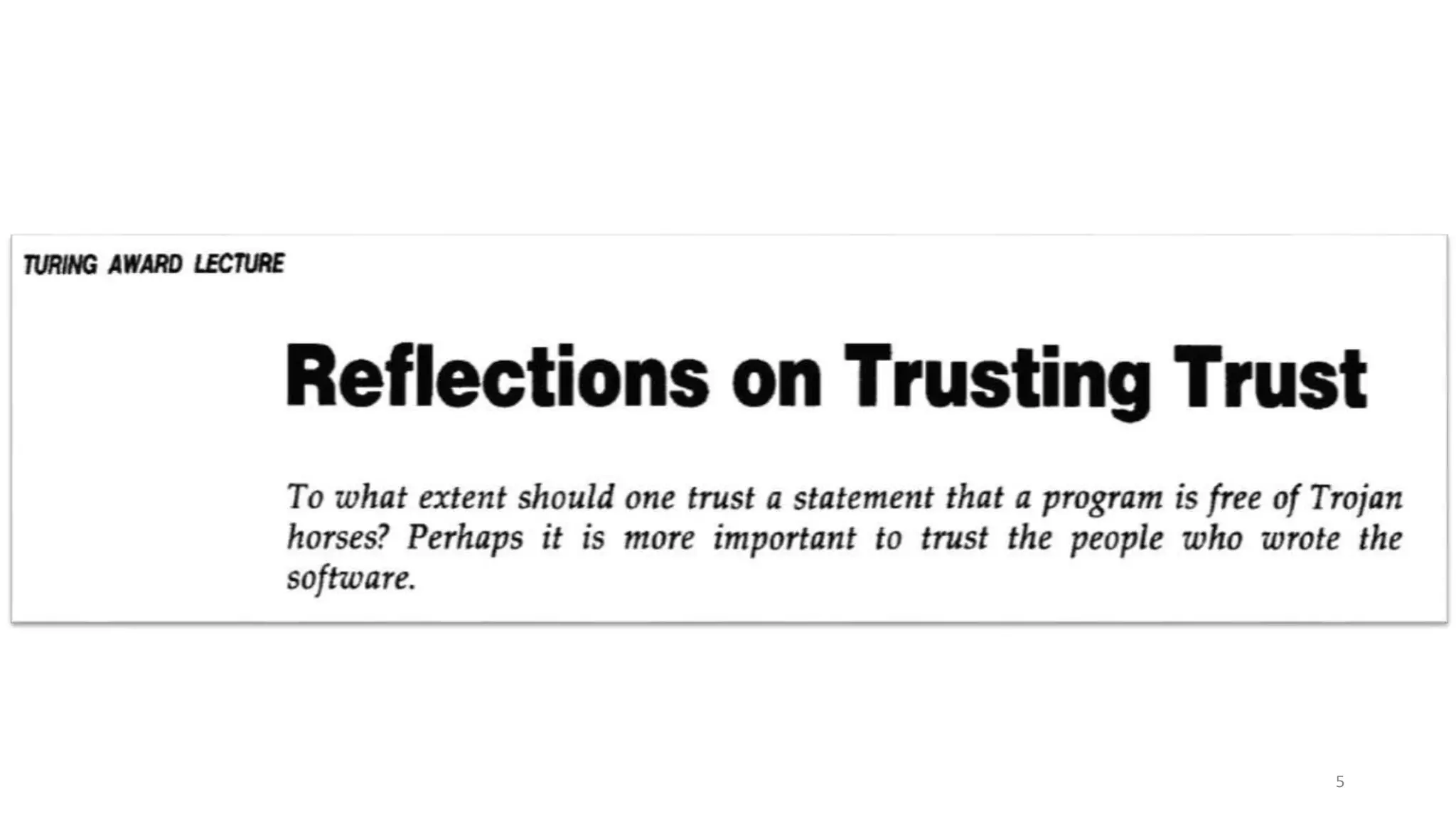
1. Turing Award Lecture (1984)
Given by: Ken Thompson
https://www.ece.cmu.edu/~ganger/712.fall02/papers/p761-thompson.pdf
2. Fully Countering Trust through Diverse Double Compiling (2009)
By: David A. Wheeler
http://www.dwheeler.com/trusting-trust/dissertation/wheeler-trusting-trust-ddc.pdf
1
GopherconSG (4 May 2018) By: Yeo Kheng Meng (yeokm1@gmail.com)
https://github.com/yeokm1/reflections-on-trusting-trust-go
2
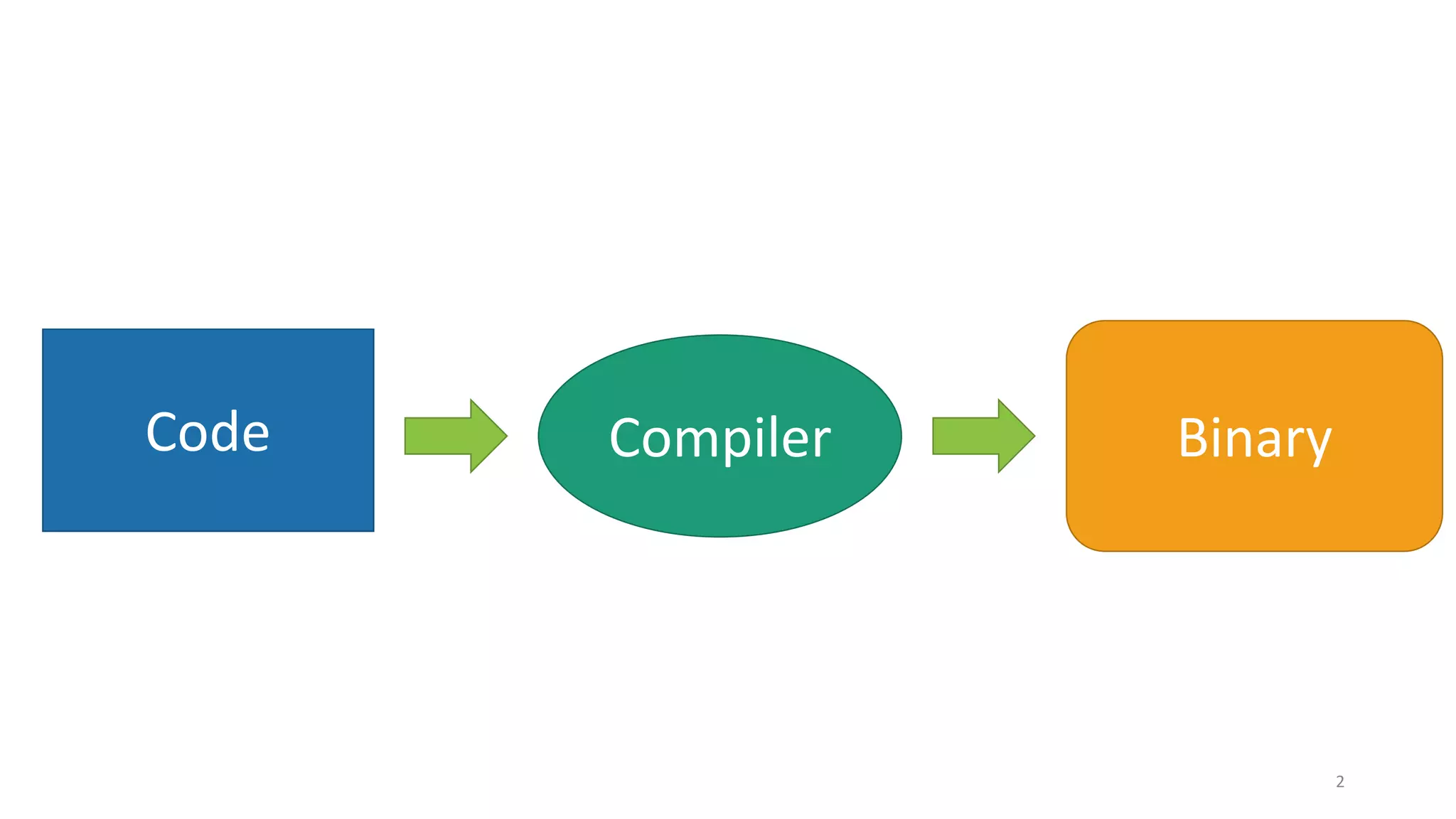
Compiler BinaryCode
Why Reflections on Trusting Trust?
3
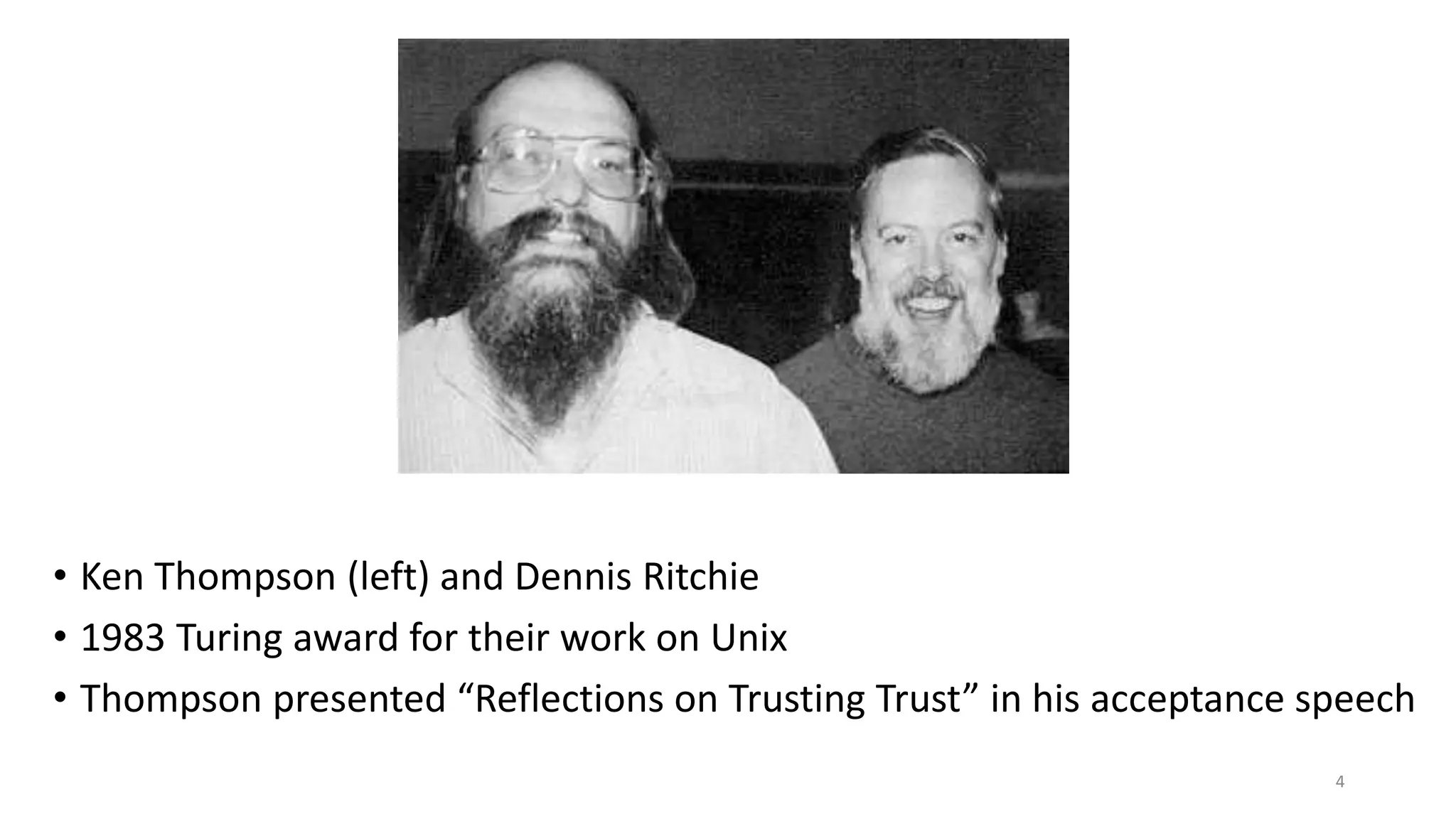
• Ken Thompson (left) and Dennis Ritchie
• 1983 Turing award for their work on Unix
• Thompson presented “Reflections on Trusting Trust” in his acceptance speech
4
5
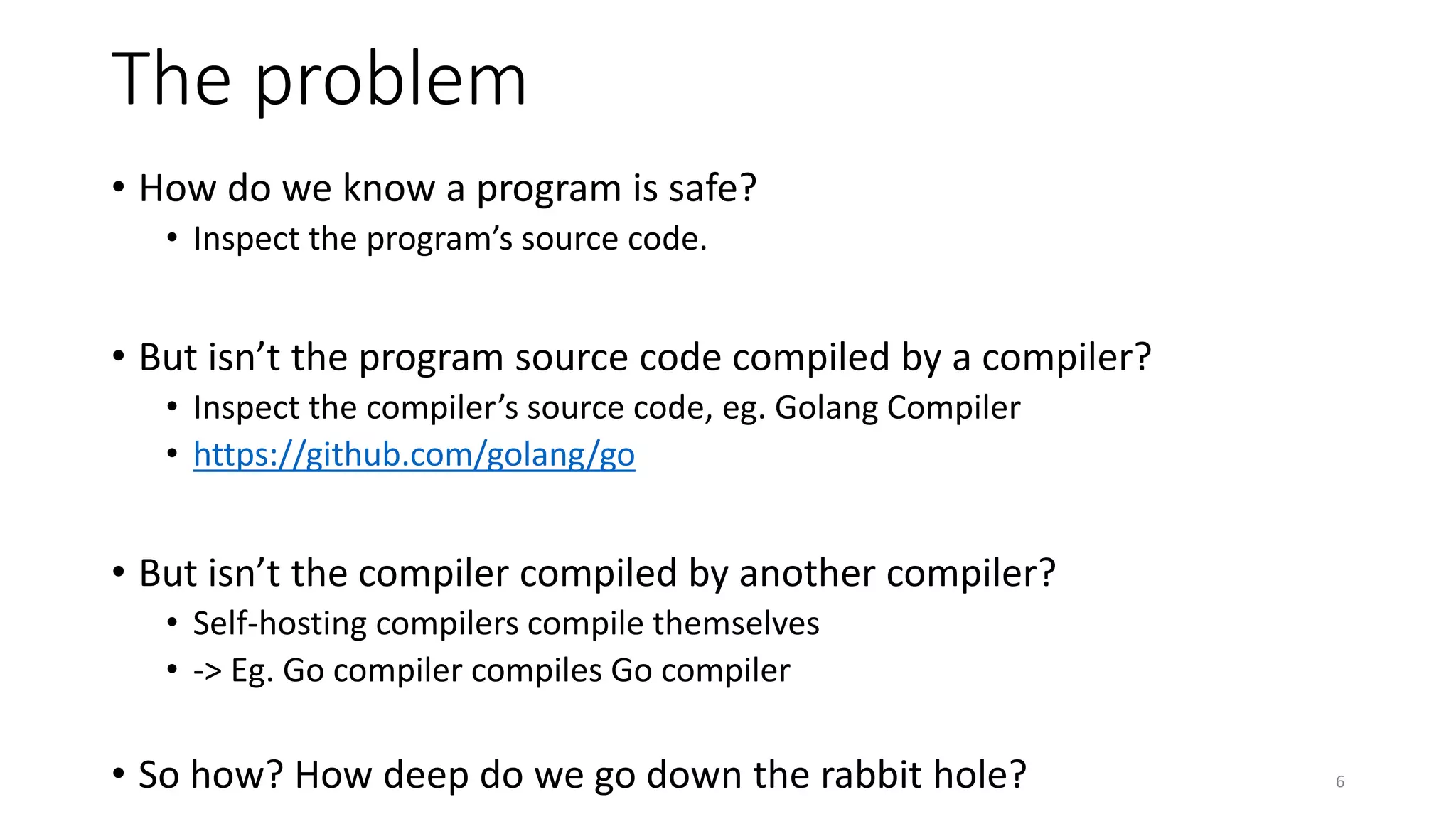
The problem
• How do we know a program is safe?
• Inspect the program’s source code.
• But isn’t the program source code compiled by a compiler?
• Inspect the compiler’s source code, eg. Golang Compiler
• https://github.com/golang/go
• But isn’t the compiler compiled by another compiler?
• Self-hosting compilers compile themselves
• -> Eg. Go compiler compiles Go compiler
• So how? How deep do we go down the rabbit hole? 6
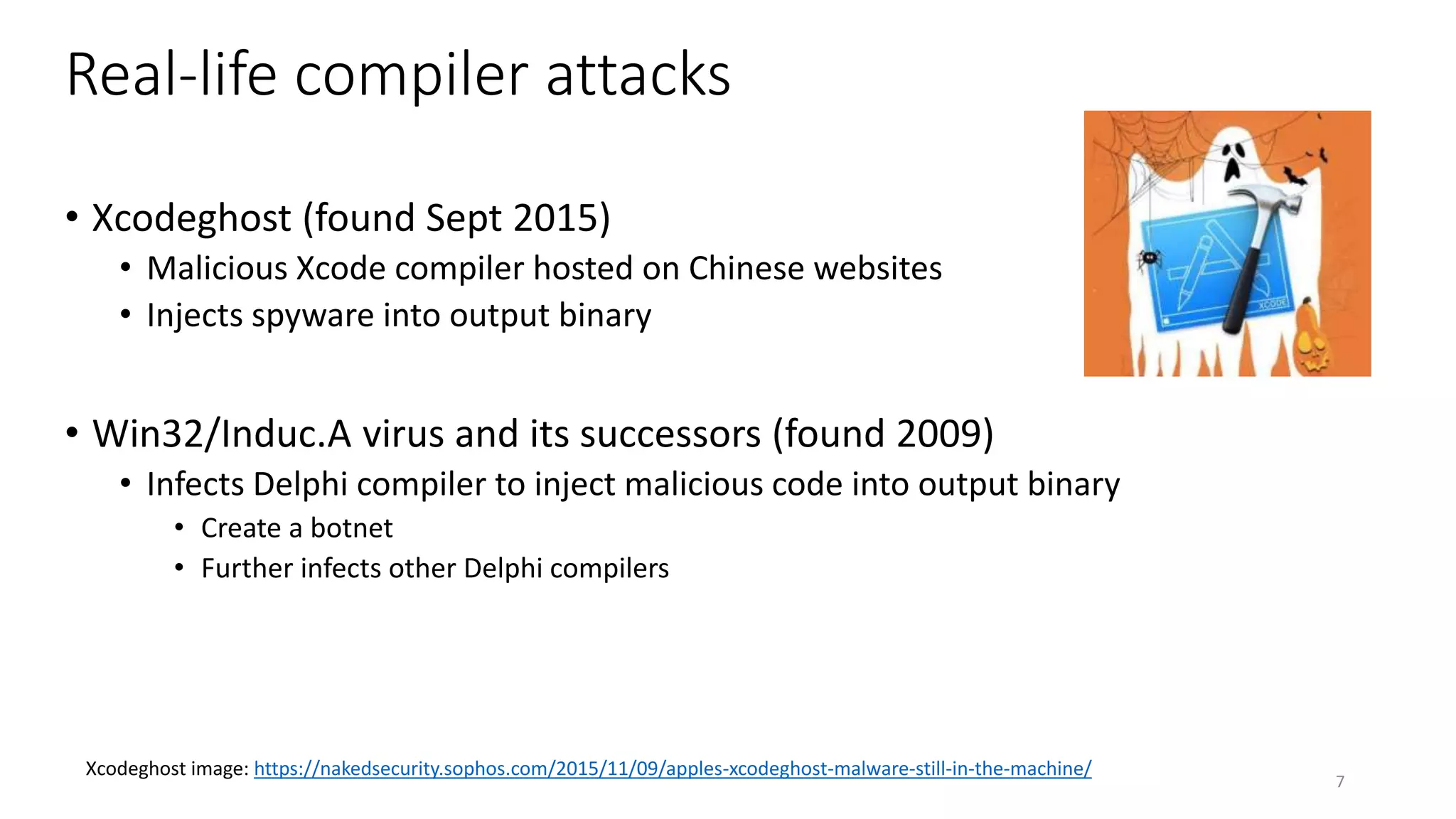
Real-life compiler attacks
• Xcodeghost (found Sept 2015)
• Malicious Xcode compiler hosted on Chinese websites
• Injects spyware into output binary
• Win32/Induc.A virus and its successors (found 2009)
• Infects Delphi compiler to inject malicious code into output binary
• Create a botnet
• Further infects other Delphi compilers
7
Xcodeghost image: https://nakedsecurity.sophos.com/2015/11/09/apples-xcodeghost-malware-still-in-the-machine/
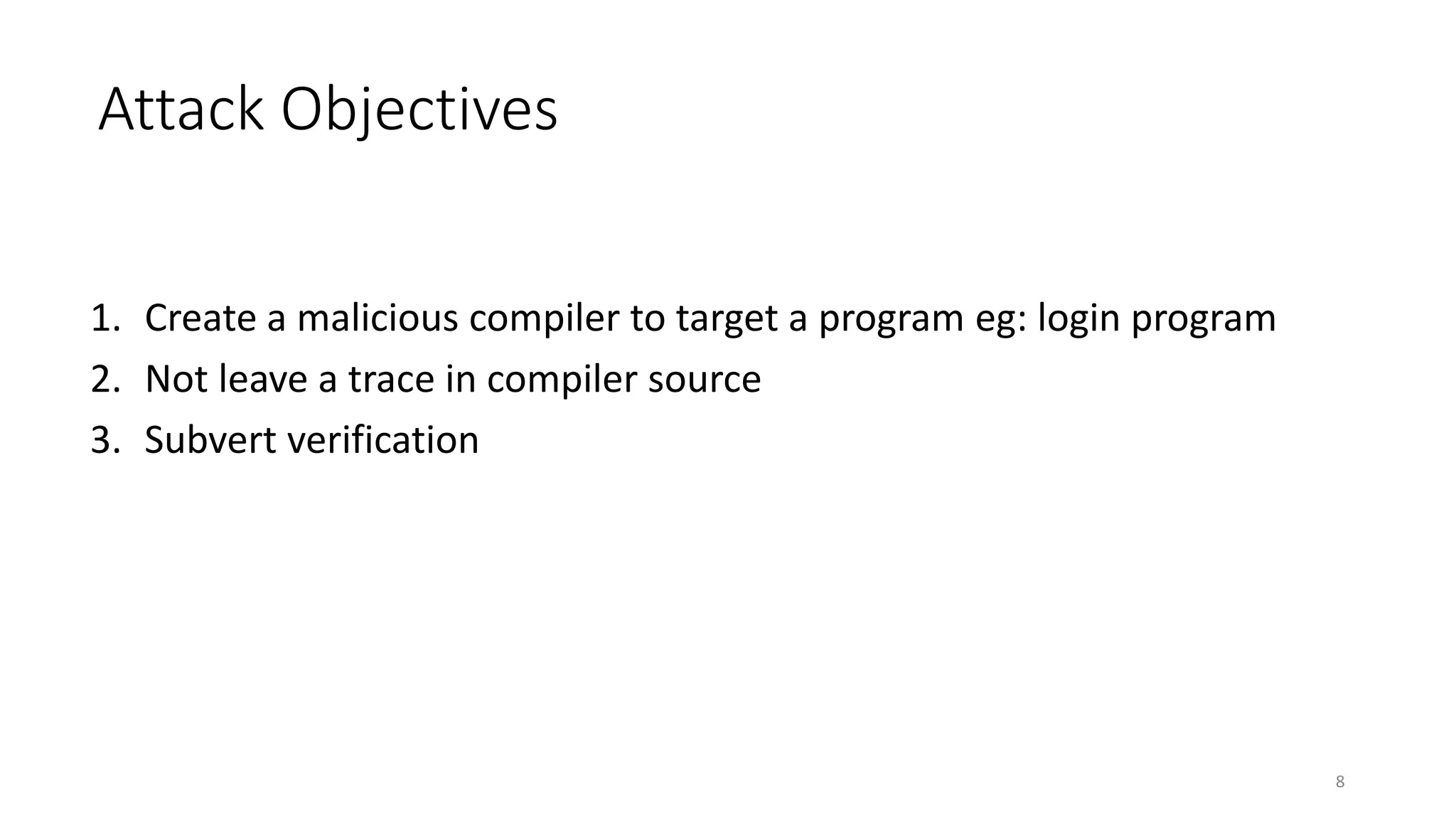
Attack Objectives
1. Create a malicious compiler to target a program eg: login program
2. Not leave a trace in compiler source
3. Subvert verification
8
Presentation Outline
1. Self-reproducing program (Quine)
2. Compiler knowledge propagation (Bootstrapping)
3. Attack on the login program
4. Initial Conclusion
5. Mitigation strategy?
9
Stage 1: Self-reproducing program (Quine)
A source program that when compiled and executed,
will produce as output an exact copy of its source.
10
Stage 2: Compiler knowledge propagation
•Pass knowledge down compiler iterations
11
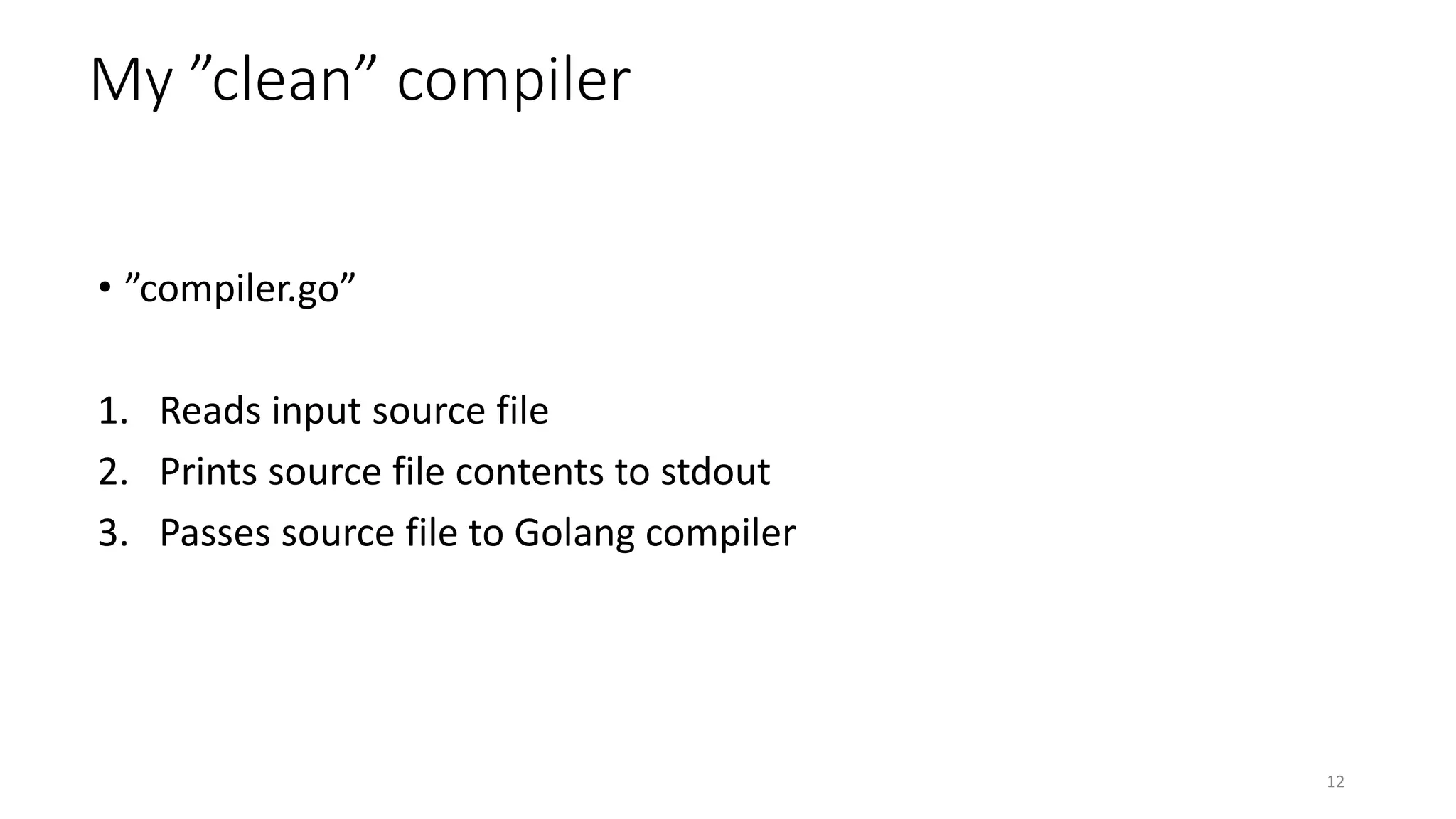
My ”clean” compiler
• ”compiler.go”
1. Reads input source file
2. Prints source file contents to stdout
3. Passes source file to Golang compiler
12
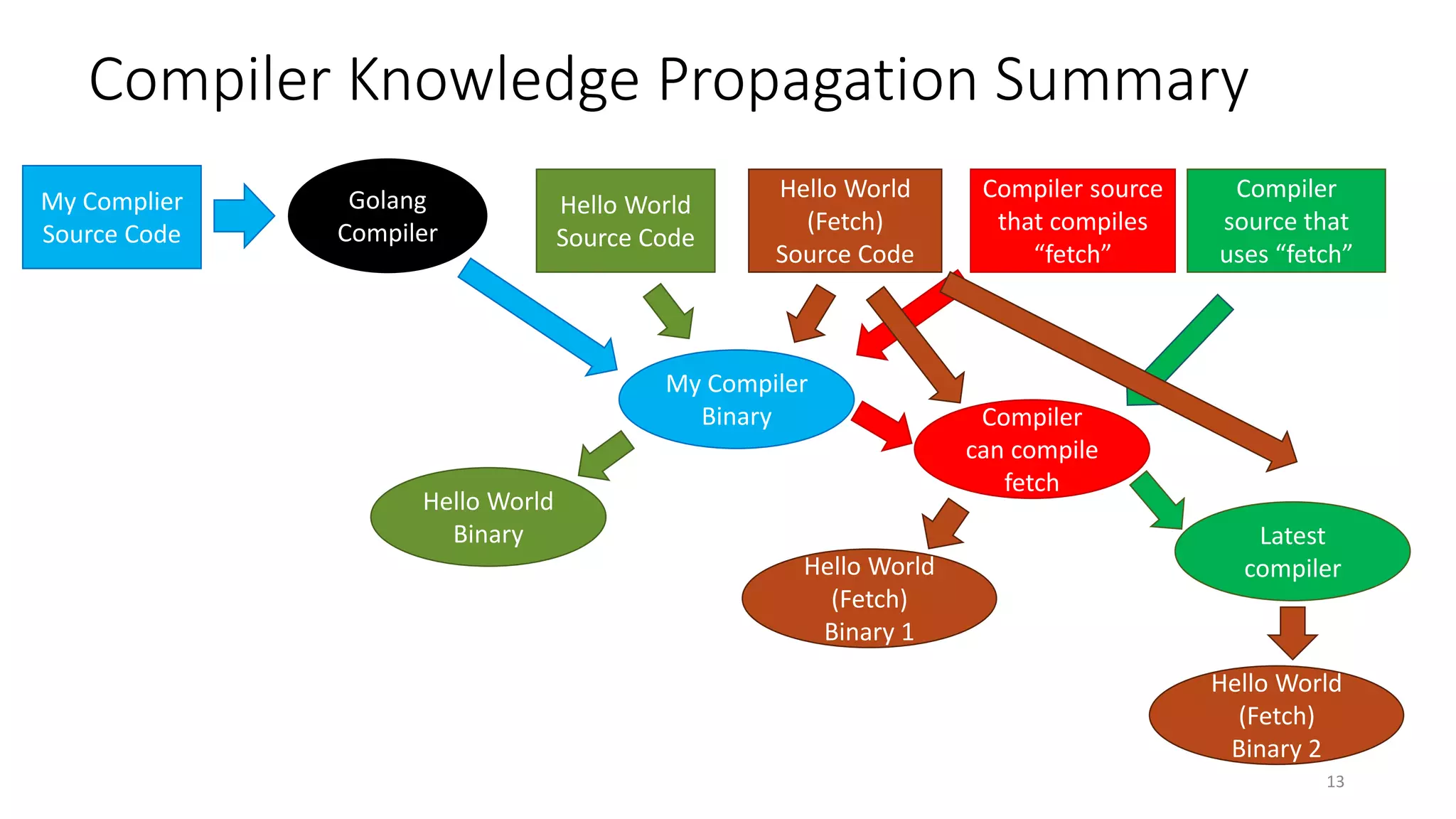
13
My Compiler
Binary
My Complier
Source Code
Golang
Compiler
Hello World
Source Code
Hello World
Binary
Hello World
(Fetch)
Source Code
Compiler source
that compiles
“fetch”
Compiler
can compile
fetch
Compiler
source that
uses “fetch”
Latest
compilerHello World
(Fetch)
Binary 1
Hello World
(Fetch)
Binary 2
Compiler Knowledge Propagation Summary
What we have learned so far?
• A program can output another program even itself.
• Compiler bootstrapping
14
Stage 3: Adding an undetectable backdoor to a login program
15
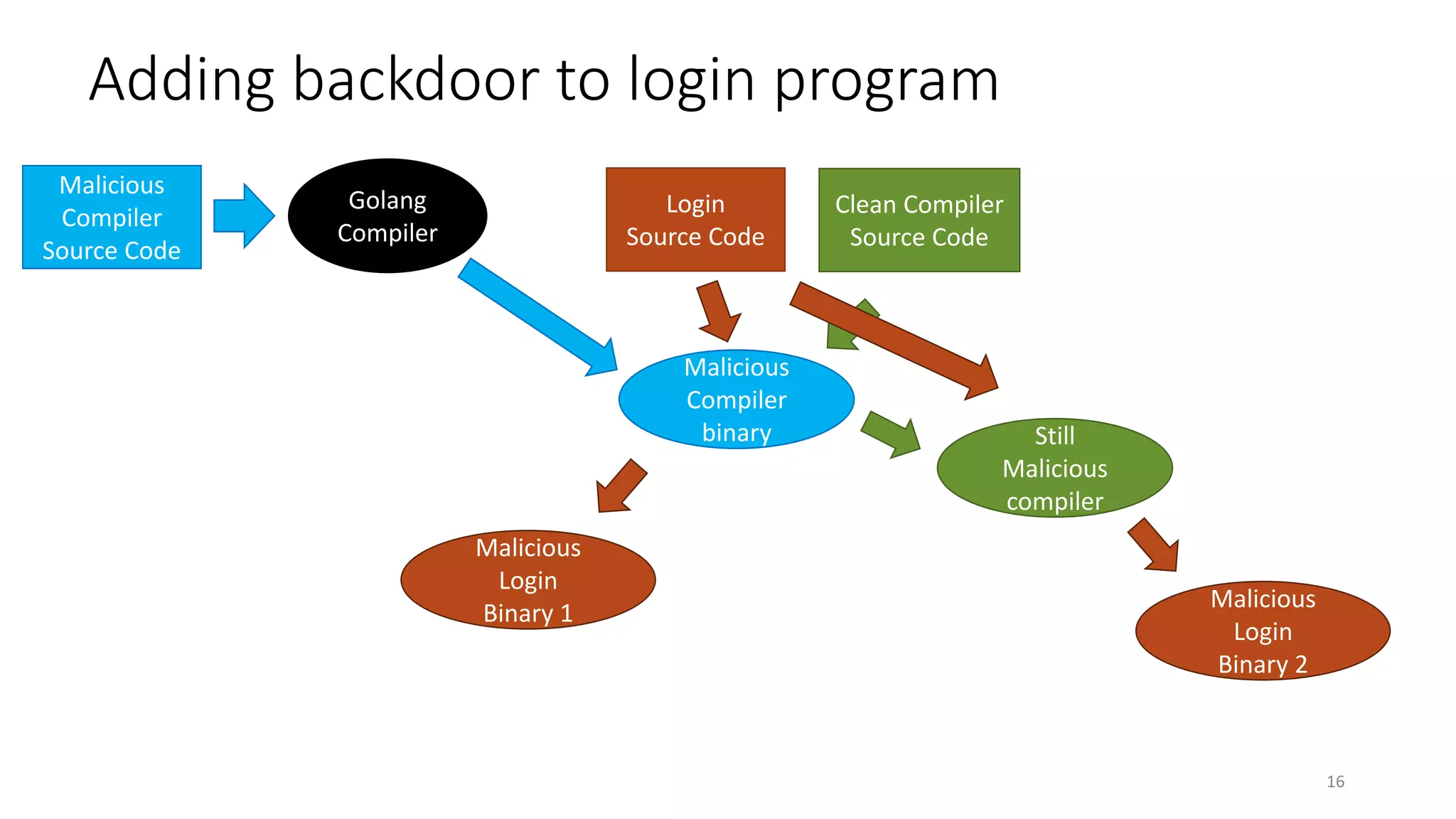
16
Malicious
Compiler
binary
Malicious
Compiler
Source Code
Golang
Compiler
Clean Compiler
Source Code
Login
Source Code
Malicious
Login
Binary 1
Adding backdoor to login program
Still
Malicious
compiler
Malicious
Login
Binary 2
Verifying the compiler binary
• Expected SHA-256 of Go 1.10.1 darwin/amd64 compiler
• 53b31f87d27bfa88c90789654c9dbec8297a6b157f61076037a85bf0c2687b1d
17
Stage 4: Subverting verification
• Can we prevent the user from detecting the bugged compiler?
18
19
Hacking the SHA256 Program
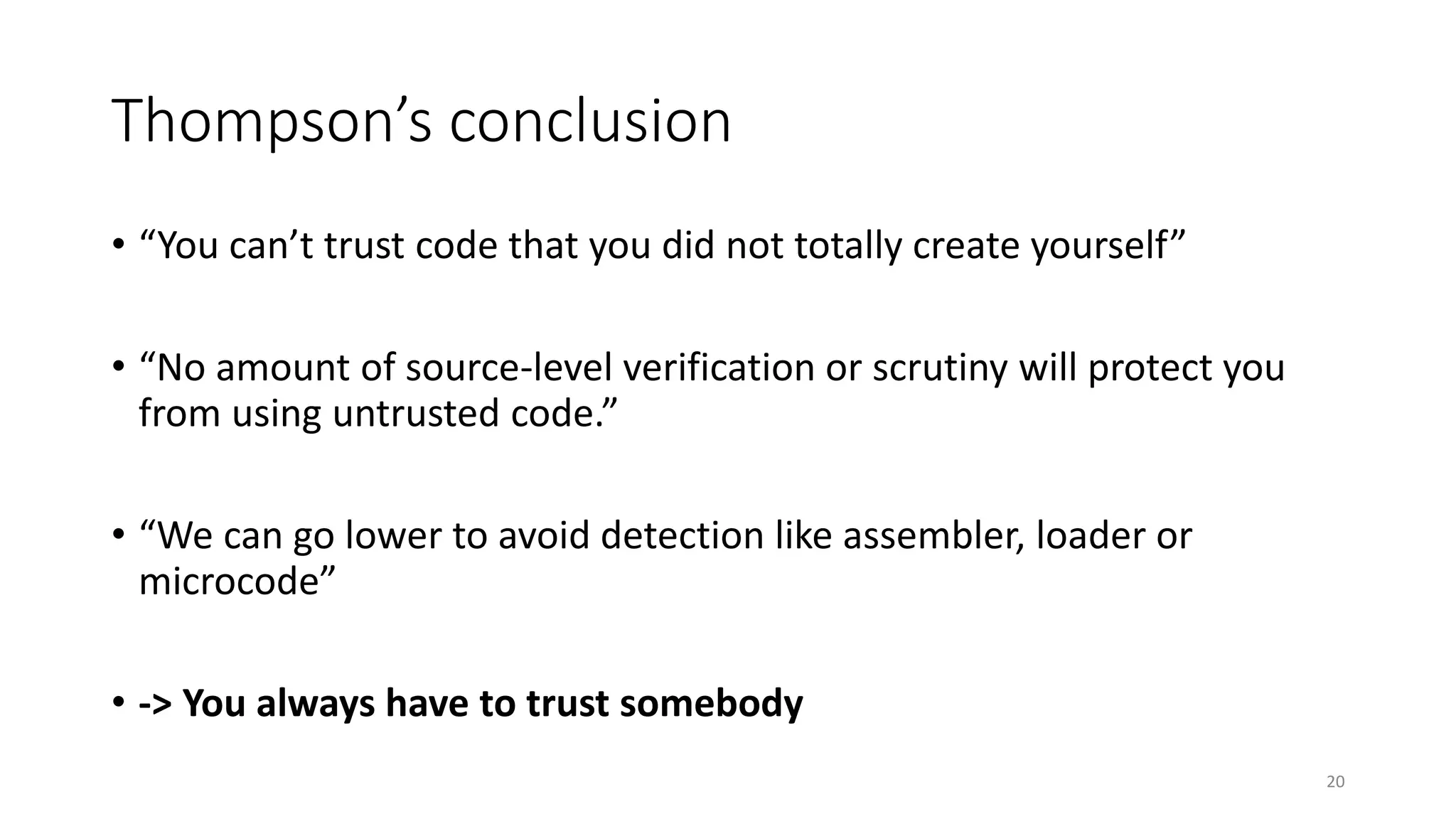
Thompson’s conclusion
• “You can’t trust code that you did not totally create yourself”
• “No amount of source-level verification or scrutiny will protect you
from using untrusted code.”
• “We can go lower to avoid detection like assembler, loader or
microcode”
• -> You always have to trust somebody
20
Possible defence?
21
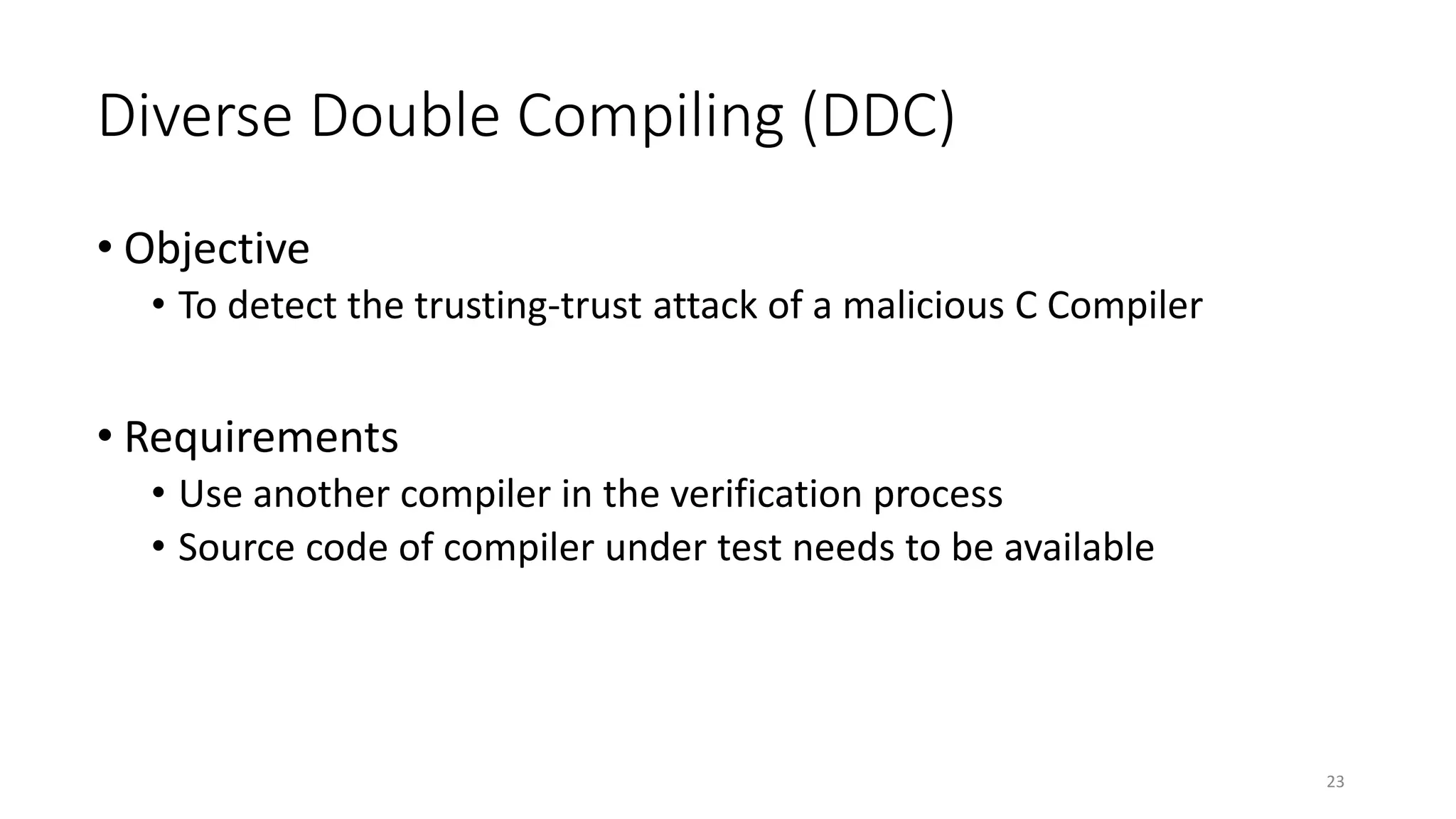
“Fully Countering Trusting Trust through Diverse Double-Compiling (DDC) -
Countering Trojan Horse attacks on Compilers”
2009 PhD dissertation by David A. Wheeler
George Mason University
http://www.dwheeler.com/trusting-trust/dissertation/wheeler-trusting-trust-ddc.pdf
22
Diverse Double Compiling (DDC)
• Objective
• To detect the trusting-trust attack of a malicious C Compiler
• Requirements
• Use another compiler in the verification process
• Source code of compiler under test needs to be available
23
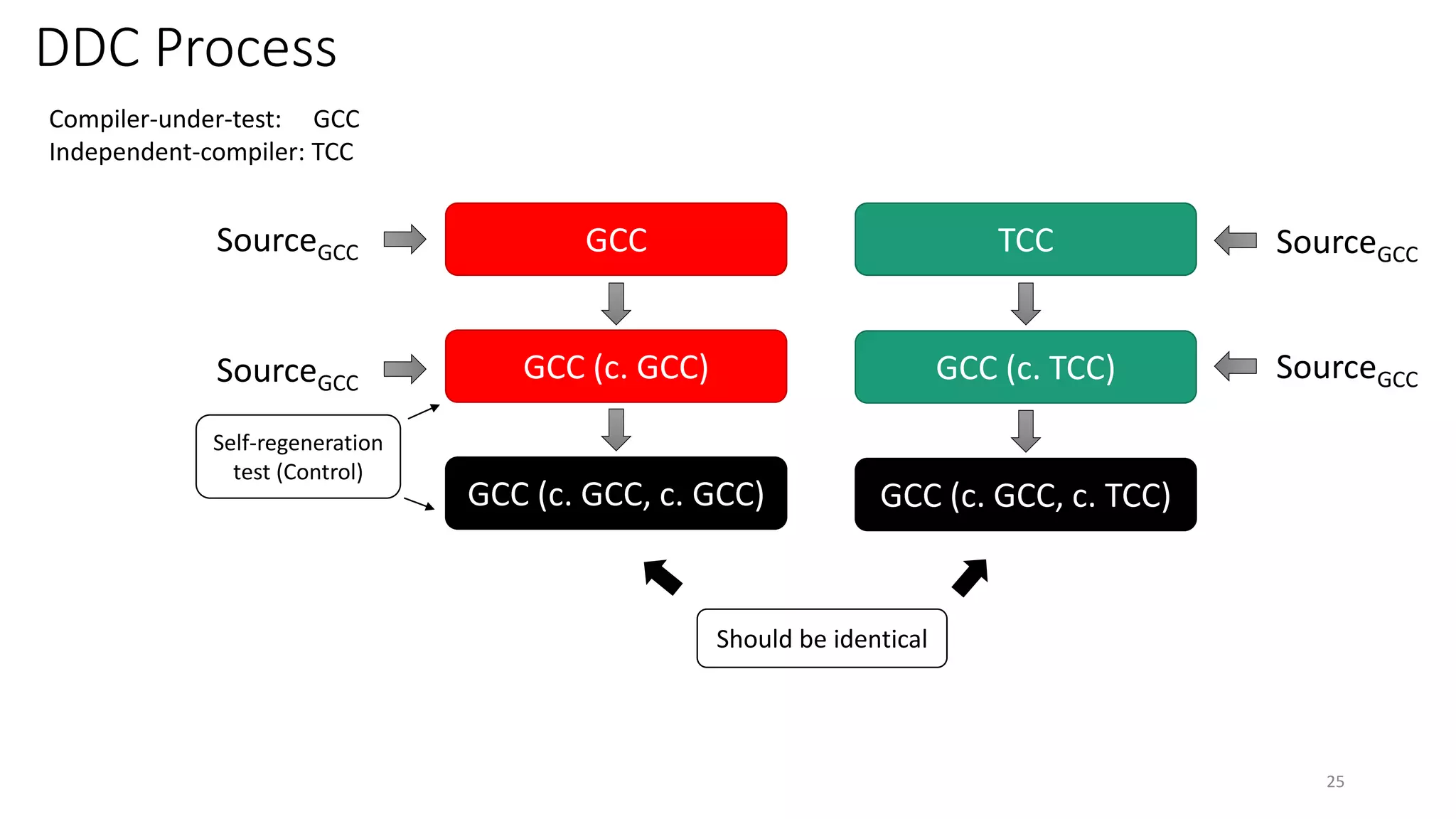
DDC Process
• Assume we are have GCC and Tiny C (TCC) compilers
• We suspect GCC is malicious and want to test it
• Compiler-under-test : GCC
• Independent-compiler: TCC
• Independent-compiler can be:
• Small: just enough code to compile compiler-under-test
• Generate inefficient code
24
DDC Process
25
TCCSourceGCC
Self-regeneration
test (Control)
Should be identical
GCC (c. GCC, c. GCC) GCC (c. GCC, c. TCC)
Compiler-under-test: GCC
Independent-compiler: TCC
GCC (c. TCC)GCC (c. GCC)
GCC
SourceGCC
SourceGCC
SourceGCC
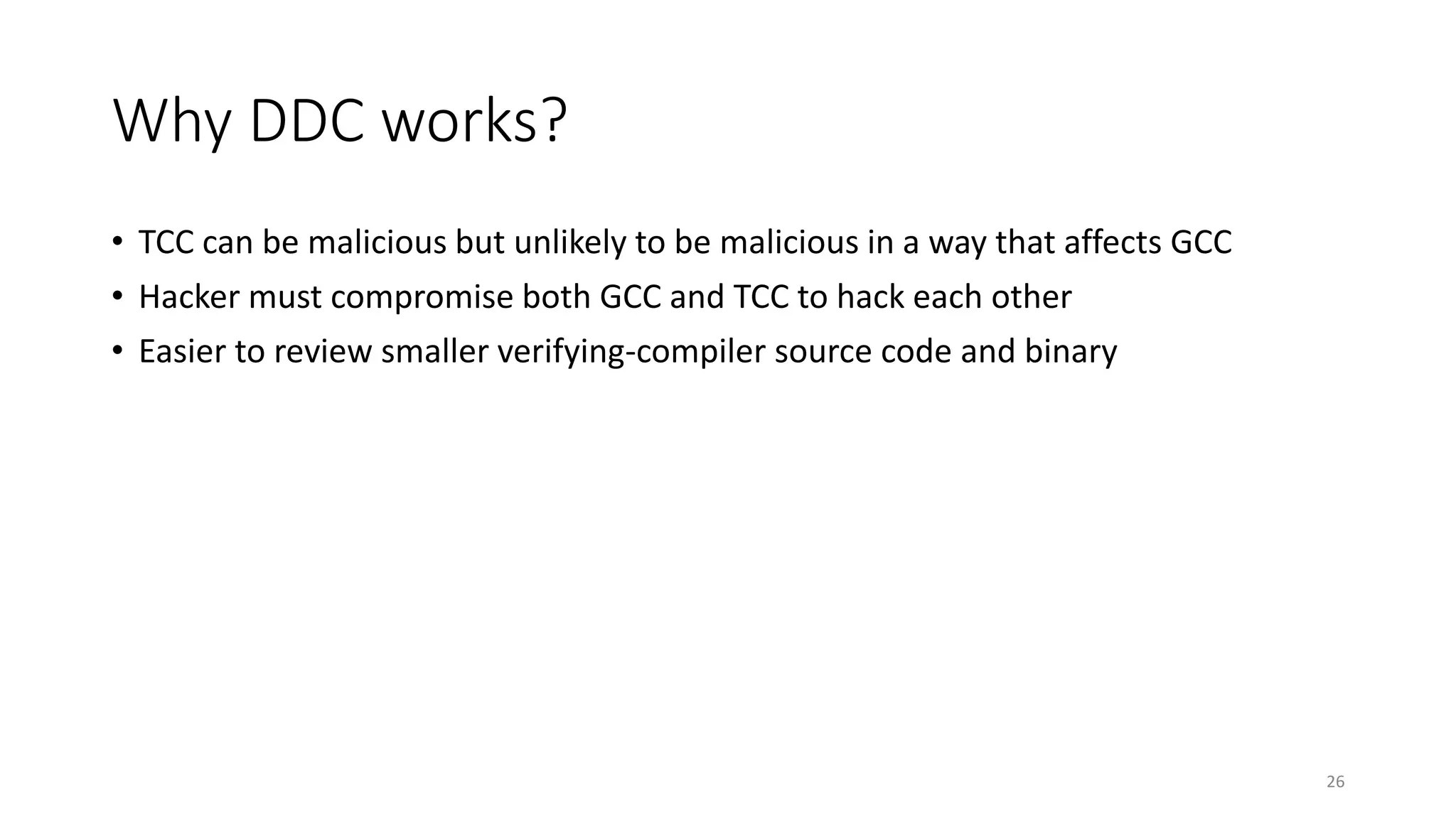
Why DDC works?
• TCC can be malicious but unlikely to be malicious in a way that affects GCC
• Hacker must compromise both GCC and TCC to hack each other
• Easier to review smaller verifying-compiler source code and binary
26
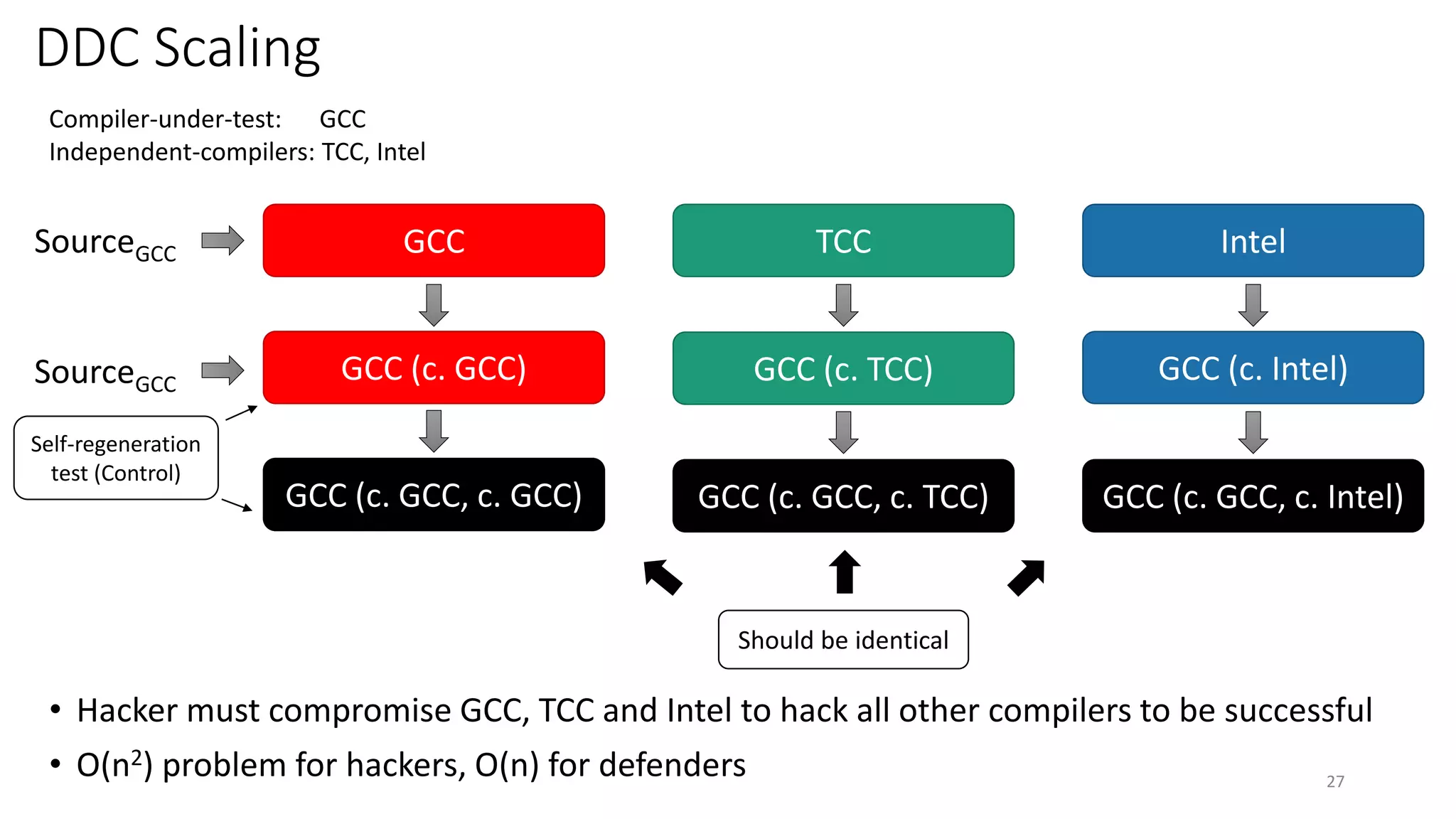
DDC Scaling
27
TCCSourceGCC
Self-regeneration
test (Control)
Should be identical
GCC (c. GCC, c. GCC) GCC (c. GCC, c. TCC) GCC (c. GCC, c. Intel)
Compiler-under-test: GCC
Independent-compilers: TCC, Intel
GCC (c. TCC) GCC (c. Intel)
Intel
GCC (c. GCC)
GCC
• Hacker must compromise GCC, TCC and Intel to hack all other compilers to be successful
• O(n2) problem for hackers, O(n) for defenders
SourceGCC
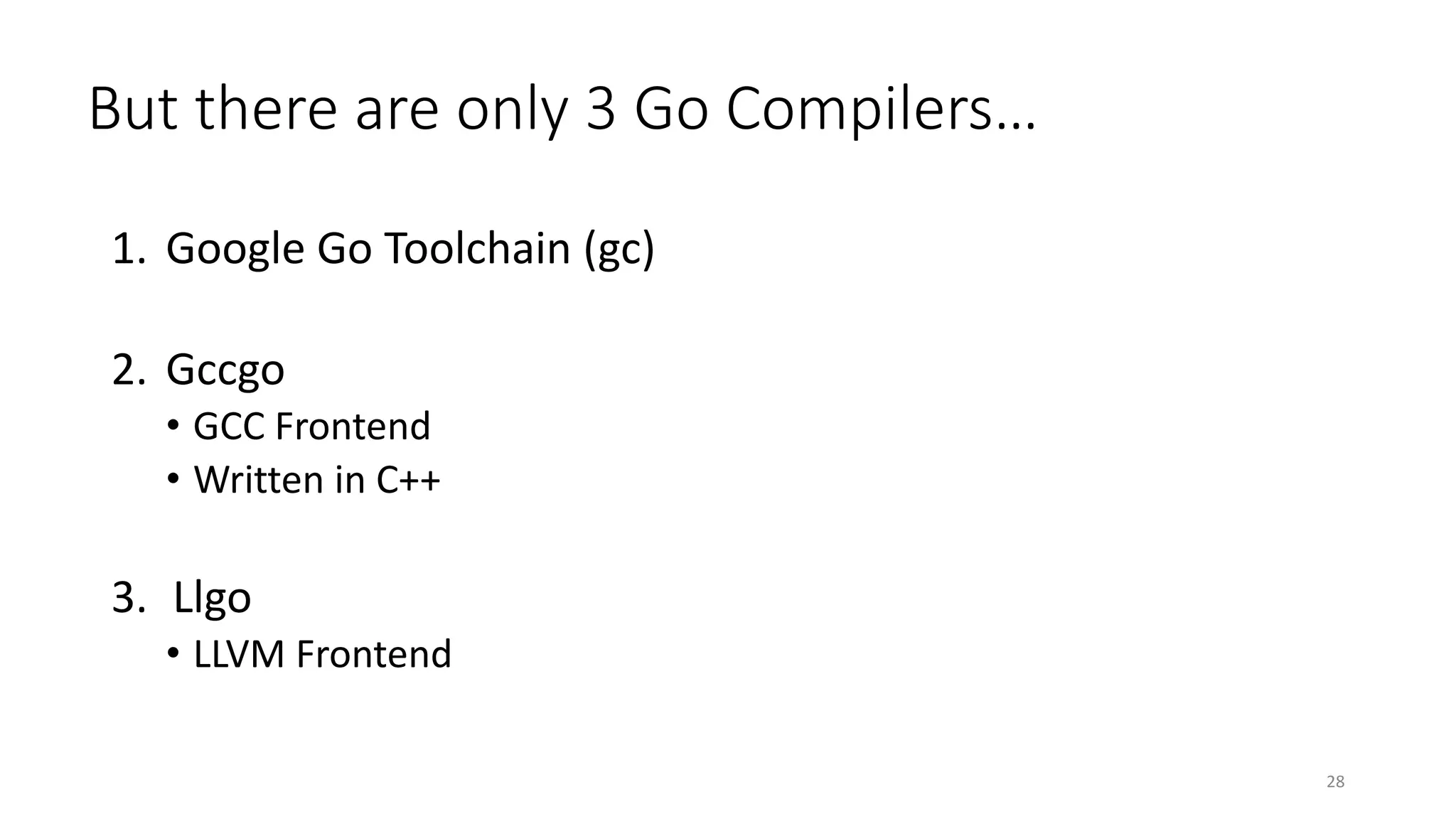
But there are only 3 Go Compilers…
28
1. Google Go Toolchain (gc)
2. Gccgo
• GCC Frontend
• Written in C++
3. Llgo
• LLVM Frontend
Possible Solution?
29
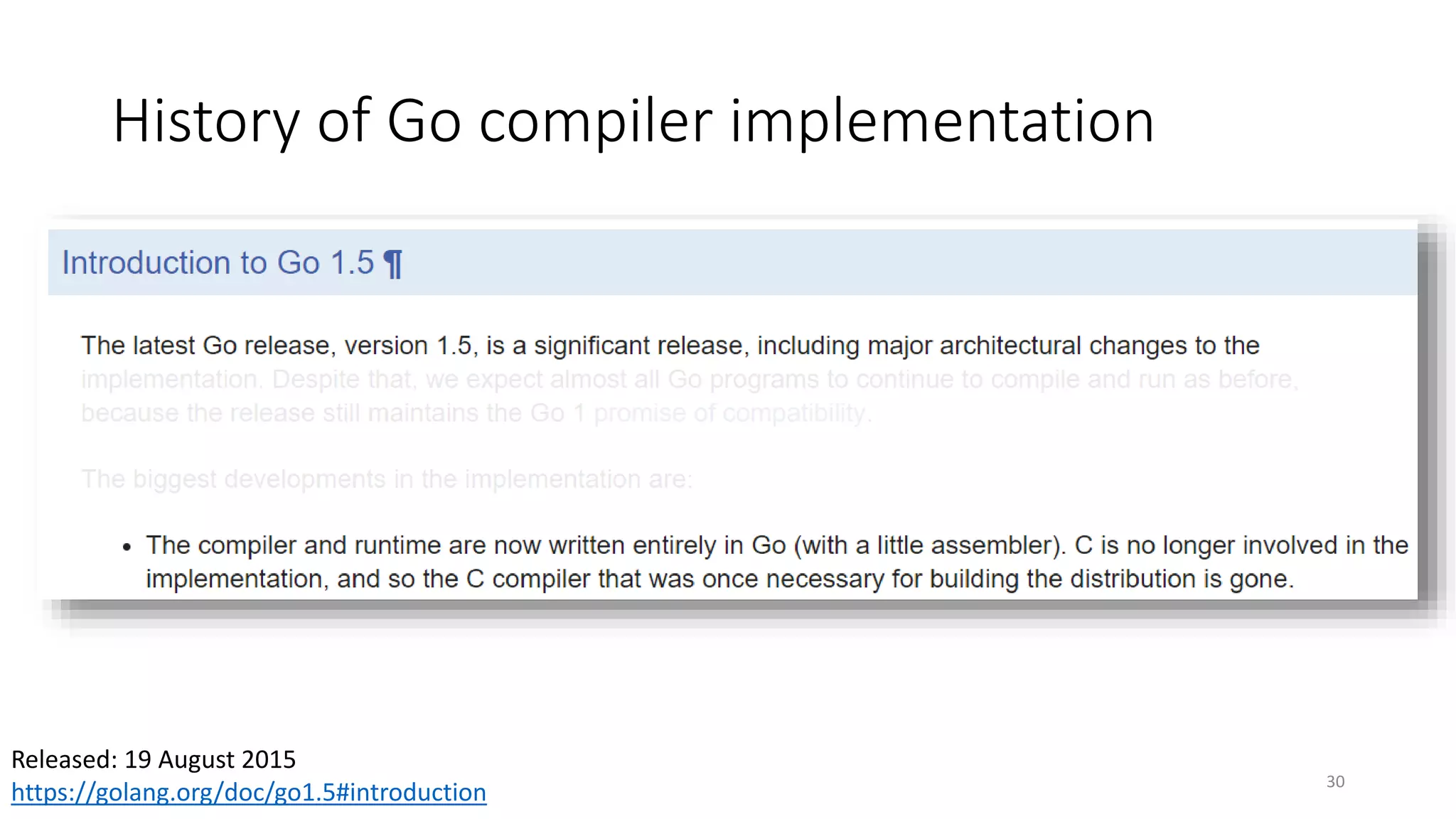
History of Go compiler implementation
30
Released: 19 August 2015
https://golang.org/doc/go1.5#introduction
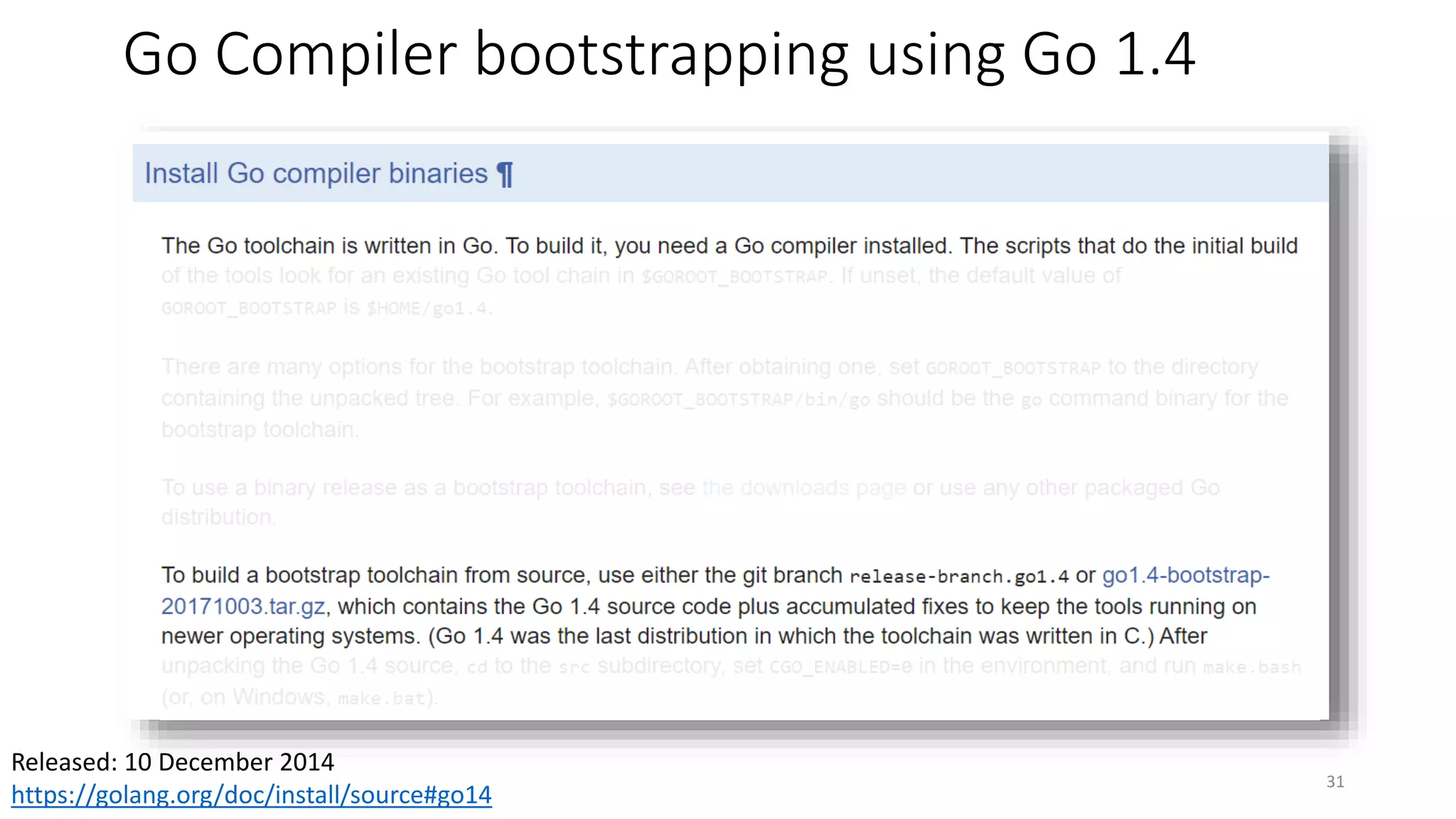
Go Compiler bootstrapping using Go 1.4
31
Released: 10 December 2014
https://golang.org/doc/install/source#go14
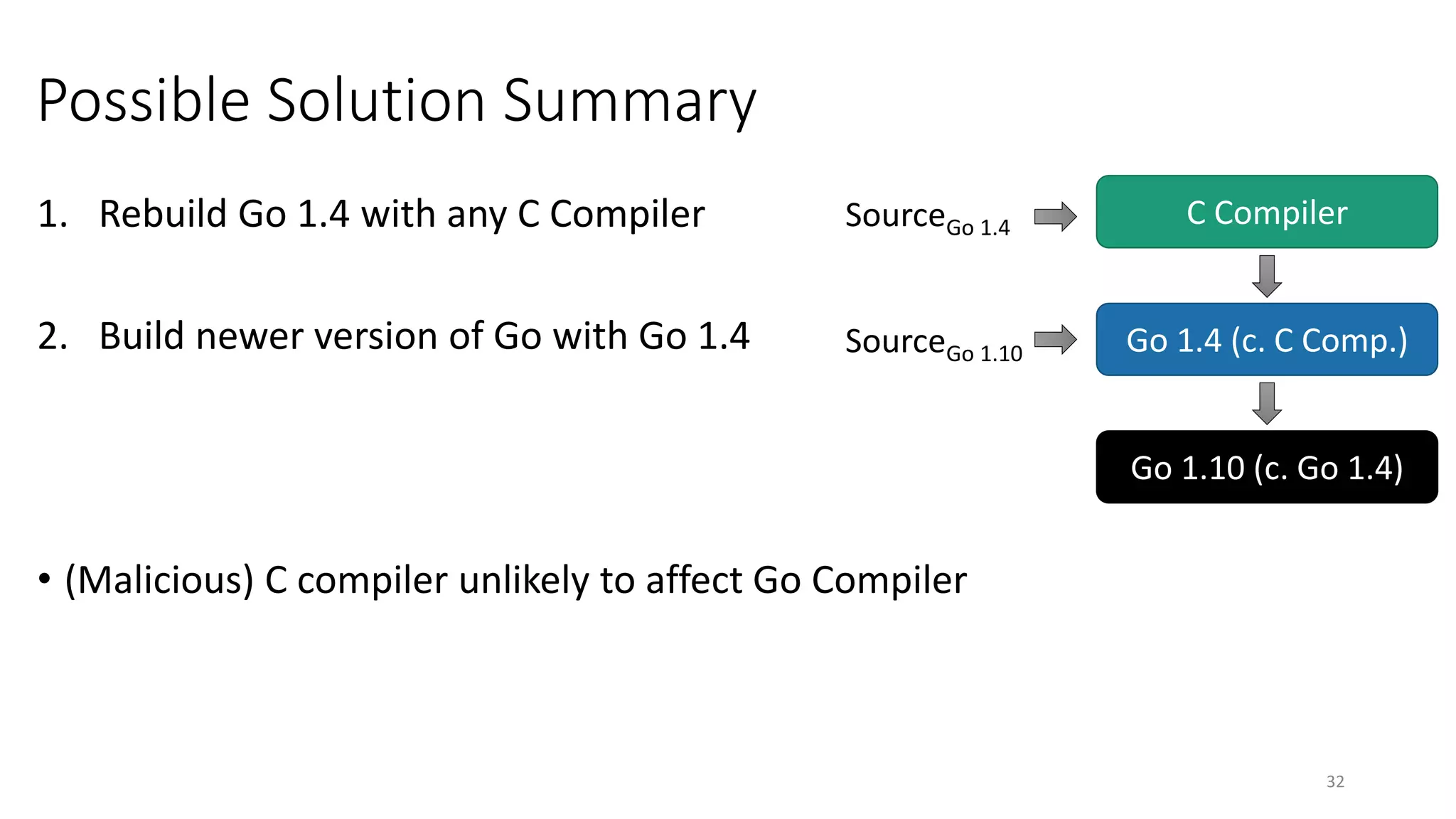
Possible Solution Summary
1. Rebuild Go 1.4 with any C Compiler
2. Build newer version of Go with Go 1.4
• (Malicious) C compiler unlikely to affect Go Compiler
32
C Compiler
Go 1.10 (c. Go 1.4)
Go 1.4 (c. C Comp.)
SourceGo 1.4
SourceGo 1.10
Do you still trust your compiler?
33
By: Yeo Kheng Meng (yeokm1@gmail.com)
https://github.com/yeokm1/reflections-of-trusting-trust-go

Reflections on Trusting Trust for Go

  • 1.
    Reflections on TrustingTrust for Go 1. Turing Award Lecture (1984) Given by: Ken Thompson https://www.ece.cmu.edu/~ganger/712.fall02/papers/p761-thompson.pdf 2. Fully Countering Trust through Diverse Double Compiling (2009) By: David A. Wheeler http://www.dwheeler.com/trusting-trust/dissertation/wheeler-trusting-trust-ddc.pdf 1 GopherconSG (4 May 2018) By: Yeo Kheng Meng (yeokm1@gmail.com) https://github.com/yeokm1/reflections-on-trusting-trust-go
  • 2.
  • 3.
    Why Reflections onTrusting Trust? 3
  • 4.
    • Ken Thompson(left) and Dennis Ritchie • 1983 Turing award for their work on Unix • Thompson presented “Reflections on Trusting Trust” in his acceptance speech 4
  • 5.
  • 6.
    The problem • Howdo we know a program is safe? • Inspect the program’s source code. • But isn’t the program source code compiled by a compiler? • Inspect the compiler’s source code, eg. Golang Compiler • https://github.com/golang/go • But isn’t the compiler compiled by another compiler? • Self-hosting compilers compile themselves • -> Eg. Go compiler compiles Go compiler • So how? How deep do we go down the rabbit hole? 6
  • 7.
    Real-life compiler attacks •Xcodeghost (found Sept 2015) • Malicious Xcode compiler hosted on Chinese websites • Injects spyware into output binary • Win32/Induc.A virus and its successors (found 2009) • Infects Delphi compiler to inject malicious code into output binary • Create a botnet • Further infects other Delphi compilers 7 Xcodeghost image: https://nakedsecurity.sophos.com/2015/11/09/apples-xcodeghost-malware-still-in-the-machine/
  • 8.
    Attack Objectives 1. Createa malicious compiler to target a program eg: login program 2. Not leave a trace in compiler source 3. Subvert verification 8
  • 9.
    Presentation Outline 1. Self-reproducingprogram (Quine) 2. Compiler knowledge propagation (Bootstrapping) 3. Attack on the login program 4. Initial Conclusion 5. Mitigation strategy? 9
  • 10.
    Stage 1: Self-reproducingprogram (Quine) A source program that when compiled and executed, will produce as output an exact copy of its source. 10
  • 11.
    Stage 2: Compilerknowledge propagation •Pass knowledge down compiler iterations 11
  • 12.
    My ”clean” compiler •”compiler.go” 1. Reads input source file 2. Prints source file contents to stdout 3. Passes source file to Golang compiler 12
  • 13.
    13 My Compiler Binary My Complier SourceCode Golang Compiler Hello World Source Code Hello World Binary Hello World (Fetch) Source Code Compiler source that compiles “fetch” Compiler can compile fetch Compiler source that uses “fetch” Latest compilerHello World (Fetch) Binary 1 Hello World (Fetch) Binary 2 Compiler Knowledge Propagation Summary
  • 14.
    What we havelearned so far? • A program can output another program even itself. • Compiler bootstrapping 14
  • 15.
    Stage 3: Addingan undetectable backdoor to a login program 15
  • 16.
    16 Malicious Compiler binary Malicious Compiler Source Code Golang Compiler Clean Compiler SourceCode Login Source Code Malicious Login Binary 1 Adding backdoor to login program Still Malicious compiler Malicious Login Binary 2
  • 17.
    Verifying the compilerbinary • Expected SHA-256 of Go 1.10.1 darwin/amd64 compiler • 53b31f87d27bfa88c90789654c9dbec8297a6b157f61076037a85bf0c2687b1d 17
  • 18.
    Stage 4: Subvertingverification • Can we prevent the user from detecting the bugged compiler? 18
  • 19.
  • 20.
    Thompson’s conclusion • “Youcan’t trust code that you did not totally create yourself” • “No amount of source-level verification or scrutiny will protect you from using untrusted code.” • “We can go lower to avoid detection like assembler, loader or microcode” • -> You always have to trust somebody 20
  • 21.
  • 22.
    “Fully Countering TrustingTrust through Diverse Double-Compiling (DDC) - Countering Trojan Horse attacks on Compilers” 2009 PhD dissertation by David A. Wheeler George Mason University http://www.dwheeler.com/trusting-trust/dissertation/wheeler-trusting-trust-ddc.pdf 22
  • 23.
    Diverse Double Compiling(DDC) • Objective • To detect the trusting-trust attack of a malicious C Compiler • Requirements • Use another compiler in the verification process • Source code of compiler under test needs to be available 23
  • 24.
    DDC Process • Assumewe are have GCC and Tiny C (TCC) compilers • We suspect GCC is malicious and want to test it • Compiler-under-test : GCC • Independent-compiler: TCC • Independent-compiler can be: • Small: just enough code to compile compiler-under-test • Generate inefficient code 24
  • 25.
    DDC Process 25 TCCSourceGCC Self-regeneration test (Control) Shouldbe identical GCC (c. GCC, c. GCC) GCC (c. GCC, c. TCC) Compiler-under-test: GCC Independent-compiler: TCC GCC (c. TCC)GCC (c. GCC) GCC SourceGCC SourceGCC SourceGCC
  • 26.
    Why DDC works? •TCC can be malicious but unlikely to be malicious in a way that affects GCC • Hacker must compromise both GCC and TCC to hack each other • Easier to review smaller verifying-compiler source code and binary 26
  • 27.
    DDC Scaling 27 TCCSourceGCC Self-regeneration test (Control) Shouldbe identical GCC (c. GCC, c. GCC) GCC (c. GCC, c. TCC) GCC (c. GCC, c. Intel) Compiler-under-test: GCC Independent-compilers: TCC, Intel GCC (c. TCC) GCC (c. Intel) Intel GCC (c. GCC) GCC • Hacker must compromise GCC, TCC and Intel to hack all other compilers to be successful • O(n2) problem for hackers, O(n) for defenders SourceGCC
  • 28.
    But there areonly 3 Go Compilers… 28 1. Google Go Toolchain (gc) 2. Gccgo • GCC Frontend • Written in C++ 3. Llgo • LLVM Frontend
  • 29.
  • 30.
    History of Gocompiler implementation 30 Released: 19 August 2015 https://golang.org/doc/go1.5#introduction
  • 31.
    Go Compiler bootstrappingusing Go 1.4 31 Released: 10 December 2014 https://golang.org/doc/install/source#go14
  • 32.
    Possible Solution Summary 1.Rebuild Go 1.4 with any C Compiler 2. Build newer version of Go with Go 1.4 • (Malicious) C compiler unlikely to affect Go Compiler 32 C Compiler Go 1.10 (c. Go 1.4) Go 1.4 (c. C Comp.) SourceGo 1.4 SourceGo 1.10
  • 33.
    Do you stilltrust your compiler? 33 By: Yeo Kheng Meng (yeokm1@gmail.com) https://github.com/yeokm1/reflections-of-trusting-trust-go