Giving effective presentations
Claus O. Wilke
Integrative Biology, UT Austin
serialmentor.com/blog
Why giving great presentations is important:
Consider the example of faculty hiring
What I will cover
1. How to present an engaging story
2. Designing slides: The assertion-evidence template
3. Claus' pet peeves about presentations
1. How to present an engaging story:
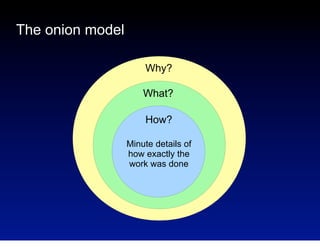
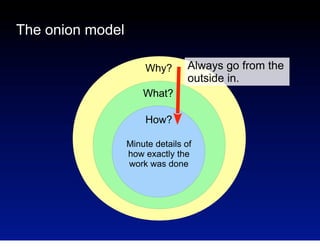
The onion model
Let's start with an example (a bad one)
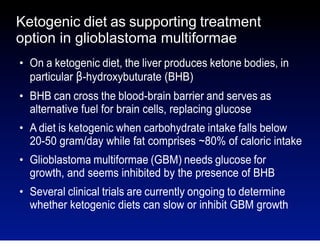
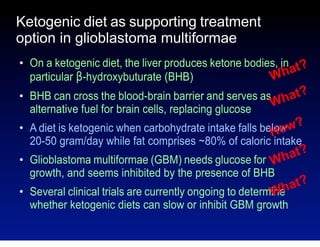
Ketogenic diet as supporting treatment
option in glioblastoma multiformae
●

●

●

●

●

On a ketogenic diet, the liver produces ketone bodies, in
particular β-hydroxybuturate (BHB)
BHB can cross the blood-brain barrier and serves as
alternative fuel for brain cells, replacing glucose
A diet is ketogenic when carbohydrate intake falls below
20-50 gram/day while fat comprises ~80% of caloric intake
Glioblastoma multiformae (GBM) needs glucose for
growth, and seems inhibited by the presence of BHB
Several clinical trials are currently ongoing to determine
whether ketogenic diets can slow or inhibit GBM growth
Did this get you excited about ketogenic diets?
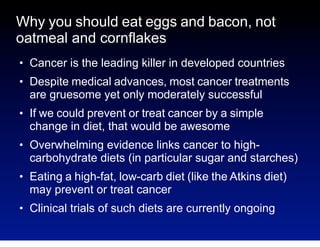
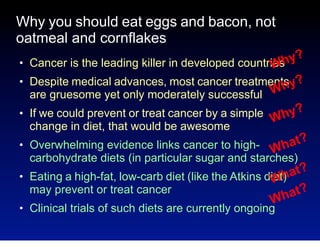
Why you should eat eggs and bacon, not
oatmeal and cornflakes
●

●

●

●

●

●

Cancer is the leading killer in developed countries
Despite medical advances, most cancer treatments
are gruesome yet only moderately successful
If we could prevent or treat cancer by a simple
change in diet, that would be awesome
Overwhelming evidence links cancer to highcarbohydrate diets (in particular sugar and starches)
Eating a high-fat, low-carb diet (like the Atkins diet)
may prevent or treat cancer
Clinical trials of such diets are currently ongoing
Did this get you more excited?
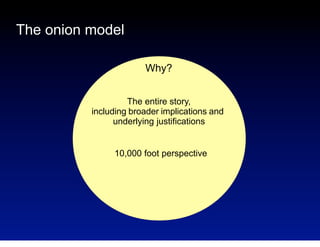
The onion model
The onion model
Why?
The entire story,
including broader implications and
underlying justifications
10,000 foot perspective
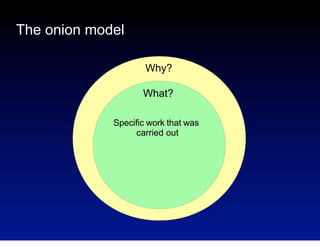
The onion model
Why?
What?
Specific work that was
carried out
The onion model
Why?
What?
How?
Minute details of
how exactly the
work was done
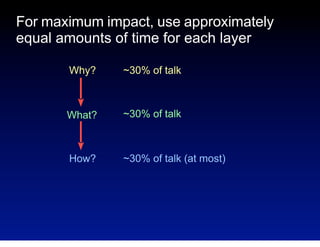
For maximum impact, use approximately
equal amounts of time for each layer
Why?

~30% of talk

What?

~30% of talk

How?

~30% of talk (at most)
Let's analyze the content of the earlier
ketogenic diet slides
Ketogenic diet as supporting treatment
option in glioblastoma multiformae
●

●

●

●

On a ketogenic diet, the liver produces ketone bodies, in t?
ha
W
particular β-hydroxybuturate (BHB)
BHB can cross the blood-brain barrier and serves as hat?
W
alternative fuel for brain cells, replacing glucose
A diet is ketogenic when carbohydrate intake falls below w?
Ho
20-50 gram/day while fat comprises ~80% of caloric intake

at?
Glioblastoma multiformae (GBM) needs glucose for Wh
growth, and seems inhibited by the presence of BHB

●

at?
Several clinical trials are currently ongoing to determine
Wh
whether ketogenic diets can slow or inhibit GBM growth
Why you should eat eggs and bacon, not
oatmeal and cornflakes
●

●

●

hy?
Cancer is the leading killer in developed countries
W
Despite medical advances, most cancer treatments y?
Wh
are gruesome yet only moderately successful
If we could prevent or treat cancer by a simple
hy?
W
change in diet, that would be awesome

●

●

●

at?
Overwhelming evidence links cancer to high- Wh
carbohydrate diets (in particular sugar and starches)
at?
Eating a high-fat, low-carb diet (like the Atkins diet)
Wh
may prevent or treat cancer
at?
Wh
Clinical trials of such diets are currently ongoing
2. Designing slides:
The assertion-evidence template
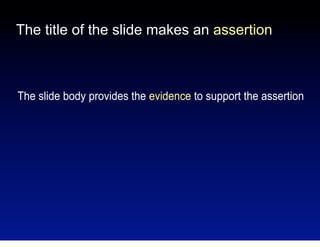
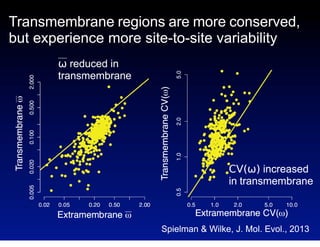
The title of the slide makes an assertion

The slide body provides the evidence to support the assertion
Examples
When you make clear assertions, your
audience will always get your point
3. Claus' pet peeves about presentations
How to ruin a talk and put your
audience to sleep in one slide
Claus O. Wilke
Integrative Biology, UT Austin
serialmentor.com/blog
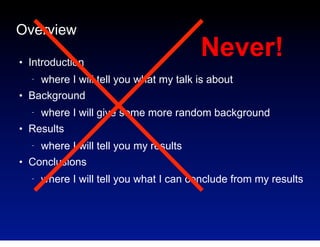
Overview
●

Introduction
−

●

where I will give some more random background

Results
−

●

where I will tell you what my talk is about

Background
−

●

Never!

where I will tell you my results

Conclusions
−

where I will tell you what I can conclude from my results
Always start your presentation with an
engaging story
If needed, you can give an overview later
What I will cover
1. How to present an engaging story
2. Designing slides: The assertion-evidence template
3. Claus' pet peeves about presentations
st

Claus' 1 law of presentations:
All text on slides needs to be read aloud
While I generally prefer graphical elements over text, there
are cases in which text is the preferred visualization aid. For
example, summary slides often require some amount of text.
Text is fine as long as you read it word for word. If you start
paraphrasing or talking over a text-heavy slide, however,
your audience will get confused. They cannot at the same
time read the text and listen to you.
Some audience members will read the text and stop
listening to you. Others will listen to you but not read.
All will worry that they made the wrong choice and missed
something important.
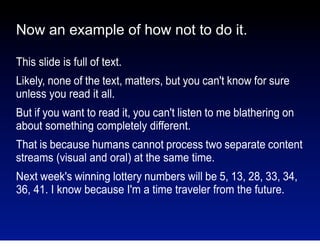
Now an example of how not to do it.
This slide is full of text.
Likely, none of the text, matters, but you can't know for sure
unless you read it all.
But if you want to read it, you can't listen to me blathering on
about something completely different.
That is because humans cannot process two separate content
streams (visual and oral) at the same time.
Next week's winning lottery numbers will be 5, 13, 28, 33, 34,
36, 41. I know because I'm a time traveler from the future.
Which story line were you able to follow?
Dark vs light backgrounds, which are
preferable?
●

●

Dark background is more elegant, easier on the eye
Light background is less work to prepare,
tends to look Ok even if the projector is weak
Summary
●

Tell a story

●

Lead from the why, then cover the what and limit the how

●

Start the talk strong, for example with an interesting
anecdote

●

Use the assertion-evidence template

●

Don't start your talk with a boring overview slide

●

When your slides contain text, read it out
Bonus #1: Use strong, open body language
Bonus #2: Don't visually shock your audience
by switching from dark to light backgrounds.

Giving effective presentations -- Oct. 2013

  • 1.
    Giving effective presentations ClausO. Wilke Integrative Biology, UT Austin serialmentor.com/blog
  • 2.
    Why giving greatpresentations is important: Consider the example of faculty hiring
  • 3.
    What I willcover 1. How to present an engaging story 2. Designing slides: The assertion-evidence template 3. Claus' pet peeves about presentations
  • 4.
    1. How topresent an engaging story: The onion model
  • 5.
    Let's start withan example (a bad one)
  • 6.
    Ketogenic diet assupporting treatment option in glioblastoma multiformae ● ● ● ● ● On a ketogenic diet, the liver produces ketone bodies, in particular β-hydroxybuturate (BHB) BHB can cross the blood-brain barrier and serves as alternative fuel for brain cells, replacing glucose A diet is ketogenic when carbohydrate intake falls below 20-50 gram/day while fat comprises ~80% of caloric intake Glioblastoma multiformae (GBM) needs glucose for growth, and seems inhibited by the presence of BHB Several clinical trials are currently ongoing to determine whether ketogenic diets can slow or inhibit GBM growth
  • 7.
    Did this getyou excited about ketogenic diets?
  • 8.
    Why you shouldeat eggs and bacon, not oatmeal and cornflakes ● ● ● ● ● ● Cancer is the leading killer in developed countries Despite medical advances, most cancer treatments are gruesome yet only moderately successful If we could prevent or treat cancer by a simple change in diet, that would be awesome Overwhelming evidence links cancer to highcarbohydrate diets (in particular sugar and starches) Eating a high-fat, low-carb diet (like the Atkins diet) may prevent or treat cancer Clinical trials of such diets are currently ongoing
  • 9.
    Did this getyou more excited?
  • 10.
  • 11.
    The onion model Why? Theentire story, including broader implications and underlying justifications 10,000 foot perspective
  • 12.
    The onion model Why? What? Specificwork that was carried out
  • 13.
    The onion model Why? What? How? Minutedetails of how exactly the work was done
  • 15.
    For maximum impact,use approximately equal amounts of time for each layer Why? ~30% of talk What? ~30% of talk How? ~30% of talk (at most)
  • 16.
    Let's analyze thecontent of the earlier ketogenic diet slides
  • 17.
    Ketogenic diet assupporting treatment option in glioblastoma multiformae ● ● ● ● On a ketogenic diet, the liver produces ketone bodies, in t? ha W particular β-hydroxybuturate (BHB) BHB can cross the blood-brain barrier and serves as hat? W alternative fuel for brain cells, replacing glucose A diet is ketogenic when carbohydrate intake falls below w? Ho 20-50 gram/day while fat comprises ~80% of caloric intake at? Glioblastoma multiformae (GBM) needs glucose for Wh growth, and seems inhibited by the presence of BHB ● at? Several clinical trials are currently ongoing to determine Wh whether ketogenic diets can slow or inhibit GBM growth
  • 18.
    Why you shouldeat eggs and bacon, not oatmeal and cornflakes ● ● ● hy? Cancer is the leading killer in developed countries W Despite medical advances, most cancer treatments y? Wh are gruesome yet only moderately successful If we could prevent or treat cancer by a simple hy? W change in diet, that would be awesome ● ● ● at? Overwhelming evidence links cancer to high- Wh carbohydrate diets (in particular sugar and starches) at? Eating a high-fat, low-carb diet (like the Atkins diet) Wh may prevent or treat cancer at? Wh Clinical trials of such diets are currently ongoing
  • 19.
    2. Designing slides: Theassertion-evidence template
  • 20.
    The title ofthe slide makes an assertion The slide body provides the evidence to support the assertion
  • 21.
  • 26.
    When you makeclear assertions, your audience will always get your point
  • 27.
    3. Claus' petpeeves about presentations
  • 28.
    How to ruina talk and put your audience to sleep in one slide Claus O. Wilke Integrative Biology, UT Austin serialmentor.com/blog
  • 29.
    Overview ● Introduction − ● where I willgive some more random background Results − ● where I will tell you what my talk is about Background − ● Never! where I will tell you my results Conclusions − where I will tell you what I can conclude from my results
  • 30.
    Always start yourpresentation with an engaging story If needed, you can give an overview later
  • 31.
    What I willcover 1. How to present an engaging story 2. Designing slides: The assertion-evidence template 3. Claus' pet peeves about presentations
  • 32.
    st Claus' 1 lawof presentations: All text on slides needs to be read aloud While I generally prefer graphical elements over text, there are cases in which text is the preferred visualization aid. For example, summary slides often require some amount of text. Text is fine as long as you read it word for word. If you start paraphrasing or talking over a text-heavy slide, however, your audience will get confused. They cannot at the same time read the text and listen to you. Some audience members will read the text and stop listening to you. Others will listen to you but not read. All will worry that they made the wrong choice and missed something important.
  • 33.
    Now an exampleof how not to do it. This slide is full of text. Likely, none of the text, matters, but you can't know for sure unless you read it all. But if you want to read it, you can't listen to me blathering on about something completely different. That is because humans cannot process two separate content streams (visual and oral) at the same time. Next week's winning lottery numbers will be 5, 13, 28, 33, 34, 36, 41. I know because I'm a time traveler from the future.
  • 34.
    Which story linewere you able to follow?
  • 35.
    Dark vs lightbackgrounds, which are preferable? ● ● Dark background is more elegant, easier on the eye Light background is less work to prepare, tends to look Ok even if the projector is weak
  • 36.
    Summary ● Tell a story ● Leadfrom the why, then cover the what and limit the how ● Start the talk strong, for example with an interesting anecdote ● Use the assertion-evidence template ● Don't start your talk with a boring overview slide ● When your slides contain text, read it out
  • 37.
    Bonus #1: Usestrong, open body language
  • 38.
    Bonus #2: Don'tvisually shock your audience
  • 39.
    by switching fromdark to light backgrounds.