Big-data Analytics: Challenges and 
Opportunities 
Chih-Jen Lin 
Department of Computer Science 
National Taiwan University 
Talk at ðcÇ™Ñx}t, August 30, 2014 
Chih-Jen Lin (National Taiwan Univ.) 1 / 54
Everybody talks about big data now, but it's not easy to 
have an overall picture of this subject 
In this talk, I will give some personal thoughts on 
technical developments of big-data analytics. Some are 
very pre-mature, so your comments are very welcome 
Chih-Jen Lin (National Taiwan Univ.) 2 / 54
Outline 
1 From data mining to big data 
2 Challenges 
3 Opportunities 
4 Discussion and conclusions 
Chih-Jen Lin (National Taiwan Univ.) 3 / 54
From data mining to big data 
Outline 
1 From data mining to big data 
2 Challenges 
3 Opportunities 
4 Discussion and conclusions 
Chih-Jen Lin (National Taiwan Univ.) 4 / 54
From data mining to big data 
From Data Mining to Big Data 
In early 90's, a buzzword called data mining 
appeared 
Many years after, we have another one called big 
data 
Well, what's the dierence? 
Chih-Jen Lin (National Taiwan Univ.) 5 / 54
From data mining to big data 
Status of Data Mining and Machine 
Learning 
Over the years, we have all kinds of eective 
methods for classi
cation, clustering, and regression 
We also have good integrated tools for data mining 
(e.g., Weka, R, Scikit-learn) 
However, mining useful information remains dicult 
for some real-world applications 
Chih-Jen Lin (National Taiwan Univ.) 6 / 54
From data mining to big data 
What's Big Data? 
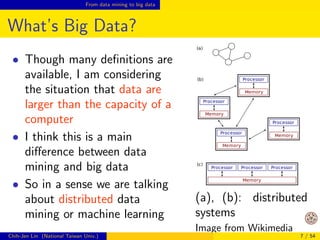
 Though many de
nitions are 
available, I am considering 
the situation that data are 
larger than the capacity of a 
computer 
 I think this is a main 
dierence between data 
mining and big data 
 So in a sense we are talking 
about distributed data 
mining or machine learning 
(a), (b): distributed 
systems 
Image from Wikimedia 
Chih-Jen Lin (National Taiwan Univ.) 7 / 54
From data mining to big data 
From Small to Big Data 
Two important dierences: 
Negative side: 
Methods for big data analytics are not quite ready, 
not even mentioned to integrated tools 
Positive side: 
Some (Halevy et al., 2009) argue that the almost 
unlimited data make us easier to mine information 
I will discuss the
rst dierence 
Chih-Jen Lin (National Taiwan Univ.) 8 / 54
Challenges 
Outline 
1 From data mining to big data 
2 Challenges 
3 Opportunities 
4 Discussion and conclusions 
Chih-Jen Lin (National Taiwan Univ.) 9 / 54
Challenges 
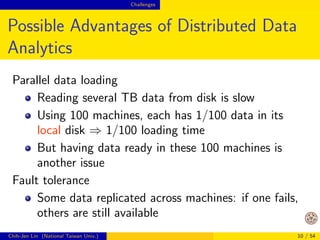
Possible Advantages of Distributed Data 
Analytics 
Parallel data loading 
Reading several TB data from disk is slow 
Using 100 machines, each has 1/100 data in its 
local disk ) 1/100 loading time 
But having data ready in these 100 machines is 
another issue 
Fault tolerance 
Some data replicated across machines: if one fails, 
others are still available 
Chih-Jen Lin (National Taiwan Univ.) 10 / 54
Challenges 
Possible Advantages of Distributed Data 
Analytics (Cont'd) 
Work
ow not interrupted 
If data are already distributedly stored, it's not 
convenient to reduce some to one machine for 
analysis 
Chih-Jen Lin (National Taiwan Univ.) 11 / 54
Challenges 
Possible Disadvantages of Distributed 
Data Analytics 
More complicated (of course) 
Communication and synchronization 
Everybody says moving computation to data, but 
this isn't that easy 
Chih-Jen Lin (National Taiwan Univ.) 12 / 54
Challenges 
Going Distributed or Not Isn't Easy to 
Decide 
Quote from Yann LeCun (KDnuggets News 14:n05) 
I have seen people insisting on using Hadoop for 
datasets that could easily
t on a 
ash drive and 
could easily be processed on a laptop. 
Now disk and RAM are large. You may load several 
TB of data once and conveniently conduct all 
analysis 
The decision is application dependent 
We will discuss this issue again later 
Chih-Jen Lin (National Taiwan Univ.) 13 / 54
Challenges 
Distributed Environments 
Many easy tasks on one computer become dicult 
in a distributed environment 
For example, subsampling is easy on one machine, 
but may not be in a distributed system 
Usually we attribute the problem to slow 
communication between machines 
Chih-Jen Lin (National Taiwan Univ.) 14 / 54
Challenges 
Challenges 
Big data, small analysis 
versus 
Big data, big analysis 
If you need a single record from a huge set, it's 
reasonably easy 
For example, accessing your high-speed rail 
reservation is fast 
However, if you want to analyze the whole set by 
accessing data several time, it can be much harder 
Chih-Jen Lin (National Taiwan Univ.) 15 / 54
Challenges 
Challenges (Cont'd) 
Most existing data mining/machine learning 
methods were designed without considering data 
access and communication of intermediate results 
They iteratively use data by assuming they are 
readily available 
Example: doing least-square regression isn't easy in 
a distributed environment 
Chih-Jen Lin (National Taiwan Univ.) 16 / 54
Challenges 
Challenges (Cont'd) 
So we are facing many challenges 
methods not ready 
no convenient tools 
rapid change on the system side 
and many others 
What should we do? 
Chih-Jen Lin (National Taiwan Univ.) 17 / 54
Opportunities 
Outline 
1 From data mining to big data 
2 Challenges 
3 Opportunities 
4 Discussion and conclusions 
Chih-Jen Lin (National Taiwan Univ.) 18 / 54
Opportunities 
Opportunities 
Looks like we are in the early stage of a research 
topic 
But what is our chance? 
Chih-Jen Lin (National Taiwan Univ.) 19 / 54
Opportunities Lessons from past developments in one machine 
Outline 
3 Opportunities 
Lessons from past developments in one machine 
Successful examples? 
Design of big-data algorithms 
Chih-Jen Lin (National Taiwan Univ.) 20 / 54
Opportunities Lessons from past developments in one machine 
Algorithms for Distributed Data Analytics 
This is an on-going research topic. 
Roughly there are two types of approaches 
1 Parallelize existing (single-machine) algorithms 
2 Design new algorithms particularly for distributed 
settings 
Of course there are things in between 
Chih-Jen Lin (National Taiwan Univ.) 21 / 54
Opportunities Lessons from past developments in one machine 
Algorithms for Distributed Data Analytics 
(Cont'd) 
Given the complicated distributed setting, we 
wonder if easy-to-use big-data analytics tools can 
ever be available? 
I don't know either. Let's try to think about the 
situation on one computer
rst 
Indeed those easy-to-use analytics tools on one 
computer were not there at the
rst day 
Chih-Jen Lin (National Taiwan Univ.) 22 / 54
Opportunities Lessons from past developments in one machine 
Past Development on One Computer 
The problem now is we take many things for 
granted on one computer 
On one computer, have you ever worried about 
calculating the average of some numbers? 
Probably not. You can use Excel, statistical 
software (e.g., R and SAS), and many things else 
We seldom care internally how these tools work 
Can we go back to see the early development on 
one computer and learn some lessons/experiences? 
Chih-Jen Lin (National Taiwan Univ.) 23 / 54
Opportunities Lessons from past developments in one machine 
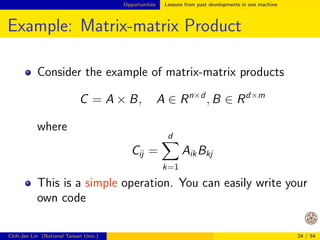
Example: Matrix-matrix Product 
Consider the example of matrix-matrix products 
C = A  B; A 2 Rnd ; B 2 Rdm 
where 
Cij = 
Xd 
k=1 
AikBkj 
This is a simple operation. You can easily write your 
own code 
Chih-Jen Lin (National Taiwan Univ.) 24 / 54
Opportunities Lessons from past developments in one machine 
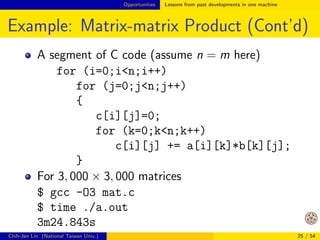
Example: Matrix-matrix Product (Cont'd) 
A segment of C code (assume n = m here) 
for (i=0;in;i++) 
for (j=0;jn;j++) 
{ 
c[i][j]=0; 
for (k=0;kn;k++) 
c[i][j] += a[i][k]*b[k][j]; 
} 
For 3; 000  3; 000 matrices 
$ gcc -O3 mat.c 
$ time ./a.out 
3m24.843s 
Chih-Jen Lin (National Taiwan Univ.) 25 / 54
Opportunities Lessons from past developments in one machine 
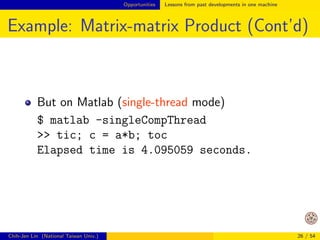
Example: Matrix-matrix Product (Cont'd) 
But on Matlab (single-thread mode) 
$ matlab -singleCompThread 
 tic; c = a*b; toc 
Elapsed time is 4.095059 seconds. 
Chih-Jen Lin (National Taiwan Univ.) 26 / 54
Opportunities Lessons from past developments in one machine 
Example: Matrix-matrix Product (Cont'd) 
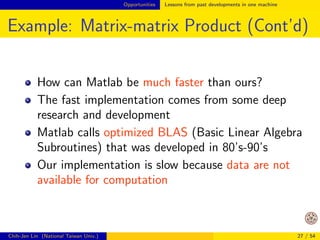
How can Matlab be much faster than ours? 
The fast implementation comes from some deep 
research and development 
Matlab calls optimized BLAS (Basic Linear Algebra 
Subroutines) that was developed in 80's-90's 
Our implementation is slow because data are not 
available for computation 
Chih-Jen Lin (National Taiwan Univ.) 27 / 54
Opportunities Lessons from past developments in one machine 
Example: Matrix-matrix Product (Cont'd) 
CPU 
# 
Registers 
# 
Cache 
# 
Main Memory 
# 
Secondary storage (Disk) 
: increasing in speed 
#: increasing in 
capacity 
Optimized BLAS: try 
to make data available 
in a higher level of 
memory 
You don't waste time 
to frequently move 
data 
Chih-Jen Lin (National Taiwan Univ.) 28 / 54
Opportunities Lessons from past developments in one machine 
Example: Matrix-matrix Product (Cont'd) 
Optimized BLAS uses block algorithms 
A  B = 
2 
4 
A11    A14 
... 
A41    A44 
3 
5 
2 
4 
B11    B14 
... 
B41    B44 
3 
5 
= 
 
A11B11 +    + A14B41    
... 
. . . 
 
If we compare the number of page faults (cache 
misses) 
Ours: much larger 
Block: much smaller 
Chih-Jen Lin (National Taiwan Univ.) 29 / 54
Opportunities Lessons from past developments in one machine 
Example: Matrix-matrix Product (Cont'd) 
I like this example because it involves both 
mathematical operations (matrix products), 
and 
computer architecture (memory hierarchy) 
Only if knowing both, you can make breakthroughs 
Chih-Jen Lin (National Taiwan Univ.) 30 / 54
Opportunities Lessons from past developments in one machine 
Example: Matrix-matrix Product (Cont'd) 
For big-data analytics, we are in a similar situation 
We want to run mathematical algorithms 
(classi
cation and clustering) in a complicated 
architecture (distributed system) 
But we are like at the time point before optimized 
BLAS was developed 
Chih-Jen Lin (National Taiwan Univ.) 31 / 54
Opportunities Lessons from past developments in one machine 
Algorithms and Systems 
To have technical breakthroughs for big-data 
analytics, we should know both algorithms and 
systems well, and consider them together 
Indeed, if you are an expert on both topics, 
everybody wants you now 
Many machine learning Ph.D. students don't know 
much about systems. But this isn't the case in the 
early days of computer science 
Chih-Jen Lin (National Taiwan Univ.) 32 / 54
Opportunities Lessons from past developments in one machine 
Algorithms and Systems (Cont'd) 
At that time, every numerical analyst knows 
computer architecture well. 
That's how they successfully developed 

oating-point systems and IEEE 754/854 standard 
Chih-Jen Lin (National Taiwan Univ.) 33 / 54
Opportunities Lessons from past developments in one machine 
Example: Machine Learning Using Spark 
Recently we developed a classi
er on Spark 
Spark is an in-memory cluster-computing platform 
Beyond algorithms we must take details of 
Spark 
Scala 
into account 
For example, you want to know 
the dierence between mapPartitions and 
map in Spark, and 
the slower for loop than while loop in Scala 
Chih-Jen Lin (National Taiwan Univ.) 34 / 54
Opportunities Lessons from past developments in one machine 
Example: Machine Learning Using Spark 
(Cont'd) 
During our development, Spark was signi
cantly 
upgraded from version 0.9 to 1.0. We must learn 
their changes 
It's like when you write a code on a computer, but 
the compiler or OS is actively changed. We are in a 
stage just like that. 
Chih-Jen Lin (National Taiwan Univ.) 35 / 54
Opportunities Successful examples? 
Outline 
3 Opportunities 
Lessons from past developments in one machine 
Successful examples? 
Design of big-data algorithms 
Chih-Jen Lin (National Taiwan Univ.) 36 / 54
Opportunities Successful examples? 
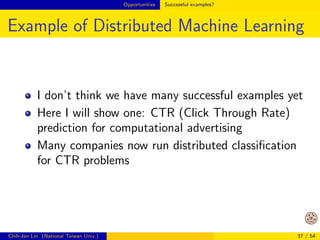
Example of Distributed Machine Learning 
I don't think we have many successful examples yet 
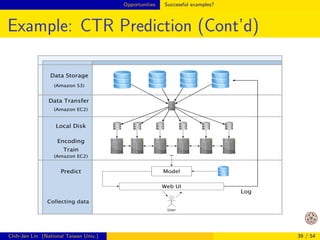
Here I will show one: CTR (Click Through Rate) 
prediction for computational advertising 
Many companies now run distributed classi
cation 
for CTR problems 
Chih-Jen Lin (National Taiwan Univ.) 37 / 54
Opportunities Successful examples? 
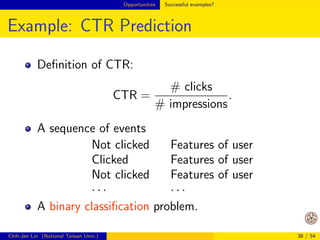
Example: CTR Prediction 
De
nition of CTR: 
CTR = 
# clicks 
# impressions 
. 
A sequence of events 
Not clicked Features of user 
Clicked Features of user 
Not clicked Features of user 
      
A binary classi
cation problem. 
Chih-Jen Lin (National Taiwan Univ.) 38 / 54
Opportunities Successful examples? 
Example: CTR Prediction (Cont'd) 
Chih-Jen Lin (National Taiwan Univ.) 39 / 54
Opportunities Design of big-data algorithms 
Outline 
3 Opportunities 
Lessons from past developments in one machine 
Successful examples? 
Design of big-data algorithms 
Chih-Jen Lin (National Taiwan Univ.) 40 / 54
Opportunities Design of big-data algorithms 
Design Considerations 
Generally you want to minimize the data access and 
communication in a distributed environment 
It's possible that 
method A better than B on one computer 
but 
method A worse than B in distributed environments 
Chih-Jen Lin (National Taiwan Univ.) 41 / 54
Opportunities Design of big-data algorithms 
Design Considerations (Cont'd) 
Example: on one computer, often we do batch 
rather than online learning 
Online and streaming learning may be more useful 
for big-data applications 
Example: very often we design synchronous parallel 
algorithms 
Maybe asynchronous ones are better for big data? 
Chih-Jen Lin (National Taiwan Univ.) 42 / 54
Opportunities Design of big-data algorithms 
Work
ow Issues 
Data analytics is often only part of the work
ow of 
a big-data application 
By work
ow, I mean things from raw data to
nal 
use of the results 
Other steps may be more complicated than the 
analytics step 
In one-computer situation, the focus is often on the 
analytics step 
Chih-Jen Lin (National Taiwan Univ.) 43 / 54
Opportunities Design of big-data algorithms 
How to Get Started? 
In my opinion, we should start from applications 
Applications ! programming frameworks and 
algorithms ! general tools 
Now almost every big-data application requires 
special settings of algorithms, but I believe general 
tools will be possible 
Chih-Jen Lin (National Taiwan Univ.) 44 / 54

Big-data analytics: challenges and opportunities

  • 1.
    Big-data Analytics: Challengesand Opportunities Chih-Jen Lin Department of Computer Science National Taiwan University Talk at ðcÇ™Ñx}t, August 30, 2014 Chih-Jen Lin (National Taiwan Univ.) 1 / 54
  • 2.
    Everybody talks aboutbig data now, but it's not easy to have an overall picture of this subject In this talk, I will give some personal thoughts on technical developments of big-data analytics. Some are very pre-mature, so your comments are very welcome Chih-Jen Lin (National Taiwan Univ.) 2 / 54
  • 3.
    Outline 1 Fromdata mining to big data 2 Challenges 3 Opportunities 4 Discussion and conclusions Chih-Jen Lin (National Taiwan Univ.) 3 / 54
  • 4.
    From data miningto big data Outline 1 From data mining to big data 2 Challenges 3 Opportunities 4 Discussion and conclusions Chih-Jen Lin (National Taiwan Univ.) 4 / 54
  • 5.
    From data miningto big data From Data Mining to Big Data In early 90's, a buzzword called data mining appeared Many years after, we have another one called big data Well, what's the dierence? Chih-Jen Lin (National Taiwan Univ.) 5 / 54
  • 6.
    From data miningto big data Status of Data Mining and Machine Learning Over the years, we have all kinds of eective methods for classi
  • 7.
    cation, clustering, andregression We also have good integrated tools for data mining (e.g., Weka, R, Scikit-learn) However, mining useful information remains dicult for some real-world applications Chih-Jen Lin (National Taiwan Univ.) 6 / 54
  • 8.
    From data miningto big data What's Big Data? Though many de
  • 9.
    nitions are available,I am considering the situation that data are larger than the capacity of a computer I think this is a main dierence between data mining and big data So in a sense we are talking about distributed data mining or machine learning (a), (b): distributed systems Image from Wikimedia Chih-Jen Lin (National Taiwan Univ.) 7 / 54
  • 10.
    From data miningto big data From Small to Big Data Two important dierences: Negative side: Methods for big data analytics are not quite ready, not even mentioned to integrated tools Positive side: Some (Halevy et al., 2009) argue that the almost unlimited data make us easier to mine information I will discuss the
  • 11.
    rst dierence Chih-JenLin (National Taiwan Univ.) 8 / 54
  • 12.
    Challenges Outline 1From data mining to big data 2 Challenges 3 Opportunities 4 Discussion and conclusions Chih-Jen Lin (National Taiwan Univ.) 9 / 54
  • 13.
    Challenges Possible Advantagesof Distributed Data Analytics Parallel data loading Reading several TB data from disk is slow Using 100 machines, each has 1/100 data in its local disk ) 1/100 loading time But having data ready in these 100 machines is another issue Fault tolerance Some data replicated across machines: if one fails, others are still available Chih-Jen Lin (National Taiwan Univ.) 10 / 54
  • 14.
    Challenges Possible Advantagesof Distributed Data Analytics (Cont'd) Work ow not interrupted If data are already distributedly stored, it's not convenient to reduce some to one machine for analysis Chih-Jen Lin (National Taiwan Univ.) 11 / 54
  • 15.
    Challenges Possible Disadvantagesof Distributed Data Analytics More complicated (of course) Communication and synchronization Everybody says moving computation to data, but this isn't that easy Chih-Jen Lin (National Taiwan Univ.) 12 / 54
  • 16.
    Challenges Going Distributedor Not Isn't Easy to Decide Quote from Yann LeCun (KDnuggets News 14:n05) I have seen people insisting on using Hadoop for datasets that could easily
  • 17.
    t on a ash drive and could easily be processed on a laptop. Now disk and RAM are large. You may load several TB of data once and conveniently conduct all analysis The decision is application dependent We will discuss this issue again later Chih-Jen Lin (National Taiwan Univ.) 13 / 54
  • 18.
    Challenges Distributed Environments Many easy tasks on one computer become dicult in a distributed environment For example, subsampling is easy on one machine, but may not be in a distributed system Usually we attribute the problem to slow communication between machines Chih-Jen Lin (National Taiwan Univ.) 14 / 54
  • 19.
    Challenges Challenges Bigdata, small analysis versus Big data, big analysis If you need a single record from a huge set, it's reasonably easy For example, accessing your high-speed rail reservation is fast However, if you want to analyze the whole set by accessing data several time, it can be much harder Chih-Jen Lin (National Taiwan Univ.) 15 / 54
  • 20.
    Challenges Challenges (Cont'd) Most existing data mining/machine learning methods were designed without considering data access and communication of intermediate results They iteratively use data by assuming they are readily available Example: doing least-square regression isn't easy in a distributed environment Chih-Jen Lin (National Taiwan Univ.) 16 / 54
  • 21.
    Challenges Challenges (Cont'd) So we are facing many challenges methods not ready no convenient tools rapid change on the system side and many others What should we do? Chih-Jen Lin (National Taiwan Univ.) 17 / 54
  • 22.
    Opportunities Outline 1From data mining to big data 2 Challenges 3 Opportunities 4 Discussion and conclusions Chih-Jen Lin (National Taiwan Univ.) 18 / 54
  • 23.
    Opportunities Opportunities Lookslike we are in the early stage of a research topic But what is our chance? Chih-Jen Lin (National Taiwan Univ.) 19 / 54
  • 24.
    Opportunities Lessons frompast developments in one machine Outline 3 Opportunities Lessons from past developments in one machine Successful examples? Design of big-data algorithms Chih-Jen Lin (National Taiwan Univ.) 20 / 54
  • 25.
    Opportunities Lessons frompast developments in one machine Algorithms for Distributed Data Analytics This is an on-going research topic. Roughly there are two types of approaches 1 Parallelize existing (single-machine) algorithms 2 Design new algorithms particularly for distributed settings Of course there are things in between Chih-Jen Lin (National Taiwan Univ.) 21 / 54
  • 26.
    Opportunities Lessons frompast developments in one machine Algorithms for Distributed Data Analytics (Cont'd) Given the complicated distributed setting, we wonder if easy-to-use big-data analytics tools can ever be available? I don't know either. Let's try to think about the situation on one computer
  • 27.
    rst Indeed thoseeasy-to-use analytics tools on one computer were not there at the
  • 28.
    rst day Chih-JenLin (National Taiwan Univ.) 22 / 54
  • 29.
    Opportunities Lessons frompast developments in one machine Past Development on One Computer The problem now is we take many things for granted on one computer On one computer, have you ever worried about calculating the average of some numbers? Probably not. You can use Excel, statistical software (e.g., R and SAS), and many things else We seldom care internally how these tools work Can we go back to see the early development on one computer and learn some lessons/experiences? Chih-Jen Lin (National Taiwan Univ.) 23 / 54
  • 30.
    Opportunities Lessons frompast developments in one machine Example: Matrix-matrix Product Consider the example of matrix-matrix products C = A B; A 2 Rnd ; B 2 Rdm where Cij = Xd k=1 AikBkj This is a simple operation. You can easily write your own code Chih-Jen Lin (National Taiwan Univ.) 24 / 54
  • 31.
    Opportunities Lessons frompast developments in one machine Example: Matrix-matrix Product (Cont'd) A segment of C code (assume n = m here) for (i=0;in;i++) for (j=0;jn;j++) { c[i][j]=0; for (k=0;kn;k++) c[i][j] += a[i][k]*b[k][j]; } For 3; 000 3; 000 matrices $ gcc -O3 mat.c $ time ./a.out 3m24.843s Chih-Jen Lin (National Taiwan Univ.) 25 / 54
  • 32.
    Opportunities Lessons frompast developments in one machine Example: Matrix-matrix Product (Cont'd) But on Matlab (single-thread mode) $ matlab -singleCompThread tic; c = a*b; toc Elapsed time is 4.095059 seconds. Chih-Jen Lin (National Taiwan Univ.) 26 / 54
  • 33.
    Opportunities Lessons frompast developments in one machine Example: Matrix-matrix Product (Cont'd) How can Matlab be much faster than ours? The fast implementation comes from some deep research and development Matlab calls optimized BLAS (Basic Linear Algebra Subroutines) that was developed in 80's-90's Our implementation is slow because data are not available for computation Chih-Jen Lin (National Taiwan Univ.) 27 / 54
  • 34.
    Opportunities Lessons frompast developments in one machine Example: Matrix-matrix Product (Cont'd) CPU # Registers # Cache # Main Memory # Secondary storage (Disk) : increasing in speed #: increasing in capacity Optimized BLAS: try to make data available in a higher level of memory You don't waste time to frequently move data Chih-Jen Lin (National Taiwan Univ.) 28 / 54
  • 35.
    Opportunities Lessons frompast developments in one machine Example: Matrix-matrix Product (Cont'd) Optimized BLAS uses block algorithms A B = 2 4 A11 A14 ... A41 A44 3 5 2 4 B11 B14 ... B41 B44 3 5 = A11B11 + + A14B41 ... . . . If we compare the number of page faults (cache misses) Ours: much larger Block: much smaller Chih-Jen Lin (National Taiwan Univ.) 29 / 54
  • 36.
    Opportunities Lessons frompast developments in one machine Example: Matrix-matrix Product (Cont'd) I like this example because it involves both mathematical operations (matrix products), and computer architecture (memory hierarchy) Only if knowing both, you can make breakthroughs Chih-Jen Lin (National Taiwan Univ.) 30 / 54
  • 37.
    Opportunities Lessons frompast developments in one machine Example: Matrix-matrix Product (Cont'd) For big-data analytics, we are in a similar situation We want to run mathematical algorithms (classi
  • 38.
    cation and clustering)in a complicated architecture (distributed system) But we are like at the time point before optimized BLAS was developed Chih-Jen Lin (National Taiwan Univ.) 31 / 54
  • 39.
    Opportunities Lessons frompast developments in one machine Algorithms and Systems To have technical breakthroughs for big-data analytics, we should know both algorithms and systems well, and consider them together Indeed, if you are an expert on both topics, everybody wants you now Many machine learning Ph.D. students don't know much about systems. But this isn't the case in the early days of computer science Chih-Jen Lin (National Taiwan Univ.) 32 / 54
  • 40.
    Opportunities Lessons frompast developments in one machine Algorithms and Systems (Cont'd) At that time, every numerical analyst knows computer architecture well. That's how they successfully developed oating-point systems and IEEE 754/854 standard Chih-Jen Lin (National Taiwan Univ.) 33 / 54
  • 41.
    Opportunities Lessons frompast developments in one machine Example: Machine Learning Using Spark Recently we developed a classi
  • 42.
    er on Spark Spark is an in-memory cluster-computing platform Beyond algorithms we must take details of Spark Scala into account For example, you want to know the dierence between mapPartitions and map in Spark, and the slower for loop than while loop in Scala Chih-Jen Lin (National Taiwan Univ.) 34 / 54
  • 43.
    Opportunities Lessons frompast developments in one machine Example: Machine Learning Using Spark (Cont'd) During our development, Spark was signi
  • 44.
    cantly upgraded fromversion 0.9 to 1.0. We must learn their changes It's like when you write a code on a computer, but the compiler or OS is actively changed. We are in a stage just like that. Chih-Jen Lin (National Taiwan Univ.) 35 / 54
  • 45.
    Opportunities Successful examples? Outline 3 Opportunities Lessons from past developments in one machine Successful examples? Design of big-data algorithms Chih-Jen Lin (National Taiwan Univ.) 36 / 54
  • 46.
    Opportunities Successful examples? Example of Distributed Machine Learning I don't think we have many successful examples yet Here I will show one: CTR (Click Through Rate) prediction for computational advertising Many companies now run distributed classi
  • 47.
    cation for CTRproblems Chih-Jen Lin (National Taiwan Univ.) 37 / 54
  • 48.
    Opportunities Successful examples? Example: CTR Prediction De
  • 49.
    nition of CTR: CTR = # clicks # impressions . A sequence of events Not clicked Features of user Clicked Features of user Not clicked Features of user A binary classi
  • 50.
    cation problem. Chih-JenLin (National Taiwan Univ.) 38 / 54
  • 51.
    Opportunities Successful examples? Example: CTR Prediction (Cont'd) Chih-Jen Lin (National Taiwan Univ.) 39 / 54
  • 52.
    Opportunities Design ofbig-data algorithms Outline 3 Opportunities Lessons from past developments in one machine Successful examples? Design of big-data algorithms Chih-Jen Lin (National Taiwan Univ.) 40 / 54
  • 53.
    Opportunities Design ofbig-data algorithms Design Considerations Generally you want to minimize the data access and communication in a distributed environment It's possible that method A better than B on one computer but method A worse than B in distributed environments Chih-Jen Lin (National Taiwan Univ.) 41 / 54
  • 54.
    Opportunities Design ofbig-data algorithms Design Considerations (Cont'd) Example: on one computer, often we do batch rather than online learning Online and streaming learning may be more useful for big-data applications Example: very often we design synchronous parallel algorithms Maybe asynchronous ones are better for big data? Chih-Jen Lin (National Taiwan Univ.) 42 / 54
  • 55.
    Opportunities Design ofbig-data algorithms Work ow Issues Data analytics is often only part of the work ow of a big-data application By work ow, I mean things from raw data to
  • 56.
    nal use ofthe results Other steps may be more complicated than the analytics step In one-computer situation, the focus is often on the analytics step Chih-Jen Lin (National Taiwan Univ.) 43 / 54
  • 57.
    Opportunities Design ofbig-data algorithms How to Get Started? In my opinion, we should start from applications Applications ! programming frameworks and algorithms ! general tools Now almost every big-data application requires special settings of algorithms, but I believe general tools will be possible Chih-Jen Lin (National Taiwan Univ.) 44 / 54