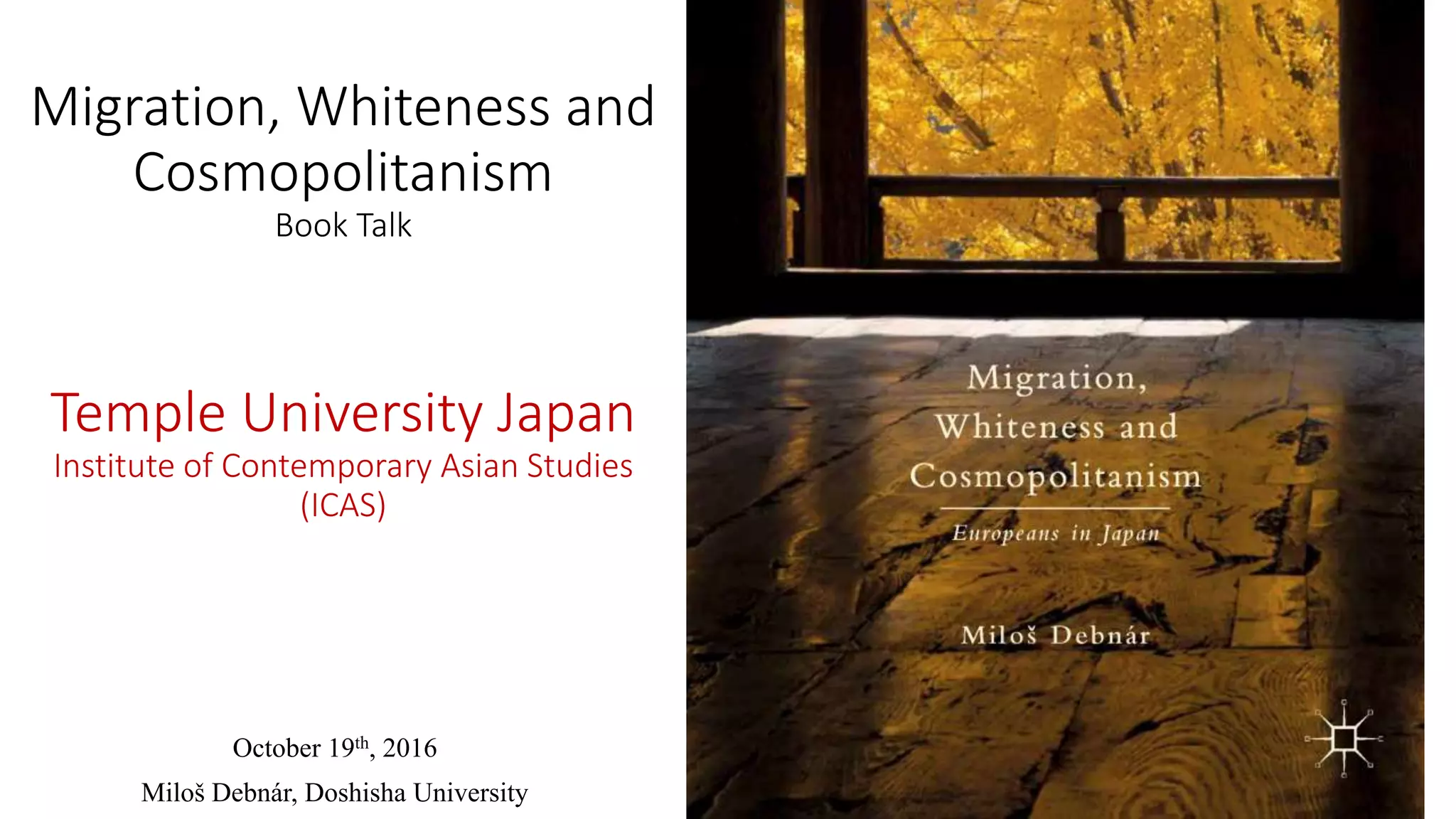

Temple University Japan
Institute of Contemporary Asian Studies
(ICAS)
October 19th, 2016
Miloš Debnár, Doshisha University
Migration, Whiteness and
Cosmopolitanism
Book Talk
Book contents
• 1 Introduction
• Part I Migration
• 2 European Migration to Japan:
Historical Roots and Recent
Development
• 3 Between Entertainers and
High-Skilled Elites: Skills, Study,
and Marriage
• Part II Integration and Privilege
• 4 Race and Privilege in
Integration: Occupations, White
Privilege, and Gender
• 5 White Privilege Revised:
White Man’s ‘Burden’ in
Japan
• Part III Cosmopolitanism
• 6 Integration and social
relations
• 7 Conclusions
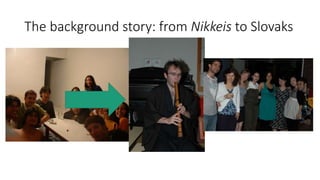
The background story: from Nikkeis to Slovaks
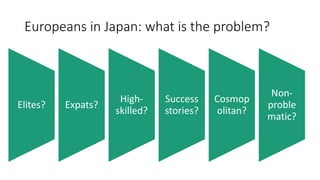
Europeans in Japan: what is the problem?
Elites? Expats?
High-
skilled?
Success
stories?
Cosmop
olitan?
Non-
proble
matic?
Views of migration
Traditional migration
• Victims of globalization
• Labor (low-skilled) migration,
family reunion etc.
• Lower class origin, South-North
mig.
• Rather closed ethnic
communities
Cosmopolitanism
• Winners of globalization
• High-skilled labor, free mobility,
etc.
• Upper-class origin, mig. from
North
• communities based on status
and world views
Transnationalism
• Empowered victims
• Low/semi-skilled migration,
family reunion etc.
• Lower to middle class origin
• More opened ethnic
communities
??
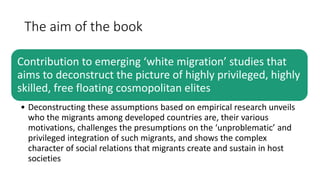
The aim of the book
Contribution to emerging ‘white migration’ studies that
aims to deconstruct the picture of highly privileged, highly
skilled, free floating cosmopolitan elites
• Deconstructing these assumptions based on empirical research unveils
who the migrants among developed countries are, their various
motivations, challenges the presumptions on the ‘unproblematic’ and
privileged integration of such migrants, and shows the complex
character of social relations that migrants create and sustain in host
societies
Part I MIGRATION
Chapter 2 European Migration to Japan: Historical Roots and Recent Development
Chapter 3 Between Entertainers and High-Skilled Elites: Skills, Study, and Marriage
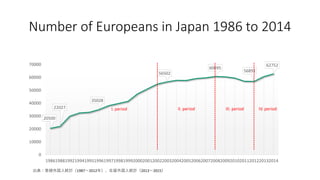
Number of Europeans in Japan 1986 to 2014
出典:登録外国人統計(1987~2012年)、在留外国人統計(2013~2015)
20500
22027
35028
56502
60695
56891
62752
0
10000
20000
30000
40000
50000
60000
70000
198619881992199419951996199719981999200020012002200320042005200620072008200920102011201220132014
III. period IV. periodII. periodI. period
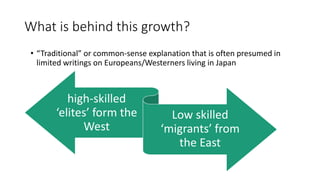
What is behind this growth?
• “Traditional” or common-sense explanation that is often presumed in
limited writings on Europeans/Westerners living in Japan
high-skilled
‘elites’ form the
West
Low skilled
‘migrants’ from
the East
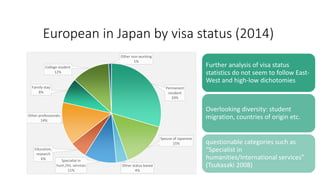
European in Japan by visa status (2014)
Further analysis of visa status
statistics do not seem to follow East-
West and high-low dichotomies
Overlooking diversity: student
migration, countries of origin etc.
questionable categories such as
“Specialist in
humanities/International services”
(Tsukasaki 2008)
Permanent
resident
29%
Spouse of Japanese
15%
Other status based
4%
Specialist in
hum./Int. services
11%
Education,
research
6%
Other professionals
14%
Family stay
8%
College student
12%
Other non-working
1%
Three propensities behind the European
migration to Japan
Propensity for a lifestyle
• Post-material values
• Lifestyle migration and middle class differentiation strategies
Propensity to move
• Mobility culture (Urry)
• Reflexive modernity (Beck, Giddens) and individualized societies (Bauman, Beck)
Propensity for Japan
• Interest in Japan preceding the decision to migrate
Part II INTEGRATION AND
PRIVILEGE
Chapter 4 Race and Privilege in Integration: Occupations, White Privilege, and
Gender
Chapter 5 White Privilege Revised: White Man’s ‘Burden’ in Japan
Whiteness and Japan: a complicated
relationship?
Positive perceptions of whiteness and the West:
• West was historically the most significant ‘other’ and it was the western notion of the race and racial
hierarchy that denied Japan to be recognized as a first-class nation (Majima 2014)
• The white skin color has pre-modern, positive connotations in Japan, although it seems to be
associated rather with Japanese (Wagatsuma 1967, Ashikari 2005)
• Western and other European countries rank high in terms of national prestige (Tanabe 2009)
At the same time
• Perceptions of Europe and the West in Japan have oscillated between overt admiration and denial
• Resentment towards the racial hierarchy imposed by the West can be seen not only in the open
confrontation of the Western powers, but also in modern anthropology (Oguma 2002), or popular
conceptualizations of the white skin color as a trait unique to Japanese
• Disbelief in the superiority of the Westerners (not exceeding 11% since late 1960s) and support of
the idea of superiority of Japanese (at least 30%-44%)
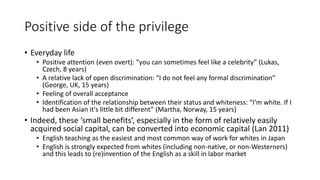
Positive side of the privilege
• Everyday life
• Positive attention (even overt): “you can sometimes feel like a celebrity” (Lukas,
Czech, 8 years)
• A relative lack of open discrimination: “I do not feel any formal discrimination”
(George, UK, 15 years)
• Feeling of overall acceptance
• Identification of the relationship between their status and whiteness: “I’m white. If I
had been Asian it's little bit different” (Martha, Norway, 15 years)
• Indeed, these ‘small benefits’, especially in the form of relatively easily
acquired social capital, can be converted into economic capital (Lan 2011)
• English teaching as the easiest and most common way of work for whites in Japan
• English is strongly expected from whites (including non-native, or non-Westerners)
and this leads to (re)invention of the English as a skill in labor market
Race, culture and the labor market
Everyday differentiation
• Accepted strangers means welcomed guests: “I consider myself a long-term guest” (John,
UK, 12 years)
• Discrimination: not common but present in blatant forms and is largely unpunishable
• Everyday differentiation in terms of race (positive and normative nuances of whiteness
allow for its blatant emphasis in everyday life), language, or cultural practices
These instances, however, have their consequences in the labor market
• Struggling high-skilled labor: in the discourse of ‘global’ (which is represented by ‘others’
and often primarily whites), the local is rendered in opposing terms and interconnected
with nationalism and self-orientalism what translates into a priori denial of the possibility
of connecting local with non-Japanese
Double-edged character of the white privilege: segmented occupational niches (Lan 2011)
• Cultural service workers: English and other cultural skills in a variety of occupations
• Lack of other alternatives: foreign companies, starting a business (Vasil, Sylvaine)
Inescapable niches
• Case of Michael, Germany, fluent in German, Japanese, English: Struggling to enter the hotel/restauration for a
long time, yet being accepted without hesitation as an English teacher
• Similar in the higher education: Anton, Ukraine, fluent in Japanese upon arrival, acquired PhD from a top Japanese
university in mathematics. Struggled to get ‘normal’ teaching job (i.e. teaching in Japanese to Japanese student as
he defines it) for more than 5 years (and countless applications), but was recommended for and straightforwardly
accepted for a ‘global’ job (i.e. within global initiative of his alma matter teaching in English and mainly to foreign
students)
Are these niches privileged?
Working conditions and job insecurity:
• English teacher: myth of high income (shift since 1980s/90s): “Some of the stupidest things I’ve
ever heard …[is that] the foreigners come here to work as English teachers, make millions of
dollars and take it back home with them. English teachers earn about 2,500 dollars a month
[and t]hey can barely scrape through rent” (interviewee in Storlöpare’s (2013) documentary)
• Precarious jobs in high education: tenure track positions vs. fixed-terms (Anton) or part-time
lecturer (Vincenzo) positions are growing within the neo-liberal transformations of higher
education
• Many subjects working in highly deregulated non-regular forms of employment: these are in
Japan seen as highly unstable, with low social prestige, and not promising (Genda 2005), or
even as representing underclass (Sugimoto 2010:42)
• Relatively high share of self-employed (also from census data on UK nationals)
White privilege or ‘burden’ of whiteness’?
• Limits to capital conversion
• Cultural skills and particularly English can be ‘successfully’ transformed into opportunities
• On the other hand, other forms of capital (e.g. high-skills, or knowledge as human capital) are
considerably more difficult to convert into job opportunities
• Inflexibility in terms of hiring age and routes, or the persistence of on-job training (Oishi
2012) devaluing prior skills or knowledge can be seen as negative factors, but arguably race
delimits expected social roles and positions of white Europeans in Japan and imposes
significant barriers to accessing others
• Their culture is commodified and consumed similarly to other ethnic minorities
• tabunka kyōsei (multiculturalism) policies are preoccupied with the so-called 3F - food,
festival and fashion - while avoiding promotion of more rights (Takezawa 2009, 2011a)
• Consumption of the foreign cultures is not a sign of Japan’s “subjective desire to
internationalize” but is “provoked by nationalist sentiments” (Clammer 1997:95) and
represents another vessel for nationalism in the age of globalization (see also Iwabuchi 1994)
Conclusions
Migration
• From high-skilled to skilled
• From migration of elites to migration as “normal” middle-class activity
• Increased diversity of factors shaping migration decisions
• ‘Hints’ for immigration policies?
Whiteness and privilege
• ‘Racial grammar’ and the experience of white migrants
• Discrimination of a positive minority or ‘white ululation’?
• Consequences for integration policies?

Public Lecture Presentation Slides (10.19.2016) Book talk Miloš Debnár: Europeans in Japan: Migration and Whiteness

  • 1.
    Temple University Japan Instituteof Contemporary Asian Studies (ICAS) October 19th, 2016 Miloš Debnár, Doshisha University Migration, Whiteness and Cosmopolitanism Book Talk
  • 2.
    Book contents • 1Introduction • Part I Migration • 2 European Migration to Japan: Historical Roots and Recent Development • 3 Between Entertainers and High-Skilled Elites: Skills, Study, and Marriage • Part II Integration and Privilege • 4 Race and Privilege in Integration: Occupations, White Privilege, and Gender • 5 White Privilege Revised: White Man’s ‘Burden’ in Japan • Part III Cosmopolitanism • 6 Integration and social relations • 7 Conclusions
  • 3.
    The background story:from Nikkeis to Slovaks
  • 4.
    Europeans in Japan:what is the problem? Elites? Expats? High- skilled? Success stories? Cosmop olitan? Non- proble matic?
  • 5.
    Views of migration Traditionalmigration • Victims of globalization • Labor (low-skilled) migration, family reunion etc. • Lower class origin, South-North mig. • Rather closed ethnic communities Cosmopolitanism • Winners of globalization • High-skilled labor, free mobility, etc. • Upper-class origin, mig. from North • communities based on status and world views Transnationalism • Empowered victims • Low/semi-skilled migration, family reunion etc. • Lower to middle class origin • More opened ethnic communities ??
  • 6.
    The aim ofthe book Contribution to emerging ‘white migration’ studies that aims to deconstruct the picture of highly privileged, highly skilled, free floating cosmopolitan elites • Deconstructing these assumptions based on empirical research unveils who the migrants among developed countries are, their various motivations, challenges the presumptions on the ‘unproblematic’ and privileged integration of such migrants, and shows the complex character of social relations that migrants create and sustain in host societies
  • 7.
    Part I MIGRATION Chapter2 European Migration to Japan: Historical Roots and Recent Development Chapter 3 Between Entertainers and High-Skilled Elites: Skills, Study, and Marriage
  • 8.
    Number of Europeansin Japan 1986 to 2014 出典:登録外国人統計(1987~2012年)、在留外国人統計(2013~2015) 20500 22027 35028 56502 60695 56891 62752 0 10000 20000 30000 40000 50000 60000 70000 198619881992199419951996199719981999200020012002200320042005200620072008200920102011201220132014 III. period IV. periodII. periodI. period
  • 9.
    What is behindthis growth? • “Traditional” or common-sense explanation that is often presumed in limited writings on Europeans/Westerners living in Japan high-skilled ‘elites’ form the West Low skilled ‘migrants’ from the East
  • 10.
    European in Japanby visa status (2014) Further analysis of visa status statistics do not seem to follow East- West and high-low dichotomies Overlooking diversity: student migration, countries of origin etc. questionable categories such as “Specialist in humanities/International services” (Tsukasaki 2008) Permanent resident 29% Spouse of Japanese 15% Other status based 4% Specialist in hum./Int. services 11% Education, research 6% Other professionals 14% Family stay 8% College student 12% Other non-working 1%
  • 11.
    Three propensities behindthe European migration to Japan Propensity for a lifestyle • Post-material values • Lifestyle migration and middle class differentiation strategies Propensity to move • Mobility culture (Urry) • Reflexive modernity (Beck, Giddens) and individualized societies (Bauman, Beck) Propensity for Japan • Interest in Japan preceding the decision to migrate
  • 12.
    Part II INTEGRATIONAND PRIVILEGE Chapter 4 Race and Privilege in Integration: Occupations, White Privilege, and Gender Chapter 5 White Privilege Revised: White Man’s ‘Burden’ in Japan
  • 13.
    Whiteness and Japan:a complicated relationship? Positive perceptions of whiteness and the West: • West was historically the most significant ‘other’ and it was the western notion of the race and racial hierarchy that denied Japan to be recognized as a first-class nation (Majima 2014) • The white skin color has pre-modern, positive connotations in Japan, although it seems to be associated rather with Japanese (Wagatsuma 1967, Ashikari 2005) • Western and other European countries rank high in terms of national prestige (Tanabe 2009) At the same time • Perceptions of Europe and the West in Japan have oscillated between overt admiration and denial • Resentment towards the racial hierarchy imposed by the West can be seen not only in the open confrontation of the Western powers, but also in modern anthropology (Oguma 2002), or popular conceptualizations of the white skin color as a trait unique to Japanese • Disbelief in the superiority of the Westerners (not exceeding 11% since late 1960s) and support of the idea of superiority of Japanese (at least 30%-44%)
  • 14.
    Positive side ofthe privilege • Everyday life • Positive attention (even overt): “you can sometimes feel like a celebrity” (Lukas, Czech, 8 years) • A relative lack of open discrimination: “I do not feel any formal discrimination” (George, UK, 15 years) • Feeling of overall acceptance • Identification of the relationship between their status and whiteness: “I’m white. If I had been Asian it's little bit different” (Martha, Norway, 15 years) • Indeed, these ‘small benefits’, especially in the form of relatively easily acquired social capital, can be converted into economic capital (Lan 2011) • English teaching as the easiest and most common way of work for whites in Japan • English is strongly expected from whites (including non-native, or non-Westerners) and this leads to (re)invention of the English as a skill in labor market
  • 15.
    Race, culture andthe labor market Everyday differentiation • Accepted strangers means welcomed guests: “I consider myself a long-term guest” (John, UK, 12 years) • Discrimination: not common but present in blatant forms and is largely unpunishable • Everyday differentiation in terms of race (positive and normative nuances of whiteness allow for its blatant emphasis in everyday life), language, or cultural practices These instances, however, have their consequences in the labor market • Struggling high-skilled labor: in the discourse of ‘global’ (which is represented by ‘others’ and often primarily whites), the local is rendered in opposing terms and interconnected with nationalism and self-orientalism what translates into a priori denial of the possibility of connecting local with non-Japanese
  • 16.
    Double-edged character ofthe white privilege: segmented occupational niches (Lan 2011) • Cultural service workers: English and other cultural skills in a variety of occupations • Lack of other alternatives: foreign companies, starting a business (Vasil, Sylvaine) Inescapable niches • Case of Michael, Germany, fluent in German, Japanese, English: Struggling to enter the hotel/restauration for a long time, yet being accepted without hesitation as an English teacher • Similar in the higher education: Anton, Ukraine, fluent in Japanese upon arrival, acquired PhD from a top Japanese university in mathematics. Struggled to get ‘normal’ teaching job (i.e. teaching in Japanese to Japanese student as he defines it) for more than 5 years (and countless applications), but was recommended for and straightforwardly accepted for a ‘global’ job (i.e. within global initiative of his alma matter teaching in English and mainly to foreign students)
  • 17.
    Are these nichesprivileged? Working conditions and job insecurity: • English teacher: myth of high income (shift since 1980s/90s): “Some of the stupidest things I’ve ever heard …[is that] the foreigners come here to work as English teachers, make millions of dollars and take it back home with them. English teachers earn about 2,500 dollars a month [and t]hey can barely scrape through rent” (interviewee in Storlöpare’s (2013) documentary) • Precarious jobs in high education: tenure track positions vs. fixed-terms (Anton) or part-time lecturer (Vincenzo) positions are growing within the neo-liberal transformations of higher education • Many subjects working in highly deregulated non-regular forms of employment: these are in Japan seen as highly unstable, with low social prestige, and not promising (Genda 2005), or even as representing underclass (Sugimoto 2010:42) • Relatively high share of self-employed (also from census data on UK nationals)
  • 18.
    White privilege or‘burden’ of whiteness’? • Limits to capital conversion • Cultural skills and particularly English can be ‘successfully’ transformed into opportunities • On the other hand, other forms of capital (e.g. high-skills, or knowledge as human capital) are considerably more difficult to convert into job opportunities • Inflexibility in terms of hiring age and routes, or the persistence of on-job training (Oishi 2012) devaluing prior skills or knowledge can be seen as negative factors, but arguably race delimits expected social roles and positions of white Europeans in Japan and imposes significant barriers to accessing others • Their culture is commodified and consumed similarly to other ethnic minorities • tabunka kyōsei (multiculturalism) policies are preoccupied with the so-called 3F - food, festival and fashion - while avoiding promotion of more rights (Takezawa 2009, 2011a) • Consumption of the foreign cultures is not a sign of Japan’s “subjective desire to internationalize” but is “provoked by nationalist sentiments” (Clammer 1997:95) and represents another vessel for nationalism in the age of globalization (see also Iwabuchi 1994)
  • 19.
    Conclusions Migration • From high-skilledto skilled • From migration of elites to migration as “normal” middle-class activity • Increased diversity of factors shaping migration decisions • ‘Hints’ for immigration policies? Whiteness and privilege • ‘Racial grammar’ and the experience of white migrants • Discrimination of a positive minority or ‘white ululation’? • Consequences for integration policies?