A LIBRARY SOCIAL MEDIA
MANIFESTO
@ned_potter
#VALA2022
Social Media is
problematic in all sorts
of ways, but as library
marketers it is perhaps
the greatest opportunity
we’ve ever been given.
We get to go to where our
audience are and converse
with them, inform them,
and entertain them –
perhaps breaking down
some barriers too.
From Statista.
The numbers go
up and up – we
can be confident
that time invested
in social media is
worth it…
Active social media users as percentage of the total population
in Australia from 2015 to 2021
Despite all these
positives, it’s actually
very easy to social media
without ever asking:
why are we there?
What is it that we, as
organisations, are trying
to achieve by being on
social media?
we will have
PURPOSE
Often (always?) library social media
presences are built the wrong way up:
join a platform, find a use.
Ideally it would happen the other way
around – an obvious user need would
present itself, with a social media
platform being the best way to fulfil it.
Often (always?) library social media
presences are built the wrong way up:
join a platform, find a use.
Ideally it would happen the other way
around – an obvious user need would
present itself, with a social media
platform being the best way to fulfil it.
It’s not too late to do this – we all just
need time and space to think about it.
Keeping users up to date with news & events Getting user feedback
Improving the library’s reputation / brand Answering questions
Making the library more informal / fun /
approachable
Recruiting new users
Keeping the library in the mind of existing
users
Promoting specific services
Promoting resources / collections Engaging the users in dialogue
Being part of a wider conversation Critical service updates during the pandemic
Supporting your library’s marketing plan Increasing awareness of what the library does
Instigating partnerships Marketing upwards (to funders / parent org]
Tips, tricks, and hacks Providing something light, fun, and distracting
[intentionally left blank: you’ll probably be able to think of some great
reasons I’ve not listed here…]
PICK FIVE:
MAKE THESE YOUR FOCUS
A simple way to refresh and reenergise your social
media is to establish its purpose. Wipe the slate clean
and work out your goals - then aim squarely
at them.
Your users will benefit from that intention too. Focus
and momentum count for a lot in social media –
when you become known for something, your job
becomes easier.
we will
Coordinate
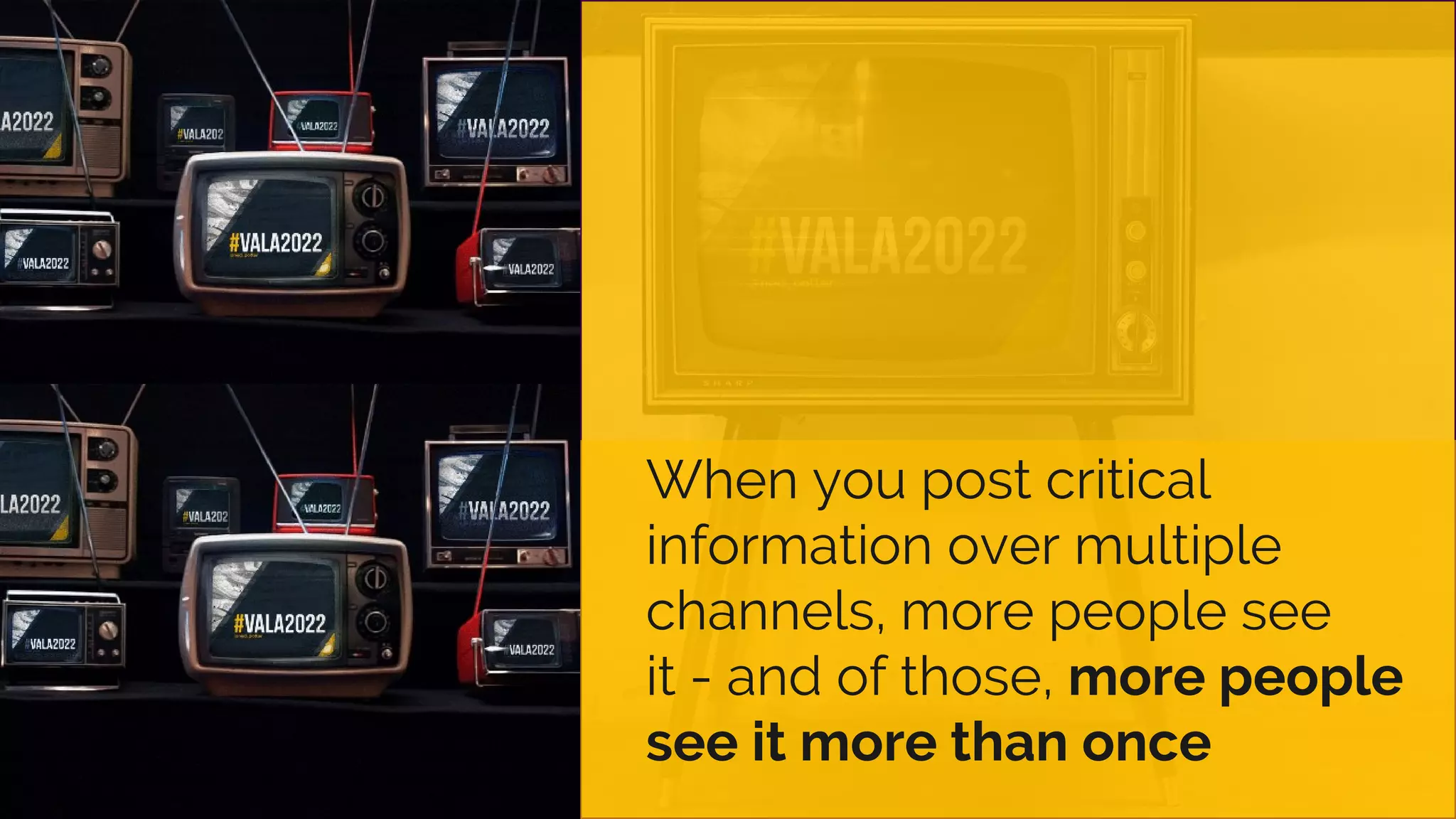
When you post critical
information over multiple
channels, more people see
it - and of those, more people
see it more than once
The aim is not
to produce
identical
content for
every
platform, but
variations of
the same
message,
adapted to
suit.
Because
different
parts of our
community
are on
different
platforms.
How do we
know which
ones?
83
79
71
60
43
19
1
3
8
15
25
24
4
7
6
8
6
5
0% 10% 20% 30% 40% 50% 60% 70% 80% 90% 100%
Aged 65+
Aged 55-64
Aged 45-54
Aged 35-44
Aged 25-34
Aged 16-24
Which social network do you use most often? Data adapted From Statista.
Generally speaking…
Fairly universal. 3rd most popular site on the internet, so your users ARE there.
Video is really useful tool but needs proper promotion to be worth the time it takes
Still the most popular social network by miles. Increasingly deserted by younger
people. Use this: specifically aim your FB content towards older demographics.
By far the most even spread among age groups of all the major social networks,
but most popular among 35-44 year olds. Great for interaction and dialogue.
Growing all the time, increasingly important for libraries and worth putting time
into. Useful for all age groups but especially for younger people.
Completely skewed towards 16-24 bracket, very hard to do well without appearing
on camera… You need someone know KNOWS TikTok to do this well. See
@toonlibraries for inspiration, but personally I’d be prioritising Instagram over this!
So strategise. We only have so much time to
spend on social media – which platform needs a
higher percentage of your attention?
Factors to consider:
1) Your strategic priorities: in particular which demographics are you most
interested in engaging? (Top tip: prioritise the ones where you can make
the most tangible gains!)
2) Historic prioritisation. Is your FaceBook page 15 years old and incredibly
successful? If so it may be time to divert more energy to a platform which
hasn’t benefited from so much work already.
Keeping users up to date with news & events Getting user feedback
Improving the library’s reputation / brand Answering questions
Making the library more informal / fun /
approachable
Recruiting new users
Keeping the library in the mind of existing
users
Promoting specific services
Promoting resources / collections Engaging the users in dialogue
Being part of a wider conversation Critical service updates during the pandemic
Supporting your library’s marketing plan Increasing awareness of what the library does
Instigating partnerships Marketing upwards (to funders / parent org]
Tips, tricks, and hacks Providing something light, fun, and distracting
Are certain platforms more important for certain aims?
Which of the aims below would be a focus for Twitter? Which for
Facebook, which for Insta and which for YouTube? (NB: I’ve put examples
below – there is no ‘correct’ answer to this)
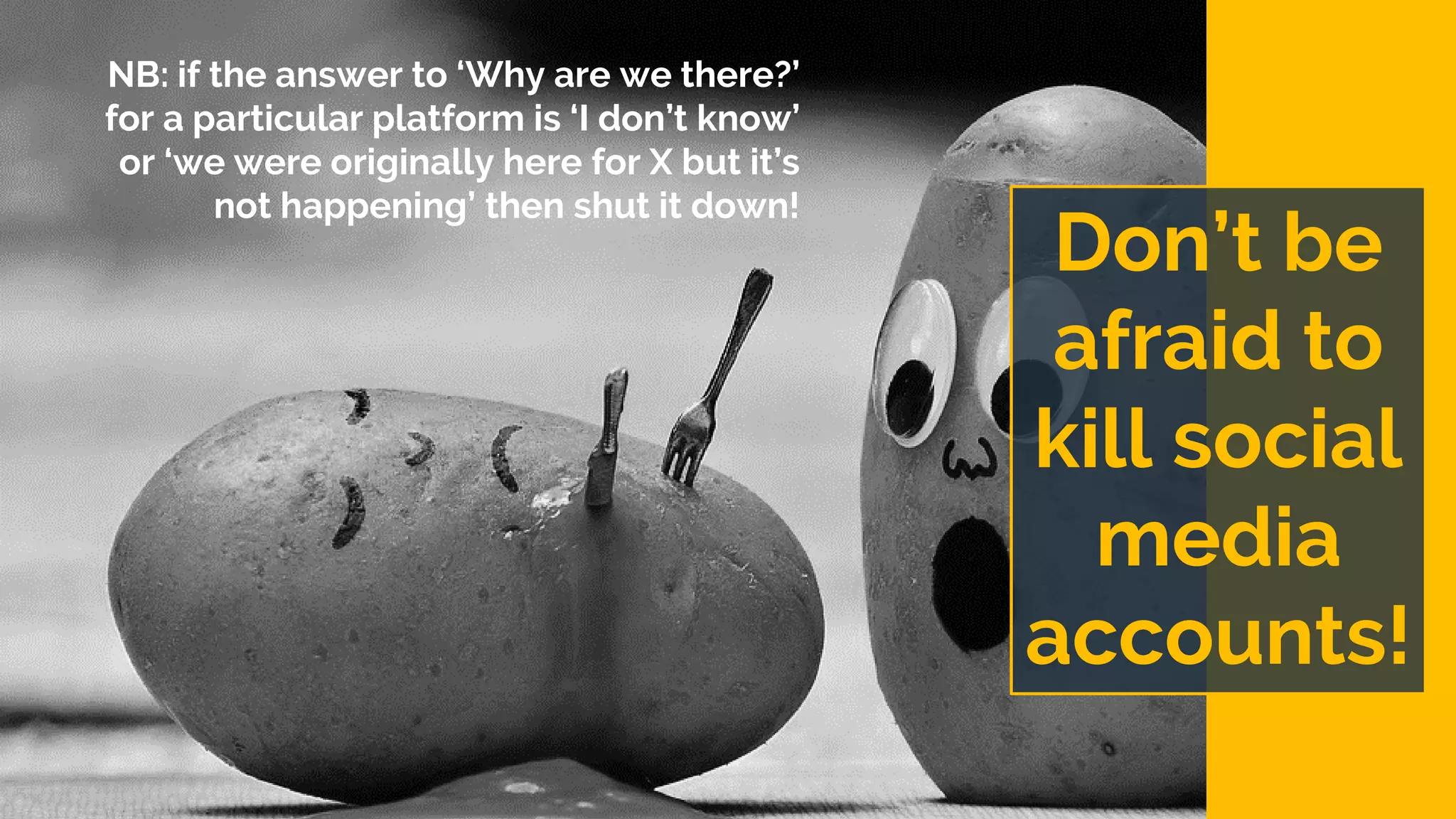
Don’t be
afraid to
kill social
media
accounts!
NB: if the answer to ‘Why are we there?’
for a particular platform is ‘I don’t know’
or ‘we were originally here for X but it’s
not happening’ then shut it down!
we will show
PERSONALITY
Consistency
is overrated.
more than one
personality
beats no personality
Social media is
mostly ephemeral.
There is simply so much of
it that it constantly buries
itself. This means taking
risks on social media is not
like taking this sort of risk…
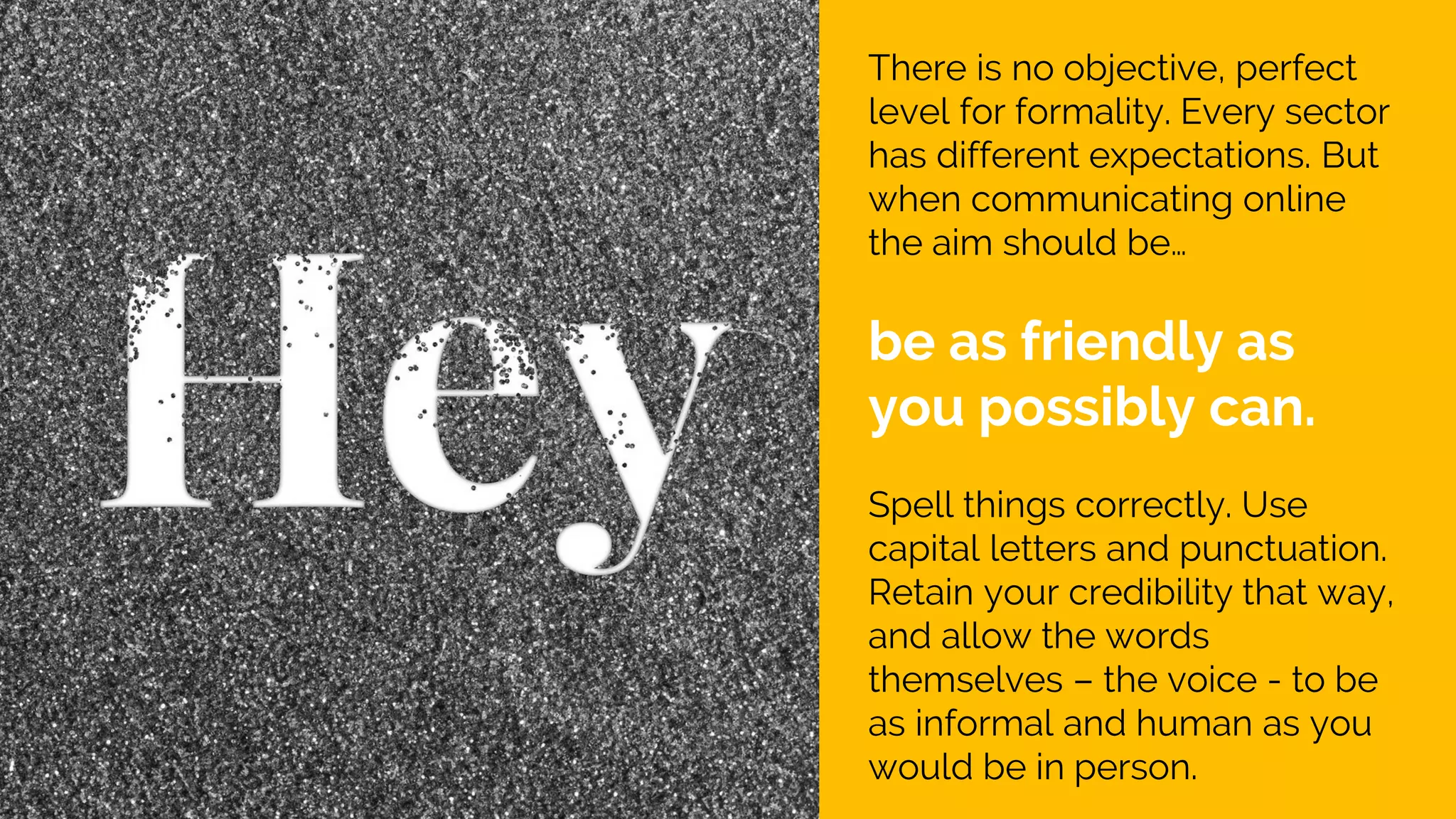
There is no objective, perfect
level for formality. Every sector
has different expectations. But
when communicating online
the aim should be…
be as friendly as
you possibly can.
Spell things correctly. Use
capital letters and punctuation.
Retain your credibility that way,
and allow the words
themselves – the voice - to be
as informal and human as you
would be in person.
An unscientific study
of popular posts.
TAKING OPPORTUNITIES FOR LEVITY…
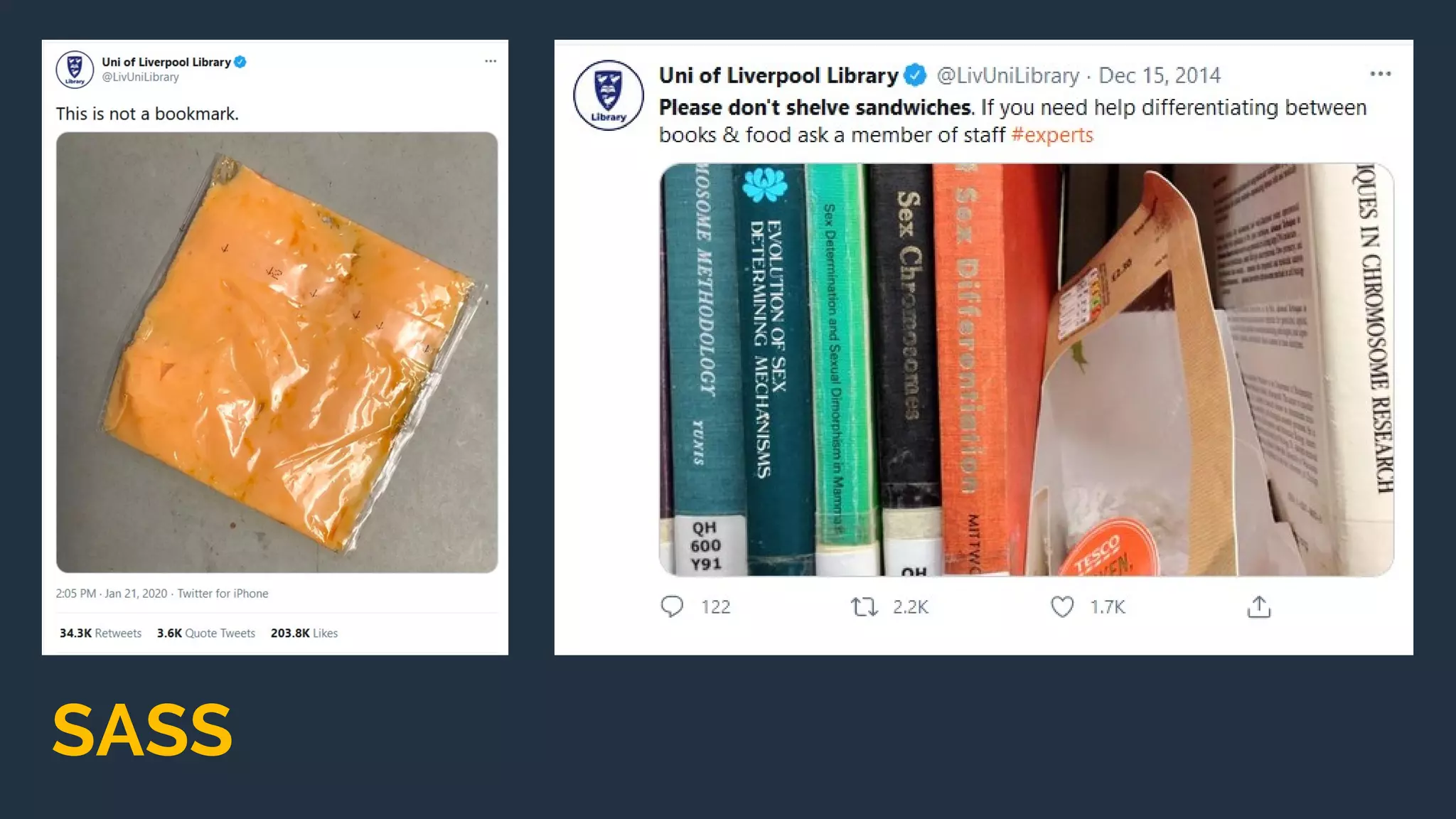
SASS
WHIMSY
Virality isn’t the aim.
Engaging your community is the aim.
KEEP IN MIND…
If you do this with sincerity, or humour, or sass,
or whimsy, or grabbing opportunities when they
arise, going viral may be a happy by-product. But
the aim is to use these techniques to engage your
particular audience, and increase the chances
they’ll pass your messages on to their peers.
we will
empathise
So what?
Would I act
on this if it
was all the
info I had?
What does it
take to make
me change
my plans?
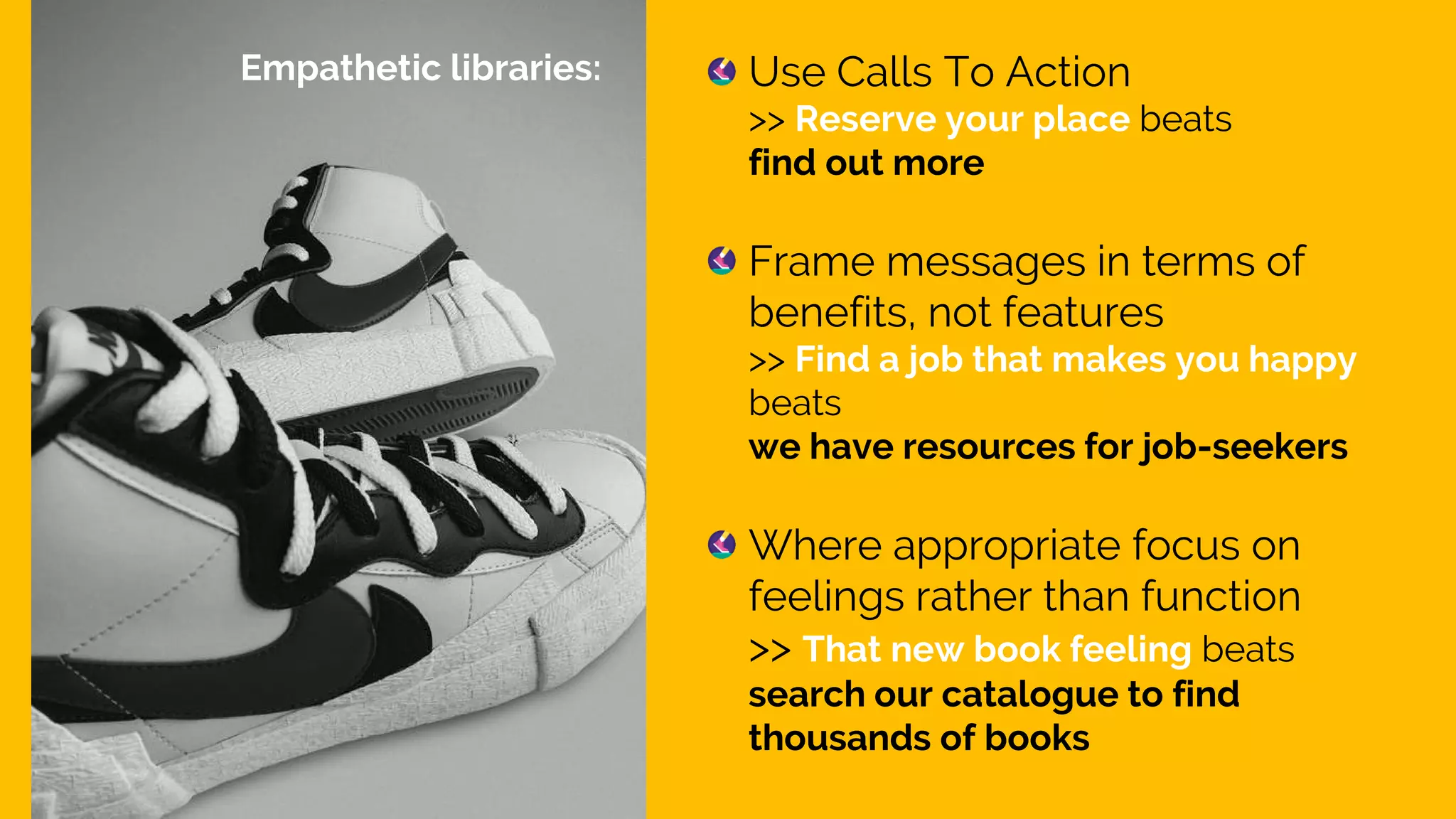
Empathetic libraries: Use Calls To Action
>> Reserve your place beats
find out more
Frame messages in terms of
benefits, not features
>> Find a job that makes you happy
beats
we have resources for job-seekers
Where appropriate focus on
feelings rather than function
>> That new book feeling beats
search our catalogue to find
thousands of books
Empathetic libraries: Don’t duplicate messages
>> Adapt your messages across the
different social media platforms
Use the platforms as the users
wish them to
>> For example, use Instagram Stories
for News and the Grid for soft-
marketing. Use Twitter for
conversation not just broadcasting
Learn from their users
>> You don’t need to be an Analytics
guru to be responsive to your
community – their actions will tell
you what they do and don’t like!
we will
ANALYSE
A word on
comparative metrics…
The only comparisons
which matter are A)
your Facebook*
metrics versus your
previous and future FB
metrics and B) the
engagement you get
on FB versus the other
ways YOU
communicate…
*Same goes for Twitter,
Instagram, YouTube
Don’t let analytics overwhelm you.
You only need to learn enough to say: our community appears to
engage more with this, and less with that.
Twitter Analytics, Facebook Business Suite (for FB and Insta) and
YouTube Analytics are free and are simple enough that any of us
can get – forgive me – actionable insights from 10 minutes’ work…
The easiest way to
improve your
Instagram
engagement is to
check the Likes and
learn from them. That’s
it. You need Likes for
your own audience to
get shown your pics, so
unless there’s a good
reason not to, it’s best
to do more of the things
your audience responds
best to. It’s that simple.
Our
manifesto
in full
Thank you for having me #VALA2022!
ned-potter.com
@ned_potter

A library social media manifesto | #VALA2022

  • 1.
    A LIBRARY SOCIALMEDIA MANIFESTO @ned_potter #VALA2022
  • 2.
    Social Media is problematicin all sorts of ways, but as library marketers it is perhaps the greatest opportunity we’ve ever been given. We get to go to where our audience are and converse with them, inform them, and entertain them – perhaps breaking down some barriers too.
  • 3.
    From Statista. The numbersgo up and up – we can be confident that time invested in social media is worth it… Active social media users as percentage of the total population in Australia from 2015 to 2021
  • 4.
    Despite all these positives,it’s actually very easy to social media without ever asking: why are we there? What is it that we, as organisations, are trying to achieve by being on social media?
  • 5.
  • 6.
    Often (always?) librarysocial media presences are built the wrong way up: join a platform, find a use. Ideally it would happen the other way around – an obvious user need would present itself, with a social media platform being the best way to fulfil it.
  • 7.
    Often (always?) librarysocial media presences are built the wrong way up: join a platform, find a use. Ideally it would happen the other way around – an obvious user need would present itself, with a social media platform being the best way to fulfil it. It’s not too late to do this – we all just need time and space to think about it.
  • 8.
    Keeping users upto date with news & events Getting user feedback Improving the library’s reputation / brand Answering questions Making the library more informal / fun / approachable Recruiting new users Keeping the library in the mind of existing users Promoting specific services Promoting resources / collections Engaging the users in dialogue Being part of a wider conversation Critical service updates during the pandemic Supporting your library’s marketing plan Increasing awareness of what the library does Instigating partnerships Marketing upwards (to funders / parent org] Tips, tricks, and hacks Providing something light, fun, and distracting [intentionally left blank: you’ll probably be able to think of some great reasons I’ve not listed here…] PICK FIVE: MAKE THESE YOUR FOCUS
  • 9.
    A simple wayto refresh and reenergise your social media is to establish its purpose. Wipe the slate clean and work out your goals - then aim squarely at them. Your users will benefit from that intention too. Focus and momentum count for a lot in social media – when you become known for something, your job becomes easier.
  • 10.
  • 11.
    When you postcritical information over multiple channels, more people see it - and of those, more people see it more than once
  • 12.
    The aim isnot to produce identical content for every platform, but variations of the same message, adapted to suit.
  • 13.
    Because different parts of our community areon different platforms. How do we know which ones?
  • 14.
    83 79 71 60 43 19 1 3 8 15 25 24 4 7 6 8 6 5 0% 10% 20%30% 40% 50% 60% 70% 80% 90% 100% Aged 65+ Aged 55-64 Aged 45-54 Aged 35-44 Aged 25-34 Aged 16-24 Which social network do you use most often? Data adapted From Statista.
  • 15.
    Generally speaking… Fairly universal.3rd most popular site on the internet, so your users ARE there. Video is really useful tool but needs proper promotion to be worth the time it takes Still the most popular social network by miles. Increasingly deserted by younger people. Use this: specifically aim your FB content towards older demographics. By far the most even spread among age groups of all the major social networks, but most popular among 35-44 year olds. Great for interaction and dialogue. Growing all the time, increasingly important for libraries and worth putting time into. Useful for all age groups but especially for younger people. Completely skewed towards 16-24 bracket, very hard to do well without appearing on camera… You need someone know KNOWS TikTok to do this well. See @toonlibraries for inspiration, but personally I’d be prioritising Instagram over this!
  • 16.
    So strategise. Weonly have so much time to spend on social media – which platform needs a higher percentage of your attention? Factors to consider: 1) Your strategic priorities: in particular which demographics are you most interested in engaging? (Top tip: prioritise the ones where you can make the most tangible gains!) 2) Historic prioritisation. Is your FaceBook page 15 years old and incredibly successful? If so it may be time to divert more energy to a platform which hasn’t benefited from so much work already.
  • 17.
    Keeping users upto date with news & events Getting user feedback Improving the library’s reputation / brand Answering questions Making the library more informal / fun / approachable Recruiting new users Keeping the library in the mind of existing users Promoting specific services Promoting resources / collections Engaging the users in dialogue Being part of a wider conversation Critical service updates during the pandemic Supporting your library’s marketing plan Increasing awareness of what the library does Instigating partnerships Marketing upwards (to funders / parent org] Tips, tricks, and hacks Providing something light, fun, and distracting Are certain platforms more important for certain aims? Which of the aims below would be a focus for Twitter? Which for Facebook, which for Insta and which for YouTube? (NB: I’ve put examples below – there is no ‘correct’ answer to this)
  • 18.
    Don’t be afraid to killsocial media accounts! NB: if the answer to ‘Why are we there?’ for a particular platform is ‘I don’t know’ or ‘we were originally here for X but it’s not happening’ then shut it down!
  • 19.
  • 20.
  • 21.
  • 23.
    Social media is mostlyephemeral. There is simply so much of it that it constantly buries itself. This means taking risks on social media is not like taking this sort of risk…
  • 24.
    There is noobjective, perfect level for formality. Every sector has different expectations. But when communicating online the aim should be… be as friendly as you possibly can. Spell things correctly. Use capital letters and punctuation. Retain your credibility that way, and allow the words themselves – the voice - to be as informal and human as you would be in person.
  • 25.
    An unscientific study ofpopular posts. TAKING OPPORTUNITIES FOR LEVITY…
  • 26.
  • 27.
  • 28.
    Virality isn’t theaim. Engaging your community is the aim. KEEP IN MIND… If you do this with sincerity, or humour, or sass, or whimsy, or grabbing opportunities when they arise, going viral may be a happy by-product. But the aim is to use these techniques to engage your particular audience, and increase the chances they’ll pass your messages on to their peers.
  • 29.
  • 30.
    So what? Would Iact on this if it was all the info I had? What does it take to make me change my plans?
  • 31.
    Empathetic libraries: UseCalls To Action >> Reserve your place beats find out more Frame messages in terms of benefits, not features >> Find a job that makes you happy beats we have resources for job-seekers Where appropriate focus on feelings rather than function >> That new book feeling beats search our catalogue to find thousands of books
  • 32.
    Empathetic libraries: Don’tduplicate messages >> Adapt your messages across the different social media platforms Use the platforms as the users wish them to >> For example, use Instagram Stories for News and the Grid for soft- marketing. Use Twitter for conversation not just broadcasting Learn from their users >> You don’t need to be an Analytics guru to be responsive to your community – their actions will tell you what they do and don’t like!
  • 33.
  • 34.
    A word on comparativemetrics… The only comparisons which matter are A) your Facebook* metrics versus your previous and future FB metrics and B) the engagement you get on FB versus the other ways YOU communicate… *Same goes for Twitter, Instagram, YouTube
  • 35.
    Don’t let analyticsoverwhelm you. You only need to learn enough to say: our community appears to engage more with this, and less with that. Twitter Analytics, Facebook Business Suite (for FB and Insta) and YouTube Analytics are free and are simple enough that any of us can get – forgive me – actionable insights from 10 minutes’ work…
  • 36.
    The easiest wayto improve your Instagram engagement is to check the Likes and learn from them. That’s it. You need Likes for your own audience to get shown your pics, so unless there’s a good reason not to, it’s best to do more of the things your audience responds best to. It’s that simple.
  • 37.
  • 38.
    Thank you forhaving me #VALA2022! ned-potter.com @ned_potter