Hello.
© Coinmen Consultants LLP
EMERGING TRENDS
© Coinmen Consultants LLP
India : Emerging trends
Emerging Trends in Finance, Tax and Regulatory Framework
11 May 2018
EMERGING TRENDS
© Coinmen Consultants LLP
EMERGING TRENDS
4
MACRO PERSPECTIVE
 Realignment of global economy – focus on India
 GDP growth of 7-7.5% in last three years
– Focus on certain key sectors and initiatives
 Ease of doing business or lack of it – determinantal to investments
– India moves up 30 spots in ease of doing business (130th to 100th spot): World Bank’s report
– Alignment with international best practices
 Tax structure remains complex
© Coinmen Consultants LLP
EMERGING TRENDS
5
LANDMARK INITIATIVES
Digitisation drive
 Processes being run online
 Efforts being made to continuously digitise the economy
Historic tax reform
 GST turned entire India into one common market
 ‘Indian Customs Single Window Project’ to facilitate trade put in place
 Start-ups within INR10 cr. share capital threshold, exempted from angel tax
New insolvency code
 Consolidation of regulations regarding insolvency into a single legislation
 Promotes entrepreneurship, investors confidence and increases availability of credit, by strengthening procedures
© Coinmen Consultants LLP
EMERGING TRENDS
6
LANDMARK INITIATIVES
Further easing of FDI policy
 FDI liberalization in 87 policy areas across 21 sectors is paying off
 Most sectors now are under automatic route
 Sectoral caps across major sectors including defence, aviation, single brand retail trading increased to 100%
Institutional reforms
 Jan Dhan Yojana - making banking, remittance, and insurance services available to every Indian at affordable cost
 Aadhaar biometric identification
Infrastructure push
 New railway lines constructed
 5 new industrial corridors coming up
 Rural India electrified
© Coinmen Consultants LLP
EMERGING TRENDS
7
LANDMARK INITIATIVES
Renewable energy
 India is World #4 in terms of installed capacity to harness power from wind
 World #6 in terms of installed solar power capacity
 Operations to enhance wind power, solar power, biomass power and small hydro power capabilities put in place
Unearthing black money
 Demonetisation
 Increased focus on tax compliance
 Widening of tax net
© Coinmen Consultants LLP
EMERGING TRENDS
8
INDIAN TAX AND REGULATORY ENVIRONMENT
Indian tax and regulatory system – A myriad of complex regulations
 Key challenges:
– Multiple compliances
– Time consuming processes
– Little coherence with International tax practices
– Long drawn litigations
 Latest trends suggests government working on improvement in all areas
© Coinmen Consultants LLP
Ease of doing business in India
EMERGING TRENDS
© Coinmen Consultants LLP
EMERGING TRENDS
10
CORPORATE LAW
 One form - “SPICE”, for simplified Incorporation procedure under (including PAN/TAN)
 Name reservation process now online - “RUN” (Reserve Unique Name)
 Process of incorporation to be completed within 20 days
 No Minimum Share capital
 Earlier restriction on participation of directors in Board meetings through video conferencing eased
 Fast Track Merger put in place - Holding Co and WoS or two or more small companies
 WoS can conduct their EGM outside India which was initially restricted (yet to be notified)
© Coinmen Consultants LLP
EMERGING TRENDS
11
LIBERALIZATION IN FOREIGN EXCHANGE POLICY
Single brand retail trading
 100% FDI under the automatic route permitted
 Foreign companies given 5 years to comply with the local sourcing requirements
 New definition of ‘incremental sourcing’
FDI in Investment/ Holding cos.
 Foreign investment into an Indian company, engaged only in the activity of investing in the capital of other Indian
companies / limited liability partnerships and in ‘Core Investing Companies’ has been liberalized
 Companies regulated by financial sector regulator: 100% FDI under the automatic route
 Companies not regulated/ part regulated by financial sector regulator: 100% FDI under the approval route
Changes in ECB scenario
 End use prescriptions norms altered: Now common negative list for all tracks (with few exceptions)
 Expansion of eligible borrowers list
© Coinmen Consultants LLP
EMERGING TRENDS
12
DIGITIZATION IN TAX MATTERS
 Initiation of e-assessment proceedings
– Assessment to be done in electronic mode;
– Endeavour to make the process faceless, nameless and paperless
 Selection of majority cases for scrutiny done primarily through Computer Aided Scrutiny Selection (CASS);
– Manual selection for scrutiny limited
 Filings are done online
 Risk based case selection for assessments
 E-Biz portal: One-stop clearance platform for investment proposals, Government to business portal put in place
© Coinmen Consultants LLP
EMERGING TRENDS
13
CERTAINTY IN TAX POSITIONS
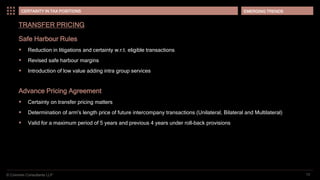
TRANSFER PRICING
Safe Harbour Rules
 Reduction in litigations and certainty w.r.t. eligible transactions
 Revised safe harbour margins
 Introduction of low value adding intra group services
Advance Pricing Agreement
 Certainty on transfer pricing matters
 Determination of arm's length price of future intercompany transactions (Unilateral, Bilateral and Multilateral)
 Valid for a maximum period of 5 years and previous 4 years under roll-back provisions
© Coinmen Consultants LLP
EMERGING TRENDS
14
CERTAINTY IN TAX POSITIONS
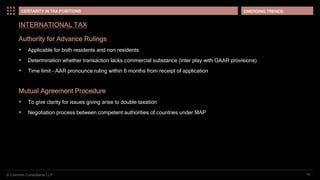
INTERNATIONAL TAX
Authority for Advance Rulings
 Applicable for both residents and non residents
 Determination whether transaction lacks commercial substance (inter play with GAAR provisions)
 Time limit – AAR pronounce ruling within 6 months from receipt of application
Mutual Agreement Procedure
 To give clarity for issues giving arise to double taxation
 Negotiation process between competent authorities of countries under MAP
© Coinmen Consultants LLP
Coherence with International Standards
EMERGING TRENDS
© Coinmen Consultants LLP
EMERGING TRENDS
16
BASE EROSION AND PROFIT SHIFTING
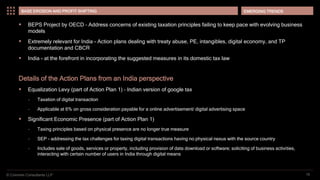
 BEPS Project by OECD – Address concerns of existing taxation principles failing to keep pace with evolving business
models
 Extremely relevant for India - Action plans dealing with treaty abuse, PE, intangibles, digital economy, and TP
documentation and CBCR
 India - at the forefront in incorporating the suggested measures in its domestic tax law
Details of the Action Plans from an India perspective
 Equalization Levy (part of Action Plan 1) – Indian version of google tax
– Taxation of digital transaction
– Applicable at 6% on gross consideration payable for a online advertisement/ digital advertising space
 Significant Economic Presence (part of Action Plan 1)
– Taxing principles based on physical presence are no longer true measure
– SEP - addressing the tax challenges for taxing digital transactions having no physical nexus with the source country
– Includes sale of goods, services or property, including provision of data download or software; soliciting of business activities,
interacting with certain number of users in India through digital means
© Coinmen Consultants LLP
EMERGING TRENDS
17
BASE EROSION AND PROFIT SHIFTING (BEPS)
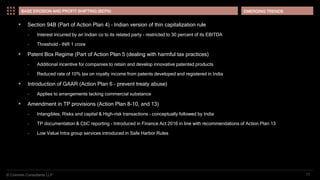
 Section 94B (Part of Action Plan 4) – Indian version of thin capitalization rule
– Interest incurred by an Indian co to its related party - restricted to 30 percent of its EBITDA
– Threshold – INR 1 crore
 Patent Box Regime (Part of Action Plan 5 (dealing with harmful tax practices)
– Additional incentive for companies to retain and develop innovative patented products
– Reduced rate of 10% tax on royalty income from patents developed and registered in India
 Introduction of GAAR (Action Plan 6 – prevent treaty abuse)
– Applies to arrangements lacking commercial substance
 Amendment in TP provisions (Action Plan 8-10, and 13)
– Intangibles, Risks and capital & High-risk transactions – conceptually followed by India
– TP documentation & CbC reporting - Introduced in Finance Act 2016 in line with recommendations of Action Plan 13
– Low Value Intra group services introduced in Safe Harbor Rules
© Coinmen Consultants LLP
EMERGING TRENDS
18
BASE EROSION AND PROFIT SHIFTING (BEPS)
 Action Plan 15 – Multilateral Instruments
– MLI incorporates treaty related measures identified as part of final BEPS measures in relation to
– India signatory to MLI
– Covered Tax agreements – 93 tax treaties entered into by India
– MLI incorporates treaty related measures related to:
• Neutralizing the effects of hybrid mismatch arrangements (Action 2)
• Preventing the granting of Treaty benefits in inappropriate circumstances i.e. Treaty abuse (Action 6)
• Preventing the artificial avoidance of permanent establishment status (Action 7)
• Making dispute resolution mechanism more effective (Action 14)
 Recent Amendment:
– Scope of ‘Business Connection’ as provided in the present law aligned in view of BEPS and MLI
– Widened to include agents habitually playing a principal role in conclusion of contract
© Coinmen Consultants LLP
EMERGING TRENDS
19
GOODS AND SERVICES TAX (GST)
 E - Way bill : Permit required for transferring goods from one place to other place
 Reverse charge on purchase from unregistered dealers have been deferred till 30th June 2018
 Practically facing difficulties in GST self assessments with department due to unavailability of annual return form and
other forms
 Blockage of GST refunds unless audit is completed and annual return is filed
 No provisional credit where no return is filed by the vendor
 To promote digital transactions for B2C – 2% rebate on GST rate subject to Rs. 100 per transaction
 No option available for revision of returns till date
 Single consolidated return in place of multiple returns proposed
© Coinmen Consultants LLP
EMERGING TRENDS
20
INDIAN ACCOUNTING STANDARDS (IND AS)
 Monumental change in the financial reporting landscape in India
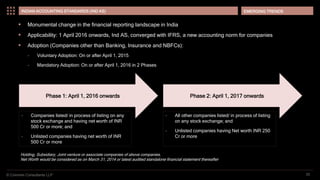
 Applicability: 1 April 2016 onwards, Ind AS, converged with IFRS, a new accounting norm for companies
 Adoption (Companies other than Banking, Insurance and NBFCs):
– Voluntary Adoption: On or after April 1, 2015
– Mandatory Adoption: On or after April 1, 2016 in 2 Phases
Phase 1: April 1, 2016 onwards
– Companies listed/ in process of listing on any
stock exchange and having net worth of INR
500 Cr or more; and
– Unlisted companies having net worth of INR
500 Cr or more
– All other companies listed/ in process of listing
on any stock exchange; and
– Unlisted companies having Net worth INR 250
Cr or more
Holding, Subsidiary, Joint venture or associate companies of above companies.
Net Worth would be considered as on March 31, 2014 or latest audited standalone financial statement thereafter
Phase 2: April 1, 2017 onwards
© Coinmen Consultants LLP
EMERGING TRENDS
21
INDIAN ACCOUNTING STANDARDS (IND AS)
 Make financial statements easier to compare
across countries and competitors
 Convergence with IFRS and not pure adoption
(with certain carve-outs)
 Comparative figures to be presented as per Ind
AS
 Conversion journey extends beyond accounting to
process, people, controls, and technology
 Increased stress on disclosure (e.g. risk relating
to financial instruments, fair value, operating
segments, significant assumptions/estimates,
etc.)
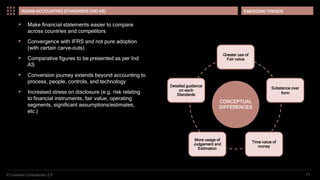
Greater use of
Fair value
Substance over
form
Time value of
money
More usage of
Judgement and
Estimation
Detailed guidance
on each
Standards
CONCEPTUAL
DIFFERENCES
© Coinmen Consultants LLP
EMERGING TRENDS
22
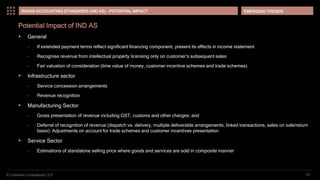
INDIAN ACCOUNTING STANDARDS (IND AS) - POTENTIAL IMPACT
Potential Impact of IND AS
 General
– If extended payment terms reflect significant financing component, present its effects in income statement
– Recognise revenue from intellectual property licensing only on customer’s subsequent sales
– Fair valuation of consideration (time value of money, customer incentive schemes and trade schemes)
 Infrastructure sector
– Service concession arrangements
– Revenue recognition
 Manufacturing Sector
– Gross presentation of revenue including GST, customs and other charges; and
– Deferral of recognition of revenue (dispatch vs. delivery, multiple deliverable arrangements, linked transactions, sales on sale/return
basis): Adjustments on account for trade schemes and customer incentives presentation
 Service Sector
– Estimations of standalone selling price where goods and services are sold in composite manner
© Coinmen Consultants LLP
Other evolving areas
EMERGING TRENDS
© Coinmen Consultants LLP
EMERGING TRENDS
24
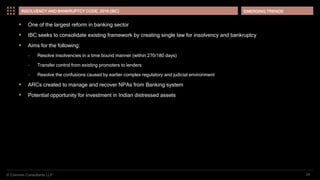
INSOLVENCY AND BANKRUPTCY CODE, 2016 (IBC)
 One of the largest reform in banking sector
 IBC seeks to consolidate existing framework by creating single law for insolvency and bankruptcy
 Aims for the following:
– Resolve insolvencies in a time bound manner (within 270/180 days)
– Transfer control from existing promoters to lenders
– Resolve the confusions caused by earlier complex regulatory and judicial environment
 ARCs created to manage and recover NPAs from Banking system
 Potential opportunity for investment in Indian distressed assets
© Coinmen Consultants LLP
EMERGING TRENDS
25
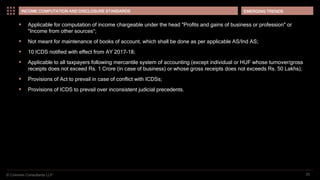
INCOME COMPUTATION AND DISCLOSURE STANDARDS
 Applicable for computation of income chargeable under the head "Profits and gains of business or profession" or
"Income from other sources“;
 Not meant for maintenance of books of account, which shall be done as per applicable AS/Ind AS;
 10 ICDS notified with effect from AY 2017-18;
 Applicable to all taxpayers following mercantile system of accounting (except individual or HUF whose turnover/gross
receipts does not exceed Rs. 1 Crore (in case of business) or whose gross receipts does not exceeds Rs. 50 Lakhs);
 Provisions of Act to prevail in case of conflict with ICDSs;
 Provisions of ICDS to prevail over inconsistent judicial precedents.
© Coinmen Consultants LLP
EMERGING TRENDS
26
CLOSING REMARKS
Current trends
 Path to reforms
 Strong focus on ease of doing business
 Creating administrative infrastructure for managing growth
Things to watch out for
 Elections in 2019 – key event
 Political deadlocks – bottleneck
 Currency
Coinmen Consultants LLP
A-22, IInd Floor, Green Park Main, Aurobindo Marg, New Delhi 110016, India
+91 - 11 – 4106 – 0160 | www.coinmen.in
Appreciate your time!
© Coinmen Consultants LLP
EMERGING TRENDS
NITIN GARG
Partner

India Trends - 2018

  • 2.
    Hello. © Coinmen ConsultantsLLP EMERGING TRENDS
  • 3.
    © Coinmen ConsultantsLLP India : Emerging trends Emerging Trends in Finance, Tax and Regulatory Framework 11 May 2018 EMERGING TRENDS
  • 4.
    © Coinmen ConsultantsLLP EMERGING TRENDS 4 MACRO PERSPECTIVE  Realignment of global economy – focus on India  GDP growth of 7-7.5% in last three years – Focus on certain key sectors and initiatives  Ease of doing business or lack of it – determinantal to investments – India moves up 30 spots in ease of doing business (130th to 100th spot): World Bank’s report – Alignment with international best practices  Tax structure remains complex
  • 5.
    © Coinmen ConsultantsLLP EMERGING TRENDS 5 LANDMARK INITIATIVES Digitisation drive  Processes being run online  Efforts being made to continuously digitise the economy Historic tax reform  GST turned entire India into one common market  ‘Indian Customs Single Window Project’ to facilitate trade put in place  Start-ups within INR10 cr. share capital threshold, exempted from angel tax New insolvency code  Consolidation of regulations regarding insolvency into a single legislation  Promotes entrepreneurship, investors confidence and increases availability of credit, by strengthening procedures
  • 6.
    © Coinmen ConsultantsLLP EMERGING TRENDS 6 LANDMARK INITIATIVES Further easing of FDI policy  FDI liberalization in 87 policy areas across 21 sectors is paying off  Most sectors now are under automatic route  Sectoral caps across major sectors including defence, aviation, single brand retail trading increased to 100% Institutional reforms  Jan Dhan Yojana - making banking, remittance, and insurance services available to every Indian at affordable cost  Aadhaar biometric identification Infrastructure push  New railway lines constructed  5 new industrial corridors coming up  Rural India electrified
  • 7.
    © Coinmen ConsultantsLLP EMERGING TRENDS 7 LANDMARK INITIATIVES Renewable energy  India is World #4 in terms of installed capacity to harness power from wind  World #6 in terms of installed solar power capacity  Operations to enhance wind power, solar power, biomass power and small hydro power capabilities put in place Unearthing black money  Demonetisation  Increased focus on tax compliance  Widening of tax net
  • 8.
    © Coinmen ConsultantsLLP EMERGING TRENDS 8 INDIAN TAX AND REGULATORY ENVIRONMENT Indian tax and regulatory system – A myriad of complex regulations  Key challenges: – Multiple compliances – Time consuming processes – Little coherence with International tax practices – Long drawn litigations  Latest trends suggests government working on improvement in all areas
  • 9.
    © Coinmen ConsultantsLLP Ease of doing business in India EMERGING TRENDS
  • 10.
    © Coinmen ConsultantsLLP EMERGING TRENDS 10 CORPORATE LAW  One form - “SPICE”, for simplified Incorporation procedure under (including PAN/TAN)  Name reservation process now online - “RUN” (Reserve Unique Name)  Process of incorporation to be completed within 20 days  No Minimum Share capital  Earlier restriction on participation of directors in Board meetings through video conferencing eased  Fast Track Merger put in place - Holding Co and WoS or two or more small companies  WoS can conduct their EGM outside India which was initially restricted (yet to be notified)
  • 11.
    © Coinmen ConsultantsLLP EMERGING TRENDS 11 LIBERALIZATION IN FOREIGN EXCHANGE POLICY Single brand retail trading  100% FDI under the automatic route permitted  Foreign companies given 5 years to comply with the local sourcing requirements  New definition of ‘incremental sourcing’ FDI in Investment/ Holding cos.  Foreign investment into an Indian company, engaged only in the activity of investing in the capital of other Indian companies / limited liability partnerships and in ‘Core Investing Companies’ has been liberalized  Companies regulated by financial sector regulator: 100% FDI under the automatic route  Companies not regulated/ part regulated by financial sector regulator: 100% FDI under the approval route Changes in ECB scenario  End use prescriptions norms altered: Now common negative list for all tracks (with few exceptions)  Expansion of eligible borrowers list
  • 12.
    © Coinmen ConsultantsLLP EMERGING TRENDS 12 DIGITIZATION IN TAX MATTERS  Initiation of e-assessment proceedings – Assessment to be done in electronic mode; – Endeavour to make the process faceless, nameless and paperless  Selection of majority cases for scrutiny done primarily through Computer Aided Scrutiny Selection (CASS); – Manual selection for scrutiny limited  Filings are done online  Risk based case selection for assessments  E-Biz portal: One-stop clearance platform for investment proposals, Government to business portal put in place
  • 13.
    © Coinmen ConsultantsLLP EMERGING TRENDS 13 CERTAINTY IN TAX POSITIONS TRANSFER PRICING Safe Harbour Rules  Reduction in litigations and certainty w.r.t. eligible transactions  Revised safe harbour margins  Introduction of low value adding intra group services Advance Pricing Agreement  Certainty on transfer pricing matters  Determination of arm's length price of future intercompany transactions (Unilateral, Bilateral and Multilateral)  Valid for a maximum period of 5 years and previous 4 years under roll-back provisions
  • 14.
    © Coinmen ConsultantsLLP EMERGING TRENDS 14 CERTAINTY IN TAX POSITIONS INTERNATIONAL TAX Authority for Advance Rulings  Applicable for both residents and non residents  Determination whether transaction lacks commercial substance (inter play with GAAR provisions)  Time limit – AAR pronounce ruling within 6 months from receipt of application Mutual Agreement Procedure  To give clarity for issues giving arise to double taxation  Negotiation process between competent authorities of countries under MAP
  • 15.
    © Coinmen ConsultantsLLP Coherence with International Standards EMERGING TRENDS
  • 16.
    © Coinmen ConsultantsLLP EMERGING TRENDS 16 BASE EROSION AND PROFIT SHIFTING  BEPS Project by OECD – Address concerns of existing taxation principles failing to keep pace with evolving business models  Extremely relevant for India - Action plans dealing with treaty abuse, PE, intangibles, digital economy, and TP documentation and CBCR  India - at the forefront in incorporating the suggested measures in its domestic tax law Details of the Action Plans from an India perspective  Equalization Levy (part of Action Plan 1) – Indian version of google tax – Taxation of digital transaction – Applicable at 6% on gross consideration payable for a online advertisement/ digital advertising space  Significant Economic Presence (part of Action Plan 1) – Taxing principles based on physical presence are no longer true measure – SEP - addressing the tax challenges for taxing digital transactions having no physical nexus with the source country – Includes sale of goods, services or property, including provision of data download or software; soliciting of business activities, interacting with certain number of users in India through digital means
  • 17.
    © Coinmen ConsultantsLLP EMERGING TRENDS 17 BASE EROSION AND PROFIT SHIFTING (BEPS)  Section 94B (Part of Action Plan 4) – Indian version of thin capitalization rule – Interest incurred by an Indian co to its related party - restricted to 30 percent of its EBITDA – Threshold – INR 1 crore  Patent Box Regime (Part of Action Plan 5 (dealing with harmful tax practices) – Additional incentive for companies to retain and develop innovative patented products – Reduced rate of 10% tax on royalty income from patents developed and registered in India  Introduction of GAAR (Action Plan 6 – prevent treaty abuse) – Applies to arrangements lacking commercial substance  Amendment in TP provisions (Action Plan 8-10, and 13) – Intangibles, Risks and capital & High-risk transactions – conceptually followed by India – TP documentation & CbC reporting - Introduced in Finance Act 2016 in line with recommendations of Action Plan 13 – Low Value Intra group services introduced in Safe Harbor Rules
  • 18.
    © Coinmen ConsultantsLLP EMERGING TRENDS 18 BASE EROSION AND PROFIT SHIFTING (BEPS)  Action Plan 15 – Multilateral Instruments – MLI incorporates treaty related measures identified as part of final BEPS measures in relation to – India signatory to MLI – Covered Tax agreements – 93 tax treaties entered into by India – MLI incorporates treaty related measures related to: • Neutralizing the effects of hybrid mismatch arrangements (Action 2) • Preventing the granting of Treaty benefits in inappropriate circumstances i.e. Treaty abuse (Action 6) • Preventing the artificial avoidance of permanent establishment status (Action 7) • Making dispute resolution mechanism more effective (Action 14)  Recent Amendment: – Scope of ‘Business Connection’ as provided in the present law aligned in view of BEPS and MLI – Widened to include agents habitually playing a principal role in conclusion of contract
  • 19.
    © Coinmen ConsultantsLLP EMERGING TRENDS 19 GOODS AND SERVICES TAX (GST)  E - Way bill : Permit required for transferring goods from one place to other place  Reverse charge on purchase from unregistered dealers have been deferred till 30th June 2018  Practically facing difficulties in GST self assessments with department due to unavailability of annual return form and other forms  Blockage of GST refunds unless audit is completed and annual return is filed  No provisional credit where no return is filed by the vendor  To promote digital transactions for B2C – 2% rebate on GST rate subject to Rs. 100 per transaction  No option available for revision of returns till date  Single consolidated return in place of multiple returns proposed
  • 20.
    © Coinmen ConsultantsLLP EMERGING TRENDS 20 INDIAN ACCOUNTING STANDARDS (IND AS)  Monumental change in the financial reporting landscape in India  Applicability: 1 April 2016 onwards, Ind AS, converged with IFRS, a new accounting norm for companies  Adoption (Companies other than Banking, Insurance and NBFCs): – Voluntary Adoption: On or after April 1, 2015 – Mandatory Adoption: On or after April 1, 2016 in 2 Phases Phase 1: April 1, 2016 onwards – Companies listed/ in process of listing on any stock exchange and having net worth of INR 500 Cr or more; and – Unlisted companies having net worth of INR 500 Cr or more – All other companies listed/ in process of listing on any stock exchange; and – Unlisted companies having Net worth INR 250 Cr or more Holding, Subsidiary, Joint venture or associate companies of above companies. Net Worth would be considered as on March 31, 2014 or latest audited standalone financial statement thereafter Phase 2: April 1, 2017 onwards
  • 21.
    © Coinmen ConsultantsLLP EMERGING TRENDS 21 INDIAN ACCOUNTING STANDARDS (IND AS)  Make financial statements easier to compare across countries and competitors  Convergence with IFRS and not pure adoption (with certain carve-outs)  Comparative figures to be presented as per Ind AS  Conversion journey extends beyond accounting to process, people, controls, and technology  Increased stress on disclosure (e.g. risk relating to financial instruments, fair value, operating segments, significant assumptions/estimates, etc.) Greater use of Fair value Substance over form Time value of money More usage of Judgement and Estimation Detailed guidance on each Standards CONCEPTUAL DIFFERENCES
  • 22.
    © Coinmen ConsultantsLLP EMERGING TRENDS 22 INDIAN ACCOUNTING STANDARDS (IND AS) - POTENTIAL IMPACT Potential Impact of IND AS  General – If extended payment terms reflect significant financing component, present its effects in income statement – Recognise revenue from intellectual property licensing only on customer’s subsequent sales – Fair valuation of consideration (time value of money, customer incentive schemes and trade schemes)  Infrastructure sector – Service concession arrangements – Revenue recognition  Manufacturing Sector – Gross presentation of revenue including GST, customs and other charges; and – Deferral of recognition of revenue (dispatch vs. delivery, multiple deliverable arrangements, linked transactions, sales on sale/return basis): Adjustments on account for trade schemes and customer incentives presentation  Service Sector – Estimations of standalone selling price where goods and services are sold in composite manner
  • 23.
    © Coinmen ConsultantsLLP Other evolving areas EMERGING TRENDS
  • 24.
    © Coinmen ConsultantsLLP EMERGING TRENDS 24 INSOLVENCY AND BANKRUPTCY CODE, 2016 (IBC)  One of the largest reform in banking sector  IBC seeks to consolidate existing framework by creating single law for insolvency and bankruptcy  Aims for the following: – Resolve insolvencies in a time bound manner (within 270/180 days) – Transfer control from existing promoters to lenders – Resolve the confusions caused by earlier complex regulatory and judicial environment  ARCs created to manage and recover NPAs from Banking system  Potential opportunity for investment in Indian distressed assets
  • 25.
    © Coinmen ConsultantsLLP EMERGING TRENDS 25 INCOME COMPUTATION AND DISCLOSURE STANDARDS  Applicable for computation of income chargeable under the head "Profits and gains of business or profession" or "Income from other sources“;  Not meant for maintenance of books of account, which shall be done as per applicable AS/Ind AS;  10 ICDS notified with effect from AY 2017-18;  Applicable to all taxpayers following mercantile system of accounting (except individual or HUF whose turnover/gross receipts does not exceed Rs. 1 Crore (in case of business) or whose gross receipts does not exceeds Rs. 50 Lakhs);  Provisions of Act to prevail in case of conflict with ICDSs;  Provisions of ICDS to prevail over inconsistent judicial precedents.
  • 26.
    © Coinmen ConsultantsLLP EMERGING TRENDS 26 CLOSING REMARKS Current trends  Path to reforms  Strong focus on ease of doing business  Creating administrative infrastructure for managing growth Things to watch out for  Elections in 2019 – key event  Political deadlocks – bottleneck  Currency
  • 27.
    Coinmen Consultants LLP A-22,IInd Floor, Green Park Main, Aurobindo Marg, New Delhi 110016, India +91 - 11 – 4106 – 0160 | www.coinmen.in Appreciate your time! © Coinmen Consultants LLP EMERGING TRENDS NITIN GARG Partner

Editor's Notes

  • #5 “India achieved an average growth of 7.5% in first three years of our Government.  Indian economy is now 2.5 trillion dollar economy – seventh largest in the world.  India is expected to become the fifth largest economy very soon’ – Hon’ble FM in his Budget 2018 speech. “The journey of economic reforms during the past few years has been challenging but rewarding. As a result of the reforms undertaken by the Government, foreign direct investment has gone up. Measures taken by the Government have made it much easier to do business in India.” – Hon’ble FM in his Budget 2018 speech.
  • #6 Digitisation drive: Incorporation of company to payment of taxes -  processes being made online.  The Government will explore use of block chain technology proactively for ushering in digital economy- FM in Budget Speech New insolvency Code: Enables companies to tide over financial difficulties and opt for restructuring while still fulfilling orders;
  • #9 Income tax data analysis suggests that major portion of personal income-tax collection comes from the salaried class. For assessment year 2016-17, 1.89 crore salaried individuals have filed their returns and have paid total tax of `1.44 lakh crores which works out to average tax payment of `76,306/- per individual salaried taxpayer. As against this, 1.88 crores individual business taxpayers including professionals, who filed their returns for the same assessment year paid total tax of `48,000 crores which works out to an average tax payment of `25,753/- per individual business taxpayer
  • #12 Single Brand Retail Trading: With granting of permission to bring in 100% FDI in single brand retail trading under automatic route, more swanky stores exclusively for brands such as Louis Vuitton bags, Ikea furniture or Cartier watches is expected to set up in India;
  • #13 We had introduced e-assessment in 2016 on a pilot basis and in 2017, extended it to 102 cities with the objective of reducing the interface between the department and the taxpayers. With the experience gained so far, we are now ready to roll out the E-assessment across the country, which will transform the age-old assessment procedure of the income tax department and the manner in which they interact with taxpayers and other stakeholders. Accordingly, I propose to amend the Income-tax Act to notify a new scheme for assessment where the assessment will be done in electronic mode which will almost eliminate person to person contact leading to greater efficiency and transparency. –Hon’ble FM in Budget 2018 speech
  • #14 APA: CBDT has signed 16 more APAs during March 2018, 14 Unilateral & 2 Bilateral (with USA), thus taking total APA tally to 219 (199 Unilateral and 20 Bilateral); APAs gives certainty to taxpayers, reduce disputes, enhance  tax revenues and make the country an attractive destination for foreign investments. 
  • #15 AAR: Was not functioning from past few days due to non constitution of bench, now active Help companies to plan their income-tax affairs well in advance and to avoid long drawn and expensive litigation MAP: Within 3 years from the end of assessment/dispute
  • #18 Many corporates register their IP in lower-tax jurisdictions even if it is developed elsewhere, resulting in the shifting of profits. In order to retain this IP in the source country and provide an incentive to innovation and job creation, many countries offer preferential treatment for income from the exploitation of IP. The OECD has recommended in BEPS under Action Plan 5 , the nexus approach which prescribes that income arising from exploitation of IP should be attributed and taxed in the jurisdiction where substantial R&D activities are undertaken rather than jurisdiction of legal ownership only.
  • #19 MLI: One document to amend DTAAs amongst multiple countries; Specifically, the MLI grants jurisdictions: i. Choice with respect to which tax treaties the MLI modifies (referred to as Covered Tax Agreements or CTAs) ii. Alternative ways to meet the minimum standards under Actions 6 (treaty abuse) and 14 (mutual agreement procedures) agreed as part of the BEPS project iii. Ability to opt out completely or partially of certain provisions with respect to all or with respect to certain CTAs, and iv. Ability to apply optional or alternative provisions Hybrid mismatch arrangements: Arrangements exploiting differences in the tax treatment of instruments, entities or transfers between two or more countries. Eg. under the arrangement, B Co (resident in Country B) issues a hybrid financial instrument to its parent A Co (resident in Country A). Country B treats the instrument as debt, so that payments under the instrument are treated as deductible interest to B Co. Country A treats the instrument as equity, so that payments under the instrument are treated as exempt dividends (or otherwise tax relieved) to A Co. The tax outcome is no tax.; Once MLI becomes operational, one will have to ensure that the treaty provisions are not read on a stand-alone basis but with the corresponding provisions of MLI along with related country reservations.
  • #27 Currency - Rising crude oil prices leading to increase in import burden; - FIIs turning net sellers in Indian Stock Market; - Rupee Expected to depreciate further; - Rising crude oil prices and increase in US bonds yield rates make dollar investment more attractive