Effective ES6
@teppeis
YAPC::Asia Tokyo 2015
Aug 21
Hello!
• Teppei Sato, @teppeis
• Cybozu, Inc. / kintone
• This is my first and last YAPC :)
I created
http://cybozushiki.cybozu.co.jp/articles/m000978.html
kintone.com
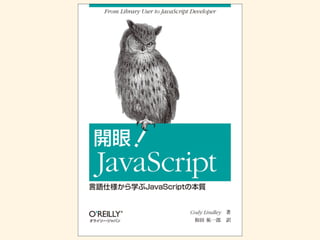
MUST BUY!
Today talk about:
• Introduce ES6 features
• Deprecated best-practice/patterns
• What’s ES2016, ES2017…
• How to use ES6 from now
Background
–Brendan Eich
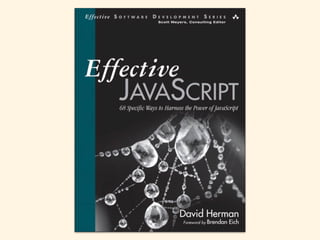
from Effective JavaScript
“My solution to the challenging
requirements and crazy-short schedule
was to make JavaScript extremely
malleable from the start.”
https://www.flickr.com/photos/jsconf/4587502948/
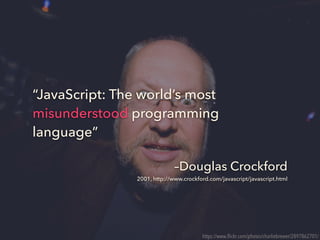
–Douglas Crockford
2001, http://www.crockford.com/javascript/javascript.html
“JavaScript: The world’s most
misunderstood programming
language”
https://www.flickr.com/photos/charliebrewer/2897862701/
JavaScript has many pitfalls…
• Prototype inheritance (No class)
• new, this
• Function scope (No block scope)
• Global variables (No module system)
• Hoisting
• NaN, undefined
• typeof null
• with, eval
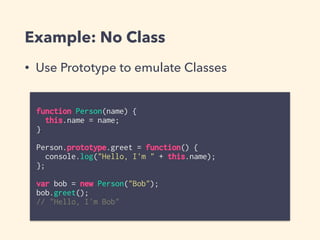
Example: No Class
function Person(name) {
this.name = name;
}
Person.prototype.greet = function() {
console.log("Hello, I'm " + this.name);
};
var bob = new Person("Bob");
bob.greet();
// "Hello, I'm Bob"
• Use Prototype to emulate Classes
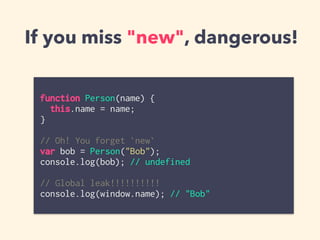
If you miss "new", dangerous!
function Person(name) {
this.name = name;
}
// Oh! You forget `new`
var bob = Person("Bob");
console.log(bob); // undefined
// Global leak!!!!!!!!!!
console.log(window.name); // "Bob"
We've made best-practices
a.k.a. “work around”
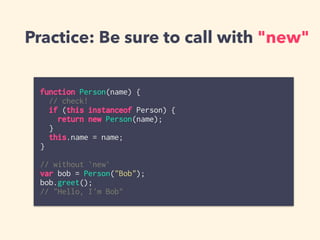
Practice: Be sure to call with "new"
function Person(name) {
// check!
if (this instanceof Person) {
return new Person(name);
}
this.name = name;
}
// without `new`
var bob = Person("Bob");
bob.greet();
// "Hello, I'm Bob"
ES6!
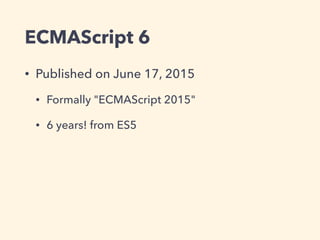
ECMAScript 6
• Published on June 17, 2015
• Formally "ECMAScript 2015"
• 6 years! from ES5
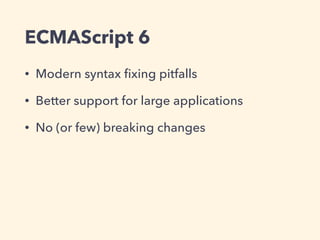
ECMAScript 6
• Modern syntax fixing pitfalls
• Better support for large applications
• No (or few) breaking changes
For example: ES6 Classes
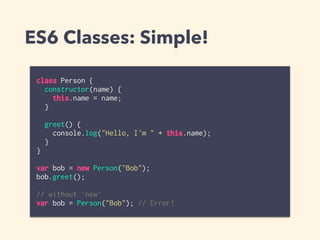
ES6 Classes: Simple!
class Person {
constructor(name) {
this.name = name;
}
greet() {
console.log("Hello, I'm " + this.name);
}
}
var bob = new Person("Bob");
bob.greet();
// without `new`
var bob = Person("Bob"); // Error!
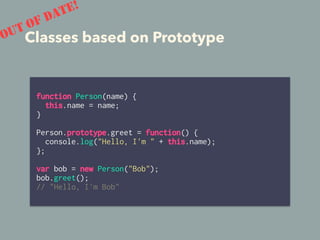
Classes based on Prototype
function Person(name) {
this.name = name;
}
Person.prototype.greet = function() {
console.log("Hello, I'm " + this.name);
};
var bob = new Person("Bob");
bob.greet();
// "Hello, I'm Bob"
OUT OF DATE!
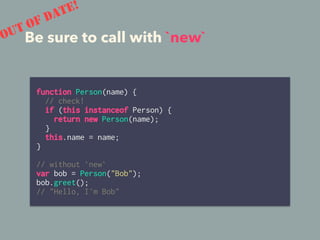
Be sure to call with `new`
function Person(name) {
// check!
if (this instanceof Person) {
return new Person(name);
}
this.name = name;
}
// without `new`
var bob = Person("Bob");
bob.greet();
// "Hello, I'm Bob"
OUT OF DATE!
New ES6 features deprecates
yesterday’s best-practices
No more altJS!
https://www.flickr.com/photos/jorge-11/2765216505/
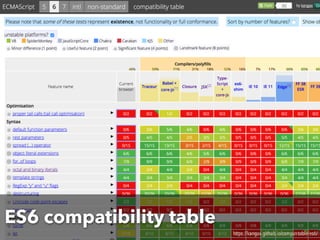
Can I use ES6 now?
ES6 compatibility table
https://kangax.github.io/compat-table/es6/
You can use ES6 now!
• Modern browsers and io.js (node.js) support 

half of ES6 features.
• Safari 9 (WebKit) will support many ES6 features soon.
• Except for IE11…
Transpiler and polyfill
• ES6 Transpiler:

source code converter from ES6 to ES5/ES3
• ES6 Polyfill:

library to provide ES6 built-in classes,
functions and objects for ES5/ES3
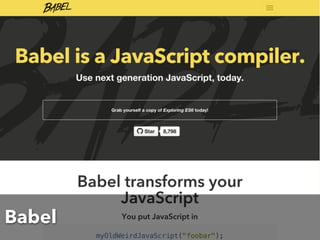
Babel
Babel
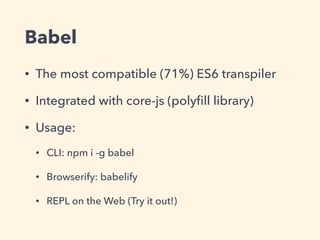
• The most compatible (71%) ES6 transpiler
• Integrated with core-js (polyfill library)
• Usage:
• CLI: npm i -g babel
• Browserify: babelify
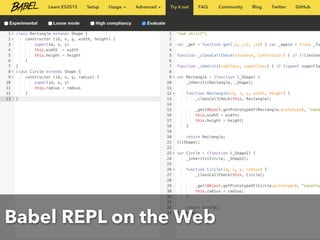
• REPL on the Web (Try it out!)
Babel REPL on the Web
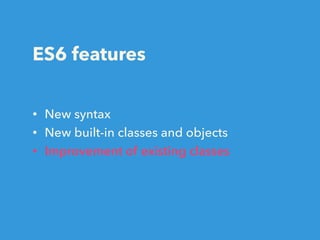
ES6 features
ES6 features
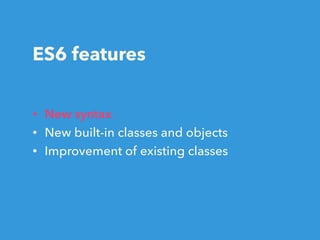
• New syntax
• New built-in classes and objects
• Improvement of existing classes
ES6 features
• New syntax
• New built-in classes and objects
• Improvement of existing classes
New syntax
• Arrow Function
• Classes
• Modules
• Block Scope (let/const)
• Extended Object
Literal
• Default Params
• Rest Params
• Spread Operator
• Destructuring
• Iterator
• Generator
• Template Literal
• Tail Call Optimization
Arrow Function
Prefer arrow function
// ES5 old function
var add = function(a, b) {
return a + b;
};
// ES6 arrow function!
var add = (a, b) => {
return a + b;
};
var add = (a, b) => a + b;
var square = n => n * n;
// good for array filter chains
[1, 2, 3, 4].filter(n => n % 2 === 0).map(n => n * n);
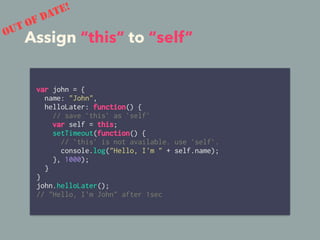
Assign “this” to “self”
var john = {
name: "John",
helloLater: function() {
// save `this` as `self`
var self = this;
setTimeout(function() {
// `this` is not available. use `self`.
console.log("Hello, I'm " + self.name);
}, 1000);
}
}
john.helloLater();
// "Hello, I'm John" after 1sec
OUT OF DATE!
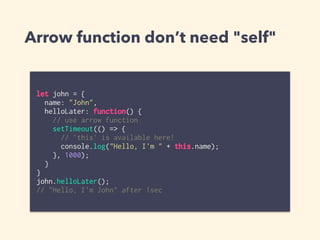
Arrow function don’t need "self"
let john = {
name: "John",
helloLater: function() {
// use arrow function
setTimeout(() => {
// `this` is available here!
console.log("Hello, I'm " + this.name);
}, 1000);
}
}
john.helloLater();
// "Hello, I'm John" after 1sec
Classes
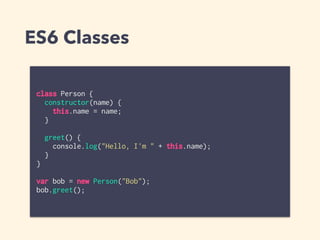
ES6 Classes
class Person {
constructor(name) {
this.name = name;
}
greet() {
console.log("Hello, I'm " + this.name);
}
}
var bob = new Person("Bob");
bob.greet();
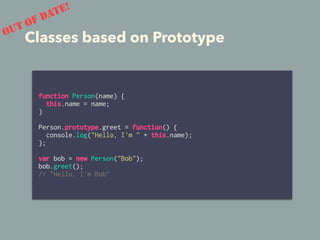
Classes based on Prototype
function Person(name) {
this.name = name;
}
Person.prototype.greet = function() {
console.log("Hello, I'm " + this.name);
};
var bob = new Person("Bob");
bob.greet();
// "Hello, I'm Bob"
OUT OF DATE!
Handmade inheritance function
// handmade function to extend
function __extends(child, parent) {
for (var key in parent) {
if (Object.prototype.hasOwnProperty.call(parent, key)) {
child[key] = parent[key];
}
}
function ctor() {
this.constructor = child;
}
ctor.prototype = parent.prototype;
child.prototype = new ctor();
child.__super__ = parent.prototype;
return child;
};
function Programmer(name, language) {
Person.call(this, name);
this.language = language;
}
__extends(Programmer, Person);
OUT OF DATE!
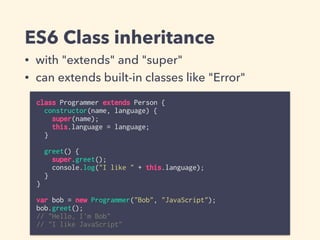
ES6 Class inheritance
class Programmer extends Person {
constructor(name, language) {
super(name);
this.language = language;
}
greet() {
super.greet();
console.log("I like " + this.language);
}
}
var bob = new Programmer("Bob", "JavaScript");
bob.greet();
// "Hello, I'm Bob"
// "I like JavaScript"
• with "extends" and "super"
• can extends built-in classes like "Error"
Modules
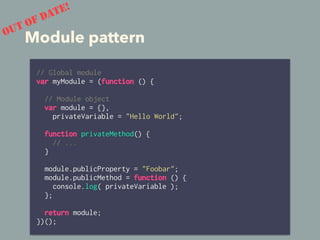
Module pattern
// Global module
var myModule = (function () {
// Module object
var module = {},
privateVariable = "Hello World";
function privateMethod() {
// ...
}
module.publicProperty = "Foobar";
module.publicMethod = function () {
console.log( privateVariable );
};
return module;
})();
OUT OF DATE!
CommonJS Modules
// import
var foo = require('foo');
foo();
// export
exports.bar = function() {
console.log('bar');
}
OUT OF DATE!
• node.js/npm friendly
• browserify/webpack to build for browser
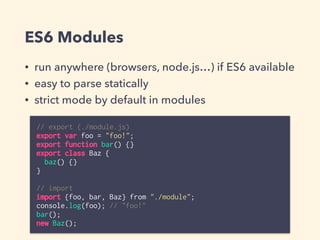
ES6 Modules
• run anywhere (browsers, node.js…) if ES6 available
• easy to parse statically
• strict mode by default in modules
// export (./module.js)
export var foo = "foo!";
export function bar() {}
export class Baz {
baz() {}
}
// import
import {foo, bar, Baz} from "./module";
console.log(foo); // "foo!"
bar();
new Baz();
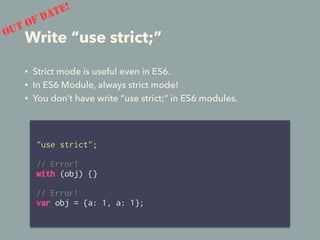
Write “use strict;”
• Strict mode is useful even in ES6.
• In ES6 Module, always strict mode!
• You don’t have write “use strict;” in ES6 modules.
"use strict";
// Error!
with (obj) {}
// Error!
var obj = {a: 1, a: 1};
OUT OF DATE!
Block Scope (let/const)
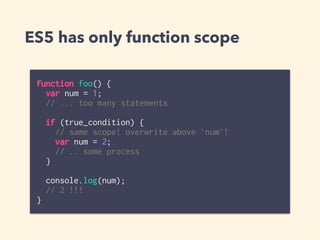
ES5 has only function scope
function foo() {
var num = 1;
// ... too many statements
if (true_condition) {
// same scope! overwrite above `num`!
var num = 2;
// .. some process
}
console.log(num);
// 2 !!!
}
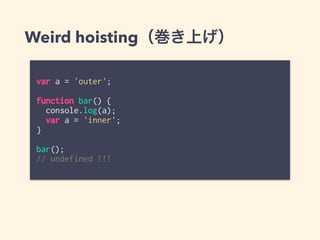
Weird hoisting(巻き上げ)
var a = 'outer';
function bar() {
console.log(a);
var a = 'inner';
}
bar();
// undefined !!!
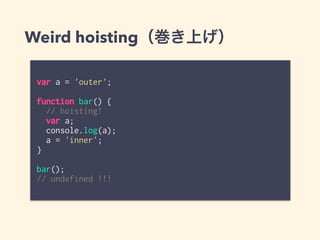
Weird hoisting(巻き上げ)
var a = 'outer';
function bar() {
// hoisting!
var a;
console.log(a);
a = 'inner';
}
bar();
// undefined !!!
Place “var”s at the top of the scope
• for function scope and hoisting
function init() {
// `var` once at the top of the scope!
var i,
cell,
cells = document.getElementsByTagName('td');
for (i = 0; i < cells.length; i++) {
cell = cells[i];
cell.addEventListener('click', function() {
cell.style.backgroundColor = '#00F';
}, false);
}
}
OUT OF DATE!
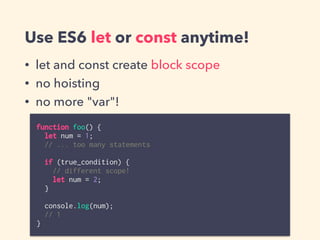
Use ES6 let or const anytime!
• let and const create block scope
• no hoisting
• no more "var"!
function foo() {
let num = 1;
// ... too many statements
if (true_condition) {
// different scope!
let num = 2;
}
console.log(num);
// 1
}
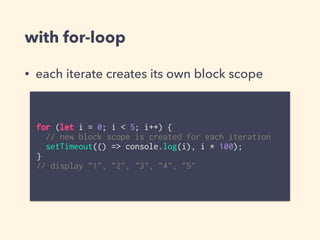
with for-loop
• each iterate creates its own block scope
for (let i = 0; i < 5; i++) {
// new block scope is created for each iteration
setTimeout(() => console.log(i), i * 100);
}
// display "1", "2", "3", "4", "5"
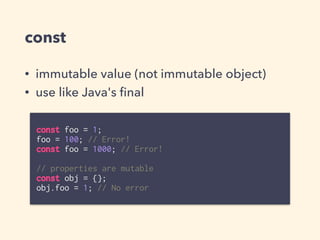
const
• immutable value (not immutable object)
• use like Java's final
const foo = 1;
foo = 100; // Error!
const foo = 1000; // Error!
// properties are mutable
const obj = {};
obj.foo = 1; // No error
Default Parameters
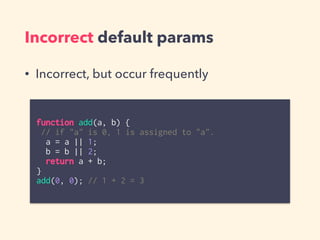
Incorrect default params
function add(a, b) {
// if "a" is 0, 1 is assigned to "a".
a = a || 1;
b = b || 2;
return a + b;
}
add(0, 0); // 1 + 2 = 3
• Incorrect, but occur frequently
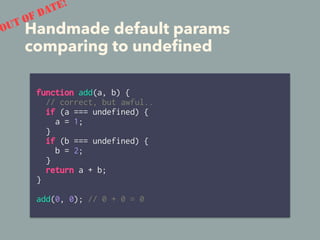
function add(a, b) {
// correct, but awful..
if (a === undefined) {
a = 1;
}
if (b === undefined) {
b = 2;
}
return a + b;
}
add(0, 0); // 0 + 0 = 0
Handmade default params
comparing to undefined
OUT OF DATE!
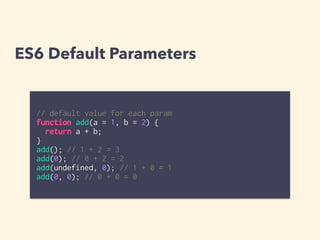
ES6 Default Parameters
// default value for each param
function add(a = 1, b = 2) {
return a + b;
}
add(); // 1 + 2 = 3
add(0); // 0 + 2 = 2
add(undefined, 0); // 1 + 0 = 1
add(0, 0); // 0 + 0 = 0
Rest Parameters
Use "arguments" for variable-length
arguments
function foo(first, second) {
console.log("first:", first);
console.log("second:", second);
// arguments is an ArrayLike, not an Array.
var rest = Array.prototype.slice.call(arguments, 2);
console.log("rest:", rest);
}
foo(1, 2, 3, 4, 5);
// first: 1
// second: 2
// rest: [3, 4, 5]
OUT OF DATE!
ES6 Rest Params instead of arguments
• You don’t have to use `arguments`
function foo(first, second, ...rest) {
console.log("first:", first);
console.log("second:", second);
console.log("rest:", rest);
}
foo(1, 2, 3, 4, 5);
// first: 1
// second: 2
// rest: [3, 4, 5]
Destructuring
Destructuring assignment
• Array assignment
let match = /(d{4})(d{2})(d{2})/.exec("20151231");
// match: [2015151231, 2015, 12, 31]
let [, year, month, day] = match;
console.log(year, month, day); // 2015 12 31
// Swapping
[x, y] = [y, x]
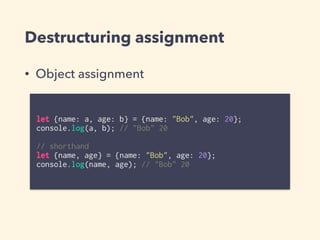
Destructuring assignment
• Object assignment
let {name: a, age: b} = {name: "Bob", age: 20};
console.log(a, b); // "Bob" 20
// shorthand
let {name, age} = {name: "Bob", age: 20};
console.log(name, age); // "Bob" 20
Destructuring assignment
• Function params like "named-params"
• Options object param
function draw(x, y, {width = 320, height = 160} = {}) {
// do the task
}
size(0, 0);
size(0, 0, {});
size(0, 0, {width: 1});
size(0, 0, {height: 2});
size(0, 0, {width: 1, height: 2});
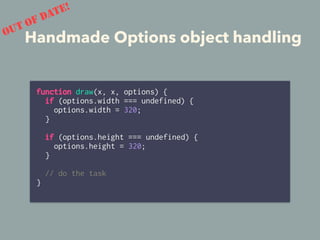
Handmade Options object handlingOUT OF DATE!
function draw(x, x, options) {
if (options.width === undefined) {
options.width = 320;
}
if (options.height === undefined) {
options.height = 320;
}
// do the task
}
Template Literal
Concat with "+" or String#join()
// concat with variables
var name = 'Bob';
var str = "Hello, I'm " + name + ".";
// create multiple lines
var multi = ["line1", "line2", "line3"].join("n");
OUT OF DATE!
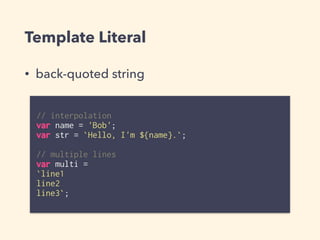
Template Literal
// interpolation
var name = 'Bob';
var str = `Hello, I'm ${name}.`;
// multiple lines
var multi =
`line1
line2
line3`;
• back-quoted string
Extended Object Literal
Extended object literal for shorthand
let foo = 1;
let bar = 2;
// shorthand
let obj = {foo, bar};
// same as: {foo: foo, bar: bar};
let prefix = 'foo';
let obj = {
// computed property
[prefix + 'abc']: 1,
// method definition without "function" keyword
foo() {
console.log('foo!');
}
};
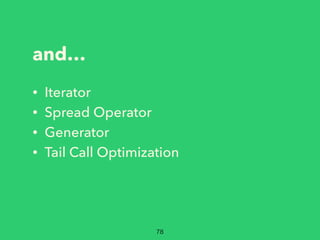
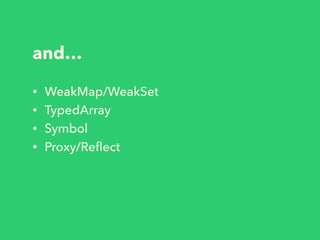
and…
• Iterator
• Spread Operator
• Generator
• Tail Call Optimization
78
ES6 features
• New syntax
• New built-in classes and objects
• Improvement of existing classes
New built-in classes and objects
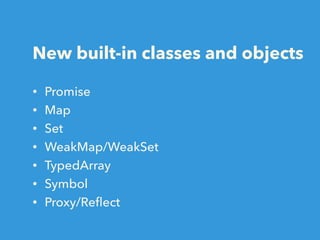
• Promise
• Map
• Set
• WeakMap/WeakSet
• TypedArray
• Symbol
• Proxy/Reflect
Promise
Callback args for async API
function asyncTask(a, b, callback) {
// ...some async task
if (error) {
callback(error);
} else {
callback(null, result);
}
}
asyncTask(1, 2, function(error, result) {
if (error) {
// ...error handling
}
console.log(result);
});
OUT OF DATE!
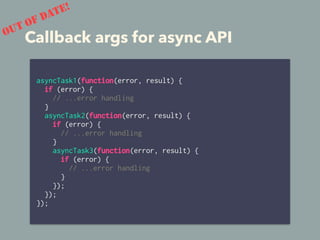
Callback args for async API
asyncTask1(function(error, result) {
if (error) {
// ...error handling
}
asyncTask2(function(error, result) {
if (error) {
// ...error handling
}
asyncTask3(function(error, result) {
if (error) {
// ...error handling
}
});
});
});
OUT OF DATE!
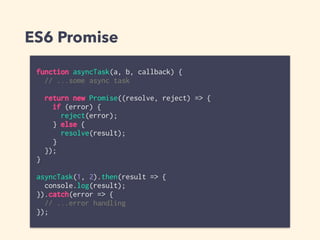
ES6 Promise
function asyncTask(a, b, callback) {
// ...some async task
return new Promise((resolve, reject) => {
if (error) {
reject(error);
} else {
resolve(result);
}
});
}
asyncTask(1, 2).then(result => {
console.log(result);
}).catch(error => {
// ...error handling
});
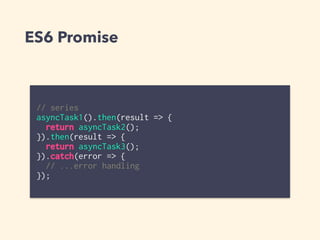
ES6 Promise
// series
asyncTask1().then(result => {
return asyncTask2();
}).then(result => {
return asyncTask3();
}).catch(error => {
// ...error handling
});
ES6 Promise
// parallel
Promise.all([
asyncTask1(),
asyncTask2(),
asyncTask3()
]).then(results => {
console.log(results[0]);
// result of asyncTask1
});
Map/Set
Use Object as a dictionary
// some keys are dangerous
var obj = {};
var key = "toString";
obj[key] = "value1";
String(obj);
// TypeError: can't convert obj to string
OUT OF DATE!
• some special keys are dangerous
Use Object as a dictionary
// cannot use object as a key
var key1 = {name: "key1"};
var key2 = {name: "key2"};
obj[key1] = "value1";
obj[key2] = "value2";
console.log(obj[key1]);
// "value2"
console.log(Object.keys(obj));
// ["[object Object]"]
OUT OF DATE!
• cannot use an object as a key
ES6 Map
// no dangerous keys
let map = new Map();
map.set("toString", "value1");
map.get("toString"); // "value1"
String(map); // "[object Map]"
// object as a key
let key1 = {};
let key2 = {};
let m = new Map();
m.set(key1, "v1");
m.set(key2, "v2");
m.get(key1); // "v1"
ES6 Set
let set = new Set();
set.add("value1");
console.log(set.size); // 1
// unique
set.add("value1");
console.log(set.size); // 1
• not easy to implement Set in ES5
and…
• WeakMap/WeakSet
• TypedArray
• Symbol
• Proxy/Reflect
ES6 features
• New syntax
• New built-in classes and objects
• Improvement of existing classes
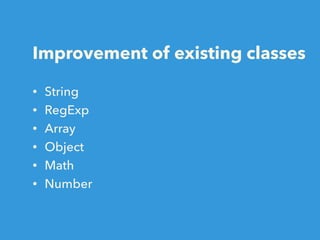
Improvement of existing classes
• String
• RegExp
• Array
• Object
• Math
• Number
Object
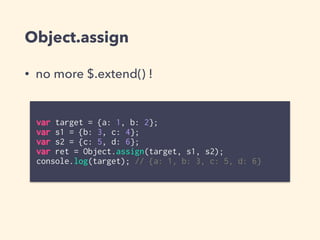
Object.assign
var target = {a: 1, b: 2};
var s1 = {b: 3, c: 4};
var s2 = {c: 5, d: 6};
var ret = Object.assign(target, s1, s2);
console.log(target); // {a: 1, b: 3, c: 5, d: 6}
• no more $.extend() !
String
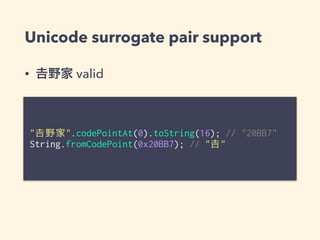
Unicode surrogate pair support
• 野家 valid
"𠮷野家".codePointAt(0).toString(16); // "20BB7"
String.fromCodePoint(0x20BB7); // "𠮷"
New pitfalls
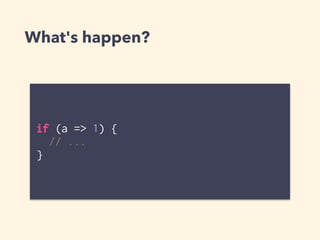
What's happen?
if (a => 1) {
// ...
}
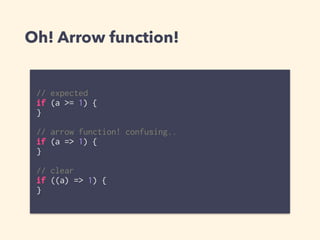
Oh! Arrow function!
// expected
if (a >= 1) {
}
// arrow function! confusing..
if (a => 1) {
}
// clear
if ((a) => 1) {
}
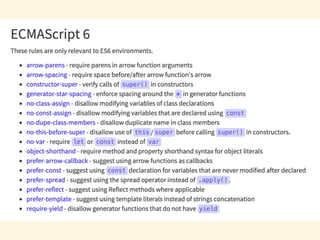
ESLint
ES.next = ES2016?
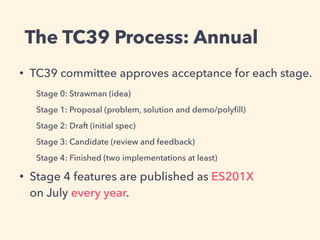
The TC39 Process: Annual
• TC39 committee approves acceptance for each stage.
Stage 0: Strawman (idea)
Stage 1: Proposal (problem, solution and demo/polyfill)
Stage 2: Draft (initial spec)
Stage 3: Candidate (review and feedback)
Stage 4: Finished (two implementations at least)
• Stage 4 features are published as ES201X

on July every year.
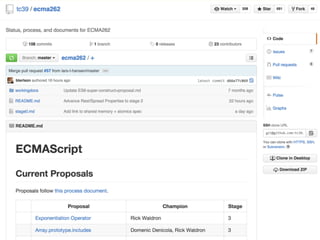
Stage 3: Candidate
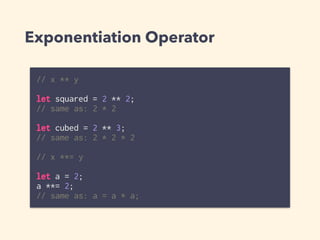
Exponentiation Operator
// x ** y
let squared = 2 ** 2;
// same as: 2 * 2
let cubed = 2 ** 3;
// same as: 2 * 2 * 2
// x **= y
let a = 2;
a **= 2;
// same as: a = a * a;
Array.prototype.includes(str, pos)
[1, 2, 3].includes(2); // true
[1, 2, 3].includes(4); // false
[1, 2, NaN].includes(NaN); // true
["a", "b", "c"].includes("a", 0); // true
["a", "b", "c"].includes("a", 1); // false
Stage 2: Draft
Object.observe(obj, observer)
let records;
function observer(recs) {
records = recs;
}
let obj = {id: 1};
Object.observe(obj, observer);
obj.a = 'b';
obj.id++;
Object.deliverChangeRecords(observer);
assertChangesAre(records, [
{object: obj, type: 'add', name: 'a'},
{object: obj, type: 'update', name: 'id', oldValue: 1}
]);
Async/await
async function chainAnimationsAsync(elem, animations) {
let ret = null;
try {
for (let anim of animations) {
ret = await anim(elem);
}
} catch(e) { /* ignore */ }
return ret;
}
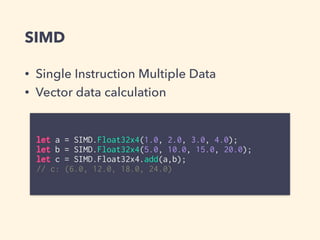
SIMD
let a = SIMD.Float32x4(1.0, 2.0, 3.0, 4.0);
let b = SIMD.Float32x4(5.0, 10.0, 15.0, 20.0);
let c = SIMD.Float32x4.add(a,b);
// c: (6.0, 12.0, 18.0, 24.0)
• Single Instruction Multiple Data
• Vector data calculation
How can I get along with
ES6 and ES.next?
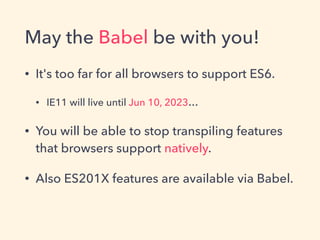
May the Babel be with you!
• It's too far for all browsers to support ES6.
• IE11 will live until Jun 10, 2023…
• You will be able to stop transpiling features
that browsers support natively.
• Also ES201X features are available via Babel.
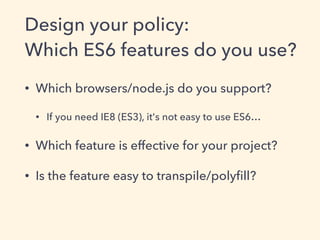
Design your policy:
Which ES6 features do you use?
• Which browsers/node.js do you support?
• If you need IE8 (ES3), it's not easy to use ES6…
• Which feature is effective for your project?
• Is the feature easy to transpile/polyfill?
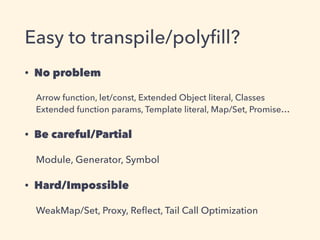
Easy to transpile/polyfill?
• No problem
Arrow function, let/const, Extended Object literal, Classes

Extended function params, Template literal, Map/Set, Promise…
• Be careful/Partial
Module, Generator, Symbol
• Hard/Impossible
WeakMap/Set, Proxy, Reflect, Tail Call Optimization
Customize Babel config
• Specify TC39 Stage (default: Stage 2)
• Specify your blacklist features
// .babelrc
{
"stage": 3,
"blacklist": [
"es6.tailCall",
"regenerator"
]
}
Conclusion
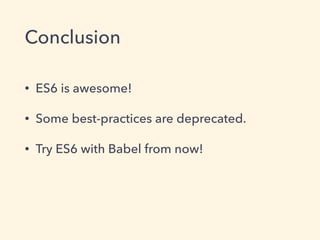
Conclusion
• ES6 is awesome!
• Some best-practices are deprecated.
• Try ES6 with Babel from now!
MUST BUY!
Thanks!

Effective ES6

  • 1.
  • 2.
    Hello! • Teppei Sato,@teppeis • Cybozu, Inc. / kintone • This is my first and last YAPC :)
  • 3.
  • 4.
  • 5.
  • 6.
  • 7.
    Today talk about: •Introduce ES6 features • Deprecated best-practice/patterns • What’s ES2016, ES2017… • How to use ES6 from now
  • 8.
  • 9.
    –Brendan Eich from EffectiveJavaScript “My solution to the challenging requirements and crazy-short schedule was to make JavaScript extremely malleable from the start.” https://www.flickr.com/photos/jsconf/4587502948/
  • 10.
    –Douglas Crockford 2001, http://www.crockford.com/javascript/javascript.html “JavaScript:The world’s most misunderstood programming language” https://www.flickr.com/photos/charliebrewer/2897862701/
  • 11.
    JavaScript has manypitfalls… • Prototype inheritance (No class) • new, this • Function scope (No block scope) • Global variables (No module system) • Hoisting • NaN, undefined • typeof null • with, eval
  • 12.
    Example: No Class functionPerson(name) { this.name = name; } Person.prototype.greet = function() { console.log("Hello, I'm " + this.name); }; var bob = new Person("Bob"); bob.greet(); // "Hello, I'm Bob" • Use Prototype to emulate Classes
  • 13.
    If you miss"new", dangerous! function Person(name) { this.name = name; } // Oh! You forget `new` var bob = Person("Bob"); console.log(bob); // undefined // Global leak!!!!!!!!!! console.log(window.name); // "Bob"
  • 14.
  • 19.
    Practice: Be sureto call with "new" function Person(name) { // check! if (this instanceof Person) { return new Person(name); } this.name = name; } // without `new` var bob = Person("Bob"); bob.greet(); // "Hello, I'm Bob"
  • 20.
  • 21.
    ECMAScript 6 • Publishedon June 17, 2015 • Formally "ECMAScript 2015" • 6 years! from ES5
  • 22.
    ECMAScript 6 • Modernsyntax fixing pitfalls • Better support for large applications • No (or few) breaking changes
  • 23.
  • 24.
    ES6 Classes: Simple! classPerson { constructor(name) { this.name = name; } greet() { console.log("Hello, I'm " + this.name); } } var bob = new Person("Bob"); bob.greet(); // without `new` var bob = Person("Bob"); // Error!
  • 25.
    Classes based onPrototype function Person(name) { this.name = name; } Person.prototype.greet = function() { console.log("Hello, I'm " + this.name); }; var bob = new Person("Bob"); bob.greet(); // "Hello, I'm Bob" OUT OF DATE!
  • 26.
    Be sure tocall with `new` function Person(name) { // check! if (this instanceof Person) { return new Person(name); } this.name = name; } // without `new` var bob = Person("Bob"); bob.greet(); // "Hello, I'm Bob" OUT OF DATE!
  • 27.
    New ES6 featuresdeprecates yesterday’s best-practices No more altJS! https://www.flickr.com/photos/jorge-11/2765216505/
  • 28.
    Can I useES6 now?
  • 29.
  • 30.
    You can useES6 now! • Modern browsers and io.js (node.js) support 
 half of ES6 features. • Safari 9 (WebKit) will support many ES6 features soon. • Except for IE11…
  • 31.
    Transpiler and polyfill •ES6 Transpiler:
 source code converter from ES6 to ES5/ES3 • ES6 Polyfill:
 library to provide ES6 built-in classes, functions and objects for ES5/ES3
  • 32.
  • 33.
    Babel • The mostcompatible (71%) ES6 transpiler • Integrated with core-js (polyfill library) • Usage: • CLI: npm i -g babel • Browserify: babelify • REPL on the Web (Try it out!)
  • 34.
  • 35.
  • 36.
    ES6 features • Newsyntax • New built-in classes and objects • Improvement of existing classes
  • 37.
    ES6 features • Newsyntax • New built-in classes and objects • Improvement of existing classes
  • 38.
    New syntax • ArrowFunction • Classes • Modules • Block Scope (let/const) • Extended Object Literal • Default Params • Rest Params • Spread Operator • Destructuring • Iterator • Generator • Template Literal • Tail Call Optimization
  • 39.
  • 40.
    Prefer arrow function //ES5 old function var add = function(a, b) { return a + b; }; // ES6 arrow function! var add = (a, b) => { return a + b; }; var add = (a, b) => a + b; var square = n => n * n; // good for array filter chains [1, 2, 3, 4].filter(n => n % 2 === 0).map(n => n * n);
  • 41.
    Assign “this” to“self” var john = { name: "John", helloLater: function() { // save `this` as `self` var self = this; setTimeout(function() { // `this` is not available. use `self`. console.log("Hello, I'm " + self.name); }, 1000); } } john.helloLater(); // "Hello, I'm John" after 1sec OUT OF DATE!
  • 42.
    Arrow function don’tneed "self" let john = { name: "John", helloLater: function() { // use arrow function setTimeout(() => { // `this` is available here! console.log("Hello, I'm " + this.name); }, 1000); } } john.helloLater(); // "Hello, I'm John" after 1sec
  • 43.
  • 44.
    ES6 Classes class Person{ constructor(name) { this.name = name; } greet() { console.log("Hello, I'm " + this.name); } } var bob = new Person("Bob"); bob.greet();
  • 45.
    Classes based onPrototype function Person(name) { this.name = name; } Person.prototype.greet = function() { console.log("Hello, I'm " + this.name); }; var bob = new Person("Bob"); bob.greet(); // "Hello, I'm Bob" OUT OF DATE!
  • 46.
    Handmade inheritance function //handmade function to extend function __extends(child, parent) { for (var key in parent) { if (Object.prototype.hasOwnProperty.call(parent, key)) { child[key] = parent[key]; } } function ctor() { this.constructor = child; } ctor.prototype = parent.prototype; child.prototype = new ctor(); child.__super__ = parent.prototype; return child; }; function Programmer(name, language) { Person.call(this, name); this.language = language; } __extends(Programmer, Person); OUT OF DATE!
  • 47.
    ES6 Class inheritance classProgrammer extends Person { constructor(name, language) { super(name); this.language = language; } greet() { super.greet(); console.log("I like " + this.language); } } var bob = new Programmer("Bob", "JavaScript"); bob.greet(); // "Hello, I'm Bob" // "I like JavaScript" • with "extends" and "super" • can extends built-in classes like "Error"
  • 48.
  • 49.
    Module pattern // Globalmodule var myModule = (function () { // Module object var module = {}, privateVariable = "Hello World"; function privateMethod() { // ... } module.publicProperty = "Foobar"; module.publicMethod = function () { console.log( privateVariable ); }; return module; })(); OUT OF DATE!
  • 50.
    CommonJS Modules // import varfoo = require('foo'); foo(); // export exports.bar = function() { console.log('bar'); } OUT OF DATE! • node.js/npm friendly • browserify/webpack to build for browser
  • 51.
    ES6 Modules • runanywhere (browsers, node.js…) if ES6 available • easy to parse statically • strict mode by default in modules // export (./module.js) export var foo = "foo!"; export function bar() {} export class Baz { baz() {} } // import import {foo, bar, Baz} from "./module"; console.log(foo); // "foo!" bar(); new Baz();
  • 52.
    Write “use strict;” •Strict mode is useful even in ES6. • In ES6 Module, always strict mode! • You don’t have write “use strict;” in ES6 modules. "use strict"; // Error! with (obj) {} // Error! var obj = {a: 1, a: 1}; OUT OF DATE!
  • 53.
  • 54.
    ES5 has onlyfunction scope function foo() { var num = 1; // ... too many statements if (true_condition) { // same scope! overwrite above `num`! var num = 2; // .. some process } console.log(num); // 2 !!! }
  • 55.
    Weird hoisting(巻き上げ) var a= 'outer'; function bar() { console.log(a); var a = 'inner'; } bar(); // undefined !!!
  • 56.
    Weird hoisting(巻き上げ) var a= 'outer'; function bar() { // hoisting! var a; console.log(a); a = 'inner'; } bar(); // undefined !!!
  • 57.
    Place “var”s atthe top of the scope • for function scope and hoisting function init() { // `var` once at the top of the scope! var i, cell, cells = document.getElementsByTagName('td'); for (i = 0; i < cells.length; i++) { cell = cells[i]; cell.addEventListener('click', function() { cell.style.backgroundColor = '#00F'; }, false); } } OUT OF DATE!
  • 58.
    Use ES6 letor const anytime! • let and const create block scope • no hoisting • no more "var"! function foo() { let num = 1; // ... too many statements if (true_condition) { // different scope! let num = 2; } console.log(num); // 1 }
  • 59.
    with for-loop • eachiterate creates its own block scope for (let i = 0; i < 5; i++) { // new block scope is created for each iteration setTimeout(() => console.log(i), i * 100); } // display "1", "2", "3", "4", "5"
  • 60.
    const • immutable value(not immutable object) • use like Java's final const foo = 1; foo = 100; // Error! const foo = 1000; // Error! // properties are mutable const obj = {}; obj.foo = 1; // No error
  • 61.
  • 62.
    Incorrect default params functionadd(a, b) { // if "a" is 0, 1 is assigned to "a". a = a || 1; b = b || 2; return a + b; } add(0, 0); // 1 + 2 = 3 • Incorrect, but occur frequently
  • 63.
    function add(a, b){ // correct, but awful.. if (a === undefined) { a = 1; } if (b === undefined) { b = 2; } return a + b; } add(0, 0); // 0 + 0 = 0 Handmade default params comparing to undefined OUT OF DATE!
  • 64.
    ES6 Default Parameters //default value for each param function add(a = 1, b = 2) { return a + b; } add(); // 1 + 2 = 3 add(0); // 0 + 2 = 2 add(undefined, 0); // 1 + 0 = 1 add(0, 0); // 0 + 0 = 0
  • 65.
  • 66.
    Use "arguments" forvariable-length arguments function foo(first, second) { console.log("first:", first); console.log("second:", second); // arguments is an ArrayLike, not an Array. var rest = Array.prototype.slice.call(arguments, 2); console.log("rest:", rest); } foo(1, 2, 3, 4, 5); // first: 1 // second: 2 // rest: [3, 4, 5] OUT OF DATE!
  • 67.
    ES6 Rest Paramsinstead of arguments • You don’t have to use `arguments` function foo(first, second, ...rest) { console.log("first:", first); console.log("second:", second); console.log("rest:", rest); } foo(1, 2, 3, 4, 5); // first: 1 // second: 2 // rest: [3, 4, 5]
  • 68.
  • 69.
    Destructuring assignment • Arrayassignment let match = /(d{4})(d{2})(d{2})/.exec("20151231"); // match: [2015151231, 2015, 12, 31] let [, year, month, day] = match; console.log(year, month, day); // 2015 12 31 // Swapping [x, y] = [y, x]
  • 70.
    Destructuring assignment • Objectassignment let {name: a, age: b} = {name: "Bob", age: 20}; console.log(a, b); // "Bob" 20 // shorthand let {name, age} = {name: "Bob", age: 20}; console.log(name, age); // "Bob" 20
  • 71.
    Destructuring assignment • Functionparams like "named-params" • Options object param function draw(x, y, {width = 320, height = 160} = {}) { // do the task } size(0, 0); size(0, 0, {}); size(0, 0, {width: 1}); size(0, 0, {height: 2}); size(0, 0, {width: 1, height: 2});
  • 72.
    Handmade Options objecthandlingOUT OF DATE! function draw(x, x, options) { if (options.width === undefined) { options.width = 320; } if (options.height === undefined) { options.height = 320; } // do the task }
  • 73.
  • 74.
    Concat with "+"or String#join() // concat with variables var name = 'Bob'; var str = "Hello, I'm " + name + "."; // create multiple lines var multi = ["line1", "line2", "line3"].join("n"); OUT OF DATE!
  • 75.
    Template Literal // interpolation varname = 'Bob'; var str = `Hello, I'm ${name}.`; // multiple lines var multi = `line1 line2 line3`; • back-quoted string
  • 76.
  • 77.
    Extended object literalfor shorthand let foo = 1; let bar = 2; // shorthand let obj = {foo, bar}; // same as: {foo: foo, bar: bar}; let prefix = 'foo'; let obj = { // computed property [prefix + 'abc']: 1, // method definition without "function" keyword foo() { console.log('foo!'); } };
  • 78.
    and… • Iterator • SpreadOperator • Generator • Tail Call Optimization 78
  • 79.
    ES6 features • Newsyntax • New built-in classes and objects • Improvement of existing classes
  • 80.
    New built-in classesand objects • Promise • Map • Set • WeakMap/WeakSet • TypedArray • Symbol • Proxy/Reflect
  • 81.
  • 82.
    Callback args forasync API function asyncTask(a, b, callback) { // ...some async task if (error) { callback(error); } else { callback(null, result); } } asyncTask(1, 2, function(error, result) { if (error) { // ...error handling } console.log(result); }); OUT OF DATE!
  • 83.
    Callback args forasync API asyncTask1(function(error, result) { if (error) { // ...error handling } asyncTask2(function(error, result) { if (error) { // ...error handling } asyncTask3(function(error, result) { if (error) { // ...error handling } }); }); }); OUT OF DATE!
  • 84.
    ES6 Promise function asyncTask(a,b, callback) { // ...some async task return new Promise((resolve, reject) => { if (error) { reject(error); } else { resolve(result); } }); } asyncTask(1, 2).then(result => { console.log(result); }).catch(error => { // ...error handling });
  • 85.
    ES6 Promise // series asyncTask1().then(result=> { return asyncTask2(); }).then(result => { return asyncTask3(); }).catch(error => { // ...error handling });
  • 86.
  • 87.
  • 88.
    Use Object asa dictionary // some keys are dangerous var obj = {}; var key = "toString"; obj[key] = "value1"; String(obj); // TypeError: can't convert obj to string OUT OF DATE! • some special keys are dangerous
  • 89.
    Use Object asa dictionary // cannot use object as a key var key1 = {name: "key1"}; var key2 = {name: "key2"}; obj[key1] = "value1"; obj[key2] = "value2"; console.log(obj[key1]); // "value2" console.log(Object.keys(obj)); // ["[object Object]"] OUT OF DATE! • cannot use an object as a key
  • 90.
    ES6 Map // nodangerous keys let map = new Map(); map.set("toString", "value1"); map.get("toString"); // "value1" String(map); // "[object Map]" // object as a key let key1 = {}; let key2 = {}; let m = new Map(); m.set(key1, "v1"); m.set(key2, "v2"); m.get(key1); // "v1"
  • 91.
    ES6 Set let set= new Set(); set.add("value1"); console.log(set.size); // 1 // unique set.add("value1"); console.log(set.size); // 1 • not easy to implement Set in ES5
  • 92.
  • 93.
    ES6 features • Newsyntax • New built-in classes and objects • Improvement of existing classes
  • 94.
    Improvement of existingclasses • String • RegExp • Array • Object • Math • Number
  • 95.
  • 96.
    Object.assign var target ={a: 1, b: 2}; var s1 = {b: 3, c: 4}; var s2 = {c: 5, d: 6}; var ret = Object.assign(target, s1, s2); console.log(target); // {a: 1, b: 3, c: 5, d: 6} • no more $.extend() !
  • 97.
  • 98.
    Unicode surrogate pairsupport • 野家 valid "𠮷野家".codePointAt(0).toString(16); // "20BB7" String.fromCodePoint(0x20BB7); // "𠮷"
  • 99.
  • 100.
    What's happen? if (a=> 1) { // ... }
  • 101.
    Oh! Arrow function! //expected if (a >= 1) { } // arrow function! confusing.. if (a => 1) { } // clear if ((a) => 1) { }
  • 102.
  • 104.
  • 105.
    The TC39 Process:Annual • TC39 committee approves acceptance for each stage. Stage 0: Strawman (idea) Stage 1: Proposal (problem, solution and demo/polyfill) Stage 2: Draft (initial spec) Stage 3: Candidate (review and feedback) Stage 4: Finished (two implementations at least) • Stage 4 features are published as ES201X
 on July every year.
  • 107.
  • 108.
    Exponentiation Operator // x** y let squared = 2 ** 2; // same as: 2 * 2 let cubed = 2 ** 3; // same as: 2 * 2 * 2 // x **= y let a = 2; a **= 2; // same as: a = a * a;
  • 109.
    Array.prototype.includes(str, pos) [1, 2,3].includes(2); // true [1, 2, 3].includes(4); // false [1, 2, NaN].includes(NaN); // true ["a", "b", "c"].includes("a", 0); // true ["a", "b", "c"].includes("a", 1); // false
  • 110.
  • 111.
    Object.observe(obj, observer) let records; functionobserver(recs) { records = recs; } let obj = {id: 1}; Object.observe(obj, observer); obj.a = 'b'; obj.id++; Object.deliverChangeRecords(observer); assertChangesAre(records, [ {object: obj, type: 'add', name: 'a'}, {object: obj, type: 'update', name: 'id', oldValue: 1} ]);
  • 112.
    Async/await async function chainAnimationsAsync(elem,animations) { let ret = null; try { for (let anim of animations) { ret = await anim(elem); } } catch(e) { /* ignore */ } return ret; }
  • 113.
    SIMD let a =SIMD.Float32x4(1.0, 2.0, 3.0, 4.0); let b = SIMD.Float32x4(5.0, 10.0, 15.0, 20.0); let c = SIMD.Float32x4.add(a,b); // c: (6.0, 12.0, 18.0, 24.0) • Single Instruction Multiple Data • Vector data calculation
  • 114.
    How can Iget along with ES6 and ES.next?
  • 115.
    May the Babelbe with you! • It's too far for all browsers to support ES6. • IE11 will live until Jun 10, 2023… • You will be able to stop transpiling features that browsers support natively. • Also ES201X features are available via Babel.
  • 116.
    Design your policy: WhichES6 features do you use? • Which browsers/node.js do you support? • If you need IE8 (ES3), it's not easy to use ES6… • Which feature is effective for your project? • Is the feature easy to transpile/polyfill?
  • 117.
    Easy to transpile/polyfill? •No problem Arrow function, let/const, Extended Object literal, Classes
 Extended function params, Template literal, Map/Set, Promise… • Be careful/Partial Module, Generator, Symbol • Hard/Impossible WeakMap/Set, Proxy, Reflect, Tail Call Optimization
  • 118.
    Customize Babel config •Specify TC39 Stage (default: Stage 2) • Specify your blacklist features // .babelrc { "stage": 3, "blacklist": [ "es6.tailCall", "regenerator" ] }
  • 119.
  • 120.
    Conclusion • ES6 isawesome! • Some best-practices are deprecated. • Try ES6 with Babel from now!
  • 121.
  • 122.