www.vestforsk.no
Bitcoin and blockchain for
dummies:
-An introduction to the
technology and its applications
Svein Ølnes, Vestlandsforsking
Jon Bing’s Memorial Seminar, 19th of April 2016
www.vestforsk.no
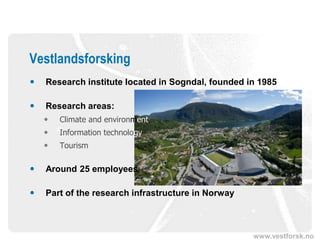
 Research institute located in Sogndal, founded in 1985
 Research areas:
 Climate and environment
 Information technology
 Tourism
 Around 25 employees
 Part of the research infrastructure in Norway
Vestlandsforsking
www.vestforsk.no
 Researcher at Vestlandsforsking since 1996
 Research field: ICT in public sector
 Interested in Bitcoin/blockchain since 2011
 bought my first bitcoins in 2011 (Mt. Gox!)
 have followed the development since then
 interested in the intersection of technology, economy, and society
About me
www.vestforsk.no
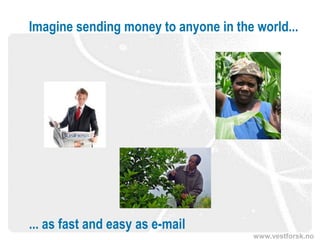
Imagine sending money to anyone in the world...
... as fast and easy as e-mail
www.vestforsk.no
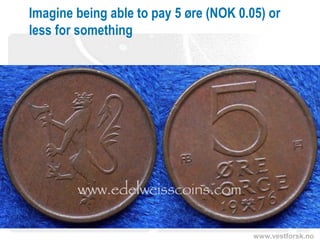
Imagine being able to pay 5 øre (NOK 0.05) or
less for something
www.vestforsk.no
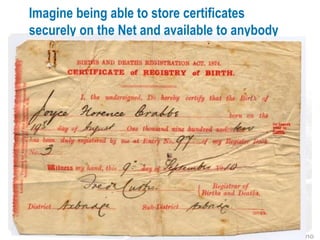
Imagine being able to store certificates
securely on the Net and available to anybody
www.vestforsk.no
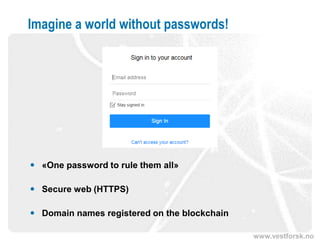
Imagine a world without passwords!
 «One password to rule them all»
 Secure web (HTTPS)
 Domain names registered on the blockchain
www.vestforsk.no
 What is Bitcoin?
 Bitcoin - the currency
 Blockchain - the infrastructure
 Currency and infrastructure interplay
 A future-looking use case
Content
www.vestforsk.no
What is Bitcoin?
1. A currency
 Digital cash («Internet money», «Money over IP»)
2. An infrastructure
 Blockchain technology
 An open, permissionless infrastructure for innovation
 Bitcoin is proof of ownership without the need for a third-party
 First presented in the white paper «Bitcoin – A Peer-to-Peer
Electronic Cash System», by Satoshi Nakamoto, Oct. 2008
 The Bitcoin system was launched on 3rd of Jan. 2009
www.vestforsk.no
Technological breaktrough
1. Secure transactions made possible in a trustless environment
(Internet) without the need for a third-party
 «The Byzantine Generals’ Problem»
 How to reach consensus in a decentralized environment without a
trusted third-party
2. The first functional system for micro payments
3. The first open, permissionless platform for financial innovation
 You don’t need to ask anybody to make a payment system
www.vestforsk.no
The Bitcoin software
 Open source software (code available on Github)
 Based on well known cryptographic standards
 Public key cryptography
 Hashing functions
 TCP/IP for communication between nodes (IPv6 is supported)
www.vestforsk.no
Centralized, decentralized og distributed
Paul Baran: «On Distributed Communications Network»
[Baran invented packet switching, together with Donald Davies, UK]
www.vestforsk.no
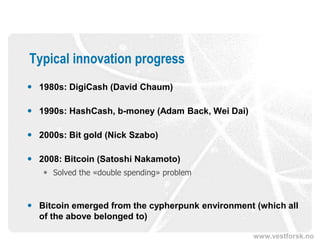
Typical innovation progress
 1980s: DigiCash (David Chaum)
 1990s: HashCash, b-money (Adam Back, Wei Dai)
 2000s: Bit gold (Nick Szabo)
 2008: Bitcoin (Satoshi Nakamoto)
 Solved the «double spending» problem
 Bitcoin emerged from the cypherpunk environment (which all
of the above belonged to)
www.vestforsk.no
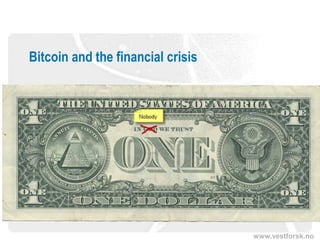
Bitcoin and the financial crisis
www.vestforsk.no
What is a bitcoin?
 A bitcoin transaction is a digital signature
 Handing over ownership from one to another (bitcoins, assets)
 Bitcoins never leave the blockchain!
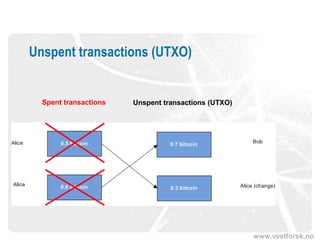
 Chain of transactions: A bitcoin is always an unspent output
 Bitcoins can disappear, like ordinary cash: by loosing your private key,
by «burning»
 The ownership of bitcoins (assets) is recorded on the
blockchain
 A distributed ledger, shared by all nodes (compters) in the system
 Anybody can read the content
 Updating the ledger requries computer resources («Proof of work»)
www.vestforsk.no
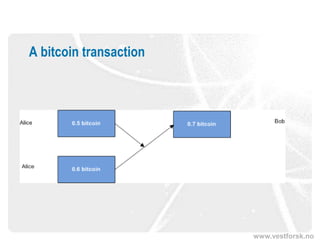
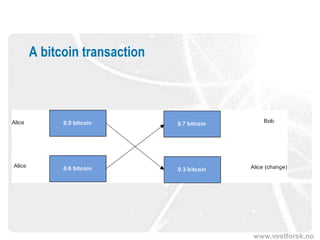
A bitcoin transaction
Alice pays 0.7 bitcoin to Bob
Alice has 1.1 bitcoins
www.vestforsk.no
A bitcoin transaction
www.vestforsk.no
A bitcoin transaction
www.vestforsk.no
Unspent transactions (UTXO)
Spent transactions Unspent transactions (UTXO)
www.vestforsk.no
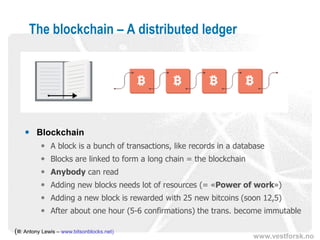
The blockchain – A distributed ledger
(Ill: Antony Lewis – www.bitsonblocks.net)
 Blockchain
 A block is a bunch of transactions, like records in a database
 Blocks are linked to form a long chain = the blockchain
 Anybody can read
 Adding new blocks needs lot of resources (= «Proof of work»)
 Adding a new block is rewarded with 25 new bitcoins (soon to be 12,5)
 After about one hour (5-6 confirmations) the trans. become immutable
www.vestforsk.no
Key actors
(Ill: Antony Lewis – www.bitsonblocks.net)
 Bitcoin users
 running the full client software
 Miners
 securing the transactions
 Programmers
 maintaining the system, implementing improvements
www.vestforsk.no
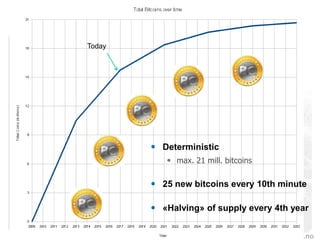
Today
 Deterministic
 max. 21 mill. bitcoins
 1 bitcoin = 108 satoshi
 25 new bitcoins every 10th minute
 «Halving» of supply every 4th year
www.vestforsk.no
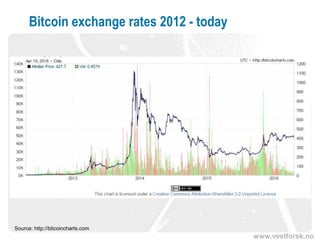
Bitcoin exchange rates 2012 - today
Source: http://bitcoincharts.com
www.vestforsk.no
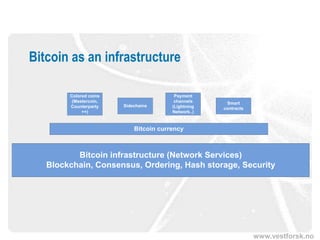
Bitcoin as an infrastructure
Bitcoin infrastructure (Network Services)
Blockchain, Consensus, Ordering, Hash storage, Security
Bitcoin currency
Colored coins
(Mastercoin,
Counterparty
++)
Sidechains
Payment
channels
(Lightning
Network..)
Smart
contracts
www.vestforsk.no
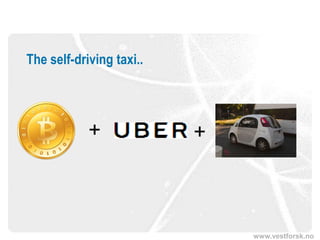
The self-driving taxi..
+ +
www.vestforsk.no
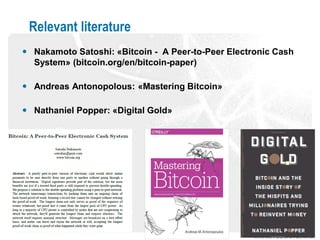
Relevant literature
 Nakamoto Satoshi: «Bitcoin - A Peer-to-Peer Electronic Cash
System» (bitcoin.org/en/bitcoin-paper)
 Andreas Antonopolous: «Mastering Bitcoin»
 Nathaniel Popper: «Digital Gold»
www.vestforsk.no
www.vestforsk.no
Thanks for your attention!
E-mail: sol@vestforsk.no
This presentation:
http://www.slideshare.net/sveino/jonbingmemorial
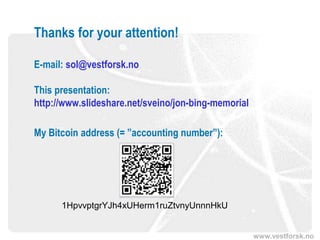
My Bitcoin address (= ”accounting number”):
1HpvvptgrYJh4xUHerm1ruZtvnyUnnnHkU

Jon Bing Memorial Seminar

  • 1.
    www.vestforsk.no Bitcoin and blockchainfor dummies: -An introduction to the technology and its applications Svein Ølnes, Vestlandsforsking Jon Bing’s Memorial Seminar, 19th of April 2016
  • 2.
    www.vestforsk.no  Research institutelocated in Sogndal, founded in 1985  Research areas:  Climate and environment  Information technology  Tourism  Around 25 employees  Part of the research infrastructure in Norway Vestlandsforsking
  • 3.
    www.vestforsk.no  Researcher atVestlandsforsking since 1996  Research field: ICT in public sector  Interested in Bitcoin/blockchain since 2011  bought my first bitcoins in 2011 (Mt. Gox!)  have followed the development since then  interested in the intersection of technology, economy, and society About me
  • 4.
    www.vestforsk.no Imagine sending moneyto anyone in the world... ... as fast and easy as e-mail
  • 5.
    www.vestforsk.no Imagine being ableto pay 5 øre (NOK 0.05) or less for something
  • 6.
    www.vestforsk.no Imagine being ableto store certificates securely on the Net and available to anybody
  • 7.
    www.vestforsk.no Imagine a worldwithout passwords!  «One password to rule them all»  Secure web (HTTPS)  Domain names registered on the blockchain
  • 8.
    www.vestforsk.no  What isBitcoin?  Bitcoin - the currency  Blockchain - the infrastructure  Currency and infrastructure interplay  A future-looking use case Content
  • 9.
    www.vestforsk.no What is Bitcoin? 1.A currency  Digital cash («Internet money», «Money over IP») 2. An infrastructure  Blockchain technology  An open, permissionless infrastructure for innovation  Bitcoin is proof of ownership without the need for a third-party  First presented in the white paper «Bitcoin – A Peer-to-Peer Electronic Cash System», by Satoshi Nakamoto, Oct. 2008  The Bitcoin system was launched on 3rd of Jan. 2009
  • 10.
    www.vestforsk.no Technological breaktrough 1. Securetransactions made possible in a trustless environment (Internet) without the need for a third-party  «The Byzantine Generals’ Problem»  How to reach consensus in a decentralized environment without a trusted third-party 2. The first functional system for micro payments 3. The first open, permissionless platform for financial innovation  You don’t need to ask anybody to make a payment system
  • 11.
    www.vestforsk.no The Bitcoin software Open source software (code available on Github)  Based on well known cryptographic standards  Public key cryptography  Hashing functions  TCP/IP for communication between nodes (IPv6 is supported)
  • 12.
    www.vestforsk.no Centralized, decentralized ogdistributed Paul Baran: «On Distributed Communications Network» [Baran invented packet switching, together with Donald Davies, UK]
  • 13.
    www.vestforsk.no Typical innovation progress 1980s: DigiCash (David Chaum)  1990s: HashCash, b-money (Adam Back, Wei Dai)  2000s: Bit gold (Nick Szabo)  2008: Bitcoin (Satoshi Nakamoto)  Solved the «double spending» problem  Bitcoin emerged from the cypherpunk environment (which all of the above belonged to)
  • 14.
  • 15.
    www.vestforsk.no What is abitcoin?  A bitcoin transaction is a digital signature  Handing over ownership from one to another (bitcoins, assets)  Bitcoins never leave the blockchain!  Chain of transactions: A bitcoin is always an unspent output  Bitcoins can disappear, like ordinary cash: by loosing your private key, by «burning»  The ownership of bitcoins (assets) is recorded on the blockchain  A distributed ledger, shared by all nodes (compters) in the system  Anybody can read the content  Updating the ledger requries computer resources («Proof of work»)
  • 16.
    www.vestforsk.no A bitcoin transaction Alicepays 0.7 bitcoin to Bob Alice has 1.1 bitcoins
  • 17.
  • 18.
  • 19.
    www.vestforsk.no Unspent transactions (UTXO) Spenttransactions Unspent transactions (UTXO)
  • 20.
    www.vestforsk.no The blockchain –A distributed ledger (Ill: Antony Lewis – www.bitsonblocks.net)  Blockchain  A block is a bunch of transactions, like records in a database  Blocks are linked to form a long chain = the blockchain  Anybody can read  Adding new blocks needs lot of resources (= «Proof of work»)  Adding a new block is rewarded with 25 new bitcoins (soon to be 12,5)  After about one hour (5-6 confirmations) the trans. become immutable
  • 21.
    www.vestforsk.no Key actors (Ill: AntonyLewis – www.bitsonblocks.net)  Bitcoin users  running the full client software  Miners  securing the transactions  Programmers  maintaining the system, implementing improvements
  • 22.
    www.vestforsk.no Today  Deterministic  max.21 mill. bitcoins  1 bitcoin = 108 satoshi  25 new bitcoins every 10th minute  «Halving» of supply every 4th year
  • 23.
    www.vestforsk.no Bitcoin exchange rates2012 - today Source: http://bitcoincharts.com
  • 24.
    www.vestforsk.no Bitcoin as aninfrastructure Bitcoin infrastructure (Network Services) Blockchain, Consensus, Ordering, Hash storage, Security Bitcoin currency Colored coins (Mastercoin, Counterparty ++) Sidechains Payment channels (Lightning Network..) Smart contracts
  • 25.
  • 26.
    www.vestforsk.no Relevant literature  NakamotoSatoshi: «Bitcoin - A Peer-to-Peer Electronic Cash System» (bitcoin.org/en/bitcoin-paper)  Andreas Antonopolous: «Mastering Bitcoin»  Nathaniel Popper: «Digital Gold»
  • 27.
  • 28.
    www.vestforsk.no Thanks for yourattention! E-mail: sol@vestforsk.no This presentation: http://www.slideshare.net/sveino/jonbingmemorial My Bitcoin address (= ”accounting number”): 1HpvvptgrYJh4xUHerm1ruZtvnyUnnnHkU