www.vestforsk.no
Bitcoin and blockchain in eGovernment
Svein Ølnes, Vestlandsforsking, eGov/ePart 2017
ITMO University, St. Petersburg, 04.09.2017
www.vestforsk.no
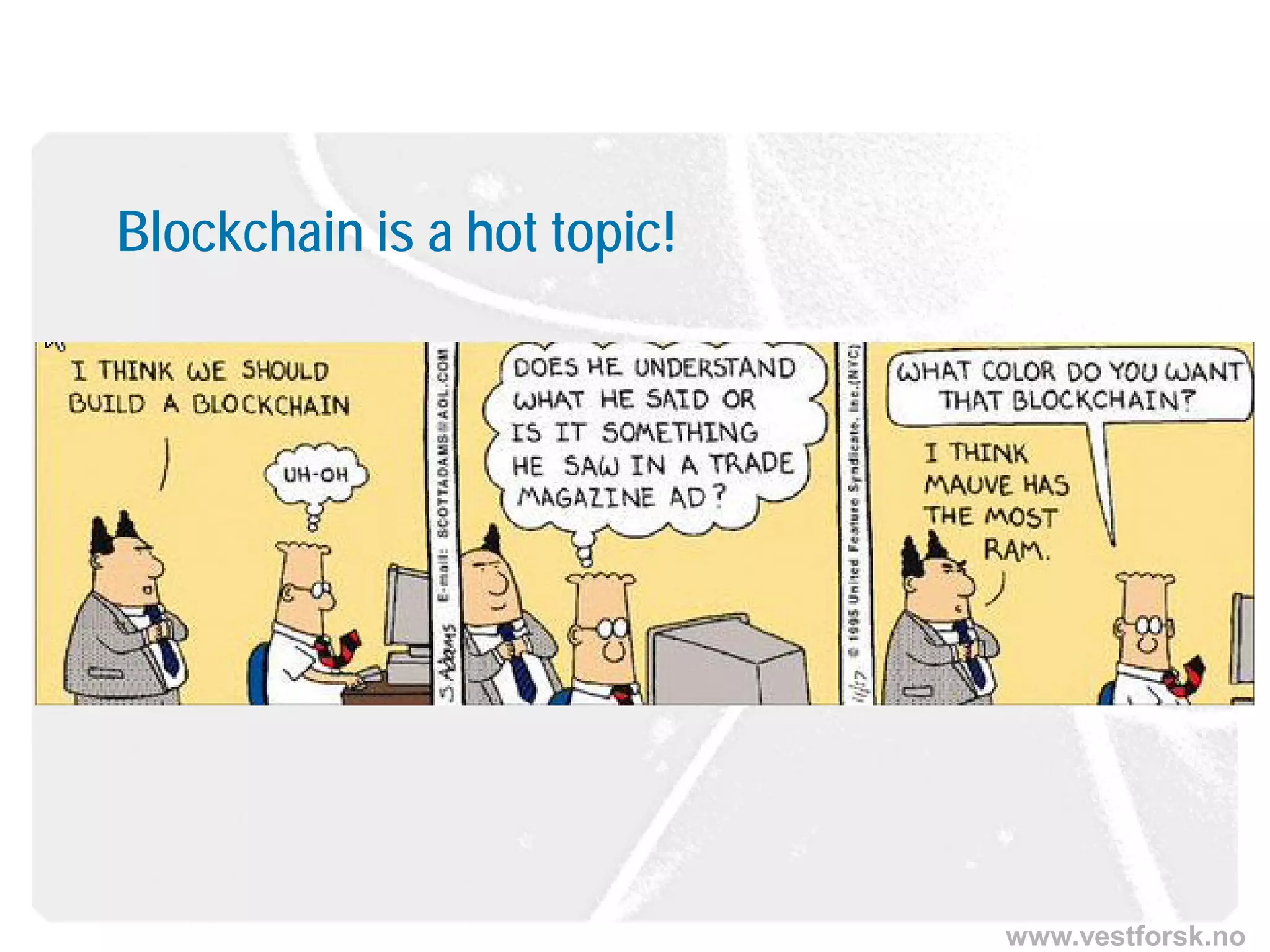
Blockchain is a hot topic!
www.vestforsk.no
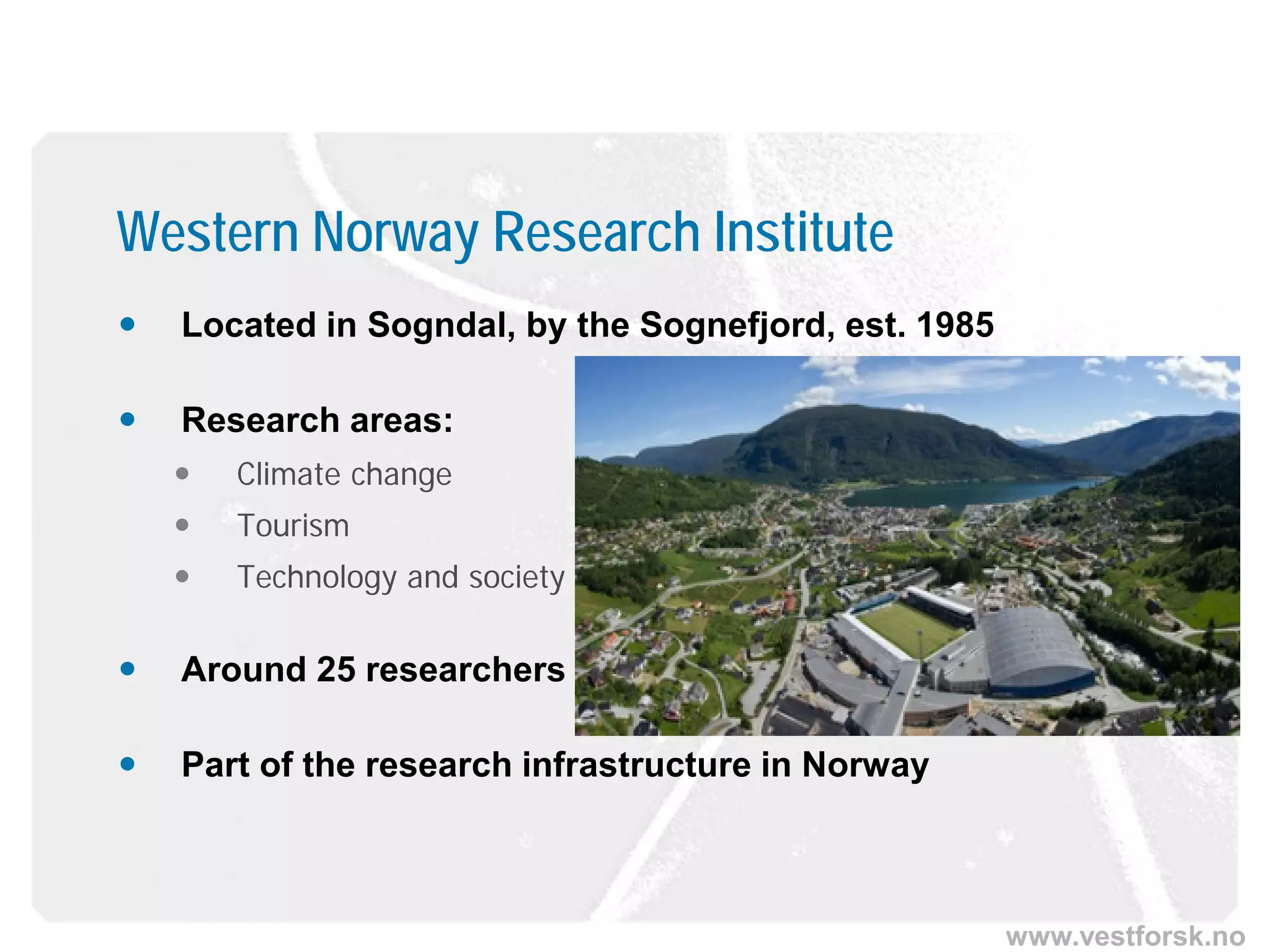
 Located in Sogndal, by the Sognefjord, est. 1985
 Research areas:
 Climate change
 Tourism
 Technology and society
 Around 25 researchers
 Part of the research infrastructure in Norway
Western Norway Research Institute
www.vestforsk.no
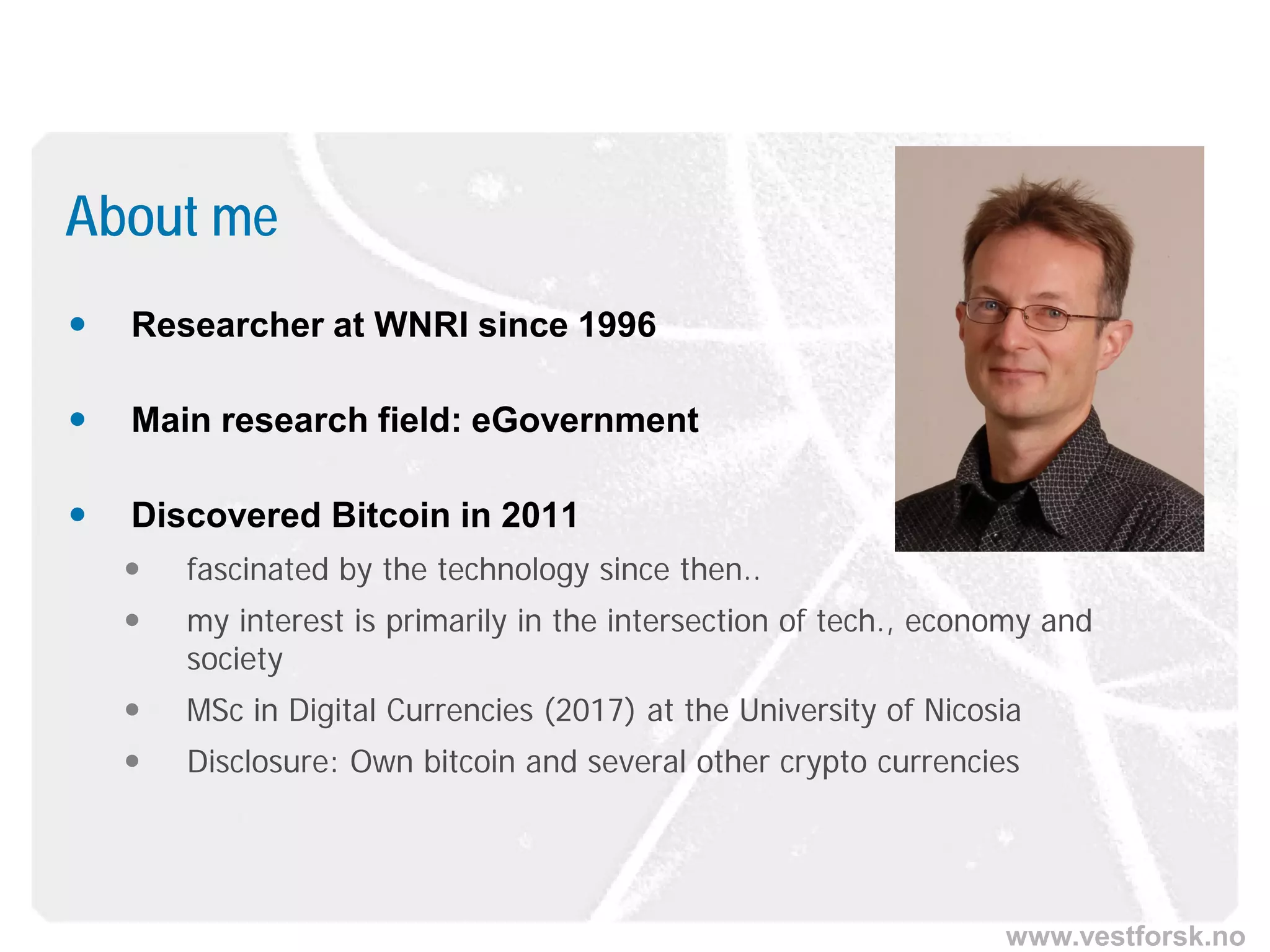
 Researcher at WNRI since 1996
 Main research field: eGovernment
 Discovered Bitcoin in 2011
 fascinated by the technology since then..
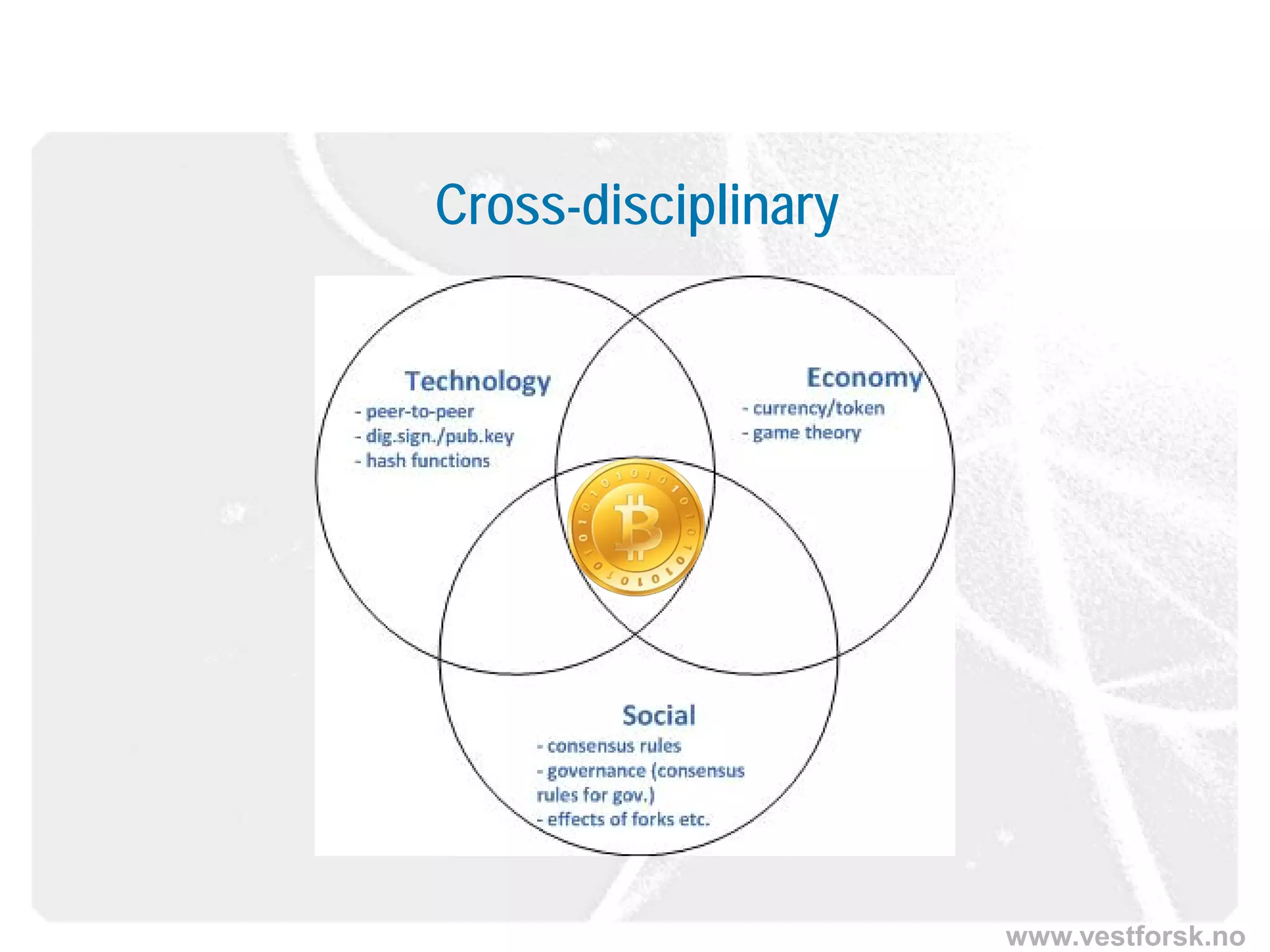
 my interest is primarily in the intersection of tech., economy and
society
 MSc in Digital Currencies (2017) at the University of Nicosia
 Disclosure: Own bitcoin and several other crypto currencies
About me
www.vestforsk.no
Content
 Short history of Bitcoin and blockchain development
 Introduction to Bitcoin and blockchain technology
 Myths and facts
 Bitcoin/blockchain as a platform and possible infrastructure
 Use cases for public sector
 Q&A
www.vestforsk.no
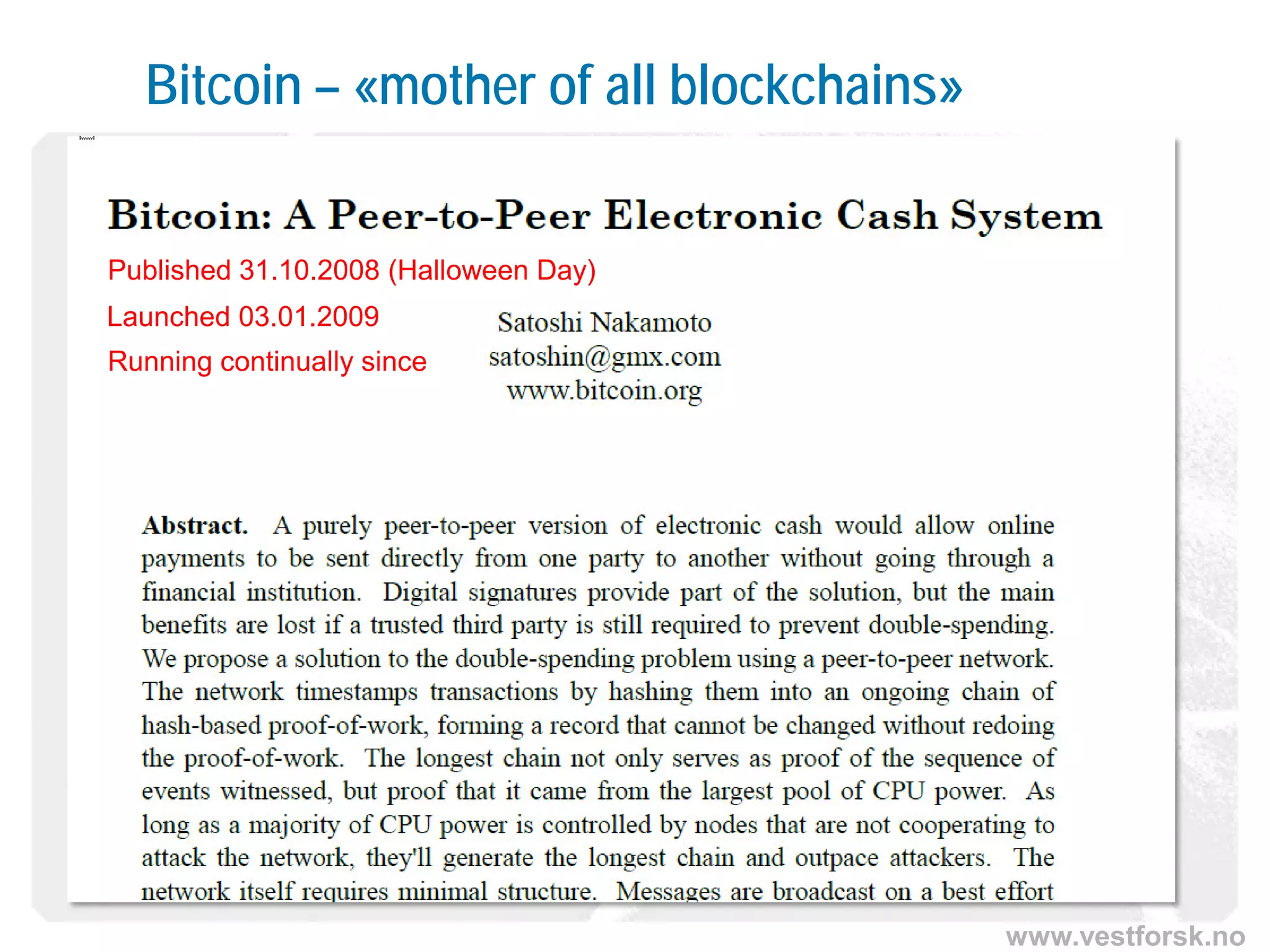
Bitcoin – «mother of all blockchains»
Published 31.10.2008 (Halloween Day)
Launched 03.01.2009
Running continually since
www.vestforsk.no
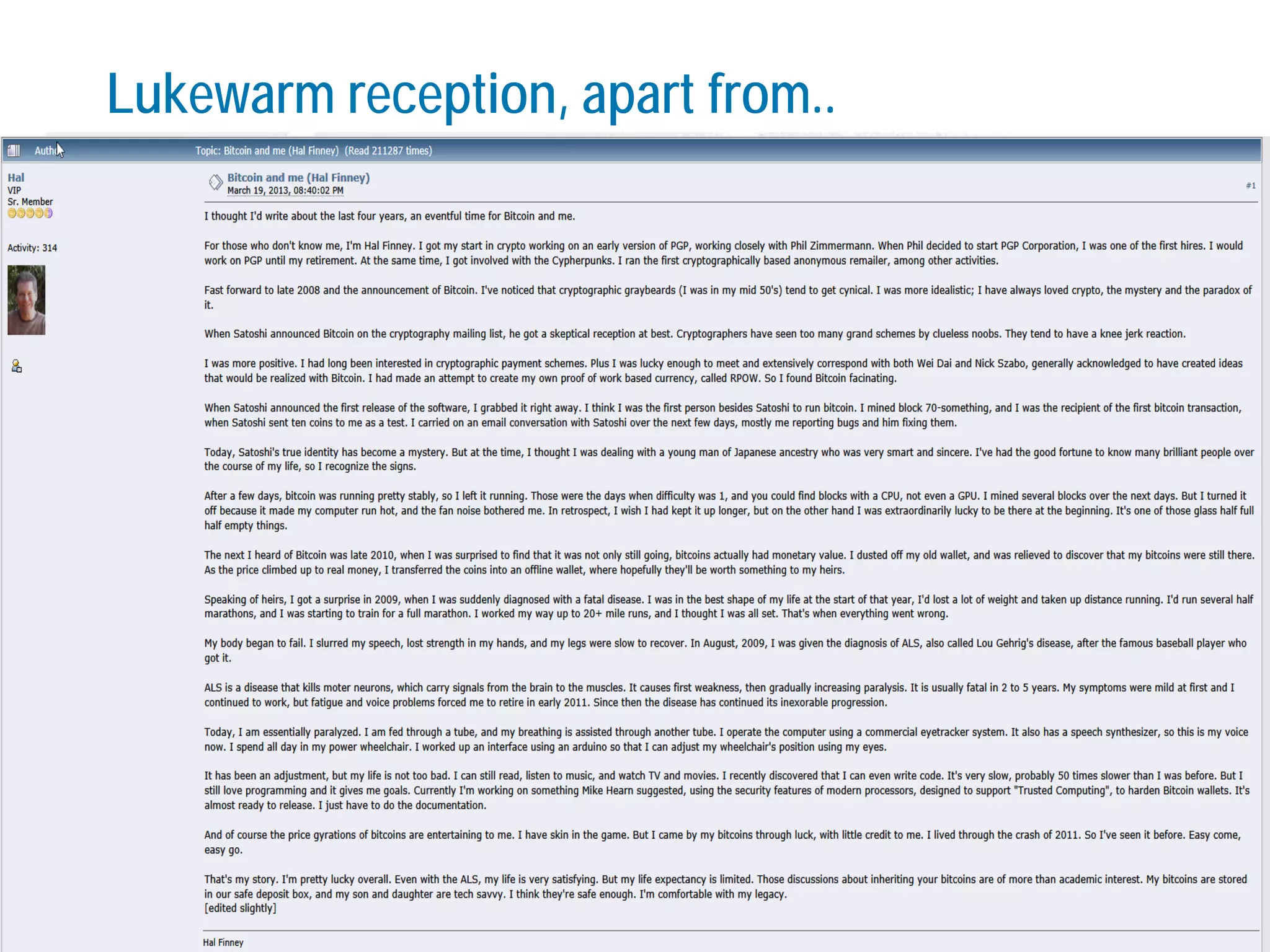
Lukewarm reception, apart from..
www.vestforsk.no
A classic innovation
 Building on decades of ground research in cryptography
 All components known on beforehand
 Put together in a novel way
 Solved decades of failed attempts to solve the double-
spending problem in a decentralized way
(the Byzantine Generals’ Problem)
www.vestforsk.no
Bitcoin builds on
 David Chaum’s blind signatures and work with Digital Cash
 Adam Back’s HashCash and Proof of Work
 Hal Finney’s RPOW (Reusable Proof of Work)
 Wai Dei’s b-money
 Nick Szabo’s BitGold
www.vestforsk.no
Content
 Short history of Bitcoin and blockchain development
 Introduction to Bitcoin and blockchain technology
 Myths and facts
 Bitcoin/blockchain as a platform and possible infrastructure
 Use cases for public sector
 Q&A
www.vestforsk.no
Back to start: Distributed Internet
Paul Baran: «On Distributed Communications Network»
[Baran invented packet switching, together with (and ind.p. of) Donald Davies, UK]
www.vestforsk.no
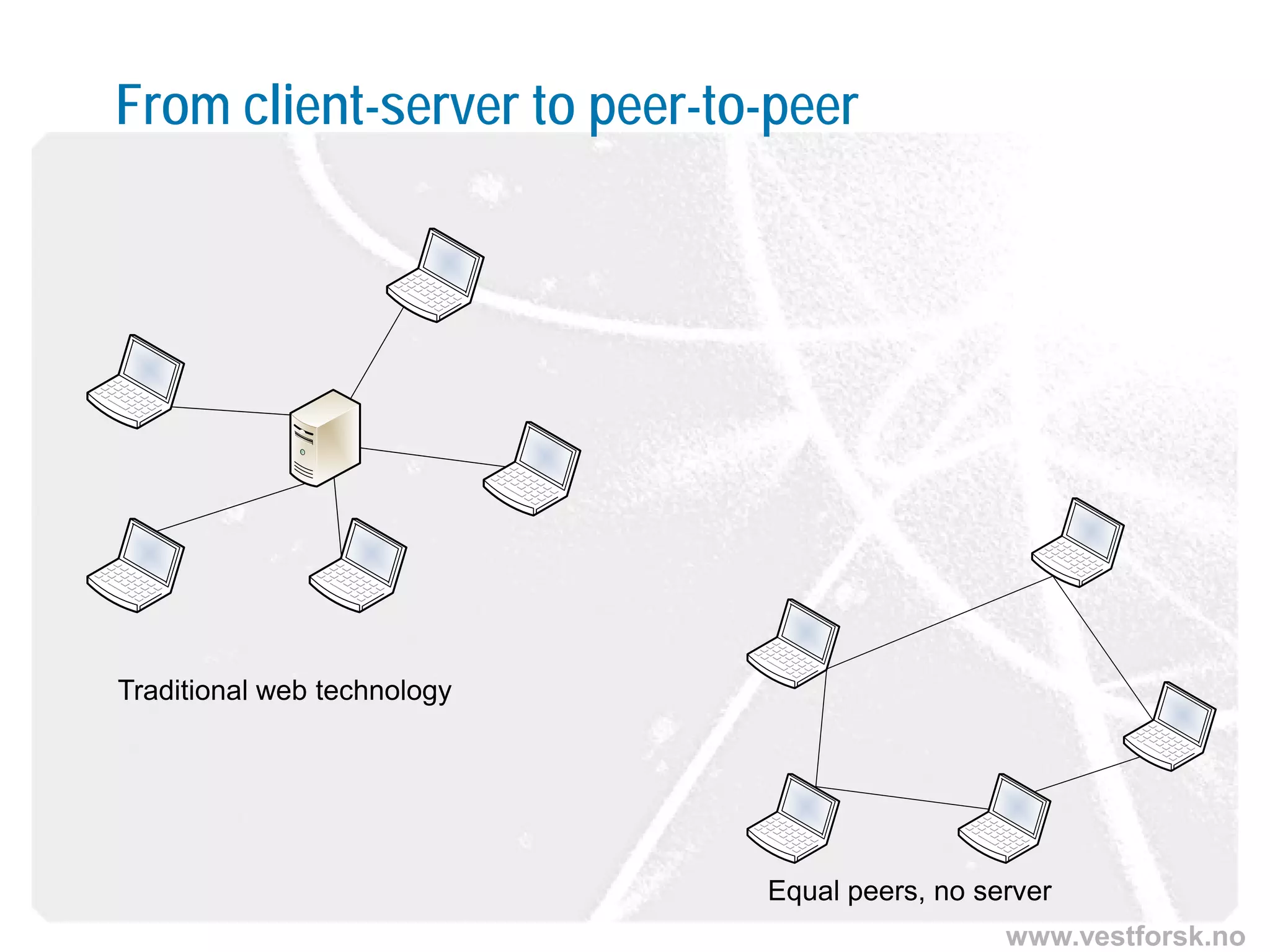
From client-server to peer-to-peer
Traditional web technology
Equal peers, no server
www.vestforsk.no
Cryptographic underpinnings
 Public key cryptography and digital signatures
 Hashing algorithms
 Merkle trees (of hashes)
www.vestforsk.no
Bitcoin definition
 Bitcoin is proof of ownership without the need for a third-party
 ownership of currency (bitcoin)
 ownership of any physical or digital object that this currency represents
www.vestforsk.no
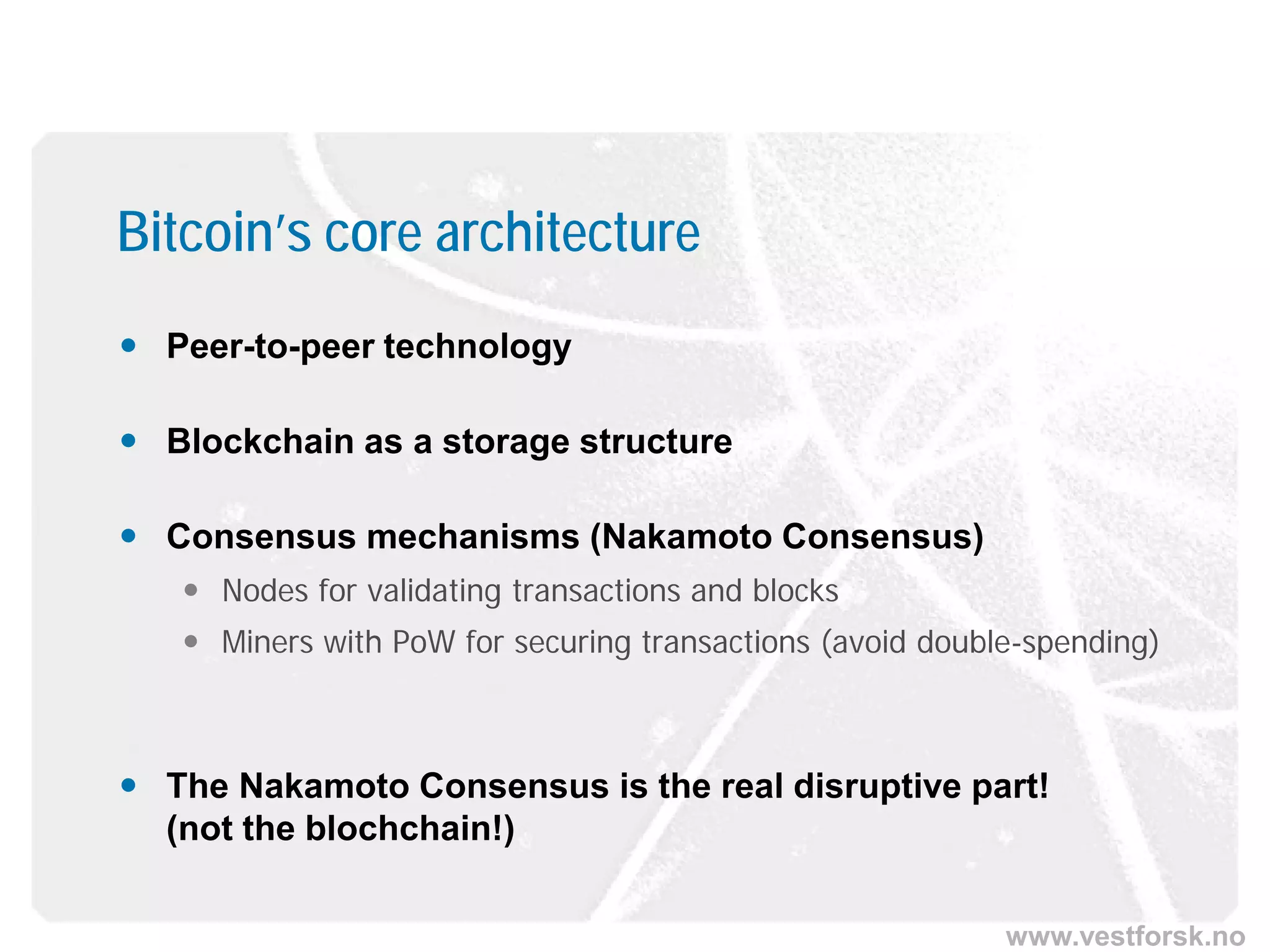
Bitcoin’s core architecture
 Peer-to-peer technology
 Blockchain as a storage structure
 Consensus mechanisms (Nakamoto Consensus)
 Nodes for validating transactions and blocks
 Miners with PoW for securing transactions (avoid double-spending)
 The Nakamoto Consensus is the real disruptive part!
(not the blochchain!)
www.vestforsk.no
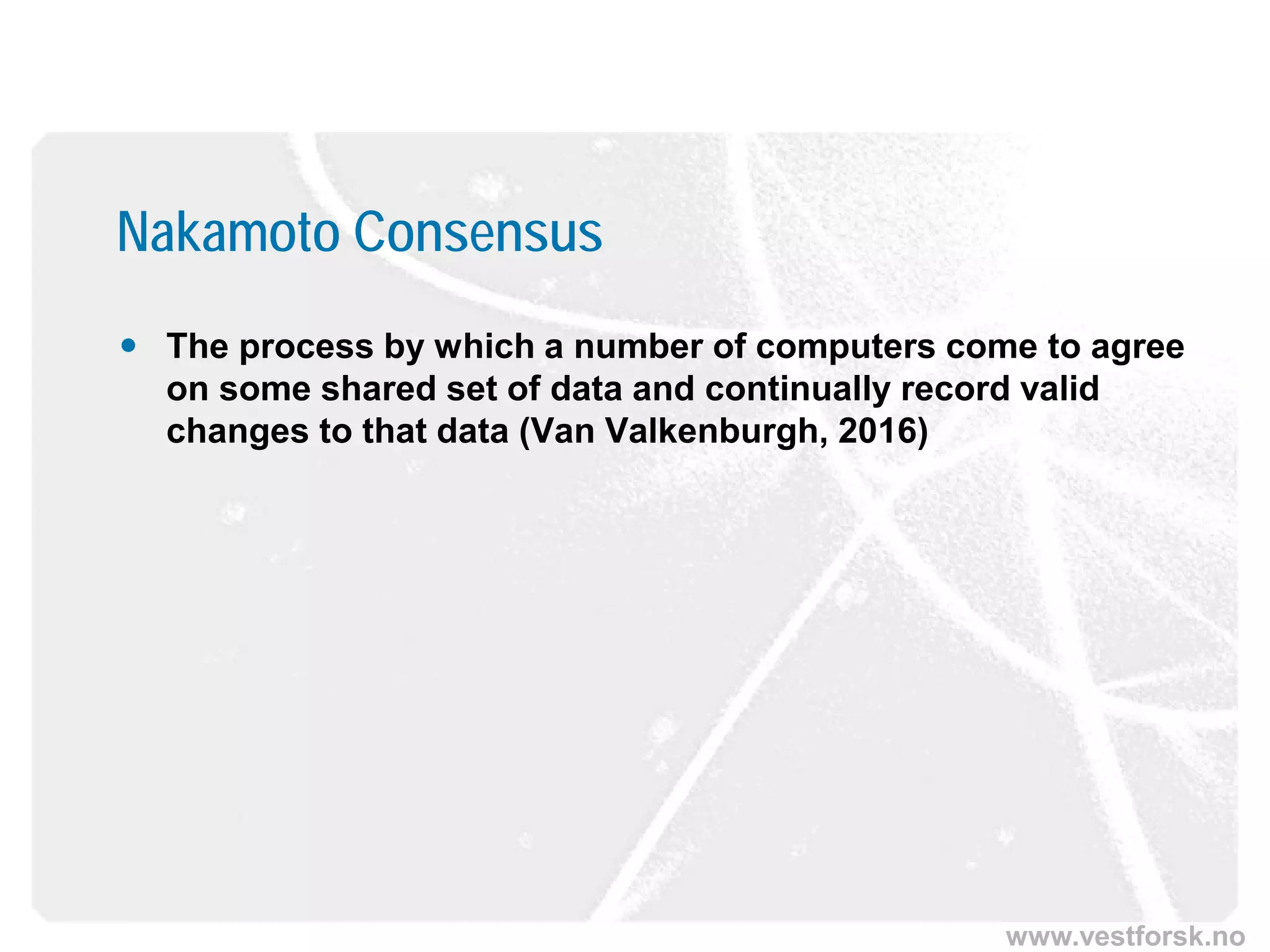
Nakamoto Consensus
 The process by which a number of computers come to agree
on some shared set of data and continually record valid
changes to that data (Van Valkenburgh, 2016)
www.vestforsk.no
Cross-disciplinary
www.vestforsk.no
The Bitcoin blockchain structure
Important! Tamper evident vs. tamper proof!
www.vestforsk.no
Bitcoin i praksis
www.vestforsk.no
Bitcoin constituencies
 Bitcoin users
 Full node: Those who download the whole blockchain and participates in
validation
 Lightweight nodes: Mobile apps
 Miners
 Secures the blockchain
 Developers
 Maintenance and further development of the open source software
 Exchanges
 Exchanging between crypto currencies and fiat money and betw. CCs
 Merchants
 Those who accept crypto currencies for goods and services
www.vestforsk.no
Content
 Short history of Bitcoin and blockchain development
 Introduction to Bitcoin and blockchain technology
 Myths and facts
 Bitcoin/blockchain as a platform and possible infrastructure
 Use cases for public sector
 Q&A
www.vestforsk.no
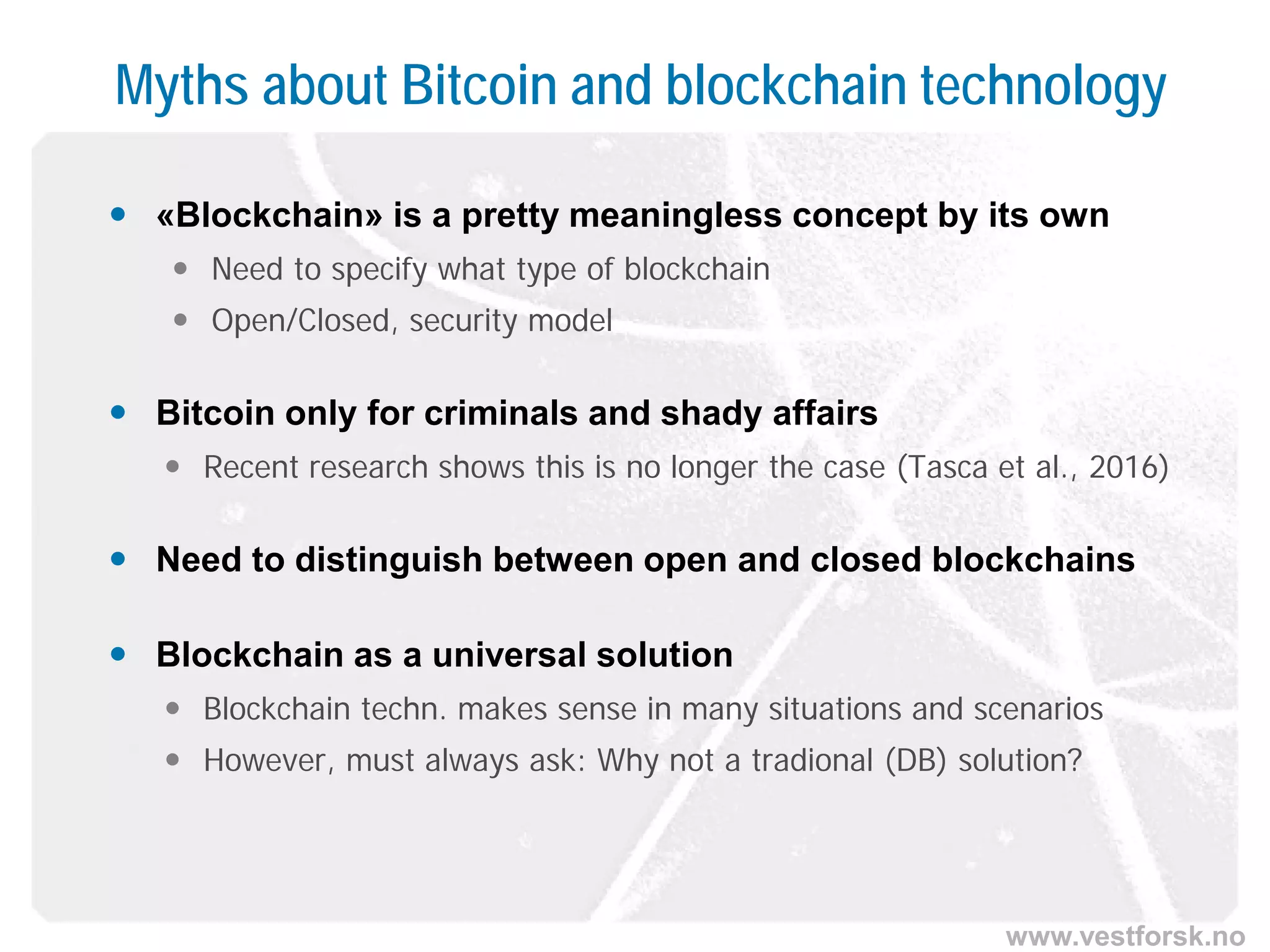
Myths about Bitcoin and blockchain technology
 «Blockchain» is a pretty meaningless concept by its own
 Need to specify what type of blockchain
 Open/Closed, security model
 Bitcoin only for criminals and shady affairs
 Recent research shows this is no longer the case (Tasca et al., 2016)
 Need to distinguish between open and closed blockchains
 Blockchain as a universal solution
 Blockchain techn. makes sense in many situations and scenarios
 However, must always ask: Why not a tradional (DB) solution?
www.vestforsk.no
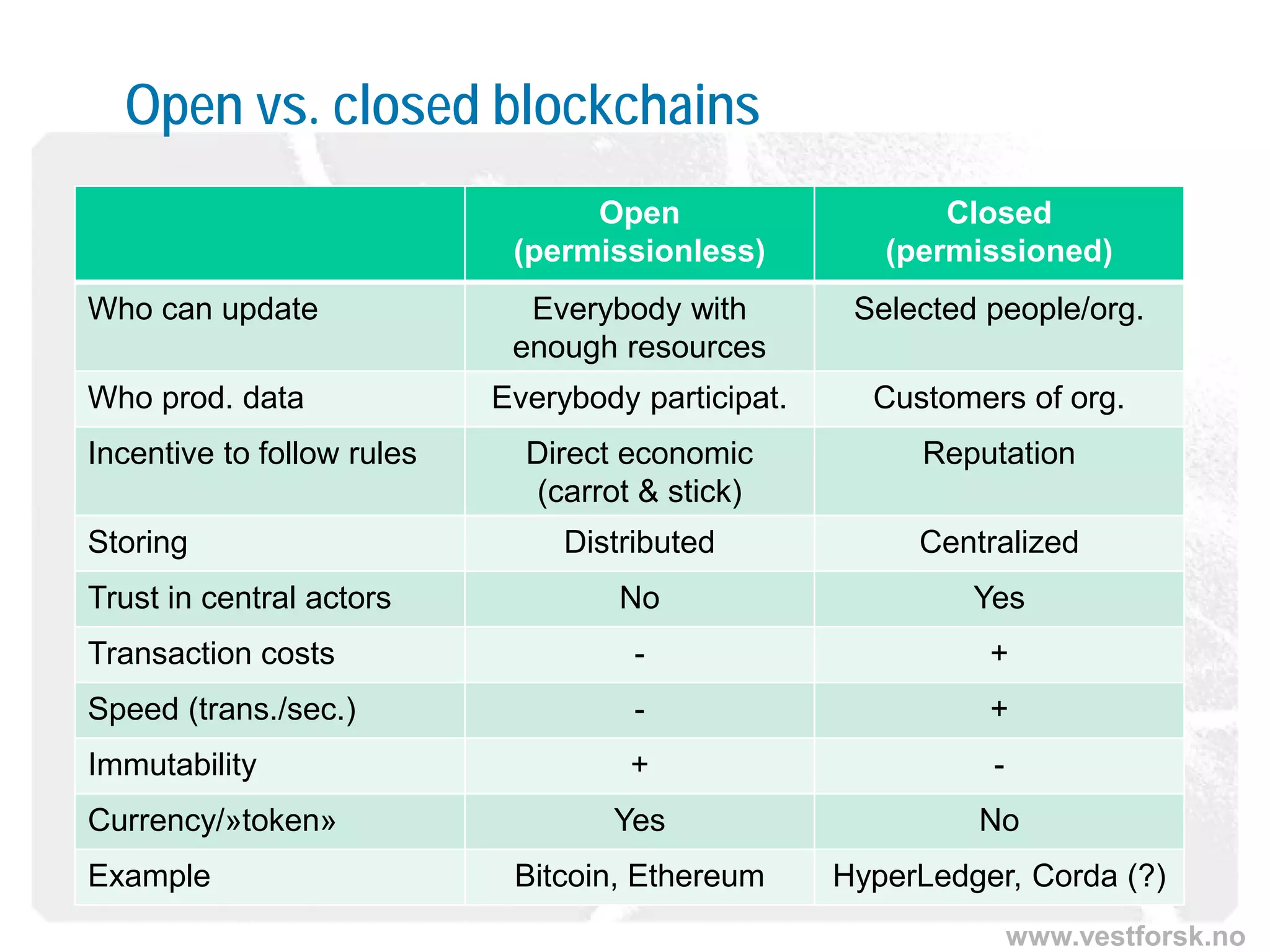
Open vs. closed blockchains
Open
(permissionless)
Closed
(permissioned)
Who can update Everybody with
enough resources
Selected people/org.
Who prod. data Everybody participat. Customers of org.
Incentive to follow rules Direct economic
(carrot & stick)
Reputation
Storing Distributed Centralized
Trust in central actors No Yes
Transaction costs - +
Speed (trans./sec.) - +
Immutability + -
Currency/»token» Yes No
Example Bitcoin, Ethereum HyperLedger, Corda (?)
www.vestforsk.no
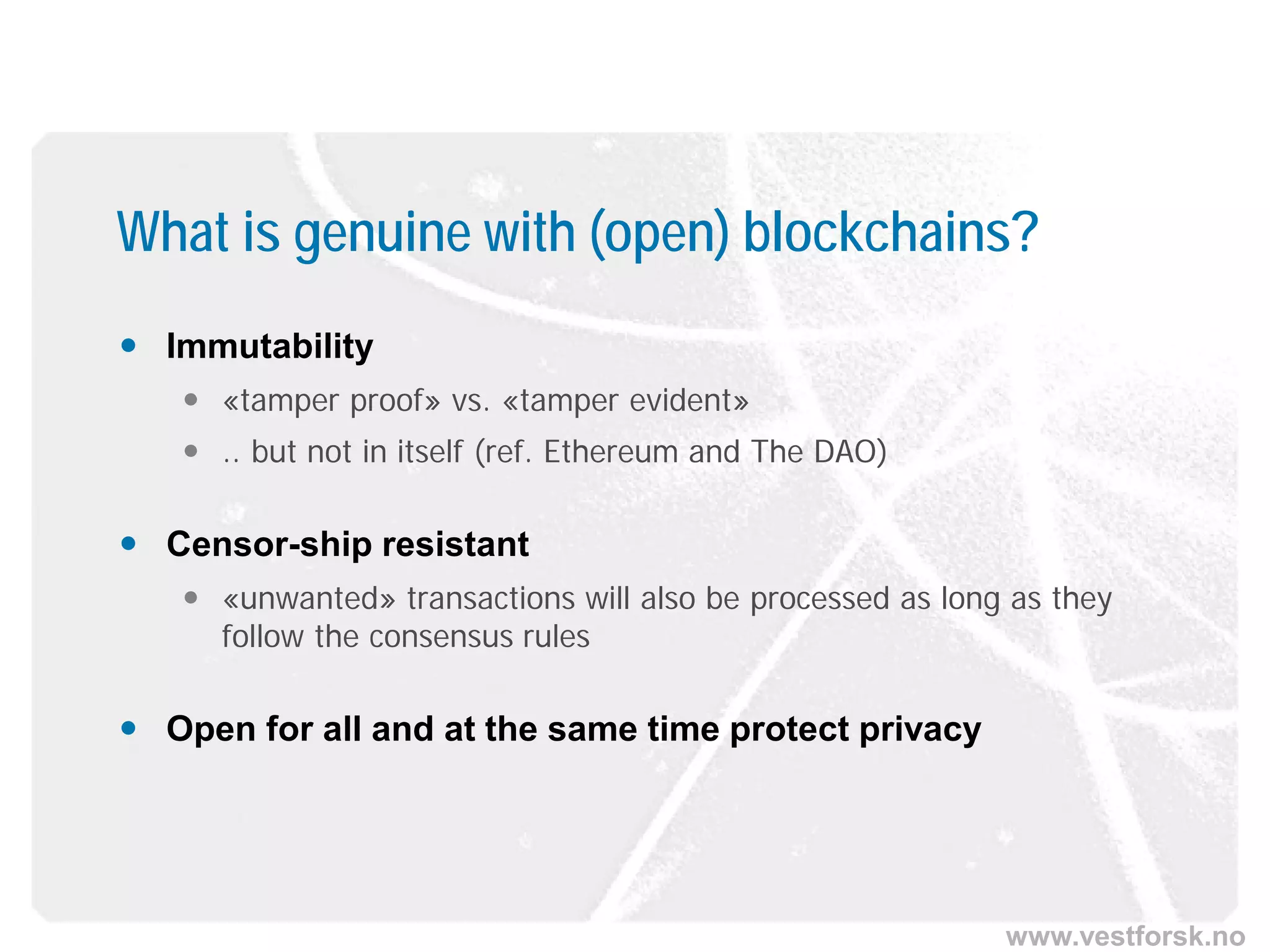
What is genuine with (open) blockchains?
 Immutability
 «tamper proof» vs. «tamper evident»
 .. but not in itself (ref. Ethereum and The DAO)
 Censor-ship resistant
 «unwanted» transactions will also be processed as long as they
follow the consensus rules
 Open for all and at the same time protect privacy
www.vestforsk.no
Content
 Short history of Bitcoin and blockchain development
 Introduction to Bitcoin and blockchain technology
 Myths and facts
 Bitcoin/blockchain as a platform and possible infrastructure
 Use cases for public sector
 Q&A
www.vestforsk.no
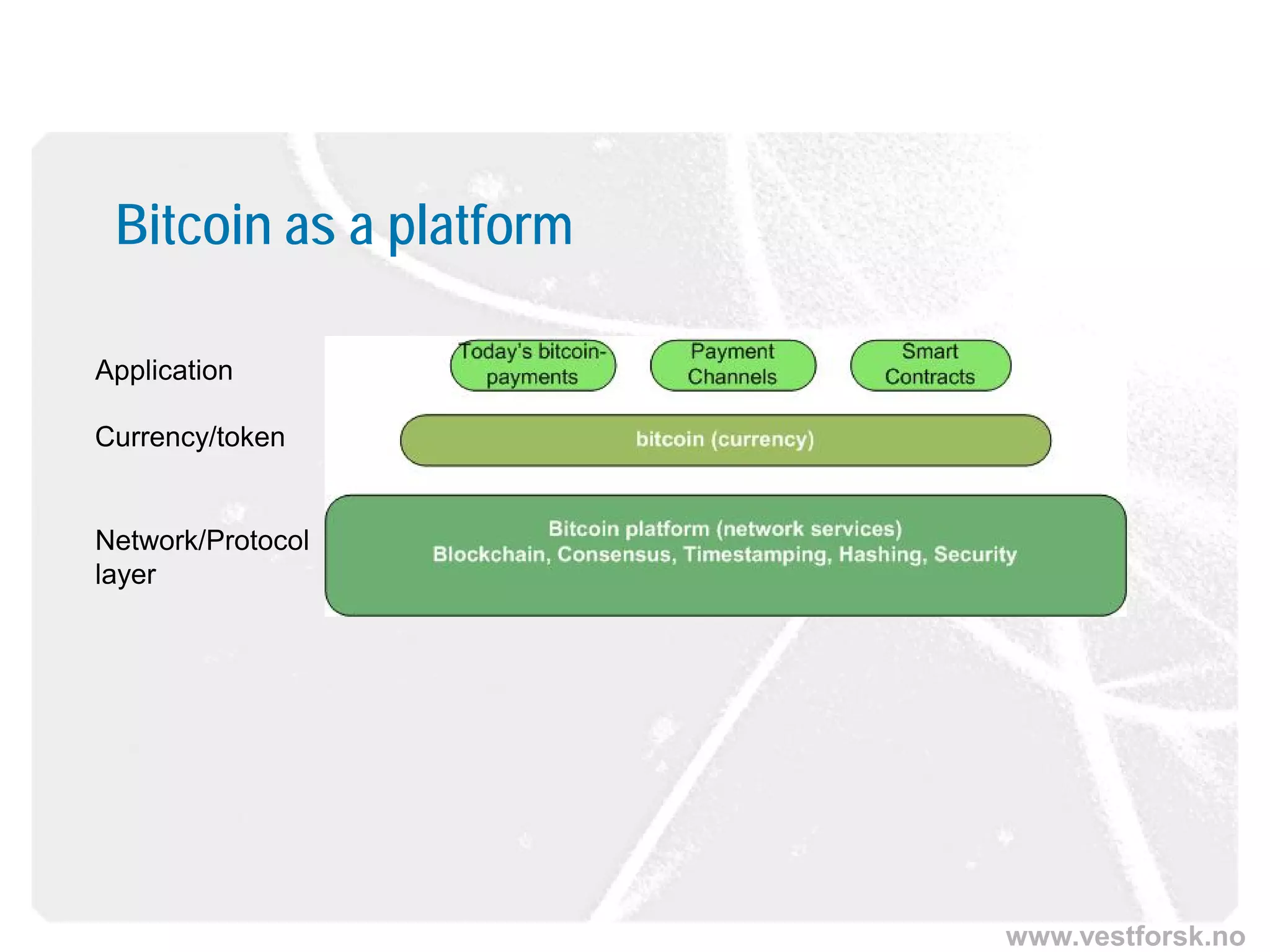
Bitcoin as a platform
Network/Protocol
layer
Currency/token
Application
www.vestforsk.no
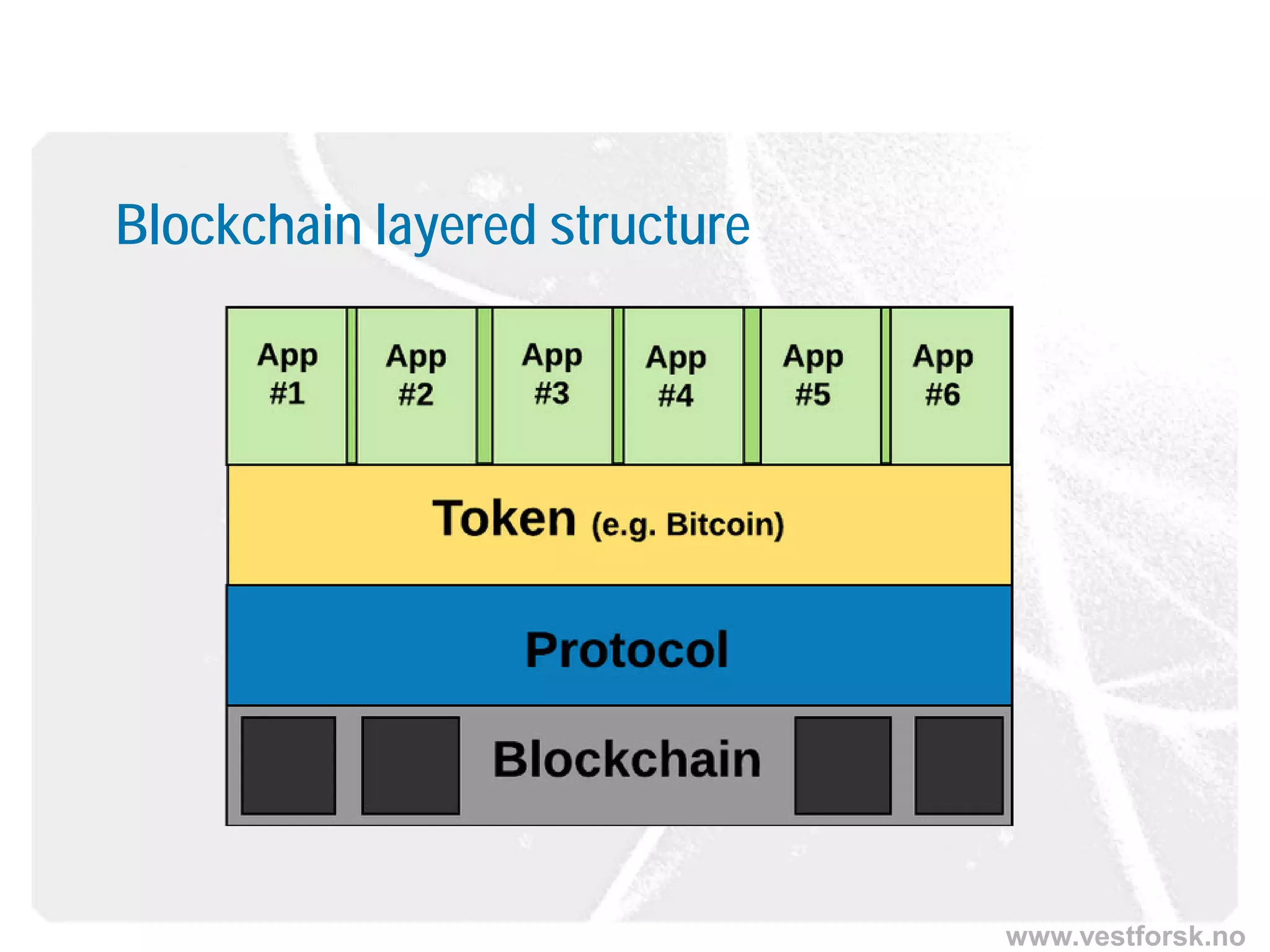
Blockchain layered structure
www.vestforsk.no
Internet and blockchain technology stacks
Support infrastructures
www.vestforsk.no
Content
 Short history of Bitcoin and blockchain development
 Introduction to Bitcoin and blockchain technology
 Myths and facts
 Bitcoin/blockchain as a platform and possible infrastructure
 Use cases for public sector
 Q&A
www.vestforsk.no
Open or closed blockchains in public sector?
 Openness should be the main rule in public sector
 However, cannot rule out the benefits of closed/private BCs
 Blockchain technology should be perceived as a platform-
enabling technology
 as a platform technology for public sector, it should be open
 as an information infrastructure, it needs to be open
 Look at the development of blockchain technology the same
way as the development of the Internet
 gradually developed to an open network
 the web also developed into an open platform (remember the
extranets?)
www.vestforsk.no
Bitcoin and blockchain technology in public sector
 Authentication of documents
 badges, course certificates, CVs
 other certificates and licenses
 ++
 Proof of ownership
 property
 +++
 Security and privacy
 secure, decentralized identity management
 enhanced privacy
 Think of Bitcoin/blockchain as a new Internet-based platform!
www.vestforsk.no
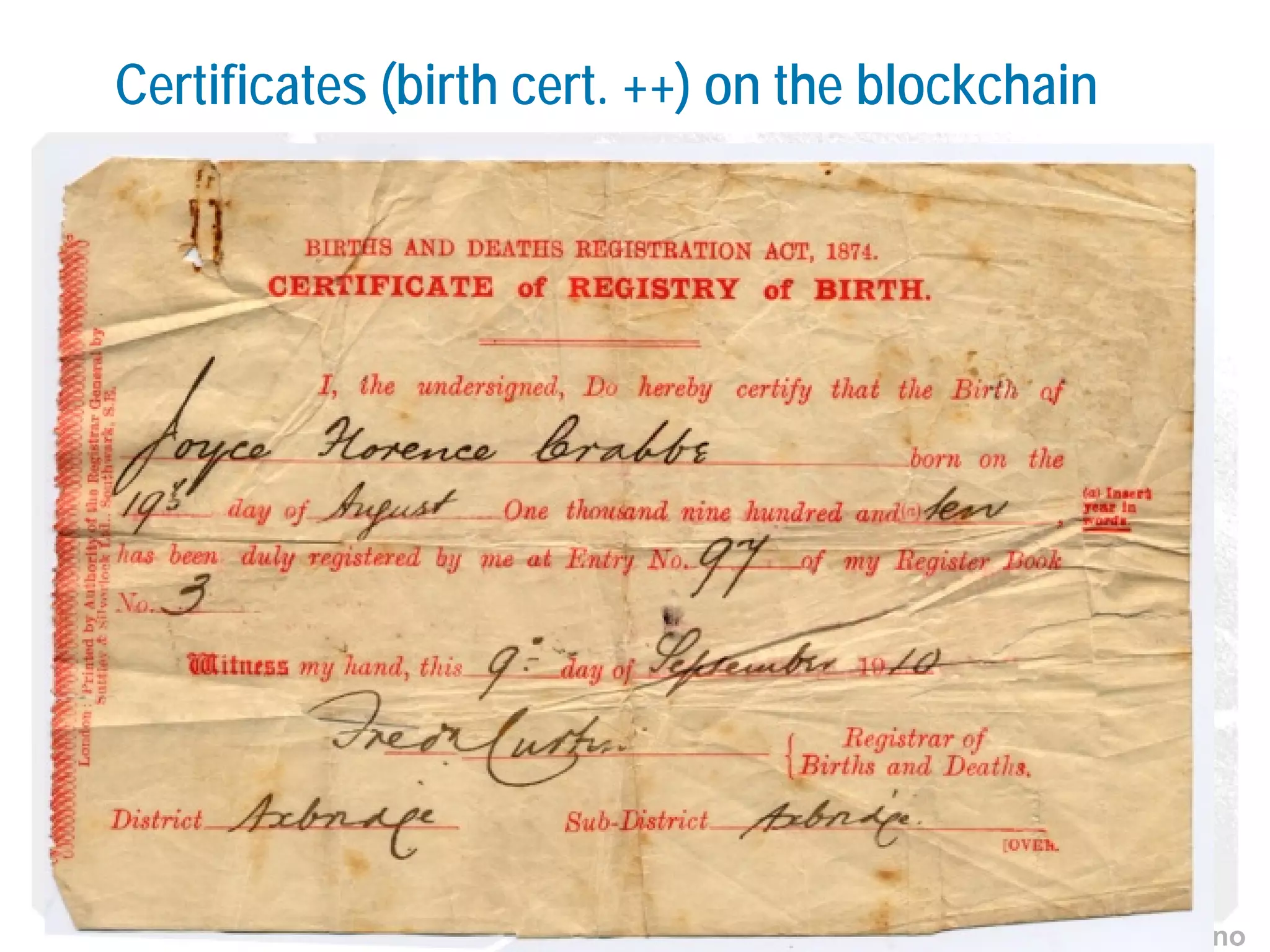
Certificates (birth cert. ++) on the blockchain
www.vestforsk.no
Domain name and password on the blockchain
 «One password to rule them all»
 Secure web (HTTPS)
 Domain names registered directly on the blockchain
(e.g. NameCoin)
www.vestforsk.no
Relevant literature
www.vestforsk.no
More literature..
 «Bitcon – A Peer-to-Peer Electronic Cash System»
Satoshi Nakamoto, 2008
 «Open Matters - Why Permissionless Blockchains are
Essential to the Future of the Internet”
Peter van Valkenburgh, Coin Center
 «Beyond Bitcoin – Enabling Smart Government Using
Blockchain Technology»
 Svein Ølnes, eGov 2016, Springer LNCS
 «Deja vú all over again: Thinking through law & code, again
Lawrence Lessig, https://vimeo.com/148665401
www.vestforsk.no
Other resources
 News about Bitcoin and blockchain technology
 CoinDesk (www.coindesk.com)
 Coin Telegraph (www.cointelegraph.com)
 Bitcoin Magazine (www.bitcoinmagazine.com)
 + many more
 Bitcoin blockchain (and other BCs) in real time
 www.bitcoin.info
 www.tradeblock.com/bitcoin
 https://data.bitcoinity.org
 www.statoshi.info
 + many more
www.vestforsk.no
Content
 Short history of Bitcoin and blockchain development
 Introduction to Bitcoin and blockchain technology
 Myths and facts
 Bitcoin/blockchain as a platform and possible infrastructure
 Use cases for public sector
 Q&A
www.vestforsk.no
Thank you for your attention!
Email: sol@vestforsk.no
This presentation:
http://www.slideshare.net/sveino/eGov2017
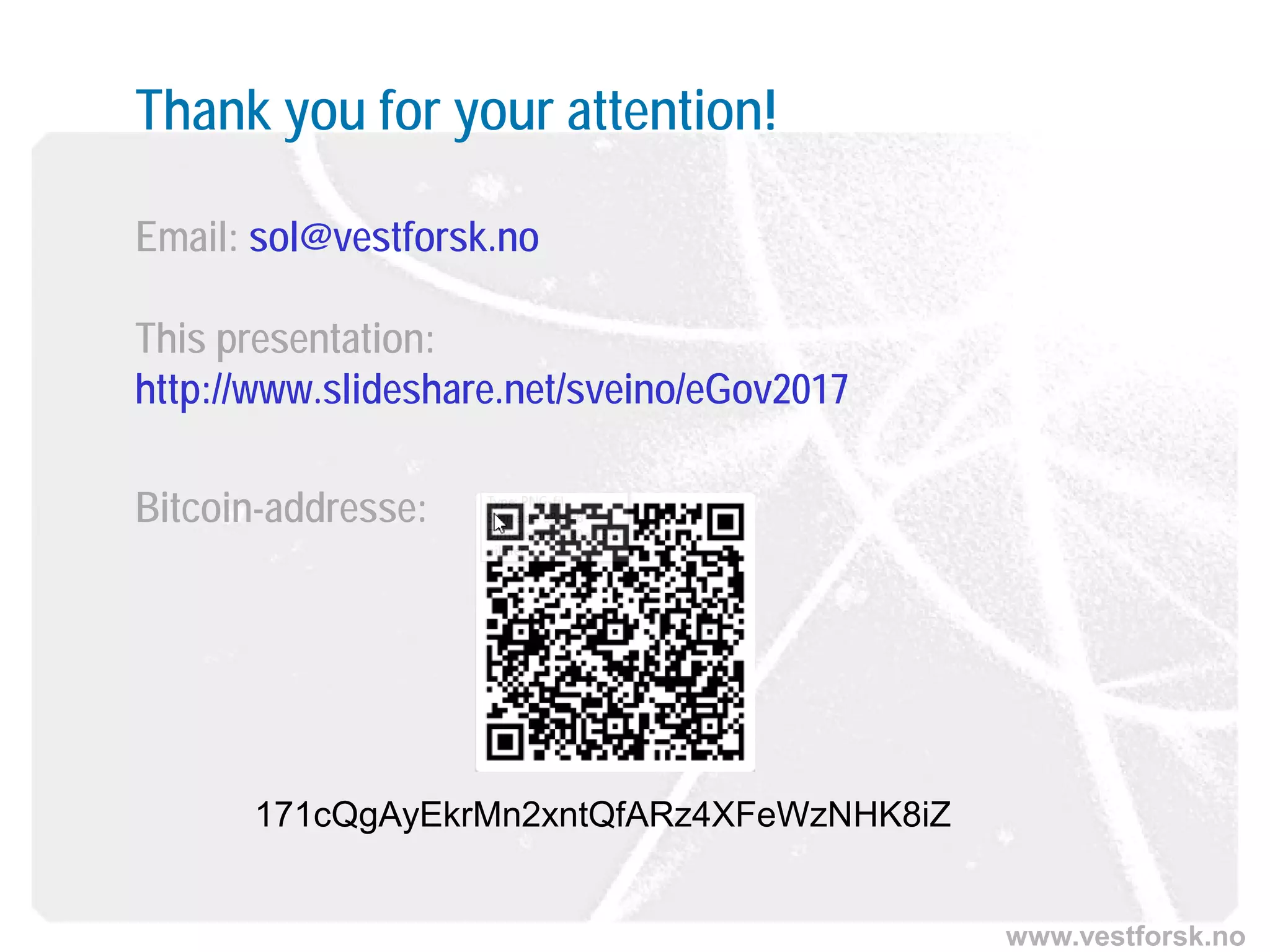
Bitcoin-addresse:
171cQgAyEkrMn2xntQfARz4XFeWzNHK8iZ

eGov2017Keynote

  • 1.
    www.vestforsk.no Bitcoin and blockchainin eGovernment Svein Ølnes, Vestlandsforsking, eGov/ePart 2017 ITMO University, St. Petersburg, 04.09.2017
  • 2.
  • 3.
    www.vestforsk.no  Located inSogndal, by the Sognefjord, est. 1985  Research areas:  Climate change  Tourism  Technology and society  Around 25 researchers  Part of the research infrastructure in Norway Western Norway Research Institute
  • 4.
    www.vestforsk.no  Researcher atWNRI since 1996  Main research field: eGovernment  Discovered Bitcoin in 2011  fascinated by the technology since then..  my interest is primarily in the intersection of tech., economy and society  MSc in Digital Currencies (2017) at the University of Nicosia  Disclosure: Own bitcoin and several other crypto currencies About me
  • 5.
    www.vestforsk.no Content  Short historyof Bitcoin and blockchain development  Introduction to Bitcoin and blockchain technology  Myths and facts  Bitcoin/blockchain as a platform and possible infrastructure  Use cases for public sector  Q&A
  • 6.
    www.vestforsk.no Bitcoin – «motherof all blockchains» Published 31.10.2008 (Halloween Day) Launched 03.01.2009 Running continually since
  • 7.
  • 8.
    www.vestforsk.no A classic innovation Building on decades of ground research in cryptography  All components known on beforehand  Put together in a novel way  Solved decades of failed attempts to solve the double- spending problem in a decentralized way (the Byzantine Generals’ Problem)
  • 9.
    www.vestforsk.no Bitcoin builds on David Chaum’s blind signatures and work with Digital Cash  Adam Back’s HashCash and Proof of Work  Hal Finney’s RPOW (Reusable Proof of Work)  Wai Dei’s b-money  Nick Szabo’s BitGold
  • 10.
    www.vestforsk.no Content  Short historyof Bitcoin and blockchain development  Introduction to Bitcoin and blockchain technology  Myths and facts  Bitcoin/blockchain as a platform and possible infrastructure  Use cases for public sector  Q&A
  • 11.
    www.vestforsk.no Back to start:Distributed Internet Paul Baran: «On Distributed Communications Network» [Baran invented packet switching, together with (and ind.p. of) Donald Davies, UK]
  • 12.
    www.vestforsk.no From client-server topeer-to-peer Traditional web technology Equal peers, no server
  • 13.
    www.vestforsk.no Cryptographic underpinnings  Publickey cryptography and digital signatures  Hashing algorithms  Merkle trees (of hashes)
  • 14.
    www.vestforsk.no Bitcoin definition  Bitcoinis proof of ownership without the need for a third-party  ownership of currency (bitcoin)  ownership of any physical or digital object that this currency represents
  • 15.
    www.vestforsk.no Bitcoin’s core architecture Peer-to-peer technology  Blockchain as a storage structure  Consensus mechanisms (Nakamoto Consensus)  Nodes for validating transactions and blocks  Miners with PoW for securing transactions (avoid double-spending)  The Nakamoto Consensus is the real disruptive part! (not the blochchain!)
  • 16.
    www.vestforsk.no Nakamoto Consensus  Theprocess by which a number of computers come to agree on some shared set of data and continually record valid changes to that data (Van Valkenburgh, 2016)
  • 17.
  • 18.
    www.vestforsk.no The Bitcoin blockchainstructure Important! Tamper evident vs. tamper proof!
  • 19.
  • 20.
    www.vestforsk.no Bitcoin constituencies  Bitcoinusers  Full node: Those who download the whole blockchain and participates in validation  Lightweight nodes: Mobile apps  Miners  Secures the blockchain  Developers  Maintenance and further development of the open source software  Exchanges  Exchanging between crypto currencies and fiat money and betw. CCs  Merchants  Those who accept crypto currencies for goods and services
  • 21.
    www.vestforsk.no Content  Short historyof Bitcoin and blockchain development  Introduction to Bitcoin and blockchain technology  Myths and facts  Bitcoin/blockchain as a platform and possible infrastructure  Use cases for public sector  Q&A
  • 22.
    www.vestforsk.no Myths about Bitcoinand blockchain technology  «Blockchain» is a pretty meaningless concept by its own  Need to specify what type of blockchain  Open/Closed, security model  Bitcoin only for criminals and shady affairs  Recent research shows this is no longer the case (Tasca et al., 2016)  Need to distinguish between open and closed blockchains  Blockchain as a universal solution  Blockchain techn. makes sense in many situations and scenarios  However, must always ask: Why not a tradional (DB) solution?
  • 23.
    www.vestforsk.no Open vs. closedblockchains Open (permissionless) Closed (permissioned) Who can update Everybody with enough resources Selected people/org. Who prod. data Everybody participat. Customers of org. Incentive to follow rules Direct economic (carrot & stick) Reputation Storing Distributed Centralized Trust in central actors No Yes Transaction costs - + Speed (trans./sec.) - + Immutability + - Currency/»token» Yes No Example Bitcoin, Ethereum HyperLedger, Corda (?)
  • 24.
    www.vestforsk.no What is genuinewith (open) blockchains?  Immutability  «tamper proof» vs. «tamper evident»  .. but not in itself (ref. Ethereum and The DAO)  Censor-ship resistant  «unwanted» transactions will also be processed as long as they follow the consensus rules  Open for all and at the same time protect privacy
  • 25.
    www.vestforsk.no Content  Short historyof Bitcoin and blockchain development  Introduction to Bitcoin and blockchain technology  Myths and facts  Bitcoin/blockchain as a platform and possible infrastructure  Use cases for public sector  Q&A
  • 26.
    www.vestforsk.no Bitcoin as aplatform Network/Protocol layer Currency/token Application
  • 27.
  • 28.
    www.vestforsk.no Internet and blockchaintechnology stacks Support infrastructures
  • 29.
    www.vestforsk.no Content  Short historyof Bitcoin and blockchain development  Introduction to Bitcoin and blockchain technology  Myths and facts  Bitcoin/blockchain as a platform and possible infrastructure  Use cases for public sector  Q&A
  • 30.
    www.vestforsk.no Open or closedblockchains in public sector?  Openness should be the main rule in public sector  However, cannot rule out the benefits of closed/private BCs  Blockchain technology should be perceived as a platform- enabling technology  as a platform technology for public sector, it should be open  as an information infrastructure, it needs to be open  Look at the development of blockchain technology the same way as the development of the Internet  gradually developed to an open network  the web also developed into an open platform (remember the extranets?)
  • 31.
    www.vestforsk.no Bitcoin and blockchaintechnology in public sector  Authentication of documents  badges, course certificates, CVs  other certificates and licenses  ++  Proof of ownership  property  +++  Security and privacy  secure, decentralized identity management  enhanced privacy  Think of Bitcoin/blockchain as a new Internet-based platform!
  • 32.
  • 33.
    www.vestforsk.no Domain name andpassword on the blockchain  «One password to rule them all»  Secure web (HTTPS)  Domain names registered directly on the blockchain (e.g. NameCoin)
  • 34.
  • 35.
    www.vestforsk.no More literature..  «Bitcon– A Peer-to-Peer Electronic Cash System» Satoshi Nakamoto, 2008  «Open Matters - Why Permissionless Blockchains are Essential to the Future of the Internet” Peter van Valkenburgh, Coin Center  «Beyond Bitcoin – Enabling Smart Government Using Blockchain Technology»  Svein Ølnes, eGov 2016, Springer LNCS  «Deja vú all over again: Thinking through law & code, again Lawrence Lessig, https://vimeo.com/148665401
  • 36.
    www.vestforsk.no Other resources  Newsabout Bitcoin and blockchain technology  CoinDesk (www.coindesk.com)  Coin Telegraph (www.cointelegraph.com)  Bitcoin Magazine (www.bitcoinmagazine.com)  + many more  Bitcoin blockchain (and other BCs) in real time  www.bitcoin.info  www.tradeblock.com/bitcoin  https://data.bitcoinity.org  www.statoshi.info  + many more
  • 37.
    www.vestforsk.no Content  Short historyof Bitcoin and blockchain development  Introduction to Bitcoin and blockchain technology  Myths and facts  Bitcoin/blockchain as a platform and possible infrastructure  Use cases for public sector  Q&A
  • 38.
    www.vestforsk.no Thank you foryour attention! Email: sol@vestforsk.no This presentation: http://www.slideshare.net/sveino/eGov2017 Bitcoin-addresse: 171cQgAyEkrMn2xntQfARz4XFeWzNHK8iZ