1
Maximising Response
in Census 2021
Welcome
Please turn off your camera and mute your microphone
Questions?
Visit www.sli.do and enter code 76712 to ask your questions
Technology problems?
Email sdr.stakeholder.engagement@ons.gov.uk
Starting at 12:30pm
#Census2021
2
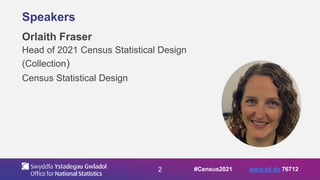
Speakers
Orlaith Fraser
Head of 2021 Census Statistical Design
(Collection)
Census Statistical Design
#Census2021 www.sli.do 76712
3
Aims for this session:
• Explore how we can model the expected patterns of returns and simulate
different operational scenarios
• Demonstrate how we will identify shortfalls in response
• Explain how we will use live data to inform us of progress and respond flexibly
where needed to enable us to meet our response targets
#Census2021 www.sli.do 76712
4
Why are we running these webinars?
• To explain how the census works in collecting information
and producing great statistics
• To sign-post where more information is available
• To follow on from the material we published in October
• COVID response
• Statistical Design
• Findings from 2019 rehearsal
#Census2021 www.sli.do 76712
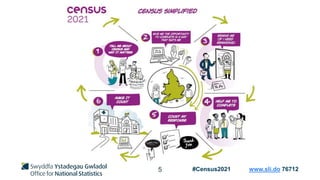
5 #Census2021 www.sli.do 76712
6
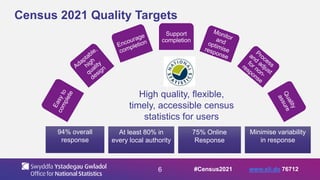
Census 2021 Quality Targets
High quality, flexible,
timely, accessible census
statistics for users
94% overall
response
At least 80% in
every local authority
75% Online
Response
Minimise variability
in response
Support
completion
#Census2021 www.sli.do 76712
7
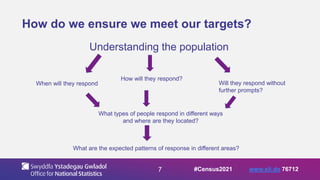
How do we ensure we meet our targets?
Understanding the population
When will they respond
How will they respond?
Will they respond without
further prompts?
What types of people respond in different ways
and where are they located?
What are the expected patterns of response in different areas?
#Census2021 www.sli.do 76712
8
An Online first Census
Principle to guide design & development of statistical and operational
processes
Better data quality
Quicker outputs
Easier for respondents
Complete anywhere on any device
Routing and use of search-as-you-type
BUT – we don’t expect everyone to complete a census online

Aim is 75% of households choosing online completion in 2021
#Census2021 www.sli.do 76712
9
How will it work?
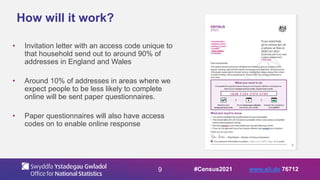
• Invitation letter with an access code unique to
that household send out to around 90% of
addresses in England and Wales
• Around 10% of addresses in areas where we
expect people to be less likely to complete
online will be sent paper questionnaires.
• Paper questionnaires will also have access
codes on to enable online response
#Census2021 www.sli.do 76712
10
Helping those who can’t or won’t respond online
• Paper questionnaires – four key routes:
1. As first contact
2. As a reminder
3. Via contact centre
4. Via the website
• Additional targeted support
• Paper questionnaires available from census officers on the doorstep
• Telephone capture for those who may have difficulty completing online or on paper
• Census Support Centres in the community for those who wish to complete the Census online
but may need assistance to do so.
#Census2021 www.sli.do 76712
11
Census Coverage Survey (CCS)
• Survey of 1% of households 6 weeks after Census Day
• Face-to-face interviews on the doorstep
• Subset of Census questions asked
• Used to establish coverage in the Census and to impute missing
people
High quality Census estimates dependent on maximising
response to both the Census and CCS
#Census2021 www.sli.do 76712
12
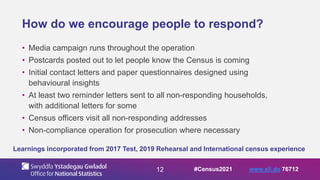
How do we encourage people to respond?
• Media campaign runs throughout the operation
• Postcards posted out to let people know the Census is coming
• Initial contact letters and paper questionnaires designed using
behavioural insights
• At least two reminder letters sent to all non-responding households,
with additional letters for some
• Census officers visit all non-responding addresses
• Non-compliance operation for prosecution where necessary
Learnings incorporated from 2017 Test, 2019 Rehearsal and International census experience
#Census2021 www.sli.do 76712
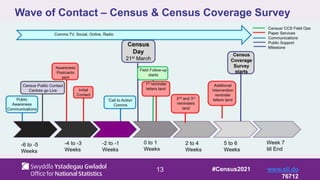
13 #Census2021 www.sli.do
76712
Wave of Contact – Census & Census Coverage Survey
14
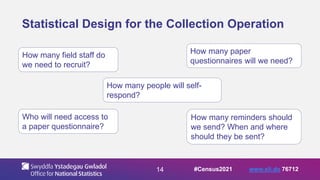
Statistical Design for the Collection Operation
How many field staff do
we need to recruit?
How many paper
questionnaires will we need?
How many people will self-
respond?
Who will need access to
a paper questionnaire?
How many reminders should
we send? When and where
should they be sent?
#Census2021 www.sli.do 76712
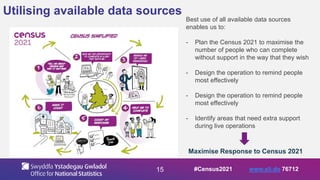
Utilising available data sources
15
Best use of all available data sources
enables us to:
- Plan the Census 2021 to maximise the
number of people who can complete
without support in the way that they wish
- Design the operation to remind people
most effectively
- Design the operation to remind people
most effectively
- Identify areas that need extra support
during live operations
Maximise Response to Census 2021
#Census2021 www.sli.do 76712
16
Hard to Count Index
#Census2021 www.sli.do 76712
17
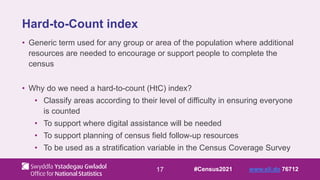
Hard-to-Count index
• Generic term used for any group or area of the population where additional
resources are needed to encourage or support people to complete the
census
• Why do we need a hard-to-count (HtC) index?
• Classify areas according to their level of difficulty in ensuring everyone
is counted
• To support where digital assistance will be needed
• To support planning of census field follow-up resources
• To be used as a stratification variable in the Census Coverage Survey
#Census2021 www.sli.do 76712
18
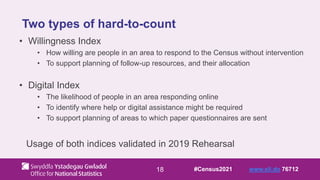
Two types of hard-to-count
• Willingness Index
• How willing are people in an area to respond to the Census without intervention
• To support planning of follow-up resources, and their allocation
• Digital Index
• The likelihood of people in an area responding online
• To identify where help or digital assistance might be required
• To support planning of areas to which paper questionnaires are sent
Usage of both indices validated in 2019 Rehearsal
#Census2021 www.sli.do 76712
19
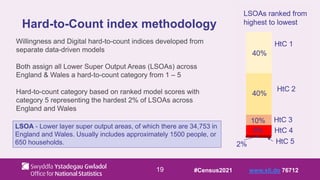
Hard-to-Count index methodology
Willingness and Digital hard-to-count indices developed from
separate data-driven models
Both assign all Lower Super Output Areas (LSOAs) across
England & Wales a hard-to-count category from 1 – 5
Hard-to-count category based on ranked model scores with
category 5 representing the hardest 2% of LSOAs across
England and Wales
LSOA - Lower layer super output areas, of which there are 34,753 in
England and Wales. Usually includes approximately 1500 people, or
650 households.
#Census2021 www.sli.do 76712
20
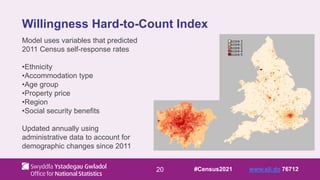
Willingness Hard-to-Count Index
Model uses variables that predicted
2011 Census self-response rates
•Ethnicity
•Accommodation type
•Age group
•Property price
•Region
•Social security benefits
Updated annually using
administrative data to account for
demographic changes since 2011
#Census2021 www.sli.do 76712
21
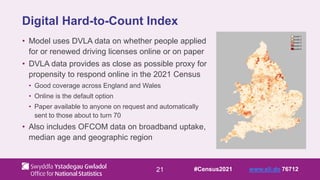
Digital Hard-to-Count Index
• Model uses DVLA data on whether people applied
for or renewed driving licenses online or on paper
• DVLA data provides as close as possible proxy for
propensity to respond online in the 2021 Census
• Good coverage across England and Wales
• Online is the default option
• Paper available to anyone on request and automatically
sent to those about to turn 70
• Also includes OFCOM data on broadband uptake,
median age and geographic region
#Census2021 www.sli.do 76712
22
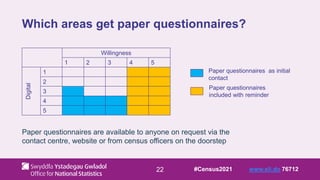
Which areas get paper questionnaires?
Willingness
1 2 3 4 5
Digital
1
2
3
4
5
Paper questionnaires as initial
contact
Paper questionnaires
included with reminder
Paper questionnaires are available to anyone on request via the
contact centre, website or from census officers on the doorstep
#Census2021 www.sli.do 76712
23
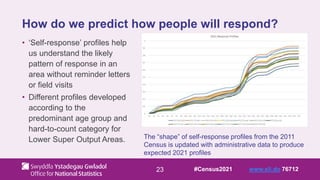
How do we predict how people will respond?
• ‘Self-response’ profiles help
us understand the likely
pattern of response in an
area without reminder letters
or field visits
• Different profiles developed
according to the
predominant age group and
hard-to-count category for
Lower Super Output Areas. The “shape” of self-response profiles from the 2011
Census is updated with administrative data to produce
expected 2021 profiles
#Census2021 www.sli.do 76712
24
We now know who is likely to
respond without further prompts
How do we get the rest of the
population to respond?
#Census2021 www.sli.do 76712
25
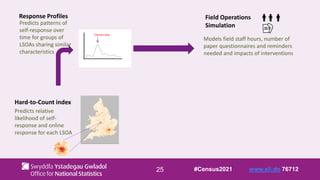
Hard-to-Count index
Predicts relative
likelihood of self-
response and online
response for each LSOA
Response Profiles
Predicts patterns of
self-response over
time for groups of
LSOAs sharing similar
characteristics
Field Operations
Simulation
Models field staff hours, number of
paper questionnaires and reminders
needed and impacts of interventions
Census day
#Census2021 www.sli.do 76712
26
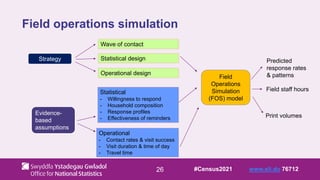
Field operations simulation
Strategy
Wave of contact
Statistical design
Operational design
Evidence-
based
assumptions
Statistical
- Willingness to respond
- Household composition
- Response profiles
- Effectiveness of reminders
Operational
- Contact rates & visit success
- Visit duration & time of day
- Travel time
Field
Operations
Simulation
(FOS) model
Field staff hours
Print volumes
Predicted
response rates
& patterns
#Census2021 www.sli.do 76712
27
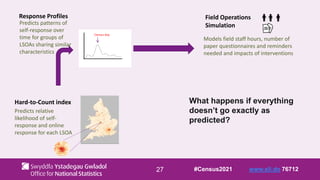
Hard-to-Count index
Predicts relative
likelihood of self-
response and online
response for each LSOA
Response Profiles
Predicts patterns of
self-response over
time for groups of
LSOAs sharing similar
characteristics
Field Operations
Simulation
Models field staff hours, number of
paper questionnaires and reminders
needed and impacts of interventions
Census day
What happens if everything
doesn’t go exactly as
predicted?
#Census2021 www.sli.do 76712
28
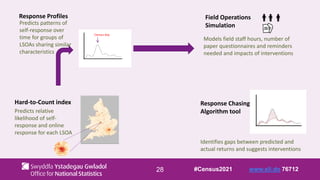
Hard-to-Count index
Predicts relative
likelihood of self-
response and online
response for each LSOA
Response Profiles
Predicts patterns of
self-response over
time for groups of
LSOAs sharing similar
characteristics
Field Operations
Simulation
Models field staff hours, number of
paper questionnaires and reminders
needed and impacts of interventions
Census day
Response Chasing
Algorithm tool
Identifies gaps between predicted and
actual returns and suggests interventions
#Census2021 www.sli.do 76712
29
Response Chasing
Algorithm
#Census2021 www.sli.do 76712
30
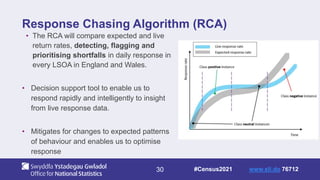
Response Chasing Algorithm (RCA)
• The RCA will compare expected and live
return rates, detecting, flagging and
prioritising shortfalls in daily response in
every LSOA in England and Wales.
• Decision support tool to enable us to
respond rapidly and intelligently to insight
from live response data.
• Mitigates for changes to expected patterns
of behaviour and enables us to optimise
response
#Census2021 www.sli.do 76712
31
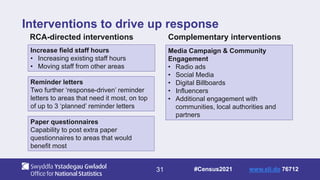
Interventions to drive up response
RCA-directed interventions
Increase field staff hours
• Increasing existing staff hours
• Moving staff from other areas
Reminder letters
Two further ‘response-driven’ reminder
letters to areas that need it most, on top
of up to 3 ‘planned’ reminder letters
Paper questionnaires
Capability to post extra paper
questionnaires to areas that would
benefit most
Complementary interventions
Media Campaign & Community
Engagement
• Radio ads
• Social Media
• Digital Billboards
• Influencers
• Additional engagement with
communities, local authorities and
partners
#Census2021 www.sli.do 76712
32
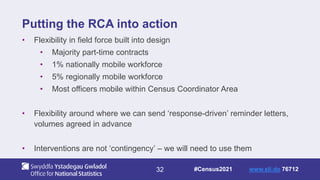
Putting the RCA into action
• Flexibility in field force built into design
• Majority part-time contracts
• 1% nationally mobile workforce
• 5% regionally mobile workforce
• Most officers mobile within Census Coordinator Area
• Flexibility around where we can send ‘response-driven’ reminder letters,
volumes agreed in advance
• Interventions are not ‘contingency’ – we will need to use them
#Census2021 www.sli.do 76712
33
Optimising Response
& Minimising Variability
#Census2021 www.sli.do 76712
34
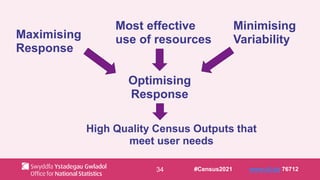
Maximising
Response
Most effective
use of resources
Minimising
Variability
Optimising
Response
High Quality Census Outputs that
meet user needs
#Census2021 www.sli.do 76712
35
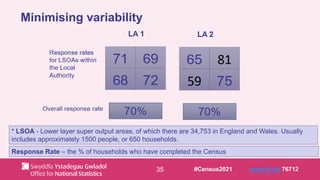
Minimising variability
* LSOA - Lower layer super output areas, of which there are 34,753 in England and Wales. Usually
includes approximately 1500 people, or 650 households.
Response Rate – the % of households who have completed the Census
#Census2021 www.sli.do 76712
36
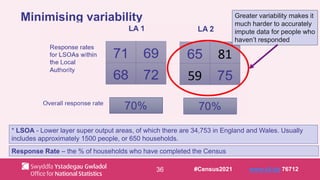
Minimising variability Greater variability makes it
much harder to accurately
impute data for people who
haven’t responded
* LSOA - Lower layer super output areas, of which there are 34,753 in England and Wales. Usually
includes approximately 1500 people, or 650 households.
Response Rate – the % of households who have completed the Census
#Census2021 www.sli.do 76712
37
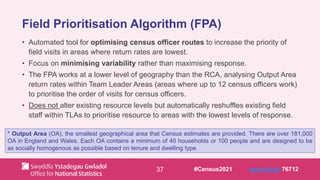
Field Prioritisation Algorithm (FPA)
• Automated tool for optimising census officer routes to increase the priority of
field visits in areas where return rates are lowest.
• Focus on minimising variability rather than maximising response.
• The FPA works at a lower level of geography than the RCA, analysing Output Area
return rates within Team Leader Areas (areas where up to 12 census officers work)
to prioritise the order of visits for census officers.
• Does not alter existing resource levels but automatically reshuffles existing field
staff within TLAs to prioritise resource to areas with the lowest levels of response.
* Output Area (OA), the smallest geographical area that Census estimates are provided. There are over 181,000
OA in England and Wales. Each OA contains a minimum of 40 households or 100 people and are designed to be
as socially homogenous as possible based on tenure and dwelling type.
#Census2021 www.sli.do 76712
38
Helping those who need
more support
#Census2021 www.sli.do 76712
39
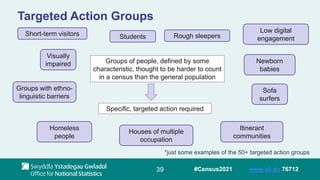
Targeted Action Groups
Groups of people, defined by some
characteristic, thought to be harder to count
in a census than the general population
Specific, targeted action required
Newborn
babies
Sofa
surfers
Homeless
people
Visually
impaired
Groups with ethno-
linguistic barriers
Houses of multiple
occupation
Low digital
engagement
Itinerant
communities
Students Rough sleepers
Short-term visitors
*just some examples of the 50+ targeted action groups
#Census2021 www.sli.do 76712
40
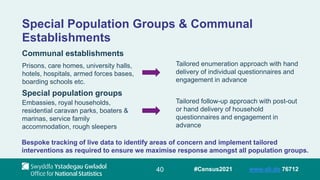
Special Population Groups & Communal
Establishments
Communal establishments
Prisons, care homes, university halls,
hotels, hospitals, armed forces bases,
boarding schools etc.
Tailored enumeration approach with hand
delivery of individual questionnaires and
engagement in advance
Special population groups
Embassies, royal households,
residential caravan parks, boaters &
marinas, service family
accommodation, rough sleepers
Tailored follow-up approach with post-out
or hand delivery of household
questionnaires and engagement in
advance
Bespoke tracking of live data to identify areas of concern and implement tailored
interventions as required to ensure we maximise response amongst all population groups.
#Census2021 www.sli.do 76712
41
Covid-19 Impacts
#Census2021 www.sli.do 76712
42
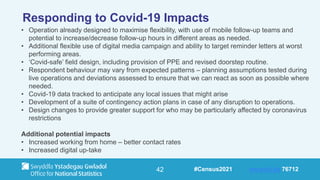
Responding to Covid-19 Impacts
• Operation already designed to maximise flexibility, with use of mobile follow-up teams and
potential to increase/decrease follow-up hours in different areas as needed.
• Additional flexible use of digital media campaign and ability to target reminder letters at worst
performing areas.
• ‘Covid-safe’ field design, including provision of PPE and revised doorstep routine.
• Respondent behaviour may vary from expected patterns – planning assumptions tested during
live operations and deviations assessed to ensure that we can react as soon as possible where
needed.
• Covid-19 data tracked to anticipate any local issues that might arise
• Development of a suite of contingency action plans in case of any disruption to operations.
• Design changes to provide greater support for who may be particularly affected by coronavirus
restrictions
Additional potential impacts
• Increased working from home – better contact rates
• Increased digital up-take
#Census2021 www.sli.do 76712
43
Summary
• Making the most of best available data and methodology to design the
operation with an optimal strategy and resource allocation to meet our
quality targets
• Maximising use of live return data during the Census operational period to
identify any areas of concern early
• Flexible operational design to enable rapid, targeted approach to
responding to areas of concern and optimise response
• Inclusive design to ensure that everyone has the opportunity to respond in
the way that they wish to do so.
#Census2021 www.sli.do 76712
44
Maximising Response in
the Census 2021
Any questions?
Visit www.sli.do and enter code 76712
Please complete our evaluation survey (we have emailed you a link) and let us know how we
did.
If you have any questions email us on SDR.stakeholder.engagement@ons.gov.uk.
Want to learn more about the Census 2021 Statistical Design? Visit our website to find out
more about our other webinars.
#Census2021
45
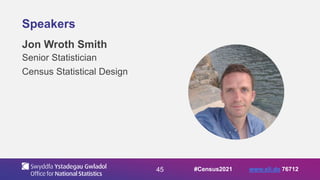
Speakers
Jon Wroth Smith
Senior Statistician
Census Statistical Design
#Census2021 www.sli.do 76712
46
Speakers
Jason Zawadzki
Deputy Director
Census Collection
#Census2021 www.sli.do 76712

Maximising Response in Census 2021

  • 1.
    1 Maximising Response in Census2021 Welcome Please turn off your camera and mute your microphone Questions? Visit www.sli.do and enter code 76712 to ask your questions Technology problems? Email sdr.stakeholder.engagement@ons.gov.uk Starting at 12:30pm #Census2021
  • 2.
    2 Speakers Orlaith Fraser Head of2021 Census Statistical Design (Collection) Census Statistical Design #Census2021 www.sli.do 76712
  • 3.
    3 Aims for thissession: • Explore how we can model the expected patterns of returns and simulate different operational scenarios • Demonstrate how we will identify shortfalls in response • Explain how we will use live data to inform us of progress and respond flexibly where needed to enable us to meet our response targets #Census2021 www.sli.do 76712
  • 4.
    4 Why are werunning these webinars? • To explain how the census works in collecting information and producing great statistics • To sign-post where more information is available • To follow on from the material we published in October • COVID response • Statistical Design • Findings from 2019 rehearsal #Census2021 www.sli.do 76712
  • 5.
  • 6.
    6 Census 2021 QualityTargets High quality, flexible, timely, accessible census statistics for users 94% overall response At least 80% in every local authority 75% Online Response Minimise variability in response Support completion #Census2021 www.sli.do 76712
  • 7.
    7 How do weensure we meet our targets? Understanding the population When will they respond How will they respond? Will they respond without further prompts? What types of people respond in different ways and where are they located? What are the expected patterns of response in different areas? #Census2021 www.sli.do 76712
  • 8.
    8 An Online firstCensus Principle to guide design & development of statistical and operational processes Better data quality Quicker outputs Easier for respondents Complete anywhere on any device Routing and use of search-as-you-type BUT – we don’t expect everyone to complete a census online Aim is 75% of households choosing online completion in 2021 #Census2021 www.sli.do 76712
  • 9.
    9 How will itwork? • Invitation letter with an access code unique to that household send out to around 90% of addresses in England and Wales • Around 10% of addresses in areas where we expect people to be less likely to complete online will be sent paper questionnaires. • Paper questionnaires will also have access codes on to enable online response #Census2021 www.sli.do 76712
  • 10.
    10 Helping those whocan’t or won’t respond online • Paper questionnaires – four key routes: 1. As first contact 2. As a reminder 3. Via contact centre 4. Via the website • Additional targeted support • Paper questionnaires available from census officers on the doorstep • Telephone capture for those who may have difficulty completing online or on paper • Census Support Centres in the community for those who wish to complete the Census online but may need assistance to do so. #Census2021 www.sli.do 76712
  • 11.
    11 Census Coverage Survey(CCS) • Survey of 1% of households 6 weeks after Census Day • Face-to-face interviews on the doorstep • Subset of Census questions asked • Used to establish coverage in the Census and to impute missing people High quality Census estimates dependent on maximising response to both the Census and CCS #Census2021 www.sli.do 76712
  • 12.
    12 How do weencourage people to respond? • Media campaign runs throughout the operation • Postcards posted out to let people know the Census is coming • Initial contact letters and paper questionnaires designed using behavioural insights • At least two reminder letters sent to all non-responding households, with additional letters for some • Census officers visit all non-responding addresses • Non-compliance operation for prosecution where necessary Learnings incorporated from 2017 Test, 2019 Rehearsal and International census experience #Census2021 www.sli.do 76712
  • 13.
    13 #Census2021 www.sli.do 76712 Waveof Contact – Census & Census Coverage Survey
  • 14.
    14 Statistical Design forthe Collection Operation How many field staff do we need to recruit? How many paper questionnaires will we need? How many people will self- respond? Who will need access to a paper questionnaire? How many reminders should we send? When and where should they be sent? #Census2021 www.sli.do 76712
  • 15.
    Utilising available datasources 15 Best use of all available data sources enables us to: - Plan the Census 2021 to maximise the number of people who can complete without support in the way that they wish - Design the operation to remind people most effectively - Design the operation to remind people most effectively - Identify areas that need extra support during live operations Maximise Response to Census 2021 #Census2021 www.sli.do 76712
  • 16.
    16 Hard to CountIndex #Census2021 www.sli.do 76712
  • 17.
    17 Hard-to-Count index • Genericterm used for any group or area of the population where additional resources are needed to encourage or support people to complete the census • Why do we need a hard-to-count (HtC) index? • Classify areas according to their level of difficulty in ensuring everyone is counted • To support where digital assistance will be needed • To support planning of census field follow-up resources • To be used as a stratification variable in the Census Coverage Survey #Census2021 www.sli.do 76712
  • 18.
    18 Two types ofhard-to-count • Willingness Index • How willing are people in an area to respond to the Census without intervention • To support planning of follow-up resources, and their allocation • Digital Index • The likelihood of people in an area responding online • To identify where help or digital assistance might be required • To support planning of areas to which paper questionnaires are sent Usage of both indices validated in 2019 Rehearsal #Census2021 www.sli.do 76712
  • 19.
    19 Hard-to-Count index methodology Willingnessand Digital hard-to-count indices developed from separate data-driven models Both assign all Lower Super Output Areas (LSOAs) across England & Wales a hard-to-count category from 1 – 5 Hard-to-count category based on ranked model scores with category 5 representing the hardest 2% of LSOAs across England and Wales LSOA - Lower layer super output areas, of which there are 34,753 in England and Wales. Usually includes approximately 1500 people, or 650 households. #Census2021 www.sli.do 76712
  • 20.
    20 Willingness Hard-to-Count Index Modeluses variables that predicted 2011 Census self-response rates •Ethnicity •Accommodation type •Age group •Property price •Region •Social security benefits Updated annually using administrative data to account for demographic changes since 2011 #Census2021 www.sli.do 76712
  • 21.
    21 Digital Hard-to-Count Index •Model uses DVLA data on whether people applied for or renewed driving licenses online or on paper • DVLA data provides as close as possible proxy for propensity to respond online in the 2021 Census • Good coverage across England and Wales • Online is the default option • Paper available to anyone on request and automatically sent to those about to turn 70 • Also includes OFCOM data on broadband uptake, median age and geographic region #Census2021 www.sli.do 76712
  • 22.
    22 Which areas getpaper questionnaires? Willingness 1 2 3 4 5 Digital 1 2 3 4 5 Paper questionnaires as initial contact Paper questionnaires included with reminder Paper questionnaires are available to anyone on request via the contact centre, website or from census officers on the doorstep #Census2021 www.sli.do 76712
  • 23.
    23 How do wepredict how people will respond? • ‘Self-response’ profiles help us understand the likely pattern of response in an area without reminder letters or field visits • Different profiles developed according to the predominant age group and hard-to-count category for Lower Super Output Areas. The “shape” of self-response profiles from the 2011 Census is updated with administrative data to produce expected 2021 profiles #Census2021 www.sli.do 76712
  • 24.
    24 We now knowwho is likely to respond without further prompts How do we get the rest of the population to respond? #Census2021 www.sli.do 76712
  • 25.
    25 Hard-to-Count index Predicts relative likelihoodof self- response and online response for each LSOA Response Profiles Predicts patterns of self-response over time for groups of LSOAs sharing similar characteristics Field Operations Simulation Models field staff hours, number of paper questionnaires and reminders needed and impacts of interventions Census day #Census2021 www.sli.do 76712
  • 26.
    26 Field operations simulation Strategy Waveof contact Statistical design Operational design Evidence- based assumptions Statistical - Willingness to respond - Household composition - Response profiles - Effectiveness of reminders Operational - Contact rates & visit success - Visit duration & time of day - Travel time Field Operations Simulation (FOS) model Field staff hours Print volumes Predicted response rates & patterns #Census2021 www.sli.do 76712
  • 27.
    27 Hard-to-Count index Predicts relative likelihoodof self- response and online response for each LSOA Response Profiles Predicts patterns of self-response over time for groups of LSOAs sharing similar characteristics Field Operations Simulation Models field staff hours, number of paper questionnaires and reminders needed and impacts of interventions Census day What happens if everything doesn’t go exactly as predicted? #Census2021 www.sli.do 76712
  • 28.
    28 Hard-to-Count index Predicts relative likelihoodof self- response and online response for each LSOA Response Profiles Predicts patterns of self-response over time for groups of LSOAs sharing similar characteristics Field Operations Simulation Models field staff hours, number of paper questionnaires and reminders needed and impacts of interventions Census day Response Chasing Algorithm tool Identifies gaps between predicted and actual returns and suggests interventions #Census2021 www.sli.do 76712
  • 29.
  • 30.
    30 Response Chasing Algorithm(RCA) • The RCA will compare expected and live return rates, detecting, flagging and prioritising shortfalls in daily response in every LSOA in England and Wales. • Decision support tool to enable us to respond rapidly and intelligently to insight from live response data. • Mitigates for changes to expected patterns of behaviour and enables us to optimise response #Census2021 www.sli.do 76712
  • 31.
    31 Interventions to driveup response RCA-directed interventions Increase field staff hours • Increasing existing staff hours • Moving staff from other areas Reminder letters Two further ‘response-driven’ reminder letters to areas that need it most, on top of up to 3 ‘planned’ reminder letters Paper questionnaires Capability to post extra paper questionnaires to areas that would benefit most Complementary interventions Media Campaign & Community Engagement • Radio ads • Social Media • Digital Billboards • Influencers • Additional engagement with communities, local authorities and partners #Census2021 www.sli.do 76712
  • 32.
    32 Putting the RCAinto action • Flexibility in field force built into design • Majority part-time contracts • 1% nationally mobile workforce • 5% regionally mobile workforce • Most officers mobile within Census Coordinator Area • Flexibility around where we can send ‘response-driven’ reminder letters, volumes agreed in advance • Interventions are not ‘contingency’ – we will need to use them #Census2021 www.sli.do 76712
  • 33.
    33 Optimising Response & MinimisingVariability #Census2021 www.sli.do 76712
  • 34.
    34 Maximising Response Most effective use ofresources Minimising Variability Optimising Response High Quality Census Outputs that meet user needs #Census2021 www.sli.do 76712
  • 35.
    35 Minimising variability * LSOA- Lower layer super output areas, of which there are 34,753 in England and Wales. Usually includes approximately 1500 people, or 650 households. Response Rate – the % of households who have completed the Census #Census2021 www.sli.do 76712
  • 36.
    36 Minimising variability Greatervariability makes it much harder to accurately impute data for people who haven’t responded * LSOA - Lower layer super output areas, of which there are 34,753 in England and Wales. Usually includes approximately 1500 people, or 650 households. Response Rate – the % of households who have completed the Census #Census2021 www.sli.do 76712
  • 37.
    37 Field Prioritisation Algorithm(FPA) • Automated tool for optimising census officer routes to increase the priority of field visits in areas where return rates are lowest. • Focus on minimising variability rather than maximising response. • The FPA works at a lower level of geography than the RCA, analysing Output Area return rates within Team Leader Areas (areas where up to 12 census officers work) to prioritise the order of visits for census officers. • Does not alter existing resource levels but automatically reshuffles existing field staff within TLAs to prioritise resource to areas with the lowest levels of response. * Output Area (OA), the smallest geographical area that Census estimates are provided. There are over 181,000 OA in England and Wales. Each OA contains a minimum of 40 households or 100 people and are designed to be as socially homogenous as possible based on tenure and dwelling type. #Census2021 www.sli.do 76712
  • 38.
    38 Helping those whoneed more support #Census2021 www.sli.do 76712
  • 39.
    39 Targeted Action Groups Groupsof people, defined by some characteristic, thought to be harder to count in a census than the general population Specific, targeted action required Newborn babies Sofa surfers Homeless people Visually impaired Groups with ethno- linguistic barriers Houses of multiple occupation Low digital engagement Itinerant communities Students Rough sleepers Short-term visitors *just some examples of the 50+ targeted action groups #Census2021 www.sli.do 76712
  • 40.
    40 Special Population Groups& Communal Establishments Communal establishments Prisons, care homes, university halls, hotels, hospitals, armed forces bases, boarding schools etc. Tailored enumeration approach with hand delivery of individual questionnaires and engagement in advance Special population groups Embassies, royal households, residential caravan parks, boaters & marinas, service family accommodation, rough sleepers Tailored follow-up approach with post-out or hand delivery of household questionnaires and engagement in advance Bespoke tracking of live data to identify areas of concern and implement tailored interventions as required to ensure we maximise response amongst all population groups. #Census2021 www.sli.do 76712
  • 41.
  • 42.
    42 Responding to Covid-19Impacts • Operation already designed to maximise flexibility, with use of mobile follow-up teams and potential to increase/decrease follow-up hours in different areas as needed. • Additional flexible use of digital media campaign and ability to target reminder letters at worst performing areas. • ‘Covid-safe’ field design, including provision of PPE and revised doorstep routine. • Respondent behaviour may vary from expected patterns – planning assumptions tested during live operations and deviations assessed to ensure that we can react as soon as possible where needed. • Covid-19 data tracked to anticipate any local issues that might arise • Development of a suite of contingency action plans in case of any disruption to operations. • Design changes to provide greater support for who may be particularly affected by coronavirus restrictions Additional potential impacts • Increased working from home – better contact rates • Increased digital up-take #Census2021 www.sli.do 76712
  • 43.
    43 Summary • Making themost of best available data and methodology to design the operation with an optimal strategy and resource allocation to meet our quality targets • Maximising use of live return data during the Census operational period to identify any areas of concern early • Flexible operational design to enable rapid, targeted approach to responding to areas of concern and optimise response • Inclusive design to ensure that everyone has the opportunity to respond in the way that they wish to do so. #Census2021 www.sli.do 76712
  • 44.
    44 Maximising Response in theCensus 2021 Any questions? Visit www.sli.do and enter code 76712 Please complete our evaluation survey (we have emailed you a link) and let us know how we did. If you have any questions email us on SDR.stakeholder.engagement@ons.gov.uk. Want to learn more about the Census 2021 Statistical Design? Visit our website to find out more about our other webinars. #Census2021
  • 45.
    45 Speakers Jon Wroth Smith SeniorStatistician Census Statistical Design #Census2021 www.sli.do 76712
  • 46.
    46 Speakers Jason Zawadzki Deputy Director CensusCollection #Census2021 www.sli.do 76712