Banking
                       Financial
                       Services
                       Insurance


   Presented By-
Surendra Singh Bisht
BFSI SECTOR
• Banking, financial services and insurance (BFSI) is an
  industry term of art for companies that provide a range
  of such products/services.
• Banking may include core banking, retail, private,
  corporate, investment, cards and the like.
• Financial services may include stock-broking, payment
  gateways, mutual funds etc.
• Insurance covers both life & general insurance.
BANKING
• The Indian banking industry has its foundations in the 18th
  century,
• The General Bank of India(1786) & Bank of Hindustan(1770)
  are first Bank in India
• The Reserve Bank of India, India's central banking authority,
  was established in April 1935, but was nationalized on January
  1, 1949
• In 1949, the Banking Regulation Act was enacted which
  empowered the Reserve Bank of India (RBI) "to regulate,
  control, and inspect the banks in India".
• More than 26 nationalise banks and private banks in india
• State bank of india is the largest bank in india
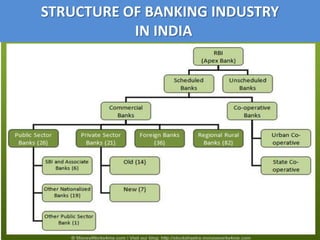
STRUCTURE OF BANKING INDUSTRY
           IN INDIA
GROWTH AND FUTURE PROSPECTS

• As per IBA-FICCI-BCG the Indian banking industry
  is set for an exponential growth with its assets size
  from $1,350 bn.(2010) to $28,500 bn.(2025)
• Total bank credit grew at 15.9 per cent, while total
  deposits growth was 14.3 per cent as at end
  September 2012
• Indian banks face the prospect of retirement of nearly
  55 per cent of their people so here huge opportunity
  for employment
• New banking license
FINANCIAL SERVICES
• The history of Indian financial markets spans back 200 years,
around the end of the 18th century

• India financial market comprise of the primary market, FDIs,
alternative investment options, the pension sectors, asset
management segment as well.

• One of the oldest across the globe and is definitely the fastest
growing and best among all the financial markets of the
emerging economies.
CONTINUE….
• The capital market of India initially developed
  around Mumbai; with around 200 to 250
  securities brokers participating in active trade
  during the second half of the 19th century.

• India has a strong financial regulatory system,
  administered by Reserve Bank of India (RBI) and
  supported by securities and exchange board of
  India (SEBI), which govern capital markets and
  mutual funds, among other financial institutions
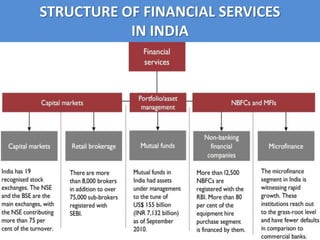
STRUCTURE OF FINANCIAL SERVICES
           IN INDIA
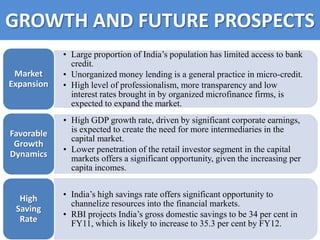
GROWTH AND FUTURE PROSPECTS
            • Large proportion of India’s population has limited access to bank
              credit.
 Market     • Unorganized money lending is a general practice in micro-credit.
Expansion   • High level of professionalism, more transparency and low
              interest rates brought in by organized microfinance firms, is
              expected to expand the market.
            • High GDP growth rate, driven by significant corporate earnings,
Favorable     is expected to create the need for more intermediaries in the
              capital market.
 Growth
            • Lower penetration of the retail investor segment in the capital
Dynamics      markets offers a significant opportunity, given the increasing per
              capita incomes.


  High      • India’s high savings rate offers significant opportunity to
              channelize resources into the financial markets.
 Saving
            • RBI projects India’s gross domestic savings to be 34 per cent in
  Rate        FY11, which is likely to increase to 35.3 per cent by FY12.
INSURANCE
• In 1818, when Oriental Life Insurance Company was
  started by Anita Bhavsar in Kolkata to cater to the needs
  of European community.
• In 1870, Bombay Mutual Life Assurance Society
  became the first Indian insurer.
• In the year 1912, the Life Insurance Companies Act and
  the Provident Fund Act were passed to regulate the
  insurance business.
• The oldest existing insurance company in India is the
  National Insurance Company Ltd., which was founded
  in 1906.
• Currently India is a US$41 billion industry.
CONTINUE…..
• The Insurance Act of 1938 was the first legislation governing
  all forms of insurance to provide strict state control over
  insurance business.
• The Govt. of India introduced the Insurance Regulatory and
  Development Authority Act in 1999, thereby de-regulating the
  insurance sector and allowing private companies.
• Foreign investment was also allowed and capped at 51%
  holding in the Indian insurance companies.
• In 2006, the Actuaries Act was passed by parliament to give
  the profession statutory status on par with Chartered
  Accountants, Notaries, Cost & Works Accountants,
  Advocates, Architects and Company Secretaries.
• A minimum capital of US$80 million(Rs.400 Cr.) is required
  by legislation to set up an insurance business.
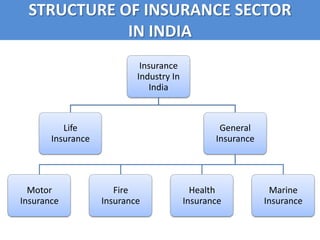
STRUCTURE OF INSURANCE SECTOR
            IN INDIA
                            Insurance
                           Industry In
                              India


          Life                                   General
       Insurance                                Insurance


  Motor               Fire                 Health            Marine
Insurance          Insurance             Insurance          Insurance
LIFE INSURANCE
• The Government of India issued an Ordinance
  on 19 January 1956 nationalising the Life
  Insurance sector
• Life Insurance Corporation (LIC) absorbed
  154 Indian, 16 non-Indian insurers as also 75
  provident societies—245 Indian and foreign
  insurers and came into existence in 1956
• Today 1 public and 23 private life insurance
  companies operating in India.
GENERAL INSURANCE
• In 1972, the general insurance sector was to be
  nationalized with effect from 1 January 1973.
• At that time107 insurers were amalgamated and
  grouped into four companies, namely-
      New India Assurance Co Ltd (NIACL),
      Oriental Insurance Company Ltd (OIC),
      United India Insurance Co Ltd (UIIC)
      National Insurance Company Ltd (NIC).
• Today there are 27 (4 public and 23 private) general
  insurance companies including the ECGC and
  Agriculture Insurance Corporation of India are
  operating in India
GROWTH AND FUTURE PROSPECT
• According to BRIC data life insurance industry is
  estimated to grow at a compounded annual
  growth rate (CAGR) of 14.1 per cent
• Life insurance industries reach US$ 111.9 billion
  in 2015 from US$ 66.5 billion in 2011
• The Indian health insurance industry is expected
  to grow at a CAGR of 37.2% from FY’2011 -
  FY’2016 second largest in insurance sector.
• Currently, in India approx. two million people
  (0.2% of the total population of above1 billion)
  are covered under mediclaim
IT IN THE (BFSI) SECTOR IN INDIA.
• BFSI sector contributed to 11.1% of total
  spending for IT in India, or about $3.4 billion.
• Indian capital market is highly depend on IT
• Innovative products like virtual debit cards and
  services like branchless and mobile
  banking require a mammoth IT infrastructure.
• Insurance sector is increasing its footprint
  including mobile, internet and E-Insurance
  accounts.
INDIAN BFSI SECTOR HAS HUGE
              POTENTIAL
• The BFSI sector certainly offers a ray of hope to fresh
  graduates who are ready to take a plunge in the industry.
• Companies are also going all the way to encourage
  fresher's, by assigning challenging projects in diverse areas
  to develop their skills.
• Entry level executives should look forward to an extremely
  fast paced challenging enterprising and remunerative career
  in the BFSI sector.
• In the context of the challenging global economic
  environment, the Indian financial sector has remained
  relatively resilient.
• Expansion within the sector which will not only create new
  job opportunities for young talent, but will also offer a
  major scope for skilled, knowledgeable and experienced
  workforce
Bfsi sector

Bfsi sector

  • 1.
    Banking Financial Services Insurance Presented By- Surendra Singh Bisht
  • 2.
    BFSI SECTOR • Banking,financial services and insurance (BFSI) is an industry term of art for companies that provide a range of such products/services. • Banking may include core banking, retail, private, corporate, investment, cards and the like. • Financial services may include stock-broking, payment gateways, mutual funds etc. • Insurance covers both life & general insurance.
  • 4.
    BANKING • The Indianbanking industry has its foundations in the 18th century, • The General Bank of India(1786) & Bank of Hindustan(1770) are first Bank in India • The Reserve Bank of India, India's central banking authority, was established in April 1935, but was nationalized on January 1, 1949 • In 1949, the Banking Regulation Act was enacted which empowered the Reserve Bank of India (RBI) "to regulate, control, and inspect the banks in India". • More than 26 nationalise banks and private banks in india • State bank of india is the largest bank in india
  • 5.
    STRUCTURE OF BANKINGINDUSTRY IN INDIA
  • 6.
    GROWTH AND FUTUREPROSPECTS • As per IBA-FICCI-BCG the Indian banking industry is set for an exponential growth with its assets size from $1,350 bn.(2010) to $28,500 bn.(2025) • Total bank credit grew at 15.9 per cent, while total deposits growth was 14.3 per cent as at end September 2012 • Indian banks face the prospect of retirement of nearly 55 per cent of their people so here huge opportunity for employment • New banking license
  • 8.
    FINANCIAL SERVICES • Thehistory of Indian financial markets spans back 200 years, around the end of the 18th century • India financial market comprise of the primary market, FDIs, alternative investment options, the pension sectors, asset management segment as well. • One of the oldest across the globe and is definitely the fastest growing and best among all the financial markets of the emerging economies.
  • 9.
    CONTINUE…. • The capitalmarket of India initially developed around Mumbai; with around 200 to 250 securities brokers participating in active trade during the second half of the 19th century. • India has a strong financial regulatory system, administered by Reserve Bank of India (RBI) and supported by securities and exchange board of India (SEBI), which govern capital markets and mutual funds, among other financial institutions
  • 10.
    STRUCTURE OF FINANCIALSERVICES IN INDIA
  • 11.
    GROWTH AND FUTUREPROSPECTS • Large proportion of India’s population has limited access to bank credit. Market • Unorganized money lending is a general practice in micro-credit. Expansion • High level of professionalism, more transparency and low interest rates brought in by organized microfinance firms, is expected to expand the market. • High GDP growth rate, driven by significant corporate earnings, Favorable is expected to create the need for more intermediaries in the capital market. Growth • Lower penetration of the retail investor segment in the capital Dynamics markets offers a significant opportunity, given the increasing per capita incomes. High • India’s high savings rate offers significant opportunity to channelize resources into the financial markets. Saving • RBI projects India’s gross domestic savings to be 34 per cent in Rate FY11, which is likely to increase to 35.3 per cent by FY12.
  • 13.
    INSURANCE • In 1818,when Oriental Life Insurance Company was started by Anita Bhavsar in Kolkata to cater to the needs of European community. • In 1870, Bombay Mutual Life Assurance Society became the first Indian insurer. • In the year 1912, the Life Insurance Companies Act and the Provident Fund Act were passed to regulate the insurance business. • The oldest existing insurance company in India is the National Insurance Company Ltd., which was founded in 1906. • Currently India is a US$41 billion industry.
  • 14.
    CONTINUE….. • The InsuranceAct of 1938 was the first legislation governing all forms of insurance to provide strict state control over insurance business. • The Govt. of India introduced the Insurance Regulatory and Development Authority Act in 1999, thereby de-regulating the insurance sector and allowing private companies. • Foreign investment was also allowed and capped at 51% holding in the Indian insurance companies. • In 2006, the Actuaries Act was passed by parliament to give the profession statutory status on par with Chartered Accountants, Notaries, Cost & Works Accountants, Advocates, Architects and Company Secretaries. • A minimum capital of US$80 million(Rs.400 Cr.) is required by legislation to set up an insurance business.
  • 15.
    STRUCTURE OF INSURANCESECTOR IN INDIA Insurance Industry In India Life General Insurance Insurance Motor Fire Health Marine Insurance Insurance Insurance Insurance
  • 16.
    LIFE INSURANCE • TheGovernment of India issued an Ordinance on 19 January 1956 nationalising the Life Insurance sector • Life Insurance Corporation (LIC) absorbed 154 Indian, 16 non-Indian insurers as also 75 provident societies—245 Indian and foreign insurers and came into existence in 1956 • Today 1 public and 23 private life insurance companies operating in India.
  • 17.
    GENERAL INSURANCE • In1972, the general insurance sector was to be nationalized with effect from 1 January 1973. • At that time107 insurers were amalgamated and grouped into four companies, namely- New India Assurance Co Ltd (NIACL), Oriental Insurance Company Ltd (OIC), United India Insurance Co Ltd (UIIC) National Insurance Company Ltd (NIC). • Today there are 27 (4 public and 23 private) general insurance companies including the ECGC and Agriculture Insurance Corporation of India are operating in India
  • 18.
    GROWTH AND FUTUREPROSPECT • According to BRIC data life insurance industry is estimated to grow at a compounded annual growth rate (CAGR) of 14.1 per cent • Life insurance industries reach US$ 111.9 billion in 2015 from US$ 66.5 billion in 2011 • The Indian health insurance industry is expected to grow at a CAGR of 37.2% from FY’2011 - FY’2016 second largest in insurance sector. • Currently, in India approx. two million people (0.2% of the total population of above1 billion) are covered under mediclaim
  • 19.
    IT IN THE(BFSI) SECTOR IN INDIA. • BFSI sector contributed to 11.1% of total spending for IT in India, or about $3.4 billion. • Indian capital market is highly depend on IT • Innovative products like virtual debit cards and services like branchless and mobile banking require a mammoth IT infrastructure. • Insurance sector is increasing its footprint including mobile, internet and E-Insurance accounts.
  • 20.
    INDIAN BFSI SECTORHAS HUGE POTENTIAL • The BFSI sector certainly offers a ray of hope to fresh graduates who are ready to take a plunge in the industry. • Companies are also going all the way to encourage fresher's, by assigning challenging projects in diverse areas to develop their skills. • Entry level executives should look forward to an extremely fast paced challenging enterprising and remunerative career in the BFSI sector. • In the context of the challenging global economic environment, the Indian financial sector has remained relatively resilient. • Expansion within the sector which will not only create new job opportunities for young talent, but will also offer a major scope for skilled, knowledgeable and experienced workforce