Basics of BFSI
Introduction
 Financial Markets
 Role of Intermediaries in BFSI sector
 History, growth, current position and
challenges for Banking, Financial services and
insurance sectors
Sub Topics to be covered
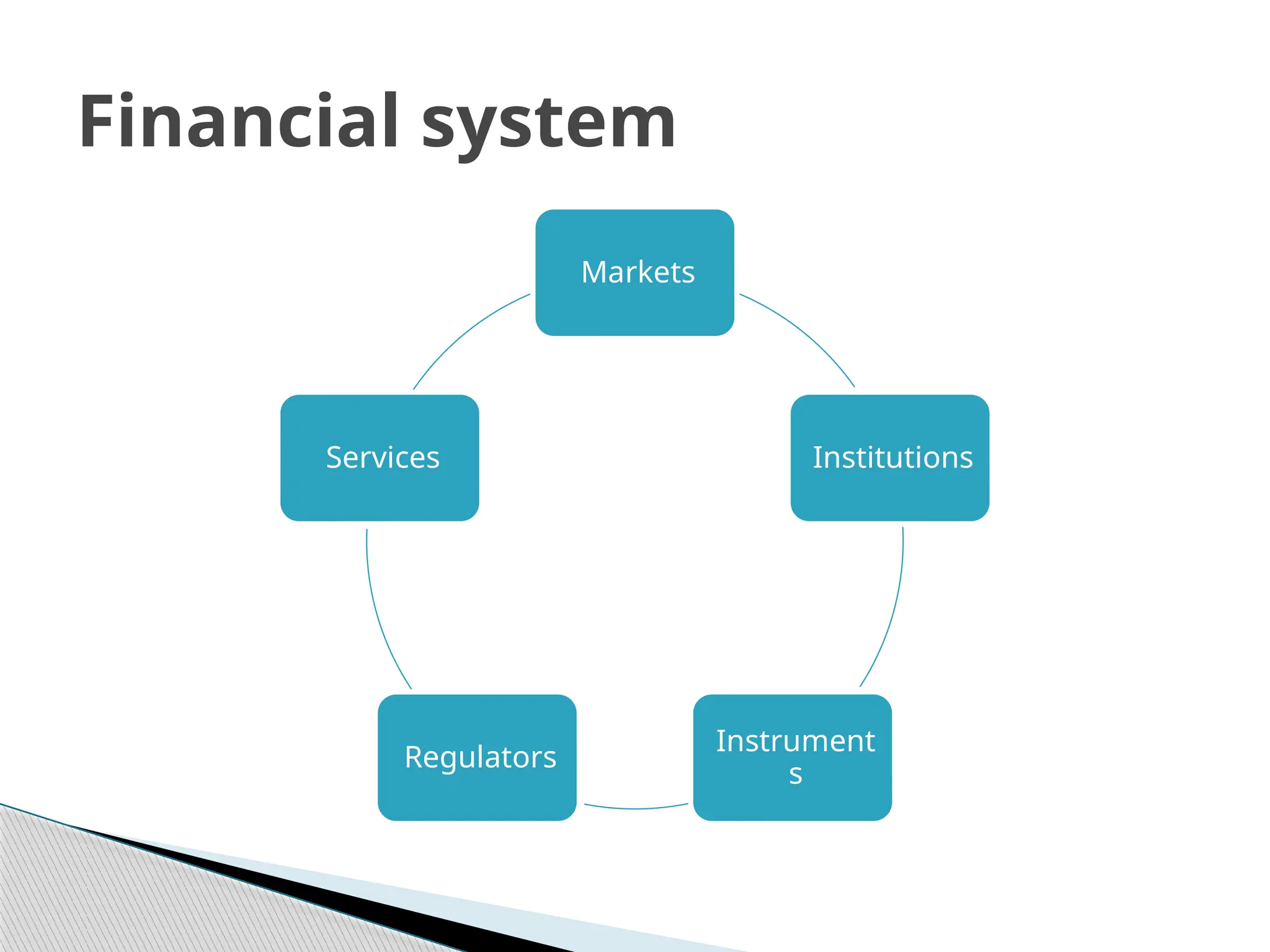
Markets
Institutions
Instrument
s
Regulators
Services
Financial system
 A financial system is the set of global, regional, or
firm-specific institutions and practices used to
facilitate the exchange of funds.
 Financial markets refer to a centre that provides the
facilities of sale or purchase of financial claims and
services.
 Individuals, financial institutions ,corporations and
government trade in this market either directly or
indirectly through brokers and dealers.
 Activities in financial markets lead to direct effects
on behaviour of individual, business and consumers
Financial Markets
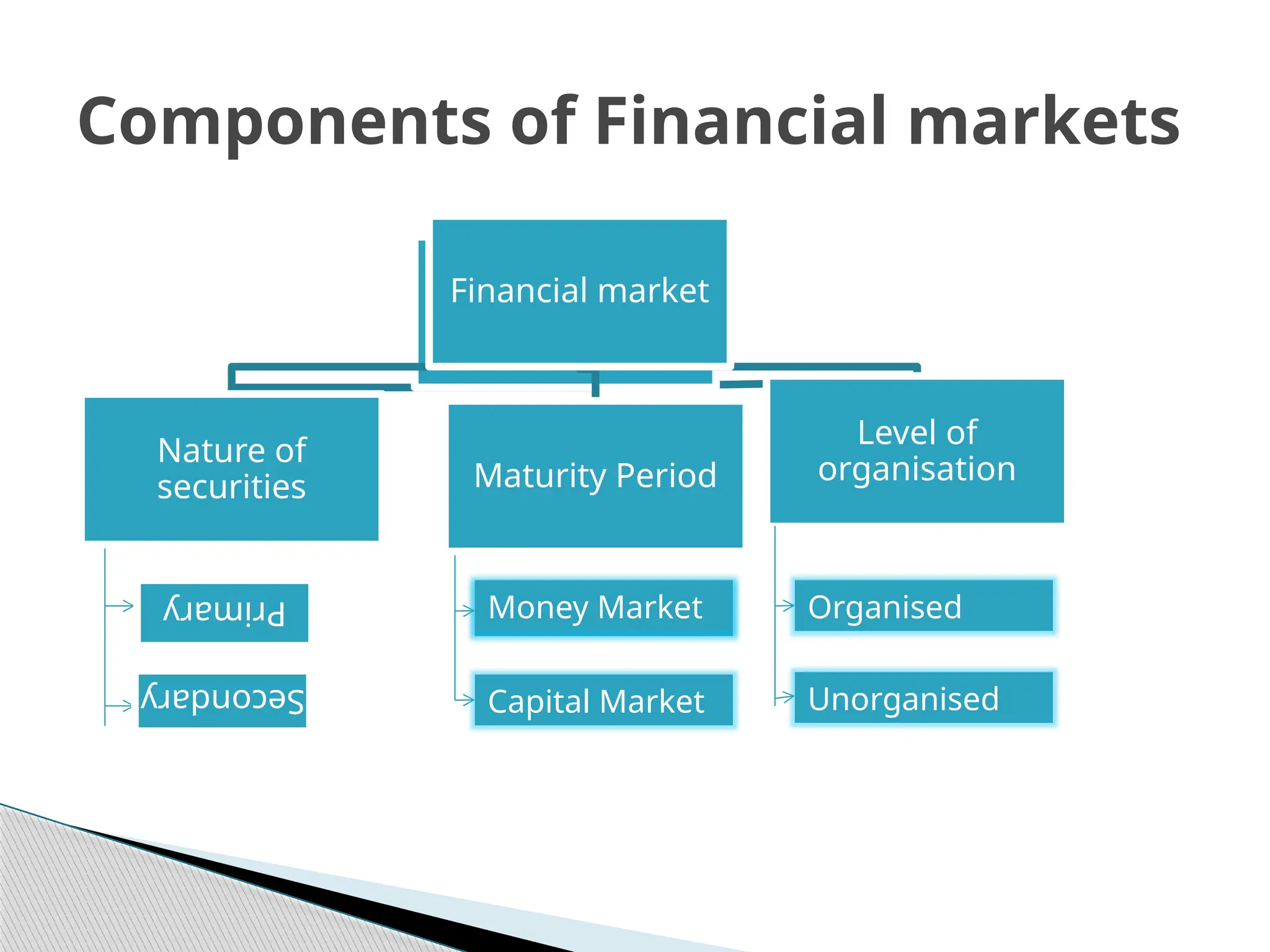
Financial market
Nature Maturity Period
Level of
organisation
Primary
Secondary
Components of Financial markets
Money Market
Capital Market
Financial market
Nature of
securities Maturity Period
Level of
organisation
Primary
Secondary
Money Market Organised
Unorganised
 Money market (where short term interest rates
are determined)
 Capital Markets ( major effect on people’s and
firm’s decisions)
 Foreign exchange market ( changes in the
foreign exchange rates affect economic activity)
 Derivatives Market (used for hedging and
speculation objective cannot be ruled out)
Key Financial Markets
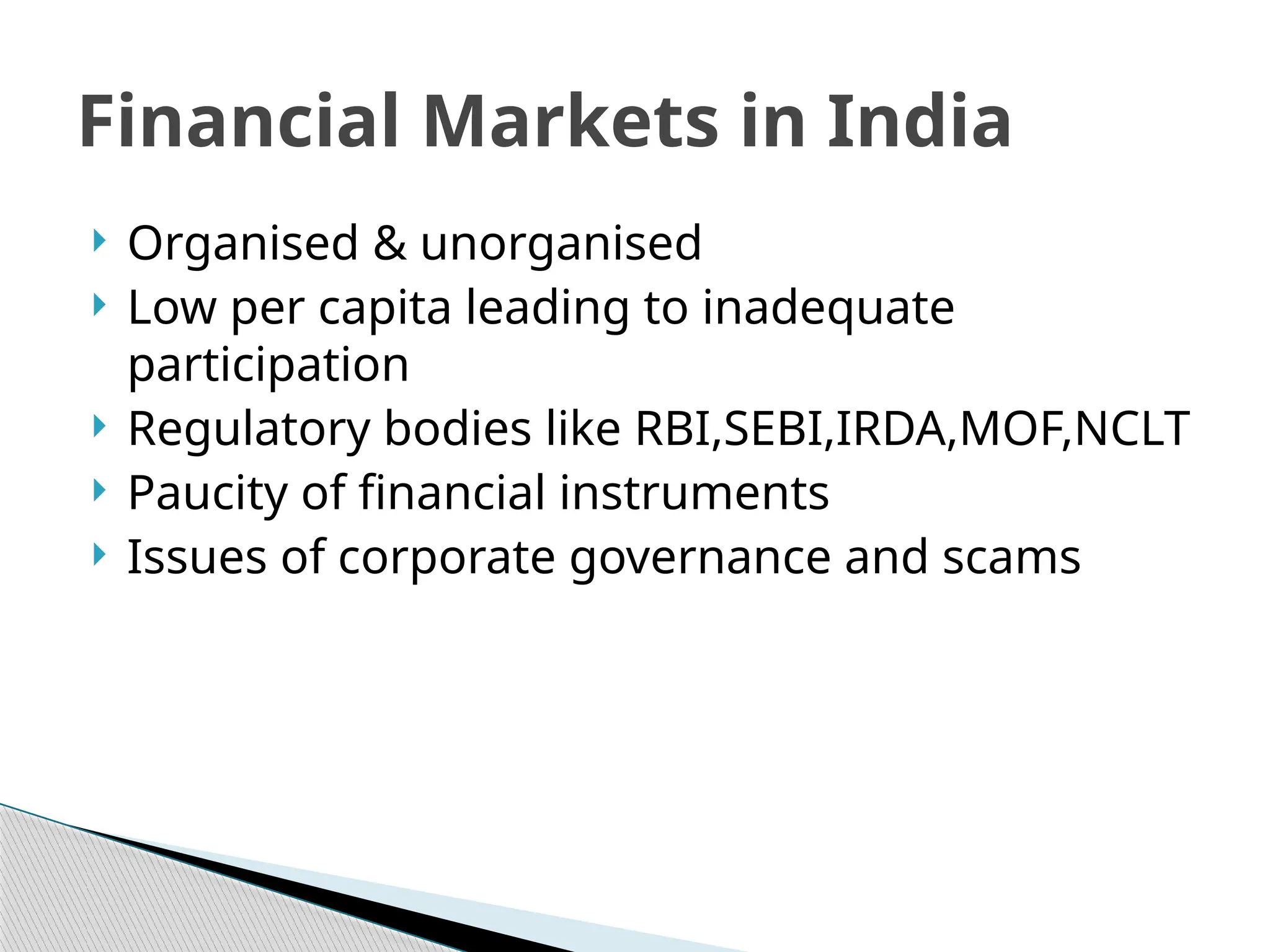
 Organised & unorganised
 Low per capita leading to inadequate
participation
 Regulatory bodies like RBI,SEBI,IRDA,MOF,NCLT
 Paucity of financial instruments
 Issues of corporate governance and scams
Financial Markets in India
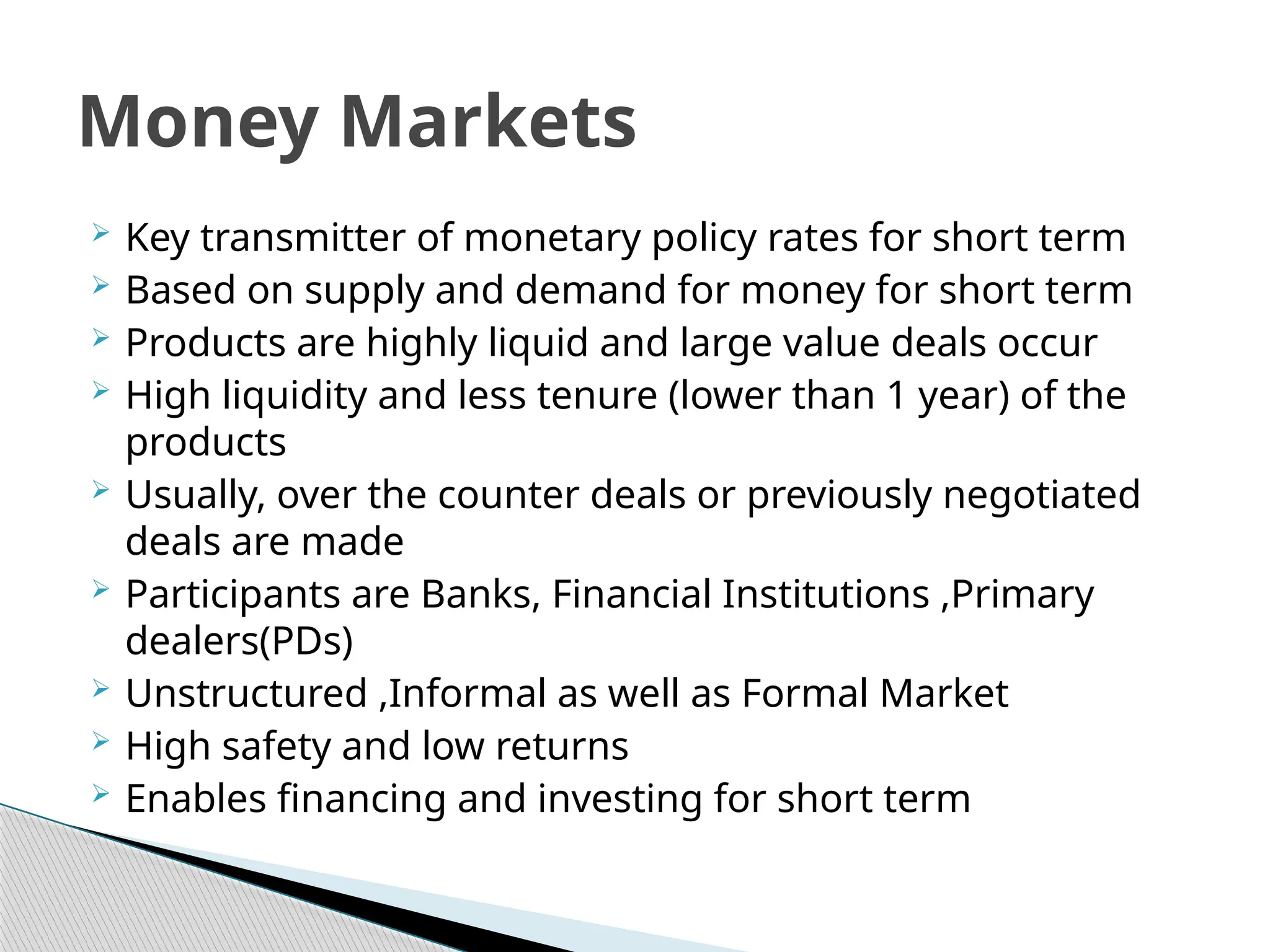
 Key transmitter of monetary policy rates for short term
 Based on supply and demand for money for short term
 Products are highly liquid and large value deals occur
 High liquidity and less tenure (lower than 1 year) of the
products
 Usually, over the counter deals or previously negotiated
deals are made
 Participants are Banks, Financial Institutions ,Primary
dealers(PDs)
 Unstructured ,Informal as well as Formal Market
 High safety and low returns
 Enables financing and investing for short term
Money Markets
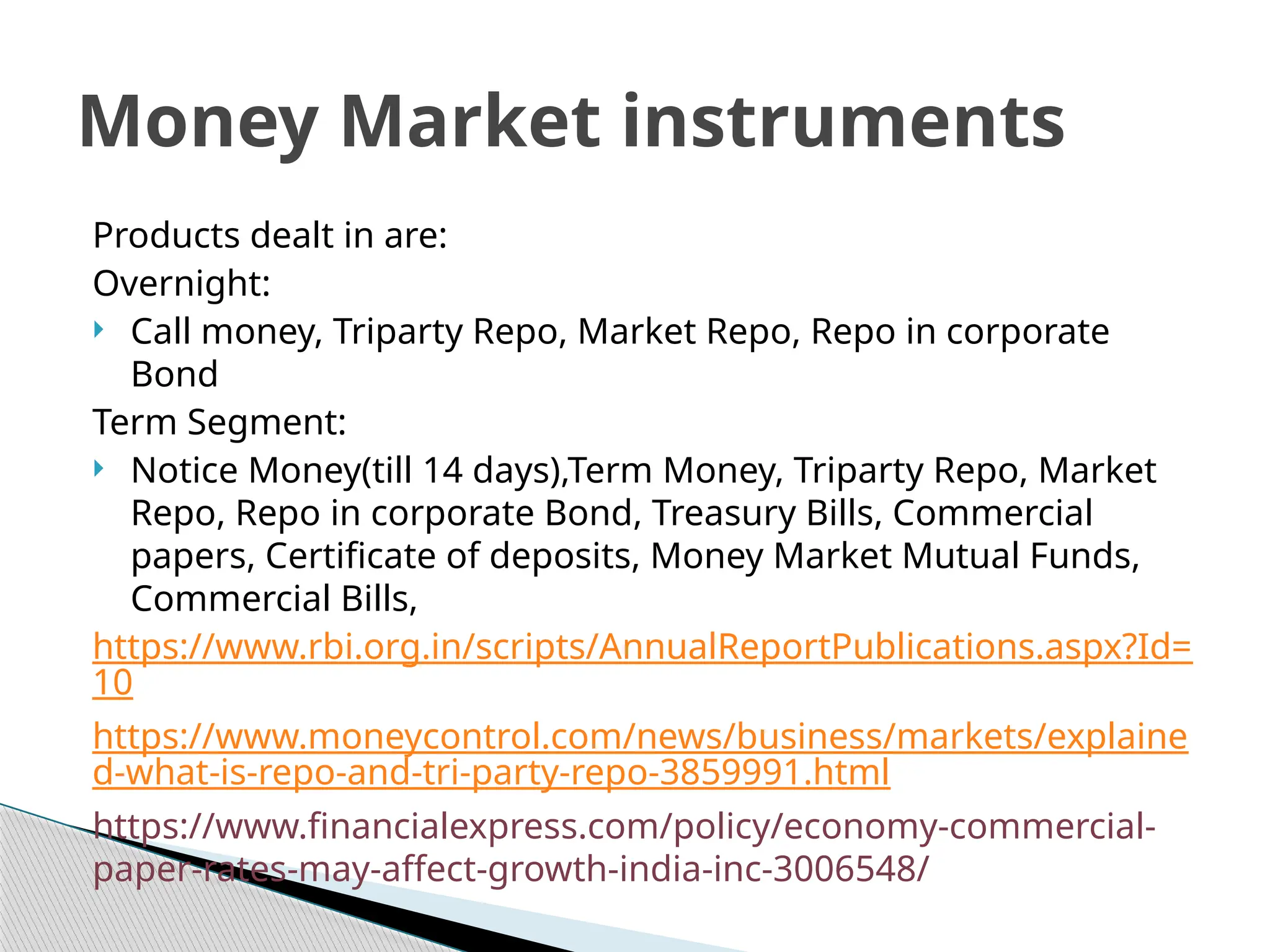
Products dealt in are:
Overnight:
 Call money, Triparty Repo, Market Repo, Repo in corporate
Bond
Term Segment:
 Notice Money(till 14 days),Term Money, Triparty Repo, Market
Repo, Repo in corporate Bond, Treasury Bills, Commercial
papers, Certificate of deposits, Money Market Mutual Funds,
Commercial Bills,
https://www.rbi.org.in/scripts/AnnualReportPublications.aspx?Id=
10
https://www.moneycontrol.com/news/business/markets/explaine
d-what-is-repo-and-tri-party-repo-3859991.html
https://www.financialexpress.com/policy/economy-commercial-
paper-rates-may-affect-growth-india-inc-3006548/
Money Market instruments
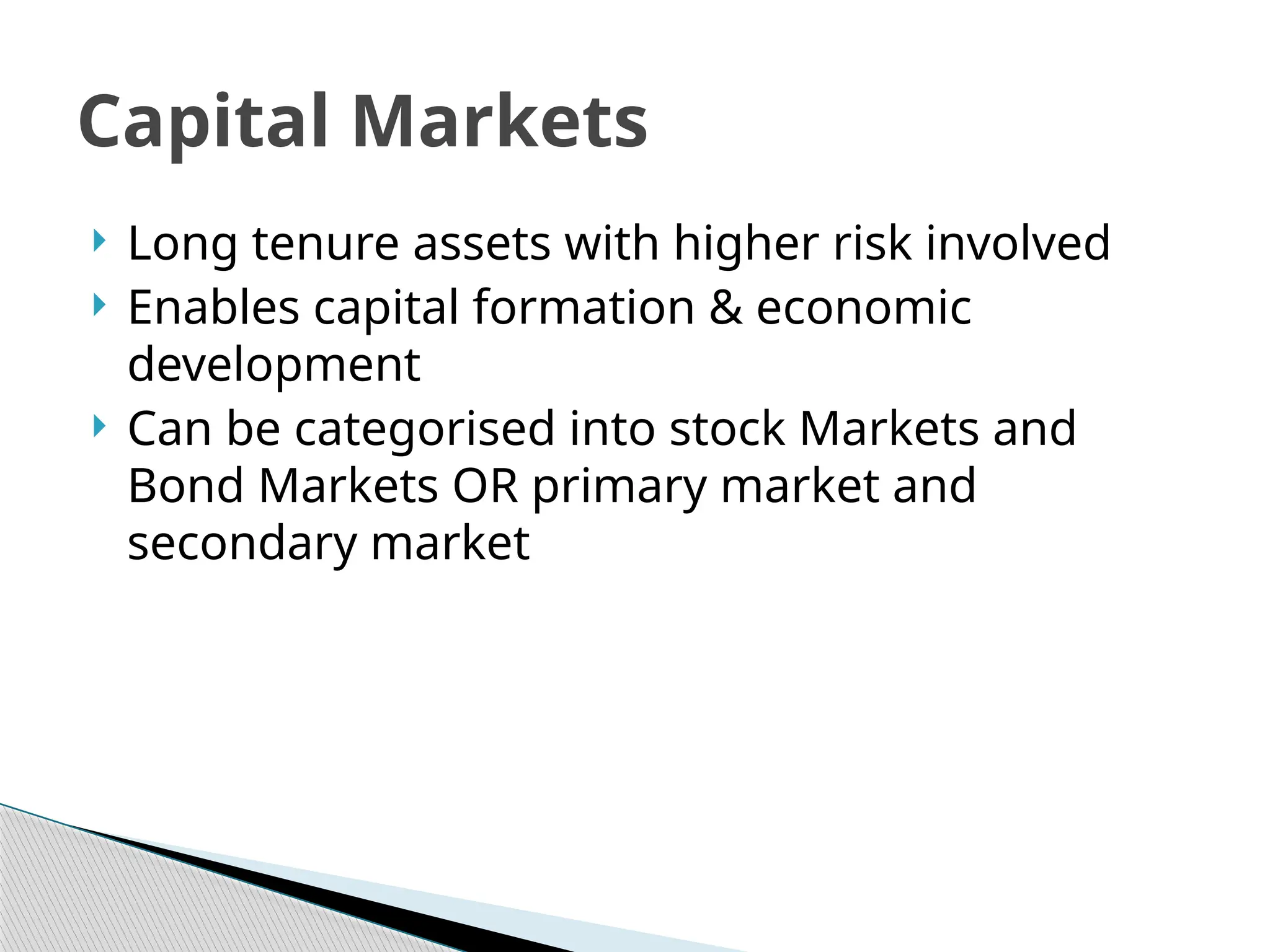
 Long tenure assets with higher risk involved
 Enables capital formation & economic
development
 Can be categorised into stock Markets and
Bond Markets OR primary market and
secondary market
Capital Markets
 Products are Equities, Mutual Funds, ETFs,
Securities borrowing and lending schemes,
Debts-Corporate debts and securitised assets
 In bond market, long term trading of
government securities, Bonds issued by PSU
Undertakings/Corporates/Banks like floating
rate bonds, Zero coupon Bonds, Corporate
debentures, state government loans,
securitised assets of banks, FIs , corporates and
others
Capital Markets
 Largest Financial market with players all over
the world
 Global network working 24 hours a day
 Facilitates determination of foreign exchange
rates between currency pairs
 Participants include Banks, forex dealers,
Central bankers, hedge funds, investors
Foreign Exchange Markets
 Derivatives are financial securities and are financial
contracts that obtain value from something else,
known as underlying securities. Underlying
securities may be stocks, currency, commodities or
bonds, etc.
 Formal derivative trading started in year 2001 after
electronic trading mechanisms were introduced in
India
 Examples: Forwards, Futures, Options, Swaps
 https://rmoneyindia.com/research-blog-traders/
indian-derivatives-market-investing/
Derivatives Market
 Direct Finance: Savers invest their funds
directly without any intervention of the
financial intermediary For example: issue of
equity shares and /or corporate bonds by
companies to public
 Indirect Finance: Involves role of financial
intermediaries to facilitate movement of funds
from surplus units to deficit units For eg:
Banks, Mutual Funds etc
Types of Finance
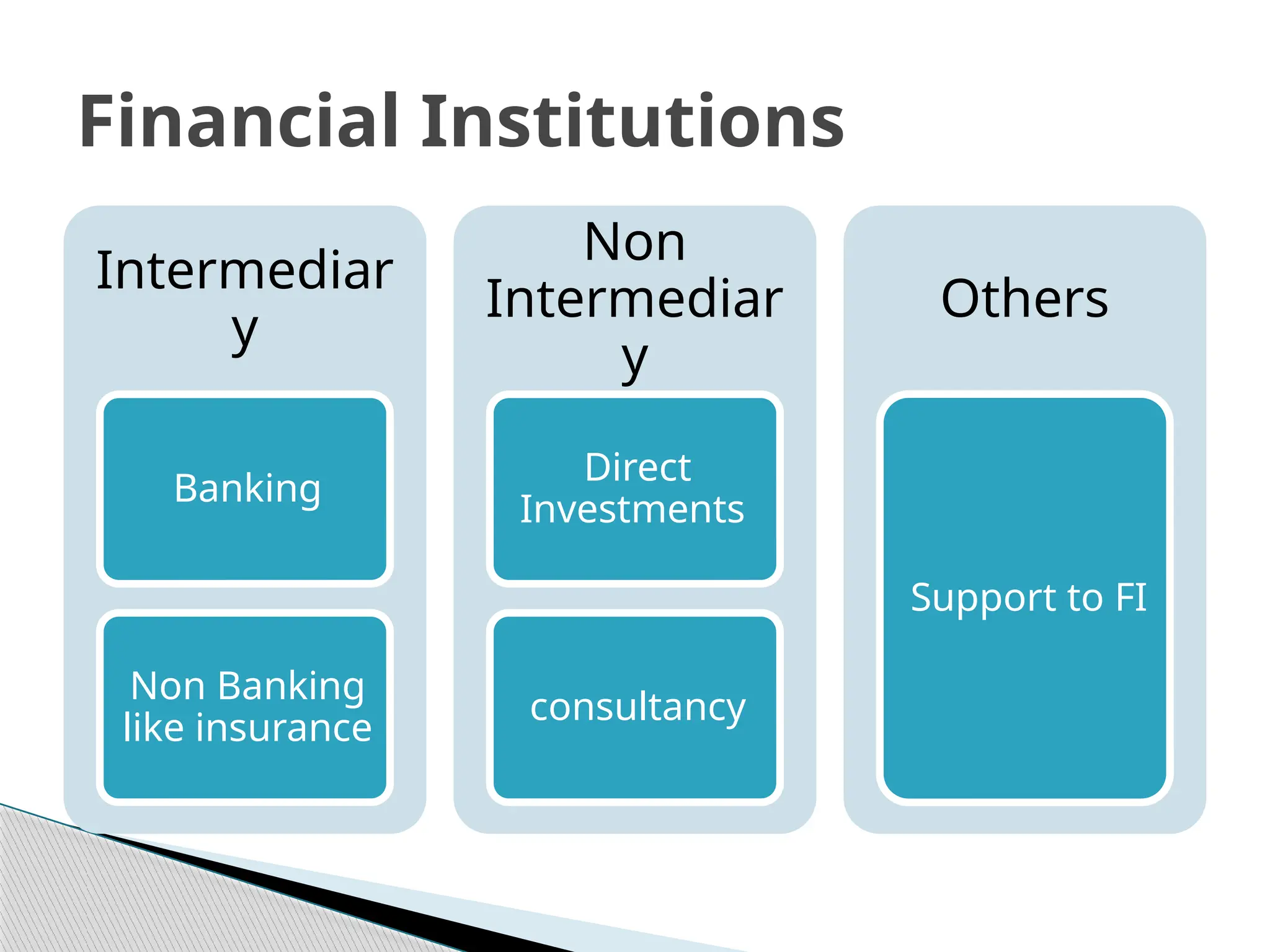
Intermediar
y
Banking
Non Banking
like insurance
Non
Intermediar
y
Direct
Investments
consultancy
Others
Support to FI
Financial Institutions
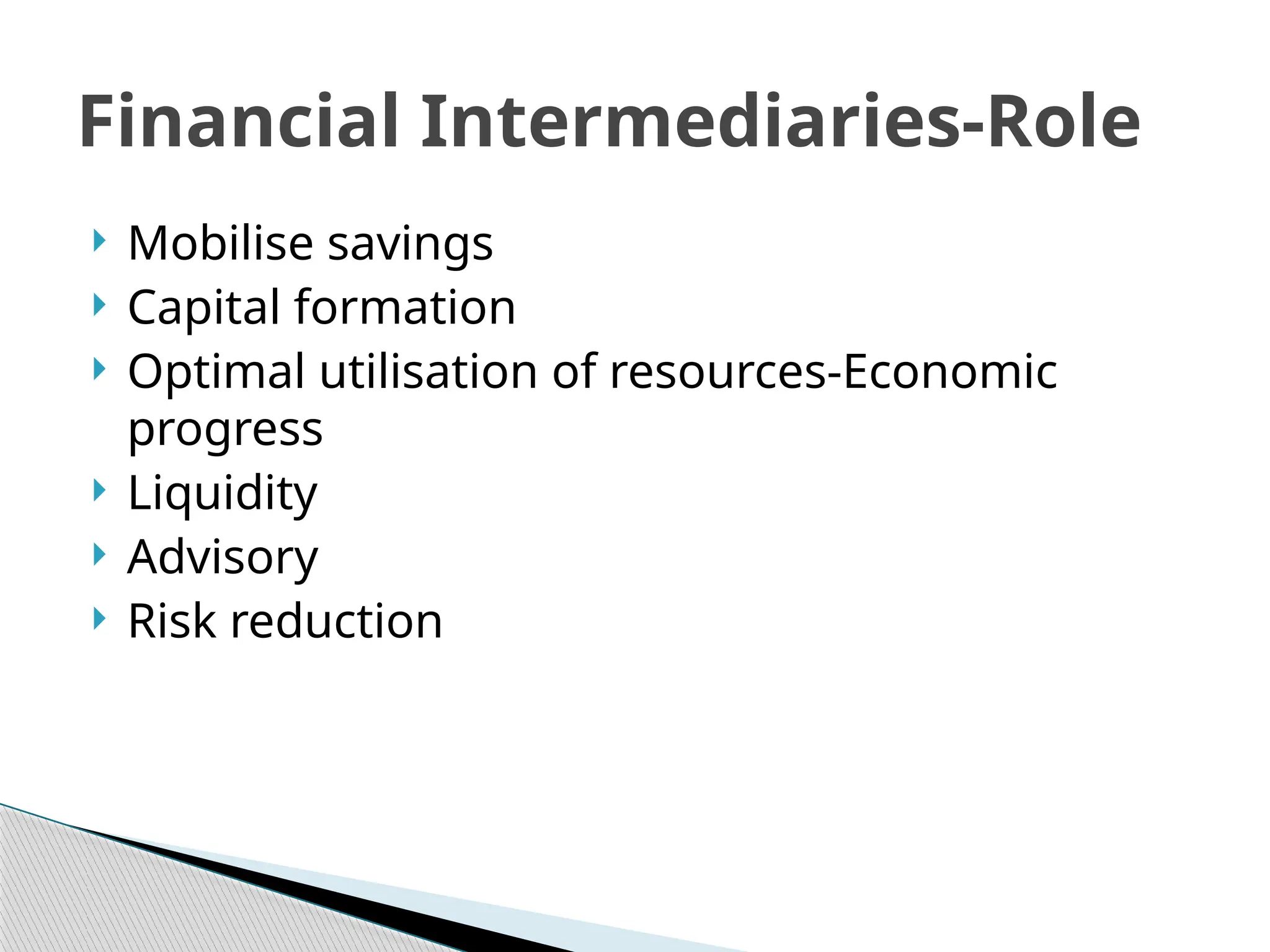
 Mobilise savings
 Capital formation
 Optimal utilisation of resources-Economic
progress
 Liquidity
 Advisory
 Risk reduction
Financial Intermediaries-Role
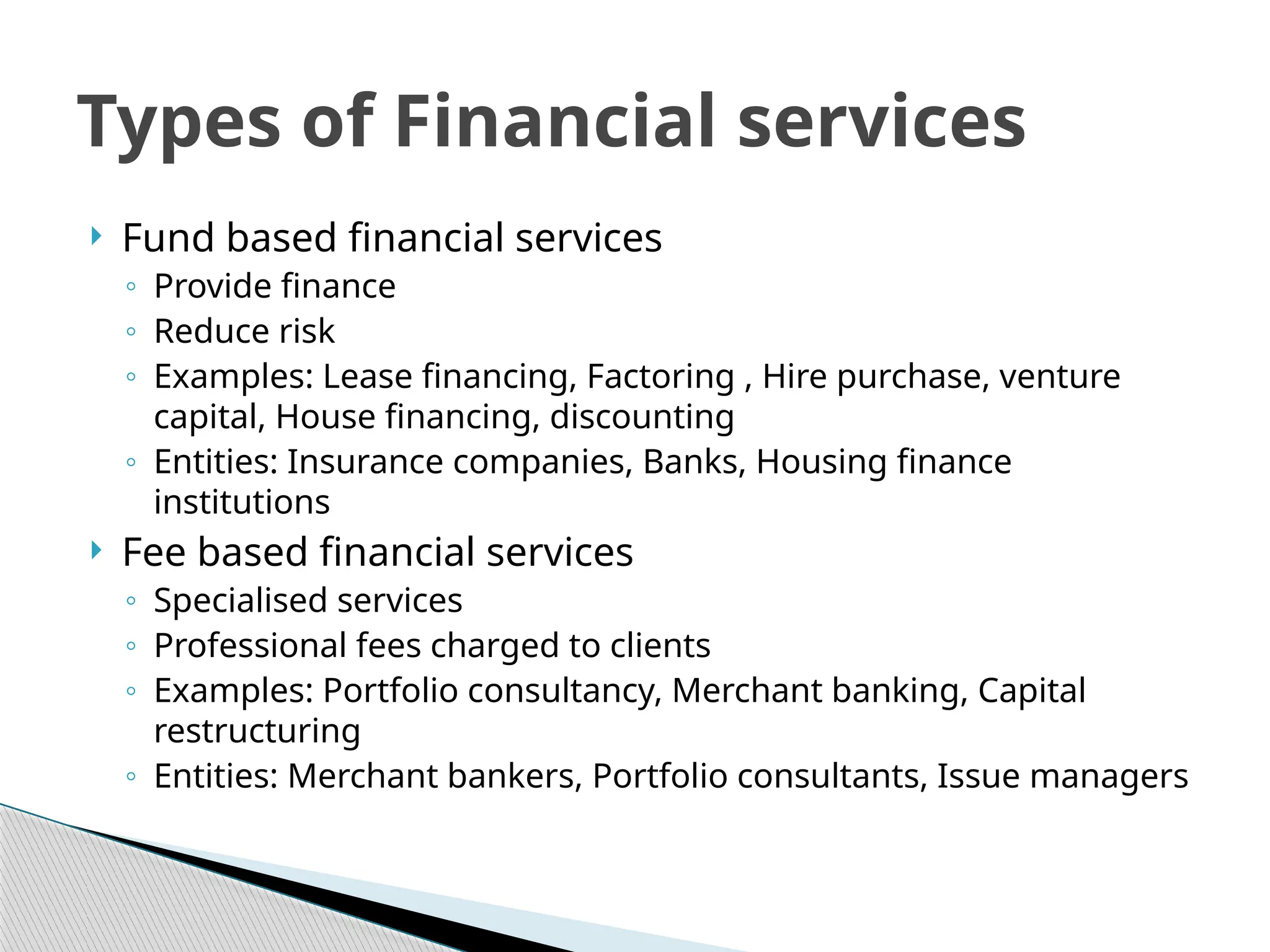
 Fund based financial services
◦ Provide finance
◦ Reduce risk
◦ Examples: Lease financing, Factoring , Hire purchase, venture
capital, House financing, discounting
◦ Entities: Insurance companies, Banks, Housing finance
institutions
 Fee based financial services
◦ Specialised services
◦ Professional fees charged to clients
◦ Examples: Portfolio consultancy, Merchant banking, Capital
restructuring
◦ Entities: Merchant bankers, Portfolio consultants, Issue managers
Types of Financial services
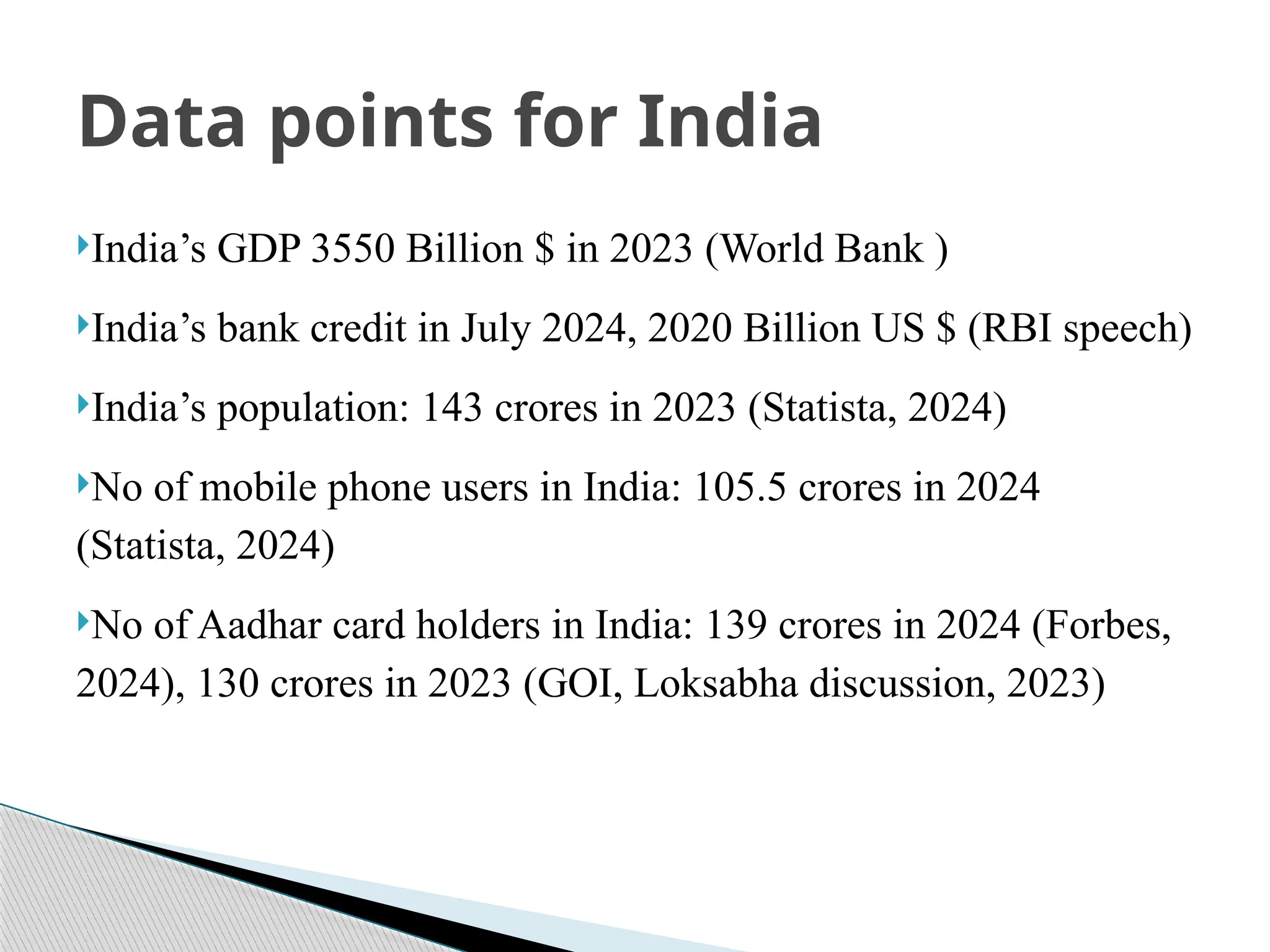
India’s GDP 3550 Billion $ in 2023 (World Bank )
India’s bank credit in July 2024, 2020 Billion US $ (RBI speech)
India’s population: 143 crores in 2023 (Statista, 2024)
No of mobile phone users in India: 105.5 crores in 2024
(Statista, 2024)
No of Aadhar card holders in India: 139 crores in 2024 (Forbes,
2024), 130 crores in 2023 (GOI, Loksabha discussion, 2023)
Data points for India

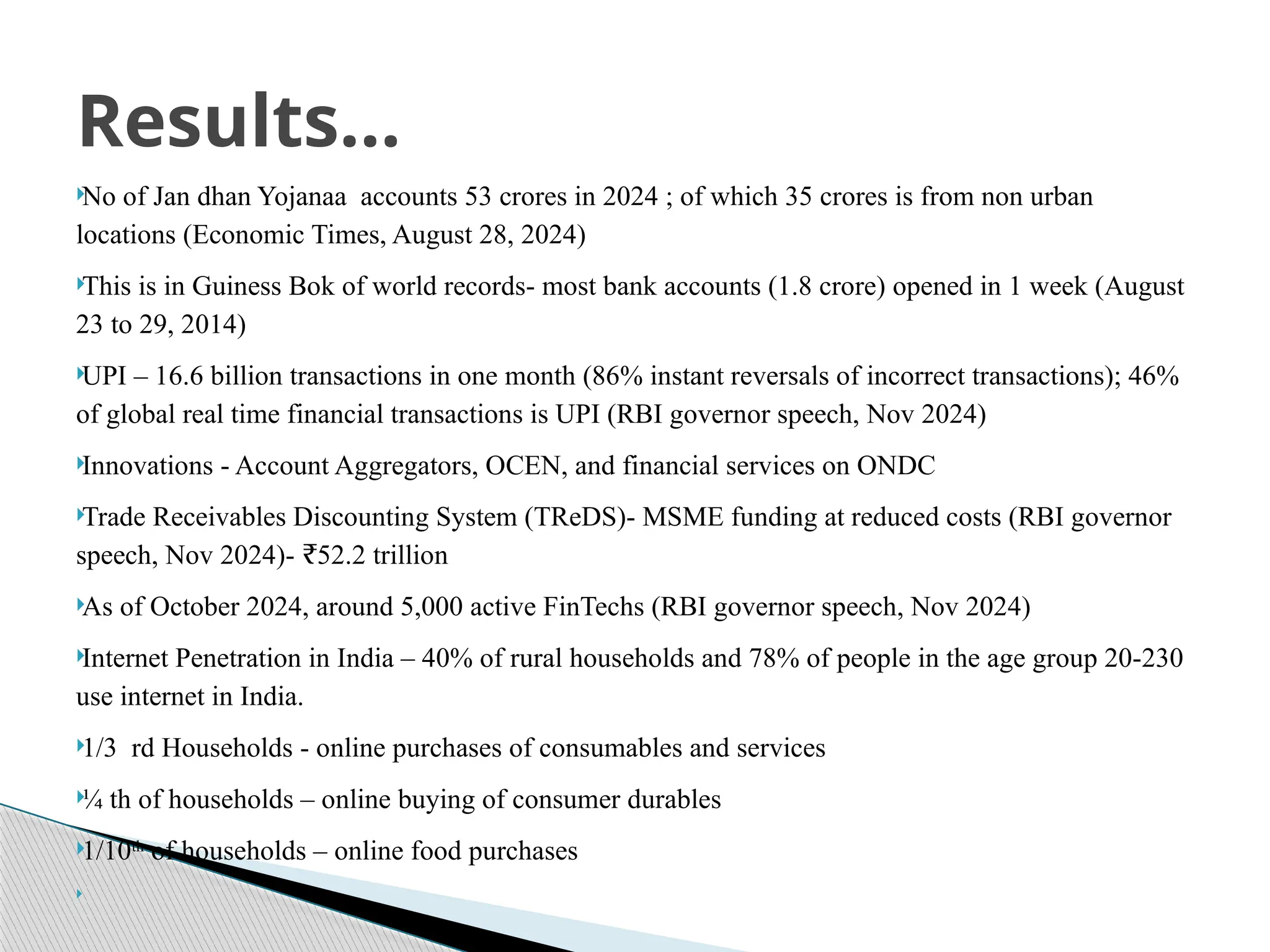
No of Jan dhan Yojanaa accounts 53 crores in 2024 ; of which 35 crores is from non urban
locations (Economic Times, August 28, 2024)

This is in Guiness Bok of world records- most bank accounts (1.8 crore) opened in 1 week (August
23 to 29, 2014)

UPI – 16.6 billion transactions in one month (86% instant reversals of incorrect transactions); 46%
of global real time financial transactions is UPI (RBI governor speech, Nov 2024)

Innovations - Account Aggregators, OCEN, and financial services on ONDC

Trade Receivables Discounting System (TReDS)- MSME funding at reduced costs (RBI governor
speech, Nov 2024)- 52.2 trillion
₹

As of October 2024, around 5,000 active FinTechs (RBI governor speech, Nov 2024)

Internet Penetration in India – 40% of rural households and 78% of people in the age group 20-230
use internet in India.

1/3 rd Households - online purchases of consumables and services

¼ th of households – online buying of consumer durables

1/10th
of households – online food purchases

Results…
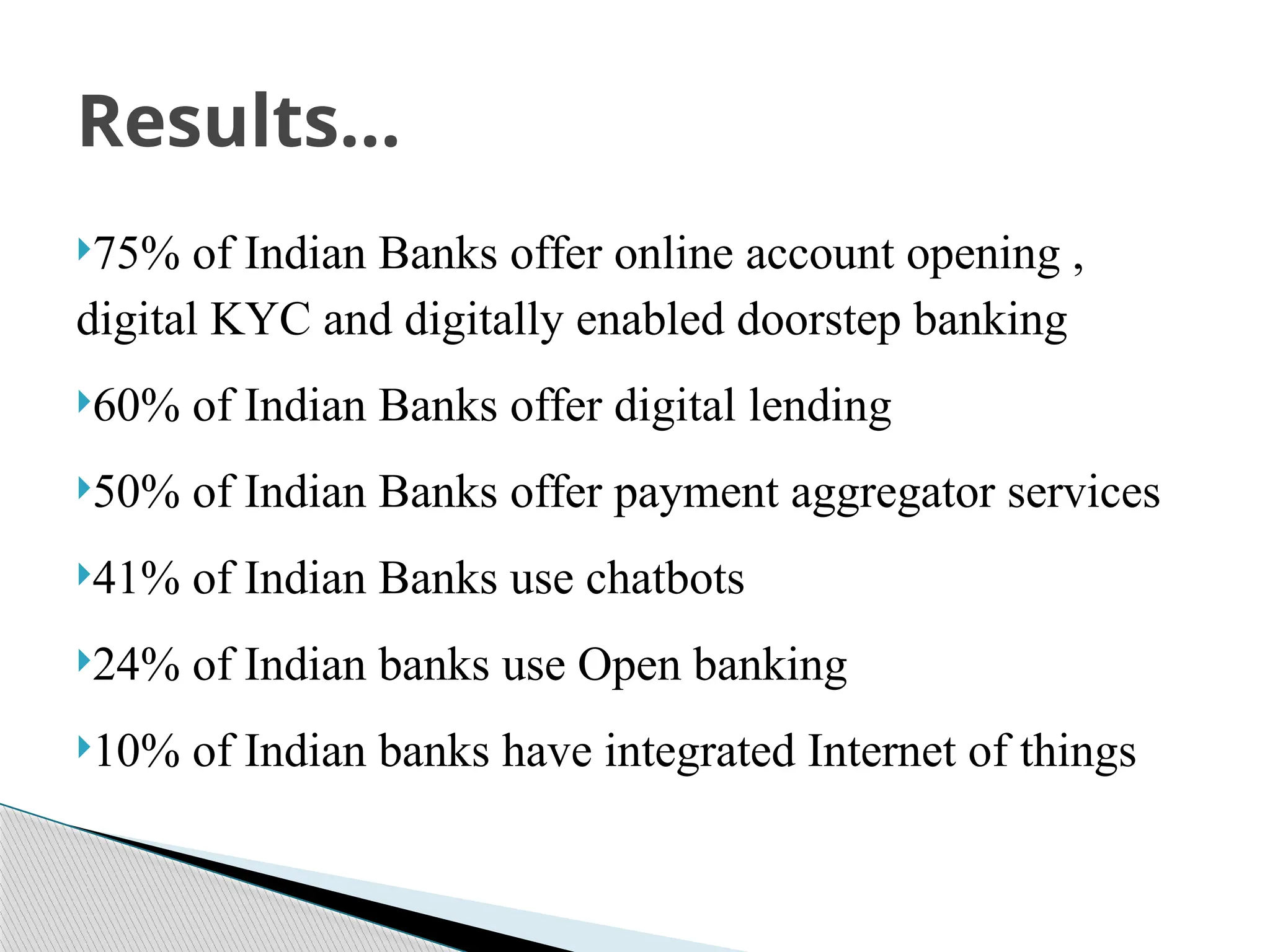
75% of Indian Banks offer online account opening ,
digital KYC and digitally enabled doorstep banking
60% of Indian Banks offer digital lending
50% of Indian Banks offer payment aggregator services
41% of Indian Banks use chatbots
24% of Indian banks use Open banking
10% of Indian banks have integrated Internet of things
Results…

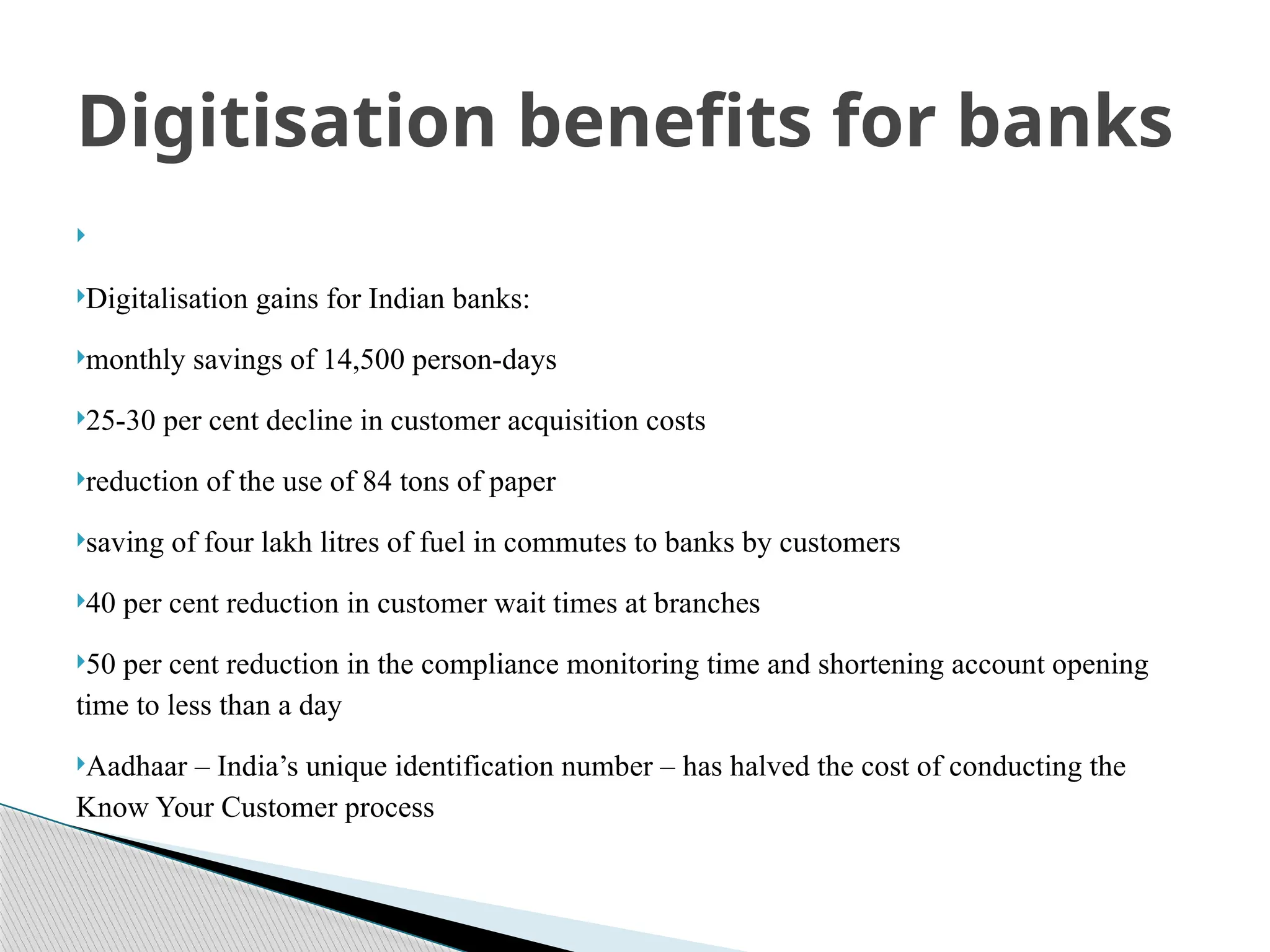
Digitalisation gains for Indian banks:
monthly savings of 14,500 person-days
25-30 per cent decline in customer acquisition costs
reduction of the use of 84 tons of paper
saving of four lakh litres of fuel in commutes to banks by customers
40 per cent reduction in customer wait times at branches
50 per cent reduction in the compliance monitoring time and shortening account opening
time to less than a day
Aadhaar – India’s unique identification number – has halved the cost of conducting the
Know Your Customer process
Digitisation benefits for banks
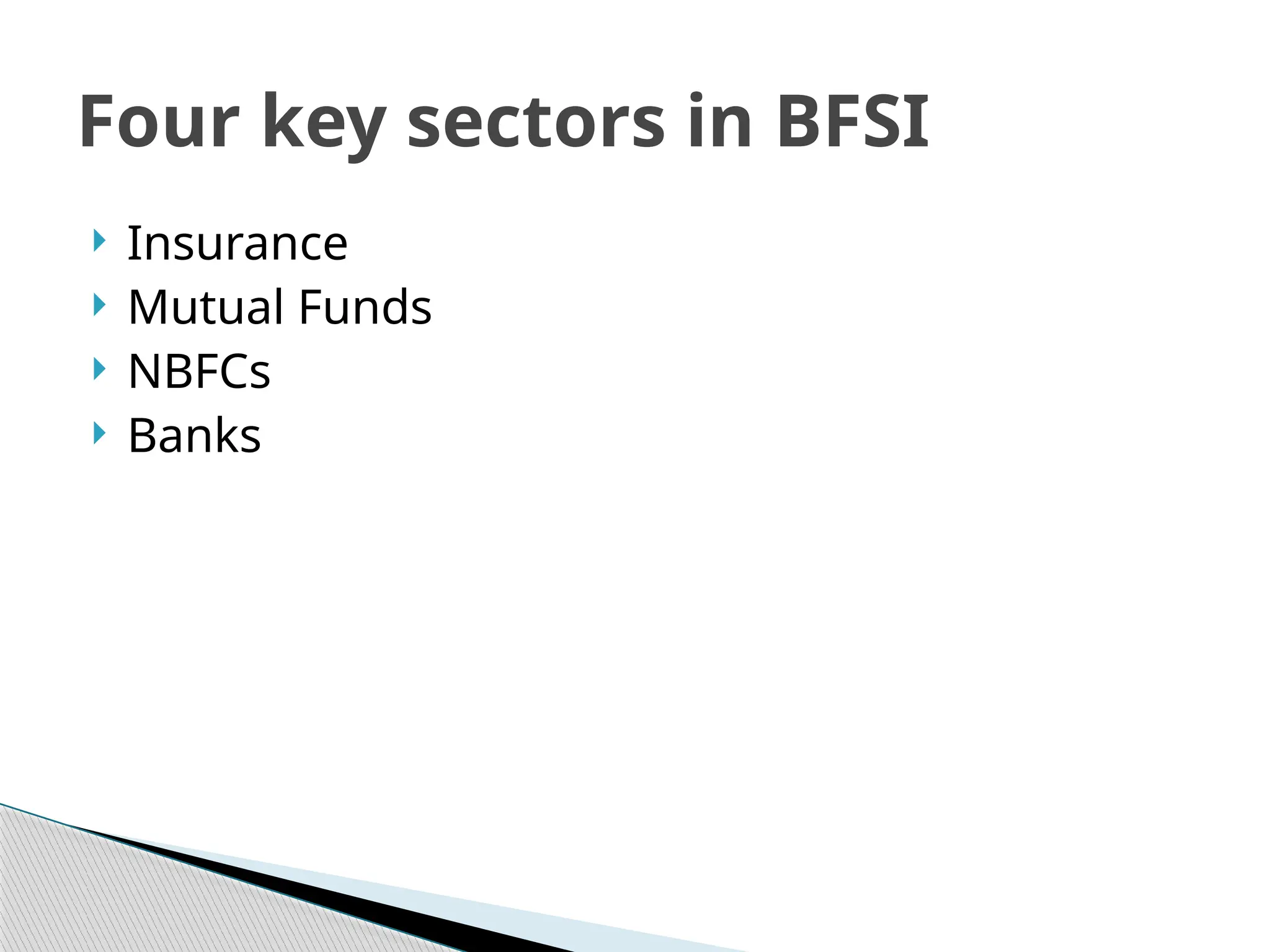
 Insurance
 Mutual Funds
 NBFCs
 Banks
Four key sectors in BFSI
Insurance
 Purpose: pooling of risks
 sharing of losses
 transferring risk
 Basic Principle: insurable interest, indemnity,
subrogation, contribution, disclosure, utmost
faith, relevance of proximate cause
 Two main streams: Life & Non Life/General
What is Insurance?
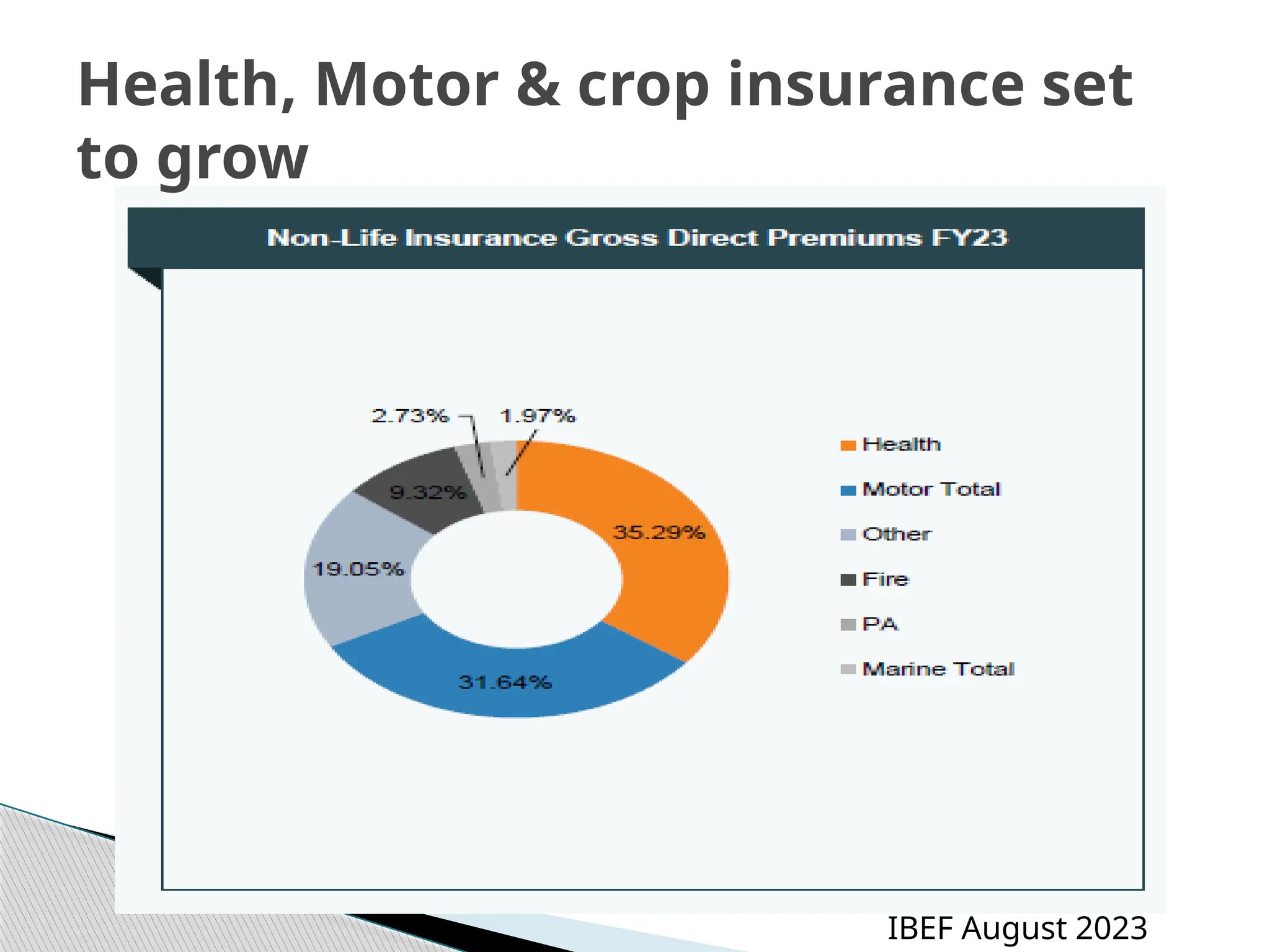
 The first quarter of FY24 saw nonlife players' premium income increase by
17.9% year-over-year to Rs. 64,262.8 crore (US$ 7.72 billion) due to strong
demand for health and motor policies.
 The government’s flagship initiative for crop insurance, Pradhan Mantri
Fasal Bima Yojana (PMFBY), has led to significant growth in the premium
income for crop insurance
 As per the Insurance Regulatory and Development Authority of India
(IRDAI), India will be the sixth-largest insurance market within a
decade, leapfrogging Germany, Canada, Italy and South Korea.
 India allowed private companies in insurance sector in 2000, setting a limit
on FDI to 26%, which was increased to 49% in 2014 and further increased
to 74% in the Union Budget (Feb 2021).
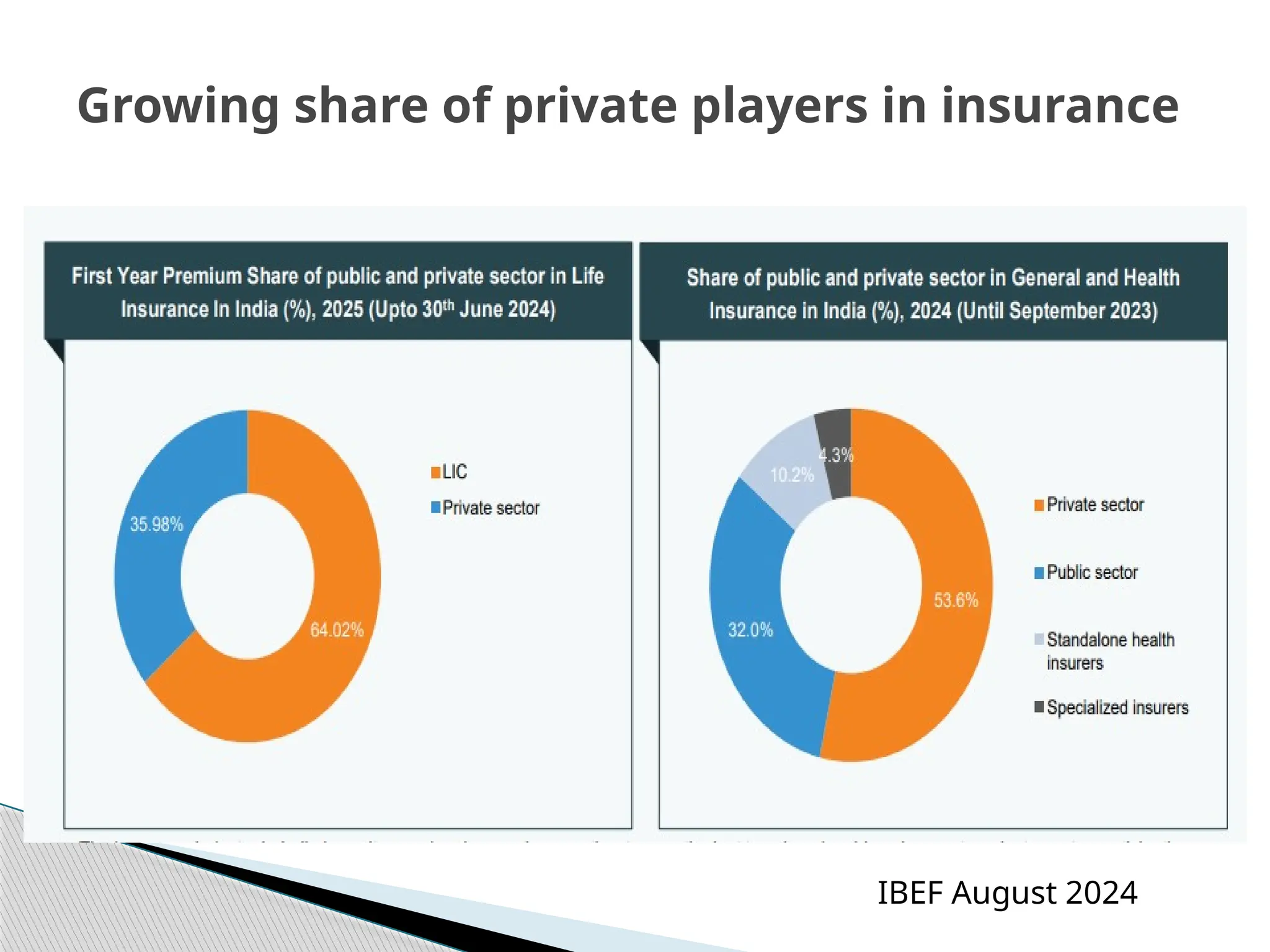
 The market share of private sector companies in the non-life insurance
market rose from 15% in 2004 to 62% in FY23.
 Private insurers like HDFC, ICICI and SBI have been some tough
competitors for providing life as well as non-life products to the insurance
sector in India.
Key facts
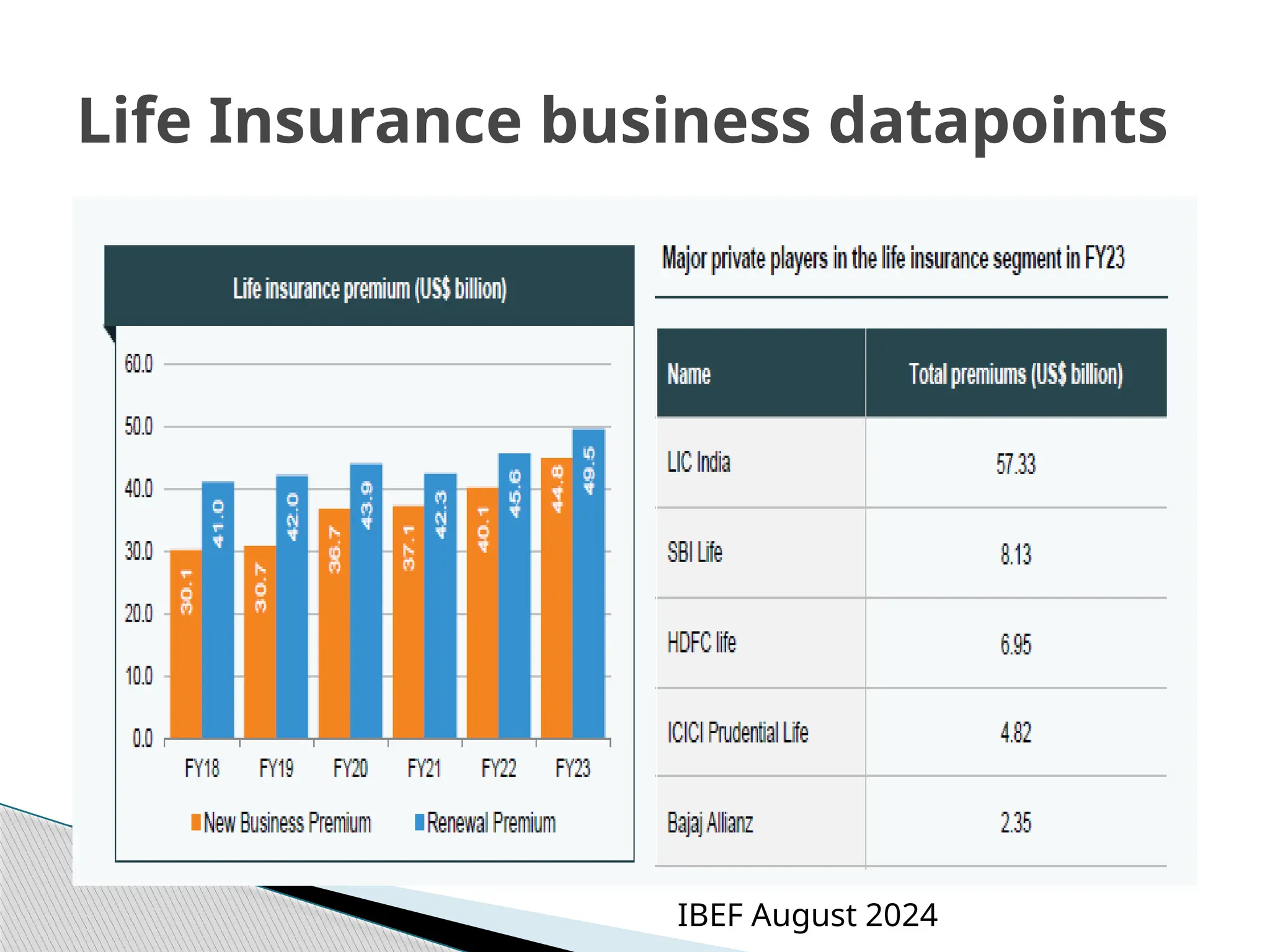
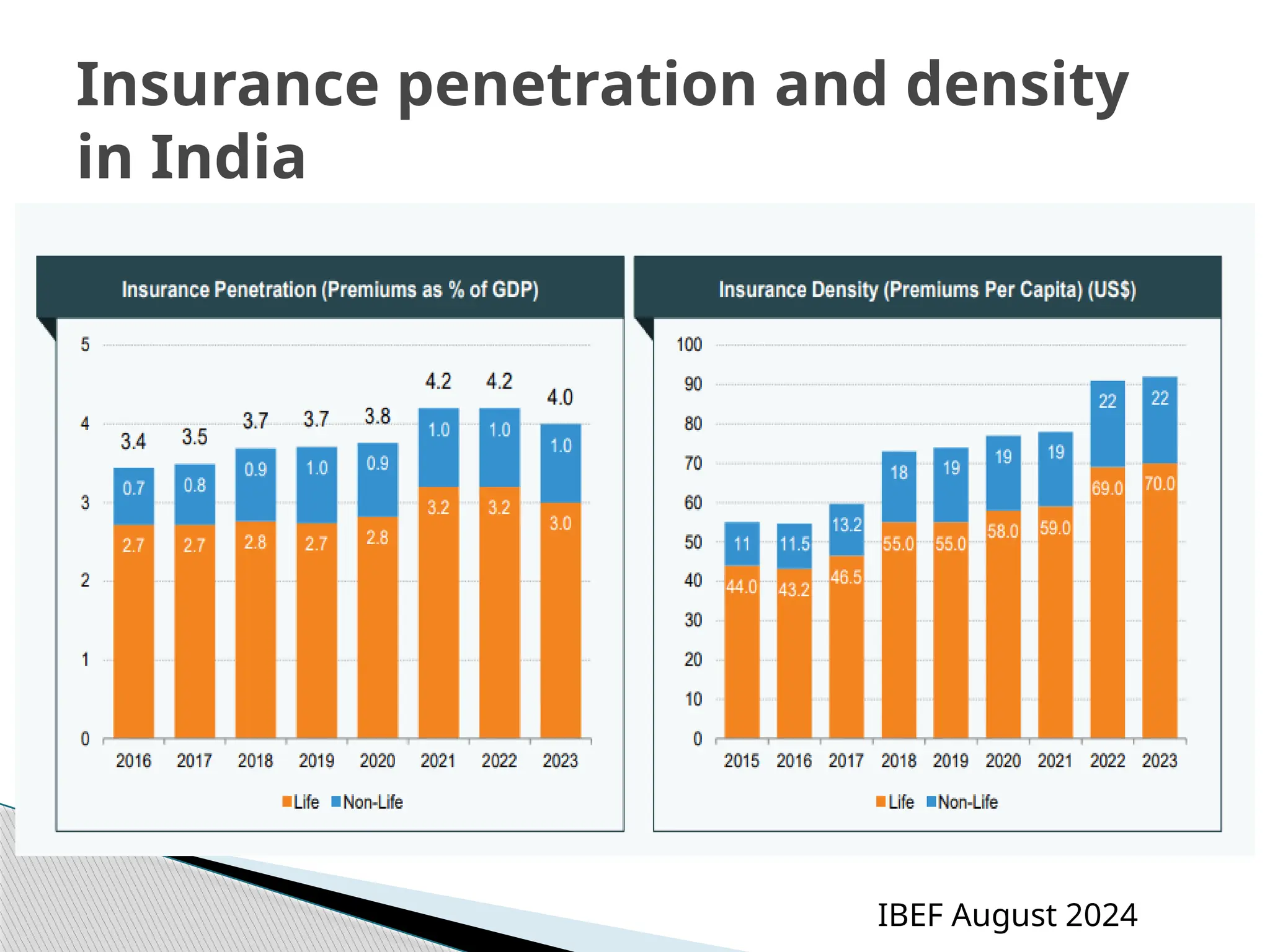
 The life insurance industry is expected to increase at a
CAGR of 5.3% between 2019 and 2023. India’s insurance
penetration was pegged at 4.2% in FY21, with life
insurance penetration at 3.2% and non-life insurance
penetration at 1.0%. In terms of insurance density,
India’s overall density stood at US$ 78 in FY21.
Life Insurance trends
 India is the 4th largest general insurance market in Asia and the 14th
largest globally.
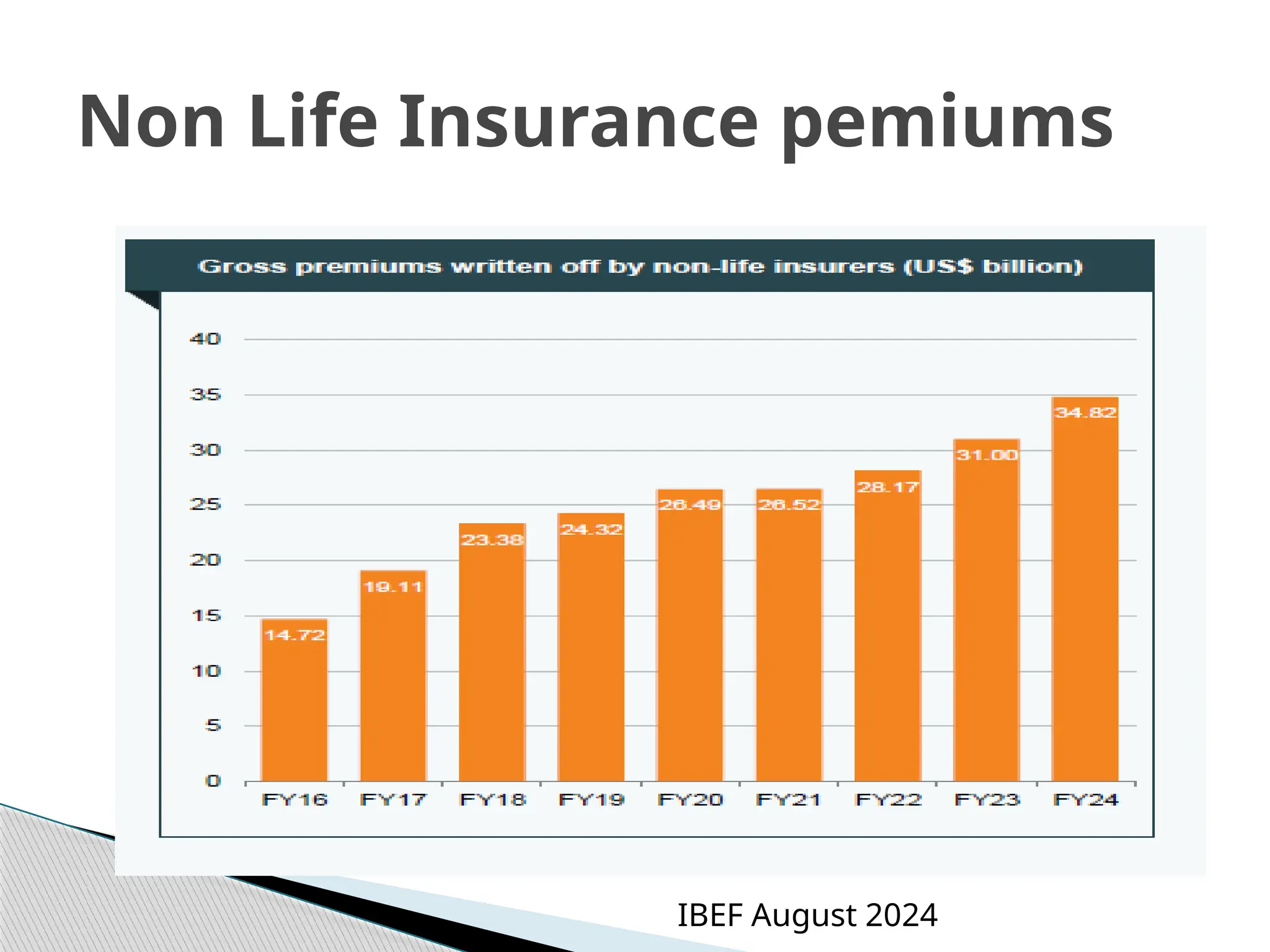
 In FY23, non-life insurers (comprising general insurers, standalone health
insurers and specialized insurers) recorded a 16.4% growth in gross direct
premiums. In India, gross premiums written off by non-life insurers reached
US$ 31 billion in FY23 and US$ 10.95 billion in first quarter of FY24*, from
US$ 28.14 billion in FY22, driven by strong growth from general insurance
companies.
 Going forward, general insurance companies will be key beneficiaries of the
opening-up of economies, especially with improved trade activity increasing
demand for motor and health insurance. Strong growth in the automotive
industry over the next decade is expected to boost the motor insurance
market
Non life insurance trends
 https://youtu.be/8OZngCJQ-GA?si=ZCH6rFUDnT
67v6JD
 https://youtu.be/1SV8h9n2pLY?
si=FLBTgEfgowCgS29g
Videos for Insurance updates
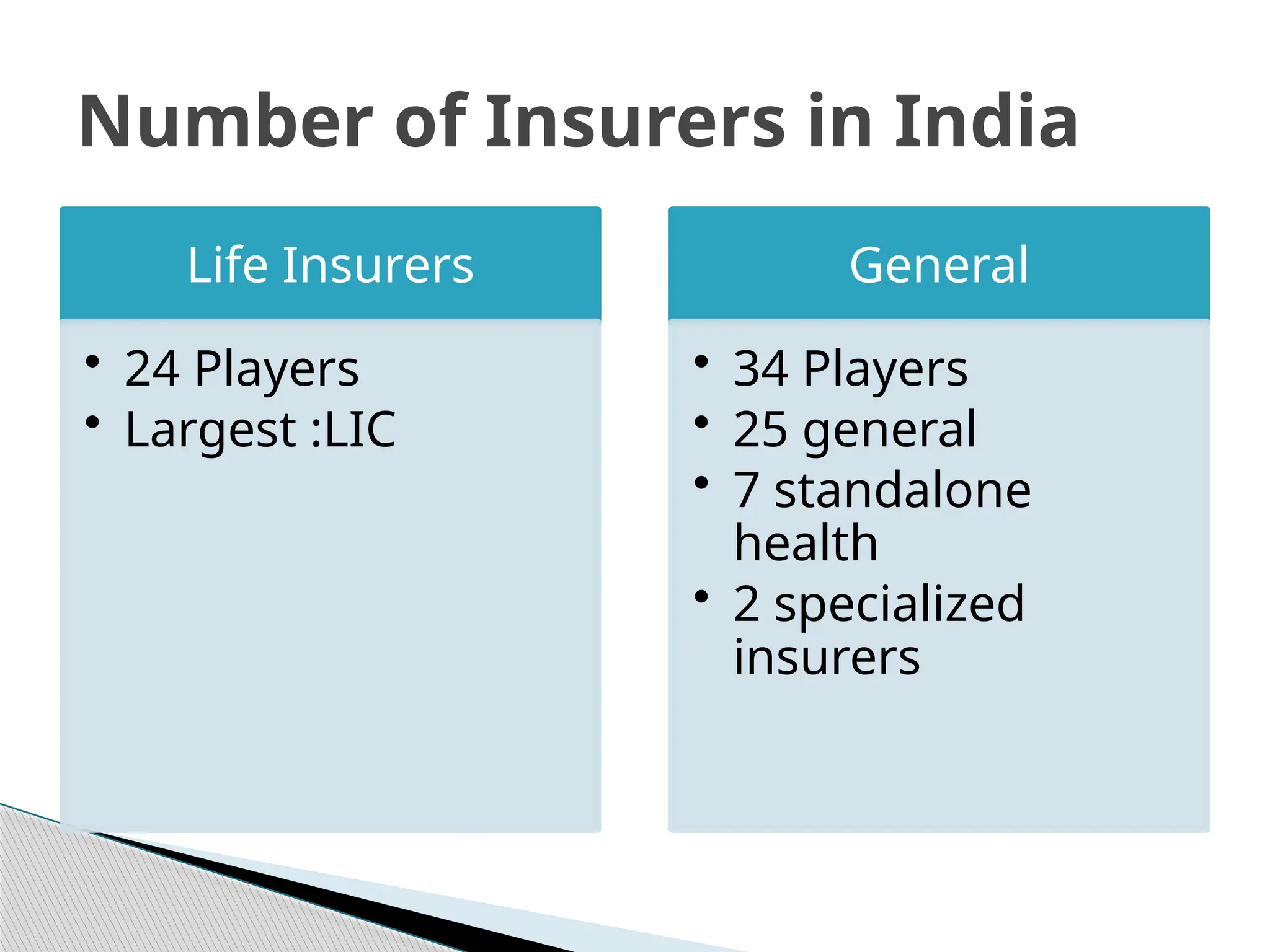
Life Insurers
• 24 Players
• Largest :LIC
General
• 34 Players
• 25 general
• 7 standalone
health
• 2 specialized
insurers
Number of Insurers in India
 Term Insurance
 Endowment Policy
 Whole Life Insurance
 Children's Policies
 Annuity Plans
 Many others
Types of Life Insurance Products
Life Insurance business datapoints
IBEF August 2024
Non Life Insurance pemiums
IBEF August 2024
Insurance penetration and density
in India
IBEF August 2024
Growing share of private players in insurance
IBEF August 2024
Health, Motor & crop insurance set
to grow
IBEF August 2023
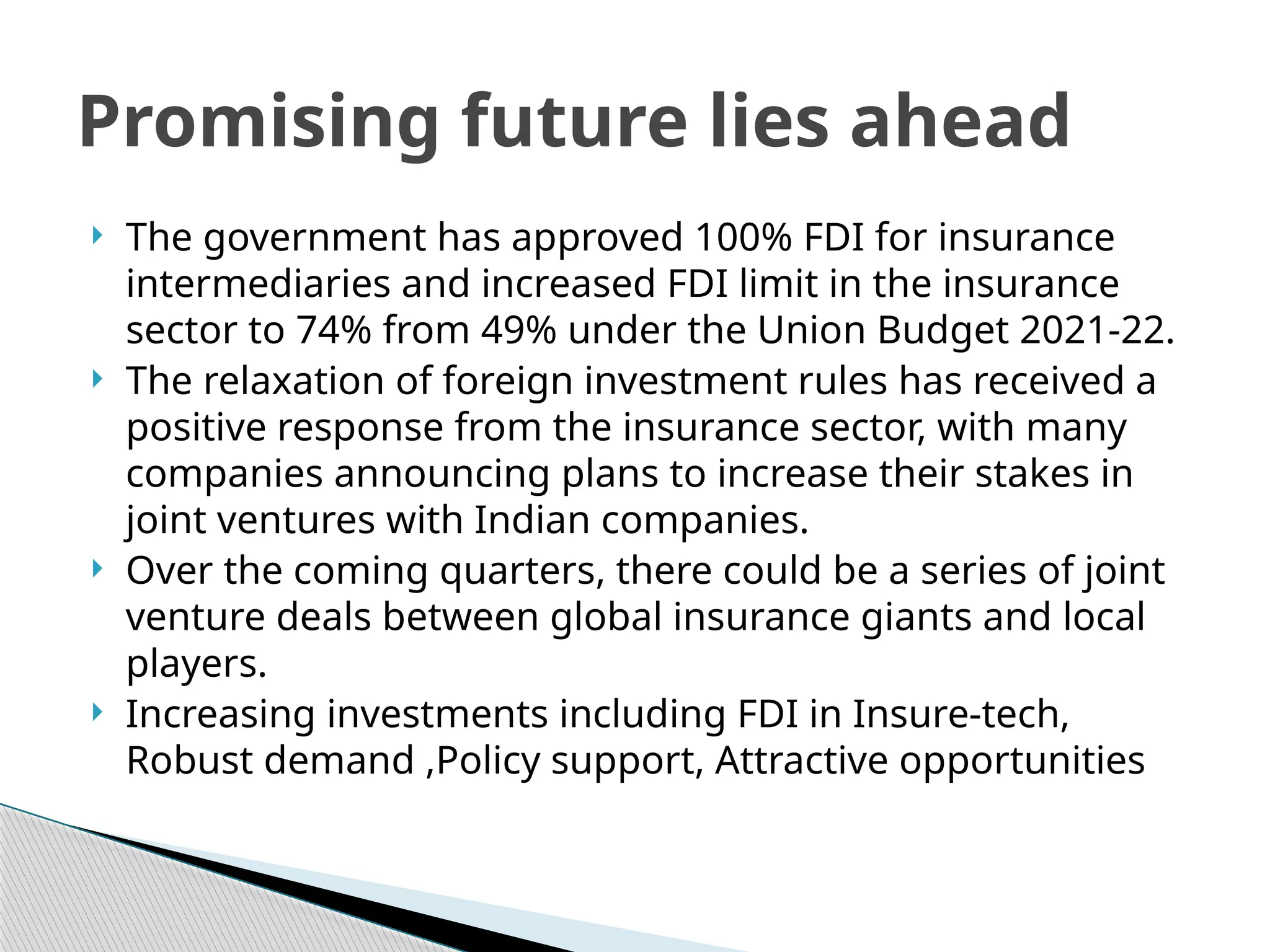
 The government has approved 100% FDI for insurance
intermediaries and increased FDI limit in the insurance
sector to 74% from 49% under the Union Budget 2021-22.
 The relaxation of foreign investment rules has received a
positive response from the insurance sector, with many
companies announcing plans to increase their stakes in
joint ventures with Indian companies.
 Over the coming quarters, there could be a series of joint
venture deals between global insurance giants and local
players.
 Increasing investments including FDI in Insure-tech,
Robust demand ,Policy support, Attractive opportunities
Promising future lies ahead
Insurance market – attractive?
 Growing middle class
 Young insurable population
 Growing awareness of the need for
insurance
 Retirement planning a big opportunity
 Growth in premia expected at 12-15%
over next 3-5 years
 Bhima Vahak: Bima Vahaks (women centric)have to
be deployed in each gram panchayat
 Bhima Vistaar :The first of its kind all-in-one
affordable insurance product, Bima Vistaar —
offering life, health and property cover — is likely to
be rolled out soon.
 Bhima Sugam :simplifying buying insurance on a
single platform
New initiatives for Insurance: Insurance trinity
set to have soft launch soon- IRDAI Chairman
https://www.newindianexpress.com/business/2024/Oct/22/first-phase-
of-bima-insurance-trinity-will-be-ready-for-soft-launch-soon-irdai-chief
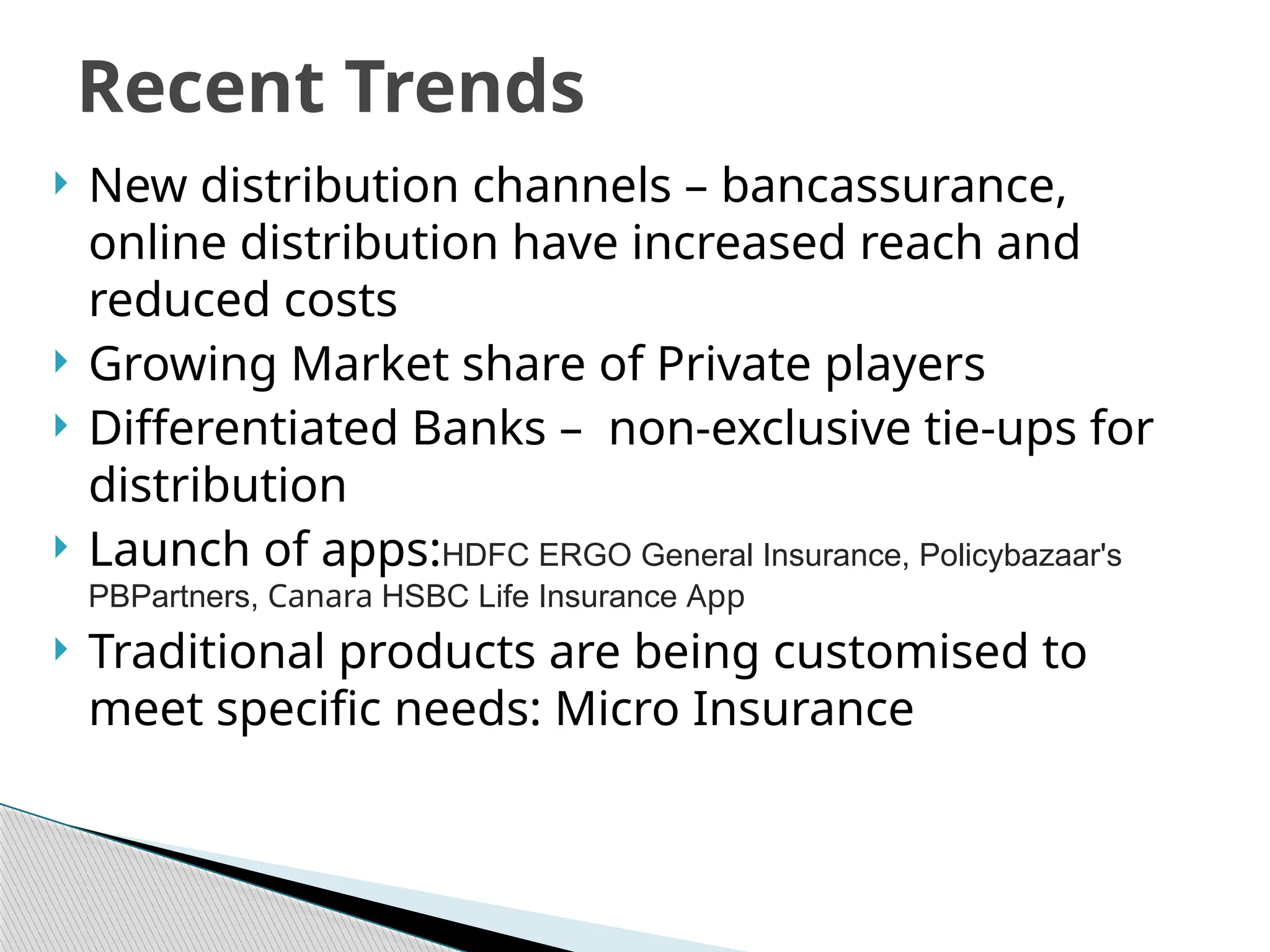
Recent Trends
 New distribution channels – bancassurance,
online distribution have increased reach and
reduced costs
 Growing Market share of Private players
 Differentiated Banks – non-exclusive tie-ups for
distribution
 Launch of apps:HDFC ERGO General Insurance, Policybazaar's
PBPartners, Canara HSBC Life Insurance App
 Traditional products are being customised to
meet specific needs: Micro Insurance
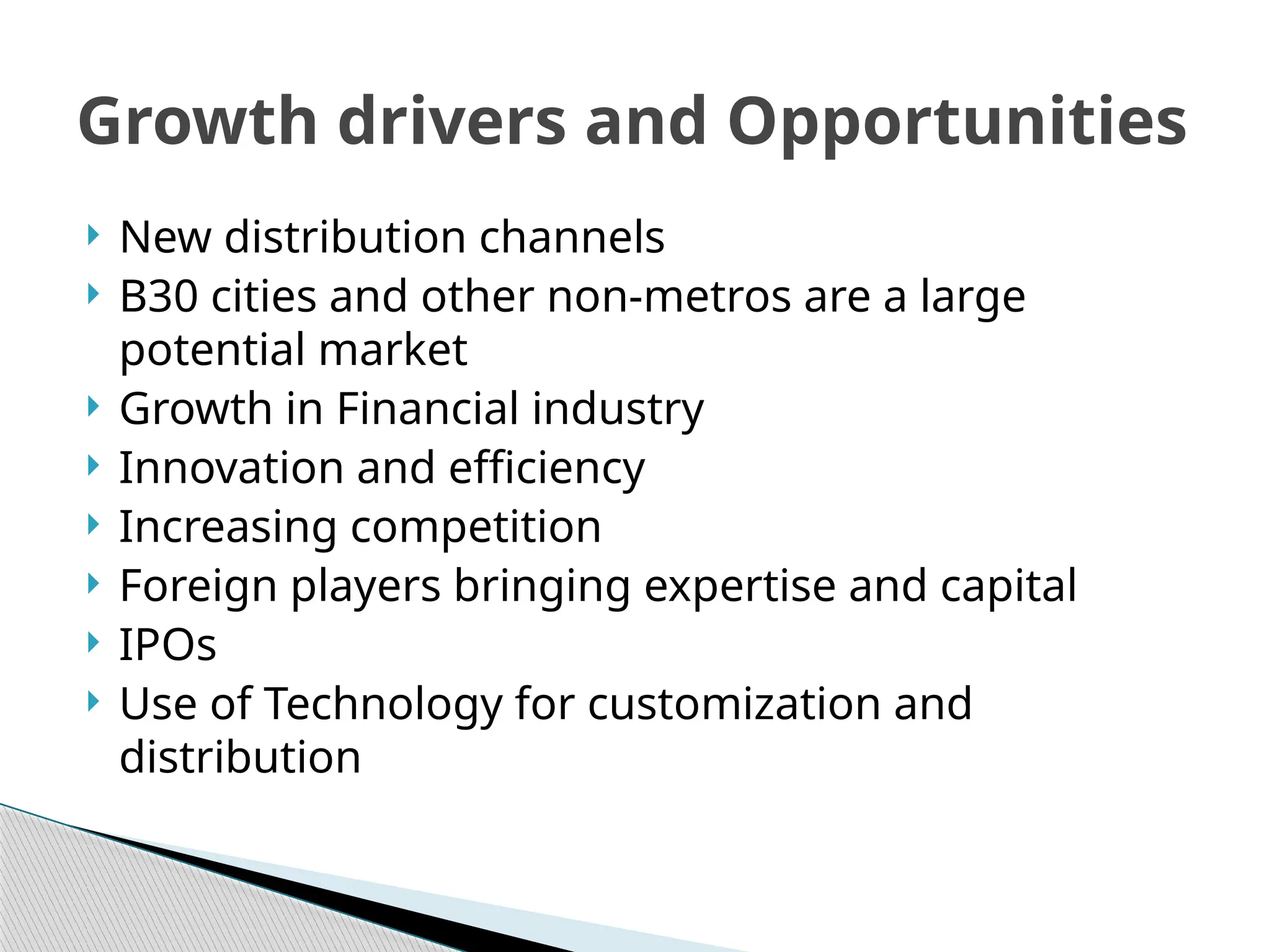
Growth drivers and Opportunities
 New distribution channels
 B30 cities and other non-metros are a large
potential market
 Growth in Financial industry
 Innovation and efficiency
 Increasing competition
 Foreign players bringing expertise and capital
 IPOs
 Use of Technology for customization and
distribution
Mutual Funds
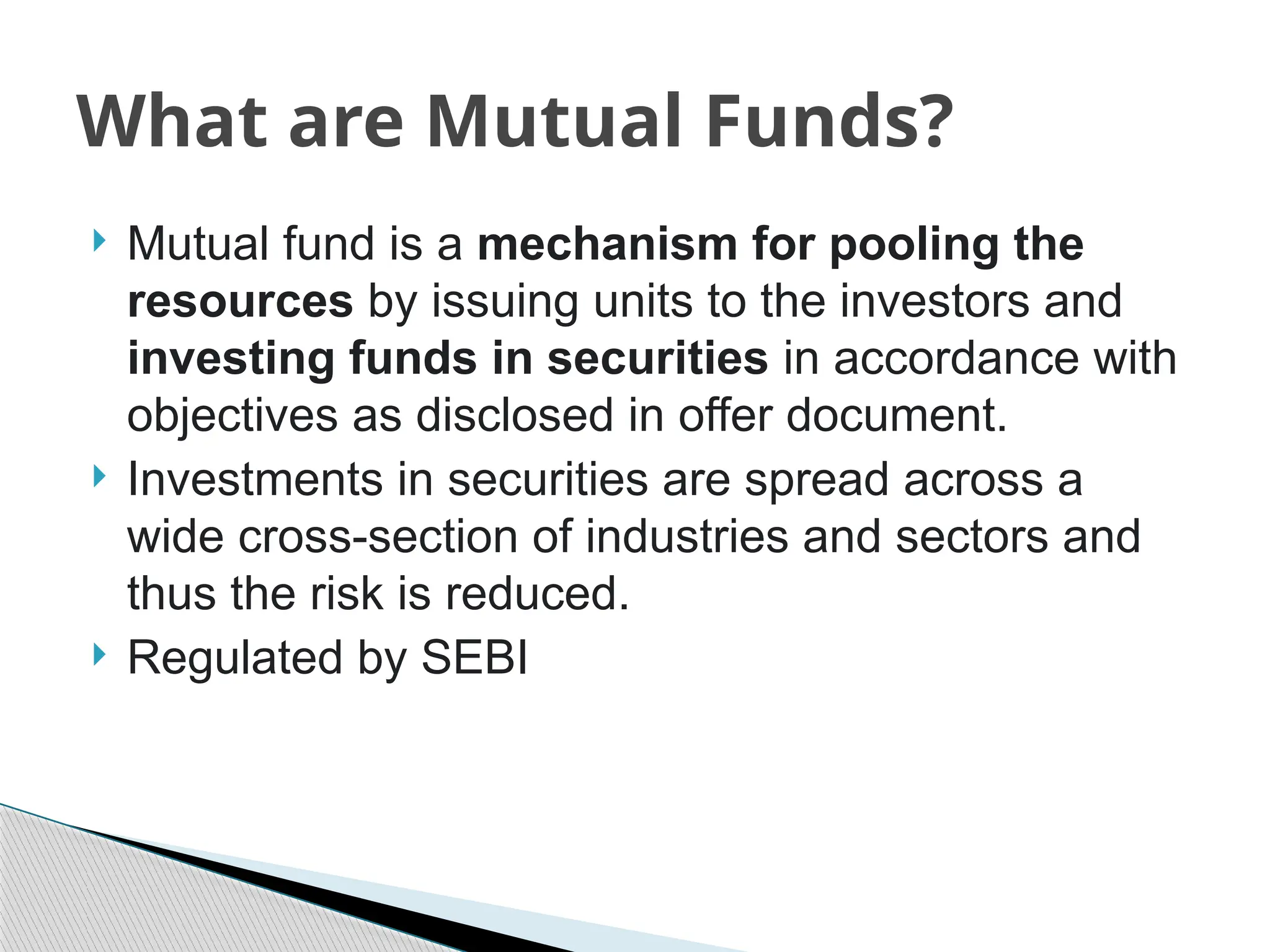
 Mutual fund is a mechanism for pooling the
resources by issuing units to the investors and
investing funds in securities in accordance with
objectives as disclosed in offer document.
 Investments in securities are spread across a
wide cross-section of industries and sectors and
thus the risk is reduced.
 Regulated by SEBI
What are Mutual Funds?
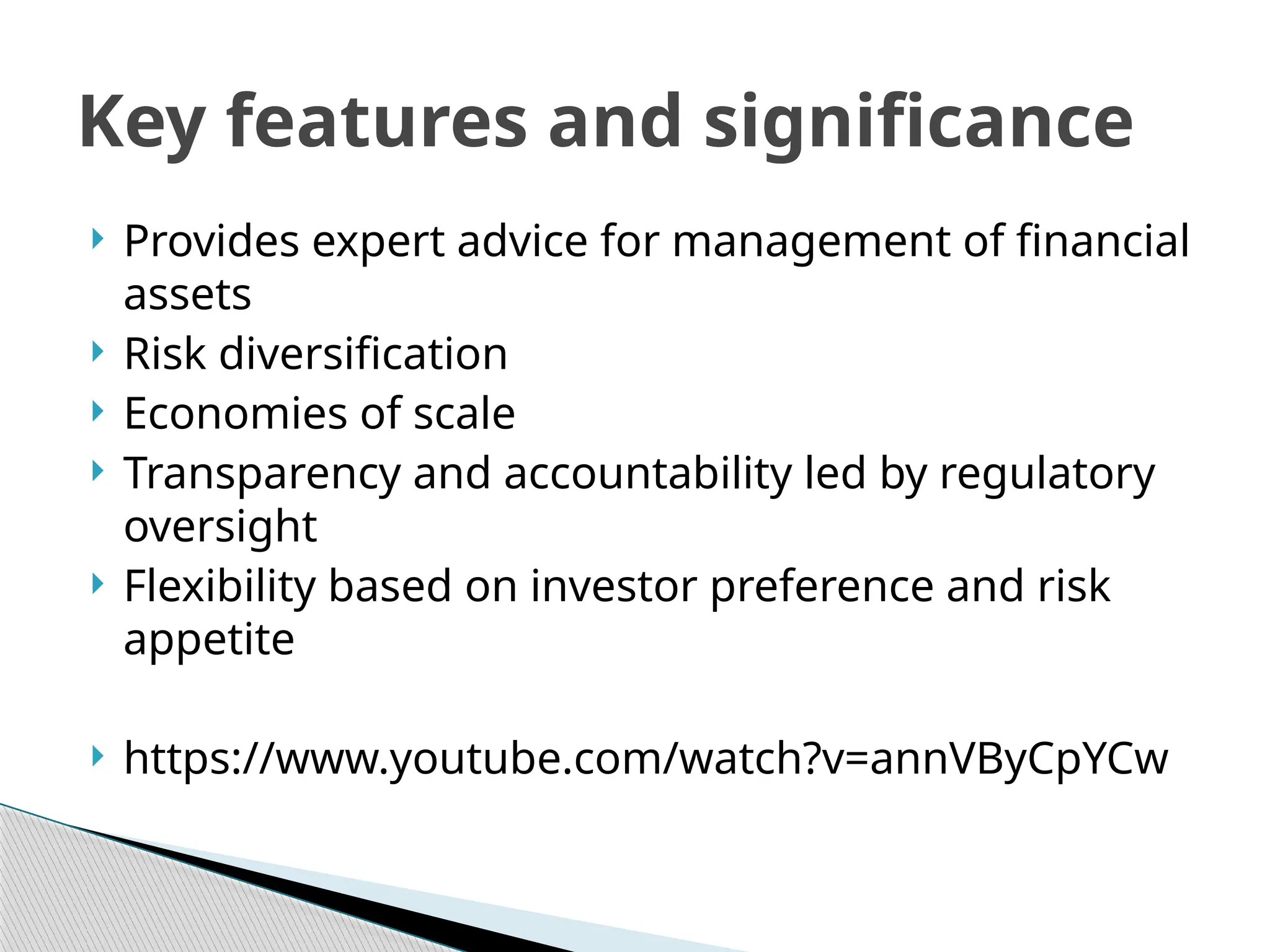
 Provides expert advice for management of financial
assets
 Risk diversification
 Economies of scale
 Transparency and accountability led by regulatory
oversight
 Flexibility based on investor preference and risk
appetite
 https://www.youtube.com/watch?v=annVByCpYCw
Key features and significance
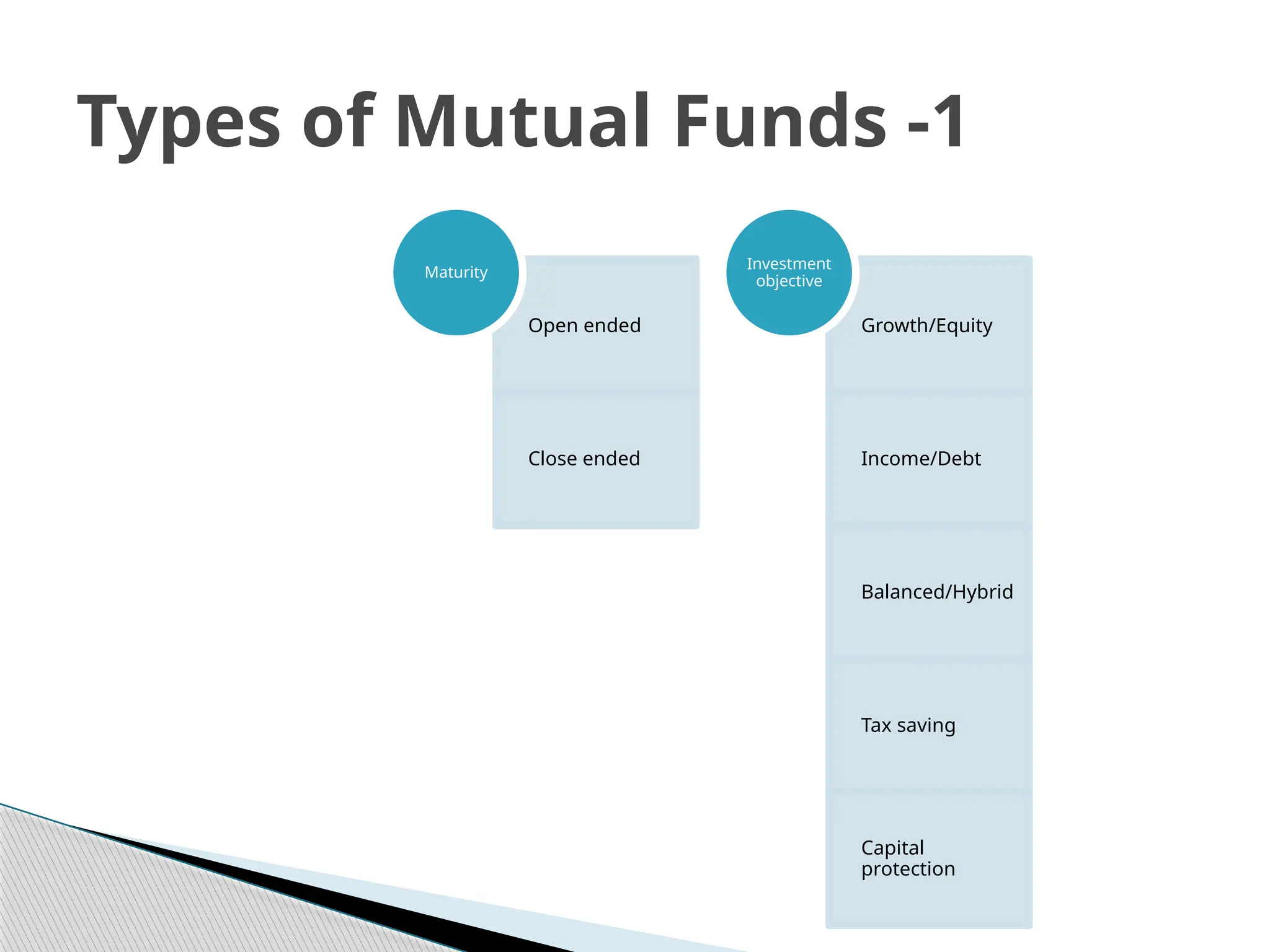
Open ended
Close ended
Maturity
Growth/Equity
Income/Debt
Balanced/Hybrid
Tax saving
Capital
protection
Investment
objective
Types of Mutual Funds -1
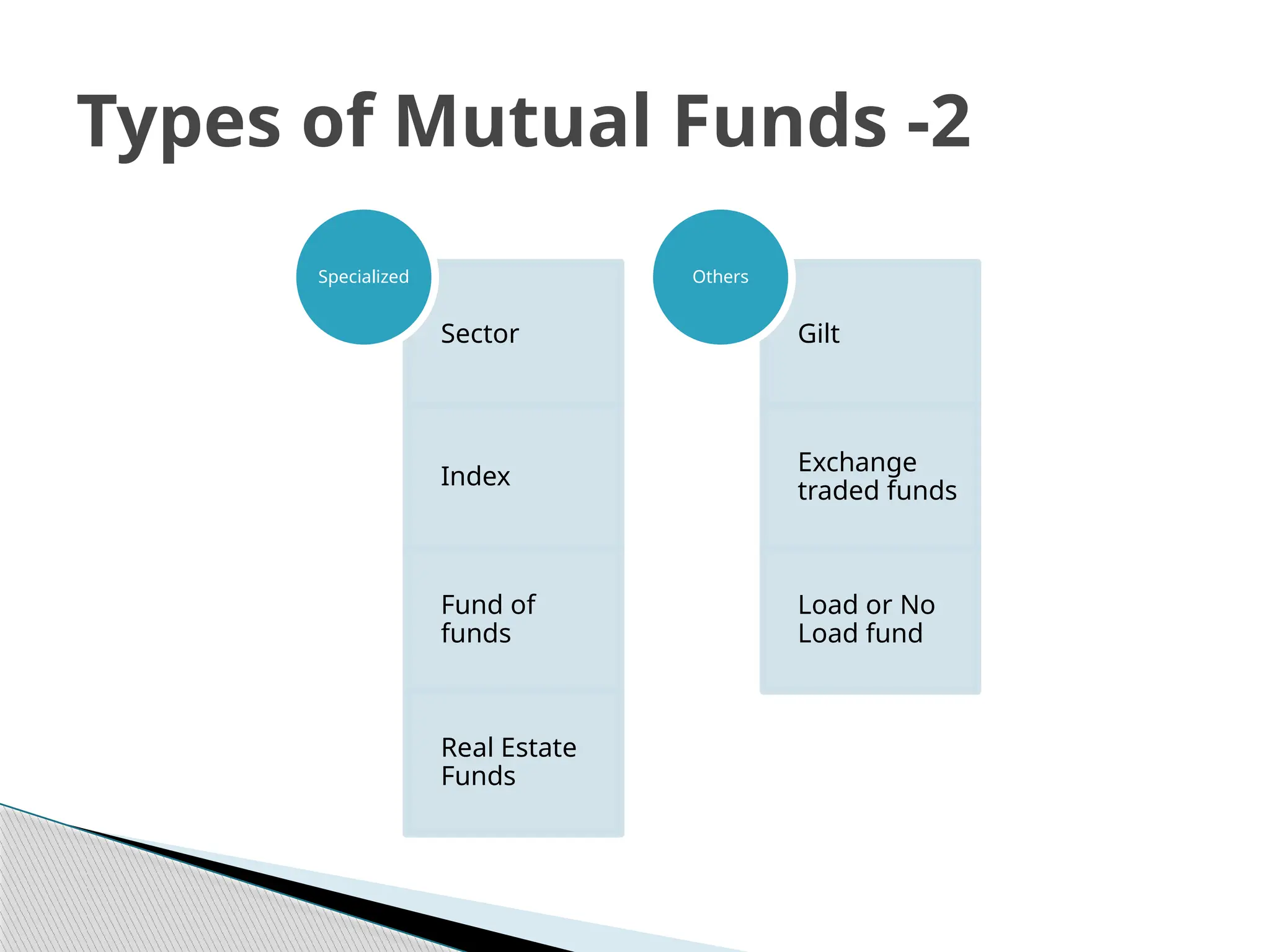
Sector
Index
Fund of
funds
Real Estate
Funds
Specialized
Gilt
Exchange
traded funds
Load or No
Load fund
Others
Types of Mutual Funds -2
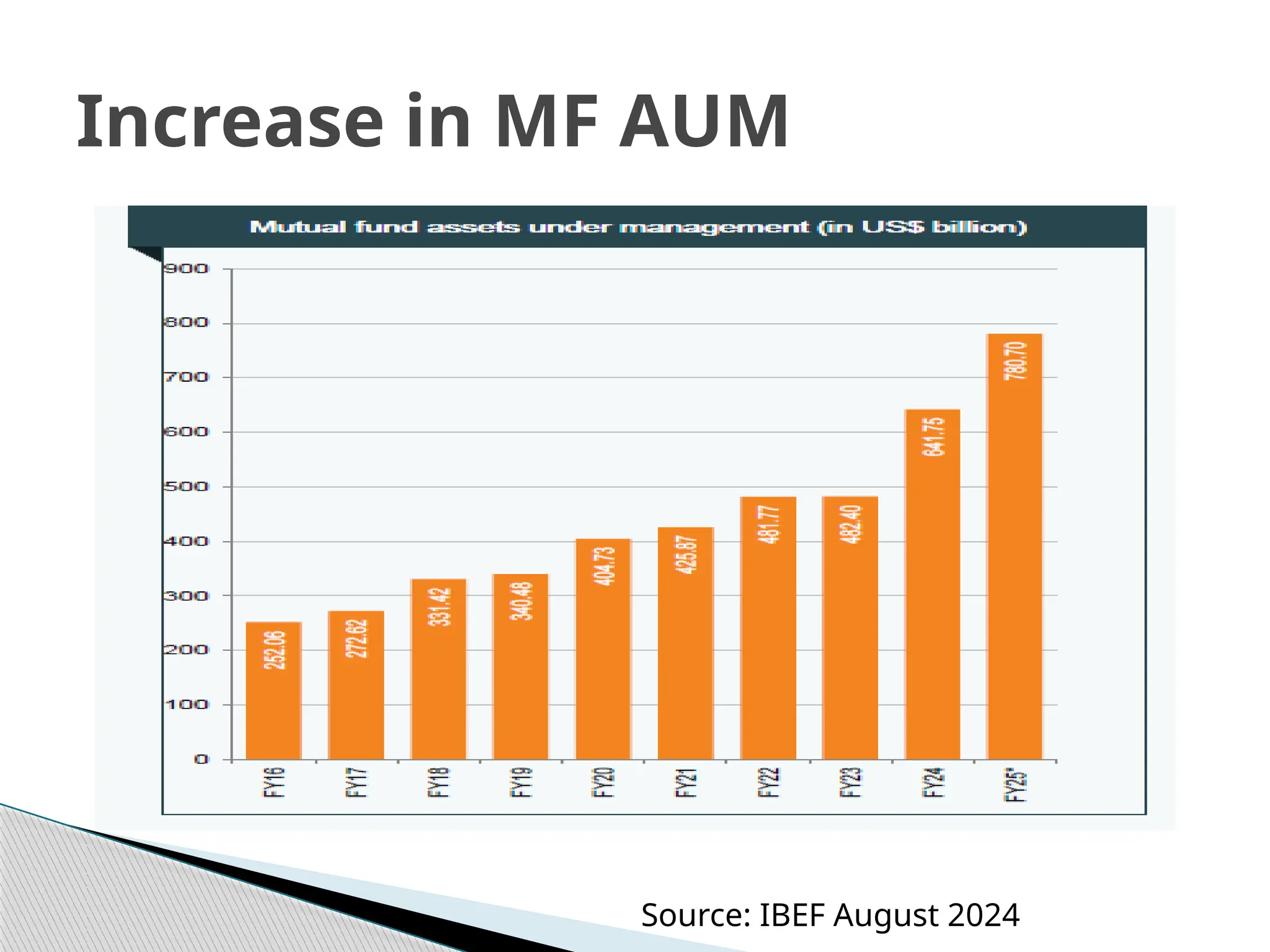
Increase in MF AUM
Source: IBEF August 2024
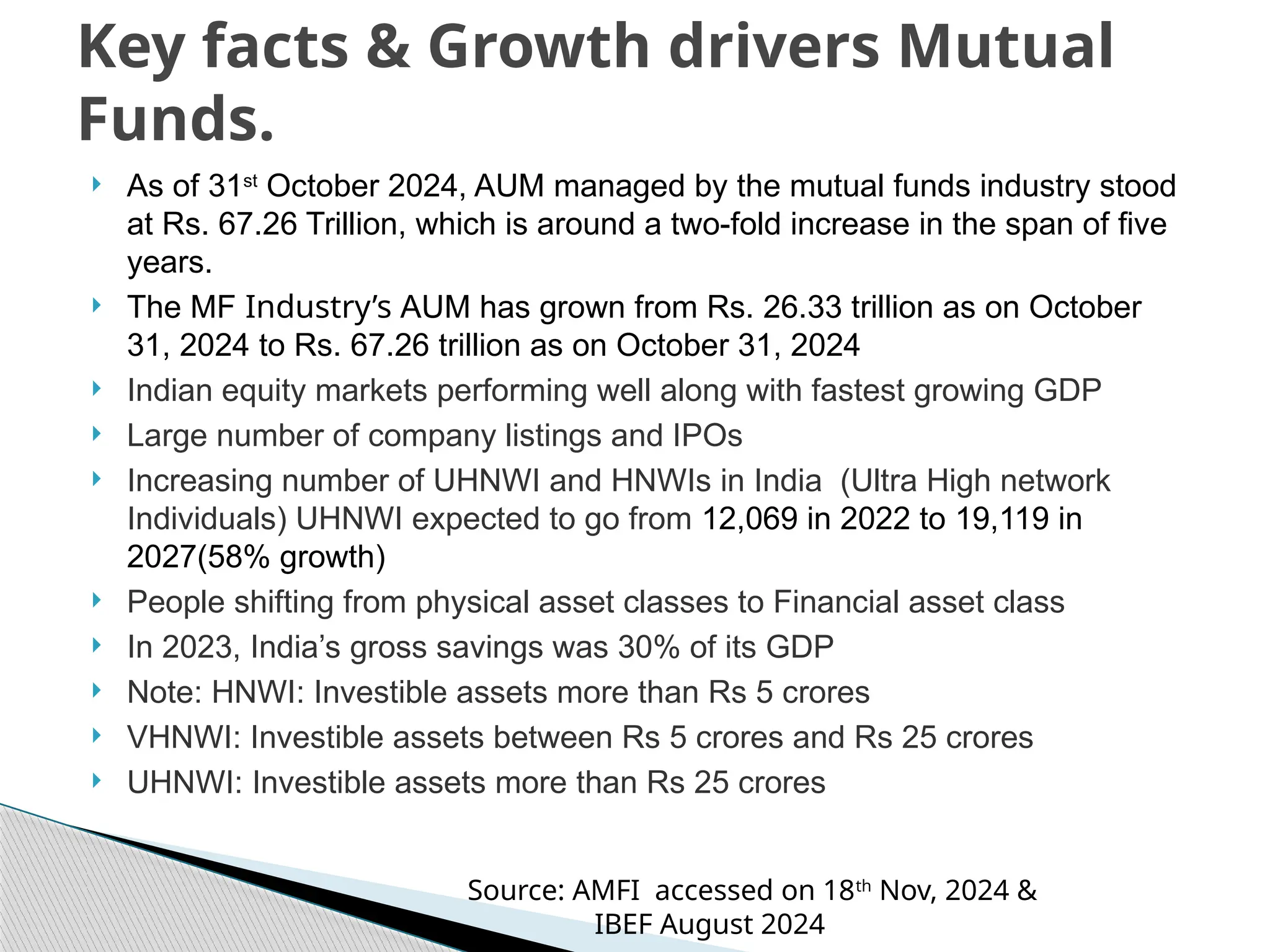
Key facts & Growth drivers Mutual
Funds.
 As of 31st
October 2024, AUM managed by the mutual funds industry stood
at Rs. 67.26 Trillion, which is around a two-fold increase in the span of five
years.
 The MF Industry’s AUM has grown from Rs. 26.33 trillion as on October
31, 2024 to Rs. 67.26 trillion as on October 31, 2024
 Indian equity markets performing well along with fastest growing GDP
 Large number of company listings and IPOs
 Increasing number of UHNWI and HNWIs in India (Ultra High network
Individuals) UHNWI expected to go from 12,069 in 2022 to 19,119 in
2027(58% growth)
 People shifting from physical asset classes to Financial asset class
 In 2023, India’s gross savings was 30% of its GDP
 Note: HNWI: Investible assets more than Rs 5 crores
 VHNWI: Investible assets between Rs 5 crores and Rs 25 crores
 UHNWI: Investible assets more than Rs 25 crores
Source: AMFI accessed on 18th
Nov, 2024 &
IBEF August 2024
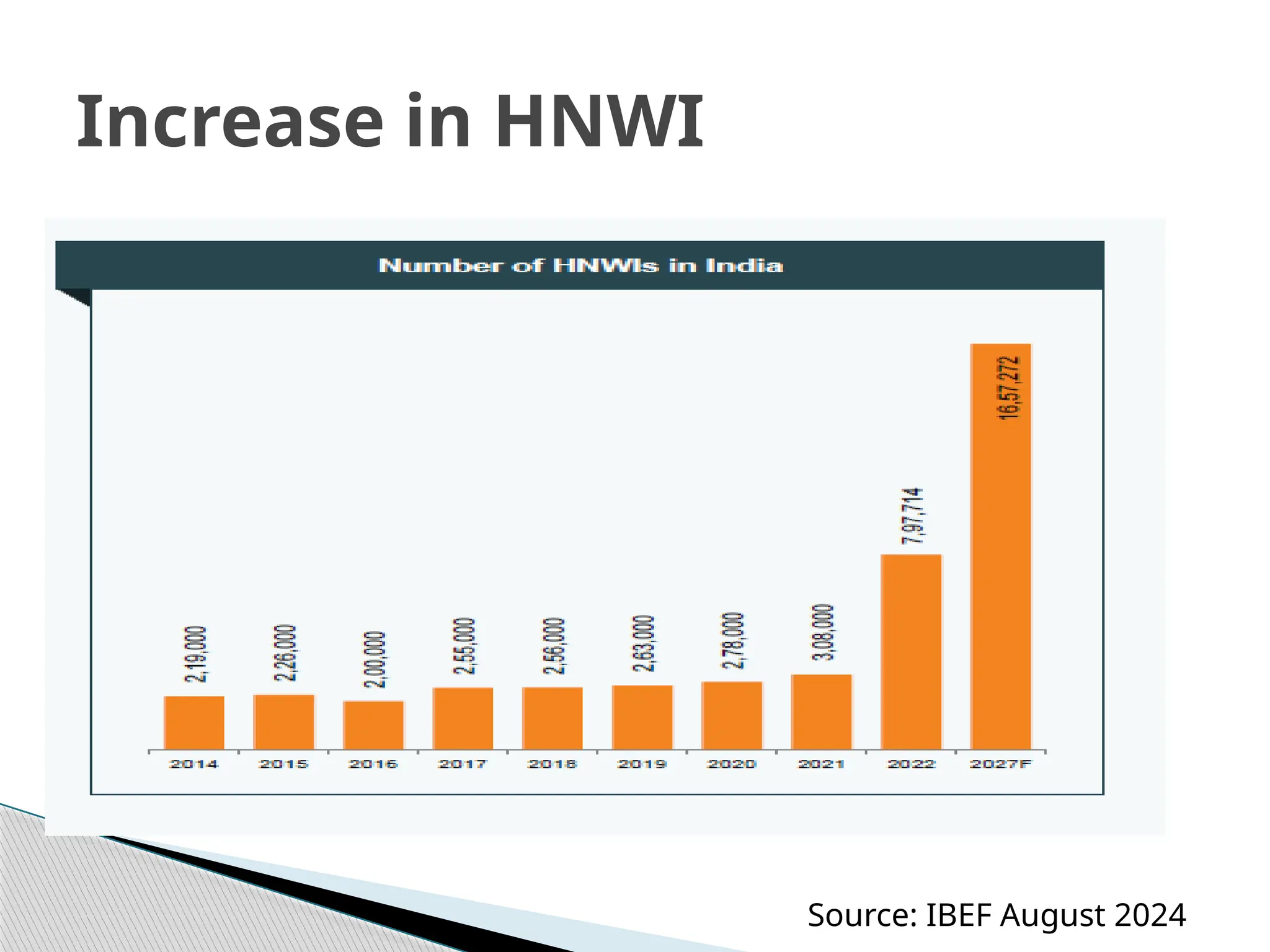
Increase in HNWI
Source: IBEF August 2024
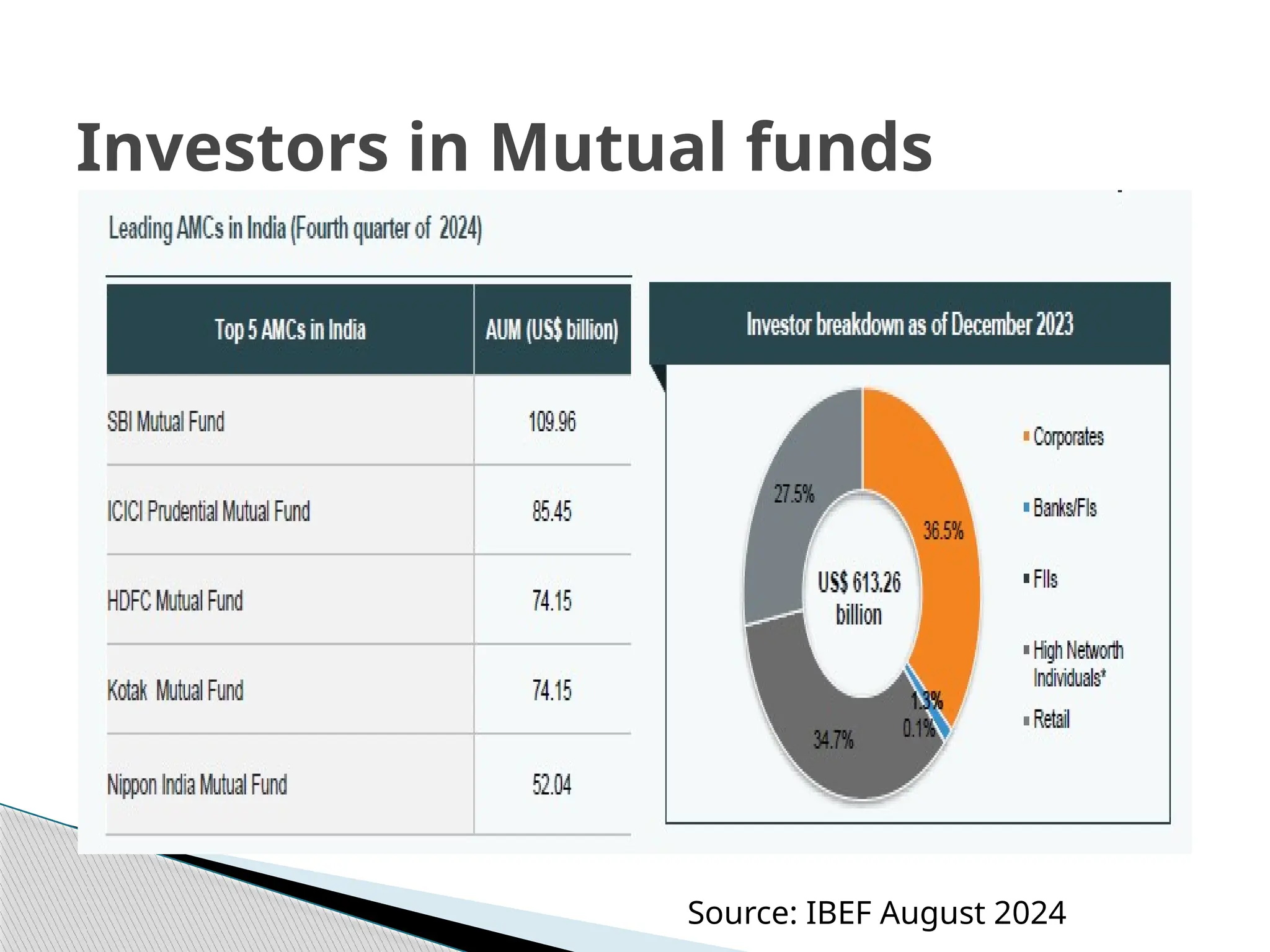
Investors in Mutual funds
Source: IBEF August 2024
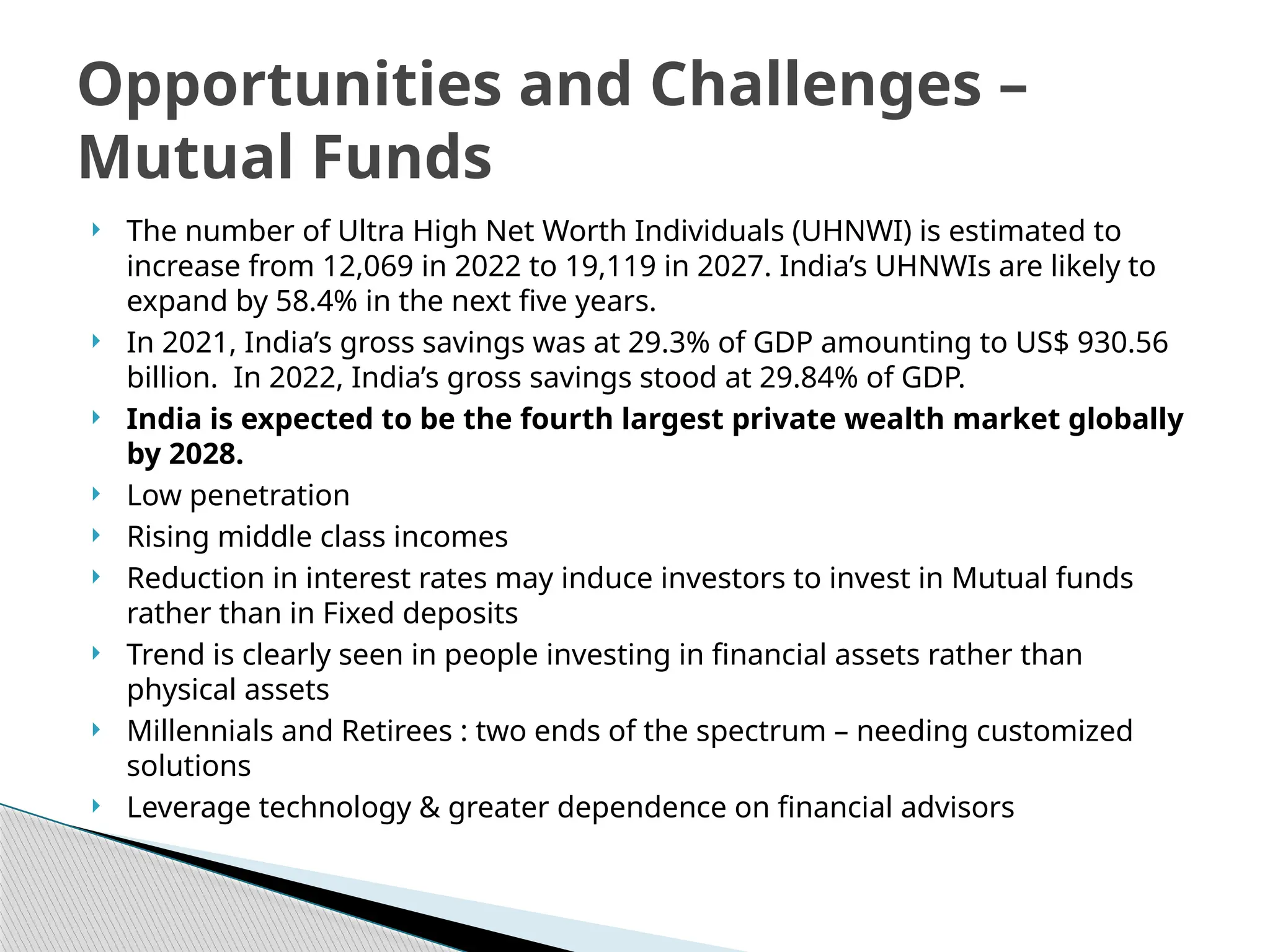
 The number of Ultra High Net Worth Individuals (UHNWI) is estimated to
increase from 12,069 in 2022 to 19,119 in 2027. India’s UHNWIs are likely to
expand by 58.4% in the next five years.
 In 2021, India’s gross savings was at 29.3% of GDP amounting to US$ 930.56
billion. In 2022, India’s gross savings stood at 29.84% of GDP.
 India is expected to be the fourth largest private wealth market globally
by 2028.
 Low penetration
 Rising middle class incomes
 Reduction in interest rates may induce investors to invest in Mutual funds
rather than in Fixed deposits
 Trend is clearly seen in people investing in financial assets rather than
physical assets
 Millennials and Retirees : two ends of the spectrum – needing customized
solutions
 Leverage technology & greater dependence on financial advisors
Opportunities and Challenges –
Mutual Funds
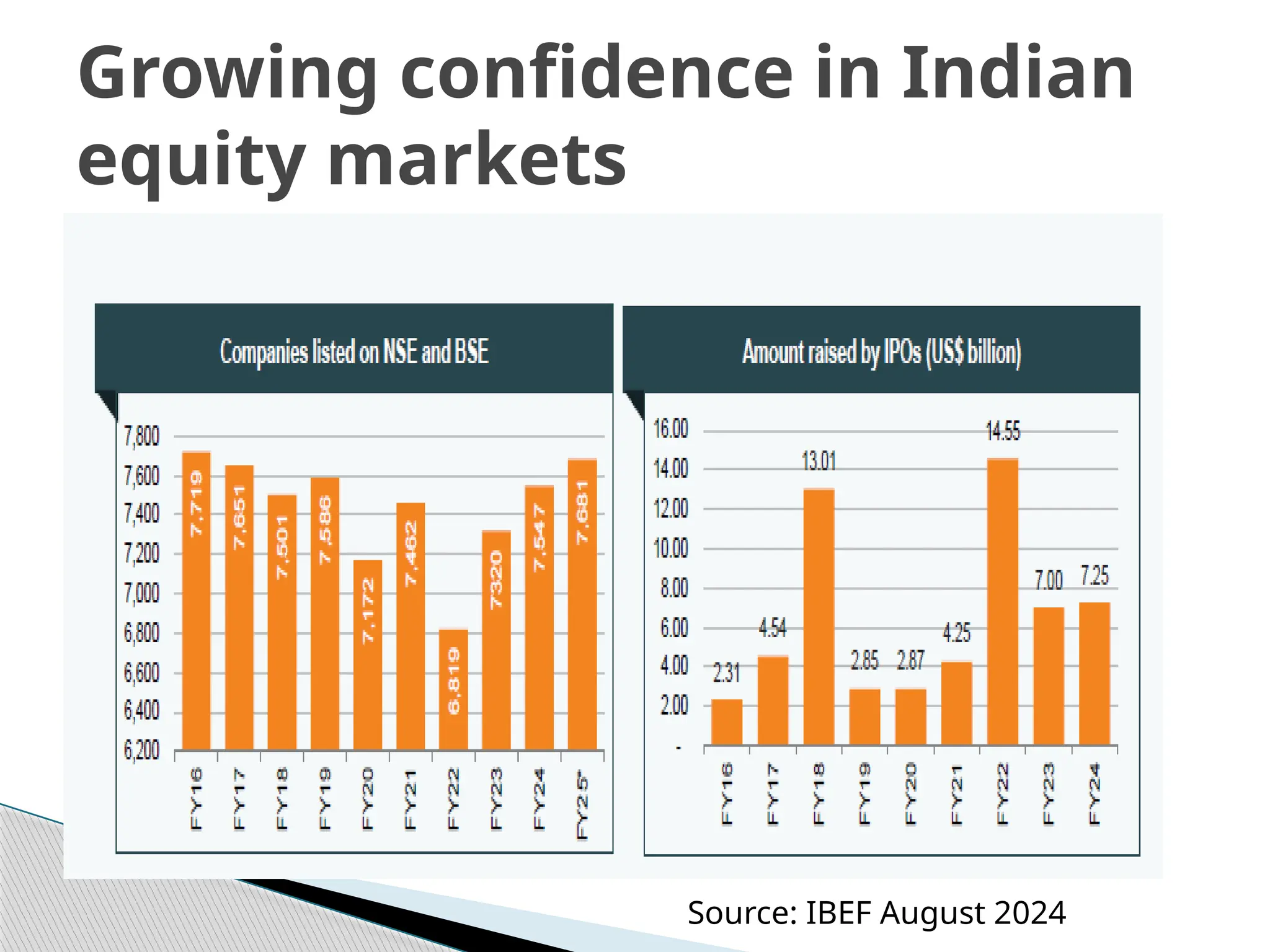
Growing confidence in Indian
equity markets
Source: IBEF August 2024
 https://www.statista.com/statistics/204095/dist
ribution-of-ultra-high-net-worth-individuals-for-
selected-countries/
 https://www.youtube.com/watch?
v=annVByCpYCw
 https://www.youtube.com/watch?
v=XltjQD40iS4&t=251s
Articles/Videos for Mutual fund
industry
NBFCs
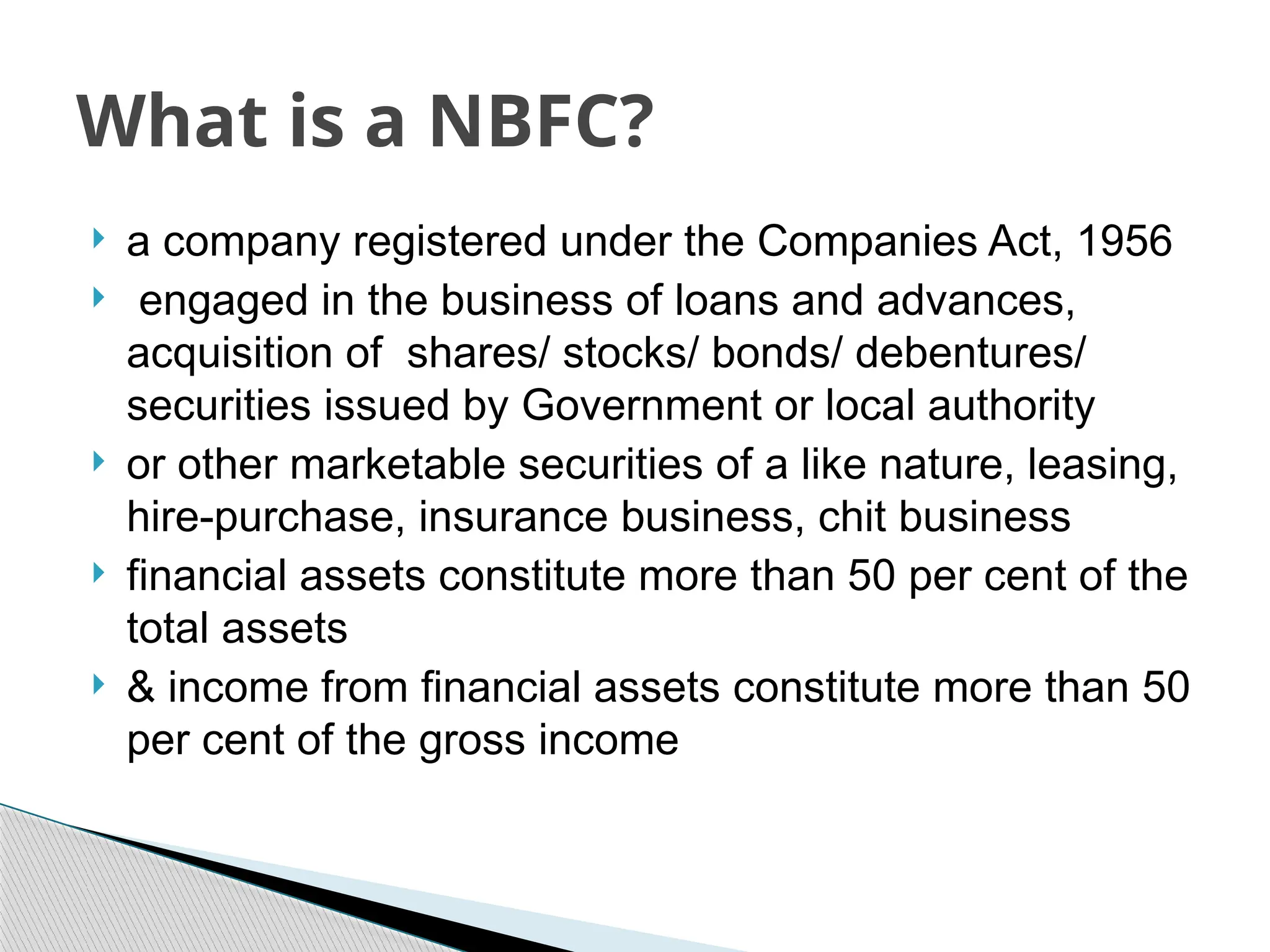
 a company registered under the Companies Act, 1956
 engaged in the business of loans and advances,
acquisition of shares/ stocks/ bonds/ debentures/
securities issued by Government or local authority
 or other marketable securities of a like nature, leasing,
hire-purchase, insurance business, chit business
 financial assets constitute more than 50 per cent of the
total assets
 & income from financial assets constitute more than 50
per cent of the gross income
What is a NBFC?
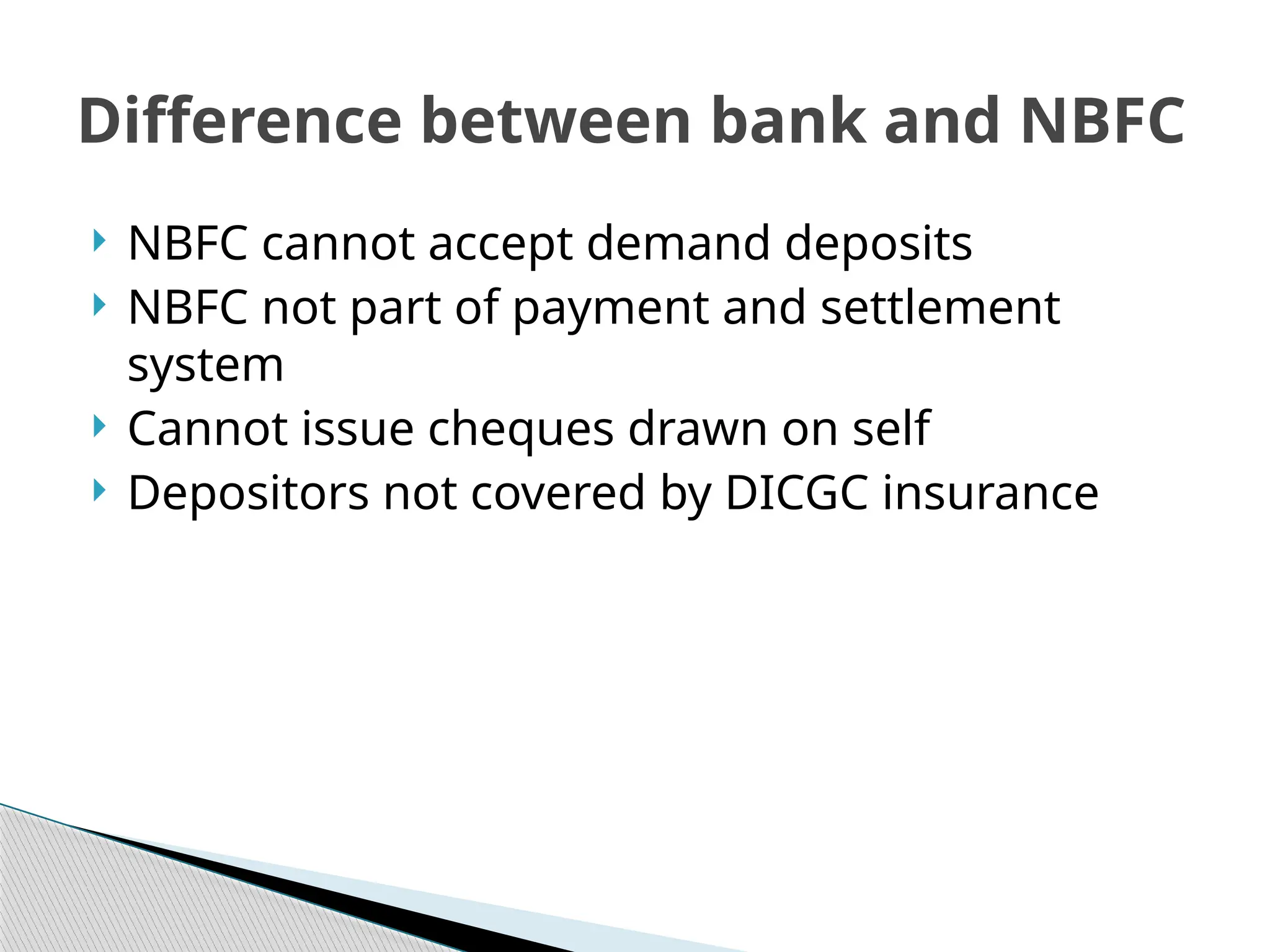
 NBFC cannot accept demand deposits
 NBFC not part of payment and settlement
system
 Cannot issue cheques drawn on self
 Depositors not covered by DICGC insurance
Difference between bank and NBFC
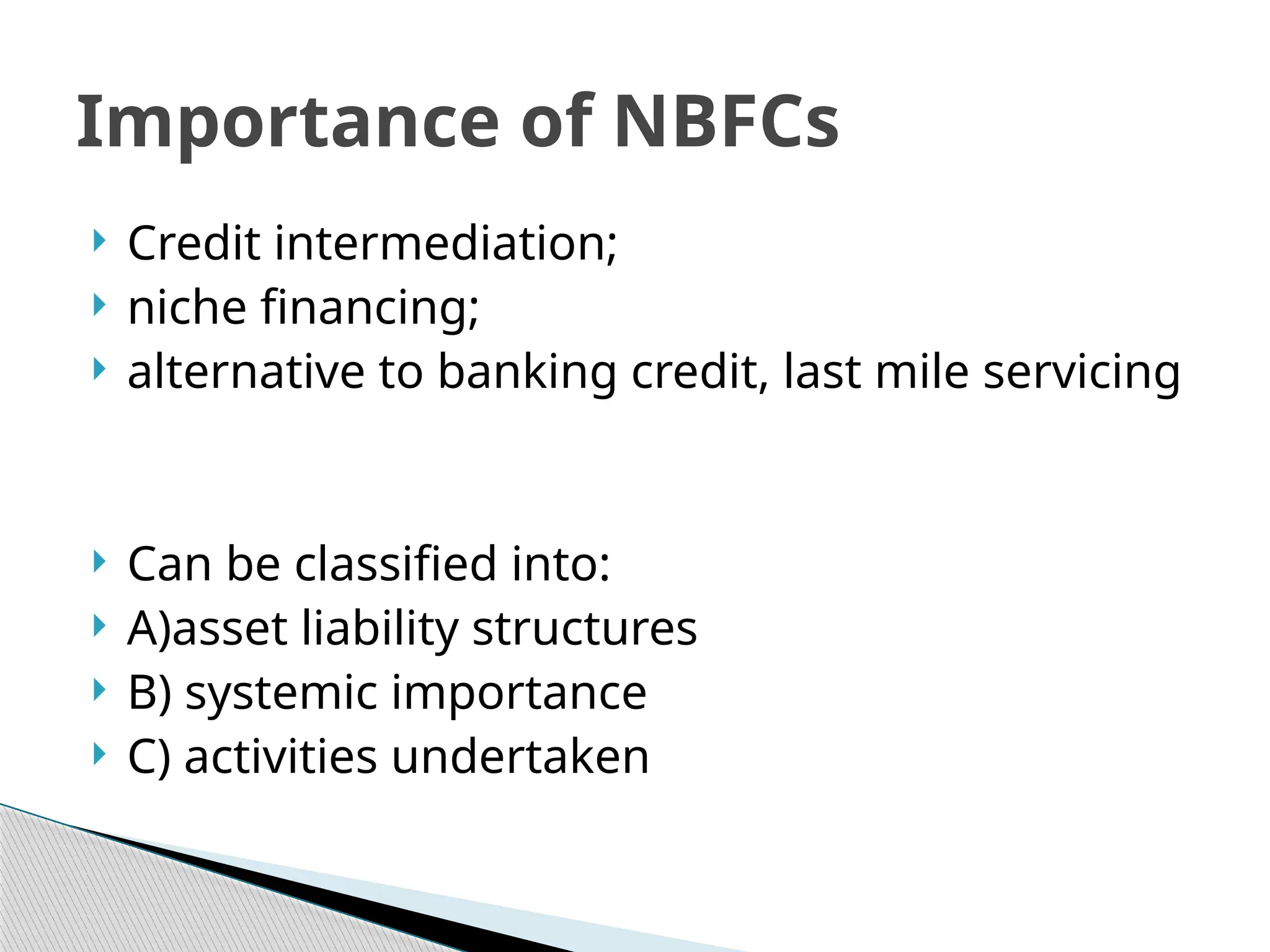
 Credit intermediation;
 niche financing;
 alternative to banking credit, last mile servicing
 Can be classified into:
 A)asset liability structures
 B) systemic importance
 C) activities undertaken
Importance of NBFCs
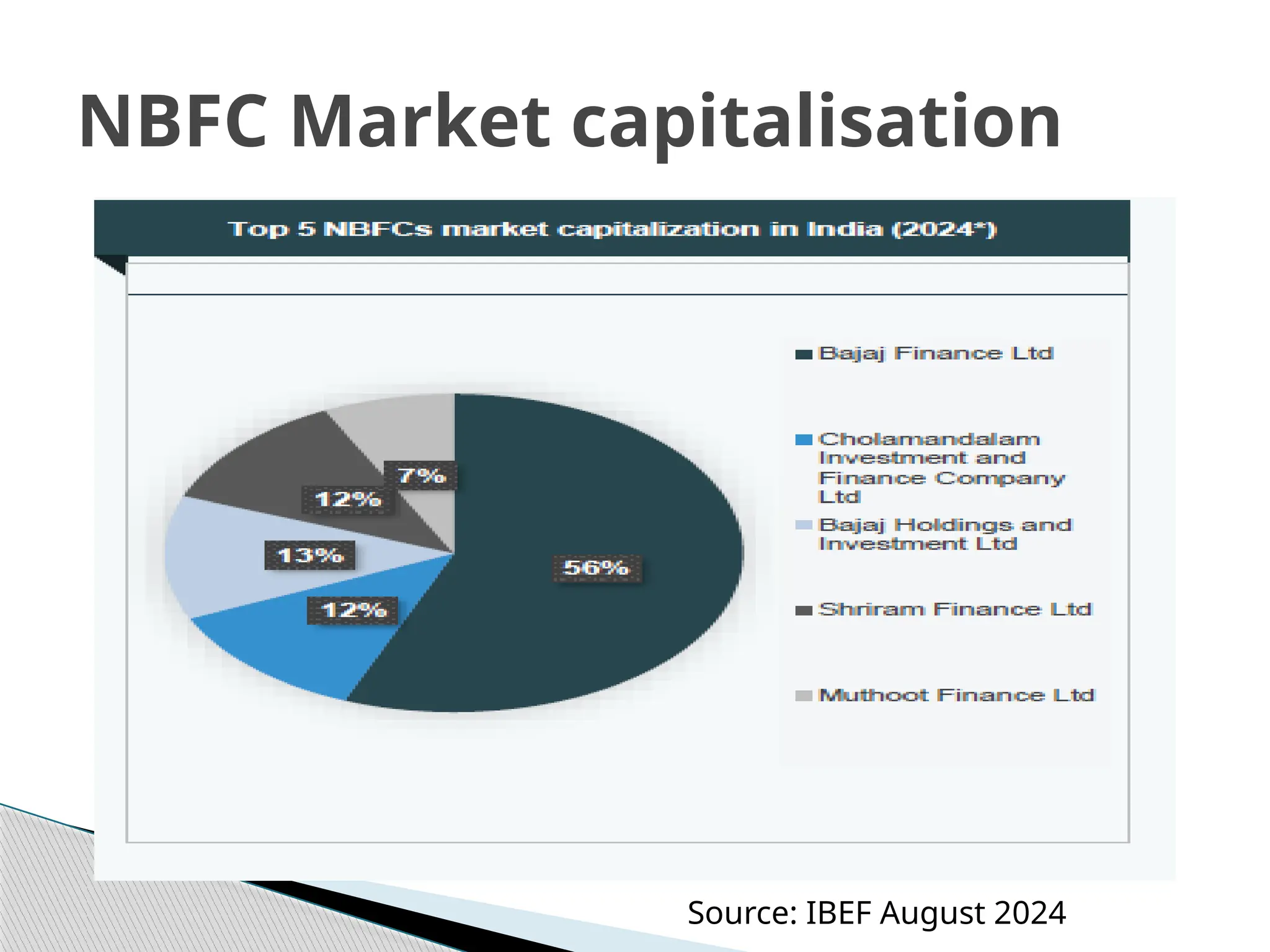
NBFC Market capitalisation
Source: IBEF August 2024
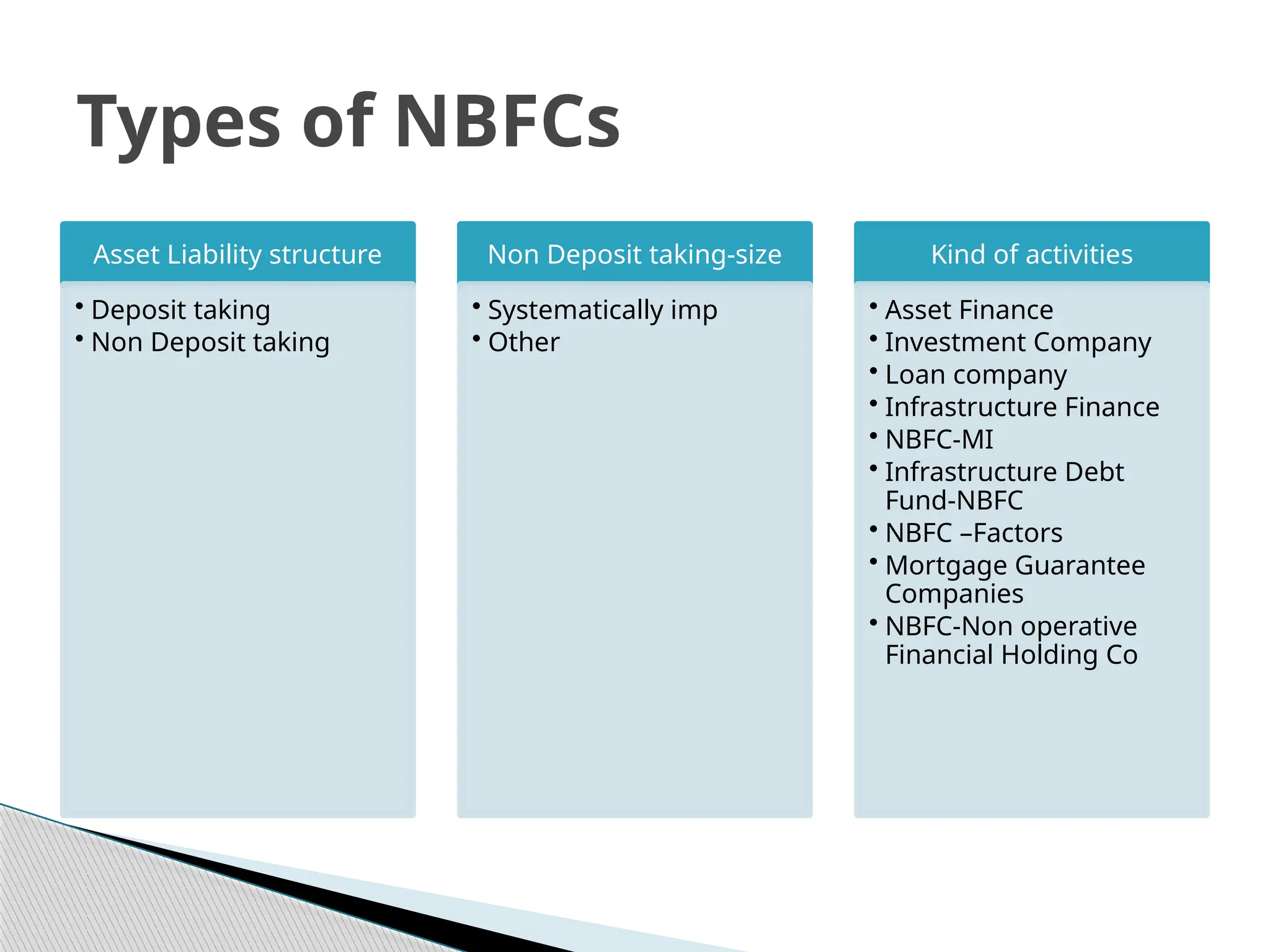
Asset Liability structure
• Deposit taking
• Non Deposit taking
Non Deposit taking-size
• Systematically imp
• Other
Kind of activities
• Asset Finance
• Investment Company
• Loan company
• Infrastructure Finance
• NBFC-MI
• Infrastructure Debt
Fund-NBFC
• NBFC –Factors
• Mortgage Guarantee
Companies
• NBFC-Non operative
Financial Holding Co
Types of NBFCs
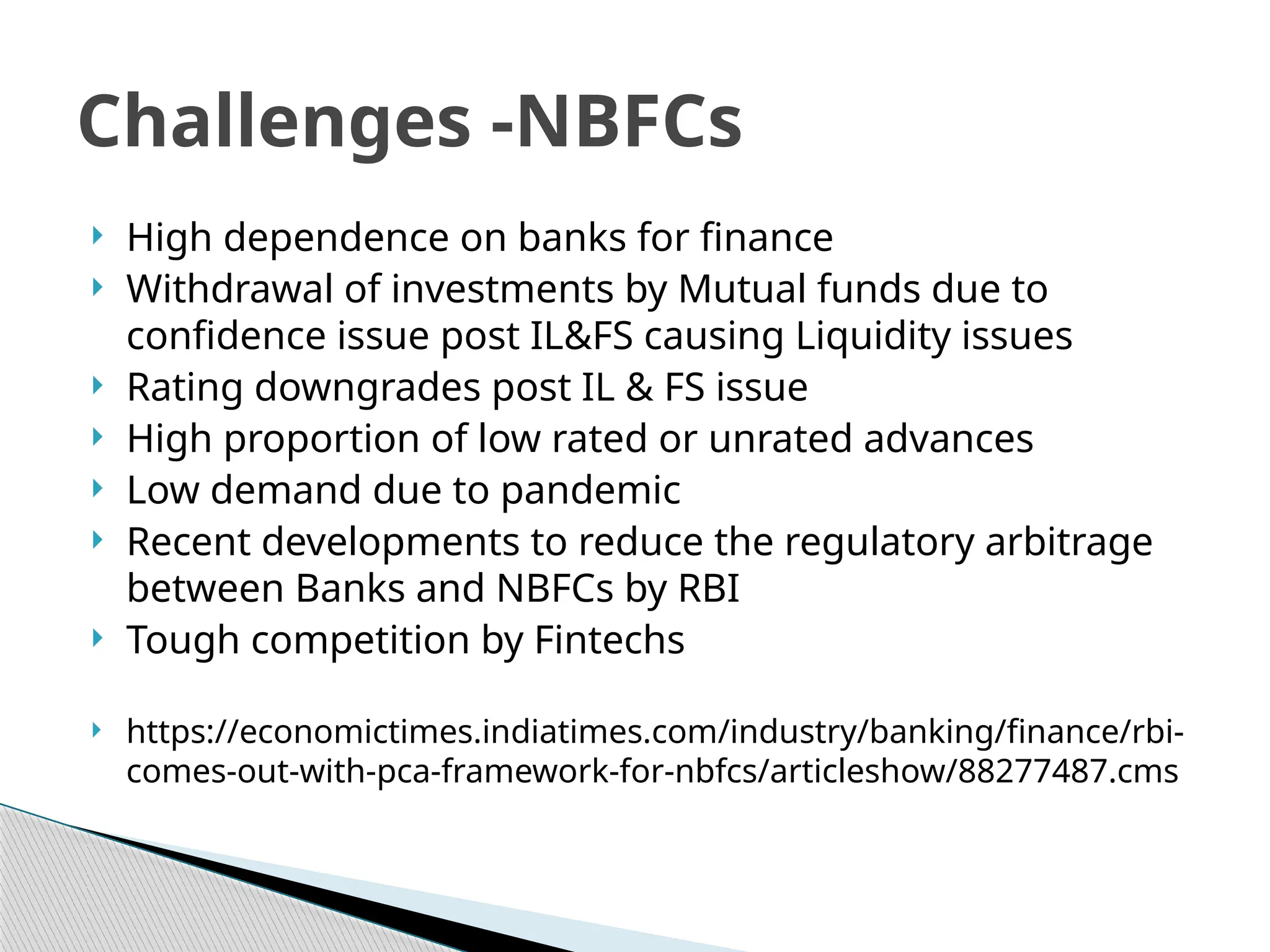
 High dependence on banks for finance
 Withdrawal of investments by Mutual funds due to
confidence issue post IL&FS causing Liquidity issues
 Rating downgrades post IL & FS issue
 High proportion of low rated or unrated advances
 Low demand due to pandemic
 Recent developments to reduce the regulatory arbitrage
between Banks and NBFCs by RBI
 Tough competition by Fintechs
 https://economictimes.indiatimes.com/industry/banking/finance/rbi-
comes-out-with-pca-framework-for-nbfcs/articleshow/88277487.cms
Challenges -NBFCs
Banks
 A bank is a financial intermediary that receives
deposits from the general public (including
demand deposits ) and lends it
 Forms part of payment and settlement system
 Deposit insurance facility available to
depositors upto Rs 5 lakhs per depositor
 Other functions
What is a Bank?
Public Sector (12) Private Sector (21) Foreign (45)
Small Finance (12) Payments (4)
Others including
Regional Rural (43) ,
Local Area (3) ,
Cooperative
Types of Banks
 Types of Banks : differentiated by nature of allowable
activities, level of regulation.
 21 Private sector banks,3 Local area banks,12 small finance
banks,4 payments banks, 12 Public sector banks, 4 financial
institutions,43 Regional rural banks,44 Foreign banks with
branches in India
 Co-operative banks : Multi state Cooperative banks under
direct control of RBI. District central co-operative banks and
state cooperative banks under dual regulators. Primary
agricultural credit society(PACS) not under RBI purview.
 List of scheduled banks (other than co-operative) available
on https://www.rbi.org.in/scripts/banklinks.asp
Banking Sector
 Public sector banks hold around 66% of the total
assets of the banking sector
 Private sector banks have better profitability than
Public sector banks
 Profitability under pressure sue to tough competition
from fintech; especially in retail segment
 Increase in bank branches and ATMs (of private
sector banks)
 Exposure of private sector banks to sensitive sectors
like Real estate is lowering but still higher than that
of Public sector banks
Key Trends
 During and post pandemic, deposits have grown at a
higher pace than advances(PSBs gathering more
deposits than PVBs); excessive profitability. Low
economic activity and risk aversion causing low credit
growth. This trend has now reversed.
 Lending to Retail sector increasing while that to
Industry and agriculture is showing a dip
 GNPA ratio of industries is highest with large accounts
going bad from FY 17-18.
 Increasing Co-lending arrangements
 Issuance of green bonds & Foreign currency bonds by
Banks
Key trends
 IBC proceedings a dominant source of recovery
from NPAs
 Retail fraud – a concern
 Need to increase investor awareness
 Consolidation occurring in the sector in Public
sector banks as well as Private sector banks
Key trends
 Increase in technology enabled solutions
 Customer centric approaches
 Mobile penetration with low cost internet – a
boost to use of telecom for banking services-
driving financial inclusion
 Expected increase in NPAs given the rolling
back of policy measures and the standstill in
asset classification allowed to banks
 Notable increase in digital payments like
UPI,NEFT,IMPS
Key trends
 Increasing collaboration and competition between
banks and fintechs
 Use of technology to reduce costs and provide
transparency, flexibility and last mile financial services
to hinterland driving fintechs
 Digital lending, use of blockchain, application of AI and
ML are the emerging areas of influence for fintechs
 Regulatory sandbox mechanism (recently for use of
mobile banking on feature phones ) will be a path
breaking initiative.
 Mobile banking, Mobile bill payments, Mobile
commerce: to reduce costs and increase volume
Banks and fintechs
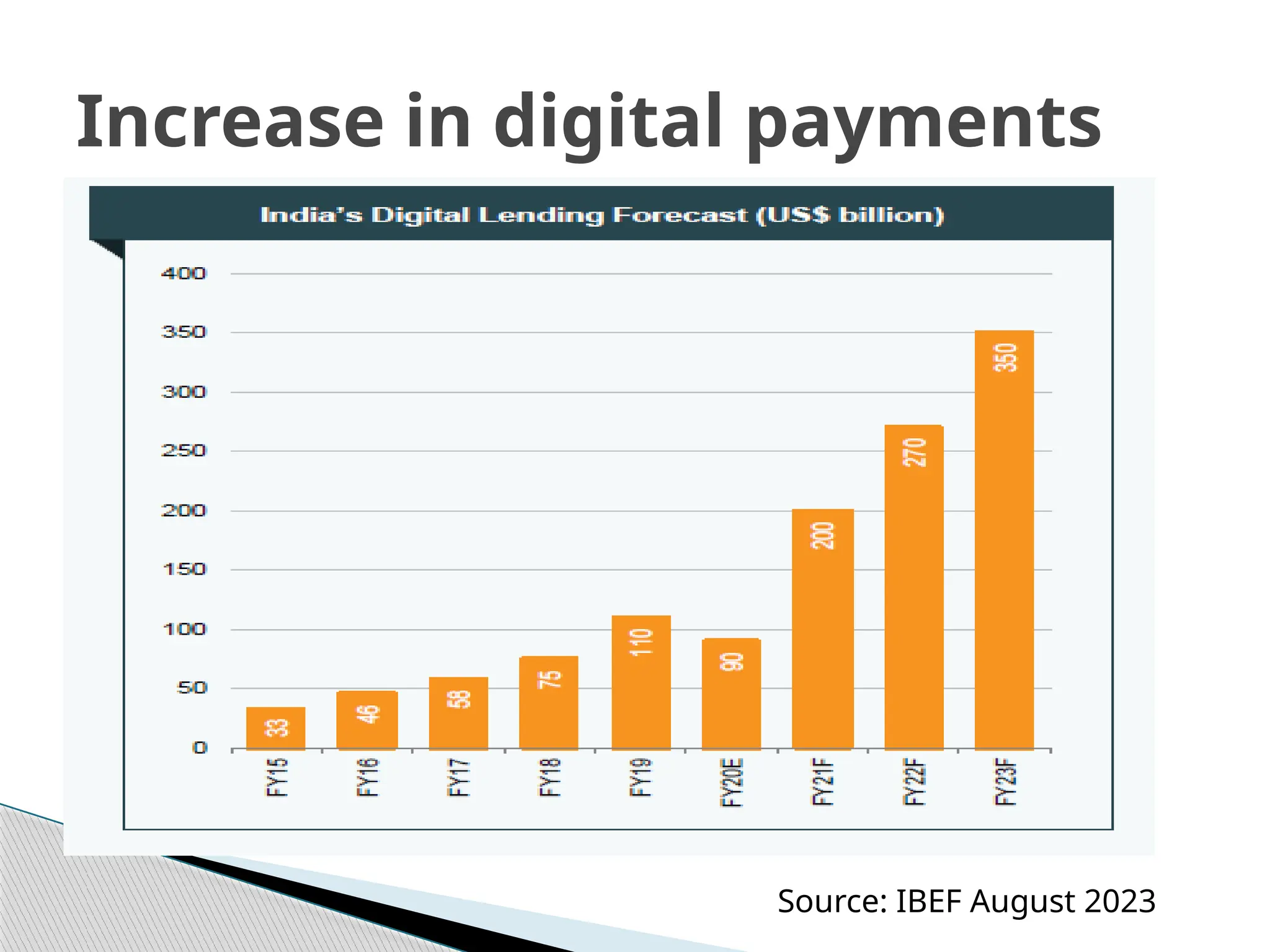
Increase in digital payments
Source: IBEF August 2023
 Neo Banking: Digital Banks with no physical presence,
reducing infrastructure and administrative costs and
fostering innovation. In India, they are not allowed to
function in solo, they rely on bank partners to provide
services For eg: Razorpay X,Jupiter, Niyo, Open.
Challenges include lack of trust, limited services,
regulatory hurdles.
 Open banking: banking practice that will allow third
party financial providers access to financial data across
the banking sector by use of application programming
interfaces(APIs). Account aggregator service allowed in
India is a step in this direction.
Some new terms related to Banking
 https://economictimes.indiatimes.com/definitio
n/payments-banks
 https://www.youtube.com/watch?v=-
G3kQloMVKQ
Articles/Videos on payment bank
business models
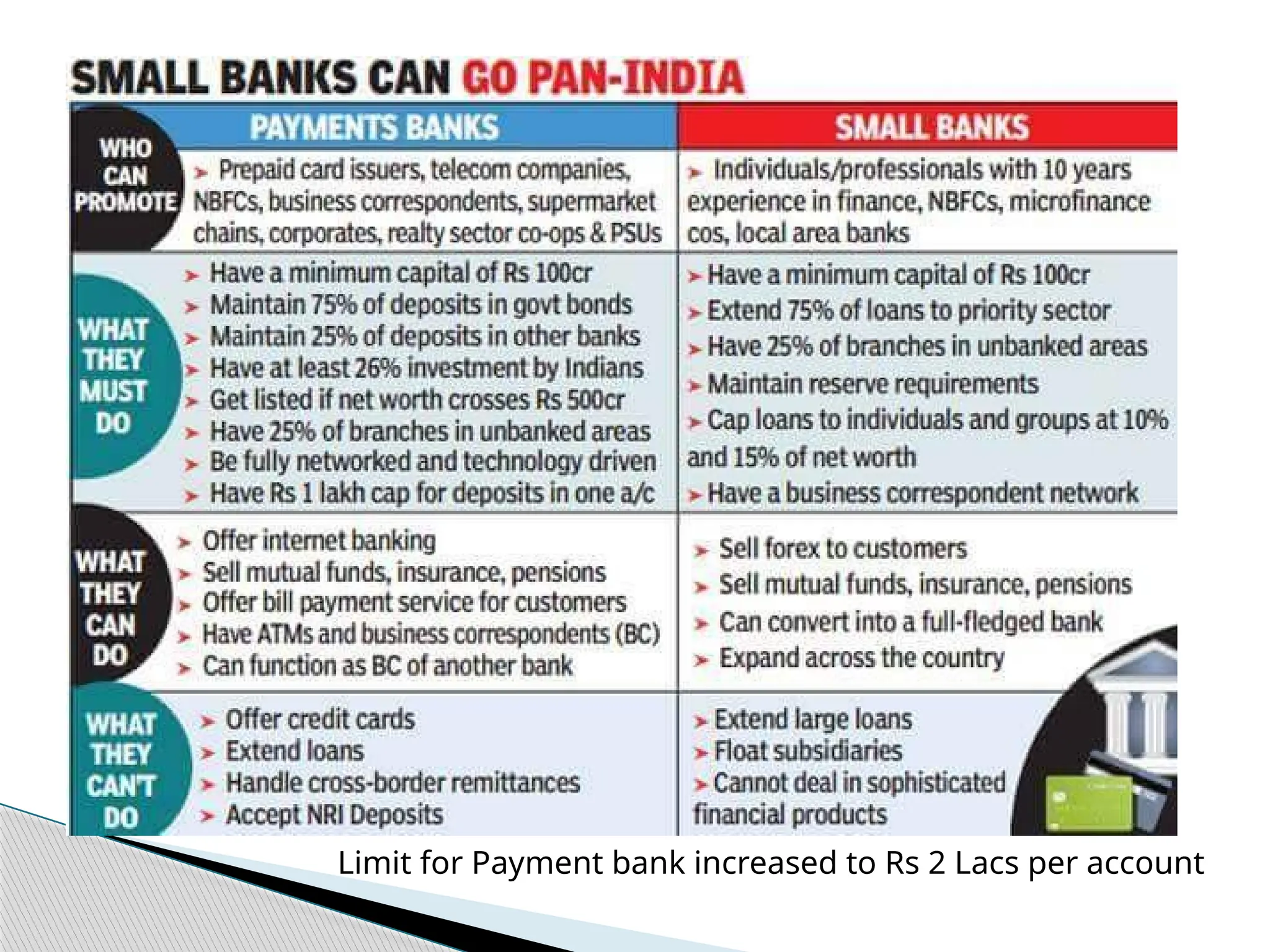
Limit for Payment bank increased to Rs 2 Lacs per account
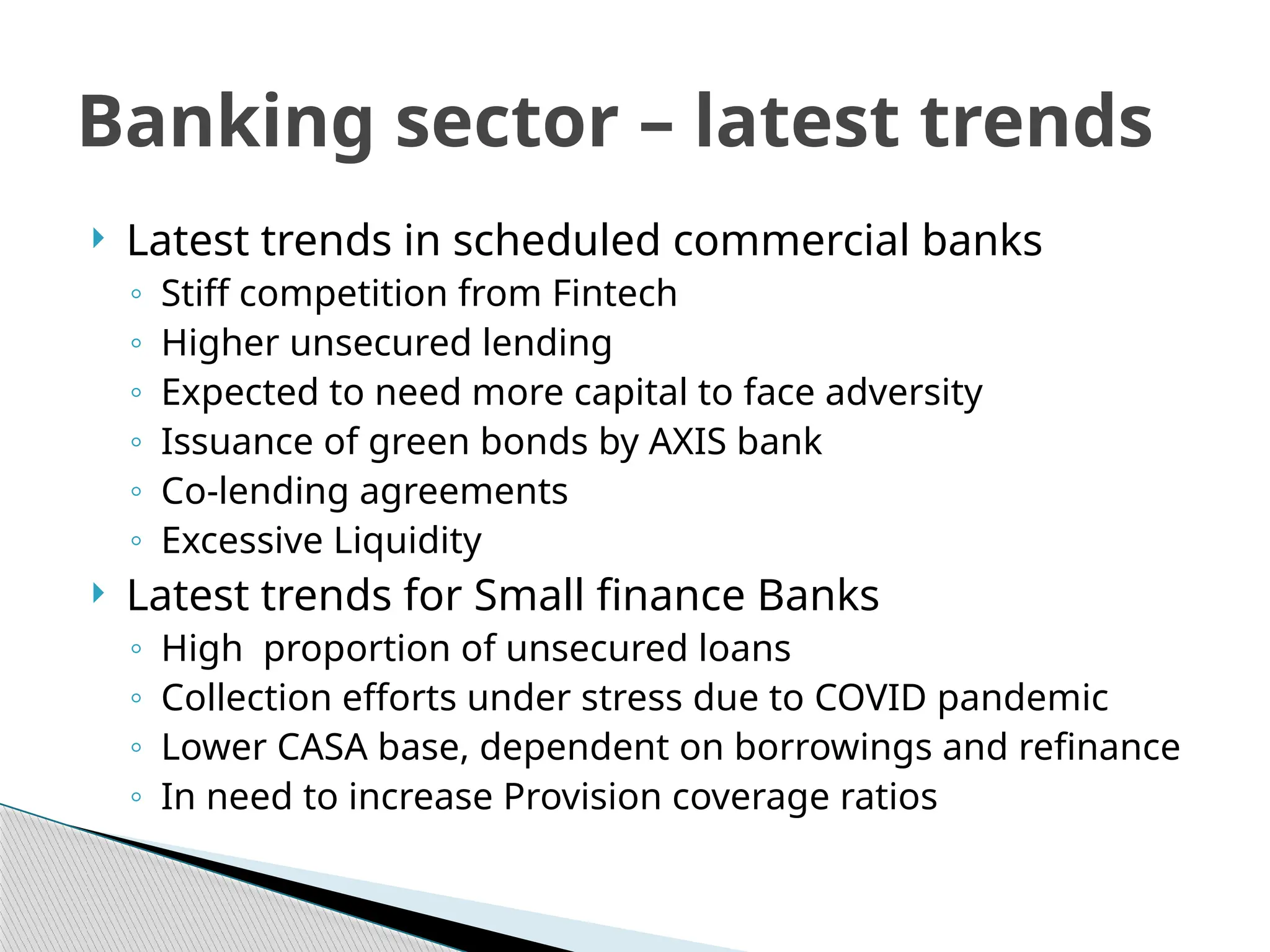
 Latest trends in scheduled commercial banks
◦ Stiff competition from Fintech
◦ Higher unsecured lending
◦ Expected to need more capital to face adversity
◦ Issuance of green bonds by AXIS bank
◦ Co-lending agreements
◦ Excessive Liquidity
 Latest trends for Small finance Banks
◦ High proportion of unsecured loans
◦ Collection efforts under stress due to COVID pandemic
◦ Lower CASA base, dependent on borrowings and refinance
◦ In need to increase Provision coverage ratios
Banking sector – latest trends
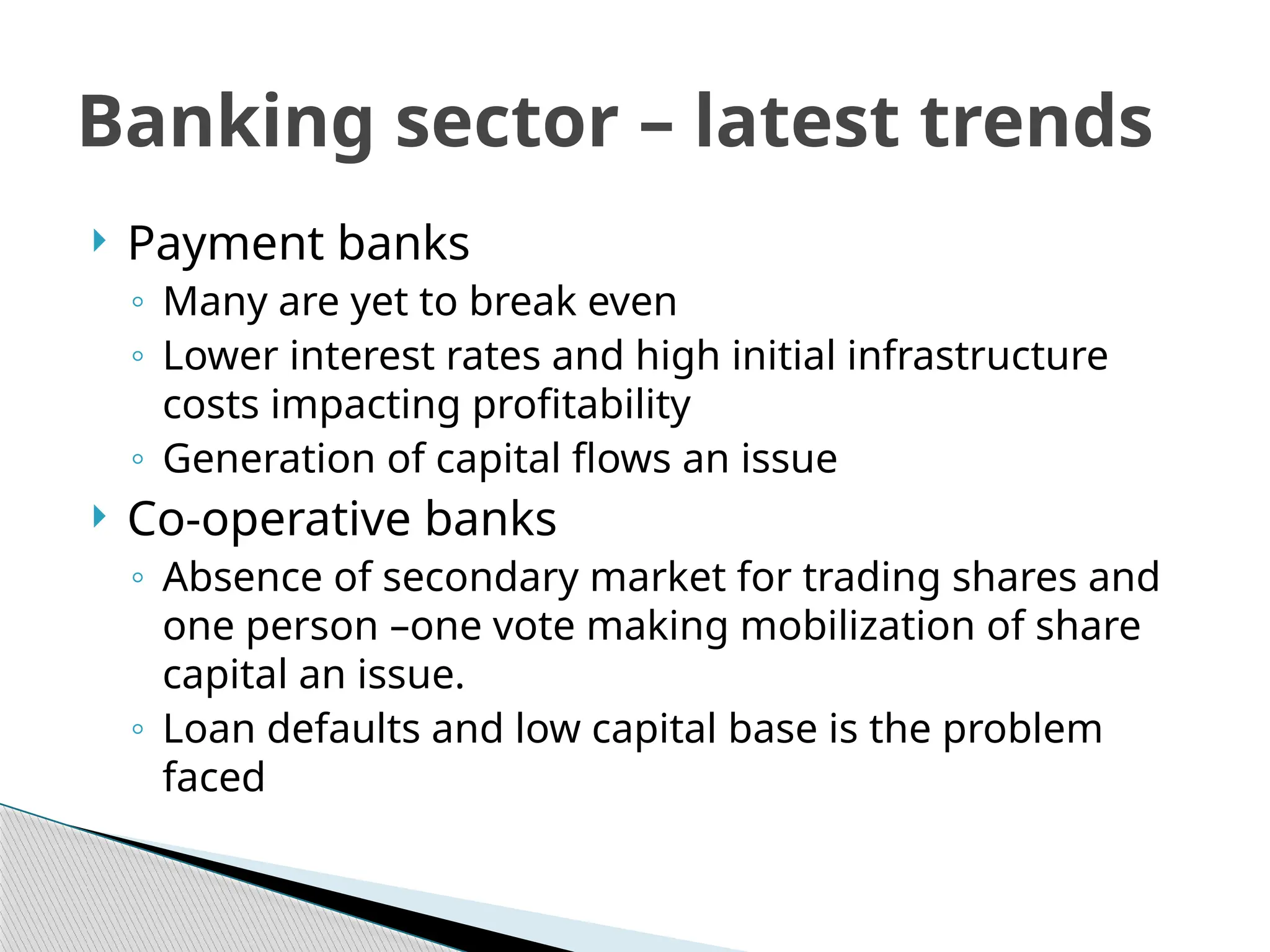
 Payment banks
◦ Many are yet to break even
◦ Lower interest rates and high initial infrastructure
costs impacting profitability
◦ Generation of capital flows an issue
 Co-operative banks
◦ Absence of secondary market for trading shares and
one person –one vote making mobilization of share
capital an issue.
◦ Loan defaults and low capital base is the problem
faced
Banking sector – latest trends
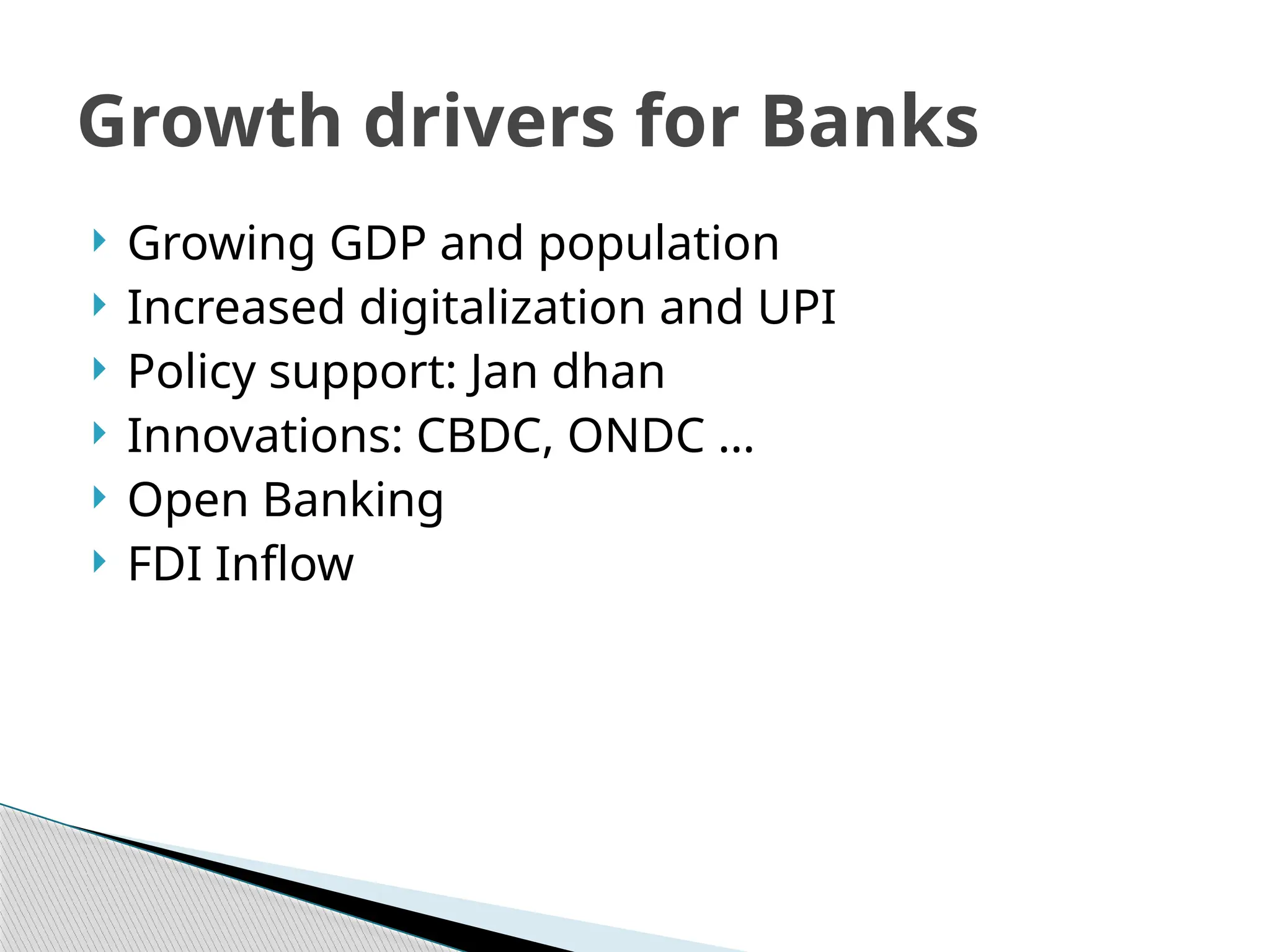
 Growing GDP and population
 Increased digitalization and UPI
 Policy support: Jan dhan
 Innovations: CBDC, ONDC …
 Open Banking
 FDI Inflow
Growth drivers for Banks
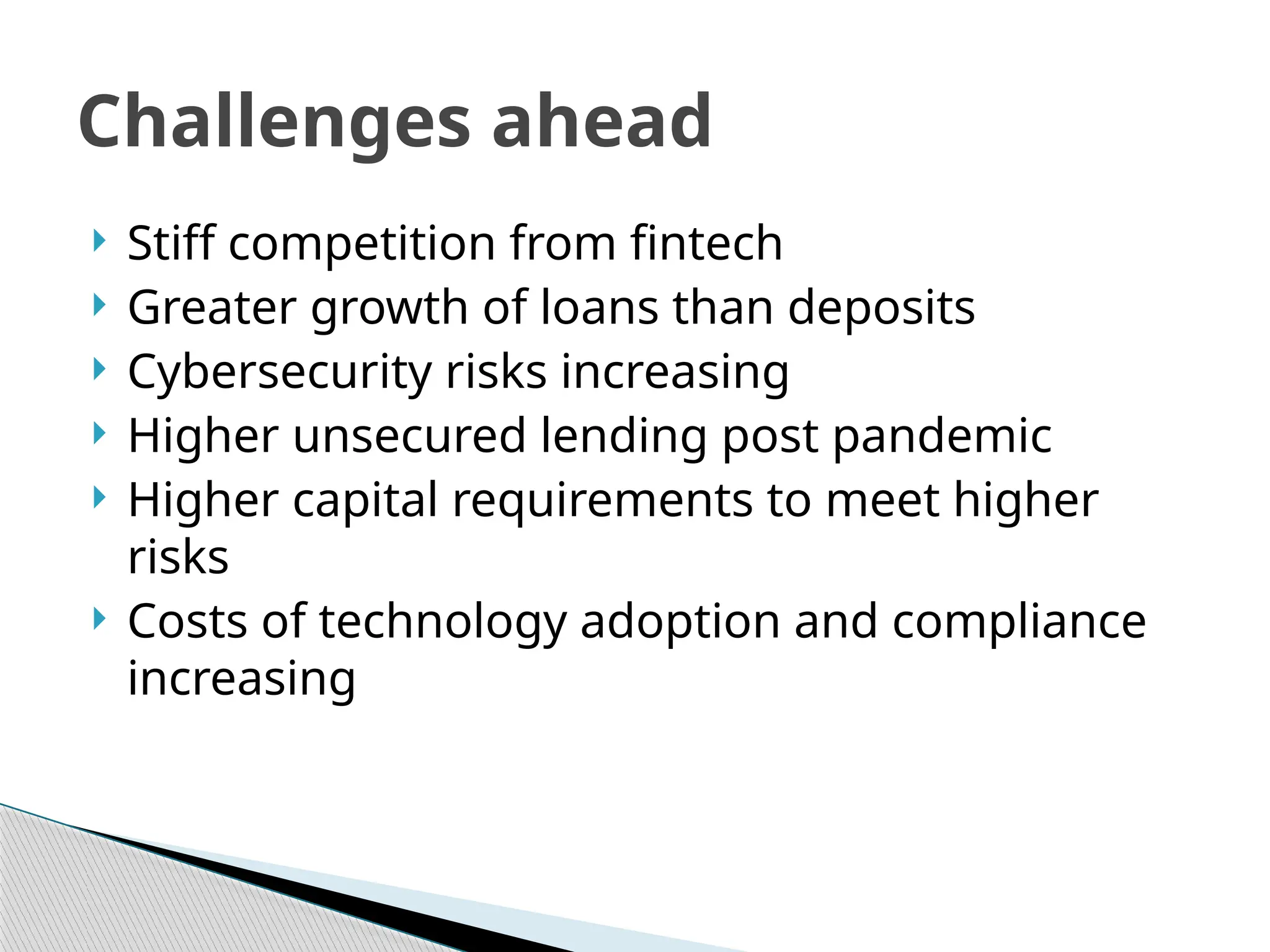
 Stiff competition from fintech
 Greater growth of loans than deposits
 Cybersecurity risks increasing
 Higher unsecured lending post pandemic
 Higher capital requirements to meet higher
risks
 Costs of technology adoption and compliance
increasing
Challenges ahead
THANK YOU

Basics_of_BFSI_Session_1.pptx for mba students

  • 1.
  • 2.
     Financial Markets Role of Intermediaries in BFSI sector  History, growth, current position and challenges for Banking, Financial services and insurance sectors Sub Topics to be covered
  • 3.
  • 4.
     A financialsystem is the set of global, regional, or firm-specific institutions and practices used to facilitate the exchange of funds.  Financial markets refer to a centre that provides the facilities of sale or purchase of financial claims and services.  Individuals, financial institutions ,corporations and government trade in this market either directly or indirectly through brokers and dealers.  Activities in financial markets lead to direct effects on behaviour of individual, business and consumers Financial Markets
  • 5.
    Financial market Nature MaturityPeriod Level of organisation Primary Secondary Components of Financial markets Money Market Capital Market Financial market Nature of securities Maturity Period Level of organisation Primary Secondary Money Market Organised Unorganised
  • 6.
     Money market(where short term interest rates are determined)  Capital Markets ( major effect on people’s and firm’s decisions)  Foreign exchange market ( changes in the foreign exchange rates affect economic activity)  Derivatives Market (used for hedging and speculation objective cannot be ruled out) Key Financial Markets
  • 7.
     Organised &unorganised  Low per capita leading to inadequate participation  Regulatory bodies like RBI,SEBI,IRDA,MOF,NCLT  Paucity of financial instruments  Issues of corporate governance and scams Financial Markets in India
  • 8.
     Key transmitterof monetary policy rates for short term  Based on supply and demand for money for short term  Products are highly liquid and large value deals occur  High liquidity and less tenure (lower than 1 year) of the products  Usually, over the counter deals or previously negotiated deals are made  Participants are Banks, Financial Institutions ,Primary dealers(PDs)  Unstructured ,Informal as well as Formal Market  High safety and low returns  Enables financing and investing for short term Money Markets
  • 9.
    Products dealt inare: Overnight:  Call money, Triparty Repo, Market Repo, Repo in corporate Bond Term Segment:  Notice Money(till 14 days),Term Money, Triparty Repo, Market Repo, Repo in corporate Bond, Treasury Bills, Commercial papers, Certificate of deposits, Money Market Mutual Funds, Commercial Bills, https://www.rbi.org.in/scripts/AnnualReportPublications.aspx?Id= 10 https://www.moneycontrol.com/news/business/markets/explaine d-what-is-repo-and-tri-party-repo-3859991.html https://www.financialexpress.com/policy/economy-commercial- paper-rates-may-affect-growth-india-inc-3006548/ Money Market instruments
  • 10.
     Long tenureassets with higher risk involved  Enables capital formation & economic development  Can be categorised into stock Markets and Bond Markets OR primary market and secondary market Capital Markets
  • 11.
     Products areEquities, Mutual Funds, ETFs, Securities borrowing and lending schemes, Debts-Corporate debts and securitised assets  In bond market, long term trading of government securities, Bonds issued by PSU Undertakings/Corporates/Banks like floating rate bonds, Zero coupon Bonds, Corporate debentures, state government loans, securitised assets of banks, FIs , corporates and others Capital Markets
  • 12.
     Largest Financialmarket with players all over the world  Global network working 24 hours a day  Facilitates determination of foreign exchange rates between currency pairs  Participants include Banks, forex dealers, Central bankers, hedge funds, investors Foreign Exchange Markets
  • 13.
     Derivatives arefinancial securities and are financial contracts that obtain value from something else, known as underlying securities. Underlying securities may be stocks, currency, commodities or bonds, etc.  Formal derivative trading started in year 2001 after electronic trading mechanisms were introduced in India  Examples: Forwards, Futures, Options, Swaps  https://rmoneyindia.com/research-blog-traders/ indian-derivatives-market-investing/ Derivatives Market
  • 14.
     Direct Finance:Savers invest their funds directly without any intervention of the financial intermediary For example: issue of equity shares and /or corporate bonds by companies to public  Indirect Finance: Involves role of financial intermediaries to facilitate movement of funds from surplus units to deficit units For eg: Banks, Mutual Funds etc Types of Finance
  • 15.
  • 16.
     Mobilise savings Capital formation  Optimal utilisation of resources-Economic progress  Liquidity  Advisory  Risk reduction Financial Intermediaries-Role
  • 17.
     Fund basedfinancial services ◦ Provide finance ◦ Reduce risk ◦ Examples: Lease financing, Factoring , Hire purchase, venture capital, House financing, discounting ◦ Entities: Insurance companies, Banks, Housing finance institutions  Fee based financial services ◦ Specialised services ◦ Professional fees charged to clients ◦ Examples: Portfolio consultancy, Merchant banking, Capital restructuring ◦ Entities: Merchant bankers, Portfolio consultants, Issue managers Types of Financial services
  • 18.
    India’s GDP 3550Billion $ in 2023 (World Bank ) India’s bank credit in July 2024, 2020 Billion US $ (RBI speech) India’s population: 143 crores in 2023 (Statista, 2024) No of mobile phone users in India: 105.5 crores in 2024 (Statista, 2024) No of Aadhar card holders in India: 139 crores in 2024 (Forbes, 2024), 130 crores in 2023 (GOI, Loksabha discussion, 2023) Data points for India
  • 19.
     No of Jandhan Yojanaa accounts 53 crores in 2024 ; of which 35 crores is from non urban locations (Economic Times, August 28, 2024)  This is in Guiness Bok of world records- most bank accounts (1.8 crore) opened in 1 week (August 23 to 29, 2014)  UPI – 16.6 billion transactions in one month (86% instant reversals of incorrect transactions); 46% of global real time financial transactions is UPI (RBI governor speech, Nov 2024)  Innovations - Account Aggregators, OCEN, and financial services on ONDC  Trade Receivables Discounting System (TReDS)- MSME funding at reduced costs (RBI governor speech, Nov 2024)- 52.2 trillion ₹  As of October 2024, around 5,000 active FinTechs (RBI governor speech, Nov 2024)  Internet Penetration in India – 40% of rural households and 78% of people in the age group 20-230 use internet in India.  1/3 rd Households - online purchases of consumables and services  ¼ th of households – online buying of consumer durables  1/10th of households – online food purchases  Results…
  • 20.
    75% of IndianBanks offer online account opening , digital KYC and digitally enabled doorstep banking 60% of Indian Banks offer digital lending 50% of Indian Banks offer payment aggregator services 41% of Indian Banks use chatbots 24% of Indian banks use Open banking 10% of Indian banks have integrated Internet of things Results…
  • 21.
     Digitalisation gains forIndian banks: monthly savings of 14,500 person-days 25-30 per cent decline in customer acquisition costs reduction of the use of 84 tons of paper saving of four lakh litres of fuel in commutes to banks by customers 40 per cent reduction in customer wait times at branches 50 per cent reduction in the compliance monitoring time and shortening account opening time to less than a day Aadhaar – India’s unique identification number – has halved the cost of conducting the Know Your Customer process Digitisation benefits for banks
  • 22.
     Insurance  MutualFunds  NBFCs  Banks Four key sectors in BFSI
  • 23.
  • 24.
     Purpose: poolingof risks  sharing of losses  transferring risk  Basic Principle: insurable interest, indemnity, subrogation, contribution, disclosure, utmost faith, relevance of proximate cause  Two main streams: Life & Non Life/General What is Insurance?
  • 25.
     The firstquarter of FY24 saw nonlife players' premium income increase by 17.9% year-over-year to Rs. 64,262.8 crore (US$ 7.72 billion) due to strong demand for health and motor policies.  The government’s flagship initiative for crop insurance, Pradhan Mantri Fasal Bima Yojana (PMFBY), has led to significant growth in the premium income for crop insurance  As per the Insurance Regulatory and Development Authority of India (IRDAI), India will be the sixth-largest insurance market within a decade, leapfrogging Germany, Canada, Italy and South Korea.  India allowed private companies in insurance sector in 2000, setting a limit on FDI to 26%, which was increased to 49% in 2014 and further increased to 74% in the Union Budget (Feb 2021).  The market share of private sector companies in the non-life insurance market rose from 15% in 2004 to 62% in FY23.  Private insurers like HDFC, ICICI and SBI have been some tough competitors for providing life as well as non-life products to the insurance sector in India. Key facts
  • 26.
     The lifeinsurance industry is expected to increase at a CAGR of 5.3% between 2019 and 2023. India’s insurance penetration was pegged at 4.2% in FY21, with life insurance penetration at 3.2% and non-life insurance penetration at 1.0%. In terms of insurance density, India’s overall density stood at US$ 78 in FY21. Life Insurance trends
  • 27.
     India isthe 4th largest general insurance market in Asia and the 14th largest globally.  In FY23, non-life insurers (comprising general insurers, standalone health insurers and specialized insurers) recorded a 16.4% growth in gross direct premiums. In India, gross premiums written off by non-life insurers reached US$ 31 billion in FY23 and US$ 10.95 billion in first quarter of FY24*, from US$ 28.14 billion in FY22, driven by strong growth from general insurance companies.  Going forward, general insurance companies will be key beneficiaries of the opening-up of economies, especially with improved trade activity increasing demand for motor and health insurance. Strong growth in the automotive industry over the next decade is expected to boost the motor insurance market Non life insurance trends
  • 28.
  • 29.
    Life Insurers • 24Players • Largest :LIC General • 34 Players • 25 general • 7 standalone health • 2 specialized insurers Number of Insurers in India
  • 30.
     Term Insurance Endowment Policy  Whole Life Insurance  Children's Policies  Annuity Plans  Many others Types of Life Insurance Products
  • 31.
    Life Insurance businessdatapoints IBEF August 2024
  • 32.
    Non Life Insurancepemiums IBEF August 2024
  • 33.
    Insurance penetration anddensity in India IBEF August 2024
  • 34.
    Growing share ofprivate players in insurance IBEF August 2024
  • 35.
    Health, Motor &crop insurance set to grow IBEF August 2023
  • 36.
     The governmenthas approved 100% FDI for insurance intermediaries and increased FDI limit in the insurance sector to 74% from 49% under the Union Budget 2021-22.  The relaxation of foreign investment rules has received a positive response from the insurance sector, with many companies announcing plans to increase their stakes in joint ventures with Indian companies.  Over the coming quarters, there could be a series of joint venture deals between global insurance giants and local players.  Increasing investments including FDI in Insure-tech, Robust demand ,Policy support, Attractive opportunities Promising future lies ahead
  • 37.
    Insurance market –attractive?  Growing middle class  Young insurable population  Growing awareness of the need for insurance  Retirement planning a big opportunity  Growth in premia expected at 12-15% over next 3-5 years
  • 38.
     Bhima Vahak:Bima Vahaks (women centric)have to be deployed in each gram panchayat  Bhima Vistaar :The first of its kind all-in-one affordable insurance product, Bima Vistaar — offering life, health and property cover — is likely to be rolled out soon.  Bhima Sugam :simplifying buying insurance on a single platform New initiatives for Insurance: Insurance trinity set to have soft launch soon- IRDAI Chairman https://www.newindianexpress.com/business/2024/Oct/22/first-phase- of-bima-insurance-trinity-will-be-ready-for-soft-launch-soon-irdai-chief
  • 39.
    Recent Trends  Newdistribution channels – bancassurance, online distribution have increased reach and reduced costs  Growing Market share of Private players  Differentiated Banks – non-exclusive tie-ups for distribution  Launch of apps:HDFC ERGO General Insurance, Policybazaar's PBPartners, Canara HSBC Life Insurance App  Traditional products are being customised to meet specific needs: Micro Insurance
  • 40.
    Growth drivers andOpportunities  New distribution channels  B30 cities and other non-metros are a large potential market  Growth in Financial industry  Innovation and efficiency  Increasing competition  Foreign players bringing expertise and capital  IPOs  Use of Technology for customization and distribution
  • 41.
  • 42.
     Mutual fundis a mechanism for pooling the resources by issuing units to the investors and investing funds in securities in accordance with objectives as disclosed in offer document.  Investments in securities are spread across a wide cross-section of industries and sectors and thus the risk is reduced.  Regulated by SEBI What are Mutual Funds?
  • 43.
     Provides expertadvice for management of financial assets  Risk diversification  Economies of scale  Transparency and accountability led by regulatory oversight  Flexibility based on investor preference and risk appetite  https://www.youtube.com/watch?v=annVByCpYCw Key features and significance
  • 44.
    Open ended Close ended Maturity Growth/Equity Income/Debt Balanced/Hybrid Taxsaving Capital protection Investment objective Types of Mutual Funds -1
  • 45.
    Sector Index Fund of funds Real Estate Funds Specialized Gilt Exchange tradedfunds Load or No Load fund Others Types of Mutual Funds -2
  • 46.
    Increase in MFAUM Source: IBEF August 2024
  • 47.
    Key facts &Growth drivers Mutual Funds.  As of 31st October 2024, AUM managed by the mutual funds industry stood at Rs. 67.26 Trillion, which is around a two-fold increase in the span of five years.  The MF Industry’s AUM has grown from Rs. 26.33 trillion as on October 31, 2024 to Rs. 67.26 trillion as on October 31, 2024  Indian equity markets performing well along with fastest growing GDP  Large number of company listings and IPOs  Increasing number of UHNWI and HNWIs in India (Ultra High network Individuals) UHNWI expected to go from 12,069 in 2022 to 19,119 in 2027(58% growth)  People shifting from physical asset classes to Financial asset class  In 2023, India’s gross savings was 30% of its GDP  Note: HNWI: Investible assets more than Rs 5 crores  VHNWI: Investible assets between Rs 5 crores and Rs 25 crores  UHNWI: Investible assets more than Rs 25 crores Source: AMFI accessed on 18th Nov, 2024 & IBEF August 2024
  • 48.
    Increase in HNWI Source:IBEF August 2024
  • 49.
    Investors in Mutualfunds Source: IBEF August 2024
  • 50.
     The numberof Ultra High Net Worth Individuals (UHNWI) is estimated to increase from 12,069 in 2022 to 19,119 in 2027. India’s UHNWIs are likely to expand by 58.4% in the next five years.  In 2021, India’s gross savings was at 29.3% of GDP amounting to US$ 930.56 billion. In 2022, India’s gross savings stood at 29.84% of GDP.  India is expected to be the fourth largest private wealth market globally by 2028.  Low penetration  Rising middle class incomes  Reduction in interest rates may induce investors to invest in Mutual funds rather than in Fixed deposits  Trend is clearly seen in people investing in financial assets rather than physical assets  Millennials and Retirees : two ends of the spectrum – needing customized solutions  Leverage technology & greater dependence on financial advisors Opportunities and Challenges – Mutual Funds
  • 51.
    Growing confidence inIndian equity markets Source: IBEF August 2024
  • 52.
  • 53.
  • 54.
     a companyregistered under the Companies Act, 1956  engaged in the business of loans and advances, acquisition of shares/ stocks/ bonds/ debentures/ securities issued by Government or local authority  or other marketable securities of a like nature, leasing, hire-purchase, insurance business, chit business  financial assets constitute more than 50 per cent of the total assets  & income from financial assets constitute more than 50 per cent of the gross income What is a NBFC?
  • 55.
     NBFC cannotaccept demand deposits  NBFC not part of payment and settlement system  Cannot issue cheques drawn on self  Depositors not covered by DICGC insurance Difference between bank and NBFC
  • 56.
     Credit intermediation; niche financing;  alternative to banking credit, last mile servicing  Can be classified into:  A)asset liability structures  B) systemic importance  C) activities undertaken Importance of NBFCs
  • 57.
  • 58.
    Asset Liability structure •Deposit taking • Non Deposit taking Non Deposit taking-size • Systematically imp • Other Kind of activities • Asset Finance • Investment Company • Loan company • Infrastructure Finance • NBFC-MI • Infrastructure Debt Fund-NBFC • NBFC –Factors • Mortgage Guarantee Companies • NBFC-Non operative Financial Holding Co Types of NBFCs
  • 59.
     High dependenceon banks for finance  Withdrawal of investments by Mutual funds due to confidence issue post IL&FS causing Liquidity issues  Rating downgrades post IL & FS issue  High proportion of low rated or unrated advances  Low demand due to pandemic  Recent developments to reduce the regulatory arbitrage between Banks and NBFCs by RBI  Tough competition by Fintechs  https://economictimes.indiatimes.com/industry/banking/finance/rbi- comes-out-with-pca-framework-for-nbfcs/articleshow/88277487.cms Challenges -NBFCs
  • 60.
  • 61.
     A bankis a financial intermediary that receives deposits from the general public (including demand deposits ) and lends it  Forms part of payment and settlement system  Deposit insurance facility available to depositors upto Rs 5 lakhs per depositor  Other functions What is a Bank?
  • 62.
    Public Sector (12)Private Sector (21) Foreign (45) Small Finance (12) Payments (4) Others including Regional Rural (43) , Local Area (3) , Cooperative Types of Banks
  • 63.
     Types ofBanks : differentiated by nature of allowable activities, level of regulation.  21 Private sector banks,3 Local area banks,12 small finance banks,4 payments banks, 12 Public sector banks, 4 financial institutions,43 Regional rural banks,44 Foreign banks with branches in India  Co-operative banks : Multi state Cooperative banks under direct control of RBI. District central co-operative banks and state cooperative banks under dual regulators. Primary agricultural credit society(PACS) not under RBI purview.  List of scheduled banks (other than co-operative) available on https://www.rbi.org.in/scripts/banklinks.asp Banking Sector
  • 64.
     Public sectorbanks hold around 66% of the total assets of the banking sector  Private sector banks have better profitability than Public sector banks  Profitability under pressure sue to tough competition from fintech; especially in retail segment  Increase in bank branches and ATMs (of private sector banks)  Exposure of private sector banks to sensitive sectors like Real estate is lowering but still higher than that of Public sector banks Key Trends
  • 65.
     During andpost pandemic, deposits have grown at a higher pace than advances(PSBs gathering more deposits than PVBs); excessive profitability. Low economic activity and risk aversion causing low credit growth. This trend has now reversed.  Lending to Retail sector increasing while that to Industry and agriculture is showing a dip  GNPA ratio of industries is highest with large accounts going bad from FY 17-18.  Increasing Co-lending arrangements  Issuance of green bonds & Foreign currency bonds by Banks Key trends
  • 66.
     IBC proceedingsa dominant source of recovery from NPAs  Retail fraud – a concern  Need to increase investor awareness  Consolidation occurring in the sector in Public sector banks as well as Private sector banks Key trends
  • 67.
     Increase intechnology enabled solutions  Customer centric approaches  Mobile penetration with low cost internet – a boost to use of telecom for banking services- driving financial inclusion  Expected increase in NPAs given the rolling back of policy measures and the standstill in asset classification allowed to banks  Notable increase in digital payments like UPI,NEFT,IMPS Key trends
  • 68.
     Increasing collaborationand competition between banks and fintechs  Use of technology to reduce costs and provide transparency, flexibility and last mile financial services to hinterland driving fintechs  Digital lending, use of blockchain, application of AI and ML are the emerging areas of influence for fintechs  Regulatory sandbox mechanism (recently for use of mobile banking on feature phones ) will be a path breaking initiative.  Mobile banking, Mobile bill payments, Mobile commerce: to reduce costs and increase volume Banks and fintechs
  • 69.
    Increase in digitalpayments Source: IBEF August 2023
  • 70.
     Neo Banking:Digital Banks with no physical presence, reducing infrastructure and administrative costs and fostering innovation. In India, they are not allowed to function in solo, they rely on bank partners to provide services For eg: Razorpay X,Jupiter, Niyo, Open. Challenges include lack of trust, limited services, regulatory hurdles.  Open banking: banking practice that will allow third party financial providers access to financial data across the banking sector by use of application programming interfaces(APIs). Account aggregator service allowed in India is a step in this direction. Some new terms related to Banking
  • 71.
  • 72.
    Limit for Paymentbank increased to Rs 2 Lacs per account
  • 73.
     Latest trendsin scheduled commercial banks ◦ Stiff competition from Fintech ◦ Higher unsecured lending ◦ Expected to need more capital to face adversity ◦ Issuance of green bonds by AXIS bank ◦ Co-lending agreements ◦ Excessive Liquidity  Latest trends for Small finance Banks ◦ High proportion of unsecured loans ◦ Collection efforts under stress due to COVID pandemic ◦ Lower CASA base, dependent on borrowings and refinance ◦ In need to increase Provision coverage ratios Banking sector – latest trends
  • 74.
     Payment banks ◦Many are yet to break even ◦ Lower interest rates and high initial infrastructure costs impacting profitability ◦ Generation of capital flows an issue  Co-operative banks ◦ Absence of secondary market for trading shares and one person –one vote making mobilization of share capital an issue. ◦ Loan defaults and low capital base is the problem faced Banking sector – latest trends
  • 75.
     Growing GDPand population  Increased digitalization and UPI  Policy support: Jan dhan  Innovations: CBDC, ONDC …  Open Banking  FDI Inflow Growth drivers for Banks
  • 76.
     Stiff competitionfrom fintech  Greater growth of loans than deposits  Cybersecurity risks increasing  Higher unsecured lending post pandemic  Higher capital requirements to meet higher risks  Costs of technology adoption and compliance increasing Challenges ahead
  • 77.