1
Apple Inc.
NASDAQ: AAPL
Porter’s Five Forces
• Porter’s 5 Forces is one of the most recognized frameworks,
used to assess the competitiveness and attractiveness of a
particular company and its industry.
• Named after Harvard professor, Michael E. Porter, this
framework identifies five forces that can help investors identify
opportunities and threats within an industry.
• The 5 forces are: threat of new entry, supplier power, buyer
power, threat of substitution and competitive rivalry.
• While Porter’s is good at examining a company’s strengths and
weaknesses, it’s only meant as a starting point and may not be
predictive of the long-term.
2
What is Porter’s Five Forces?
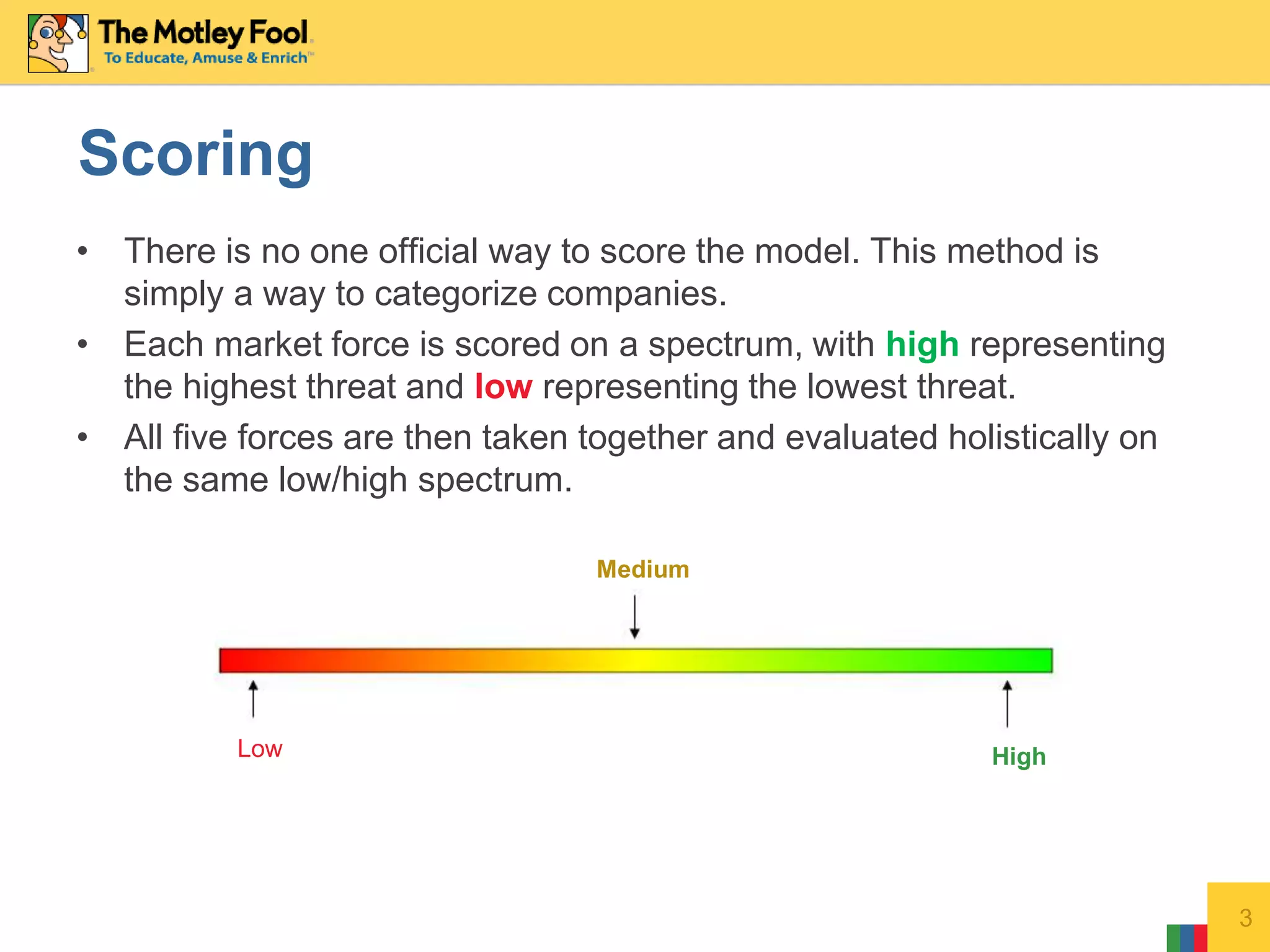
• There is no one official way to score the model. This method is
simply a way to categorize companies.
• Each market force is scored on a spectrum, with high representing
the highest threat and low representing the lowest threat.
• All five forces are then taken together and evaluated holistically on
the same low/high spectrum.
3
Scoring
Low High
Medium
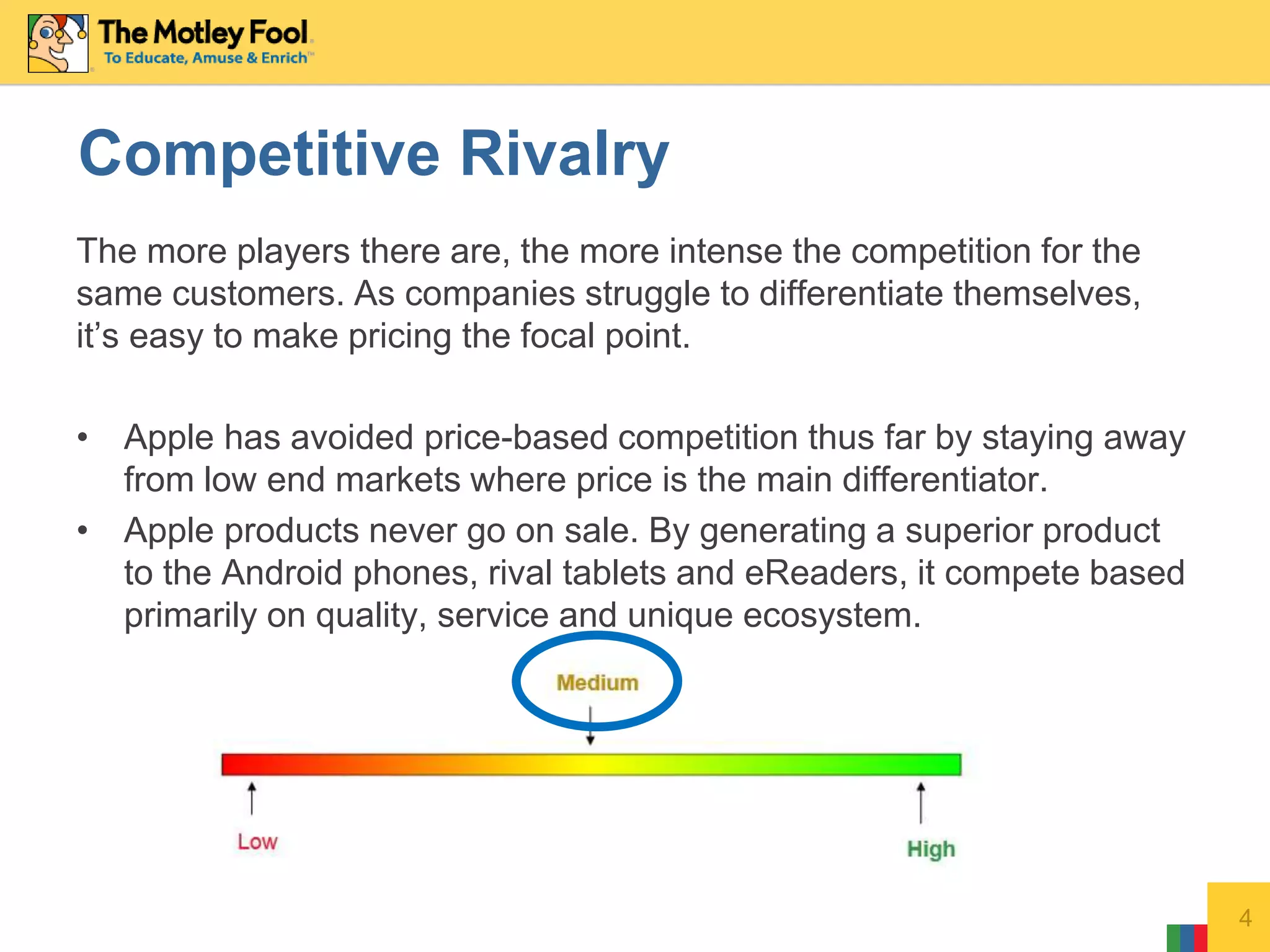
The more players there are, the more intense the competition for the
same customers. As companies struggle to differentiate themselves,
it’s easy to make pricing the focal point.
• Apple has avoided price-based competition thus far by staying away
from low end markets where price is the main differentiator.
• Apple products never go on sale. By generating a superior product
to the Android phones, rival tablets and eReaders, it compete based
primarily on quality, service and unique ecosystem.
4
Competitive Rivalry
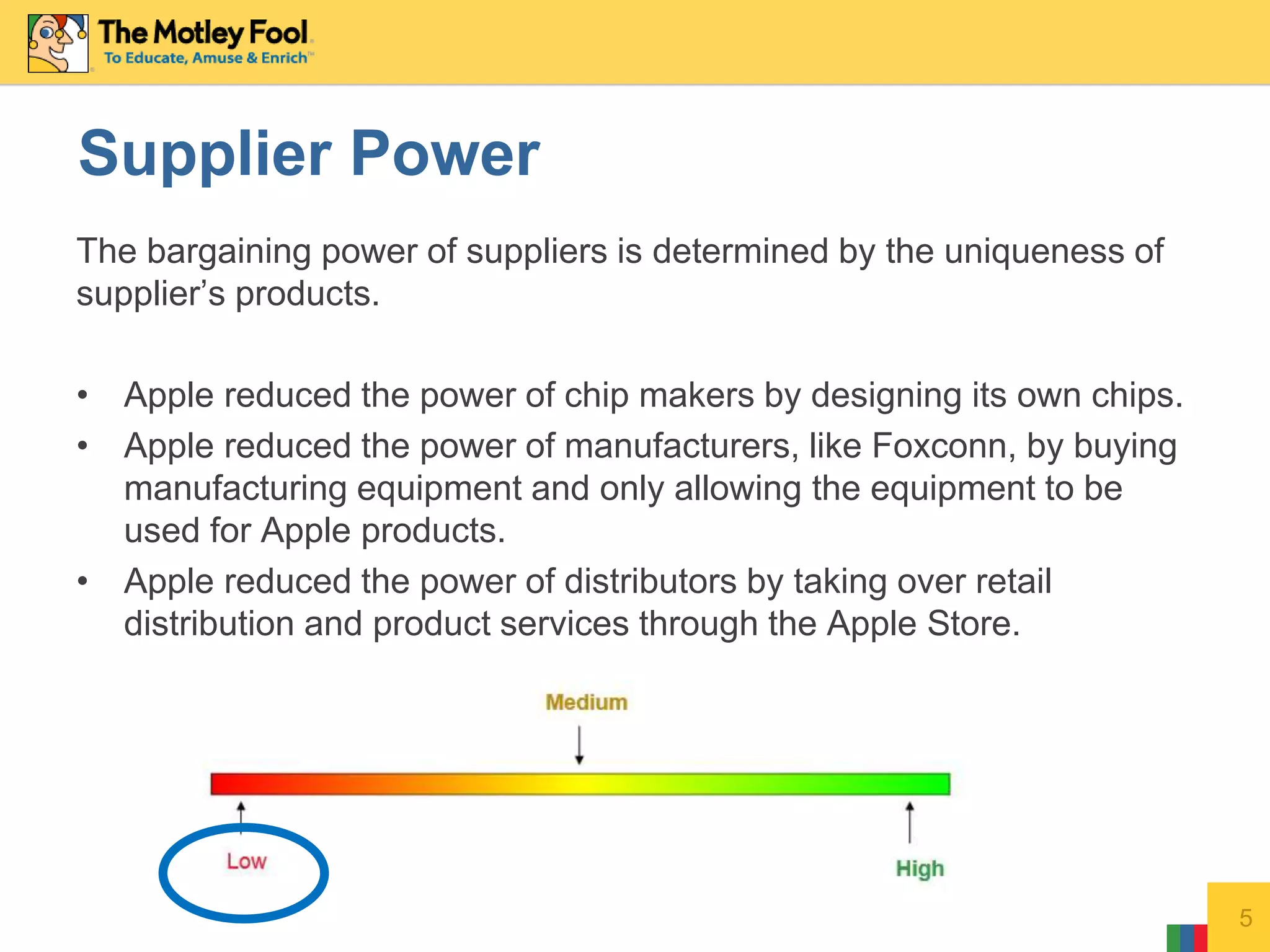
The bargaining power of suppliers is determined by the uniqueness of
supplier’s products.
• Apple reduced the power of chip makers by designing its own chips.
• Apple reduced the power of manufacturers, like Foxconn, by buying
manufacturing equipment and only allowing the equipment to be
used for Apple products.
• Apple reduced the power of distributors by taking over retail
distribution and product services through the Apple Store.
5
Supplier Power
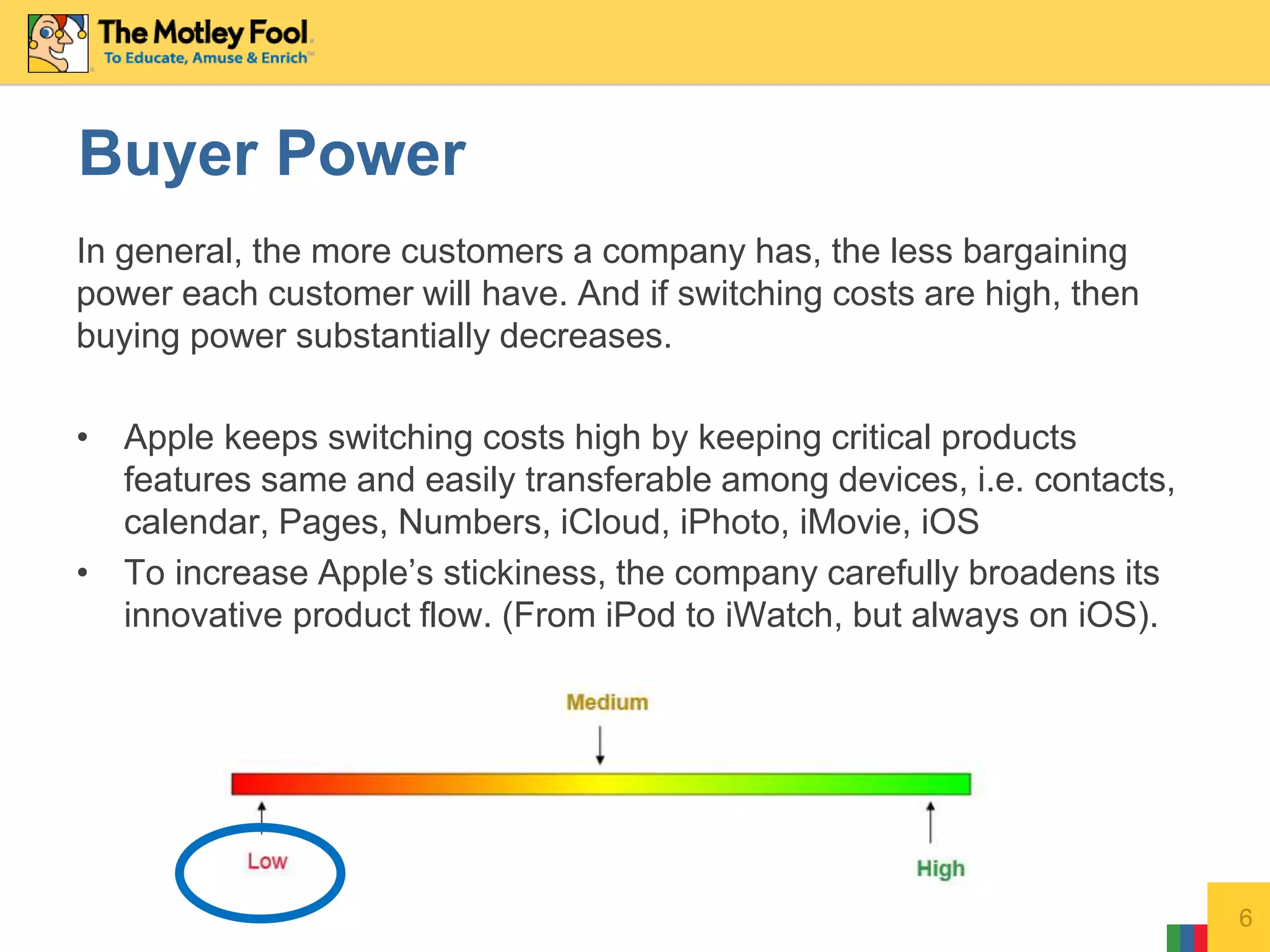
In general, the more customers a company has, the less bargaining
power each customer will have. And if switching costs are high, then
buying power substantially decreases.
• Apple keeps switching costs high by keeping critical products
features same and easily transferable among devices, i.e. contacts,
calendar, Pages, Numbers, iCloud, iPhoto, iMovie, iOS
• To increase Apple’s stickiness, the company carefully broadens its
innovative product flow. (From iPod to iWatch, but always on iOS).
6
Buyer Power
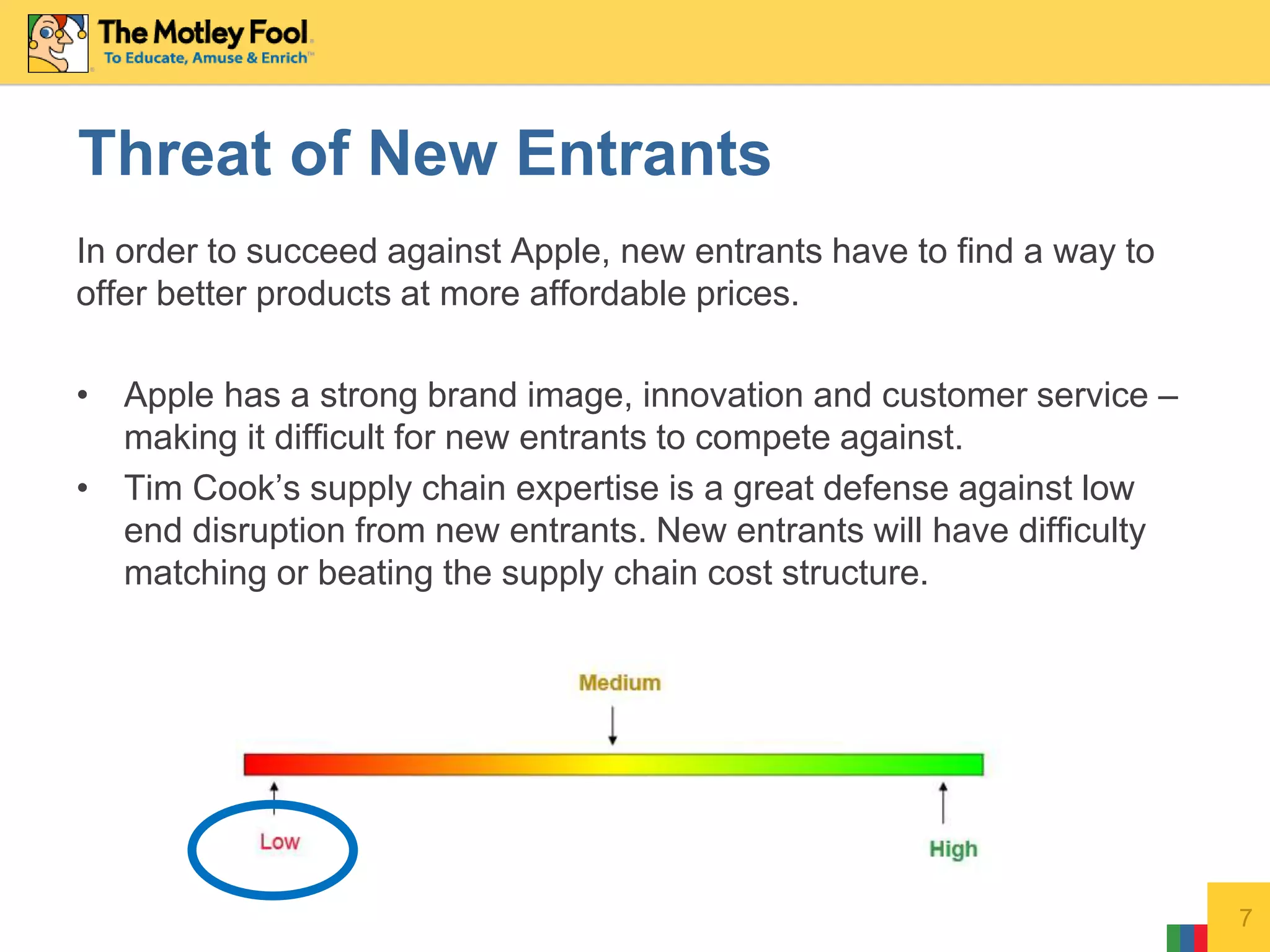
In order to succeed against Apple, new entrants have to find a way to
offer better products at more affordable prices.
• Apple has a strong brand image, innovation and customer service –
making it difficult for new entrants to compete against.
• Tim Cook’s supply chain expertise is a great defense against low
end disruption from new entrants. New entrants will have difficulty
matching or beating the supply chain cost structure.
7
Threat of New Entrants
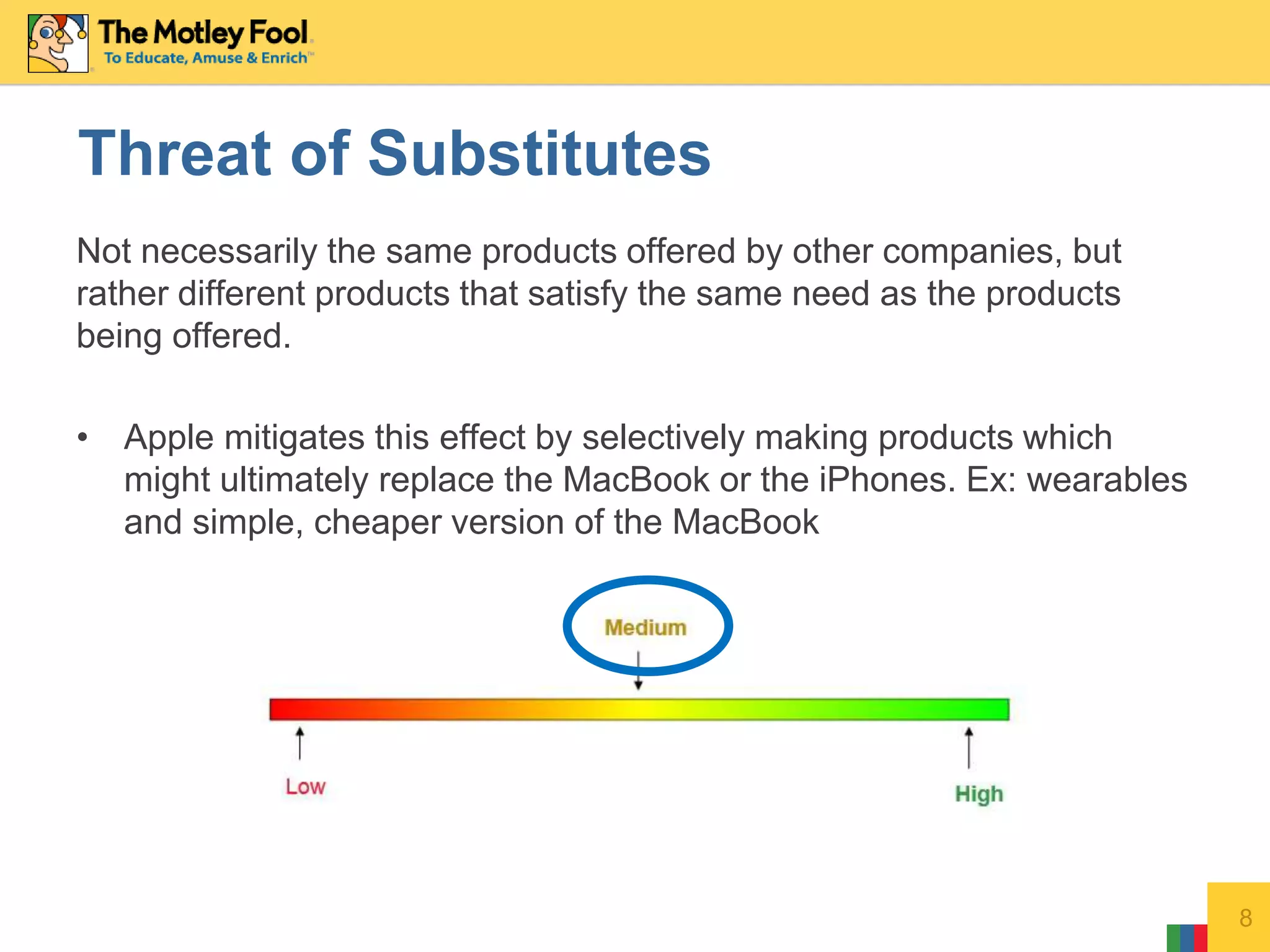
Not necessarily the same products offered by other companies, but
rather different products that satisfy the same need as the products
being offered.
• Apple mitigates this effect by selectively making products which
might ultimately replace the MacBook or the iPhones. Ex: wearables
and simple, cheaper version of the MacBook
8
Threat of Substitutes
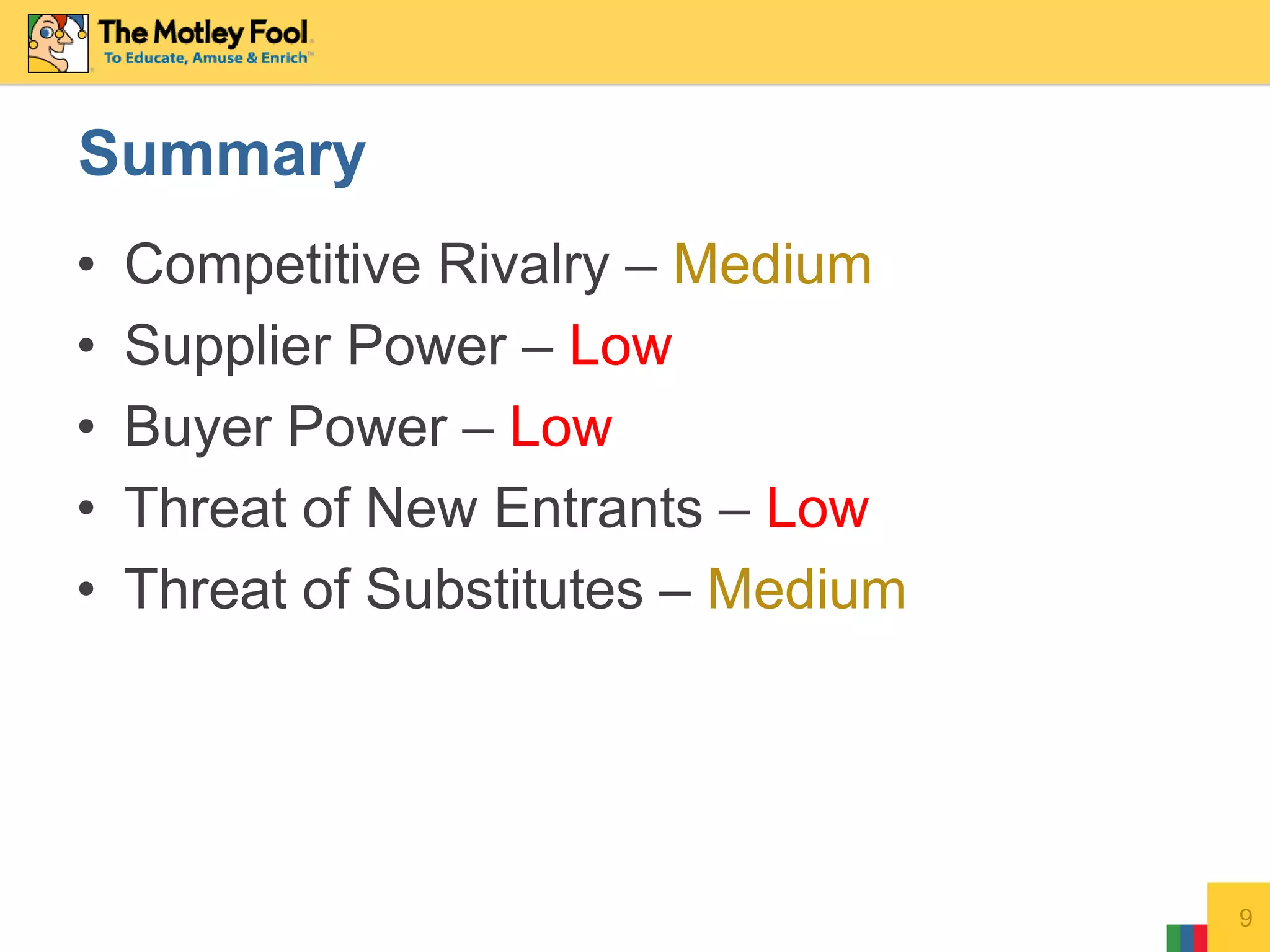
• Competitive Rivalry – Medium
• Supplier Power – Low
• Buyer Power – Low
• Threat of New Entrants – Low
• Threat of Substitutes – Medium
9
Summary

Using Porter's 5 Forces on Apple

  • 1.
  • 2.
    • Porter’s 5Forces is one of the most recognized frameworks, used to assess the competitiveness and attractiveness of a particular company and its industry. • Named after Harvard professor, Michael E. Porter, this framework identifies five forces that can help investors identify opportunities and threats within an industry. • The 5 forces are: threat of new entry, supplier power, buyer power, threat of substitution and competitive rivalry. • While Porter’s is good at examining a company’s strengths and weaknesses, it’s only meant as a starting point and may not be predictive of the long-term. 2 What is Porter’s Five Forces?
  • 3.
    • There isno one official way to score the model. This method is simply a way to categorize companies. • Each market force is scored on a spectrum, with high representing the highest threat and low representing the lowest threat. • All five forces are then taken together and evaluated holistically on the same low/high spectrum. 3 Scoring Low High Medium
  • 4.
    The more playersthere are, the more intense the competition for the same customers. As companies struggle to differentiate themselves, it’s easy to make pricing the focal point. • Apple has avoided price-based competition thus far by staying away from low end markets where price is the main differentiator. • Apple products never go on sale. By generating a superior product to the Android phones, rival tablets and eReaders, it compete based primarily on quality, service and unique ecosystem. 4 Competitive Rivalry
  • 5.
    The bargaining powerof suppliers is determined by the uniqueness of supplier’s products. • Apple reduced the power of chip makers by designing its own chips. • Apple reduced the power of manufacturers, like Foxconn, by buying manufacturing equipment and only allowing the equipment to be used for Apple products. • Apple reduced the power of distributors by taking over retail distribution and product services through the Apple Store. 5 Supplier Power
  • 6.
    In general, themore customers a company has, the less bargaining power each customer will have. And if switching costs are high, then buying power substantially decreases. • Apple keeps switching costs high by keeping critical products features same and easily transferable among devices, i.e. contacts, calendar, Pages, Numbers, iCloud, iPhoto, iMovie, iOS • To increase Apple’s stickiness, the company carefully broadens its innovative product flow. (From iPod to iWatch, but always on iOS). 6 Buyer Power
  • 7.
    In order tosucceed against Apple, new entrants have to find a way to offer better products at more affordable prices. • Apple has a strong brand image, innovation and customer service – making it difficult for new entrants to compete against. • Tim Cook’s supply chain expertise is a great defense against low end disruption from new entrants. New entrants will have difficulty matching or beating the supply chain cost structure. 7 Threat of New Entrants
  • 8.
    Not necessarily thesame products offered by other companies, but rather different products that satisfy the same need as the products being offered. • Apple mitigates this effect by selectively making products which might ultimately replace the MacBook or the iPhones. Ex: wearables and simple, cheaper version of the MacBook 8 Threat of Substitutes
  • 9.
    • Competitive Rivalry– Medium • Supplier Power – Low • Buyer Power – Low • Threat of New Entrants – Low • Threat of Substitutes – Medium 9 Summary