The
Origin of .Religion:
Evolution · or Revelation
BASED ON THE SMYTH LECTURES
DELIVERED AT COLUMBIA THEOLOGICAL SEMINARY
DECATUR, GEORGIA, 1935
Third and Revised Edition.
BY SAMUEL MARINUS ZWEMER, D.D., Litt. D.,
PROFESSOR EMERITUS OF THE HISTORY OF
RELIGION AND CHRISTIAN MISSIONS
AT PRINCETON THEOLOGic;;AL
SEMINARY
NEW YORK
LOIZEAUX BROTHERS
1 9 4 5
THE ORIGIN OF RELIGION
COPYRlGHT, MCMXXXV
BY SAMUEL M. ZWEMER
All rights in th_is· book are reserved. No part of the
t�tomay �tr_reptoduCW in anydQi:m without written per­
mission- of ·the publiShers, exCept brief quotations used
in connection with reviews in a magazine or newspaper
Printed in the U.S.A.
L. B. PRINTING CO., INC.
19 West 21st Street
New York 10, N. Y.
DEDICATED BY PERMISSION
TO
P. WILHELM SCHMIDT, S.V.D.
PROFESSOR AT THE UNIVERSITY OP VIENNA
DISTINGUISHED SCHOLAR AND ANTHROPOLOOIST
FOUNDER AND EDITOR OF "ANTHROPOS"
AUTHOR OF MANY BOOKS ON
THE ORIGIN AND GROWTH OF RELIGION
AND WHOSE GREAT WORK ON "THE ORIGIN OF THE IDEA OF Goo"
WILL EVER REMAIN A MONUMENT 07
ERUDITION AND SUGGESTIVE THOUGHT
CONTENTS
INTRODUCTION
The literature on this subject is abundant, but much of it is
anti-theistic, The vastness of the stellar universe and its
age do not reduce the importance of man as observer.
Argument of the book in outline. Based not primarily on
Scripture but on anthropology by the historical method.
The history of religion from this viewpoint.
11
I. THE HISTORY OF ORIGINS IN RELIGION • 19
The problem of the origin of man closely related. His
antiquity. The unity of the race. Religion as old as human-
ity. Theistic and anti-theistic theories in conflict. History
of religion defined. Its precursors and protagonists. Max
Miiller and later. Present status. The Bible as source­
book The great living religions and· Christianity. Its
finality.
II: THE ORIGIN OF RELIGION
Evolution or revelation. Earlier theories n:o longer ade­
quate. Andrew Lang's theory. Wilhelm Schmidt. His
method. The primitive Hifh-gods. Boegner. Du Bois.
Renouf. Marett. The rel�1on of the Stone Age. Le Roy.
Five elements in all primitive religion:· the family, the
High-god, conscience, belief in immortality, prayer, and
sacrifke.
.III. THE ORIGIN OF THE IDEA OF GOD .
Andrew Lang's Sky-gods. Schmidt's work on the subject
Further evidence from every area of primitive culture.
The character of the High-gods. Among American In­
dians. In Africa. China. The Isokos. Sumatra. Mono­
theism in ethnic religions. China. Japan. Egypt. As­
syria. Arabia. India. How eKJ)lain this, The subjective
,and objective factors in origin of idea of God. Francis L.
Patton and John Calvin quoted.
SI
7S
IV. THE ORIGIN OF THE WORLD AND OF MAN . • 101
Myths·regarding creation widespread and significant.· Four
possible theories. Evolution and Emanation not as common
7
8 CONTENTS
as Creation among primitives. Maori poem. Tahiti hymn.
Creation myths coUated by Schmidt. Among American
Indians. Andaman Islanders. The Pygmies. The Ainus.
Semangs. Samoyeds. . Cosmogony of ethnic religions.
Assyria and Babylonia. P�rsia. India. Similarity to
account in Genesis. The origin of man in these myths due
to special creation. Origin of evil in the world. Golden
Age is in the past. Walter Lippman quoted. The Bible
as key to the creation-myths of the race.
V. THE ORIGIN OF PRAYER AND SACRIFICE . . 125
Pra7er the oldest and most universal religious rite. .Its
motive and character. Among ancient Greeks and Romans.
Heiler on the prayer of primitives. Prayer was prior to
tnagic. Posture and its significance. Examples of prayer.
Delaware Indian. Khonds. In Africa. Algonquin In­
dians. Arapahos. Chinese Emperor. Origin of Sacrifice.
R 0. James' apinion. The idea of substitution. Classi­
fication of sacrifices. Examples. Is it due to totemism?
The Semites not,totemistic. The reference to its origin in
Genesis.
VI. THE ORIGIN OF FIRE-WORSHIP AND FIRE AS
A SYMBOL OF DEITY . . . . • • • . 151
Early association of fire with worship. Crawley's state­
ment. (1) Fire in the Bible narrative as symbol of.
Deity. In Jewish tradition. In primitive religion. Its
various forms. Origin of fire· in human culture. Legends
regarding its origin. Prometheus. Agni. The story as
told by the Indians. Maoris. Bantus. (2) Fire-gods in
Mexico. In Japan. Sun-worship. Zoroastrian worship
of fire. Agni and the hearth. China. The Yezdis. The
Vestal virgins. (3) Fire as method of communion by
flame, smoke, or incense. The hearth as sacred. Antiquity
of incense-trade. (4) Fire�baptism �d ordeal. The halo
as symbol of divine favor. Moses' face. The halo in art.
Our God is a consuming fire.
VII. THE ORIGIN OF MARRIAGE AND PRIMITIVE
ETHICS . ·. • . . • • . . . • • 179
The so-called cave-man's religion. Newberry and Lewis
Browne. Antiquity of family-life. Theory of promiscuity
and tribal marriage supported and also opposed by anthrer
pologists. Malinowsky and Westermarck on monogamy as
earliest form of marriage and in every area of primitive
culture. Incest a crime. Crowley on primitive marrif!ge.
Grosse. Seligmann. The origin of the moral _idea. The
dawn of conscience. Faith, hope, and charity in primitive
CONTENTS
religion. Loyalty and mother-love. Not emergent evo­
lution but innate. The moral law. Examples. The Su­
preme Being author of moral code. Homo sapiens.
9
VIII. THE ORIGIN OF BELIEF IN IMMORTALITY • 207
This belief one of strongest moral sanctions. Universal
and ancient. Love is stronger than death. Etruscan
tombs. The Jains. Sir James Frazer. This belief in
Israel. Among primitives. Burial rites. Mourning cus­
toms. Antiquity of this belief. Calling the dead. Origin
of this faith in immortality. Palimpsest of primitive reve­
latiotL Future life in a better world. Primitive eschatol-
ogy includes reward and punishment hereafter. The gospel
of the Resurrection. The otherworldly character of all
religions. Of C�ristianity. Alexander Whyte quoted.
L'ENVOI BY PROFESSOR SCHMIDT •
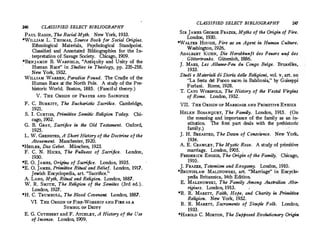
CLASSIFIED SELECT BIBLIOGRAPHY
INDEX
. 233
• 239
. 249
INTRODUCTION
THERE IS NO DEARTH OF LITERATURE ON THE ORIGIN
and growth of religion, as is evident from the vast bibli­
ography of the subject. Most of the popular works,
however, especially those of the nineteenth century,
are based on an evolutionary hypothesis regarding the
-origin of man, and in many cases they took for fact
another hypothesis which eliminated God from human
history. This book is written in the firm faith that God
is the creator of the universe and that he made.man in
his image.
The universe is undoubtedly very large and very old.
The whole sidereal system is a mere unit of measure-
. rnent in the curvature of space, although itis said to
contain between thirty thousand and a hundred thou­
sand million stars. Light could pass from one end to
the other only in 100,000 years! And this is only one
among a million or more of similar systems. Yet, ,as
far as science can interpret the facts, our little earth is
the only planet in the vast universe where we find
rational life.1
And even as science has made us aware
· of the almost incredible vastness of the universe in time
and- space, it has also made us realize its unity. "The
l Eddington, Nature of the Ph,ysical World, p. 170. Jeans, Th,
Mysterious Universe, p. 2.
11
12 INTRODUCTION
only God in whom a modern western man can believe
is one Gold Almighty, maker of heaven and earth" •
According to Douglass Jerrold, "modern man with his
crafts, arts, and social organziation appears suddenly
not much earlier than 20,000 B.c., and very possibly as
late as 15,000 B.C., and (what was never realized until
recently) within a few thousand years of the first ap­
pearance of a culture, man is found living in a highly
complex society." The problem for scientific inquiry
is not the length of precultural history, but the facts.
Archaeology in giving man a much longer pedigree
gave him also a newer pedigree rather than that for­
merly attributed to the cave-man. The new movement
in anthropology is based on the historical method adopt­
ed by the late Dr. Rivers at Cambridge, by Professor
Graebner and Peter Schmidt in Germany and Austria,
by Le Roy in France, and by R. H. Lowie and other
American anthropologists. It may yet be proved, as
one of.these writers states, that "there is, in fact, more
sound anthropology in the Old Testament than in all
the works of 'modern historians' put together." The
fact is that the supposed length of the precultural stage
of man's history does not affect the validity of his­
torical inquiry any more than the size of the universe
reduces the importance of man-the observer of it.
The homo sapiens of the scientist, in any case,
appears on the scene already possessed of a religious
instinct and exercising religious rites. He is conscious
of an unseen world and realizes that death does not end
1
Sydney Dark, Orthodoxy Sees It Through, p. 144.
INTRODUCTION 13
all. What was the origin and character of his religion?
The argument of the lectures that follow can be sum­
marized in a few sentences:
(I) The history of the history of religion reveals
two theories, the one theistic, the other anti-theistic,
and these are in conflict. It is important, therefore, for
all who believe in God and his revelation not to omit the
Bible as source-book in the study of origins.
(II) The origin of the idea of God is not by any
process of evolution, but by instinct or by an objective­
subjective revelation.
(III) The evidence for primitive monotheism is
found, not only in every area of primitive culture, but
also in the earlier forms of the great ethnic religions.
(IV) The widespread Creation-myths regarding the
origin of the world and of man, the so-called Golden
Age and the entrance of death, all point to a common
tradition regarding man's Creation and the Fall,
strangely parallel to the Scriptures.
(V) Prayer and sacrifice are religious rites of such
antiquity and universality that their signficance and
persistence point to a common origin, namely, in man's
desire to restore a lost communion and propitiate God.
(VI) The origin of fire is mysterious and it is every­
where associated with religion and sacrifice. In primi­
tive religion and in ethnic faiths it is a symbol of deity,
an object of worship, or a method of communion. The
universality of this symbolism and its antiquity point to
a common primitive tradition.
(VII) Taboos and totemism, together with the laws
14 INTRODUCTION
a,gainst incest, witness to the early sanctity of marriage
and its monogamous character over against the evolu­
tionary theory of early promiscuity. There are evi­
dences of faith, hope, and charity in primitive religion,
which can only be explained on the basis of a primitive
revelation.
(VIII) Finally, belief in the immortality of the soul
is universal among primitives and in nearly all of the
Ethnic religions; this other worldly character of man's
religious outlook is also proof of primitive revelation.
The argument as outlined above is based, however,
not primarily on the Scriptures nor on any dogmatic
preconceptions, but on the historical method of investi­
gation. For even as the science of archaeology has
proved in so many cases a vindication of the accuracy
and historicity of the Pentateuch, so the use of the his­
toric method in anthropology has compelled many to
restate their findings on the origin of religion, and the
result is more in accord with Scriptures. The evolu­
tionary view has been tied down to the supposed axiom
that the higher must always have come later than the
lower. The Evolutionist could never see monotheism
in the early history of religion; it must always be pre­
ceded by polytheism and that, in turn, by animism.
Andrew Lang sprang a breach in this rigid wall by
revealing the idea of High-gods among primitives.
Professor Wilhelm Schmidt in his Origin of the Idea
of God concludes: "A belief in a Supreme Being is to
be found among all the peoples of the primitive culture,
not indeed everywhere in the same form or the same
INTRODUCTION 15
vigor, but still everywhere prominent enough to make
his dominant position indubitable."
Dr. Langdon, Professor of Assyriology at Oxford,
makes an equally startling statement in his book,
Semitic Mythology:
"I may fail to carry conviction in concluding that, both
in Sumerian and Semitic religions, monotheism preceded
polythesism and belief in good and evil spirits. The evi­
dence and reasons for this conclusion, so contrary to
accepted and current views, have been set down with care
and with the perception of adverse criticism. It is, I trust,
the conclusion of knowledge and not of audacious precon­
ception." (p.xviii.)
And a little later he says:
"Although the South Arabians and Accadians are far
advanced beyond the primitive Bedouin stage in the periods
when the inscriptions begin, their history shows that it is
characteristic of the Semites to use animal names in times
of advanced culture, when there is no possible influence of
primitive totemism. I therefore reject the totemistic
theory absolutely. Early Canaanitish and Hebrew. reli- .
gions are far beyond primitive totemism (if it ever existed
among them ). in the period when any definite information
can be obtained about them. ....All Semitic tribes appear
to have started with a single tribal deity whom they re­
garded as the Divine Creator of his people." (p. 93. )
Now if this be the case both among primitives in
every part of the world and in some of the oldest cul­
tures, Sumerian, Semitic, and Accadian, we can only
conclude that the history of religion has been one of
16 INTRODUCTION
decline and degeneration, rather than of evolution and
unbroken ascent.
Dr. Schmidt sums up his conclusions in two para­
graphs which at the outset of our discussion may well
challenge attention, if they do not produce conviction.
His words are a striking parallel to Paul's statement in
the first chapter of his epistle to the Romans:
"i'i.s external civilization increased in ·splendour and
wealth, so religion came to be expressed in forms of ever­
increasing magnificance and opulence. Images of gods
and daimones multiplied to an extent which defies all
classification. Wealthy temples, shrines, and groves arose;
more priests and servants, more sacrifices and ceremonies
were instituted. But all this cannot blind us to the fact
that despite the glory and wealth of the outward forms,
the inner kernel of religion often disappeared and its es­
sential strength was weakened. The results of this, both
moral and social, were anything but desirable, leading to
extreme degradation and even to the deification of the
immoral and antisocial. The principal cause of this cor�
ruption was that the figure of the Supreme Being was
sinking further and further into the background, hidden
behind the impenetrable phalanx of the thousand new gods
and daimones. .. . .
"But all the while, the ancient primitive religion still
continued among the few remainders of the primitive cul­
ture, preserved by fragmentary peoples driven into the
most.distant regions. Yet in their condition of stagnation,
poverty, and insignificance, even there it must necessarily
have lost much of its power and greatness, so that even
among such peoples it is much too late to find a true image
of the faith of really primitive men. It remains for us, by
INTRODUCTION 17
dint of laborious research, to put gradually together from
many faded fragments a lifelike picture of this religion." •
We have attempted to collate the results of this
laborious research on the part of Dr. Schmidt and other
ethnologists, in the chapters that follow, six of which
were first given as lectures on the Smyth Foundation
at Columbia Theological Seminary, Decatur, Georgia,
in March, 1935. It was a privilege and an honor to
make some. small contribution to this series of lectures,
made possible through the generosity of the late Rev.
Thomas Smyth, D.D., pastor of the Second Presby­
terian Church of Charleston, South Carolina. For the
past twenty-three years distinguished scholars have
treated a large variety of themes, doctrinal, critical,
practic;,.1, and archaeological. This was, I believe, the
first course on the History of Religion and Its Origin.
The classified Bibliography at the end of the volume
and the footnotes indicate our sources and will afford
an index to the more recent literature for further study.
SAMUEL M. ZwEMER
Princeton, New Jer.sey
1 Schmidt, Origin and Growth of Religion, pp. 289, 290.
18 INTRODUCTION
NOTE ON THIRD AND R!!vISED EDITION
Owing to War conditions and Government Conserva­
tion Order No. M99, the plates of this book were melted
down in 1942. When the demand for it continued,
especially for study-classes in anthropology, this third
and revised edition was prepared with full consent of
the original publishers. We pray that its message may
reach a still wider circle of readers.
S. M. Z.
Nov. 1945.
C H A P T B R O N B
THE HISTORY OF ORIGINS
IN RELIGION
WHEN we recognize the enormous period of time during
which man is now asserted to have evolved on the earth,
and compare it with the fact that we have such scanty
knowledge of his thoughts as revealed by writing and
inferred from cult implements and edifices for any period
earlier than 3000 B.c., it is obvious that dogmatism on
the subject is wholly impossible. But it is difficult not to
feel that it is an impossible task to explain the evolution of
religion from magic in any form, and that we must accept
as ultimate the religious sentiment. We are, it is true, only
gradually emerging from the doctrines of a crude evolu­
tionism, but already it is less fashionable than it was to
assert that. consciousness is a late epiphenomenon on
matter, and we may anticipate that it will eventually be
generally accepted that it is unwise to claim that religion
is derived from magic and is the creation of minds which
had realized that magic could not produce the effects which
it was at first believed to be potent to accomplish."
A. BERRIEDALE KEITH, D.
C.
L., D.Litt.,
Professor of Sanskrit and Comparative
Philology at the University of Edinbwgh,
in FOREWORD TO THE ORIGIN AND .DEVELOP­
MENT OF RELIGION IN VEDIC LITERATURE,
by P. S. Deshmukh.
20
C H A P T E R O N E
THE HISTORY OF ORIGINS
IN RELIGION
IN DEALING WITH THE QUESTION OF THE GENESIS
and growth of religion we necessarily meet the problem
of the origin of man and of the world in which h� lives.
According to a recent writer in a popular magazine, it
all began "ten million years ago in the accidental ap­
proach of a wandering star which set up such a tidal
wave upon our sun as' to turn it into a cigar-shaped
object which broke up into separate pieces, and our
earth was formed out o f one of these pieces. " 1
But
although materialistic philosophy has taught that the
origin of the world was an accident, the best scientists
now repudiate such theory. "I had rather believe, "
said Lord Bacon, "all the fables in the Legend and the
Talmud and the Koran than that this universal frame
is without a mind.
" We too would rather believe the
firstverse of Genesis in its majesty and reticence before
the mystery of the Universe, "In the beginning God
created the heavens and the earth, " than accept the dis-
1
John Langdon-Davis in Pearson's Magazine, June, 1934, "Was
There a Creation ?"
21
22 HISTORY OF ORIGINS IN RELIGION
cordant findings of unbelieving mathematicians and
geologists. There can be no creation without a Creator
and no religion without a god.
Professor, Driesch, a leading embryologist of Great
Britain, writes a chapter on "The Breakdown of Ma­
terialism" in a recent work on design in nature_ and
says, "The machine theory of development or morpho­
genesis has been completely refuted and the mechanistic
theory does not hold in the field of embryology." In
the same volume Sir Oliver Lodge has an eloquent
passage;noble in its acknowledgment of the Creator :
"In dealing with the universe as a whole we have no
prehistoric qualms to contend with, no hesitation about
attributing Intelligence to the operations of a distant Mind
or Logos. 'In the beginning was the Word.' The mind
responsible is still active today, and we have no reason to
suppose that it has changed in the (east. The material
universe has evolved, and has rendered possible a fresh
influx of spiritual reality as it attained greater complexity,
but the Creator may be the same yesterday, today, and for
ever. His design and purpose in bringing the Universe
into existencemay not be apparent to us ; or we may form
some hazy conception of it. That is a relative and sub­
jective matter, not of much consequence except to our­
selves. But surely we may have faith that there is. a
Design _and Purpose running through it all, and that the
ultimate outcome of the present cosmos; and all its mani­
fold puzzles, will be something grander, more magnificent,
and more satisfying than anything we unaided can hope
to conceive.
"Survey the whole sweep of evolution; the wonder of
regulation amid the immensities of the universe beyond
.the reach of the most powerful telescope ; th� equal wonder
HISTORY OF ORIGINS IN RBUGION Z3
· of regulation amid the minutiae of atomic structure and
behaviour, far beyond the penetration of the microscope;
the emergence of life on the Earth, on the speck of the
universe of which we know most; the gradual develop­
ment of intelligence, of reason, of appreciation of beauty
and of power to create beauty, even the transcendent
beauty of personal character. A star is no greater than.a
violet; gravitation as a force cannot transcend love, for
love seems incomparably more effective, more forceful
than any physical force, lying as it does at the very root
of the universe. But it is all one, beginning in the dust
and reaching up into persons who .can appreciate and
create beauty, and feel love-a constantly changing whole,
alive, personal. And it doth not yet appear what there
shall be.'' •
No longer can Herbert Spencer's Unknowable First
Cause be regarded as a sufficient explanation· of the
work of Creation. "Every house," as Paul says, "is .
builded by ·someone, but he that built all things is
God. " So · we begin our investigations by a great
affirmation: "Thou Lord in the beginning hast laid the
foundations of the earth, and the heavens are the work
of thy hands." And we agree with Archbishop Trench
that in the study of religion
"The third chapter of Genesis is undoubtedly the _most
important chapter in the whole Bible. It is the only chap­
ter which, if we could concetve it as being withdrawn,
would leave all the rest of Scripture unintelligible. Take
away this chapter and you take away the key of knowledge
to all the rest of the Bible." •
• The Great Design, ed. Frances Mason. London, 1934.
1
sermon preached in WestminsterAbbey on Gen. 3 : 21.
24 HISTORY OF ORIGINS IN RELIGION
Modern anthropology deals with the antiquity of
man, the problems of race distribution, of langu�ge,
culture, and religion, and in each of these fields theistic
and antitheistic theories are in conflict. Yet on two
�eat conceptions modern scientists areagreed: namely,
on the unity of the race and on the essential religious
nature of man. Even so the New Testament Scripture
points out both of these facts: "Goel hath made of one
all the nations that dwell on earth and all men are seek­
ing after him if haply they may find him " (Acts 17:
26, 27).
The essential .unity and solidarity of the human
family is proved by anatomy and physiology-it is a
physical unity in which there is no essential difference.
Ethnology, sociology, and psychology agree that the
various races are intellectually and emotionally of the
same kind, while the spiritual unity of the race in their
· varieties of religious experience and in their response
to the Gospel is evident from the history of missions.
The fact of this essential unity has been forcibly
expressed in a paper. on "The Antiquity and Unity of
Man" by the late Dr. Warfield:
"The psychological unity of the race is still more mani­
fC!!t. All men of all varieties are psychologically one and
prove themselves possessors of the same mental nature
and furniture. Under the same influences they function
mentally and spiritually in the same fashion, and prove
capable of the same mental reactions. They, they all, and
they alone, in the whole realm of animal existences mani­
fest themselves as rational and moral natures ; so ·that
Mr. Fiske was fully justified when he declared that though
HISTORY OF ORIGINS IN RELIGION 25
for zoological man the erection of a distinct family from
the chimpanzee and orangmight suffice, 'on the other hand,
for psychological man you must erect a distinct kingdom;
nay, you must even dichotomize the universe, putting
Man on one side and all things else on the other.'
"So far is it from being of no concern to theology,
therefore, that it would be truer to say that the whole
doctrinal structure of the Bible account of redemption is
founded on its assumption that the race of man is one
organic whole, and may be dealt with as such. It is be­
cause all are one in Adam that in the matter of sin there
is no difference, but all have fallen short of the glory of
God (Rom. 3 : 22 ff. ), and, as well, that in the new man
there cannot be Greek and Jew, circumcision and uncir­
cumcision, .barbarian, Scythian, bondman, freeman ;- but
Christ is all and in all (Col.3 : 11 ). The unity of the old
man in Adam is the postulate of the unity of the new man
in Christ.
" '
It is of great interest, therefore, to note that all of
the older classifications and divisions of the human race
have been largely discarded. R.R. Marett of Oxford
in his textbook on Anthropology exclaims:
"Oh for an external race-mark about which there could
be no mistake! That has always been a dream of the
anthropologist ; but it is a dream that shows no signs of
coming true. All sorts of tests of this kind have been
suggested. Cranium, cranial sutures, frontal process,
nasal bone�, eye, chin, jaws, wisdom teeth, hair, humerus,
pelvis, the heart-line across the hand, calf, tibia, heel,
colotU", and even smell-all of these external signs, as well
as many more, have been thought, separately or together,
to afford the crucial test of a man's pedigree.
'' '
• Benjamin Breckenridge Warfield, Studies in Theolugy, pp.
255-258.
' R. R. Marett, AKthropology (Home University Library), p. 72.
26 HISTORY OF ORIGINS IN RELIGION
But he goes on to show that there is no real ;ace dis­
.
tinction. "Man is very much alike everywhere from
�na to Peru. . . . . Race or breed remains something
which we cannot at present isolate." '
Again, man always has been and is incurably reli­
gious. This is the verdict of archaelogy and anthro­
pology. The rude art on the walls of the caves in which
the folk of the Stone Age took shelter has religious
significance. The graves of the dead testify to their
faith in a hereafter. Religion is as old as the oldest
records and is universal amongthe most primitivetribes
today.' . .
Anthropological theories of the origin of religion all
seem to go wrong mainly because they seek to simplify
overmuch. Religion has just as many aspects as
?uman life and the mind of man. Because humanity
itself finds its roots in God, religion does also-unless
we begin with an anti-theistic bias.'
What has been the history ·of the science of reli­
gions? What various theories have been advanced
to account for this universal phenomenon that man is
incurably religious? To begin with, the History oiRe­
ligion is incomparatively a new science. So young, in
' Op. cit., pp. 91, 92.
' � C. Clemens, Urpeschichtliche Religion: die Religion der
Stein--, !Jronae- � Essenzeit.. Bonn, 1932. Cf. vol. II for the
ilt�strahons. Ga1us Gl�nn Atkins, Procession of the Gods, pp,. 5-19.
We ,nowhere find e1th�r a gr�at race or even a division, how­
ev�r un_importa1!t, f?rofe�smg athe1�m. Two beliefs are practically
umver�al : a behef m bemgs superior to man and a conViction that
the ex1sten�e of �n is not_ limited to the pres_ent life, but that
there remams for him a future beyond the grave." Quatrefages
The Huffl<ln Species, third edition, pp. 483, 484. '
HISTORY OF ORIGINS IN RELIGION
fact, that, like all infants, it has yet to rise out of its
cradle, get rid of its swaddling-clothes, become inde­
pendent of its mother, and stand on its own feet.
Whereas the science of Christian missions is as old
as the book of Acts, for scarcely tv;o generations have
scholars spoken of a Science of Religion as distinct
from Apologetics, and truly independent and conscious
of its aim.
Its cradle was philosophy, which took care of it for
over one hundred years. At present, we recall without
much enthusiasm those first attempts at a Science of
Religion in the rationalistic period of Voltaire and in
the later period of Schelling and Hegel. Bunsen and
Max Miiller were enthusiastic pupils of Schelling, and
through them Romantic philosophy gave impulse to
studies that were a decisive factor in the study of the
History of Religion.• Because the science was so new
and arose at a time when Rationalism was the vogue
in philosophy, Christian theologians as well as the
Christian public were at first unwilling to give it a
place. Many felt with Principal Fairbairn (although
he spoke of anthropology) that "there is no field where
competent instructors are so few and so rare, where
unlearned authorities are so many and so rash, and
whose testimonies are so contradictory, or so apt to
,dissolve under analysis into airy nothings." 10
Archbishop Soderblom and others have sought to
draw a distinction between the History of Religion
9 Cf. Edw. Lehmann, "The Evolution of the History of Religion"
in the Revue d'Histoire et de Philosophie Religieuse, vol. ix, no. 6.
10
Quoted in the. Princeton Theological Review, vol. xix, p. 704.
28 HISTORY OF ORIGINS IN RELIGION
and the. History of Religions." The History of Re­
ligion, they say, proposes to show the essential unity
of the psychological phenomena called religion and it
makes research for the reasons of this unity, which
manifests itself under such varied forms in the course
of ages among different races and different peoples ;
and because the History of Religion presupposes a
unity in such development, it, generally speaking, ac­
cepts the evolutionary hypothesis as the basis of that
unity and denies the unique caharacter of the Revela­
tion of God in the Old and New Testament Scriptures,
although this also might well form such a basis of
unity.
On the other hand, the History of Religions, they
say, traces the development of each religion to its own
sources. These sources are often borrowed one from
the other, and the various religions show degeneration
and deterioration as well as progressive cultural de­
velopment. This proposed distinction in the use of the
singular and plural noun is, however useful, largely
academic. Both terms are used indiscriminately by
good authorities. In. the literature on the subject, the
titles "History of Religion" and "History of Religions"
cover thesamegeneral ground.
The Science of Religion in its wider sense may con­
veniently be divided into three main divisions or de­
partments, and these, chronologically stated, are as
follows: The History of Religion, The Comparison
of Religions, The Philosophy of Religion. The first
11 Manvel d'Histoire des Religions, Paris, 1925, p. 2.
HISTORY OF ORIGINS IN RELIGION 29
collects and classifies the facts; the second compares
the data; and the third draws conclusions in the realm
of philosophy. The History of Religion in its widest
significance, therefore, includes all three. It is "an
account of the origin, development, and characteristic
. features of all religions from those of the lowest savage
tribes.to those of the most cultivated nations." " Is it
not therefore almost impossible for a Christian to ap­
proach the subject with an empty mind and without
any preconceptions?_ "If the Gospel is a revelation
of the Eternal, through facts of time, it cannot be
treated simply as one religion among others. Given
the revelation of God, Comparative Religion may help
to show us how the .forms of human nature clothed
it with religions of men ; but the application of Com­
parative Religion to the Revelation itself is a funda­
mental error." 11
The history of Islam, for example, is not the evolu­
tion of a people from animism to monotheism, but of
a people, once monotheistic, under the influence of a
new religion (which was nevertheless in part old), and
which borrowed elements from Christianity and Juda­
ism as well as from Arabian paganism.
What has been the history of the History of Re­
ligions? It is a long story, for we agree with Brunner
that the heart of the history of humanity is the his­
tory of religions.,. All the ancient civilizations re-
11
Philip Schaff, Theological Propadeutic, p. 19.
11 Henry M. Gwatkin, Early Church History, vol. i, p. 564.
u "La Philosophic de la Religion de M. Briinner," by Philippe
Bride!, in Revue de Theologie et de Philosophie, March, 1930.
30 HISTORY OF ORIGINS IN RELIGION
vealed by archaeology found their root in religious
beliefs. If we define religion as "t:he ensemble of
beliefs, obligations, and practices by which man recog­
nizes the supernatural world, performs his duties to­
ward it, and asks help from it," then religion is as old
as the oldest records and remains of man."
· "No one any longer believes," says Reinach, "that
even quaternary man was ignorant of religion ; unless
we admit the gratuitous and puerile hypothesis of a
primitive revelation we must seek the origin of re­
ligions in the psychology of man, not of civilized man,
but of man the farthest removed." "
That is the issue, clearly stated by a representative
of the rationalistic and evolutionary school. "The
puerile hypothesis" of revelation or the assumption of
evolution ; God or man ; supernaturalism or naturalism.
Alas, in the writing of the History of Religions, un­
belief and rationalism have had the largest share and,
especially during the past century, "This Science seems
to have been conducted in a deliberately anti-Chris­
tian spirit." u
We are indebted to Dr. Lehmann of the University
of Lund for an excellent summary of the history of
this branch of learning." Centuries before Christ,
Herodotus (481 B.C.) and Plutarch, not to speak of
Berosos (250 B.C. ) , gave sketches of the history of
u Le Roy, Religion of the Primitives, p. 3.
ie
Cults, Myths, and Religions, p. 30.
H Le Roy, op_. cit., p. 8.
11
"Zur Geschichte der Religions-Geschichte," in 4th edition of
Chantepie de la Saussaye's Lehrbuch der Religions-Geschichte,
vol. 1, pp, 1-22.
HISTORY OF ORIGINS IN RELIGION 31
var!ous religions and described the customs of foreign
, nations. Strabo, about the time of Christ, is the first
· cri!ical writer who deals with the religions of the
Qr1ent. He was followed by Varro (died 27 n.c.)
and Tacitus.
When we tum to Christian writers, the first im­
portant name is that of Augustine. In his book The
' City of God he considers the heathen religions to be
the work of the Devil; nevertheless he quotes from
non-Christian writers, especially from those who rep­
r.esent Rome and Manicheism. Among medieval writ­
ers only the Scandinavian Saxo ( 1220) and the Ice­
lander Snorri (1241) are remarkable for their con­
tribution on the religions of Northern Europe.
. �o�er Bacon (1294) wrote a large work on Pagan
Rel1g1�ns and Islam. About the time of Bacon, Mangy
Khan 1� Mo�golia and the Emperor Akbar (1542-
1605) m India held congresses of religion in which
Jews, Moslems, Christians, Hindus, Buddhists, etc.,
took part. These were .the precursors of the Parlia�
ment of Religions held in Chicago.
It is interesting to note that among the earliest his­
tories of religion are those written by Mohammedans
in .their books on geography and general history; The
outstanding name is that of Mohammed Abdul-Karim
Shahrastani 6f Khorasan, Persia, whose well-known
work (A.D. 1153) was translated into German and
English,
.
and is the first real History of Religions in
world literature. Writing from the Moslem �tand­
point, he divides all religions as follows: Moslcms;
32 HISTORY OF ORIGINS IN RELIGION
People of the Book (Jews and Christians) ; those who
have a revelation but are not included in class two;
and lastly, freethinkers and philosophers." Similar
works appeared in India in the fourteenth·century, but
they are inferior in character.
Marco Polo, who visited Central_ Asia in 1271 and
spent seventeen years in his travels, added much to the
knowledge of Oriental Religions in Europe in his day.
Meanwhile, Spanish and Portuguese writers also de­
scribed the religions of Mexico and Peru at the time
of their conquests. A Dutch traveler, Bosman, lifted
the veil of paganism on the Guinea coast (1798) and
the Frenchman, Charles Brosses, wrote the first book
on Fetishism in 1760.
At the time of the Reformation and the Renais­
sance, Erasmus wrote on the heathen origin of certain
elements in the Catholic cult and teaching, and Joh,;
Toland wrote on the same subject (1696) in his book
Christianity Not Mysterious. Along this path ration­
alism then began its theory of the origin of religion (in
opposition to the statements of Paul· in Romans and
than of the Church Fathers) by denying an original
revelation. David Hume's Natural History of Re­
ligion (1757) and Voltaire's Essay (1780) are typi­
cal. German rationalism is represented by Mullers
and Creuzer at the beginning of the nineteenth century.
They were followed by Schelling and Hegel.
The second period (before we speak of the real
" Translated by W. Cureton (2 vol., London, 1846) under the
title Book of Religions and Philosophical Sects_ (Al Millal wa'l
nahal). German translation of Haarbriicker (Halle, 1850).
HISTORY OF ORIGINS IN RELIGION 33
founder of the modern science, Max Muller, 1823-
1900) is marked by a newphase of historical investiga­
tion on the part of Orientalists who specialized in one
or more aspects of the subject, namely: Duperron onthe
Parsis ; William Jones on Sanskrit; Champollion on
Ancient Egypt; Rask, the Dane, on Persia and India;
and Niebuhr, Botta, Layard, and others on the Baby­
lonian cult. It was Ernest Renan (1822-1892) who
invented the term "Comparative study of religions." 20
But in a real sense the life of Max Muller and his
work marked the beginning of this new science of the
History of Religions. Max Muller, born in Germany
(1823), studied in Paris, and taught in London. He
wrote many books, among which Chips from a Ger­
man Workshop is best known. Finally he edited his
· great monument and life-work, a series of The Sacred
Books of the East. His final theory of the origin of
· Religion was that the so-called original henotheistic
Nature Worship degenerated into Polytheism, sank into
Fetishism, and then rose in some cases to new forms
of Pantheism or Theism.
Max Muller's colleague at Oxford, Tylor, followed
by Andrew Lang, criticized this theory. Tylor pub­
lished his book Primitive Culture (1871) in which he
emphasized Animism as the source of all religious be­
liefs. This evolutionary hypothesis was eagerly wel­
comed by Herbert Spencer in his Principles of Sociol­
ogy (London, 1877).
u According to Father Weiss, Le Peril Religieux. Quoted as
footnote, p. 7, in Le Roy's The Religion of the Primitives.
34 HISTORY OF ORIGINS IN RELIGION
Parallel with. these theories Totemism came to the
front. This word was first used by J. Long (1791)
in reference to. the beliefs. of the American Indians.
:frazer and Lang (for a time) followed this hypoth­
esis and even Robertson Smith in his Religion of the
. ' .
Semites (1889) made Totemism the most in:ipor�a�t
factor in early religion. Others became their disci­
ples, among whom were Lubbock and Jev?ns. !his
particular theory, however, did not meet with univer­
sal acceptance. A group of Dutch scholars led by
Tiele. (1830-1902) prepared the middle groun� �­
tween the Evolution and the Revelation schools. Tiele s
Gifford Lectures on the Science of Religion (Edin­
burgh 1896) marked the new epoch. He was fol­
lowed' by another Hollander, P. D. Chantepie de la
Saussaye ( 1842-1920), .and by the Swiss O�elli.
Neither of these writers accepted the evoh1tionary view ;
Orelli especially emphasizes the fact of primitive mono­
theism among all nations. The latest textbook on the
History of Religions, and that which is considered t?e
best in Germany, is based upon the work of Chantepie.
The fourth edition, revised, appeared in 1925 (by Ber­
tholet and Lehmann, Tiibingen, 2 vols.).
Meanwhile in France we find the important names
of Reville, who founded a Review of the History of
Religions; Darmesteter, the translator of the Avest�;
Barth, Maspero, and Reinach. Another group of soci­
ologists who made special study of the History of
Religions was led by Durkheim. Their quarterly pu�­
lications are interesting, as they frequently contain
HISTORY OF ORIGINS IN RELIGION 35
criticism of the positions taken by Tylor, Robertson
Smith, etc.
The present status of the History of Religions, even
among those who reject Revelation, is that neither the
theory of evolution nor that of degeneration is wholly
acc"epted other than as a hypothesis. The tendency is
to deal, not with the theory of origins, but with the
history of development. "Primitive Culture" no longer
signifies the original condition of humanity. One
hears less and less of "the noble primitive faith" of sav­
ages in their pristine innocence, because the real charac­
ter. of Fetishism, Magic, and Totemism is now better
known. A greater emphasis was put on earlier mono­
theistic ideas, especially by Andrew Lang in his book
The Making of Religion and by Howitt in The Native
Tribes of Southern Australia (London, 1904).
Alkema and Bezemer of the University of Utrecht
in their recent book Volkenkunde van Nederlandsch
Indie have a special chapter on the origin of the Na­
ture religions, and do not accept the evolutionary
theory at all (Haarlem, 1928, pp. 126-204). They
say: "The study of primitive religion has been alto­
gether too much swayed by the evolutionary hypothesis,
and those who wrote on the subject approached it with
· prejudgments." They give as instances Max Miiller,
Hegel, and Darwin, but especially Tylor (Primitive
Culture, 1871). Wilken too followed the latter, but
both were assailed by later scholarship. Many con­
tested the conclusions reached by Tylor on the animis­
tic origin of religion. The following may he men-
36 HISTORY OF ORIGINS IN RELIGION
tioned: Mauss of Paris, Van Gennep of Neuchatel,
Preusz of Berlin, Kruijt of Java, and especially
Schmidt in his great work on The Origin of the Idea
of God. In each case their conclusion is that not
animistic thought, but pre-animistic knowledge of a
High-god is the oldest religious conception.
The reader may, however, ask whether Dr. Schmidt
speaks with authority in this realm of knowledge, or
whether he is merely voicing the old orthodoxy of the
:Roman Catholic Church and, in this case, of evangeli­
cal Christianity. The answer is that in all of the
volumes so far issued Dr. Schmidt makes no appeal
to the Scriptures and (writing from the standpoint
of anthropological science) gives .no scriptural refer­
ences. He bases his whole argument on the data gath­
ered by scores of investigators and scholars who lived
among Primitives. Father Wilhelm Schmidt is the
most renowned of the group of scholars resident at
St. Gabriel Scientific Institute in the suburbs of Vi­
enna. A Westphalian, sixty-six years of age, he began
to publish important studies on the South Sea lan­
guages as early as 1889. He founded Anthropos, the
outstanding international review of ethnology and lin­
guistics, in 1906, and was for twenty years its editor.
He has written one hundred· and fifty books and pam­
phlets on scientific subjects and is an acknowledged au­
thority in Europe and America." The only attempt I
have seen to reply to his argument in Der Ursprung
11
The Catholic World, Apri11 19231 gives a sketch of his work,
and a Festschrift published in his honor (Vienna, 1928) gives a
list of all his publications.
HISTORY OF ORIGINS IN RELIGION 37
der Gottesidee is by a Dutch scholar, Dr. J. J. Fahren­
fort of Gronigen University, in his book Het Hoogste
Wezen der Primitieven." He contends that the evi­
dence for primitive monotheism given by Dr. Schmidt
is inadequate and that his argument is based on pre­
suppositions. But his thesis received a crushing re­
ply by Dr. Schmidt in a paper published under the
title "Ein Versuch zur Rettung des Evolutionismus"
(An Attempt to Save Evolution) in the International
Archiv fur Ethnografie (Band XXIX, Heft VI-VI,
Leiden, 1928)."
"Dr. Schmidt," says Bertram C. A. Windle, "is a
recognized authority in ethnology ; and his book,
L'Origine de l'Idee de Dieu, is a classic on that sub­
ject. M. Mainage, another first-rate authority, sum­
marizes his colleague's views and comes to the conclu­
sion, as others have done, that monotheism is the
primitive form of religion among all primitive races,
and that we may say of the Supreme Being of such
races, as both of these authors have said: 'Dieu n'est
pas seulement Createur: II ·surveille et retribue les actes
des hommes, et c'est pourquoi dans l'immense majo­
rite des cas, !es lois ethniques sont referees formelle­
ment a l'Etre Supreme.' "
He goes on to say in reference to other theories for
the origin of religion:
"The fact is, that all these theories suffer from this
original and fatal vice- they assume a primary period of
"J. B. Wolters, The Hague, 1927, pp. 307.
11
Dr. Fahrenfott replied in a pamphlet· Wie der Urmonotheis­
mus am Leben erhalten wird (Hagg, 1930).
38 HISTORY OF ORIGINS IN REUGION
atheism which is flat contrary.to all the evidence. In fact,
scientific anthropologists are coming back to the belief in
the primary monotheism they so long scouted. Professor
Swanton, for example, when delivering the Presidential
Address a few years ago to the American Anthropological
Association, and dealing with theories long held but now
to be abandoned (such as group marriage instead of primi­
tive monogamy which seems to have been the rule), adcled
the statement: 'Even in the case of our regnant mono­
theism, it is a fair question whether· it does not tie on to
the belief in a sky-god extending back to the earliest days
of religion among men, the only change which it has under­
gone being the relatively greater importance and deeper
spiritualization of the concept in later times.' " 24
Even in our own land and from unexpected quarters
there are voices warning us that in the study o f the
History o f Religions we must not neglect our princi­
pal source-book, namely, the Holy Scriptures. Pro­
fessor Irving F. Wood of Smith College wrote a valu­
able paper on "The Contribution of the Bible to the
History o f Religion." His words are suggestive and
make us hope for the day when Christian scholars will
regard the Scriptures not only as a source-book but as
"the infallible rule of faith ·and practice" in the com­
parative study o f religion. Professor Wood says: "
"The history of Religion is the profoundest attempt to
understand the inner life, the thoughts and intents of the
heart, of all the peoples of the earth, evermade in the field
of scholarship. The result of this has been that the Bible
takes its place beside other sacred literatures as only one
24 "The Religion of Prehistoric Man," in The Dublin Review,
vol. clxx, 1922, pp. 170, 232.
11
In the Journal of Biblical Literature, vol. 47, 1928.
HISTORY OF ORIGINS IN RELIGION 39
of the great documents in the religious evolution of man­
kind. Moreover, since. a knowledge of the biblical religions
is often assumed-how mistakenly we all know-to be the
common possession of intelligent people, the emphasis of
students of the history of religion is often thrown upon
those Oriental religions which require much explanation
if they are to be understood by Occidentals ; or even upon
the religious ideas and practices of primitive races.
"So far has the pendulum swung in this direction that
the student of the Bible sometimes seems to be the acolyte
at a minor shrine in the great temple where are placed the
altars of the religions of the world. It is time for the
'pendulum to swing back somewhat. Bible students may
well claim the supremacy of the Bible among the literary
sources of the History of Religion; not on the old ground
that it presents the true religion and all the rest are false,
but on the ground that it is the literature of greatest im­
portance. It presents much material in better form than
any other literature ; and it presents some supremely im­
portant elements not presented at all elsewhere.
"
Professor Wood does not go far enough, and yet
we are grateful. He gives as reasons for his position
that: (1 ) Other Sacred Scriptures are detached from
history while the Bible is embedded in history; (2 )
for the most part the literature o f the great Oriental
religions is in a social vacuum, but the Bible gives the
religious biography of a nation; (3 ) the Bible is the
one book where we can clearly trace the growth o f an
ethical monotheism. And he concludes:
"The Bible does not philosophize, yet the most important
contributions in that field will come, I am confident, from
the familiar pages of the Bible. Biblical scholarship will
yet bear the leading part in the history of religion."
40 HISTORY OF ORIGINS 1N RELIGION
If this is true, it is evident that we cannot wholly
discard such a book as the Bible,.whatever its origin,
in the study of the origin of religion and its various
. elements.
The knowledge of other religions undoubtedly is
valuable to the missionary who is anxious to find points
of contact between himself and the non-Christianworld,
valuable for comparative purposes, to show wherein
Christianity excels all other religions, valuable also
as showing that these religions were providential antic­
ipations of a wider and more important truth; but
most of all valuable because it creates a spirit of sym­
pathy and "compassion for the ignorant and those that
are out of the way." This is indispensable to everyone
who would have the heartand mind of Jesus Christ.
For, as Dr.Oesterly points out :
"The study of Comparative Religion will in the future
become one _of the greatest dangers to the Christian reli­
gion, or else its handmaiden. If the former, then Chris­
tian Apologetics will have to find new defensive armour ;
but if the latter, then its offensive armour will have become
stronger than ever." 26
The missionary enterprise is to make disciples of
all nations for Christ, not merely to share our own
experiences with those of other faiths. The Jerusalem
Council message in 1928 asserted unequivocally and
without compromise the finality and absoluteness of
Jesus Christ and at the same time insisted that we are
H L. H. Jordan, Comrarative Religion: A Survey of Its Litera­
ture, London. 1920, p. 9
HISTORY OF ORIGINS IN RELIGION 41
to find avenues of approach and points of contact with
those of other faiths by a thorough and sympathetic
study of what is best in their creeds and conduct.
Only by such scholarly effort and painstaking approach
can we learn the values of the non-Christian religions
and the value of those values.
27
Moreover, this branch of learning is of use not only
to the future missionary, but to every earnest student,
because the eye that has been sharpened through a
comparative study of religions can better realize the
religious content of Christianity itself ; and the history
of Christianity can be rightly understood only when
one has studied the non-Christian religions which have
borrowed so much and from which Christianity has
borrowed so little ; and above all, to which it stands in
sharp contrast as the religion of Revelation and Re­
demption.
"
No one can ignore the science of the History of
Religions. It is found in popular form in our best
magazines and in all sorts of handbooks (some of
them superficial and a few even supercilious) which
profess to introduce· the West to the philosophies of
the East. In any case, for better or for worse, the
comparative study of religion and the history of re-
n Report of the Jerusalem Meeting, vol. i, pp. 341-459.
u "We must strive to. understand and explain the other religions
from the standpoint of Christianity. Too often the reverse has
been t�E; case.. �hile it is true that the natural is· first and then
�e sp1r1tual, 1t .1s a?,so true, a� Paul says, that the spiritual man
d1sc�l'!leth all thmgs. Chantep1e d_e la Saussaye, Die Vergleichende
Religions-forschung und der Religiiise Glaube (Frieburg 1898)
p. 25.
' '
42 HISTORY OF ORIGINS IN RELIGION
ligion is now carried on in our colleges and univer­
sities, not,to speak of high schools, and the problems
that it raises must be solved by facing them squarely,
not by ignoring them: The depreciation of the Old
Testament and the exaltation of the Sacred Books of
other faiths have sometimes gone hand in hand.
Christ's words, "I came not to destroy but to fulfil,"
have been wrested out of their context ana made to
mean that he came to fulfil the Bhagavad-gita, theAna­
lects of Confucius, and even the Koran ! while the Old
Testament is designated "mere folklore" and so often
goes by the board. It is highly encouraging that, in
contrast to this easy-going anti-supernaturalistic tend­
ency, we .have the works of Andrew Lang,•• von
Orelli,8
0 S. H. Kellogg,81 and Pettazoni," not to men­
tion St. Clair Tisdall, Jevons, and others. At the con­
clusion of his study of The Religion of the Primitives,
Le Roy comes to a rather conservative value-judgment,
which will be confirmed by what follows in our dis­
cussion:
"In this great question tof the origin of religion] as
it presents itself to us, the human species migrated from
the original spot where it first appeared, at a period which
science is powerless to determine in a precise manner.
There had been put into its possession a fund of religious
and moral truths, with the elements of a worship, the whole
rooted in the very nature of man, and there conserved
u The Making of Religion.
80 Allgemeine Religipnsgeschich,te.
11
The Genesis and Growth of Religion.
1
.
1
"La Formation du Monotheisme" in Revue de l'Histoire des
Religions, vol. 88, pp. 193-229,_ Paris, 1923.
HISTORY OF ORIGINS IN RELIGION 43
.along with the family, developing with society. Each race,
according to its particular mentalities, its intellectual ten­
dency, and the special conditions of its life, gradually
.established those superficially varied but fundamentally
identical forms that we call religions. Everywhere and
·from the beginning, there were attached to these religions
myths, superstitions, and magics which vitiated and dis­
figured them and turned them from their object." 88
Stephen H. Langdon of Oxford comes to a like
conclusion in his book on Semitic Mythology, as al­
ready quoted in our introduction."
In the chapters that follow we deal primarily with
''.primitive religion" so-called or, better, the religious
beliefs and practices of primitive tribes in the earlier
stages of culture. But we cannot wholly ignore the .
great ethnic faiths of historic origin. Here too the
roots of religion go back to prehistoric time. Do they
show signs of progressive evolution or of deteriora­
tion ?
, Four of the great living non-Christian religions
today are.Judaism, Hinduism, Buddhism, and Islam.
The strength of these systems of thought lies not in
their bad qualities or tendencies, but in their good;
not in their erroneous teachings, but in their truths
and half-truths. To study them with sympathy, there­
fore, we must seek to know what was their origin,
where their strength lies today, and what are the ele­
ments of truth and beauty in them.
11
The Religion of the Primitives, p. 319.
" The Mythology of All Races, London, 1931, vol. S, Semitic,
pp. xviii, 93.
44 HISTORY OF ORIGINS IN RELIGION
Now the central affirmation of Hinduism is in its
pantheistic formula "Thou art that': ; " the perso�al
becomes the impersonal, and the denial of personality
in God and man issues in a pantheism in which moral
distinctions tend compl,etely to disappear by an over­
emphasis of the truth of God's immanence. Th� c�n­
tral affirmation of Buddhism is that the renunc1at10n
of desire, even the desire to live, is the way of esca�e
from the misery of existence. It is an overemphasis
of the truth of death-to-self and of man's nothingness.
The central affirmation of Mohammedanism is the
absolute unity of God and his sovereignty, the Pan­
theism of Force, an overemphasis of God's transcend­
ence and a denial of his Incarnation. The central
thought of Judaism is the holiness of God and his cove­
nant faithfulness to a chosen people; although the
rejection of the Messiah resulted in an arrested de�el­
opment and confined the program of the race to Zton­
ism.
The central affirmation of the Christian religion
is that God, who is eternally both transcendent and im­
manent, became incarnate in Christ, taking sinful man
back into his favor and that by his death and resurrec­
tion we have redemption through his blood and re­
ceive, by grace alone, forgiveness of sin and ete�al
life and joy-and are translated from bondage ,�to
the glorious liberty of the sons of God, to share with
n "The whole doctrine of the Vedanta is summed up in two
Upanishadic phrases : Verily One without second, and Thou ar,!
that. There exists n?thing but absolute thought, Self, Brahma.
Barnett's Bhagavad-gita, p. '27.
HISTORY OF ORIGINS IN RELIGION 45
him the unspeakable privilege of extending his king­
dom among men.
Now in trying to present this unique message, cdn­
tact with non-Christian thought and life often sheds
light on the vital elements of Christianity, deepens our
conception of its truths, and brings out forgotten or
underestimated doctrines. Against the darkness or
twilight-shadows of heathenism and Islam, Chri�tian
beliefs and ideas are thrown into bold relief, like a
sunlit face in one of Rembrandt's paintings.
This applies to such doctrines as Inspiration and
Revelation when compared with the Islamic idea; the
Virgin birth when compared with so-called parallels .
in other religions; the Trinity; the Atonement; Pre­
destination according to Paul and according to Islamic
theology; the immortality of the soul and the resur­
rection of the body in contrast with the Hindu belief
in metempsychosis or an infinite series of incarnations ;
the life of the believer hid in Christ with the Hindu
doctrine of Bhakti.
The life and history of Islam, for example, afford
the strongest psychological argument and historical
proof of the irrepressible yearning of the heart for a
divine-human mediator. For the religion that came
to stamp out the deification of Christ ended in an apoth­
eosis of its own prophet, Mohammed, and even in al­
most universal saint-worship. Gottfried Simon testifies
that his study of Islam in Sumatra deepened his ap­
preciation of vital Christianity. "Certain aspects of
Christian doctrine which seemed to me not funda-
46 HISTORY OF ORIGINS IN REUGION
mental for my own religious life have been shown by
, comparison with Islam to be indispensable and con­
structive elements." " And Canon Geoffrey Dale of
Zanzibar says that, in contact with Islam, Christians
are compelled to think through _the exact meaning of
their belief in the unity of God and forced to appre­
hend more clearly the idea of the transcendence of God
when "they have been startled into self-examination by
the in-sha-Allah and the Alhamdu-'lillah of the Mos­
lem." 87
Also, face to face with non-Christians, we will learn
to use simpler and Jess confusing spiritual terminology
and St,e to it that the Christian message is clad in a
garb that will do it no discredit. At some of the con­
ferences we held in South India in 1928, it was re­
solved that "the Indian Church should set apart some
of its. members for definite Christian work among
Moslems, for this would help to clarify and crystallize
the theology and strengthen the life of the South In­
dian Church." It was a Moslem theologian, Ibn-al­
Arabi, who said "that the error of Christianity does
not lie in making Christ God, but that it lies in making
God Christ." 88 What did he mean? The depth of the
riches both of the wisdom and knowledge of God as
revealed in the doctrine of the Holy Trinity becomes
more real and precious when we are compelled by Mos­
lem thought to take it out of the category of mere
.
0
Vital Forces of Christianity and Islam, p. 121.
" Ibid.,p. 210.
" Ibid.,p. 190.
HISTORY OF ORIGINS IN REUGION 47
dogma into the realm of vital Christian experience.
When we see an intellectual stumblingblock become a
stepping-stone to faith and joy and the abundant life
in Moslem converts, then we realize that the Trinity
is the very heart of Christian theism." On the other
hand, as the late Canon Temple Gairdner reminds us,
"The Unity of God needs to be emphasized afresh.
Some presentations of the Atonement that were .dis­
tressingly suggestive of Tri-theism, even to the ex­
tent of asserting the existence of differences of ethical
character within the Godhead, may be henceforth
buried, surely unlamented." ••
The greatest gain of all from a true and sympathetic
study of the History of Religion will be the conviction
of the finality and sufficiency of Christ. This is fore­
shadowed in the Old Testament. It is remarkable
how many of the ancient heathen religions are.referred
to in"the Bible. Every careful reader notices the num­
ber and variety of the forms of idolatry with which
Israel came into contact: Babylonian, Assyrian, Egyp­
tian, Phoenician, Moabite, Ammonite, Hittite, Philis­
tinian, Greek, and Roman cults and deities-"gods
many and lords many." Yet in the midst of such an
environment the universal mission and message of Is,
rael to the nations was never lost from sight. The
unity of the race, the fatherhood of God, the promise
of blessing to Noah, and for all nations of the earth
through Abraham's seed in the fulness of time; the
11 Zwemer, The Moslem Doctrine of God, pp. 107-120.
'° Vital Forces of Christianity and Islam, p. 38.
48 HISTORY OF ORIGINS IN RELIGION
prophecies of Isaiah, Amos, Habakkuk, Jeremiah, Ezek­
iel, Daniel, Joel, Haggai, and Malachi concerning the
Messiah, all proclaim that the name of Jehovah "shall
be great from the rising of the sun to the going down
of the same" and that this knowledge shall once "cover
the whole earth as the waters cover the sea." Only one
Savior, only one Servant of Jehovah, only one name
exalted above every name, only one Messiah, only one
son-of-man sitting on the throne of judgment, only one
kingdom that is to be established forever when the
kingdoms of this world have become the kingdom of
the Lord of his Christ.
The New Testament has the same universal outlook
and the same emphasis of one, only Savior. Our Lord
himself and his apostles were conscious of a world
mission. Although he was sent primarily to the lost
sheep of the house of Israel, he is the Good Shepherd
who has other sheep among all nations. Although_Von
Harnack (in a chapter which Dr. James Moffatt char­
acterized as the most controversial and the least con­
vincing of his great work on The Mission and Expan­
sion of Christendom) concludes that Jesus was not
conscious of a universal mission and that the great com­
mission as recorded -is not genuine; yet, in that very
chapter Harnack admits that the fourth gospel is satu­
rated with statements of a directly universalistic char­
acter. And he concludes that "Christ shattered Juda­
ism and brought out the kernel of the religion of
HISTORY OF ORIGINS IN REL/IS/ON 49
Israel, thereby, and by his own death founded the uni­
versal religion." 41
The universality and finality of the Christian Revelas
tion of God in Christ has been maintai_ned on various
·grounds, scriptural, ethical, philosophical, or for mis­
sionary, that is to say, pragmatic reasons. Dr. Hein­
rich Frick argued that "we do not need a new interpre­
tation of Christian missions, but rather a revival of
their most ancient form based on the consciousness of
the final and absolute superiority of the Gospel over
all the other religious messages of the world." ., A
thoughtful writer of the Anglican Church based a
strong argument for the finality and absoluteness of
Christianity on the sole fact of t,he Incarnation and its
implications."
The miracle of History, the miracle above all mir­
acles, is Jesus Christ, who was born of the Virgin,
who died on the Cross, and who is alive forevermore.
Those who have experienced his love and forgiveness
never doubt that he is the only and sufficient Savior.
For them the two eternities, past and future, and the
whole period lying in between ar� united and con­
trolled by one purpose, redemption through Christ.
He is the Alpha and the Omega. In all things he has
the pre-eminence. He will yet reconcile all things unto
0
The Mission and Expansion of Christianity, vol. i, chap. iv.
Cf. the very able reply of Max Meinertz, Jesus und die Heiden•
mission, Miinster, 1925.
u Article in International Review of Missions, "Is a ConviCtion
of the Superiority of His Message Essential to the Missionary!"
•Rev. J. K. Mozley in The Church Overseas, January, 1930.
50 HISTORY OF ORIGINS IN REUGION
himself, whether things upon the earth or things in
the Heavens. He will restore the lost harmony of the
univer-se, because to him every knee shall bow and ,
every tongue confess. This is the glorious and certain
goal of the long history of religions and of the yet
unfinished task of missions.
C H A P T E R T W O
THE ORIGIN OF RELIGION
THE scene today is entirely different from what it was in
the time of Victoria. Then evolntion, with its implicit
doctrine of the perfectibility of man by his own inherent
virtnes, combined with the extraordinary mechanical and
industrial development of the age and the far-reaching
discoveries of the scientists to produce an illusion of the
inevitability of progress. More than one of these essays
summarize the steady disillusionment of our own time
until so far from expecting the announcement of the in­
auguration of Utopia many men have ceased to believe in
the future of European civilization. The fundamental
ground upon which humanism was negativing Christianity,
that man had risen from the dust and was rapidly ap­
proaching perfection, has proved mere marshland, and the
structure reared upon it has fallen. Earlier in the century
Bernard Shaw had doubted whether man could solve the
problems that his own civilization had created ; and today
the atmosphere of disillusionment, of suspecting that there
may be something amiss not only with material civiliza­
tion but with man himself, provides a better opportunity
for orthodoxy to state its case than it has had for many
generations."
52
THE LONDON TIMES
in a review of Sidney Dark's
Orthodosy Sees It Through,
June 28, 1934.
C H A P T E R T W O
THE ORIGIN OF RELIGION
BY EVOLUTION OR BY REVELATION
lN THE SIXTEENTH EDITION OF A POPULAR ACCOUNT
of the great religions of mankind, Lewis Browne re­
lates in the prologue how he thinks it all began:
"In the beginning there was fear; and fear was in the
heart of man; and fear controlled man. At every tum it
whelmed over him, leaving him no moment of ease. With
the wild soughing of the wind it swept through him; with
the crashing of the thunder and the growling of lurking
beasts. All the days of man were gray with fear, because
all his universe seemed charged with danger. . . . And
he, poor gibbering half-ape, nursing his wound in some
draughty cave, could only tremble with fear." 1
The evolutionary hypothesis seems to have the right
of way, notpnly in such popular works by non-Chris­
tians, but with Christian writers as well. We quote
from two recent works on the study of the history of
religion:
"There was a belief once that religion began with a full
knowledge of one true God and that thereafter through
human fault and disobedience the light of the first splendid
1
This Believing World, 16th edition, p. S.
53
54 THE ORIGIN OF RELIGlON
vision was clouded or lost. But this is not the story told
by the assembled records. The story of religion is not a
recessional._ The worship of sticks and stones is not reli­
gion fallen into the dark ; it is religion rising out of the
dark. The procession of the gods has been an advance
and not a retreat. The faiths of the dark and the dawn
are not 'a sleep and a forgetting' ; they are man's religious
awakening and his first suppliant gesture toward the un­
seen. Why did he make this gesture?" •
Professor E. D. Soper in his Religions of Mankind
puts it even more frankly:
"Christians, Jews, and Mohammedans alike assumed a
primitive divine revelation, and that settled the whole
question. They conceived that in the beginning-that
means when the first man was created and placed in the
Garden of Eden-God revealed to him in some manner the
essential truths of religion, such as the existence of one
God, the obligation to.obey him, and the hope of immor­
tality. Thus furnished, he began his career, but when sin
emerged the revelation became hazy and indistinct and
finally was well-nigh if not completely lost. The difficulty
with this exceedingly fascinating picture is that it rests
on no solid foundation of fact. The Bible makes no clear
statement which would lead to this conclusion. When man
began to play his part he performed religious acts and
engaged at times in a religious ritual ; so much is evident,
but nothing is. said as to origins. That man reteived his
religious nature from God is very plausible, but that differs
widely from the statement that he came into life furnished
with a full set of religious ideas. The theory of evolution
presents us with a very different account of early man, an
account which makes belief in a more or less complete
revelation incong�ous. " 1
' Professor G. G. Atkins, Procession of the Godsr p. S.
• Professor E. D. Soper, Religions of Mankind, pp. 29, 30.
THE ORIGIN OF RELIGION 55
. According to writers of this school, the Hebrew
religion itself is largely due to a process of evolution.
Yahweh was from time immemorial the tribal god of
the Midianites and his abode was Mount Sinai. From
the Kenite priest Jethro, Moses gained the knowledge
of Yahweh. So the later covenant at Sinai is present­
ed in the form that Israel chose Yahweh, not that Yah­
weh chose Israel. Volcanic phenomena account for
the terrors at the giving of the Law. There was an
ancient pastoral feast called Passover, and it is not im­
possible that a form of the seventh day Sabbath was
imposed. "Beyond these points it is hardly possible
even to hazard a conjecture. " Later on, much later
on, the prophets proclaimed a higher conception of
deity as Lord of all and a universal morality.' Here
again we have the hypothesis of evolution applied to
the documents and teachings of the Old Testament,
and.the argument has become familiar.
But the verdict is not unanimous. In a recent im­
portant work by Dr. Israel Rabin, entitled Studien zur
Vormosaischen Gottesvorstellung, this orthodox Jew
protests against the view that monotheism was a later
development in Israel and that it was preceded by poly�
theism and animism. Not only Moses, he says, but the
Patriarchs were already monotheists. "The Covenant
idea is as old as Abraham, and the covenant at Sinai
' W. 0. E. Oesterley and Theodore Robinson Hebrew Religion:
Its OrigitJ and Development, pp. 4-16, 22, 23, 17s, etc. For a con­
trary view see Adolf Loods, "Le monotheisme a-t-il eu des precur­
seurs parmi les Sa�es de l'ancien Orient?" in Revue d'histoire et
de philosophie religieuse, June, 1934.
56 THE ORIGIN OF RELIGION
is history, not fiction. The God of Sinai is no mere
mountain-god or local Kenite god. Monotheism is
not the result of an evolutionary process, but it rests
upon revelation and existed from the beginning of
Israel's history as portrayed in Genesis; there is no
bridge from polytheism to monotheism." There is
no bridge from polytheism to monotheism unless it be.
one-way traffic across the chasm in the other direction.
In the history of religion and in the study of the
origin of the idea of God the neglected factors are
coming to their own. Entirely apart from the teach­
ing of the early chapters in Genesis and Paul's state­
ment in the first chapter of Romans, the·evidence for
primitive High-gods and for early monotheism in the
ethnic religions can no longer be ignored. Recent
scholarship on both sides of the Atlantic agrees that
not evolution but innate knowlege or a revelation is
the key to the origin of the idea of God, of immortality,
and of the rites of prayer and sacrifice. This we shall
see later on.
The first modern writer to emphasize the fact that
monotheistic ideas were found among primitive races
and must be taken into account was Andrew Lang in
his book The Making of Religion ( 1898).' In 1924
Redan delivered an address before the Jewish Histor­
ical Society on Monotheism among Primitive Peoples,
in which he wholly rejected the evolutionary hypothe­
sis. "Most of us," said he, "have been brought up in
• Andrew Lang, The Making of Religion, London, pp. 173-209.
Cf. our next chapter for summary of the boo�.
THE ORIGIN, OF RELIGION 57
or influenced by the tenets of orthodox ethnology, and
this was largely an enthusiastic and quite uncritical at­
tempt to apply the Darwinian theory of evolution to
the facts of social experience. Many ethnolc;,gists,
sociologists, and psychologists still persist in this en­
deavor. No progress will ever be achieved, however,
until scholars rid themselves, once and for all, of the
curious notion that everything possesses an evolution­
ary history ; until they r.ealize that certain ideas and
certain concepts are as ultimate for man as a social
being as specific physiological reactions are for him as
a biological entity."
It is encouraging to note that· the tide has turned
and that we have, especially on the European Conti­
nent, outstanding scholars in this field who hold fast
to supernaturalism and are opposed to the evolution­
ary hypothesis as the sole key to the history of re­
ligion. Among them we may mention the late Arch­
bishop Soderblom of Sweden, Alfred Bertholet and
Edward Blum-Ernst, Le Roy, Albert C. Kruijt, but
especially P. Wilhelm Schmidt, founder of the anthro­
pological review Anthropos and Professor. of Ethnol­
ogy and Philology in the University of Vienna. The
exhaustive work of this Roman Catholic savant on the
origin of the idea of God, Der Ursprung der Gottesidee,
is to be completed in six massive volumes. In the
five which have already appeared, he weighs in the
balance the various theories of Lubbock, Spencer,
Tylor, Andrew Lang, Frazer, and others, and finds
them all wanting. The idea of God, he concludes, did
58 THE ORIGIN OF RELIGION
not come by evolution but by revelation, and the evi­
den�e, massed together, analyzed., and sifted with schol�
arly acumen, is altogether convincing.
In 1934, Dr. K. L. Bellon, Professor in the Univer­
sity of Nymegen, published an introduction to the
science of comparative religion, in the Holland lan­
guage, in which he follows the general outline of Pro�
fessor Schmidt, with whose conclusions he seems to be
iri thorough agreement:
"As a positive result of the investigation of P. W.
Schmidt, we must undoubtedly accept that the oldest cul­
tures and the most primitive tribes have knowledge of an
almighty and beneficent High-god. How this belief origi­
nated we do not know, but we do know with certainty
that it did not originate from any of the factors or germs
proposed in evolutionary theories, because this belief in a
High-god is rooted in the noblest faculties of man, namely
his mind, and emotions, and his will, even among the most
primitive tribes.
" 8
Dr. Frederick Schleiter in his book, Religion. and
Culture (New York, 1919), also opposes the evolu­
ti-0nary theory because
''All evolutionary schemes of religion, without exception,
in the determination of the primordium and the serial
stages of alleged development, proceed upon a purely
arbitrary and uncontrolled basis; in this manner, from a
primary point of orientation, they are indefinitely nµmer­
ous, and, if we spread before ourselves dispassionately a
number of classical evolutionary schemes, there is little
e lnleiding tot de Vergelijkende Godsdientwetenscha-p (1934),
p. 380.
THE ORIGIN OF RELIGION 59
reason to accord preferential respectability to any one.of
them on the ground of a relatively greater degree of
plausibility." (p. 39.)
Earlier in this vo)ume he expresses himself stiU
more forcibly.
"One of the dogmas which has been very popular with
evolutionary writers from time immemorial, is that the
idea of God is.a relatively late development in history and
·represents a mature flowering, as it were, of the religious
spirit which is immanent in man. Investigation, however,
entirely fails to support this view, there being considerable
evidence that the concept of an omnipotent being may arise
spontaneously among the most primitive tribes." (p. 35.)
Anthropology and ethnology are also swinging away
from the old evolutionary concept as regards primitive
races. Dr. Robert H. Lowie of the American Mu­
seum of Natural History, in his recent important study
on Primitive Society, says:
"The time has come for eschewing the all-embracing
and baseless theories of yore to settle down to sober his­
torical research. The Africans·did not pass from a Stone
Age to an Age of Copper and Bronze and then to an Iron
Age . . . . they passed directly from stone tools to the
manufacture of iron tools." 7
He concludes that "neither morphologically nor dy­
namically can social life .be said to have progressed
from a stage o(savagery to a stage of enlightenment."
Whatever may be the reaction of students of anthro­
pology to a doctrine so alien to tradition still prevail-
1 Dr. Robert H. Lowie, , Primitive Society, 13th edition, New
York, pp. 436, 437.
60 THE ORIGIN OF RELIGION
ing among many scholars, it will do no harm to face
the arguments here presented with such force and ap­
parently so well documented. The London Times Lit­
erary Supplement, in reviewing Schmidt's book at
considerable length, did so under the title Evolution or
Eden. It is inevitable that Dr. Schmidt divides inves­
tigators of the history of religion into two classes-­
the believing and the unbelieving. By the latter he
means those scholars who have themselves repudiated
all faith in the supernatural, and "will talk of religion
as a blind man might of colors, or one totally devoid
of hearing of a beautiful musical composition." '
The work is divided into five parts. The introduc­
tion deals with the nature, aim, and method of com­
parative study of religion and the history of the sub­
ject. Part Two sketches the theories that were in
vogue during the nineteenth century, namely those that
found the origin of religion in Nature-myths, Fetish­
ism, Maoism or Ghost-worship, and animism. Part
Three deals with the twentieth century, and sketches the
Pan-Babylonian theory, Totemism, Magianism, and
Dynamism. In every case Dr. Schmidt gives an ex­
position of these various theories and a refutation of
them based upon more accurate data from later inves­
tigations.
One can give in a table the outstanding theories of
the origin of religion together with their leading advo-
• The· Origin and Growth of Religion: Facts and Theories, by
W. Schmidt. Translated by H. J. Rose. The Dial Press, New
York, 1931, p. 297.
THE ORIGIN OF RELIGION 61
cates and the element of truth emphasized in regard
to ·primitive beliefs, as follows:
1. Naturemyths--Max Muller-Immanence of the
supernatural.
2. Fetishism-Lubbock-Awe for the supernatural.
3. Maoism-Herbert Spencer-Immortality of the
soul.
4. Animism-Tylor-The super-sensuous in all
creation.
5. Star myths--Jeremias-Transcendence.
6. Totemism�Frazer-Exogamy. in family-life.
7. Magism-King and Durkheim-Sacramental
idea.
8. Sky-gods-Lang-Creation.
9. Primitive High-god-Schmidt-Revelation.
Of all these theories, only the fourth has large fol­
lowing today among those who reject the findings of
Andrew Lang and Wilhelm Schmidt. The full evi­
dence is found in the ertcyclopedic work of the latter,
Der Ursprung der Gottesidee (in seven volumes)
and in his English books, The Origin and Growth of
Religion.
In Part Four we have an account of the supreme
Sky-gods whose existence was posited by Andrew
Lang and others. It appears that during the twentieth
century there was a progressive recognition of the prim­
itive High-god by European and American students of
ethnology and religion. This protest against the evolu­
tionary theory applies not only to the religion of primi-
62 THE ORIGIN OF RELIGION
tives, but to those who find the same development in
the religion of the Old Testament.
Dr. Schmidt follows the historical method men­
tioned in our first chapter, and traces the belief in a
supreme God across the wide areas where primitive
culture prevails; for example, among the Pygmies of
Africa, the Indians of North America, and certain
tribes in Australia. The last chapter of this epoch­
making book is entitled "The Origin and History of
the Primitive High-god," in which we have the sum­
mary of the argument.
"That the Supreme Being of the primitive culture is
reallythegod of a monotheism, and that thereligion which
includes him is genuinely monotheistic-this is the position
which is most attacked by a number of authors. To this
attack we may reply that there is a sufficient number of
tribes among whom the really monotheistic character of
their Supreme.Being is clear even to a cursory examina­
tion. That is true of the Supreme Being of most Pygmy
tribes so far as we know them; also of the Tierra de!
Fuegians, the primitive Bushmen, the Kurrla_i, Kulin, and
Yuin of Southeast Australia, the peoples of the Arctic
culture, except the Koryaks, and well-nigh all the primi­
tives of North America."
Again, in massing the evidence for the character of
this Supreme Being, he says:
"The name 'father' is applied to the Supreme Being in
every single area of the primitive culture when he is
addressed or appealed to. It seems, therefore, that we may
consider it primeval and proper to the oldest primitive cul­
ture. We find it in the form 'father' simply, also in the
individual form ('my father') and the collective ('our
THE ORIGIN OF RELIGION 63
father'). So far, this name has not )leen discovered among
the Central African Pygmies, but it exists among the
Bushmen and the Mountain Dama. It is lacking also
among the Andamanese and the Philippine Negritos, but
is found, although not commonly, among the Semang.
Among the Samoyeds we find the formula 'my Num­
father,' i.e., sky-father. In North Central California, the
name occurs among the Pomo and the Patwin; aH three
forms of it are widely distributed among the Algonkians.
It is also widely current among the two oldest Tierra de!
Fuegian tribes, the Yamana and the Halakwulup, who use
the form 'my father.' Among all the tribes-of Southeast
Australia it is in common use in the form 'our father.'
There it is the oldest name of all, and even the women and
children know it; the oldest of the tribes, the Kurnai,
have no other name for Him. There is no doubt possible
that the name 'father' is intended in this connection to
denote, not psysiological paternity (save in cases where
the figures of the Supreme Being and of the First Father
have coalesced), but an attitude of the greatest reverence,
of tender affection and steadfast trust on the part of man
toward his god."
The evidence for these astonishing statements is
abundantly given in the larger six-volume work, to
which we have already referred. In his lectures on
High-gods in North America, given at Oxford last
year, Dr. Schmidt gives further evidence for his view
· that the gods of these tribes.were true gods with moral
attributes, and that their beliefs possess a high re­
ligious value. Incidentally he proves that this pure
religious faith comes before fetishism, animism, ghosts
worship, totemism, or magism, from one or another of
. which evolution theories had derived .the origin of re�
64 THE ORIGIN OF RELIGION
ligion. The Professor claims to have made it clear by
his discoveries that "progressive evolution is not the
key which opens the door to a true history of humanity,
and conseque;,tly of man's religion. " The peoples
ethnologically oldest know.nothing of totemism or any
similar phenomena, but emphasize in their religion the
creative power of the Supreme Being. Not evolution,
but degeneration or deterioration, is found in the his­
tory of religion among primitive tribes and the higher
cultures that followed after their migration.
In the same series of lectures Professor Schmidt,
after reviewing all the evidence in the case of three
groups of Indians, states:
"In each of these religions there exists atrue High-god :
nay, I do not hesitate to employ amore decided phrase and
say: 'These people worship One God.
' Sometime ago
Archbishop Soderblom refused to recognize these High­
gods as more than 'originators' (Urheber), and said, with
a tinge of Jrony, that such an 'originator' was neither 'one'
nor 'God'; but I hope I have now shown him to be really
both. A High-god of this type is one, for in his oldest
and most original form he has beside him no figures of
animistic or manistic type to prejudice his absolute su­
premacy ; in particular, he has neither wife nor child. . . .
"Thus we have in those religions a true God who is
truly one; not a distant, cold 'originator,' but a true Su­
preme God, who is not afar off; not a stranger to men,
but onewhotakes a keen interest in and exercises manifold
influences on their life; whom also men do not consider as
a stranger, but to whom they address themselves in a lively
worship comprising a variety of prayers, sacrifices, and
ceremonies. Quite remarkable is the wide diffusion of
THE ORIGIN OF RELIGION 65
prayer, which we encountered so frequently at morning,
evening, and mealtimes. Not less astonishing is the fre­
quency of true offerings of first-fruits, by which the su­
preme power of the Creator and Master of life and death is
so simplyand sosolemnly recognized." •
In a recent book by Marc Boegner with the startling
title, God, the Eternal Torment of Man, there are also
some interesting references to the High-gods among
primitive races. He says:
"The·heathen, of whom we often speak much but know
little, experience this torment of separation from God.
The missionary Rusillon, who has made a most useful
study of the Negroes, shows in a recent book on heathen­
ism that they understand what separates them from God.
They themselves are to blame. Their legends say so with­
out evasion. 'Even today the heathen soul accuses jtself
all through its stories, legends, and proverbs. If it is
separated from God as a result of its own voluntary act,
it has seriously offended him. The responsibility for the
rupture reverts to man, and he has never discovere� t�e
way to bring God back. In consequence he has deep m his
heart a profound homesick longing.' " 10
Again in these same lectures, given in Paris, the
same writer speaks of the retrogression in religion as
follows:
"We have noted in our survey of the world of the gods
the very opposite of progressions, what we can call digres­
sions. For example, this change, so characteristic, from
amonotheism which appeared primitive--to the extent that
we can speak of primitive--to distinctly inferior forms of
religious life. How is this to be accounted for from the
' Pp. 129, 131.
io P.23.
66 THE ORIGIN OF RELIGION
point of view of sociologisme! 'The language of the
heathen of the present day,' the missionary Rusillon points
out, is 'chock-full of ideas which they have forgotten and
is better than their heart.' " 11
The most recent testimony in corroboration of
Schmidt's theory is that given by the French scholar
who wrote on The Conversion of Primitives, and
to whom Boegner refers, as follows :
"What conclusion is to be reached, gentlemen, on thi�
matter, except that the problem of primitive monotheism
which would be found at the source of human beliefs is
far from being solved? Raoul Allier indicates this most
judiciously in a very 'important note to his book : 'When
we took up our task,' he says, 'this idea ·of a primitive
monotheism appeared to us inspired by an a priori dog­
matism. The investigations of Pere W. Schmidt (a
Catholic scholar, universally known and respected ) now
appear to us disquieting. , , , The notion of a Supreme
Being gives the impression now and again of becoming
more clearly defined the farther back through the course
of the ages we go. It is recognized that scholars, and not
the least of them, are declaring today that the whole·prob­
lem must be taken up agaiu.
' "
Pere H. M. Dubois, who has made special study of
the religions of Madagascar, fiuds here also a sub­
stratum of belief in a Supreme God back of all anim­
istic and manistic conceptions. "The authentic names
of his High-god in ancient Malagasy are Andriama­
nitra and Zanahary." He gives evidence that between
" Pp. 49, 50.
THE ORIGIN OF RELIGION 67
Zanahary and the Manes (spirits ) there is a vast dif­
ference as regards attributes and worship.
12
It is clear that Dr. Schmidt is not the first or only
authority on primitive monotheism over against other
theories for the origin of religion. Fifty years ago
Dr.Francis L.Patton summed up the argument for his
day:
"It is more important to note the fact, that aside from
the declarations of Scripture upon the subject, there is
good reason to.believe that Monotheism was the primitive
religion. And it is certainly true that polytheism, fetish­
ism, and idolatry are corruptions of an earlier and purer
faith. 'Five thousand years ago the Chinese were mono­
. theists-not henotheists, but monotheists ; and this mono­
theism was in danger of being cor,rupted, as we have seen,
by a nature-worship on the one hand, and by a system of
superstitious divination on the other.
' So says Dr, Legge.
And says M, Emmanuel Rouge : 'The first characteristic
ofthe religion of ancient Egypt is the unity of God, most
energetically expressed.
' Says LePage Renouf : 'The gods
of the Egyptian, as well as those of the Indian, Greek, or
Teutonic mythologies, were the upowers" of nature, th�
"strong ones," whose might was seen and felt to be ·ir­
resistible, yet so constant, unchanging, and orderly•in its
operations, as to leave no doubt as to the presence of an
ever-living and active intelligence.' Says Professor
Grimm : 'The monotheistic form appears to be the more
ancient, and that out of which antiquity in its infancy
formed polytheism, , , . All mythologies lead us to this
conclusion.' This, too, was once the belief of Max Miiller,
though, as has been shown, his opinions seem to have
undergone a change under the pressure of a demand that
• 12 H. M. Dubois, 1
'L'id6e de Dieu cltez les anciens Malgaches,"
in Antlwopos, xxiv, pp.281-311, and xxix, pp. 757-774.
68 THE ORIGIN OF RELIGION
religion shall be accounted for as a product of man's five
senses. 'The more we go back, the more explain the
earliest germs of any religion, the purer, I believe, we shall
find the conceptions of the Deity, the nobler the purposes
of each founder of a new worship. " 18
The fact is that the evolutionary theory as an ex­
planation of the history of religion is more and more
being abandoned. It has raised more difficulties than
it has explained. Professor Dr.J.Huizenga of Utrecht
University gave an address a few years ago on the
history of human culture in which he actually defended
this thesis: "The evolutionary theory has been a liabil­
ity and not an asset in the scientific treatment of the
history of civilization.
" "
The degeneration theory (that is, in scriptural lan­
guage, sin and the fall of man) is gaining adherents
among enthnologists whg are not theologians. Among
them is R.R.Marett, who speaks of ups and downs in
the history of religion and whose recent lectures on
Faith, Hope, and Charity in Primitive Religion (New
York, 1932) are the very opposite of proof for the
evolution of the religious idea. Not only was incest a
crime, but monogamy was the earliest form of marriage
among the most primitive tribes. Primitive man be­
lieved in immortality and, after a fashion, in a world
beyond. "Neanderthal man, to whom we grudge the
name of homo sapiens," says Marett, "achieved a future
:: "The Or!&in of Theism," Presbyterian Review, October, 1882.
Quoted .m Alkema and Bezemer's Volkenkunde van Neder­
/?nd.sch In<(1e JE_Iaarl_em, 1927), p. 134. Cf. 1!1•.':"lire i:hapter on
Degeneration m this unportant work on ,pnm1ttve tribes of the
Dutch East Indies.
THE ORIGIN OF RELIGION 69
life. There can be noquestion, I think, that the experts
are right in attributing to him deliberate burials with
due provision for a hereafter. It is even noticeable
that funeral custom is already beyond its earliest stage.
At La Chapelle-aux-Saints, for instance, not only is
the grave neatly dug and food laid by conveniently,
but a cave too small for habitation has evidently been
selected for a purely sepulchral purpose. If there was
a time when the dead man was simply left lying by him­
self within his own cave-home, or when, perhaps, the
dying man was prematurely abandoned, we are well
past it." 111
Dr. Carl Clemen also fi11ds evidence for religion
during the paleolithic period such as belief in a future
life, sacrifice, etc.
," while in his latest book on The
Fear of the Dead in Primitive Religion, Sir James G.
Frazer uses these remarkable words:
"Men commonly believe that their conscious being will
not end at death, but that it will be continued for an in­
definite time or forever, long after the frail corporeal
envelope which lodged it for a time has moldered in the
dnst. This belief in the immortality of the soul, as we call
it, is by no means confined to the adherents of those great
historical religions which are now professed by·the most
u p_ 34.
11
Urgeschichtliche Religion. Bonn, 1932. "The importance of
these discoveries in their effect on modern beliefs and on contem­
porary literature cannot be overestimated. They transcend in
impo�e Einstein's discovery of Relativity: What skyscrapers
of erudition have been erected on the assumption, expressed or im•
plied, of the evolution of religion I And now the -time has come
when they prove to be unsound at th,eir very foundation !"-Sir
Charles Marston, F.S.A., in a paper read at the Victoria Institute,'
London, April, 1934.
70 THE ORIGIN OF RELIGION
civilized nations of the world; it is held with at least equal
confidence by most, if not all, of those peoples of lower
culture whom we call savages or barbarians, and there is
every reason to think thatamong them the belief is native ;
in other words, that it originated among them in a stage
of savagery at least as low as.that which they now occupy,
and that it has been handed down among them from gen­
eration to generation without being materially modified by
contact with races at higher levels of culture. It is there­
fore a mistake to suppose that the hope of immortality
after death was first revealed to mankind by the founders
of the great historical religions, Buddhism, Christianity,
and Islam ; to all appearance, it was cherished by men all
over the world thousands of years before· Buddha, Jesus
Christ, and Mohammed were born."
If we have belief in immortality, faith, hope, and
love, knowledge of a High-god or Sky-god and con­
science with its taboos and dread of judgment, how
does that kind of primitive man of .ethnology differ
psychologically from Adam in the Book of Genesis ?
Professor Le Roy, after twenty years among the
tribes of Africa, states·that "when you have lived with
primitives a long time, when you have come to be ac­
cepted as one of them, entering into their life and
mentality, andare acquainted with their language, prac- ·
tices, and beliefs, you reach the conclusion that behind
what is called their naturism, animism, or fetishism,
everywhere there rises up real and living, though often
more or less veiled, the notion of a higher God, above
nien, manes, spirits, and all the forces of nature. Other
THE ORIGIN OF RELIGION 71
beliefs are variable, like the ceremonies attached to
them, but this one is universal and fundamental." "
Schmidt and Le Roy have found disciples. In the
valuable Bibliotheque Catholique des Sciences Reli­
gieuses a volume has just appeared on Polytheism and
Fetishism, written by a Roman Catholic missionary in
West Africa ; it closes with a chapter on primitive reve­
lation. The religion of primitive tribes in West Africa,
the author says, always includes five elements, all of
which are impossible to explain without accepting the
fact that God has spoken (Heb. 1 : 1). These five
elements are : an organized family life ; a name for a
supreme, unseen Power, sovereign and benevolent ; a
moral sense, namely of truth, justice, shame, and a
knowledge that there is good and evil; the idea of
"soul" in every African language and the universal
belief that this soul does not dies with the death of the
body; and, finally, communion with the unseen supreme
Power by prayer and sacrificial rites. "Devant ces
considerations l'hypothese de la Revelation primitive
prend bien de la vraisemblance. " 18
Before such con­
siderations the hypothesis of a Primitive revelation
takes on every appearance of truth.
The evolution hypothesis in religion has been over­
worked, and has seriously embarrassed students of
religion who have grappled with the problem of sin, its
u Religion of the Primitives. Cf. Paul Radin, Monotheism among
Primitive Peoples, London, 1924, pp. 65-67, and R. E. Dennett, At
the Back o[ the Black Man's Mind, London, 1906, p. 168.
11 R. P. M. Briault, Polythlisme et Fitichisme, Paris, 1929,· pp.
191-195.
72 THE ORIGIN OF RELIGION
universality, and the universality of its · correlate,
namely conscience, that is a sense of sin as a subjective
reality. In the history of religion, and in the study of
the origin of the idea of God, we may no longer neglect
the early chapters of Genesis and the statement of the
Apostle Paul in the first chapter of his Epistle to the
Romans.19 Revelation, and not evolution, is the key
to the origin of the idea of God and also, as we hope to
show, of the origin of prayer and of sacrifice.
As Professor Paul Elmer More, in his little book,
The Sceptical Approach to Religion, points out, in the
study of non-Christian faiths
"sooner or later a more dispassionately comparative
view of the whole subject is bound to reckon with the
radically different as well as with the radically common
features of religion. And the particular point it will have
to consider is this : a monotheistic current, as we have seen,
runs under the surface of all religions and apparently is at
the source of the whole ethical experience and otherworldly
belief of mankind, yet in one place only has this current
worked itself out historically; why should this be?" '°
11
Cf. a special monograph by Emil Weber, Die Beziehungen
von Rom. 1-3 zur Missions praxis des Paulus, Giittersloh, 1905.
so Princeton University Press, 1934, p. 156.
C H A P T ll R T H R ll ll
THE ORIGIN OF THE IDEA OF GOD
WHEREFORE God also gave them up to uncleanness
through the lusts of their own hearts, to dishonour their
own bodies between themselves : who changed the truth of
God into a lie, and worshipped and served the creature
more than the Creator, who is blessed for ever." Amen.
ROMANS 1 : 24, 25.
"Thereafter, as external civilization i.ncreased in splen­
dor and wealth, so religion came to be expressed in forms
of ever-increasing magnificence and opulence. Images of
gods and daimones multiplied to an extent which d�fies
all classification. Wealthy temples, shrines, and groves
arose; more priests and servants, more sacrifices and cere�
monies were instituted. But all this cannot blind us to the
fact that despite the glory and wealth of the.outward form,
the inner kernel of religion often ·disappeared and its es­
sential strength was weakened. The results of this, both
moral and social, were anything but desirable, leading to
extreme degradation and even to the deification of the
immoral and antisocial. The principal cause of this cor­
ruption was that the figure of the Supreme Being was
sinking further and further into the background, hidden
behind the impenetrable phalanx of the thousand new
gods and daimones."
74
w. SCHMIDT,
THE ORIGIN AND GROWTH OF
RELIGION, p. 289.
C H A P T B R T H R B B
THE ORIGIN OF THE IDEA OF GOD
SOMB THIRTY-FIVB YEARS AGO ANDREW LANG, IN THE
preface to his Making of Religion, spoke of his "an­
achronistic" views regarding the prevalence of a Sky­
god or Highest God among primitive tribes. His ideas,
so bravely voiced in an age carried away by the evolu­
tionary hypothesis, seemed absurd to most of his con­
temporaries and his great contribution to the study of
the origin of religion was not appreciated (and was
even ignored) until it was revived by Dr. ·w. Schmidt
and others in our day, and so forced its way to recog­
nition and wide acceptance by the new wealth of evi­
dence gathered in corroboration, as we have already
noted.
Through endless transformations, myths, and
legends, the Sky-god or High-god is found at the base
of all the ethnic religions in the Mediterranean area and
in the Far East. We find him also among primitive
tribes in most widely scattered areas and the belief in
such a Supreme Spirit is characterized by a spontaneity,
75
76 THE ORIGIN OF THE IDEA OF GOD
universality, and persistency which can only point to a
veritable primitive revelation or an innate perception.
'
"Of the existence of a belief in a Supreme Being, "
wrote Andrew Lang, "among primitive tribes there is
as good evidence as we possess for any fact in the
ethnographic region.
" ... "We shall show that certain
low savages are as monotheistic as some Christians.
They have a Supreme Being and the distinctive at­
tributes of Deity are not by them assigned to other
beings. " 2
How then did fetishism, magic, and ancestor-worship
develop from such an early belief ? Andrew Lang gives
his answer; there was degeneration:
"Man being_what he is, man was certain to 'go a whor­
ing'after practically useful ghosts, ghost-gods, and fetishes
which he could keep in his wallet or 'medicine bag.
' For
these he was sure, in the long run, first to neglect his idea
of his Creator ; next, perhaps, to reckon him as only one,
if the highest of the venerable rabble of spirits or deities,
and to sacrifice to him, as to them. And this is exactly
what happened ! If we are not to call it 'degeneration,'
what are we to call it ? It may be an old theory, but facts
'winna ding,' and are on: the side of an old theory." 8
All thestartling facts on the side of this "old theory, "
all the mass of evidence from every part of the world,
has now been collated and illuminated in the great work
' Kellogg, Genesis and Growth of Religion, pp. 172, 174. Cf,
art. "Sky:-gods" by Foucart in "Encyclopedia of Religion and
Ethics." Also the remarks on the origin of religion by W. St. Oaii­
Tisdall, Comparative Religion, pp. 1-15.
1
The Making of Religion, pp. 181, 183.
.
, Ibid., pp. 281, 282,
THE ORIGIN OF THE IDEA OF GOD 77
of W. Schmidt entitled Der Urspmng der Gottesidee.
His five great volumes are an encyclopedia, of facts,
carefully documented, and represent every area of
primitive culture.' His English work on The Origin
and Growth of Religion is a mere summary in three
hundred pages of the larger work numbering over
4,790 pages, and not yet completed,·
-We have already referred to this great work on
Primitive Monotheism. .It covers all those racial and
tribal groups belonging to scattered stocks, not homo­
geneous, and thrust into remote places by later migra­
tions.
"On the lower cultural levels are these: the Negritos of
the Philippine Islands ; various tribes of Micronesia and
Polynesia ; the Papuans of New Guinea; the black Aruntas
of Australia ; the Andaman Islanders in the Bay of Ben­
gal ; the Kols and Pariahs of Central and South India ; the
Pygmies and Bushmen of the Central African Congo
basin; the Caribs of the West Indies ; and the Yahgans of
the extreme south of South America.
"On a higher plane are these: the S:µnoans and Hawai­
ians ; the Kalmuks of Siberia ; the Veddas of Ceylon; the
Todas of the Nilgiri Hills, South India ; the Bantu of
south central and southern Africa ; the Eskimos ·and the
Amerinds [American Indians] . " •
The geographical distribution of these groups when
indicated by color on a world map show most graphic-
4Vol. i has 832 pp.; vol. ii, 1,063 pp. i vol. iii, 1,155 pp. ; vol. iv,
820 pp. ; and vol. v, 921 pp.
� This list is from J. K. Archer, Faiths Men Live By, pp. 18, 19,
and foltows in general Schmidt's classification.
78 THE ORIGIN OF THE IDEA OF GOD
ally that wedeal with phenomena and facts of universal
significance.
The last named group, the American Indians, are the
special subject on which Dr. Schmidt gave a course of
.lectures in 1932 at Oxford,' and they occupy an entire
volume in his larger work (vol. v). He demonstrates
that "it is precisely among the three oldest primitive
peoples of North America that we find a clear and
firmly established belief in a High-god." Further,
"It is only now that we can produce the final proof that
these High-gods, in their oldest form, come before all
·other
. elements, be they naturism, fetishism, ghost-worship,
.animism, totemisrn, or magisrit, from one or other of
which the earlier evolutionistic theories had derived the
origin of religion." (p. 19.)
Quite a large number of these tribes have no{ only a
High-god, but have reached the idea that he is Creator
ex nihilo of the visible universe.' And, speaking of the
Algonquins, he summarizes eighty pages of evidence by
saying:
"Thus we have in those religions a true God who is
truly one; not a distant, cold 'originator,' but a true Su­
preme God, who is. not afar off; not a stranger to men,
but one who takes a keen interest in and exercises mani­
fold influences on their life; whom also men do not con­
sider as a stranger, but to whom they address themselves
in a lively worship comprising a variety of prayers, sacri­
fices, and ceremonies/'
• High Gods in North America.
' Ibid., p. 131. Ursprung der Gottesidee, vol, v, pp, 473-554.
THE (?RIGIN OF THE IDEA OF GOD
What is true of the Algonquins is equally true.of other
areas and races.
Grace H. Trumbull quotes from the ritual of the
Omaha Indians, giving similar evidence, and it is from
their own lips:
"At the beginning all things were in the mind of
Wakonda, All creatures, including man, were spirits.
They moved about in space between the earth and the
stars. They were seeking a place where they could come
into a bodily existence. . . .
"Dry land appeared; the grasses and the trees grew.
The hosts of spirits descended and became flesh and blood.
They fed on the seeds and grasses and the fruits of the
trees, and the land vibrated with their expressions of joy
and gratitude to Wakonda, the Maker of all things." •
The Supreme Being is generally represented in primi­
.tive tradition as absolutely good. He is called by
.various names denoting fatherhood, creative power, or
residence in the sky. The name Father is used not by
one tribe only, but among African Pygmies and Bush­
men, by the Philippine Negritos, and in far-off South­
east Australia. The name Creator is not so widely
distributed, but is common among the American In­
dians. The Ainu Supreme Being (in Northem Japan)
has three beautiful names, viz. : Upholder, Cradle (of
children), and Protector.'
The missionary Robert H. Nassau speaks of the idea
of God among tribes where he has had forty years
' TOtlgues of Fire, p. 10.
• Sc;:hmidt, Origin and Growth of Religion, pp. 263-269.
80 THE ORIGIN OF THE IDEA OF GOD
residence, using their language and 'conversant with
their customs:
"Under the slightly varying form of Anyambe, Anyam­
bie, Njambi, Mzambi, Anzam, Nyam, or, in other parts,
Ukuku, Suku, and so forth, they know of a Being superior
to themselves of whom they themselves inform me that
he is the Maker and Father. The divine and human rela­
tions of these two namesat once give me ground on which
to stand in beginning my address.
"If suddenly they should be asked the flat question,
'Do you know Anyambe?' they would probably tell any
white visitor, trader, traveler, or even missionary, under
a feeling of their general ignorance and the white man's
superior knowledge, 'No ! What do we know? You are
white people and are spirits; you come from Njambi's
town, and know all about him I' {This will help to ex­
plain what is probably true, that some natives have some­
times made the thoughtless admission that they 'know
nothing about a God.') I reply, 'No, I am not a spirit;
and, while I do indeed know about Anyambe, I did not
call him by that name. . It's your own word. Where did ·
you get it?' 'Our forefathers told us that name. Njambi
is the One-who-made-us. He is our Father.' Pursuing
the conversation, they will interestedly and voluntarily say,
'He made these trees, that mountain, this river, these goats
·and chickens, and us people.' " 10
And Father F. M. Savina, writing aqout the Miao
race in China, says:
"The Miao hold an essentially monotheistic faith, they
have never had a written language, they live in tribes and
are an ancient people, having inhabited China before the
present Chinese, and been pushed by them toward the
1
° Feticliism in West Africa, pp. 36, 37.
THE ORIGIN OF THE IDEA OF GOD 81
mountains in the south. . . . They believe in a Supreme
Being, Creator of the world and of men. Death came_as
a consequence of man's sin ; the woman had eaten white
strawberriesforbidden by j:he Lord of Heaven. They know
of a de1uge, followed by a dispersal of peoples. They be­
lieve in a life after death and in judgment : punishment
and rewards and transmigration. They recognize good
and evil spirits ; the good are helpers, but God is directly
petitioned to free men from the evil.'' 11
The attributes of the High-god or Great Spirit,
known by various names and in widely separated areas,
are always nearly the same, namely: eternity, omnis­
cience, beneficence, omnipotence, and power to give
moral rewards and punishments. "A whole array of
primitive peoples, the great majority, extend the Su­
preme Being's rewards and punishments to the other
world. All primitive peoples without exception believe
in another Iife." '•
Another anthropologist, James W. Welch, states that
the Northwestern corner of the Niger Delta is a virgin
field for investigation and describes the Isoko people.
He says:
"Their religion begins with the Supreme Being called
Oghene, whe> is believed to have created the whole world
and all peoples, including the Isokos. .He lives in the
sky which is a part of him, sends rain and sunshine, and
shows his anger through thunder. Oghene is entirely be­
yond human comprehension, has never been seen, is sex­
less, and is only known by his actions, which have led men
11
Histoire des Miao, Hongkong, 1930.·
· " Schmid� Origin and Growth of Religion, pp. 270-275. Cf. vols.
ii, iii, iv of Ursprung der Gottesidee.
82 THE ORIGIN OF THE IDEA OF GOD
to speak of Oghene as 'him,' because he is thought of as
the creator and therefore father of all the Isokos. He is
spoken of as Our Father, never as My Father. Oghene
always punishes evil and rewards good. " 11
There is no missionary who has had a wider ex­
perience among Animistic heathen tribes than Johannes
Wameck, superintendent of the Battak Mission in
Sumatra. Hi� book on The Living Christ and Dying
Heathenism is a classic on the power of the Gospel and
was epoch-making. He does not mince words in de­
scribing the horrors of heathenism, and yet he speaks of
a root-idea in paganism
"very delicate and very difficult to discover, though
deeply
_
im�edded in the soul of the people. The eye,
searchmg 10 the darkness, perceives the outline of a
th?�ght of some omnipotent power reigning over all those
deities. Among the Battaks this is .reflected in the general
name, Debata, i.e., god. He is called simply god, also lord
and grandfath�r. The idea which is here come upon of a
supr�� God_1s very vague, and is always in conflict with
an1m1sttc feeling. All these chief gods and all great chiefs
are called Debata. Great chiefs are to their subjects the
hi!'hest beings,because they are most to be feared. Every�
thing wonderful and worthy of veneration-ancestors dis­
tinguished men, wild beasts, striking objects of a hlgher
ci��ization--is called grandfather. The myths about the
deities· are not all ·the common possession of the people
but how':v�r dm the notions about them are, the heathe�
Ba� d1�nes m the Debata, the Lord who.reigns over the
universe m general and over man in particular. To him
men tum instinctively in special distress. .One often hears
11
"The lsoko Tribe" in Africa (London), April, 1934.
THE ORIGIN OF THE IDEA OF GOD 83
in daily life expressions such as 'everything depends on
God,' 'we are in God's hands,' 'that depends on Cod,' 'as
God grants,' 'God is gracious.' There are beautiful prov­
erbs about God-'A drop of dew with God's blessing makes
a feast,' 'What God does man must not change,' 'God rises
and looks down upon those who suffer wrong,' 'Do not
follow crooked ways for riches come from God,' 'God is a
righteous Judge,' 'Wherever we sit God is present.' " "
The most recent discussion of primitive monotheism
is by Dr. Georg Wobbermin of the University of
Gi:ittingen in his lectures on The Nature of Religion
(New York, 1933).
"The theory of primitive monotheism has had a long
preliminary history. Although we must here entirely dis­
regard the dogmatic theory of degeneration of the school­
men, it must at least be mentioned that in certain rudi­
mentary beginnings even David Hume, and then in the
nineteenth century Creuzer, Schelling, and Max Muller,
advocated a theory of primitive monotheism." (p. 356.)
He.refers, also, of course, to the later works of Dr.
Wilhelm Schmidt, who carried out La_ng's idea and
investigations more radically.
"For this purpose and also in order to prove his own
theory which asserts a primitive monotheism in the strict­
est sense, Schmidt takes two paths. He attempts (1 ) to
increase Lang's evidence; and (2 ) by means of critical
study to formulate more convincingly that evidence. A
discussion of this dual understanding of Schmidt fromthe
point of view of the religio-psychological method should
bring the whole problem nearer to a satisfactory solution. "
u Joh. Warneck, Tht Living Christ and Dying Heathenism, p. 33.
84 THE ORIGIN OF THE IDEA OF GOD
But Wobbermin does not indicate in his appraisal of
this evidence its accumulative and ubiquitous character.
The detailed evidence regarding High-gods among all
�rimitive tribes and accepted by ethnologists is given
m summary by Schmidt, vol. i, pp. 632-700. He men­
tions the following: P. Ehrenreich, 1906; L. Von
Schroder, 1914; J. H. Leuba, 1912; A. Titus, 1913 ;
K. T. Preuss, 1914; K. Oesterreich, 1917; J. R. Swan­
ton, 1917 ; A. L. Kroeker, 1907 ; A. Borens, 1918 ; Fr.
Schleiter, 1919 ; Fr. Heiler, 1918 ; A. A. Goldenweiser,
1922 ; A. W. Niewenhuis, 1920 ; C. Brockelmann,
1922 ; R. Pettazoni, 1923 ; P. Radin, 1924.
All of these ethnologists deal chiefly with primitive
religion and early cultural stages.
The evidence for primitive monotheism, however, is
not limited to the legends, beliefs, and worship of primi­
tive tribes. When we turn to the great ethnic religions '
of the past and of the present we meet with the same
phenomena-a Sky-god or High-god who- antedates
polytheism, nature-worship, demonolatry, and ances­
tor-worship.
To begin with China and Japan:
"Dr. Timothy Richards, who lived for over half a
�e'!-tury in China and knew the Chinese as well as any
hvmg European, writes : 'A Chinaman would consider it
the greatest insult imaginable to speak of his countrymen
as having no idea of the supreme God. Everyone I have
�ver met believes in the Supreme God far more than does
the average man in Christendom !" 111
15 ptarles H. R<?bi�son, The Interpretation of the Character of
Chrut to Non-Chnsttan Races, p. 77.
THE ORIGIN OF THE IDEA OF GOD 85
Not to mention Legge and earlier scholars, Dr. John
Ross of the United Free Church of Scotland wrote a
book entitled Primitive Monotheism in China. In this
volume he gathers evidence that seems indisputable:
"By neglecting the long past of China, when investigat­
ing the nature and probable sources of religion, philoso­
phers and critics have missed an important element of
information. Some modern theories would not have been
so dogmatically ushered into the world, or so readily ac­
cepted when published, were the original religion of China
familiar to the theorists. The 'ghost theory' of religion
would scarcely have been broached, or the statement made
that the spiritual form of -religion known to us is the
result of a long process of evolution from an original
image-worship, had the story of the original religion of
China been generally known.
"It is of some importance to note that the name given
to God is similar in significance to the various names
which we find in the Old Testament. The underlying
concept of them all is 'power,' 'rule.' The Chinese name
is composed of two separate words--Shang, meaning
'above,' 'superior to,' and ti, 'ruler' ; the compound Shang­
ti is Supreme Ruler, or 'King of kings, and Lord of lords.'
The idea underlying the name Yahwe-the continually
existing One-is implied in the uninterrupted use from
unknown antiquity of the name Shangti.
"We fail to _find a hint anywhere as to the manner how
or the time when the idea of God originated in China, or
by what process it came into common use. The name
bursts suddenly upon us from the first page of history
without a note of warning. At this point the very thresh­
old of what the Chinese critics accept as the beginning of
their authentic history, the name of God and other reli-
86 THE ORIGIN OF THE IDEA OF GOD
gious matters present themselves with. the completeness
of a Minerva." us
We have quoted at some length, for the facts relate
to the largest mission field and the most pop;,_lous. As
regards Japan, we find a most interesting testimony by
Professor Genchi Kato of the Imperial University at
Tokio in a paper written for the Asiatic Society. He
is.dealing with the earliest form of Shinto:
"From what has been said above, it is natural and safest
to say that Arna no Mi Naka Nusho no Mikoto is a mani­
festation of the so-called primitive monotheism.
."The thoughtf�l reader will perhaps be able to agree
with my conclusion, that Arna no Mi Naka Nusho no
Mikota shows in its origin a clear trace of primitive mono­
theism when viewed in the light of the modern study of the
science of religion." 17
.
In ai:'cient India we have Varuna, the most impres­
s'.ve d
_e
1ty among all the Vedic gods. He is the pre­
historic Sky-god whose nature and attributes point to a
very early monotheistic conception. He certainly dates
from the Indo-lranian period. "There is very much
to be said in favour of regarding Varuna as originally
the same as Ouranos," says Dr. Griswold. Varuna is
the ethical god of the Hindu pantheon, merciful and
gracious. Here are two stanzas from many prayers
addressed to him in the Rigveda (vii : 89) :
11
Primitive Monotheism in China, pp. 18, 23, 25.
1
' "Transactions of the,Asiatic Society· of Japan," vol. xxxvi, pp,
159, 162. Cf. also Le Sh,nto by Gcnchi Kato. Paris : Paul Geuth-
ner, 1931.
THE ORIGIN OF THE IDEA OF GOD
"I do not wish, King Varuna,
To. go dpwn to the ho'!'e of clay,
Be gracious, mighty lord, and spare.
''Whatever wrong we men commit against the race
Of heavenly ones, 0 Varona, whatever law
87
Of thine we here have broken through thoughtlessness,
For that transgression do not punish us, 0 god."
And these monotheistic ideas werenotborrowed from
Zoroastrianism. They were earlier.
"Scholars practically agree that Varuna equals Ahura
Mazda, that is to say, the ethical god of the Rik is regarded
as the same in origin as the ethical and supreme god of the
Avesta. This means that a movement in the direction of
ethical monotheism preceded the Inda-Iranian dispersion.
This movement was not originated by the reformation con­
nected with the name of Zoroaster, since that took place
after the Inclo-Iranian separation, probably as early as
1000 B.C.
" 11
In .the beautiful words of Max Miiller, "There is a
monotheism that precedes the polytheism of the Veda;
and even in the invocations of the innumerable gods the
remembrance of a God, one and infinite, breaks through
the mist of idolatrous phraseology like the blue sky
that is hidden by passing clouds." 1
• The subject is
so important that we give further testimony from a
recent article in Anthropos:
"Varuna is omniscient. He knows everything, down to
the secretest thoughts and desires of men. He numbers
the winkings of every man's eyes; if a man were to flee
1
1 Griswold, The Religion of the Rig Veda, pp. 24, 25.
11
History of Sanskrit Literature, p. 559 (quoted in Kellogg
Genesis and Growth of Religion).
88 THE ORIGIN OF THE IDEA OF GOD
b�yond the heavens he would still be seen by Varuna and
his thousand Spasas. He is wise and universal lord. RV
1 : 25 says :
" 'Varuna, true to holy law (Rta) sits down among his
people, he, most wise, sits there to govern all. From
thence perceiving he beholds all wondrous things, both
wha� hath been and what hereafter will be done. Thou,
0 wise God, are lord of all; thou art the king of earth and
heaven.'
"Neit�er are th�se mere expressions of flattery to coax
the god into granting favours. Max Miiller had put for­
ward a theory of Henotheism or Kathenotheism, but he
had no followers. It is admitted by all modern scholars
(Oldenberg, von Schroeder, Winternitz, Macdonell, Keith)
that Varuna occupies a unique position in the early Rig­
V�d�. He is not just one of many gods, but the only God.
this 1s why I have dwelt so long on Varuna. In the later
Rig-V:eda and in the Atharva Veda.he sinks in importance,
but st,!! stands out among all the Vedic gods, Indra not
excepted, as Professor Bloomfield remarks, 'like a god
among men.'
'.'Varuna is already
_
on the wane and yielding to the most
b01sterou� and matenal
_
Indra when the Rig-Veda opens.
But even 1£ we have no information of pre-Vedic times we
can judge from the progress in the Rig-Veda itself �hat
the Vedic Varuna really was. He is never mentioned with
an equal or rival. He is supreme God, till he disappears
altogether and leaves his place to Indra. Though their at­
tributes as monotheistic gods are not metaphysically ex­
plained and proved in the early Avesta and Rig-Veda,
Ahura Mazda and Varuna are both lineal descendants of
Dyaus Pilar, supreme creatorand ruler of the universe and
supreme judge of men's actions." 20
,o '.'Sin �d �alvation in th� Early Rig Vedas," by T. N. Siqueira
of St Xa"t.er s College, India (in Anthropos, 1934).
THE ORIGIN OF THE IDEA OF GOD 89
The writings of ancient Egypt also witness to mono­
theistic belief in the midst of polytheism, and apparently
of earlier date.. "It is incontestably true," says Renouf,
"that the sublimer portions of the Egyptian religion
are not the comparatively late result of a process of
development or elimfnation of the grosser. The sub­
limer portions are demonstrably ancient and the last
stage of the Egyptian religion was by far the most cor­
rupt." And he goes on to quote from another French
scholar, Rouge: "The belief.in the unity of theSupreme
God and in his attributes as Creator and Lawgiver of
man-these are primitive notions, encased like inde­
structible diamonds in the midst of the myths-logical
superfetations accumulated in the centuries which have
passed over the ancient civilization." 21
We turn from Egypt to Assyria and learn that
Ashur, the King-god, in the words of Olmstead, "was
in many respects the precursor of Yahweh. . . . . Each·
nation was at about the same period well on the road to
monotheism. And then came the parting of the ways:
Yahweh entered upon that unexampled development
which led to the Christian Jehovah; Ashur succumbed
1
1 Renouf, Origin and Growth of Religion, p. 95. 11We will not
go astray/' says Alfred Blum•Emst, "if we posit for the early
Egyptians, next to their zOOlatry and polytheism, a monotheistic
tendency. It is not, however, the result of a development, but
rather a heritage of primeval date." He then quotes at length from
the Egyptologist Brugsch, who condudes : "Die zahllosen Fii.lle, in
welchen mit alter Klarheit und1Deutlichkeit des Verstii.ndnisses der
Aegypter von Gott spricht. oder sich an Gott wendet, erwecken den
Glauben, als sei bereits in den friihesten Zeiten der 3.gyptischen
Geschichte der eine, namenlose, unerfassliche, ewige Gott in seiner
hOChsten Reinheit von den Bewohnern des Niltales bekannt und
verehrt worden."
90
_THE ORIGIN OF THE IDEA OF GOD
to the miasma of Shumer.· In the best Sumerian days,
however, the worship of Ashur approached mono­
theism." 22
In another passage and speaking of a longer hymn of
praise carved on a statue of Nabu he says: "The author
of this profession of faith has felt henotheism far
behind and has almost reached pure monotheism with
its intolerance of other gods, for he solemnly concludes:
'Trust not in any other god.' " "
When we come to consider the Arabs of ancient
Arabia, long before the days of Mohammed, we find
here also monotheistic belief preceding their later poly­
theism ;md nature-worship.
"The pagan Arabs, before Mohammed's time, knew their
chief god by the name of Allah and even, in a sense, pro­
claimed his unity. In pre-Islamic literature, Christian or
pagan, ilah is used for any god and Al-ilah (contracted to
Allah), i.e., 6 e..,, the god, was the name of the Supreme.
Among the pagan Arabs this term denoted the chief god
of their pantheon, the Kaaba, with its three hundred and
sixty idols. Herodotus informs us (Lib. II, cap.viii) that
in his day the Arabs had two principal deities, Orotal and
Alilat. The former is doubtless a corruption of Allah
Taal, God most high, a term _very common in the Moslem
vocabulary ; the latter is Al Lat, mentioned as a pagan
goddess in the Koran. Two of the pagan poets of Arabia
Nabiga and Labid, use the word Allah repeatedly in th;
sense of a supreme deity. Nabiga says (Diwan, poem I,
verses 23, 24) : 'Allah has given them a kindness and·grace
" A. T. Olmstead, History of Assyria, pp. 612, 653.
" Ibid., p. 165.
THE ORIGIN OF THE IDEA OF GOD 91
which others have not. Their abode is the God (AI-ilah)
himself and their religion is strong,' etc.
"Labid says : 'Neither those who divine by striking
-stones or watching birds, know what Allah.has just cre­
ated.'
"Al-Shahristani says of the pagan Arabs that some of
them 'believed in a Creator and a creation, but denied
Allah's prophets and worshiped false gods, concerning
whom they believed that in the next world they would l)e­
come mediators between themselves and Allah.
' And Ibn
Hisham, the earliest biographer of Mohammed whose work
is extant, admits that the tribes of Kinanah and Koreish
used the following words when performing the pre-Islamic
ceremony of ihlal: 'We are present in thy service, 0 God.
.Thou hast no partner except the partner of thy dread.
Thou ownest him and whatsoever he owneth.' " 2
'
Professor D.C. Brockelmann of the University of
Halle in a recent work deals with the question and re­
jects the view that Arabian monotheism was derived
from Christian or Jewish sources." He examines
"Wellhausen's view that Allah owes his existenceto the
peculiarities of the Arabic language,· in which each tribe
fell into the way of calling itsown deity simply 'God,' with
the result that the particular gods gradually disappeared.
This view also Brockelmann rejects.
�' 'It is impossible,' he says, 'to understand how this gen­
eral name could have raised itself so decidedly over .the
specific ideas that it could triumphantly survive their an­
nihilation' ; and he rightly conjectures 'that Wel/hausen,
when he put forward this theory, was more or less con-
u Zwerner, The Moslem Doctrine of God, pp. 24-26.
�· "Allah und die GOtzen, der Ursprung der Vorislamischen
Monotheismus," in Archiv fiir Religionswissenschaft, vol. xx� pp. ·
99-121.
92 THE ORIGIN OF THE IDEA OF COD
sciously under the influence of the hypotheses put forward
by the British school of anthropology under E. B. Tylor,
of whose supporters in the field of Semitic studies Robert­
son Smith and besides him Wellhausen have exercised the
strongest directing influence on studies of the history of
religion.' 'It is well known that the most important tenet
,of this school is the origin of the idea of God from
animism. . . .. Thus, as Wellhausen, after the fashion of
this school, supposed animism to be the only source of the
religious life, logical consistency impelled him to derive the
Arabian Allah, who conld not be evolved directly from
animism, out of animistic deities by the way of a process
of abstraction.' " 28
In view of all this it is preposterous to find the liberal
school of Bible interpreters denying that Moses was a
monotheist and making Yahweh a local thunder-god of
the Sinai peninsula," or tracing the religion of Israel
from animism and totemism to the early prophets who
were the first monotheists."
On the contrary, the most ancient traditions of the
race represent mankind as having commenced existence
in a divine fellowship, and as having lost this estate only
through sin. Such a view of the origin of religion
has prevailed from the beginning of traceable history
among all nations of the earth, varying only to such .
slight extent as would permit polytheistic peoples to
conceive of the primeval divine fellowship polytheistic,
ally, and the monotheistic peoples monotheistically. To
" Schmidt, Origin and Growth of Religion, pp. 192, 193.
n Barton, Semitic and Hamitic Origins, pp. 325, 328, 334.
0
W., 0. E. Oesterley and T. H. Robinson, Hebrew Religion:
Its Origin and Development, pp. 6-21, 194-201.
THE ORIGIN OF THE IDEA OF GOD
a monotheist it is significant that several of the ancient
nations, representing widely different races, as for ex­
ample the Eg)']l
tians, the Persians, the Chinese, seem to
have been more monotheistic in their earliest concep­
tions of religion than in their later and latest creed and
practice. But without dwelling upon this it may be
stated as a broad and impressive fact that, with the ex­
ception of a few speculative authors, the solid tradi­
tional belief of the whole human family, in every age
of the world, has been that man began his existence
pure and sinless, and in conscious and intelligent divine
communion. The golden age is put in the past. What
is this than the biblical doctrine of the origin and first
form of religion among men? What other theory can
account for all the facts, even those relating to primitive
races? The answer is not far to seek-and it comes
from a scientist.
John R. Swanton, the President of the Anthropo­
logical Society of Washington, in an address on Some
Anthropological Misconceptions, given on the occasion
of his retirement from the presidency, spoke 0£ the
various evolutionary theories from Spencer to Frazer
as follows:
"All of these theories are, it will be seen, particularistic,
Each selects one particular feature from the mass of phe­
nomena and arranges the rest in a series ending with the
dominant belief of civilized man. As in the other cases,
some element of belief particularly strange to so-called
'civilized' people is selected to start the series, and each
94 THE ORIGIN OF THE IDEA OF GOD
chain of evolution leads dutifully up to either the mono­
theism or the atheism of western Europe.
"As in the other cases one answer to these theories is
that tl)e selection of one feature rather than another lacks
validity, and that the arrangement of the evolutionary step
is arbitrary. Furthermore, instead of being scattered
through different peoples which might then be considered
to represent so many distinct stages in the evolution of
religion, one or more of these elements are frequently
found in tribes equally primitive.. ...In fact, the data at
hand up to this pointsuggest that each element thus seized
upon as a point of origination has in fact had an independ­
ent and parallel history. Even in the case of our regnant
monotheism it is a fair question whether it does not tie on
to a belief in a sky-god extending back to the earliest days
of religion among men, the only change which it has under­
gone being the relatively greater importance and deeper
spiritualization of the concept in later times." "
Clement C. J. Webb, in his lectures on Religion and
Theism delivered at Liverpool University in 1933, dis­
cussed the psychological accounts of the origin of qelief
in God, pointing out that "the explanation offered by
psychologists of the·nature of the idea of God do not
answer the question about the origin of that idea put
by such thinkers as Descartes, who found no satisfac­
tory solution except in the assertion of the reality of
such a Being as the idea in question representsto us." 80
In the study of the origin and growth of religion the
primary question is the idea of God. And this idea of
" American Anthrof,ologist, vol. xix (1917), pp. 459-470.
'°·Cement C. J. Webb, Religion and Theism, p. 93.
THE ORIGIN OF THE IDEA OF GOD 95
� High-god, a Sky-god, a Supreme Spirit, we have seen,
is too widespread to be ignored.
In conclusion, therefore, we ask how, apart from
the Bible, are we to explain the origin of this almost
universal tradition of the High-god among primitive
tribes and in the ancient ethnic religions?
We undoubtedly have ti:> recognize two factors, the
one subjective, the other objective. . The subjective
factor we find in the nature of man as constituted by
special creation. He bears the image of God. He is
naturally endowed with a religious faculty. ' He is,
_even according to scientific nomenclature, homo
sapiens, the type of anthropoid that is conscious of
knowledge-in this case the knowledge of a Creator.
There is abundance of Scripture proof for this
unique place of man in the universe and for these in­
nate powers of his soul. And this scriptural evidence
is corroborated by missionary experience in all lands. .
.In other words, man is capable of knowing his Maker. .
The other factor is objective. The. Creator is capable
of making himself known to his creature. Dr.Kellogg
expresses in a paragraph the need and the reasonable­
ness of such an objective revelation:
"A man may have eyes, but as long as he is shut upin a
dark cave he cannot see. So a man might have a faculty
of apprehending God and his relation to him, but without
a revelation of him he could not have a religion. The phe­
homena which are presented in the existence -and the
history of religion would still be ine,cplicable, except we
assume, not merely a natural capacity in man for forming
96 THE ORIGIN OF THE IDEA OF GOD
religious conceptions, but also, correlated with these, a
revelation of God to man, both original and universal. It
is not indeed necessary, in order to account for the facts,
to suppose that such a revelation must have been given it
in a supernatural manner. Even Holy Scripture does not
so represent the case. But an objective revelation, in some
way, of the existence, and to some extent, of the character,
of God, there inust have been from the beginning, or the
phenomena presented in religion are unaccountable." 11
Some fifty years ago Dr.Francis L. Patton discussed
the origin of Theism and, after giving the various
theories of his day, came to conclusions which are now
corroborated by the data collected in the great work of
Dr.W. Schmidt and from the standpoint of anthropo­
logical science.
"If we may so express it, Adam derived his Monotheism
by Inspiration, and we have derived ours from Revelation.
This, however; is only a partial statement of the case.
"Setting aside the distinction between Revelation and
Inspiration, it is easy tosee that the question between those
who advocate the theory of development on the one hand,
and that of Revelation on the other, is whether man has
attained to his idea of God by slow stages and his own
unaided efforts, or whether he had it to begin with and by
Divine communication. It is the question whether history
has been an improvement or a degradation. It is one·form
of the great debate between the natural and the super­
natural, in whichso much thatis precious is involved." .. . .
And in a later paragraph he goes on to say:
11 Kellogg, Genesis and Growth of Religion, p. 171. Cf. Hodge,­
Systematic Theology, vol. i, pp. 191-303.
THE ORIGIN OF THE IDEA OF GOD 97
"There is a natural Theismaswellas a revealed Theism;
and this natural Theism is a factor in our Monotheism.
The question is, whether this natural Theism is to be re­
garded as an inference or as an intuition. Those who
hold that belief in one God is the slow growth of the cen­
turies, hold that the theistic concept is an inference; but
those who hold that belief in God is an inference do
.not necessarily hold that it was crude in its beginnings.
The advocates of development theories generally assume
thatprimitive man was incapable of reasoning in any other
way than by supposing that physical objects are alive.
But why should the causal judgment be developed only in
this crude form? Why should primitive man be assumed
to have no conscience? Why should the idea of the In­
finite, or of necessary being, not present itself to his mind?
And why is it unreasonable to suppose that before men
became corrupt and degraded, as the result of sin, they
were able to go by a direct inferential process, from their
own existence to the existence of one God? It may be
said that this view presupposes the fact of Revelation.
No, it does not. It simply follows from the conclusions
that have been reached regarding primitive Henotheism
that if the theistic concept is an inference it started as a
very pure and complete inference. Primitive Henotheism,
in this respect, is in remarkable accord with the Bible's
account of the beginnings of human history. . . . .
"We find, therefore, when we examine our belief in
one living; personal God, that we cannot put our explana­
tion of it under any one of the four categories that
.
have
been named. It is made up of different elements ; and
among them will be found the indwelling presence of God
himself, the unconscious inference whereby we grasp the
idea of dependence and a Being on whom we are depend-
98 THE ORIGIN OF THE IDEA OF GOD
ent in one indivisible synthesis, the historic proof and
elaborate defenses of a reasoned Theism,. and the progres­
sive revelations of the inspired Word." 82
In this connection it is of interest to note that al­
though Calvin's doctrine of the knowledge of God and
of Common Grace was wholly based on tlie Scriptures,
this very doctrine is now largely confirmed by anthro­
pology and the history of religion. He held that in
every man there is still a seed of religious truth and an
ineradicable consciousness of God. Light is still shin­
ing in the darkness and all men still retain a degree of
love for the truth, for justice and a social order. This
knowledge of God, said Calvin, is innate but quickened
by the manifestation of God in nature. It fails in its
proper effect because of sin, and could only be restored
by special grace in a special objective revelation."
We conclude therefore that the origin of the idea of
God is not due to magic, fetishism, manism, animism,
or any process of evolution on man's part, but to God
himself, the Creator of man ·and his Redeemer. "For
ever since the world was created, his invisible nature,
his everlasting power and divine being, have been quite
perceptible in what he has made. So they have no
excuse. Though they knew God, they have not glori­
fied him as God nor given thanks to him; they have
turned to futile speculations till their ignorant minds
grew dark. . . . . Since they have exchanged.the truth
0
The Presbyterian Review, October, 1882, pp. 732�760.
n Benjamin B. Warfield, Calvin's Doctrine of the. Knowledge. of
God, and Herman Bavinck, "Calvin and Common Grace/' in Ct¥vin
and the Refarmation, New York, 1909, pp. 118, 119, 133-137.
THE ORIGIN OF THE IDEA OF GOD
of God for an untruth, worshiping and serving the
creature rather than the Creator who is blessed for
ever. Amen." (Rom. 1 : 20, 21, 25.)
The remaining chapters of this book are corrobora­
tive testimony, from many anthropological angles and
a score of outstanding authorities, that the theory of
evolution has many gaps and difficulties. The primi­
tive myths as to the or.igin of man and of the world,
the universality of prayer to an unseen Great Spirit,
the idea of atoning blood-sacrifice, the universal asso­
ciation of the divine presence with fire, the sacredness
of marriage and the universal belief in immortality-all
of these do not confirm but combat the idea of religion
as based on evolution.
C H A P T E R F O U R
THE ORIGIN OF THE WORLD AND OF MAN
WHERE wast thou when I laid the foundations of the
earth ? Declare if thou hast understanding. Who de­
termined the measure thereof if thou knowest? Or who
stretched the line upon it? . . . When the morning stars
sang together and all the sons of God shoutedfor joy?"
JOB 38: 4-7.
"Then there was neither aughtnor naught. No sky nor
anything above it. What.covered all, and where, by what
protected? Was it water or deep darkness?
"Death was not there, nor immortality ; nor confines of
day and night. But that One breathed calmly alone ;
other than the One existed nothing which since hath been.
Darkness was concealed in darkness in the beginning ;
indistinguishable water was all this universe.
"But the living force which lay enveloped in the husk
at length burst forth from fervent heat. Through desire,
the primal seed of mind, arose creation ; desire known to
the wise as the bond of being and non-being."
RIG-VEDA X : 129.
102
C H A P T E R P O U R
THE ORIGIN OF THE WORLD AND OF MAN
"EVERY RELIGION AND EVERY MYTHOLOGY," S,A.YS
James Freeman Clarke, "has held to the same formula:
From Chaos to Cosmos. " ' All races of men in all
times and from the earliest records have agreed in a
most remarkable way in assuming a beginning of the
universe and a process of creation by a Creator. Aris­
totle and Cicero are said to have expressed the opinion
that "the universality of any conviction is a proof of its
truth. " As Hooker puts it: "Thegeneral and perpetual
voice of men is as the sentence of God himself. For
that which allmen haveat all times learned, Nature her­
self must needs have taught; and God being the author
of nature, her voice is but his instrument." •
Before we discuss the universality of this evidence
for creation and the origin of man, it may be well to
recall the words of the Scripture in all their sublimity
and lofty uniqueness as we compare them with the cos­
mogonies .of the ethnic religions and the legends of
primitive tribes. "In the beginning God created the
1
Ten GreatReligions, vol. ii, p. 196.
• Ecclesiastical Polity, book i, ch. viii : 3.
!OJ
104 ORIGIN OF WORLD AND OF MAN
heavens and the earth. And the earth was without
form and void and darkness was upon the face of the
deep. And the Spirit of God moved upon the face of
the waters. And God said, Let there be light, and there
was light." Here theism comes to its own on the very
first page of the Bible against every form of atheism,
materialism, and pantheism. "The first of ancient
books (Genesis) is the first of modern books ; indeed,
so to speak, it is the author of them all, for from its
pages were to proceed all the languages, all the elo­
quence, all the poetry, �nd all the civilization that later
times have known." 8
The current theories regarding the origin of the
universe may be reduced to four: (1) It had no origin
and existed from eternity; (2) it came by a process of
self-unfolding or evolution ; (3) it came by a process of
emanation ; or (4) it was created by some higher in­
telligent Being. Although the second and fourth are
not necessarily exclusive. The first of these theories has
never been the belief of mankind anywhere. Chaos
is first in every system of Cosmogony and cosmos is
the result of a process or of a power that overcomes
chaos. We read in the laws of Manu, "The universe
existed in darkness, imperceptible, undefinable, as if
immersed in sleep." Then came creation. The Phoe­
nicians taught that "at the beginning of all things there
was a dark condensed air, a turbid and black chaos."
We find the same idea in the creation-myths of the
Aztecs in Mexico and of the primitives in Polynesia.
•Ozanam, La Civilisation. au Vme Siecle, vol. ii, p. 147.
ORIGIN OF WORLD AND OF MAN 105
According to Brinton (Myths of the New World),
one can read in the picture-writing of the Aztecs this
parallel to the first chapter of Genesis: "In the year and
day of clouds, before years and days, the world lay in
darkness; all things were without order ; a water cov­
ered the slime and the ooze." 4
The notion of evolution is found among many races;
sometimes combined with an original creation. The
origin of all things is traced to a world-egg or world­
seed from which the universe is developed. From very
early times some nations have been obsessed with the
idea that progenitiveness was the key to unlock the
mystery of existence. Sex-worship, together with the
philosophy of a dual principle back of all life, is here
found closely associated. The Shinto cosmogony of
Japan is a striking example. Here there is no creation
proper. Chaos contained germs like a world-egg and
then we have personifications of the sky and earth,
Izanagi-no-Mikoto and .Izanami-no-Mikota-the male
and the female deities-who-invite-and give birth to the
god-of-fire, etc.' Babylonia and Egypt have similar
myths of Bel and Beltu or of Nu (the primeval deep)
. and Nut, the sky from which all things originated.'
In ancient China we have something not unlike this
dualism: "Before the beginning of all things there was
Nothing. In the lapse of ages Nothing coalesced into
Unity, the
_
Great Monad. After more ages, the Great
' Clarke, Ten Great Religions, vol. ii, p. 19S.
• W. G. Aston, Shinto, The Wa-y of the Gods.
' W. St. Clair Tisdal!, Christianity and Other Faiths, pp. SO, 51.
106 ORIGIN OF WORLD AND OF MAN
Monad separated into duality, the male and female
principles of Nature: and then by a process of biogene­
sis the visible universe was produced." Popular cos­
mogony goes on to relate how a being called P'an Ku
came into existence who constructed the world through
his death. His breath became the wind ; his voice,
thunder; his left eye, the sun ; his right eye, the moon ;
his hair, roots and plants; his flesh, the soil; his sweat
descended as rain; while the parasites which infested his
body were the origin of the human race! ' Here there
is no mention of Shangti, the Supreme Ruler, as Cre­
ator.
The curious reader will find a full account of the
cosmogonies of the various ethnic faiths in the Encyclo­
pedia of Religion and Ethics. Most of ·these are based
on development or emanation theories, although a few
bear some resemblance to the creation story of Genesis.
We are more concerned with the beliefs of primitive
religion as found in the legends and myths of aborig­
inal tribes. These generally believe in a Creator or
High-god who is cause of the visible creation, and
without whom nothing came into existence. Wilhelm
Schmidt has collected all of these creation stories in
detail and with documentary evidence, from many ob­
servers.8
In volume ii, for example, we find the crea­
tion-myths of the following Indian tribes: Arapaho
(pp. 684-717), Cheyenne (pp. 759-763), Gros Ventres
(pp. 673-676), Menominee (pp. 550-561), Pomo (pp.
' Giles, Religions ofAncient China, l?P· 7, 8.
' Ursprung der Gottesidee, vol. ii, with pages as indicated.
ORIGIN OF WORLD AND OF MAN 107
211-214), Yuki (pp. 58-62), and especially the Winne­
bago (pp. 618-635); All these creation stories have
great similarity and yet their variety is positive proof
that they are indigenous and not due, as some have
supposed, to the infiltration of ideas from missionary
contacts.
As a specimen from another source than Schmidt, we
give the creation-story of the Indians of Guatemala,
translated by Bancroft from their own language,
Quiche :
"The heaven was formed, and its boundaries fixed
toward the four winds by the Creator and Former-the
Mother and Father of all living things-he by whom all
move, the father and cherisher of the peace'of men, whose
wisdom has planned all things.
"There was as yet no man, nor any animal, nor bird,
nor fish, nor green herb, nor any tree. The face of·the
, earth was not yet seen, only the peaceful sea and the space
of heaven. Nothing was· joined together, nothing clung
to anything else, nothing balanced itself, there was no
sound. Nothing existed b'ut the sea, calm and alone, im­
mobility and silence, darkness and night.
"Alone was the Creator, the Former, and th� feathered
serpent, enveloped in green,and blue, their name Gu-cu­
matz, or Feathered Serpent. They are the heart of heaven.
They spake together and consulted, mingling their
thoughts. They said 'Earth,' and earth came, like a cloud
or fog. Then the mountains arose, and the trees appeared,
and Gu-cu-matz was filled with joy, saying 'Blessed be thy
coming, 0 Heart of Heaven ! our work is doneI' " •
• Clarke, Tm Great Religions, vol. ii, pp. 200, 201.
108 ORIGIN OF WORLD AND OF MAN
We also find similar creation myths in the Andaman
Islands ;10
among the Semang pygmies of Malay;11
the
Samoyeds of the Arctic, whose High-god, Num, is
creator of all things;12
the Ainu of Japan ;" the Kulin
of Australia;" and the Pygmies of West Equatorial
Africa." Other creation stories are given by Schmidt
as found among the Batwa of Ruanda in Africa and
elsewhere. The Ituri-Pygmies of Central Africa, he
says, are an exception to the rule, as they have no
creation myths.
We have already referred in Chapter III to the beau­
tiful account of creation given in the Omaha Indian
ritual. Here is a fragment from the Maori poem of
creation as given by J. C. Andersen: "The night had
conceived the seed of night. The heart, the foundation
of night, had stood .forth, self-existing even in gloom.
It groweth in gloom, the life pulsating and the cup of
life. The shadows screen the faintest ray of light. . . . .
The procreative power, the ecstasy of life first known.
. . . . Thus the progeny of the Great-extending filled
heaven's expanse. The chorus of life arose and swelle<l
into ecstasy, then rested in bliss of calm and quiet." "
- What a distant echo this is of the creation as de­
scribed in the book of Job, when God laid the founda-
10
Schmidt, Ursprung der Gottesidee, vol. iii, pp. 65-68.
" Ibid., p. 230.
" Ibid., pp. 352 ff.
" Ibid., pp. 446, 447.
" Ibid., pp, 674-682.
10
Ibid., vol. iv, pp. 26-39.
ie Turnbull1 Tongues of Fire, p. 11.
ORIGIN OF WORLD AND OF MAN 109
tions of the earth while "all the morning stars sang
together and the sons of God shouted for joy."
And from the far-off island Tahiti we havea similar
hymn of creation:
"He abidetb, Taaroa by name, in the immensity of space.
There was no earth, there Was no heaven, there was no
sea, there was no mankind.
"Taaroa calleth on high ; he changed himself fully.
Taaroa is the root the rocks, the sands ; Taaroa stretcheth
out the branches;'Taaroa is the light; Taaro� is.within;
Taaroa is below ; Taaroa is enduring ; Taaroa ts wise. He
created the land of Hawaii, Hawaii great and sacred, as a
cruse for Taaroa." 11
When we study the attributes of the primitive High­
god as held in the various culture areas already men­
tioned from the Arctic to Tierra de! Fuego, we find
everywhere not only a sorfof eternity ascribed to him,
but omniscience, beneficence, morality, and above all
"Th S B ' "
omnipotent creative power. e upreme emg,
says Schmidt, "is recognized as Creator m�re or less
definitely among all Pygmy peoples, concernmg whom
we have anything like full information; also among
the Ainu the Southeast Australians, the oldest Tierra
de! Fueg� people, and most especially among the primi-
tives of the American Northwest and North Central
Californians, the Algonquin and the Winnebago. In
this last group we find the idea of Creation·in its high­
est form, that of creation ex nihilo expressed with the
n Turnbull, op. cit., p. 12. Both quoted from Paul Radin, Primi­
tive Man as Philosopher.
110 ORIGIN OF WORLD AND OF MAN
greatest definiteness and explicitness." 1
8
The Winne­
bago Indians have great tribal ceremonies which are
representations and repetitions of their creation story.
The creation of man is often the subject of special
legends, some of which have points of resemblance to
the Scriptures. In North Central California, according
to Schmidt, three methods are described.
"In the first, man was made from birds' feathers; this
probably is due to totemic influences. In the second, he
was made from sticks, which became human overnight.
In the third, his body was formed out of clay, and life was
put into the bodies of clay overnight by the Supreme Be­
ing sweating amongstthem. Amongst the Kulin of South­
east Australia, the body is made of clay and the Supreme
Being breathes Iife into it through the nose, mouth, and
navel. Among the East Kenta Semang also, Kari makes
two children out of clay for his wife Manoid ; among the
Kensiu Semang he makes them out of fruits, but nothing
is said of a separate creation or immission of the soul.
Among the Gabon Pygmies the Supreme Being makes the
body of the first man of wet clay, and gives it life by his
almighty word. Among the Ainu, God makes the skeleton
out of a piece of wood and fills in the gaps with earth." "
It is worthy of remark that in most of these primi­
tive accounts of creation, the creation of man is told
in a special form. He is the culmination of creation.
The High-god completed his work when·he made man.
The same is true in some of the ethnic religions.
According to Zoroaster, "the first creation of Ahura
?8
Schmidt, Origin and GrQWth of Religion, p. 272.
" Ibid., p. 273.
ORIGIN OF WORLD AND OF MAN 111
Mazda was the sky; the second, water ; the third, soil ;
the fourth, plants; the fifth, animals; the sixth, man­
kind." This very closely follows the order in Genesis.
Afterward God created a Paradise and introduced
Mashya and Mashyoi, brother and sister, the ancestors
of the race.
"God (Ahura Mazda) spake to Mashya and Mashyoi,
saying, 'You are man, you are the ancestry of the world,
and you are created perfect in devotion by me. Perform
devotedly the duty of the law, think good thoughts, speak
good words, do good deeds, and worship no demons.'
"And, afterward, antagonism rushed into their minds,
and their minds were thoroughly corrupted, and they ex­
claimed that the Evil Spirit created the water and the earth,
the plants and the animals and the other things named
above. That false speech was spoken through the will of
the demons, and the Evil Spirit possessed himself of his_
first enjoyment from them. Through that false speech
they became wicked and their souls are in hell until the
future existence." 10
Then follows a long account of their banishment, of
how they discovered the use of fire, made clothing of
skins, and forged iron for tools. Somewhat later the
Zoroastrian scriptures ehronicle the story of the flood
and the ark."
The fact is that we often find side by side in these
creation stories references also. to the fall of man and
to a great flood. Here again we have parallels to.
Genesis which are.difficult to explain or to explain away.
ro M. M. Dawson, The Ethica.l Religion of Zoroaster, p. 53.
" Ibid., pp. S4-S8.
112 ORIGIN OF WORLD Af!ID OF MAN
The old idea that the primitive traditions of creation
were crude, low, and childish needs modification, for
"we may as well judge the wine by the dregs as to
judge primitive man by the savage of today." Side by
side with the most absurd myths we have the concep­
tion of a good Being who is the creator of all things
and the guardian of the moral life of men."
It is true that the demiurge at whose hand the great
Spirit creates the world is often pictured as a boar, a
fish, a hawk, a tortoise, or a coyote. In some cases
these are symbols of wisdom or power, and again they
may be identical with the totem of the tribe. In spite
of immense diversities, therefore, we see a family like­
ness in the creation myths of the world even as we do
in the case of the flood-myths, and this is very sig­
nificant." This flood-tradition of the human race also
seems to testify to the historicity of the earlier chap­
ters of Genesis. Frazer in his Folk-lore in the Old
Testament gives a full list of these flood-stories. Other
and earlier writers, however, do not consider them
myths, but rather traditions of a common human ex­
perience. The subject has been carefully studied by a
number of writers. Among the best known of these
we may mention the Germans, R. Andree, H. Usener,
E. Biiklen, G. Gerland, and, at a much earlier date,
Philipp Buttman. Besides these there were the Aus-
n Lang, Myth, Ritual, and Religion, i : 329.
11 A. W. Nieuwenhuis, "Die Sintflutsagen als Kausal-logische
N�tur-Sch6pfungsmythen/' in Festschrift of P. W. Schmidt,
Vienna, 1928, pp. 515-526. He collates hundreds of Flood-stories
from every area of culture and compares them with similar creation­
myths and legends.
ORIGIN OF WORLD AND OF MAN 113
train, M. Wintemitz, and the French savant, Francois
Lenormant. In a recent book on the evidence for a
universal flood, Harold Peake says:
"One {hing appears clear, namely, that none of these
[flood-storiesJ bear any but quite accidental resemblance
to the Hebrew story, except that recorded in Mesopotamia.
These two stand apart from the others in mariy significant
details, and, as we shall see in subsequent chapters, both
relate to the same event, which can now be shown to have
a strictly historical basis."
His interesting volume deals with the archaeological
evidence for the truth of the flood-epic as related in the
book of Genesis."
We turn back, however, to the creation myths and
traditions.
The religious history of Egypt, says J. Strachan, is
"the history of a theism almost choked by an animism
which defied beasts, birds, and trees." " Yet we find
Ptah or Thoth represented as the master artisans, the
Creators of the world. In a papyrus kept at Turin we
read the following words put into the mouth of a
Creator:
"I am the maker of heaven and of the earth, I raise its
mountains and the creatures which are upon it: I make the
waters. . . . . I am the maker of heaven, and of the mys­
teries of the twofold horizon. It is I who have given to all
the gods the soul which is within them. When I open my
u Harold Peake, The Flood: New Light on an Old Story, New
York, 1930, pp. 14, 27, 95-116.
11 "Encyclopedia of Religion and Ethics," vol. iv, p. 227.
114 ORIGIN OF WORLD AND OF MAN
eyes, there .is light; when I close them, there is dark-
ness." "
In the Indian cosmogony Varona is called the creator
of the universe, although the religion of the Vedas is
polytheistic. And although fanciful and obscene myths
are not few, we also have the sublime creation hymn
quoted at the beginning of this chapter.
It is well known that the creation-epic of Babylonia
has such resemblance to the Mosaic account that certain
scholars claim it was the earlier. Professor A. H.
Sayce, however, says that this epic of Marduk and
Tiamat is of far later date than the Sumerian creation
myths on which it is based."
. And Professor More, in comparing the creation
myths with the early chapters of Genesis, says:
. "As the �tory appears in Genesis (a relatively late ver­
sion, re-wntten by some priestly scribe), the fantastic
elements have been eliminated, or reduced to a minimum
while all the emphasis is laid on the creative power of
Jehovah. The whole legend is simple and sublime and
even �hows curiot1;1 adaptability to a scientific theory of
�volut'.on. In passing from it to the Babylonian tablets it
1s as tf one slipped from the sobriety of daylight into a
succession of telescoping nightmares." 28
The Greek cosmogonies may be divided into three
classes: those that begin with a spiritual principle as
Zeus; those beginning with an abstract principle as
Chaos, Time, or Night; and those beginning with a
:: ''�cyclopedia of Religion and Ethics," vol. iv, p. 228.
Ibid., art. Cosmogony.
" The Sceptical APP,-oa,;h to Religian (1934), p. 148.
ORIGIN OF WORLD AND OF MAN 115
material principle, such as water, earth, and ether. Why
should we say that the latter is the most primitive? It
is not clear, as some writers tell us, that "the spiritual
creation story by Zeus and its unitarian tendency is a
later development." Why should not the early Greeks
as well as the primitives of Africa and America have
had the conception of a High-god who was the creator
of the world and benefactor of man-the Zeus-pater,
Jupiter, Heavenly Father?
Lewis Spence .in his article on the cosmogony of the
North American Indians calls attention to the similarity
of their myth to the account in Genesis. The tribe he
mentions lived east of the Mississippi and belonged to
the Seminole family.
"The Muskhogees believe that before the Creation a
great body of water alone was visible. Over the dreary
waste two pigeons flew to and fro, and at last espied a
blade of grass rising above the surface. Dry land gradu­
ally followed, and the mainland and the islands took·their
present shapes, In the center of the hill Nunne Chaha
was the house of Esaugetuh Emissee, the 'Master of
breath,' who molded the first man from the clay which
surrounded his abode. The waters still covered the earth,
so that he was compelled to build a great wall to dry the
mud-fashioned men upon. When the soft mud had·
hardened into flesh and bone, he directed the wafers to
their present places, and gave the dry land to the men
whom he had made. Here we cannot doubt that the ap­
pearance of the two pigeons signifies the brooding of the
creative spirit upon the waste of waters." 29
n ''Encyclopedia of Religion and Ethics/' vol. iv, p. 127.
116 ORIGIN OF WORLD AND OF MAN
Not only, as we have seen above in the legends and
myths of the creation in general, but also in those relat­
ing to the creation of man are there strange coincidences.
and parallels to the record in Genesis. It is not easy
to explain why the creation of man should be regarded
as a special and extraordinary work of the High-god
among primitives unless man occupies a place that is
unique above all other creatures. Here no totemistic
explanation can bridge the chasm. The whole animate
and inanimate world is on one side, man is on the other.
He belongs to a separate class. His moral nature and
his immortal nature place him above the brutes. "On
this point," as Clarke says, "the Hottentot and the
Fiji Islanders agree with Plato and Aristotle." •• "Our
blacks," writes Le Roy, "have a �orality whose basis
is fundamentally just the same as that acknowledged by
the conscience of the whole human species, whatever
race, country, or period of development." "
At the back of the Black man's mind, therefore, and
in his legends of creation, we have a consciousness of·a
special relation of the immortal human spirit to the
Creator. Man is distinct from the cosmos. Among
the Gabun Pygmies there are three creation-myths re­
garding man: He was made of clay and life injected
when the Great Spirit said, "Get up!" Another story
is that life came to the molded form of man (as in
Michelangelo's "Creation of Adam" !) by the touch of
'° Ten Great Religions, vol. ii, p. 163.
81 Le Roy, The Religion of the Primitives� p. 168.
ORIGIN OF WORLD AND OF MAN 117
God's finger. In a third account man and his mate were
made by God from the cola-nut.82
Among the Andamanese they say, "The High-god
created the first man and his wife." The Semang
Pygmies have other stories of a special creation.
Schmidt sums up the evidence by saying: "The belief
in man's special creation is well-nigh universal among
all the Pygmy-tribes of Asia and Africa. They only
differ regarding the manner of this cre�tion." "
Namely, to use his own words:
"Dit Mittel, durch welche der aus Lehm geformte oder
in Friichten praexistente Leib des Menchen sein Leben
erhiilt und dadurch zu einem ·wirklichen Menschenleib
wird, sind: 1. Einfaches Liegenlassen die Nacht hindurch
(Kenta) ; 2. Anstossen mit dem Finger; 3. Anhauchen;
4. Anspeien; 5. In-den-Mund-nehmen (die Formen 2, 3, 4,
5 bei den Gabun-Pygmaen)."
Nowhere is the creation of man placed on the level
of the general creation of animals. A delightful story
is told among the Gabun Pygmies in this connection:
"When the first huma!J. pair were created the monkeys
came from every side to look at them and to greet them,
saying, 'We are your friends.' Then the Creator ·re­
buked them and sent them back to their shelter saying,
'Man is not your friend, he is your lord.' " " That man
is the lord of creation according to primitive religion is
evident from the folk-lore of primitives, their taboos,
u Schmidt, Ursp�ng der Gottesidee, vol. vi, p. 499.
11
Ibid., vol iv, pp. 758':"761.
u Ibid., vol. iv, p. 462.
118 ORIGIN OF WORLD AND OF MAN
their "faith, hope, and charity," and most of all, as we
shall see later,.in their defiance of death and belief in
immortality.
Nevertheless, man is also conscious that he has lost
his first estate. He questions the why and how of evil
and death. These questionings we find give rise to
innumerable myths which suggest as answer that in the
. distant past something had occurred which reduced man
to his present state.· Some great disaster has affected
his destiny and robbed him of a former happier Golden
Age. Some of these myths explain the presence of
death and other evils by man's own fault in breaking a
taboo. Or they tell how man lost his intercourse with
God bysexualcraving or bythe instigation of a woman.
The Dog-rib Indians say man lost an arrow which the
Creator gave him to ke�p with great care, and then the
High-god left the world and death entered. The Black­
foot Indians say the folly of a woman caused death.to
enter the world. The Polynesians tell of a Golden Age
when death, war, and famine were tlllknown.. Then,
through a quarrel, death, disease, and famine came to
mankind. More usually death is directly attributed to
man's disobedience, eating of forbidden fruit or enter­
ing a forbidden area. "Some myths of this class,"
says J. A.MacCulloch, "bear.a striking resemblance to
the story in Genesis." He gives scores of examples
from every part of the world, "many of which are un­
doubtedly original, even if a few might at first seem to
be borrowed.
" For example:
ORIGIN OF WORLD AND OF MAN 119
"The Andamanese, whose remarkable theology, accord­
ing to the best authorities, is independent of Christian in­
fluence, believe that Puluga, the creator, gave the first man,
Torno, various injunctions, especially concerning certain
trees which grew only at one place (Paradise) in the
jungle, and which he was not to touch at certain seasons-­
during the rains, when Puluga himself visits them and par­
takes. Later, some of Tomo's descendants disobeyed and
were severely punished. · Others, disregarding Puluga's
commands about murder, adultery, theft, etc.
, and becom­
ing more and more wicked, were drowned in a deluge.
Two men and twowomen survived, and in revenge wished
to kill Puluga, who, telling them that their friends had
been justly punished, disappeared from the earth." "
So vivid is the memory of the effects of this fall .and
disobedience of man that the picture of a Golden Agein
the past is common to all the great ethnic religions. In
the words of Walter Lippman (who is surely an un­
prejudiced witness in such a matter) :
,
"The memory of an age of innocence has haunted the
.whole of mankind.. It has been a light behind their present
experience w!,ich cast shadows upon it, and made it seem
insubstantial and not inevitable. Before this life, there
had been another which was happier. And so they rea­
soned that what once was possible must somehow be pos­
sible again. Having once known the good, it was unbe­
lievable that evil should be final." 88
The evidence of anthropology therefore seems to be
that of an almost universal tradition of a creation of
u "Encyclopedia of Religion and Ethics," article Fall, vol. v,
p. 707.
u A Preface to Morals, p. 151.
120 ORIGIN OF WORLD AND OF MAN
the world by a High-god in which man occupies a
special place as its culmination. Moreover, we find to­
gether with this account of man's place in the universe
and parallel to it a widely-spread tradition of man's
displacement, <;>f a tragedy of disobedience and the loss
of his former state of happiness. Who can resist the
conclusion that these many and multiform creation­
myths, these constant memories of a lost "age of in­
nocence " point to a common human tradition and cor­
roborate the scriptural data ?
Even from the standpoint of evolution the last word
regarding the appearance of Homo sapiens has notbeen
spoken. In the most recent book available, a popular
treatise on the origin of man, we can see how far back
his ancestry goes.
"Among the things which change very slowly in
terms of human time (as distinct from geological and
astronomical time), " says L. S. B. Leaky, "we may
reckon physical evolution, and also belief in a life after
death. We have seen that Stone Age man, especially
toward the close of the Pleistocene period, buried his
dead with elaborate care, and placed with them offer­
ings of food and tools. From this we can only imply
one thing. These Stone Age ancestors of ours-and
also our Stone Age cousins the men of the Neanderthal
species-believed in a life after death, and acted upon
that belief, just as men do today, all over the world." "
nAdam's Ancestors. An Up-to-Date Outline of What Is Known
about the Origin of Man. By L. S. B. Leaky. London : 1934.
Methuen & Co., Ltd. Pp. 226-228.
ORIGIN OF WORLD AND OF MAN 121
And the scientist goes on to say a little later :
"Perhaps some readers of this book, when they realize
that prehistory has now traced back man of our own type
to the beginning of Pleistocene, and has shown that he
was contemporary with various other more primitive types
of man and not evolvedfrom them, will begin to think that
here is evidence which is contrary to the theory of evolu­
tion. It has been suggested to me that since the results of
our work show that Homo sapiens has changed so little
in the long period of time known as the Pleistocene, this
may be taken to indicate that this type of man has his
origin in a special creative act, and is not the result of any
normal evolutionary process.
"This is certainly not the interpretation which I would
put upon the available evidence. I should say rather that
we have learned that evolution has been very much slower
than we have sometimes been led to believe. The presence
of four completely different types of man at the beginning
of the Pleistocene suggests to me that their common an­
cestor must be looked for in deposits at least as old as the
Miocene period. The further fact that in deposits of
Miocene Age we have evidence of the existence of anthro­
poid apes very akin to those still living today must suggest
that the common ancestor of man and the anthropoids will
have to be sought in deposits of still greater age. There
can be little doubt now that man has been in existence upon
the earth much longer than the million years assigned to
the Pleistocene period." 88
Hence the imaginary link that binds man to the brute
on the tree-of-ancestors•is put back in time so far that
the question of his origin becomes purely academic. In
II
Leaky, Of,, cit,
122 ORIGIN OF WORLD AND OF MAN
the Miocene age anthropoidsand men were already dis­
tinct species!
How much more reasonable is the fact of a special
creation. Once we admit that the High-gods were
earlier than animism and nature-worship, than magic
and manism, there is an a priori argument for c.reation.
For, as Coleridge says in his Aids to Refiection, "the
moment we assume an origin in nature, a true begin­
ning, an actual first, that moment we rise above nature
and are compelled to assume a supernatural power."
Compelled by what? By the demand for an adequate
cause, a sufficient reason for the visible and tangible
world that surrounds us. Primitive man, according
to the creation-myths and legends, made this very de­
duction. "For the invisible things of Him from the
creation of the world are clearly seen, being understood
by the things that are made, even his eternal power and
Godhead."
"In the beginning God created the heavens and the
earth." "This statement," said Ernest Renan, "is like
the cold mistral which cleared the sky, like the sweep
of the broom which related far beyond our horizon the
chimeras which darkened it. A free will, as amplied in
the. words, 'He created,' substituted for ten thousand
capricious fancies is a progress of its kind. The great .
truth of the unity of the world and of the absolute
solidarity of its parts which polytheism failed to appre­
ciate, is at least clearly perceived in these narratives in
which all parts of nature bring forth by the action of
the same thought and the effect of the same verb. . . . .
ORIGIN OF WORLD AND OF MAN 123
What reads as grotesque in Berosus appears in the
Bible narrative so true and so natural that we, with our
western credulity, have treated it as history, and have
imagined when we adopted these fables that we have
been discarding mythology." "
It is, however, not mythology. No nomad shepherd
could have invented this creation story. It is altogether
different from the other cosmogonies. It bears the
stamp of truth, by the objective evidence of anthro­
pology in its contrasting stories of creation and myths
often grotesque and absurd.
And the genesis of the world and of man as recorded
on the first pages of the Bible leaves the impression of
a sublimity and truthfulness and conviction that pre­
clude all invention. Here we have not myth but fact.
It is one total conception, perfect and consistent in all
its parts, unequaled by any other creation-epic. "Gene­
sis,"· as Luther says, "is a lofty book ; we can never
exhaust its meaning." And this is especially true when
we use it as a source-book in the study of the history of
religion. Here speaks a Voice ; all else is echo.
0
The People of Israel, vol. i, pp. 67, 68.
C H A P 'l' B R F I V B
•
THE ORIGIN OF PRAYER AND SACRIFICE
"Prayer-the Churche's banquet, Angel's age,
God's breath in man returning to his birth,
The soul in paraphrase, heart in pilgrimage,
The Christian plummet sounding heav'n and earth;
Engine against the' Almightie, sinner's towre,
Reversed thunder, Christ-side-piercing spear,
The six-daies-world transposing in an houre,
A kind of tune which all things heare and fear ;
Softnesse, and peace, and joy, and love, and bliss,
Exalted manna, gladnesse of the best,
Heaven in ordinarie, man well drest,
The milkie way, the bird of Paradise,
Church-bells beyond the starres heard, the soul's bloud,
The land of spices, something understood."
GEORGE HERBERT
"To express his relation to the supernatural world that
dominates him, we shall find in the primitive's religion all
the feelings that vivify the most elevated religions : sub­
mission, veneration, adoration, expressed by the lowered
and prostrate position of the body; grief (which assumes
special marks in case of mourning-white paint covering
the whole body or merely the forehead, torn clothes, fast­
ing, etc.) ; joy (indicated by certain ornaments of the body
and of the costume, by dances and songs ) ; purity or puri­
fication (obtained or symbolized by various means among
which we must point out the use of lustral water ) ; the
desire of imitation, which creates an additional affinity
between man and the object of his worship ; that sort of
aspiration in man for a visible and tangible God, which
results in fetishism and idolatry."
LE RoY,
126
THE RELIGION OF THE PRIMI­
TIVES, p, 195.
C H A P T E R F I V E
THE ORIGIN OF PRAYER AND SACRIFICE
PRAYER IS UNDOUBTEDLY THE OLDEST AND MOST UNI­
versal of all religious rites. It is perhaps even older
than sacrifice, for it lies at the root of the latter. There
are certain tribes in Australia where prayer exists, btlt
where the rite of sacrifice is unknown' and originally
the rite of sacrifice was the greeting and acknowledg�
ment of obeisance to the one to whom the worshiper
presented a petition or gave thanks.
Yet the two are closely related in all primitive reli­
gion as they are in the great ethnic religions o f the past
and in the living religions of our day.
Professor Archer, in speaking of sacrifice and prayer,
says that "two constant elements among all the higher
primitives who recognize nature-powers as gods are of­
fering and prayer;'
"Sometimes the offering is of blood in expiation, to
cleanse the people of their sins. When the flesh of the
slaughtered animal is consumed in part by priest and peo­
ple, it strengthens the whole trilie;.and when portions of
the offering are burnt, the odor rising on high is pleasing
1
Heiler, Das Gebet, p. 72.
127
128 ORIGIN OF PRAYER AND SACRIFICE
to the nostrils of the gods. Sacrifice is not a simple, but
a complex rite, even among primitive peoples.
"Offerings are accompanied by prayers ; man voices his
intent before the gods, telling his simple needs. Now
prayer, and possibly sacrifice, is, strictly speaking, on a
higher than magical level, for prayer is a recognition of
superhuman powers which must be petitioned, not coerced.
Primitive prayers are, however, scatcely more than decla­
rations, praise, and petitions. They are for the most part
extempore, but since the occasions of prayer are more or
less constant, the prayers often assume apparently fixed
forms." 1
Whatever the form of prayer among primitive races,
the fact of prayer is universal. There is no tribe or
people, however degraded or ignorant of even the be­
ginnings of civilization, that does not pray. In all ages
and in all lands men have called upon their gods, in­
visible spirits, or the Great Spirit, and poured out their
needs.
The motive of this universal practice must be either
an urge to prayer from within or from without. Men
began to pray and continued to pray, either because
their petitions were answered and they received blessing,
or they began and continued to pray because the ne­
cessity of their moral nature bade them commune with
the Unseen. As Augustine said, "O God, thou hast
made us for thyself and our hearts find no rest until
they rest in thee. "
"In the earliest exiSting documents,'' says Grace H.
Turnbull, "there already comes to light the ceaseless
•John Clark Archer, Faiths MenLive By, p. 41.
ORIGIN OF PRAYER AND SACRIFICE 129
searching after God if haply he might be found ; and the
unanimity of this quest all down the ages is the surest evi­
dence of man's need of Deity. Whatever this straining
after God might signify, whether he can be expressed in
human terms or not, whether he is but the projection of
our own highest ideals, no study is more uplifting than the
attempt through the centuries of man's eager, often crude
attempt to overtake his Creator and portray him in all his
blinding glory to our mortal eyes.
"As far into the remote reaches of existence as we can
penetrate, we find too the persistent ideas of holiness and
righteous living, however that ideal may very from age to
age. Strange, how this notion of holiness (wholeness)
first entered human thoughtI Yet there it is, voicing itself
in admonitions and aspirations very like our own, in
prayers that might have been written yesterday, in lives
that approach the Christian ideal if not that of Christ
himself I" •
Not only is the fact of prayer universal among primi­
tive races, but more and more the evidence is accumulat­
ing that the most primitive prayers were addressed to a
Supreme Being. And a study of prayers among primi­
tive peoples contributesits testimony that monotheistic
ideas preceded the worship of many gods and that the
earliest form of religion in China and India, not to men­
tion ancient Egypt, was monotheistic.
Thus among the backward races such as the Ameri­
can Indians or the Bushmen of South Africa we find
prayer addressed to a Great Spirit. In the South Sea
Islands and among some of the hill tribes of India, the
Great Spirit is even called Father-of-All.
• Grace H. Turnbull, Tongues of Fire, p. xxiii.
130 ORIGIN OF PRAYER AND SACRIFICE
The study of non-Christian religions reveals the
fact that God has not left himself without a witness
among all nations and_that his common grace is shed
abroad in human hearts even where no knowledge of
the Gospel has illuminated the soul. For it is true of
the non-Christian world as of our own that
"Prayer is the soul's sincer� desire,
Uttered or unexpressed;
The motion of a hidden fire
That trembles in the breast.
Prayer is the burden of a sigh.
The falling of a tear,
The upward glancingof an eye
When none but God is near." •
Prayer is the ladder between earth and heaven. The
man who prays belongs to two worlds; the prayerless
man to only one. The man who prays looks up to
· powers higher than himself and so is made better. We
gladly recognize that even among primitive savages
prayer is a means of strengthening emotion, sustaining
courage, and awakening hope.
Prayer among the ancient Greeks was woven into
their public and private life. As a rule they prayed in
short formulas which they believed had a magical
power. Plato says, "Every man of sense before be­
ginning any important work will ask help of the gods."
Plutarch tells of the great orator Pericles that before he
began an address he always prayed the gods to make
his words profitable.
' James Monteomery.
ORIGIN·OF PRAYER AND SACRIFICE 131
Seneca the Roman, a philosopher in the midst of
idolatry, proclaimed God's unity when he prayed: "We
worship and adore the framer and former of the Uni­
verse; governor, disposer, keeper. Him on whom all
things depend ; mind and spirit of the world ; from
whom all things spring; by whose spirit we live. God
of all power. God always present. God above all gods.
Thee we worship and adore." (Heiler. )
, The ancient Mexicans recognized, amid all their cruel
idolatries, a Supreme Being and addressed him as "In­
visible, without body, One God of perfection and purity
imder whose wings we find repose and sure defense."
Even among the Hottentots of South Africa, one of
the names of the Great Spirit was, "The Father of all
our chiefs" ; and the Kekchi tribe of Indians prayed:
"O Lord our Mother, our Father, Lord of the hills and
the valleys." So near and yet so far was their thought
from Christ's words, 'Our Father which art in heaven."
Heiler, in his great monograph on prayer, devotes
over one hundred pages to the prayer of primitive races,
and discusses its cause and motive as well as its form
and to whom it is addressed.
The earliest form of prayer is a cry for help.
Through all ages and in all lands this is the dominant
note of spontaneous prayer.
Men seek for supernatural help for health, for rain,
for tl-iumph over their enemies, for daily bread in time
of famine.
A well-known Italian scholar in a recent book on
prayer looks with disfavor on the evolutionary theory
132 ORIGIN OF PRAYER AND SACRIFICE
which teaches that prayer is a form of magic or a modi­
. fication of the tribal excitement in the dance.'
"He considers the studies which have been made of the
subject from the empirical, comparative, psychological, and
philosophical viewpoints, and declares that the bias toward
a theory of evolution, which simply leads to the abstract
position of deducing a religious act like prayer from an act
which is not prayer, is a defect which vitiates practically
the whole field of contemporary religious study. Those
giving an account of the origin of prayer are influenced
by some particular system of thought which forces them
to take an a priori position. For example, the psycho­
analysts concentrate their view on a one-sided interpreta­
tion and perceive nothing in prayer but an outlet for sexual
excitement."
Professor Tylor in his great work on Primitive Cul­
ture suggests that the Tibetan prayer wheel and other
methods of charms and spells are degraded survivals
of prayer in which original intelligent petitions have
dwindled into mystic sentences. If this be true and
we admit that prayers may pass into spells, is not the
reverse possible and may not prayer have had its origin
in magic? No, there is a real distinction which Jevons
points out in his chapter on prayer:
"The difference between prayer and spell lies in the
difference of the spirit inspiring them; and then we shall
see that the difference is essential, fundamental, as little to
be ignored as it is impossible to bridge." •
• Mario Puglisi, Prayer, translated by Bernard M. Allen. New
York: Macmillan, 1929, p. 296.
s Jevons, Introduction to the Study of Comparative Religion, p.
152.
ORIGIN OF PRAYER AND SACRIFICE 133
Moreover, prayer was prior to magic. It moves in
a higher sphere. This is very evident from its very con­
tent and aim. As Sidney Dark observes:
"The fact that some phenomena which accompany strong
religious emotion are also characteristic of other emotional
upheavals (such as anger, love, and so forth) is no evi­
dence that religion is simply one of these other emotions
under a slightly perplexing disguise. Yet this also is sug­
gested-to say no more-by some of the popular treat­
ments of religion from the psychological point of view.
One might as well say that because a man kneels to prayer,
and also to retrieve a collar-stud from beneath a chest of
drawers, the former action has no other significance or
intention than the latter. Indeed, it is probably only the
. accident that primitive man did not wear collar-studs
which has prevented some irresponsible investigator from
finding the origin of kneeling in prayer in this fact." 7
The use of prayer, moreover, is more universal than
magic itself. Prayers of praise are found in ancient
India, Egypt, Babylonia, Peru, and Mexico. That is,
the ritual of prayer already existed in the earliest civili­
zations. Primitive prayer, as we shall see later, includes
not only self-centered petition but devout confession
and requests for pardon. Men express their religious
feelings in terms of their own moral standards. The
divine image is blurred by their own gross desires. But
they express those desires in address to unseen super­
natural powers.
"No a priori proofs of any cogency, therefore, have
been adduced by Dr. Frazer, and none therefore are likely
1
Sidney Dark, Orthodoxy Sees It Through, p. 170.
134 ORIGIN OF PRAYER AND SACRIFICE
to be produced by anyone else, to show that there was
ever a period in the history of man when prayers and re-
ligion were unknown to him. The question remains
whether any actual instances are known to the science of
religion." 8
We must therefore refuse to .give assent to the opin­
ion of Tylor "that prayer ·appeared in the religion of
the lower culture but that in its earlier stage it was
unethical." The examples we give later prove the con-
trary.
. We have definite and beautiful examples of prayer
from the Negritos of the Philippine Islands, the Ya•
mema of Tierra de! Fuego, the Batwa of Ruanda, and
the Bushmen of South Africa. There is but one primi­
tive people among whom we cannot yet prove the exist­
ence of prayer, namely, the Andamanese.'
According to Heiler, who collected evidences from a
wide field, and whose statements are all carefully docu­
mented, prayer among primitives is not only individual
but also corporate. It is at times therefore formal and
follows a ritual with or without accompaniment of sac­
rifice. At other times it is individual and spontaneous.
The content of prayer among primitive tribes-among
all those who have a conception of a Sky-god or High­
god includes appeal, complaint, prayer for health, food,
crops, children, cattle, victory over enemies, and success
in magic.
More rarely we find intercession for wife and chi!-
• Jevons, op. cit., p. 160.
' Schmid� Origin and Growth of R,ligion, pp. 278, 279.
ORIGIN OF PRAYER AND SACRIFICE 135
dren, for friends and, in some cases, even for stran­
gers. Then there are sacrificial formulas and prayers
of confession of which we shall speak later."
There is always a special reverence and an attitude
of awe in the worshiper, and we must not forget the
psychological significance of this fact. The position of
the body is not ordinary. Men lift their hands or their
arms, they prostrate themselves, take off their sandals
or their clothing, tl:tey cover or uncover the head ; again
they use special gestures of invocation or greeting when
they pray." All of which is not intended as magic
or spell, but evidently is due to the sense of awe and
fear in approaching the unseen Spirit whose dwelling
place is high above men and whose attributes are not
like those of mortals.
Not in every case is prayer addressed to the High­
God or the Great Spirit. Alas! most of their prayers
are to the spirits of the forest or the sea, to the lesser
gods who dwell with men. They also address prayer
to idols and fetishes, the local gods who rule their im­
·mediate environment. They invoke the aid also of
their ancestors or propitiate their spirits by offerings
and supplications. Nevertheless the conception of a
supreme God is not wholly absent.12
Heiler summarizes the significance of primitive
prayer as follows:
" Heiler, Das Gebel, pp. 47-58 and 59-90.
" Ibid., pp. 98-109.
" Ibid., pp. 131-139.
136 ORIGIN OF PRAYER AND SACRIFICE
"Primitive prayer is no soliloquy, no meditation, but a
cry to God, a speech with God.Face to face with an 'I'
is a 'thou,' with man another manlike being; the 'I' and
the 'thou,' man and the other, come into relation with each
other. Prayer is a social phenomenon.
"The social relation in which the praying man stands to
God is one of subordination and dependence. God is
greater 'and mightier than man, man's destiny is in his
power. This relation of dependence is always a faithful
reflection of an earthly social relation, mostly one of kin­
ship or of subjection. This social relation supporting the
prayer is nearly always expressed in the introductory
words. 'The idea of the kinship of man with God,' says
Dr.Farnell, 'belongs to the alphabet of true prayer.
' 'In
the liturgies of primitive peoples as of advanced ·religion
the divinity is ordinarily addressed in the relations of kin­
ship.
' Aeschylus makes the chorus in the Suppli.ants cry :
'O Mother Earth, 0 Mother Earth ! Turn from us what
is terrible ! 0 Father, Son of Earth, Zeus!'
"The relation of the praying man to God as a filial rela­
tion is a primitive religious phenomenon. In this address
to God, Pygmies and Australians, Bantu-peoples and
Indians clasp hands with Greeks, Romans, Assyrians, and
Hindus. Primitive men call the Creator and Heavenly
Father, the mysterious First Cause, by the name 'Father,'
and with this name they address him in prayer. They
boast to him of their filial relation. 'Art thou not our
father? Are we not thy children?'
"It is true that the name 'father' iti many primitive
prayers is merely a polite phrase, not the expression of a
real filial feeling ; frequently the pleasing manner and
cordiality in prayer are only half genuine, determined by
the selfish effort to prevail upon God. But in many primi­
tive prayers the names 'father' and 'mother' spring from
the depths of the soul. In many prayers to ancestors, to
ORIGIN OF PRAYER AND SACRIFICE 137
the life-bestowing goddess, and to the exalted Supreme
Father, we find the language of fervor and affection which
sprin�s from a real filial relation to the divinity. We must
!"Y as'.de the modern pre_i�dice that, as Alfred Maury said,
fe�r ts the fathe� o�_rehg!on �nd love its late-born daugh­
ter. The real pr1m1tive man 1s no 'savage,' no 'uncivilized
cre�ture,' no half-brute whose only psychical springs of
action are fear and self-seeking ; 'he is an unspoiled
product of Nature of a iovable character.
' The attitude
which primitive man takes up toward those people whose
goodness he knows by experience is the same attitude
which he assumes in communicating with supernatural
beings. The same affection and trustfulness which he
shows toward parents and relations he reveals also in
prayer to those exalted beings who are to him as father
or mother, grandfather or grandmother. He speaks as a
child to his parents. In perfect candor heexpresses him­
self frankly, he 'pours out his heart' in simple confidence-­
God is no stranger, he knows him well ; with unaffected
sincerity he loves him because he has often experienced his
goodness; with heartfelt confidence he trusts in him he
relies on his power and kindness.
,, 18
'
Actual examples of primitive prayer prove the truth
of these statements.
A Delaware Indian prayed before going to war:
"Great Spirit above ! Have pity on my children and
on my wife. Let them not mourn for me. Let me
succeed in this enterprise, slay mine enemy, return in
safety to my dear family and friends that we may re­
joice together. Have pity on me and protect my life."
is Fredrich Heiler, Prayer. A Study in the History and Psy­
chology of Religion. Translated by Samuel McComb D D Pp 58
� A
, . . . ,
138 ORIGIN OF PRAYER AND SACRIFICE
Among the Khonds of Orissa, India, they use this
prayer: "O Boorah Penner [the name of their God],
who created us and made us to be hungry, who gave
us corn and taught us to plow. Remember this and
grant our prayers. When we·go out in the early morn­
ing to sow save us from the tiger and the snake. Let
not the birds eat the seed. Let our plows. go easily
through the earth. Let the corn be plentiful. Let our
cattle be so many that there shall be no room for them
in the stalls. You know what is good for us. Give
it to us."
The following prayer was heard from the lips of an
African pagan, a chief among his ·people: "Mbamba,
thou hast held back the rain; give us rain lest we die.
Save us from death by famine. Thou art our Father
and we are thy children and thou hast created us.
Dost thou desire our death? Give us daily food.
Thou hast given us legs to run and arms to work and
children also. Now give us rain that we may have a
harvest."
Nor do pagans pray only for material things. Some
of their prayers rise to the ethical and spiritual level
and reveal the deeper hunger and famine of the soul.
The Gallas of East Africa have an evening prayer that
has this beautiful petition: "To Thee, 0 God, we take
our flight; do not take Thy flight and go a,way from
us."
The. Kekchi Indians use as a morning prayer words
full of pathos: "Who is my Father, Who is my
Mother? Only thou, 0 God, thou seest me and guard-
ORIGIN OF PRAYER AND SACRIFICE 139
est me on all my path, in darkness and trouble. Thou,
Lord of the valleys and the mountains."
Most remarkable of all we find even among Pagans
of Africa prayers of intercession for others, unselfish
prayers. Professor Routledge, who with his wife
traveled in East Africa, gives the following prayer of­
fered by a pagan chief in Kikuyu, who was their host:
"O God, accept this offering for the white man who ha,s
come to my hut. If the white man or his wife should be­
come ill, may it not be a serious illness. The white man
has come from far across the sea to us. He is a good man
and treats the people kindly who labor for him. . . . . May
they not quarrel with him. . . . Wherever he travels may
he not become seriously ill. I am also a good man and a
rich man, and we together are a,s dose as if we had had a
common mother. 0 God, here is a fat sheep as an offer­
ing for thee which I and the white man and my people
offer at the trunk of this tree. Let me not become sick ;
because I have tanght the white man to offer thee, just as
if he too were one of the real tribe of Mkikuyu."
Regarding .prayer among the Algonqnin Indians,
Dr. Frank G. Speck gives the first part of the annual
thanksgiving ceremony of the Delaware Indians as
follows:
"I am thankful, 0 Thou Great Spirit, that we have bee_n
spared to live until now to purify with cedar smoke this
our House, because that has always been the rule in the
ancient world since the beginning of creation. When any­
one thinks of his children, how fortunate it is to see them
enjoy good health! And this is the cause of a feeling of
happiness, when we consider how greatly we are blessed
140 ORIGIN OF PRAYER AND SACRIFICE
by the benevolence of our father, the Great Spirit. And
we can alsofeel the great strength of him, our grandfather
Fire, to whom we give pleasure when we purify him and
take care of him, and when we feed him with this cedar.
All of this together we offer in esteem for him, our grand­
father, because he has compassion, when he sees how piti­
fully we behave while we are pleading with all the manitos
above, as they were created, and with all those here on
earth. Give us everything, our father, that we ask of you,
Great Spirit, even the Creator." u
John·Tanner, who was taken captive by the Indians
in 1830 and wrote a narrative of his captivity, tells
how the Ottawa Indians invoked the Great Spirit be­
fore the beginning of a perilous vc,yage.
" 'We were passed on,' he writes, 'into the sea about 200
yards, when all the boats halted together, and the chief
with a very loud voice addressed a prayer to the Great
Spirit, in which he implored him to conduct us safely
through the sea. He said, 'Thou hast made this sea, and
Thou hast made us Thy children. Thoµ canst also ar­
range that the sea remains smooth, whilst.we pass on in
safety." In this manner he continued to pray through five
or ten minutes. Then he threw into the sea a small hand­
ful of tobacco, and all of the canoes followed him. They
then all continued their voyage, and the old chief began a
song of a religious nature.' "
The Arapaho Indians, according to Dr. Schmidt,
use a prayer before mealtime. Among the Cheyennes
the same custom is in vogue.
u Publications of the Pennsylvania Historical -Commission, vol.
ii, p. 82. Harrisburg, 1931.
ORIGIN OF PRAYER AND SACRIFICE 141
"A meal was begun and finished with prayer, and before
eating, a little of (the contents of) every kettle was offered
to the Manitus : the food was elevated toward heaven and
then put on the soil at the corner of the fire. Many
prayers were performed in the healing ceremony executed
by the medicine-man, who had received his power from
the Supreme Being. A special prayer was recited and a
song sung on the death of a person of some importance,
over the corpse of the dead." 111
Before we pa�s on to the origin of sacrifice, it may
be well to give one of the sacrificial prayers used by
the Chinese Emperor at the service formerly performed
in the Temple of Heaven twice each year:
"Thou hast vouchsafed, 0 God, to hear us, for Thou
as our Father dost regard us.· I, Thy child, dull and un­
enlightened, ain unable to show forth my feelings. Hon­
orable is Thy great name. With reverence we spread out
these precious stores and silk, and as swallows rejoicing
in the Spring praise Thine abundant love. The great and
lofty One sends down His favor and regard, which we, in
our insignificance, are hardly sufficient to receive. I, His
simple servant, while I worship, present this precious cup
to Him whose years have no end. Men and creatures are
emparadised, 0 God, in Thy love. All living things are
indebted to Thy goodness, but who knows whence his
blessings come to him? It is Thou alone, 0 Lord, who art
the true parent of all things. The service is completed,
but our poor sincerity cannot be fully expressed. ·Thy
sovereign goodness is indefinite. As a potter hast Thou
made all living things. Great and small are curtained
round by Thee. As engraven on the heart of Thy poor
servant is the sense of Thy goodness, but my feeling can-
,,. Schmidt, High Gods in America.
142 ORIGIN OF PRAYER AND SACRIFICE
not be fully displayed. With great kindness dost Thou
bear with us, aud notwithstanding our demerits dost grant
us life and prosperity. Spirits and men rejoice together,
praising God the Lord. What limit, what measure can
there be, while we celebrate His great name? Forever He
setteth fast the high heavens, and shapeth the solid earth.
His government is everlasting. His poor servant, I bow
my head and lay it in the dust, bathed in His grace and
glory. We have worshiped and written the great name on
this gemlike sheet. Now we display it before God, and
place it in the fire. These valuable offetings of silks and
fine meats we burn also, with these sincere prayers, that
they may ascend in volumes of flames up to the distant
azure. All the ends of the earth look up to Him. All
human beings, all things on the earth, rejoice together in
the Great Name." 10
What was the origin of sacrifice?
To those who accept the Scriptures as the word of
God the answer is evident and all explanations of totem­
ism and sympathetic magic seem ·far-fetched and fan­
·tastic. "It has yet to be proved, " says E. 0. James,
President of the Folklore Society of Great Britain,
"that the Hebrews passed through a totemic stage in
the evolution of their highly complex sacrificial sys­
tem. Be this as it may, it certainly cannot now he
maintained that 'originally all sacrifices were eaten by
the worshipers,' and, 'in the oldest sacrifice the blood
was drunk by the worshipers, and after it ceased to be
it was poured out upon the altar.' '"'
l• Charles H. Robinson, D.D., The InterPretation of the Char­
acter of Christ to Non-Christian Races, p. 194.
" E. 0. James, Origins of Sacrifice, p. 47.
ORIGIN OF PRAYE� AND SACRIFICE 143
In this volume from which we have quoted James
gives a detailed and critical analysis of the origin and
histor-y of sacrifice in religioq. The standpoint of the
author is indicated in his preface:
"In the anthropological treatment of a ritual of this
character, which has persisted throughout the ages, and
undergone a complete metamorphosis in the long course of
its complex history, there is a dang�r ?f interpretin? the
final products in terms of crude begmnmgs, by the s1mp!e
method of overleaping the intervening series of changes m
thought and expression. As Professor Percy Gardner has
pointed out, it is all too ':asy to
.
assume, f?� exa':"�le, that
the notion of a ceremomal eatmg of a d1vme victim per­
sisted from savage orgiastic rites, not only into the more
civilized pagan mysteries, but even into early Christianity.
A certain school of anthropologists, he says, take ancient
religion at its lowest, not at its highest levels, regardless
of the fact that 'while magic and materialism no doubt
p�rsisted, all the noble spirits warred against them:' The
author believes, with Dr. Westermarck, that the tdea of
substitution is vital in blood sacrifices. In this practice of
offering life to preserve life may be discerned the begin­
nings of the idea of substitution and propitiation, which,
in many of the higher religions, have taken over a lofty
ethical significance."
The blood was regarded as the life-stream, the very
seat of vitality being the heart. This is thefundamental
belief, expressed in Scripture language, that "the b:ood
is the life " and that blood makes atonement, an idea
which we find perhaps even in the Paleolithic age.
Clemen refers to it in his book on the Religion of
144 ORIGIN OF PRAYER AND SACRIFICE
the Stone Age, and James speaks of the cave paintings
in France :
"Thus, for example, in·the inner.recesses of the cavern
called Niaux, near Tarascon-en-Ariege, three h,ollows on
the ground have been utilized as wounds by drawing around
them the outline of a bison, and annexing to the cups little
arrows painted in red. It is now generally admitted that
designs of this character, which are numerous in the
Franco-Cantabrian region, together with the mutilated clay
models of animals having spear thrusts upon them, recently
discovered by M. Casteret at Montespan, can only be ex­
plained satisfactorily in terms of hunting magic. Nothing
less than a strong supernatural reason is likely to have
led Magdalenian man into a cave which today necessitates
swimming nearly a mile up a subterranean stream, and
passing through the neck of a syphon-if these conditions
prevailed in Paleolithic times." 18
But we do not need to go back to the Stone Age
and the uncertain interpretation of archaeological dis­
coveries. Dr. Ross devotes an entire chapter to sac­
rifice in primitive Chinese faith. The significance of
sacrifice in China he defines,as follows: Sacrifice may
be offered in order to obtain one or more of four
objects: ( 1) the offering may be propitiatory, intended
to appease the anger orto avert the judgment of Deity,
who is believed to be offended by some wrongdoing on
the part of the offerer; (2) it may be reverential, ex­
pressive of honor ; (3) it may be donative, in acknowl­
edgment of, and gratitude for, favors received ; (4)
it may be implorative, to secure favors in the future,
18 James, op. cit., pp. 23, 24.
ORIGIN OF PRAYER AND SACRIFICE. 145
either (a) by averting impending calamity, or (b ) by
obtaining blessings, spiritual, physical, personal, or
relative. Sacrifice implies a sense on the part of the
offerer both of dependence and of need.
"
This general division of sacrifice applies in general
to all primitive tribes. It can be put into tabular form
as follows:
I. Communal Sacrifice:
A festal meal with or without a slain victim.
As pledge of kinship with the gods. Here the gods
are regarded as kin.
II. Honorific Sacrifice:
a ) Periodicalgifts of honor to gods.
b ) Emergency gifts (for rain, etc.
).
The gods considered asrulers who need to be honored.
III. Piacular Sacrifice for Propitiation:
The gods as estranged or angry.
Blood sacrifice.
Hair offering (as part of victim).
Salt covenant (salt = blood).
Thus, we have in primitive sacrifice the threefold idea
of fellowship, gratitude, and propitiation with a sense
of sin or unworthiness.
All of these are not found among all primitives,
yet'there are clear examples of each form in many far
separated cultures, e.g., the Eskimo, the Pygmies, the
Algonquins, the Bushmen, and the Veddas.20
The
dominant form is the offering of first-fruits or por-
a The Original Religion of China, p. 106.
" Schmidt, Originand Growth of Religion, p. 280.
146 ORIGIN OF PRAYER AND SACRIFICE
tions of the food; in the case of hunting .tribes the
offering of the skulls or the marrow-bones obtained in
the chase. One pygmy tribe has a sin-offering of a
sort without parallel in the world. The Semang of
Malacca, during thunder storms, say that it is the
voice of their Supreme Being, Kari; then they take a
bamboo knife, make a little cut with it at the knee,
mix the blood with water, and throw the mixture sky­
ward, praying at the same time for pardon, and if the
storm lasts, making a detailed confession of their
sins.
21 Regarding the Isoka Tribe in Nigeria, we read
that ancestors are worshiped on various occasions, but
"most of all they are worshiped and expiatory sacrifices
offered when the family name has been sullied by incest,
adultery, theft, or misuse of the family land and posses­
sions. Should the priest advise that a sickness is caused
by an ancestor, members of the family are urged to con­
fess any sins they have committed, and sacrifices are
offered." 22
In view of all this evidence, the whole idea that the
origin of sacrifice is due to Totemism can no longer
be sustained, although it had as its distinguished
protagonist W. Robertson Smith."
Le Roy defines Totemism as follows :
"An institution consisting essentially of a magical pact,
representing and forming a relationship of a mystical and
supernatural order, by which, uqder the visible form of
11 Schmidt, op. cit., p. 281.
12
Welch, "The Isoka Tribe," in Africa.
11
�eligion of the Semites and Kinship and Marriage in Early
Arabia.
ORIGIN OF PRAYER AND SACRIFICE 147
an animal and, by exception, of a vegetable, _miner�, �r
astral body, an invisible spirit is associated with an md1-
vidual, a family, a clan, a tribe, a secret society, in view
of a reciprocity of services."
Then he goes on to say:
"Totemism is a means employed by primitive. man to
unite, distinguish, strengthen, and extend the family
through a magical pact.
"It creates neither the religious conscience nor morality
nor belief in spirits nor sacrifice nor communion : on the
contrary, it supposes allthese as already exis
_
ting, an� uses
them to perpetuate itself. To make �n alliance_ wit� an
invisible being, it is necessary 'to ,beheve that 1t exists :
you do not ally yourself with nothing.
"It is, then, not the primitive religion, it is not
. even a
religion nor even a part of religion. It is a family and
social magical pact." H
In his latest work on Semitic and Hamitic Origins,
George A. Barton of the University of Pennsylvania
retracts his earlier opinions and repudiates them. The
Semites were not totemistic; the facts collected by W.
R. Smith must, he says, be explained in some other
way.2t1
They can be explained in the best and easiest way by
opening our Bibles at Gen. 3 :. 21 : "And Jehovah God
made for Adam and for his wife coats of skins and
clothed them." Archbishop Trench,, preaching on that
text in Westminster Abbey, years ago, said:
"We note in this Scripture that the clothing which God
u Le Roy, The Religion of the Primitives, p. 87.
u Semitic and Hamit-ic Orig-int, pp. 123, 218 ff.
148 ORIGIN OF PRAYER AND SACRIFICE
found for Adam could only have been obtained at the cost
of a life, and that the life of one unguilty, of one who had
'.'o share nor part in the sin which made the providing of
it needful. So it must necessarily have been. A beast, one
or more, must have been slain before these coats of skins
could have been prepared; and it must have been slain by
the act of God. I do not scruple to say that we have here
the first institution of sacrifice; and what is more notice­
able still, �od hims_elf the institutor; not merely enjoining,
commanding, but himself ordaining, showing the way ; and
the central idea of sacrifice, as it afterward unfolded itself
in mainfold rites, is wrapped up in this first idea of Para­
dise."
.
S_ure_ly the ".1ention of an occurrence so apparently
trivial m the midst of a solemn history must have arisen
from its association with some other transaction of
higher importance, and that was none else than the in­
stitution of animal sacrifices, an institution undoubtedly
of Divine appointment, adapted to the capabilities of
men in early ages, and designed to transmit the in­
struction given as to the only acceptable mode of wor­
ship for sinful creatures, by faith in a Redeemer,
through the medium of a symbolical rite, which im­
pressively reminded them of that fundamental truth.
The fig-leaf aprons were of no use either as an ade­
quate or a permanent covering; and, besides, they
stirred no recollections, nor suggested any needful
cheering thoughts. Whereas, the skin of a lamb or a
kid, besides being more durable, could not be pro­
cured without the death of the animal ; and as its
slaughter, if effected by the hands of the first man,
ORIGIN OF PRAYER AND SACRIFICE 149
must have been a substitutionary victim, to be offered
according to the Divine directions, the blood-stained
hide of the slain beast, as it was worn on the persons
of the fallen pair, would be a constant painful remem­
brance of the death which their guilt deserved. The
mention of the "coats of skin," then, as Archbishop
Trench and other commentators suggest, is eminently
worthy, considering their origin and their use, of the
place it holds among the momentous details of this
tragic narrative. They are associated with the insti­
tution of a sacred rite of deep symbolical import; and
certainly no time could have been more seasonable­
rather, none could have been so appropriate--for the
appointment of that rite, and the supply of that cloth­
ing, as when the announcement of the Redeemer was
first made, when the need of his propitiatory death
began to be felt, and the benefits of being clad in the
robes of his righteousness were held out to man. There
was a subordinate object served by the furnishing of
those skins. "By this clothing," says Kiel, "God im­
parted to the feeling of shame the visible sign of an
awakened conscience, and to the consequent necessity
for a covering to the bodily nakedness, the higher work
of a suitable discipline for the sinner." By selecting
the skins of beasts for the clothing of the first pair,
and therefore causing the death or slaughter of beasts
for that purpose, he showed them how they might use
the sovereignty they possessed over the animals for
their own good, and even sacrifice animal life for the
preservation of human; so that this act of God laid the
1$0 ORIGIN OF PRAYER AND SACRIFICE
:foundation for the sacrifices, even if the first clothing
did not prefigure our ultimate "clothing upon" (II
Cor. 5: 4), nor the coats of skin the robe of righteous­
ness..20
u Cf. Jamieson, Fausset, and Brown, Critical and E:rperimental
Commentary, Genesis, p. 61.
C H A P T E R S I X
THE ORIGIN OF FIRE-WORSHIP AND FIRE
AS A SYMBOL OF DEITY
THE fire thus brought from a burning ground is then fed
with fuel and is placed on a piece of ground open to wind.
By its side and in a windward direction, they place a heap
of powdered sandalwood, frankincense, and such other
easily combustible substances. The heat and the blaze of
the fire, carried by the wind toward the heap, ignites it.
When thus ignited, this fresh fire is fed with fuel. Then,
again, by its side another heap of powdered sandalwood,
frankincense, and such other combustibles is placed in
such a position that the blaze and the heat of the fire pro­
duced as abo".e may be carried by the wind toward it and
that it may be easily ignited. This process is repeated
ninety-one times. The distance between each burning
fire and the next heap to be ignited must be about half a
gas or about a foot. Each preceding fire is allowed to
extinguish itself. The fire ignited for the ninety-first time
is then considered to be fit for use and is kept burning by
being regularly fed. This is the process of collecting the
first fire in the above list of sixteen fires, vis., the fire of a
burning corpse."
1!1
JIVANJI JAMSHEDJI Mom,
ffl, THE RELtGlOUS CEREMO­
NIES AND CuSTOMS OF THE
PARSEES, p, 214.
C H A P T E R S I X
THE ORIGIN OF FIRE-WORSHIP AND FIRE
AS A SYMBOL OF DEITY
FROM THE EARLIEST AGES AND IN EVERY PART OF
the world man has associated fire with worship. The
smoke of an altar, the cloud of incense, and the burn­
ing of a flame are met with on the threshold of re­
ligion. Long before it was recorded in Holy Writ
men have whispered: "Our God is a consuming fire."
Fire-worship was one of the earliest forms of ap­
proach to the unseen gods, and the origin of fire is one
of the mysteries of early civilization, which only finds
its key in the Scriptures.
A. E. Crawley says in the "Encyclopedia of Re­
ligion and Ethics" (Vol. VI, p. 28) that "the mention
of fire and the fire ritual is remarkably rare in the He­
brew books, although the principle and practice of
burnt-offering are ubiquitous." Quite the contrary is
the fact. The Old and New Testaments contain more
than four hundred references to fire, its use on the
altar or as a symbol for the presence of God and his
manifestation in power or in judgment. The worship
of Ra, the Sun-god of Egypt, that of Agni the Fire-
153
154 THE ORIGIN OF FIRE-WOir.SHIP
god of India, that of fire as symbol of deity by the
Zoroastrians-all this may be only a dim recollection
on the part of the scattered race of that terrible scene
at the gates of a lost Paradise wheµ the cherubim with
flaming sword guarded the way to the Tree of Life.
From central Mexico to the far South Seas and to
northern Japan, as we shall see, there are evidences
of fire-worship.
Abel's offering was doubtless accepted by fire. Of
Abraham we read that when Jehovah made covenant
with him "it came to pass when the sun went down and
it was dark, behold a smoking furnace and a flaming
torch" passed between the divided sacrificial offering,
and the horror of a great darkness fell upon Abraham,1
Moses first h.eard Jehovah's voice at the burning bush
in the desert of Midian. Again at Sinai "the sight of
the glory of the Lord was like a devouring fire on the
top of the mount in the eyes of the children of Israel." '
The pillar of fire and the cloud by day were the symbol
of the presence of Jehovah for forty years with Israel
in the wilderness. · Gideon's sacrifice was kindled by
the touch of an angel.8
In the Tabernacle and in the
Temple the golden candlestick sent forth its light per­
petually in the holy of holies, while the smoke and
fire of incense and sacrifice were the constant symbols
of worship.
Fire came down from heaven in blessing and. in
' Gen. 15: 12-17.
' Exod. 24 : 17.
' Judges 6: 21.
THE ORIGIN OF FIRE-WORSHIP 155
judgment. On the threshing-floor of Oman, where
David ·built his altar; • on Mount Carmel and Mount
Horeb to Elijah ; to Solomon at the dedication of the
Temple ; ' and in the judgment of those who defied the
prophet Elijah.'
Isaiah received in vision a coal from the Divine altar
to purge his lips and recorded the promise: "The Light
of Israel will become a fire and his holy one a flame
. . . . to bum and devour his thorns and briars in one
day." 7 Ezekifl's great vision of the presence of Je­
hovah is in whirling wheels of flame and a light in­
accessible and full of glory.
Jesus Christ came to baptize with fire. "I am come
to cast fire on the earth." ' While in the last portrait
of our Savior, John sees him, his face as the sun shini,ng
in strength, with eyes as a flame of fire, his feet as
brass burning in a furnace, and walking amid the seven
burning golden candlesticks and seven stars in his right
hand. The tongues of flame at Pentecost and "the
seven lamps of fire burning before the throne" are the
sevenfold Spirit of God. So full is the Bible of this ·
one great symbol that it might well be called the Book
of Divine Fire. In type and promise and symbolism
and theophany our God is a consuming fire. No won­
der the universal Church sings:
• I Chron. 21 : 26.
' II Chron. 7: I.
' II Kings 1 : 10-12.
' Isa. 10 : 17.
' Luke 12 : 49.
156 THE ORIGIN OF FIRE-WORSHIP
"Come, Holy Ghost, our souls inspire,
And lighten with celestial fire.
Thou the anointing Spirit art,
Who dost thy sevenfold gifts impart.
"
And so God's ministers themselves become flames of
fire.
' Fire is regarded in the Scriptures as one of the
agents of the Divine will and a concomitant of various
theophanies (Gen. 15: 17; Exod. 3: 2; Deut. 4: 36;
Ps. 78: 14). Fire is also the instrument of divine
wrath (Num. 1 1 : 1; Dent. 32: 22 ; Amos 1 : 4; Isa.
65: 5), but God himself is not in the fire; it is only
his symbol (I King 19: 12).
According to a Rabbinical legend, fire was created
on the eve of the Sabbath when Adam, overwhelmed
by the darkness, feared that this too was a consequence
of his sin. "Whereupon the Holy One put in his way
two bricks which he rubbed against each other and from
which fire came forth." 10
The Torah given by God
was made of "an integument of white fire, the engraved
letters were of black fire, and it was itself of fire mixed
with fire, hewn out of fire, an/I given from the midst
of_ tire.",
11
So much for the place of fire in the Scriptures and
in Jewish tradition. When we consider its place in
primitive religion and in the great ethnic faiths, we
find so many strange parallels that they seem to point
to a common and primary origin.
' Heb. 1 : 6.
10
"Jewish Encyclopedia,11
article Fire (Yer. Ber., 12a).
" Ibid. (Yer. Sotak, VIII : 22).
THE ORIGIN OF FIRE-WORSHIP 157
Tylor, in his great work on Primitive Culture, says:
"The real and absolute worship of fire falls into two
great divisions, the first belonging rather to fetishism, the
second to polytheism proper, and the two apparently repre­
senting an earlier and later stage of theological ideas. The
first is the rude barbarian's adoration of the actual flame
which he watches writhing, roaring, devouring like a live
animal; the second belongs to an advanced generalization,
that any individual fire is a manifestation of one general
elemental being-the Fire-god. Unfortunately, evidence
of the exact meaning of fire-worship among the lower
races is scanty, while the transition from fetishism topoly­
theism seems a gradual process of which the stages elude
close definition. Moreover, it must be borne in mind that
rites performed with fire are, though often, yet by no
means necessarily, due to worship of the fire itself.
Authors who indiscriminately mixed up such rites as the
new fire, the perpetual fire, the passing through the fire,
classing them as acts of fire-worship, without proper evi­
dence as to their meaning in any particular case, have
added to the perplexity of a subject not too easy to deal
·with, even under strict precautions. Two sources of
error are especially to be noted. On the one hand, fire
happens to be a usual means whereby sacrifices are trans­
mitted to departed souls and deities in general ; and on the
other hand, the ceremonies of earthly fire-worship are
habitually and naturally transferred to celestial fire-wor­
ship in the religion of the Sun." 12
To avoid these sources of error we will treat first of
the origin of fire in human culture, then of fire as a
symbol of deity, lastly as a way of communion with
deity and as a symbol of Divine favor.
uEdward B. Tylor, Primitive Culture, vol. ii, pp. 277, 278.
158 THE ORIGIN OF FIRE-WORSHIP
1. The use of fire as an agent in human culture goes
back to prehistoric ages. From time to time travejers
have told about fireless peoples. But all these stories
have long since been proved without foundation. No
one knows who invented fire. Its use and preservation
is absolutely universal. "FIRE, GREATEST OF ALL DIS·
COVERIES, ENABLING MAN TO LIVE _IN VARIOUS CLI·
MATES, USE MANY FOODS, AND COMPEL THE FORCES_ OF
NATURE TO D0 HIS WORK." 18
Recent scientific speculation places the knowledge of
fire-making as early as the Second Interglacial period,
approximately 400,000 years ago! In all likelihood
the first suggestion came neither fro!I) volcanic fire
nor from lightning, but from the inevitable sparks pro-
duced in the early manufacture of flint arrows and im­
plements." The primitive methods of fire-making are
by friction, percussion, or compression._ The modern
method is_chemical. The stick and groove method was
used chiefly in the South Sea Islands. The fire-driU ·
and the fire-saw have a much wider range in Australia,
Tasmania, ancient India, Europe, Africa, and North
and South America. In Borneo, Sumatra, and parts of
eastern Asia, fire was occasionally made by striking
two pieces of split bamboo together. Flints wereused
in the Paleolithic age and by the Eskimos and the North
American Indians. "But there does not seem to be
" Part of the inscriptit>n on the Union Station, Washington, D. C.
u "Encyclopedia of Religion and Ethics.'' vol. vi, p. 26. Article,'
Fire and Fire�gods.
THE ORIGIN OF FIRE-WORSHIP 159
any regular course of evolution in fire-making meth0·
ods," says Crawley. Therefore the myths regarding
its origin are widespread and numerous. All seem
agreed that fire is a gift of the gods. Each nation has
its own story of a Prometheus.
In China they tell of "a great sage who went to walk
beyond the bounds of the moon and the sun ; he saw
a tree and on this tree a bird which pecked at it and
made fire come forth. The sage was struck with this,
took a branch of the tree, and produced fire from it."
Hence he was called Sun-jin-she, i.e., the first person
who produced fire." The Sanskrit. name for the fire­
spindle used in making fire is pramantha, which is
probably connected with the name of the Greek fire­
giver Prometheus.18
Agni (Latin ignis, fire) is the first word of the first
hymn of the Rig Veda. "Agni, I entreat, divine ap­
pointed priest of sacrifice." No god stands higher
than Agni the fire-god, mighty in his power, yet lowly
in his ministry to man as the protector of the family
hearth." "No origin myths," says Walter Hough,
"yield so much interest as those relating to the man­
ner in which fire came to man." They are found among
American Indians, in Polynesia, in Oceania, and among
African and Asiaticraces. Throughout the world there·
appears a similarity. Prometheus steals fire from·
hea;ven; .the Coyote of North America steals it from
" E. B. Tylor, Early History of Mankind, p. 256.
" A. Kuhn, Die Herabkunft des Feuers, Giitersloh, 1886, pp.
13-15.
n Tylor, Primitiw Culhwe, vol li, p. 281.
160 THE ORIGIN OF FIRE-WORSHIP
an old woman. Here are a few out of hundreds of
examples:18
"The Maidu fire myth recounts that after the people
had found fire Thunder seized it away from them and kept
it for himself under the care of a little bird. The people
were thus compelled to resume the conditions of primitive
times, but succeeded in stealing the fire by strategy of
Mouse, Deer, Dog, Coyote, and Skunk. The Mouse crept
in Thunder's lodge, placed fire in a flute, a portion in
Dog's ear, and some on the hock of Deer's leg, and raced
back pursued by Thunder.
"The fire-origin myth of the Eskimo of Kegitareik is as
follows : After the creation of the coast men, who were
born from a bean pod, Raven taught them how to live.
'He taught them how to make a fire drill and bow from a
piece of dry wood and a cord, taking the wood from the
bushes and small trees he had caused to grow in hollows
and sheltered places on the hillsides.
' He returned then
and taught the first man who lived inland 'to ,make fire
with a fire drill and place the spark of tinder in a bunch
of dry grass and wave it about until it blazed, and then to
place dry wood upon it. Also to roast fish on a stick.'
"The Uintah Utes say : 'Coyote caught fire and gave it
to the Indians. The Indians kept the fire and never lost it
again. It made light and heat. It was cold ; and if there
had been no fire the Indians wonld all have died. The
fire kept them alive. Coyote said, "It is very good to do
that." He gave life to the Indians. Per)taps Coyote got
the fire from the white men in the east.' "
The Maori of New Zealand say that fire was de­
rived from the fire children born of the Dawn Maid
18
Walter Hough, Fire as an Agent in Human Culture, Smith­
sonian Institution, Washington, D. C., 1926, pp. 156-164.
THE ORIGIN OF FIRE-WORSHIP 161
and named for the five fingers of the hand. In Cey­
lon the "story current about the blue-black swallo"'.­
tailed flycatcher, and its mortal enemy, the crow, 1s
that the former, like Prometheus of old, brought down
fire from heaven for the benefit of man. The crow,
jealous of the honor, dipped his wings i
_
n "'.ater �nd
shook the drippings over the flame, quenchmg 1t. Smee
that time there has been deadly enmity between the
birds. "
According to Junod, the southern Bantus have the
following myth:
"In the Ronga clans these two ancestors of mankind are
called Likala Rumba and Nsilambowa. The first name
means theonewho brought a glowing cinder in a shell, viz.
,
the originator of fire. Nsilambowa, the name of the
woman, means the one who grinds vegetables. The first
human beings, according to these names! would h3:ve been
those who introduced fire and the cuhnary art into the
world ! This idea is interesting, and seems. to show th�t
for the native mind the cooking of food 1s the pursmt
which differentiates man from the animals." "
·The Sioux Indians in their ghost dance have a song
that carries back the origin of fire, not to our first an­
cestors, but to God himself:
"It was the Father who gave us these things,
It was the Father who gave us these things,
It was. the Father who gave us fire,
It was the Father who gave us fire,
The Father gave it to us,
The Father gave it to us."
11
H. A. Junod, The Life of a South African Tribe, vol. ii, p. 3Zl,
162 THE ORIGIN OF FIRE-WORSHIP
The significance of all these myths and traditions
is obvious. Fire is from above. It is a gift of the
gods. Its use distinguishes man from the brute creac
tion. Its invention or discovery gave him lordship
and power. It is not surprising, therefore, that we
find firecworship and fire-ritual widely diffused.
2. Fire is the symbol of deity, not only in certain
Ethnic religions, but among savage tribes. There is
an extensive pantheon of fire-gods extending from Baal,
the Chaldean and Phoenician fire-god, to Mexico's firec
god, with many strange names signifying "Lord of
comets," "yellow-face," "the ancient father-god," etc.
Bernardino Sahagun gives the following prayer of­
fered to the Mexican firecgod :
''You, Lord, who are the father and mother of gods and
the m.ost ancient. divinity, know that comes here your vas­
sal, yourslave ; weeping, he approa<!hes with great sadness ;
he comes plunged in grief,because he recognizes that he is
plunged in error, having slipped over some wicked sins and
some grave delinquencies which merit death ; he comes, on
account. of this, very heavy and oppressed. Our god of
pity, who art the sustainer and defender of all, receive in
penitence and relieve in his anguish your serf and vas­
sal.'' 20
The Pueblo Indians also have their firecgod who is rep­
resented as "black spotted with red" and a fearsome
being ; likewise the Navahoes, the Manitous, and the
other Algonquin tribes.
The Ainus of northern Japan make much of the fire-
ao
Hough, op. cit., p. 127.
THE ORIGIN OF FIRE-WORSHIP 163
goddess who is closely connected with their firecritual.
The missionary Rev. John Bachelor writes : · ·
"The deity who is generally looked ':'pon as standing
next in order to. the goddess of the sun is the goddess of
fire. She is conceived of as being both useful �d awf':'1.;
useful, inasmuch as she.warms the body, heals .'t when. '.ti,
and cooks its food ; awful, inasmuch as she is a special
witness to note the acts and words of men and women.
It is she who will appear either for or against us at the
Judgment Day. She will present the great J_udge of all
with a perfect picture of every word and acho':' ?f each
individual human being, and there can be no avordmg her.
Thus every person wilt be rewarded or punished hereafter
according to the representations of the godde_ss of fire:
We can, therefore, easily understand the great _importance
the Ainu attach to fire worship. But here agam we.mu�t
be careful not to think that it is the fire itself which �s
worshiped. Fire is not worshiped, but a go_ddess who �s
supposed to dwell in the fire, and �h?se :,'ehicle t�e fire is
supposed to be. This is a subtle distinction, but is never-
theless true.
"The Ainu always pray to the goddess of fire in case�
of distress. Thus, when a person is taken ill, his frie�d or
relative the chief of the village gets a new piece of willow
wood f�esh from the forest, and sitting down_bef?re the
fire peels off the outer rind and sh�v�s the stick mt� an
inao. When it is finished he places it m the comer_of the
hearth near the fire, and asks the fire goddess, who is.
sup­
posed to be a great purifier from disease, to look kmdly
upon the sick one." 21
According to Schn;iidt, there is a whole series �f �a�es
"among whom the Supreme Being is described as shimng
" The Ai"" ofJapan, New York, 193, pp. tl7, 97.
164 THE ORIGIN OF FIRE-WORSHIP
white' or.'like fire' ; for example, among the Northwestern
Semang, the Southern Andamanese, the Wiyot and Pat­
win of North Central California, the Lenape, and Algon­
quin tribe, and the Winnebago, a Sioux tribe influenced
by the Algonquins. Among the Maidu of North Central
California we are assured that the whole form of the Su­
preme Being shines like the light of the sun, but that his
face is always covered and no one has ever seen it, except
the Evil Spirit, who did so once. The K;urnai and Wira­
dyuri teach that the Supreme Being is surrounded by an
aureole of sunrays. Among the Samoyeds a shaman saw
him blazing with so bright a light that he could not look
at him." 22
The Damaras of South Africa also have a well­
developed fire-ritual somewhat similar to that of the
Vestal virgins in Rome. The idea of fire as a purifier
is universal. One of the best illustrations is that given
by Willoughby regarding the Bantu of South Africa:
"Fire often figures.in the ritual of expurgation. Some
tribes hold that µothing but fire will purge the more per­
sonal possessions of the dead. 'Fire was used · (by the
Basuto ) to purify a person who had defiled himself by
walking over a grave, or even having his foot upon it. A
small fire was lighted and the feet of the person were
singed in the flame.' When a Barozi burial-party returns
to the village, a small fire is made on the path outside, and
the whole party (men and women ) have to leap over the
fire as a form of purification. The Alunda of Barotseland
do not leap over the fire as the Barotse do, but stand at
the nearest bifurcation of the path leading to the village,
and the oldest woman of the village brings burning sticks
and passes them round the burial party. Tumbuka mourn-
u The Origin and Growth of Religion, p. 266.
THE ORIGIN OF FIRE-WORSHIP 165
ers returning from the grave to the village are met on �e
path by a 'doctor,' who kindles a greatfireand puts certam
roots into it, and each of the mourners pas.5es through the
flames of the fire. 'To the Central African the hearth
and its fires are sacred. For instance, if any serious dis­
ease breaks out in a village, the head-man will call upon
the medicine-man to place medicine at the crossroads, the
village fires are raked out, and the smouldering embers
thrown upon the bowl of medicine at the crossroads. All
shout aloud and make as much noise as possible, while the
medicine-man departs alone to produce a new flame with
his fire-stick, from which all !ires are rekindled.
' " 28
Sun-worship is closely allied to fire-worship among
primitives, especially among· the American Indians.
On Vancouver Island they prayed to the sun as he
mounts the zenith; among the Delawares they sacri­
ficed to the sun; the Virginian .Indians bowed before
the sun as he rose and set; his likeness is found in the
Algonquin picture-writings as representing the High­
god or Great Manitu. The Sioux Indians venerated
the Sun as the Maker and Preserver of all things,
while the Creeks regarded him as the symbol of the
Great Spirit.,.
It is in the ancient religions of Persia, India, China,
and Rome that we have the best examples of fire as
symbol of deity, especially in the two lands first named.
Zarathustra (Zoroaster ) came to a people holding the
ancient nature-worship. Their gods were Sky and
Earth, Sun and Moon, Fire and Wind. He preached
u w. C. Willoughby, Nature-Worship and Taboo (Hartford,
1932), pp. 203, 204.
u Tylor, op. cit., vol. ii, p. 287.
166 THE ORIGIN OF FIRE-WORSHIP
a spiritual monotheism, the Wise Lord, Ahura Mazda.
But the Parsi religion retained its old fire-ritual, de­
scribed with such sympathy by Dr. Moulton:
"Two buildings are requited as soon as a Parsi com­
mu�ity of sufficient siz� (s established in any new place-­
a Fire-temple for the hvmg, and a Tower of Silence for
the dead. Let us begin with these, and first with the
temple, served by the priests of the higher order, the
Mobeds, described in the preceding chapter.
"There �re three kinds of Fire-temples. The specially
holy place 1s called an Atesh Behram a name which com­
bines those of the Avestan Yazads Fi;e and Victory (Atar,
Tapa.8p•-:r•). The Indian name Agiari (cf. Vedic Agni =
lgnis) 1s a general term usually applied to both the other
kinds, Atesh Adaran and Atesh Dadgah. The difference
lies, as we shall see, in the amount of purification the Fire
has undergone. A native Iranian name is also used
Dar-'i-Mihr, or 'Gate of Mithra.' The buildings, which
"re �ften not easily distinguishable f�om an ordinary
dwelling-house, are · studiously plain and unpretentious ;
one almost suspects that they eschew ornament of set
purpose. All is concentrated on the Fire.
"It is the preparation of the Fire that makes the estab­
lishment of an Atesh Behram so costly. The fire has to be
compounded of sixteen different fires, all purified after a
long and complicated ritual. One of them is the fire from
the burning of a corpse, which for a Parsi mind is the last
indignity that can be offered to their sacramental element.
A number of sandalwood logs are kindled from the crema­
tion. Then above the flame, a little too high to touch it, a
metal spoon is held, with small holes in it, containing chips
o� sandalwood. When these ignite, the flame is made to
kindle a fresh fire. This process is repeated ninety-one
times, to the accompaniment of recited prayers. The puri-
THE ORIGIN OF FIRE-WORSHIP _ 167
fied fire is set aside in an urn, and of course kept burning
with special care.
"It is, however, very misleading to use the word 'wor­
ship' to describe the attitude of Parsis toward their sacred
symbol. If it is held to imply that they regard Fire as a
deity, the term is wholly false, though there may be ignorant
members of the community who misinterpret the reverence
paid to it. Educated Parsis always protest vehemently that
for them there is one God, and that reverence offered to
angels .and spirits, and to the sacramental element, is only
a form of approach to the 'Wise Lord.' " "
Some say that the history of religion practically in­
cludes only two genuine fire-gods: Agni of early Hindu­
ism and Atar of Zoroastrianism. In other cases fire
is rather a symbol or a mode of approach to the Di­
vine. The two chief differences, however, between
Indian and Persian fire-worship are (1) the abhor­
rence in the latter of burning the dead, so common
among Hindus, and (2) the imperfect personification
of Atar as compared with Agni.
Fire in the Brahman religion is the first or primal
element produced from Brahma himself. The Upani•
shads speak of the seven tongues of fire. Sparks and
fire resemble each other even as the individual souls of
men resemble Brahma. The process of kindling fire
with two sticks is an act of generation.
Each morning the family assembled around the
hearth saying: "Ve approach thee, 0 Fire, with rev­
erence and adoration." The god Agni takes preced-
" James �ope Moulton, The Treasure of the Magi (O�ford,
1917), pp, 141, 142, 146.
168 THE ORIGIN OF FIRE-WORSHIP
ence over alJ other gods in sacrifice. His triple form
is terrestrial, celestial, and solar fire. He is the giver
of immortality and purges from sin. After death he
burns away the guilt of the body and carries the im­
mortal part to heaven." How many resemblances we
find here to the teaching of the Bible regarding fire as
symbol of God's holiness and power to purify the
unclean and the sinful !
In China we have no fire-god, but the rotation of
nature, the system of cosmogony, is based on the Yang
and the Yin, the light and the dark hemispheres of the
universe. The progress of Yang in springtime is
characterized by the flowering of the peach-tree. The
red brilliant colors of its blossoms represent the de­
struction of dark and cold winter. Red paper, red
firecrackers, bonfires, and ·torches are therefore used
everywhere in China as protection against evil. Fires
are lit at the New Year festival to make it propitious."
Fire and light and red colors alJ are hostile to the king­
dom of darkness and the specters of the night. Here
again we have a faint echo of the words, "God is light.
. . . . .God is a consuming fire. . . . . In him is no dark­
ness at au."
According to Dr. Clifford H. Flopper, however, pop­
ular religion in China has a real fire-god. He is calJed
Chu Yung, or the Red Emperor. He is represented as
having the body of an animal, but a human face. His
face, beard, and clothing are red. He is a fierce, quick-
,. "Encyclopedia of Religion and Ethics,U vol. v� p. 29.
n De Groot. The Religion of the Chinese, pp. 37-39.
THE ORIGIN OF FIRE-WORSHIP I�
tempered god, delighting in punishing people and sent
from heaven for that purpose. His festival takes
place on the fifteenth day of the fourth mon
_
th. Then
incense is burned in the home before the kitchen-god
and public parades are held in honor of the fire-god."
The Yezdis of Mesopotamia who live near Mosul
have, as part of their strange and ancient religion, �re­
worship which may be allied to that of the Persians
before Islam. Layard says:
"They have more in common with the Sabaeans than
with any other sect . . . . reverence the sun : . . . hav� a
temple and oxen dedicated to the sun . . . . kiss the obJect
on which its first beams fa!l. For fire, as symbolical, they
have nearly the same reverence; they never spit in!o it, but
frequently pass their hands through the flame ; �ss them
and rub them over their right eyebrow, or sometimes over
the whole face."
He also says of the priests, who are occupants of
the tomb of Sheikh Adi, founder of the sect:
"As servants of Sheikh Adi they are the guardians of
his tomb, keep up the holy fires and �ring provisio� :'-°d
fuel to those who dwell within its precincts and to p1lgnms
of distinction." 29
As another example of the world-wide cult of fire
as symbol of deity we have Rome with its '!estal
virgins, who kept the perpetual altar-fire burning in
°䨀 Chinese Religion through Its Proverbs (Shanghai, 1926), pp.
43, 44.
i• Hough, Fire asan Agent in Human Culture, p. 131.
170 THE ORIGIN OF FIRE-WORSHIP
their sacred temple, and the Greek-Roman. legends re­
garding Prometheus, who brought fire from heaven.
What was their tale of someone on a summit
Looking, I think, upon the endless sea­
One with a fate, and sworn to overcome it,
One who was fettered and who should be free ?
Round him a robe, for shaming and for searing,
Ate with empoisonmentand stung with fire,
He thro' it all was to his lord uprearing
Desperate patience of a brave desire.
On this legend Aeschylus baseu his great tragedy Pro­
metheus Bound-so full of parallels to Bible teaching.
Among the Romans,  said St.Augustine, nothing
is held more holy than the temple of Vesta.
 80 The
origin of the Vestal virgins as an organized cult dates
from 716 B.c., but the worship of fire was doubtless
much earlier. If the sacred fire died down or was ac­
cidentally put out, it was again kindled by using con­
cave mirrors of brass, even as in Peru. The long his­
tory of this cult is told by Sir T.Cato Worsfold, who
concludes:
It is significant of the hold which their cult obtained
over the religious life of Rome that their functions re­
mained unchanged and .their importance increased rather
than diminished, in spite of the many political upheavals
in the evolution of the Roman people.
Nothing less than a complete revolution in religious
thought, and the advent of a greater Faith, was powerful
10
De Civitate Dei, iii. 28.
THE ORIGIN OF FIRE-WORSHIP 171
-
enough to destroy the worship that had defied the chances
and changes of a thousand years.
Through all the phases of Rome's evolution, from the
early hamlet to the Eternal City, _the sacredness �f.the
family hearth remained the foundation of Roman rehg1ous
feeling, symbolized by the little Temple of Mother Vesta,
the mysterious goddess of whom no statue was ever
made.
 a1
3. Fire is also found in widespread areas of culture,
both primitive and secondary, as a method
_
of com­
munion with the Divine. This is generally m one of
three forms: either a fire on the hearth to propitiate
the household gods, fire on the altar to releas� �he sac­
rifice, or fire with incense to please or propitiate the
gods by its sweet smell. We select' only a few exams
pies from each of these methods of using fire in wor-
ship.
There was always thought to be special virtue in �he
perpetuation of the hearth-fire. It was guarded with
care, and its extinction was a bad omen. In the hut
of the chief of the Thonga tribe in South Africa a per•
petual fire burns. It must be fed with special wood
provided by a certain clan. It is t�Ix;o t� take embers
from this fire. The hut and the chief s wife, keeper of
the sacred fire, are taboo. 8 2
Frazer and other stu­
dents of folk-lore give many similar instances from
tribes in A frica, Asia, and America. The idea that
fire could be contaminated and that there was strange
11
History of the Vestal Virgins, pp. 18, 19, 153. . .
n Henri A. Junod, The Life of a South African Tribe, vol. 1,
19131 p. 364. Many other references are found 10 the same work.
172 THE ORIGIN OF FIRE-WORSHIP
fire occurs in many places. Stolen fire is taboo in
Polynesia; in other places fire is contaminated by spit­
ting or even by the pointing of a spear or a sharp in­
strument. Pure fire is (as we have seen in the case of
the Zoroastrians) obtained by a long process. Even
the priest who officiates at the fire-worship wears a
white cloth over his face lest he contaminate it with his
breath. The Hindus have similar burdensome cus­
toms to obtain or retain purity of fire. In all this we
have a sidelight on the enigmatic statement regarding
Nadab and Abihu in Lev. 10: 1-3.
It is obvious that in the history of animal sacrifice ·
and of human sacrifice, fire was the element that trans­
ferred the offering from man to the gods and from
earth to heaven. Except among the ancient Persians
the altar-fires were the symbol of sacrificial worship.
So true is this that perhaps the clearest traces of sac­
rifice among the early Celts are to be found in the case
of the Beltane fires of Scotland and Ireland, and of
the bonfires in other Celtic countries. 88
Scientific theories for the origin of sacrifice are mu­
tually contradictory. Tylor and Spencer, Robertson
Smith and Jevons, Mauss and Frazer all offer.various
suggestions but do not agree except that the essential
nature of sacrifice is communion with the gods. If
we accept the testimony of the Scriptures, the sacri­
fice offered on the altar was accepted of God by fire.
And not only in Israel but among the nations, the god
 Encyclopedia of Religion and Ethics, Celtic Sacrifice, vol. xi,
p. 10.
THE ORIGIN OF FIRE-WORSHIP 173
that answered by fire, he is God. When the altar fires
die to ashes worship ceases, but the smoke ?f the altar
is the universal symbol of the act of worship.
Not only piacular victims were laid on the altar �or
the gods, but sweet-smelling incense was burned '.1th
fire to propitiate the unseen powers. The
.
earliest
routes.of land travel, says Sprenger, were theweihrauch­
strasse, the incense-roads, of Arabia. On Ptolemy's
map the whole of southern Asia is marked Libanoto­
pheros Regio, and Pliny termed it Regio Thurifera,
incense country. Frankincense went from here by
caravan to Egypt and Babylonia before the dawn of
history. Sprenger devotes several pages describing the
extentand influenceof this trade on antiquity.
If the smoke of sacrifice was pleasing to the gods,
the smoke of costly frankincense would be also. It
became a symbol of prayer ascending to the ?od� and
its ritual use was common at a very early penod m all
the ethnic religions. The American Indians had as a
substitute the offering of tobacco smoke, while in Poly­
nesia they use aromatic plants, and, among the Malays,
benzoin. In every instance it was burning that car­
ried the sweet smell to the unseen world of spirits; fire
was the agent of transfer from worshiper to the Wor­
shiped. The history of the use of incense in divine
worship goes back to the earliest ages and extends to
the present. From Egypt, Babylonia, Assyria, Persia,
..Zwemer Arabia the Cradle of Islam, p. 18. Sprenger, Alte
Geographie Arabiens, 1875, pp.398ff., 429 ff.
11
uEncyclopedia of Religion and Ethics, article, Incense.
174 THE ORIGIN OF FIRE-WORSHIP
!ndia, China,
.
Greece, and Rome we have examples of
its use and its importance in worship. In ancient
Egypt there was a temple official, in 3000 B.C. with the
title Chief of the House of Incense, wh; presided
over incense offerings. In the Creation Story of the
Babylonians (1500 B.c.) we are told of the hero who
survived the flood:
I made a libation on the summit of the mountain.
By sevens I set out the vessels.
Underthem I heaped up calamus, cedar-wood, and rig-gir.
The gods smelt the sweet.savor. 
In_ ancien� Israel incense was offered morning and
· evenmg on the golden altar (Exod. 30: 7, 8) and for
'.11aking atonement (Lev. 16: 12; Luke 1 : 10). When
it was unlawfully offered, severe penalties followed
_
(Num, 16: 16-35). The altar for burnt-offering stood
m the holy place, that for incense was in the Holy of
Holies, while in John's vision there is an altar for in­
cense in heaven itself (Rev. 8: 2; 9: 13). We see in
every one of these instances, both among Jews and
Gentiles, that the use of incense is a symbol of com­
munion with God. Men drew near to him by fire who
is himself consuming fire.
'
D
�e
_E. G. Cut�bert Atchley, A History of the Vse of Incense in
wine Worship (London, 1901), p. 17.
u The flame of my tife burns IOw
Under the clut�ered days, like a fire of leaves.
But always a little blue sweet-smelling smoke
Goes up to God.
(Karl Wilson Baker)
THE ORIGIN OF FIRE-WORSHIP 175
4. Finally we have evidence that fire-baptism, the
flame of fire, the halo or the disk of light, are all 11sed
as symbols of heaven-sent grace or favor. And this not
only·in Judaism and Christianity, but in such. wide and
unexpected groups of culture that the only explanation
seems to be a primitive sense or intuition that fire and
flame are gifts of the gods.
Light is one of the attributes of deity. It is pen�
trating, intangible, shines afar off, and is not harmful
but beneficial. Many fire-gods are also light-gods.
Myths regarding the origin of light are rare compared
with those regarding the origin of fire. Yet in many
of the ethnic religions we have the feast-of-lights,
e.g., the Lupercalia at Rome, the feast of lamps in
memory of Isis in Egypt, the Japanese feast of lanterns,
and similar occasions in lndia and China. The per­
petual light, as the perpetual fire, finds a place in many
religions. The Jewish Nur-tamid is as familiar as the
altar-lamps in Roman Catholic churches. Both sym­
bolize the presence of God, who is light. Therefore
' too we find the use of candles in all the great religions .
of the world. Fire and light have purifying signifi­
cance. The purification therefore in many cults is done
by fire. Walter Hough gives instances among the
American Indians and in Burma, Borneo, and Tar­
tary.
Ordeal by fire is a primitive substitute for law.
The custom goes back to great antiquity. Men were
tried as by fire to prove innocence or guilt. The
 Op. cit., p. 173.
176 THE ORIGIN OF FIRE-WORSHIP
Greeks also practiced this ordeal. In the Antigone of
Sophocles, Creon is assured that all the guards were
faithful and ready,
Either red-hot bars totakeup with our hands
Or pass through fires, or by the gods to swear
That neither in the body did we enter
Nor privy to the wicked action were.
It is only a step from this t.;,,nporary contact with fire
unharmed, to the higher degree of touch with the Di­
vine when fire or flame rests on those who are inno­
cent or saintly enough to he favored of heaven. We
refer to the halo or nimbus of glory found in art among
tnany nations.
Moses' face shone after his sojourn on the holy
mountain. Stephen's face before his martyrdom was
illuminated like that of an angel. The pillar-of-fire
was the sign of God's presence in the wilderness and
the tongues-of-fire witnessed to the descent of the Spir­
it at Pentecost. Religious art has adopted this sym­
bolism and it goes back to early Egypt. There we
see on the monuments Amen-Ra and Rat withthe gold­
en disk on their heads. The disk may be the original ·
of the aureole, the nimbus, horns of light, and the halo,
for all these are found in art to represent nearness to
God. The aureole takes various forms. Sometimes
it circles the head only, and again the whole body. In
relief sculpture there is a frame or band in some cases
a gilded ring maintained by slight supports. In Bud-
u E. A. W. Budge, Gods of the Egyptians, vol. i, pp. 328. 330.
THE ORIGIN OF FIRE-WORSHIP
dhist art it is very decorative and takes the form of
a nimbus or cloud of light. The vesica piscis is an
aureole of pointed oval shape quite common in Chris­
tian art. Again we have flames above the brow or the
cruciferous nimbus. Buddha, Brahma, Krishna, and
other Indian gods are represented with a nimbus and
starlike rays. The nimbus in Christian art appeared
first in the fifth century, but it is found much earlier
in India and Egypt. Its use has been traced through
the Egyptians to the Greeks and Romans. But the
supernatural radiance on Moses' face and the cloven
tongues like as of fire on the heads of the apostles,
not to speak of the theophanies of the Old Testament
or the Transfiguration and the glory of our Risen
Redeemer as he appeared to John on Patmos--all these
are not art or symbol but reality. They bring us back ·
to where we began. Our God is a consuming fire.
He dwells in light inaccessible and full of glory. The
light of the knowledge of the glory of the transcendent
Father is in the face of his Son Jesus Christ. The
mystery of fire and light go back to the first day of
creation and the human family have carried the tradi­
tion of that Genesis to every corner of the globe.
to
O. M. Dalton, Late Christian Art. Charles Coleman, Hindu
Mythology. London, 1832.
41
Cf Edwyn Bevan Symbolism and Belief. In the sixth lecture
he dea
0
ls with light as symbol of deity in all parts of the world
pp. 125-150.
C H A P T E R S B V B N
THE ORIGIN OF MARRIAGE AND
PRIMITIVE ETHICS
NOW a casual observer of savage life is apt to imagine it
a welter of amatory confusion. Nay, responsible the­
orists have vied with each other in depicting a primal con-
dition of society when marriage simply was not, and the
habits of the barnyard or the rabbit-warren predominated
instead. Whether termed crudely promiscuity, or cryp­
tically hetairism, or pedantically agamy, or euphemistically
communal marriage, or delicately primitive indifference,
the state of affairs thus variously indicated was such as
must have caused the student of early man to blush, had
any power of television enabled him to look upon it.
Fortunately, he has been spared the unseemly sight, and
in the meantime is too busy to listen to disreputable stories
about forerunners whose historical status is about on a
par with that of the fairies. On the other hand, the real
savage as we observe him is so far from being a votary of
free love that he is rather the victim of an all-too-legal ·
matrimony.
180
R. R. MARETT,
in FAITH, Hon, AND CHARITY
IN PRIMITIVE RELIGION, p. 77.
C H A P T E R S E V E N
THE ORIGIN OF MARRIAGE AND
PRIMITIVE ETHICS
A RECENT BOOK DEALING WITH THE HISTORY OF RE­
iigion is entitled The Rainbow Bridge. The first chap­
ter is about the creed of the cave-man. Primitive man
is here portrayed in all his nakedness of soul and body
-a religious animal who worships a beast! The sacred
beast or totem was regarded as the founder of the clan.
He was Alpha and Omega, the beginning and the
end. The Kangaroo-man lived on the kangaroo and
married a Kangaroo woman. All of our knowledge
and philosophy began with the culf of a totem-animal
which was the creed of the cave-man.  '
,
1
John Story Newberry, The Rainbow Bridge, PP, 1-23.. We
read in the Foreword : This tale of beasts and man and demt-gods
and gods traces' the history of paganism from the Stone �ge to the
Age of Pericles. I have undertaken to analyze the ideas that
formed the basis of the religious cults o! the cave men,
,
the Su­
merians the Chinese and Japanese, the Hmdus, the Egyptians, the
Persian�, the Hebrews, the Phrygians, and the _
Greeks, and to co­
ordinate these different racial attempts to exploit the supernatural,
thus showing how the beliefs of the savage evolved into the creed
of the most enlightened race of ancient times.
, '!-'he same the�ry
controls a book by Frederick Engels on The Origin. of the Famd;y,
Private Property and the State, pp. 27-35. Translated from the
German. 4th edition, Chicago, 1910.
181
182 MARRIAGE AND PRIMITIVE ETHICS
Primitive man, according to this theory, was utterly
unable to draw fine distinctions between soul and body
or spirit and matter. Fear controlled him. His pas­
sions were given free scope. He had no love or faith,
only hate and lust. Sexual license controlled by a few
taboos was at the basis of family li-fe, if there was a
family at all. The actual course of development,
writes Lewis Browne; otit of which were evolved the
ideas of sin, conscience, and post-mortem retribution
was, to be sure, not so simple. . . . . For centudes man
fumbled about to lay hold of these ideas blundering
off into the most pathetic errors and beating his way
back only with horridest pain . . . . but finally the great.
ta�k was accomplished and morality preserved. 2
_ But whatever the condition of the so-called cave­
man, he must have been a social being and had a fam­
ily. That was prior to all else in the history of prog­
ress. Around the family, as Chesterton says, gather
the sanctities that separate men from ants and bees.
Decency is the curtain of that tent ; liberty is the wall
of that city ; property is the family farm ; and honor is
the family flag. 8
There is no tribe or clan, no speech or language in
the wide world, where this ancient trinity of father,
mother, and child does not exist. In spite of all the
pseudo-scientific gossip about promiscuity, marriage by
capture, or the picture of the cave--man beating the
' Lewis Browne, This Believing Warid, p. 53. Cf. H. G. Wells,
Outline of History, ch. i.
. a G. K. Chesterton, The Everlasting Man, p. 44.
MARRIAGE AND PRIMITIVE ETHICS 183
cave-woman with a club, the verdict of science today
agrees rather with the statement in Gen. 2: 18-25:
And the man said, This is now bone of- my bone and
flesh of my flesh, and she shall be called woman, because
she was taken out of man. Therefore shall a man leave
his father and his mother, and shall cleave unto his
wife, and they shall be one flesh.
Biologically, every community must rest on the fam­
ily, and the first point to be noted, according to the
anthropologist Robert H. Lowie, is the bilateral char­
acter involved in that concept. The family as a social
unit includes both parents and in a secondary sense the
kindred on both sides. The question then that con­
cerns us above all others is whether primitive tribes
recognize this bilateral principle in their conception of
family life. • And after a careful discussion, Lowie
concludes that in spite of matriarchal and patriarchal
variations of custom, in spite of the sexual division of
labor, the bilateral family is none the less an abso­
lutely universal unit of human society. ' Neither
morphologically nor dynamically can social life be said
to have progressed froni a stage of savagery to a stage
of enlightenment. '
Under the influence of the evolutionary hypothesis
the trend of anthropology was to assert promiscuity,
communal marriage, or polygamy as the earliest form
of social organization. This view has been advanced
• Primitive Society, p. 64.
 Ibid., p. 78.
' Ibid., p. 440.
184 MARRIAGE AND PRIMITIVE ETHICS
by Bachofen, Morgan, and McLennan. It has found
support in such distinguished writers as Howitt, Ty.
!or, Spencer, Frazer, and others. But it was combatted
by Darwin, Westermarck, Lang, Grosse, Crawley, and
most recently by Brunislaw Malinowski, Professor of
Anthropology in the University of London.' The sub­
ject is of considerable importance, notonly biologically,
but also in the realm of ethics.
Thesuppositions on which the sex reformers rely, 
says Sidney Dark, have been shown by the defenders
of Christianity to be false. The appeal which was once
confidently made to the promiscuity practiced by the
earliest groups of mankind, and the elaborate descrip­
tion of development through matriarchy have had to
be abandoned. The available evidence points always to
the primary importance of marriage and family in
primitive societies. The appeal again to biology to sup­
port the modem theory that sexual love has no neces­
sary connection with the propagation of the species has
not been borne out by the facts. •
Westmarck, i!l his first chapter on the origin of
human marriage, refers to the relation of the sexes
among animals :
Most birds, with the exception of those belonging to
the Gallinaceous family, when pairing, do so once for all
till either one or the other dies. And Dr. Brehm is so
filled with admiration for their exemplary family life that
1
See his article on Marriage in the Encyclopedia Britannica,
Fourteenth Edition, vol. xiv, pp. 940-950.
• Sidney Dark, Orthodoxy Sees It Through, p. 56.
MARRIAGE AND PRIMITIVE ETHICS 185
he enthusiastically declares that 'real genuine marriage
can only be found among birds.
' 
This is not the case among mammals. But there are
here important exceptions. He gives as instances
whales, seals, gazelles, antelope, reindeer, squirrels,
moles, etc. Among all these animals the sexes remain
together, by pairs, even after the birth of the young,
the male being the protector of the family. What
among lower mammals is an exception is among the
quadrumana a rule.
'
After describing the various forms of human mar­
riage, polyandry, polygyny, and polygamy, and ex­
plaining the motives that led to these abnormal condi­
tions, Malinowski states:
Monogamy is not only the most important form of
marriage, not only that which predominates in most com­
munities, and which occurs, statistically speaking, in an
overwhelming majority of instances, but it is also the
pattern and prototype of marriage.
Both polyandry and polygyny are compound marriages,
consisting of several unions combined into a larger system,
but each of them constituted into a pattern of a mono­
gamous marriage. As a rule polygamous cohabitation is
a successive monogamy and not joint domesticity; children
and property are divided, and in every other respect the
contracts are entered individually between two partners at
a time. . . . .
Monogamy as pattern and prototype of human mar­
riage, on the other hand, is universal. The whole institu­
tion, in the sexual, parental, economic, legal, and religious
' The History of Human Marriage, pp. 11-15.
186 MARRIAGE AND PRIMITWE ETHICS
aspects, is founded on the fad that the real function of
marriage---sexual union, production and care of children,
and the co-operation which it implies-requires essentially
two people, and two people only, and that in the over­
whelming majority of cases two people only are united in
order to fulfil these facts.
Conjugation necessarily takes place only between two
organisms ; children are produced by two parents only,
and always socially regarded as the offspring of one
couple; the economics of the household are never con­
ducted group-wise; the legal contract is never entered
upon jointly; the religious sanction is given only to the
union of two. A form of marriage based on communism
in sex, joint parenthood, domesticity, group-contract, and a
promiscuous sacrament has never been described. Monog­
amy is, has been, and will remain the only true type of
marriage. To place polygyny and polyandry as 'forms of
marriage, co-ordinate with monogamy is erroneous. To
speak about 'group-marriage' as another variety shows a
complete lack of understanding as to the nature of mar­
riage.
The mass of evidence on which these conclusions are
based is found in Malinowski's own book, Sex and Re­
fression in Savage Society, but more especially in Wes­
termarck's great work, The History of Human Mar­
riage, in three volumes.10 Dr.Edward Westermarck
was lecturer on Sociology at the University of Finland,
Helsingfors, and. his authority is unquestioned. We
therefore make no apology to quote once more from
this standard work:
10
Our references and quotations are from thC. abridged one­
volume edition by Macmillan  Co., New York, 1891. He gives a
list of over seven hundred authorities in his thirty pages of bibli-
ography.
, -
MARRIAGE AND PRIMITIVE ETHICS 187
In all probability there has been no stage of · human
development when marriage has not existed and thus the
father has always been as a rule the protector of the
family. 11
After examining the so-called evidence for an early
stage of promiscuity, according to Bachofen, Lubbock,
and others, he quotes Mr.Man regarding the Andaman­
ese that they are strictly monogamous, that divorce
is unknown, and conjugal fidelity till death not the ex­
ception but the rule.
  In the case of some African
tribes Westermarck ad.mits that sexual relations seem
to be promiscuous.
On the other hand, among the lowest races on earth,
as the Veddahs, Fuegians, and Australians, the relations
of the sexes are of a much more definite character. The
Veddahs are a truly monogamous people, and have a
saying that 'death alone separates husband and wife.
'  18
And afterward Westermarck concludes :
Having now examined all the groups of social phe0
nomena adduced as evidence for the hypothesis of promis0
cuity, we have found that, in point of fact, there is no
evidence. Not one of the customs alleged as relics of an
ancient state of indiscriminate cohabitation of the sexes,
or 'communal marriage,' presupposes the former existence
of that state. The numerous facts put forward in support
of the hypothesis do not entitle us to assume that promis­
cuity has ever been the prevailing form of sexual relations
among a single people, far less that it has constituted a
general stage in the social development of man, and, least
11
Westermarck, History of Human Marriage, p. 50.
 Ibid.,p. 57.
11
Ibid., p. 60.
188 MARRIAGE AND PRIMITIVE ETHICS
of all, that such a stage formed the starting point of human
history. u.
Not only has the hypothesis of promiscuity no basis
in fact. Westermarck goes on to demonstr;ite that it
is opposed to all the correct ideas w� are able to form
with regard to the early condition of man. Jealousy
and the rights of property demanded chastity on the
part of women among the Chippewas, the Aztecs, in
Samoa, and in New Guinea. The idea that a woman
belongs exclusively to one man is deep-rooted every­
where and the deceased husband may torment a wife
after death if she proves unfaithful.
But there is not a shred of genuine evidence for the
notion that promiscuity ever formed a general stage in the
�ocial history of n:iankind. The hypothesis of promiscuity,
mstead of belongmg, as Professor Giraud-Teulon thinks,
to the class of hypotheses which are scientifically permis­
sible, has no real foundation, and is essentially unscien­
tific. 11
We will conclude with one more quotation from
Westerinarck:
Summing up the results reached in this chapter, we
may safely say that, although polygyny occurs among most
�sting peoples, and polyandry among some, monogamy
ts by far the most common form of human marriage. It
was so also among the ancient peoples of whom we have
any direct knowledge. Monogamy is the form which is
generally recognized as legal and permitted. The great
u Westmarck, op. cit,, p. 113.
 Ibid.,p. 123.
 Ibid., p. 130.
lT
Ibid., p. 133.
MARRIAGE AND PRIMITIVE ETHICS 111'}
majority of peoples are, as a rule, monogamous, and the
other forms of marriage are usually modified in a monog­
amous direction.
 18
It would be possible to add here the testimony of
a score of other witnesses, in addition to Westermarck,
whose names are well-known in anthropology. They
all agree that the family is the central pillar of all so­
cial life among primitives ; that love for mother and
for wife is not nominal but real ; and that, generally
speaking, polyandry where known is the product, not
of a primitive state, but of a perverted civilization.20
Further it is generally agreed that exogamy (or mar­
riage outside of the clan) is almost universal and that
no crime is considered so great as that of incest.
A new theory on totemism is put forward in Man
(September, 1931), by C. Bullock, who draws his con­
clusions from observations made among the Mashona
Tribes. Totemism there stands in close relation to
exogamy, and certain taboos regulating the use of
uWestermarck, op. cit., p. 459.
19 Dr. J. D. Unwin, late Fellow Commoner Research Student,
Peterhouse, Cambridge, has conducted a detailed inquiry into the
relation between sexual opportunity and cultural condition among
wicivilized and civilized peoples. The bulk of his book, Sex and
Culture (Oxford, 1934), is devoted to· the evidence provided by
anthropologists and the customs of eighty uncivilized peoples have
been examined. Among such peoples Dr. Unwin distinguishes three
main types of cultural pattern-the deistic which is characterized
by the building of temples, the manistic characterized by the paying
of post-funeral attention to the dead, and the zoistic, in which the
people did neither of these things. On the basis of his careful
researches Dr. Unwin is able to show that all deistic communities
insist on pre-nuptial chastity, all manistic communities insist on an
irregular or occasional continence, while all zoistic communities
permit pre-nuptial freedom.
so Le Roy, The Religi'on of Primitives, pp. 62-70.
190 MARRIAGE AND PRIMITIVE ETHICS
totem words between the sexes, as well as the meaning
of these totem words, - indicate that sexual thought,
especially the avoidance of incest, is the inherent at­
tribute of totemism.
, This fact leads Mr. Bullock to
propound the following theory: The social group is
not exogamous because totemic, but vice versa. To­
temism is a consequence of exogamy; it is the artificial
concept which has followed the natural thought.

Totemism is a device employed by primitive man to
unite, distinguish, and strengthen the family tie through
a magical pact. Consanguineous unions are nearly
everywhere taboo. Incest is the sin of sins and is
therefore tolerated only among the most exceptional
conditions. . ... Incest and the shedding of tribal blood
together with witchcraft-these alone are the three
deadly sins, that cannot be forgiven among primi�
tives.22
One of the most exhaustive studies on primitive
marriage is that by E. Crawley, who concludes: It
may be confidently assumed that individual marriage
has been, so far as we can trace it back, the regular type
of union of man and woman. The promiscuity theory
really belongs to the mythological stage of human in­
telligence . . . . these myths are interesting but of no
scientific value. 28
81 Le Roy, op. cit., pp. 70, 87.
u R. R. Marett, Faith, Hqpe, and Charity in Primitive Religions,
pp. 91, 92. New York, 1932. ·
_
 The Mystic Rose: A Study of Primitive Marriage, p. 483.
MARRIAGE AND PRIMITIVE ETHICS 191
Malinowski, in referring to this monograph, says:
Another important result of Mr. Crawley's work 'is
the establishment of the principle that marriage rites, being
the breaking of a dangerous taboo, are an essential part of
marriage, and therefore their study is essential for the
understanding of this institution. The rites, being ex­
clusively intended to break the taboo between two individ­
uals and not between two groups, lead to individual
marriage and family, and not to 'group marriage' and
'group family.''
To corroborate my supposition that marriage cere­
monies are much more frequent in Australia than stated
by the authorities I may quote Mr. Crawley's view. He
says that 'as to those (peoples) who are said to poss�ss
no marriage ceremony, it will generally be found that there
is some act performed which is too slight or too practical
to be marked by an observer as a ceremony,'' but which
when analyzed turns outto be a real marriagerite.'  ••
According to Grosse, not only is there no evidence
of group-marriage among Australian aborigines, but
the husband is sole proprietor._
Seligmann, in his monograph on the Veddas, one of
the most primitive tribes, living in the mountains of
Ceylon, says:
The Veddas are strictly monogamous, and we were
able to confirm Bailey's observations as regards their
marital fidelity. 'Their constancy to their wives is a very
remarkable trait in their character in a country where
conjugal fidelity is certainly not classed as the highest of
H Fmnily Life among the Australian Aborigines, pp. 30S, 306.
0
Helen Bosanquet, The Family, p. 29. For detailed evidence
on the priority of monogamy among primitives cf. Schmidt,
Urspnmg der Gottesidee!
vol. i, pp. 224-235.
192 MARRIAGE AND PRIMITIVE ETHICS
domestic virtues. Infidelity, whether in the husband or the
wife, appears to be unknown, and I was very careful in
my inquiries on this subject. Had it existed, the neighbor­
ing Sinhalese would have had no hesitation in accusing
them of it, but I could not obtain a trace of it.'  
In regard to the head-hunters of Borneo, we have the
testimony of Carl Lumholtz that monogamy is the gen­
eral practice, only the chief being allowed to have five
or more wives, and even this was at the displeasure of
his immediate family. The same is true. of the An­
danianese, whose social organization, marriage rites,
and. duties are all based on the monogamous ideal.
Conjugal fidelity till death is not the exception but the
rule.'� zs
Now if marriage according to the evolutionary theory
was transmitted to man from some distant apelike
ancestor it is impossible to account for such high ideals
among Primitives, for we may safely affirm, said
Alfred Russell Vallace, that the better specimens of
savages are much superior to the lower examples of
civilized peoples. 29 The temporary American citizens
of Reno might learn from the fidelity of some savage
tribes or even from the quadrumana what God intended
the family to be, because the orang-utan, for example,
live in families-the male, female, and a young one.
On occasion I found a family in which there were two
young ones, one of them much larger than the other, and
 The Veddas, pp. 87, 88, Cambridge, 1911.
n Through Central Borneo, vol. i, ·p. 199.
u A. R Brown, The Andaman Islanders, p. 70.
1111
Quoted as motto text to his Travels in Central Borneo by
Carl Lumholtz, vol. i, p. vi.
MARRIAGE AND PRIMITIVE ETHICS 193
I took this as a proof that the family tie had existed for
at least two seasons. They build commodious nests in the
trees which form their feeding-ground, and, so far as I
could observe, the nests, which are well lined with dry
leaves, are only occupied by the female and young, the male
passing the night in the fork of the same or another tree
in the vicinity. ao
We turn from the primitive marriage to the origin of
the moral idea. Man universally is possessed of a
faculty which we may call conscience. Earlier writers
of the evolutionary school asserted that in many savage
races the moral sense was utterly lacking. A recent
writer on Egyptology calls his book The Dawn of Con­
science. He places the first moral judgment about the
year 3500 B.C. Until then, he infers, the words for
right and wrong are not in the Egyptian vocabulary.
Over against this we may place the judgment of an
earlier writer, Quatrefages, who affirms:
Confining ourselves rigorously to the region of facts,
and carefully avoiding the territory of philosophy and
theology, we may state without hesitation that there is no
human society, or even association, in which the idea of
good and evil is not represented by certain acts regarded
by the members of that society or association as morally
good and morally bad. Even among robbers and pirates
theft·is regarded as a misdeed, sometimes as a crime, and
severely punished, while treachery is branded with infamy.
The facts noticed by Wallace among the Karubars and
Santals show how the consciousness of moral good and
'° William I. Thomas, Source Book for Social Origins, p. 450.
11
J. H. Breasted, The Dawn of Conscience.
194 MARRIAGE AND PRIMITIVE ETHICS
truth is anterior to experience and independent of ques-
tions of utility. 82
Not only do all men recognize moral distinctions as
shown by the law of taboos and the horror of incest,
but they recognize moral obligations. Modern social
psychologists teach that moral impulses originated out
of influences operating in family relationships. In
other words, the family tie is the basis of tribal morals.
According to the Bible, the Dawn of Conscience came
with the fall of man and the tragedy of sin. And if we
accept this there is no more vivid and accurate picture
of such a dawn which came up like thunder, than in
the third chapter of Genesis. Yet there is no chapter
in the Bible the interpretation of which has been more
affected by prejudgments, scientific or philosophical,
than this one. It is remarkable, however, that the latest
anthropological studies seem to fit, as a key to the lock,
the great concepts of that chapter.
R. R.Marett, in his recent book Foith, Hope, and
Charity in Primiti.ve Religion, challenges at.tention by
its very title. After speaking of the universality of
religion and of its emotional content, he goes on to say:
· There are unhelpful, not to say positively harmful,
propensities almost or quite as universal as the religious
tendency ; and it would be paradoxical to argue that we are
any the better for having to stagger along under this
pilgrim's burden, this load of original sin.  (The italics
arenot Marett's.)
11
The Human Species, p. 459.
°⹒ Faith, Hope, and Charity in Primitive Religion, p. 5.
MARRIAGE AND PRIMITIVE ETHICS 195
Religion is the.central fact of savage society, he says,
but we makea mistake if we look only on the surfaceof
primitive cult and ritual.
One might as well try to extract literature from a glos­
sary as to read a religious significance into the intermin­
able catalogue of savage gods and godlings which the less
enlightened of our field-workers so laboriously compile.
These have for the most part little more than what might
be called incantation-value. 
What really matters is the religion of the heart which
even in the savage includes faith, hope, and love.
Born in the mud like the other beasts, man alone
refuses to be a stick-in-the-mud ; he aspires to reach
higher, and, millenniums before Walter Lippman, he
writes his own Preface to Morals I
This includes first of all loyalty to the kin-group;
for kinly feeling is kindly feeling in the making. The
typical savage regards his elders, alive or dead, as the
embodiments of wisdom and power. It has been true
of man,'' says Marett, since the times of the Ice Age
that the grave itself cannot make an end of family
affection.
  The origin of OX:ogamy is obscure to
science--not to those who read the third chapter of
Genesis. Westermarck believes that it is an instinct
against inbreeding. But as it meets us in history it is
a full-fledged institution with moral sanctions and
penalties. Another.primary idea is the sacredness of
H o;. Cit,, p, 9.
11 Article on Rudimentary Ethics in Encyclopedia of Religion
and Ethics, p. 432.
196 MARRIAGE AND PRIMITIVE ETHICS
motherhood and of woman's blood. Hence the num­
berless taboos in this regard.
 And we are told that
these ceremonial customs, starting as taboo in ceremo­
nial aversion, become almost universally moralized as
purity of heart . . . . that develops into the confession
of sins. 87
Where we have in all, or most, of these primitive
tribes such elementary moral concepts, together (as we
shall see later ) with a firm belief in life after death, it
becomes impossible to hold to the evolutionary origin of
the moral imperative. Not Evolution but Revelation
lies back of Faith, Hope, and Charity in primitive re­
ligion. Not Evolution but only a primitive Revelation
can account for the Dawn of Conscience and for belief
in a Day of Doom. How has the non-moral tangle­
of-apes been transmitted into moral man? Who has
taught these savages knowledge above the beasts of the
field ?
The birth of conscience and the moral idea has been
explained on purely naturalistic grounds in three ways :
by Utilitarian philosophy, by Evolutionary Hedonism,
and by so-called Emergent Evolution. Bentham,
Hume, and Mill are advocates of the first theory. They
say man became moral because certain actions were
conducive of pleasure or saved from pain. Self-interest
produced ethics.
The Evolutionary theorists of Hedonism had as their
ae Encyclopedia of Religion and Ethics, Article, Rudimentary
Ethics, p. 431.
n Ibid., p. 435.
MARRIAGE AND PRIMITIVE ETHICS 197
protagonist Herbert Spencer-and for them happiness
was the dictator of conduct. Both theories fail to show
the origin of morals. As Dr.Harold C.Morton, deal­
ing with these three theories in a very thoughful paper,
remarks :
Evolution does not alter the essentials of the problem.
It adds the element of almost limitless time. It claims that
associations have been fixed in the brain by inheritance
through long generations. The illusion of the independ­
ence of the Moral Imperative is made easier, but it is an
illusion still. No .cause has been shown which could by
any possibility transform a couns�l of prudence concerning
the way to find pleasure and avoid pain into the sublime
Imperative of the Spirit which bids us do the right for its
own sake1 in sc�m of consequence of any sort. 88
And in regard to the theory of Emergent Evolution,
advocated by C. Lloyd Morgan and W. Macdougall,
he writes:
Thus Emergent Evolution offers no explanation of the
Moral Imperative, nor of any other 'emergent qualities.'
It simply asks us to accept, without any 'power that works
changes,' the assumption that these qualities did emerge,
and in an order which fits in with evolutionary speculation.
All this we are to accept with 'natural piety' ! Surely it
is not for us to accept with natural piety, but to reject
with supernatural energy, a philosophy which gets rid of
both God and Cause in order to effect its purpose. Emer­
gent Evolution is an admission of the failure to show cause
for the origin of the Moral Imperative ; and still the great
89 The Supposed Evolutionary Origin of the Moral lmpera•
tive in the Journal of the Victoria Institute, London, vol. lxv, p.
156.
198 MARRIAGE AND PRIMITIVE ETHICS
Imperative of our Moral Life sounds forth, unexplained
and unexplainable save on this one foundation : 'And God
said, Let us make man in o.ur image, after our like·
ness.'  89
We repeat, that the only adequate explanation for
the presence of the moral idea and of moral ideals in
primitive religions is primitive revelation. For when
the Gentiles who have not the law do by nature the
things contained in the law, these, having not the law,
are a law unto themselves: which show the work of the
law written in their hearts, their conscience also bear­
ing witness, and their thoughts the meanwhile accusing
or else excusing one another (Rom. 2 : 14, 15). As a
matter of fact, human ethics have always been based
rightly or wrongly on religious sanctions. Religion
precedes morality. This is clear because the breaking of
t.aboo or witchcraft or murder are regarded not merely
as wrongs done against a man's neighbor, but against
the God or the gods of the community.
'° The concep·
tion of a High-god or Sky-god who knows all and sees
all, of a God who is immortal and benevolent, must also,
surely, be related to primitive ethics. Paul, in his
preaching on Mars' Hill to cultured pagans, and in his
missionary journeys among ·more or less primitive
races, appealed to the natural conscience (Acts 14:
15-17). Because that which may be known of God
is manifest in them for God hath shewed it unto them.
For the invisible things of him from the creation of the
0
Op. cit., ·p. 164.
40
Jevons, Introduction to Comparative Religion, p. 22l
MARRIAGE AND PRIMIT!VE ETHICS 199
world are clearly seen, being understood by the things
which are made even his eternal power and Godhead,
so that they are without excuse (Rom.1 : 19, 20).
The Utilitarian and Emergent evolutionary theories
of conscience fail entirely to account for the fact that
even among savage races and the most primitive cul·
tures we can see men and women act contrary to self­
interest and inclination and even suffer torture and
death for what they think is the judgment of their
conscience.
Du Chaillu relates of the Aponos near the Equator
in Africa that they were an honest people and stole
nothing from him, while some always took his part
when a dispute arose against him.
 Livingstone gives
many instances of kindness and unselfishness in his
Journals. The crowning example, however, is that
after his death his two faithful Negro servants carried
his body (after they had buried his heart under a tree)
with his papers and all his valuables to Zanzibar. They
dried the body in the sun, wrapped it in calico, inclosed
it in a bark cylinder, sewed a piece of sail-cloth around
it, and then set out on their difficult journey. It was
nine months' toil on their part without looking for
reward. They ran the risk of hostile tribes and wild
beasts, but when they met a white party who urged
them to bury the body, they refused and persevered t
What courage and devotion, what noble loyalty was
heret When one stands with bared head in Westmin-
0 , , a - 01 '11 l!.II J U 1,•. :,,,.Jc-•a,1111-
U Clark, Ten Great Relt'gions, vol. ii, p. 298.
ZOO MARRIAGE AND PRIMITIVE ETHICS
ster Abbey over the grave of Livingstone one cannot
. forget the first words of the inscription:
Brought by faithful hands over land and sea
Here rests David Livingstone . . . .
It is a tribute to the nobility of the Bantu race and the
Negro conscience.
Or take, as a common example, mother-love among
all primitive races.
It is no sacrifice of the mother to suckle her child.
Nay, it is the nearest thing to communion on God's earth,
and may therefore stand as the perfect symbol of peaceful
and bountiful love, as it might be not only in the Com­
munion of Saints, but likewise among us poor human
beings. Charity is no late message sent down to civilized
folk from heaven. It is something that whispers in the
very life-blood of the race ; as if it were the tender voice
of the Earth-mother bidding us remember that we are all
her children. 42
The words recorded in the book of Acts regarding
Paul's experience with the natives of Melita are re­
peated again and again in missionary annals : The
barbarians showed us no little kindness : for they
kindled a fire and received us every one because of the
present rain and because of the cold. Who has not
been astonished by suchhospitality?
With conscience and kindness goes the idea of justice,
for we read, regarding the same barbarians, that when
they noticed the viper hanging from Paul's hand they
.
0
These are the eloquent closing words in Marett's book Faith,
Hope, and Charity in Primitive Religion, pp. 235, 236.
MARRIAGE AND PRIMITIVE ETHICS 201
said among themselves, No doubt this man is a mur­
derer whom, though he hathescaped the sea, yet justice
(vengeance) suffereth not to live.
We do not desire to give a one-sided picture of the
virtues of Primitives. Their faults, offenses, crimes,
and cruelties are evidence of sin and of age-long de­
generation. Slothful, jealous, proud, given to anger,
avarice, lust, and lying, their conduct is often shocking
to the traveler. As Le Roy says :
Sometimes a lack of moral sense is met with that quite
disconcerts us : it may be a calm and ferocious egoism, or
deep conceit, perfect treachery, cool and deliberate cruelty,
or a shameless want of pity for the weak, the sick, the use­
less, the abandoned.
And yet, withal, what good dispositions we find, what
easy and ever ready hospitality, what fidelity to their word,
what attachment, generosity, disinterestedness, endurance,
courage !
By their reserve and modesty these savages frequently
give civilized man wonderful surprises. Vices against
nature are everywhere rare and seem even to be unknown
in many places. 48
R.E.Dennett even cites a series of commandments
that constitute the ethical code of the Bavili tribe of
Loango in Africa:
The Bavili have a very distinct idea of the moral and
natural law, and classify their sins into five distinct sec­
tions of the one great class of laws called Xina, or things
forbidden.
03 The Religion of the Primitives, p. 160.
MARRIAGE AND PRIMITIVE ETHICS
The first section is called Xina Xivanga Nzambi, or that
which is contrary to God the Creator.
The second refers to the magic-mirror-resembling
photography-into which only the Nganga Neambi (the
'seeing of God') may look to discover therein the successor
of the chief of Loango, made, they say, after the image of
God.
The third we find in the way the mothers correct their
children when they talk foolishly of God.
The fourth prescribes the observance of each fourth
day. On this day 'the prince or father may have no con­
nection with his wife, he may not go outside of his town,
he may not hold a palaver. The doctor of Nganga Bitongo
may not bleed his·patient. The women may not 'jVork in
the fields.
The fi£th comprises all those ceremonies and things
forbidden concerning maternity. 
All of such commandments have the sanction of the
High-god who is referred to in them. The fact that
the primitive High-god has a moral character is very
significant. Schmidt, in his summary of the attributes
of the High-god, says:
As regards morality, the primitive Supreme Being is
without exception unalterably righteous; his only connec­
tion with anything morally bad is to abhor and punish it
The true source of this deeply moral character ·of the
Supreme Being is the fact that he is the first and highest,
the giver of the moral,law, and consequently its origin ; a
point on which we shalt have more to say later. For the
very reason that all evil is kept far from the Supreme
Being, those peoples which lay especially great emphasis
 Dennett, At the Back of the Black Ma,.•, Mind, pp. 50-52,
MARRIAGE AND PRIMITIVE ETHICS 203
on his moral characte.r oppose to him another being who is
the representative of evil, who meets all his endeavors for
good with protests and. hindrances. We cannot properly
call this dualism, for the good Supreme Being is repre­
sented as far the stronger and more important; but the
origin and continuance of the evil being is often shrouded
in a dim twilight•which our present knowledge does not
allow us to brighten. This is the state of the case among
Arctic primitives, the Samoyeds and the Ainu, and the
most part of the primitive peoples of North America, for
instance the North Central Californians, the tribes of the
Northwest and both the Western and Eastern Algon­
quin. '11
The Supreme Being among all Pygmy peoples and
also among the Samoyeds, Ainu, North Central Cali­
fornians, Algonquin, Tierra de! Fuegans, and Southeast
Australians is held to be the author of the moral code.
In general, says Schmidt, the morality of these
primitive races is by no means low ; a clear proof that
they really follow the ethical commands and prohibi­
tions of their Supreme Being.  That is, the con­
science or the moral sense is, in their own judgment,
closely related to God the Creator-the Sky-god, the
One who knows and sees all. How much nearer this
primitive faith is to the Scriptures than the vague
ethical theories of humanistic liberalism. What would
these simple aborigines make of a philosophy that says,
Civilization lies somewhere beyond conscience?
A recent book by one of this school of thoughtmain-
0 W. Schmidt, The Origin and Growth of Religion, p. 271.
0
Ibid., p� 274. On this subject compare also Schmidt's
Urs/J'rung der Gottesidee, vol. vi, pp. 410-439.
204 MARRIAGE AND PRIMITIVE ETHICS
tains that conscience cannot be conside.red the voice of
God in the soul, for we can neither prove that God is,
or that he is good ; nor can conscience be trusted by
reason of its own logical authority; nor because of any
social sanction approved by society. The only valid
reasons for respecting conscience, we·are told, are the
aesthetic satisfaction arising from contemplation of
our duty tensions and the facf that through conscience
alone can its host reach unified selfhood. In a final
chapter the Chicago philosopher deduces the principle
that health, individual and social, demands the substi­
tution of understanding of conscience for conscience
itself. n
After reading such an attempt at sublimating the
great moral imperatives by yielding tribute ,to Freudian
behaviorism and Marxist ideology, one turns with relief
to the law of God written on tables of stone and on the
tables of the human heart. At the Back of the Black
Man's Mind, to use Dennett's striking phrase, we find
moral ideas that 'are strangely similar to the Ten Com­
mandments-and not beyond Conscience nor apart
from God !
Our conclusion, then, is that we need no longer cross
a Rainbow Bridge to find.a cave-man who by evolu­
tionary processes becomes homo sapiens; but that on
the threshold of human history and in the earliest cul­
tures he greets us made in the.image of God, conscious
of his Creator, aware of moral impulses and moral
 T. V. Smith, Beyond Conscience (New York, 1934), pp. 57,
59, 65, 200, efc.
MARRIAGE AND PRIMITIVE ETHICS 205
failure with the law of God written on his heart and
the lov� of God reflected,although feebly, in a primitive
family life, which by all evidence ':'as m_onogamous.
The origin of the family and of conscience 1s not due to
evolution but to a primitive revelation, subjective or
objective.
One cannot read the mass of evidence in recent books
on ethnology without finding again and again corro�­
ration of the truth of Revelation: God created man m
his own image, male and female created he them.
God breathed into his nostrils the breath of Divine life.
He mademan a littlelower thantheangels and crowned
him with glory and honor. He is our Father, and al­
though we are clay he is our Potter and we are all the
work of his hands. Man is the image and glory of God
even after the fall, as Paul asserts. God made of one
blood all the nations of men. He fashioneth their
hearts alike. Have we not all one Father? Hath not
one God created us? From the place of his habitation
he looketh upon all the inhabitants of the earth. God
made man upright, but they have sought out many
inventions.'8
 Gen. I : 27 · Ps. 8 : 5 ; Isa. 64 : 8; I Cor. 1 1 : 7; Acts 17 : 26;
Ps. 33: IS ; Mai. 2 : 10 ; Ps. 33: 14; Eccles. 7 : 29.
C H A P T E R B I G H T
THE ORIGIN OF BELIEF IN IMMORTALITY
THUS, then, so far as force of will could do it, Neanderthal
man, to whom we grudge the name of Homo sapiens ·
achieved a future Iife. There can be no question, I think:
tha� the e;perts are right in attributing to him deliberate
bur
.
1als wtth due provision for a hereafter. It is even
noticeable that funeral custom is already beyond its earliest
�tage. At La Chapelle-aux-Saints, for instance, not only
1s the grave neatly dug and food laid by conveniently, but
a cave too small for habitation has evidently been selected
for a purely sepulchral purpose. If there was a time when
the dead man was simply left lying by himself within his
own cave-home, or when, perhaps, the dying man was pre­
maturely abandoned, we are well past it.
R. R. MARETT,
FAITH, Hon AND CHARITY
IN PRIMITIVE RELIGION, p. 34.
Also He hath set eternity in their heart, yet so that man
can?ot. find out the work that God hath done from the
beg,nmng even to the end.
EccLES. 3 : 11 (Revised Version).
208
C H A P T E R B I G H T
THE ORIGIN OF BELIEF IN IMMORTALITY
PERHAPS THE MOST REMARKABLE FACT IN THE CoM­
parative History of Religion is the universal belief of
mankind in a future state of existence after death.
Without that faith man sinks to the level of the brute.
In Dostoievski's novel, The Brothers Karamazov, Ivan
says: If you were to destroy in mankind the belief in
immortality, not only love, but every living force con­
taining the life of the world would at once be dried up.
·Moreover, nothing thenwould be immoral. Everything
would be lawful, including cannibalism. There is no
virtue if there is no immortality.
Belief in a future destiny is one of the strongest
moral sanctions, and it is this conviction above all else
that gives dignity to human nature and action. It gives
a meaning and purpose to life, even among savages of
th_e lower cultures; as Charlevoix, a Jesuit missionary,
said, The belief best established among Aboriginal
Americans is that of the immortality of the soul.
Men have had this belief everywhere and in all ages.
Whatever its origin, we find it among the ancient
Egyptians and ancient Hindus ; among the Eskimo of
209
210 ORIGIN OF BELIEF IN IMMORTALITY
the far North and among the tribesof Tierra de) Fuego
on the extreme South. It cannot therefore be the result
of contact with superior cultures or be due to a process
of reasoning. It seems to be innate or instinctive.
None of the great religions teach that death ends all,
and no primitive tribe believes it. Even the Buddhist.
does not understand Nirvana to be annihilation, but a
state or an absorption of the soul into peace and tran­
quillity. Tennyson is right when he sings:
''Whatever crazy sorrow saith
No life that breathes with h;man breath
Hath ever truly longed for death.
'Tis life of which our nerves are scant,
'Tislife, notdeath, for whichwepant
More life and fuller that we want. '
Men believe in the immortality of the soul because
of the intrinsic incompleteness of the present life.
Death closes the door; but we believe it leads to another
room because we see that character grows even after
the faculties begin to decline.
And among all races there have been those who be­
lieved in life eternal because of the imperative
clamor of the affections. Not only in Christian lands,
but among all races, love is stronger than death. Think
of the burial rites of the animist in the deep forests of
Africa or in the isles of the South Seas. In ancient
Greece or to men like Homer, Cicero, and Plato, there
was no question of man's immortality-they believed it.
The religion of ancient Egypt proclaims it in tombs and
ORIGIN OF BELIEF IN IMMORTALITY 211
the witness of monuments. What is the Book of the
Dead or Tutankhamen's tomb and tteasure-house save
an abiding witnessthat theseancients lived for eternity?
It is one unbroken testimony from Mexico, Rome,
Greece, India, and Africa.
· James Freeman Clarke, in writing on the idea of a
future Iife among all races, tells how the ancient tombs
of the Etruscans bear inscriptions that whisper faith
in immortality :
One says, 'While we depart to nought, our essence
rises'; another, 'We rise like a bird' ; another, 'We ascend
to our ancestors' ; another, 'The soul rises like fire.' They
have pictures of the soul seated on a horse, and with a
traveling-bag in its hand.  '
Or take a modern instance. Writing on. Jainism 
in the Review of Nations (January, 1927), a Hindu,
Champat Rai Jain, says:
Happiness is not possible for b.im who has constantly
the fear of death gnawing at his heart. In short, we want
immortality, all-embracing knowledge, and uninterrupted
bliss, and will not be satisfied with anything less. Now,
Jainism discovers that the soul is by its very- nature a
simple substance as distinguished from a compound thing,
endowed with the capacity for infinite all-embracing
knowledge, and blissful. The space at my disposal will
not admit of my enlarging on any of these essential poten­
tialities of the soul substance, or to undertake their proof.
But very strict logical proof is available to prove the Jaina
claim in this respect. Modem experimental psychology is
generally coming round to the view that_the soul is a simple
1
Tm Great Religions, vol. ii, p. 326.
212 ORIGIN OF BELIEF IN IMMORTALITY
. s�bs
_
tance, and, as such, deathless and immortal. The
�ignificance of the simple nature of the soul is that it is
mcap�ble of disintegration or of being destroyed, because
what ts not made up of parts cannot be pulled to pieces in
anyway. The soul,then, is immortal in itsown nature.

So unquestioned and universal is this belief in the
immo�ality of the soul that Sir James Frazer, thegreat
au:hority on folk-lore and early religious beliefs, re­
qmre� thr�e
_
v?lu�es to tell of the belief in immortality
among pnmitives. The first volume dealswith these
beliefs as found among the aborigines of Australia the
Torres Straits, New Guinea, and Melanesia; the se�ond
with the races of Polynesia ; and the third with the scat­
tered tribes of Micronesia and Indonesia.
Is it not astonishing that some liberal theologians
and the Graf-Welhausen school of Bible critics do not
find the idea of immortality in the Old Testament?
They even state that Moses only knew Jahveh as a tribal
god of Sinai. We would ask with Andrew Lang:
_
Have critics and manual-makers no knowledge of the
science of comparative religion? Are they unaware that
peoples infinitely more backward than Israel was at the
date supposed, have already moral Supreme Beings
a
_
cknowledg�-
over
_
vast tracts of territory ? Have they a
tittle of positive evtdence that early Israel was benighted
beyond the darkness of Bushmen, Andamanese, Pawnees,
Blackfeet, Hurons, Indians of British Guiana Dinkas
Negroes, and soforth I Unless Israel had this ra�e ill-luck
1
Ja�es George Frazer, The Belief in Immortality and the
Worship of the Dead. 3 vo1. London, 1922.
OR.IGIN.OF BP:LIEF IN IMMORTALITY 213
(which Israel denies) of course Israel must have had a
secular tradition, however dim, of a Supreme Being. 8
If Israel knew the Supreme God, who can imagine
that before or after their sojourn in Egypt they were
ignorant of the immortality of the soul? The argu­
ment from silence in the Pentateuch or the historic
books is not conclusive. For example, nothing was
more commonplace in the daily life of the Israelites
than the date-fruit and the domestic cat. Pictured on
the Egyptian monuments and hieroglyphs, both wor­
shiped and embalmed, there is yet no mention of either
the date or the cat in the whole Old Testament! So
common were they that they escaped mention. May
not the belief in survival after death have been a com­
monplace of the belief of the patriarchs and of Israel ?
At any rate we have the great passage in Job as an ex­
ception that proves the rule, not to speak of references
in the Psalms and the Prophets. Dr. James Orr denies
emphatically that the Old Testament has no doctrine of
immortality. The Hebrews, like every other ancient
people, believed that the soul survived the body.
It is said we have no doctrine of Immortality in the
Old Testament. But I reply; we have immortality at the
very commencement-for man, as he came from the hands
of his Creator, was made for immortal life. Man in Eden
was immortal. He was intended to live, not to die. Then
came sin, and with it death. Adam called his son Seth,
and Seth called his son Enoch, which means 'frail, mortal
man.' Seth himself died, his son died, his·son's son died.
aAndrew Lang, The Making of Religion, p. 312.
214 ORIGIN OF BELIEF IN IMMORTALITY
and so the line of death goes on. Then comes an inter­
ruption, the intervention, as it were, of a higher law, a new
inbreaking of immortality into a line of death. 'Enoch
walked with God, and he was not; for God took him.'
Enoch did not die. Every other life in that record ends
with the statement, 'and he died' ; but Enoch's is given as
an exception. He did not die, but God 'took' him, i.e.
,
.without death.'' •
And then he sums up the evidence fromother parts of
the Old Testament, not for life after death only, but ·
for a whole immortality of body and soul and sjirit­
namely, the hope of a resurrection, such as the Pharisees
held at the time of Christ.
What is even more astonishing than the denial of the
doctrine of immortality in the Old Testam�nt is that
some· Liberals of the·humanistic type express no desire
for personal immortality or for a life after death. A
professor at Harvard University in a brilliant lecture
given this year on Indian conceptions o f immortality
says : So far as I can discover from observation on
myself, the concept of immortality plays little part in
my own thought and has had no appreciable influence
on the formation of my character or on my conduct.
It is hard for me to understand those to whom it is an
obsession. 11
But, as we have noted already, the idea of a future
life is an obsession with the vast majority of mankind
:ind has been since the earliest ages. The materialistic
conception of the universe finds no place among Primi-
• Orr, The Christian View of God and the World, Pl'· 200-211.
' The Ingersoll uc11'1'e, p. J. Cambridge, Mass., 1934.
ORIGIN OF BELIEF IN IMMORTALITY 215
tives. Their whole thought-life is molded by animism,
i.e., the belief in s oul-stuff or mana not only in man
but in animals and what we call inanimate nature. The
body di.es ; the soul lives on.
The oldest records of the race and the oldest monu­
ments witness to a life beyond the grave. Professor
W. E. Hocking thus comments on Bertrand Russell's
view that When the brain ceases to function the mind
ceases to e�t; the notion of a separable soul is an
illusion:
Certainly these are sane conclusions, favored by every
visible appearance; indeed, they are so sane and obvious
as to be totally devoid of novelty or intellectual remark,
for they are as ancientas this external view of man. What
is remarkable is that the race with singular accord and per­
sistence has refused to accept them-this strange refusal
has not been of the fair-weather variety. It is in just
those crises of experience when nature gives the clearest
demonstration of its power to swallow man up that man
has issued his rejection of those claims. . . . . For the major
ceremonies of religion are so many gestures of defiance
to the claims of nature. What is the most complete and
universal assertion of nature's power over man ? Death.
What is the most universal and emphatic of all rites ? The
burial rite which. is the ceremonial denial of that asser­
,, tion. e
And it is among all primitive tribes, in every part of
the world, that these burial rites are so striking and
significant. The Kpelle tribe of Liberia build a hut
over the grave of their chiefs ·and furnish it with all
' W. Colby Bell, If a Man Die, p. 46.
216 ORIGIN OF BELIEF IN IMMORTALITY
the usual implements and weapons. The Shilluks have
a similar custom.' The custom of dressing the dead in
their best array and with ornaments or flowers is very
widespread both in Africa and in Polynesia. In Togo­
land and on the island of Tahiti they dress their dead
in fine clothing and cover them with garlands.• On the
island of Nias they say, The dead carry with them to
the other world the shadows of all they possessed here. 
In many parts of the world the dead are regularly
furnished with food and drink which is laid out or
poured out, a libation on the grave. For fear that the
spirits of the dead may return and work evil on the
living, the corpse is tied fast, or maimed, or weighed
down with heavy stones, or even in some parts of the
world decapitated before burial.' .In the New Hebrides
and on the Solomon Islands the dead are carried far out
to sea to prevent their spirits returning to their old
dwelling-place. It is worthy of note that among many
savage tribes in different parts of the world there still
exists, as in very-ancient Egypt and ancient Europe, the
custom of burying the dead in a doubled-up positio
n
as that of a child in the womb. This was intended to
typify belief in a future birth into another life beyond
the grave.
In a careful analytical study of burial rites in every
' ]. Witte, das Jenzeits im Glauben der VOiker, p. 9. Leipsig,
1924.
' Ibid., pp. 11, 12.
' Ibid., pp. 13-15. Cf. Wameck, pp. 59, 60.
'
0
W. St. qair Tisdall, Christianity and OtherFaiths, p. 131.
ORIGIN OF BELIEF IN IMMORTALITY 217
part ofthe world,. Miss Effie B�ndann of t�e ��
iversity
of Chicago reaches the followmg conclus1on:
The primitive seems to be concerned with the pr?blem
of life after death, if we may judge from the prom,nence
which this attitude assumes in the de°!h-comple�. In
many instances the kind of death determmes the d'.sposal
of the. body, the nature of life after death,· th� ktnd of
offerings to be made to the deceased, and vanous cere­
monials of a ritualistic character, , . . ,
·As far as this investigation goes, the only e!eme?ts
which are exclusively characteristic of �e death-_s,tuation
are mourning-customs . . . . and the idea of hfe after
death. 
The writer of this interesting volume calls attention
to the universality of the notion that death is unnat­
ural. Once death did not exist. It came by human
error or by disobedience to the Divine Command. In
the Caroline Islands they say, Long, long .ago deat?
was unknown or it was a short sleep. . . . . But an evil
spirit contrived the sleep of death.
The following story is told by th� Balolo of th� �pper
Congo to explain the continuance, ,f not the on�, �f
death in the world. One day, while a man was workmg m
the forest a little man with two bundles, one large and one
small, we�t up to him and said, 'Whi:h of �hese bun?1es
will you have? The large one contams knives,, loo�g­
glasses, cloth and so forth; and the smal one contams
immortal life.' 'I cannot choose by myself, answered th
�
man; 'I must go and ask the other people in the to�.
While he was gone to ask the others, some.women arnved
and the choice was left to· them. They tned the edges of
11 Death Customs, pp. 270, 282. New York, 1930.
218 ORIGIN OF BELIEF IN IMMORTALITY
the kn(ves, decked themselves in the cloth, admired them­
selves.m the looking-glas;'s, and, without more ado, chose
the big bu?dle. The httle man, picking up the small
bundle, vanished. So when the man came back from th
town, the l!t�e man and his bundles were gone. Th:
�omen exhibited and shared the things, but death con­
tinued on the earth. Hence the people often say 'Oh if
those wm_nen _had only chosen the small bundle, w� sho�ld
not be dymg hke this !'  12
· Among various tribes in New South Wales it is said
t�t men were supposed to live forever. They were for­
bidden to app�oach a certain tree where the wild bees made
a nest. Despite many warnings, some women who coveted
the honey attacked the tree with tomahawks. Whereupon
ou� flew a bat �hich was Death. From now on it could
claim all whom 1t co
.
uld touch with its wings. 18
1:he ?'issionary Murray who traveled all across the
Pacific island area in East Melanesia and New Guiriea
says: I �ave never found in all my wanderings among
s
_avage tribes any who had not some idea of a future
hfe.  And _Rosalind Moss, in a special detailed study
of all t�e tr1�s of the Malay Archipelago, comes to the
conclusion : Thus we have only one authenticated in­
stance of the denial of any future life and doubtful
reports fr?m some degraded Jakun people. The rites
of these .tribes seem to be of the nomadic forest-dweller
!ype,nam�(Y abandonment before death and subsequent
interment.· Even here there may be animistic beliefs
not yet. tabulated. The writer states that this uni-
:: Frazer, The Belief in Immortality, v6l. i, p. 472.
u E. Ben
,
dann, Death Customs, pp. 24, 26.
Th, LifeAfter Death in Oceania, p. 26. Oxford, 1925.
ORIGIN OF BELIEF IN IMMORTALITY 219
versa! belief in a future life can be inferred from burial
customs as far back as the glacial period. The anthro­
pologist can at least bear witness to the age-long and
world-wide prevalence of the belief ; leaving it to the
philosopher to estimate the precise value of the argu­
ment from consent as best he may.  
There is indeed no question among present-day
anthropologists as to the extreme antiquity of the belief
in a future Iife after death. Some burials not only of
the Upper but also of the Lower Palaeolithic Age ap­
pear to indicate. that men at that period buried their
dead with a dim and groping faith that for them life
went on in some fashion beyond the grave. There is a
famous example in the youth of the Neanderthal type
found in the caves of Le Moustier in France. The
position of his arms and weapons with bones of the wild
ox split open for their marrow make it appear reasoil­
able,  says John Murphy, that these accompaniments
of burial were intended as food and weapons for use
after the change we call death.  1•
In the Fiji Islands there is a simple and pathetic cus•
tom of calling to the dead. The savage climbs a high
tree or cliff and looking across the landscape mentions
the name of a dead friend and exclaims: Come backI
come back !  There is a long period of time and of
civilization between this cry and that of Tennyson in
his poem In Memoriam, but the human heart is the
1
1 Op. cit., Foreword, p. ix.
11
John Murphy, Primitive Man: His Essential Quest, p. 152,
Oxford, 1927.
220 ORIGIN OF BELIEF IN IMMORTALITY
same everywhere. Thou hast put eternity in their
heart. 11
Dr. John Murphy concludes his chapter on primitive
belief in a future life with these eloquent words :
In the background of this study we place frankly our
theistic and Christian philosophy, which maintains that
at the formless beginnings of the universe there is not
merely the moving nebula but also God, and that God's
way of clothing the lilies is by growth and wonderful
transformation from the all but shapeless root down in the
black earth. From this standpoint atleast we perceive that
even our apparent negative is but the reverse side of a
positive, namely, that behind the inability to achieve the
first distinct concepts, there is the ineradicable' impulse to
form concepts. And, indeed, there is behind it all, the
Q11conquerable effort on man's part, as sharing in the tide­
flow of the universe toward integration and differentiation,
to attain unity in himself and in his world. In other
terms, there is here the endeavour of man to make his life
complete, to reach full 'self-realization,' which is the spark
of the divine in the human and accounts for all man's
progress. From this point of view, also, it is that the
striking impression is gained of the immense spectacle of
man in all ages from primeval times, with most rare ex­
ceptions, dinging to a belief in a world beyond this, and
often following their dead into the mists which hide that
world, not without love and hope. 18
No one can read the long, long story of death and
sorrow in the annals of the race--written on funeral
urns and on tombs or in strange burial-rites, in the
11
Eccles, 3: 11, Hebrew text.
11 Primitive Man, p. 163.
ORIGIN OF BELIEF IN IMMORTALITY 221
·worship of ancestors, in the fear of returning spirits, in
mutilations for the dead, in mourning as those who
haveno hope--no onecan read,this tragic story without
realizing that there is a heart-hunger for eternity; and
that there is a God and Father of all who knows and
cares--who can have pity on the ignorant and those
who are out of the way groping in darkness toward the
Light . . . . because they are made in God's image and
likeness.
Never a sigh of passion or ofpity,
Never a wail for weakness or'for wrong
Has not its archive in the angels' city,
Finds not its echo in the endlesssong.
It is this universal belief in immortality, in a life
beyond the present life that forms the best point of
contaGt with non-Christians in the presentation of the
Christian message. We preach Christ and the resurrec­
tion to those without Christ but not without a belief
in a resurrection.
A longing and seeking for God,  says Warneck,
runs through the animistic heathen world like a vein
of gold in the dirty rock. . . . . The heart of the
heathen is like a palimpsest, the original writing of
which is written over and become unintelligible. 10
We haveseen thatthis palimpsest of a primitive reve­
lation to all mankind included a knowledge of God, the
idea of prayer and propitiatory sacrifice, the sanctity of
monogamous marriage, and thesenseof moral responsi-
10 The Living Christ and Dying Heathenism, pp. 96, 98.
222 ORIGIN OF BELIEF IN IMMORTALITY
bility. We now can add that with the belief in immor-'
tality there was also the belief in another life in a
world-to-come with rewards for the good and punish­
ment for the evil. This is closely related to the various
interpretations primitive peoples give of what takes
place after death.
Some, such as the Shilluks, the Xosa-Kafirs, do not
distinguish an immortality of the soul, but believe that
body and soul together continue to live after death in
accordance with their life here. A much larger number
of primitives distinguish between .soul and body and
even teach that m�n has two souls, both of which live
after death. The Tami of New Guinea say man has a
long soul and a short soul: the former wanders
after death on earth; the latter enters the underworld.
But the great majority of primitive peoples believe in
�ne soul only which exists after the body decays and
hves· on. For a. short time these undying spirits hover
in the vicinity of the corpse and are to be feared or
propitiated or honored. Afterward they enter the r:alm
of the hereafter.
Where is this located? Sometimes on distant islands
or in high mountains, but generally under the earth.
In Nias they call it the city of the dead under­
ground. 20
Among the Eskimos the rainbow is the
bridge that leads to the sky and the better world.
Others 5'.1Y it is the Milky Way that leads to it. Among
many tribes the realm of the dead is in the far West
where the sun sets. The Dyaks of Borneo place the
..J. Witte,DasJen11eitsim. Glauben der VOlker,·pp. 20, 21.
ORIGIN OF BELIEF IN IMMORTALITY 223
next world beyond a fabulous stream across which. (as
among the Greeks and Babylonians) a ferryman tabs
the soul. Therefore the coffin is often made in the
shape of a canoe, as also among the Algonquin In•
di.ans.21
Others speak of a narrow bridge from.thia ,
world to the next. The Akpoto of Benue in Africa say
it is as n,arrow as a sword's edge and a thousand years
journey across! This latter may, however, be due to
infiltration of Islamic eschatology.
The Eskimos picture heaven as a realm of light where
there is no snow nor storm, no sorrow nor weariness,
but only dancing and song.22
The natives of Tahiti
portray the future life of good souls as eternal joy in a
realm of flowers and sunshine. The Indian of North
America, as Pope reminded us,
Sees God in cloudsand hears him inthe wind.
Hissoul proud Science nevertaught to stray
Far as the solar walk, or milky way;
Yet simple nature to hishope has given
Behind the cloud-topt hill an humble heaven . . . .
He thinks admitted to that equal sky
His faithful dog shall bear him company. 11
There is a beautiful touch in the eschatology of the
Andaman Islanders. Not only have they a heaven for .
the warriors but a children's heaven. Here those who
die young spend their days in heavenly meadows catch­
ing the birds of Paradise and feeding on ripe figs.
u J. Witte, op. cit., pp. 21, 22.
 Ibid., p. 24.
11
Pope, Essay on Man, part iii.
.. ]. Witte, op. cit., p. 26.
224 ORIGIN OF BELIEF IN IMMORTALITY
But over against this almost universal belief in an
abode of bliss for the good, the primitive also portrays
in his legends and folk-lore a place of torment for the
wicked. The Eskimos say There is no sun there, but
perpetual darkness, and howling storms of snow and
ice. The tribes of Tartary picture hell as a place
where the damned are choked by food they cannot
swallow. The Ewe tribe believe that the fate of the
avaricious miser is to have an abundance of cowrie­
shells as money in the next world, but there is no food
market ! Unfaithful wives must eternally embrace
thorn-bushes.
Although not in all cases, yet among many primitives
the rewards and punishments are based on moral
grounds. The ethical standards of savages may be
very different from our own, as among the head-hunt­
ers of Borneo, but even they still look forward to an
after-life in accordance with their ideas of moral desert.
How powerful this belief in immortality is can be
judged from the astonishing fact that in Samoa, the
Fiji Islands, in parts of Africa, and among the Eski­
mos, the custom formerly prevailed of killing their aged
relatives so as to hasten their entrance into a happy
hereafter. And this to us cruel practice was welcomed
by its victims as eagerly as modern science speaks of
euthanasia.
. When we try to sum up the ideas of the future life
n J. Witte, op. cit., pp. 26, 27.
,. Ibid., p. 30. Cf. on this also Spiess, Vorstellnngen vom
Zustiinde nach dem Tod,, pp. 54-110. Jena, 1877.
ORIGIN OF BELIEF IN IMMORTALITY 225
among primitives, says Spiess, we conclude that al­
though they are often sensuous and lowly, they are'very
seldom unworthy or impure. It is an established fact
that there is no tribe or people that does not possess the
expectation of a future life and none that places the
end and goal of human life here on earth. In this fact
we cannot help but recognize the gleam of an eternal
truth. And he concludes that we cannot explain this
primitive faith on any other ground than that of a
Divine Voice in the soul or an instinctive urge of the
emotions in the heart of man.27
The.belief in immortality and in a final separation
of man from man on an ethical basis seems almost too
high an attainment for savage tribes descended from
the cave-man according to science so-called. Yet facts
are stranger than fiction.
The father and mother of all fears, says Marett,
is, biologically speaking, the fear of death. But
primitive man, instead of succumbing to this innate
fear, met it squarely for thousands of years by an ever­
lasting hope. He would not, he could not believe that
death ends all. Rather death began all.
Marett draws a true picture of why heaven, hell, and
a judgment were conceived by primitives:
Now to consider in the first place the idea of hell, it
is perhaps easier to find reasons why such a notion should
have arisen than to account for the opposite belief in a
happy hereafter, a heaven. For death encountered in the
flesh is not a beautiful but a ghastly sight; nor, on the plane
u Spiess, pp. 172, 173.
226 ORIGIN OF BELIEF IN IMMORTALITY
of a merely animal intelligence, is its fou_lness anything
but a warning to the living to keep away, seemg that human
beings have not the entrails of hyenas... . . . . .
From this to an embryonic theory of retribution 1s but
a step ; for since one's friends are natur�lly good and ?ne's
enemies bad, unequal distribution of their future happmess
seems to be eminently just. Finally, some sort of !ast
judgment at which each soul must reap re_ward or pums�­
ment according to its personal and particular dese1;s_ 1s
clearly conceived-so clearly, in fact, that an obhgmg
savage will sometimes draw a map to_ show exactly where
along the trail of the dead the stem Judge stand� and the
path divides. It is to be noted, too, that such behefs often
occur among peoples of lowly culture amongst wh_om there
is small opportunity for individuality to develop m a ge�­
eral way. Doubtless the explanation is that, as men die .
b . d b .. ..
one .by one, sothey are held to e examme one y one.
How close this natural religion comes to the words
of the Apostle, For we must all be made manifest
before the judgment seat of Christ that each one may
receive the things done in the body according to what
he hath done, whether it he good or bad  (H Cor. 5:
10).
We come therefore once more to the question of the
origin of this universal belief in immortality and judg­
ment-to what the great anthropologist, Quatrefages,
calls a conviction that.the existence of man is not lim­
ited to the present life but there remains for him a
future beyond the grave.  If for no other re�son
than this, man surely deserves the name, homo sapiens.
i, Faith, Hope, and Charity in Primitive Religion, pp. 65, 67.
111
The Human Species, third edition, p. 484.
ORIGIN OF BELIEF IN IMMORTALITY
He knows God, althoughafar off, and he knowsthat his
destiny is not that of the beasts which perish. He has
an inkling of and a desire for a long home. When the
golden bowl is broken and the silver cord is loosed and
the mourners go about the streets after his dead, he is
conscious of another life. Man has by nature a capacity
for religion and a desire for immortality. These fun­
damental religious beliefs are, as Kellogg remarks,
held with an extraordinary universality, intensity,
and persistency. They are unaccountable, except that
there has been a subjective or objective r_evelation of
God the Creator.80
God's voice in conscience, his image in man's intel­
lectual and spiritual being, the faint reflection of his
attributes in man's moral nature, so that we have a sott
of faith, hope, and love even after the Fall, and among ·
wild savages-all this is proof of a Revelation given to
humanity in the beginning.
The Bible is the only book that gives an authoritative
account, though in poetic language, of the origin of
man and of his destiny, of his high calling, and of the
revelation that came to fallen man. It is a book that has
wide horizons, infinite stretches of space and time.
It deals primarily, not with this life, but with a life
yet to be. The great Pessimist of the Old Testament
and the great Optimist Apostle of the New offer a sharp
contrast in their personalities, environment, and mes-
80
Kellogg, The Genesis and Growth of. Religion, pp. 172-174.
Cf. also the arguments of Walter Lippman in A Preface to Morals,
pp. 41-45, that Modernists have decoded the biblical doctrine of
immortality and left only an empt� shell.
228 ORIGIN OF BELIEF IN IMMORTALITY
sage. But the writer of Ecclesiastes and Paul both
insist that the present life is only vanity of vanities
when compared with the life beyond. There is a time
for everything and God hath made everything beautiful
in its time. Yet all man's work and man himself mus(
face a final judgment. The things that are seen are
temporal, secular, only age-long ; the things that are
not seen are enduring, everlasting, and eternal.
The longing of the pagan soul is only satisfied by the
Gospel of the Resurrection. St. Augustine's great word
is true of the heathen heart everywhere: Thou hast
made us for thyself and o�r hearts find no ;es� un�il
they rest in thee. That 1s why Jesus Chmt m his
teaching and Paul in his epistles continually lay empha­
sis on the eternal aspects of the present life, of the
Church and of the ·missionary enterprise. Christ's
parables have the background of the great day of judg­
ment and deal with.eternity. The parable of the Tal­
ents, of the Pounds, of the Ten Virgins, of the Wheat
and the Tares, of Lazarus and Dives, of the Net, of the
Great Supper-all are eschatological and refer to the
life after death. Read Christ's last discourse in John's
Gospel or his words on the end c,f the age in the Synop­
tics and you will realize that his horizon was distant and
beyond the river that has no bridge. Eternal life and
eternal punishment cannot be eliminated from the teach­
ing of Jesus. His Gospel of the resurrection at the
grave of Lazarus rises far above the present earthly life.
What shall it profit a man, he said, on another ace
casion, if he shall gain the whole world and lose his
ORIGIN OF BELIEF IN IMMORTALITY 229
own soul? To eat, to drink, to be merry, to forget
the other world is the life of a fool. Here we sow,
but the harvest is the end of the world for every one
of us.
Paul's missionary message and passion were due to
this vision of the eternal. We look not at the things
which are seen. Knowing the terror of the Lord, we
persuade men. We must all appear before the judg­
ment seat of Christ. If in this life only we have hope
in Christ we are of all men most miserable. Not only
at Damascus, but all through Paul's life, he could not
see (earthly things) for the glory of that light-which
shone from the heavenly world.
A social gospel without an otherworldly message will
not attract or win even the most primitive races. They
have the far-horizon. If even these aboriginal tribes
long for a happy life across the River that has no
bridge, we must emphasize the otherworldly character
of our Gospel. The aim and goal of the missionary
enterprise is not of the earth and earthly. John saw it
on lonely Patmos--the great multitude which no man
could number of all nations and kindreds and peoples
and tongues before the throne in white robes giving
glory to the Lamb for ever and ever.
The three problems in anthropology to which evolu­
tion can offer.no solution are those of the origin of sin
and the dawn of conscience, the ineradicable desire for
immortality, and the appearance on earth of a Sinless
11
This and the preceding paragraph are taken from the writer's
Thinking Missions with Christ, pp. 129-131.
Z30 ORIGIN OF BELIEF IN IMMORTALITY
One who wrought redemption by his death and resur­
rection.
In. the first volume of an interesting series of studies
on Bible ;:haracters, the late Dr. Alexander Whyte of
Edinburgh speaks of Adam and the question of his
origin. He emphasizes, as we have tried to do in these
chapters, the clear distinction between biological evolu­
tion in the realm of science and evolution as an attempt
to explain origins in religion. We may well close our
study with his weighty words:
As we are carried away by the spell of thegreat writers
on evolution, we feel all the time that, after all has been
told, there is still something unrecognized and undescribed
from which we suffer the most disturbing and injurious
influences. All the time we feel in ourselves a backward,
sideward, downward, perverse pull under which we reel ·
and stagger continually; it is an experience that makes us
wiser than all our teachers in some of the most obscure,
but at the same time some of the most certain matters of
mankind and their spiritual history. Speaking for myself,
as· I read the great books of our modern scientific men
witha delight and an advantage I cannot put enough words
upon, I always miss in them-in them all and in the best
of them all-a, matter of more importance to me than all
else they tell me. . For, all the time I am reading their
fascinating discoveries and speculations, I still feel in
myself a disturbance, a disorder, a disharmony, and a
positive dislocation from the moral, and even from the
material, order of the universe around me and above me:
a disorder and a dislocation that my scientific teachers
neither acknowledge nor leave room for its acknowledg­
ment or redress. That is magnificent! That is noble!
ORIGIN OF BELIEF IN IMMORTALITY Z31
That is divine ! I exclaim as I read. · But when I come to
the end of my reading-Is that all? I ask. I am com­
pelled by all my experience and all my observation to ask,
Is that all? Is that your very last word to me? Then, if
that is all, I must go still in search of a philosophy of
nature and of man that understands me, and aecounts for
me, and has, if so be, a more comprehensive, a more
scientific, a more profound, and a more consoling message
to me. In one word, and to speak out of the whole of my
disappointment and complaint in one word, .What about
sin? What is sin? When and where did sin enter in the
evolution of·the human race and seize in this deadly way
on the human heart? Why do you all so avoid and shut
your eyes to sin? And, still more, what about Jesus
Christ? Why do I find nothing in your best textbooks
about him who was without sin? About him who is more
to me, and to so many more of your best readers, than all
Nature, and all her suns, and systems, and laws, and
processes put together ? Far more. For he has carried
both our understanding and our irnagination and our heart
so absolutely captive that we cannot read with our whole
heart the best book you have written because his,name is
not in it. Who and what is he, we insist, who has leaped
at a bound above all law and all order of matter and of
mind, and of cosmic and ethic evolution, and has taken his
stand of holiness at the head of the human race?
L'ENVOI
THESE lectures had been delivered and the chapters
completed when we had the honor and pleasure of a
visit from Professor Wilhelm Schmidt. Accompanied
by a distinguished German mathematician, he was on his
way to China for further anthropological research, and
on April 2 gave a remarkable lecture for us in Miller
Chapel. It was an answer to a question whether the
sixth volume of his work, Der Ursprung der Gottesidee,
when it appeared, would give a synthesis of his argu-
ment and tell us whence the relatively high religion
of the_oldest primitive peoples might have come. The
substance of this important summary we give as fol­
lows. The whole argument is found in the final volume
of Dr. Schmidt's work, which appeared later.
The answer to the question about the origin of the
oldest religions, he said, is from three sources: first,
from the testimony of primitive men themselves; sec­
ond, from the content of their religions; and, third,
from the causal and final ways of thinking in these
religions.
If we tum, as seems quite natural, first to primi­
tive men themselves, the reply they give leads always in
the direction that they have not acquired religion by
their own thinking and research, but by oral tradition
233
234 L'BNVOI
from their fathers and forefathers, and finally from the
Creator. Among the oldest of these tribes there are
traditions that the Creator himself lived, after the crea­
tion, with men, and instructed them in their religious,
social, and moral obligations. Nowhere do we receive
evidence that these · religions were developed to a
higher degree of perfection by men through their own
searching and finding, but, ·on the contrary, there is
decline and deterioration.
The content of primitive religion always includes two
beliefs: that the Supreme Being is effectively good, i.e.,
kind in sentiment and soli�itude, and he·is also morally
good, i.e., holy, both positively and negatively. Now of
these two beliefs it is especially the latter which seems
to be astonishing. For even though the morality of the
earlier primitive peoples compares favorably with that
of the later primary peoples, yet they were men with
numerous failings. Thus in their own experience they
could not find a being who in every respect was morally
good; therefore the belief in such a High Being could
not be the result of their .own research.
Causal thinking in primitive man is accompanied by
final thinking ; therefore, with the same universality
with which they believe that God has created the world,
they affirm that he has given to this world created· by
him, its final goal and aim, and that aim is to glorify
him and serve man. If perhaps it seems to be quite
natural that some of these primitive peoples arrived at
this belief, it is more difficult to explain by purely
natural causes that this belief is adhered to by all these
I:BNPOI 2;35
peoples. It is still more difficult to explain how limita­
tions were imposed upon man in utilizing the objects
of creation, i.e., to employ them with reverence and
temperance and to communicate them freely to others.
Quite impermeable to purely natural explanation re- '
mains also the offering of first-fruit sacrifices before
making use of the animal and vegetable food acquired
from the created world.
These people believe also that not only to the world
but to man himself the Creator has given a final goal;
after having finished life here on earth, man is destined
to be with him for ·all eternity. It seems to me that
this belief in its concrete form cannot have been ac­
quired by purely natural reason and research.
Thus causal and final thinking of man certainly
points out some of the beliefs of the oldest religions.
But they do not fully open the 4oor to the totality and
universality of beliefs which are found in those reli­
gions. Moreover, purely natural causal and final think­
ing produces new enigmas and creates new problems
which are difficult of solution by natural thinking and
research. Therefore, it is clear to me that it does not
furnish us the key for opening the door that leads into
the innermost sanctuary of the oldest religions and fully
reveals to us the secret of their first origin.
How and where shall we find this key?
There must have been something quite impressively
powerful which was met by primitive man not all too
long after the beginning of their natural thinking and
searching and which became to him an innermost ex-
236 L'ENVOI
perience, penetrating and exciting his whole soul, and
generating by its overwhelming power that unity which
we see in the oldest religion.
This cannot have been a purely subjective event in
the soul of man, because that could have originated
neither .the power and unity of this religion, nor the
clearness and firmness of its beliefs and forms of cult.
Nor can it have been a purely exterior event, as it could
not have then exercised such a deep influence upon the
free will of man and produced therein such a firmness
and clearness of thinking and doing.
Nay, it must have been a great and powerful per­
sonality which met them in those days, a personality
which was also able to attract their intellect by luminous
truths, to bind their will by high and noble command­
ments, and to win their hearts by ravishing beauty and
goodness. And this personality cannot have been
merely a product of their own thinking and imagina­
tion ; for such a subjective creature could not have had
the real power of producing the effects that we have
seen in that oldest religion. It must have been a per­
sonality which in his true objective reality forced him­
self 11pon them from without, and which just by the
virtue of His reality overpowered them and persuaded
them.
There can be no doubt, said Dr. Schmidt, as to who
•this personality was, and, besides, these oldest peoples
themselves tell us: It is the really existing Supreme
Being, the real Creator of heaven; of earth, and of
men themselves, who presented himself to men, his
L'ENVOI 237
highest creatures, and revealed himself to their think­
ing and willing and feeling, revealed to them his being
and acting, directly after the creation when he livedwith
men on earth in familiar communication.
And it is to this conclusion that we are also led by
the evidence of anthropology and the explicit witness
of the Scriptures ; the origin of religion is not by evolu­
tion but by revelation.
CLASSIFIED SELECT BIBLIOGRAPHY
THE entire attempt to formulate universal laws upon the
basis of the intensive study of a very limited group of
cultural facts literally bristles with fallacies and insup-
portable presuppositions, the most obvious and far-reach­
ing of which embodies the idea that the ethnographic
phenomena found in some specially selected area are the
result of an independent development, and constitute, as
it were, alt indigenous entity possessing complete historic
individuality.
A suppressed element of irrefragable absurdity lies
behind the attempt to frame evolutionary hypothesis on
the basis of tribes alleged to be most primitive and, there­
fore, to constitute the elementary stage in the process of
development. In any particular case, it is perfectly pos­
sible that the specific people involved has not wilfully
contrived to remain in statu quo, in a chrysalis stage, for
untold ages, and so provide the convenient basis for specu­
lative reconstructions of the order of development, but on
the other hand, may represent a process of degeneration
from a higher level of culture.
SCHLEITER,
RELIGION AND CULTURE, pp.
10, 19.
24-0
CLASSIFIED SELECT BIBLIOGRAPHY
THE following bibliography includes the most important
works consulted on the subject. It has been classified into
a General List which includes works on the History of Re­
ligion, followed by a list of books on each of the chapters
for special reading. This classification necessarily over­
laps, although each book is entered once only. The most
important books are marked with an asterisk.
I. THE HISTORY OF RELIGION IN GENERAL
*B. ALKEMA and T. J. BEZEMER, Volkenkunde van Neder­
landsch-lndie. Haarlem, 1927.
*COMTE GOBLET D'ALVIELLA, Croyances, Rites, Institu-
tions. 3 vols. Paris, 1911.
*JoHN CLARK ARCHER, Faiths Men Lwe By. New York,
1934.
JOHN BACHELOR, The Ainu of Japan. New York, 1903.
*K. L. BELLON, lnleiding tot de Vergelijkende Godsdienst­
, wetenschap. Mecklen, 1932.
*ALFRED BERTHOLET tmd EDWARD LEHMANN, Lehrbuch
der Religionsgeschichte. 2 vol. Tiibingen, 1925.
ALFRED BLUM-ERNST, Wurms Handbuch der Religions­
geschichte. Stuttgart, 1929.
A. R. RADCLIFFE-BROWN, The Andaman Islanders,
Cambridge, 1933.
G. K. CHESTERTON, The Everlasting Man. New York,
1925.
241
242 CLASSIFIED SELECT BIBLIOGRAPHY
CARL CLEMEN, Grundriss der Religionsphilosophie.
Bonn : Ludwig Riihrscheid, 1934.
CARL CLEMEN, Religions of the World: Their Nature and
Their History. Tr. A. K. Dallas. New York, 1931.
*CARL CLEMEN, Urgeschicht/iche Religion (Untersuch­
ungen zur allgemeinen Religionsgeschichte, Heft 4).
Bonn, 1932.
_CARL CLEMEN, Urgeschichtliche Religion. Die Religion
der Stein-, Bronze- und Eisenzeit. II. Abbildungen.
Bonn ; Ludwig Riihrscheid, 1933.
FRANK F. ELLINWOOD,·Oriental Religions· and Christian­
ity. Cn. vii, 'DraCes of Primitiv� ·Monotheism.
New York, 1892.
HoRACE L. FRIESS and HERBERT W. ScHNEIDER, Reli­
gion in Various Cultures. New York, 1932.
*A. W. HowITT, The Native Tribes of South-East Aus­
tralia. London, 1904.
*LAWRENCE HYDE, The Learned Knife. An Essay on
Science and Human Values. London : Gerald Howe
Limited, 1928.
WILHELM IMMENROTH, Kultur und Umwelt der Klein­
Wuchsigen in Afrika. Leipzig, 1933. (An account
of the culture and social structure of Pygmy society.)
LoUis HENRY JORDAN, Comparative Religion: Its Gene­
. sis and Growth. Edinburgh, 1905.
HENRI A. JUNOD, The Life of a South African Tribe,
2 vol. London, 1927.
*ALBERT C. KRVJJT, Het Animisme in den lndischen
Archipel. The Hague, 1906.
BRUHL-LEVY, La Mentalite Primitive.
CARL LuMHOLTZ, Through Central Borneo. 2 vol. New
York, 1920.
*HENDRIK GERHARDUS LuTTIG, The Religious System and
Social Organization of the Herero. Utrecht, 1934.
(Testimony to the High-god among the Bantus.)
CLASSIFIED SELECT BIBUOGRAPHY 243
*PAUL Eu,:1Eli MoRE, The Sceptical Approach to Religion.
Princeton, 1934.
JOHN STRON� NEWBERRY, The Rainbow Bridge: A
Study of Paganism. Boston, 1934.
GJtORGE McCREADY PRICE, M.A., Modern Discoveries
Which Help Us to Believe. New York, 1934.
A. SPRENGER, Alte Geographie Arabiens. Bern, 1875.
W. ST. CLAIR TISDALL, Christianity and Other Faiths.
London, 1912.
W. ST. CLAIR TISDALL, Comparative Religion (ehapter
on Sacrifice). London, 1909.
RICHARD CHENEVIX TRENCH, D.D., Sermons Preached
in Westminster Abbey. New York, 1860.
GRACE H. TURNBULL, Tongues of Fire: A Bible of .
Sacred Scriptures of the Pagan World. New York,
1929. .
*EDWARD B. TYLOR, Primitive Culture. 2 vol. London,
1920.
*JOH. WARNECK, The Living Christ and Dying Heathen-,
ism. Tr. Neil Buchanan. New York, n.d.
CLEMENT C. J. WEBB, F.B.A., Religion and Theism.
London, 1934.
*GEORG WoBBERMIN, The Nature of Religion. Tr. The­
ophil Menzel and Daniel Sommer Robinson. New
York, 1933.
WILLIAM KELLEY WRIGHT, A Student's Philosophy of
Religion. New York, 1935.
SAMUEL M. ZwEMER, Arabia the Cradle of Islam. New
York, 1892.
IL THE ORIGIN OF RELIGION
GRANT ALLEN, The Evolution of the Idea of God. New
York, 1897.
*E. DENNERT, Des geistige Eru:achen des Urmenschen.
Erfurt, 1929. (An astonishing proof of the cultural
attainment of man in _the Stone-age.)
244 CLASSIFIED SELECT BIBLIOGRAPHY
*THEODORE GRAEBNER, Essays on Evolution. St. Louis,
1925.
A. M. HocART, The Progress of Man. London, 1933.
E. w.ASHBURN HOPKINS, Origin and Evolution of Reli­
gion. New Haven, 1933.
*ROBERT H. Lowrn, PH.D., Primitive Society. New York,
1920.
NATHAN GRIER MOORE, LL.D., Man and His Manor.
A History and an Outlook. Chicago : Privately
Printed, 1935.
*Louis TRENCHARD MORE, The Dogma of Evolution.
Princeton, 1925.
FRANCIS L. PATTON, The Origin of Theism. In the
Presbyterian Review, pp. 732-760, New York, 1882.
CLIFFORD IL POPPER, Chinese Religion through Its
Proverbs. Shanghai, 1926.
*W. SCHMIDT, High Gods in North Amtrica. Oxford,
1933.
*W. SCHMIDT, The Origin and Growth of Religion: Facts
and Theories. Tr. H. J. Rose. New York, 1931. .
W. SCHMIDT, L'Origine de l' !dee de Dieu. Articles in
Anthropos, Vienna, 1908-1910.
*JOHN Ross, The Original Religion of China. New York
and Cincinnati, n.d.
*MICHAEL J. STOLEE, D.D., The Genesis of Religion.
Minneapolis, 1930.
III. THE ORIGIN OF THE lnEA OF Goo
M. BLOOMFIELD, The Religion of the Veda. New York,
1908.
DE GROOT, The Religion of the Chinese.
*P. S. DESHMUKH, Religion in Vedic Literature. Ox­
ford, 1933.
H. D. GRISWOLD, The Religion of the Rigveda (Farquhar
CLASSIFIED SELECT BIBLIOGRAPHY 245
and Griswold, The Religious Quest of India ).· Ox­
ford, 1923.
F. B. JEVONS, The Idea of God in theEarly Religions.
*AL.
'ANDER LE Rov, The Religion·of the Primitives: Tr.
Newton Thompson. New York, 1922.
*R. H. Lowrn, Primitive Religion. New York, 1924.
JAMES HOPE MOULTON, The Treasure of the Magi. Ox­
ford, 1917.
*JoHN MURPHY, Primitive Man: His Essential Quest.
Oxford, 1927.
*W. SCHMIDT, Der Ursprung der Gottesidee. Munster,
1926-1934.
Band I. Historisch-Kritischer Tei! (with Bibliog­
raphy ).
Band II. Die Religionen der Urvolker Amerikas.
Band III. Die Religionen der Urviilker Asiens und
Australiens.
Band IV. Die Religion der Urviilker Afrikas.
Band V. Nachtrage zu den Religionen der Urviilker
Amerikas, Asiens und Australiens, 1934.
Band VI and VII (These give his conclusions. )
W. SCHMIDT, Ein Versuch sur Rettung des Evolution­
ismus. International Archiv fiir Ethnographie, Band
xxix, Heft iv-vi. E. J. Brill, Leyden, 1928.
C. G. SELIGMANN, The Veddas. Cambridge, 1911.
(The Veddas of Ceylon have been regarded as op.e of
the most primitive of existing races. )
IV. THE ORIGIN OF THE WORLD AND OF MAN
HAROLD PEAKE, The Flood: New Light on an Old Story.
New York, 1930.
*PAUL RADIN, . The Method. and Theory of Ethnology.
London, 1933.
PAUL RADIN, Primititve Man as Philosopher. New
York, 1927.
246 CLASSIFIED SELECT BIBLIOGRAPHY
PAUL RADIN, Th.e Racial Myth. New York, 1933.
*WILLIAM L.THOMAS, Source Book for Social Origins.
Ethnological Materials, Psychological Standpoint.
Classified and Annotated Bibliographies for the In­
. terpretation of Savage Society. Chicago, 1909.
*BENJAMIN B. WARFIELD, Antiquity and Unity of the
'
Human Race in Studies in Theology, pp.235-258.
New York, 1932.
WILLIAM WARREN, Paradise Found. The Cradle of the
Human Race at the North Pole. A study of the Pre­
historic World. Boston, 1885. (Fanciful theory.)
V. THE ORIGIN OF PRAYER AND· SACRIFICE
F. C. BURKITT, The Eucharistic Sacrifice. Cambridge,
1921. . .
S. I. CuRTiss, Primitive Semitic Religion Today. Chi­
cago, 1902.
G. B. GRAY, Sacrifice in the Old Testament. Oxford,
1925.
L. W.GRENSTED, A Short History of the Doctrine of the
Atonement. Manchester, 1920. ·
*HEILER, Das Gebel. Miinchen, 1923.
F. C. N. HICKS, The Fullness of Sacrifice. London,
· 1930.
*E. 0. JAMES, Origins of Sacrifice. London, 1935.
*E. 0. JAMES, Primitive Ritual and Belief. London, 1917.
Jewish Encyclopedia, art. Sacrifice.
A.LANG, Myth, Ritual and Religion. London, 1887.
W. R. SMITH, The Religion of the Semites (3rd ed.).
London, 1927.
*H.C. TRUMBULL, The Blood Covenant. London, 1887.
VI. THE ORIGIN OF FIRE-WORSHIP AND FIRE AS A
SYMBOL
0
0F DEITY
E.G.CUTHBERT and F. ATCHLEY, A History of the Use
af Incense. London, 1909.
CLASSIFIED SELECT BIBLIOGRAPHY 247
SIR JAMES GEORGE FRAZER, Myths of the Origin of Fire.
London, 1930.
*WALTER HotiGH, Fire as an Agent, in Human Culture.
Washington, 1926.
ADALBERT KUHN, Die Herabkunft des Feuers und des
, Gottertranks. Giitersloh, 1886.
J. MAES, Les Allume-Feu du Congo Beige. Bruxelles,
. 1933.
Studi e Materiali di Storia delle Religioni, vol.v, art. on
La festa de! Fuoco sacra in Babilonia, by Guiseppi
Furlani. Rome, 1928.
T. CATO WORSFOLD, The History of the Vestal Virgins
of Rome. London, 1932.
VII. THE ORIGIN OF MARRIAGE AND PRIMITIVE ETHICS
HELEN BosANQUET, The Family. London, 1915. (On
the meaning and importance of the family as an in­
stitution. The first part deals with the prehistoric
family.)
J.H.BREASTED, The·Dawn of Conscience. New York
1934.
'
A. E.CRAWLEY, The Mystic Rose. A study of primitive
marriage. London, 1905.
FREDERICK ENGEIS, The Origin of the Family. Chicago,
1910.
. .
J. FRAZER, Totemism and Exogamy. Lond'on, 1910.
*BRUNISLAw MALINOWSKI, art. Marriage in Encyclo:..
pedia Britannica, 14th Edition.
E. MALINOWSKI, The Family Among Australian Abo­
rigines. London, 1913.
*R. R. MARETT, Faith, Hope, and Charity in Primitive
Religion. New York, 1932.
R. R. MARETT, Sacraments of Simple Folk. London,
1933. ·
*HAROLD C. MORTON, The Supposed Evolutionary Origin
248 CLASSIFIED SELECT BIBLIOGRAPHY
of the Moral Imperative. In the Journal of Transac­
tions of the Victoria Institute, vol.!xv.
T.V.SMITH, Beyond Conscience. New York, 1934.
C.N.STARCKE, The Primitive Family in Its Origin and
Development. New York, 1889.
N.W.THOMAS, Kinship Organization and Group-Mar­
riage in Australia. 1906.
*EDWARD WESTERMARCK, The History of Human Mar­
riage. London, 1891.
EDWARD WESTERMARCK, The Origin and Development of
the Moral Ideas.
*EDWARD WESTERMARCK, Three Essays on Sex and Mar­
riage. London, 1934. (The third essay is a reply
to Briffault's criticism of his work on Human Mar­
riage, reasserting his theory of primitive monogamy.
)
W. C. WILLOUGHBY, Nature Worship and Taboo.
Hartford, 1932.
VIII. THE ORIGIN OF BELIEF IN IMMORTALITY
EFFIE BENDANN, Death Customs: An Analytical Study
of Burial Rites. New York, 1930.
*CARL CLEMEN, Das Leben nach dem Tode im Glauben
der Menschheit. Leipzig und Berlin, 1920.
*J. G. FRAZER, The Belief in Immortality and the Wor­
ship of the Dead. London, 1913.
*J.G. FRAZER, The Fear of the Dead in Primitive Reli­
gion. London, 1933.
R. R. MARETT, The Threshald of Religion. 1909.
ROSALINE Moss, The Life after Death in Oceania and
the Malay Archipelago. Oxford, 1925.
*EDMUND SPIESS, Entwi.cklungsgeschichte der ):orstel­
lungen vom Zustande nach dem Tode. Jena, 1887.
WILLIAM TEMPLE (Archbishop of York ), The Idea of
Immortality in Relation to Religion and Ethics.
London, 1932.
INDEX
A
Abel's Offering, 154
Abraham's smoking furnace, 154
Acts 14: 15-17; 198
Adam, 69, 96, 156 •
Adi, Sheikh, founder of Yezdi
sect, 169
Aeschylus, Prometheus Bound,
170
Agni, 153, 159
Ahura Mazda, 87, 166
Ainu of North Japan, 162 f.
Akbar, 31
Akpoto of Benue, Africa, 223
Algonquin Indians, 139, 145, 223
Allah, 90
Allier, Raoul, 65
Altar-fires. symbol of sacrificial
worship, 172
Amen-Ra and Rat with golden
disk, 176
American Indians, 61, 78 11S
223
' '
Ancient heathenreligions,47
Andaman Islanders, 108, 223
-creation-myth of, 117, 119
-have no prayer, 134
-monogamous, 187, 192
Ailthropological misconcentions
93
 '
Antiquity of belief in future life
after death, 219
Antiquity of man. 24
Arabs of ancient Arabia, 90
Arapaho Indians, 140
Archaeology and age of man, 12
Aristotle, 103
Ashur, worship of, 90
Assyria, 89
Atchley, E. G. Cuthbert, on
incense, 174
Atkins, G. G., 54
Augustine, 128
-City of God, 31
Aztecs, 104·-------
B
Bachelor, John, on fire-gods of
Japan, 163
Bacon, Lord, 21
Bacon. Roger, 31
Baker, Karl Wilson, poem on
flame of life, 174
Banhl race, nobility of, �
Barth, Karl, 34
Barton, George A., says Semites
not totemistic, 147
Battak proverbs, 83
Belief in immortality among
primitives, 212
Bellon, K. L., 58
Beltane fires of Scotland and
Ireland, 172
Bentham, 196
Berosos, 30
B�akti, Hindu doctrine 0£, 4S
B1hle-and history of relifflon
38
o• '
-on dawn of conscience, 194
Biblical scholarship and history
of religion, 39
Black man's mind, 116
Blood sacrifice. 143
, Arg,unent of the book, 12-14
249
250 INDEX
Boegner, Marc, 64
Bonfires in Celtic countries, 172
Bosman,32
Brockelmann, D. C., on Arabian
monotheism, 91
Brosses, 32
Browne, Lewis, 53
� primitive society, 182
Buddhism, 44, 69
Bunsen, Zl
Burial rites, 215
Bushmen, 145
C
Calvin's doctrine of the knowl­
edge of God, 98
Cave-man, 182
Caves of Le Motlstier, France,
219
-paintings, 144
Champollion, 33
Chaos to Cosmos, 103
Ohastity, 188
Chesterton on sanctity of the
family, 182
Cheyenne Indians, 140
Chinese Cosmogony, 105
Chinese faith, primitiv� 144
Chinese Monotheism, 84
Chris� Jesus, 49
---came to baptize with fire,
155
-and the Resurrection, 221
-parables deal with eternity,
228
Christian religion., its character,
44
Christian Revelation, universal-
ity and finality of, 49, 232
Cicero, 103
Oarke, James Freeman, 103
Coleridge, Aids to Reflection,
122
Columbia Theological Seminary,
17
Comparative Religion, 29
Consanguinous unions taboo, 190
Conscience, 71
-:-nature of, 204
-related to God the Creator,
203
Conversion of Primitives, The,
65
Cosmogonies; 104
Crawley, A E., 153
Creation. 22
Creation ex nihilo� 109
Creation of man, 117
-North Central California
legend, 110
Creation-epic of Babylonia, 114,
174.
Creation-myths, 13, 104
---and early chapters of Gene­
sis, 114
-of Indian tribes, 106
Creation - story of Guatemala,
107
Creuzer, 3Z
Cultural levels, list of, 77
Culture, primitive, 35
D
Damaras of SouthAfrica, 164
Dark, Sidney, on prayer ges-
tures·, 133
Darmesteter, 34
Darwinian theory, 57
David's altar, 155
Daum of Con.science, The, 193
Death in primitive religion, 118
Death, origin of, 118, 217
-unnatural in p r i m i t i v e
though� 217
Degeneration, 240
-or deterioration of religion,
63
Delaware Indians, 139, 165
-prayer, 137
Demiurge as Creator, 112
Dostoievski, The Brothers Ka­
ramosov, 209
Driesch, Professor, 22
Duperron, 33
INDEX 251
Durkheim, 34
J)yaks of Borneo, 222
. E
Ecclesiastes and Paul on pres-
ent and future lite, 228
Egyptian Monoth�sm, 89
Elijah on Mount Carmel, 155
Eskimos, 145, 222
Ethical code of Bavili tribe, 201
Ethics, primitive, 116
Etruscan inscriptions show be-
,
lief in immortality, 211
Evolution, 22, 52, 55, 63', 105, 120,
197
-the latest word On, 121
, Evolution. Emergent, 196, 197
Evolution or Revelation, 196
Evolutionary concept, 59
Evolutionary hedonism, 196
Evolutionary hypothesis, 35, 240
-rejected, 56
Evolutionary theory, 57
Ewe tribe, 224
Exogamy, origin of, 195
-almost universal, 189
Expiation, 127
Ezekiel's vision, 155
F
Fahrenfo� J. J., reply to
Schmidt, 37
Fairbairn, Principal, 27
Faith, Hope, and Charity in
Primitive Religion, 194
Family as a social unit, 183-
-the central _ pillar of social
life among primitives, 189
Father, name · applied to Su.­
preme Being, 62,79
-in primitive prayer, 136
Fatherhood of God among prim­
itives, 131
Fear of the Dead in frimitive
Religion, The, 69
Fetishism, first book on. 32
Fiji Islanders, calling the dead,
219
Fire-origin in human culture,
13, 157
-in Scripture, 156
-in Jewish tradition, 156
-as agent in human culture,
158
-as purifier, 164
-in Brahman religion, 167
-as method of communion
. with God, 171
Fire-baP.tism, 175
Fire-drill and fire-saw, 158
Fire-gods, 162
-of Pueblo Indians, 162
-in China, 168
- also light-gods, 175
Fire-making, primitive methods,
158
Fire-origin myth-of Eskimo,
160
--of Maori, 160
-of Sionx Indians, 161
Fire-temples, 166
Fire-worship- and fire as a
symbol of deity, 153 ff.
-and fetishism, 157
-and fire-ritual widely dif-
fused, 162
F1ints in Palaeolithic age, 158
Flood - story in Zoroastrian
Scriptures, 111
Flood-tradition - Harold Peake
on, 113
-universality of, 112
Frankincense trade of antiquity,
173
Freudian behaviorism, 204
Funeral customs, earliest stage,
68
Future life in New_ Guinea, 218
Future state of existence after
death, 209 ff.
G
Gabun Pygmies, 116
Gairdner, Temple, 47
Gallas of E•st Africa, 138
252 INDEX
Gardner, Percy, on eating of
sacrifice, 143
Genesis, 56, 71, 104, 111, 113,
119
-Adam's coat of skin, 147
-on originof marria;ge, 183
Gideon's sacrifice, 154
God of Silllli, 56
God made of fo;e among primi­
tives, 163
God, the Eternal Torment of
Man, 64
God's ministers flames of fire,
156
God's voice in conscience, '227
Golden Age, 93, 118 f.
Gospel of the resurrection, 228
Graf-Wellhausen Bible ·critics
on immortality in Old
Testament, 212
Great Spirit called Father-of­
All, 129
Greek cosmogonies, 114
H
Halo, the, 175 ff.
Head-hunters of Borneo monog­
amous, 192
Heart of heathen likepalimpsest,
221
Hearth-fire, 165, 171
Heaven of primitive religion,
223
Heaven, hell, and judgment con-
ceived by primitives, 225
Hebrew religion, 55
Hegel, 27, 32
Heiler on prayer, 135 ff.
Hell inprimitive religion, 224
Herbert, George, poem on
Prayer, 126
Herodotus, 30, 90
High-gods, 63, 78, 95
-primitive, 61
-,-lttributes of 81, 109
-among all primitive ttibes,
evidence for, 84
-or Sky-god, 198
-has moral character, 202
High-gods in North America,
62
Hinduism, 44
Historical method, 12, 61
History of religion 261 28
--divisions of, 28
-summary, 30
-value of, 40, 47
History of religions, 29 .
History of the_ history of reh­
gion, twotheories, 13 ff.
Hocking W. E., comments on
Bert'ran.d Russell's view,
215
Homo sapiens, 12, ffl, 95, 121,
208, 226
Hooker, 103
Howitt, 35
Hume, David, 32 196
I
Ibn-al-Arabi on Deity of Christ,
46
Immortality of the soul 14, 69,
209 ff.
Incarnation, 49
Incense-in worship, 173 ff.
-in Babylonia, 174
-in Israel, 174
Incest, 146
-the sin of sins, 190
Inspiration and revelation, 45
Isaiah's vision, 155
Islam, 45 f., 69
-history of, 29
-in Sumatra, 45
Isoka Tribe in.Nigeria, 81, 146
Ituri-Pygmies of Central Africa,
108
Izanagi-no-mikoto, 105
J
Jain, Champat Rai, quoted on
immortality of soul, 211
Jainism and future life, 211
James E. 0., on origin of sac­
rifice, 142
INDEX 253
Japanese feast of lanterns, 175
Jerrold Douglass, 12
Jerusalem Council, 40
Jevons, 34
Jewish Nur-Tamid, 175
Job, 102
Judaism, 44
Judgment seat of Christ, 226
Kaaba 90
Karubars, 193
K
Kato, Genchi, on monotheism in
Japan, 86
Keith, A. Berriedale, quoted, 20
Kekchi Indian,;:. 138
Kellog, Dr., 95
Kiel on Genesis 3 : 21, 149
Killing of a,ed relatives to has-
ten their entrance into a
happy hereafter, 224
Kruijt, 36
Kulin of Australia, 108
L
Lang, Andrew, 14, 76, 212
Langdon, 15
Lehmann, 30
Le Roy, Religion of the Primi-­
tives, 42
Leviticus 10: 1-3, Nada-b and
Abihu, 172
Libanotopheros Regio, 173
Lippman, Walter-on the Gold­
en Age, 119
-Preface to Morals, 195
Livingstone, instances of kind-
ness and unselfishness, 199
Lodge, Oliver, 22
Lowie, Robert H., 59, 183
Lubbock, 34
Lupercalia at Rome, 175
Luther on Genesis, 123
M
Magic---and prayer, 135
-in religion, 146
Maidu fire-myth, 160
Malinowski on monogamy, 185
Man-in the universe, 95
-origin of, 21, 103 ff.
-vs. monkey among Pygmies,
117
-primitive, 122
-primitive, causal' thinking
of, 234
Maori poem of creation, 108
Marett, R. R.-on promiscuity
vs. monogamy, 180
-or racial unity, 25
Marriage among Australian ab-
origines, 191
Marxist ideology, 204
Materialism, breakdown of, 22
Mauss, 36
Mexican prayer, 131
Miao race of China, 80
Michelangelo,CreationofAdam,
116
Mill, 196
Missionary enterprise, 40
-not merely social, 229
Modi, Jivaniji Jamshedji, on
customs of Parsees, 152
Mohammedanism, 44
Monogamy, 186
--earliest form of marriage,
68
-most common form of hu­
man niarriage,·188
Monotheism, 37, 56, 64
-primitive, 13, 65, 77
-primitive, in Japan, 86
Moral idea and moral ideals, 198
-origin of, 193 ff.
More, Paul Elmer, 71
-on creation-myths and early
chapters of Genesis, 11'4
Morton, Harold C., quoted, 197
Moses at burning bush. 154
Moslems, 31
Mother-love in primitive races
200
Muller, Max, 27, 33
Murphy, John, 220
Myths regarding origin of fire,
159
254 INDEX
N
Nadab and Abihu (Lev. 10:
1-3), 172
Nassau, Robert H., on mono­
theism, 79
Neanderthal man, 68, 120
New Testament, universal out­
lookof, 48
Nimbus in pagan and Christian
art, 175, 177
Nirvana, 210
Non-Christian religiqns, 41, 43
-reveal primitive revelation,
130
Non-Christian though, 45
0
Oesterly, 40
Offering of tobacco smoke, 173
Old and New Testament on fire
as symbol, 153
Old Testameu, 47
-importance of, 42
-prophets of, 48
-doctrine of Immortality, 213
Omaha Indians, 79
OQLng-utan, fa�ily life of the,
192
Ordeal by fire, 175
Orelli, 34
Original sin, 194
Ottawa Indians invoke Great
Spirit, 140
p
Paleolithic period, 144
-religion of, 68
Parallels to Genesis, 116
Parsi religion, 166
-custom of fire-worship, 152
Passover, 55
Patton, Francis L., 96
Paul and Ecclesiastes on present
and future life, 228
Paul arid natives of Melita, 200
Paul's missionary message and
passion, 229
Parliament of Religions, Chi-
cago, 31
Pentecost, tongues of flame, 155
Pillar of fire, 154
PJatoon prayer, 130
Pleistocene period, 121
Flopper, Clifford H., on fire­
gods in China, 168
Plutarch, 30
--on prayer, 130
Polo, Marco, 32
PrayC1'-Md sacrifice, 13
-primitive, 126
-primitive, examples, 137
-primitive, addressed to a
Supreme Being, 129
-its antiquity and universal-
ity, 127ff.
-and magic, 128, 132
-natureof, 130
-prior to magic, 133
--contentof among primitves,
134
---examples of, 134
-pasture in, 135
-to spirits of forest, 13S
-before meals, 140 f.
-of Chinese·Emperor, 141
-to Mexican fire�gOd, 162
Predestination, 45
Primi.ti.ve Culture, 33
Primitive MonOtheism in China,
85
Primitive Society, 59
Primitives, virtues of, 201
Prometheus, 159, 170
Promiscuity and the origin of
marriage, 183
Puglisi, Mario, on prayer, 132
Pygmies, 61, 108, 145
Q
Quatrefages, 26
R
Ra, Sun-god of Egypt, 153
Rabbinical legend about fire, 156
Rabin, Israel, 55
INDEX 255
Rainbow Bridge, The, a recent
book on history of religion,
181
Rask, 33
Redan, 56
Reinach, 34
Religion-defined, 30
. -of primitive tribes, fiv.e ele-
ments of, 70
-degeneration of, 74, 76
-origin of, 26
-primitive, 30, 234
Religion of the Primitives, 42
Religion of the Semites, 34
Renan, Ernest, 33
-on Genesis, 122
Resurrection, belief in at time
of Christ, 214
Revelation, 96, 236
-primitive, 196, 227
-primitive, subjective or ob·
J.ective, 205
RCv11le, 34
Richards, Timothy, 84
Rig-Veda, 86, 102, 159
R�,chapter I, 16, 56,71
. -4 . 14, IS; 198
Ross, John. Primitive Mono­
theism in China, 85
Routledge, account of African
prayer, 139
s
Sabaeans, 169
Sacrifice-and prayer, 127 ff.
-origin of, 141 ff.
-in China1 144
-classification of, 145
-Biblical or�in of, 148
St. Gabriel Scientific Institute,
36
Samoyeds of the Arctic,·108
Santals, 193
Saussaye, Chantepie de �a, 34
Saxo, 31
Sayce, A. H., on creation-epic,
114
Schelling, 27, 32
Schleiter, Frederick, 58
Schmidt, Wilhelm, 14, 16, 57 .
-his life and works,.36
--book reviewed and analyzed,
60
-summary of argument, 233
Semang Pygmies, 108, 117, 146
Seminoles, 11S
Seneca's prayer, 131
Sexual love among animals, 184
. Sex-worship, 105
Shahrastam, 31
Shangti, the Supreme Ruler,
106
Shiliuks, 222
Shinto cosmogony, 105
Sin-in :vrimitive society, 201
-origm of, 231
-and death, origin of, 118
Sioux Indians, 165
Sky-god, 94
-among primitive tribes, .75
Smith, Robertson, 34
Smyth Foundation, 17
-theory of sacrifice, 146
Soderblom, Archbishop, 2J
Soper, E, D., 54
Sophocles, Antigqne, and ordeal
by fire, 176
Spencer, Herbert, 33, 197
-Unknowable First Cause. 23
Stephen, 176
Stone Age, 59
-religion of, 26, 144
Strabo, 31
Sun-worship allied to fire-wor·
ship, 165
Supreme Being and First Fa·
ther, 62
-author of moral code, 203
T
Taboos and totemism, 13
Tacitus, 31
Tahiti hymn of creation. 109
Tami of New Guinea, 222
Tanner, John, captured by In-
dians, 140
256 INDEX
Tennyson-on immortality, 210
-In Memoriam, 219
Theism-origin of, 96
-natural and revealed, 97
-in early Egypt, 113
Thoth as Creator, 113
Tibetan prayer wheel, 132
Tiele, 34
Toland, John, 32
Torah a book of fire, 156
Totemism, 34, 63, 142, 181
-defined, 146
-a family pact, 147
-in close relation to exog-
amy, 189
-strengthens family bond,
190
Totemistic theory rejected; 15
Tower of Silence, 166
Transfiguration, The, 177
Tree of Life, The, 154
Trench, Archbishop, 23, 147
Tribes, primitive, 77
Trinity, The, 45, 47
Tutankhamen's tomb and belief
in future life, 211
Tylor, 33
-on fire-worship, 157
u
Unity of God, 46
, Unity of the race, 24 ff.
Universe, greatness of, 11
Ursprung der Gottesidee, Der,
57, 77
Utilitarian philosophy, 196
V
Van Gennep, '36
Vancouver Island, 165
Varro, 31
Varuna, prehistoric Sky-god, 86
-Creator of the universe, 114
Veddas, 145
-monogamous, 187, 191
Vesica piscis, aureole, 177
Vestal virgins, 169-171
Voltaire, 27, 32
w
Warfield, Dr., on unity of race,
24
Warneck, Johannes, The Living
Christ and Dying Heathen­
ism, 82
Westermarck-on substitution in
blood sacrifices, 143
-in marriage, 184 ff.
Whyte, Alexander, on Adam
and question of. his origin,
230 f.
Winnebago Indians, 110
Wobbermin, George, on primi­
tive monotheisi:n, 83
Wood, Irving F., on the Bible
as source-book, 38
World, origin of the, 104 ff.
X
Xosa-Kafirs, 222
y
Yahweh, 89
Yezdis of Mesopotamia, 169
z
Zeus-Pater, 115
Zionism, 44
Zoroaster, 110, 165
Zoroastrianism, 87, 154, 167
-paradise, 111
-fire-worship, 152
Loizeaux Brothers, Inc., Bible Truth Depot
19 West 21st Street, New York IO, N. Y.
B r i t i s h A g e n t s
PICKERING  INGLIS
33 NEW BRIDGE STREET, LONDON, E: C. 4
229 BOTHWELL STREET, GLASGOW, C. 2
29 GEORGE IV BRIDGE, EDINBURGH
C a n a d i a n A g e n t s
HOME EVANGEL BOOK SHOP
4 1 8 Church St.. Toronto, 2, Canada
-It
WESTERN BOOK  TRACT CO., INC.
1 7 1 9 Franklin Street, Oakland 1 2, Calif.
[l'!IINTFI]
!:-I u s ,
The
O?figijt
of
Religion
Zwem1:er

Loizeaux
Brothers
Inc.
T H E O R I G I N
OF RELIGION
S A M U E L
By
M. Z W E M E R
Professor, History of Religion and Christian
Missions, Princeton Theological Seminary
Dr. Zwemer is professor of History .'f Religion and Christian
Missions at Princeton Theological Seminary. He brings to this
book a life-time of study and research, born out of his contact with
peoples of other lands as missionary and keen student of their
religions, ancient and _modern. For twenty-five years he has been
the editor of The Moslem World. He was the organizer and
chairman of the historic Mohammedan Missionary Conference held
at Cairo, Egypt, in 1906. At home and abroad he is considered
an authority on the religion of Islam in its many ramifications
including its relations to primitive tribal religion in Arabia.
Price-$2
The Origin of
Religion
0
BY
SAMUEL M. ZWEMER
0
• Here, at last, is a fascinating study of
the origin of religion. Through apt and
illuminating selections of authoritative
source materials, and scholarly consid­
eration and observations of them, Dr.
Zwemer presents a most satisfactory
study of the very genesis of religion.
With many of the great British and
Continental scholars Dr. Zwemer is in
accord on these important subjects:
Religion came by revelation, not as a
result of an evolutionary process; God
revealed Himself to man in Creation;
monotheism preceded polytheism; prayer
and sacrifice are of such antiquity and
universality that they point to a common
origin; there are evidences of faith, hope,
and charity in primitive religion which
can only be explained on the basis of a
primitive revelation; belief in the im­
mortality of the soul is universal among
( Turn to back flap, please!)
The Origin of Religion
(Continued from front flap)
primitives and in nearly all the ethnic
religions and this other-worldly character
of man's religious outlook is also proof
of primitive revelation.
Within the covers of this new magnum
opus is a wealth of material hitherto
available only in many books. One finds
interesting data on: The High Gods; the
religion of the Stone Age; The Creation­
myths of the primitives, with succinct
observations on the Bible as the key to
the Creation-myths of the race; The
Origin of Fire Worship; The Origin of
Marriage and Primitive Ethics; The
Origin of Belief in Immortality.
Throughout one finds the finality of
Christianity contrasted with the beliefs
of the great living religions and those of
the past.
Professor Zwemer is also the author of
Across the World of Islam, Thinking
Missions with Christ, The Influence of
Animism on Islam, and a number of
other important books in related fields.
LOIZEAUX BROTHERS, INC.
19 WEST 21ST Sr., NEW YORK 10, N. Y.

Zwemer-Origin-of-Religion.pdf

  • 1.
    The Origin of .Religion: Evolution· or Revelation BASED ON THE SMYTH LECTURES DELIVERED AT COLUMBIA THEOLOGICAL SEMINARY DECATUR, GEORGIA, 1935 Third and Revised Edition. BY SAMUEL MARINUS ZWEMER, D.D., Litt. D., PROFESSOR EMERITUS OF THE HISTORY OF RELIGION AND CHRISTIAN MISSIONS AT PRINCETON THEOLOGic;;AL SEMINARY NEW YORK LOIZEAUX BROTHERS 1 9 4 5
  • 2.
    THE ORIGIN OFRELIGION COPYRlGHT, MCMXXXV BY SAMUEL M. ZWEMER All rights in th_is· book are reserved. No part of the t�tomay �tr_reptoduCW in anydQi:m without written per­ mission- of ·the publiShers, exCept brief quotations used in connection with reviews in a magazine or newspaper Printed in the U.S.A. L. B. PRINTING CO., INC. 19 West 21st Street New York 10, N. Y. DEDICATED BY PERMISSION TO P. WILHELM SCHMIDT, S.V.D. PROFESSOR AT THE UNIVERSITY OP VIENNA DISTINGUISHED SCHOLAR AND ANTHROPOLOOIST FOUNDER AND EDITOR OF "ANTHROPOS" AUTHOR OF MANY BOOKS ON THE ORIGIN AND GROWTH OF RELIGION AND WHOSE GREAT WORK ON "THE ORIGIN OF THE IDEA OF Goo" WILL EVER REMAIN A MONUMENT 07 ERUDITION AND SUGGESTIVE THOUGHT
  • 3.
    CONTENTS INTRODUCTION The literature onthis subject is abundant, but much of it is anti-theistic, The vastness of the stellar universe and its age do not reduce the importance of man as observer. Argument of the book in outline. Based not primarily on Scripture but on anthropology by the historical method. The history of religion from this viewpoint. 11 I. THE HISTORY OF ORIGINS IN RELIGION • 19 The problem of the origin of man closely related. His antiquity. The unity of the race. Religion as old as human- ity. Theistic and anti-theistic theories in conflict. History of religion defined. Its precursors and protagonists. Max Miiller and later. Present status. The Bible as source­ book The great living religions and· Christianity. Its finality. II: THE ORIGIN OF RELIGION Evolution or revelation. Earlier theories n:o longer ade­ quate. Andrew Lang's theory. Wilhelm Schmidt. His method. The primitive Hifh-gods. Boegner. Du Bois. Renouf. Marett. The rel�1on of the Stone Age. Le Roy. Five elements in all primitive religion:· the family, the High-god, conscience, belief in immortality, prayer, and sacrifke. .III. THE ORIGIN OF THE IDEA OF GOD . Andrew Lang's Sky-gods. Schmidt's work on the subject Further evidence from every area of primitive culture. The character of the High-gods. Among American In­ dians. In Africa. China. The Isokos. Sumatra. Mono­ theism in ethnic religions. China. Japan. Egypt. As­ syria. Arabia. India. How eKJ)lain this, The subjective ,and objective factors in origin of idea of God. Francis L. Patton and John Calvin quoted. SI 7S IV. THE ORIGIN OF THE WORLD AND OF MAN . • 101 Myths·regarding creation widespread and significant.· Four possible theories. Evolution and Emanation not as common 7
  • 4.
    8 CONTENTS as Creationamong primitives. Maori poem. Tahiti hymn. Creation myths coUated by Schmidt. Among American Indians. Andaman Islanders. The Pygmies. The Ainus. Semangs. Samoyeds. . Cosmogony of ethnic religions. Assyria and Babylonia. P�rsia. India. Similarity to account in Genesis. The origin of man in these myths due to special creation. Origin of evil in the world. Golden Age is in the past. Walter Lippman quoted. The Bible as key to the creation-myths of the race. V. THE ORIGIN OF PRAYER AND SACRIFICE . . 125 Pra7er the oldest and most universal religious rite. .Its motive and character. Among ancient Greeks and Romans. Heiler on the prayer of primitives. Prayer was prior to tnagic. Posture and its significance. Examples of prayer. Delaware Indian. Khonds. In Africa. Algonquin In­ dians. Arapahos. Chinese Emperor. Origin of Sacrifice. R 0. James' apinion. The idea of substitution. Classi­ fication of sacrifices. Examples. Is it due to totemism? The Semites not,totemistic. The reference to its origin in Genesis. VI. THE ORIGIN OF FIRE-WORSHIP AND FIRE AS A SYMBOL OF DEITY . . . . • • • . 151 Early association of fire with worship. Crawley's state­ ment. (1) Fire in the Bible narrative as symbol of. Deity. In Jewish tradition. In primitive religion. Its various forms. Origin of fire· in human culture. Legends regarding its origin. Prometheus. Agni. The story as told by the Indians. Maoris. Bantus. (2) Fire-gods in Mexico. In Japan. Sun-worship. Zoroastrian worship of fire. Agni and the hearth. China. The Yezdis. The Vestal virgins. (3) Fire as method of communion by flame, smoke, or incense. The hearth as sacred. Antiquity of incense-trade. (4) Fire�baptism �d ordeal. The halo as symbol of divine favor. Moses' face. The halo in art. Our God is a consuming fire. VII. THE ORIGIN OF MARRIAGE AND PRIMITIVE ETHICS . ·. • . . • • . . . • • 179 The so-called cave-man's religion. Newberry and Lewis Browne. Antiquity of family-life. Theory of promiscuity and tribal marriage supported and also opposed by anthrer pologists. Malinowsky and Westermarck on monogamy as earliest form of marriage and in every area of primitive culture. Incest a crime. Crowley on primitive marrif!ge. Grosse. Seligmann. The origin of the moral _idea. The dawn of conscience. Faith, hope, and charity in primitive CONTENTS religion. Loyalty and mother-love. Not emergent evo­ lution but innate. The moral law. Examples. The Su­ preme Being author of moral code. Homo sapiens. 9 VIII. THE ORIGIN OF BELIEF IN IMMORTALITY • 207 This belief one of strongest moral sanctions. Universal and ancient. Love is stronger than death. Etruscan tombs. The Jains. Sir James Frazer. This belief in Israel. Among primitives. Burial rites. Mourning cus­ toms. Antiquity of this belief. Calling the dead. Origin of this faith in immortality. Palimpsest of primitive reve­ latiotL Future life in a better world. Primitive eschatol- ogy includes reward and punishment hereafter. The gospel of the Resurrection. The otherworldly character of all religions. Of C�ristianity. Alexander Whyte quoted. L'ENVOI BY PROFESSOR SCHMIDT • CLASSIFIED SELECT BIBLIOGRAPHY INDEX . 233 • 239 . 249
  • 5.
    INTRODUCTION THERE IS NODEARTH OF LITERATURE ON THE ORIGIN and growth of religion, as is evident from the vast bibli­ ography of the subject. Most of the popular works, however, especially those of the nineteenth century, are based on an evolutionary hypothesis regarding the -origin of man, and in many cases they took for fact another hypothesis which eliminated God from human history. This book is written in the firm faith that God is the creator of the universe and that he made.man in his image. The universe is undoubtedly very large and very old. The whole sidereal system is a mere unit of measure- . rnent in the curvature of space, although itis said to contain between thirty thousand and a hundred thou­ sand million stars. Light could pass from one end to the other only in 100,000 years! And this is only one among a million or more of similar systems. Yet, ,as far as science can interpret the facts, our little earth is the only planet in the vast universe where we find rational life.1 And even as science has made us aware · of the almost incredible vastness of the universe in time and- space, it has also made us realize its unity. "The l Eddington, Nature of the Ph,ysical World, p. 170. Jeans, Th, Mysterious Universe, p. 2. 11
  • 6.
    12 INTRODUCTION only Godin whom a modern western man can believe is one Gold Almighty, maker of heaven and earth" • According to Douglass Jerrold, "modern man with his crafts, arts, and social organziation appears suddenly not much earlier than 20,000 B.c., and very possibly as late as 15,000 B.C., and (what was never realized until recently) within a few thousand years of the first ap­ pearance of a culture, man is found living in a highly complex society." The problem for scientific inquiry is not the length of precultural history, but the facts. Archaeology in giving man a much longer pedigree gave him also a newer pedigree rather than that for­ merly attributed to the cave-man. The new movement in anthropology is based on the historical method adopt­ ed by the late Dr. Rivers at Cambridge, by Professor Graebner and Peter Schmidt in Germany and Austria, by Le Roy in France, and by R. H. Lowie and other American anthropologists. It may yet be proved, as one of.these writers states, that "there is, in fact, more sound anthropology in the Old Testament than in all the works of 'modern historians' put together." The fact is that the supposed length of the precultural stage of man's history does not affect the validity of his­ torical inquiry any more than the size of the universe reduces the importance of man-the observer of it. The homo sapiens of the scientist, in any case, appears on the scene already possessed of a religious instinct and exercising religious rites. He is conscious of an unseen world and realizes that death does not end 1 Sydney Dark, Orthodoxy Sees It Through, p. 144. INTRODUCTION 13 all. What was the origin and character of his religion? The argument of the lectures that follow can be sum­ marized in a few sentences: (I) The history of the history of religion reveals two theories, the one theistic, the other anti-theistic, and these are in conflict. It is important, therefore, for all who believe in God and his revelation not to omit the Bible as source-book in the study of origins. (II) The origin of the idea of God is not by any process of evolution, but by instinct or by an objective­ subjective revelation. (III) The evidence for primitive monotheism is found, not only in every area of primitive culture, but also in the earlier forms of the great ethnic religions. (IV) The widespread Creation-myths regarding the origin of the world and of man, the so-called Golden Age and the entrance of death, all point to a common tradition regarding man's Creation and the Fall, strangely parallel to the Scriptures. (V) Prayer and sacrifice are religious rites of such antiquity and universality that their signficance and persistence point to a common origin, namely, in man's desire to restore a lost communion and propitiate God. (VI) The origin of fire is mysterious and it is every­ where associated with religion and sacrifice. In primi­ tive religion and in ethnic faiths it is a symbol of deity, an object of worship, or a method of communion. The universality of this symbolism and its antiquity point to a common primitive tradition. (VII) Taboos and totemism, together with the laws
  • 7.
    14 INTRODUCTION a,gainst incest,witness to the early sanctity of marriage and its monogamous character over against the evolu­ tionary theory of early promiscuity. There are evi­ dences of faith, hope, and charity in primitive religion, which can only be explained on the basis of a primitive revelation. (VIII) Finally, belief in the immortality of the soul is universal among primitives and in nearly all of the Ethnic religions; this other worldly character of man's religious outlook is also proof of primitive revelation. The argument as outlined above is based, however, not primarily on the Scriptures nor on any dogmatic preconceptions, but on the historical method of investi­ gation. For even as the science of archaeology has proved in so many cases a vindication of the accuracy and historicity of the Pentateuch, so the use of the his­ toric method in anthropology has compelled many to restate their findings on the origin of religion, and the result is more in accord with Scriptures. The evolu­ tionary view has been tied down to the supposed axiom that the higher must always have come later than the lower. The Evolutionist could never see monotheism in the early history of religion; it must always be pre­ ceded by polytheism and that, in turn, by animism. Andrew Lang sprang a breach in this rigid wall by revealing the idea of High-gods among primitives. Professor Wilhelm Schmidt in his Origin of the Idea of God concludes: "A belief in a Supreme Being is to be found among all the peoples of the primitive culture, not indeed everywhere in the same form or the same INTRODUCTION 15 vigor, but still everywhere prominent enough to make his dominant position indubitable." Dr. Langdon, Professor of Assyriology at Oxford, makes an equally startling statement in his book, Semitic Mythology: "I may fail to carry conviction in concluding that, both in Sumerian and Semitic religions, monotheism preceded polythesism and belief in good and evil spirits. The evi­ dence and reasons for this conclusion, so contrary to accepted and current views, have been set down with care and with the perception of adverse criticism. It is, I trust, the conclusion of knowledge and not of audacious precon­ ception." (p.xviii.) And a little later he says: "Although the South Arabians and Accadians are far advanced beyond the primitive Bedouin stage in the periods when the inscriptions begin, their history shows that it is characteristic of the Semites to use animal names in times of advanced culture, when there is no possible influence of primitive totemism. I therefore reject the totemistic theory absolutely. Early Canaanitish and Hebrew. reli- . gions are far beyond primitive totemism (if it ever existed among them ). in the period when any definite information can be obtained about them. ....All Semitic tribes appear to have started with a single tribal deity whom they re­ garded as the Divine Creator of his people." (p. 93. ) Now if this be the case both among primitives in every part of the world and in some of the oldest cul­ tures, Sumerian, Semitic, and Accadian, we can only conclude that the history of religion has been one of
  • 8.
    16 INTRODUCTION decline anddegeneration, rather than of evolution and unbroken ascent. Dr. Schmidt sums up his conclusions in two para­ graphs which at the outset of our discussion may well challenge attention, if they do not produce conviction. His words are a striking parallel to Paul's statement in the first chapter of his epistle to the Romans: "i'i.s external civilization increased in ·splendour and wealth, so religion came to be expressed in forms of ever­ increasing magnificance and opulence. Images of gods and daimones multiplied to an extent which defies all classification. Wealthy temples, shrines, and groves arose; more priests and servants, more sacrifices and ceremonies were instituted. But all this cannot blind us to the fact that despite the glory and wealth of the outward forms, the inner kernel of religion often disappeared and its es­ sential strength was weakened. The results of this, both moral and social, were anything but desirable, leading to extreme degradation and even to the deification of the immoral and antisocial. The principal cause of this cor� ruption was that the figure of the Supreme Being was sinking further and further into the background, hidden behind the impenetrable phalanx of the thousand new gods and daimones. .. . . "But all the while, the ancient primitive religion still continued among the few remainders of the primitive cul­ ture, preserved by fragmentary peoples driven into the most.distant regions. Yet in their condition of stagnation, poverty, and insignificance, even there it must necessarily have lost much of its power and greatness, so that even among such peoples it is much too late to find a true image of the faith of really primitive men. It remains for us, by INTRODUCTION 17 dint of laborious research, to put gradually together from many faded fragments a lifelike picture of this religion." • We have attempted to collate the results of this laborious research on the part of Dr. Schmidt and other ethnologists, in the chapters that follow, six of which were first given as lectures on the Smyth Foundation at Columbia Theological Seminary, Decatur, Georgia, in March, 1935. It was a privilege and an honor to make some. small contribution to this series of lectures, made possible through the generosity of the late Rev. Thomas Smyth, D.D., pastor of the Second Presby­ terian Church of Charleston, South Carolina. For the past twenty-three years distinguished scholars have treated a large variety of themes, doctrinal, critical, practic;,.1, and archaeological. This was, I believe, the first course on the History of Religion and Its Origin. The classified Bibliography at the end of the volume and the footnotes indicate our sources and will afford an index to the more recent literature for further study. SAMUEL M. ZwEMER Princeton, New Jer.sey 1 Schmidt, Origin and Growth of Religion, pp. 289, 290.
  • 9.
    18 INTRODUCTION NOTE ONTHIRD AND R!!vISED EDITION Owing to War conditions and Government Conserva­ tion Order No. M99, the plates of this book were melted down in 1942. When the demand for it continued, especially for study-classes in anthropology, this third and revised edition was prepared with full consent of the original publishers. We pray that its message may reach a still wider circle of readers. S. M. Z. Nov. 1945. C H A P T B R O N B THE HISTORY OF ORIGINS IN RELIGION
  • 10.
    WHEN we recognizethe enormous period of time during which man is now asserted to have evolved on the earth, and compare it with the fact that we have such scanty knowledge of his thoughts as revealed by writing and inferred from cult implements and edifices for any period earlier than 3000 B.c., it is obvious that dogmatism on the subject is wholly impossible. But it is difficult not to feel that it is an impossible task to explain the evolution of religion from magic in any form, and that we must accept as ultimate the religious sentiment. We are, it is true, only gradually emerging from the doctrines of a crude evolu­ tionism, but already it is less fashionable than it was to assert that. consciousness is a late epiphenomenon on matter, and we may anticipate that it will eventually be generally accepted that it is unwise to claim that religion is derived from magic and is the creation of minds which had realized that magic could not produce the effects which it was at first believed to be potent to accomplish." A. BERRIEDALE KEITH, D. C. L., D.Litt., Professor of Sanskrit and Comparative Philology at the University of Edinbwgh, in FOREWORD TO THE ORIGIN AND .DEVELOP­ MENT OF RELIGION IN VEDIC LITERATURE, by P. S. Deshmukh. 20 C H A P T E R O N E THE HISTORY OF ORIGINS IN RELIGION IN DEALING WITH THE QUESTION OF THE GENESIS and growth of religion we necessarily meet the problem of the origin of man and of the world in which h� lives. According to a recent writer in a popular magazine, it all began "ten million years ago in the accidental ap­ proach of a wandering star which set up such a tidal wave upon our sun as' to turn it into a cigar-shaped object which broke up into separate pieces, and our earth was formed out o f one of these pieces. " 1 But although materialistic philosophy has taught that the origin of the world was an accident, the best scientists now repudiate such theory. "I had rather believe, " said Lord Bacon, "all the fables in the Legend and the Talmud and the Koran than that this universal frame is without a mind. " We too would rather believe the firstverse of Genesis in its majesty and reticence before the mystery of the Universe, "In the beginning God created the heavens and the earth, " than accept the dis- 1 John Langdon-Davis in Pearson's Magazine, June, 1934, "Was There a Creation ?" 21
  • 11.
    22 HISTORY OFORIGINS IN RELIGION cordant findings of unbelieving mathematicians and geologists. There can be no creation without a Creator and no religion without a god. Professor, Driesch, a leading embryologist of Great Britain, writes a chapter on "The Breakdown of Ma­ terialism" in a recent work on design in nature_ and says, "The machine theory of development or morpho­ genesis has been completely refuted and the mechanistic theory does not hold in the field of embryology." In the same volume Sir Oliver Lodge has an eloquent passage;noble in its acknowledgment of the Creator : "In dealing with the universe as a whole we have no prehistoric qualms to contend with, no hesitation about attributing Intelligence to the operations of a distant Mind or Logos. 'In the beginning was the Word.' The mind responsible is still active today, and we have no reason to suppose that it has changed in the (east. The material universe has evolved, and has rendered possible a fresh influx of spiritual reality as it attained greater complexity, but the Creator may be the same yesterday, today, and for ever. His design and purpose in bringing the Universe into existencemay not be apparent to us ; or we may form some hazy conception of it. That is a relative and sub­ jective matter, not of much consequence except to our­ selves. But surely we may have faith that there is. a Design _and Purpose running through it all, and that the ultimate outcome of the present cosmos; and all its mani­ fold puzzles, will be something grander, more magnificent, and more satisfying than anything we unaided can hope to conceive. "Survey the whole sweep of evolution; the wonder of regulation amid the immensities of the universe beyond .the reach of the most powerful telescope ; th� equal wonder HISTORY OF ORIGINS IN RBUGION Z3 · of regulation amid the minutiae of atomic structure and behaviour, far beyond the penetration of the microscope; the emergence of life on the Earth, on the speck of the universe of which we know most; the gradual develop­ ment of intelligence, of reason, of appreciation of beauty and of power to create beauty, even the transcendent beauty of personal character. A star is no greater than.a violet; gravitation as a force cannot transcend love, for love seems incomparably more effective, more forceful than any physical force, lying as it does at the very root of the universe. But it is all one, beginning in the dust and reaching up into persons who .can appreciate and create beauty, and feel love-a constantly changing whole, alive, personal. And it doth not yet appear what there shall be.'' • No longer can Herbert Spencer's Unknowable First Cause be regarded as a sufficient explanation· of the work of Creation. "Every house," as Paul says, "is . builded by ·someone, but he that built all things is God. " So · we begin our investigations by a great affirmation: "Thou Lord in the beginning hast laid the foundations of the earth, and the heavens are the work of thy hands." And we agree with Archbishop Trench that in the study of religion "The third chapter of Genesis is undoubtedly the _most important chapter in the whole Bible. It is the only chap­ ter which, if we could concetve it as being withdrawn, would leave all the rest of Scripture unintelligible. Take away this chapter and you take away the key of knowledge to all the rest of the Bible." • • The Great Design, ed. Frances Mason. London, 1934. 1 sermon preached in WestminsterAbbey on Gen. 3 : 21.
  • 12.
    24 HISTORY OFORIGINS IN RELIGION Modern anthropology deals with the antiquity of man, the problems of race distribution, of langu�ge, culture, and religion, and in each of these fields theistic and antitheistic theories are in conflict. Yet on two �eat conceptions modern scientists areagreed: namely, on the unity of the race and on the essential religious nature of man. Even so the New Testament Scripture points out both of these facts: "Goel hath made of one all the nations that dwell on earth and all men are seek­ ing after him if haply they may find him " (Acts 17: 26, 27). The essential .unity and solidarity of the human family is proved by anatomy and physiology-it is a physical unity in which there is no essential difference. Ethnology, sociology, and psychology agree that the various races are intellectually and emotionally of the same kind, while the spiritual unity of the race in their · varieties of religious experience and in their response to the Gospel is evident from the history of missions. The fact of this essential unity has been forcibly expressed in a paper. on "The Antiquity and Unity of Man" by the late Dr. Warfield: "The psychological unity of the race is still more mani­ fC!!t. All men of all varieties are psychologically one and prove themselves possessors of the same mental nature and furniture. Under the same influences they function mentally and spiritually in the same fashion, and prove capable of the same mental reactions. They, they all, and they alone, in the whole realm of animal existences mani­ fest themselves as rational and moral natures ; so ·that Mr. Fiske was fully justified when he declared that though HISTORY OF ORIGINS IN RELIGION 25 for zoological man the erection of a distinct family from the chimpanzee and orangmight suffice, 'on the other hand, for psychological man you must erect a distinct kingdom; nay, you must even dichotomize the universe, putting Man on one side and all things else on the other.' "So far is it from being of no concern to theology, therefore, that it would be truer to say that the whole doctrinal structure of the Bible account of redemption is founded on its assumption that the race of man is one organic whole, and may be dealt with as such. It is be­ cause all are one in Adam that in the matter of sin there is no difference, but all have fallen short of the glory of God (Rom. 3 : 22 ff. ), and, as well, that in the new man there cannot be Greek and Jew, circumcision and uncir­ cumcision, .barbarian, Scythian, bondman, freeman ;- but Christ is all and in all (Col.3 : 11 ). The unity of the old man in Adam is the postulate of the unity of the new man in Christ. " ' It is of great interest, therefore, to note that all of the older classifications and divisions of the human race have been largely discarded. R.R. Marett of Oxford in his textbook on Anthropology exclaims: "Oh for an external race-mark about which there could be no mistake! That has always been a dream of the anthropologist ; but it is a dream that shows no signs of coming true. All sorts of tests of this kind have been suggested. Cranium, cranial sutures, frontal process, nasal bone�, eye, chin, jaws, wisdom teeth, hair, humerus, pelvis, the heart-line across the hand, calf, tibia, heel, colotU", and even smell-all of these external signs, as well as many more, have been thought, separately or together, to afford the crucial test of a man's pedigree. '' ' • Benjamin Breckenridge Warfield, Studies in Theolugy, pp. 255-258. ' R. R. Marett, AKthropology (Home University Library), p. 72.
  • 13.
    26 HISTORY OFORIGINS IN RELIGION But he goes on to show that there is no real ;ace dis­ . tinction. "Man is very much alike everywhere from �na to Peru. . . . . Race or breed remains something which we cannot at present isolate." ' Again, man always has been and is incurably reli­ gious. This is the verdict of archaelogy and anthro­ pology. The rude art on the walls of the caves in which the folk of the Stone Age took shelter has religious significance. The graves of the dead testify to their faith in a hereafter. Religion is as old as the oldest records and is universal amongthe most primitivetribes today.' . . Anthropological theories of the origin of religion all seem to go wrong mainly because they seek to simplify overmuch. Religion has just as many aspects as ?uman life and the mind of man. Because humanity itself finds its roots in God, religion does also-unless we begin with an anti-theistic bias.' What has been the history ·of the science of reli­ gions? What various theories have been advanced to account for this universal phenomenon that man is incurably religious? To begin with, the History oiRe­ ligion is incomparatively a new science. So young, in ' Op. cit., pp. 91, 92. ' � C. Clemens, Urpeschichtliche Religion: die Religion der Stein--, !Jronae- � Essenzeit.. Bonn, 1932. Cf. vol. II for the ilt�strahons. Ga1us Gl�nn Atkins, Procession of the Gods, pp,. 5-19. We ,nowhere find e1th�r a gr�at race or even a division, how­ ev�r un_importa1!t, f?rofe�smg athe1�m. Two beliefs are practically umver�al : a behef m bemgs superior to man and a conViction that the ex1sten�e of �n is not_ limited to the pres_ent life, but that there remams for him a future beyond the grave." Quatrefages The Huffl<ln Species, third edition, pp. 483, 484. ' HISTORY OF ORIGINS IN RELIGION fact, that, like all infants, it has yet to rise out of its cradle, get rid of its swaddling-clothes, become inde­ pendent of its mother, and stand on its own feet. Whereas the science of Christian missions is as old as the book of Acts, for scarcely tv;o generations have scholars spoken of a Science of Religion as distinct from Apologetics, and truly independent and conscious of its aim. Its cradle was philosophy, which took care of it for over one hundred years. At present, we recall without much enthusiasm those first attempts at a Science of Religion in the rationalistic period of Voltaire and in the later period of Schelling and Hegel. Bunsen and Max Miiller were enthusiastic pupils of Schelling, and through them Romantic philosophy gave impulse to studies that were a decisive factor in the study of the History of Religion.• Because the science was so new and arose at a time when Rationalism was the vogue in philosophy, Christian theologians as well as the Christian public were at first unwilling to give it a place. Many felt with Principal Fairbairn (although he spoke of anthropology) that "there is no field where competent instructors are so few and so rare, where unlearned authorities are so many and so rash, and whose testimonies are so contradictory, or so apt to ,dissolve under analysis into airy nothings." 10 Archbishop Soderblom and others have sought to draw a distinction between the History of Religion 9 Cf. Edw. Lehmann, "The Evolution of the History of Religion" in the Revue d'Histoire et de Philosophie Religieuse, vol. ix, no. 6. 10 Quoted in the. Princeton Theological Review, vol. xix, p. 704.
  • 14.
    28 HISTORY OFORIGINS IN RELIGION and the. History of Religions." The History of Re­ ligion, they say, proposes to show the essential unity of the psychological phenomena called religion and it makes research for the reasons of this unity, which manifests itself under such varied forms in the course of ages among different races and different peoples ; and because the History of Religion presupposes a unity in such development, it, generally speaking, ac­ cepts the evolutionary hypothesis as the basis of that unity and denies the unique caharacter of the Revela­ tion of God in the Old and New Testament Scriptures, although this also might well form such a basis of unity. On the other hand, the History of Religions, they say, traces the development of each religion to its own sources. These sources are often borrowed one from the other, and the various religions show degeneration and deterioration as well as progressive cultural de­ velopment. This proposed distinction in the use of the singular and plural noun is, however useful, largely academic. Both terms are used indiscriminately by good authorities. In. the literature on the subject, the titles "History of Religion" and "History of Religions" cover thesamegeneral ground. The Science of Religion in its wider sense may con­ veniently be divided into three main divisions or de­ partments, and these, chronologically stated, are as follows: The History of Religion, The Comparison of Religions, The Philosophy of Religion. The first 11 Manvel d'Histoire des Religions, Paris, 1925, p. 2. HISTORY OF ORIGINS IN RELIGION 29 collects and classifies the facts; the second compares the data; and the third draws conclusions in the realm of philosophy. The History of Religion in its widest significance, therefore, includes all three. It is "an account of the origin, development, and characteristic . features of all religions from those of the lowest savage tribes.to those of the most cultivated nations." " Is it not therefore almost impossible for a Christian to ap­ proach the subject with an empty mind and without any preconceptions?_ "If the Gospel is a revelation of the Eternal, through facts of time, it cannot be treated simply as one religion among others. Given the revelation of God, Comparative Religion may help to show us how the .forms of human nature clothed it with religions of men ; but the application of Com­ parative Religion to the Revelation itself is a funda­ mental error." 11 The history of Islam, for example, is not the evolu­ tion of a people from animism to monotheism, but of a people, once monotheistic, under the influence of a new religion (which was nevertheless in part old), and which borrowed elements from Christianity and Juda­ ism as well as from Arabian paganism. What has been the history of the History of Re­ ligions? It is a long story, for we agree with Brunner that the heart of the history of humanity is the his­ tory of religions.,. All the ancient civilizations re- 11 Philip Schaff, Theological Propadeutic, p. 19. 11 Henry M. Gwatkin, Early Church History, vol. i, p. 564. u "La Philosophic de la Religion de M. Briinner," by Philippe Bride!, in Revue de Theologie et de Philosophie, March, 1930.
  • 15.
    30 HISTORY OFORIGINS IN RELIGION vealed by archaeology found their root in religious beliefs. If we define religion as "t:he ensemble of beliefs, obligations, and practices by which man recog­ nizes the supernatural world, performs his duties to­ ward it, and asks help from it," then religion is as old as the oldest records and remains of man." · "No one any longer believes," says Reinach, "that even quaternary man was ignorant of religion ; unless we admit the gratuitous and puerile hypothesis of a primitive revelation we must seek the origin of re­ ligions in the psychology of man, not of civilized man, but of man the farthest removed." " That is the issue, clearly stated by a representative of the rationalistic and evolutionary school. "The puerile hypothesis" of revelation or the assumption of evolution ; God or man ; supernaturalism or naturalism. Alas, in the writing of the History of Religions, un­ belief and rationalism have had the largest share and, especially during the past century, "This Science seems to have been conducted in a deliberately anti-Chris­ tian spirit." u We are indebted to Dr. Lehmann of the University of Lund for an excellent summary of the history of this branch of learning." Centuries before Christ, Herodotus (481 B.C.) and Plutarch, not to speak of Berosos (250 B.C. ) , gave sketches of the history of u Le Roy, Religion of the Primitives, p. 3. ie Cults, Myths, and Religions, p. 30. H Le Roy, op_. cit., p. 8. 11 "Zur Geschichte der Religions-Geschichte," in 4th edition of Chantepie de la Saussaye's Lehrbuch der Religions-Geschichte, vol. 1, pp, 1-22. HISTORY OF ORIGINS IN RELIGION 31 var!ous religions and described the customs of foreign , nations. Strabo, about the time of Christ, is the first · cri!ical writer who deals with the religions of the Qr1ent. He was followed by Varro (died 27 n.c.) and Tacitus. When we tum to Christian writers, the first im­ portant name is that of Augustine. In his book The ' City of God he considers the heathen religions to be the work of the Devil; nevertheless he quotes from non-Christian writers, especially from those who rep­ r.esent Rome and Manicheism. Among medieval writ­ ers only the Scandinavian Saxo ( 1220) and the Ice­ lander Snorri (1241) are remarkable for their con­ tribution on the religions of Northern Europe. . �o�er Bacon (1294) wrote a large work on Pagan Rel1g1�ns and Islam. About the time of Bacon, Mangy Khan 1� Mo�golia and the Emperor Akbar (1542- 1605) m India held congresses of religion in which Jews, Moslems, Christians, Hindus, Buddhists, etc., took part. These were .the precursors of the Parlia� ment of Religions held in Chicago. It is interesting to note that among the earliest his­ tories of religion are those written by Mohammedans in .their books on geography and general history; The outstanding name is that of Mohammed Abdul-Karim Shahrastani 6f Khorasan, Persia, whose well-known work (A.D. 1153) was translated into German and English, . and is the first real History of Religions in world literature. Writing from the Moslem �tand­ point, he divides all religions as follows: Moslcms;
  • 16.
    32 HISTORY OFORIGINS IN RELIGION People of the Book (Jews and Christians) ; those who have a revelation but are not included in class two; and lastly, freethinkers and philosophers." Similar works appeared in India in the fourteenth·century, but they are inferior in character. Marco Polo, who visited Central_ Asia in 1271 and spent seventeen years in his travels, added much to the knowledge of Oriental Religions in Europe in his day. Meanwhile, Spanish and Portuguese writers also de­ scribed the religions of Mexico and Peru at the time of their conquests. A Dutch traveler, Bosman, lifted the veil of paganism on the Guinea coast (1798) and the Frenchman, Charles Brosses, wrote the first book on Fetishism in 1760. At the time of the Reformation and the Renais­ sance, Erasmus wrote on the heathen origin of certain elements in the Catholic cult and teaching, and Joh,; Toland wrote on the same subject (1696) in his book Christianity Not Mysterious. Along this path ration­ alism then began its theory of the origin of religion (in opposition to the statements of Paul· in Romans and than of the Church Fathers) by denying an original revelation. David Hume's Natural History of Re­ ligion (1757) and Voltaire's Essay (1780) are typi­ cal. German rationalism is represented by Mullers and Creuzer at the beginning of the nineteenth century. They were followed by Schelling and Hegel. The second period (before we speak of the real " Translated by W. Cureton (2 vol., London, 1846) under the title Book of Religions and Philosophical Sects_ (Al Millal wa'l nahal). German translation of Haarbriicker (Halle, 1850). HISTORY OF ORIGINS IN RELIGION 33 founder of the modern science, Max Muller, 1823- 1900) is marked by a newphase of historical investiga­ tion on the part of Orientalists who specialized in one or more aspects of the subject, namely: Duperron onthe Parsis ; William Jones on Sanskrit; Champollion on Ancient Egypt; Rask, the Dane, on Persia and India; and Niebuhr, Botta, Layard, and others on the Baby­ lonian cult. It was Ernest Renan (1822-1892) who invented the term "Comparative study of religions." 20 But in a real sense the life of Max Muller and his work marked the beginning of this new science of the History of Religions. Max Muller, born in Germany (1823), studied in Paris, and taught in London. He wrote many books, among which Chips from a Ger­ man Workshop is best known. Finally he edited his · great monument and life-work, a series of The Sacred Books of the East. His final theory of the origin of · Religion was that the so-called original henotheistic Nature Worship degenerated into Polytheism, sank into Fetishism, and then rose in some cases to new forms of Pantheism or Theism. Max Muller's colleague at Oxford, Tylor, followed by Andrew Lang, criticized this theory. Tylor pub­ lished his book Primitive Culture (1871) in which he emphasized Animism as the source of all religious be­ liefs. This evolutionary hypothesis was eagerly wel­ comed by Herbert Spencer in his Principles of Sociol­ ogy (London, 1877). u According to Father Weiss, Le Peril Religieux. Quoted as footnote, p. 7, in Le Roy's The Religion of the Primitives.
  • 17.
    34 HISTORY OFORIGINS IN RELIGION Parallel with. these theories Totemism came to the front. This word was first used by J. Long (1791) in reference to. the beliefs. of the American Indians. :frazer and Lang (for a time) followed this hypoth­ esis and even Robertson Smith in his Religion of the . ' . Semites (1889) made Totemism the most in:ipor�a�t factor in early religion. Others became their disci­ ples, among whom were Lubbock and Jev?ns. !his particular theory, however, did not meet with univer­ sal acceptance. A group of Dutch scholars led by Tiele. (1830-1902) prepared the middle groun� �­ tween the Evolution and the Revelation schools. Tiele s Gifford Lectures on the Science of Religion (Edin­ burgh 1896) marked the new epoch. He was fol­ lowed' by another Hollander, P. D. Chantepie de la Saussaye ( 1842-1920), .and by the Swiss O�elli. Neither of these writers accepted the evoh1tionary view ; Orelli especially emphasizes the fact of primitive mono­ theism among all nations. The latest textbook on the History of Religions, and that which is considered t?e best in Germany, is based upon the work of Chantepie. The fourth edition, revised, appeared in 1925 (by Ber­ tholet and Lehmann, Tiibingen, 2 vols.). Meanwhile in France we find the important names of Reville, who founded a Review of the History of Religions; Darmesteter, the translator of the Avest�; Barth, Maspero, and Reinach. Another group of soci­ ologists who made special study of the History of Religions was led by Durkheim. Their quarterly pu�­ lications are interesting, as they frequently contain HISTORY OF ORIGINS IN RELIGION 35 criticism of the positions taken by Tylor, Robertson Smith, etc. The present status of the History of Religions, even among those who reject Revelation, is that neither the theory of evolution nor that of degeneration is wholly acc"epted other than as a hypothesis. The tendency is to deal, not with the theory of origins, but with the history of development. "Primitive Culture" no longer signifies the original condition of humanity. One hears less and less of "the noble primitive faith" of sav­ ages in their pristine innocence, because the real charac­ ter. of Fetishism, Magic, and Totemism is now better known. A greater emphasis was put on earlier mono­ theistic ideas, especially by Andrew Lang in his book The Making of Religion and by Howitt in The Native Tribes of Southern Australia (London, 1904). Alkema and Bezemer of the University of Utrecht in their recent book Volkenkunde van Nederlandsch Indie have a special chapter on the origin of the Na­ ture religions, and do not accept the evolutionary theory at all (Haarlem, 1928, pp. 126-204). They say: "The study of primitive religion has been alto­ gether too much swayed by the evolutionary hypothesis, and those who wrote on the subject approached it with · prejudgments." They give as instances Max Miiller, Hegel, and Darwin, but especially Tylor (Primitive Culture, 1871). Wilken too followed the latter, but both were assailed by later scholarship. Many con­ tested the conclusions reached by Tylor on the animis­ tic origin of religion. The following may he men-
  • 18.
    36 HISTORY OFORIGINS IN RELIGION tioned: Mauss of Paris, Van Gennep of Neuchatel, Preusz of Berlin, Kruijt of Java, and especially Schmidt in his great work on The Origin of the Idea of God. In each case their conclusion is that not animistic thought, but pre-animistic knowledge of a High-god is the oldest religious conception. The reader may, however, ask whether Dr. Schmidt speaks with authority in this realm of knowledge, or whether he is merely voicing the old orthodoxy of the :Roman Catholic Church and, in this case, of evangeli­ cal Christianity. The answer is that in all of the volumes so far issued Dr. Schmidt makes no appeal to the Scriptures and (writing from the standpoint of anthropological science) gives .no scriptural refer­ ences. He bases his whole argument on the data gath­ ered by scores of investigators and scholars who lived among Primitives. Father Wilhelm Schmidt is the most renowned of the group of scholars resident at St. Gabriel Scientific Institute in the suburbs of Vi­ enna. A Westphalian, sixty-six years of age, he began to publish important studies on the South Sea lan­ guages as early as 1889. He founded Anthropos, the outstanding international review of ethnology and lin­ guistics, in 1906, and was for twenty years its editor. He has written one hundred· and fifty books and pam­ phlets on scientific subjects and is an acknowledged au­ thority in Europe and America." The only attempt I have seen to reply to his argument in Der Ursprung 11 The Catholic World, Apri11 19231 gives a sketch of his work, and a Festschrift published in his honor (Vienna, 1928) gives a list of all his publications. HISTORY OF ORIGINS IN RELIGION 37 der Gottesidee is by a Dutch scholar, Dr. J. J. Fahren­ fort of Gronigen University, in his book Het Hoogste Wezen der Primitieven." He contends that the evi­ dence for primitive monotheism given by Dr. Schmidt is inadequate and that his argument is based on pre­ suppositions. But his thesis received a crushing re­ ply by Dr. Schmidt in a paper published under the title "Ein Versuch zur Rettung des Evolutionismus" (An Attempt to Save Evolution) in the International Archiv fur Ethnografie (Band XXIX, Heft VI-VI, Leiden, 1928)." "Dr. Schmidt," says Bertram C. A. Windle, "is a recognized authority in ethnology ; and his book, L'Origine de l'Idee de Dieu, is a classic on that sub­ ject. M. Mainage, another first-rate authority, sum­ marizes his colleague's views and comes to the conclu­ sion, as others have done, that monotheism is the primitive form of religion among all primitive races, and that we may say of the Supreme Being of such races, as both of these authors have said: 'Dieu n'est pas seulement Createur: II ·surveille et retribue les actes des hommes, et c'est pourquoi dans l'immense majo­ rite des cas, !es lois ethniques sont referees formelle­ ment a l'Etre Supreme.' " He goes on to say in reference to other theories for the origin of religion: "The fact is, that all these theories suffer from this original and fatal vice- they assume a primary period of "J. B. Wolters, The Hague, 1927, pp. 307. 11 Dr. Fahrenfott replied in a pamphlet· Wie der Urmonotheis­ mus am Leben erhalten wird (Hagg, 1930).
  • 19.
    38 HISTORY OFORIGINS IN REUGION atheism which is flat contrary.to all the evidence. In fact, scientific anthropologists are coming back to the belief in the primary monotheism they so long scouted. Professor Swanton, for example, when delivering the Presidential Address a few years ago to the American Anthropological Association, and dealing with theories long held but now to be abandoned (such as group marriage instead of primi­ tive monogamy which seems to have been the rule), adcled the statement: 'Even in the case of our regnant mono­ theism, it is a fair question whether· it does not tie on to the belief in a sky-god extending back to the earliest days of religion among men, the only change which it has under­ gone being the relatively greater importance and deeper spiritualization of the concept in later times.' " 24 Even in our own land and from unexpected quarters there are voices warning us that in the study o f the History o f Religions we must not neglect our princi­ pal source-book, namely, the Holy Scriptures. Pro­ fessor Irving F. Wood of Smith College wrote a valu­ able paper on "The Contribution of the Bible to the History o f Religion." His words are suggestive and make us hope for the day when Christian scholars will regard the Scriptures not only as a source-book but as "the infallible rule of faith ·and practice" in the com­ parative study o f religion. Professor Wood says: " "The history of Religion is the profoundest attempt to understand the inner life, the thoughts and intents of the heart, of all the peoples of the earth, evermade in the field of scholarship. The result of this has been that the Bible takes its place beside other sacred literatures as only one 24 "The Religion of Prehistoric Man," in The Dublin Review, vol. clxx, 1922, pp. 170, 232. 11 In the Journal of Biblical Literature, vol. 47, 1928. HISTORY OF ORIGINS IN RELIGION 39 of the great documents in the religious evolution of man­ kind. Moreover, since. a knowledge of the biblical religions is often assumed-how mistakenly we all know-to be the common possession of intelligent people, the emphasis of students of the history of religion is often thrown upon those Oriental religions which require much explanation if they are to be understood by Occidentals ; or even upon the religious ideas and practices of primitive races. "So far has the pendulum swung in this direction that the student of the Bible sometimes seems to be the acolyte at a minor shrine in the great temple where are placed the altars of the religions of the world. It is time for the 'pendulum to swing back somewhat. Bible students may well claim the supremacy of the Bible among the literary sources of the History of Religion; not on the old ground that it presents the true religion and all the rest are false, but on the ground that it is the literature of greatest im­ portance. It presents much material in better form than any other literature ; and it presents some supremely im­ portant elements not presented at all elsewhere. " Professor Wood does not go far enough, and yet we are grateful. He gives as reasons for his position that: (1 ) Other Sacred Scriptures are detached from history while the Bible is embedded in history; (2 ) for the most part the literature o f the great Oriental religions is in a social vacuum, but the Bible gives the religious biography of a nation; (3 ) the Bible is the one book where we can clearly trace the growth o f an ethical monotheism. And he concludes: "The Bible does not philosophize, yet the most important contributions in that field will come, I am confident, from the familiar pages of the Bible. Biblical scholarship will yet bear the leading part in the history of religion."
  • 20.
    40 HISTORY OFORIGINS 1N RELIGION If this is true, it is evident that we cannot wholly discard such a book as the Bible,.whatever its origin, in the study of the origin of religion and its various . elements. The knowledge of other religions undoubtedly is valuable to the missionary who is anxious to find points of contact between himself and the non-Christianworld, valuable for comparative purposes, to show wherein Christianity excels all other religions, valuable also as showing that these religions were providential antic­ ipations of a wider and more important truth; but most of all valuable because it creates a spirit of sym­ pathy and "compassion for the ignorant and those that are out of the way." This is indispensable to everyone who would have the heartand mind of Jesus Christ. For, as Dr.Oesterly points out : "The study of Comparative Religion will in the future become one _of the greatest dangers to the Christian reli­ gion, or else its handmaiden. If the former, then Chris­ tian Apologetics will have to find new defensive armour ; but if the latter, then its offensive armour will have become stronger than ever." 26 The missionary enterprise is to make disciples of all nations for Christ, not merely to share our own experiences with those of other faiths. The Jerusalem Council message in 1928 asserted unequivocally and without compromise the finality and absoluteness of Jesus Christ and at the same time insisted that we are H L. H. Jordan, Comrarative Religion: A Survey of Its Litera­ ture, London. 1920, p. 9 HISTORY OF ORIGINS IN RELIGION 41 to find avenues of approach and points of contact with those of other faiths by a thorough and sympathetic study of what is best in their creeds and conduct. Only by such scholarly effort and painstaking approach can we learn the values of the non-Christian religions and the value of those values. 27 Moreover, this branch of learning is of use not only to the future missionary, but to every earnest student, because the eye that has been sharpened through a comparative study of religions can better realize the religious content of Christianity itself ; and the history of Christianity can be rightly understood only when one has studied the non-Christian religions which have borrowed so much and from which Christianity has borrowed so little ; and above all, to which it stands in sharp contrast as the religion of Revelation and Re­ demption. " No one can ignore the science of the History of Religions. It is found in popular form in our best magazines and in all sorts of handbooks (some of them superficial and a few even supercilious) which profess to introduce· the West to the philosophies of the East. In any case, for better or for worse, the comparative study of religion and the history of re- n Report of the Jerusalem Meeting, vol. i, pp. 341-459. u "We must strive to. understand and explain the other religions from the standpoint of Christianity. Too often the reverse has been t�E; case.. �hile it is true that the natural is· first and then �e sp1r1tual, 1t .1s a?,so true, a� Paul says, that the spiritual man d1sc�l'!leth all thmgs. Chantep1e d_e la Saussaye, Die Vergleichende Religions-forschung und der Religiiise Glaube (Frieburg 1898) p. 25. ' '
  • 21.
    42 HISTORY OFORIGINS IN RELIGION ligion is now carried on in our colleges and univer­ sities, not,to speak of high schools, and the problems that it raises must be solved by facing them squarely, not by ignoring them: The depreciation of the Old Testament and the exaltation of the Sacred Books of other faiths have sometimes gone hand in hand. Christ's words, "I came not to destroy but to fulfil," have been wrested out of their context ana made to mean that he came to fulfil the Bhagavad-gita, theAna­ lects of Confucius, and even the Koran ! while the Old Testament is designated "mere folklore" and so often goes by the board. It is highly encouraging that, in contrast to this easy-going anti-supernaturalistic tend­ ency, we .have the works of Andrew Lang,•• von Orelli,8 0 S. H. Kellogg,81 and Pettazoni," not to men­ tion St. Clair Tisdall, Jevons, and others. At the con­ clusion of his study of The Religion of the Primitives, Le Roy comes to a rather conservative value-judgment, which will be confirmed by what follows in our dis­ cussion: "In this great question tof the origin of religion] as it presents itself to us, the human species migrated from the original spot where it first appeared, at a period which science is powerless to determine in a precise manner. There had been put into its possession a fund of religious and moral truths, with the elements of a worship, the whole rooted in the very nature of man, and there conserved u The Making of Religion. 80 Allgemeine Religipnsgeschich,te. 11 The Genesis and Growth of Religion. 1 . 1 "La Formation du Monotheisme" in Revue de l'Histoire des Religions, vol. 88, pp. 193-229,_ Paris, 1923. HISTORY OF ORIGINS IN RELIGION 43 .along with the family, developing with society. Each race, according to its particular mentalities, its intellectual ten­ dency, and the special conditions of its life, gradually .established those superficially varied but fundamentally identical forms that we call religions. Everywhere and ·from the beginning, there were attached to these religions myths, superstitions, and magics which vitiated and dis­ figured them and turned them from their object." 88 Stephen H. Langdon of Oxford comes to a like conclusion in his book on Semitic Mythology, as al­ ready quoted in our introduction." In the chapters that follow we deal primarily with ''.primitive religion" so-called or, better, the religious beliefs and practices of primitive tribes in the earlier stages of culture. But we cannot wholly ignore the . great ethnic faiths of historic origin. Here too the roots of religion go back to prehistoric time. Do they show signs of progressive evolution or of deteriora­ tion ? , Four of the great living non-Christian religions today are.Judaism, Hinduism, Buddhism, and Islam. The strength of these systems of thought lies not in their bad qualities or tendencies, but in their good; not in their erroneous teachings, but in their truths and half-truths. To study them with sympathy, there­ fore, we must seek to know what was their origin, where their strength lies today, and what are the ele­ ments of truth and beauty in them. 11 The Religion of the Primitives, p. 319. " The Mythology of All Races, London, 1931, vol. S, Semitic, pp. xviii, 93.
  • 22.
    44 HISTORY OFORIGINS IN RELIGION Now the central affirmation of Hinduism is in its pantheistic formula "Thou art that': ; " the perso�al becomes the impersonal, and the denial of personality in God and man issues in a pantheism in which moral distinctions tend compl,etely to disappear by an over­ emphasis of the truth of God's immanence. Th� c�n­ tral affirmation of Buddhism is that the renunc1at10n of desire, even the desire to live, is the way of esca�e from the misery of existence. It is an overemphasis of the truth of death-to-self and of man's nothingness. The central affirmation of Mohammedanism is the absolute unity of God and his sovereignty, the Pan­ theism of Force, an overemphasis of God's transcend­ ence and a denial of his Incarnation. The central thought of Judaism is the holiness of God and his cove­ nant faithfulness to a chosen people; although the rejection of the Messiah resulted in an arrested de�el­ opment and confined the program of the race to Zton­ ism. The central affirmation of the Christian religion is that God, who is eternally both transcendent and im­ manent, became incarnate in Christ, taking sinful man back into his favor and that by his death and resurrec­ tion we have redemption through his blood and re­ ceive, by grace alone, forgiveness of sin and ete�al life and joy-and are translated from bondage ,�to the glorious liberty of the sons of God, to share with n "The whole doctrine of the Vedanta is summed up in two Upanishadic phrases : Verily One without second, and Thou ar,! that. There exists n?thing but absolute thought, Self, Brahma. Barnett's Bhagavad-gita, p. '27. HISTORY OF ORIGINS IN RELIGION 45 him the unspeakable privilege of extending his king­ dom among men. Now in trying to present this unique message, cdn­ tact with non-Christian thought and life often sheds light on the vital elements of Christianity, deepens our conception of its truths, and brings out forgotten or underestimated doctrines. Against the darkness or twilight-shadows of heathenism and Islam, Chri�tian beliefs and ideas are thrown into bold relief, like a sunlit face in one of Rembrandt's paintings. This applies to such doctrines as Inspiration and Revelation when compared with the Islamic idea; the Virgin birth when compared with so-called parallels . in other religions; the Trinity; the Atonement; Pre­ destination according to Paul and according to Islamic theology; the immortality of the soul and the resur­ rection of the body in contrast with the Hindu belief in metempsychosis or an infinite series of incarnations ; the life of the believer hid in Christ with the Hindu doctrine of Bhakti. The life and history of Islam, for example, afford the strongest psychological argument and historical proof of the irrepressible yearning of the heart for a divine-human mediator. For the religion that came to stamp out the deification of Christ ended in an apoth­ eosis of its own prophet, Mohammed, and even in al­ most universal saint-worship. Gottfried Simon testifies that his study of Islam in Sumatra deepened his ap­ preciation of vital Christianity. "Certain aspects of Christian doctrine which seemed to me not funda-
  • 23.
    46 HISTORY OFORIGINS IN REUGION mental for my own religious life have been shown by , comparison with Islam to be indispensable and con­ structive elements." " And Canon Geoffrey Dale of Zanzibar says that, in contact with Islam, Christians are compelled to think through _the exact meaning of their belief in the unity of God and forced to appre­ hend more clearly the idea of the transcendence of God when "they have been startled into self-examination by the in-sha-Allah and the Alhamdu-'lillah of the Mos­ lem." 87 Also, face to face with non-Christians, we will learn to use simpler and Jess confusing spiritual terminology and St,e to it that the Christian message is clad in a garb that will do it no discredit. At some of the con­ ferences we held in South India in 1928, it was re­ solved that "the Indian Church should set apart some of its. members for definite Christian work among Moslems, for this would help to clarify and crystallize the theology and strengthen the life of the South In­ dian Church." It was a Moslem theologian, Ibn-al­ Arabi, who said "that the error of Christianity does not lie in making Christ God, but that it lies in making God Christ." 88 What did he mean? The depth of the riches both of the wisdom and knowledge of God as revealed in the doctrine of the Holy Trinity becomes more real and precious when we are compelled by Mos­ lem thought to take it out of the category of mere . 0 Vital Forces of Christianity and Islam, p. 121. " Ibid.,p. 210. " Ibid.,p. 190. HISTORY OF ORIGINS IN REUGION 47 dogma into the realm of vital Christian experience. When we see an intellectual stumblingblock become a stepping-stone to faith and joy and the abundant life in Moslem converts, then we realize that the Trinity is the very heart of Christian theism." On the other hand, as the late Canon Temple Gairdner reminds us, "The Unity of God needs to be emphasized afresh. Some presentations of the Atonement that were .dis­ tressingly suggestive of Tri-theism, even to the ex­ tent of asserting the existence of differences of ethical character within the Godhead, may be henceforth buried, surely unlamented." •• The greatest gain of all from a true and sympathetic study of the History of Religion will be the conviction of the finality and sufficiency of Christ. This is fore­ shadowed in the Old Testament. It is remarkable how many of the ancient heathen religions are.referred to in"the Bible. Every careful reader notices the num­ ber and variety of the forms of idolatry with which Israel came into contact: Babylonian, Assyrian, Egyp­ tian, Phoenician, Moabite, Ammonite, Hittite, Philis­ tinian, Greek, and Roman cults and deities-"gods many and lords many." Yet in the midst of such an environment the universal mission and message of Is, rael to the nations was never lost from sight. The unity of the race, the fatherhood of God, the promise of blessing to Noah, and for all nations of the earth through Abraham's seed in the fulness of time; the 11 Zwemer, The Moslem Doctrine of God, pp. 107-120. '° Vital Forces of Christianity and Islam, p. 38.
  • 24.
    48 HISTORY OFORIGINS IN RELIGION prophecies of Isaiah, Amos, Habakkuk, Jeremiah, Ezek­ iel, Daniel, Joel, Haggai, and Malachi concerning the Messiah, all proclaim that the name of Jehovah "shall be great from the rising of the sun to the going down of the same" and that this knowledge shall once "cover the whole earth as the waters cover the sea." Only one Savior, only one Servant of Jehovah, only one name exalted above every name, only one Messiah, only one son-of-man sitting on the throne of judgment, only one kingdom that is to be established forever when the kingdoms of this world have become the kingdom of the Lord of his Christ. The New Testament has the same universal outlook and the same emphasis of one, only Savior. Our Lord himself and his apostles were conscious of a world mission. Although he was sent primarily to the lost sheep of the house of Israel, he is the Good Shepherd who has other sheep among all nations. Although_Von Harnack (in a chapter which Dr. James Moffatt char­ acterized as the most controversial and the least con­ vincing of his great work on The Mission and Expan­ sion of Christendom) concludes that Jesus was not conscious of a universal mission and that the great com­ mission as recorded -is not genuine; yet, in that very chapter Harnack admits that the fourth gospel is satu­ rated with statements of a directly universalistic char­ acter. And he concludes that "Christ shattered Juda­ ism and brought out the kernel of the religion of HISTORY OF ORIGINS IN REL/IS/ON 49 Israel, thereby, and by his own death founded the uni­ versal religion." 41 The universality and finality of the Christian Revelas tion of God in Christ has been maintai_ned on various ·grounds, scriptural, ethical, philosophical, or for mis­ sionary, that is to say, pragmatic reasons. Dr. Hein­ rich Frick argued that "we do not need a new interpre­ tation of Christian missions, but rather a revival of their most ancient form based on the consciousness of the final and absolute superiority of the Gospel over all the other religious messages of the world." ., A thoughtful writer of the Anglican Church based a strong argument for the finality and absoluteness of Christianity on the sole fact of t,he Incarnation and its implications." The miracle of History, the miracle above all mir­ acles, is Jesus Christ, who was born of the Virgin, who died on the Cross, and who is alive forevermore. Those who have experienced his love and forgiveness never doubt that he is the only and sufficient Savior. For them the two eternities, past and future, and the whole period lying in between ar� united and con­ trolled by one purpose, redemption through Christ. He is the Alpha and the Omega. In all things he has the pre-eminence. He will yet reconcile all things unto 0 The Mission and Expansion of Christianity, vol. i, chap. iv. Cf. the very able reply of Max Meinertz, Jesus und die Heiden• mission, Miinster, 1925. u Article in International Review of Missions, "Is a ConviCtion of the Superiority of His Message Essential to the Missionary!" •Rev. J. K. Mozley in The Church Overseas, January, 1930.
  • 25.
    50 HISTORY OFORIGINS IN REUGION himself, whether things upon the earth or things in the Heavens. He will restore the lost harmony of the univer-se, because to him every knee shall bow and , every tongue confess. This is the glorious and certain goal of the long history of religions and of the yet unfinished task of missions. C H A P T E R T W O THE ORIGIN OF RELIGION
  • 26.
    THE scene todayis entirely different from what it was in the time of Victoria. Then evolntion, with its implicit doctrine of the perfectibility of man by his own inherent virtnes, combined with the extraordinary mechanical and industrial development of the age and the far-reaching discoveries of the scientists to produce an illusion of the inevitability of progress. More than one of these essays summarize the steady disillusionment of our own time until so far from expecting the announcement of the in­ auguration of Utopia many men have ceased to believe in the future of European civilization. The fundamental ground upon which humanism was negativing Christianity, that man had risen from the dust and was rapidly ap­ proaching perfection, has proved mere marshland, and the structure reared upon it has fallen. Earlier in the century Bernard Shaw had doubted whether man could solve the problems that his own civilization had created ; and today the atmosphere of disillusionment, of suspecting that there may be something amiss not only with material civiliza­ tion but with man himself, provides a better opportunity for orthodoxy to state its case than it has had for many generations." 52 THE LONDON TIMES in a review of Sidney Dark's Orthodosy Sees It Through, June 28, 1934. C H A P T E R T W O THE ORIGIN OF RELIGION BY EVOLUTION OR BY REVELATION lN THE SIXTEENTH EDITION OF A POPULAR ACCOUNT of the great religions of mankind, Lewis Browne re­ lates in the prologue how he thinks it all began: "In the beginning there was fear; and fear was in the heart of man; and fear controlled man. At every tum it whelmed over him, leaving him no moment of ease. With the wild soughing of the wind it swept through him; with the crashing of the thunder and the growling of lurking beasts. All the days of man were gray with fear, because all his universe seemed charged with danger. . . . And he, poor gibbering half-ape, nursing his wound in some draughty cave, could only tremble with fear." 1 The evolutionary hypothesis seems to have the right of way, notpnly in such popular works by non-Chris­ tians, but with Christian writers as well. We quote from two recent works on the study of the history of religion: "There was a belief once that religion began with a full knowledge of one true God and that thereafter through human fault and disobedience the light of the first splendid 1 This Believing World, 16th edition, p. S. 53
  • 27.
    54 THE ORIGINOF RELIGlON vision was clouded or lost. But this is not the story told by the assembled records. The story of religion is not a recessional._ The worship of sticks and stones is not reli­ gion fallen into the dark ; it is religion rising out of the dark. The procession of the gods has been an advance and not a retreat. The faiths of the dark and the dawn are not 'a sleep and a forgetting' ; they are man's religious awakening and his first suppliant gesture toward the un­ seen. Why did he make this gesture?" • Professor E. D. Soper in his Religions of Mankind puts it even more frankly: "Christians, Jews, and Mohammedans alike assumed a primitive divine revelation, and that settled the whole question. They conceived that in the beginning-that means when the first man was created and placed in the Garden of Eden-God revealed to him in some manner the essential truths of religion, such as the existence of one God, the obligation to.obey him, and the hope of immor­ tality. Thus furnished, he began his career, but when sin emerged the revelation became hazy and indistinct and finally was well-nigh if not completely lost. The difficulty with this exceedingly fascinating picture is that it rests on no solid foundation of fact. The Bible makes no clear statement which would lead to this conclusion. When man began to play his part he performed religious acts and engaged at times in a religious ritual ; so much is evident, but nothing is. said as to origins. That man reteived his religious nature from God is very plausible, but that differs widely from the statement that he came into life furnished with a full set of religious ideas. The theory of evolution presents us with a very different account of early man, an account which makes belief in a more or less complete revelation incong�ous. " 1 ' Professor G. G. Atkins, Procession of the Godsr p. S. • Professor E. D. Soper, Religions of Mankind, pp. 29, 30. THE ORIGIN OF RELIGION 55 . According to writers of this school, the Hebrew religion itself is largely due to a process of evolution. Yahweh was from time immemorial the tribal god of the Midianites and his abode was Mount Sinai. From the Kenite priest Jethro, Moses gained the knowledge of Yahweh. So the later covenant at Sinai is present­ ed in the form that Israel chose Yahweh, not that Yah­ weh chose Israel. Volcanic phenomena account for the terrors at the giving of the Law. There was an ancient pastoral feast called Passover, and it is not im­ possible that a form of the seventh day Sabbath was imposed. "Beyond these points it is hardly possible even to hazard a conjecture. " Later on, much later on, the prophets proclaimed a higher conception of deity as Lord of all and a universal morality.' Here again we have the hypothesis of evolution applied to the documents and teachings of the Old Testament, and.the argument has become familiar. But the verdict is not unanimous. In a recent im­ portant work by Dr. Israel Rabin, entitled Studien zur Vormosaischen Gottesvorstellung, this orthodox Jew protests against the view that monotheism was a later development in Israel and that it was preceded by poly� theism and animism. Not only Moses, he says, but the Patriarchs were already monotheists. "The Covenant idea is as old as Abraham, and the covenant at Sinai ' W. 0. E. Oesterley and Theodore Robinson Hebrew Religion: Its OrigitJ and Development, pp. 4-16, 22, 23, 17s, etc. For a con­ trary view see Adolf Loods, "Le monotheisme a-t-il eu des precur­ seurs parmi les Sa�es de l'ancien Orient?" in Revue d'histoire et de philosophie religieuse, June, 1934.
  • 28.
    56 THE ORIGINOF RELIGION is history, not fiction. The God of Sinai is no mere mountain-god or local Kenite god. Monotheism is not the result of an evolutionary process, but it rests upon revelation and existed from the beginning of Israel's history as portrayed in Genesis; there is no bridge from polytheism to monotheism." There is no bridge from polytheism to monotheism unless it be. one-way traffic across the chasm in the other direction. In the history of religion and in the study of the origin of the idea of God the neglected factors are coming to their own. Entirely apart from the teach­ ing of the early chapters in Genesis and Paul's state­ ment in the first chapter of Romans, the·evidence for primitive High-gods and for early monotheism in the ethnic religions can no longer be ignored. Recent scholarship on both sides of the Atlantic agrees that not evolution but innate knowlege or a revelation is the key to the origin of the idea of God, of immortality, and of the rites of prayer and sacrifice. This we shall see later on. The first modern writer to emphasize the fact that monotheistic ideas were found among primitive races and must be taken into account was Andrew Lang in his book The Making of Religion ( 1898).' In 1924 Redan delivered an address before the Jewish Histor­ ical Society on Monotheism among Primitive Peoples, in which he wholly rejected the evolutionary hypothe­ sis. "Most of us," said he, "have been brought up in • Andrew Lang, The Making of Religion, London, pp. 173-209. Cf. our next chapter for summary of the boo�. THE ORIGIN, OF RELIGION 57 or influenced by the tenets of orthodox ethnology, and this was largely an enthusiastic and quite uncritical at­ tempt to apply the Darwinian theory of evolution to the facts of social experience. Many ethnolc;,gists, sociologists, and psychologists still persist in this en­ deavor. No progress will ever be achieved, however, until scholars rid themselves, once and for all, of the curious notion that everything possesses an evolution­ ary history ; until they r.ealize that certain ideas and certain concepts are as ultimate for man as a social being as specific physiological reactions are for him as a biological entity." It is encouraging to note that· the tide has turned and that we have, especially on the European Conti­ nent, outstanding scholars in this field who hold fast to supernaturalism and are opposed to the evolution­ ary hypothesis as the sole key to the history of re­ ligion. Among them we may mention the late Arch­ bishop Soderblom of Sweden, Alfred Bertholet and Edward Blum-Ernst, Le Roy, Albert C. Kruijt, but especially P. Wilhelm Schmidt, founder of the anthro­ pological review Anthropos and Professor. of Ethnol­ ogy and Philology in the University of Vienna. The exhaustive work of this Roman Catholic savant on the origin of the idea of God, Der Ursprung der Gottesidee, is to be completed in six massive volumes. In the five which have already appeared, he weighs in the balance the various theories of Lubbock, Spencer, Tylor, Andrew Lang, Frazer, and others, and finds them all wanting. The idea of God, he concludes, did
  • 29.
    58 THE ORIGINOF RELIGION not come by evolution but by revelation, and the evi­ den�e, massed together, analyzed., and sifted with schol� arly acumen, is altogether convincing. In 1934, Dr. K. L. Bellon, Professor in the Univer­ sity of Nymegen, published an introduction to the science of comparative religion, in the Holland lan­ guage, in which he follows the general outline of Pro� fessor Schmidt, with whose conclusions he seems to be iri thorough agreement: "As a positive result of the investigation of P. W. Schmidt, we must undoubtedly accept that the oldest cul­ tures and the most primitive tribes have knowledge of an almighty and beneficent High-god. How this belief origi­ nated we do not know, but we do know with certainty that it did not originate from any of the factors or germs proposed in evolutionary theories, because this belief in a High-god is rooted in the noblest faculties of man, namely his mind, and emotions, and his will, even among the most primitive tribes. " 8 Dr. Frederick Schleiter in his book, Religion. and Culture (New York, 1919), also opposes the evolu­ ti-0nary theory because ''All evolutionary schemes of religion, without exception, in the determination of the primordium and the serial stages of alleged development, proceed upon a purely arbitrary and uncontrolled basis; in this manner, from a primary point of orientation, they are indefinitely nµmer­ ous, and, if we spread before ourselves dispassionately a number of classical evolutionary schemes, there is little e lnleiding tot de Vergelijkende Godsdientwetenscha-p (1934), p. 380. THE ORIGIN OF RELIGION 59 reason to accord preferential respectability to any one.of them on the ground of a relatively greater degree of plausibility." (p. 39.) Earlier in this vo)ume he expresses himself stiU more forcibly. "One of the dogmas which has been very popular with evolutionary writers from time immemorial, is that the idea of God is.a relatively late development in history and ·represents a mature flowering, as it were, of the religious spirit which is immanent in man. Investigation, however, entirely fails to support this view, there being considerable evidence that the concept of an omnipotent being may arise spontaneously among the most primitive tribes." (p. 35.) Anthropology and ethnology are also swinging away from the old evolutionary concept as regards primitive races. Dr. Robert H. Lowie of the American Mu­ seum of Natural History, in his recent important study on Primitive Society, says: "The time has come for eschewing the all-embracing and baseless theories of yore to settle down to sober his­ torical research. The Africans·did not pass from a Stone Age to an Age of Copper and Bronze and then to an Iron Age . . . . they passed directly from stone tools to the manufacture of iron tools." 7 He concludes that "neither morphologically nor dy­ namically can social life .be said to have progressed from a stage o(savagery to a stage of enlightenment." Whatever may be the reaction of students of anthro­ pology to a doctrine so alien to tradition still prevail- 1 Dr. Robert H. Lowie, , Primitive Society, 13th edition, New York, pp. 436, 437.
  • 30.
    60 THE ORIGINOF RELIGION ing among many scholars, it will do no harm to face the arguments here presented with such force and ap­ parently so well documented. The London Times Lit­ erary Supplement, in reviewing Schmidt's book at considerable length, did so under the title Evolution or Eden. It is inevitable that Dr. Schmidt divides inves­ tigators of the history of religion into two classes-­ the believing and the unbelieving. By the latter he means those scholars who have themselves repudiated all faith in the supernatural, and "will talk of religion as a blind man might of colors, or one totally devoid of hearing of a beautiful musical composition." ' The work is divided into five parts. The introduc­ tion deals with the nature, aim, and method of com­ parative study of religion and the history of the sub­ ject. Part Two sketches the theories that were in vogue during the nineteenth century, namely those that found the origin of religion in Nature-myths, Fetish­ ism, Maoism or Ghost-worship, and animism. Part Three deals with the twentieth century, and sketches the Pan-Babylonian theory, Totemism, Magianism, and Dynamism. In every case Dr. Schmidt gives an ex­ position of these various theories and a refutation of them based upon more accurate data from later inves­ tigations. One can give in a table the outstanding theories of the origin of religion together with their leading advo- • The· Origin and Growth of Religion: Facts and Theories, by W. Schmidt. Translated by H. J. Rose. The Dial Press, New York, 1931, p. 297. THE ORIGIN OF RELIGION 61 cates and the element of truth emphasized in regard to ·primitive beliefs, as follows: 1. Naturemyths--Max Muller-Immanence of the supernatural. 2. Fetishism-Lubbock-Awe for the supernatural. 3. Maoism-Herbert Spencer-Immortality of the soul. 4. Animism-Tylor-The super-sensuous in all creation. 5. Star myths--Jeremias-Transcendence. 6. Totemism�Frazer-Exogamy. in family-life. 7. Magism-King and Durkheim-Sacramental idea. 8. Sky-gods-Lang-Creation. 9. Primitive High-god-Schmidt-Revelation. Of all these theories, only the fourth has large fol­ lowing today among those who reject the findings of Andrew Lang and Wilhelm Schmidt. The full evi­ dence is found in the ertcyclopedic work of the latter, Der Ursprung der Gottesidee (in seven volumes) and in his English books, The Origin and Growth of Religion. In Part Four we have an account of the supreme Sky-gods whose existence was posited by Andrew Lang and others. It appears that during the twentieth century there was a progressive recognition of the prim­ itive High-god by European and American students of ethnology and religion. This protest against the evolu­ tionary theory applies not only to the religion of primi-
  • 31.
    62 THE ORIGINOF RELIGION tives, but to those who find the same development in the religion of the Old Testament. Dr. Schmidt follows the historical method men­ tioned in our first chapter, and traces the belief in a supreme God across the wide areas where primitive culture prevails; for example, among the Pygmies of Africa, the Indians of North America, and certain tribes in Australia. The last chapter of this epoch­ making book is entitled "The Origin and History of the Primitive High-god," in which we have the sum­ mary of the argument. "That the Supreme Being of the primitive culture is reallythegod of a monotheism, and that thereligion which includes him is genuinely monotheistic-this is the position which is most attacked by a number of authors. To this attack we may reply that there is a sufficient number of tribes among whom the really monotheistic character of their Supreme.Being is clear even to a cursory examina­ tion. That is true of the Supreme Being of most Pygmy tribes so far as we know them; also of the Tierra de! Fuegians, the primitive Bushmen, the Kurrla_i, Kulin, and Yuin of Southeast Australia, the peoples of the Arctic culture, except the Koryaks, and well-nigh all the primi­ tives of North America." Again, in massing the evidence for the character of this Supreme Being, he says: "The name 'father' is applied to the Supreme Being in every single area of the primitive culture when he is addressed or appealed to. It seems, therefore, that we may consider it primeval and proper to the oldest primitive cul­ ture. We find it in the form 'father' simply, also in the individual form ('my father') and the collective ('our THE ORIGIN OF RELIGION 63 father'). So far, this name has not )leen discovered among the Central African Pygmies, but it exists among the Bushmen and the Mountain Dama. It is lacking also among the Andamanese and the Philippine Negritos, but is found, although not commonly, among the Semang. Among the Samoyeds we find the formula 'my Num­ father,' i.e., sky-father. In North Central California, the name occurs among the Pomo and the Patwin; aH three forms of it are widely distributed among the Algonkians. It is also widely current among the two oldest Tierra de! Fuegian tribes, the Yamana and the Halakwulup, who use the form 'my father.' Among all the tribes-of Southeast Australia it is in common use in the form 'our father.' There it is the oldest name of all, and even the women and children know it; the oldest of the tribes, the Kurnai, have no other name for Him. There is no doubt possible that the name 'father' is intended in this connection to denote, not psysiological paternity (save in cases where the figures of the Supreme Being and of the First Father have coalesced), but an attitude of the greatest reverence, of tender affection and steadfast trust on the part of man toward his god." The evidence for these astonishing statements is abundantly given in the larger six-volume work, to which we have already referred. In his lectures on High-gods in North America, given at Oxford last year, Dr. Schmidt gives further evidence for his view · that the gods of these tribes.were true gods with moral attributes, and that their beliefs possess a high re­ ligious value. Incidentally he proves that this pure religious faith comes before fetishism, animism, ghosts worship, totemism, or magism, from one or another of . which evolution theories had derived .the origin of re�
  • 32.
    64 THE ORIGINOF RELIGION ligion. The Professor claims to have made it clear by his discoveries that "progressive evolution is not the key which opens the door to a true history of humanity, and conseque;,tly of man's religion. " The peoples ethnologically oldest know.nothing of totemism or any similar phenomena, but emphasize in their religion the creative power of the Supreme Being. Not evolution, but degeneration or deterioration, is found in the his­ tory of religion among primitive tribes and the higher cultures that followed after their migration. In the same series of lectures Professor Schmidt, after reviewing all the evidence in the case of three groups of Indians, states: "In each of these religions there exists atrue High-god : nay, I do not hesitate to employ amore decided phrase and say: 'These people worship One God. ' Sometime ago Archbishop Soderblom refused to recognize these High­ gods as more than 'originators' (Urheber), and said, with a tinge of Jrony, that such an 'originator' was neither 'one' nor 'God'; but I hope I have now shown him to be really both. A High-god of this type is one, for in his oldest and most original form he has beside him no figures of animistic or manistic type to prejudice his absolute su­ premacy ; in particular, he has neither wife nor child. . . . "Thus we have in those religions a true God who is truly one; not a distant, cold 'originator,' but a true Su­ preme God, who is not afar off; not a stranger to men, but onewhotakes a keen interest in and exercises manifold influences on their life; whom also men do not consider as a stranger, but to whom they address themselves in a lively worship comprising a variety of prayers, sacrifices, and ceremonies. Quite remarkable is the wide diffusion of THE ORIGIN OF RELIGION 65 prayer, which we encountered so frequently at morning, evening, and mealtimes. Not less astonishing is the fre­ quency of true offerings of first-fruits, by which the su­ preme power of the Creator and Master of life and death is so simplyand sosolemnly recognized." • In a recent book by Marc Boegner with the startling title, God, the Eternal Torment of Man, there are also some interesting references to the High-gods among primitive races. He says: "The·heathen, of whom we often speak much but know little, experience this torment of separation from God. The missionary Rusillon, who has made a most useful study of the Negroes, shows in a recent book on heathen­ ism that they understand what separates them from God. They themselves are to blame. Their legends say so with­ out evasion. 'Even today the heathen soul accuses jtself all through its stories, legends, and proverbs. If it is separated from God as a result of its own voluntary act, it has seriously offended him. The responsibility for the rupture reverts to man, and he has never discovere� t�e way to bring God back. In consequence he has deep m his heart a profound homesick longing.' " 10 Again in these same lectures, given in Paris, the same writer speaks of the retrogression in religion as follows: "We have noted in our survey of the world of the gods the very opposite of progressions, what we can call digres­ sions. For example, this change, so characteristic, from amonotheism which appeared primitive--to the extent that we can speak of primitive--to distinctly inferior forms of religious life. How is this to be accounted for from the ' Pp. 129, 131. io P.23.
  • 33.
    66 THE ORIGINOF RELIGION point of view of sociologisme! 'The language of the heathen of the present day,' the missionary Rusillon points out, is 'chock-full of ideas which they have forgotten and is better than their heart.' " 11 The most recent testimony in corroboration of Schmidt's theory is that given by the French scholar who wrote on The Conversion of Primitives, and to whom Boegner refers, as follows : "What conclusion is to be reached, gentlemen, on thi� matter, except that the problem of primitive monotheism which would be found at the source of human beliefs is far from being solved? Raoul Allier indicates this most judiciously in a very 'important note to his book : 'When we took up our task,' he says, 'this idea ·of a primitive monotheism appeared to us inspired by an a priori dog­ matism. The investigations of Pere W. Schmidt (a Catholic scholar, universally known and respected ) now appear to us disquieting. , , , The notion of a Supreme Being gives the impression now and again of becoming more clearly defined the farther back through the course of the ages we go. It is recognized that scholars, and not the least of them, are declaring today that the whole·prob­ lem must be taken up agaiu. ' " Pere H. M. Dubois, who has made special study of the religions of Madagascar, fiuds here also a sub­ stratum of belief in a Supreme God back of all anim­ istic and manistic conceptions. "The authentic names of his High-god in ancient Malagasy are Andriama­ nitra and Zanahary." He gives evidence that between " Pp. 49, 50. THE ORIGIN OF RELIGION 67 Zanahary and the Manes (spirits ) there is a vast dif­ ference as regards attributes and worship. 12 It is clear that Dr. Schmidt is not the first or only authority on primitive monotheism over against other theories for the origin of religion. Fifty years ago Dr.Francis L.Patton summed up the argument for his day: "It is more important to note the fact, that aside from the declarations of Scripture upon the subject, there is good reason to.believe that Monotheism was the primitive religion. And it is certainly true that polytheism, fetish­ ism, and idolatry are corruptions of an earlier and purer faith. 'Five thousand years ago the Chinese were mono­ . theists-not henotheists, but monotheists ; and this mono­ theism was in danger of being cor,rupted, as we have seen, by a nature-worship on the one hand, and by a system of superstitious divination on the other. ' So says Dr, Legge. And says M, Emmanuel Rouge : 'The first characteristic ofthe religion of ancient Egypt is the unity of God, most energetically expressed. ' Says LePage Renouf : 'The gods of the Egyptian, as well as those of the Indian, Greek, or Teutonic mythologies, were the upowers" of nature, th� "strong ones," whose might was seen and felt to be ·ir­ resistible, yet so constant, unchanging, and orderly•in its operations, as to leave no doubt as to the presence of an ever-living and active intelligence.' Says Professor Grimm : 'The monotheistic form appears to be the more ancient, and that out of which antiquity in its infancy formed polytheism, , , . All mythologies lead us to this conclusion.' This, too, was once the belief of Max Miiller, though, as has been shown, his opinions seem to have undergone a change under the pressure of a demand that • 12 H. M. Dubois, 1 'L'id6e de Dieu cltez les anciens Malgaches," in Antlwopos, xxiv, pp.281-311, and xxix, pp. 757-774.
  • 34.
    68 THE ORIGINOF RELIGION religion shall be accounted for as a product of man's five senses. 'The more we go back, the more explain the earliest germs of any religion, the purer, I believe, we shall find the conceptions of the Deity, the nobler the purposes of each founder of a new worship. " 18 The fact is that the evolutionary theory as an ex­ planation of the history of religion is more and more being abandoned. It has raised more difficulties than it has explained. Professor Dr.J.Huizenga of Utrecht University gave an address a few years ago on the history of human culture in which he actually defended this thesis: "The evolutionary theory has been a liabil­ ity and not an asset in the scientific treatment of the history of civilization. " " The degeneration theory (that is, in scriptural lan­ guage, sin and the fall of man) is gaining adherents among enthnologists whg are not theologians. Among them is R.R.Marett, who speaks of ups and downs in the history of religion and whose recent lectures on Faith, Hope, and Charity in Primitive Religion (New York, 1932) are the very opposite of proof for the evolution of the religious idea. Not only was incest a crime, but monogamy was the earliest form of marriage among the most primitive tribes. Primitive man be­ lieved in immortality and, after a fashion, in a world beyond. "Neanderthal man, to whom we grudge the name of homo sapiens," says Marett, "achieved a future :: "The Or!&in of Theism," Presbyterian Review, October, 1882. Quoted .m Alkema and Bezemer's Volkenkunde van Neder­ /?nd.sch In<(1e JE_Iaarl_em, 1927), p. 134. Cf. 1!1•.':"lire i:hapter on Degeneration m this unportant work on ,pnm1ttve tribes of the Dutch East Indies. THE ORIGIN OF RELIGION 69 life. There can be noquestion, I think, that the experts are right in attributing to him deliberate burials with due provision for a hereafter. It is even noticeable that funeral custom is already beyond its earliest stage. At La Chapelle-aux-Saints, for instance, not only is the grave neatly dug and food laid by conveniently, but a cave too small for habitation has evidently been selected for a purely sepulchral purpose. If there was a time when the dead man was simply left lying by him­ self within his own cave-home, or when, perhaps, the dying man was prematurely abandoned, we are well past it." 111 Dr. Carl Clemen also fi11ds evidence for religion during the paleolithic period such as belief in a future life, sacrifice, etc. ," while in his latest book on The Fear of the Dead in Primitive Religion, Sir James G. Frazer uses these remarkable words: "Men commonly believe that their conscious being will not end at death, but that it will be continued for an in­ definite time or forever, long after the frail corporeal envelope which lodged it for a time has moldered in the dnst. This belief in the immortality of the soul, as we call it, is by no means confined to the adherents of those great historical religions which are now professed by·the most u p_ 34. 11 Urgeschichtliche Religion. Bonn, 1932. "The importance of these discoveries in their effect on modern beliefs and on contem­ porary literature cannot be overestimated. They transcend in impo�e Einstein's discovery of Relativity: What skyscrapers of erudition have been erected on the assumption, expressed or im• plied, of the evolution of religion I And now the -time has come when they prove to be unsound at th,eir very foundation !"-Sir Charles Marston, F.S.A., in a paper read at the Victoria Institute,' London, April, 1934.
  • 35.
    70 THE ORIGINOF RELIGION civilized nations of the world; it is held with at least equal confidence by most, if not all, of those peoples of lower culture whom we call savages or barbarians, and there is every reason to think thatamong them the belief is native ; in other words, that it originated among them in a stage of savagery at least as low as.that which they now occupy, and that it has been handed down among them from gen­ eration to generation without being materially modified by contact with races at higher levels of culture. It is there­ fore a mistake to suppose that the hope of immortality after death was first revealed to mankind by the founders of the great historical religions, Buddhism, Christianity, and Islam ; to all appearance, it was cherished by men all over the world thousands of years before· Buddha, Jesus Christ, and Mohammed were born." If we have belief in immortality, faith, hope, and love, knowledge of a High-god or Sky-god and con­ science with its taboos and dread of judgment, how does that kind of primitive man of .ethnology differ psychologically from Adam in the Book of Genesis ? Professor Le Roy, after twenty years among the tribes of Africa, states·that "when you have lived with primitives a long time, when you have come to be ac­ cepted as one of them, entering into their life and mentality, andare acquainted with their language, prac- · tices, and beliefs, you reach the conclusion that behind what is called their naturism, animism, or fetishism, everywhere there rises up real and living, though often more or less veiled, the notion of a higher God, above nien, manes, spirits, and all the forces of nature. Other THE ORIGIN OF RELIGION 71 beliefs are variable, like the ceremonies attached to them, but this one is universal and fundamental." " Schmidt and Le Roy have found disciples. In the valuable Bibliotheque Catholique des Sciences Reli­ gieuses a volume has just appeared on Polytheism and Fetishism, written by a Roman Catholic missionary in West Africa ; it closes with a chapter on primitive reve­ lation. The religion of primitive tribes in West Africa, the author says, always includes five elements, all of which are impossible to explain without accepting the fact that God has spoken (Heb. 1 : 1). These five elements are : an organized family life ; a name for a supreme, unseen Power, sovereign and benevolent ; a moral sense, namely of truth, justice, shame, and a knowledge that there is good and evil; the idea of "soul" in every African language and the universal belief that this soul does not dies with the death of the body; and, finally, communion with the unseen supreme Power by prayer and sacrificial rites. "Devant ces considerations l'hypothese de la Revelation primitive prend bien de la vraisemblance. " 18 Before such con­ siderations the hypothesis of a Primitive revelation takes on every appearance of truth. The evolution hypothesis in religion has been over­ worked, and has seriously embarrassed students of religion who have grappled with the problem of sin, its u Religion of the Primitives. Cf. Paul Radin, Monotheism among Primitive Peoples, London, 1924, pp. 65-67, and R. E. Dennett, At the Back o[ the Black Man's Mind, London, 1906, p. 168. 11 R. P. M. Briault, Polythlisme et Fitichisme, Paris, 1929,· pp. 191-195.
  • 36.
    72 THE ORIGINOF RELIGION universality, and the universality of its · correlate, namely conscience, that is a sense of sin as a subjective reality. In the history of religion, and in the study of the origin of the idea of God, we may no longer neglect the early chapters of Genesis and the statement of the Apostle Paul in the first chapter of his Epistle to the Romans.19 Revelation, and not evolution, is the key to the origin of the idea of God and also, as we hope to show, of the origin of prayer and of sacrifice. As Professor Paul Elmer More, in his little book, The Sceptical Approach to Religion, points out, in the study of non-Christian faiths "sooner or later a more dispassionately comparative view of the whole subject is bound to reckon with the radically different as well as with the radically common features of religion. And the particular point it will have to consider is this : a monotheistic current, as we have seen, runs under the surface of all religions and apparently is at the source of the whole ethical experience and otherworldly belief of mankind, yet in one place only has this current worked itself out historically; why should this be?" '° 11 Cf. a special monograph by Emil Weber, Die Beziehungen von Rom. 1-3 zur Missions praxis des Paulus, Giittersloh, 1905. so Princeton University Press, 1934, p. 156. C H A P T ll R T H R ll ll THE ORIGIN OF THE IDEA OF GOD
  • 37.
    WHEREFORE God alsogave them up to uncleanness through the lusts of their own hearts, to dishonour their own bodies between themselves : who changed the truth of God into a lie, and worshipped and served the creature more than the Creator, who is blessed for ever." Amen. ROMANS 1 : 24, 25. "Thereafter, as external civilization i.ncreased in splen­ dor and wealth, so religion came to be expressed in forms of ever-increasing magnificence and opulence. Images of gods and daimones multiplied to an extent which d�fies all classification. Wealthy temples, shrines, and groves arose; more priests and servants, more sacrifices and cere� monies were instituted. But all this cannot blind us to the fact that despite the glory and wealth of the.outward form, the inner kernel of religion often ·disappeared and its es­ sential strength was weakened. The results of this, both moral and social, were anything but desirable, leading to extreme degradation and even to the deification of the immoral and antisocial. The principal cause of this cor­ ruption was that the figure of the Supreme Being was sinking further and further into the background, hidden behind the impenetrable phalanx of the thousand new gods and daimones." 74 w. SCHMIDT, THE ORIGIN AND GROWTH OF RELIGION, p. 289. C H A P T B R T H R B B THE ORIGIN OF THE IDEA OF GOD SOMB THIRTY-FIVB YEARS AGO ANDREW LANG, IN THE preface to his Making of Religion, spoke of his "an­ achronistic" views regarding the prevalence of a Sky­ god or Highest God among primitive tribes. His ideas, so bravely voiced in an age carried away by the evolu­ tionary hypothesis, seemed absurd to most of his con­ temporaries and his great contribution to the study of the origin of religion was not appreciated (and was even ignored) until it was revived by Dr. ·w. Schmidt and others in our day, and so forced its way to recog­ nition and wide acceptance by the new wealth of evi­ dence gathered in corroboration, as we have already noted. Through endless transformations, myths, and legends, the Sky-god or High-god is found at the base of all the ethnic religions in the Mediterranean area and in the Far East. We find him also among primitive tribes in most widely scattered areas and the belief in such a Supreme Spirit is characterized by a spontaneity, 75
  • 38.
    76 THE ORIGINOF THE IDEA OF GOD universality, and persistency which can only point to a veritable primitive revelation or an innate perception. ' "Of the existence of a belief in a Supreme Being, " wrote Andrew Lang, "among primitive tribes there is as good evidence as we possess for any fact in the ethnographic region. " ... "We shall show that certain low savages are as monotheistic as some Christians. They have a Supreme Being and the distinctive at­ tributes of Deity are not by them assigned to other beings. " 2 How then did fetishism, magic, and ancestor-worship develop from such an early belief ? Andrew Lang gives his answer; there was degeneration: "Man being_what he is, man was certain to 'go a whor­ ing'after practically useful ghosts, ghost-gods, and fetishes which he could keep in his wallet or 'medicine bag. ' For these he was sure, in the long run, first to neglect his idea of his Creator ; next, perhaps, to reckon him as only one, if the highest of the venerable rabble of spirits or deities, and to sacrifice to him, as to them. And this is exactly what happened ! If we are not to call it 'degeneration,' what are we to call it ? It may be an old theory, but facts 'winna ding,' and are on: the side of an old theory." 8 All thestartling facts on the side of this "old theory, " all the mass of evidence from every part of the world, has now been collated and illuminated in the great work ' Kellogg, Genesis and Growth of Religion, pp. 172, 174. Cf, art. "Sky:-gods" by Foucart in "Encyclopedia of Religion and Ethics." Also the remarks on the origin of religion by W. St. Oaii­ Tisdall, Comparative Religion, pp. 1-15. 1 The Making of Religion, pp. 181, 183. . , Ibid., pp. 281, 282, THE ORIGIN OF THE IDEA OF GOD 77 of W. Schmidt entitled Der Urspmng der Gottesidee. His five great volumes are an encyclopedia, of facts, carefully documented, and represent every area of primitive culture.' His English work on The Origin and Growth of Religion is a mere summary in three hundred pages of the larger work numbering over 4,790 pages, and not yet completed,· -We have already referred to this great work on Primitive Monotheism. .It covers all those racial and tribal groups belonging to scattered stocks, not homo­ geneous, and thrust into remote places by later migra­ tions. "On the lower cultural levels are these: the Negritos of the Philippine Islands ; various tribes of Micronesia and Polynesia ; the Papuans of New Guinea; the black Aruntas of Australia ; the Andaman Islanders in the Bay of Ben­ gal ; the Kols and Pariahs of Central and South India ; the Pygmies and Bushmen of the Central African Congo basin; the Caribs of the West Indies ; and the Yahgans of the extreme south of South America. "On a higher plane are these: the S:µnoans and Hawai­ ians ; the Kalmuks of Siberia ; the Veddas of Ceylon; the Todas of the Nilgiri Hills, South India ; the Bantu of south central and southern Africa ; the Eskimos ·and the Amerinds [American Indians] . " • The geographical distribution of these groups when indicated by color on a world map show most graphic- 4Vol. i has 832 pp.; vol. ii, 1,063 pp. i vol. iii, 1,155 pp. ; vol. iv, 820 pp. ; and vol. v, 921 pp. � This list is from J. K. Archer, Faiths Men Live By, pp. 18, 19, and foltows in general Schmidt's classification.
  • 39.
    78 THE ORIGINOF THE IDEA OF GOD ally that wedeal with phenomena and facts of universal significance. The last named group, the American Indians, are the special subject on which Dr. Schmidt gave a course of .lectures in 1932 at Oxford,' and they occupy an entire volume in his larger work (vol. v). He demonstrates that "it is precisely among the three oldest primitive peoples of North America that we find a clear and firmly established belief in a High-god." Further, "It is only now that we can produce the final proof that these High-gods, in their oldest form, come before all ·other . elements, be they naturism, fetishism, ghost-worship, .animism, totemisrn, or magisrit, from one or other of which the earlier evolutionistic theories had derived the origin of religion." (p. 19.) Quite a large number of these tribes have no{ only a High-god, but have reached the idea that he is Creator ex nihilo of the visible universe.' And, speaking of the Algonquins, he summarizes eighty pages of evidence by saying: "Thus we have in those religions a true God who is truly one; not a distant, cold 'originator,' but a true Su­ preme God, who is. not afar off; not a stranger to men, but one who takes a keen interest in and exercises mani­ fold influences on their life; whom also men do not con­ sider as a stranger, but to whom they address themselves in a lively worship comprising a variety of prayers, sacri­ fices, and ceremonies/' • High Gods in North America. ' Ibid., p. 131. Ursprung der Gottesidee, vol, v, pp, 473-554. THE (?RIGIN OF THE IDEA OF GOD What is true of the Algonquins is equally true.of other areas and races. Grace H. Trumbull quotes from the ritual of the Omaha Indians, giving similar evidence, and it is from their own lips: "At the beginning all things were in the mind of Wakonda, All creatures, including man, were spirits. They moved about in space between the earth and the stars. They were seeking a place where they could come into a bodily existence. . . . "Dry land appeared; the grasses and the trees grew. The hosts of spirits descended and became flesh and blood. They fed on the seeds and grasses and the fruits of the trees, and the land vibrated with their expressions of joy and gratitude to Wakonda, the Maker of all things." • The Supreme Being is generally represented in primi­ .tive tradition as absolutely good. He is called by .various names denoting fatherhood, creative power, or residence in the sky. The name Father is used not by one tribe only, but among African Pygmies and Bush­ men, by the Philippine Negritos, and in far-off South­ east Australia. The name Creator is not so widely distributed, but is common among the American In­ dians. The Ainu Supreme Being (in Northem Japan) has three beautiful names, viz. : Upholder, Cradle (of children), and Protector.' The missionary Robert H. Nassau speaks of the idea of God among tribes where he has had forty years ' TOtlgues of Fire, p. 10. • Sc;:hmidt, Origin and Growth of Religion, pp. 263-269.
  • 40.
    80 THE ORIGINOF THE IDEA OF GOD residence, using their language and 'conversant with their customs: "Under the slightly varying form of Anyambe, Anyam­ bie, Njambi, Mzambi, Anzam, Nyam, or, in other parts, Ukuku, Suku, and so forth, they know of a Being superior to themselves of whom they themselves inform me that he is the Maker and Father. The divine and human rela­ tions of these two namesat once give me ground on which to stand in beginning my address. "If suddenly they should be asked the flat question, 'Do you know Anyambe?' they would probably tell any white visitor, trader, traveler, or even missionary, under a feeling of their general ignorance and the white man's superior knowledge, 'No ! What do we know? You are white people and are spirits; you come from Njambi's town, and know all about him I' {This will help to ex­ plain what is probably true, that some natives have some­ times made the thoughtless admission that they 'know nothing about a God.') I reply, 'No, I am not a spirit; and, while I do indeed know about Anyambe, I did not call him by that name. . It's your own word. Where did · you get it?' 'Our forefathers told us that name. Njambi is the One-who-made-us. He is our Father.' Pursuing the conversation, they will interestedly and voluntarily say, 'He made these trees, that mountain, this river, these goats ·and chickens, and us people.' " 10 And Father F. M. Savina, writing aqout the Miao race in China, says: "The Miao hold an essentially monotheistic faith, they have never had a written language, they live in tribes and are an ancient people, having inhabited China before the present Chinese, and been pushed by them toward the 1 ° Feticliism in West Africa, pp. 36, 37. THE ORIGIN OF THE IDEA OF GOD 81 mountains in the south. . . . They believe in a Supreme Being, Creator of the world and of men. Death came_as a consequence of man's sin ; the woman had eaten white strawberriesforbidden by j:he Lord of Heaven. They know of a de1uge, followed by a dispersal of peoples. They be­ lieve in a life after death and in judgment : punishment and rewards and transmigration. They recognize good and evil spirits ; the good are helpers, but God is directly petitioned to free men from the evil.'' 11 The attributes of the High-god or Great Spirit, known by various names and in widely separated areas, are always nearly the same, namely: eternity, omnis­ cience, beneficence, omnipotence, and power to give moral rewards and punishments. "A whole array of primitive peoples, the great majority, extend the Su­ preme Being's rewards and punishments to the other world. All primitive peoples without exception believe in another Iife." '• Another anthropologist, James W. Welch, states that the Northwestern corner of the Niger Delta is a virgin field for investigation and describes the Isoko people. He says: "Their religion begins with the Supreme Being called Oghene, whe> is believed to have created the whole world and all peoples, including the Isokos. .He lives in the sky which is a part of him, sends rain and sunshine, and shows his anger through thunder. Oghene is entirely be­ yond human comprehension, has never been seen, is sex­ less, and is only known by his actions, which have led men 11 Histoire des Miao, Hongkong, 1930.· · " Schmid� Origin and Growth of Religion, pp. 270-275. Cf. vols. ii, iii, iv of Ursprung der Gottesidee.
  • 41.
    82 THE ORIGINOF THE IDEA OF GOD to speak of Oghene as 'him,' because he is thought of as the creator and therefore father of all the Isokos. He is spoken of as Our Father, never as My Father. Oghene always punishes evil and rewards good. " 11 There is no missionary who has had a wider ex­ perience among Animistic heathen tribes than Johannes Wameck, superintendent of the Battak Mission in Sumatra. Hi� book on The Living Christ and Dying Heathenism is a classic on the power of the Gospel and was epoch-making. He does not mince words in de­ scribing the horrors of heathenism, and yet he speaks of a root-idea in paganism "very delicate and very difficult to discover, though deeply _ im�edded in the soul of the people. The eye, searchmg 10 the darkness, perceives the outline of a th?�ght of some omnipotent power reigning over all those deities. Among the Battaks this is .reflected in the general name, Debata, i.e., god. He is called simply god, also lord and grandfath�r. The idea which is here come upon of a supr�� God_1s very vague, and is always in conflict with an1m1sttc feeling. All these chief gods and all great chiefs are called Debata. Great chiefs are to their subjects the hi!'hest beings,because they are most to be feared. Every� thing wonderful and worthy of veneration-ancestors dis­ tinguished men, wild beasts, striking objects of a hlgher ci��ization--is called grandfather. The myths about the deities· are not all ·the common possession of the people but how':v�r dm the notions about them are, the heathe� Ba� d1�nes m the Debata, the Lord who.reigns over the universe m general and over man in particular. To him men tum instinctively in special distress. .One often hears 11 "The lsoko Tribe" in Africa (London), April, 1934. THE ORIGIN OF THE IDEA OF GOD 83 in daily life expressions such as 'everything depends on God,' 'we are in God's hands,' 'that depends on Cod,' 'as God grants,' 'God is gracious.' There are beautiful prov­ erbs about God-'A drop of dew with God's blessing makes a feast,' 'What God does man must not change,' 'God rises and looks down upon those who suffer wrong,' 'Do not follow crooked ways for riches come from God,' 'God is a righteous Judge,' 'Wherever we sit God is present.' " " The most recent discussion of primitive monotheism is by Dr. Georg Wobbermin of the University of Gi:ittingen in his lectures on The Nature of Religion (New York, 1933). "The theory of primitive monotheism has had a long preliminary history. Although we must here entirely dis­ regard the dogmatic theory of degeneration of the school­ men, it must at least be mentioned that in certain rudi­ mentary beginnings even David Hume, and then in the nineteenth century Creuzer, Schelling, and Max Muller, advocated a theory of primitive monotheism." (p. 356.) He.refers, also, of course, to the later works of Dr. Wilhelm Schmidt, who carried out La_ng's idea and investigations more radically. "For this purpose and also in order to prove his own theory which asserts a primitive monotheism in the strict­ est sense, Schmidt takes two paths. He attempts (1 ) to increase Lang's evidence; and (2 ) by means of critical study to formulate more convincingly that evidence. A discussion of this dual understanding of Schmidt fromthe point of view of the religio-psychological method should bring the whole problem nearer to a satisfactory solution. " u Joh. Warneck, Tht Living Christ and Dying Heathenism, p. 33.
  • 42.
    84 THE ORIGINOF THE IDEA OF GOD But Wobbermin does not indicate in his appraisal of this evidence its accumulative and ubiquitous character. The detailed evidence regarding High-gods among all �rimitive tribes and accepted by ethnologists is given m summary by Schmidt, vol. i, pp. 632-700. He men­ tions the following: P. Ehrenreich, 1906; L. Von Schroder, 1914; J. H. Leuba, 1912; A. Titus, 1913 ; K. T. Preuss, 1914; K. Oesterreich, 1917; J. R. Swan­ ton, 1917 ; A. L. Kroeker, 1907 ; A. Borens, 1918 ; Fr. Schleiter, 1919 ; Fr. Heiler, 1918 ; A. A. Goldenweiser, 1922 ; A. W. Niewenhuis, 1920 ; C. Brockelmann, 1922 ; R. Pettazoni, 1923 ; P. Radin, 1924. All of these ethnologists deal chiefly with primitive religion and early cultural stages. The evidence for primitive monotheism, however, is not limited to the legends, beliefs, and worship of primi­ tive tribes. When we turn to the great ethnic religions ' of the past and of the present we meet with the same phenomena-a Sky-god or High-god who- antedates polytheism, nature-worship, demonolatry, and ances­ tor-worship. To begin with China and Japan: "Dr. Timothy Richards, who lived for over half a �e'!-tury in China and knew the Chinese as well as any hvmg European, writes : 'A Chinaman would consider it the greatest insult imaginable to speak of his countrymen as having no idea of the supreme God. Everyone I have �ver met believes in the Supreme God far more than does the average man in Christendom !" 111 15 ptarles H. R<?bi�son, The Interpretation of the Character of Chrut to Non-Chnsttan Races, p. 77. THE ORIGIN OF THE IDEA OF GOD 85 Not to mention Legge and earlier scholars, Dr. John Ross of the United Free Church of Scotland wrote a book entitled Primitive Monotheism in China. In this volume he gathers evidence that seems indisputable: "By neglecting the long past of China, when investigat­ ing the nature and probable sources of religion, philoso­ phers and critics have missed an important element of information. Some modern theories would not have been so dogmatically ushered into the world, or so readily ac­ cepted when published, were the original religion of China familiar to the theorists. The 'ghost theory' of religion would scarcely have been broached, or the statement made that the spiritual form of -religion known to us is the result of a long process of evolution from an original image-worship, had the story of the original religion of China been generally known. "It is of some importance to note that the name given to God is similar in significance to the various names which we find in the Old Testament. The underlying concept of them all is 'power,' 'rule.' The Chinese name is composed of two separate words--Shang, meaning 'above,' 'superior to,' and ti, 'ruler' ; the compound Shang­ ti is Supreme Ruler, or 'King of kings, and Lord of lords.' The idea underlying the name Yahwe-the continually existing One-is implied in the uninterrupted use from unknown antiquity of the name Shangti. "We fail to _find a hint anywhere as to the manner how or the time when the idea of God originated in China, or by what process it came into common use. The name bursts suddenly upon us from the first page of history without a note of warning. At this point the very thresh­ old of what the Chinese critics accept as the beginning of their authentic history, the name of God and other reli-
  • 43.
    86 THE ORIGINOF THE IDEA OF GOD gious matters present themselves with. the completeness of a Minerva." us We have quoted at some length, for the facts relate to the largest mission field and the most pop;,_lous. As regards Japan, we find a most interesting testimony by Professor Genchi Kato of the Imperial University at Tokio in a paper written for the Asiatic Society. He is.dealing with the earliest form of Shinto: "From what has been said above, it is natural and safest to say that Arna no Mi Naka Nusho no Mikoto is a mani­ festation of the so-called primitive monotheism. ."The thoughtf�l reader will perhaps be able to agree with my conclusion, that Arna no Mi Naka Nusho no Mikota shows in its origin a clear trace of primitive mono­ theism when viewed in the light of the modern study of the science of religion." 17 . In ai:'cient India we have Varuna, the most impres­ s'.ve d _e 1ty among all the Vedic gods. He is the pre­ historic Sky-god whose nature and attributes point to a very early monotheistic conception. He certainly dates from the Indo-lranian period. "There is very much to be said in favour of regarding Varuna as originally the same as Ouranos," says Dr. Griswold. Varuna is the ethical god of the Hindu pantheon, merciful and gracious. Here are two stanzas from many prayers addressed to him in the Rigveda (vii : 89) : 11 Primitive Monotheism in China, pp. 18, 23, 25. 1 ' "Transactions of the,Asiatic Society· of Japan," vol. xxxvi, pp, 159, 162. Cf. also Le Sh,nto by Gcnchi Kato. Paris : Paul Geuth- ner, 1931. THE ORIGIN OF THE IDEA OF GOD "I do not wish, King Varuna, To. go dpwn to the ho'!'e of clay, Be gracious, mighty lord, and spare. ''Whatever wrong we men commit against the race Of heavenly ones, 0 Varona, whatever law 87 Of thine we here have broken through thoughtlessness, For that transgression do not punish us, 0 god." And these monotheistic ideas werenotborrowed from Zoroastrianism. They were earlier. "Scholars practically agree that Varuna equals Ahura Mazda, that is to say, the ethical god of the Rik is regarded as the same in origin as the ethical and supreme god of the Avesta. This means that a movement in the direction of ethical monotheism preceded the Inda-Iranian dispersion. This movement was not originated by the reformation con­ nected with the name of Zoroaster, since that took place after the Inclo-Iranian separation, probably as early as 1000 B.C. " 11 In .the beautiful words of Max Miiller, "There is a monotheism that precedes the polytheism of the Veda; and even in the invocations of the innumerable gods the remembrance of a God, one and infinite, breaks through the mist of idolatrous phraseology like the blue sky that is hidden by passing clouds." 1 • The subject is so important that we give further testimony from a recent article in Anthropos: "Varuna is omniscient. He knows everything, down to the secretest thoughts and desires of men. He numbers the winkings of every man's eyes; if a man were to flee 1 1 Griswold, The Religion of the Rig Veda, pp. 24, 25. 11 History of Sanskrit Literature, p. 559 (quoted in Kellogg Genesis and Growth of Religion).
  • 44.
    88 THE ORIGINOF THE IDEA OF GOD b�yond the heavens he would still be seen by Varuna and his thousand Spasas. He is wise and universal lord. RV 1 : 25 says : " 'Varuna, true to holy law (Rta) sits down among his people, he, most wise, sits there to govern all. From thence perceiving he beholds all wondrous things, both wha� hath been and what hereafter will be done. Thou, 0 wise God, are lord of all; thou art the king of earth and heaven.' "Neit�er are th�se mere expressions of flattery to coax the god into granting favours. Max Miiller had put for­ ward a theory of Henotheism or Kathenotheism, but he had no followers. It is admitted by all modern scholars (Oldenberg, von Schroeder, Winternitz, Macdonell, Keith) that Varuna occupies a unique position in the early Rig­ V�d�. He is not just one of many gods, but the only God. this 1s why I have dwelt so long on Varuna. In the later Rig-V:eda and in the Atharva Veda.he sinks in importance, but st,!! stands out among all the Vedic gods, Indra not excepted, as Professor Bloomfield remarks, 'like a god among men.' '.'Varuna is already _ on the wane and yielding to the most b01sterou� and matenal _ Indra when the Rig-Veda opens. But even 1£ we have no information of pre-Vedic times we can judge from the progress in the Rig-Veda itself �hat the Vedic Varuna really was. He is never mentioned with an equal or rival. He is supreme God, till he disappears altogether and leaves his place to Indra. Though their at­ tributes as monotheistic gods are not metaphysically ex­ plained and proved in the early Avesta and Rig-Veda, Ahura Mazda and Varuna are both lineal descendants of Dyaus Pilar, supreme creatorand ruler of the universe and supreme judge of men's actions." 20 ,o '.'Sin �d �alvation in th� Early Rig Vedas," by T. N. Siqueira of St Xa"t.er s College, India (in Anthropos, 1934). THE ORIGIN OF THE IDEA OF GOD 89 The writings of ancient Egypt also witness to mono­ theistic belief in the midst of polytheism, and apparently of earlier date.. "It is incontestably true," says Renouf, "that the sublimer portions of the Egyptian religion are not the comparatively late result of a process of development or elimfnation of the grosser. The sub­ limer portions are demonstrably ancient and the last stage of the Egyptian religion was by far the most cor­ rupt." And he goes on to quote from another French scholar, Rouge: "The belief.in the unity of theSupreme God and in his attributes as Creator and Lawgiver of man-these are primitive notions, encased like inde­ structible diamonds in the midst of the myths-logical superfetations accumulated in the centuries which have passed over the ancient civilization." 21 We turn from Egypt to Assyria and learn that Ashur, the King-god, in the words of Olmstead, "was in many respects the precursor of Yahweh. . . . . Each· nation was at about the same period well on the road to monotheism. And then came the parting of the ways: Yahweh entered upon that unexampled development which led to the Christian Jehovah; Ashur succumbed 1 1 Renouf, Origin and Growth of Religion, p. 95. 11We will not go astray/' says Alfred Blum•Emst, "if we posit for the early Egyptians, next to their zOOlatry and polytheism, a monotheistic tendency. It is not, however, the result of a development, but rather a heritage of primeval date." He then quotes at length from the Egyptologist Brugsch, who condudes : "Die zahllosen Fii.lle, in welchen mit alter Klarheit und1Deutlichkeit des Verstii.ndnisses der Aegypter von Gott spricht. oder sich an Gott wendet, erwecken den Glauben, als sei bereits in den friihesten Zeiten der 3.gyptischen Geschichte der eine, namenlose, unerfassliche, ewige Gott in seiner hOChsten Reinheit von den Bewohnern des Niltales bekannt und verehrt worden."
  • 45.
    90 _THE ORIGIN OFTHE IDEA OF GOD to the miasma of Shumer.· In the best Sumerian days, however, the worship of Ashur approached mono­ theism." 22 In another passage and speaking of a longer hymn of praise carved on a statue of Nabu he says: "The author of this profession of faith has felt henotheism far behind and has almost reached pure monotheism with its intolerance of other gods, for he solemnly concludes: 'Trust not in any other god.' " " When we come to consider the Arabs of ancient Arabia, long before the days of Mohammed, we find here also monotheistic belief preceding their later poly­ theism ;md nature-worship. "The pagan Arabs, before Mohammed's time, knew their chief god by the name of Allah and even, in a sense, pro­ claimed his unity. In pre-Islamic literature, Christian or pagan, ilah is used for any god and Al-ilah (contracted to Allah), i.e., 6 e..,, the god, was the name of the Supreme. Among the pagan Arabs this term denoted the chief god of their pantheon, the Kaaba, with its three hundred and sixty idols. Herodotus informs us (Lib. II, cap.viii) that in his day the Arabs had two principal deities, Orotal and Alilat. The former is doubtless a corruption of Allah Taal, God most high, a term _very common in the Moslem vocabulary ; the latter is Al Lat, mentioned as a pagan goddess in the Koran. Two of the pagan poets of Arabia Nabiga and Labid, use the word Allah repeatedly in th; sense of a supreme deity. Nabiga says (Diwan, poem I, verses 23, 24) : 'Allah has given them a kindness and·grace " A. T. Olmstead, History of Assyria, pp. 612, 653. " Ibid., p. 165. THE ORIGIN OF THE IDEA OF GOD 91 which others have not. Their abode is the God (AI-ilah) himself and their religion is strong,' etc. "Labid says : 'Neither those who divine by striking -stones or watching birds, know what Allah.has just cre­ ated.' "Al-Shahristani says of the pagan Arabs that some of them 'believed in a Creator and a creation, but denied Allah's prophets and worshiped false gods, concerning whom they believed that in the next world they would l)e­ come mediators between themselves and Allah. ' And Ibn Hisham, the earliest biographer of Mohammed whose work is extant, admits that the tribes of Kinanah and Koreish used the following words when performing the pre-Islamic ceremony of ihlal: 'We are present in thy service, 0 God. .Thou hast no partner except the partner of thy dread. Thou ownest him and whatsoever he owneth.' " 2 ' Professor D.C. Brockelmann of the University of Halle in a recent work deals with the question and re­ jects the view that Arabian monotheism was derived from Christian or Jewish sources." He examines "Wellhausen's view that Allah owes his existenceto the peculiarities of the Arabic language,· in which each tribe fell into the way of calling itsown deity simply 'God,' with the result that the particular gods gradually disappeared. This view also Brockelmann rejects. �' 'It is impossible,' he says, 'to understand how this gen­ eral name could have raised itself so decidedly over .the specific ideas that it could triumphantly survive their an­ nihilation' ; and he rightly conjectures 'that Wel/hausen, when he put forward this theory, was more or less con- u Zwerner, The Moslem Doctrine of God, pp. 24-26. �· "Allah und die GOtzen, der Ursprung der Vorislamischen Monotheismus," in Archiv fiir Religionswissenschaft, vol. xx� pp. · 99-121.
  • 46.
    92 THE ORIGINOF THE IDEA OF COD sciously under the influence of the hypotheses put forward by the British school of anthropology under E. B. Tylor, of whose supporters in the field of Semitic studies Robert­ son Smith and besides him Wellhausen have exercised the strongest directing influence on studies of the history of religion.' 'It is well known that the most important tenet ,of this school is the origin of the idea of God from animism. . . .. Thus, as Wellhausen, after the fashion of this school, supposed animism to be the only source of the religious life, logical consistency impelled him to derive the Arabian Allah, who conld not be evolved directly from animism, out of animistic deities by the way of a process of abstraction.' " 28 In view of all this it is preposterous to find the liberal school of Bible interpreters denying that Moses was a monotheist and making Yahweh a local thunder-god of the Sinai peninsula," or tracing the religion of Israel from animism and totemism to the early prophets who were the first monotheists." On the contrary, the most ancient traditions of the race represent mankind as having commenced existence in a divine fellowship, and as having lost this estate only through sin. Such a view of the origin of religion has prevailed from the beginning of traceable history among all nations of the earth, varying only to such . slight extent as would permit polytheistic peoples to conceive of the primeval divine fellowship polytheistic, ally, and the monotheistic peoples monotheistically. To " Schmidt, Origin and Growth of Religion, pp. 192, 193. n Barton, Semitic and Hamitic Origins, pp. 325, 328, 334. 0 W., 0. E. Oesterley and T. H. Robinson, Hebrew Religion: Its Origin and Development, pp. 6-21, 194-201. THE ORIGIN OF THE IDEA OF GOD a monotheist it is significant that several of the ancient nations, representing widely different races, as for ex­ ample the Eg)']l tians, the Persians, the Chinese, seem to have been more monotheistic in their earliest concep­ tions of religion than in their later and latest creed and practice. But without dwelling upon this it may be stated as a broad and impressive fact that, with the ex­ ception of a few speculative authors, the solid tradi­ tional belief of the whole human family, in every age of the world, has been that man began his existence pure and sinless, and in conscious and intelligent divine communion. The golden age is put in the past. What is this than the biblical doctrine of the origin and first form of religion among men? What other theory can account for all the facts, even those relating to primitive races? The answer is not far to seek-and it comes from a scientist. John R. Swanton, the President of the Anthropo­ logical Society of Washington, in an address on Some Anthropological Misconceptions, given on the occasion of his retirement from the presidency, spoke 0£ the various evolutionary theories from Spencer to Frazer as follows: "All of these theories are, it will be seen, particularistic, Each selects one particular feature from the mass of phe­ nomena and arranges the rest in a series ending with the dominant belief of civilized man. As in the other cases, some element of belief particularly strange to so-called 'civilized' people is selected to start the series, and each
  • 47.
    94 THE ORIGINOF THE IDEA OF GOD chain of evolution leads dutifully up to either the mono­ theism or the atheism of western Europe. "As in the other cases one answer to these theories is that tl)e selection of one feature rather than another lacks validity, and that the arrangement of the evolutionary step is arbitrary. Furthermore, instead of being scattered through different peoples which might then be considered to represent so many distinct stages in the evolution of religion, one or more of these elements are frequently found in tribes equally primitive.. ...In fact, the data at hand up to this pointsuggest that each element thus seized upon as a point of origination has in fact had an independ­ ent and parallel history. Even in the case of our regnant monotheism it is a fair question whether it does not tie on to a belief in a sky-god extending back to the earliest days of religion among men, the only change which it has under­ gone being the relatively greater importance and deeper spiritualization of the concept in later times." " Clement C. J. Webb, in his lectures on Religion and Theism delivered at Liverpool University in 1933, dis­ cussed the psychological accounts of the origin of qelief in God, pointing out that "the explanation offered by psychologists of the·nature of the idea of God do not answer the question about the origin of that idea put by such thinkers as Descartes, who found no satisfac­ tory solution except in the assertion of the reality of such a Being as the idea in question representsto us." 80 In the study of the origin and growth of religion the primary question is the idea of God. And this idea of " American Anthrof,ologist, vol. xix (1917), pp. 459-470. '°·Cement C. J. Webb, Religion and Theism, p. 93. THE ORIGIN OF THE IDEA OF GOD 95 � High-god, a Sky-god, a Supreme Spirit, we have seen, is too widespread to be ignored. In conclusion, therefore, we ask how, apart from the Bible, are we to explain the origin of this almost universal tradition of the High-god among primitive tribes and in the ancient ethnic religions? We undoubtedly have ti:> recognize two factors, the one subjective, the other objective. . The subjective factor we find in the nature of man as constituted by special creation. He bears the image of God. He is naturally endowed with a religious faculty. ' He is, _even according to scientific nomenclature, homo sapiens, the type of anthropoid that is conscious of knowledge-in this case the knowledge of a Creator. There is abundance of Scripture proof for this unique place of man in the universe and for these in­ nate powers of his soul. And this scriptural evidence is corroborated by missionary experience in all lands. . .In other words, man is capable of knowing his Maker. . The other factor is objective. The. Creator is capable of making himself known to his creature. Dr.Kellogg expresses in a paragraph the need and the reasonable­ ness of such an objective revelation: "A man may have eyes, but as long as he is shut upin a dark cave he cannot see. So a man might have a faculty of apprehending God and his relation to him, but without a revelation of him he could not have a religion. The phe­ homena which are presented in the existence -and the history of religion would still be ine,cplicable, except we assume, not merely a natural capacity in man for forming
  • 48.
    96 THE ORIGINOF THE IDEA OF GOD religious conceptions, but also, correlated with these, a revelation of God to man, both original and universal. It is not indeed necessary, in order to account for the facts, to suppose that such a revelation must have been given it in a supernatural manner. Even Holy Scripture does not so represent the case. But an objective revelation, in some way, of the existence, and to some extent, of the character, of God, there inust have been from the beginning, or the phenomena presented in religion are unaccountable." 11 Some fifty years ago Dr.Francis L. Patton discussed the origin of Theism and, after giving the various theories of his day, came to conclusions which are now corroborated by the data collected in the great work of Dr.W. Schmidt and from the standpoint of anthropo­ logical science. "If we may so express it, Adam derived his Monotheism by Inspiration, and we have derived ours from Revelation. This, however; is only a partial statement of the case. "Setting aside the distinction between Revelation and Inspiration, it is easy tosee that the question between those who advocate the theory of development on the one hand, and that of Revelation on the other, is whether man has attained to his idea of God by slow stages and his own unaided efforts, or whether he had it to begin with and by Divine communication. It is the question whether history has been an improvement or a degradation. It is one·form of the great debate between the natural and the super­ natural, in whichso much thatis precious is involved." .. . . And in a later paragraph he goes on to say: 11 Kellogg, Genesis and Growth of Religion, p. 171. Cf. Hodge,­ Systematic Theology, vol. i, pp. 191-303. THE ORIGIN OF THE IDEA OF GOD 97 "There is a natural Theismaswellas a revealed Theism; and this natural Theism is a factor in our Monotheism. The question is, whether this natural Theism is to be re­ garded as an inference or as an intuition. Those who hold that belief in one God is the slow growth of the cen­ turies, hold that the theistic concept is an inference; but those who hold that belief in God is an inference do .not necessarily hold that it was crude in its beginnings. The advocates of development theories generally assume thatprimitive man was incapable of reasoning in any other way than by supposing that physical objects are alive. But why should the causal judgment be developed only in this crude form? Why should primitive man be assumed to have no conscience? Why should the idea of the In­ finite, or of necessary being, not present itself to his mind? And why is it unreasonable to suppose that before men became corrupt and degraded, as the result of sin, they were able to go by a direct inferential process, from their own existence to the existence of one God? It may be said that this view presupposes the fact of Revelation. No, it does not. It simply follows from the conclusions that have been reached regarding primitive Henotheism that if the theistic concept is an inference it started as a very pure and complete inference. Primitive Henotheism, in this respect, is in remarkable accord with the Bible's account of the beginnings of human history. . . . . "We find, therefore, when we examine our belief in one living; personal God, that we cannot put our explana­ tion of it under any one of the four categories that . have been named. It is made up of different elements ; and among them will be found the indwelling presence of God himself, the unconscious inference whereby we grasp the idea of dependence and a Being on whom we are depend-
  • 49.
    98 THE ORIGINOF THE IDEA OF GOD ent in one indivisible synthesis, the historic proof and elaborate defenses of a reasoned Theism,. and the progres­ sive revelations of the inspired Word." 82 In this connection it is of interest to note that al­ though Calvin's doctrine of the knowledge of God and of Common Grace was wholly based on tlie Scriptures, this very doctrine is now largely confirmed by anthro­ pology and the history of religion. He held that in every man there is still a seed of religious truth and an ineradicable consciousness of God. Light is still shin­ ing in the darkness and all men still retain a degree of love for the truth, for justice and a social order. This knowledge of God, said Calvin, is innate but quickened by the manifestation of God in nature. It fails in its proper effect because of sin, and could only be restored by special grace in a special objective revelation." We conclude therefore that the origin of the idea of God is not due to magic, fetishism, manism, animism, or any process of evolution on man's part, but to God himself, the Creator of man ·and his Redeemer. "For ever since the world was created, his invisible nature, his everlasting power and divine being, have been quite perceptible in what he has made. So they have no excuse. Though they knew God, they have not glori­ fied him as God nor given thanks to him; they have turned to futile speculations till their ignorant minds grew dark. . . . . Since they have exchanged.the truth 0 The Presbyterian Review, October, 1882, pp. 732�760. n Benjamin B. Warfield, Calvin's Doctrine of the. Knowledge. of God, and Herman Bavinck, "Calvin and Common Grace/' in Ct¥vin and the Refarmation, New York, 1909, pp. 118, 119, 133-137. THE ORIGIN OF THE IDEA OF GOD of God for an untruth, worshiping and serving the creature rather than the Creator who is blessed for ever. Amen." (Rom. 1 : 20, 21, 25.) The remaining chapters of this book are corrobora­ tive testimony, from many anthropological angles and a score of outstanding authorities, that the theory of evolution has many gaps and difficulties. The primi­ tive myths as to the or.igin of man and of the world, the universality of prayer to an unseen Great Spirit, the idea of atoning blood-sacrifice, the universal asso­ ciation of the divine presence with fire, the sacredness of marriage and the universal belief in immortality-all of these do not confirm but combat the idea of religion as based on evolution.
  • 50.
    C H AP T E R F O U R THE ORIGIN OF THE WORLD AND OF MAN
  • 51.
    WHERE wast thouwhen I laid the foundations of the earth ? Declare if thou hast understanding. Who de­ termined the measure thereof if thou knowest? Or who stretched the line upon it? . . . When the morning stars sang together and all the sons of God shoutedfor joy?" JOB 38: 4-7. "Then there was neither aughtnor naught. No sky nor anything above it. What.covered all, and where, by what protected? Was it water or deep darkness? "Death was not there, nor immortality ; nor confines of day and night. But that One breathed calmly alone ; other than the One existed nothing which since hath been. Darkness was concealed in darkness in the beginning ; indistinguishable water was all this universe. "But the living force which lay enveloped in the husk at length burst forth from fervent heat. Through desire, the primal seed of mind, arose creation ; desire known to the wise as the bond of being and non-being." RIG-VEDA X : 129. 102 C H A P T E R P O U R THE ORIGIN OF THE WORLD AND OF MAN "EVERY RELIGION AND EVERY MYTHOLOGY," S,A.YS James Freeman Clarke, "has held to the same formula: From Chaos to Cosmos. " ' All races of men in all times and from the earliest records have agreed in a most remarkable way in assuming a beginning of the universe and a process of creation by a Creator. Aris­ totle and Cicero are said to have expressed the opinion that "the universality of any conviction is a proof of its truth. " As Hooker puts it: "Thegeneral and perpetual voice of men is as the sentence of God himself. For that which allmen haveat all times learned, Nature her­ self must needs have taught; and God being the author of nature, her voice is but his instrument." • Before we discuss the universality of this evidence for creation and the origin of man, it may be well to recall the words of the Scripture in all their sublimity and lofty uniqueness as we compare them with the cos­ mogonies .of the ethnic religions and the legends of primitive tribes. "In the beginning God created the 1 Ten GreatReligions, vol. ii, p. 196. • Ecclesiastical Polity, book i, ch. viii : 3. !OJ
  • 52.
    104 ORIGIN OFWORLD AND OF MAN heavens and the earth. And the earth was without form and void and darkness was upon the face of the deep. And the Spirit of God moved upon the face of the waters. And God said, Let there be light, and there was light." Here theism comes to its own on the very first page of the Bible against every form of atheism, materialism, and pantheism. "The first of ancient books (Genesis) is the first of modern books ; indeed, so to speak, it is the author of them all, for from its pages were to proceed all the languages, all the elo­ quence, all the poetry, �nd all the civilization that later times have known." 8 The current theories regarding the origin of the universe may be reduced to four: (1) It had no origin and existed from eternity; (2) it came by a process of self-unfolding or evolution ; (3) it came by a process of emanation ; or (4) it was created by some higher in­ telligent Being. Although the second and fourth are not necessarily exclusive. The first of these theories has never been the belief of mankind anywhere. Chaos is first in every system of Cosmogony and cosmos is the result of a process or of a power that overcomes chaos. We read in the laws of Manu, "The universe existed in darkness, imperceptible, undefinable, as if immersed in sleep." Then came creation. The Phoe­ nicians taught that "at the beginning of all things there was a dark condensed air, a turbid and black chaos." We find the same idea in the creation-myths of the Aztecs in Mexico and of the primitives in Polynesia. •Ozanam, La Civilisation. au Vme Siecle, vol. ii, p. 147. ORIGIN OF WORLD AND OF MAN 105 According to Brinton (Myths of the New World), one can read in the picture-writing of the Aztecs this parallel to the first chapter of Genesis: "In the year and day of clouds, before years and days, the world lay in darkness; all things were without order ; a water cov­ ered the slime and the ooze." 4 The notion of evolution is found among many races; sometimes combined with an original creation. The origin of all things is traced to a world-egg or world­ seed from which the universe is developed. From very early times some nations have been obsessed with the idea that progenitiveness was the key to unlock the mystery of existence. Sex-worship, together with the philosophy of a dual principle back of all life, is here found closely associated. The Shinto cosmogony of Japan is a striking example. Here there is no creation proper. Chaos contained germs like a world-egg and then we have personifications of the sky and earth, Izanagi-no-Mikoto and .Izanami-no-Mikota-the male and the female deities-who-invite-and give birth to the god-of-fire, etc.' Babylonia and Egypt have similar myths of Bel and Beltu or of Nu (the primeval deep) . and Nut, the sky from which all things originated.' In ancient China we have something not unlike this dualism: "Before the beginning of all things there was Nothing. In the lapse of ages Nothing coalesced into Unity, the _ Great Monad. After more ages, the Great ' Clarke, Ten Great Religions, vol. ii, p. 19S. • W. G. Aston, Shinto, The Wa-y of the Gods. ' W. St. Clair Tisdal!, Christianity and Other Faiths, pp. SO, 51.
  • 53.
    106 ORIGIN OFWORLD AND OF MAN Monad separated into duality, the male and female principles of Nature: and then by a process of biogene­ sis the visible universe was produced." Popular cos­ mogony goes on to relate how a being called P'an Ku came into existence who constructed the world through his death. His breath became the wind ; his voice, thunder; his left eye, the sun ; his right eye, the moon ; his hair, roots and plants; his flesh, the soil; his sweat descended as rain; while the parasites which infested his body were the origin of the human race! ' Here there is no mention of Shangti, the Supreme Ruler, as Cre­ ator. The curious reader will find a full account of the cosmogonies of the various ethnic faiths in the Encyclo­ pedia of Religion and Ethics. Most of ·these are based on development or emanation theories, although a few bear some resemblance to the creation story of Genesis. We are more concerned with the beliefs of primitive religion as found in the legends and myths of aborig­ inal tribes. These generally believe in a Creator or High-god who is cause of the visible creation, and without whom nothing came into existence. Wilhelm Schmidt has collected all of these creation stories in detail and with documentary evidence, from many ob­ servers.8 In volume ii, for example, we find the crea­ tion-myths of the following Indian tribes: Arapaho (pp. 684-717), Cheyenne (pp. 759-763), Gros Ventres (pp. 673-676), Menominee (pp. 550-561), Pomo (pp. ' Giles, Religions ofAncient China, l?P· 7, 8. ' Ursprung der Gottesidee, vol. ii, with pages as indicated. ORIGIN OF WORLD AND OF MAN 107 211-214), Yuki (pp. 58-62), and especially the Winne­ bago (pp. 618-635); All these creation stories have great similarity and yet their variety is positive proof that they are indigenous and not due, as some have supposed, to the infiltration of ideas from missionary contacts. As a specimen from another source than Schmidt, we give the creation-story of the Indians of Guatemala, translated by Bancroft from their own language, Quiche : "The heaven was formed, and its boundaries fixed toward the four winds by the Creator and Former-the Mother and Father of all living things-he by whom all move, the father and cherisher of the peace'of men, whose wisdom has planned all things. "There was as yet no man, nor any animal, nor bird, nor fish, nor green herb, nor any tree. The face of·the , earth was not yet seen, only the peaceful sea and the space of heaven. Nothing was· joined together, nothing clung to anything else, nothing balanced itself, there was no sound. Nothing existed b'ut the sea, calm and alone, im­ mobility and silence, darkness and night. "Alone was the Creator, the Former, and th� feathered serpent, enveloped in green,and blue, their name Gu-cu­ matz, or Feathered Serpent. They are the heart of heaven. They spake together and consulted, mingling their thoughts. They said 'Earth,' and earth came, like a cloud or fog. Then the mountains arose, and the trees appeared, and Gu-cu-matz was filled with joy, saying 'Blessed be thy coming, 0 Heart of Heaven ! our work is doneI' " • • Clarke, Tm Great Religions, vol. ii, pp. 200, 201.
  • 54.
    108 ORIGIN OFWORLD AND OF MAN We also find similar creation myths in the Andaman Islands ;10 among the Semang pygmies of Malay;11 the Samoyeds of the Arctic, whose High-god, Num, is creator of all things;12 the Ainu of Japan ;" the Kulin of Australia;" and the Pygmies of West Equatorial Africa." Other creation stories are given by Schmidt as found among the Batwa of Ruanda in Africa and elsewhere. The Ituri-Pygmies of Central Africa, he says, are an exception to the rule, as they have no creation myths. We have already referred in Chapter III to the beau­ tiful account of creation given in the Omaha Indian ritual. Here is a fragment from the Maori poem of creation as given by J. C. Andersen: "The night had conceived the seed of night. The heart, the foundation of night, had stood .forth, self-existing even in gloom. It groweth in gloom, the life pulsating and the cup of life. The shadows screen the faintest ray of light. . . . . The procreative power, the ecstasy of life first known. . . . . Thus the progeny of the Great-extending filled heaven's expanse. The chorus of life arose and swelle<l into ecstasy, then rested in bliss of calm and quiet." " - What a distant echo this is of the creation as de­ scribed in the book of Job, when God laid the founda- 10 Schmidt, Ursprung der Gottesidee, vol. iii, pp. 65-68. " Ibid., p. 230. " Ibid., pp. 352 ff. " Ibid., pp. 446, 447. " Ibid., pp, 674-682. 10 Ibid., vol. iv, pp. 26-39. ie Turnbull1 Tongues of Fire, p. 11. ORIGIN OF WORLD AND OF MAN 109 tions of the earth while "all the morning stars sang together and the sons of God shouted for joy." And from the far-off island Tahiti we havea similar hymn of creation: "He abidetb, Taaroa by name, in the immensity of space. There was no earth, there Was no heaven, there was no sea, there was no mankind. "Taaroa calleth on high ; he changed himself fully. Taaroa is the root the rocks, the sands ; Taaroa stretcheth out the branches;'Taaroa is the light; Taaro� is.within; Taaroa is below ; Taaroa is enduring ; Taaroa ts wise. He created the land of Hawaii, Hawaii great and sacred, as a cruse for Taaroa." 11 When we study the attributes of the primitive High­ god as held in the various culture areas already men­ tioned from the Arctic to Tierra de! Fuego, we find everywhere not only a sorfof eternity ascribed to him, but omniscience, beneficence, morality, and above all "Th S B ' " omnipotent creative power. e upreme emg, says Schmidt, "is recognized as Creator m�re or less definitely among all Pygmy peoples, concernmg whom we have anything like full information; also among the Ainu the Southeast Australians, the oldest Tierra de! Fueg� people, and most especially among the primi- tives of the American Northwest and North Central Californians, the Algonquin and the Winnebago. In this last group we find the idea of Creation·in its high­ est form, that of creation ex nihilo expressed with the n Turnbull, op. cit., p. 12. Both quoted from Paul Radin, Primi­ tive Man as Philosopher.
  • 55.
    110 ORIGIN OFWORLD AND OF MAN greatest definiteness and explicitness." 1 8 The Winne­ bago Indians have great tribal ceremonies which are representations and repetitions of their creation story. The creation of man is often the subject of special legends, some of which have points of resemblance to the Scriptures. In North Central California, according to Schmidt, three methods are described. "In the first, man was made from birds' feathers; this probably is due to totemic influences. In the second, he was made from sticks, which became human overnight. In the third, his body was formed out of clay, and life was put into the bodies of clay overnight by the Supreme Be­ ing sweating amongstthem. Amongst the Kulin of South­ east Australia, the body is made of clay and the Supreme Being breathes Iife into it through the nose, mouth, and navel. Among the East Kenta Semang also, Kari makes two children out of clay for his wife Manoid ; among the Kensiu Semang he makes them out of fruits, but nothing is said of a separate creation or immission of the soul. Among the Gabon Pygmies the Supreme Being makes the body of the first man of wet clay, and gives it life by his almighty word. Among the Ainu, God makes the skeleton out of a piece of wood and fills in the gaps with earth." " It is worthy of remark that in most of these primi­ tive accounts of creation, the creation of man is told in a special form. He is the culmination of creation. The High-god completed his work when·he made man. The same is true in some of the ethnic religions. According to Zoroaster, "the first creation of Ahura ?8 Schmidt, Origin and GrQWth of Religion, p. 272. " Ibid., p. 273. ORIGIN OF WORLD AND OF MAN 111 Mazda was the sky; the second, water ; the third, soil ; the fourth, plants; the fifth, animals; the sixth, man­ kind." This very closely follows the order in Genesis. Afterward God created a Paradise and introduced Mashya and Mashyoi, brother and sister, the ancestors of the race. "God (Ahura Mazda) spake to Mashya and Mashyoi, saying, 'You are man, you are the ancestry of the world, and you are created perfect in devotion by me. Perform devotedly the duty of the law, think good thoughts, speak good words, do good deeds, and worship no demons.' "And, afterward, antagonism rushed into their minds, and their minds were thoroughly corrupted, and they ex­ claimed that the Evil Spirit created the water and the earth, the plants and the animals and the other things named above. That false speech was spoken through the will of the demons, and the Evil Spirit possessed himself of his_ first enjoyment from them. Through that false speech they became wicked and their souls are in hell until the future existence." 10 Then follows a long account of their banishment, of how they discovered the use of fire, made clothing of skins, and forged iron for tools. Somewhat later the Zoroastrian scriptures ehronicle the story of the flood and the ark." The fact is that we often find side by side in these creation stories references also. to the fall of man and to a great flood. Here again we have parallels to. Genesis which are.difficult to explain or to explain away. ro M. M. Dawson, The Ethica.l Religion of Zoroaster, p. 53. " Ibid., pp. S4-S8.
  • 56.
    112 ORIGIN OFWORLD Af!ID OF MAN The old idea that the primitive traditions of creation were crude, low, and childish needs modification, for "we may as well judge the wine by the dregs as to judge primitive man by the savage of today." Side by side with the most absurd myths we have the concep­ tion of a good Being who is the creator of all things and the guardian of the moral life of men." It is true that the demiurge at whose hand the great Spirit creates the world is often pictured as a boar, a fish, a hawk, a tortoise, or a coyote. In some cases these are symbols of wisdom or power, and again they may be identical with the totem of the tribe. In spite of immense diversities, therefore, we see a family like­ ness in the creation myths of the world even as we do in the case of the flood-myths, and this is very sig­ nificant." This flood-tradition of the human race also seems to testify to the historicity of the earlier chap­ ters of Genesis. Frazer in his Folk-lore in the Old Testament gives a full list of these flood-stories. Other and earlier writers, however, do not consider them myths, but rather traditions of a common human ex­ perience. The subject has been carefully studied by a number of writers. Among the best known of these we may mention the Germans, R. Andree, H. Usener, E. Biiklen, G. Gerland, and, at a much earlier date, Philipp Buttman. Besides these there were the Aus- n Lang, Myth, Ritual, and Religion, i : 329. 11 A. W. Nieuwenhuis, "Die Sintflutsagen als Kausal-logische N�tur-Sch6pfungsmythen/' in Festschrift of P. W. Schmidt, Vienna, 1928, pp. 515-526. He collates hundreds of Flood-stories from every area of culture and compares them with similar creation­ myths and legends. ORIGIN OF WORLD AND OF MAN 113 train, M. Wintemitz, and the French savant, Francois Lenormant. In a recent book on the evidence for a universal flood, Harold Peake says: "One {hing appears clear, namely, that none of these [flood-storiesJ bear any but quite accidental resemblance to the Hebrew story, except that recorded in Mesopotamia. These two stand apart from the others in mariy significant details, and, as we shall see in subsequent chapters, both relate to the same event, which can now be shown to have a strictly historical basis." His interesting volume deals with the archaeological evidence for the truth of the flood-epic as related in the book of Genesis." We turn back, however, to the creation myths and traditions. The religious history of Egypt, says J. Strachan, is "the history of a theism almost choked by an animism which defied beasts, birds, and trees." " Yet we find Ptah or Thoth represented as the master artisans, the Creators of the world. In a papyrus kept at Turin we read the following words put into the mouth of a Creator: "I am the maker of heaven and of the earth, I raise its mountains and the creatures which are upon it: I make the waters. . . . . I am the maker of heaven, and of the mys­ teries of the twofold horizon. It is I who have given to all the gods the soul which is within them. When I open my u Harold Peake, The Flood: New Light on an Old Story, New York, 1930, pp. 14, 27, 95-116. 11 "Encyclopedia of Religion and Ethics," vol. iv, p. 227.
  • 57.
    114 ORIGIN OFWORLD AND OF MAN eyes, there .is light; when I close them, there is dark- ness." " In the Indian cosmogony Varona is called the creator of the universe, although the religion of the Vedas is polytheistic. And although fanciful and obscene myths are not few, we also have the sublime creation hymn quoted at the beginning of this chapter. It is well known that the creation-epic of Babylonia has such resemblance to the Mosaic account that certain scholars claim it was the earlier. Professor A. H. Sayce, however, says that this epic of Marduk and Tiamat is of far later date than the Sumerian creation myths on which it is based." . And Professor More, in comparing the creation myths with the early chapters of Genesis, says: . "As the �tory appears in Genesis (a relatively late ver­ sion, re-wntten by some priestly scribe), the fantastic elements have been eliminated, or reduced to a minimum while all the emphasis is laid on the creative power of Jehovah. The whole legend is simple and sublime and even �hows curiot1;1 adaptability to a scientific theory of �volut'.on. In passing from it to the Babylonian tablets it 1s as tf one slipped from the sobriety of daylight into a succession of telescoping nightmares." 28 The Greek cosmogonies may be divided into three classes: those that begin with a spiritual principle as Zeus; those beginning with an abstract principle as Chaos, Time, or Night; and those beginning with a :: ''�cyclopedia of Religion and Ethics," vol. iv, p. 228. Ibid., art. Cosmogony. " The Sceptical APP,-oa,;h to Religian (1934), p. 148. ORIGIN OF WORLD AND OF MAN 115 material principle, such as water, earth, and ether. Why should we say that the latter is the most primitive? It is not clear, as some writers tell us, that "the spiritual creation story by Zeus and its unitarian tendency is a later development." Why should not the early Greeks as well as the primitives of Africa and America have had the conception of a High-god who was the creator of the world and benefactor of man-the Zeus-pater, Jupiter, Heavenly Father? Lewis Spence .in his article on the cosmogony of the North American Indians calls attention to the similarity of their myth to the account in Genesis. The tribe he mentions lived east of the Mississippi and belonged to the Seminole family. "The Muskhogees believe that before the Creation a great body of water alone was visible. Over the dreary waste two pigeons flew to and fro, and at last espied a blade of grass rising above the surface. Dry land gradu­ ally followed, and the mainland and the islands took·their present shapes, In the center of the hill Nunne Chaha was the house of Esaugetuh Emissee, the 'Master of breath,' who molded the first man from the clay which surrounded his abode. The waters still covered the earth, so that he was compelled to build a great wall to dry the mud-fashioned men upon. When the soft mud had· hardened into flesh and bone, he directed the wafers to their present places, and gave the dry land to the men whom he had made. Here we cannot doubt that the ap­ pearance of the two pigeons signifies the brooding of the creative spirit upon the waste of waters." 29 n ''Encyclopedia of Religion and Ethics/' vol. iv, p. 127.
  • 58.
    116 ORIGIN OFWORLD AND OF MAN Not only, as we have seen above in the legends and myths of the creation in general, but also in those relat­ ing to the creation of man are there strange coincidences. and parallels to the record in Genesis. It is not easy to explain why the creation of man should be regarded as a special and extraordinary work of the High-god among primitives unless man occupies a place that is unique above all other creatures. Here no totemistic explanation can bridge the chasm. The whole animate and inanimate world is on one side, man is on the other. He belongs to a separate class. His moral nature and his immortal nature place him above the brutes. "On this point," as Clarke says, "the Hottentot and the Fiji Islanders agree with Plato and Aristotle." •• "Our blacks," writes Le Roy, "have a �orality whose basis is fundamentally just the same as that acknowledged by the conscience of the whole human species, whatever race, country, or period of development." " At the back of the Black man's mind, therefore, and in his legends of creation, we have a consciousness of·a special relation of the immortal human spirit to the Creator. Man is distinct from the cosmos. Among the Gabun Pygmies there are three creation-myths re­ garding man: He was made of clay and life injected when the Great Spirit said, "Get up!" Another story is that life came to the molded form of man (as in Michelangelo's "Creation of Adam" !) by the touch of '° Ten Great Religions, vol. ii, p. 163. 81 Le Roy, The Religion of the Primitives� p. 168. ORIGIN OF WORLD AND OF MAN 117 God's finger. In a third account man and his mate were made by God from the cola-nut.82 Among the Andamanese they say, "The High-god created the first man and his wife." The Semang Pygmies have other stories of a special creation. Schmidt sums up the evidence by saying: "The belief in man's special creation is well-nigh universal among all the Pygmy-tribes of Asia and Africa. They only differ regarding the manner of this cre�tion." " Namely, to use his own words: "Dit Mittel, durch welche der aus Lehm geformte oder in Friichten praexistente Leib des Menchen sein Leben erhiilt und dadurch zu einem ·wirklichen Menschenleib wird, sind: 1. Einfaches Liegenlassen die Nacht hindurch (Kenta) ; 2. Anstossen mit dem Finger; 3. Anhauchen; 4. Anspeien; 5. In-den-Mund-nehmen (die Formen 2, 3, 4, 5 bei den Gabun-Pygmaen)." Nowhere is the creation of man placed on the level of the general creation of animals. A delightful story is told among the Gabun Pygmies in this connection: "When the first huma!J. pair were created the monkeys came from every side to look at them and to greet them, saying, 'We are your friends.' Then the Creator ·re­ buked them and sent them back to their shelter saying, 'Man is not your friend, he is your lord.' " " That man is the lord of creation according to primitive religion is evident from the folk-lore of primitives, their taboos, u Schmidt, Ursp�ng der Gottesidee, vol. vi, p. 499. 11 Ibid., vol iv, pp. 758':"761. u Ibid., vol. iv, p. 462.
  • 59.
    118 ORIGIN OFWORLD AND OF MAN their "faith, hope, and charity," and most of all, as we shall see later,.in their defiance of death and belief in immortality. Nevertheless, man is also conscious that he has lost his first estate. He questions the why and how of evil and death. These questionings we find give rise to innumerable myths which suggest as answer that in the . distant past something had occurred which reduced man to his present state.· Some great disaster has affected his destiny and robbed him of a former happier Golden Age. Some of these myths explain the presence of death and other evils by man's own fault in breaking a taboo. Or they tell how man lost his intercourse with God bysexualcraving or bythe instigation of a woman. The Dog-rib Indians say man lost an arrow which the Creator gave him to ke�p with great care, and then the High-god left the world and death entered. The Black­ foot Indians say the folly of a woman caused death.to enter the world. The Polynesians tell of a Golden Age when death, war, and famine were tlllknown.. Then, through a quarrel, death, disease, and famine came to mankind. More usually death is directly attributed to man's disobedience, eating of forbidden fruit or enter­ ing a forbidden area. "Some myths of this class," says J. A.MacCulloch, "bear.a striking resemblance to the story in Genesis." He gives scores of examples from every part of the world, "many of which are un­ doubtedly original, even if a few might at first seem to be borrowed. " For example: ORIGIN OF WORLD AND OF MAN 119 "The Andamanese, whose remarkable theology, accord­ ing to the best authorities, is independent of Christian in­ fluence, believe that Puluga, the creator, gave the first man, Torno, various injunctions, especially concerning certain trees which grew only at one place (Paradise) in the jungle, and which he was not to touch at certain seasons-­ during the rains, when Puluga himself visits them and par­ takes. Later, some of Tomo's descendants disobeyed and were severely punished. · Others, disregarding Puluga's commands about murder, adultery, theft, etc. , and becom­ ing more and more wicked, were drowned in a deluge. Two men and twowomen survived, and in revenge wished to kill Puluga, who, telling them that their friends had been justly punished, disappeared from the earth." " So vivid is the memory of the effects of this fall .and disobedience of man that the picture of a Golden Agein the past is common to all the great ethnic religions. In the words of Walter Lippman (who is surely an un­ prejudiced witness in such a matter) : , "The memory of an age of innocence has haunted the .whole of mankind.. It has been a light behind their present experience w!,ich cast shadows upon it, and made it seem insubstantial and not inevitable. Before this life, there had been another which was happier. And so they rea­ soned that what once was possible must somehow be pos­ sible again. Having once known the good, it was unbe­ lievable that evil should be final." 88 The evidence of anthropology therefore seems to be that of an almost universal tradition of a creation of u "Encyclopedia of Religion and Ethics," article Fall, vol. v, p. 707. u A Preface to Morals, p. 151.
  • 60.
    120 ORIGIN OFWORLD AND OF MAN the world by a High-god in which man occupies a special place as its culmination. Moreover, we find to­ gether with this account of man's place in the universe and parallel to it a widely-spread tradition of man's displacement, <;>f a tragedy of disobedience and the loss of his former state of happiness. Who can resist the conclusion that these many and multiform creation­ myths, these constant memories of a lost "age of in­ nocence " point to a common human tradition and cor­ roborate the scriptural data ? Even from the standpoint of evolution the last word regarding the appearance of Homo sapiens has notbeen spoken. In the most recent book available, a popular treatise on the origin of man, we can see how far back his ancestry goes. "Among the things which change very slowly in terms of human time (as distinct from geological and astronomical time), " says L. S. B. Leaky, "we may reckon physical evolution, and also belief in a life after death. We have seen that Stone Age man, especially toward the close of the Pleistocene period, buried his dead with elaborate care, and placed with them offer­ ings of food and tools. From this we can only imply one thing. These Stone Age ancestors of ours-and also our Stone Age cousins the men of the Neanderthal species-believed in a life after death, and acted upon that belief, just as men do today, all over the world." " nAdam's Ancestors. An Up-to-Date Outline of What Is Known about the Origin of Man. By L. S. B. Leaky. London : 1934. Methuen & Co., Ltd. Pp. 226-228. ORIGIN OF WORLD AND OF MAN 121 And the scientist goes on to say a little later : "Perhaps some readers of this book, when they realize that prehistory has now traced back man of our own type to the beginning of Pleistocene, and has shown that he was contemporary with various other more primitive types of man and not evolvedfrom them, will begin to think that here is evidence which is contrary to the theory of evolu­ tion. It has been suggested to me that since the results of our work show that Homo sapiens has changed so little in the long period of time known as the Pleistocene, this may be taken to indicate that this type of man has his origin in a special creative act, and is not the result of any normal evolutionary process. "This is certainly not the interpretation which I would put upon the available evidence. I should say rather that we have learned that evolution has been very much slower than we have sometimes been led to believe. The presence of four completely different types of man at the beginning of the Pleistocene suggests to me that their common an­ cestor must be looked for in deposits at least as old as the Miocene period. The further fact that in deposits of Miocene Age we have evidence of the existence of anthro­ poid apes very akin to those still living today must suggest that the common ancestor of man and the anthropoids will have to be sought in deposits of still greater age. There can be little doubt now that man has been in existence upon the earth much longer than the million years assigned to the Pleistocene period." 88 Hence the imaginary link that binds man to the brute on the tree-of-ancestors•is put back in time so far that the question of his origin becomes purely academic. In II Leaky, Of,, cit,
  • 61.
    122 ORIGIN OFWORLD AND OF MAN the Miocene age anthropoidsand men were already dis­ tinct species! How much more reasonable is the fact of a special creation. Once we admit that the High-gods were earlier than animism and nature-worship, than magic and manism, there is an a priori argument for c.reation. For, as Coleridge says in his Aids to Refiection, "the moment we assume an origin in nature, a true begin­ ning, an actual first, that moment we rise above nature and are compelled to assume a supernatural power." Compelled by what? By the demand for an adequate cause, a sufficient reason for the visible and tangible world that surrounds us. Primitive man, according to the creation-myths and legends, made this very de­ duction. "For the invisible things of Him from the creation of the world are clearly seen, being understood by the things that are made, even his eternal power and Godhead." "In the beginning God created the heavens and the earth." "This statement," said Ernest Renan, "is like the cold mistral which cleared the sky, like the sweep of the broom which related far beyond our horizon the chimeras which darkened it. A free will, as amplied in the. words, 'He created,' substituted for ten thousand capricious fancies is a progress of its kind. The great . truth of the unity of the world and of the absolute solidarity of its parts which polytheism failed to appre­ ciate, is at least clearly perceived in these narratives in which all parts of nature bring forth by the action of the same thought and the effect of the same verb. . . . . ORIGIN OF WORLD AND OF MAN 123 What reads as grotesque in Berosus appears in the Bible narrative so true and so natural that we, with our western credulity, have treated it as history, and have imagined when we adopted these fables that we have been discarding mythology." " It is, however, not mythology. No nomad shepherd could have invented this creation story. It is altogether different from the other cosmogonies. It bears the stamp of truth, by the objective evidence of anthro­ pology in its contrasting stories of creation and myths often grotesque and absurd. And the genesis of the world and of man as recorded on the first pages of the Bible leaves the impression of a sublimity and truthfulness and conviction that pre­ clude all invention. Here we have not myth but fact. It is one total conception, perfect and consistent in all its parts, unequaled by any other creation-epic. "Gene­ sis,"· as Luther says, "is a lofty book ; we can never exhaust its meaning." And this is especially true when we use it as a source-book in the study of the history of religion. Here speaks a Voice ; all else is echo. 0 The People of Israel, vol. i, pp. 67, 68.
  • 62.
    C H AP 'l' B R F I V B • THE ORIGIN OF PRAYER AND SACRIFICE
  • 63.
    "Prayer-the Churche's banquet,Angel's age, God's breath in man returning to his birth, The soul in paraphrase, heart in pilgrimage, The Christian plummet sounding heav'n and earth; Engine against the' Almightie, sinner's towre, Reversed thunder, Christ-side-piercing spear, The six-daies-world transposing in an houre, A kind of tune which all things heare and fear ; Softnesse, and peace, and joy, and love, and bliss, Exalted manna, gladnesse of the best, Heaven in ordinarie, man well drest, The milkie way, the bird of Paradise, Church-bells beyond the starres heard, the soul's bloud, The land of spices, something understood." GEORGE HERBERT "To express his relation to the supernatural world that dominates him, we shall find in the primitive's religion all the feelings that vivify the most elevated religions : sub­ mission, veneration, adoration, expressed by the lowered and prostrate position of the body; grief (which assumes special marks in case of mourning-white paint covering the whole body or merely the forehead, torn clothes, fast­ ing, etc.) ; joy (indicated by certain ornaments of the body and of the costume, by dances and songs ) ; purity or puri­ fication (obtained or symbolized by various means among which we must point out the use of lustral water ) ; the desire of imitation, which creates an additional affinity between man and the object of his worship ; that sort of aspiration in man for a visible and tangible God, which results in fetishism and idolatry." LE RoY, 126 THE RELIGION OF THE PRIMI­ TIVES, p, 195. C H A P T E R F I V E THE ORIGIN OF PRAYER AND SACRIFICE PRAYER IS UNDOUBTEDLY THE OLDEST AND MOST UNI­ versal of all religious rites. It is perhaps even older than sacrifice, for it lies at the root of the latter. There are certain tribes in Australia where prayer exists, btlt where the rite of sacrifice is unknown' and originally the rite of sacrifice was the greeting and acknowledg� ment of obeisance to the one to whom the worshiper presented a petition or gave thanks. Yet the two are closely related in all primitive reli­ gion as they are in the great ethnic religions o f the past and in the living religions of our day. Professor Archer, in speaking of sacrifice and prayer, says that "two constant elements among all the higher primitives who recognize nature-powers as gods are of­ fering and prayer;' "Sometimes the offering is of blood in expiation, to cleanse the people of their sins. When the flesh of the slaughtered animal is consumed in part by priest and peo­ ple, it strengthens the whole trilie;.and when portions of the offering are burnt, the odor rising on high is pleasing 1 Heiler, Das Gebet, p. 72. 127
  • 64.
    128 ORIGIN OFPRAYER AND SACRIFICE to the nostrils of the gods. Sacrifice is not a simple, but a complex rite, even among primitive peoples. "Offerings are accompanied by prayers ; man voices his intent before the gods, telling his simple needs. Now prayer, and possibly sacrifice, is, strictly speaking, on a higher than magical level, for prayer is a recognition of superhuman powers which must be petitioned, not coerced. Primitive prayers are, however, scatcely more than decla­ rations, praise, and petitions. They are for the most part extempore, but since the occasions of prayer are more or less constant, the prayers often assume apparently fixed forms." 1 Whatever the form of prayer among primitive races, the fact of prayer is universal. There is no tribe or people, however degraded or ignorant of even the be­ ginnings of civilization, that does not pray. In all ages and in all lands men have called upon their gods, in­ visible spirits, or the Great Spirit, and poured out their needs. The motive of this universal practice must be either an urge to prayer from within or from without. Men began to pray and continued to pray, either because their petitions were answered and they received blessing, or they began and continued to pray because the ne­ cessity of their moral nature bade them commune with the Unseen. As Augustine said, "O God, thou hast made us for thyself and our hearts find no rest until they rest in thee. " "In the earliest exiSting documents,'' says Grace H. Turnbull, "there already comes to light the ceaseless •John Clark Archer, Faiths MenLive By, p. 41. ORIGIN OF PRAYER AND SACRIFICE 129 searching after God if haply he might be found ; and the unanimity of this quest all down the ages is the surest evi­ dence of man's need of Deity. Whatever this straining after God might signify, whether he can be expressed in human terms or not, whether he is but the projection of our own highest ideals, no study is more uplifting than the attempt through the centuries of man's eager, often crude attempt to overtake his Creator and portray him in all his blinding glory to our mortal eyes. "As far into the remote reaches of existence as we can penetrate, we find too the persistent ideas of holiness and righteous living, however that ideal may very from age to age. Strange, how this notion of holiness (wholeness) first entered human thoughtI Yet there it is, voicing itself in admonitions and aspirations very like our own, in prayers that might have been written yesterday, in lives that approach the Christian ideal if not that of Christ himself I" • Not only is the fact of prayer universal among primi­ tive races, but more and more the evidence is accumulat­ ing that the most primitive prayers were addressed to a Supreme Being. And a study of prayers among primi­ tive peoples contributesits testimony that monotheistic ideas preceded the worship of many gods and that the earliest form of religion in China and India, not to men­ tion ancient Egypt, was monotheistic. Thus among the backward races such as the Ameri­ can Indians or the Bushmen of South Africa we find prayer addressed to a Great Spirit. In the South Sea Islands and among some of the hill tribes of India, the Great Spirit is even called Father-of-All. • Grace H. Turnbull, Tongues of Fire, p. xxiii.
  • 65.
    130 ORIGIN OFPRAYER AND SACRIFICE The study of non-Christian religions reveals the fact that God has not left himself without a witness among all nations and_that his common grace is shed abroad in human hearts even where no knowledge of the Gospel has illuminated the soul. For it is true of the non-Christian world as of our own that "Prayer is the soul's sincer� desire, Uttered or unexpressed; The motion of a hidden fire That trembles in the breast. Prayer is the burden of a sigh. The falling of a tear, The upward glancingof an eye When none but God is near." • Prayer is the ladder between earth and heaven. The man who prays belongs to two worlds; the prayerless man to only one. The man who prays looks up to · powers higher than himself and so is made better. We gladly recognize that even among primitive savages prayer is a means of strengthening emotion, sustaining courage, and awakening hope. Prayer among the ancient Greeks was woven into their public and private life. As a rule they prayed in short formulas which they believed had a magical power. Plato says, "Every man of sense before be­ ginning any important work will ask help of the gods." Plutarch tells of the great orator Pericles that before he began an address he always prayed the gods to make his words profitable. ' James Monteomery. ORIGIN·OF PRAYER AND SACRIFICE 131 Seneca the Roman, a philosopher in the midst of idolatry, proclaimed God's unity when he prayed: "We worship and adore the framer and former of the Uni­ verse; governor, disposer, keeper. Him on whom all things depend ; mind and spirit of the world ; from whom all things spring; by whose spirit we live. God of all power. God always present. God above all gods. Thee we worship and adore." (Heiler. ) , The ancient Mexicans recognized, amid all their cruel idolatries, a Supreme Being and addressed him as "In­ visible, without body, One God of perfection and purity imder whose wings we find repose and sure defense." Even among the Hottentots of South Africa, one of the names of the Great Spirit was, "The Father of all our chiefs" ; and the Kekchi tribe of Indians prayed: "O Lord our Mother, our Father, Lord of the hills and the valleys." So near and yet so far was their thought from Christ's words, 'Our Father which art in heaven." Heiler, in his great monograph on prayer, devotes over one hundred pages to the prayer of primitive races, and discusses its cause and motive as well as its form and to whom it is addressed. The earliest form of prayer is a cry for help. Through all ages and in all lands this is the dominant note of spontaneous prayer. Men seek for supernatural help for health, for rain, for tl-iumph over their enemies, for daily bread in time of famine. A well-known Italian scholar in a recent book on prayer looks with disfavor on the evolutionary theory
  • 66.
    132 ORIGIN OFPRAYER AND SACRIFICE which teaches that prayer is a form of magic or a modi­ . fication of the tribal excitement in the dance.' "He considers the studies which have been made of the subject from the empirical, comparative, psychological, and philosophical viewpoints, and declares that the bias toward a theory of evolution, which simply leads to the abstract position of deducing a religious act like prayer from an act which is not prayer, is a defect which vitiates practically the whole field of contemporary religious study. Those giving an account of the origin of prayer are influenced by some particular system of thought which forces them to take an a priori position. For example, the psycho­ analysts concentrate their view on a one-sided interpreta­ tion and perceive nothing in prayer but an outlet for sexual excitement." Professor Tylor in his great work on Primitive Cul­ ture suggests that the Tibetan prayer wheel and other methods of charms and spells are degraded survivals of prayer in which original intelligent petitions have dwindled into mystic sentences. If this be true and we admit that prayers may pass into spells, is not the reverse possible and may not prayer have had its origin in magic? No, there is a real distinction which Jevons points out in his chapter on prayer: "The difference between prayer and spell lies in the difference of the spirit inspiring them; and then we shall see that the difference is essential, fundamental, as little to be ignored as it is impossible to bridge." • • Mario Puglisi, Prayer, translated by Bernard M. Allen. New York: Macmillan, 1929, p. 296. s Jevons, Introduction to the Study of Comparative Religion, p. 152. ORIGIN OF PRAYER AND SACRIFICE 133 Moreover, prayer was prior to magic. It moves in a higher sphere. This is very evident from its very con­ tent and aim. As Sidney Dark observes: "The fact that some phenomena which accompany strong religious emotion are also characteristic of other emotional upheavals (such as anger, love, and so forth) is no evi­ dence that religion is simply one of these other emotions under a slightly perplexing disguise. Yet this also is sug­ gested-to say no more-by some of the popular treat­ ments of religion from the psychological point of view. One might as well say that because a man kneels to prayer, and also to retrieve a collar-stud from beneath a chest of drawers, the former action has no other significance or intention than the latter. Indeed, it is probably only the . accident that primitive man did not wear collar-studs which has prevented some irresponsible investigator from finding the origin of kneeling in prayer in this fact." 7 The use of prayer, moreover, is more universal than magic itself. Prayers of praise are found in ancient India, Egypt, Babylonia, Peru, and Mexico. That is, the ritual of prayer already existed in the earliest civili­ zations. Primitive prayer, as we shall see later, includes not only self-centered petition but devout confession and requests for pardon. Men express their religious feelings in terms of their own moral standards. The divine image is blurred by their own gross desires. But they express those desires in address to unseen super­ natural powers. "No a priori proofs of any cogency, therefore, have been adduced by Dr. Frazer, and none therefore are likely 1 Sidney Dark, Orthodoxy Sees It Through, p. 170.
  • 67.
    134 ORIGIN OFPRAYER AND SACRIFICE to be produced by anyone else, to show that there was ever a period in the history of man when prayers and re- ligion were unknown to him. The question remains whether any actual instances are known to the science of religion." 8 We must therefore refuse to .give assent to the opin­ ion of Tylor "that prayer ·appeared in the religion of the lower culture but that in its earlier stage it was unethical." The examples we give later prove the con- trary. . We have definite and beautiful examples of prayer from the Negritos of the Philippine Islands, the Ya• mema of Tierra de! Fuego, the Batwa of Ruanda, and the Bushmen of South Africa. There is but one primi­ tive people among whom we cannot yet prove the exist­ ence of prayer, namely, the Andamanese.' According to Heiler, who collected evidences from a wide field, and whose statements are all carefully docu­ mented, prayer among primitives is not only individual but also corporate. It is at times therefore formal and follows a ritual with or without accompaniment of sac­ rifice. At other times it is individual and spontaneous. The content of prayer among primitive tribes-among all those who have a conception of a Sky-god or High­ god includes appeal, complaint, prayer for health, food, crops, children, cattle, victory over enemies, and success in magic. More rarely we find intercession for wife and chi!- • Jevons, op. cit., p. 160. ' Schmid� Origin and Growth of R,ligion, pp. 278, 279. ORIGIN OF PRAYER AND SACRIFICE 135 dren, for friends and, in some cases, even for stran­ gers. Then there are sacrificial formulas and prayers of confession of which we shall speak later." There is always a special reverence and an attitude of awe in the worshiper, and we must not forget the psychological significance of this fact. The position of the body is not ordinary. Men lift their hands or their arms, they prostrate themselves, take off their sandals or their clothing, tl:tey cover or uncover the head ; again they use special gestures of invocation or greeting when they pray." All of which is not intended as magic or spell, but evidently is due to the sense of awe and fear in approaching the unseen Spirit whose dwelling place is high above men and whose attributes are not like those of mortals. Not in every case is prayer addressed to the High­ God or the Great Spirit. Alas! most of their prayers are to the spirits of the forest or the sea, to the lesser gods who dwell with men. They also address prayer to idols and fetishes, the local gods who rule their im­ ·mediate environment. They invoke the aid also of their ancestors or propitiate their spirits by offerings and supplications. Nevertheless the conception of a supreme God is not wholly absent.12 Heiler summarizes the significance of primitive prayer as follows: " Heiler, Das Gebel, pp. 47-58 and 59-90. " Ibid., pp. 98-109. " Ibid., pp. 131-139.
  • 68.
    136 ORIGIN OFPRAYER AND SACRIFICE "Primitive prayer is no soliloquy, no meditation, but a cry to God, a speech with God.Face to face with an 'I' is a 'thou,' with man another manlike being; the 'I' and the 'thou,' man and the other, come into relation with each other. Prayer is a social phenomenon. "The social relation in which the praying man stands to God is one of subordination and dependence. God is greater 'and mightier than man, man's destiny is in his power. This relation of dependence is always a faithful reflection of an earthly social relation, mostly one of kin­ ship or of subjection. This social relation supporting the prayer is nearly always expressed in the introductory words. 'The idea of the kinship of man with God,' says Dr.Farnell, 'belongs to the alphabet of true prayer. ' 'In the liturgies of primitive peoples as of advanced ·religion the divinity is ordinarily addressed in the relations of kin­ ship. ' Aeschylus makes the chorus in the Suppli.ants cry : 'O Mother Earth, 0 Mother Earth ! Turn from us what is terrible ! 0 Father, Son of Earth, Zeus!' "The relation of the praying man to God as a filial rela­ tion is a primitive religious phenomenon. In this address to God, Pygmies and Australians, Bantu-peoples and Indians clasp hands with Greeks, Romans, Assyrians, and Hindus. Primitive men call the Creator and Heavenly Father, the mysterious First Cause, by the name 'Father,' and with this name they address him in prayer. They boast to him of their filial relation. 'Art thou not our father? Are we not thy children?' "It is true that the name 'father' iti many primitive prayers is merely a polite phrase, not the expression of a real filial feeling ; frequently the pleasing manner and cordiality in prayer are only half genuine, determined by the selfish effort to prevail upon God. But in many primi­ tive prayers the names 'father' and 'mother' spring from the depths of the soul. In many prayers to ancestors, to ORIGIN OF PRAYER AND SACRIFICE 137 the life-bestowing goddess, and to the exalted Supreme Father, we find the language of fervor and affection which sprin�s from a real filial relation to the divinity. We must !"Y as'.de the modern pre_i�dice that, as Alfred Maury said, fe�r ts the fathe� o�_rehg!on �nd love its late-born daugh­ ter. The real pr1m1tive man 1s no 'savage,' no 'uncivilized cre�ture,' no half-brute whose only psychical springs of action are fear and self-seeking ; 'he is an unspoiled product of Nature of a iovable character. ' The attitude which primitive man takes up toward those people whose goodness he knows by experience is the same attitude which he assumes in communicating with supernatural beings. The same affection and trustfulness which he shows toward parents and relations he reveals also in prayer to those exalted beings who are to him as father or mother, grandfather or grandmother. He speaks as a child to his parents. In perfect candor heexpresses him­ self frankly, he 'pours out his heart' in simple confidence-­ God is no stranger, he knows him well ; with unaffected sincerity he loves him because he has often experienced his goodness; with heartfelt confidence he trusts in him he relies on his power and kindness. ,, 18 ' Actual examples of primitive prayer prove the truth of these statements. A Delaware Indian prayed before going to war: "Great Spirit above ! Have pity on my children and on my wife. Let them not mourn for me. Let me succeed in this enterprise, slay mine enemy, return in safety to my dear family and friends that we may re­ joice together. Have pity on me and protect my life." is Fredrich Heiler, Prayer. A Study in the History and Psy­ chology of Religion. Translated by Samuel McComb D D Pp 58 � A , . . . ,
  • 69.
    138 ORIGIN OFPRAYER AND SACRIFICE Among the Khonds of Orissa, India, they use this prayer: "O Boorah Penner [the name of their God], who created us and made us to be hungry, who gave us corn and taught us to plow. Remember this and grant our prayers. When we·go out in the early morn­ ing to sow save us from the tiger and the snake. Let not the birds eat the seed. Let our plows. go easily through the earth. Let the corn be plentiful. Let our cattle be so many that there shall be no room for them in the stalls. You know what is good for us. Give it to us." The following prayer was heard from the lips of an African pagan, a chief among his ·people: "Mbamba, thou hast held back the rain; give us rain lest we die. Save us from death by famine. Thou art our Father and we are thy children and thou hast created us. Dost thou desire our death? Give us daily food. Thou hast given us legs to run and arms to work and children also. Now give us rain that we may have a harvest." Nor do pagans pray only for material things. Some of their prayers rise to the ethical and spiritual level and reveal the deeper hunger and famine of the soul. The Gallas of East Africa have an evening prayer that has this beautiful petition: "To Thee, 0 God, we take our flight; do not take Thy flight and go a,way from us." The. Kekchi Indians use as a morning prayer words full of pathos: "Who is my Father, Who is my Mother? Only thou, 0 God, thou seest me and guard- ORIGIN OF PRAYER AND SACRIFICE 139 est me on all my path, in darkness and trouble. Thou, Lord of the valleys and the mountains." Most remarkable of all we find even among Pagans of Africa prayers of intercession for others, unselfish prayers. Professor Routledge, who with his wife traveled in East Africa, gives the following prayer of­ fered by a pagan chief in Kikuyu, who was their host: "O God, accept this offering for the white man who ha,s come to my hut. If the white man or his wife should be­ come ill, may it not be a serious illness. The white man has come from far across the sea to us. He is a good man and treats the people kindly who labor for him. . . . . May they not quarrel with him. . . . Wherever he travels may he not become seriously ill. I am also a good man and a rich man, and we together are a,s dose as if we had had a common mother. 0 God, here is a fat sheep as an offer­ ing for thee which I and the white man and my people offer at the trunk of this tree. Let me not become sick ; because I have tanght the white man to offer thee, just as if he too were one of the real tribe of Mkikuyu." Regarding .prayer among the Algonqnin Indians, Dr. Frank G. Speck gives the first part of the annual thanksgiving ceremony of the Delaware Indians as follows: "I am thankful, 0 Thou Great Spirit, that we have bee_n spared to live until now to purify with cedar smoke this our House, because that has always been the rule in the ancient world since the beginning of creation. When any­ one thinks of his children, how fortunate it is to see them enjoy good health! And this is the cause of a feeling of happiness, when we consider how greatly we are blessed
  • 70.
    140 ORIGIN OFPRAYER AND SACRIFICE by the benevolence of our father, the Great Spirit. And we can alsofeel the great strength of him, our grandfather Fire, to whom we give pleasure when we purify him and take care of him, and when we feed him with this cedar. All of this together we offer in esteem for him, our grand­ father, because he has compassion, when he sees how piti­ fully we behave while we are pleading with all the manitos above, as they were created, and with all those here on earth. Give us everything, our father, that we ask of you, Great Spirit, even the Creator." u John·Tanner, who was taken captive by the Indians in 1830 and wrote a narrative of his captivity, tells how the Ottawa Indians invoked the Great Spirit be­ fore the beginning of a perilous vc,yage. " 'We were passed on,' he writes, 'into the sea about 200 yards, when all the boats halted together, and the chief with a very loud voice addressed a prayer to the Great Spirit, in which he implored him to conduct us safely through the sea. He said, 'Thou hast made this sea, and Thou hast made us Thy children. Thoµ canst also ar­ range that the sea remains smooth, whilst.we pass on in safety." In this manner he continued to pray through five or ten minutes. Then he threw into the sea a small hand­ ful of tobacco, and all of the canoes followed him. They then all continued their voyage, and the old chief began a song of a religious nature.' " The Arapaho Indians, according to Dr. Schmidt, use a prayer before mealtime. Among the Cheyennes the same custom is in vogue. u Publications of the Pennsylvania Historical -Commission, vol. ii, p. 82. Harrisburg, 1931. ORIGIN OF PRAYER AND SACRIFICE 141 "A meal was begun and finished with prayer, and before eating, a little of (the contents of) every kettle was offered to the Manitus : the food was elevated toward heaven and then put on the soil at the corner of the fire. Many prayers were performed in the healing ceremony executed by the medicine-man, who had received his power from the Supreme Being. A special prayer was recited and a song sung on the death of a person of some importance, over the corpse of the dead." 111 Before we pa�s on to the origin of sacrifice, it may be well to give one of the sacrificial prayers used by the Chinese Emperor at the service formerly performed in the Temple of Heaven twice each year: "Thou hast vouchsafed, 0 God, to hear us, for Thou as our Father dost regard us.· I, Thy child, dull and un­ enlightened, ain unable to show forth my feelings. Hon­ orable is Thy great name. With reverence we spread out these precious stores and silk, and as swallows rejoicing in the Spring praise Thine abundant love. The great and lofty One sends down His favor and regard, which we, in our insignificance, are hardly sufficient to receive. I, His simple servant, while I worship, present this precious cup to Him whose years have no end. Men and creatures are emparadised, 0 God, in Thy love. All living things are indebted to Thy goodness, but who knows whence his blessings come to him? It is Thou alone, 0 Lord, who art the true parent of all things. The service is completed, but our poor sincerity cannot be fully expressed. ·Thy sovereign goodness is indefinite. As a potter hast Thou made all living things. Great and small are curtained round by Thee. As engraven on the heart of Thy poor servant is the sense of Thy goodness, but my feeling can- ,,. Schmidt, High Gods in America.
  • 71.
    142 ORIGIN OFPRAYER AND SACRIFICE not be fully displayed. With great kindness dost Thou bear with us, aud notwithstanding our demerits dost grant us life and prosperity. Spirits and men rejoice together, praising God the Lord. What limit, what measure can there be, while we celebrate His great name? Forever He setteth fast the high heavens, and shapeth the solid earth. His government is everlasting. His poor servant, I bow my head and lay it in the dust, bathed in His grace and glory. We have worshiped and written the great name on this gemlike sheet. Now we display it before God, and place it in the fire. These valuable offetings of silks and fine meats we burn also, with these sincere prayers, that they may ascend in volumes of flames up to the distant azure. All the ends of the earth look up to Him. All human beings, all things on the earth, rejoice together in the Great Name." 10 What was the origin of sacrifice? To those who accept the Scriptures as the word of God the answer is evident and all explanations of totem­ ism and sympathetic magic seem ·far-fetched and fan­ ·tastic. "It has yet to be proved, " says E. 0. James, President of the Folklore Society of Great Britain, "that the Hebrews passed through a totemic stage in the evolution of their highly complex sacrificial sys­ tem. Be this as it may, it certainly cannot now he maintained that 'originally all sacrifices were eaten by the worshipers,' and, 'in the oldest sacrifice the blood was drunk by the worshipers, and after it ceased to be it was poured out upon the altar.' '"' l• Charles H. Robinson, D.D., The InterPretation of the Char­ acter of Christ to Non-Christian Races, p. 194. " E. 0. James, Origins of Sacrifice, p. 47. ORIGIN OF PRAYE� AND SACRIFICE 143 In this volume from which we have quoted James gives a detailed and critical analysis of the origin and histor-y of sacrifice in religioq. The standpoint of the author is indicated in his preface: "In the anthropological treatment of a ritual of this character, which has persisted throughout the ages, and undergone a complete metamorphosis in the long course of its complex history, there is a dang�r ?f interpretin? the final products in terms of crude begmnmgs, by the s1mp!e method of overleaping the intervening series of changes m thought and expression. As Professor Percy Gardner has pointed out, it is all too ':asy to . assume, f?� exa':"�le, that the notion of a ceremomal eatmg of a d1vme victim per­ sisted from savage orgiastic rites, not only into the more civilized pagan mysteries, but even into early Christianity. A certain school of anthropologists, he says, take ancient religion at its lowest, not at its highest levels, regardless of the fact that 'while magic and materialism no doubt p�rsisted, all the noble spirits warred against them:' The author believes, with Dr. Westermarck, that the tdea of substitution is vital in blood sacrifices. In this practice of offering life to preserve life may be discerned the begin­ nings of the idea of substitution and propitiation, which, in many of the higher religions, have taken over a lofty ethical significance." The blood was regarded as the life-stream, the very seat of vitality being the heart. This is thefundamental belief, expressed in Scripture language, that "the b:ood is the life " and that blood makes atonement, an idea which we find perhaps even in the Paleolithic age. Clemen refers to it in his book on the Religion of
  • 72.
    144 ORIGIN OFPRAYER AND SACRIFICE the Stone Age, and James speaks of the cave paintings in France : "Thus, for example, in·the inner.recesses of the cavern called Niaux, near Tarascon-en-Ariege, three h,ollows on the ground have been utilized as wounds by drawing around them the outline of a bison, and annexing to the cups little arrows painted in red. It is now generally admitted that designs of this character, which are numerous in the Franco-Cantabrian region, together with the mutilated clay models of animals having spear thrusts upon them, recently discovered by M. Casteret at Montespan, can only be ex­ plained satisfactorily in terms of hunting magic. Nothing less than a strong supernatural reason is likely to have led Magdalenian man into a cave which today necessitates swimming nearly a mile up a subterranean stream, and passing through the neck of a syphon-if these conditions prevailed in Paleolithic times." 18 But we do not need to go back to the Stone Age and the uncertain interpretation of archaeological dis­ coveries. Dr. Ross devotes an entire chapter to sac­ rifice in primitive Chinese faith. The significance of sacrifice in China he defines,as follows: Sacrifice may be offered in order to obtain one or more of four objects: ( 1) the offering may be propitiatory, intended to appease the anger orto avert the judgment of Deity, who is believed to be offended by some wrongdoing on the part of the offerer; (2) it may be reverential, ex­ pressive of honor ; (3) it may be donative, in acknowl­ edgment of, and gratitude for, favors received ; (4) it may be implorative, to secure favors in the future, 18 James, op. cit., pp. 23, 24. ORIGIN OF PRAYER AND SACRIFICE. 145 either (a) by averting impending calamity, or (b ) by obtaining blessings, spiritual, physical, personal, or relative. Sacrifice implies a sense on the part of the offerer both of dependence and of need. " This general division of sacrifice applies in general to all primitive tribes. It can be put into tabular form as follows: I. Communal Sacrifice: A festal meal with or without a slain victim. As pledge of kinship with the gods. Here the gods are regarded as kin. II. Honorific Sacrifice: a ) Periodicalgifts of honor to gods. b ) Emergency gifts (for rain, etc. ). The gods considered asrulers who need to be honored. III. Piacular Sacrifice for Propitiation: The gods as estranged or angry. Blood sacrifice. Hair offering (as part of victim). Salt covenant (salt = blood). Thus, we have in primitive sacrifice the threefold idea of fellowship, gratitude, and propitiation with a sense of sin or unworthiness. All of these are not found among all primitives, yet'there are clear examples of each form in many far separated cultures, e.g., the Eskimo, the Pygmies, the Algonquins, the Bushmen, and the Veddas.20 The dominant form is the offering of first-fruits or por- a The Original Religion of China, p. 106. " Schmidt, Originand Growth of Religion, p. 280.
  • 73.
    146 ORIGIN OFPRAYER AND SACRIFICE tions of the food; in the case of hunting .tribes the offering of the skulls or the marrow-bones obtained in the chase. One pygmy tribe has a sin-offering of a sort without parallel in the world. The Semang of Malacca, during thunder storms, say that it is the voice of their Supreme Being, Kari; then they take a bamboo knife, make a little cut with it at the knee, mix the blood with water, and throw the mixture sky­ ward, praying at the same time for pardon, and if the storm lasts, making a detailed confession of their sins. 21 Regarding the Isoka Tribe in Nigeria, we read that ancestors are worshiped on various occasions, but "most of all they are worshiped and expiatory sacrifices offered when the family name has been sullied by incest, adultery, theft, or misuse of the family land and posses­ sions. Should the priest advise that a sickness is caused by an ancestor, members of the family are urged to con­ fess any sins they have committed, and sacrifices are offered." 22 In view of all this evidence, the whole idea that the origin of sacrifice is due to Totemism can no longer be sustained, although it had as its distinguished protagonist W. Robertson Smith." Le Roy defines Totemism as follows : "An institution consisting essentially of a magical pact, representing and forming a relationship of a mystical and supernatural order, by which, uqder the visible form of 11 Schmidt, op. cit., p. 281. 12 Welch, "The Isoka Tribe," in Africa. 11 �eligion of the Semites and Kinship and Marriage in Early Arabia. ORIGIN OF PRAYER AND SACRIFICE 147 an animal and, by exception, of a vegetable, _miner�, �r astral body, an invisible spirit is associated with an md1- vidual, a family, a clan, a tribe, a secret society, in view of a reciprocity of services." Then he goes on to say: "Totemism is a means employed by primitive. man to unite, distinguish, strengthen, and extend the family through a magical pact. "It creates neither the religious conscience nor morality nor belief in spirits nor sacrifice nor communion : on the contrary, it supposes allthese as already exis _ ting, an� uses them to perpetuate itself. To make �n alliance_ wit� an invisible being, it is necessary 'to ,beheve that 1t exists : you do not ally yourself with nothing. "It is, then, not the primitive religion, it is not . even a religion nor even a part of religion. It is a family and social magical pact." H In his latest work on Semitic and Hamitic Origins, George A. Barton of the University of Pennsylvania retracts his earlier opinions and repudiates them. The Semites were not totemistic; the facts collected by W. R. Smith must, he says, be explained in some other way.2t1 They can be explained in the best and easiest way by opening our Bibles at Gen. 3 :. 21 : "And Jehovah God made for Adam and for his wife coats of skins and clothed them." Archbishop Trench,, preaching on that text in Westminster Abbey, years ago, said: "We note in this Scripture that the clothing which God u Le Roy, The Religion of the Primitives, p. 87. u Semitic and Hamit-ic Orig-int, pp. 123, 218 ff.
  • 74.
    148 ORIGIN OFPRAYER AND SACRIFICE found for Adam could only have been obtained at the cost of a life, and that the life of one unguilty, of one who had '.'o share nor part in the sin which made the providing of it needful. So it must necessarily have been. A beast, one or more, must have been slain before these coats of skins could have been prepared; and it must have been slain by the act of God. I do not scruple to say that we have here the first institution of sacrifice; and what is more notice­ able still, �od hims_elf the institutor; not merely enjoining, commanding, but himself ordaining, showing the way ; and the central idea of sacrifice, as it afterward unfolded itself in mainfold rites, is wrapped up in this first idea of Para­ dise." . S_ure_ly the ".1ention of an occurrence so apparently trivial m the midst of a solemn history must have arisen from its association with some other transaction of higher importance, and that was none else than the in­ stitution of animal sacrifices, an institution undoubtedly of Divine appointment, adapted to the capabilities of men in early ages, and designed to transmit the in­ struction given as to the only acceptable mode of wor­ ship for sinful creatures, by faith in a Redeemer, through the medium of a symbolical rite, which im­ pressively reminded them of that fundamental truth. The fig-leaf aprons were of no use either as an ade­ quate or a permanent covering; and, besides, they stirred no recollections, nor suggested any needful cheering thoughts. Whereas, the skin of a lamb or a kid, besides being more durable, could not be pro­ cured without the death of the animal ; and as its slaughter, if effected by the hands of the first man, ORIGIN OF PRAYER AND SACRIFICE 149 must have been a substitutionary victim, to be offered according to the Divine directions, the blood-stained hide of the slain beast, as it was worn on the persons of the fallen pair, would be a constant painful remem­ brance of the death which their guilt deserved. The mention of the "coats of skin," then, as Archbishop Trench and other commentators suggest, is eminently worthy, considering their origin and their use, of the place it holds among the momentous details of this tragic narrative. They are associated with the insti­ tution of a sacred rite of deep symbolical import; and certainly no time could have been more seasonable­ rather, none could have been so appropriate--for the appointment of that rite, and the supply of that cloth­ ing, as when the announcement of the Redeemer was first made, when the need of his propitiatory death began to be felt, and the benefits of being clad in the robes of his righteousness were held out to man. There was a subordinate object served by the furnishing of those skins. "By this clothing," says Kiel, "God im­ parted to the feeling of shame the visible sign of an awakened conscience, and to the consequent necessity for a covering to the bodily nakedness, the higher work of a suitable discipline for the sinner." By selecting the skins of beasts for the clothing of the first pair, and therefore causing the death or slaughter of beasts for that purpose, he showed them how they might use the sovereignty they possessed over the animals for their own good, and even sacrifice animal life for the preservation of human; so that this act of God laid the
  • 75.
    1$0 ORIGIN OFPRAYER AND SACRIFICE :foundation for the sacrifices, even if the first clothing did not prefigure our ultimate "clothing upon" (II Cor. 5: 4), nor the coats of skin the robe of righteous­ ness..20 u Cf. Jamieson, Fausset, and Brown, Critical and E:rperimental Commentary, Genesis, p. 61. C H A P T E R S I X THE ORIGIN OF FIRE-WORSHIP AND FIRE AS A SYMBOL OF DEITY
  • 76.
    THE fire thusbrought from a burning ground is then fed with fuel and is placed on a piece of ground open to wind. By its side and in a windward direction, they place a heap of powdered sandalwood, frankincense, and such other easily combustible substances. The heat and the blaze of the fire, carried by the wind toward the heap, ignites it. When thus ignited, this fresh fire is fed with fuel. Then, again, by its side another heap of powdered sandalwood, frankincense, and such other combustibles is placed in such a position that the blaze and the heat of the fire pro­ duced as abo".e may be carried by the wind toward it and that it may be easily ignited. This process is repeated ninety-one times. The distance between each burning fire and the next heap to be ignited must be about half a gas or about a foot. Each preceding fire is allowed to extinguish itself. The fire ignited for the ninety-first time is then considered to be fit for use and is kept burning by being regularly fed. This is the process of collecting the first fire in the above list of sixteen fires, vis., the fire of a burning corpse." 1!1 JIVANJI JAMSHEDJI Mom, ffl, THE RELtGlOUS CEREMO­ NIES AND CuSTOMS OF THE PARSEES, p, 214. C H A P T E R S I X THE ORIGIN OF FIRE-WORSHIP AND FIRE AS A SYMBOL OF DEITY FROM THE EARLIEST AGES AND IN EVERY PART OF the world man has associated fire with worship. The smoke of an altar, the cloud of incense, and the burn­ ing of a flame are met with on the threshold of re­ ligion. Long before it was recorded in Holy Writ men have whispered: "Our God is a consuming fire." Fire-worship was one of the earliest forms of ap­ proach to the unseen gods, and the origin of fire is one of the mysteries of early civilization, which only finds its key in the Scriptures. A. E. Crawley says in the "Encyclopedia of Re­ ligion and Ethics" (Vol. VI, p. 28) that "the mention of fire and the fire ritual is remarkably rare in the He­ brew books, although the principle and practice of burnt-offering are ubiquitous." Quite the contrary is the fact. The Old and New Testaments contain more than four hundred references to fire, its use on the altar or as a symbol for the presence of God and his manifestation in power or in judgment. The worship of Ra, the Sun-god of Egypt, that of Agni the Fire- 153
  • 77.
    154 THE ORIGINOF FIRE-WOir.SHIP god of India, that of fire as symbol of deity by the Zoroastrians-all this may be only a dim recollection on the part of the scattered race of that terrible scene at the gates of a lost Paradise wheµ the cherubim with flaming sword guarded the way to the Tree of Life. From central Mexico to the far South Seas and to northern Japan, as we shall see, there are evidences of fire-worship. Abel's offering was doubtless accepted by fire. Of Abraham we read that when Jehovah made covenant with him "it came to pass when the sun went down and it was dark, behold a smoking furnace and a flaming torch" passed between the divided sacrificial offering, and the horror of a great darkness fell upon Abraham,1 Moses first h.eard Jehovah's voice at the burning bush in the desert of Midian. Again at Sinai "the sight of the glory of the Lord was like a devouring fire on the top of the mount in the eyes of the children of Israel." ' The pillar of fire and the cloud by day were the symbol of the presence of Jehovah for forty years with Israel in the wilderness. · Gideon's sacrifice was kindled by the touch of an angel.8 In the Tabernacle and in the Temple the golden candlestick sent forth its light per­ petually in the holy of holies, while the smoke and fire of incense and sacrifice were the constant symbols of worship. Fire came down from heaven in blessing and. in ' Gen. 15: 12-17. ' Exod. 24 : 17. ' Judges 6: 21. THE ORIGIN OF FIRE-WORSHIP 155 judgment. On the threshing-floor of Oman, where David ·built his altar; • on Mount Carmel and Mount Horeb to Elijah ; to Solomon at the dedication of the Temple ; ' and in the judgment of those who defied the prophet Elijah.' Isaiah received in vision a coal from the Divine altar to purge his lips and recorded the promise: "The Light of Israel will become a fire and his holy one a flame . . . . to bum and devour his thorns and briars in one day." 7 Ezekifl's great vision of the presence of Je­ hovah is in whirling wheels of flame and a light in­ accessible and full of glory. Jesus Christ came to baptize with fire. "I am come to cast fire on the earth." ' While in the last portrait of our Savior, John sees him, his face as the sun shini,ng in strength, with eyes as a flame of fire, his feet as brass burning in a furnace, and walking amid the seven burning golden candlesticks and seven stars in his right hand. The tongues of flame at Pentecost and "the seven lamps of fire burning before the throne" are the sevenfold Spirit of God. So full is the Bible of this · one great symbol that it might well be called the Book of Divine Fire. In type and promise and symbolism and theophany our God is a consuming fire. No won­ der the universal Church sings: • I Chron. 21 : 26. ' II Chron. 7: I. ' II Kings 1 : 10-12. ' Isa. 10 : 17. ' Luke 12 : 49.
  • 78.
    156 THE ORIGINOF FIRE-WORSHIP "Come, Holy Ghost, our souls inspire, And lighten with celestial fire. Thou the anointing Spirit art, Who dost thy sevenfold gifts impart. " And so God's ministers themselves become flames of fire. ' Fire is regarded in the Scriptures as one of the agents of the Divine will and a concomitant of various theophanies (Gen. 15: 17; Exod. 3: 2; Deut. 4: 36; Ps. 78: 14). Fire is also the instrument of divine wrath (Num. 1 1 : 1; Dent. 32: 22 ; Amos 1 : 4; Isa. 65: 5), but God himself is not in the fire; it is only his symbol (I King 19: 12). According to a Rabbinical legend, fire was created on the eve of the Sabbath when Adam, overwhelmed by the darkness, feared that this too was a consequence of his sin. "Whereupon the Holy One put in his way two bricks which he rubbed against each other and from which fire came forth." 10 The Torah given by God was made of "an integument of white fire, the engraved letters were of black fire, and it was itself of fire mixed with fire, hewn out of fire, an/I given from the midst of_ tire.", 11 So much for the place of fire in the Scriptures and in Jewish tradition. When we consider its place in primitive religion and in the great ethnic faiths, we find so many strange parallels that they seem to point to a common and primary origin. ' Heb. 1 : 6. 10 "Jewish Encyclopedia,11 article Fire (Yer. Ber., 12a). " Ibid. (Yer. Sotak, VIII : 22). THE ORIGIN OF FIRE-WORSHIP 157 Tylor, in his great work on Primitive Culture, says: "The real and absolute worship of fire falls into two great divisions, the first belonging rather to fetishism, the second to polytheism proper, and the two apparently repre­ senting an earlier and later stage of theological ideas. The first is the rude barbarian's adoration of the actual flame which he watches writhing, roaring, devouring like a live animal; the second belongs to an advanced generalization, that any individual fire is a manifestation of one general elemental being-the Fire-god. Unfortunately, evidence of the exact meaning of fire-worship among the lower races is scanty, while the transition from fetishism topoly­ theism seems a gradual process of which the stages elude close definition. Moreover, it must be borne in mind that rites performed with fire are, though often, yet by no means necessarily, due to worship of the fire itself. Authors who indiscriminately mixed up such rites as the new fire, the perpetual fire, the passing through the fire, classing them as acts of fire-worship, without proper evi­ dence as to their meaning in any particular case, have added to the perplexity of a subject not too easy to deal ·with, even under strict precautions. Two sources of error are especially to be noted. On the one hand, fire happens to be a usual means whereby sacrifices are trans­ mitted to departed souls and deities in general ; and on the other hand, the ceremonies of earthly fire-worship are habitually and naturally transferred to celestial fire-wor­ ship in the religion of the Sun." 12 To avoid these sources of error we will treat first of the origin of fire in human culture, then of fire as a symbol of deity, lastly as a way of communion with deity and as a symbol of Divine favor. uEdward B. Tylor, Primitive Culture, vol. ii, pp. 277, 278.
  • 79.
    158 THE ORIGINOF FIRE-WORSHIP 1. The use of fire as an agent in human culture goes back to prehistoric ages. From time to time travejers have told about fireless peoples. But all these stories have long since been proved without foundation. No one knows who invented fire. Its use and preservation is absolutely universal. "FIRE, GREATEST OF ALL DIS· COVERIES, ENABLING MAN TO LIVE _IN VARIOUS CLI· MATES, USE MANY FOODS, AND COMPEL THE FORCES_ OF NATURE TO D0 HIS WORK." 18 Recent scientific speculation places the knowledge of fire-making as early as the Second Interglacial period, approximately 400,000 years ago! In all likelihood the first suggestion came neither fro!I) volcanic fire nor from lightning, but from the inevitable sparks pro- duced in the early manufacture of flint arrows and im­ plements." The primitive methods of fire-making are by friction, percussion, or compression._ The modern method is_chemical. The stick and groove method was used chiefly in the South Sea Islands. The fire-driU · and the fire-saw have a much wider range in Australia, Tasmania, ancient India, Europe, Africa, and North and South America. In Borneo, Sumatra, and parts of eastern Asia, fire was occasionally made by striking two pieces of split bamboo together. Flints wereused in the Paleolithic age and by the Eskimos and the North American Indians. "But there does not seem to be " Part of the inscriptit>n on the Union Station, Washington, D. C. u "Encyclopedia of Religion and Ethics.'' vol. vi, p. 26. Article,' Fire and Fire�gods. THE ORIGIN OF FIRE-WORSHIP 159 any regular course of evolution in fire-making meth0· ods," says Crawley. Therefore the myths regarding its origin are widespread and numerous. All seem agreed that fire is a gift of the gods. Each nation has its own story of a Prometheus. In China they tell of "a great sage who went to walk beyond the bounds of the moon and the sun ; he saw a tree and on this tree a bird which pecked at it and made fire come forth. The sage was struck with this, took a branch of the tree, and produced fire from it." Hence he was called Sun-jin-she, i.e., the first person who produced fire." The Sanskrit. name for the fire­ spindle used in making fire is pramantha, which is probably connected with the name of the Greek fire­ giver Prometheus.18 Agni (Latin ignis, fire) is the first word of the first hymn of the Rig Veda. "Agni, I entreat, divine ap­ pointed priest of sacrifice." No god stands higher than Agni the fire-god, mighty in his power, yet lowly in his ministry to man as the protector of the family hearth." "No origin myths," says Walter Hough, "yield so much interest as those relating to the man­ ner in which fire came to man." They are found among American Indians, in Polynesia, in Oceania, and among African and Asiaticraces. Throughout the world there· appears a similarity. Prometheus steals fire from· hea;ven; .the Coyote of North America steals it from " E. B. Tylor, Early History of Mankind, p. 256. " A. Kuhn, Die Herabkunft des Feuers, Giitersloh, 1886, pp. 13-15. n Tylor, Primitiw Culhwe, vol li, p. 281.
  • 80.
    160 THE ORIGINOF FIRE-WORSHIP an old woman. Here are a few out of hundreds of examples:18 "The Maidu fire myth recounts that after the people had found fire Thunder seized it away from them and kept it for himself under the care of a little bird. The people were thus compelled to resume the conditions of primitive times, but succeeded in stealing the fire by strategy of Mouse, Deer, Dog, Coyote, and Skunk. The Mouse crept in Thunder's lodge, placed fire in a flute, a portion in Dog's ear, and some on the hock of Deer's leg, and raced back pursued by Thunder. "The fire-origin myth of the Eskimo of Kegitareik is as follows : After the creation of the coast men, who were born from a bean pod, Raven taught them how to live. 'He taught them how to make a fire drill and bow from a piece of dry wood and a cord, taking the wood from the bushes and small trees he had caused to grow in hollows and sheltered places on the hillsides. ' He returned then and taught the first man who lived inland 'to ,make fire with a fire drill and place the spark of tinder in a bunch of dry grass and wave it about until it blazed, and then to place dry wood upon it. Also to roast fish on a stick.' "The Uintah Utes say : 'Coyote caught fire and gave it to the Indians. The Indians kept the fire and never lost it again. It made light and heat. It was cold ; and if there had been no fire the Indians wonld all have died. The fire kept them alive. Coyote said, "It is very good to do that." He gave life to the Indians. Per)taps Coyote got the fire from the white men in the east.' " The Maori of New Zealand say that fire was de­ rived from the fire children born of the Dawn Maid 18 Walter Hough, Fire as an Agent in Human Culture, Smith­ sonian Institution, Washington, D. C., 1926, pp. 156-164. THE ORIGIN OF FIRE-WORSHIP 161 and named for the five fingers of the hand. In Cey­ lon the "story current about the blue-black swallo"'.­ tailed flycatcher, and its mortal enemy, the crow, 1s that the former, like Prometheus of old, brought down fire from heaven for the benefit of man. The crow, jealous of the honor, dipped his wings i _ n "'.ater �nd shook the drippings over the flame, quenchmg 1t. Smee that time there has been deadly enmity between the birds. " According to Junod, the southern Bantus have the following myth: "In the Ronga clans these two ancestors of mankind are called Likala Rumba and Nsilambowa. The first name means theonewho brought a glowing cinder in a shell, viz. , the originator of fire. Nsilambowa, the name of the woman, means the one who grinds vegetables. The first human beings, according to these names! would h3:ve been those who introduced fire and the cuhnary art into the world ! This idea is interesting, and seems. to show th�t for the native mind the cooking of food 1s the pursmt which differentiates man from the animals." " ·The Sioux Indians in their ghost dance have a song that carries back the origin of fire, not to our first an­ cestors, but to God himself: "It was the Father who gave us these things, It was the Father who gave us these things, It was. the Father who gave us fire, It was the Father who gave us fire, The Father gave it to us, The Father gave it to us." 11 H. A. Junod, The Life of a South African Tribe, vol. ii, p. 3Zl,
  • 81.
    162 THE ORIGINOF FIRE-WORSHIP The significance of all these myths and traditions is obvious. Fire is from above. It is a gift of the gods. Its use distinguishes man from the brute creac tion. Its invention or discovery gave him lordship and power. It is not surprising, therefore, that we find firecworship and fire-ritual widely diffused. 2. Fire is the symbol of deity, not only in certain Ethnic religions, but among savage tribes. There is an extensive pantheon of fire-gods extending from Baal, the Chaldean and Phoenician fire-god, to Mexico's firec god, with many strange names signifying "Lord of comets," "yellow-face," "the ancient father-god," etc. Bernardino Sahagun gives the following prayer of­ fered to the Mexican firecgod : ''You, Lord, who are the father and mother of gods and the m.ost ancient. divinity, know that comes here your vas­ sal, yourslave ; weeping, he approa<!hes with great sadness ; he comes plunged in grief,because he recognizes that he is plunged in error, having slipped over some wicked sins and some grave delinquencies which merit death ; he comes, on account. of this, very heavy and oppressed. Our god of pity, who art the sustainer and defender of all, receive in penitence and relieve in his anguish your serf and vas­ sal.'' 20 The Pueblo Indians also have their firecgod who is rep­ resented as "black spotted with red" and a fearsome being ; likewise the Navahoes, the Manitous, and the other Algonquin tribes. The Ainus of northern Japan make much of the fire- ao Hough, op. cit., p. 127. THE ORIGIN OF FIRE-WORSHIP 163 goddess who is closely connected with their firecritual. The missionary Rev. John Bachelor writes : · · "The deity who is generally looked ':'pon as standing next in order to. the goddess of the sun is the goddess of fire. She is conceived of as being both useful �d awf':'1.; useful, inasmuch as she.warms the body, heals .'t when. '.ti, and cooks its food ; awful, inasmuch as she is a special witness to note the acts and words of men and women. It is she who will appear either for or against us at the Judgment Day. She will present the great J_udge of all with a perfect picture of every word and acho':' ?f each individual human being, and there can be no avordmg her. Thus every person wilt be rewarded or punished hereafter according to the representations of the godde_ss of fire: We can, therefore, easily understand the great _importance the Ainu attach to fire worship. But here agam we.mu�t be careful not to think that it is the fire itself which �s worshiped. Fire is not worshiped, but a go_ddess who �s supposed to dwell in the fire, and �h?se :,'ehicle t�e fire is supposed to be. This is a subtle distinction, but is never- theless true. "The Ainu always pray to the goddess of fire in case� of distress. Thus, when a person is taken ill, his frie�d or relative the chief of the village gets a new piece of willow wood f�esh from the forest, and sitting down_bef?re the fire peels off the outer rind and sh�v�s the stick mt� an inao. When it is finished he places it m the comer_of the hearth near the fire, and asks the fire goddess, who is. sup­ posed to be a great purifier from disease, to look kmdly upon the sick one." 21 According to Schn;iidt, there is a whole series �f �a�es "among whom the Supreme Being is described as shimng " The Ai"" ofJapan, New York, 193, pp. tl7, 97.
  • 82.
    164 THE ORIGINOF FIRE-WORSHIP white' or.'like fire' ; for example, among the Northwestern Semang, the Southern Andamanese, the Wiyot and Pat­ win of North Central California, the Lenape, and Algon­ quin tribe, and the Winnebago, a Sioux tribe influenced by the Algonquins. Among the Maidu of North Central California we are assured that the whole form of the Su­ preme Being shines like the light of the sun, but that his face is always covered and no one has ever seen it, except the Evil Spirit, who did so once. The K;urnai and Wira­ dyuri teach that the Supreme Being is surrounded by an aureole of sunrays. Among the Samoyeds a shaman saw him blazing with so bright a light that he could not look at him." 22 The Damaras of South Africa also have a well­ developed fire-ritual somewhat similar to that of the Vestal virgins in Rome. The idea of fire as a purifier is universal. One of the best illustrations is that given by Willoughby regarding the Bantu of South Africa: "Fire often figures.in the ritual of expurgation. Some tribes hold that µothing but fire will purge the more per­ sonal possessions of the dead. 'Fire was used · (by the Basuto ) to purify a person who had defiled himself by walking over a grave, or even having his foot upon it. A small fire was lighted and the feet of the person were singed in the flame.' When a Barozi burial-party returns to the village, a small fire is made on the path outside, and the whole party (men and women ) have to leap over the fire as a form of purification. The Alunda of Barotseland do not leap over the fire as the Barotse do, but stand at the nearest bifurcation of the path leading to the village, and the oldest woman of the village brings burning sticks and passes them round the burial party. Tumbuka mourn- u The Origin and Growth of Religion, p. 266. THE ORIGIN OF FIRE-WORSHIP 165 ers returning from the grave to the village are met on �e path by a 'doctor,' who kindles a greatfireand puts certam roots into it, and each of the mourners pas.5es through the flames of the fire. 'To the Central African the hearth and its fires are sacred. For instance, if any serious dis­ ease breaks out in a village, the head-man will call upon the medicine-man to place medicine at the crossroads, the village fires are raked out, and the smouldering embers thrown upon the bowl of medicine at the crossroads. All shout aloud and make as much noise as possible, while the medicine-man departs alone to produce a new flame with his fire-stick, from which all !ires are rekindled. ' " 28 Sun-worship is closely allied to fire-worship among primitives, especially among· the American Indians. On Vancouver Island they prayed to the sun as he mounts the zenith; among the Delawares they sacri­ ficed to the sun; the Virginian .Indians bowed before the sun as he rose and set; his likeness is found in the Algonquin picture-writings as representing the High­ god or Great Manitu. The Sioux Indians venerated the Sun as the Maker and Preserver of all things, while the Creeks regarded him as the symbol of the Great Spirit.,. It is in the ancient religions of Persia, India, China, and Rome that we have the best examples of fire as symbol of deity, especially in the two lands first named. Zarathustra (Zoroaster ) came to a people holding the ancient nature-worship. Their gods were Sky and Earth, Sun and Moon, Fire and Wind. He preached u w. C. Willoughby, Nature-Worship and Taboo (Hartford, 1932), pp. 203, 204. u Tylor, op. cit., vol. ii, p. 287.
  • 83.
    166 THE ORIGINOF FIRE-WORSHIP a spiritual monotheism, the Wise Lord, Ahura Mazda. But the Parsi religion retained its old fire-ritual, de­ scribed with such sympathy by Dr. Moulton: "Two buildings are requited as soon as a Parsi com­ mu�ity of sufficient siz� (s established in any new place-­ a Fire-temple for the hvmg, and a Tower of Silence for the dead. Let us begin with these, and first with the temple, served by the priests of the higher order, the Mobeds, described in the preceding chapter. "There �re three kinds of Fire-temples. The specially holy place 1s called an Atesh Behram a name which com­ bines those of the Avestan Yazads Fi;e and Victory (Atar, Tapa.8p•-:r•). The Indian name Agiari (cf. Vedic Agni = lgnis) 1s a general term usually applied to both the other kinds, Atesh Adaran and Atesh Dadgah. The difference lies, as we shall see, in the amount of purification the Fire has undergone. A native Iranian name is also used Dar-'i-Mihr, or 'Gate of Mithra.' The buildings, which "re �ften not easily distinguishable f�om an ordinary dwelling-house, are · studiously plain and unpretentious ; one almost suspects that they eschew ornament of set purpose. All is concentrated on the Fire. "It is the preparation of the Fire that makes the estab­ lishment of an Atesh Behram so costly. The fire has to be compounded of sixteen different fires, all purified after a long and complicated ritual. One of them is the fire from the burning of a corpse, which for a Parsi mind is the last indignity that can be offered to their sacramental element. A number of sandalwood logs are kindled from the crema­ tion. Then above the flame, a little too high to touch it, a metal spoon is held, with small holes in it, containing chips o� sandalwood. When these ignite, the flame is made to kindle a fresh fire. This process is repeated ninety-one times, to the accompaniment of recited prayers. The puri- THE ORIGIN OF FIRE-WORSHIP _ 167 fied fire is set aside in an urn, and of course kept burning with special care. "It is, however, very misleading to use the word 'wor­ ship' to describe the attitude of Parsis toward their sacred symbol. If it is held to imply that they regard Fire as a deity, the term is wholly false, though there may be ignorant members of the community who misinterpret the reverence paid to it. Educated Parsis always protest vehemently that for them there is one God, and that reverence offered to angels .and spirits, and to the sacramental element, is only a form of approach to the 'Wise Lord.' " " Some say that the history of religion practically in­ cludes only two genuine fire-gods: Agni of early Hindu­ ism and Atar of Zoroastrianism. In other cases fire is rather a symbol or a mode of approach to the Di­ vine. The two chief differences, however, between Indian and Persian fire-worship are (1) the abhor­ rence in the latter of burning the dead, so common among Hindus, and (2) the imperfect personification of Atar as compared with Agni. Fire in the Brahman religion is the first or primal element produced from Brahma himself. The Upani• shads speak of the seven tongues of fire. Sparks and fire resemble each other even as the individual souls of men resemble Brahma. The process of kindling fire with two sticks is an act of generation. Each morning the family assembled around the hearth saying: "Ve approach thee, 0 Fire, with rev­ erence and adoration." The god Agni takes preced- " James �ope Moulton, The Treasure of the Magi (O�ford, 1917), pp, 141, 142, 146.
  • 84.
    168 THE ORIGINOF FIRE-WORSHIP ence over alJ other gods in sacrifice. His triple form is terrestrial, celestial, and solar fire. He is the giver of immortality and purges from sin. After death he burns away the guilt of the body and carries the im­ mortal part to heaven." How many resemblances we find here to the teaching of the Bible regarding fire as symbol of God's holiness and power to purify the unclean and the sinful ! In China we have no fire-god, but the rotation of nature, the system of cosmogony, is based on the Yang and the Yin, the light and the dark hemispheres of the universe. The progress of Yang in springtime is characterized by the flowering of the peach-tree. The red brilliant colors of its blossoms represent the de­ struction of dark and cold winter. Red paper, red firecrackers, bonfires, and ·torches are therefore used everywhere in China as protection against evil. Fires are lit at the New Year festival to make it propitious." Fire and light and red colors alJ are hostile to the king­ dom of darkness and the specters of the night. Here again we have a faint echo of the words, "God is light. . . . . .God is a consuming fire. . . . . In him is no dark­ ness at au." According to Dr. Clifford H. Flopper, however, pop­ ular religion in China has a real fire-god. He is calJed Chu Yung, or the Red Emperor. He is represented as having the body of an animal, but a human face. His face, beard, and clothing are red. He is a fierce, quick- ,. "Encyclopedia of Religion and Ethics,U vol. v� p. 29. n De Groot. The Religion of the Chinese, pp. 37-39. THE ORIGIN OF FIRE-WORSHIP I� tempered god, delighting in punishing people and sent from heaven for that purpose. His festival takes place on the fifteenth day of the fourth mon _ th. Then incense is burned in the home before the kitchen-god and public parades are held in honor of the fire-god." The Yezdis of Mesopotamia who live near Mosul have, as part of their strange and ancient religion, �re­ worship which may be allied to that of the Persians before Islam. Layard says: "They have more in common with the Sabaeans than with any other sect . . . . reverence the sun : . . . hav� a temple and oxen dedicated to the sun . . . . kiss the obJect on which its first beams fa!l. For fire, as symbolical, they have nearly the same reverence; they never spit in!o it, but frequently pass their hands through the flame ; �ss them and rub them over their right eyebrow, or sometimes over the whole face." He also says of the priests, who are occupants of the tomb of Sheikh Adi, founder of the sect: "As servants of Sheikh Adi they are the guardians of his tomb, keep up the holy fires and �ring provisio� :'-°d fuel to those who dwell within its precincts and to p1lgnms of distinction." 29 As another example of the world-wide cult of fire as symbol of deity we have Rome with its '!estal virgins, who kept the perpetual altar-fire burning in °䨀 Chinese Religion through Its Proverbs (Shanghai, 1926), pp. 43, 44. i• Hough, Fire asan Agent in Human Culture, p. 131.
  • 85.
    170 THE ORIGINOF FIRE-WORSHIP their sacred temple, and the Greek-Roman. legends re­ garding Prometheus, who brought fire from heaven. What was their tale of someone on a summit Looking, I think, upon the endless sea­ One with a fate, and sworn to overcome it, One who was fettered and who should be free ? Round him a robe, for shaming and for searing, Ate with empoisonmentand stung with fire, He thro' it all was to his lord uprearing Desperate patience of a brave desire. On this legend Aeschylus baseu his great tragedy Pro­ metheus Bound-so full of parallels to Bible teaching. Among the Romans, said St.Augustine, nothing is held more holy than the temple of Vesta. 80 The origin of the Vestal virgins as an organized cult dates from 716 B.c., but the worship of fire was doubtless much earlier. If the sacred fire died down or was ac­ cidentally put out, it was again kindled by using con­ cave mirrors of brass, even as in Peru. The long his­ tory of this cult is told by Sir T.Cato Worsfold, who concludes: It is significant of the hold which their cult obtained over the religious life of Rome that their functions re­ mained unchanged and .their importance increased rather than diminished, in spite of the many political upheavals in the evolution of the Roman people. Nothing less than a complete revolution in religious thought, and the advent of a greater Faith, was powerful 10 De Civitate Dei, iii. 28. THE ORIGIN OF FIRE-WORSHIP 171 - enough to destroy the worship that had defied the chances and changes of a thousand years. Through all the phases of Rome's evolution, from the early hamlet to the Eternal City, _the sacredness �f.the family hearth remained the foundation of Roman rehg1ous feeling, symbolized by the little Temple of Mother Vesta, the mysterious goddess of whom no statue was ever made. a1 3. Fire is also found in widespread areas of culture, both primitive and secondary, as a method _ of com­ munion with the Divine. This is generally m one of three forms: either a fire on the hearth to propitiate the household gods, fire on the altar to releas� �he sac­ rifice, or fire with incense to please or propitiate the gods by its sweet smell. We select' only a few exams pies from each of these methods of using fire in wor- ship. There was always thought to be special virtue in �he perpetuation of the hearth-fire. It was guarded with care, and its extinction was a bad omen. In the hut of the chief of the Thonga tribe in South Africa a per• petual fire burns. It must be fed with special wood provided by a certain clan. It is t�Ix;o t� take embers from this fire. The hut and the chief s wife, keeper of the sacred fire, are taboo. 8 2 Frazer and other stu­ dents of folk-lore give many similar instances from tribes in A frica, Asia, and America. The idea that fire could be contaminated and that there was strange 11 History of the Vestal Virgins, pp. 18, 19, 153. . . n Henri A. Junod, The Life of a South African Tribe, vol. 1, 19131 p. 364. Many other references are found 10 the same work.
  • 86.
    172 THE ORIGINOF FIRE-WORSHIP fire occurs in many places. Stolen fire is taboo in Polynesia; in other places fire is contaminated by spit­ ting or even by the pointing of a spear or a sharp in­ strument. Pure fire is (as we have seen in the case of the Zoroastrians) obtained by a long process. Even the priest who officiates at the fire-worship wears a white cloth over his face lest he contaminate it with his breath. The Hindus have similar burdensome cus­ toms to obtain or retain purity of fire. In all this we have a sidelight on the enigmatic statement regarding Nadab and Abihu in Lev. 10: 1-3. It is obvious that in the history of animal sacrifice · and of human sacrifice, fire was the element that trans­ ferred the offering from man to the gods and from earth to heaven. Except among the ancient Persians the altar-fires were the symbol of sacrificial worship. So true is this that perhaps the clearest traces of sac­ rifice among the early Celts are to be found in the case of the Beltane fires of Scotland and Ireland, and of the bonfires in other Celtic countries. 88 Scientific theories for the origin of sacrifice are mu­ tually contradictory. Tylor and Spencer, Robertson Smith and Jevons, Mauss and Frazer all offer.various suggestions but do not agree except that the essential nature of sacrifice is communion with the gods. If we accept the testimony of the Scriptures, the sacri­ fice offered on the altar was accepted of God by fire. And not only in Israel but among the nations, the god Encyclopedia of Religion and Ethics, Celtic Sacrifice, vol. xi, p. 10. THE ORIGIN OF FIRE-WORSHIP 173 that answered by fire, he is God. When the altar fires die to ashes worship ceases, but the smoke ?f the altar is the universal symbol of the act of worship. Not only piacular victims were laid on the altar �or the gods, but sweet-smelling incense was burned '.1th fire to propitiate the unseen powers. The . earliest routes.of land travel, says Sprenger, were theweihrauch­ strasse, the incense-roads, of Arabia. On Ptolemy's map the whole of southern Asia is marked Libanoto­ pheros Regio, and Pliny termed it Regio Thurifera, incense country. Frankincense went from here by caravan to Egypt and Babylonia before the dawn of history. Sprenger devotes several pages describing the extentand influenceof this trade on antiquity. If the smoke of sacrifice was pleasing to the gods, the smoke of costly frankincense would be also. It became a symbol of prayer ascending to the ?od� and its ritual use was common at a very early penod m all the ethnic religions. The American Indians had as a substitute the offering of tobacco smoke, while in Poly­ nesia they use aromatic plants, and, among the Malays, benzoin. In every instance it was burning that car­ ried the sweet smell to the unseen world of spirits; fire was the agent of transfer from worshiper to the Wor­ shiped. The history of the use of incense in divine worship goes back to the earliest ages and extends to the present. From Egypt, Babylonia, Assyria, Persia, ..Zwemer Arabia the Cradle of Islam, p. 18. Sprenger, Alte Geographie Arabiens, 1875, pp.398ff., 429 ff. 11 uEncyclopedia of Religion and Ethics, article, Incense.
  • 87.
    174 THE ORIGINOF FIRE-WORSHIP !ndia, China, . Greece, and Rome we have examples of its use and its importance in worship. In ancient Egypt there was a temple official, in 3000 B.C. with the title Chief of the House of Incense, wh; presided over incense offerings. In the Creation Story of the Babylonians (1500 B.c.) we are told of the hero who survived the flood: I made a libation on the summit of the mountain. By sevens I set out the vessels. Underthem I heaped up calamus, cedar-wood, and rig-gir. The gods smelt the sweet.savor. In_ ancien� Israel incense was offered morning and · evenmg on the golden altar (Exod. 30: 7, 8) and for '.11aking atonement (Lev. 16: 12; Luke 1 : 10). When it was unlawfully offered, severe penalties followed _ (Num, 16: 16-35). The altar for burnt-offering stood m the holy place, that for incense was in the Holy of Holies, while in John's vision there is an altar for in­ cense in heaven itself (Rev. 8: 2; 9: 13). We see in every one of these instances, both among Jews and Gentiles, that the use of incense is a symbol of com­ munion with God. Men drew near to him by fire who is himself consuming fire. ' D �e _E. G. Cut�bert Atchley, A History of the Vse of Incense in wine Worship (London, 1901), p. 17. u The flame of my tife burns IOw Under the clut�ered days, like a fire of leaves. But always a little blue sweet-smelling smoke Goes up to God. (Karl Wilson Baker) THE ORIGIN OF FIRE-WORSHIP 175 4. Finally we have evidence that fire-baptism, the flame of fire, the halo or the disk of light, are all 11sed as symbols of heaven-sent grace or favor. And this not only·in Judaism and Christianity, but in such. wide and unexpected groups of culture that the only explanation seems to be a primitive sense or intuition that fire and flame are gifts of the gods. Light is one of the attributes of deity. It is pen� trating, intangible, shines afar off, and is not harmful but beneficial. Many fire-gods are also light-gods. Myths regarding the origin of light are rare compared with those regarding the origin of fire. Yet in many of the ethnic religions we have the feast-of-lights, e.g., the Lupercalia at Rome, the feast of lamps in memory of Isis in Egypt, the Japanese feast of lanterns, and similar occasions in lndia and China. The per­ petual light, as the perpetual fire, finds a place in many religions. The Jewish Nur-tamid is as familiar as the altar-lamps in Roman Catholic churches. Both sym­ bolize the presence of God, who is light. Therefore ' too we find the use of candles in all the great religions . of the world. Fire and light have purifying signifi­ cance. The purification therefore in many cults is done by fire. Walter Hough gives instances among the American Indians and in Burma, Borneo, and Tar­ tary. Ordeal by fire is a primitive substitute for law. The custom goes back to great antiquity. Men were tried as by fire to prove innocence or guilt. The Op. cit., p. 173.
  • 88.
    176 THE ORIGINOF FIRE-WORSHIP Greeks also practiced this ordeal. In the Antigone of Sophocles, Creon is assured that all the guards were faithful and ready, Either red-hot bars totakeup with our hands Or pass through fires, or by the gods to swear That neither in the body did we enter Nor privy to the wicked action were. It is only a step from this t.;,,nporary contact with fire unharmed, to the higher degree of touch with the Di­ vine when fire or flame rests on those who are inno­ cent or saintly enough to he favored of heaven. We refer to the halo or nimbus of glory found in art among tnany nations. Moses' face shone after his sojourn on the holy mountain. Stephen's face before his martyrdom was illuminated like that of an angel. The pillar-of-fire was the sign of God's presence in the wilderness and the tongues-of-fire witnessed to the descent of the Spir­ it at Pentecost. Religious art has adopted this sym­ bolism and it goes back to early Egypt. There we see on the monuments Amen-Ra and Rat withthe gold­ en disk on their heads. The disk may be the original · of the aureole, the nimbus, horns of light, and the halo, for all these are found in art to represent nearness to God. The aureole takes various forms. Sometimes it circles the head only, and again the whole body. In relief sculpture there is a frame or band in some cases a gilded ring maintained by slight supports. In Bud- u E. A. W. Budge, Gods of the Egyptians, vol. i, pp. 328. 330. THE ORIGIN OF FIRE-WORSHIP dhist art it is very decorative and takes the form of a nimbus or cloud of light. The vesica piscis is an aureole of pointed oval shape quite common in Chris­ tian art. Again we have flames above the brow or the cruciferous nimbus. Buddha, Brahma, Krishna, and other Indian gods are represented with a nimbus and starlike rays. The nimbus in Christian art appeared first in the fifth century, but it is found much earlier in India and Egypt. Its use has been traced through the Egyptians to the Greeks and Romans. But the supernatural radiance on Moses' face and the cloven tongues like as of fire on the heads of the apostles, not to speak of the theophanies of the Old Testament or the Transfiguration and the glory of our Risen Redeemer as he appeared to John on Patmos--all these are not art or symbol but reality. They bring us back · to where we began. Our God is a consuming fire. He dwells in light inaccessible and full of glory. The light of the knowledge of the glory of the transcendent Father is in the face of his Son Jesus Christ. The mystery of fire and light go back to the first day of creation and the human family have carried the tradi­ tion of that Genesis to every corner of the globe. to O. M. Dalton, Late Christian Art. Charles Coleman, Hindu Mythology. London, 1832. 41 Cf Edwyn Bevan Symbolism and Belief. In the sixth lecture he dea 0 ls with light as symbol of deity in all parts of the world pp. 125-150.
  • 89.
    C H AP T E R S B V B N THE ORIGIN OF MARRIAGE AND PRIMITIVE ETHICS
  • 90.
    NOW a casualobserver of savage life is apt to imagine it a welter of amatory confusion. Nay, responsible the­ orists have vied with each other in depicting a primal con- dition of society when marriage simply was not, and the habits of the barnyard or the rabbit-warren predominated instead. Whether termed crudely promiscuity, or cryp­ tically hetairism, or pedantically agamy, or euphemistically communal marriage, or delicately primitive indifference, the state of affairs thus variously indicated was such as must have caused the student of early man to blush, had any power of television enabled him to look upon it. Fortunately, he has been spared the unseemly sight, and in the meantime is too busy to listen to disreputable stories about forerunners whose historical status is about on a par with that of the fairies. On the other hand, the real savage as we observe him is so far from being a votary of free love that he is rather the victim of an all-too-legal · matrimony. 180 R. R. MARETT, in FAITH, Hon, AND CHARITY IN PRIMITIVE RELIGION, p. 77. C H A P T E R S E V E N THE ORIGIN OF MARRIAGE AND PRIMITIVE ETHICS A RECENT BOOK DEALING WITH THE HISTORY OF RE­ iigion is entitled The Rainbow Bridge. The first chap­ ter is about the creed of the cave-man. Primitive man is here portrayed in all his nakedness of soul and body -a religious animal who worships a beast! The sacred beast or totem was regarded as the founder of the clan. He was Alpha and Omega, the beginning and the end. The Kangaroo-man lived on the kangaroo and married a Kangaroo woman. All of our knowledge and philosophy began with the culf of a totem-animal which was the creed of the cave-man. ' , 1 John Story Newberry, The Rainbow Bridge, PP, 1-23.. We read in the Foreword : This tale of beasts and man and demt-gods and gods traces' the history of paganism from the Stone �ge to the Age of Pericles. I have undertaken to analyze the ideas that formed the basis of the religious cults o! the cave men, , the Su­ merians the Chinese and Japanese, the Hmdus, the Egyptians, the Persian�, the Hebrews, the Phrygians, and the _ Greeks, and to co­ ordinate these different racial attempts to exploit the supernatural, thus showing how the beliefs of the savage evolved into the creed of the most enlightened race of ancient times. , '!-'he same the�ry controls a book by Frederick Engels on The Origin. of the Famd;y, Private Property and the State, pp. 27-35. Translated from the German. 4th edition, Chicago, 1910. 181
  • 91.
    182 MARRIAGE ANDPRIMITIVE ETHICS Primitive man, according to this theory, was utterly unable to draw fine distinctions between soul and body or spirit and matter. Fear controlled him. His pas­ sions were given free scope. He had no love or faith, only hate and lust. Sexual license controlled by a few taboos was at the basis of family li-fe, if there was a family at all. The actual course of development, writes Lewis Browne; otit of which were evolved the ideas of sin, conscience, and post-mortem retribution was, to be sure, not so simple. . . . . For centudes man fumbled about to lay hold of these ideas blundering off into the most pathetic errors and beating his way back only with horridest pain . . . . but finally the great. ta�k was accomplished and morality preserved. 2 _ But whatever the condition of the so-called cave­ man, he must have been a social being and had a fam­ ily. That was prior to all else in the history of prog­ ress. Around the family, as Chesterton says, gather the sanctities that separate men from ants and bees. Decency is the curtain of that tent ; liberty is the wall of that city ; property is the family farm ; and honor is the family flag. 8 There is no tribe or clan, no speech or language in the wide world, where this ancient trinity of father, mother, and child does not exist. In spite of all the pseudo-scientific gossip about promiscuity, marriage by capture, or the picture of the cave--man beating the ' Lewis Browne, This Believing Warid, p. 53. Cf. H. G. Wells, Outline of History, ch. i. . a G. K. Chesterton, The Everlasting Man, p. 44. MARRIAGE AND PRIMITIVE ETHICS 183 cave-woman with a club, the verdict of science today agrees rather with the statement in Gen. 2: 18-25: And the man said, This is now bone of- my bone and flesh of my flesh, and she shall be called woman, because she was taken out of man. Therefore shall a man leave his father and his mother, and shall cleave unto his wife, and they shall be one flesh. Biologically, every community must rest on the fam­ ily, and the first point to be noted, according to the anthropologist Robert H. Lowie, is the bilateral char­ acter involved in that concept. The family as a social unit includes both parents and in a secondary sense the kindred on both sides. The question then that con­ cerns us above all others is whether primitive tribes recognize this bilateral principle in their conception of family life. • And after a careful discussion, Lowie concludes that in spite of matriarchal and patriarchal variations of custom, in spite of the sexual division of labor, the bilateral family is none the less an abso­ lutely universal unit of human society. ' Neither morphologically nor dynamically can social life be said to have progressed froni a stage of savagery to a stage of enlightenment. ' Under the influence of the evolutionary hypothesis the trend of anthropology was to assert promiscuity, communal marriage, or polygamy as the earliest form of social organization. This view has been advanced • Primitive Society, p. 64. Ibid., p. 78. ' Ibid., p. 440.
  • 92.
    184 MARRIAGE ANDPRIMITIVE ETHICS by Bachofen, Morgan, and McLennan. It has found support in such distinguished writers as Howitt, Ty. !or, Spencer, Frazer, and others. But it was combatted by Darwin, Westermarck, Lang, Grosse, Crawley, and most recently by Brunislaw Malinowski, Professor of Anthropology in the University of London.' The sub­ ject is of considerable importance, notonly biologically, but also in the realm of ethics. Thesuppositions on which the sex reformers rely, says Sidney Dark, have been shown by the defenders of Christianity to be false. The appeal which was once confidently made to the promiscuity practiced by the earliest groups of mankind, and the elaborate descrip­ tion of development through matriarchy have had to be abandoned. The available evidence points always to the primary importance of marriage and family in primitive societies. The appeal again to biology to sup­ port the modem theory that sexual love has no neces­ sary connection with the propagation of the species has not been borne out by the facts. • Westmarck, i!l his first chapter on the origin of human marriage, refers to the relation of the sexes among animals : Most birds, with the exception of those belonging to the Gallinaceous family, when pairing, do so once for all till either one or the other dies. And Dr. Brehm is so filled with admiration for their exemplary family life that 1 See his article on Marriage in the Encyclopedia Britannica, Fourteenth Edition, vol. xiv, pp. 940-950. • Sidney Dark, Orthodoxy Sees It Through, p. 56. MARRIAGE AND PRIMITIVE ETHICS 185 he enthusiastically declares that 'real genuine marriage can only be found among birds. ' This is not the case among mammals. But there are here important exceptions. He gives as instances whales, seals, gazelles, antelope, reindeer, squirrels, moles, etc. Among all these animals the sexes remain together, by pairs, even after the birth of the young, the male being the protector of the family. What among lower mammals is an exception is among the quadrumana a rule. ' After describing the various forms of human mar­ riage, polyandry, polygyny, and polygamy, and ex­ plaining the motives that led to these abnormal condi­ tions, Malinowski states: Monogamy is not only the most important form of marriage, not only that which predominates in most com­ munities, and which occurs, statistically speaking, in an overwhelming majority of instances, but it is also the pattern and prototype of marriage. Both polyandry and polygyny are compound marriages, consisting of several unions combined into a larger system, but each of them constituted into a pattern of a mono­ gamous marriage. As a rule polygamous cohabitation is a successive monogamy and not joint domesticity; children and property are divided, and in every other respect the contracts are entered individually between two partners at a time. . . . . Monogamy as pattern and prototype of human mar­ riage, on the other hand, is universal. The whole institu­ tion, in the sexual, parental, economic, legal, and religious ' The History of Human Marriage, pp. 11-15.
  • 93.
    186 MARRIAGE ANDPRIMITWE ETHICS aspects, is founded on the fad that the real function of marriage---sexual union, production and care of children, and the co-operation which it implies-requires essentially two people, and two people only, and that in the over­ whelming majority of cases two people only are united in order to fulfil these facts. Conjugation necessarily takes place only between two organisms ; children are produced by two parents only, and always socially regarded as the offspring of one couple; the economics of the household are never con­ ducted group-wise; the legal contract is never entered upon jointly; the religious sanction is given only to the union of two. A form of marriage based on communism in sex, joint parenthood, domesticity, group-contract, and a promiscuous sacrament has never been described. Monog­ amy is, has been, and will remain the only true type of marriage. To place polygyny and polyandry as 'forms of marriage, co-ordinate with monogamy is erroneous. To speak about 'group-marriage' as another variety shows a complete lack of understanding as to the nature of mar­ riage. The mass of evidence on which these conclusions are based is found in Malinowski's own book, Sex and Re­ fression in Savage Society, but more especially in Wes­ termarck's great work, The History of Human Mar­ riage, in three volumes.10 Dr.Edward Westermarck was lecturer on Sociology at the University of Finland, Helsingfors, and. his authority is unquestioned. We therefore make no apology to quote once more from this standard work: 10 Our references and quotations are from thC. abridged one­ volume edition by Macmillan Co., New York, 1891. He gives a list of over seven hundred authorities in his thirty pages of bibli- ography. , - MARRIAGE AND PRIMITIVE ETHICS 187 In all probability there has been no stage of · human development when marriage has not existed and thus the father has always been as a rule the protector of the family. 11 After examining the so-called evidence for an early stage of promiscuity, according to Bachofen, Lubbock, and others, he quotes Mr.Man regarding the Andaman­ ese that they are strictly monogamous, that divorce is unknown, and conjugal fidelity till death not the ex­ ception but the rule. In the case of some African tribes Westermarck ad.mits that sexual relations seem to be promiscuous. On the other hand, among the lowest races on earth, as the Veddahs, Fuegians, and Australians, the relations of the sexes are of a much more definite character. The Veddahs are a truly monogamous people, and have a saying that 'death alone separates husband and wife. ' 18 And afterward Westermarck concludes : Having now examined all the groups of social phe0 nomena adduced as evidence for the hypothesis of promis0 cuity, we have found that, in point of fact, there is no evidence. Not one of the customs alleged as relics of an ancient state of indiscriminate cohabitation of the sexes, or 'communal marriage,' presupposes the former existence of that state. The numerous facts put forward in support of the hypothesis do not entitle us to assume that promis­ cuity has ever been the prevailing form of sexual relations among a single people, far less that it has constituted a general stage in the social development of man, and, least 11 Westermarck, History of Human Marriage, p. 50. Ibid.,p. 57. 11 Ibid., p. 60.
  • 94.
    188 MARRIAGE ANDPRIMITIVE ETHICS of all, that such a stage formed the starting point of human history. u. Not only has the hypothesis of promiscuity no basis in fact. Westermarck goes on to demonstr;ite that it is opposed to all the correct ideas w� are able to form with regard to the early condition of man. Jealousy and the rights of property demanded chastity on the part of women among the Chippewas, the Aztecs, in Samoa, and in New Guinea. The idea that a woman belongs exclusively to one man is deep-rooted every­ where and the deceased husband may torment a wife after death if she proves unfaithful. But there is not a shred of genuine evidence for the notion that promiscuity ever formed a general stage in the �ocial history of n:iankind. The hypothesis of promiscuity, mstead of belongmg, as Professor Giraud-Teulon thinks, to the class of hypotheses which are scientifically permis­ sible, has no real foundation, and is essentially unscien­ tific. 11 We will conclude with one more quotation from Westerinarck: Summing up the results reached in this chapter, we may safely say that, although polygyny occurs among most �sting peoples, and polyandry among some, monogamy ts by far the most common form of human marriage. It was so also among the ancient peoples of whom we have any direct knowledge. Monogamy is the form which is generally recognized as legal and permitted. The great u Westmarck, op. cit,, p. 113. Ibid.,p. 123. Ibid., p. 130. lT Ibid., p. 133. MARRIAGE AND PRIMITIVE ETHICS 111'} majority of peoples are, as a rule, monogamous, and the other forms of marriage are usually modified in a monog­ amous direction. 18 It would be possible to add here the testimony of a score of other witnesses, in addition to Westermarck, whose names are well-known in anthropology. They all agree that the family is the central pillar of all so­ cial life among primitives ; that love for mother and for wife is not nominal but real ; and that, generally speaking, polyandry where known is the product, not of a primitive state, but of a perverted civilization.20 Further it is generally agreed that exogamy (or mar­ riage outside of the clan) is almost universal and that no crime is considered so great as that of incest. A new theory on totemism is put forward in Man (September, 1931), by C. Bullock, who draws his con­ clusions from observations made among the Mashona Tribes. Totemism there stands in close relation to exogamy, and certain taboos regulating the use of uWestermarck, op. cit., p. 459. 19 Dr. J. D. Unwin, late Fellow Commoner Research Student, Peterhouse, Cambridge, has conducted a detailed inquiry into the relation between sexual opportunity and cultural condition among wicivilized and civilized peoples. The bulk of his book, Sex and Culture (Oxford, 1934), is devoted to· the evidence provided by anthropologists and the customs of eighty uncivilized peoples have been examined. Among such peoples Dr. Unwin distinguishes three main types of cultural pattern-the deistic which is characterized by the building of temples, the manistic characterized by the paying of post-funeral attention to the dead, and the zoistic, in which the people did neither of these things. On the basis of his careful researches Dr. Unwin is able to show that all deistic communities insist on pre-nuptial chastity, all manistic communities insist on an irregular or occasional continence, while all zoistic communities permit pre-nuptial freedom. so Le Roy, The Religi'on of Primitives, pp. 62-70.
  • 95.
    190 MARRIAGE ANDPRIMITIVE ETHICS totem words between the sexes, as well as the meaning of these totem words, - indicate that sexual thought, especially the avoidance of incest, is the inherent at­ tribute of totemism. , This fact leads Mr. Bullock to propound the following theory: The social group is not exogamous because totemic, but vice versa. To­ temism is a consequence of exogamy; it is the artificial concept which has followed the natural thought. Totemism is a device employed by primitive man to unite, distinguish, and strengthen the family tie through a magical pact. Consanguineous unions are nearly everywhere taboo. Incest is the sin of sins and is therefore tolerated only among the most exceptional conditions. . ... Incest and the shedding of tribal blood together with witchcraft-these alone are the three deadly sins, that cannot be forgiven among primi� tives.22 One of the most exhaustive studies on primitive marriage is that by E. Crawley, who concludes: It may be confidently assumed that individual marriage has been, so far as we can trace it back, the regular type of union of man and woman. The promiscuity theory really belongs to the mythological stage of human in­ telligence . . . . these myths are interesting but of no scientific value. 28 81 Le Roy, op. cit., pp. 70, 87. u R. R. Marett, Faith, Hqpe, and Charity in Primitive Religions, pp. 91, 92. New York, 1932. · _ The Mystic Rose: A Study of Primitive Marriage, p. 483. MARRIAGE AND PRIMITIVE ETHICS 191 Malinowski, in referring to this monograph, says: Another important result of Mr. Crawley's work 'is the establishment of the principle that marriage rites, being the breaking of a dangerous taboo, are an essential part of marriage, and therefore their study is essential for the understanding of this institution. The rites, being ex­ clusively intended to break the taboo between two individ­ uals and not between two groups, lead to individual marriage and family, and not to 'group marriage' and 'group family.'' To corroborate my supposition that marriage cere­ monies are much more frequent in Australia than stated by the authorities I may quote Mr. Crawley's view. He says that 'as to those (peoples) who are said to poss�ss no marriage ceremony, it will generally be found that there is some act performed which is too slight or too practical to be marked by an observer as a ceremony,'' but which when analyzed turns outto be a real marriagerite.' •• According to Grosse, not only is there no evidence of group-marriage among Australian aborigines, but the husband is sole proprietor._ Seligmann, in his monograph on the Veddas, one of the most primitive tribes, living in the mountains of Ceylon, says: The Veddas are strictly monogamous, and we were able to confirm Bailey's observations as regards their marital fidelity. 'Their constancy to their wives is a very remarkable trait in their character in a country where conjugal fidelity is certainly not classed as the highest of H Fmnily Life among the Australian Aborigines, pp. 30S, 306. 0 Helen Bosanquet, The Family, p. 29. For detailed evidence on the priority of monogamy among primitives cf. Schmidt, Urspnmg der Gottesidee! vol. i, pp. 224-235.
  • 96.
    192 MARRIAGE ANDPRIMITIVE ETHICS domestic virtues. Infidelity, whether in the husband or the wife, appears to be unknown, and I was very careful in my inquiries on this subject. Had it existed, the neighbor­ ing Sinhalese would have had no hesitation in accusing them of it, but I could not obtain a trace of it.' In regard to the head-hunters of Borneo, we have the testimony of Carl Lumholtz that monogamy is the gen­ eral practice, only the chief being allowed to have five or more wives, and even this was at the displeasure of his immediate family. The same is true. of the An­ danianese, whose social organization, marriage rites, and. duties are all based on the monogamous ideal. Conjugal fidelity till death is not the exception but the rule.'� zs Now if marriage according to the evolutionary theory was transmitted to man from some distant apelike ancestor it is impossible to account for such high ideals among Primitives, for we may safely affirm, said Alfred Russell Vallace, that the better specimens of savages are much superior to the lower examples of civilized peoples. 29 The temporary American citizens of Reno might learn from the fidelity of some savage tribes or even from the quadrumana what God intended the family to be, because the orang-utan, for example, live in families-the male, female, and a young one. On occasion I found a family in which there were two young ones, one of them much larger than the other, and The Veddas, pp. 87, 88, Cambridge, 1911. n Through Central Borneo, vol. i, ·p. 199. u A. R Brown, The Andaman Islanders, p. 70. 1111 Quoted as motto text to his Travels in Central Borneo by Carl Lumholtz, vol. i, p. vi. MARRIAGE AND PRIMITIVE ETHICS 193 I took this as a proof that the family tie had existed for at least two seasons. They build commodious nests in the trees which form their feeding-ground, and, so far as I could observe, the nests, which are well lined with dry leaves, are only occupied by the female and young, the male passing the night in the fork of the same or another tree in the vicinity. ao We turn from the primitive marriage to the origin of the moral idea. Man universally is possessed of a faculty which we may call conscience. Earlier writers of the evolutionary school asserted that in many savage races the moral sense was utterly lacking. A recent writer on Egyptology calls his book The Dawn of Con­ science. He places the first moral judgment about the year 3500 B.C. Until then, he infers, the words for right and wrong are not in the Egyptian vocabulary. Over against this we may place the judgment of an earlier writer, Quatrefages, who affirms: Confining ourselves rigorously to the region of facts, and carefully avoiding the territory of philosophy and theology, we may state without hesitation that there is no human society, or even association, in which the idea of good and evil is not represented by certain acts regarded by the members of that society or association as morally good and morally bad. Even among robbers and pirates theft·is regarded as a misdeed, sometimes as a crime, and severely punished, while treachery is branded with infamy. The facts noticed by Wallace among the Karubars and Santals show how the consciousness of moral good and '° William I. Thomas, Source Book for Social Origins, p. 450. 11 J. H. Breasted, The Dawn of Conscience.
  • 97.
    194 MARRIAGE ANDPRIMITIVE ETHICS truth is anterior to experience and independent of ques- tions of utility. 82 Not only do all men recognize moral distinctions as shown by the law of taboos and the horror of incest, but they recognize moral obligations. Modern social psychologists teach that moral impulses originated out of influences operating in family relationships. In other words, the family tie is the basis of tribal morals. According to the Bible, the Dawn of Conscience came with the fall of man and the tragedy of sin. And if we accept this there is no more vivid and accurate picture of such a dawn which came up like thunder, than in the third chapter of Genesis. Yet there is no chapter in the Bible the interpretation of which has been more affected by prejudgments, scientific or philosophical, than this one. It is remarkable, however, that the latest anthropological studies seem to fit, as a key to the lock, the great concepts of that chapter. R. R.Marett, in his recent book Foith, Hope, and Charity in Primiti.ve Religion, challenges at.tention by its very title. After speaking of the universality of religion and of its emotional content, he goes on to say: · There are unhelpful, not to say positively harmful, propensities almost or quite as universal as the religious tendency ; and it would be paradoxical to argue that we are any the better for having to stagger along under this pilgrim's burden, this load of original sin. (The italics arenot Marett's.) 11 The Human Species, p. 459. °⹒ Faith, Hope, and Charity in Primitive Religion, p. 5. MARRIAGE AND PRIMITIVE ETHICS 195 Religion is the.central fact of savage society, he says, but we makea mistake if we look only on the surfaceof primitive cult and ritual. One might as well try to extract literature from a glos­ sary as to read a religious significance into the intermin­ able catalogue of savage gods and godlings which the less enlightened of our field-workers so laboriously compile. These have for the most part little more than what might be called incantation-value. What really matters is the religion of the heart which even in the savage includes faith, hope, and love. Born in the mud like the other beasts, man alone refuses to be a stick-in-the-mud ; he aspires to reach higher, and, millenniums before Walter Lippman, he writes his own Preface to Morals I This includes first of all loyalty to the kin-group; for kinly feeling is kindly feeling in the making. The typical savage regards his elders, alive or dead, as the embodiments of wisdom and power. It has been true of man,'' says Marett, since the times of the Ice Age that the grave itself cannot make an end of family affection. The origin of OX:ogamy is obscure to science--not to those who read the third chapter of Genesis. Westermarck believes that it is an instinct against inbreeding. But as it meets us in history it is a full-fledged institution with moral sanctions and penalties. Another.primary idea is the sacredness of H o;. Cit,, p, 9. 11 Article on Rudimentary Ethics in Encyclopedia of Religion and Ethics, p. 432.
  • 98.
    196 MARRIAGE ANDPRIMITIVE ETHICS motherhood and of woman's blood. Hence the num­ berless taboos in this regard. And we are told that these ceremonial customs, starting as taboo in ceremo­ nial aversion, become almost universally moralized as purity of heart . . . . that develops into the confession of sins. 87 Where we have in all, or most, of these primitive tribes such elementary moral concepts, together (as we shall see later ) with a firm belief in life after death, it becomes impossible to hold to the evolutionary origin of the moral imperative. Not Evolution but Revelation lies back of Faith, Hope, and Charity in primitive re­ ligion. Not Evolution but only a primitive Revelation can account for the Dawn of Conscience and for belief in a Day of Doom. How has the non-moral tangle­ of-apes been transmitted into moral man? Who has taught these savages knowledge above the beasts of the field ? The birth of conscience and the moral idea has been explained on purely naturalistic grounds in three ways : by Utilitarian philosophy, by Evolutionary Hedonism, and by so-called Emergent Evolution. Bentham, Hume, and Mill are advocates of the first theory. They say man became moral because certain actions were conducive of pleasure or saved from pain. Self-interest produced ethics. The Evolutionary theorists of Hedonism had as their ae Encyclopedia of Religion and Ethics, Article, Rudimentary Ethics, p. 431. n Ibid., p. 435. MARRIAGE AND PRIMITIVE ETHICS 197 protagonist Herbert Spencer-and for them happiness was the dictator of conduct. Both theories fail to show the origin of morals. As Dr.Harold C.Morton, deal­ ing with these three theories in a very thoughful paper, remarks : Evolution does not alter the essentials of the problem. It adds the element of almost limitless time. It claims that associations have been fixed in the brain by inheritance through long generations. The illusion of the independ­ ence of the Moral Imperative is made easier, but it is an illusion still. No .cause has been shown which could by any possibility transform a couns�l of prudence concerning the way to find pleasure and avoid pain into the sublime Imperative of the Spirit which bids us do the right for its own sake1 in sc�m of consequence of any sort. 88 And in regard to the theory of Emergent Evolution, advocated by C. Lloyd Morgan and W. Macdougall, he writes: Thus Emergent Evolution offers no explanation of the Moral Imperative, nor of any other 'emergent qualities.' It simply asks us to accept, without any 'power that works changes,' the assumption that these qualities did emerge, and in an order which fits in with evolutionary speculation. All this we are to accept with 'natural piety' ! Surely it is not for us to accept with natural piety, but to reject with supernatural energy, a philosophy which gets rid of both God and Cause in order to effect its purpose. Emer­ gent Evolution is an admission of the failure to show cause for the origin of the Moral Imperative ; and still the great 89 The Supposed Evolutionary Origin of the Moral lmpera• tive in the Journal of the Victoria Institute, London, vol. lxv, p. 156.
  • 99.
    198 MARRIAGE ANDPRIMITIVE ETHICS Imperative of our Moral Life sounds forth, unexplained and unexplainable save on this one foundation : 'And God said, Let us make man in o.ur image, after our like· ness.' 89 We repeat, that the only adequate explanation for the presence of the moral idea and of moral ideals in primitive religions is primitive revelation. For when the Gentiles who have not the law do by nature the things contained in the law, these, having not the law, are a law unto themselves: which show the work of the law written in their hearts, their conscience also bear­ ing witness, and their thoughts the meanwhile accusing or else excusing one another (Rom. 2 : 14, 15). As a matter of fact, human ethics have always been based rightly or wrongly on religious sanctions. Religion precedes morality. This is clear because the breaking of t.aboo or witchcraft or murder are regarded not merely as wrongs done against a man's neighbor, but against the God or the gods of the community. '° The concep· tion of a High-god or Sky-god who knows all and sees all, of a God who is immortal and benevolent, must also, surely, be related to primitive ethics. Paul, in his preaching on Mars' Hill to cultured pagans, and in his missionary journeys among ·more or less primitive races, appealed to the natural conscience (Acts 14: 15-17). Because that which may be known of God is manifest in them for God hath shewed it unto them. For the invisible things of him from the creation of the 0 Op. cit., ·p. 164. 40 Jevons, Introduction to Comparative Religion, p. 22l MARRIAGE AND PRIMIT!VE ETHICS 199 world are clearly seen, being understood by the things which are made even his eternal power and Godhead, so that they are without excuse (Rom.1 : 19, 20). The Utilitarian and Emergent evolutionary theories of conscience fail entirely to account for the fact that even among savage races and the most primitive cul· tures we can see men and women act contrary to self­ interest and inclination and even suffer torture and death for what they think is the judgment of their conscience. Du Chaillu relates of the Aponos near the Equator in Africa that they were an honest people and stole nothing from him, while some always took his part when a dispute arose against him. Livingstone gives many instances of kindness and unselfishness in his Journals. The crowning example, however, is that after his death his two faithful Negro servants carried his body (after they had buried his heart under a tree) with his papers and all his valuables to Zanzibar. They dried the body in the sun, wrapped it in calico, inclosed it in a bark cylinder, sewed a piece of sail-cloth around it, and then set out on their difficult journey. It was nine months' toil on their part without looking for reward. They ran the risk of hostile tribes and wild beasts, but when they met a white party who urged them to bury the body, they refused and persevered t What courage and devotion, what noble loyalty was heret When one stands with bared head in Westmin- 0 , , a - 01 '11 l!.II J U 1,•. :,,,.Jc-•a,1111- U Clark, Ten Great Relt'gions, vol. ii, p. 298.
  • 100.
    ZOO MARRIAGE ANDPRIMITIVE ETHICS ster Abbey over the grave of Livingstone one cannot . forget the first words of the inscription: Brought by faithful hands over land and sea Here rests David Livingstone . . . . It is a tribute to the nobility of the Bantu race and the Negro conscience. Or take, as a common example, mother-love among all primitive races. It is no sacrifice of the mother to suckle her child. Nay, it is the nearest thing to communion on God's earth, and may therefore stand as the perfect symbol of peaceful and bountiful love, as it might be not only in the Com­ munion of Saints, but likewise among us poor human beings. Charity is no late message sent down to civilized folk from heaven. It is something that whispers in the very life-blood of the race ; as if it were the tender voice of the Earth-mother bidding us remember that we are all her children. 42 The words recorded in the book of Acts regarding Paul's experience with the natives of Melita are re­ peated again and again in missionary annals : The barbarians showed us no little kindness : for they kindled a fire and received us every one because of the present rain and because of the cold. Who has not been astonished by suchhospitality? With conscience and kindness goes the idea of justice, for we read, regarding the same barbarians, that when they noticed the viper hanging from Paul's hand they . 0 These are the eloquent closing words in Marett's book Faith, Hope, and Charity in Primitive Religion, pp. 235, 236. MARRIAGE AND PRIMITIVE ETHICS 201 said among themselves, No doubt this man is a mur­ derer whom, though he hathescaped the sea, yet justice (vengeance) suffereth not to live. We do not desire to give a one-sided picture of the virtues of Primitives. Their faults, offenses, crimes, and cruelties are evidence of sin and of age-long de­ generation. Slothful, jealous, proud, given to anger, avarice, lust, and lying, their conduct is often shocking to the traveler. As Le Roy says : Sometimes a lack of moral sense is met with that quite disconcerts us : it may be a calm and ferocious egoism, or deep conceit, perfect treachery, cool and deliberate cruelty, or a shameless want of pity for the weak, the sick, the use­ less, the abandoned. And yet, withal, what good dispositions we find, what easy and ever ready hospitality, what fidelity to their word, what attachment, generosity, disinterestedness, endurance, courage ! By their reserve and modesty these savages frequently give civilized man wonderful surprises. Vices against nature are everywhere rare and seem even to be unknown in many places. 48 R.E.Dennett even cites a series of commandments that constitute the ethical code of the Bavili tribe of Loango in Africa: The Bavili have a very distinct idea of the moral and natural law, and classify their sins into five distinct sec­ tions of the one great class of laws called Xina, or things forbidden. 03 The Religion of the Primitives, p. 160.
  • 101.
    MARRIAGE AND PRIMITIVEETHICS The first section is called Xina Xivanga Nzambi, or that which is contrary to God the Creator. The second refers to the magic-mirror-resembling photography-into which only the Nganga Neambi (the 'seeing of God') may look to discover therein the successor of the chief of Loango, made, they say, after the image of God. The third we find in the way the mothers correct their children when they talk foolishly of God. The fourth prescribes the observance of each fourth day. On this day 'the prince or father may have no con­ nection with his wife, he may not go outside of his town, he may not hold a palaver. The doctor of Nganga Bitongo may not bleed his·patient. The women may not 'jVork in the fields. The fi£th comprises all those ceremonies and things forbidden concerning maternity. All of such commandments have the sanction of the High-god who is referred to in them. The fact that the primitive High-god has a moral character is very significant. Schmidt, in his summary of the attributes of the High-god, says: As regards morality, the primitive Supreme Being is without exception unalterably righteous; his only connec­ tion with anything morally bad is to abhor and punish it The true source of this deeply moral character ·of the Supreme Being is the fact that he is the first and highest, the giver of the moral,law, and consequently its origin ; a point on which we shalt have more to say later. For the very reason that all evil is kept far from the Supreme Being, those peoples which lay especially great emphasis Dennett, At the Back of the Black Ma,.•, Mind, pp. 50-52, MARRIAGE AND PRIMITIVE ETHICS 203 on his moral characte.r oppose to him another being who is the representative of evil, who meets all his endeavors for good with protests and. hindrances. We cannot properly call this dualism, for the good Supreme Being is repre­ sented as far the stronger and more important; but the origin and continuance of the evil being is often shrouded in a dim twilight•which our present knowledge does not allow us to brighten. This is the state of the case among Arctic primitives, the Samoyeds and the Ainu, and the most part of the primitive peoples of North America, for instance the North Central Californians, the tribes of the Northwest and both the Western and Eastern Algon­ quin. '11 The Supreme Being among all Pygmy peoples and also among the Samoyeds, Ainu, North Central Cali­ fornians, Algonquin, Tierra de! Fuegans, and Southeast Australians is held to be the author of the moral code. In general, says Schmidt, the morality of these primitive races is by no means low ; a clear proof that they really follow the ethical commands and prohibi­ tions of their Supreme Being. That is, the con­ science or the moral sense is, in their own judgment, closely related to God the Creator-the Sky-god, the One who knows and sees all. How much nearer this primitive faith is to the Scriptures than the vague ethical theories of humanistic liberalism. What would these simple aborigines make of a philosophy that says, Civilization lies somewhere beyond conscience? A recent book by one of this school of thoughtmain- 0 W. Schmidt, The Origin and Growth of Religion, p. 271. 0 Ibid., p� 274. On this subject compare also Schmidt's Urs/J'rung der Gottesidee, vol. vi, pp. 410-439.
  • 102.
    204 MARRIAGE ANDPRIMITIVE ETHICS tains that conscience cannot be conside.red the voice of God in the soul, for we can neither prove that God is, or that he is good ; nor can conscience be trusted by reason of its own logical authority; nor because of any social sanction approved by society. The only valid reasons for respecting conscience, we·are told, are the aesthetic satisfaction arising from contemplation of our duty tensions and the facf that through conscience alone can its host reach unified selfhood. In a final chapter the Chicago philosopher deduces the principle that health, individual and social, demands the substi­ tution of understanding of conscience for conscience itself. n After reading such an attempt at sublimating the great moral imperatives by yielding tribute ,to Freudian behaviorism and Marxist ideology, one turns with relief to the law of God written on tables of stone and on the tables of the human heart. At the Back of the Black Man's Mind, to use Dennett's striking phrase, we find moral ideas that 'are strangely similar to the Ten Com­ mandments-and not beyond Conscience nor apart from God ! Our conclusion, then, is that we need no longer cross a Rainbow Bridge to find.a cave-man who by evolu­ tionary processes becomes homo sapiens; but that on the threshold of human history and in the earliest cul­ tures he greets us made in the.image of God, conscious of his Creator, aware of moral impulses and moral T. V. Smith, Beyond Conscience (New York, 1934), pp. 57, 59, 65, 200, efc. MARRIAGE AND PRIMITIVE ETHICS 205 failure with the law of God written on his heart and the lov� of God reflected,although feebly, in a primitive family life, which by all evidence ':'as m_onogamous. The origin of the family and of conscience 1s not due to evolution but to a primitive revelation, subjective or objective. One cannot read the mass of evidence in recent books on ethnology without finding again and again corro�­ ration of the truth of Revelation: God created man m his own image, male and female created he them. God breathed into his nostrils the breath of Divine life. He mademan a littlelower thantheangels and crowned him with glory and honor. He is our Father, and al­ though we are clay he is our Potter and we are all the work of his hands. Man is the image and glory of God even after the fall, as Paul asserts. God made of one blood all the nations of men. He fashioneth their hearts alike. Have we not all one Father? Hath not one God created us? From the place of his habitation he looketh upon all the inhabitants of the earth. God made man upright, but they have sought out many inventions.'8 Gen. I : 27 · Ps. 8 : 5 ; Isa. 64 : 8; I Cor. 1 1 : 7; Acts 17 : 26; Ps. 33: IS ; Mai. 2 : 10 ; Ps. 33: 14; Eccles. 7 : 29.
  • 103.
    C H AP T E R B I G H T THE ORIGIN OF BELIEF IN IMMORTALITY
  • 104.
    THUS, then, sofar as force of will could do it, Neanderthal man, to whom we grudge the name of Homo sapiens · achieved a future Iife. There can be no question, I think: tha� the e;perts are right in attributing to him deliberate bur . 1als wtth due provision for a hereafter. It is even noticeable that funeral custom is already beyond its earliest �tage. At La Chapelle-aux-Saints, for instance, not only 1s the grave neatly dug and food laid by conveniently, but a cave too small for habitation has evidently been selected for a purely sepulchral purpose. If there was a time when the dead man was simply left lying by himself within his own cave-home, or when, perhaps, the dying man was pre­ maturely abandoned, we are well past it. R. R. MARETT, FAITH, Hon AND CHARITY IN PRIMITIVE RELIGION, p. 34. Also He hath set eternity in their heart, yet so that man can?ot. find out the work that God hath done from the beg,nmng even to the end. EccLES. 3 : 11 (Revised Version). 208 C H A P T E R B I G H T THE ORIGIN OF BELIEF IN IMMORTALITY PERHAPS THE MOST REMARKABLE FACT IN THE CoM­ parative History of Religion is the universal belief of mankind in a future state of existence after death. Without that faith man sinks to the level of the brute. In Dostoievski's novel, The Brothers Karamazov, Ivan says: If you were to destroy in mankind the belief in immortality, not only love, but every living force con­ taining the life of the world would at once be dried up. ·Moreover, nothing thenwould be immoral. Everything would be lawful, including cannibalism. There is no virtue if there is no immortality. Belief in a future destiny is one of the strongest moral sanctions, and it is this conviction above all else that gives dignity to human nature and action. It gives a meaning and purpose to life, even among savages of th_e lower cultures; as Charlevoix, a Jesuit missionary, said, The belief best established among Aboriginal Americans is that of the immortality of the soul. Men have had this belief everywhere and in all ages. Whatever its origin, we find it among the ancient Egyptians and ancient Hindus ; among the Eskimo of 209
  • 105.
    210 ORIGIN OFBELIEF IN IMMORTALITY the far North and among the tribesof Tierra de) Fuego on the extreme South. It cannot therefore be the result of contact with superior cultures or be due to a process of reasoning. It seems to be innate or instinctive. None of the great religions teach that death ends all, and no primitive tribe believes it. Even the Buddhist. does not understand Nirvana to be annihilation, but a state or an absorption of the soul into peace and tran­ quillity. Tennyson is right when he sings: ''Whatever crazy sorrow saith No life that breathes with h;man breath Hath ever truly longed for death. 'Tis life of which our nerves are scant, 'Tislife, notdeath, for whichwepant More life and fuller that we want. ' Men believe in the immortality of the soul because of the intrinsic incompleteness of the present life. Death closes the door; but we believe it leads to another room because we see that character grows even after the faculties begin to decline. And among all races there have been those who be­ lieved in life eternal because of the imperative clamor of the affections. Not only in Christian lands, but among all races, love is stronger than death. Think of the burial rites of the animist in the deep forests of Africa or in the isles of the South Seas. In ancient Greece or to men like Homer, Cicero, and Plato, there was no question of man's immortality-they believed it. The religion of ancient Egypt proclaims it in tombs and ORIGIN OF BELIEF IN IMMORTALITY 211 the witness of monuments. What is the Book of the Dead or Tutankhamen's tomb and tteasure-house save an abiding witnessthat theseancients lived for eternity? It is one unbroken testimony from Mexico, Rome, Greece, India, and Africa. · James Freeman Clarke, in writing on the idea of a future Iife among all races, tells how the ancient tombs of the Etruscans bear inscriptions that whisper faith in immortality : One says, 'While we depart to nought, our essence rises'; another, 'We rise like a bird' ; another, 'We ascend to our ancestors' ; another, 'The soul rises like fire.' They have pictures of the soul seated on a horse, and with a traveling-bag in its hand. ' Or take a modern instance. Writing on. Jainism in the Review of Nations (January, 1927), a Hindu, Champat Rai Jain, says: Happiness is not possible for b.im who has constantly the fear of death gnawing at his heart. In short, we want immortality, all-embracing knowledge, and uninterrupted bliss, and will not be satisfied with anything less. Now, Jainism discovers that the soul is by its very- nature a simple substance as distinguished from a compound thing, endowed with the capacity for infinite all-embracing knowledge, and blissful. The space at my disposal will not admit of my enlarging on any of these essential poten­ tialities of the soul substance, or to undertake their proof. But very strict logical proof is available to prove the Jaina claim in this respect. Modem experimental psychology is generally coming round to the view that_the soul is a simple 1 Tm Great Religions, vol. ii, p. 326.
  • 106.
    212 ORIGIN OFBELIEF IN IMMORTALITY . s�bs _ tance, and, as such, deathless and immortal. The �ignificance of the simple nature of the soul is that it is mcap�ble of disintegration or of being destroyed, because what ts not made up of parts cannot be pulled to pieces in anyway. The soul,then, is immortal in itsown nature. So unquestioned and universal is this belief in the immo�ality of the soul that Sir James Frazer, thegreat au:hority on folk-lore and early religious beliefs, re­ qmre� thr�e _ v?lu�es to tell of the belief in immortality among pnmitives. The first volume dealswith these beliefs as found among the aborigines of Australia the Torres Straits, New Guinea, and Melanesia; the se�ond with the races of Polynesia ; and the third with the scat­ tered tribes of Micronesia and Indonesia. Is it not astonishing that some liberal theologians and the Graf-Welhausen school of Bible critics do not find the idea of immortality in the Old Testament? They even state that Moses only knew Jahveh as a tribal god of Sinai. We would ask with Andrew Lang: _ Have critics and manual-makers no knowledge of the science of comparative religion? Are they unaware that peoples infinitely more backward than Israel was at the date supposed, have already moral Supreme Beings a _ cknowledg�- over _ vast tracts of territory ? Have they a tittle of positive evtdence that early Israel was benighted beyond the darkness of Bushmen, Andamanese, Pawnees, Blackfeet, Hurons, Indians of British Guiana Dinkas Negroes, and soforth I Unless Israel had this ra�e ill-luck 1 Ja�es George Frazer, The Belief in Immortality and the Worship of the Dead. 3 vo1. London, 1922. OR.IGIN.OF BP:LIEF IN IMMORTALITY 213 (which Israel denies) of course Israel must have had a secular tradition, however dim, of a Supreme Being. 8 If Israel knew the Supreme God, who can imagine that before or after their sojourn in Egypt they were ignorant of the immortality of the soul? The argu­ ment from silence in the Pentateuch or the historic books is not conclusive. For example, nothing was more commonplace in the daily life of the Israelites than the date-fruit and the domestic cat. Pictured on the Egyptian monuments and hieroglyphs, both wor­ shiped and embalmed, there is yet no mention of either the date or the cat in the whole Old Testament! So common were they that they escaped mention. May not the belief in survival after death have been a com­ monplace of the belief of the patriarchs and of Israel ? At any rate we have the great passage in Job as an ex­ ception that proves the rule, not to speak of references in the Psalms and the Prophets. Dr. James Orr denies emphatically that the Old Testament has no doctrine of immortality. The Hebrews, like every other ancient people, believed that the soul survived the body. It is said we have no doctrine of Immortality in the Old Testament. But I reply; we have immortality at the very commencement-for man, as he came from the hands of his Creator, was made for immortal life. Man in Eden was immortal. He was intended to live, not to die. Then came sin, and with it death. Adam called his son Seth, and Seth called his son Enoch, which means 'frail, mortal man.' Seth himself died, his son died, his·son's son died. aAndrew Lang, The Making of Religion, p. 312.
  • 107.
    214 ORIGIN OFBELIEF IN IMMORTALITY and so the line of death goes on. Then comes an inter­ ruption, the intervention, as it were, of a higher law, a new inbreaking of immortality into a line of death. 'Enoch walked with God, and he was not; for God took him.' Enoch did not die. Every other life in that record ends with the statement, 'and he died' ; but Enoch's is given as an exception. He did not die, but God 'took' him, i.e. , .without death.'' • And then he sums up the evidence fromother parts of the Old Testament, not for life after death only, but · for a whole immortality of body and soul and sjirit­ namely, the hope of a resurrection, such as the Pharisees held at the time of Christ. What is even more astonishing than the denial of the doctrine of immortality in the Old Testam�nt is that some· Liberals of the·humanistic type express no desire for personal immortality or for a life after death. A professor at Harvard University in a brilliant lecture given this year on Indian conceptions o f immortality says : So far as I can discover from observation on myself, the concept of immortality plays little part in my own thought and has had no appreciable influence on the formation of my character or on my conduct. It is hard for me to understand those to whom it is an obsession. 11 But, as we have noted already, the idea of a future life is an obsession with the vast majority of mankind :ind has been since the earliest ages. The materialistic conception of the universe finds no place among Primi- • Orr, The Christian View of God and the World, Pl'· 200-211. ' The Ingersoll uc11'1'e, p. J. Cambridge, Mass., 1934. ORIGIN OF BELIEF IN IMMORTALITY 215 tives. Their whole thought-life is molded by animism, i.e., the belief in s oul-stuff or mana not only in man but in animals and what we call inanimate nature. The body di.es ; the soul lives on. The oldest records of the race and the oldest monu­ ments witness to a life beyond the grave. Professor W. E. Hocking thus comments on Bertrand Russell's view that When the brain ceases to function the mind ceases to e�t; the notion of a separable soul is an illusion: Certainly these are sane conclusions, favored by every visible appearance; indeed, they are so sane and obvious as to be totally devoid of novelty or intellectual remark, for they are as ancientas this external view of man. What is remarkable is that the race with singular accord and per­ sistence has refused to accept them-this strange refusal has not been of the fair-weather variety. It is in just those crises of experience when nature gives the clearest demonstration of its power to swallow man up that man has issued his rejection of those claims. . . . . For the major ceremonies of religion are so many gestures of defiance to the claims of nature. What is the most complete and universal assertion of nature's power over man ? Death. What is the most universal and emphatic of all rites ? The burial rite which. is the ceremonial denial of that asser­ ,, tion. e And it is among all primitive tribes, in every part of the world, that these burial rites are so striking and significant. The Kpelle tribe of Liberia build a hut over the grave of their chiefs ·and furnish it with all ' W. Colby Bell, If a Man Die, p. 46.
  • 108.
    216 ORIGIN OFBELIEF IN IMMORTALITY the usual implements and weapons. The Shilluks have a similar custom.' The custom of dressing the dead in their best array and with ornaments or flowers is very widespread both in Africa and in Polynesia. In Togo­ land and on the island of Tahiti they dress their dead in fine clothing and cover them with garlands.• On the island of Nias they say, The dead carry with them to the other world the shadows of all they possessed here. In many parts of the world the dead are regularly furnished with food and drink which is laid out or poured out, a libation on the grave. For fear that the spirits of the dead may return and work evil on the living, the corpse is tied fast, or maimed, or weighed down with heavy stones, or even in some parts of the world decapitated before burial.' .In the New Hebrides and on the Solomon Islands the dead are carried far out to sea to prevent their spirits returning to their old dwelling-place. It is worthy of note that among many savage tribes in different parts of the world there still exists, as in very-ancient Egypt and ancient Europe, the custom of burying the dead in a doubled-up positio n as that of a child in the womb. This was intended to typify belief in a future birth into another life beyond the grave. In a careful analytical study of burial rites in every ' ]. Witte, das Jenzeits im Glauben der VOiker, p. 9. Leipsig, 1924. ' Ibid., pp. 11, 12. ' Ibid., pp. 13-15. Cf. Wameck, pp. 59, 60. ' 0 W. St. qair Tisdall, Christianity and OtherFaiths, p. 131. ORIGIN OF BELIEF IN IMMORTALITY 217 part ofthe world,. Miss Effie B�ndann of t�e �� iversity of Chicago reaches the followmg conclus1on: The primitive seems to be concerned with the pr?blem of life after death, if we may judge from the prom,nence which this attitude assumes in the de°!h-comple�. In many instances the kind of death determmes the d'.sposal of the. body, the nature of life after death,· th� ktnd of offerings to be made to the deceased, and vanous cere­ monials of a ritualistic character, , . . , ·As far as this investigation goes, the only e!eme?ts which are exclusively characteristic of �e death-_s,tuation are mourning-customs . . . . and the idea of hfe after death. The writer of this interesting volume calls attention to the universality of the notion that death is unnat­ ural. Once death did not exist. It came by human error or by disobedience to the Divine Command. In the Caroline Islands they say, Long, long .ago deat? was unknown or it was a short sleep. . . . . But an evil spirit contrived the sleep of death. The following story is told by th� Balolo of th� �pper Congo to explain the continuance, ,f not the on�, �f death in the world. One day, while a man was workmg m the forest a little man with two bundles, one large and one small, we�t up to him and said, 'Whi:h of �hese bun?1es will you have? The large one contams knives,, loo�g­ glasses, cloth and so forth; and the smal one contams immortal life.' 'I cannot choose by myself, answered th � man; 'I must go and ask the other people in the to�. While he was gone to ask the others, some.women arnved and the choice was left to· them. They tned the edges of 11 Death Customs, pp. 270, 282. New York, 1930.
  • 109.
    218 ORIGIN OFBELIEF IN IMMORTALITY the kn(ves, decked themselves in the cloth, admired them­ selves.m the looking-glas;'s, and, without more ado, chose the big bu?dle. The httle man, picking up the small bundle, vanished. So when the man came back from th town, the l!t�e man and his bundles were gone. Th: �omen exhibited and shared the things, but death con­ tinued on the earth. Hence the people often say 'Oh if those wm_nen _had only chosen the small bundle, w� sho�ld not be dymg hke this !' 12 · Among various tribes in New South Wales it is said t�t men were supposed to live forever. They were for­ bidden to app�oach a certain tree where the wild bees made a nest. Despite many warnings, some women who coveted the honey attacked the tree with tomahawks. Whereupon ou� flew a bat �hich was Death. From now on it could claim all whom 1t co . uld touch with its wings. 18 1:he ?'issionary Murray who traveled all across the Pacific island area in East Melanesia and New Guiriea says: I �ave never found in all my wanderings among s _avage tribes any who had not some idea of a future hfe. And _Rosalind Moss, in a special detailed study of all t�e tr1�s of the Malay Archipelago, comes to the conclusion : Thus we have only one authenticated in­ stance of the denial of any future life and doubtful reports fr?m some degraded Jakun people. The rites of these .tribes seem to be of the nomadic forest-dweller !ype,nam�(Y abandonment before death and subsequent interment.· Even here there may be animistic beliefs not yet. tabulated. The writer states that this uni- :: Frazer, The Belief in Immortality, v6l. i, p. 472. u E. Ben , dann, Death Customs, pp. 24, 26. Th, LifeAfter Death in Oceania, p. 26. Oxford, 1925. ORIGIN OF BELIEF IN IMMORTALITY 219 versa! belief in a future life can be inferred from burial customs as far back as the glacial period. The anthro­ pologist can at least bear witness to the age-long and world-wide prevalence of the belief ; leaving it to the philosopher to estimate the precise value of the argu­ ment from consent as best he may. There is indeed no question among present-day anthropologists as to the extreme antiquity of the belief in a future Iife after death. Some burials not only of the Upper but also of the Lower Palaeolithic Age ap­ pear to indicate. that men at that period buried their dead with a dim and groping faith that for them life went on in some fashion beyond the grave. There is a famous example in the youth of the Neanderthal type found in the caves of Le Moustier in France. The position of his arms and weapons with bones of the wild ox split open for their marrow make it appear reasoil­ able, says John Murphy, that these accompaniments of burial were intended as food and weapons for use after the change we call death. 1• In the Fiji Islands there is a simple and pathetic cus• tom of calling to the dead. The savage climbs a high tree or cliff and looking across the landscape mentions the name of a dead friend and exclaims: Come backI come back ! There is a long period of time and of civilization between this cry and that of Tennyson in his poem In Memoriam, but the human heart is the 1 1 Op. cit., Foreword, p. ix. 11 John Murphy, Primitive Man: His Essential Quest, p. 152, Oxford, 1927.
  • 110.
    220 ORIGIN OFBELIEF IN IMMORTALITY same everywhere. Thou hast put eternity in their heart. 11 Dr. John Murphy concludes his chapter on primitive belief in a future life with these eloquent words : In the background of this study we place frankly our theistic and Christian philosophy, which maintains that at the formless beginnings of the universe there is not merely the moving nebula but also God, and that God's way of clothing the lilies is by growth and wonderful transformation from the all but shapeless root down in the black earth. From this standpoint atleast we perceive that even our apparent negative is but the reverse side of a positive, namely, that behind the inability to achieve the first distinct concepts, there is the ineradicable' impulse to form concepts. And, indeed, there is behind it all, the Q11conquerable effort on man's part, as sharing in the tide­ flow of the universe toward integration and differentiation, to attain unity in himself and in his world. In other terms, there is here the endeavour of man to make his life complete, to reach full 'self-realization,' which is the spark of the divine in the human and accounts for all man's progress. From this point of view, also, it is that the striking impression is gained of the immense spectacle of man in all ages from primeval times, with most rare ex­ ceptions, dinging to a belief in a world beyond this, and often following their dead into the mists which hide that world, not without love and hope. 18 No one can read the long, long story of death and sorrow in the annals of the race--written on funeral urns and on tombs or in strange burial-rites, in the 11 Eccles, 3: 11, Hebrew text. 11 Primitive Man, p. 163. ORIGIN OF BELIEF IN IMMORTALITY 221 ·worship of ancestors, in the fear of returning spirits, in mutilations for the dead, in mourning as those who haveno hope--no onecan read,this tragic story without realizing that there is a heart-hunger for eternity; and that there is a God and Father of all who knows and cares--who can have pity on the ignorant and those who are out of the way groping in darkness toward the Light . . . . because they are made in God's image and likeness. Never a sigh of passion or ofpity, Never a wail for weakness or'for wrong Has not its archive in the angels' city, Finds not its echo in the endlesssong. It is this universal belief in immortality, in a life beyond the present life that forms the best point of contaGt with non-Christians in the presentation of the Christian message. We preach Christ and the resurrec­ tion to those without Christ but not without a belief in a resurrection. A longing and seeking for God, says Warneck, runs through the animistic heathen world like a vein of gold in the dirty rock. . . . . The heart of the heathen is like a palimpsest, the original writing of which is written over and become unintelligible. 10 We haveseen thatthis palimpsest of a primitive reve­ lation to all mankind included a knowledge of God, the idea of prayer and propitiatory sacrifice, the sanctity of monogamous marriage, and thesenseof moral responsi- 10 The Living Christ and Dying Heathenism, pp. 96, 98.
  • 111.
    222 ORIGIN OFBELIEF IN IMMORTALITY bility. We now can add that with the belief in immor-' tality there was also the belief in another life in a world-to-come with rewards for the good and punish­ ment for the evil. This is closely related to the various interpretations primitive peoples give of what takes place after death. Some, such as the Shilluks, the Xosa-Kafirs, do not distinguish an immortality of the soul, but believe that body and soul together continue to live after death in accordance with their life here. A much larger number of primitives distinguish between .soul and body and even teach that m�n has two souls, both of which live after death. The Tami of New Guinea say man has a long soul and a short soul: the former wanders after death on earth; the latter enters the underworld. But the great majority of primitive peoples believe in �ne soul only which exists after the body decays and hves· on. For a. short time these undying spirits hover in the vicinity of the corpse and are to be feared or propitiated or honored. Afterward they enter the r:alm of the hereafter. Where is this located? Sometimes on distant islands or in high mountains, but generally under the earth. In Nias they call it the city of the dead under­ ground. 20 Among the Eskimos the rainbow is the bridge that leads to the sky and the better world. Others 5'.1Y it is the Milky Way that leads to it. Among many tribes the realm of the dead is in the far West where the sun sets. The Dyaks of Borneo place the ..J. Witte,DasJen11eitsim. Glauben der VOlker,·pp. 20, 21. ORIGIN OF BELIEF IN IMMORTALITY 223 next world beyond a fabulous stream across which. (as among the Greeks and Babylonians) a ferryman tabs the soul. Therefore the coffin is often made in the shape of a canoe, as also among the Algonquin In• di.ans.21 Others speak of a narrow bridge from.thia , world to the next. The Akpoto of Benue in Africa say it is as n,arrow as a sword's edge and a thousand years journey across! This latter may, however, be due to infiltration of Islamic eschatology. The Eskimos picture heaven as a realm of light where there is no snow nor storm, no sorrow nor weariness, but only dancing and song.22 The natives of Tahiti portray the future life of good souls as eternal joy in a realm of flowers and sunshine. The Indian of North America, as Pope reminded us, Sees God in cloudsand hears him inthe wind. Hissoul proud Science nevertaught to stray Far as the solar walk, or milky way; Yet simple nature to hishope has given Behind the cloud-topt hill an humble heaven . . . . He thinks admitted to that equal sky His faithful dog shall bear him company. 11 There is a beautiful touch in the eschatology of the Andaman Islanders. Not only have they a heaven for . the warriors but a children's heaven. Here those who die young spend their days in heavenly meadows catch­ ing the birds of Paradise and feeding on ripe figs. u J. Witte, op. cit., pp. 21, 22. Ibid., p. 24. 11 Pope, Essay on Man, part iii. .. ]. Witte, op. cit., p. 26.
  • 112.
    224 ORIGIN OFBELIEF IN IMMORTALITY But over against this almost universal belief in an abode of bliss for the good, the primitive also portrays in his legends and folk-lore a place of torment for the wicked. The Eskimos say There is no sun there, but perpetual darkness, and howling storms of snow and ice. The tribes of Tartary picture hell as a place where the damned are choked by food they cannot swallow. The Ewe tribe believe that the fate of the avaricious miser is to have an abundance of cowrie­ shells as money in the next world, but there is no food market ! Unfaithful wives must eternally embrace thorn-bushes. Although not in all cases, yet among many primitives the rewards and punishments are based on moral grounds. The ethical standards of savages may be very different from our own, as among the head-hunt­ ers of Borneo, but even they still look forward to an after-life in accordance with their ideas of moral desert. How powerful this belief in immortality is can be judged from the astonishing fact that in Samoa, the Fiji Islands, in parts of Africa, and among the Eski­ mos, the custom formerly prevailed of killing their aged relatives so as to hasten their entrance into a happy hereafter. And this to us cruel practice was welcomed by its victims as eagerly as modern science speaks of euthanasia. . When we try to sum up the ideas of the future life n J. Witte, op. cit., pp. 26, 27. ,. Ibid., p. 30. Cf. on this also Spiess, Vorstellnngen vom Zustiinde nach dem Tod,, pp. 54-110. Jena, 1877. ORIGIN OF BELIEF IN IMMORTALITY 225 among primitives, says Spiess, we conclude that al­ though they are often sensuous and lowly, they are'very seldom unworthy or impure. It is an established fact that there is no tribe or people that does not possess the expectation of a future life and none that places the end and goal of human life here on earth. In this fact we cannot help but recognize the gleam of an eternal truth. And he concludes that we cannot explain this primitive faith on any other ground than that of a Divine Voice in the soul or an instinctive urge of the emotions in the heart of man.27 The.belief in immortality and in a final separation of man from man on an ethical basis seems almost too high an attainment for savage tribes descended from the cave-man according to science so-called. Yet facts are stranger than fiction. The father and mother of all fears, says Marett, is, biologically speaking, the fear of death. But primitive man, instead of succumbing to this innate fear, met it squarely for thousands of years by an ever­ lasting hope. He would not, he could not believe that death ends all. Rather death began all. Marett draws a true picture of why heaven, hell, and a judgment were conceived by primitives: Now to consider in the first place the idea of hell, it is perhaps easier to find reasons why such a notion should have arisen than to account for the opposite belief in a happy hereafter, a heaven. For death encountered in the flesh is not a beautiful but a ghastly sight; nor, on the plane u Spiess, pp. 172, 173.
  • 113.
    226 ORIGIN OFBELIEF IN IMMORTALITY of a merely animal intelligence, is its fou_lness anything but a warning to the living to keep away, seemg that human beings have not the entrails of hyenas... . . . . . From this to an embryonic theory of retribution 1s but a step ; for since one's friends are natur�lly good and ?ne's enemies bad, unequal distribution of their future happmess seems to be eminently just. Finally, some sort of !ast judgment at which each soul must reap re_ward or pums�­ ment according to its personal and particular dese1;s_ 1s clearly conceived-so clearly, in fact, that an obhgmg savage will sometimes draw a map to_ show exactly where along the trail of the dead the stem Judge stand� and the path divides. It is to be noted, too, that such behefs often occur among peoples of lowly culture amongst wh_om there is small opportunity for individuality to develop m a ge�­ eral way. Doubtless the explanation is that, as men die . b . d b .. .. one .by one, sothey are held to e examme one y one. How close this natural religion comes to the words of the Apostle, For we must all be made manifest before the judgment seat of Christ that each one may receive the things done in the body according to what he hath done, whether it he good or bad (H Cor. 5: 10). We come therefore once more to the question of the origin of this universal belief in immortality and judg­ ment-to what the great anthropologist, Quatrefages, calls a conviction that.the existence of man is not lim­ ited to the present life but there remains for him a future beyond the grave. If for no other re�son than this, man surely deserves the name, homo sapiens. i, Faith, Hope, and Charity in Primitive Religion, pp. 65, 67. 111 The Human Species, third edition, p. 484. ORIGIN OF BELIEF IN IMMORTALITY He knows God, althoughafar off, and he knowsthat his destiny is not that of the beasts which perish. He has an inkling of and a desire for a long home. When the golden bowl is broken and the silver cord is loosed and the mourners go about the streets after his dead, he is conscious of another life. Man has by nature a capacity for religion and a desire for immortality. These fun­ damental religious beliefs are, as Kellogg remarks, held with an extraordinary universality, intensity, and persistency. They are unaccountable, except that there has been a subjective or objective r_evelation of God the Creator.80 God's voice in conscience, his image in man's intel­ lectual and spiritual being, the faint reflection of his attributes in man's moral nature, so that we have a sott of faith, hope, and love even after the Fall, and among · wild savages-all this is proof of a Revelation given to humanity in the beginning. The Bible is the only book that gives an authoritative account, though in poetic language, of the origin of man and of his destiny, of his high calling, and of the revelation that came to fallen man. It is a book that has wide horizons, infinite stretches of space and time. It deals primarily, not with this life, but with a life yet to be. The great Pessimist of the Old Testament and the great Optimist Apostle of the New offer a sharp contrast in their personalities, environment, and mes- 80 Kellogg, The Genesis and Growth of. Religion, pp. 172-174. Cf. also the arguments of Walter Lippman in A Preface to Morals, pp. 41-45, that Modernists have decoded the biblical doctrine of immortality and left only an empt� shell.
  • 114.
    228 ORIGIN OFBELIEF IN IMMORTALITY sage. But the writer of Ecclesiastes and Paul both insist that the present life is only vanity of vanities when compared with the life beyond. There is a time for everything and God hath made everything beautiful in its time. Yet all man's work and man himself mus( face a final judgment. The things that are seen are temporal, secular, only age-long ; the things that are not seen are enduring, everlasting, and eternal. The longing of the pagan soul is only satisfied by the Gospel of the Resurrection. St. Augustine's great word is true of the heathen heart everywhere: Thou hast made us for thyself and o�r hearts find no ;es� un�il they rest in thee. That 1s why Jesus Chmt m his teaching and Paul in his epistles continually lay empha­ sis on the eternal aspects of the present life, of the Church and of the ·missionary enterprise. Christ's parables have the background of the great day of judg­ ment and deal with.eternity. The parable of the Tal­ ents, of the Pounds, of the Ten Virgins, of the Wheat and the Tares, of Lazarus and Dives, of the Net, of the Great Supper-all are eschatological and refer to the life after death. Read Christ's last discourse in John's Gospel or his words on the end c,f the age in the Synop­ tics and you will realize that his horizon was distant and beyond the river that has no bridge. Eternal life and eternal punishment cannot be eliminated from the teach­ ing of Jesus. His Gospel of the resurrection at the grave of Lazarus rises far above the present earthly life. What shall it profit a man, he said, on another ace casion, if he shall gain the whole world and lose his ORIGIN OF BELIEF IN IMMORTALITY 229 own soul? To eat, to drink, to be merry, to forget the other world is the life of a fool. Here we sow, but the harvest is the end of the world for every one of us. Paul's missionary message and passion were due to this vision of the eternal. We look not at the things which are seen. Knowing the terror of the Lord, we persuade men. We must all appear before the judg­ ment seat of Christ. If in this life only we have hope in Christ we are of all men most miserable. Not only at Damascus, but all through Paul's life, he could not see (earthly things) for the glory of that light-which shone from the heavenly world. A social gospel without an otherworldly message will not attract or win even the most primitive races. They have the far-horizon. If even these aboriginal tribes long for a happy life across the River that has no bridge, we must emphasize the otherworldly character of our Gospel. The aim and goal of the missionary enterprise is not of the earth and earthly. John saw it on lonely Patmos--the great multitude which no man could number of all nations and kindreds and peoples and tongues before the throne in white robes giving glory to the Lamb for ever and ever. The three problems in anthropology to which evolu­ tion can offer.no solution are those of the origin of sin and the dawn of conscience, the ineradicable desire for immortality, and the appearance on earth of a Sinless 11 This and the preceding paragraph are taken from the writer's Thinking Missions with Christ, pp. 129-131.
  • 115.
    Z30 ORIGIN OFBELIEF IN IMMORTALITY One who wrought redemption by his death and resur­ rection. In. the first volume of an interesting series of studies on Bible ;:haracters, the late Dr. Alexander Whyte of Edinburgh speaks of Adam and the question of his origin. He emphasizes, as we have tried to do in these chapters, the clear distinction between biological evolu­ tion in the realm of science and evolution as an attempt to explain origins in religion. We may well close our study with his weighty words: As we are carried away by the spell of thegreat writers on evolution, we feel all the time that, after all has been told, there is still something unrecognized and undescribed from which we suffer the most disturbing and injurious influences. All the time we feel in ourselves a backward, sideward, downward, perverse pull under which we reel · and stagger continually; it is an experience that makes us wiser than all our teachers in some of the most obscure, but at the same time some of the most certain matters of mankind and their spiritual history. Speaking for myself, as· I read the great books of our modern scientific men witha delight and an advantage I cannot put enough words upon, I always miss in them-in them all and in the best of them all-a, matter of more importance to me than all else they tell me. . For, all the time I am reading their fascinating discoveries and speculations, I still feel in myself a disturbance, a disorder, a disharmony, and a positive dislocation from the moral, and even from the material, order of the universe around me and above me: a disorder and a dislocation that my scientific teachers neither acknowledge nor leave room for its acknowledg­ ment or redress. That is magnificent! That is noble! ORIGIN OF BELIEF IN IMMORTALITY Z31 That is divine ! I exclaim as I read. · But when I come to the end of my reading-Is that all? I ask. I am com­ pelled by all my experience and all my observation to ask, Is that all? Is that your very last word to me? Then, if that is all, I must go still in search of a philosophy of nature and of man that understands me, and aecounts for me, and has, if so be, a more comprehensive, a more scientific, a more profound, and a more consoling message to me. In one word, and to speak out of the whole of my disappointment and complaint in one word, .What about sin? What is sin? When and where did sin enter in the evolution of·the human race and seize in this deadly way on the human heart? Why do you all so avoid and shut your eyes to sin? And, still more, what about Jesus Christ? Why do I find nothing in your best textbooks about him who was without sin? About him who is more to me, and to so many more of your best readers, than all Nature, and all her suns, and systems, and laws, and processes put together ? Far more. For he has carried both our understanding and our irnagination and our heart so absolutely captive that we cannot read with our whole heart the best book you have written because his,name is not in it. Who and what is he, we insist, who has leaped at a bound above all law and all order of matter and of mind, and of cosmic and ethic evolution, and has taken his stand of holiness at the head of the human race?
  • 116.
    L'ENVOI THESE lectures hadbeen delivered and the chapters completed when we had the honor and pleasure of a visit from Professor Wilhelm Schmidt. Accompanied by a distinguished German mathematician, he was on his way to China for further anthropological research, and on April 2 gave a remarkable lecture for us in Miller Chapel. It was an answer to a question whether the sixth volume of his work, Der Ursprung der Gottesidee, when it appeared, would give a synthesis of his argu- ment and tell us whence the relatively high religion of the_oldest primitive peoples might have come. The substance of this important summary we give as fol­ lows. The whole argument is found in the final volume of Dr. Schmidt's work, which appeared later. The answer to the question about the origin of the oldest religions, he said, is from three sources: first, from the testimony of primitive men themselves; sec­ ond, from the content of their religions; and, third, from the causal and final ways of thinking in these religions. If we tum, as seems quite natural, first to primi­ tive men themselves, the reply they give leads always in the direction that they have not acquired religion by their own thinking and research, but by oral tradition 233
  • 117.
    234 L'BNVOI from theirfathers and forefathers, and finally from the Creator. Among the oldest of these tribes there are traditions that the Creator himself lived, after the crea­ tion, with men, and instructed them in their religious, social, and moral obligations. Nowhere do we receive evidence that these · religions were developed to a higher degree of perfection by men through their own searching and finding, but, ·on the contrary, there is decline and deterioration. The content of primitive religion always includes two beliefs: that the Supreme Being is effectively good, i.e., kind in sentiment and soli�itude, and he·is also morally good, i.e., holy, both positively and negatively. Now of these two beliefs it is especially the latter which seems to be astonishing. For even though the morality of the earlier primitive peoples compares favorably with that of the later primary peoples, yet they were men with numerous failings. Thus in their own experience they could not find a being who in every respect was morally good; therefore the belief in such a High Being could not be the result of their .own research. Causal thinking in primitive man is accompanied by final thinking ; therefore, with the same universality with which they believe that God has created the world, they affirm that he has given to this world created· by him, its final goal and aim, and that aim is to glorify him and serve man. If perhaps it seems to be quite natural that some of these primitive peoples arrived at this belief, it is more difficult to explain by purely natural causes that this belief is adhered to by all these I:BNPOI 2;35 peoples. It is still more difficult to explain how limita­ tions were imposed upon man in utilizing the objects of creation, i.e., to employ them with reverence and temperance and to communicate them freely to others. Quite impermeable to purely natural explanation re- ' mains also the offering of first-fruit sacrifices before making use of the animal and vegetable food acquired from the created world. These people believe also that not only to the world but to man himself the Creator has given a final goal; after having finished life here on earth, man is destined to be with him for ·all eternity. It seems to me that this belief in its concrete form cannot have been ac­ quired by purely natural reason and research. Thus causal and final thinking of man certainly points out some of the beliefs of the oldest religions. But they do not fully open the 4oor to the totality and universality of beliefs which are found in those reli­ gions. Moreover, purely natural causal and final think­ ing produces new enigmas and creates new problems which are difficult of solution by natural thinking and research. Therefore, it is clear to me that it does not furnish us the key for opening the door that leads into the innermost sanctuary of the oldest religions and fully reveals to us the secret of their first origin. How and where shall we find this key? There must have been something quite impressively powerful which was met by primitive man not all too long after the beginning of their natural thinking and searching and which became to him an innermost ex-
  • 118.
    236 L'ENVOI perience, penetratingand exciting his whole soul, and generating by its overwhelming power that unity which we see in the oldest religion. This cannot have been a purely subjective event in the soul of man, because that could have originated neither .the power and unity of this religion, nor the clearness and firmness of its beliefs and forms of cult. Nor can it have been a purely exterior event, as it could not have then exercised such a deep influence upon the free will of man and produced therein such a firmness and clearness of thinking and doing. Nay, it must have been a great and powerful per­ sonality which met them in those days, a personality which was also able to attract their intellect by luminous truths, to bind their will by high and noble command­ ments, and to win their hearts by ravishing beauty and goodness. And this personality cannot have been merely a product of their own thinking and imagina­ tion ; for such a subjective creature could not have had the real power of producing the effects that we have seen in that oldest religion. It must have been a per­ sonality which in his true objective reality forced him­ self 11pon them from without, and which just by the virtue of His reality overpowered them and persuaded them. There can be no doubt, said Dr. Schmidt, as to who •this personality was, and, besides, these oldest peoples themselves tell us: It is the really existing Supreme Being, the real Creator of heaven; of earth, and of men themselves, who presented himself to men, his L'ENVOI 237 highest creatures, and revealed himself to their think­ ing and willing and feeling, revealed to them his being and acting, directly after the creation when he livedwith men on earth in familiar communication. And it is to this conclusion that we are also led by the evidence of anthropology and the explicit witness of the Scriptures ; the origin of religion is not by evolu­ tion but by revelation.
  • 119.
  • 120.
    THE entire attemptto formulate universal laws upon the basis of the intensive study of a very limited group of cultural facts literally bristles with fallacies and insup- portable presuppositions, the most obvious and far-reach­ ing of which embodies the idea that the ethnographic phenomena found in some specially selected area are the result of an independent development, and constitute, as it were, alt indigenous entity possessing complete historic individuality. A suppressed element of irrefragable absurdity lies behind the attempt to frame evolutionary hypothesis on the basis of tribes alleged to be most primitive and, there­ fore, to constitute the elementary stage in the process of development. In any particular case, it is perfectly pos­ sible that the specific people involved has not wilfully contrived to remain in statu quo, in a chrysalis stage, for untold ages, and so provide the convenient basis for specu­ lative reconstructions of the order of development, but on the other hand, may represent a process of degeneration from a higher level of culture. SCHLEITER, RELIGION AND CULTURE, pp. 10, 19. 24-0 CLASSIFIED SELECT BIBLIOGRAPHY THE following bibliography includes the most important works consulted on the subject. It has been classified into a General List which includes works on the History of Re­ ligion, followed by a list of books on each of the chapters for special reading. This classification necessarily over­ laps, although each book is entered once only. The most important books are marked with an asterisk. I. THE HISTORY OF RELIGION IN GENERAL *B. ALKEMA and T. J. BEZEMER, Volkenkunde van Neder­ landsch-lndie. Haarlem, 1927. *COMTE GOBLET D'ALVIELLA, Croyances, Rites, Institu- tions. 3 vols. Paris, 1911. *JoHN CLARK ARCHER, Faiths Men Lwe By. New York, 1934. JOHN BACHELOR, The Ainu of Japan. New York, 1903. *K. L. BELLON, lnleiding tot de Vergelijkende Godsdienst­ , wetenschap. Mecklen, 1932. *ALFRED BERTHOLET tmd EDWARD LEHMANN, Lehrbuch der Religionsgeschichte. 2 vol. Tiibingen, 1925. ALFRED BLUM-ERNST, Wurms Handbuch der Religions­ geschichte. Stuttgart, 1929. A. R. RADCLIFFE-BROWN, The Andaman Islanders, Cambridge, 1933. G. K. CHESTERTON, The Everlasting Man. New York, 1925. 241
  • 121.
    242 CLASSIFIED SELECTBIBLIOGRAPHY CARL CLEMEN, Grundriss der Religionsphilosophie. Bonn : Ludwig Riihrscheid, 1934. CARL CLEMEN, Religions of the World: Their Nature and Their History. Tr. A. K. Dallas. New York, 1931. *CARL CLEMEN, Urgeschicht/iche Religion (Untersuch­ ungen zur allgemeinen Religionsgeschichte, Heft 4). Bonn, 1932. _CARL CLEMEN, Urgeschichtliche Religion. Die Religion der Stein-, Bronze- und Eisenzeit. II. Abbildungen. Bonn ; Ludwig Riihrscheid, 1933. FRANK F. ELLINWOOD,·Oriental Religions· and Christian­ ity. Cn. vii, 'DraCes of Primitiv� ·Monotheism. New York, 1892. HoRACE L. FRIESS and HERBERT W. ScHNEIDER, Reli­ gion in Various Cultures. New York, 1932. *A. W. HowITT, The Native Tribes of South-East Aus­ tralia. London, 1904. *LAWRENCE HYDE, The Learned Knife. An Essay on Science and Human Values. London : Gerald Howe Limited, 1928. WILHELM IMMENROTH, Kultur und Umwelt der Klein­ Wuchsigen in Afrika. Leipzig, 1933. (An account of the culture and social structure of Pygmy society.) LoUis HENRY JORDAN, Comparative Religion: Its Gene­ . sis and Growth. Edinburgh, 1905. HENRI A. JUNOD, The Life of a South African Tribe, 2 vol. London, 1927. *ALBERT C. KRVJJT, Het Animisme in den lndischen Archipel. The Hague, 1906. BRUHL-LEVY, La Mentalite Primitive. CARL LuMHOLTZ, Through Central Borneo. 2 vol. New York, 1920. *HENDRIK GERHARDUS LuTTIG, The Religious System and Social Organization of the Herero. Utrecht, 1934. (Testimony to the High-god among the Bantus.) CLASSIFIED SELECT BIBUOGRAPHY 243 *PAUL Eu,:1Eli MoRE, The Sceptical Approach to Religion. Princeton, 1934. JOHN STRON� NEWBERRY, The Rainbow Bridge: A Study of Paganism. Boston, 1934. GJtORGE McCREADY PRICE, M.A., Modern Discoveries Which Help Us to Believe. New York, 1934. A. SPRENGER, Alte Geographie Arabiens. Bern, 1875. W. ST. CLAIR TISDALL, Christianity and Other Faiths. London, 1912. W. ST. CLAIR TISDALL, Comparative Religion (ehapter on Sacrifice). London, 1909. RICHARD CHENEVIX TRENCH, D.D., Sermons Preached in Westminster Abbey. New York, 1860. GRACE H. TURNBULL, Tongues of Fire: A Bible of . Sacred Scriptures of the Pagan World. New York, 1929. . *EDWARD B. TYLOR, Primitive Culture. 2 vol. London, 1920. *JOH. WARNECK, The Living Christ and Dying Heathen-, ism. Tr. Neil Buchanan. New York, n.d. CLEMENT C. J. WEBB, F.B.A., Religion and Theism. London, 1934. *GEORG WoBBERMIN, The Nature of Religion. Tr. The­ ophil Menzel and Daniel Sommer Robinson. New York, 1933. WILLIAM KELLEY WRIGHT, A Student's Philosophy of Religion. New York, 1935. SAMUEL M. ZwEMER, Arabia the Cradle of Islam. New York, 1892. IL THE ORIGIN OF RELIGION GRANT ALLEN, The Evolution of the Idea of God. New York, 1897. *E. DENNERT, Des geistige Eru:achen des Urmenschen. Erfurt, 1929. (An astonishing proof of the cultural attainment of man in _the Stone-age.)
  • 122.
    244 CLASSIFIED SELECTBIBLIOGRAPHY *THEODORE GRAEBNER, Essays on Evolution. St. Louis, 1925. A. M. HocART, The Progress of Man. London, 1933. E. w.ASHBURN HOPKINS, Origin and Evolution of Reli­ gion. New Haven, 1933. *ROBERT H. Lowrn, PH.D., Primitive Society. New York, 1920. NATHAN GRIER MOORE, LL.D., Man and His Manor. A History and an Outlook. Chicago : Privately Printed, 1935. *Louis TRENCHARD MORE, The Dogma of Evolution. Princeton, 1925. FRANCIS L. PATTON, The Origin of Theism. In the Presbyterian Review, pp. 732-760, New York, 1882. CLIFFORD IL POPPER, Chinese Religion through Its Proverbs. Shanghai, 1926. *W. SCHMIDT, High Gods in North Amtrica. Oxford, 1933. *W. SCHMIDT, The Origin and Growth of Religion: Facts and Theories. Tr. H. J. Rose. New York, 1931. . W. SCHMIDT, L'Origine de l' !dee de Dieu. Articles in Anthropos, Vienna, 1908-1910. *JOHN Ross, The Original Religion of China. New York and Cincinnati, n.d. *MICHAEL J. STOLEE, D.D., The Genesis of Religion. Minneapolis, 1930. III. THE ORIGIN OF THE lnEA OF Goo M. BLOOMFIELD, The Religion of the Veda. New York, 1908. DE GROOT, The Religion of the Chinese. *P. S. DESHMUKH, Religion in Vedic Literature. Ox­ ford, 1933. H. D. GRISWOLD, The Religion of the Rigveda (Farquhar CLASSIFIED SELECT BIBLIOGRAPHY 245 and Griswold, The Religious Quest of India ).· Ox­ ford, 1923. F. B. JEVONS, The Idea of God in theEarly Religions. *AL. 'ANDER LE Rov, The Religion·of the Primitives: Tr. Newton Thompson. New York, 1922. *R. H. Lowrn, Primitive Religion. New York, 1924. JAMES HOPE MOULTON, The Treasure of the Magi. Ox­ ford, 1917. *JoHN MURPHY, Primitive Man: His Essential Quest. Oxford, 1927. *W. SCHMIDT, Der Ursprung der Gottesidee. Munster, 1926-1934. Band I. Historisch-Kritischer Tei! (with Bibliog­ raphy ). Band II. Die Religionen der Urvolker Amerikas. Band III. Die Religionen der Urviilker Asiens und Australiens. Band IV. Die Religion der Urviilker Afrikas. Band V. Nachtrage zu den Religionen der Urviilker Amerikas, Asiens und Australiens, 1934. Band VI and VII (These give his conclusions. ) W. SCHMIDT, Ein Versuch sur Rettung des Evolution­ ismus. International Archiv fiir Ethnographie, Band xxix, Heft iv-vi. E. J. Brill, Leyden, 1928. C. G. SELIGMANN, The Veddas. Cambridge, 1911. (The Veddas of Ceylon have been regarded as op.e of the most primitive of existing races. ) IV. THE ORIGIN OF THE WORLD AND OF MAN HAROLD PEAKE, The Flood: New Light on an Old Story. New York, 1930. *PAUL RADIN, . The Method. and Theory of Ethnology. London, 1933. PAUL RADIN, Primititve Man as Philosopher. New York, 1927.
  • 123.
    246 CLASSIFIED SELECTBIBLIOGRAPHY PAUL RADIN, Th.e Racial Myth. New York, 1933. *WILLIAM L.THOMAS, Source Book for Social Origins. Ethnological Materials, Psychological Standpoint. Classified and Annotated Bibliographies for the In­ . terpretation of Savage Society. Chicago, 1909. *BENJAMIN B. WARFIELD, Antiquity and Unity of the ' Human Race in Studies in Theology, pp.235-258. New York, 1932. WILLIAM WARREN, Paradise Found. The Cradle of the Human Race at the North Pole. A study of the Pre­ historic World. Boston, 1885. (Fanciful theory.) V. THE ORIGIN OF PRAYER AND· SACRIFICE F. C. BURKITT, The Eucharistic Sacrifice. Cambridge, 1921. . . S. I. CuRTiss, Primitive Semitic Religion Today. Chi­ cago, 1902. G. B. GRAY, Sacrifice in the Old Testament. Oxford, 1925. L. W.GRENSTED, A Short History of the Doctrine of the Atonement. Manchester, 1920. · *HEILER, Das Gebel. Miinchen, 1923. F. C. N. HICKS, The Fullness of Sacrifice. London, · 1930. *E. 0. JAMES, Origins of Sacrifice. London, 1935. *E. 0. JAMES, Primitive Ritual and Belief. London, 1917. Jewish Encyclopedia, art. Sacrifice. A.LANG, Myth, Ritual and Religion. London, 1887. W. R. SMITH, The Religion of the Semites (3rd ed.). London, 1927. *H.C. TRUMBULL, The Blood Covenant. London, 1887. VI. THE ORIGIN OF FIRE-WORSHIP AND FIRE AS A SYMBOL 0 0F DEITY E.G.CUTHBERT and F. ATCHLEY, A History of the Use af Incense. London, 1909. CLASSIFIED SELECT BIBLIOGRAPHY 247 SIR JAMES GEORGE FRAZER, Myths of the Origin of Fire. London, 1930. *WALTER HotiGH, Fire as an Agent, in Human Culture. Washington, 1926. ADALBERT KUHN, Die Herabkunft des Feuers und des , Gottertranks. Giitersloh, 1886. J. MAES, Les Allume-Feu du Congo Beige. Bruxelles, . 1933. Studi e Materiali di Storia delle Religioni, vol.v, art. on La festa de! Fuoco sacra in Babilonia, by Guiseppi Furlani. Rome, 1928. T. CATO WORSFOLD, The History of the Vestal Virgins of Rome. London, 1932. VII. THE ORIGIN OF MARRIAGE AND PRIMITIVE ETHICS HELEN BosANQUET, The Family. London, 1915. (On the meaning and importance of the family as an in­ stitution. The first part deals with the prehistoric family.) J.H.BREASTED, The·Dawn of Conscience. New York 1934. ' A. E.CRAWLEY, The Mystic Rose. A study of primitive marriage. London, 1905. FREDERICK ENGEIS, The Origin of the Family. Chicago, 1910. . . J. FRAZER, Totemism and Exogamy. Lond'on, 1910. *BRUNISLAw MALINOWSKI, art. Marriage in Encyclo:.. pedia Britannica, 14th Edition. E. MALINOWSKI, The Family Among Australian Abo­ rigines. London, 1913. *R. R. MARETT, Faith, Hope, and Charity in Primitive Religion. New York, 1932. R. R. MARETT, Sacraments of Simple Folk. London, 1933. · *HAROLD C. MORTON, The Supposed Evolutionary Origin
  • 124.
    248 CLASSIFIED SELECTBIBLIOGRAPHY of the Moral Imperative. In the Journal of Transac­ tions of the Victoria Institute, vol.!xv. T.V.SMITH, Beyond Conscience. New York, 1934. C.N.STARCKE, The Primitive Family in Its Origin and Development. New York, 1889. N.W.THOMAS, Kinship Organization and Group-Mar­ riage in Australia. 1906. *EDWARD WESTERMARCK, The History of Human Mar­ riage. London, 1891. EDWARD WESTERMARCK, The Origin and Development of the Moral Ideas. *EDWARD WESTERMARCK, Three Essays on Sex and Mar­ riage. London, 1934. (The third essay is a reply to Briffault's criticism of his work on Human Mar­ riage, reasserting his theory of primitive monogamy. ) W. C. WILLOUGHBY, Nature Worship and Taboo. Hartford, 1932. VIII. THE ORIGIN OF BELIEF IN IMMORTALITY EFFIE BENDANN, Death Customs: An Analytical Study of Burial Rites. New York, 1930. *CARL CLEMEN, Das Leben nach dem Tode im Glauben der Menschheit. Leipzig und Berlin, 1920. *J. G. FRAZER, The Belief in Immortality and the Wor­ ship of the Dead. London, 1913. *J.G. FRAZER, The Fear of the Dead in Primitive Reli­ gion. London, 1933. R. R. MARETT, The Threshald of Religion. 1909. ROSALINE Moss, The Life after Death in Oceania and the Malay Archipelago. Oxford, 1925. *EDMUND SPIESS, Entwi.cklungsgeschichte der ):orstel­ lungen vom Zustande nach dem Tode. Jena, 1887. WILLIAM TEMPLE (Archbishop of York ), The Idea of Immortality in Relation to Religion and Ethics. London, 1932. INDEX A Abel's Offering, 154 Abraham's smoking furnace, 154 Acts 14: 15-17; 198 Adam, 69, 96, 156 • Adi, Sheikh, founder of Yezdi sect, 169 Aeschylus, Prometheus Bound, 170 Agni, 153, 159 Ahura Mazda, 87, 166 Ainu of North Japan, 162 f. Akbar, 31 Akpoto of Benue, Africa, 223 Algonquin Indians, 139, 145, 223 Allah, 90 Allier, Raoul, 65 Altar-fires. symbol of sacrificial worship, 172 Amen-Ra and Rat with golden disk, 176 American Indians, 61, 78 11S 223 ' ' Ancient heathenreligions,47 Andaman Islanders, 108, 223 -creation-myth of, 117, 119 -have no prayer, 134 -monogamous, 187, 192 Ailthropological misconcentions 93 ' Antiquity of belief in future life after death, 219 Antiquity of man. 24 Arabs of ancient Arabia, 90 Arapaho Indians, 140 Archaeology and age of man, 12 Aristotle, 103 Ashur, worship of, 90 Assyria, 89 Atchley, E. G. Cuthbert, on incense, 174 Atkins, G. G., 54 Augustine, 128 -City of God, 31 Aztecs, 104·------- B Bachelor, John, on fire-gods of Japan, 163 Bacon, Lord, 21 Bacon. Roger, 31 Baker, Karl Wilson, poem on flame of life, 174 Banhl race, nobility of, � Barth, Karl, 34 Barton, George A., says Semites not totemistic, 147 Battak proverbs, 83 Belief in immortality among primitives, 212 Bellon, K. L., 58 Beltane fires of Scotland and Ireland, 172 Bentham, 196 Berosos, 30 B�akti, Hindu doctrine 0£, 4S B1hle-and history of relifflon 38 o• ' -on dawn of conscience, 194 Biblical scholarship and history of religion, 39 Black man's mind, 116 Blood sacrifice. 143 , Arg,unent of the book, 12-14 249
  • 125.
    250 INDEX Boegner, Marc,64 Bonfires in Celtic countries, 172 Bosman,32 Brockelmann, D. C., on Arabian monotheism, 91 Brosses, 32 Browne, Lewis, 53 � primitive society, 182 Buddhism, 44, 69 Bunsen, Zl Burial rites, 215 Bushmen, 145 C Calvin's doctrine of the knowl­ edge of God, 98 Cave-man, 182 Caves of Le Motlstier, France, 219 -paintings, 144 Champollion, 33 Chaos to Cosmos, 103 Ohastity, 188 Chesterton on sanctity of the family, 182 Cheyenne Indians, 140 Chinese Cosmogony, 105 Chinese faith, primitiv� 144 Chinese Monotheism, 84 Chris� Jesus, 49 ---came to baptize with fire, 155 -and the Resurrection, 221 -parables deal with eternity, 228 Christian religion., its character, 44 Christian Revelation, universal- ity and finality of, 49, 232 Cicero, 103 Oarke, James Freeman, 103 Coleridge, Aids to Reflection, 122 Columbia Theological Seminary, 17 Comparative Religion, 29 Consanguinous unions taboo, 190 Conscience, 71 -:-nature of, 204 -related to God the Creator, 203 Conversion of Primitives, The, 65 Cosmogonies; 104 Crawley, A E., 153 Creation. 22 Creation ex nihilo� 109 Creation of man, 117 -North Central California legend, 110 Creation-epic of Babylonia, 114, 174. Creation-myths, 13, 104 ---and early chapters of Gene­ sis, 114 -of Indian tribes, 106 Creation - story of Guatemala, 107 Creuzer, 3Z Cultural levels, list of, 77 Culture, primitive, 35 D Damaras of SouthAfrica, 164 Dark, Sidney, on prayer ges- tures·, 133 Darmesteter, 34 Darwinian theory, 57 David's altar, 155 Daum of Con.science, The, 193 Death in primitive religion, 118 Death, origin of, 118, 217 -unnatural in p r i m i t i v e though� 217 Degeneration, 240 -or deterioration of religion, 63 Delaware Indians, 139, 165 -prayer, 137 Demiurge as Creator, 112 Dostoievski, The Brothers Ka­ ramosov, 209 Driesch, Professor, 22 Duperron, 33 INDEX 251 Durkheim, 34 J)yaks of Borneo, 222 . E Ecclesiastes and Paul on pres- ent and future lite, 228 Egyptian Monoth�sm, 89 Elijah on Mount Carmel, 155 Eskimos, 145, 222 Ethical code of Bavili tribe, 201 Ethics, primitive, 116 Etruscan inscriptions show be- , lief in immortality, 211 Evolution, 22, 52, 55, 63', 105, 120, 197 -the latest word On, 121 , Evolution. Emergent, 196, 197 Evolution or Revelation, 196 Evolutionary concept, 59 Evolutionary hedonism, 196 Evolutionary hypothesis, 35, 240 -rejected, 56 Evolutionary theory, 57 Ewe tribe, 224 Exogamy, origin of, 195 -almost universal, 189 Expiation, 127 Ezekiel's vision, 155 F Fahrenfo� J. J., reply to Schmidt, 37 Fairbairn, Principal, 27 Faith, Hope, and Charity in Primitive Religion, 194 Family as a social unit, 183- -the central _ pillar of social life among primitives, 189 Father, name · applied to Su.­ preme Being, 62,79 -in primitive prayer, 136 Fatherhood of God among prim­ itives, 131 Fear of the Dead in frimitive Religion, The, 69 Fetishism, first book on. 32 Fiji Islanders, calling the dead, 219 Fire-origin in human culture, 13, 157 -in Scripture, 156 -in Jewish tradition, 156 -as agent in human culture, 158 -as purifier, 164 -in Brahman religion, 167 -as method of communion . with God, 171 Fire-baP.tism, 175 Fire-drill and fire-saw, 158 Fire-gods, 162 -of Pueblo Indians, 162 -in China, 168 - also light-gods, 175 Fire-making, primitive methods, 158 Fire-origin myth-of Eskimo, 160 --of Maori, 160 -of Sionx Indians, 161 Fire-temples, 166 Fire-worship- and fire as a symbol of deity, 153 ff. -and fetishism, 157 -and fire-ritual widely dif- fused, 162 F1ints in Palaeolithic age, 158 Flood - story in Zoroastrian Scriptures, 111 Flood-tradition - Harold Peake on, 113 -universality of, 112 Frankincense trade of antiquity, 173 Freudian behaviorism, 204 Funeral customs, earliest stage, 68 Future life in New_ Guinea, 218 Future state of existence after death, 209 ff. G Gabun Pygmies, 116 Gairdner, Temple, 47 Gallas of E•st Africa, 138
  • 126.
    252 INDEX Gardner, Percy,on eating of sacrifice, 143 Genesis, 56, 71, 104, 111, 113, 119 -Adam's coat of skin, 147 -on originof marria;ge, 183 Gideon's sacrifice, 154 God of Silllli, 56 God made of fo;e among primi­ tives, 163 God, the Eternal Torment of Man, 64 God's ministers flames of fire, 156 God's voice in conscience, '227 Golden Age, 93, 118 f. Gospel of the resurrection, 228 Graf-Wellhausen Bible ·critics on immortality in Old Testament, 212 Great Spirit called Father-of­ All, 129 Greek cosmogonies, 114 H Halo, the, 175 ff. Head-hunters of Borneo monog­ amous, 192 Heart of heathen likepalimpsest, 221 Hearth-fire, 165, 171 Heaven of primitive religion, 223 Heaven, hell, and judgment con- ceived by primitives, 225 Hebrew religion, 55 Hegel, 27, 32 Heiler on prayer, 135 ff. Hell inprimitive religion, 224 Herbert, George, poem on Prayer, 126 Herodotus, 30, 90 High-gods, 63, 78, 95 -primitive, 61 -,-lttributes of 81, 109 -among all primitive ttibes, evidence for, 84 -or Sky-god, 198 -has moral character, 202 High-gods in North America, 62 Hinduism, 44 Historical method, 12, 61 History of religion 261 28 --divisions of, 28 -summary, 30 -value of, 40, 47 History of religions, 29 . History of the_ history of reh­ gion, twotheories, 13 ff. Hocking W. E., comments on Bert'ran.d Russell's view, 215 Homo sapiens, 12, ffl, 95, 121, 208, 226 Hooker, 103 Howitt, 35 Hume, David, 32 196 I Ibn-al-Arabi on Deity of Christ, 46 Immortality of the soul 14, 69, 209 ff. Incarnation, 49 Incense-in worship, 173 ff. -in Babylonia, 174 -in Israel, 174 Incest, 146 -the sin of sins, 190 Inspiration and revelation, 45 Isaiah's vision, 155 Islam, 45 f., 69 -history of, 29 -in Sumatra, 45 Isoka Tribe in.Nigeria, 81, 146 Ituri-Pygmies of Central Africa, 108 Izanagi-no-mikoto, 105 J Jain, Champat Rai, quoted on immortality of soul, 211 Jainism and future life, 211 James E. 0., on origin of sac­ rifice, 142 INDEX 253 Japanese feast of lanterns, 175 Jerrold Douglass, 12 Jerusalem Council, 40 Jevons, 34 Jewish Nur-Tamid, 175 Job, 102 Judaism, 44 Judgment seat of Christ, 226 Kaaba 90 Karubars, 193 K Kato, Genchi, on monotheism in Japan, 86 Keith, A. Berriedale, quoted, 20 Kekchi Indian,;:. 138 Kellog, Dr., 95 Kiel on Genesis 3 : 21, 149 Killing of a,ed relatives to has- ten their entrance into a happy hereafter, 224 Kruijt, 36 Kulin of Australia, 108 L Lang, Andrew, 14, 76, 212 Langdon, 15 Lehmann, 30 Le Roy, Religion of the Primi-­ tives, 42 Leviticus 10: 1-3, Nada-b and Abihu, 172 Libanotopheros Regio, 173 Lippman, Walter-on the Gold­ en Age, 119 -Preface to Morals, 195 Livingstone, instances of kind- ness and unselfishness, 199 Lodge, Oliver, 22 Lowie, Robert H., 59, 183 Lubbock, 34 Lupercalia at Rome, 175 Luther on Genesis, 123 M Magic---and prayer, 135 -in religion, 146 Maidu fire-myth, 160 Malinowski on monogamy, 185 Man-in the universe, 95 -origin of, 21, 103 ff. -vs. monkey among Pygmies, 117 -primitive, 122 -primitive, causal' thinking of, 234 Maori poem of creation, 108 Marett, R. R.-on promiscuity vs. monogamy, 180 -or racial unity, 25 Marriage among Australian ab- origines, 191 Marxist ideology, 204 Materialism, breakdown of, 22 Mauss, 36 Mexican prayer, 131 Miao race of China, 80 Michelangelo,CreationofAdam, 116 Mill, 196 Missionary enterprise, 40 -not merely social, 229 Modi, Jivaniji Jamshedji, on customs of Parsees, 152 Mohammedanism, 44 Monogamy, 186 --earliest form of marriage, 68 -most common form of hu­ man niarriage,·188 Monotheism, 37, 56, 64 -primitive, 13, 65, 77 -primitive, in Japan, 86 Moral idea and moral ideals, 198 -origin of, 193 ff. More, Paul Elmer, 71 -on creation-myths and early chapters of Genesis, 11'4 Morton, Harold C., quoted, 197 Moses at burning bush. 154 Moslems, 31 Mother-love in primitive races 200 Muller, Max, 27, 33 Murphy, John, 220 Myths regarding origin of fire, 159
  • 127.
    254 INDEX N Nadab andAbihu (Lev. 10: 1-3), 172 Nassau, Robert H., on mono­ theism, 79 Neanderthal man, 68, 120 New Testament, universal out­ lookof, 48 Nimbus in pagan and Christian art, 175, 177 Nirvana, 210 Non-Christian religiqns, 41, 43 -reveal primitive revelation, 130 Non-Christian though, 45 0 Oesterly, 40 Offering of tobacco smoke, 173 Old and New Testament on fire as symbol, 153 Old Testameu, 47 -importance of, 42 -prophets of, 48 -doctrine of Immortality, 213 Omaha Indians, 79 OQLng-utan, fa�ily life of the, 192 Ordeal by fire, 175 Orelli, 34 Original sin, 194 Ottawa Indians invoke Great Spirit, 140 p Paleolithic period, 144 -religion of, 68 Parallels to Genesis, 116 Parsi religion, 166 -custom of fire-worship, 152 Passover, 55 Patton, Francis L., 96 Paul and Ecclesiastes on present and future life, 228 Paul arid natives of Melita, 200 Paul's missionary message and passion, 229 Parliament of Religions, Chi- cago, 31 Pentecost, tongues of flame, 155 Pillar of fire, 154 PJatoon prayer, 130 Pleistocene period, 121 Flopper, Clifford H., on fire­ gods in China, 168 Plutarch, 30 --on prayer, 130 Polo, Marco, 32 PrayC1'-Md sacrifice, 13 -primitive, 126 -primitive, examples, 137 -primitive, addressed to a Supreme Being, 129 -its antiquity and universal- ity, 127ff. -and magic, 128, 132 -natureof, 130 -prior to magic, 133 --contentof among primitves, 134 ---examples of, 134 -pasture in, 135 -to spirits of forest, 13S -before meals, 140 f. -of Chinese·Emperor, 141 -to Mexican fire�gOd, 162 Predestination, 45 Primi.ti.ve Culture, 33 Primitive MonOtheism in China, 85 Primitive Society, 59 Primitives, virtues of, 201 Prometheus, 159, 170 Promiscuity and the origin of marriage, 183 Puglisi, Mario, on prayer, 132 Pygmies, 61, 108, 145 Q Quatrefages, 26 R Ra, Sun-god of Egypt, 153 Rabbinical legend about fire, 156 Rabin, Israel, 55 INDEX 255 Rainbow Bridge, The, a recent book on history of religion, 181 Rask, 33 Redan, 56 Reinach, 34 Religion-defined, 30 . -of primitive tribes, fiv.e ele- ments of, 70 -degeneration of, 74, 76 -origin of, 26 -primitive, 30, 234 Religion of the Primitives, 42 Religion of the Semites, 34 Renan, Ernest, 33 -on Genesis, 122 Resurrection, belief in at time of Christ, 214 Revelation, 96, 236 -primitive, 196, 227 -primitive, subjective or ob· J.ective, 205 RCv11le, 34 Richards, Timothy, 84 Rig-Veda, 86, 102, 159 R�,chapter I, 16, 56,71 . -4 . 14, IS; 198 Ross, John. Primitive Mono­ theism in China, 85 Routledge, account of African prayer, 139 s Sabaeans, 169 Sacrifice-and prayer, 127 ff. -origin of, 141 ff. -in China1 144 -classification of, 145 -Biblical or�in of, 148 St. Gabriel Scientific Institute, 36 Samoyeds of the Arctic,·108 Santals, 193 Saussaye, Chantepie de �a, 34 Saxo, 31 Sayce, A. H., on creation-epic, 114 Schelling, 27, 32 Schleiter, Frederick, 58 Schmidt, Wilhelm, 14, 16, 57 . -his life and works,.36 --book reviewed and analyzed, 60 -summary of argument, 233 Semang Pygmies, 108, 117, 146 Seminoles, 11S Seneca's prayer, 131 Sexual love among animals, 184 . Sex-worship, 105 Shahrastam, 31 Shangti, the Supreme Ruler, 106 Shiliuks, 222 Shinto cosmogony, 105 Sin-in :vrimitive society, 201 -origm of, 231 -and death, origin of, 118 Sioux Indians, 165 Sky-god, 94 -among primitive tribes, .75 Smith, Robertson, 34 Smyth Foundation, 17 -theory of sacrifice, 146 Soderblom, Archbishop, 2J Soper, E, D., 54 Sophocles, Antigqne, and ordeal by fire, 176 Spencer, Herbert, 33, 197 -Unknowable First Cause. 23 Stephen, 176 Stone Age, 59 -religion of, 26, 144 Strabo, 31 Sun-worship allied to fire-wor· ship, 165 Supreme Being and First Fa· ther, 62 -author of moral code, 203 T Taboos and totemism, 13 Tacitus, 31 Tahiti hymn of creation. 109 Tami of New Guinea, 222 Tanner, John, captured by In- dians, 140
  • 128.
    256 INDEX Tennyson-on immortality,210 -In Memoriam, 219 Theism-origin of, 96 -natural and revealed, 97 -in early Egypt, 113 Thoth as Creator, 113 Tibetan prayer wheel, 132 Tiele, 34 Toland, John, 32 Torah a book of fire, 156 Totemism, 34, 63, 142, 181 -defined, 146 -a family pact, 147 -in close relation to exog- amy, 189 -strengthens family bond, 190 Totemistic theory rejected; 15 Tower of Silence, 166 Transfiguration, The, 177 Tree of Life, The, 154 Trench, Archbishop, 23, 147 Tribes, primitive, 77 Trinity, The, 45, 47 Tutankhamen's tomb and belief in future life, 211 Tylor, 33 -on fire-worship, 157 u Unity of God, 46 , Unity of the race, 24 ff. Universe, greatness of, 11 Ursprung der Gottesidee, Der, 57, 77 Utilitarian philosophy, 196 V Van Gennep, '36 Vancouver Island, 165 Varro, 31 Varuna, prehistoric Sky-god, 86 -Creator of the universe, 114 Veddas, 145 -monogamous, 187, 191 Vesica piscis, aureole, 177 Vestal virgins, 169-171 Voltaire, 27, 32 w Warfield, Dr., on unity of race, 24 Warneck, Johannes, The Living Christ and Dying Heathen­ ism, 82 Westermarck-on substitution in blood sacrifices, 143 -in marriage, 184 ff. Whyte, Alexander, on Adam and question of. his origin, 230 f. Winnebago Indians, 110 Wobbermin, George, on primi­ tive monotheisi:n, 83 Wood, Irving F., on the Bible as source-book, 38 World, origin of the, 104 ff. X Xosa-Kafirs, 222 y Yahweh, 89 Yezdis of Mesopotamia, 169 z Zeus-Pater, 115 Zionism, 44 Zoroaster, 110, 165 Zoroastrianism, 87, 154, 167 -paradise, 111 -fire-worship, 152
  • 129.
    Loizeaux Brothers, Inc.,Bible Truth Depot 19 West 21st Street, New York IO, N. Y. B r i t i s h A g e n t s PICKERING INGLIS 33 NEW BRIDGE STREET, LONDON, E: C. 4 229 BOTHWELL STREET, GLASGOW, C. 2 29 GEORGE IV BRIDGE, EDINBURGH C a n a d i a n A g e n t s HOME EVANGEL BOOK SHOP 4 1 8 Church St.. Toronto, 2, Canada -It WESTERN BOOK TRACT CO., INC. 1 7 1 9 Franklin Street, Oakland 1 2, Calif. [l'!IINTFI] !:-I u s , The O?figijt of Religion Zwem1:er Loizeaux Brothers Inc. T H E O R I G I N OF RELIGION S A M U E L By M. Z W E M E R Professor, History of Religion and Christian Missions, Princeton Theological Seminary Dr. Zwemer is professor of History .'f Religion and Christian Missions at Princeton Theological Seminary. He brings to this book a life-time of study and research, born out of his contact with peoples of other lands as missionary and keen student of their religions, ancient and _modern. For twenty-five years he has been the editor of The Moslem World. He was the organizer and chairman of the historic Mohammedan Missionary Conference held at Cairo, Egypt, in 1906. At home and abroad he is considered an authority on the religion of Islam in its many ramifications including its relations to primitive tribal religion in Arabia.
  • 130.
    Price-$2 The Origin of Religion 0 BY SAMUELM. ZWEMER 0 • Here, at last, is a fascinating study of the origin of religion. Through apt and illuminating selections of authoritative source materials, and scholarly consid­ eration and observations of them, Dr. Zwemer presents a most satisfactory study of the very genesis of religion. With many of the great British and Continental scholars Dr. Zwemer is in accord on these important subjects: Religion came by revelation, not as a result of an evolutionary process; God revealed Himself to man in Creation; monotheism preceded polytheism; prayer and sacrifice are of such antiquity and universality that they point to a common origin; there are evidences of faith, hope, and charity in primitive religion which can only be explained on the basis of a primitive revelation; belief in the im­ mortality of the soul is universal among ( Turn to back flap, please!) The Origin of Religion (Continued from front flap) primitives and in nearly all the ethnic religions and this other-worldly character of man's religious outlook is also proof of primitive revelation. Within the covers of this new magnum opus is a wealth of material hitherto available only in many books. One finds interesting data on: The High Gods; the religion of the Stone Age; The Creation­ myths of the primitives, with succinct observations on the Bible as the key to the Creation-myths of the race; The Origin of Fire Worship; The Origin of Marriage and Primitive Ethics; The Origin of Belief in Immortality. Throughout one finds the finality of Christianity contrasted with the beliefs of the great living religions and those of the past. Professor Zwemer is also the author of Across the World of Islam, Thinking Missions with Christ, The Influence of Animism on Islam, and a number of other important books in related fields. LOIZEAUX BROTHERS, INC. 19 WEST 21ST Sr., NEW YORK 10, N. Y.