Zakos   Drossopoulos Client Account Manager Munich Reinsurance Company ( Germany ) Saturday, 4 September 2010
Cost Containment  in  Η ealth business–Public & Private Partnerships (PPPs) Zakos Drossopoulos
Introduction: public-private partnerships Abu Dhabi: DAMAN’s set-up and structure Abu Dhabi: DAMAN – Review and outlook Denia (Spain) project overview D enia (Spain) project model Conclusion Content
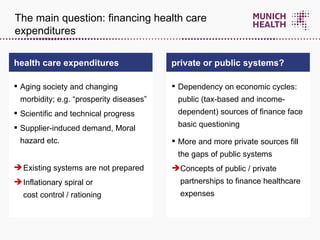
private or public systems? Aging society and changing morbidity; e.g. “prosperity diseases”  Scientific and technical progress Supplier-induced demand, Moral hazard etc. Dependency on economic cycles: public (tax-based and income-dependent) sources of finance face basic questioning  More and more private sources fill the gaps of public systems Concepts of public / private   partnerships to finance healthcare  expenses health care expenditures Existing systems are not prepared Inflationary spiral or  cost control / rationing The main question: financing health care expenditures
Healthcare system in Abu Dhabi: DAMAN’s set-up and structure Public-Private Partnerships Dr.Franz Benstetter United Arab Emirates – Daman project
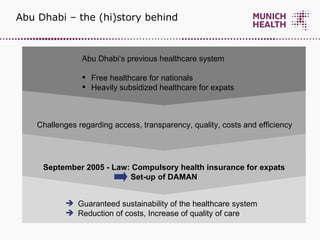
Abu Dhabi – the (hi)story behind Abu Dhabi‘s previous healthcare system  Free healthcare for nationals  Heavily subsidized healthcare for expats Challenges regarding access, transparency, quality, costs and efficiency September 2005 - Law: Compulsory health insurance for expats Set-up of DAMAN Guaranteed sustainability of the healthcare system  Reduction of costs, Increase of quality of care
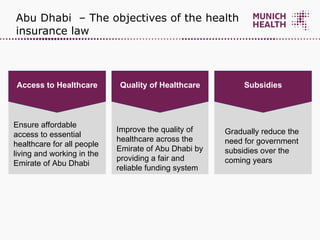
Abu Dhabi  – The objectives of the health insurance law Access to Healthcare Ensure affordable access to essential healthcare for all people living and working in the Emirate of Abu Dhabi Quality of Healthcare Improve the quality of healthcare across the Emirate of Abu Dhabi by providing a fair and reliable funding system Subsidies Gradually reduce the need for government subsidies over the coming years
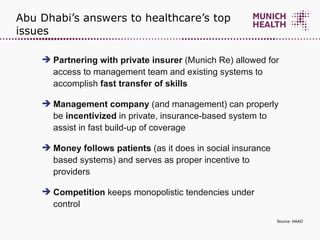
Abu Dhabi’s answers to healthcare’s top issues Partnering with private insurer  (Munich Re) allowed for access to management team and existing systems to accomplish  fast transfer of skills Management company  (and management) can properly be  incentivized  in private, insurance-based system to assist in fast build-up of coverage Money follows patients  (as it does in social insurance based systems) and serves as proper incentive to providers Competition  keeps monopolistic tendencies under control  Source: HAAD
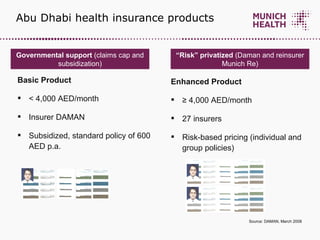
Abu Dhabi health insurance products Basic Product < 4,000 AED/month Insurer DAMAN Subsidized, standard policy of 600 AED p.a. Enhanced Product ≥   4,000 AED/month 27 insurers Risk-based pricing (individual and group policies) Source: DAMAN, March 2008  “ Risk” privatized  (Daman and reinsurer Munich Re) Governmental support  (claims cap and subsidization)
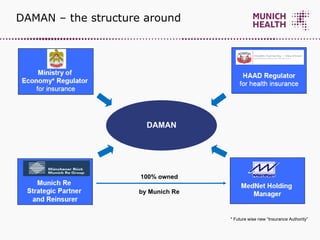
DAMAN – the structure around DAMAN * Future wise new “Insurance Authority” 100% owned by Munich Re
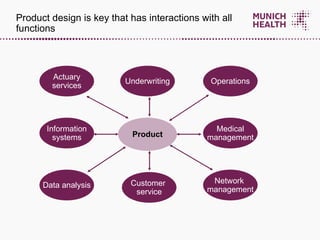
Product Information systems Customer  service Data analysis Network  management Operations Underwriting Medical management Actuary services Product design is key that has interactions with all functions
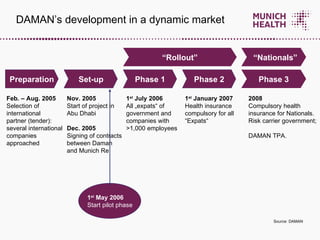
Preparation Set-up Phase 1 Phase 2 Phase 3 “ Rollout” “ Nationals” Feb. – Aug. 2005 Selection of international  partner (tender): several international companies approached Nov. 2005 Start of project in Abu Dhabi Dec. 2005 Signing of contracts between Daman and Munich Re 1 st  May 2006 Start pilot phase 1 st  July 2006 All „expats“ of government and companies with >1,000 employees 1 st  January 2007 Health insurance compulsory for all  “Expats“ 2008 Compulsory health  insurance for Nationals.  Risk carrier government;  DAMAN TPA. Source: DAMAN DAMAN’s development in a dynamic market
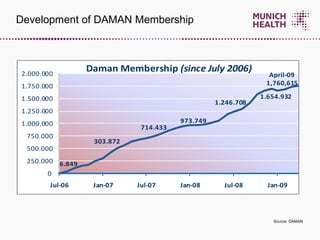
Source: DAMAN Development of DAMAN Membership
DAMAN – review and outlook Public-Private Partnerships Dr.Franz Benstetter Spain – Denia project
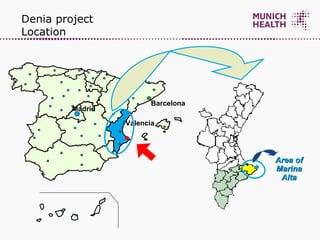
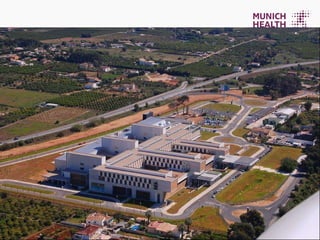
Denia project Location Barcelona Madrid Valencia Area of Marina Alta
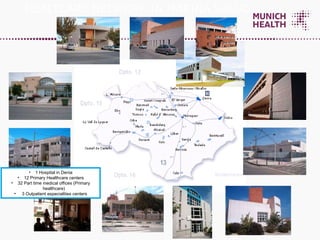
HEALTCARE NETWORK IN MARINA SALUD 1 Hospital in Denia 12 Primary Healthcare centers 32 Part time medical offices (Primary healthcare) 3 Outpatient especialities centers
 
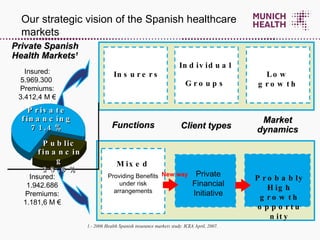
Mixed Providing Benefits under risk arrangements Low growth Private Financial Initiative Probably High growth opportunity Insurers Private Spanish Health Markets 1 Functions Client types Market dynamics New way Public financing 28,6% Private financing 71,4% Insured: 1.942.686 Premiums: 1.181,6 M € Insured: 5.969.300  Premiums: 3.412,4 M € 1.- 2006 Health Spanish insurance markets study. ICEA April, 2007.  Our strategic vision of the Spanish healthcare markets Individual Groups
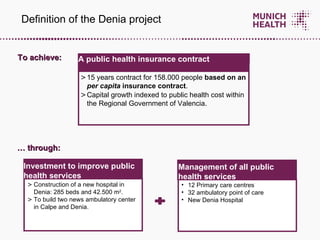
…  through: To achieve: Definition of the Denia project 15 years contract for 158.000 people  based on an  per capita  insurance contract . Capital growth indexed to public health cost within the Regional Government of Valencia. A public health insurance contract Construction of a new hospital in Denia: 285 beds and 42.500 m 2 . To build two news ambulatory center in Calpe and Denia. Investment to improve public  health services 12 Primary care centres 32 ambulatory point of care New Denia Hospital Management of all public health services
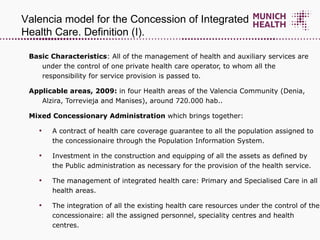
Basic Characteristics : All of the management of health and auxiliary services are under the control of one private health care operator, to whom all the responsibility for service provision is passed to. Applicable areas, 2009:  in four Health areas of the Valencia Community (Denia, Alzira, Torrevieja and Manises), around 720.000 hab.. Mixed Concessionary Administration  which brings together: A contract of health care coverage guarantee to all the population assigned to the concessionaire through the Population Information System.  Investment in the construction and equipping of all the assets as defined by the Public administration as necessary for the provision of the health service.  The management of integrated health care: Primary and Specialised Care in all health areas. The integration of all the existing health care resources under the control of the concessionaire: all the assigned personnel, speciality centres and health centres.  Valencia model for the Concession of Integrated Health Care. Definition (I) .
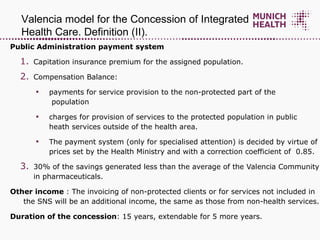
Public Administration payment system Capitation insurance premium for the assigned population.  Compensation Balance: payments for service provision to the non-protected part of the    population charges for provision of services to the protected population in public  heath services outside of the health area. The payment system (only for specialised attention) is decided by virtue of prices set by the Health Ministry and with a correction coefficient of  0.85. 30% of the savings generated less than the average of the Valencia Community in pharmaceuticals.  Other income  : The invoicing of non-protected clients or for services not included in the SNS will be an additional income, the same as those from non-health services. Duration of the concession : 15 years, extendable for 5 more years. Valencia model for the Concession of Integrated Health Care. Definition (II) .
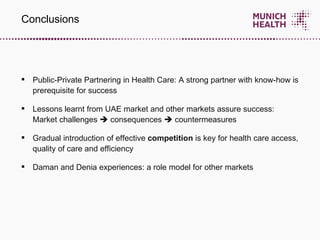
Public-Private Partnering in Health Care: A strong partner with know-how is prerequisite for success Lessons learnt from UAE market and other markets assure success:  Market challenges    consequences    countermeasures Gradual introduction of effective  competition  is   key for health care access, quality of care and efficiency Daman and Denia experiences: a role model for other markets Conclusions
Thank you very much for your attention. ( slides developed by Dr. Franz Benstetter)

Zakos Drossopoulos

  • 1.
    Zakos Drossopoulos Client Account Manager Munich Reinsurance Company ( Germany ) Saturday, 4 September 2010
  • 2.
    Cost Containment in Η ealth business–Public & Private Partnerships (PPPs) Zakos Drossopoulos
  • 3.
    Introduction: public-private partnershipsAbu Dhabi: DAMAN’s set-up and structure Abu Dhabi: DAMAN – Review and outlook Denia (Spain) project overview D enia (Spain) project model Conclusion Content
  • 4.
    private or publicsystems? Aging society and changing morbidity; e.g. “prosperity diseases” Scientific and technical progress Supplier-induced demand, Moral hazard etc. Dependency on economic cycles: public (tax-based and income-dependent) sources of finance face basic questioning More and more private sources fill the gaps of public systems Concepts of public / private partnerships to finance healthcare expenses health care expenditures Existing systems are not prepared Inflationary spiral or cost control / rationing The main question: financing health care expenditures
  • 5.
    Healthcare system inAbu Dhabi: DAMAN’s set-up and structure Public-Private Partnerships Dr.Franz Benstetter United Arab Emirates – Daman project
  • 6.
    Abu Dhabi –the (hi)story behind Abu Dhabi‘s previous healthcare system Free healthcare for nationals Heavily subsidized healthcare for expats Challenges regarding access, transparency, quality, costs and efficiency September 2005 - Law: Compulsory health insurance for expats Set-up of DAMAN Guaranteed sustainability of the healthcare system Reduction of costs, Increase of quality of care
  • 7.
    Abu Dhabi – The objectives of the health insurance law Access to Healthcare Ensure affordable access to essential healthcare for all people living and working in the Emirate of Abu Dhabi Quality of Healthcare Improve the quality of healthcare across the Emirate of Abu Dhabi by providing a fair and reliable funding system Subsidies Gradually reduce the need for government subsidies over the coming years
  • 8.
    Abu Dhabi’s answersto healthcare’s top issues Partnering with private insurer (Munich Re) allowed for access to management team and existing systems to accomplish fast transfer of skills Management company (and management) can properly be incentivized in private, insurance-based system to assist in fast build-up of coverage Money follows patients (as it does in social insurance based systems) and serves as proper incentive to providers Competition keeps monopolistic tendencies under control Source: HAAD
  • 9.
    Abu Dhabi healthinsurance products Basic Product < 4,000 AED/month Insurer DAMAN Subsidized, standard policy of 600 AED p.a. Enhanced Product ≥ 4,000 AED/month 27 insurers Risk-based pricing (individual and group policies) Source: DAMAN, March 2008 “ Risk” privatized (Daman and reinsurer Munich Re) Governmental support (claims cap and subsidization)
  • 10.
    DAMAN – thestructure around DAMAN * Future wise new “Insurance Authority” 100% owned by Munich Re
  • 11.
    Product Information systemsCustomer service Data analysis Network management Operations Underwriting Medical management Actuary services Product design is key that has interactions with all functions
  • 12.
    Preparation Set-up Phase1 Phase 2 Phase 3 “ Rollout” “ Nationals” Feb. – Aug. 2005 Selection of international partner (tender): several international companies approached Nov. 2005 Start of project in Abu Dhabi Dec. 2005 Signing of contracts between Daman and Munich Re 1 st May 2006 Start pilot phase 1 st July 2006 All „expats“ of government and companies with >1,000 employees 1 st January 2007 Health insurance compulsory for all “Expats“ 2008 Compulsory health insurance for Nationals. Risk carrier government; DAMAN TPA. Source: DAMAN DAMAN’s development in a dynamic market
  • 13.
    Source: DAMAN Developmentof DAMAN Membership
  • 14.
    DAMAN – reviewand outlook Public-Private Partnerships Dr.Franz Benstetter Spain – Denia project
  • 15.
    Denia project LocationBarcelona Madrid Valencia Area of Marina Alta
  • 16.
    HEALTCARE NETWORK INMARINA SALUD 1 Hospital in Denia 12 Primary Healthcare centers 32 Part time medical offices (Primary healthcare) 3 Outpatient especialities centers
  • 17.
  • 18.
    Mixed Providing Benefitsunder risk arrangements Low growth Private Financial Initiative Probably High growth opportunity Insurers Private Spanish Health Markets 1 Functions Client types Market dynamics New way Public financing 28,6% Private financing 71,4% Insured: 1.942.686 Premiums: 1.181,6 M € Insured: 5.969.300 Premiums: 3.412,4 M € 1.- 2006 Health Spanish insurance markets study. ICEA April, 2007. Our strategic vision of the Spanish healthcare markets Individual Groups
  • 19.
    … through:To achieve: Definition of the Denia project 15 years contract for 158.000 people based on an per capita insurance contract . Capital growth indexed to public health cost within the Regional Government of Valencia. A public health insurance contract Construction of a new hospital in Denia: 285 beds and 42.500 m 2 . To build two news ambulatory center in Calpe and Denia. Investment to improve public health services 12 Primary care centres 32 ambulatory point of care New Denia Hospital Management of all public health services
  • 20.
    Basic Characteristics :All of the management of health and auxiliary services are under the control of one private health care operator, to whom all the responsibility for service provision is passed to. Applicable areas, 2009: in four Health areas of the Valencia Community (Denia, Alzira, Torrevieja and Manises), around 720.000 hab.. Mixed Concessionary Administration which brings together: A contract of health care coverage guarantee to all the population assigned to the concessionaire through the Population Information System. Investment in the construction and equipping of all the assets as defined by the Public administration as necessary for the provision of the health service. The management of integrated health care: Primary and Specialised Care in all health areas. The integration of all the existing health care resources under the control of the concessionaire: all the assigned personnel, speciality centres and health centres. Valencia model for the Concession of Integrated Health Care. Definition (I) .
  • 21.
    Public Administration paymentsystem Capitation insurance premium for the assigned population. Compensation Balance: payments for service provision to the non-protected part of the population charges for provision of services to the protected population in public heath services outside of the health area. The payment system (only for specialised attention) is decided by virtue of prices set by the Health Ministry and with a correction coefficient of 0.85. 30% of the savings generated less than the average of the Valencia Community in pharmaceuticals. Other income : The invoicing of non-protected clients or for services not included in the SNS will be an additional income, the same as those from non-health services. Duration of the concession : 15 years, extendable for 5 more years. Valencia model for the Concession of Integrated Health Care. Definition (II) .
  • 22.
    Public-Private Partnering inHealth Care: A strong partner with know-how is prerequisite for success Lessons learnt from UAE market and other markets assure success: Market challenges  consequences  countermeasures Gradual introduction of effective competition is key for health care access, quality of care and efficiency Daman and Denia experiences: a role model for other markets Conclusions
  • 23.
    Thank you verymuch for your attention. ( slides developed by Dr. Franz Benstetter)

Editor's Notes