Toxic Transformers
The hazards of brominated and chlorinated substances in
electrical and electronic equipment
____________________________
Introduction
This briefing summarises a recent report1
from Greenpeace that pulls together evidence
demonstrating the human health and environmental impacts of electrical and electronic
equipment (EEE) that contain brominated and chlorinated substances, with particular focus
on the end-of-life (EOL) phase.
The report shows that banning individual brominated flame retardants (BFRs) on a
substance-by-substance basis is not going to address the clear trend that all BFRs can
produce dioxins, including currently unrestricted ‘emerging’ BFRs, many of which are
increasingly being detected as environmental contaminants. It also shows that there is a
whole pathway of dioxin transformation that is largely not considered in policy making,
namely the formation of mixed dioxins from both chlorinated and brominated precursors,
showing that the well known problem associated with PVC and chlorinated dioxins is only
part of the problem.
E-waste
A growing market exists for electrical and electronic goods, many of which have ever-
shortening life spans. Consequently, waste electrical and electronic equipment (WEEE) is
the fastest-growing waste stream, up to three times as fast as the growth of general
municipal waste. Current global electronic waste (e-waste) production has been estimated
to be 20-25 million tonnes a year, with Europe, the US and Australasia being the biggest
producers. For the EU, estimates of annual WEEE production for the year 2005 ranged
from 5 to 9 million tonnes a year, with an annual growth of between 2.5% and 2.7%.
E-waste contains many substances and materials with a relatively high market value when
isolated from the mixed waste. However, e-waste also contains numerous substances that
are hazardous to human health and the environment, and many are still used in the
production of new equipment. The presence of these substances poses potential impacts,
particularly during the disposal and recycling of e-waste after the consumer has finished
with the equipment. Furthermore, large quantities of e-waste generated within the EU and
other developed countries are exported, often illegally, to developing countries, including
China, India and some African countries, where much is recycled using substandard
processes. Such processes can further increase the release of hazardous substances from
e-waste. Processes that involve the open-burning of waste are of particular concern,
because some substances in e-waste can give rise to incomplete combustion products.
These include chlorinated and brominated dioxins and furans formed as a result of
chlorinated substances such as PVC plastic and brominated substances, primarily BFRs,
within the e-waste.
1 The full report ‘Toxic Transformers; - a review of the hazards of brominated & chlorinated
substances in electrical and electronic equipment, January 2010’, with all scientific references,
can be found at: www.greenpeace.to/publications/Toxic-Transformers-2010.pdf
Brominated flame retardants (BFRs)
The electrical and electronics industries account for more than half of all consumption of halogenated
(brominated and chlorinated) flame retardants. Approximately 30 to 40 different BFRs are widely found in
WEEE plastics. BFR-treated plastics typically contain between 5 and 10% by weight of BFRs, though some
materials can contain even higher levels, particularly circuit boards. For many types of products, however,
examples exist where the use of BFRs and PVC has been avoided in various components.
Three groups of BFRs have been widely used in EEE for some time, and for these considerable data does
exist; tetrabromobisphenol-A (TBBPA), polybrominated diphenyl ethers (PBDEs), and
hexabromocyclododecane (HBCD). Unfortunately, very little information is available on the quantities of
individual BFRs used in the electronics sector, including for these three BFRs. One significant change has
occurred in the use of BFRs in recent years, as a result of various restrictions within the EU on the use of
PBDEs, particularly for EEE.
‘Emerging’ BFRs
In response to growing concerns about certain BFRs, and increasing regulation of their use, alternative flame
retardants are being developed and used, including for EEE. It has been estimated that the total worldwide
production volume of so called 'emerging' BFRs (those BFRs other than TBBPA, PBDEs and HBCD) is around
100,000 metric tonnes a year (for all uses, not only EEE).
Although far less studied compared to PBDEs, TBBPA and HBCD, some ‘emerging’ BFRs have already been
found in a wide range of environmental samples, including in sediments, air, indoor dusts, and the eggs of
birds. Some of these substances have been identified in the environment at high levels, including BTBPE
(1,2-bis-2,4,6-tribromophenoxy-ethane), which has been used as a replacement for PBDEs, in some instances
at higher concentrations than PBDEs. Similarly, numerous studies demonstrate that another ‘emerging’ BFR -
decabromodiphenyl ethane (DBDPE) - is widespread in the environment, with distributions similar to those of
PBDEs in some locations. Despite their ongoing use, there is very little publically available data on the
environmental distribution and toxicity for many ‘emerging’ additive BFRs. However, even with the little data
available, concerns have already been raised for many of these substances.
PVC
In addition to BFRs, the use of the chlorinated polymer PVC in EEE contributes to the presence of
halogenated substances in e-waste, thereby increasing the potential for the formation and release of
hazardous substances under certain recycling and disposal processes, including the release of chlorinated
dioxins and furans. Furthermore, the use of PVC in EEE often requires the use of additive substances to
improve the properties of the materials. Some PVC additives, including phthalate esters (phthalates), are toxic
substances. In addition to the intrinsic hazardous properties of BFRs and other halogenated substances used
in EEE, these substances pose additional hazards when products reach their end of life and become e-waste.
During some recycling and disposal operations (e.g incineration, smelting and particularly by the use of open
burning), halogenated substances can act as precursors to the formation of hazardous substances, most
notably halogenated dioxins and furans.
Transformation of brominated and chlorinated substances into dioxins and furans
It is widely recognised, including by industry, that some BFRs have the potential to form brominated
dioxins/furans during processing and disposal. Considerable data exists demonstrating this potential for
PBDEs (including deca-BDE) and TBBPA, including brominated polymers manufactured using TBBPA which
are widely used in circuit boards. This hazard, however, is not restricted to PBDEs and TBBPA. Studies have
demonstrated the potential for the formation of halogenated dioxins/furans for a diverse range of BFRs,
including non-aromatic BFRs (HBCD) as well as ‘emerging’ BFRs (BTBPE), and that their formation is not
dependant on specific characteristics of a BFR. The available data indicates that all BFRs have the potential to
act as precursors for the formation of brominated dioxins/furans. The chlorinated polymer PVC can also act as
a precursor to the formation of chlorinated dioxins/furans.
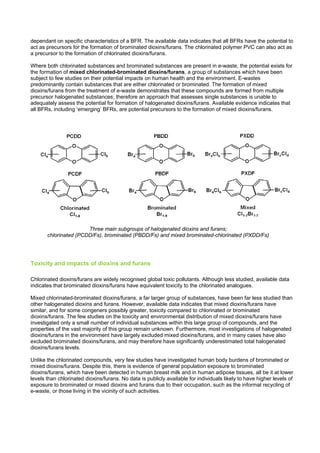
Where both chlorinated substances and brominated substances are present in e-waste, the potential exists for
the formation of mixed chlorinated-brominated dioxins/furans, a group of substances which have been
subject to few studies on their potential impacts on human health and the environment. E-wastes
predominantly contain substances that are either chlorinated or brominated. The formation of mixed
dioxins/furans from the treatment of e-waste demonstrates that these compounds are formed from multiple
precursor halogenated substances; therefore an approach that assesses single substances is unable to
adequately assess the potential for formation of halogenated dioxins/furans. Available evidence indicates that
all BFRs, including ‘emerging’ BFRs, are potential precursors to the formation of mixed dioxins/furans.
Three main subgroups of halogenated dioxins and furans;
chlorinated (PCDD/Fs), brominated (PBDD/Fs) and mixed brominated-chlorinated (PXDD/Fs)
Toxicity and impacts of dioxins and furans
Chlorinated dioxins/furans are widely recognised global toxic pollutants. Although less studied, available data
indicates that brominated dioxins/furans have equivalent toxicity to the chlorinated analogues.
Mixed chlorinated-brominated dioxins/furans, a far larger group of substances, have been far less studied than
other halogenated dioxins and furans. However, available data indicates that mixed dioxins/furans have
similar, and for some congeners possibly greater, toxicity compared to chlorinated or brominated
dioxins/furans. The few studies on the toxicity and environmental distribution of mixed dioxins/furans have
investigated only a small number of individual substances within this large group of compounds, and the
properties of the vast majority of this group remain unknown. Furthermore, most investigations of halogenated
dioxins/furans in the environment have largely excluded mixed dioxins/furans, and in many cases have also
excluded brominated dioxins/furans, and may therefore have significantly underestimated total halogenated
dioxins/furans levels.
Unlike the chlorinated compounds, very few studies have investigated human body burdens of brominated or
mixed dioxins/furans. Despite this, there is evidence of general population exposure to brominated
dioxins/furans, which have been detected in human breast milk and in human adipose tissues, all be it at lower
levels than chlorinated dioxins/furans. No data is publicly available for individuals likely to have higher levels of
exposure to brominated or mixed dioxins and furans due to their occupation, such as the informal recycling of
e-waste, or those living in the vicinity of such activities.
E-waste recycling and disposal
There is considerable data that demonstrates the release of hazardous substances from e-waste at locations
where recycling and disposal take place, both the release of additive substances such as BFRs, as well as
substances generated during recycling/disposal processes, including halogenated dioxins/furans.
A substantial part of the e-waste generated within the EU does not enter the formal WEEE recycling sector,
and there is evidence that significant quantities of e-waste arising within the EU is transported to countries
outside the EU and dealt with by the informal sector, often using sub-standard processes.
Impacts have been demonstrated in locations where e-waste is recycled and disposed of within the informal
recycling sector, where processes include the open burning of mixed e-waste for the recovery of metals
contained within the waste. Extremely high levels of certain additive BFRs have been reported in the
environment around recycling areas, as well as extensive contamination by chlorinated, brominated and mixed
dioxins/furans. One study found that levels of chlorinated dioxins/furans in the air were the highest
documented values of these compounds found in ambient air in the world. At some sites, mixed dioxins/furans
were found to be the predominate forms of halogenated dioxins/furans, at levels exceeding those of both
chlorinated and brominated analogues, highlighting the significance of mixed dioxins/furans as environmental
pollutants arising under these conditions from e-wastes containing halogenated substances. Human exposure
to additive BFRs and halogenated dioxins/furans has also been demonstrated at these locations.
Impacts are not limited to the informal sector, having also been demonstrated for the formal recycling sector
within the EU, including elevated levels of human exposure to BFRs for e-waste recycling workers, as well the
detection of BFRs in indoor air at recycling facilities, including some ‘emerging’ BFRs. Furthermore,
chlorinated, brominated and mixed dioxins/furans have been detected in incinerator emissions and in fly
ashes, including studies involving the incineration of e-waste. It is possible that chlorinated, brominated and
mixed dioxins/furans are released by smelters and metal refineries that use e-waste as feed stock, though
almost no published data is available for such emissions from most facilities, particularly for brominated and
mixed dioxins/furans. Furthermore, the presence of halogens in e-waste can also increase releases of heavy
metals from the feedstock during incineration.
Conclusion
In conclusion, there is considerable evidence that demonstrates human health and environmental impacts
during the end-of-life phase of electrical and electronic equipment that contains brominated or chlorinated
substances, both through the release of hazardous halogenated substances contained in the e-wastes, as well
as from the generation of new hazardous substances through recycling and disposal processes, particularly
halogenated dioxins/furans. While concerns over chlorinated dioxins/furans are widely recognised, there is
evidence that brominated and mixed brominated-chlorinated dioxins/furans are of equivalent concern.
The body of evidence compiled in the report, and in particular the evidence that all BFRs, including so called
‘emerging’ BFRs, have the potential to form dioxins/furans demonstrates the need to protect human health
and the environment from the consequence of the use of these hazardous substances used in EEE.
Restrictions on hazardous substances are needed that recognise the extent of the use of substandard
recycling and disposal practices, and include all halogenated substances, with restriction on a group basis
rather than by using a substance-by-substance approach.

Toxic Transformers - The Hazards of Brominated and Chlorinated Substances

  • 1.
    Toxic Transformers The hazardsof brominated and chlorinated substances in electrical and electronic equipment ____________________________ Introduction This briefing summarises a recent report1 from Greenpeace that pulls together evidence demonstrating the human health and environmental impacts of electrical and electronic equipment (EEE) that contain brominated and chlorinated substances, with particular focus on the end-of-life (EOL) phase. The report shows that banning individual brominated flame retardants (BFRs) on a substance-by-substance basis is not going to address the clear trend that all BFRs can produce dioxins, including currently unrestricted ‘emerging’ BFRs, many of which are increasingly being detected as environmental contaminants. It also shows that there is a whole pathway of dioxin transformation that is largely not considered in policy making, namely the formation of mixed dioxins from both chlorinated and brominated precursors, showing that the well known problem associated with PVC and chlorinated dioxins is only part of the problem. E-waste A growing market exists for electrical and electronic goods, many of which have ever- shortening life spans. Consequently, waste electrical and electronic equipment (WEEE) is the fastest-growing waste stream, up to three times as fast as the growth of general municipal waste. Current global electronic waste (e-waste) production has been estimated to be 20-25 million tonnes a year, with Europe, the US and Australasia being the biggest producers. For the EU, estimates of annual WEEE production for the year 2005 ranged from 5 to 9 million tonnes a year, with an annual growth of between 2.5% and 2.7%. E-waste contains many substances and materials with a relatively high market value when isolated from the mixed waste. However, e-waste also contains numerous substances that are hazardous to human health and the environment, and many are still used in the production of new equipment. The presence of these substances poses potential impacts, particularly during the disposal and recycling of e-waste after the consumer has finished with the equipment. Furthermore, large quantities of e-waste generated within the EU and other developed countries are exported, often illegally, to developing countries, including China, India and some African countries, where much is recycled using substandard processes. Such processes can further increase the release of hazardous substances from e-waste. Processes that involve the open-burning of waste are of particular concern, because some substances in e-waste can give rise to incomplete combustion products. These include chlorinated and brominated dioxins and furans formed as a result of chlorinated substances such as PVC plastic and brominated substances, primarily BFRs, within the e-waste. 1 The full report ‘Toxic Transformers; - a review of the hazards of brominated & chlorinated substances in electrical and electronic equipment, January 2010’, with all scientific references, can be found at: www.greenpeace.to/publications/Toxic-Transformers-2010.pdf
  • 2.
    Brominated flame retardants(BFRs) The electrical and electronics industries account for more than half of all consumption of halogenated (brominated and chlorinated) flame retardants. Approximately 30 to 40 different BFRs are widely found in WEEE plastics. BFR-treated plastics typically contain between 5 and 10% by weight of BFRs, though some materials can contain even higher levels, particularly circuit boards. For many types of products, however, examples exist where the use of BFRs and PVC has been avoided in various components. Three groups of BFRs have been widely used in EEE for some time, and for these considerable data does exist; tetrabromobisphenol-A (TBBPA), polybrominated diphenyl ethers (PBDEs), and hexabromocyclododecane (HBCD). Unfortunately, very little information is available on the quantities of individual BFRs used in the electronics sector, including for these three BFRs. One significant change has occurred in the use of BFRs in recent years, as a result of various restrictions within the EU on the use of PBDEs, particularly for EEE. ‘Emerging’ BFRs In response to growing concerns about certain BFRs, and increasing regulation of their use, alternative flame retardants are being developed and used, including for EEE. It has been estimated that the total worldwide production volume of so called 'emerging' BFRs (those BFRs other than TBBPA, PBDEs and HBCD) is around 100,000 metric tonnes a year (for all uses, not only EEE). Although far less studied compared to PBDEs, TBBPA and HBCD, some ‘emerging’ BFRs have already been found in a wide range of environmental samples, including in sediments, air, indoor dusts, and the eggs of birds. Some of these substances have been identified in the environment at high levels, including BTBPE (1,2-bis-2,4,6-tribromophenoxy-ethane), which has been used as a replacement for PBDEs, in some instances at higher concentrations than PBDEs. Similarly, numerous studies demonstrate that another ‘emerging’ BFR - decabromodiphenyl ethane (DBDPE) - is widespread in the environment, with distributions similar to those of PBDEs in some locations. Despite their ongoing use, there is very little publically available data on the environmental distribution and toxicity for many ‘emerging’ additive BFRs. However, even with the little data available, concerns have already been raised for many of these substances. PVC In addition to BFRs, the use of the chlorinated polymer PVC in EEE contributes to the presence of halogenated substances in e-waste, thereby increasing the potential for the formation and release of hazardous substances under certain recycling and disposal processes, including the release of chlorinated dioxins and furans. Furthermore, the use of PVC in EEE often requires the use of additive substances to improve the properties of the materials. Some PVC additives, including phthalate esters (phthalates), are toxic substances. In addition to the intrinsic hazardous properties of BFRs and other halogenated substances used in EEE, these substances pose additional hazards when products reach their end of life and become e-waste. During some recycling and disposal operations (e.g incineration, smelting and particularly by the use of open burning), halogenated substances can act as precursors to the formation of hazardous substances, most notably halogenated dioxins and furans. Transformation of brominated and chlorinated substances into dioxins and furans It is widely recognised, including by industry, that some BFRs have the potential to form brominated dioxins/furans during processing and disposal. Considerable data exists demonstrating this potential for PBDEs (including deca-BDE) and TBBPA, including brominated polymers manufactured using TBBPA which are widely used in circuit boards. This hazard, however, is not restricted to PBDEs and TBBPA. Studies have demonstrated the potential for the formation of halogenated dioxins/furans for a diverse range of BFRs, including non-aromatic BFRs (HBCD) as well as ‘emerging’ BFRs (BTBPE), and that their formation is not
  • 3.
    dependant on specificcharacteristics of a BFR. The available data indicates that all BFRs have the potential to act as precursors for the formation of brominated dioxins/furans. The chlorinated polymer PVC can also act as a precursor to the formation of chlorinated dioxins/furans. Where both chlorinated substances and brominated substances are present in e-waste, the potential exists for the formation of mixed chlorinated-brominated dioxins/furans, a group of substances which have been subject to few studies on their potential impacts on human health and the environment. E-wastes predominantly contain substances that are either chlorinated or brominated. The formation of mixed dioxins/furans from the treatment of e-waste demonstrates that these compounds are formed from multiple precursor halogenated substances; therefore an approach that assesses single substances is unable to adequately assess the potential for formation of halogenated dioxins/furans. Available evidence indicates that all BFRs, including ‘emerging’ BFRs, are potential precursors to the formation of mixed dioxins/furans. Three main subgroups of halogenated dioxins and furans; chlorinated (PCDD/Fs), brominated (PBDD/Fs) and mixed brominated-chlorinated (PXDD/Fs) Toxicity and impacts of dioxins and furans Chlorinated dioxins/furans are widely recognised global toxic pollutants. Although less studied, available data indicates that brominated dioxins/furans have equivalent toxicity to the chlorinated analogues. Mixed chlorinated-brominated dioxins/furans, a far larger group of substances, have been far less studied than other halogenated dioxins and furans. However, available data indicates that mixed dioxins/furans have similar, and for some congeners possibly greater, toxicity compared to chlorinated or brominated dioxins/furans. The few studies on the toxicity and environmental distribution of mixed dioxins/furans have investigated only a small number of individual substances within this large group of compounds, and the properties of the vast majority of this group remain unknown. Furthermore, most investigations of halogenated dioxins/furans in the environment have largely excluded mixed dioxins/furans, and in many cases have also excluded brominated dioxins/furans, and may therefore have significantly underestimated total halogenated dioxins/furans levels. Unlike the chlorinated compounds, very few studies have investigated human body burdens of brominated or mixed dioxins/furans. Despite this, there is evidence of general population exposure to brominated dioxins/furans, which have been detected in human breast milk and in human adipose tissues, all be it at lower levels than chlorinated dioxins/furans. No data is publicly available for individuals likely to have higher levels of exposure to brominated or mixed dioxins and furans due to their occupation, such as the informal recycling of e-waste, or those living in the vicinity of such activities.
  • 4.
    E-waste recycling anddisposal There is considerable data that demonstrates the release of hazardous substances from e-waste at locations where recycling and disposal take place, both the release of additive substances such as BFRs, as well as substances generated during recycling/disposal processes, including halogenated dioxins/furans. A substantial part of the e-waste generated within the EU does not enter the formal WEEE recycling sector, and there is evidence that significant quantities of e-waste arising within the EU is transported to countries outside the EU and dealt with by the informal sector, often using sub-standard processes. Impacts have been demonstrated in locations where e-waste is recycled and disposed of within the informal recycling sector, where processes include the open burning of mixed e-waste for the recovery of metals contained within the waste. Extremely high levels of certain additive BFRs have been reported in the environment around recycling areas, as well as extensive contamination by chlorinated, brominated and mixed dioxins/furans. One study found that levels of chlorinated dioxins/furans in the air were the highest documented values of these compounds found in ambient air in the world. At some sites, mixed dioxins/furans were found to be the predominate forms of halogenated dioxins/furans, at levels exceeding those of both chlorinated and brominated analogues, highlighting the significance of mixed dioxins/furans as environmental pollutants arising under these conditions from e-wastes containing halogenated substances. Human exposure to additive BFRs and halogenated dioxins/furans has also been demonstrated at these locations. Impacts are not limited to the informal sector, having also been demonstrated for the formal recycling sector within the EU, including elevated levels of human exposure to BFRs for e-waste recycling workers, as well the detection of BFRs in indoor air at recycling facilities, including some ‘emerging’ BFRs. Furthermore, chlorinated, brominated and mixed dioxins/furans have been detected in incinerator emissions and in fly ashes, including studies involving the incineration of e-waste. It is possible that chlorinated, brominated and mixed dioxins/furans are released by smelters and metal refineries that use e-waste as feed stock, though almost no published data is available for such emissions from most facilities, particularly for brominated and mixed dioxins/furans. Furthermore, the presence of halogens in e-waste can also increase releases of heavy metals from the feedstock during incineration. Conclusion In conclusion, there is considerable evidence that demonstrates human health and environmental impacts during the end-of-life phase of electrical and electronic equipment that contains brominated or chlorinated substances, both through the release of hazardous halogenated substances contained in the e-wastes, as well as from the generation of new hazardous substances through recycling and disposal processes, particularly halogenated dioxins/furans. While concerns over chlorinated dioxins/furans are widely recognised, there is evidence that brominated and mixed brominated-chlorinated dioxins/furans are of equivalent concern. The body of evidence compiled in the report, and in particular the evidence that all BFRs, including so called ‘emerging’ BFRs, have the potential to form dioxins/furans demonstrates the need to protect human health and the environment from the consequence of the use of these hazardous substances used in EEE. Restrictions on hazardous substances are needed that recognise the extent of the use of substandard recycling and disposal practices, and include all halogenated substances, with restriction on a group basis rather than by using a substance-by-substance approach.