

F O R M A R K E T
Volume 22 / Number 5
May 2013
growing
news & ideas for local food producers
Increasing tomato yields / 7
continued on page 3
‘Lean’ principles
applied to a farm
By Ben Hartman
The first few years of any farm
are chaotic. They’re filled with high-
energy experimentation. Farmers are
learning their land, trying out differ-
ent tools and production methods,
and planting everything under the
sun to see what grows well and what
sells. Tractors are bought, greenhous-
es and coolers are built, workdays are
long, vacations short.  
At some point, the chaos needs to
settle down if new farms and their
farmers are going to survive.
A few years ago, Steve Brenneman,
one of our CSA customers who owns
an aluminum trailer manufacturing
company, sent me an email offering
to come out to our farm, watch us
work, and then help us design a plan
to “lean up” our farm. Steve is a good
businessman and he is also a lean
practitioner and teacher. 
I wasn’t so sure. Lean principles
grew out of the Japanese automobile
industry (Toyota in particular is often
looked to as a model). The basic goal
is to ruthlessly eliminate waste--any-
thing the customer does not value--
from your production system.
Did a farm really have something
to learn from manufacturing? Run-
ning an assembly line is nothing like
the messy, unpredictable work of a
farmer.  
We decided to give it a try. We
toured Steve’s factory and read up on
the basic concepts. Steve came out
and helped us develop a plan, and we
got to work eliminating waste and re-
organizing our farm. 
We are by no means experts in
“lean,” but our farm after two years
of “leaning” is a very different place
from what it was in the beginning,
and some of what we learned might
be helpful for other farms, too.  
Below is a sampling of principles
from lean thinkers that we found
most helpful for us. Put together, they
can provide a powerful toolkit for
your farm.
If you are interested in learning
more, you’ll find plenty of books and
articles that teach the principles of
lean at your local library or on the In-
ternet.
1. Implement 5S
We started the lean journey by
implementing the 5S system, a work-
place organization method. Each
practice corresponds to a list of five
Japanese words which when trans-
lated all start with the letter s.
In a nutshell:
SORT. Get rid of anything that is
not absolutely necessary for your pro-
duction and keep only what you need.
When in doubt, get rid of it.
Extending edamame season / 11
Tools & equipment sanitation / 20
Trends in wedding florals / 23
GROWING FOR MARKET / MAY 20132
Growing for Market is published 10 times
per year by Fairplain Publications, Inc., PO Box
3747, Lawrence KS 66046
ISSN 1060-9296
Volume 22
Number 5,
May 2013
©2013 Fairplain
Publications, Inc.
All rights reserved.
No portion of this maga-
zine may be
copied in any manner for
use other than
by the subscriber
without permission from
the publisher.
Editor/Publisher
Lynn Byczynski
Associate Editor
Daniel Nagengast
Circulation Manager
Jozie Schimke
Office manager
Jessica Pierson
Contributing Editors
Erin Benzakein
Chris Blanchard
Pam Dawling
Josh Volk
Print edition by mail:
$36 for 1 year / $64 for 2 years / $90 for 3
(To Canada, add $15 postage; other countries, add
$30 postage. All orders in U.S. dollars.)
Electronic edition:
$30 for 1 year subscription
Full Access:
$89 for 1-year subscription plus
access to archives
Full Access Plus:
$99 for access to archives and
print editions for one year
Display Advertising: 2013 rate sheet
available at www.growingformarket.com
or phone 800-307-8949.
Classified Advertising:
Send with payment before the 7th of the
month. 50 cents per word for subscribers;
$1 for non-subscribers.
See our web site for available back issues and
market farming books.
Contact us:
Email: admin@growingformarket.com
Web: www.growingformarket.com
Toll-free phone: 800-307-8949
Fax: 785-748-0609
Mail: GFM, PO Box 3747, Lawrence, KS 66046
I was very excited to receive the most recent issue of
GFM a few days ago. This excitement was replaced by
dismay when I found, for the second issue in a row, inac-
curate information about cross-pollination for vegetable
crops. The articles, both written by Pam Dawling, are
about growing parsnips (March issue), and fennel (April
issue).
The article “Parsnips are Easy to Grow and Reliable”
lists parsnips as something that readily crosses with car-
rots and Queen Anne’s Lace. This is not true - parsnips
and carrots are not only different species, but are differ-
ent genera. It is quite difficult (perhaps even impossible)
for carrots and parsnips to cross pollinate each other.
Ms. Dawling was right, however, to note that carrots and
Queen Anne’s lace will cross, as will parsnips with wild
parsnips, as our cultivated varieties are the same species
as their wild counterparts.
In April’s article “Growing Fennel - Bulb, Herb, Pol-
len,” Ms. Dawling asserts that fennel will cross pollinate
with dill, carrots, Queen Anne’s lace, parsnips, and ci-
lantro. While these plants are all in the same family, each
of them represents a different genus (except the carrot/
Queen Anne’s lace, as previously mentioned), and cross-
ing is probably impossible.
If there are going to be more articles about vegetables in
upcoming issues of Growing for Market, please make sure
the information about species compatibility is accurate.
Perhaps she or one of your editors could reference John
Navazio’s new book, The Organic Seed Grower, which I
see is offered for sale by GFM.
Thanks in advance for stopping the spread of this mis-
information.
Sarah Kleeger
Open Oak Farm
Sweet Home, Oregon
Pam Dawling responds: On parsnips, the facts are that
parsnips can cross with wild parsnip, but not with carrots or
Queen Anne’s Lace, as I wrongly claimed.
On fennel, the facts are that fennel does not cross with
anything except other fennel. It is widely said (even by some
seed companies!) that dill and fennel cross, and some even
describe the terrible flavor of the resulting crosses. Clearly
this is a superstitious belief that continues because acting on
the belief produces good fennel (or dill) seed. Similar to how
someone might snap their fingers to keep away tigers - no
tigers - complete success! I’ve long believed dill and fennel
crossed. It’s good to know I don’t need to worry about that
any more.
I apologize for my mistakes and appreciate Sarah
Kleeger taking the time to set the record straight.
Letter points out errors on cross-pollination
WrinkleCrinkleCrumpleCress OutredgeousLettuce RedUrsaKale AuroraOracheMizspoonaMustard
LacinatoRainbowKalePurpleGoosefootHyperRedRumpleWavedLettuceEdulisLambsquaartersWhiteRussianKaleGlossyEpazote
FlashbackCalendulaWildGardenChicoriesBlushButterOakLettucGoldenPurslaneSurvivorParsleyGiantRedCeleryGreatGreen
Magma Mustard Wild Red Kale Green Velvet Orache Pink Petiole Mix Mustard Blushed Butter Cos
Wild Garden Seed
Salad Greens & Herbs
For the Fresh Market Grower
Ecological Crop Improvement For And By Farmers
Send For Our Free Catalog
Wild Garden Seed
P.O. Box 1509, Philomath, OR 97370
Our ecological approach to plant breeding generates
superior strains and original varieties for farmers
who don’t use chemical protectants and fertilizers.
Organic Seed from Gathering Together Farm
541. 929. 4068
www.wildgardenseed.com
GROWING FOR MARKET / MAY 2013 3
liness baseline of zero.
We also set aside a few hours of staff time on Friday af-
ternoons to getting the farm back in order. Doesn’t always
happen, but we’re getting better, and, once again, it helps
to have a target.
2. Find metrics to measure your work
To lean up, a farm needs to find and use consistent
metrics to track which crops and practices are making you
money and which are a drain on your resources (i.e., tar-
gets for elimination).    
Chris Blandchard’s article in GFM January 2013 pro-
vides a great overview of how to track your costs of pro-
duction, and I suggest reading it.  
In addition to a careful income/expense analysis (your
task as an owner), a “lean” practice is to pick one very sim-
ple metric that workers can use across all of your products
that will allow your team to easily compare products and
set goals.
For example, you could track the dollar value per har-
vest container for each of your different crops. Or the value
per row foot. Or the value amount of each crop you can
For us, this meant spending several weeks loading up
wagonloads for the auction or landfill.
SET IN ORDER. Every tool should have a place. At
any given time, it should either be in its place or in the
hands of a worker. There is no third option! 
Our goal was to organize our spaces so that a 10-year-
old could walk into a room and get us any tool we asked
for. So tools are hung at as close to eye level as possible and
they are not stacked on top of each other. 
Another goal is to place tools as close as possible to
where they are used. When Steve asked me to show him
how I prune the tomatoes, I had to start by walking 200 or
so steps to the storage barn for the pruners, then another
200 steps back to the greenhouse.
“Why not keep pruners in the greenhouse next to the
tomatoes?” Steve asked. The thought never occurred to
us.
Messes still happen, tools still get lost, sometimes for
days at a time. But it helps to have organizing principles
in mind.
SHINE. Clean your workspaces with a toothbrush.
Then make sure they are well lit. 
For us, we painted the cement floor of our processing
room with epoxy paint so that we can mop up easily and
we put in place stainless steel counters and sinks. Then
we installed four T8 florescent light fixtures in our 12’ x
30’ processing room. It might seem like overkill, but we
feel like the increased quality of our work was worth the
expense.
We also bought and placed around the property several
green-colored totes that are used exclusively for collecting
weeds. The system is easy to follow and having totes close
to where the weeds are encourages us to keep our growing
beds clean.
STANDARDIZE. This refers to creating work sta-
tions that are identical for a particular job.
For us, we replaced our mix of 30 or so salvaged harvest
containers of different colors and shapes with just one type
of container. Another example: we supplied each green-
house and each plot we farm with the exact same hose and
irrigation set-up, so that a worker can water different areas
without confusion.   
SUSTAIN. Setting up organization systems is one
thing, making sure you use them is another.
In some lean factories, a worker is assigned at the end
of each week to go around the facility with a clipboard and
give a numerical rating for the cleanliness of work spaces.
The goal is get a better rating each week.
We haven’t gone that far, but we do set aside time each
fall to deep clean our spaces.  We call it “taking it to zero,”
meaning we want each space to start the year with a clean-
The author harvests kale in the greenhouse. In an effort to
harvest as market-ready as possible, he pre-counts rubber
bands, bunches as he cuts, and places the kale in totes that
will go to farmers market.
Lean up your farm
continued from page 1
continued on the next page
GROWING FOR MARKET / MAY 20134
Lean up your farm
continued from page 3
Prevents weeds and boosts production...
The natural alternative to black plastic.
Organicweedcontrol.
Patent pending
®
• Better transplant survival rates
• Excellent weed suppression
• 100% Biodegradable — no removal costs,
no residual
• Feeds the soil with organic material
• Eliminates need for herbicides
• Can be tractor applied
• Works with both drip and overhead irrigation systems
• Porous — allows air and water through
www.WeedGuardPlus.com
800-654-5432
harvest in an hour. The actual metric you choose doesn’t
matter as much as making sure you’re consistent across the
board. 
You can often do this measuring in your head in just a
few seconds as you are working. Post a chart in your pro-
cessing room to keep track, then set targets for improve-
ment.
3. Spend time deciding what NOT to do
After you have information on the profit margins for
your crops, begin eliminating crops that track low. This
is surprisingly hard to do! “But we have to grow X!” you
might say. You can grow X, but realize that X might be
bogging down your farm.	
It helps to set a bar. For example, on our farm, we try
to eliminate crops that do not yield a harvest of a set dol-
lar value per hour spent harvesting and processing--what
I call “field to cooler” time. (We double the bar for “stake
and prune” crops like heirloom tomatoes and greenhouse
peppers that take a lot of upfront time to trellis and prune.)
Sometimes the metrics will help you decide on equip-
ment purchases. For example, potatoes did not make the
cut for us until we started using a simple tractor-mounted
potato digger. 
The list of crops that don’t succeed will look different
on every farm because every farmer has unique compe-
tencies and all farms have different soil types, equipment
and market access.  
  
4. Work as hard to trim expenses as you
do to increase sales 
Say your goal is to increase net profits by 50% over 10
years. What business wouldn’t love to do that! 
One way to get there would be to expand production
and increase sales. That approach would take a lot of ef-
fort: you’d need new equipment, more land, more green-
houses, more staff, more customers, etc. 
Another way would be to cut expenses. What if you
managed to cut expenses by just 5% a year (who couldn’t
do that?) over a 10 year period while keeping revenues the
same? This is lean growth.
Granted, the above example is simplistic. Revenue
streams are important and there might be ways to ef-
ficiently increase those streams. Lean thinking simply
encourages finding and eliminating waste as an equally
legitimate way to grow your business.  
Every year we examine a printout of our expense led-
ger and ask ourselves, “How can we trim another 5% off
this year?” It’s a good discipline and it has helped to have
a specific goal.
We love expense-cutting growth because the savings
GROWING FOR MARKET / MAY 2013 5
continued on the next page
are perennial. For example, if you can save $500 per year
on a cheaper compost sourced from another supplier, over
10 years you have saved $5,000. (Friends of ours who raise
pigs have done these sorts of projections comparing dif-
ferent feed sources--whey, scraps, corn, etc.) Or if you
can find a way to shave an average of just 20 minutes per
day off your processing time because of a new method,
over ten years (assuming a 5-day workweek) you will
have freed up 52,000 minutes--or 36 days--to grow more
food...or take a vacation!    
5. Create a smooth work flow
Steve asked us to imagine we were watching our farm
from overhead and to trace a line on paper whenever peo-
ple moved around. By the end of a typical harvest day, our
farm would look like a plate of spaghetti (hence the term
“spaghetti diagram”).
To smooth out our spaghetti noodles, Steve encour-
aged us to harvest as “market ready” as possible.
To get from your field into the hands of a customer,
a vegetable will go through a lots of “moves.” If you can
find a way to eliminate even one or two moves, your noo-
dle gets straighter.
For us, we have started harvesting our crops into the
same totes that we will take to market (unless the crop
needs to be washed), and we bunch or pack in the field as
we harvest. For example, if we need 50 bunches of kale,
we’ll count out 50 rubber bands, stretch them around a
couple of fingers, and band as we pick.
6. “Level the load”
This refers to spreading out your weekly and yearly
workload so that you are not overwhelmed during your
peak times/seasons (Fridays/mid-summer). 
We do this in several ways. We do as much spring bed
preparation in the late fall as possible because spring is
always a rush. We harvest throughout the week rather
than waiting for the last minute. And we keep a winter
project list of tasks to complete in order to free up time in
summer.  
Perhaps most significantly, we extend our growing
season year-round through the use of greenhouses, so that
our sales and workload are spread more evenly through-
out the year. 	
7. Remember who you are working for:
the customer
This is key. According to lean thinking, what the cus-
tomer wants is paramount. It should dictate your long-
term decisions and your day-to-day tasks.  If your im-
mediate task is not in the service of giving your customer
something they value, then you should stop doing it.
This sounds harsh, but it is not meant to strip the fun
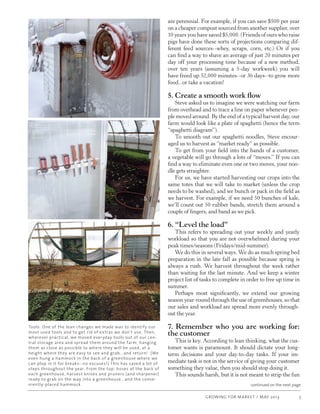
Tools: One of the lean changes we made was to identify our
most used tools and to get rid of extras we don't use. Then,
wherever practical, we moved everyday tools out of our cen-
tral storage area and spread them around the farm, hanging
them as close as possible to where they will be used, at a
height where they are easy to see and grab...and return! (We
even hung a hammock in the back of a greenhouse where we
can plop in it for breaks--no excuses!) This has saved a lot of
steps throughout the year. From the top: hoses at the back of
each greenhouse, harvest knives and pruners (and sharpener)
ready to grab on the way into a greenhouse...and the conve-
niently-placed hammock.
GROWING FOR MARKET / MAY 20136
Lean up your farm
continued from page 5
Ferrari Tractor C.I.E.
“An Appropriate Technology for Agriculture”
www.ferrari-tractors.com (530) 846-6401
Cell (530) 632-4384
Adjust with hand crank
32 inches to 52 inches wide
$1500.00
plus freight to closest USA port
2 larger sizes also.
out of farming. Rather, it’s meant to give your farm focus
so that it is profitable enough for you to pay yourself fairly
and to give you time to do things that you enjoy.
Sometimes customer-focused farming means going out
of your way. For example, we have started calling some of
our chefs (at a time they choose) so they can place quick or-
ders while flipping eggs or plating a dish. This is faster for
them than email (which would be our preference); as such,
the phone call becomes part of the service we provide.
In conclusion, if your farm, like ours, has seen its share
of chaos, then applying “lean” principles could help it run
more smoothly and profitably. You probably started grow-
ing for markets because you envisioned making a living
outdoors around the green things that you love. “Leaning
up” might help bring that goal closer to within your reach.
Ben Hartman and Rachel Hershberger own Clay Bottom
Farm near Goshen, Indiana. They have a CSA and sell at
the Goshen Farmers Market.
For LOCAL FRESH PRODUCE Professionals
800-622-7333 www.twilleyseed.com
888-645-2323 www.geoseed.com
For FLORICULTURE
Professionals
Your seed sources for outstanding
flowers and vegetables
GROWING FOR MARKET / MAY 2013 7
density, was to eliminate a few variet-
ies that did not perform well for me in
2011. I got rid of the underperforming
varieties and played with a tomato all-
star team in 2012. The only way for
you to figure out who your all-stars
are is to do what any coach would
do — keep statistics. Then make the
time to analyze them once the season
is over.
This doesn’t have to be a time-
consuming endeavor. What we do on
One Drop Farm is to repurpose our
springtime plant propagation house (a
12’ by 20’ double wall polycarbonate
lean-to off our garage) into the sum-
mertime tomato packing house. We
throw a white tarp over the structure
so it is still light inside when the sun
Increasing tomato yieldBy Andrew Mefferd
In the March issue of GFM, I
talked about a spacing change in my
tomato hoophouse, which allowed
me to plant 60 percent more plants
than the previous year. Yet I was able
to increase yield by 100 percent over
the previous year. Now, I’m going to
report on the improvements that led
to the other 40 percent of my yield in-
crease. Many of the principles can be
applied to the field as well as the hoop-
house, and crops besides tomatoes.
Learning from yield data
One of the biggest changes I made
between the 2011 and 2012 growing
seasons, besides increasing planting
is out, but the heat doesn’t build up as
it does when it’s in greenhouse mode.
A ventilation fan runs constantly
during the daytime to keep air flow-
ing over the tomatoes, to dry out any
moisture and reduce post-harvest rot.
As tomatoes are picked and brought
into the tomato packing house, they
are weighed in and noted on a pad
that lives right next to the scale. At
the end of the season, we put all the
numbers into an Excel spreadsheet
set to auto sum and we can see how
each variety did for us.
The differences can be signifi-
cant and surprising. In 2011, I grew
a bunch of different heirlooms (all of
them grafted), and some of them did
much better than others. So I elimi-
nated the under-performers, and
landed on four varieties that seemed
to work the best for me: German
Johnson, Cherokee Purple, Striped
German, and Valencia.
Last year, I noticed something
about Valencia that I had seen the pre-
vious year, but worse this time. The
plants got excessively vegetative early
in the season. Essentially, they were
putting all their energy into vines and
leavesandnotputtingmuchintoflow-
ers and fruit. The vines were as big
around as the fat part of my thumb,
and the new growth was so curled and
twisted, it looked like herbicide dam-
age! At the end of the season, I could
look back at my yield data and see that
that excessively vegetative condition
cost me earliness and yield.
Now, this excessively vegetative
condition is a combination of the
plant being young and naturally veg-
etative, and being grafted to a vigor-
ous rootstock. This is significant for
Valencia because none of the other
three grafted heirlooms I was grow-
ing reacted as vegetatively. Being
convinced of the benefits of grafting
as I am, I’m not going to stop graft-
ing, but I am going to drop Valencia
and try to find another orange tomato
that performs better UNDER MY
CONDITIONS.
continued on the next page
BLUE RIBBON PLASTIC MULCH LAYER
MODEL # BR400
This layer comes with many options; like rolling dirt shields, side chisels and center fillers.
Layer makes a 5” high bed in either 20” or 30” width depending upon if you use 3’ or 4’
plastic mulch. Bed shaper is lined with non-stick poly liner so less horse power is required.
Powder coat paint finish. This machine was demonstrated locally with great reviews from
customers.
In a single trip, make raised bed, lay drip line and cover with plastic mulch!
Horse power requirements; 20 hp 4 wheel drive or 30 2 wheel drive.
$2,300.00 with drip attachment
Distributed & sold by; MORGAN COUNTY SEEDS LLC
18761 Kelsay Rd
Barnett, MO 65011
Phone # 573-378-2655
Dealerships available.
GROWING FOR MARKET / MAY 20138
Organic Certification?
No Sweat.
Now you can efficiently keep the detailed
records required to be a certified producer
of organic crops or livestock, without even
breaking a sweat.
Developed by farmers for farmers,
COG Pro makes collecting your
agricultural data and generating reports
for certification inspection a snap— right
from your laptop, tablet or smart phone.
Visit www.cog-pro.com to find out more
about COG Pro’s low cost, easy-to-use
online notebook— try it out for free by
logging in as a guest!
w w w. c o g - p r o . c o m
Now
with GAP
records!
COG Pro
Organic certification…
simplified.
I emphasize the last part because
this is why the yield data is so im-
portant. It’s not that I think Valencia
is a bad tomato. In fact, I think that
for an orange tomato, it is remarkably
uniform and unblemished, especially
for an heirloom. But under my condi-
tions it doesn’t perform the way that I
would like it to, and I would rather fill
the space with something that can be
more productive.
If I didn’t graft or lived in another
part of the country with different
weather conditions it might perform
differently for me. Getting the hot
new variety or finding out what oth-
er growers in your area have success
with may get you half the way to good
production, but there’s no guarantee
unless you take the yield data and
verify for yourself that what you are
doing under your conditions is work-
ing. Knowing which varieties pro-
duce best is worth way more than the
time that it takes to get the data.
Your yield data may really surprise
Increasing tomato yield
continued from page 7
you. I know it surprised me this past
winter to find out that I was only get-
ting one third the yield off my grafted
heirlooms than off my grafted hy-
brids. I was shocked! All the plants
looked vigorous and healthy. You
would never think the yield difference
was that pronounced just by looking
at them. It is always said that heir-
looms are not as high yielding, besides
not having the disease resistance of
hybrids. I would have guessed maybe
a half or so of the hybrid production
but a third!?! This is an example of
something I never would have known
if I didn’t have the data.
So, what does this mean to me?
The way I think about it, my graft-
ed hybrid beefsteaks yield about 30
pounds per leader, or since they’re
double leader plants, 60 pounds per
plant. I try never to take less than
$2.50/pound for my red beefsteaks,
and we sell a significant amount of
them for more than that at the farm-
ers market, so a grafted two leader hy-
brid beefsteak tomato plant is worth
at least $150 gross to me.
The heirlooms, on the other hand
are yielding closer to 10 pounds per
leader or 20 pounds per plant. I didn’t
sell any heirlooms for less than $3/
pound, and sold a significant amount
for more at the farmers market, so
I can say that a grafted two-leader
heirloom plant is worth at least $60
dollars to me. But even that doesn’t
tell the whole story. It probably takes
me twice as long to maintain a row of
heirlooms as it does a row of hybrids.
This isn’t a coincidence; greenhouse
hybrids are bred to be lower main-
tenance. The opposite of this are the
heirlooms, which have more double
heads, dead heads, excessively large
flower clusters, and generally weird
and unruly growth habits that make
them interesting to work on but time
consuming.
In case you’re wondering about the
raw data, I averaged 31.44 pounds per
leader off my hybrid beefsteak plants,
which were Rebelski grafted onto Co-
losus. On the heirlooms, which were
all grafted onto Maxifort, I averaged
10.25 pounds per leader from Ger-
man Johnson, 9.84 pounds per leader
from Cherokee Purple, 9.7 pounds
GROWING FOR MARKET / MAY 2013 9
from Striped German, and 7.25 pounds from Valencia.
Due to their excessively vegetative condition, the Valen-
cias were also more than two weeks later to start bearing
than the other heirlooms. And I only count marketable
yield, since I leave the unsalable tomatoes in the hoop-
house to be picked up with the other plant debris. Though
the hoophouse does such a good job of protecting the fruit
from the elements, I would say that I pack out somewhere
in the high 90 percent range of the fruit that I grow.
And why did I use Maxifort for the heirlooms and
Colosus for the Rebelski? I botched my first round of
grafting with the heirlooms and by the time I started
over again, Colosus was sold out. Most heirlooms seem to
germinate and emerge in a much less even manner than
most of the hybrids, taking a week or more for them all to
come up, whereas the hybrids seem to all germinate over
the space of a few days. When you need perfectly match-
ing stems for grafting success, it can be advantageous to
start four times the number of heirlooms than you really
need to plant. The seed is cheap, and that should give you
enough to match to your rootstock variety, which is more
expensive and you could overplant by only 20% (or more,
depending on how good you are at grafting).
Whether it is “worth it” or not to grow heirlooms is
up to the individual grower. I plan to continue growing
them, though on paper it seems that I should consider do-
ing otherwise. If I didn’t grow some I would miss them.
Another consideration is that our top-quality early season
heirlooms set us apart and give us something to offer to
suppliers that might otherwise not do business with us be-
cause we are selling what everyone else is selling. Another
thing I keep in mind is that not everyone wants to buy a
red tomato and we would surely lose some farmers market
customers if we only had reds.
I figure as long as we can get 4,000 pounds of tomatoes
at $2.50/pound minimum price out of a 30 by 48 struc-
ture that probably cost less than $10,000 to build, we are
making the cost of the structure back every summer sea-
son. To my mind, that seems like a pretty good return,
even though some varieties are more profitable than oth-
ers. And knowing what different varieties are producing
for you is golden when it comes to figuring out whether
to continue with a variety, or even switch to another crop
altogether.
Leaf and cluster pruning
One other thing that probably helped out my yields last
year was that I kept up on leaf and cluster pruning. By leaf
pruning, I mean removing the leaves below the cluster of
tomatoes that is ripening. This is important to do for sev-
eral reasons. When the leaves are allowed to remain be-
low the ripening cluster, it keeps the truss cooler and that
makes the tomatoes ripen more slowly. So, taking them
off can speed up the ripening process. Also, the cluster
microclimate caused by leaf cover on all sides traps more
moisture close to the ripening fruit. This increases the
possibility of botrytis developing on the calyx or fruit, and
russeting or micro-cracking, which is made worse by free
moisture sitting on the surface of the fruit. I have found
fruits that are in perfect condition except for some russet-
ing where a leaf was touching the fruit and keeping the
fruit wet. This is particularly a problem late in the season
in an unheated hoophouse, when cold night temperatures
cause a lot of condensation on everything including the
fruit. The fall is really the only time of year that I cull fruit
because of russeting.
The leaves below the fruit cluster are too shaded to
contribute much to the plant, and as the oldest leaves they
are the most prone to diseases. When you take them off
it opens up a lot more air circulation at the bottom of the
plants. Otherwise, this is an area that tends to stay cool
and damp and build up diseases like botrytis that like
those conditions. The best way to remove these leaves is to
cut them off flush with the stem with an x-acto knife, or I
have come to prefer an old-fashioned razor blade snapped
in half lengthwise and inserted into a woodworking blade
holder. Do not snap leaves off or in any manner leave a
stub of petiole attached to the stem. Stubs are very prone
to botrytis infection that can move into the stem and pos-
sibly kill the plant.
As far as cluster pruning goes, it helps the plant remain
vigorous and keep fruit size up to thin the cluster back to
the desired number of fruits. Every flower that becomes
a fruit is essentially a growing point, not unlike a shoot,
which makes a demand on the plant to put energy into
developing the fruit. One of the ways that greenhouse
hybrids are easier to maintain than heirlooms is that they
continued on the next page
GROWING FOR MARKET / MAY 201310
produce a more reasonable number of blossoms than some
heirlooms do. I have seen a large-fruited variety like Bran-
dywine throw 15 or 20 blossoms in a cluster!
A variety like that with fruit size from a half pound to
a pound is obviously not going to develop all those fruits
and have a 10-20 pound truss! Help it out and cut it down
to a more realistic number. Most people prune beefsteaks
to 3-4 flowers, cluster tomatoes to 5-6 flowers, and cherry
tomatoes very lightly or not at all. Cherries can be tricky
because the number of fruits set varies so much by variety.
But if you look at the plant and many of the clusters have
undersized, undeveloped fruit that never ripen at the end,
you could nip that number off the future clusters to save
the plant from putting energy into fruits that are never go-
ing to develop.
This is also a way to influence fruit size. If you have
a really large variety that you would like to be a little
smaller, you could leave four flowers and you will get four,
smaller fruit than if you had pruned to three. If you have
a variety that is a little smaller than you would like it, you
could prune to 3 fruits and the plant’s energy for that truss
will only be divided in 3, resulting in slightly larger fruit.
When to actually do the pruning is another question.
If fruit is setting really well, it is common to do the prun-
ing early on with flowers before the fruit is set. This keeps
the plant from putting any energy into flowers and fruit
that you don’t want. On the other hand, sometimes fruit
setting is poor and not every flower is turning into a fruit,
due to excessively hot temperatures or inadequate pollina-
tion. In these instances it might be better to wait until the
fruits have become the size of a small marble to thin, so
you can see which ones will actually develop.
These last two techniques of leaf and cluster pruning
probably require too much labor to make sense in the field.
But they really do make a difference in the high-labor,
high-yield environment of the hoophouse and greenhouse.
Andrew Mefferd and his wife, Ann, own One Drop Farm
in Cornville, Maine. Andrew also is a trial technician for
tomatoes at Johnny’s Selected Seeds research farm.
Increasing tomato yield
continued from page 9
The author’s deleafing tool: A razor blade snapped in half in a
woodworking blade holder.
A tomato plant before deleafing, at left, shows the three
leaves below the fruit cluster, which is typical of indetermi-
nates. Above, the same plant after the three leaves have been
removed from the stem. Note how they have been cut off
flush with the stem leaving no stub. Do this on the morning
of a sunny day to give the wound all day to heal and dry out.
Be careful not to cut the string! Photos by Andrew Mefferd.
GROWING FOR MARKET / MAY 2013 11
Extending the harvest season for edamame
By Pam Dawling
Since I last wrote about edamame,
soybeans that can be eaten as a fresh
vegetable, interest in this crop has
increased and there is now more in-
formation available. Here I focus on
providing edamame for a long harvest
period. For more basic details see the
June 2007 Growing for Market, or my
book, Sustainable Market Farming.
Crop requirements
Edamame is a fast-growing, easy-
care plant that grows in wet or dry
weather, in varying soil conditions, as
long as the weather is warm. It is im-
portant to supply enough water dur-
ing pod-fill. Soil pH of 6.0-6.5 is best.
At 100 seeds/oz. average, a pound of
seed will sow 250’ at 2” spacing. In-
creasing spacing somewhat will in-
duce more branching, and not reduce
yield.
Photoperiodism
Catalogs list edamame varieties
by “days to maturity” but this in-
formation is not truly accurate, be-
cause daylength is the critical factor
for most varieties. Growers have re-
ported confusion caused by the “days
to maturity” numbers. The transi-
tion from vegetative to reproductive
(flowering) phases of soybean growth
can only occur when the daylength is
short enough. It is a “short day” crop
– flowering once the daylength has
dropped below a certain amount. The
length of darkness rather than the
length of daylight is the actual trigger.
Once the period of darkness is long
enough, the plants begin flowering
no matter how short or tall they are or
how many leaves they have. Different
varieties require different minimum
lengths of darkness to start flowering.
For maximum yields, grow variet-
ies adapted to your latitude. North-
ern states with short seasons will find
that “early-maturing” varieties which
flower and mature under a relative-
ly long day (shorter night) are best
adapted. “Early” varieties can flower
while nights are quite short (mid-
summer), while “later-maturing” va-
rieties will continue vegetative growth
until nights get longer (in the fall).
The terms early, mid or late/full-sea-
son variety are relative — an adapted
full-season variety for one area would
not be a full-season variety if grown
to the north or south. A variety would
be considered late if grown further
north, but an “early-maturity” vari-
ety if grown further south.
Soybean varieties are classified
into 13 Maturity Groups (MGs) ex-
pressed as Roman numerals. Know-
ing which MGs are adapted for your
latitude helps you choose which to
plant.
Maturity Groups
Each variety is assigned to the Ma-
turity Group where it will use most of
the available frost-free growing sea-
son and mature before frost. The MG
000 varieties are the earliest in matu-
rity and MG X varieties are the lat-
est. Most of the US is within groups
0-VII. The groups are narrow strips
across the US, with lower numbered
groups in the north, higher numbers
continued on the next page
The map shows Maturity Group zones for soybeans. The MG designated 0 are the
earliest maturing, and VII the latest maturing. The higher the number the further
south the MG is adapted for full-season growth. Source: Plant Management Net-
work.
in the south. Varieties in each higher
numbered MG require shorter days/
longer nights to flower and ripen than
those in lower numbered groups.
Each higher group requires a slightly
longer growing season. Virginia is in
MG IV or V, depending which map I
look at. Here is a link to one map:
http://www.ca.uky.edu/agc/
pubs/agr/agr129/fff00074.gif
A thorough explanation of MGs is
found in AGR-129 Soybean Produc-
tion in Kentucky Part II: Seed Selec-
tion, Variety Selection and Fertiliza-
tion: http://www.ca.uky.edu/agc/
pubs/agr/agr129/agr129.htm
A variety can be grown 100 miles
north or south of its zone fairly suc-
cessfully, but not further away. The
photoperiod response is also influ-
enced by temperature. When a high
MG variety (adapted to a southern
latitude with shorter days/longer
nights) is grown in the north, the lon-
ger daylengths (and cooler tempera-
tures) keep it growing vegetatively for
longer, resulting in a very tall plant, a
later harvest, and the risk that pods
may not mature before frost. If a va-
GROWING FOR MARKET / MAY 201312
continued on the next page
Edamame
continued from page 11
riety adapted to a northern latitude
is grown too far south (with shorter
daylengths and warmer tempera-
tures), it will stop vegetative growth
and switch to flowering early, mean-
ing smaller plants and reduced yields.
(More vegetative growth means a
higher potential yield.) If you prefer a
harvest sooner, even if it is not as big
as it could be at another time of year,
go ahead and try a lower MG variety.
Low MG varieties can sometimes
out-yield full-season ones because
of high rainfall and other weather
anomalies.
The University of Illinois has de-
veloped a series of “Gardensoy” va-
rieties adapted to U.S. conditions,
ranging from early maturing (MG 0)
to late (MG V). See the National Soy-
bean Research Laboratory Edamame
and “Gardensoy” which includes a
map of MG regions (for mature dry
commodity soybeans): nsrl.illinois.
edu/general/edamame.html. The
publication includes a link to contact
Theresa Herman for a free sample
of 30-50 seeds of several Gardensoy
varieties to test and report back on.
Each Gardensoy variety is numbered
according to its appropriate MG.
In 2006, Patricia Stansbury in
Virginia tested eight varieties of eda-
mame, four of which were developed
at Virginia State University - Asma-
ra, Owens, Randolph and VS03-688.
Three commercial varieties, Kanrich,
Butterbeans and Envy, and a Japanese
variety named Akiyoshi were also
evaluated. Asmara was voted the best
flavor (“nutty and delicious”) with a
prolific and long season. Owens was
close behind it. Butterbeans ranked
well for flavor but was lower yielding
than Asmara and Owens. All 8 va-
rieties were sown on May 2, at a soil
temperature of 70°F. The  low MG
varieties, Butterbean and Envy, were
harvested in mid-August, and the
later varieties in late September. The
trial was featured in the online maga-
zine Common Ground: southernsare.
org/Educational-Resources/News-
letters/Southern-SARE-Newslet-
ters/Common-Ground-Spring-2007
Edamame soybean ‘Mooncake’. Photo
courtesy of Southern Exposure Seed Ex-
change.
and can be found on the SARE Proj-
ect database. Search for project FS06-
210.
There are also some daylength-
neutral varieties, although the names
are hard to find. Early Hakucho 65-
75d is close to daylength-neutral. Say-
amusume 85d is adapted to the north.
Envy 72d is a variety that was bred
for New Hampshire. In Mississippi,
Besweet 2020, Butterbeans and Envy
all flowered 29-34 days after planting
(dap) and were all ready for harvest
58-64 dap, equivalent to traditional
soybean MG late III-early IV. Else-
where, Envy has been considered
MGIII or less.
For late-season plantings, use full-
season varieties adapted for your area,
not early varieties, as the nights will
be getting longer by then. High MG
varieties will be able to continue vege-
tative growth and have more potential
for bigger yields.
In cooler climates, edamame can
take considerably longer to reach ma-
turity than the catalogs suggest. For
example, in SW Washington, with
70% of the heat unit accumulation of
the mid-west, crops took 40 days lon-
ger to reach maturity.
Soybean varieties also have dif-
ferent plant growth types. Generally,
G&M Ag Supply
Company LLC
Your Source For:
•Frost Fabric
•Row Covers
•Mulch Films
•Plug Trays
•Flats & Pots
•Poly Film
•Greenhouse Structures
•Greenhouse Supplies
•Erosion control
1-800-901-0096
815 W. Country Lane
Payson, AZ 85541
gmagsupply@npgcable.com
www.gmagsupply.com
GROWING FOR MARKET / MAY 2013 13
FormTex PlasticsPlastic Packaging Solutions for the Produce Industry
Complete line of stock and custom produce clamshells and trays
u Stock clamshells and corrugated trays
that are really in stock
u Complete line of recyclable products
u All our products are made from food-safe
recycled materials
u 1 case or a truckload
u Unrivaled new product design and
prototyping capabilities
u Credit cards accepted
For more information, please call David Grice
at extension 120 or email d.grice@formtex.
com.
FormTex Plastics Corporation
6817 Wynnwood Lane Houston, Texas 77008
713 864-7300 800 669-5634 Fax 713 864-7396
Website: www.FormTex.com Email: Service@FormTex.com
We offer a complete line of low volume mist blowers.
Excellent for spraying: vegetables,
vineyards, orchards, nurseries,
Christmas trees, livestock,
mosquitos, etc.
For free brochure contact:
Swihart Sales Co.
7240 County Road AA, Quinter, KS 67752
785-754-3513 or
800-864-4595
www.swihart-sales.com
References available
in your area
Motor Models available
Sales Company
- Mist Sprayers -
American
Made
Low Maintenance
High Performance
Season extension in spring
Edamame may be transplanted,
and this makes growing the crop pos-
sible in areas with a shorter season.
In Kentucky, researchers are working
to extend harvest of fresh edamame
from July 1 to October 31. They start
edamame in greenhouses for field
transplanting. Tobacco transplanting
machines have been used successfully
in Kentucky in a 2001 trial.
Edamame can be grown in a hoop-
house earlier and later than outdoors.
Preliminary studies at Virginia State
University found that edamame
planted in the ground in high tunnels
in April can be harvested in late June,
two and half months earlier than the
earliest field-sown (Virginia adapted)
edamame varieties.
The excellent Production Sys-
tem for Extending the Harvest Time
Frame of Fresh-Market Edamame in
Kentucky (uky.edu/Ag/NewCrops/
edamame.pdf) has information on
transplanting for earlier harvest, con-
continued on the next page
varieties in Maturity Groups 00 - IV
are indeterminate: vegetative growth
continues for several weeks after
flowering starts. But Envy MGIII is
only 2’ tall. Most southern varieties
(Maturity Groups V – VIII) are de-
terminate: flowering does not start
until most of the vegetative growth
has stopped. There is also a semi-de-
terminate type which is between the
two main types in both appearance
and growth habit.
Sowing
Make a first sowing in a sunny lo-
cation, just after the average last frost
date, perhaps 7-10 days later than
your first bush bean sowing date.
Ideal soil temperature is 65°F at 2”
depth, but definitely above 55°F, with
air temperatures around 68°F. A
phenology sign is apple trees in full
bloom, starting to shed petals. Sow
1-1.5” deep, (less in cooler or wetter
soils), with about 2-3” between seeds,
and 6-24” between rows. Do not soak
the beans prior to sowing, or overwa-
ter after sowing, as they will be more
likely to rot. If you have not had many
soybeans growing on your land in the
past, use soybean inoculant, which is
not the same as general purpose pea
and bean inoculant. Don’t plant seed
beyond the season after the one the
seed was produced in, as the germi-
nation rate drops rapidly.
Where the seasons are long
enough, edamame can be grown as
a summer “catch crop” on a bed fol-
lowing a spring crop, and before a fall
crop. A benefit of growing edamame
is the nitrogen added to the soil by
the root nodule bacteria, as much as
1 pound of nitrogen for each bushel
of harvested pods (soybeans are only
a moderate nitrogen-fixer, compared
to alfalfa).
Planting several varieties from dif-
ferent neighboring MGs (or varieties
within your home MG with differing
days to maturity) on the same day can
be used to spread the harvest period.
It also spreads the weather and dis-
ease risks.
GROWING FOR MARKET / MAY 201314
we speak organic
802-223-6049
Montpelier, Vermont
vermontcompost.com
Makers of
Living Media
for Organic
Growers
tinuous planting for summer production, low tunnels and
high tunnels. Varieties of four different MGs transplanted
on the same date gave a longer harvest period than a single
variety transplanted on three different dates. Harvest of
four varieties from one date spanned 18-46 days, while
harvest of a single variety planted three times spanned
only 14-18 days. The four varieties planted on three dates
gave a total harvest period of 37 days the first year, 75 days
the second year (when the planting dates started later and
the spring was warmer). The study recommended trans-
plants for early production (with row covers for the earliest
plantings), no artificial light and, at their latitude, stick-
ing to MG II, III and IV, not MGI. Start planting out as
soon after April 1 as convenient, and continuing succes-
sion transplants with MG III and IV until early-mid May.
This schedule provides harvests 6/1-8/15, after which
direct-seeded crops may be harvested.
Succession planting
As with spring transplants, a long harvest season can
be provided most reliably by sowing varieties from dif-
ferent MGs on a single sowing date. Until more accurate
information on MGs and local experience is available,
“trying-and-seeing” is necessary.
The Kentucky study notes that plantings from early
May to mid-June produces the biggest yields, and later
sowings have lower harvests. They sowed four varieties
(MGs I-IV) six times, 14 days between sowings. The to-
tal harvest period lasted from approximately 8/12 to 10/4.
Later planting dates gave narrower harvest windows, due
to shorter daylength. The gaps between harvests varied
even though the gaps between sowings were equal. They
also found that July sowings yielded considerably less than
May sowings for all varieties. Their recommendations are
to direct sow on May 1, two varieties, one MGI or MGII,
the other MGIII or MGIV. Then sow a MGIII or MGIV
every 14 days till mid-July. This should result in a harvest
every 7-10 days from mid-August to early October. If you
really like an MGI or MGII variety, you could sow that
every two weeks after the initial sowing, but the number
of days between harvests will be variable.
For us in central Virginia, at a very similar latitude to
Kentucky, outdoor sowings are possible from April 26
(with row cover), to mid-July (about 90 days before the av-
erage first frost date). We grow Envy, which takes about
77 days to mature from our first sowing, 72 days later in
the season and more like 90 days with the July sowings.
We sow 4/26, 5/14, 5/31, 6/16, 7/1 and 7/14. The gaps be-
tween sowings are 18 days, 17, 16, 15 and 13 days. Figuring
the best succession dates is still a work in progress for us.
We find that 50’ double rows of Envy provide enough for a
Edamame
continued from page 13
GROWING FOR MARKET / MAY 2013 15
couple of servings each for a hundred
people.
Summer and fall
Edamame can be a good crop for
the hoophouse in late summer in the
south, and provides a rotation away
from the usual nightshades, lettuce,
spinach and brassicas. We grow
Envy in our hooophouse in summer
as a seed crop. Soybean seed is easy
to save: expect about 1 lb/10’. Our
hoophouse sowing (6/2-7/23) needs
110-120 days to reach the dry seed
stage. We sow after early summer
squash or cucumbers, harvest in late
October or early November (ripening
does slow down some in cooler weath-
er). We have followed edamame with
a sowing of bulb onions for outdoor
transplanting the following spring, or
greens transplanted on 10/30.
The same hard-working Kentucky
researchers used hoophouses to grow
fall crops of edamame, because low
temperatures outdoors limit the rate
of growth and frosts kill the crop.
Using similar varieties as in their
earlier trials, they sowed on 7/27 one
year and 7/29 and 8/12 the next. The
temporary hooped structures, with 6
mil plastic, were put over the already
growing plants in late September.
Harvestbegan10/21andlasted4days
(for all 4 varieties). This was only two
days earlier than unprotected plants,
but the yield was significantly higher.
The MGII variety yielded the most.
Their recommendation is to look at
whether the price you can get for late
season edamame makes the cost of
a hoophouse worthwhile. Outdoor
sowings up till mid-August can ex-
tend the harvest until the end of Oc-
tober, but the chance of frost needs
to be factored in. Of course, you will
also need to compare this with other
possible crops, if you already have a
hoophouse.
Harvest and postharvest
Pods are ready when the beans are
big, almost touching within the pod,
and the hairy pods are still bright
green. The exact color of the pods
does seem to vary between varieties,
and is somewhat a matter of personal
taste. As the beans age the flavor be-
comes more starchy, less sweet and
nutty, so don’t wait too long! Edama-
me beans reach maximum sweetness
a month after flowering. For manual
harvesting, one pound of marketable
pods per three feet of row is a reason-
able expectation.
The optimum harvest window is
only about five days. Usually a single
harvest is the most efficient method.
If the weather is hot, pull the plants
and retire to the shade to pull the
pods off the stems. Some pods will
inevitably be immature, but most will
be ready at once.
Selling the whole plant requires
the least amount of time and labor:
clip the leafy top part of the plant
off and sell the plants with the pods
continued on the next page
Take $15 OFF* Your First Order of $200+
*Use Promo Code GFM13PA during checkout.
HUGE selection of PROFESSIONAL Drip Irrigation Supplies!
DripWorks also carries Pond Liners, Solexx Greenhouses, High Tunnels, and Gardening Tools.
www.dripworks.com toll free 800.522.3747
GROWING FOR MARKET / MAY 201316
Edamame
continued from page 15
Weed, Water, & Layout Control
PRINTED FLORA-FLOW
•Faster Prep & Planting
•Built-in Drip Tape
•Printed 12” Spacing
For total flexibiity, cut your
own holes. Easy to install
with markings as guide.
PUNCHED FLORA-FLOW
•Faster Prep & Planting
•Built-in Drip Tape
•Markable Mulch
•No Holes to Cut
Easy planting every 6”, 12”,
18”, etc. Eliminate hole
cutting. Leave perforated 2”
holes in place, or rip out for
planting. White printed
blocks let you mark variety,
and dates directly on film.
Easy!
• www.Flora-Flow.com • call Sam 215-260-4555 •
Just Add
Water
Smart
Simple
Proven
All in one
package
One Product. Simple.
Designed for Hand Installation.
With
Drip
Learn More Today at Flora-Flow.com.
attached, in bunches of four to six
plants. When pods are kept on the
stems, the crop maintains freshness
and flavor. The beans retain high
sugar levels for several days, and the
quality remains at its peak.
You may want to clip the stems
above soil level and leave the roots
with their nitrogen-fixing bacteria in
the soil. Some will scrape off and re-
main, even if you pull up the plants,
which is quicker.
Edamame are not easily stored in
pods for long. They need cool condi-
tions with good air-flow to prevent
molds growing. Washing, draining,
and icing the beans before refrigerat-
ed storage in mesh bags is the method
recommended in the University of
Kentucky study. In Asia, the shelled
beans are available as a frozen veg-
etable year-round.
Marketing
Several SARE projects have been
researching edamame marketing.
Go to http://mysare.org and search
for Marketing Edamame Soybeans in
Southeast Missouri and Marketing
Edamame Soybeans in Kentucky.
Pam Dawling is the garden manager
at Twin Oaks Community in central
Virginia. Her book, Sustainable Mar-
ket Farming: Intensive Vegetable Pro-
duction on a Few Acres, is available
at www.sustainablemarketfarming.
com, or by mail order from Sustain-
able Market Farming, 138 Twin Oaks
Road, Louisa, Virginia 23093. En-
close a check (made payable to Twin
Oaks) for $40.45 including shipping.
Pam’s blog is also on facebook.com/
SustainableMarketFarming
GROWING FOR MARKET / MAY 2013 17
A sensible approach to crop budgets
By Richard Wiswall
Truth be told, I don’t like record-
keeping any more than the next
farmer. You may think that is
strange coming from someone who
is known for advocating recordkeep-
ing repeatedly in workshops and in a
book on farm business management.
No, I didn’t get struck by lightning
or have a brain transplant. I just want
to put recordkeeping in its proper
place and to stress the importance of
the end result of any data collection:
making a good living from the work I
do on my farm.
I want to share a few thoughts that
address some questions that crop up
often when crafting a crop budget. In
my workshops and book, I stress the
need to record some pieces of infor-
mation that will be used to create
enterprise budgets. These enterprise
budgets (carrots, blueberries, feeder
continued on the next page
Deep Grass Nursery
302-398-4413
E-mail: deepgrass@hughes.net
www.deepgrassnursery.com
Specializing in ALL vegetable
transplants for farms, market
gardens and CSA’s.
We welcome all orders - 1 tray to
1,000 trays.
No order too large or too small.
Sweet potato slips
Growing transplants to order
year-round.
Vegetable
Transplants
Certified Organic
pigs, dairy goats, laying hens, for
example) are compared for relative
profitability, and are at the heart of
shining light on the farm’s undis-
covered profit centers (and losers).
These enterprise budgets are used
for increasing your profitability; they
will affect your farm’s other financial
statements like the Balance Sheet,
Profit and Loss, or Cash Flow Pro-
jection, but are separate tool.
A good enterprise budget requires
taking some data during the farm
work day or work week, oftentimes
of labor tasks done for a particular
farming venture. How many person
hours did it take to weed 500 bed feet
of carrots? How long does it take to
pick 50 pounds of blueberries? How
many bushes did it take per pick-
ing? The answers to these questions
give a very accurate accounting of the
expense side of the Profit = Income
- Expenses equation for the differ-
ent things you do on the farm. Labor
expenses for harvesting and weeding,
and yields and sales price often have
the biggest impact on enterprise bud-
gets; pay attention to these.
In the excitement of wanting to
uncover their farm’s own profit cen-
ters, sometimes workshop attendees
or readers of my book will, in all good
intentions, record everything people
do all day on the farm. While this
may be useful, it can backfire. Too
much information can be overwhelm-
ing, and actually may make it harder
to make a cogent enterprise budget.
Heads spin, crucial data is missing
amidst pages of notes, arms go up
in frustration, and the once exciting
profit discovery process comes to a
halt.
This is not the desired outcome.
So…… instead of recording every-
thing everyone does all day, START
SMALL.
Begin by recording information
about your top 1-5 sellers. These crop
and animal ventures, or enterprises,
are the most important to analyze
because they are bringing the most
money into your farm checkbook.
If you only grow a few bed feet of
radishes each spring for a minimal
amount of sales dollars, then don’t
worry about them for now. Tackle
the big sellers and make sure you are
profitable (or can be made profitable)
with them first.
Only record information for
these top 1-5 sellers. Let’s say beets
are a top seller. After I prep land and
seed beets, I may not record anything
related to these beets for three weeks
(when I cultivate them). And then
another week or two goes by before
cultivating the beets again or hand
weeding them. All my data for that
crop of beets fits on one page of pa-
per. To simplify the process, desig-
nate one person to gather and record
the specific top selling crop or animal
info (if it is not yourself).
Another big help and time saver
is to record data efficiently by paying
attention to rates: bed feet weeded per
hour, bushels harvested per hour (or
bed feet, or both). Two or three vari-
ables should always be written down.
Once established, check rates for ac-
curacy a few times a season. This way
you don’t need to record often-repeat-
ed tasks, such as lettuce picking times
on numerous succession plantings.
Just check that the rate is on target.
These rates can be used very effec-
tively when creating enterprise bud-
gets.
Practice with a budget
Enterprise budgets can be made
in hindsight, using real numbers from
the previous season, or they can be
made using your best estimates for a
future enterprise. Try making a pro-
jected budget for one of your farm-
ing ventures just to get a feel for the
process. It will clearly show you what
numbers are missing, and need veri-
GROWING FOR MARKET / MAY 201318
fication in the future. You’ll be able to narrow your focus
and jot down fewer, and more meaningful, notes. Practice
this projected budget now; it will be very informative. I
recently did one in a workshop in just 11 minutes. Set aside
half an hour and I bet you’ll be pleased with the results.
Try limiting yourself to the back of an envelope - that’s
how simple it can be.
Making your first budget
The first one is always the hardest, but nonetheless
very doable. You’ll need to start with two things.
First, determine the size of the enterprise (e.g. 1/4 acre
of carrots, 100 meat birds, 2 feeder pigs, 21’ x 96’ hoop-
house of spinach). Use the size that is most commonly un-
dertaken. If you normally make 20 gallons of apple cider
per batch, use that amount.
Second, determine an hourly rate for labor. Even
though you may do all the work yourself, you still need to
know how many hours were spent on the project and what
that labor cost will be. We all share the fact that there are
only 24 hours in a day, and some of that time is needed for
sleeping, eating and personal time. The time you devote
to work is a limited resource and your work hours should
be spent in a useful way. Besides, if you break a leg or are
called away to a family wedding or funeral, you’ll have to
replace your labor, often by paying someone. The labor
rate you determine (usually what hired hands are paid)
gives the time spent on a crop or animal enterprise a quan-
tifiable number for the expense side of the profitability
equation.
(Note: if you make a profit on the enterprise, and per-
form all the labor yourself, you will keep not only the net
profit amount, but also the amount of labor expensed in
the budget).
Chronology
After determining the size of the enterprise and the
labor rate ($/hour), start budgets by writing down the
tasks of the enterprise in chronological order from be-
ginning to end. With the beet example: prep soil (spread
compost/fertilizer, disk in, chisel beds, form beds), seed
beets, cultivate with tine weeder, cultivate with baskets,
hand weed, irrigate if necessary, cultivate, harvest, pack
out, post harvest field care (disk, seed cover crop).
You can then fill in the costs associated with each task
(or do it as you write them down).
Use your recorded notes (and/or rates) and actual ex-
penses from receipts (seed cost, bag cost) to calculate a cost
for each task.
To keep it simple at first, you may want to postpone
tackling marketing, delivering, and overhead costs. You
will have a rough idea of profitability, and you can com-
pare enterprises side-by-side pretty effectively.
Don’t get hung up on one item for too long. Forge
ahead and revisit it later after more pieces are in place. Use
your best estimates. For tractor or greenhouse expenses,
refer to my book and its appendices as a shortcut. Or
spend a little more time figuring true costs for your farm.
Putting it together
After you total your production expenses, calculate
your sales revenue for the enterprise, breaking sales into
differing price structures if necessary (more beets sold
wholesale at a lower price per pound than at retail).
Subtract expenses from sales and presto! You have
a net profit for the given size of your enterprise (without
marketing, delivery and overhead expenses).
When looking at an enterprise budget, whether it is
profitable or not, look at the big expense numbers first.
These numbers have a great effect on the net profit. These
big expense numbers (and all other expense numbers) may
be able to be reduced (usually through efficiencies, some-
times by scale). Labor is often a big expense number, and
budgets without labor expenses may even look profitable.
But if you are willing to work for nothing, come work at
my farm. Focus on using labor as efficiently as possible.
For now, don’t sweat trying to bring down the smaller ex-
pense numbers, they will have the littlest effect on your
Enterprise budgets
continued from page 17
GROWING FOR MARKET / MAY 2013 19
net profit.
The other major player in your
net profit is the yield, and sales price
of that yield. Sometimes a slight yield
and/or sales price increase can dra-
matically improve net profit.
Now that you have created one
enterprise budget, others will fall into
place quickly.
Overhead expenses
The above enterprise budget
covers production expenses and sales,
and can be very useful in comparing
the things you produce on your farm
for relative profitability. I can almost
guarantee that your enterprises won’t
be the same profitability; some things
will make more than others, some-
times way more. But certain real ex-
penses are not covered in these bud-
gets. They don’t address marketing,
delivery, and overhead costs. These
are real expenses, and the money to
pay for these has to come from some-
where. If each farm product doesn’t
help pay for these expenses, off-farm
money will need to pay for them.
For simplicity, I’ll lump all over-
head expenses (farm share of insur-
ance, phone, electricity, website, land
taxes, computer, landfill, office, con-
ferences, advertising…) and market-
ing and delivery together. If that total
is $10,000 per year, then each farm
enterprise needs to contribute some of
its net profit to the $10,000. How you
allocate the overhead expenses is up
to you; it could be by acre, by breed,
by sales % of total sales. Just be fair,
and cover the whole $10,000.
I hope these tips help you to over-
come the natural inertia surround-
ing the analysis of farm finances. It
doesn’t take that long, just set aside
some time and do the math. It pays.
Richard Wiswall owns Cate Farm in
Vermont and is the author of The Or-
ganic Farmer’s Business Handbook,
shown at right.
Want to make more and
work less?
Farm smarter with
business advice from
Richard Wiswall
Buy the book at:
growingformarket.com
catefarm.com
chelseagreen.com
Alternative Refrigeration
Order now and try CoolBot for a 30-Day * RISK-FREE TRIAL *
1-888-871-5723 • www.storeitcold.com
Keep your produce cool and fresh for less
New patent-pending technology cools your walk-in or insulated room to
35 degrees with just a Window Air Conditioner
• 10% of the up-front cost of a cooler compressor
• Save up to 65% in electrical operating costs compared to same size cooler
GROWING FOR MARKET / MAY 201320
Food safety: equipment & buildings
This is the second in a series looking
more closely at the five areas of poten-
tial produce contamination identified
by the FDA.
By Chris Blanchard
The first principle of microbiologi-
cal food safety is to keep the poop –
and the potentially nasty microbes
it carries – off of the food in the first
place. That means keeping tools,
equipment, and facilities from being
contaminated by feces from people
and animals right from the start. And
because poop inevitably does make it
onto our produce and into our pack-
ing environment, we need to take rea-
sonable steps to ensure that our tools
and equipment don’t spread that poop
from one item or one place to another.
When exploring ways to produce
microbiologically safe food, we’re al-
ways looking for ways to reduce risk,
not eliminate it. Where organic farm-
ing is about following certain meth-
odologies of agriculture, food safety
is about accumulating risk reduction
to produce a decreased likelihood of
contamination by food-borne hu-
man pathogens. Because the kinds of
buildings, equipment, and tools used
on vegetable farms vary widely from
operation to operation, changing sig-
nificantly with the scale, diversity,
and product mix of a given operation,
the specific tools and tactics used will
also change.
Equipment and tools
Whatever we’re using should be
easy to inspect, maintain, clean, and
sanitize. Cracks and crannies are bac-
teria’s best friend, because they hold
water and provide snuggly little hid-
ing places. Tables should be smooth
with good welds, and knife blades
shouldn’t be loose in their handles.
Equipment that’s permanently
placed should be accessible and easy
to clean. Even shelving and pallets
need to be considered as “equipment”
if they come into contact with food or
food-contact surfaces.
Equipment and tools should be
stored in a way that avoids contami-
nation by contact with rodents, birds,
and insects. Ideally, knives and har-
vest totes would be stored in an en-
closed facility. If you don’t have an
enclosed facility, knives and other
harvest tools could be stored in a lid-
ded, solid-sided tote. If totes aren’t
stored indoors, at least turn them
upside down, elevate them off the
ground, and put some sort of cover
over them.
Even the smoothest surfaces, such
as stainless steel, can still carry E Coli
O157:H7 from one piece of produce
to another, so cleaning and sanitiz-
ing are a first line of defense against
introducing and spreading disease.
First, rinse the surface to remove any
free dirt and debris. Clay particles
and organic matter bind up sanitiz-
ers and keep them from being active
against microbes, so you’ve got to get
those off of the surface you’re sanitiz-
ing. If dirt and debris of any sort re-
main – even a thin film – after you’ve
rinsed with water, use elbow grease or
a detergent to free up the remainder,
and rinse again.
You have to rinse before apply-
ing a sanitizer, because detergents
can inactivate sanitizers, just like
clay and organic matter. Once you’ve
sanitized, don’t rinse again – that just
increases the opportunity for recon-
tamination.
It’s the best practice to clean and
sanitize all of your harvest and pack-
ing equipment at the end of every day,
and to sanitize again before you use it
again in the morning. Sanitizing clean
tools can be as easy as dunking them
in a bucket of sanitizer solution before
you take them out to the field; the wa-
ter that remains on them when you
carry them to the field will be enough
to provide an adequate contact time
for the sanitizer to be effective.
You can use a variety of sanitizers,
but make certain of two things: first,
be certain that you are using a food
grade sanitizer – no lemon Clorox
here. Second, use the right concentra-
tion, which you will find on the label.
Weak solutions aren’t effective, and
solutions that are too strong can cause
damage to the surface you’re sanitiz-
ing.
For a hard-surface sanitizers, I use
Ecolab’s Oxonia Active, because the
hydrogen peroxide and peroxyace-
tic acid blend breaks down into wa-
ter, oxygen, and acetic acid, and it’s
OMRI-approved for organic produc-
tion. Peroxyacetic acid (also known as
peracetic acid or PAA) gets dismissed
in some circles as being relatively in-
effective, but in combination with hy-
drogen peroxide it is very effective.
Keep in mind that harvest equip-
ment isn’t just knives and totes – it
also includes harvest vehicles and
carts, which also need to be cleaned
and maintained in such a way as to
avoid contamination. That means
that vehicles used to haul produce
shouldn’t be used to haul trash or
livestock, unless they are readily
cleaned and sanitized – a caveat that
would exclude many panel vans and
garden carts. Pallets can reduce con-
tact with potentially contaminated
vehicle floors.
In the field, equipment should be
operated in such a way as to avoid
moving contaminated soil into fields
where vegetables are grown. If you
are doing both livestock chores and
harvesting tasks with the same ve-
hicle, do the harvesting work first,
then move into the livestock field –
and consider how you can reduce any
contamination before you drive out to
harvest the next morning.
Rock Spring Farm’s sanitizer station
keeps sanitizers and spray bottles easily
accessible so they get used often.
GROWING FOR MARKET / MAY 2013 21
NEW
Salanova®
Lettuce
Better Flavor, Better Shelf Life,
42% Greater Yield
An employee-owned company
100% Employee Owned
The Newest
Innovation
in Salad Mix
For More Information
About This Product
1-877-564-6697
Johnnyseeds.com
IDEAS
PRODUCTS SO
LUTIONS
SINCE 1973
40YEARS
Johnny’s
Selected Seeds
Buildings
When we start talking about
buildings, remember that food safety
is about reducing risk, not about elim-
inating it. In the ideal food-safe world,
everybody would be packing produce
in state-of-the-art enclosed packing
sheds, but not every farm operates at
a scale that makes that feasible. So, we
need to do what we can to create an
environment that prevents contami-
nation with food-borne illness organ-
isms.
You should be able to clean all of
the surfaces in your packing area:
floors, ceilings, fixtures, and pipes. At
Rock Spring Farm, we use a combi-
nation of fiberglass reinforced plastic
(FRP, or dairy board) and painted
tin on our walls and ceilings to make
cleaning easy. Full-fixture shields can
make lights easy to clean, as well as
preventing physical contamination
from broken glass.
Condensationanddrippingshould
be avoided. Condensing water con-
centrates dust and provides a means
for contaminating food, food-contact
surfaces, and packing materials. Ceil-
ing insulation can reduce or eliminate
condensation and dripping in rooms
at large; in walk-in coolers, function-
ing catch pans and drain piping can
remove water from the cooling units
without condensation.
Concrete makes cleaning floors
easy, and facilitates adequate drain-
age. Packing on gravel, grass, or bare
soil makes it almost impossible to
remove all of the food waste from an
area. Puddles serve as watering holes
for pests like rodents and birds, and
provide a breeding ground for organ-
isms like Listeria monocytogenes,
the organism implicated in last sum-
mer’s cantaloupe outbreak, so you’ll
want to make certain that water flows
away from your packing area. Con-
crete crews don’t always do the great-
est job of pouring a flat and even slab,
and a squeegee can help move water
towards a floor drain if you’ve got un-
even spots in the floor.
Packing areas can be enclosed in
a variety of ways. I’ve seen success-
ful farms with heavy-duty screening
hanging from a lean-to shed, plastic
sheeting nailed to poles, and hoop
houses for packing facilities; you don’t
have to build a sophisticated structure
to keep dust, rain, and animals out.
Regardless of whether you have
an enclosed packing area or a lean-to
shed, you should make an effort to
exclude as many animals as possible.
Domestic animals provide a fertile
vector for microbes – I’ve seen what
my dog rolls in, and I don’t want that
anywhere near my food. Rodents, in-
sects, lizards, and birds can all carry
pathogenic microbes, so you should
make every effort to keep them away
from packing operations and packag-
ing materials.
Most efforts to keep animals out
continued on the next page
Produce is packed and stored in easy-
to-clean totes.
GROWING FOR MARKET / MAY 201322
of the packing area focus on physical
exclusion – screens and doors to keep
animals out of the packing facility.
Some farms use discouragement as
well, such as “scare eye” balloons of
the sort used in orchards to discour-
age birds, and owl decoys to frighten
rodents.
Exclusion means not only keeping
pests out in the first place, but also not
providing a welcome environment for
them to stay. In a lean-to with open
rafters, the addition of bird netting
stapled to the underside of the rafters
won’t keep birds from flying in, but it
will deny them a place to build their
nests and take up residence.
Pests that get in should be cap-
tured and either killed or removed.
On my farm, we used the Mr. Sticky
Fly Tape System in our old hoop-
house packing shed to significantly
reduce fly populations in the packing
area; this skinny sticky tape ran across
the top of our packing area, and could
be wound up when it was full of dead,
crunchy fly carcasses to expose fresh
new sticky tape.
sition from field to packing house,
and before they do anything that in-
volves handling food.
Waste water from hand-washing
is considered contaminated, by defi-
nition; after all, you wash your hands
because they might be contaminated,
so it only makes sense that the water
you use to wash them becomes con-
taminated as well – so it needs to be
directed into a sewage system or into
a container for later disposal, rather
than being allowed to run into the
field.
Litter and vegetable waste should
be handled in such a way as to not
harbor pests, and not to contaminate
produce or food-contact surfaces.
Lidded garbage cans for trash pro-
vide a clear place for litter, and pre-
vent access by rodents or birds.
Designated containers should be
used for vegetable waste. We spray-
painted a red stripe on several of
our plastic harvest totes to designate
them as “compost” containers, and
purchased several red buckets, as
well; on my farm, red is the color for
non-food-contact equipment, such as
brushes used to clean the walls and
brooms for cleaning floors.
Chris Blanchard owns and oper-
ates Rock Spring Farm in Northeast
Iowa, which is food-safety certified.
He offers education and consulting
as Flying Rutabaga Works (www.
flyingrutabagaworks.com) and is the
co-author of Fearless Farm Finances,
available from www.mosesorganic.org.
We monitor for rodent pests week-
ly using “tin cat” mouse traps with a
window in the lid. We place one in
each room of the packing house, in-
cluding each cooler , with the open
passage side butted up to the wall.
Traps are checked weekly for signs of
rodent activity. If we find evidence of
rodents, we label the location as a “hot
spot,” and check the location daily un-
til we have ten days with no sign of ac-
tivity. Shortly after we instituted this
monitoring program, we expanded it
to include our cover crop seed storage
and our greenhouses, and greatly re-
duce rodent damage as a result.
Plumbing, litter, and waste
Anywhere you’re picking and
packing vegetables, you’ve got waste.
Trimmings and lunch scraps provide
food for rodents and flies, and paper
towels and sewage provide potential
sources of produce contamination.
Toilet facilities should be located
in locations such that they don’t con-
taminate packing areas, and should
be designed so that they are easy to
clean, with washable walls and floors
and plenty of space around the stool.
In my packing house, the bathroom
opens onto the employee kitchen,
rather than directly into the packing
area.
Hand-wash facilities should be
located appropriately. Some people
recommend that hand-wash facili-
ties be located outside of the bath-
room, so that managers can monitor
compliance with good hand-washing
practices. In any case, they need to be
accessible to workers during the tran-
Food safety
continued from page 21
Greenhouses & supplies				Fertilizers
Drip irrigation		 Vegetable, herb & flower seeds
MORGAN COUNTY SEEDS
Top quality seeds at an affordable price
18761 Kelsay Rd., Barnett, MO 65011
Phone 573-378-2655 Fax 573-378-5401
www.morgancountyseeds.com
Free catalog
Norman & Vera Kilmer, owners
In the packing shed at Rock Spring
Farm, red means non-food contact. Red
brushes for cleaning walls and floors
are kept separate from the tools used
on food contact surfaces, and totes for
compostables have a red stripe.
GROWING FOR MARKET / MAY 2013 23
Learning from great designers
By Erin Benzakein
For the the life of our flower busi-
ness, we’ve been hunkered down,
pushing through, making do with lit-
tle and solely working with what’s at
hand. Limitation has always been the
theme. The property we farm is not
our own and is a small plot at that. We
started with no money, little training
and had to find a way for the flow-
ers to turn a profit the first year and
beyond. Don’t get me wrong, limita-
tions can be a marvelous thing and
we have learned an enormous amount
by working around them! Limited
resources = creative problem solving
and through this process we’ve blown
the doors off of what seemed possible
both financially and production-wise
per acre. But making do and going
without is hard over time both on the
physical body and morale. So 2013 is
going to be different in the very best
possible way! We’ve decided to finally
start investing in ourselves, our edu-
cation and to get a bigger view of the
world surrounding flowers.
In March we flew to Texas to see
the Arnoskys’ legendary farm and
in April I jetted to Palm Springs and
studied under one of the best flo-
ral designers in the industry, Kate
Holt of Flower Wild. Next month
I’m heading back to California for a
three-day flower intensive at Chalk
Hill Clematis with floral master Ari-
ella Chezar. Then late this summer
Brooklyn’s amazing floral artist Amy
Merrick is coming out to joint teach a
flower workshop at our farm. This fall
Jennie Love and I are scheming on a
growing/wedding class in Philadel-
phia. It’s an exciting year full of new
ideas, skills, adventure, connections
and a whole lot more wedding flower
love!
Kate Holt, owner of Flower Wild
and teacher of last month’s workshop
in Palm Springs, has been on my ra-
dar for years. Her floral designs are
fresh, abundant, garden-inspired and
most of all seasonally based. It’s one
thing to learn the mechanics of put-
ting together a fancy bridal bouquet
or centerpiece with standard material
from the wholesaler but it’s a whole
other ballgame to see an expert in the
industry using the freshest seasonal
ingredients and arranging them in a
natural, loose, organic way. Pair this
approach with gorgeous linens, killer
props, an amazing venue and spec-
tacular photos… it was pure heaven,
I tell ya!
Spending two solid days sur-
rounded by 15 floral designers from
all over North America and hearing
how they structure their businesses,
find inspiration, market online, and
struggle with the same fears and in-
securities as I do was amazing! But
probably the coolest thing that came
up in our hours and hours of talking
was how many of the designers want
to find ways to connect with local
growers and seasonal product mov-
ing forward. There were complaints
about the limited availability, poor
quality and lack of unusual ingredi-
ents through their wholesalers. Kate,
our teacher, shared that the best de-
signers in the country have cultivat-
ed close relationship with specialty
growers and it shows in their work.
The new trend emerging in the high-
end floral world is one that is rooted
in seasonal flowers that are relative to
the place they are displayed and ar-
ranged in an abundant, natural way.
Sitting in on this discussion was quite
eye opening since I often feel a little
ashamed or embarrassed that I grow
most of the flowers that I use in wed-
ding work. Hearing these designers
longing for fresh blooms, grown in
their own backyards or by a caring
farmer was almost comical ... I finally
realized how good I really have it!
Another thing that stuck out in
our conversation was the breakdown
between the ingredients designers
want and what’s being grown by local
producers. While sunflowers, millet,
gladiolas, asiatic lilies, amaranth and
zinnias are all great crops, higher-end
designers are leaning towards more
delicate ingredients in more refined
color palettes. Knowing what the flo-
rists will be requesting in the upcom-
ing seasons take a little digging but if
you can spot the trends early you’ll
be set. I suggested that the designers
seek out and meet with farmers dur-
ing the winter months to map out
what flowers, foliages and colors they
will be wanting in the seasons ahead.
While the concept of growers and
designers teaming up and collaborat-
ing is relatively new, I do think there
is a tremendous amount of promise.
If growers knew what designers were
wanting and designers got exposed to
the enormous amount of choices in
ingredients, it would be a win-win for
everyone! Jennie Love from Love N’
continued on the next page
Erin Benzakein, on right, with Gretel Adams from Sunny Meadows Flower Farm in
Columbus, Ohio. Gretel created flowers for nearly 30 weddings last year.
GROWING FOR MARKET / MAY 201324
Supplies for Small Growers
SEED STARTING - Pots Trays Inserts Plug Trays
Labels - large variety size, color & shape of blank plant pot & row markers
Weed control, fertilizer, tapes & ties, watering, and more.
AAAmercantile.com
http://www.amazon.com/shops/AAAmercantile
http://stores.ebay.com/AAA-Mercantile
Enter coupon code GFMMAY for a 15% discount for a limited time at AAAmercantile.com
Fresh Flowers and I have teamed up
on a floral idea, called The Seasonal
Bouquet Project. Every week we each
create and photograph an arrange-
ment using flowers grown within
50miles of our farms. Our goal is to
showcase what’s possible with sea-
sonal flowers and so far it’s working
out great! Many designers at the class
were already following along and in-
spired by what they saw.
Next to grocery stores, I believe
that flowers to event florists are go-
ing to be a hot sales spot in the fu-
ture. Buffing up on work by good
designers, the coming trends, popular
colors (not what Pantone says!) and
sought-after flowers is key. I person-
ally frequent many wedding and flo-
ral design blogs every week, watching
California and New York designers
especially. Many cities are a few sea-
sons delayed in style trends so keep-
ing an eye on the horizon will give you
time to plan and plant.
It was so heartening to hear such
excitement about local product com-
ing from the designers in the class.
Just a few years ago there was an enor-
mous gap between where flowers were
grown, who grew them and who was
using them in the end. Following the
path that vegetables, meat, dairy and
honey forged, local/responsibly pro-
duced flowers are finally catching on.
Getting off the farm and out into
the world has been exciting beyond
belief! While working inside such
strict limitations these past years has
really helped us hone our craft, mas-
ter efficiency and squeeze more flow-
ers than one can imagine from a tiny
plot of land, I’m ready to see what’s
going on out in the flower world and
help build a strong bridge between
growers, designers and consumers.
I thought sharing a few of my fa-
vorite resources, links, and popular
varieties might be helpful if you are
interested in charting a course into
the fancy wedding flower realm.
Wedding blogs to follow: Snippet &
Ink, Style Me Pretty, Green Wedding
Shoes, Martha Stewart Weddings,
Kiss the Groom and Jose Villa.
Designers to watch: Sarah at
Saipua, Amy at Amy Merrick Flow-
ers, Kate at Flower Wild, Ariella at
Ariella Chezar Floral Design, Sarah
at Honey of a Thousand Flowers,
Emily at Emily Thompson Flowers,
Susanne at The Blue Carrot, McKen-
zie at McKenzie Powell Designs.
Magazines to subscribe to: Mar-
tha Stewart Living, Martha Stewart
Weddings, Flower, and your local
Wedding mags (ours are Seattle Bride
and Seattle Metropolitan Bride and
Groom).
Colors that are super popular in
wedding flowers right now: white,
cream, blush, champagne, coral,
peach, salmon and orange. Later in
the season you’ll see a big draw to-
wards saturated fall tones, especially
rust, bronze, deep red and orange.
Floral designers
continued from page 23
Flowers and foliage that are super
hot right now with top designers:
Spring: Icelandic poppies, ranun-
culus, anemones (white with black
eye), parrot tulips (sherbet tones),
hellebores, lilacs, bearded iris, fritil-
laria (melagris, persicaria, uva vul-
pis), muscari (pale blue) sweet peas
(white and peach especially), her-
baceous peonies (corals, whites and
singles especially), tree peonies (any
color and variety!), jasmine vine, hy-
acinths and forced blooming branch-
es.
Summer: zinnias (Persian carpet
mix), matricaria (single daisy-flow-
ered type), dusty miller (New Look),
craspedia, celosia (plume types in
white, salmon, orange and pastel
pink ), Chantilly snapdragons (sher-
continued on the back cover
Flower Wild owner Kate Holt demonstrates how to create an abundant bridal bou-
quet using unique ingredients such as the giant purple waterlily.
GROWING FOR MARKET / MAY 2013 25
If so, I invite you to be included in a new book to be
published by GFM about using local flowers for wed-
dings. The target audience will be prospective brides in-
terested in sustainable flowers and/or DIY flowers. The
goal is to encourage the use of local flowers by helping
brides understand the seasonality, logistics, and eco-
nomics of working directly with flower farmers.
The book will be published as an E-book, which
provides an opportunity to link readers directly from
the book to your website. If you grow flowers and sell to
brides, we invite your participation in one of two ways:
1. If you do floral designs, we encourage you to sub-
mit a few photos of wedding florals you have done us-
ing your own flowers. You must own the rights to any
photos you send — either you took them yourself and
grant permission for their use, or you can obtain permis-
sion from the photographer. Email photos and permis-
sions to lynn@growingformarket.com and put Wedding
Flowers in the Subject line of your email. Include your
name, farm/business name, location, website and other
contact information. 
2. If you don’t have photos, you can still get listed in
a directory of local flower growers. Email us your farm
name, location, and website or other contact informa-
tion. 
The deadline for inclusion is June 1. We will acknowl-
edge all emails, so if you don’t get a response within
three days, assume we did not receive your email and try
again. We regret that we can’t accept photos or directory
listings unless they are sent by email. — Lynn Byczynski
Do you do wedding flowers?
w w w . h a y g r o v e . c o m
High Tunnels
EVERYTIME!
Lifting Quality, Lengthening Growing Season
& Increasing Yield
• Increase Yield & Class One Grade Quality
• Reduce Pesticide Usage
• Frost & Rain Protection
• Extend Your Growing Season
• Haygrove Tunnel Payback typically 2-3 seasons
(although growers currently reporting payback within
12-18 months)
Haygrove High Tunnels are designed to deliver results:
Tel: 1-866-HAYGROVE
Email: tunnels@haygrove.com
Haygrove Inc.
694 Kraybill Church Road • Mount Joy • PA 17552
Haygrove Canada 185x120 April 2013 V2:Layout 1 15/4/13 17:40 Page 1
GROWING FOR MARKET / MAY 201326
Market farming books
20% off for subscribers
www.growingformarket.com
To get the subscriber discount, look
for the Member Login box in the
right column on the home page. In
the email field, type print and in the
password field type member. When
you see a screen that says “You’re
logged in” click on Online Store in
left column. You’ll see the regu-
lar book price crossed out and the
discounted price above it. If you don’t
see that, stop and call us to order. We
cannot refund the discount if you
order at full price.
Or just give us a call at 1-800-307-
8949, Monday-Thursday.
Here are the prices with the discount:
• The Organic Seed Grower — $40
• Growing Organic Vegetables & Herbs for
Market — $20
• Four Season Farm Gardener’s Cook
book — $18.36
• Sustainable Market Farming — $28
• The Art of Fermentation — $32
• The 50-Mile Bouquet — $14.36
• Small Farm Equipment — $12
• A Family Farm in Tuscany — $19.96
• Winter Harvest Handbook / DVD — $80
• Market Farming Success — $20
• The Essential Urban Farmer — $20
• Crop Planning for Organic Vegetable
Growers — $21.60
• Microgreens — $16
• The Flower Farmer — $28
• Woody Cut Stems for Growers and
Florists — $32
classified advertising
Equipment
1 & 2-ROW POTATO PLANTERS. 1-ROW
POTATO AND SWEET POTATO DIGGERS.
Parts for most small diggers. SEED CUTTERS.
WATER CAGE Plant Protectors 1-888-522-
1554; www.ussmallfarm.com.
FLAME WEEDERS, 4 and 5-torch walk behind
models, ideal for market gardeners and CSA’s.
304-462-7606; www.flame-weeders.com
Supplies and services
FARMER’S MARKET SPECIAL Organic cotton
t-shirts with your logo — $8.50each/24pc
minimum. Wholesale blank shirts also
available. 100% Made in USA from organic
cotton grown on our farm. www.sosfromtexas.
com email go@sosfromtexas.com 800-245-
2339.
WOODCREEK FARM & SUPPLY—Natural
and organic products: Organic seed;
Natural fertilizers; Growing mixes; Animal
supplements; Pest management; Growers
supplies. www.woodcreekfarm.com; Cana,
VA; Phone 276-755-4902.
MARCUS CUTTER, Broker Associate, buyer’s
agent, will help you find farmland in Western
Wisconsin, marccutter@edinarealty.com 715-
491-9381
CLASSIFIED ADS WORK! And for GFM
subscribers, they’re only 50 cents per
word. ($1 per word otherwise.) Email ads@
growingformarket.com or phone 800-307-
8949. Ads in the print edition are published
online for free.
36 VARIETIES OF
HEIRLOOM BEANS
From our selection of more
than 400 vegetables, herbs,
and flowers
At left: Our customer
John Sydor of Bainbridge
Island, WA, sent this photo
of his Supermarconi pole
beans with the note “Up
to 13 inches long and still
tender.”
Request a catalog at
www.growitalian.com or
by phone 785-748-0959
Grow Italian and taste
the difference!
Growing for Market
Forums are now up and
running, so join the con-
versation!
You can contribute to a
topic or start one yourself.
At www.growingformarket.
com find the Member Login
box in the right column.
If you’re a Full Access
member, log in as usual. If
you’re a print subscriber,
put print in the email field
and member in the pass-
word field. At the screen
that says “You’re logged
in” click on Forums at top
right.
MOVING?
Please send us your new address before you move. The Postal Service will NOT forward this
periodical, so try to let us know your new address before we mail your issue the last week of
the month. You can phone us at 800-307-8949; email admin@growingformarket.com; or send
the change of address postcard to GFM, PO Box 3747, Lawrence KS 66046.
GROWING FOR MARKET / MAY 2013 27
Beware of
Imposters
Multiple Modes: Provides insect
growth regulation, anti-feeding,
repellency, and reproductive
disruption
Broad Spectrum: Activity on
a wide range of pests includ-
ing aphids, borers, true bugs,
caterpillars, psyllids and thrips
Flexible & Friendly: For use on
organic and conventionally grown
crops up to and including the day of
harvest
Highly Refined: Formulated with
minimal impurities to make the purest
azadirachtin insecticide available
Make sure you are using genuine Aza-Direct Botanical Insecticide
in your insect control program.
Better Stability + More Effective
NEW Aza-Direct!
Aza-Direct is a registered trademark of Gowan Company, LLC. EPA Reg. No. 71908-1-10163.
TERMS UP TO 7 YEARS
RATES AS LOW AS 0%
FINANCE SOLUTIONS
LIMITED TIME OFFER. SUBJECT TO APPROVAL.
Call 1.800.476.9715 today for your free catalog or shop online at www.GrowersSupply.com/ADGFM.
Yourone-stopshopforgrowing,nurseryandlandscapingneeds.
GreenhouseSystems•HighTunnels •ColdFrames•IrrigationSystems•HydroponicSystems•Polycarbonate
Film&Accessories•Benches& DisplayUnits•Wagons&Carts…AndMore!
bet tones), dahlias (the dinner plate Café Au Lait is hot!!!
Plus deep reds, oranges, corals, white and peach), ber-
ries (thornless blackberries and everbearing raspberries),
Viburnum (‘Michael Dodge’, ‘Blue Muffin’ and Opulus
cranberry), cosmos (white, seashells, chocolate), basil
(purple and oriental), succulents, echinacea pods, yar-
row (terracotta, cassis, summer berries, apple blossom),
scented geraniums (chocolate and rose), vines (large flow-
ered clematis, love in a puff, porcelain vine, cup n’ saucer),
queen anne’s lace (black and Ammi majus), garden roses
(cream, peach, coral, salmon, pink) and scabiosa (pods
and flowers).
Fall: Mums (disbud and crazy spiders in fall tones), pe-
rilla (dark leafed), dusty miller (New Look), vines (bitter-
sweet and porcelain), scented geranium (chocolate, rose,
ginger), pods (nigella, scabiosa, poppy), grasses, rosehips,
kale (redbor and winterbor), snowberries and hydrangeas.
Erin Benzakein owns Floret, a small organic flower
farm in Washington’s beautiful Skagit Valley. You can fol-
low her flower adventures on her blog: www.floretflowers.
com/blog
Floral designers
continued from page 24
Fritillaria persica, top, and the bridal bouquet Erin created,
using an unfamilar but interesting color palette of deep
blues, purples and white. Bouquet included: lilacs, ranuncu-
lus, Fritillaria persica, Muscari, sweet peas, Viburnum ‘blue
muffin’ berries and heather.

Lean Principles Applied to a Farm; Gardening Guidebook

  • 1.
    F O RM A R K E T Volume 22 / Number 5 May 2013 growing news & ideas for local food producers Increasing tomato yields / 7 continued on page 3 ‘Lean’ principles applied to a farm By Ben Hartman The first few years of any farm are chaotic. They’re filled with high- energy experimentation. Farmers are learning their land, trying out differ- ent tools and production methods, and planting everything under the sun to see what grows well and what sells. Tractors are bought, greenhous- es and coolers are built, workdays are long, vacations short.   At some point, the chaos needs to settle down if new farms and their farmers are going to survive. A few years ago, Steve Brenneman, one of our CSA customers who owns an aluminum trailer manufacturing company, sent me an email offering to come out to our farm, watch us work, and then help us design a plan to “lean up” our farm. Steve is a good businessman and he is also a lean practitioner and teacher.  I wasn’t so sure. Lean principles grew out of the Japanese automobile industry (Toyota in particular is often looked to as a model). The basic goal is to ruthlessly eliminate waste--any- thing the customer does not value-- from your production system. Did a farm really have something to learn from manufacturing? Run- ning an assembly line is nothing like the messy, unpredictable work of a farmer.   We decided to give it a try. We toured Steve’s factory and read up on the basic concepts. Steve came out and helped us develop a plan, and we got to work eliminating waste and re- organizing our farm.  We are by no means experts in “lean,” but our farm after two years of “leaning” is a very different place from what it was in the beginning, and some of what we learned might be helpful for other farms, too.   Below is a sampling of principles from lean thinkers that we found most helpful for us. Put together, they can provide a powerful toolkit for your farm. If you are interested in learning more, you’ll find plenty of books and articles that teach the principles of lean at your local library or on the In- ternet. 1. Implement 5S We started the lean journey by implementing the 5S system, a work- place organization method. Each practice corresponds to a list of five Japanese words which when trans- lated all start with the letter s. In a nutshell: SORT. Get rid of anything that is not absolutely necessary for your pro- duction and keep only what you need. When in doubt, get rid of it. Extending edamame season / 11 Tools & equipment sanitation / 20 Trends in wedding florals / 23
  • 2.
    GROWING FOR MARKET/ MAY 20132 Growing for Market is published 10 times per year by Fairplain Publications, Inc., PO Box 3747, Lawrence KS 66046 ISSN 1060-9296 Volume 22 Number 5, May 2013 ©2013 Fairplain Publications, Inc. All rights reserved. No portion of this maga- zine may be copied in any manner for use other than by the subscriber without permission from the publisher. Editor/Publisher Lynn Byczynski Associate Editor Daniel Nagengast Circulation Manager Jozie Schimke Office manager Jessica Pierson Contributing Editors Erin Benzakein Chris Blanchard Pam Dawling Josh Volk Print edition by mail: $36 for 1 year / $64 for 2 years / $90 for 3 (To Canada, add $15 postage; other countries, add $30 postage. All orders in U.S. dollars.) Electronic edition: $30 for 1 year subscription Full Access: $89 for 1-year subscription plus access to archives Full Access Plus: $99 for access to archives and print editions for one year Display Advertising: 2013 rate sheet available at www.growingformarket.com or phone 800-307-8949. Classified Advertising: Send with payment before the 7th of the month. 50 cents per word for subscribers; $1 for non-subscribers. See our web site for available back issues and market farming books. Contact us: Email: admin@growingformarket.com Web: www.growingformarket.com Toll-free phone: 800-307-8949 Fax: 785-748-0609 Mail: GFM, PO Box 3747, Lawrence, KS 66046 I was very excited to receive the most recent issue of GFM a few days ago. This excitement was replaced by dismay when I found, for the second issue in a row, inac- curate information about cross-pollination for vegetable crops. The articles, both written by Pam Dawling, are about growing parsnips (March issue), and fennel (April issue). The article “Parsnips are Easy to Grow and Reliable” lists parsnips as something that readily crosses with car- rots and Queen Anne’s Lace. This is not true - parsnips and carrots are not only different species, but are differ- ent genera. It is quite difficult (perhaps even impossible) for carrots and parsnips to cross pollinate each other. Ms. Dawling was right, however, to note that carrots and Queen Anne’s lace will cross, as will parsnips with wild parsnips, as our cultivated varieties are the same species as their wild counterparts. In April’s article “Growing Fennel - Bulb, Herb, Pol- len,” Ms. Dawling asserts that fennel will cross pollinate with dill, carrots, Queen Anne’s lace, parsnips, and ci- lantro. While these plants are all in the same family, each of them represents a different genus (except the carrot/ Queen Anne’s lace, as previously mentioned), and cross- ing is probably impossible. If there are going to be more articles about vegetables in upcoming issues of Growing for Market, please make sure the information about species compatibility is accurate. Perhaps she or one of your editors could reference John Navazio’s new book, The Organic Seed Grower, which I see is offered for sale by GFM. Thanks in advance for stopping the spread of this mis- information. Sarah Kleeger Open Oak Farm Sweet Home, Oregon Pam Dawling responds: On parsnips, the facts are that parsnips can cross with wild parsnip, but not with carrots or Queen Anne’s Lace, as I wrongly claimed. On fennel, the facts are that fennel does not cross with anything except other fennel. It is widely said (even by some seed companies!) that dill and fennel cross, and some even describe the terrible flavor of the resulting crosses. Clearly this is a superstitious belief that continues because acting on the belief produces good fennel (or dill) seed. Similar to how someone might snap their fingers to keep away tigers - no tigers - complete success! I’ve long believed dill and fennel crossed. It’s good to know I don’t need to worry about that any more. I apologize for my mistakes and appreciate Sarah Kleeger taking the time to set the record straight. Letter points out errors on cross-pollination WrinkleCrinkleCrumpleCress OutredgeousLettuce RedUrsaKale AuroraOracheMizspoonaMustard LacinatoRainbowKalePurpleGoosefootHyperRedRumpleWavedLettuceEdulisLambsquaartersWhiteRussianKaleGlossyEpazote FlashbackCalendulaWildGardenChicoriesBlushButterOakLettucGoldenPurslaneSurvivorParsleyGiantRedCeleryGreatGreen Magma Mustard Wild Red Kale Green Velvet Orache Pink Petiole Mix Mustard Blushed Butter Cos Wild Garden Seed Salad Greens & Herbs For the Fresh Market Grower Ecological Crop Improvement For And By Farmers Send For Our Free Catalog Wild Garden Seed P.O. Box 1509, Philomath, OR 97370 Our ecological approach to plant breeding generates superior strains and original varieties for farmers who don’t use chemical protectants and fertilizers. Organic Seed from Gathering Together Farm 541. 929. 4068 www.wildgardenseed.com
  • 3.
    GROWING FOR MARKET/ MAY 2013 3 liness baseline of zero. We also set aside a few hours of staff time on Friday af- ternoons to getting the farm back in order. Doesn’t always happen, but we’re getting better, and, once again, it helps to have a target. 2. Find metrics to measure your work To lean up, a farm needs to find and use consistent metrics to track which crops and practices are making you money and which are a drain on your resources (i.e., tar- gets for elimination).     Chris Blandchard’s article in GFM January 2013 pro- vides a great overview of how to track your costs of pro- duction, and I suggest reading it.   In addition to a careful income/expense analysis (your task as an owner), a “lean” practice is to pick one very sim- ple metric that workers can use across all of your products that will allow your team to easily compare products and set goals. For example, you could track the dollar value per har- vest container for each of your different crops. Or the value per row foot. Or the value amount of each crop you can For us, this meant spending several weeks loading up wagonloads for the auction or landfill. SET IN ORDER. Every tool should have a place. At any given time, it should either be in its place or in the hands of a worker. There is no third option!  Our goal was to organize our spaces so that a 10-year- old could walk into a room and get us any tool we asked for. So tools are hung at as close to eye level as possible and they are not stacked on top of each other.  Another goal is to place tools as close as possible to where they are used. When Steve asked me to show him how I prune the tomatoes, I had to start by walking 200 or so steps to the storage barn for the pruners, then another 200 steps back to the greenhouse. “Why not keep pruners in the greenhouse next to the tomatoes?” Steve asked. The thought never occurred to us. Messes still happen, tools still get lost, sometimes for days at a time. But it helps to have organizing principles in mind. SHINE. Clean your workspaces with a toothbrush. Then make sure they are well lit.  For us, we painted the cement floor of our processing room with epoxy paint so that we can mop up easily and we put in place stainless steel counters and sinks. Then we installed four T8 florescent light fixtures in our 12’ x 30’ processing room. It might seem like overkill, but we feel like the increased quality of our work was worth the expense. We also bought and placed around the property several green-colored totes that are used exclusively for collecting weeds. The system is easy to follow and having totes close to where the weeds are encourages us to keep our growing beds clean. STANDARDIZE. This refers to creating work sta- tions that are identical for a particular job. For us, we replaced our mix of 30 or so salvaged harvest containers of different colors and shapes with just one type of container. Another example: we supplied each green- house and each plot we farm with the exact same hose and irrigation set-up, so that a worker can water different areas without confusion.    SUSTAIN. Setting up organization systems is one thing, making sure you use them is another. In some lean factories, a worker is assigned at the end of each week to go around the facility with a clipboard and give a numerical rating for the cleanliness of work spaces. The goal is get a better rating each week. We haven’t gone that far, but we do set aside time each fall to deep clean our spaces.  We call it “taking it to zero,” meaning we want each space to start the year with a clean- The author harvests kale in the greenhouse. In an effort to harvest as market-ready as possible, he pre-counts rubber bands, bunches as he cuts, and places the kale in totes that will go to farmers market. Lean up your farm continued from page 1 continued on the next page
  • 4.
    GROWING FOR MARKET/ MAY 20134 Lean up your farm continued from page 3 Prevents weeds and boosts production... The natural alternative to black plastic. Organicweedcontrol. Patent pending ® • Better transplant survival rates • Excellent weed suppression • 100% Biodegradable — no removal costs, no residual • Feeds the soil with organic material • Eliminates need for herbicides • Can be tractor applied • Works with both drip and overhead irrigation systems • Porous — allows air and water through www.WeedGuardPlus.com 800-654-5432 harvest in an hour. The actual metric you choose doesn’t matter as much as making sure you’re consistent across the board.  You can often do this measuring in your head in just a few seconds as you are working. Post a chart in your pro- cessing room to keep track, then set targets for improve- ment. 3. Spend time deciding what NOT to do After you have information on the profit margins for your crops, begin eliminating crops that track low. This is surprisingly hard to do! “But we have to grow X!” you might say. You can grow X, but realize that X might be bogging down your farm. It helps to set a bar. For example, on our farm, we try to eliminate crops that do not yield a harvest of a set dol- lar value per hour spent harvesting and processing--what I call “field to cooler” time. (We double the bar for “stake and prune” crops like heirloom tomatoes and greenhouse peppers that take a lot of upfront time to trellis and prune.) Sometimes the metrics will help you decide on equip- ment purchases. For example, potatoes did not make the cut for us until we started using a simple tractor-mounted potato digger.  The list of crops that don’t succeed will look different on every farm because every farmer has unique compe- tencies and all farms have different soil types, equipment and market access.      4. Work as hard to trim expenses as you do to increase sales  Say your goal is to increase net profits by 50% over 10 years. What business wouldn’t love to do that!  One way to get there would be to expand production and increase sales. That approach would take a lot of ef- fort: you’d need new equipment, more land, more green- houses, more staff, more customers, etc.  Another way would be to cut expenses. What if you managed to cut expenses by just 5% a year (who couldn’t do that?) over a 10 year period while keeping revenues the same? This is lean growth. Granted, the above example is simplistic. Revenue streams are important and there might be ways to ef- ficiently increase those streams. Lean thinking simply encourages finding and eliminating waste as an equally legitimate way to grow your business.   Every year we examine a printout of our expense led- ger and ask ourselves, “How can we trim another 5% off this year?” It’s a good discipline and it has helped to have a specific goal. We love expense-cutting growth because the savings
  • 5.
    GROWING FOR MARKET/ MAY 2013 5 continued on the next page are perennial. For example, if you can save $500 per year on a cheaper compost sourced from another supplier, over 10 years you have saved $5,000. (Friends of ours who raise pigs have done these sorts of projections comparing dif- ferent feed sources--whey, scraps, corn, etc.) Or if you can find a way to shave an average of just 20 minutes per day off your processing time because of a new method, over ten years (assuming a 5-day workweek) you will have freed up 52,000 minutes--or 36 days--to grow more food...or take a vacation!     5. Create a smooth work flow Steve asked us to imagine we were watching our farm from overhead and to trace a line on paper whenever peo- ple moved around. By the end of a typical harvest day, our farm would look like a plate of spaghetti (hence the term “spaghetti diagram”). To smooth out our spaghetti noodles, Steve encour- aged us to harvest as “market ready” as possible. To get from your field into the hands of a customer, a vegetable will go through a lots of “moves.” If you can find a way to eliminate even one or two moves, your noo- dle gets straighter. For us, we have started harvesting our crops into the same totes that we will take to market (unless the crop needs to be washed), and we bunch or pack in the field as we harvest. For example, if we need 50 bunches of kale, we’ll count out 50 rubber bands, stretch them around a couple of fingers, and band as we pick. 6. “Level the load” This refers to spreading out your weekly and yearly workload so that you are not overwhelmed during your peak times/seasons (Fridays/mid-summer).  We do this in several ways. We do as much spring bed preparation in the late fall as possible because spring is always a rush. We harvest throughout the week rather than waiting for the last minute. And we keep a winter project list of tasks to complete in order to free up time in summer.   Perhaps most significantly, we extend our growing season year-round through the use of greenhouses, so that our sales and workload are spread more evenly through- out the year.  7. Remember who you are working for: the customer This is key. According to lean thinking, what the cus- tomer wants is paramount. It should dictate your long- term decisions and your day-to-day tasks.  If your im- mediate task is not in the service of giving your customer something they value, then you should stop doing it. This sounds harsh, but it is not meant to strip the fun Tools: One of the lean changes we made was to identify our most used tools and to get rid of extras we don't use. Then, wherever practical, we moved everyday tools out of our cen- tral storage area and spread them around the farm, hanging them as close as possible to where they will be used, at a height where they are easy to see and grab...and return! (We even hung a hammock in the back of a greenhouse where we can plop in it for breaks--no excuses!) This has saved a lot of steps throughout the year. From the top: hoses at the back of each greenhouse, harvest knives and pruners (and sharpener) ready to grab on the way into a greenhouse...and the conve- niently-placed hammock.
  • 6.
    GROWING FOR MARKET/ MAY 20136 Lean up your farm continued from page 5 Ferrari Tractor C.I.E. “An Appropriate Technology for Agriculture” www.ferrari-tractors.com (530) 846-6401 Cell (530) 632-4384 Adjust with hand crank 32 inches to 52 inches wide $1500.00 plus freight to closest USA port 2 larger sizes also. out of farming. Rather, it’s meant to give your farm focus so that it is profitable enough for you to pay yourself fairly and to give you time to do things that you enjoy. Sometimes customer-focused farming means going out of your way. For example, we have started calling some of our chefs (at a time they choose) so they can place quick or- ders while flipping eggs or plating a dish. This is faster for them than email (which would be our preference); as such, the phone call becomes part of the service we provide. In conclusion, if your farm, like ours, has seen its share of chaos, then applying “lean” principles could help it run more smoothly and profitably. You probably started grow- ing for markets because you envisioned making a living outdoors around the green things that you love. “Leaning up” might help bring that goal closer to within your reach. Ben Hartman and Rachel Hershberger own Clay Bottom Farm near Goshen, Indiana. They have a CSA and sell at the Goshen Farmers Market. For LOCAL FRESH PRODUCE Professionals 800-622-7333 www.twilleyseed.com 888-645-2323 www.geoseed.com For FLORICULTURE Professionals Your seed sources for outstanding flowers and vegetables
  • 7.
    GROWING FOR MARKET/ MAY 2013 7 density, was to eliminate a few variet- ies that did not perform well for me in 2011. I got rid of the underperforming varieties and played with a tomato all- star team in 2012. The only way for you to figure out who your all-stars are is to do what any coach would do — keep statistics. Then make the time to analyze them once the season is over. This doesn’t have to be a time- consuming endeavor. What we do on One Drop Farm is to repurpose our springtime plant propagation house (a 12’ by 20’ double wall polycarbonate lean-to off our garage) into the sum- mertime tomato packing house. We throw a white tarp over the structure so it is still light inside when the sun Increasing tomato yieldBy Andrew Mefferd In the March issue of GFM, I talked about a spacing change in my tomato hoophouse, which allowed me to plant 60 percent more plants than the previous year. Yet I was able to increase yield by 100 percent over the previous year. Now, I’m going to report on the improvements that led to the other 40 percent of my yield in- crease. Many of the principles can be applied to the field as well as the hoop- house, and crops besides tomatoes. Learning from yield data One of the biggest changes I made between the 2011 and 2012 growing seasons, besides increasing planting is out, but the heat doesn’t build up as it does when it’s in greenhouse mode. A ventilation fan runs constantly during the daytime to keep air flow- ing over the tomatoes, to dry out any moisture and reduce post-harvest rot. As tomatoes are picked and brought into the tomato packing house, they are weighed in and noted on a pad that lives right next to the scale. At the end of the season, we put all the numbers into an Excel spreadsheet set to auto sum and we can see how each variety did for us. The differences can be signifi- cant and surprising. In 2011, I grew a bunch of different heirlooms (all of them grafted), and some of them did much better than others. So I elimi- nated the under-performers, and landed on four varieties that seemed to work the best for me: German Johnson, Cherokee Purple, Striped German, and Valencia. Last year, I noticed something about Valencia that I had seen the pre- vious year, but worse this time. The plants got excessively vegetative early in the season. Essentially, they were putting all their energy into vines and leavesandnotputtingmuchintoflow- ers and fruit. The vines were as big around as the fat part of my thumb, and the new growth was so curled and twisted, it looked like herbicide dam- age! At the end of the season, I could look back at my yield data and see that that excessively vegetative condition cost me earliness and yield. Now, this excessively vegetative condition is a combination of the plant being young and naturally veg- etative, and being grafted to a vigor- ous rootstock. This is significant for Valencia because none of the other three grafted heirlooms I was grow- ing reacted as vegetatively. Being convinced of the benefits of grafting as I am, I’m not going to stop graft- ing, but I am going to drop Valencia and try to find another orange tomato that performs better UNDER MY CONDITIONS. continued on the next page BLUE RIBBON PLASTIC MULCH LAYER MODEL # BR400 This layer comes with many options; like rolling dirt shields, side chisels and center fillers. Layer makes a 5” high bed in either 20” or 30” width depending upon if you use 3’ or 4’ plastic mulch. Bed shaper is lined with non-stick poly liner so less horse power is required. Powder coat paint finish. This machine was demonstrated locally with great reviews from customers. In a single trip, make raised bed, lay drip line and cover with plastic mulch! Horse power requirements; 20 hp 4 wheel drive or 30 2 wheel drive. $2,300.00 with drip attachment Distributed & sold by; MORGAN COUNTY SEEDS LLC 18761 Kelsay Rd Barnett, MO 65011 Phone # 573-378-2655 Dealerships available.
  • 8.
    GROWING FOR MARKET/ MAY 20138 Organic Certification? No Sweat. Now you can efficiently keep the detailed records required to be a certified producer of organic crops or livestock, without even breaking a sweat. Developed by farmers for farmers, COG Pro makes collecting your agricultural data and generating reports for certification inspection a snap— right from your laptop, tablet or smart phone. Visit www.cog-pro.com to find out more about COG Pro’s low cost, easy-to-use online notebook— try it out for free by logging in as a guest! w w w. c o g - p r o . c o m Now with GAP records! COG Pro Organic certification… simplified. I emphasize the last part because this is why the yield data is so im- portant. It’s not that I think Valencia is a bad tomato. In fact, I think that for an orange tomato, it is remarkably uniform and unblemished, especially for an heirloom. But under my condi- tions it doesn’t perform the way that I would like it to, and I would rather fill the space with something that can be more productive. If I didn’t graft or lived in another part of the country with different weather conditions it might perform differently for me. Getting the hot new variety or finding out what oth- er growers in your area have success with may get you half the way to good production, but there’s no guarantee unless you take the yield data and verify for yourself that what you are doing under your conditions is work- ing. Knowing which varieties pro- duce best is worth way more than the time that it takes to get the data. Your yield data may really surprise Increasing tomato yield continued from page 7 you. I know it surprised me this past winter to find out that I was only get- ting one third the yield off my grafted heirlooms than off my grafted hy- brids. I was shocked! All the plants looked vigorous and healthy. You would never think the yield difference was that pronounced just by looking at them. It is always said that heir- looms are not as high yielding, besides not having the disease resistance of hybrids. I would have guessed maybe a half or so of the hybrid production but a third!?! This is an example of something I never would have known if I didn’t have the data. So, what does this mean to me? The way I think about it, my graft- ed hybrid beefsteaks yield about 30 pounds per leader, or since they’re double leader plants, 60 pounds per plant. I try never to take less than $2.50/pound for my red beefsteaks, and we sell a significant amount of them for more than that at the farm- ers market, so a grafted two leader hy- brid beefsteak tomato plant is worth at least $150 gross to me. The heirlooms, on the other hand are yielding closer to 10 pounds per leader or 20 pounds per plant. I didn’t sell any heirlooms for less than $3/ pound, and sold a significant amount for more at the farmers market, so I can say that a grafted two-leader heirloom plant is worth at least $60 dollars to me. But even that doesn’t tell the whole story. It probably takes me twice as long to maintain a row of heirlooms as it does a row of hybrids. This isn’t a coincidence; greenhouse hybrids are bred to be lower main- tenance. The opposite of this are the heirlooms, which have more double heads, dead heads, excessively large flower clusters, and generally weird and unruly growth habits that make them interesting to work on but time consuming. In case you’re wondering about the raw data, I averaged 31.44 pounds per leader off my hybrid beefsteak plants, which were Rebelski grafted onto Co- losus. On the heirlooms, which were all grafted onto Maxifort, I averaged 10.25 pounds per leader from Ger- man Johnson, 9.84 pounds per leader from Cherokee Purple, 9.7 pounds
  • 9.
    GROWING FOR MARKET/ MAY 2013 9 from Striped German, and 7.25 pounds from Valencia. Due to their excessively vegetative condition, the Valen- cias were also more than two weeks later to start bearing than the other heirlooms. And I only count marketable yield, since I leave the unsalable tomatoes in the hoop- house to be picked up with the other plant debris. Though the hoophouse does such a good job of protecting the fruit from the elements, I would say that I pack out somewhere in the high 90 percent range of the fruit that I grow. And why did I use Maxifort for the heirlooms and Colosus for the Rebelski? I botched my first round of grafting with the heirlooms and by the time I started over again, Colosus was sold out. Most heirlooms seem to germinate and emerge in a much less even manner than most of the hybrids, taking a week or more for them all to come up, whereas the hybrids seem to all germinate over the space of a few days. When you need perfectly match- ing stems for grafting success, it can be advantageous to start four times the number of heirlooms than you really need to plant. The seed is cheap, and that should give you enough to match to your rootstock variety, which is more expensive and you could overplant by only 20% (or more, depending on how good you are at grafting). Whether it is “worth it” or not to grow heirlooms is up to the individual grower. I plan to continue growing them, though on paper it seems that I should consider do- ing otherwise. If I didn’t grow some I would miss them. Another consideration is that our top-quality early season heirlooms set us apart and give us something to offer to suppliers that might otherwise not do business with us be- cause we are selling what everyone else is selling. Another thing I keep in mind is that not everyone wants to buy a red tomato and we would surely lose some farmers market customers if we only had reds. I figure as long as we can get 4,000 pounds of tomatoes at $2.50/pound minimum price out of a 30 by 48 struc- ture that probably cost less than $10,000 to build, we are making the cost of the structure back every summer sea- son. To my mind, that seems like a pretty good return, even though some varieties are more profitable than oth- ers. And knowing what different varieties are producing for you is golden when it comes to figuring out whether to continue with a variety, or even switch to another crop altogether. Leaf and cluster pruning One other thing that probably helped out my yields last year was that I kept up on leaf and cluster pruning. By leaf pruning, I mean removing the leaves below the cluster of tomatoes that is ripening. This is important to do for sev- eral reasons. When the leaves are allowed to remain be- low the ripening cluster, it keeps the truss cooler and that makes the tomatoes ripen more slowly. So, taking them off can speed up the ripening process. Also, the cluster microclimate caused by leaf cover on all sides traps more moisture close to the ripening fruit. This increases the possibility of botrytis developing on the calyx or fruit, and russeting or micro-cracking, which is made worse by free moisture sitting on the surface of the fruit. I have found fruits that are in perfect condition except for some russet- ing where a leaf was touching the fruit and keeping the fruit wet. This is particularly a problem late in the season in an unheated hoophouse, when cold night temperatures cause a lot of condensation on everything including the fruit. The fall is really the only time of year that I cull fruit because of russeting. The leaves below the fruit cluster are too shaded to contribute much to the plant, and as the oldest leaves they are the most prone to diseases. When you take them off it opens up a lot more air circulation at the bottom of the plants. Otherwise, this is an area that tends to stay cool and damp and build up diseases like botrytis that like those conditions. The best way to remove these leaves is to cut them off flush with the stem with an x-acto knife, or I have come to prefer an old-fashioned razor blade snapped in half lengthwise and inserted into a woodworking blade holder. Do not snap leaves off or in any manner leave a stub of petiole attached to the stem. Stubs are very prone to botrytis infection that can move into the stem and pos- sibly kill the plant. As far as cluster pruning goes, it helps the plant remain vigorous and keep fruit size up to thin the cluster back to the desired number of fruits. Every flower that becomes a fruit is essentially a growing point, not unlike a shoot, which makes a demand on the plant to put energy into developing the fruit. One of the ways that greenhouse hybrids are easier to maintain than heirlooms is that they continued on the next page
  • 10.
    GROWING FOR MARKET/ MAY 201310 produce a more reasonable number of blossoms than some heirlooms do. I have seen a large-fruited variety like Bran- dywine throw 15 or 20 blossoms in a cluster! A variety like that with fruit size from a half pound to a pound is obviously not going to develop all those fruits and have a 10-20 pound truss! Help it out and cut it down to a more realistic number. Most people prune beefsteaks to 3-4 flowers, cluster tomatoes to 5-6 flowers, and cherry tomatoes very lightly or not at all. Cherries can be tricky because the number of fruits set varies so much by variety. But if you look at the plant and many of the clusters have undersized, undeveloped fruit that never ripen at the end, you could nip that number off the future clusters to save the plant from putting energy into fruits that are never go- ing to develop. This is also a way to influence fruit size. If you have a really large variety that you would like to be a little smaller, you could leave four flowers and you will get four, smaller fruit than if you had pruned to three. If you have a variety that is a little smaller than you would like it, you could prune to 3 fruits and the plant’s energy for that truss will only be divided in 3, resulting in slightly larger fruit. When to actually do the pruning is another question. If fruit is setting really well, it is common to do the prun- ing early on with flowers before the fruit is set. This keeps the plant from putting any energy into flowers and fruit that you don’t want. On the other hand, sometimes fruit setting is poor and not every flower is turning into a fruit, due to excessively hot temperatures or inadequate pollina- tion. In these instances it might be better to wait until the fruits have become the size of a small marble to thin, so you can see which ones will actually develop. These last two techniques of leaf and cluster pruning probably require too much labor to make sense in the field. But they really do make a difference in the high-labor, high-yield environment of the hoophouse and greenhouse. Andrew Mefferd and his wife, Ann, own One Drop Farm in Cornville, Maine. Andrew also is a trial technician for tomatoes at Johnny’s Selected Seeds research farm. Increasing tomato yield continued from page 9 The author’s deleafing tool: A razor blade snapped in half in a woodworking blade holder. A tomato plant before deleafing, at left, shows the three leaves below the fruit cluster, which is typical of indetermi- nates. Above, the same plant after the three leaves have been removed from the stem. Note how they have been cut off flush with the stem leaving no stub. Do this on the morning of a sunny day to give the wound all day to heal and dry out. Be careful not to cut the string! Photos by Andrew Mefferd.
  • 11.
    GROWING FOR MARKET/ MAY 2013 11 Extending the harvest season for edamame By Pam Dawling Since I last wrote about edamame, soybeans that can be eaten as a fresh vegetable, interest in this crop has increased and there is now more in- formation available. Here I focus on providing edamame for a long harvest period. For more basic details see the June 2007 Growing for Market, or my book, Sustainable Market Farming. Crop requirements Edamame is a fast-growing, easy- care plant that grows in wet or dry weather, in varying soil conditions, as long as the weather is warm. It is im- portant to supply enough water dur- ing pod-fill. Soil pH of 6.0-6.5 is best. At 100 seeds/oz. average, a pound of seed will sow 250’ at 2” spacing. In- creasing spacing somewhat will in- duce more branching, and not reduce yield. Photoperiodism Catalogs list edamame varieties by “days to maturity” but this in- formation is not truly accurate, be- cause daylength is the critical factor for most varieties. Growers have re- ported confusion caused by the “days to maturity” numbers. The transi- tion from vegetative to reproductive (flowering) phases of soybean growth can only occur when the daylength is short enough. It is a “short day” crop – flowering once the daylength has dropped below a certain amount. The length of darkness rather than the length of daylight is the actual trigger. Once the period of darkness is long enough, the plants begin flowering no matter how short or tall they are or how many leaves they have. Different varieties require different minimum lengths of darkness to start flowering. For maximum yields, grow variet- ies adapted to your latitude. North- ern states with short seasons will find that “early-maturing” varieties which flower and mature under a relative- ly long day (shorter night) are best adapted. “Early” varieties can flower while nights are quite short (mid- summer), while “later-maturing” va- rieties will continue vegetative growth until nights get longer (in the fall). The terms early, mid or late/full-sea- son variety are relative — an adapted full-season variety for one area would not be a full-season variety if grown to the north or south. A variety would be considered late if grown further north, but an “early-maturity” vari- ety if grown further south. Soybean varieties are classified into 13 Maturity Groups (MGs) ex- pressed as Roman numerals. Know- ing which MGs are adapted for your latitude helps you choose which to plant. Maturity Groups Each variety is assigned to the Ma- turity Group where it will use most of the available frost-free growing sea- son and mature before frost. The MG 000 varieties are the earliest in matu- rity and MG X varieties are the lat- est. Most of the US is within groups 0-VII. The groups are narrow strips across the US, with lower numbered groups in the north, higher numbers continued on the next page The map shows Maturity Group zones for soybeans. The MG designated 0 are the earliest maturing, and VII the latest maturing. The higher the number the further south the MG is adapted for full-season growth. Source: Plant Management Net- work. in the south. Varieties in each higher numbered MG require shorter days/ longer nights to flower and ripen than those in lower numbered groups. Each higher group requires a slightly longer growing season. Virginia is in MG IV or V, depending which map I look at. Here is a link to one map: http://www.ca.uky.edu/agc/ pubs/agr/agr129/fff00074.gif A thorough explanation of MGs is found in AGR-129 Soybean Produc- tion in Kentucky Part II: Seed Selec- tion, Variety Selection and Fertiliza- tion: http://www.ca.uky.edu/agc/ pubs/agr/agr129/agr129.htm A variety can be grown 100 miles north or south of its zone fairly suc- cessfully, but not further away. The photoperiod response is also influ- enced by temperature. When a high MG variety (adapted to a southern latitude with shorter days/longer nights) is grown in the north, the lon- ger daylengths (and cooler tempera- tures) keep it growing vegetatively for longer, resulting in a very tall plant, a later harvest, and the risk that pods may not mature before frost. If a va-
  • 12.
    GROWING FOR MARKET/ MAY 201312 continued on the next page Edamame continued from page 11 riety adapted to a northern latitude is grown too far south (with shorter daylengths and warmer tempera- tures), it will stop vegetative growth and switch to flowering early, mean- ing smaller plants and reduced yields. (More vegetative growth means a higher potential yield.) If you prefer a harvest sooner, even if it is not as big as it could be at another time of year, go ahead and try a lower MG variety. Low MG varieties can sometimes out-yield full-season ones because of high rainfall and other weather anomalies. The University of Illinois has de- veloped a series of “Gardensoy” va- rieties adapted to U.S. conditions, ranging from early maturing (MG 0) to late (MG V). See the National Soy- bean Research Laboratory Edamame and “Gardensoy” which includes a map of MG regions (for mature dry commodity soybeans): nsrl.illinois. edu/general/edamame.html. The publication includes a link to contact Theresa Herman for a free sample of 30-50 seeds of several Gardensoy varieties to test and report back on. Each Gardensoy variety is numbered according to its appropriate MG. In 2006, Patricia Stansbury in Virginia tested eight varieties of eda- mame, four of which were developed at Virginia State University - Asma- ra, Owens, Randolph and VS03-688. Three commercial varieties, Kanrich, Butterbeans and Envy, and a Japanese variety named Akiyoshi were also evaluated. Asmara was voted the best flavor (“nutty and delicious”) with a prolific and long season. Owens was close behind it. Butterbeans ranked well for flavor but was lower yielding than Asmara and Owens. All 8 va- rieties were sown on May 2, at a soil temperature of 70°F. The  low MG varieties, Butterbean and Envy, were harvested in mid-August, and the later varieties in late September. The trial was featured in the online maga- zine Common Ground: southernsare. org/Educational-Resources/News- letters/Southern-SARE-Newslet- ters/Common-Ground-Spring-2007 Edamame soybean ‘Mooncake’. Photo courtesy of Southern Exposure Seed Ex- change. and can be found on the SARE Proj- ect database. Search for project FS06- 210. There are also some daylength- neutral varieties, although the names are hard to find. Early Hakucho 65- 75d is close to daylength-neutral. Say- amusume 85d is adapted to the north. Envy 72d is a variety that was bred for New Hampshire. In Mississippi, Besweet 2020, Butterbeans and Envy all flowered 29-34 days after planting (dap) and were all ready for harvest 58-64 dap, equivalent to traditional soybean MG late III-early IV. Else- where, Envy has been considered MGIII or less. For late-season plantings, use full- season varieties adapted for your area, not early varieties, as the nights will be getting longer by then. High MG varieties will be able to continue vege- tative growth and have more potential for bigger yields. In cooler climates, edamame can take considerably longer to reach ma- turity than the catalogs suggest. For example, in SW Washington, with 70% of the heat unit accumulation of the mid-west, crops took 40 days lon- ger to reach maturity. Soybean varieties also have dif- ferent plant growth types. Generally, G&M Ag Supply Company LLC Your Source For: •Frost Fabric •Row Covers •Mulch Films •Plug Trays •Flats & Pots •Poly Film •Greenhouse Structures •Greenhouse Supplies •Erosion control 1-800-901-0096 815 W. Country Lane Payson, AZ 85541 gmagsupply@npgcable.com www.gmagsupply.com
  • 13.
    GROWING FOR MARKET/ MAY 2013 13 FormTex PlasticsPlastic Packaging Solutions for the Produce Industry Complete line of stock and custom produce clamshells and trays u Stock clamshells and corrugated trays that are really in stock u Complete line of recyclable products u All our products are made from food-safe recycled materials u 1 case or a truckload u Unrivaled new product design and prototyping capabilities u Credit cards accepted For more information, please call David Grice at extension 120 or email d.grice@formtex. com. FormTex Plastics Corporation 6817 Wynnwood Lane Houston, Texas 77008 713 864-7300 800 669-5634 Fax 713 864-7396 Website: www.FormTex.com Email: Service@FormTex.com We offer a complete line of low volume mist blowers. Excellent for spraying: vegetables, vineyards, orchards, nurseries, Christmas trees, livestock, mosquitos, etc. For free brochure contact: Swihart Sales Co. 7240 County Road AA, Quinter, KS 67752 785-754-3513 or 800-864-4595 www.swihart-sales.com References available in your area Motor Models available Sales Company - Mist Sprayers - American Made Low Maintenance High Performance Season extension in spring Edamame may be transplanted, and this makes growing the crop pos- sible in areas with a shorter season. In Kentucky, researchers are working to extend harvest of fresh edamame from July 1 to October 31. They start edamame in greenhouses for field transplanting. Tobacco transplanting machines have been used successfully in Kentucky in a 2001 trial. Edamame can be grown in a hoop- house earlier and later than outdoors. Preliminary studies at Virginia State University found that edamame planted in the ground in high tunnels in April can be harvested in late June, two and half months earlier than the earliest field-sown (Virginia adapted) edamame varieties. The excellent Production Sys- tem for Extending the Harvest Time Frame of Fresh-Market Edamame in Kentucky (uky.edu/Ag/NewCrops/ edamame.pdf) has information on transplanting for earlier harvest, con- continued on the next page varieties in Maturity Groups 00 - IV are indeterminate: vegetative growth continues for several weeks after flowering starts. But Envy MGIII is only 2’ tall. Most southern varieties (Maturity Groups V – VIII) are de- terminate: flowering does not start until most of the vegetative growth has stopped. There is also a semi-de- terminate type which is between the two main types in both appearance and growth habit. Sowing Make a first sowing in a sunny lo- cation, just after the average last frost date, perhaps 7-10 days later than your first bush bean sowing date. Ideal soil temperature is 65°F at 2” depth, but definitely above 55°F, with air temperatures around 68°F. A phenology sign is apple trees in full bloom, starting to shed petals. Sow 1-1.5” deep, (less in cooler or wetter soils), with about 2-3” between seeds, and 6-24” between rows. Do not soak the beans prior to sowing, or overwa- ter after sowing, as they will be more likely to rot. If you have not had many soybeans growing on your land in the past, use soybean inoculant, which is not the same as general purpose pea and bean inoculant. Don’t plant seed beyond the season after the one the seed was produced in, as the germi- nation rate drops rapidly. Where the seasons are long enough, edamame can be grown as a summer “catch crop” on a bed fol- lowing a spring crop, and before a fall crop. A benefit of growing edamame is the nitrogen added to the soil by the root nodule bacteria, as much as 1 pound of nitrogen for each bushel of harvested pods (soybeans are only a moderate nitrogen-fixer, compared to alfalfa). Planting several varieties from dif- ferent neighboring MGs (or varieties within your home MG with differing days to maturity) on the same day can be used to spread the harvest period. It also spreads the weather and dis- ease risks.
  • 14.
    GROWING FOR MARKET/ MAY 201314 we speak organic 802-223-6049 Montpelier, Vermont vermontcompost.com Makers of Living Media for Organic Growers tinuous planting for summer production, low tunnels and high tunnels. Varieties of four different MGs transplanted on the same date gave a longer harvest period than a single variety transplanted on three different dates. Harvest of four varieties from one date spanned 18-46 days, while harvest of a single variety planted three times spanned only 14-18 days. The four varieties planted on three dates gave a total harvest period of 37 days the first year, 75 days the second year (when the planting dates started later and the spring was warmer). The study recommended trans- plants for early production (with row covers for the earliest plantings), no artificial light and, at their latitude, stick- ing to MG II, III and IV, not MGI. Start planting out as soon after April 1 as convenient, and continuing succes- sion transplants with MG III and IV until early-mid May. This schedule provides harvests 6/1-8/15, after which direct-seeded crops may be harvested. Succession planting As with spring transplants, a long harvest season can be provided most reliably by sowing varieties from dif- ferent MGs on a single sowing date. Until more accurate information on MGs and local experience is available, “trying-and-seeing” is necessary. The Kentucky study notes that plantings from early May to mid-June produces the biggest yields, and later sowings have lower harvests. They sowed four varieties (MGs I-IV) six times, 14 days between sowings. The to- tal harvest period lasted from approximately 8/12 to 10/4. Later planting dates gave narrower harvest windows, due to shorter daylength. The gaps between harvests varied even though the gaps between sowings were equal. They also found that July sowings yielded considerably less than May sowings for all varieties. Their recommendations are to direct sow on May 1, two varieties, one MGI or MGII, the other MGIII or MGIV. Then sow a MGIII or MGIV every 14 days till mid-July. This should result in a harvest every 7-10 days from mid-August to early October. If you really like an MGI or MGII variety, you could sow that every two weeks after the initial sowing, but the number of days between harvests will be variable. For us in central Virginia, at a very similar latitude to Kentucky, outdoor sowings are possible from April 26 (with row cover), to mid-July (about 90 days before the av- erage first frost date). We grow Envy, which takes about 77 days to mature from our first sowing, 72 days later in the season and more like 90 days with the July sowings. We sow 4/26, 5/14, 5/31, 6/16, 7/1 and 7/14. The gaps be- tween sowings are 18 days, 17, 16, 15 and 13 days. Figuring the best succession dates is still a work in progress for us. We find that 50’ double rows of Envy provide enough for a Edamame continued from page 13
  • 15.
    GROWING FOR MARKET/ MAY 2013 15 couple of servings each for a hundred people. Summer and fall Edamame can be a good crop for the hoophouse in late summer in the south, and provides a rotation away from the usual nightshades, lettuce, spinach and brassicas. We grow Envy in our hooophouse in summer as a seed crop. Soybean seed is easy to save: expect about 1 lb/10’. Our hoophouse sowing (6/2-7/23) needs 110-120 days to reach the dry seed stage. We sow after early summer squash or cucumbers, harvest in late October or early November (ripening does slow down some in cooler weath- er). We have followed edamame with a sowing of bulb onions for outdoor transplanting the following spring, or greens transplanted on 10/30. The same hard-working Kentucky researchers used hoophouses to grow fall crops of edamame, because low temperatures outdoors limit the rate of growth and frosts kill the crop. Using similar varieties as in their earlier trials, they sowed on 7/27 one year and 7/29 and 8/12 the next. The temporary hooped structures, with 6 mil plastic, were put over the already growing plants in late September. Harvestbegan10/21andlasted4days (for all 4 varieties). This was only two days earlier than unprotected plants, but the yield was significantly higher. The MGII variety yielded the most. Their recommendation is to look at whether the price you can get for late season edamame makes the cost of a hoophouse worthwhile. Outdoor sowings up till mid-August can ex- tend the harvest until the end of Oc- tober, but the chance of frost needs to be factored in. Of course, you will also need to compare this with other possible crops, if you already have a hoophouse. Harvest and postharvest Pods are ready when the beans are big, almost touching within the pod, and the hairy pods are still bright green. The exact color of the pods does seem to vary between varieties, and is somewhat a matter of personal taste. As the beans age the flavor be- comes more starchy, less sweet and nutty, so don’t wait too long! Edama- me beans reach maximum sweetness a month after flowering. For manual harvesting, one pound of marketable pods per three feet of row is a reason- able expectation. The optimum harvest window is only about five days. Usually a single harvest is the most efficient method. If the weather is hot, pull the plants and retire to the shade to pull the pods off the stems. Some pods will inevitably be immature, but most will be ready at once. Selling the whole plant requires the least amount of time and labor: clip the leafy top part of the plant off and sell the plants with the pods continued on the next page Take $15 OFF* Your First Order of $200+ *Use Promo Code GFM13PA during checkout. HUGE selection of PROFESSIONAL Drip Irrigation Supplies! DripWorks also carries Pond Liners, Solexx Greenhouses, High Tunnels, and Gardening Tools. www.dripworks.com toll free 800.522.3747
  • 16.
    GROWING FOR MARKET/ MAY 201316 Edamame continued from page 15 Weed, Water, & Layout Control PRINTED FLORA-FLOW •Faster Prep & Planting •Built-in Drip Tape •Printed 12” Spacing For total flexibiity, cut your own holes. Easy to install with markings as guide. PUNCHED FLORA-FLOW •Faster Prep & Planting •Built-in Drip Tape •Markable Mulch •No Holes to Cut Easy planting every 6”, 12”, 18”, etc. Eliminate hole cutting. Leave perforated 2” holes in place, or rip out for planting. White printed blocks let you mark variety, and dates directly on film. Easy! • www.Flora-Flow.com • call Sam 215-260-4555 • Just Add Water Smart Simple Proven All in one package One Product. Simple. Designed for Hand Installation. With Drip Learn More Today at Flora-Flow.com. attached, in bunches of four to six plants. When pods are kept on the stems, the crop maintains freshness and flavor. The beans retain high sugar levels for several days, and the quality remains at its peak. You may want to clip the stems above soil level and leave the roots with their nitrogen-fixing bacteria in the soil. Some will scrape off and re- main, even if you pull up the plants, which is quicker. Edamame are not easily stored in pods for long. They need cool condi- tions with good air-flow to prevent molds growing. Washing, draining, and icing the beans before refrigerat- ed storage in mesh bags is the method recommended in the University of Kentucky study. In Asia, the shelled beans are available as a frozen veg- etable year-round. Marketing Several SARE projects have been researching edamame marketing. Go to http://mysare.org and search for Marketing Edamame Soybeans in Southeast Missouri and Marketing Edamame Soybeans in Kentucky. Pam Dawling is the garden manager at Twin Oaks Community in central Virginia. Her book, Sustainable Mar- ket Farming: Intensive Vegetable Pro- duction on a Few Acres, is available at www.sustainablemarketfarming. com, or by mail order from Sustain- able Market Farming, 138 Twin Oaks Road, Louisa, Virginia 23093. En- close a check (made payable to Twin Oaks) for $40.45 including shipping. Pam’s blog is also on facebook.com/ SustainableMarketFarming
  • 17.
    GROWING FOR MARKET/ MAY 2013 17 A sensible approach to crop budgets By Richard Wiswall Truth be told, I don’t like record- keeping any more than the next farmer. You may think that is strange coming from someone who is known for advocating recordkeep- ing repeatedly in workshops and in a book on farm business management. No, I didn’t get struck by lightning or have a brain transplant. I just want to put recordkeeping in its proper place and to stress the importance of the end result of any data collection: making a good living from the work I do on my farm. I want to share a few thoughts that address some questions that crop up often when crafting a crop budget. In my workshops and book, I stress the need to record some pieces of infor- mation that will be used to create enterprise budgets. These enterprise budgets (carrots, blueberries, feeder continued on the next page Deep Grass Nursery 302-398-4413 E-mail: deepgrass@hughes.net www.deepgrassnursery.com Specializing in ALL vegetable transplants for farms, market gardens and CSA’s. We welcome all orders - 1 tray to 1,000 trays. No order too large or too small. Sweet potato slips Growing transplants to order year-round. Vegetable Transplants Certified Organic pigs, dairy goats, laying hens, for example) are compared for relative profitability, and are at the heart of shining light on the farm’s undis- covered profit centers (and losers). These enterprise budgets are used for increasing your profitability; they will affect your farm’s other financial statements like the Balance Sheet, Profit and Loss, or Cash Flow Pro- jection, but are separate tool. A good enterprise budget requires taking some data during the farm work day or work week, oftentimes of labor tasks done for a particular farming venture. How many person hours did it take to weed 500 bed feet of carrots? How long does it take to pick 50 pounds of blueberries? How many bushes did it take per pick- ing? The answers to these questions give a very accurate accounting of the expense side of the Profit = Income - Expenses equation for the differ- ent things you do on the farm. Labor expenses for harvesting and weeding, and yields and sales price often have the biggest impact on enterprise bud- gets; pay attention to these. In the excitement of wanting to uncover their farm’s own profit cen- ters, sometimes workshop attendees or readers of my book will, in all good intentions, record everything people do all day on the farm. While this may be useful, it can backfire. Too much information can be overwhelm- ing, and actually may make it harder to make a cogent enterprise budget. Heads spin, crucial data is missing amidst pages of notes, arms go up in frustration, and the once exciting profit discovery process comes to a halt. This is not the desired outcome. So…… instead of recording every- thing everyone does all day, START SMALL. Begin by recording information about your top 1-5 sellers. These crop and animal ventures, or enterprises, are the most important to analyze because they are bringing the most money into your farm checkbook. If you only grow a few bed feet of radishes each spring for a minimal amount of sales dollars, then don’t worry about them for now. Tackle the big sellers and make sure you are profitable (or can be made profitable) with them first. Only record information for these top 1-5 sellers. Let’s say beets are a top seller. After I prep land and seed beets, I may not record anything related to these beets for three weeks (when I cultivate them). And then another week or two goes by before cultivating the beets again or hand weeding them. All my data for that crop of beets fits on one page of pa- per. To simplify the process, desig- nate one person to gather and record the specific top selling crop or animal info (if it is not yourself). Another big help and time saver is to record data efficiently by paying attention to rates: bed feet weeded per hour, bushels harvested per hour (or bed feet, or both). Two or three vari- ables should always be written down. Once established, check rates for ac- curacy a few times a season. This way you don’t need to record often-repeat- ed tasks, such as lettuce picking times on numerous succession plantings. Just check that the rate is on target. These rates can be used very effec- tively when creating enterprise bud- gets. Practice with a budget Enterprise budgets can be made in hindsight, using real numbers from the previous season, or they can be made using your best estimates for a future enterprise. Try making a pro- jected budget for one of your farm- ing ventures just to get a feel for the process. It will clearly show you what numbers are missing, and need veri-
  • 18.
    GROWING FOR MARKET/ MAY 201318 fication in the future. You’ll be able to narrow your focus and jot down fewer, and more meaningful, notes. Practice this projected budget now; it will be very informative. I recently did one in a workshop in just 11 minutes. Set aside half an hour and I bet you’ll be pleased with the results. Try limiting yourself to the back of an envelope - that’s how simple it can be. Making your first budget The first one is always the hardest, but nonetheless very doable. You’ll need to start with two things. First, determine the size of the enterprise (e.g. 1/4 acre of carrots, 100 meat birds, 2 feeder pigs, 21’ x 96’ hoop- house of spinach). Use the size that is most commonly un- dertaken. If you normally make 20 gallons of apple cider per batch, use that amount. Second, determine an hourly rate for labor. Even though you may do all the work yourself, you still need to know how many hours were spent on the project and what that labor cost will be. We all share the fact that there are only 24 hours in a day, and some of that time is needed for sleeping, eating and personal time. The time you devote to work is a limited resource and your work hours should be spent in a useful way. Besides, if you break a leg or are called away to a family wedding or funeral, you’ll have to replace your labor, often by paying someone. The labor rate you determine (usually what hired hands are paid) gives the time spent on a crop or animal enterprise a quan- tifiable number for the expense side of the profitability equation. (Note: if you make a profit on the enterprise, and per- form all the labor yourself, you will keep not only the net profit amount, but also the amount of labor expensed in the budget). Chronology After determining the size of the enterprise and the labor rate ($/hour), start budgets by writing down the tasks of the enterprise in chronological order from be- ginning to end. With the beet example: prep soil (spread compost/fertilizer, disk in, chisel beds, form beds), seed beets, cultivate with tine weeder, cultivate with baskets, hand weed, irrigate if necessary, cultivate, harvest, pack out, post harvest field care (disk, seed cover crop). You can then fill in the costs associated with each task (or do it as you write them down). Use your recorded notes (and/or rates) and actual ex- penses from receipts (seed cost, bag cost) to calculate a cost for each task. To keep it simple at first, you may want to postpone tackling marketing, delivering, and overhead costs. You will have a rough idea of profitability, and you can com- pare enterprises side-by-side pretty effectively. Don’t get hung up on one item for too long. Forge ahead and revisit it later after more pieces are in place. Use your best estimates. For tractor or greenhouse expenses, refer to my book and its appendices as a shortcut. Or spend a little more time figuring true costs for your farm. Putting it together After you total your production expenses, calculate your sales revenue for the enterprise, breaking sales into differing price structures if necessary (more beets sold wholesale at a lower price per pound than at retail). Subtract expenses from sales and presto! You have a net profit for the given size of your enterprise (without marketing, delivery and overhead expenses). When looking at an enterprise budget, whether it is profitable or not, look at the big expense numbers first. These numbers have a great effect on the net profit. These big expense numbers (and all other expense numbers) may be able to be reduced (usually through efficiencies, some- times by scale). Labor is often a big expense number, and budgets without labor expenses may even look profitable. But if you are willing to work for nothing, come work at my farm. Focus on using labor as efficiently as possible. For now, don’t sweat trying to bring down the smaller ex- pense numbers, they will have the littlest effect on your Enterprise budgets continued from page 17
  • 19.
    GROWING FOR MARKET/ MAY 2013 19 net profit. The other major player in your net profit is the yield, and sales price of that yield. Sometimes a slight yield and/or sales price increase can dra- matically improve net profit. Now that you have created one enterprise budget, others will fall into place quickly. Overhead expenses The above enterprise budget covers production expenses and sales, and can be very useful in comparing the things you produce on your farm for relative profitability. I can almost guarantee that your enterprises won’t be the same profitability; some things will make more than others, some- times way more. But certain real ex- penses are not covered in these bud- gets. They don’t address marketing, delivery, and overhead costs. These are real expenses, and the money to pay for these has to come from some- where. If each farm product doesn’t help pay for these expenses, off-farm money will need to pay for them. For simplicity, I’ll lump all over- head expenses (farm share of insur- ance, phone, electricity, website, land taxes, computer, landfill, office, con- ferences, advertising…) and market- ing and delivery together. If that total is $10,000 per year, then each farm enterprise needs to contribute some of its net profit to the $10,000. How you allocate the overhead expenses is up to you; it could be by acre, by breed, by sales % of total sales. Just be fair, and cover the whole $10,000. I hope these tips help you to over- come the natural inertia surround- ing the analysis of farm finances. It doesn’t take that long, just set aside some time and do the math. It pays. Richard Wiswall owns Cate Farm in Vermont and is the author of The Or- ganic Farmer’s Business Handbook, shown at right. Want to make more and work less? Farm smarter with business advice from Richard Wiswall Buy the book at: growingformarket.com catefarm.com chelseagreen.com Alternative Refrigeration Order now and try CoolBot for a 30-Day * RISK-FREE TRIAL * 1-888-871-5723 • www.storeitcold.com Keep your produce cool and fresh for less New patent-pending technology cools your walk-in or insulated room to 35 degrees with just a Window Air Conditioner • 10% of the up-front cost of a cooler compressor • Save up to 65% in electrical operating costs compared to same size cooler
  • 20.
    GROWING FOR MARKET/ MAY 201320 Food safety: equipment & buildings This is the second in a series looking more closely at the five areas of poten- tial produce contamination identified by the FDA. By Chris Blanchard The first principle of microbiologi- cal food safety is to keep the poop – and the potentially nasty microbes it carries – off of the food in the first place. That means keeping tools, equipment, and facilities from being contaminated by feces from people and animals right from the start. And because poop inevitably does make it onto our produce and into our pack- ing environment, we need to take rea- sonable steps to ensure that our tools and equipment don’t spread that poop from one item or one place to another. When exploring ways to produce microbiologically safe food, we’re al- ways looking for ways to reduce risk, not eliminate it. Where organic farm- ing is about following certain meth- odologies of agriculture, food safety is about accumulating risk reduction to produce a decreased likelihood of contamination by food-borne hu- man pathogens. Because the kinds of buildings, equipment, and tools used on vegetable farms vary widely from operation to operation, changing sig- nificantly with the scale, diversity, and product mix of a given operation, the specific tools and tactics used will also change. Equipment and tools Whatever we’re using should be easy to inspect, maintain, clean, and sanitize. Cracks and crannies are bac- teria’s best friend, because they hold water and provide snuggly little hid- ing places. Tables should be smooth with good welds, and knife blades shouldn’t be loose in their handles. Equipment that’s permanently placed should be accessible and easy to clean. Even shelving and pallets need to be considered as “equipment” if they come into contact with food or food-contact surfaces. Equipment and tools should be stored in a way that avoids contami- nation by contact with rodents, birds, and insects. Ideally, knives and har- vest totes would be stored in an en- closed facility. If you don’t have an enclosed facility, knives and other harvest tools could be stored in a lid- ded, solid-sided tote. If totes aren’t stored indoors, at least turn them upside down, elevate them off the ground, and put some sort of cover over them. Even the smoothest surfaces, such as stainless steel, can still carry E Coli O157:H7 from one piece of produce to another, so cleaning and sanitiz- ing are a first line of defense against introducing and spreading disease. First, rinse the surface to remove any free dirt and debris. Clay particles and organic matter bind up sanitiz- ers and keep them from being active against microbes, so you’ve got to get those off of the surface you’re sanitiz- ing. If dirt and debris of any sort re- main – even a thin film – after you’ve rinsed with water, use elbow grease or a detergent to free up the remainder, and rinse again. You have to rinse before apply- ing a sanitizer, because detergents can inactivate sanitizers, just like clay and organic matter. Once you’ve sanitized, don’t rinse again – that just increases the opportunity for recon- tamination. It’s the best practice to clean and sanitize all of your harvest and pack- ing equipment at the end of every day, and to sanitize again before you use it again in the morning. Sanitizing clean tools can be as easy as dunking them in a bucket of sanitizer solution before you take them out to the field; the wa- ter that remains on them when you carry them to the field will be enough to provide an adequate contact time for the sanitizer to be effective. You can use a variety of sanitizers, but make certain of two things: first, be certain that you are using a food grade sanitizer – no lemon Clorox here. Second, use the right concentra- tion, which you will find on the label. Weak solutions aren’t effective, and solutions that are too strong can cause damage to the surface you’re sanitiz- ing. For a hard-surface sanitizers, I use Ecolab’s Oxonia Active, because the hydrogen peroxide and peroxyace- tic acid blend breaks down into wa- ter, oxygen, and acetic acid, and it’s OMRI-approved for organic produc- tion. Peroxyacetic acid (also known as peracetic acid or PAA) gets dismissed in some circles as being relatively in- effective, but in combination with hy- drogen peroxide it is very effective. Keep in mind that harvest equip- ment isn’t just knives and totes – it also includes harvest vehicles and carts, which also need to be cleaned and maintained in such a way as to avoid contamination. That means that vehicles used to haul produce shouldn’t be used to haul trash or livestock, unless they are readily cleaned and sanitized – a caveat that would exclude many panel vans and garden carts. Pallets can reduce con- tact with potentially contaminated vehicle floors. In the field, equipment should be operated in such a way as to avoid moving contaminated soil into fields where vegetables are grown. If you are doing both livestock chores and harvesting tasks with the same ve- hicle, do the harvesting work first, then move into the livestock field – and consider how you can reduce any contamination before you drive out to harvest the next morning. Rock Spring Farm’s sanitizer station keeps sanitizers and spray bottles easily accessible so they get used often.
  • 21.
    GROWING FOR MARKET/ MAY 2013 21 NEW Salanova® Lettuce Better Flavor, Better Shelf Life, 42% Greater Yield An employee-owned company 100% Employee Owned The Newest Innovation in Salad Mix For More Information About This Product 1-877-564-6697 Johnnyseeds.com IDEAS PRODUCTS SO LUTIONS SINCE 1973 40YEARS Johnny’s Selected Seeds Buildings When we start talking about buildings, remember that food safety is about reducing risk, not about elim- inating it. In the ideal food-safe world, everybody would be packing produce in state-of-the-art enclosed packing sheds, but not every farm operates at a scale that makes that feasible. So, we need to do what we can to create an environment that prevents contami- nation with food-borne illness organ- isms. You should be able to clean all of the surfaces in your packing area: floors, ceilings, fixtures, and pipes. At Rock Spring Farm, we use a combi- nation of fiberglass reinforced plastic (FRP, or dairy board) and painted tin on our walls and ceilings to make cleaning easy. Full-fixture shields can make lights easy to clean, as well as preventing physical contamination from broken glass. Condensationanddrippingshould be avoided. Condensing water con- centrates dust and provides a means for contaminating food, food-contact surfaces, and packing materials. Ceil- ing insulation can reduce or eliminate condensation and dripping in rooms at large; in walk-in coolers, function- ing catch pans and drain piping can remove water from the cooling units without condensation. Concrete makes cleaning floors easy, and facilitates adequate drain- age. Packing on gravel, grass, or bare soil makes it almost impossible to remove all of the food waste from an area. Puddles serve as watering holes for pests like rodents and birds, and provide a breeding ground for organ- isms like Listeria monocytogenes, the organism implicated in last sum- mer’s cantaloupe outbreak, so you’ll want to make certain that water flows away from your packing area. Con- crete crews don’t always do the great- est job of pouring a flat and even slab, and a squeegee can help move water towards a floor drain if you’ve got un- even spots in the floor. Packing areas can be enclosed in a variety of ways. I’ve seen success- ful farms with heavy-duty screening hanging from a lean-to shed, plastic sheeting nailed to poles, and hoop houses for packing facilities; you don’t have to build a sophisticated structure to keep dust, rain, and animals out. Regardless of whether you have an enclosed packing area or a lean-to shed, you should make an effort to exclude as many animals as possible. Domestic animals provide a fertile vector for microbes – I’ve seen what my dog rolls in, and I don’t want that anywhere near my food. Rodents, in- sects, lizards, and birds can all carry pathogenic microbes, so you should make every effort to keep them away from packing operations and packag- ing materials. Most efforts to keep animals out continued on the next page Produce is packed and stored in easy- to-clean totes.
  • 22.
    GROWING FOR MARKET/ MAY 201322 of the packing area focus on physical exclusion – screens and doors to keep animals out of the packing facility. Some farms use discouragement as well, such as “scare eye” balloons of the sort used in orchards to discour- age birds, and owl decoys to frighten rodents. Exclusion means not only keeping pests out in the first place, but also not providing a welcome environment for them to stay. In a lean-to with open rafters, the addition of bird netting stapled to the underside of the rafters won’t keep birds from flying in, but it will deny them a place to build their nests and take up residence. Pests that get in should be cap- tured and either killed or removed. On my farm, we used the Mr. Sticky Fly Tape System in our old hoop- house packing shed to significantly reduce fly populations in the packing area; this skinny sticky tape ran across the top of our packing area, and could be wound up when it was full of dead, crunchy fly carcasses to expose fresh new sticky tape. sition from field to packing house, and before they do anything that in- volves handling food. Waste water from hand-washing is considered contaminated, by defi- nition; after all, you wash your hands because they might be contaminated, so it only makes sense that the water you use to wash them becomes con- taminated as well – so it needs to be directed into a sewage system or into a container for later disposal, rather than being allowed to run into the field. Litter and vegetable waste should be handled in such a way as to not harbor pests, and not to contaminate produce or food-contact surfaces. Lidded garbage cans for trash pro- vide a clear place for litter, and pre- vent access by rodents or birds. Designated containers should be used for vegetable waste. We spray- painted a red stripe on several of our plastic harvest totes to designate them as “compost” containers, and purchased several red buckets, as well; on my farm, red is the color for non-food-contact equipment, such as brushes used to clean the walls and brooms for cleaning floors. Chris Blanchard owns and oper- ates Rock Spring Farm in Northeast Iowa, which is food-safety certified. He offers education and consulting as Flying Rutabaga Works (www. flyingrutabagaworks.com) and is the co-author of Fearless Farm Finances, available from www.mosesorganic.org. We monitor for rodent pests week- ly using “tin cat” mouse traps with a window in the lid. We place one in each room of the packing house, in- cluding each cooler , with the open passage side butted up to the wall. Traps are checked weekly for signs of rodent activity. If we find evidence of rodents, we label the location as a “hot spot,” and check the location daily un- til we have ten days with no sign of ac- tivity. Shortly after we instituted this monitoring program, we expanded it to include our cover crop seed storage and our greenhouses, and greatly re- duce rodent damage as a result. Plumbing, litter, and waste Anywhere you’re picking and packing vegetables, you’ve got waste. Trimmings and lunch scraps provide food for rodents and flies, and paper towels and sewage provide potential sources of produce contamination. Toilet facilities should be located in locations such that they don’t con- taminate packing areas, and should be designed so that they are easy to clean, with washable walls and floors and plenty of space around the stool. In my packing house, the bathroom opens onto the employee kitchen, rather than directly into the packing area. Hand-wash facilities should be located appropriately. Some people recommend that hand-wash facili- ties be located outside of the bath- room, so that managers can monitor compliance with good hand-washing practices. In any case, they need to be accessible to workers during the tran- Food safety continued from page 21 Greenhouses & supplies Fertilizers Drip irrigation Vegetable, herb & flower seeds MORGAN COUNTY SEEDS Top quality seeds at an affordable price 18761 Kelsay Rd., Barnett, MO 65011 Phone 573-378-2655 Fax 573-378-5401 www.morgancountyseeds.com Free catalog Norman & Vera Kilmer, owners In the packing shed at Rock Spring Farm, red means non-food contact. Red brushes for cleaning walls and floors are kept separate from the tools used on food contact surfaces, and totes for compostables have a red stripe.
  • 23.
    GROWING FOR MARKET/ MAY 2013 23 Learning from great designers By Erin Benzakein For the the life of our flower busi- ness, we’ve been hunkered down, pushing through, making do with lit- tle and solely working with what’s at hand. Limitation has always been the theme. The property we farm is not our own and is a small plot at that. We started with no money, little training and had to find a way for the flow- ers to turn a profit the first year and beyond. Don’t get me wrong, limita- tions can be a marvelous thing and we have learned an enormous amount by working around them! Limited resources = creative problem solving and through this process we’ve blown the doors off of what seemed possible both financially and production-wise per acre. But making do and going without is hard over time both on the physical body and morale. So 2013 is going to be different in the very best possible way! We’ve decided to finally start investing in ourselves, our edu- cation and to get a bigger view of the world surrounding flowers. In March we flew to Texas to see the Arnoskys’ legendary farm and in April I jetted to Palm Springs and studied under one of the best flo- ral designers in the industry, Kate Holt of Flower Wild. Next month I’m heading back to California for a three-day flower intensive at Chalk Hill Clematis with floral master Ari- ella Chezar. Then late this summer Brooklyn’s amazing floral artist Amy Merrick is coming out to joint teach a flower workshop at our farm. This fall Jennie Love and I are scheming on a growing/wedding class in Philadel- phia. It’s an exciting year full of new ideas, skills, adventure, connections and a whole lot more wedding flower love! Kate Holt, owner of Flower Wild and teacher of last month’s workshop in Palm Springs, has been on my ra- dar for years. Her floral designs are fresh, abundant, garden-inspired and most of all seasonally based. It’s one thing to learn the mechanics of put- ting together a fancy bridal bouquet or centerpiece with standard material from the wholesaler but it’s a whole other ballgame to see an expert in the industry using the freshest seasonal ingredients and arranging them in a natural, loose, organic way. Pair this approach with gorgeous linens, killer props, an amazing venue and spec- tacular photos… it was pure heaven, I tell ya! Spending two solid days sur- rounded by 15 floral designers from all over North America and hearing how they structure their businesses, find inspiration, market online, and struggle with the same fears and in- securities as I do was amazing! But probably the coolest thing that came up in our hours and hours of talking was how many of the designers want to find ways to connect with local growers and seasonal product mov- ing forward. There were complaints about the limited availability, poor quality and lack of unusual ingredi- ents through their wholesalers. Kate, our teacher, shared that the best de- signers in the country have cultivat- ed close relationship with specialty growers and it shows in their work. The new trend emerging in the high- end floral world is one that is rooted in seasonal flowers that are relative to the place they are displayed and ar- ranged in an abundant, natural way. Sitting in on this discussion was quite eye opening since I often feel a little ashamed or embarrassed that I grow most of the flowers that I use in wed- ding work. Hearing these designers longing for fresh blooms, grown in their own backyards or by a caring farmer was almost comical ... I finally realized how good I really have it! Another thing that stuck out in our conversation was the breakdown between the ingredients designers want and what’s being grown by local producers. While sunflowers, millet, gladiolas, asiatic lilies, amaranth and zinnias are all great crops, higher-end designers are leaning towards more delicate ingredients in more refined color palettes. Knowing what the flo- rists will be requesting in the upcom- ing seasons take a little digging but if you can spot the trends early you’ll be set. I suggested that the designers seek out and meet with farmers dur- ing the winter months to map out what flowers, foliages and colors they will be wanting in the seasons ahead. While the concept of growers and designers teaming up and collaborat- ing is relatively new, I do think there is a tremendous amount of promise. If growers knew what designers were wanting and designers got exposed to the enormous amount of choices in ingredients, it would be a win-win for everyone! Jennie Love from Love N’ continued on the next page Erin Benzakein, on right, with Gretel Adams from Sunny Meadows Flower Farm in Columbus, Ohio. Gretel created flowers for nearly 30 weddings last year.
  • 24.
    GROWING FOR MARKET/ MAY 201324 Supplies for Small Growers SEED STARTING - Pots Trays Inserts Plug Trays Labels - large variety size, color & shape of blank plant pot & row markers Weed control, fertilizer, tapes & ties, watering, and more. AAAmercantile.com http://www.amazon.com/shops/AAAmercantile http://stores.ebay.com/AAA-Mercantile Enter coupon code GFMMAY for a 15% discount for a limited time at AAAmercantile.com Fresh Flowers and I have teamed up on a floral idea, called The Seasonal Bouquet Project. Every week we each create and photograph an arrange- ment using flowers grown within 50miles of our farms. Our goal is to showcase what’s possible with sea- sonal flowers and so far it’s working out great! Many designers at the class were already following along and in- spired by what they saw. Next to grocery stores, I believe that flowers to event florists are go- ing to be a hot sales spot in the fu- ture. Buffing up on work by good designers, the coming trends, popular colors (not what Pantone says!) and sought-after flowers is key. I person- ally frequent many wedding and flo- ral design blogs every week, watching California and New York designers especially. Many cities are a few sea- sons delayed in style trends so keep- ing an eye on the horizon will give you time to plan and plant. It was so heartening to hear such excitement about local product com- ing from the designers in the class. Just a few years ago there was an enor- mous gap between where flowers were grown, who grew them and who was using them in the end. Following the path that vegetables, meat, dairy and honey forged, local/responsibly pro- duced flowers are finally catching on. Getting off the farm and out into the world has been exciting beyond belief! While working inside such strict limitations these past years has really helped us hone our craft, mas- ter efficiency and squeeze more flow- ers than one can imagine from a tiny plot of land, I’m ready to see what’s going on out in the flower world and help build a strong bridge between growers, designers and consumers. I thought sharing a few of my fa- vorite resources, links, and popular varieties might be helpful if you are interested in charting a course into the fancy wedding flower realm. Wedding blogs to follow: Snippet & Ink, Style Me Pretty, Green Wedding Shoes, Martha Stewart Weddings, Kiss the Groom and Jose Villa. Designers to watch: Sarah at Saipua, Amy at Amy Merrick Flow- ers, Kate at Flower Wild, Ariella at Ariella Chezar Floral Design, Sarah at Honey of a Thousand Flowers, Emily at Emily Thompson Flowers, Susanne at The Blue Carrot, McKen- zie at McKenzie Powell Designs. Magazines to subscribe to: Mar- tha Stewart Living, Martha Stewart Weddings, Flower, and your local Wedding mags (ours are Seattle Bride and Seattle Metropolitan Bride and Groom). Colors that are super popular in wedding flowers right now: white, cream, blush, champagne, coral, peach, salmon and orange. Later in the season you’ll see a big draw to- wards saturated fall tones, especially rust, bronze, deep red and orange. Floral designers continued from page 23 Flowers and foliage that are super hot right now with top designers: Spring: Icelandic poppies, ranun- culus, anemones (white with black eye), parrot tulips (sherbet tones), hellebores, lilacs, bearded iris, fritil- laria (melagris, persicaria, uva vul- pis), muscari (pale blue) sweet peas (white and peach especially), her- baceous peonies (corals, whites and singles especially), tree peonies (any color and variety!), jasmine vine, hy- acinths and forced blooming branch- es. Summer: zinnias (Persian carpet mix), matricaria (single daisy-flow- ered type), dusty miller (New Look), craspedia, celosia (plume types in white, salmon, orange and pastel pink ), Chantilly snapdragons (sher- continued on the back cover Flower Wild owner Kate Holt demonstrates how to create an abundant bridal bou- quet using unique ingredients such as the giant purple waterlily.
  • 25.
    GROWING FOR MARKET/ MAY 2013 25 If so, I invite you to be included in a new book to be published by GFM about using local flowers for wed- dings. The target audience will be prospective brides in- terested in sustainable flowers and/or DIY flowers. The goal is to encourage the use of local flowers by helping brides understand the seasonality, logistics, and eco- nomics of working directly with flower farmers. The book will be published as an E-book, which provides an opportunity to link readers directly from the book to your website. If you grow flowers and sell to brides, we invite your participation in one of two ways: 1. If you do floral designs, we encourage you to sub- mit a few photos of wedding florals you have done us- ing your own flowers. You must own the rights to any photos you send — either you took them yourself and grant permission for their use, or you can obtain permis- sion from the photographer. Email photos and permis- sions to lynn@growingformarket.com and put Wedding Flowers in the Subject line of your email. Include your name, farm/business name, location, website and other contact information.  2. If you don’t have photos, you can still get listed in a directory of local flower growers. Email us your farm name, location, and website or other contact informa- tion.  The deadline for inclusion is June 1. We will acknowl- edge all emails, so if you don’t get a response within three days, assume we did not receive your email and try again. We regret that we can’t accept photos or directory listings unless they are sent by email. — Lynn Byczynski Do you do wedding flowers? w w w . h a y g r o v e . c o m High Tunnels EVERYTIME! Lifting Quality, Lengthening Growing Season & Increasing Yield • Increase Yield & Class One Grade Quality • Reduce Pesticide Usage • Frost & Rain Protection • Extend Your Growing Season • Haygrove Tunnel Payback typically 2-3 seasons (although growers currently reporting payback within 12-18 months) Haygrove High Tunnels are designed to deliver results: Tel: 1-866-HAYGROVE Email: tunnels@haygrove.com Haygrove Inc. 694 Kraybill Church Road • Mount Joy • PA 17552 Haygrove Canada 185x120 April 2013 V2:Layout 1 15/4/13 17:40 Page 1
  • 26.
    GROWING FOR MARKET/ MAY 201326 Market farming books 20% off for subscribers www.growingformarket.com To get the subscriber discount, look for the Member Login box in the right column on the home page. In the email field, type print and in the password field type member. When you see a screen that says “You’re logged in” click on Online Store in left column. You’ll see the regu- lar book price crossed out and the discounted price above it. If you don’t see that, stop and call us to order. We cannot refund the discount if you order at full price. Or just give us a call at 1-800-307- 8949, Monday-Thursday. Here are the prices with the discount: • The Organic Seed Grower — $40 • Growing Organic Vegetables & Herbs for Market — $20 • Four Season Farm Gardener’s Cook book — $18.36 • Sustainable Market Farming — $28 • The Art of Fermentation — $32 • The 50-Mile Bouquet — $14.36 • Small Farm Equipment — $12 • A Family Farm in Tuscany — $19.96 • Winter Harvest Handbook / DVD — $80 • Market Farming Success — $20 • The Essential Urban Farmer — $20 • Crop Planning for Organic Vegetable Growers — $21.60 • Microgreens — $16 • The Flower Farmer — $28 • Woody Cut Stems for Growers and Florists — $32 classified advertising Equipment 1 & 2-ROW POTATO PLANTERS. 1-ROW POTATO AND SWEET POTATO DIGGERS. Parts for most small diggers. SEED CUTTERS. WATER CAGE Plant Protectors 1-888-522- 1554; www.ussmallfarm.com. FLAME WEEDERS, 4 and 5-torch walk behind models, ideal for market gardeners and CSA’s. 304-462-7606; www.flame-weeders.com Supplies and services FARMER’S MARKET SPECIAL Organic cotton t-shirts with your logo — $8.50each/24pc minimum. Wholesale blank shirts also available. 100% Made in USA from organic cotton grown on our farm. www.sosfromtexas. com email go@sosfromtexas.com 800-245- 2339. WOODCREEK FARM & SUPPLY—Natural and organic products: Organic seed; Natural fertilizers; Growing mixes; Animal supplements; Pest management; Growers supplies. www.woodcreekfarm.com; Cana, VA; Phone 276-755-4902. MARCUS CUTTER, Broker Associate, buyer’s agent, will help you find farmland in Western Wisconsin, marccutter@edinarealty.com 715- 491-9381 CLASSIFIED ADS WORK! And for GFM subscribers, they’re only 50 cents per word. ($1 per word otherwise.) Email ads@ growingformarket.com or phone 800-307- 8949. Ads in the print edition are published online for free. 36 VARIETIES OF HEIRLOOM BEANS From our selection of more than 400 vegetables, herbs, and flowers At left: Our customer John Sydor of Bainbridge Island, WA, sent this photo of his Supermarconi pole beans with the note “Up to 13 inches long and still tender.” Request a catalog at www.growitalian.com or by phone 785-748-0959 Grow Italian and taste the difference! Growing for Market Forums are now up and running, so join the con- versation! You can contribute to a topic or start one yourself. At www.growingformarket. com find the Member Login box in the right column. If you’re a Full Access member, log in as usual. If you’re a print subscriber, put print in the email field and member in the pass- word field. At the screen that says “You’re logged in” click on Forums at top right. MOVING? Please send us your new address before you move. The Postal Service will NOT forward this periodical, so try to let us know your new address before we mail your issue the last week of the month. You can phone us at 800-307-8949; email admin@growingformarket.com; or send the change of address postcard to GFM, PO Box 3747, Lawrence KS 66046.
  • 27.
    GROWING FOR MARKET/ MAY 2013 27 Beware of Imposters Multiple Modes: Provides insect growth regulation, anti-feeding, repellency, and reproductive disruption Broad Spectrum: Activity on a wide range of pests includ- ing aphids, borers, true bugs, caterpillars, psyllids and thrips Flexible & Friendly: For use on organic and conventionally grown crops up to and including the day of harvest Highly Refined: Formulated with minimal impurities to make the purest azadirachtin insecticide available Make sure you are using genuine Aza-Direct Botanical Insecticide in your insect control program. Better Stability + More Effective NEW Aza-Direct! Aza-Direct is a registered trademark of Gowan Company, LLC. EPA Reg. No. 71908-1-10163.
  • 28.
    TERMS UP TO7 YEARS RATES AS LOW AS 0% FINANCE SOLUTIONS LIMITED TIME OFFER. SUBJECT TO APPROVAL. Call 1.800.476.9715 today for your free catalog or shop online at www.GrowersSupply.com/ADGFM. Yourone-stopshopforgrowing,nurseryandlandscapingneeds. GreenhouseSystems•HighTunnels •ColdFrames•IrrigationSystems•HydroponicSystems•Polycarbonate Film&Accessories•Benches& DisplayUnits•Wagons&Carts…AndMore! bet tones), dahlias (the dinner plate Café Au Lait is hot!!! Plus deep reds, oranges, corals, white and peach), ber- ries (thornless blackberries and everbearing raspberries), Viburnum (‘Michael Dodge’, ‘Blue Muffin’ and Opulus cranberry), cosmos (white, seashells, chocolate), basil (purple and oriental), succulents, echinacea pods, yar- row (terracotta, cassis, summer berries, apple blossom), scented geraniums (chocolate and rose), vines (large flow- ered clematis, love in a puff, porcelain vine, cup n’ saucer), queen anne’s lace (black and Ammi majus), garden roses (cream, peach, coral, salmon, pink) and scabiosa (pods and flowers). Fall: Mums (disbud and crazy spiders in fall tones), pe- rilla (dark leafed), dusty miller (New Look), vines (bitter- sweet and porcelain), scented geranium (chocolate, rose, ginger), pods (nigella, scabiosa, poppy), grasses, rosehips, kale (redbor and winterbor), snowberries and hydrangeas. Erin Benzakein owns Floret, a small organic flower farm in Washington’s beautiful Skagit Valley. You can fol- low her flower adventures on her blog: www.floretflowers. com/blog Floral designers continued from page 24 Fritillaria persica, top, and the bridal bouquet Erin created, using an unfamilar but interesting color palette of deep blues, purples and white. Bouquet included: lilacs, ranuncu- lus, Fritillaria persica, Muscari, sweet peas, Viburnum ‘blue muffin’ berries and heather.