Accepted
Article
This article has been accepted for publication and undergone full peer review but has
not been through the copyediting, typesetting, pagination and proofreading process,
which may lead to differences between this version and the Version of Record. Please
cite this article as doi: 10.1111/bjh.16811
This article is protected by copyright. All rights reserved
MR. KUN ZHAO (Orcid ID : 0000-0002-0882-9388)
Article type : Letters
Title: Dynamic relationship between D-dimer and COVID-19 severity
Running Title: D-dimer level varies as COVID-19 progresses
Yong Li, MD PhD 1#
; Kun Zhao, PhD 1#
; Hongcheng Wei, PhD 2#
; Wensen Chen, MD 3#
; Wei
Wang, MD 4
; Ling Jia, MD 5
; Qiongfang Liu, MD 6
; Jinpeng Zhang, MD 7
; Tao Shan, MD 8
;
Zhihang Peng, MD 9
*; Yun Liu, MD 10
*; Xiaoxiang Yan, MD PhD 11
*
1 Department of Cardiology, the First Affiliated Hospital of Nanjing Medical University,
Nanjing, 210029, China
2 State Key Laboratory of Reproductive Medicine, School of Public Health, Nanjing Medical
University, Nanjing, 210029, China
3 Department of Infection Management, The First Affiliated Hospital of Nanjing Medical
University, Nanjing, Jiangsu, 210029, China
4 Network Information Center, Wuhan No.1 Hospital, No. 215 Liji North Road, Qiaokou
District, Wuhan, 430030, China
5 Department of Intensive Care Unit, Sir Run Run Hospital, Nanjing Medical University, 109
Longmian Aenue, Nanjing, Jiangsu 211166, China
6 Department of Infection Management, Wuhan hankou hospital, 2273 Jiefang Avenue,
Jiang'an District, Wuhan, 430010, China
7 Department of Critical Care Medicine, Huanggang Central Hospital, NO. 11 Kaopeng Road
of Huangzhou District, Huanggang City, Hubei Province, 438300, China
8 Information Department , The First Affiliated Hospital of Nanjing Medical University,
Nanjing, Jiangsu, 210029, China
9 Department of Epidemiology and Biostatistics, School of Public Health, Nanjing Medical
University, Nanjing, Jiangsu, 211166, China
10 Department of Medical Informatics, School of Biomedical Engineering and Informatics,
Nanjing Medical University, Nanjing, Jiangsu, 211166, China
11 Department of Cardiology, Ruijin Hospital, Shanghai Jiao Tong University School of
Medicine, 197 Ruijin 2nd Road, Shanghai, 200025, China
#
These authors contributed equally to this work.
Accepted
Article
This article is protected by copyright. All rights reserved
* To whom correspondence should be addressed:
Dr. Xiaoxiang Yan, MD PhD
Department of Cardiology, Ruijin Hospital
Shanghai Jiao Tong University School of Medicine
197 Ruijin 2nd Road, Shanghai 200025, China
Tel: 86-21-6445-7177
Fax: 86-21-6445-7177
Email: cardexyanxx@hotmail.com
Or
Dr Zhihang Peng, MD
Department of Epidemiology and Biostatistics, School of Public Health
Nanjing Medical University
No.101 Longmian Road, Nanjing, Jiangsu 211166, China
Email: zhihangpeng@njmu.edu.cn
Or
Yun Liu, MD
Department of Medical Informatics, School of Biomedical Engineering and Informatics
Nanjing Medical University
No.101 Longmian Road, Nanjing, Jiangsu 211166, China
Email: liuyun@njmu.edu.cn
KEY POINTS:
1. The dynamic changes of D-dimer level were positively correlated with the severity of COVID-
19.
2. Anticoagulant treatment may reduce the motality of COVID-19 patients, especially those without
cardiovascular diseases.
Collectively, dynamic observation of D-dimer can help to predict the progression of COVID-
19. In addition, anticoagulant treatment may be benefical for critical COVID-19 patients, even those
without cardiovascular disease.
KEY WORDS:
coagulation parameter, D-dimer, COVID-19, anticoagulant treatment
Accepted
Article
This article is protected by copyright. All rights reserved
Letter to the editor:
Since December 2019, the seriousness of coronavirus disease 2019 (COVID-19) pandemic has
been on escalation (Lu, et al 2020). Coagulopathy is common in critically ill patients with COVID-
19 (Tang, et al 2020b). Systemic microvascular thrombosismay occur in most deaths, which was
further identified by a recent autopsy (Luo 2020). However, less has been known about the
coagulation parameter D-dimer in the progression of COVID-19. In this study, we describe 279
COVID-19 patients recruited from three hospitals in Hubei Province, China, and then investigate
the dynamic relationship between D-dimer level and the progression of COVID-19.
According to COVID-19 Diagnosis and Treatment Scheme (Trial Version 7) (Commission
2020), all laboratory-confirmed COVID-19 patients were mild and moderate cases on admission in
our study. We further divided them into three groups according to their clinical courses: ordinary
group (disease was mild or subsided, n=136); improved group (disease worsened first and was then
improved gradually after treatment, n=23); poor group (disease deteriorated and deaths, n=120). On
admission, the epidemiological data, comorbidities, and clinical symptoms of patients were obtained
(Table 1). Then, we tested coagulation profile for ten consecutive days since admission.
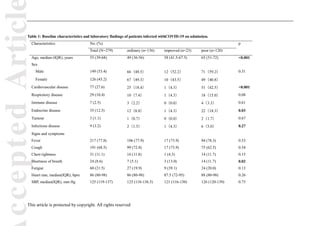
As shown in Table 1, the median age of 279 enrolled patients was 55.0 (IQR 39.0–68.0),
highest in poor group, followed by improved group. Cardiovascular disease (n=77, [27.6%]),
respiratory disease (n=29, [10.4%]), and endocrine disease (n=35, [12.5%]) were the most common
comorbidities.
Infection-induced coagulopathy and secondary hyper-fibrinolysis has been identified in severe
cases of COVID-19 (Ji, et al 2020). As well, higher D-dimer level on admission was related to a
worse prognosis of COVID-19 (Zhou, et al 2020). Thus, we tracked the variations of D-dimer for
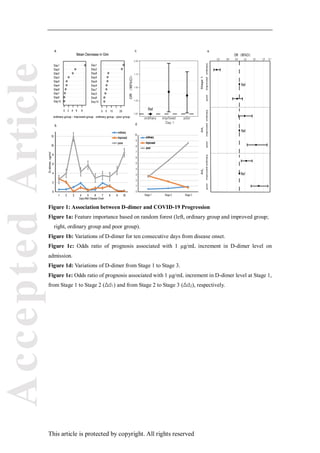
ten consecutive days. Based on random forests, Gini index at Day 1 was obviously higher than that
at the other days in three groups (Figure 1a). On admission, D-dimer level was higher in improved
and poor groups than that in ordinary group. Then, the level decreased gradually in improved group,
but remained high in poor group as the disease deteriorated (Figure 1b). The results were further
adjusted and examined by multinomial logistic regression model. As shown in Figure 1c, on
admission, compared with ordinary group, improved group and poor group demonstrated an odds
ratio (OR) of 1.42 (95%CI: 1.04, 1.96, p=0.03) and 1.35 (95%CI: 1.02, 1.80, p=0.04), respectively
(Table S1). 0.93 (0.78, 1.10)
Further, we separated the ten days into three stages: Stage 1, Day 1; Stage 2, Day 2-5; Stage 3,
Day 6-10. At Stage 1, OR of ordinary group (0.25 (95% CI: 0.16, 0.37, p<0.001)) was obviously
different from that of poor group (0.93 (95%CI: 0.78, 1.10, p=0.37)) (Figure 1d, e). From Stage 1
to Stage 2, D-dimer level increased with disease progression in poor group (1.60 (95%CI: 1.28, 2.00,
p<0.001)), but not in ordinary group (1.19 (95%CI: 0.97, 1.46, p=0.09)) (Figure 1d, e). The same
trend from Stage 2 to Stage 3 was also observed, and the OR of ordinary group and poor group
was1.25 (95%CI: 1.07, 1.47, p=0.07), and 1.71 (95%CI: 1.43, 2.05,p<0.001), respectively (Figure
1d, e). The detailed information was shown in Table S2.
Accepted
Article
This article is protected by copyright. All rights reserved
Pulmonary thrombosis is most responsible for the elevation of D-dimer in severe cases (Wang,
et al 2011). Altough more evidence is needed, our finding is meaningful for the establishment of
early diagnosis and dynamic intervention.
Moreover, it has been well documented that abonomal D-dimer is helpful in indicating deep
venous thrombosis in cardiovascular diseases (Giannitsis, et al 2017). Thus, we analysed the
correlation between D-dimer level with clinical prongnosis inpatients with/without cardiovasucular
disease. First, there was a difference in D-dimer levels of patients with and without cardiovascular
disease in the poor group (p=0.047) (Table S3). Then, among patients with cardiovascular disease
in the poor group, no difference was observed between non-survivors and survivors (p=0.83). Last,
among patients without cardiovascular disease in the poor group, non-survivors had higher D-dimer
levels than survivors (p=0.02).
As for the current therapeutic regimens for COVID-19, no effective antivirals and vaccines
have yet been recommended for patients with COVID-19. A previous report claimed that a D-dimer
level> 1μg/mL was associated with a lower mortality after heparin treatment (Tang, et al 2020a).
Thus, anticoagulant treatment appears to be beneficial in severe COVID-19 cases. Given that non-
survivors had higher D-dimer than survivors among the patients without cardiovascular diseases in
the poor group, timely and effective anticoagulant treatment may be workable.
When administrating anticoagulant treatment, enough attention should be paid to diffuse
alveolar hemorrhage (DAH), which is a life-threatening complication after warfarin use (Kiyota and
Shiota 2019). Thus, international normalized ratio (INR) should be used for early diagnosis and
rapid therapeutic intervention.
Overall, the dynamicly changes of D-dimer level is positively correlated with the prognosis of
COVID-19. Anticoagulant treatment may benefit severe COVID-19 patients, especially those
without cardiovascular diseases.
ACKNOWLEDGMENTS
We thank all patients involved in the study.
AUTHOR CONTRIBUTIONS
Drs Yong Li, Kun Zhao, Hongcheng Wei, Wensen Chen, Zhihang Peng, Yun Liu and Xiaoxiang
Yan had full access to all of the data in the study and take responsibility for the integrity of the data
and the accuracy of the data analysis.
Concept and design: Drs Yong Li, Zhihang Peng, Yun Liu and Xiaoxiang Yan. Acquisition,
analysis, or interpretation of data: All authors. Drafting of the manuscript: Drs Yong Li, Zhihang
Peng, Yun Liu and Xiaoxiang Yan. Critical revision of the manuscript for important intellectual
content: All authors. Statistical analysis: Drs Yong Li, Kun Zhao, Hongcheng Wei, Wensen Chen,
Zhihang Peng, Yun Liu and Xiaoxiang Yan. Supervision: Drs Yong Li and Xiaoxiang Yan.
Accepted
Article
This article is protected by copyright. All rights reserved
CONFLICTS OF INTEREST
The authors declare that they have no conflicts of interest.
FUNDING:
This work was supported by grants from the National key Research & Development plan of
the Ministry of Science and Technology of the People’s Republic of China (Grant no.
2018YFC1314900, 2018YFC1314901).
REFERENCE:
Commission, G.O.o.t.N.H. (2020) Notice on Printing and Distributing the New Coronary
Virus Pneumonia Diagnosis and Treatment Plan (Trial Version 7).
Giannitsis, E., Mair, J., Christersson, C., Siegbahn, A., Huber, K., Jaffe, A.S.,
Peacock, W.F., Plebani, M., Thygesen, K., Mockel, M., Mueller, C. & Lindahl,
B. (2017) How to use D-dimer in acute cardiovascular care. Eur Heart J Acute
Cardiovasc Care, 6, 69-80.
Ji, H.L., Zhao, R., Matalon, S. & Matthay, M.A. (2020) Elevated plasmin(ogen) as a
common risk factor for COVID-19 susceptibility. Physiol Rev.
Kiyota, T. & Shiota, S. (2019) Diffuse Alveolar Hemorrhage Caused by Warfarin after
Rifampicin Discontinuation. 2019, 4917856.
Lu, H., Stratton, C.W. & Tang, Y.W. (2020) Outbreak of pneumonia of unknown etiology
in Wuhan, China: The mystery and the miracle. 92, 401-402.
Luo, W.Y., H.; Gou, J.; Li, X.; Sun, Y.; Li, J.; Liu, L (2020) Clinical Pathology of
Critical Patient with Novel Coronavirus Pneumonia (COVID-19). Preprints,
2020020407.
Tang, N., Bai, H., Chen, X., Gong, J., Li, D. & Sun, Z. (2020a) Anticoagulant
treatment is associated with decreased mortality in severe coronavirus disease
2019 patients with coagulopathy. J Thromb Haemost.
Tang, N., Li, D., Wang, X. & Sun, Z. (2020b) Abnormal coagulation parameters are
associated with poor prognosis in patients with novel coronavirus pneumonia.
J Thromb Haemost, 18, 844-847.
Wang, Z.F., Su, F., Lin, X.J., Dai, B., Kong, L.F., Zhao, H.W. & Kang, J. (2011)
Serum D-dimer changes and prognostic implication in 2009 novel influenza
A(H1N1). Thromb Res, 127, 198-201.
Zhou, F., Yu, T., Du, R., Fan, G., Liu, Y., Liu, Z., Xiang, J., Wang, Y., Song, B.,
Gu, X., Guan, L., Wei, Y., Li, H., Wu, X., Xu, J., Tu, S., Zhang, Y., Chen,
H. & Cao, B. (2020) Clinical course and risk factors for mortality of adult
inpatients with COVID-19 in Wuhan, China: a retrospective cohort study. Lancet,
395, 1054-1062.
Accepted
Article
This article is protected by copyright. All rights reserved
Figure 1: Association between D-dimer and COVID-19 Progression
Figure 1a: Feature importance based on random forest (left, ordinary group and improved group;
right, ordinary group and poor group).
Figure 1b: Variations of D-dimer for ten consecutive days from disease onset.
Figure 1c: Odds ratio of prognosis associated with 1 μg/mL increment in D-dimer level on
admission.
Figure 1d: Variations of D-dimer from Stage 1 to Stage 3.
Figure 1e: Odds ratio of prognosis associated with 1 μg/mL increment in D-dimer level at Stage 1,
from Stage 1 to Stage 2 (Δd1) and from Stage 2 to Stage 3 (Δd2), respectively.
ccepted
Articl
This article is protected by copyright. All rights reserved
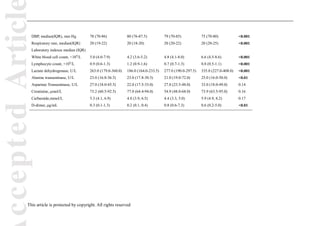
Table 1: Baseline characteristics and laboratory findings of patients infected withCOVID-19 on admission.
Characteristics No. (%) p
Total (N=279) ordinary (n=136) improved (n=23) poor (n=120)
Age, median (IQR), years 55 (39-68) 49 (36-56) 58 (41.5-67.5) 65 (51-72) <0.001
Sex
Male 149 (53.4) 66(48.5) 12(52.2) 71(59.2) 0.31
Female 126 (45.2) 67(49.3) 10(43.5) 49(40.8)
Cardiovascular disease 77 (27.6) 25(18.4) 1(4.3) 51(42.5) <0.001
Respiratory disease 29 (10.4) 10(7.4) 1(4.3) 18(15.0) 0.08
Immune disease 7 (2.5) 3(2.2) 0(0.0) 4(3.3) 0.61
Endocrine disease 35 (12.5) 12(8.8) 1(4.3) 22(18.3) 0.03
Tumour 3 (1.1) 1(0.7) 0(0.0) 2(1.7) 0.67
Infectious disease 9 (3.2) 2(1.5) 1(4.3) 6(5.0) 0.27
Signs and symptoms
Fever 217 (77.8) 106 (77.9) 17 (73.9) 94 (78.3) 0.53
Cough 191 (68.5) 99 (72.8) 17 (73.9) 75 (62.5) 0.54
Chest tightness 31 (11.1) 16 (11.8) 1 (4.3) 14 (11.7) 0.15
Shortness of breath 24 (8.6) 7 (5.1) 3 (13.0) 14 (11.7) 0.02
Fatigue 60 (21.5) 27 (19.9) 9 (39.1) 24 (20.0) 0.13
Heart rate, median(IQR), bpm 86 (80-98) 86 (80-98) 87.5 (72-95) 88 (80-98) 0.26
SBP, median(IQR), mm Hg 125 (119-137) 125 (118-136.5) 121 (116-130) 126 (120-139) 0.73
ccepted
Articl
This article is protected by copyright. All rights reserved
DBP, median(IQR), mm Hg 78 (70-86) 80 (76-87.5) 79 (70-85) 75 (70-80) <0.001
Respiratory rate, median(IQR) 20 (19-22) 20 (18-20) 20 (20-22) 20 (20-25) <0.001
Laboratory indexes median (IQR)
White blood cell count, ×109
/L 5.0 (4.0-7.9) 4.2 (3.6-5.2) 4.8 (4.1-8.0) 6.6 (4.5-8.6) <0.001
Lymphocyte count, ×109
/L 0.9 (0.6-1.3) 1.2 (0.9-1.6) 0.7 (0.7-1.3) 0.8 (0.5-1.1) <0.001
Lactate dehydrogenase, U/L 263.0 (179.0-360.0) 186.0 (164.0-233.5) 277.0 (190.0-297.5) 335.0 (227.0-408.0) <0.001
Alanine transaminase, U/L 23.0 (16.8-36.5) 23.0 (17.8-30.5) 21.0 (19.0-72.0) 25.0 (16.0-50.0) <0.01
Aspartate Transaminase, U/L 27.0 (18.0-45.5) 22.0 (17.5-33.0) 27.0 (23.5-48.0) 33.0 (18.0-49.0) 0.14
Creatinine, μmol/L 73.2 (60.5-92.5) 77.0 (64.4-94.0) 54.9 (48.0-68.0) 73.9 (63.5-95.0) 0.16
Carbamide,mmol/L 5.3 (4.1, 6.9) 4.8 (3.9, 6.5) 4.4 (3.3, 5.0) 5.9 (4.9, 8.2) 0.17
D-dimer, μg/mL 0.3 (0.1-1.3) 0.2 (0.1, 0.4) 0.8 (0.6-7.3) 0.6 (0.2-5.0) <0.01

Yong li

  • 1.
    Accepted Article This article hasbeen accepted for publication and undergone full peer review but has not been through the copyediting, typesetting, pagination and proofreading process, which may lead to differences between this version and the Version of Record. Please cite this article as doi: 10.1111/bjh.16811 This article is protected by copyright. All rights reserved MR. KUN ZHAO (Orcid ID : 0000-0002-0882-9388) Article type : Letters Title: Dynamic relationship between D-dimer and COVID-19 severity Running Title: D-dimer level varies as COVID-19 progresses Yong Li, MD PhD 1# ; Kun Zhao, PhD 1# ; Hongcheng Wei, PhD 2# ; Wensen Chen, MD 3# ; Wei Wang, MD 4 ; Ling Jia, MD 5 ; Qiongfang Liu, MD 6 ; Jinpeng Zhang, MD 7 ; Tao Shan, MD 8 ; Zhihang Peng, MD 9 *; Yun Liu, MD 10 *; Xiaoxiang Yan, MD PhD 11 * 1 Department of Cardiology, the First Affiliated Hospital of Nanjing Medical University, Nanjing, 210029, China 2 State Key Laboratory of Reproductive Medicine, School of Public Health, Nanjing Medical University, Nanjing, 210029, China 3 Department of Infection Management, The First Affiliated Hospital of Nanjing Medical University, Nanjing, Jiangsu, 210029, China 4 Network Information Center, Wuhan No.1 Hospital, No. 215 Liji North Road, Qiaokou District, Wuhan, 430030, China 5 Department of Intensive Care Unit, Sir Run Run Hospital, Nanjing Medical University, 109 Longmian Aenue, Nanjing, Jiangsu 211166, China 6 Department of Infection Management, Wuhan hankou hospital, 2273 Jiefang Avenue, Jiang'an District, Wuhan, 430010, China 7 Department of Critical Care Medicine, Huanggang Central Hospital, NO. 11 Kaopeng Road of Huangzhou District, Huanggang City, Hubei Province, 438300, China 8 Information Department , The First Affiliated Hospital of Nanjing Medical University, Nanjing, Jiangsu, 210029, China 9 Department of Epidemiology and Biostatistics, School of Public Health, Nanjing Medical University, Nanjing, Jiangsu, 211166, China 10 Department of Medical Informatics, School of Biomedical Engineering and Informatics, Nanjing Medical University, Nanjing, Jiangsu, 211166, China 11 Department of Cardiology, Ruijin Hospital, Shanghai Jiao Tong University School of Medicine, 197 Ruijin 2nd Road, Shanghai, 200025, China # These authors contributed equally to this work.
  • 2.
    Accepted Article This article isprotected by copyright. All rights reserved * To whom correspondence should be addressed: Dr. Xiaoxiang Yan, MD PhD Department of Cardiology, Ruijin Hospital Shanghai Jiao Tong University School of Medicine 197 Ruijin 2nd Road, Shanghai 200025, China Tel: 86-21-6445-7177 Fax: 86-21-6445-7177 Email: cardexyanxx@hotmail.com Or Dr Zhihang Peng, MD Department of Epidemiology and Biostatistics, School of Public Health Nanjing Medical University No.101 Longmian Road, Nanjing, Jiangsu 211166, China Email: zhihangpeng@njmu.edu.cn Or Yun Liu, MD Department of Medical Informatics, School of Biomedical Engineering and Informatics Nanjing Medical University No.101 Longmian Road, Nanjing, Jiangsu 211166, China Email: liuyun@njmu.edu.cn KEY POINTS: 1. The dynamic changes of D-dimer level were positively correlated with the severity of COVID- 19. 2. Anticoagulant treatment may reduce the motality of COVID-19 patients, especially those without cardiovascular diseases. Collectively, dynamic observation of D-dimer can help to predict the progression of COVID- 19. In addition, anticoagulant treatment may be benefical for critical COVID-19 patients, even those without cardiovascular disease. KEY WORDS: coagulation parameter, D-dimer, COVID-19, anticoagulant treatment
  • 3.
    Accepted Article This article isprotected by copyright. All rights reserved Letter to the editor: Since December 2019, the seriousness of coronavirus disease 2019 (COVID-19) pandemic has been on escalation (Lu, et al 2020). Coagulopathy is common in critically ill patients with COVID- 19 (Tang, et al 2020b). Systemic microvascular thrombosismay occur in most deaths, which was further identified by a recent autopsy (Luo 2020). However, less has been known about the coagulation parameter D-dimer in the progression of COVID-19. In this study, we describe 279 COVID-19 patients recruited from three hospitals in Hubei Province, China, and then investigate the dynamic relationship between D-dimer level and the progression of COVID-19. According to COVID-19 Diagnosis and Treatment Scheme (Trial Version 7) (Commission 2020), all laboratory-confirmed COVID-19 patients were mild and moderate cases on admission in our study. We further divided them into three groups according to their clinical courses: ordinary group (disease was mild or subsided, n=136); improved group (disease worsened first and was then improved gradually after treatment, n=23); poor group (disease deteriorated and deaths, n=120). On admission, the epidemiological data, comorbidities, and clinical symptoms of patients were obtained (Table 1). Then, we tested coagulation profile for ten consecutive days since admission. As shown in Table 1, the median age of 279 enrolled patients was 55.0 (IQR 39.0–68.0), highest in poor group, followed by improved group. Cardiovascular disease (n=77, [27.6%]), respiratory disease (n=29, [10.4%]), and endocrine disease (n=35, [12.5%]) were the most common comorbidities. Infection-induced coagulopathy and secondary hyper-fibrinolysis has been identified in severe cases of COVID-19 (Ji, et al 2020). As well, higher D-dimer level on admission was related to a worse prognosis of COVID-19 (Zhou, et al 2020). Thus, we tracked the variations of D-dimer for ten consecutive days. Based on random forests, Gini index at Day 1 was obviously higher than that at the other days in three groups (Figure 1a). On admission, D-dimer level was higher in improved and poor groups than that in ordinary group. Then, the level decreased gradually in improved group, but remained high in poor group as the disease deteriorated (Figure 1b). The results were further adjusted and examined by multinomial logistic regression model. As shown in Figure 1c, on admission, compared with ordinary group, improved group and poor group demonstrated an odds ratio (OR) of 1.42 (95%CI: 1.04, 1.96, p=0.03) and 1.35 (95%CI: 1.02, 1.80, p=0.04), respectively (Table S1). 0.93 (0.78, 1.10) Further, we separated the ten days into three stages: Stage 1, Day 1; Stage 2, Day 2-5; Stage 3, Day 6-10. At Stage 1, OR of ordinary group (0.25 (95% CI: 0.16, 0.37, p<0.001)) was obviously different from that of poor group (0.93 (95%CI: 0.78, 1.10, p=0.37)) (Figure 1d, e). From Stage 1 to Stage 2, D-dimer level increased with disease progression in poor group (1.60 (95%CI: 1.28, 2.00, p<0.001)), but not in ordinary group (1.19 (95%CI: 0.97, 1.46, p=0.09)) (Figure 1d, e). The same trend from Stage 2 to Stage 3 was also observed, and the OR of ordinary group and poor group was1.25 (95%CI: 1.07, 1.47, p=0.07), and 1.71 (95%CI: 1.43, 2.05,p<0.001), respectively (Figure 1d, e). The detailed information was shown in Table S2.
  • 4.
    Accepted Article This article isprotected by copyright. All rights reserved Pulmonary thrombosis is most responsible for the elevation of D-dimer in severe cases (Wang, et al 2011). Altough more evidence is needed, our finding is meaningful for the establishment of early diagnosis and dynamic intervention. Moreover, it has been well documented that abonomal D-dimer is helpful in indicating deep venous thrombosis in cardiovascular diseases (Giannitsis, et al 2017). Thus, we analysed the correlation between D-dimer level with clinical prongnosis inpatients with/without cardiovasucular disease. First, there was a difference in D-dimer levels of patients with and without cardiovascular disease in the poor group (p=0.047) (Table S3). Then, among patients with cardiovascular disease in the poor group, no difference was observed between non-survivors and survivors (p=0.83). Last, among patients without cardiovascular disease in the poor group, non-survivors had higher D-dimer levels than survivors (p=0.02). As for the current therapeutic regimens for COVID-19, no effective antivirals and vaccines have yet been recommended for patients with COVID-19. A previous report claimed that a D-dimer level> 1μg/mL was associated with a lower mortality after heparin treatment (Tang, et al 2020a). Thus, anticoagulant treatment appears to be beneficial in severe COVID-19 cases. Given that non- survivors had higher D-dimer than survivors among the patients without cardiovascular diseases in the poor group, timely and effective anticoagulant treatment may be workable. When administrating anticoagulant treatment, enough attention should be paid to diffuse alveolar hemorrhage (DAH), which is a life-threatening complication after warfarin use (Kiyota and Shiota 2019). Thus, international normalized ratio (INR) should be used for early diagnosis and rapid therapeutic intervention. Overall, the dynamicly changes of D-dimer level is positively correlated with the prognosis of COVID-19. Anticoagulant treatment may benefit severe COVID-19 patients, especially those without cardiovascular diseases. ACKNOWLEDGMENTS We thank all patients involved in the study. AUTHOR CONTRIBUTIONS Drs Yong Li, Kun Zhao, Hongcheng Wei, Wensen Chen, Zhihang Peng, Yun Liu and Xiaoxiang Yan had full access to all of the data in the study and take responsibility for the integrity of the data and the accuracy of the data analysis. Concept and design: Drs Yong Li, Zhihang Peng, Yun Liu and Xiaoxiang Yan. Acquisition, analysis, or interpretation of data: All authors. Drafting of the manuscript: Drs Yong Li, Zhihang Peng, Yun Liu and Xiaoxiang Yan. Critical revision of the manuscript for important intellectual content: All authors. Statistical analysis: Drs Yong Li, Kun Zhao, Hongcheng Wei, Wensen Chen, Zhihang Peng, Yun Liu and Xiaoxiang Yan. Supervision: Drs Yong Li and Xiaoxiang Yan.
  • 5.
    Accepted Article This article isprotected by copyright. All rights reserved CONFLICTS OF INTEREST The authors declare that they have no conflicts of interest. FUNDING: This work was supported by grants from the National key Research & Development plan of the Ministry of Science and Technology of the People’s Republic of China (Grant no. 2018YFC1314900, 2018YFC1314901). REFERENCE: Commission, G.O.o.t.N.H. (2020) Notice on Printing and Distributing the New Coronary Virus Pneumonia Diagnosis and Treatment Plan (Trial Version 7). Giannitsis, E., Mair, J., Christersson, C., Siegbahn, A., Huber, K., Jaffe, A.S., Peacock, W.F., Plebani, M., Thygesen, K., Mockel, M., Mueller, C. & Lindahl, B. (2017) How to use D-dimer in acute cardiovascular care. Eur Heart J Acute Cardiovasc Care, 6, 69-80. Ji, H.L., Zhao, R., Matalon, S. & Matthay, M.A. (2020) Elevated plasmin(ogen) as a common risk factor for COVID-19 susceptibility. Physiol Rev. Kiyota, T. & Shiota, S. (2019) Diffuse Alveolar Hemorrhage Caused by Warfarin after Rifampicin Discontinuation. 2019, 4917856. Lu, H., Stratton, C.W. & Tang, Y.W. (2020) Outbreak of pneumonia of unknown etiology in Wuhan, China: The mystery and the miracle. 92, 401-402. Luo, W.Y., H.; Gou, J.; Li, X.; Sun, Y.; Li, J.; Liu, L (2020) Clinical Pathology of Critical Patient with Novel Coronavirus Pneumonia (COVID-19). Preprints, 2020020407. Tang, N., Bai, H., Chen, X., Gong, J., Li, D. & Sun, Z. (2020a) Anticoagulant treatment is associated with decreased mortality in severe coronavirus disease 2019 patients with coagulopathy. J Thromb Haemost. Tang, N., Li, D., Wang, X. & Sun, Z. (2020b) Abnormal coagulation parameters are associated with poor prognosis in patients with novel coronavirus pneumonia. J Thromb Haemost, 18, 844-847. Wang, Z.F., Su, F., Lin, X.J., Dai, B., Kong, L.F., Zhao, H.W. & Kang, J. (2011) Serum D-dimer changes and prognostic implication in 2009 novel influenza A(H1N1). Thromb Res, 127, 198-201. Zhou, F., Yu, T., Du, R., Fan, G., Liu, Y., Liu, Z., Xiang, J., Wang, Y., Song, B., Gu, X., Guan, L., Wei, Y., Li, H., Wu, X., Xu, J., Tu, S., Zhang, Y., Chen, H. & Cao, B. (2020) Clinical course and risk factors for mortality of adult inpatients with COVID-19 in Wuhan, China: a retrospective cohort study. Lancet, 395, 1054-1062.
  • 6.
    Accepted Article This article isprotected by copyright. All rights reserved Figure 1: Association between D-dimer and COVID-19 Progression Figure 1a: Feature importance based on random forest (left, ordinary group and improved group; right, ordinary group and poor group). Figure 1b: Variations of D-dimer for ten consecutive days from disease onset. Figure 1c: Odds ratio of prognosis associated with 1 μg/mL increment in D-dimer level on admission. Figure 1d: Variations of D-dimer from Stage 1 to Stage 3. Figure 1e: Odds ratio of prognosis associated with 1 μg/mL increment in D-dimer level at Stage 1, from Stage 1 to Stage 2 (Δd1) and from Stage 2 to Stage 3 (Δd2), respectively.
  • 7.
    ccepted Articl This article isprotected by copyright. All rights reserved Table 1: Baseline characteristics and laboratory findings of patients infected withCOVID-19 on admission. Characteristics No. (%) p Total (N=279) ordinary (n=136) improved (n=23) poor (n=120) Age, median (IQR), years 55 (39-68) 49 (36-56) 58 (41.5-67.5) 65 (51-72) <0.001 Sex Male 149 (53.4) 66(48.5) 12(52.2) 71(59.2) 0.31 Female 126 (45.2) 67(49.3) 10(43.5) 49(40.8) Cardiovascular disease 77 (27.6) 25(18.4) 1(4.3) 51(42.5) <0.001 Respiratory disease 29 (10.4) 10(7.4) 1(4.3) 18(15.0) 0.08 Immune disease 7 (2.5) 3(2.2) 0(0.0) 4(3.3) 0.61 Endocrine disease 35 (12.5) 12(8.8) 1(4.3) 22(18.3) 0.03 Tumour 3 (1.1) 1(0.7) 0(0.0) 2(1.7) 0.67 Infectious disease 9 (3.2) 2(1.5) 1(4.3) 6(5.0) 0.27 Signs and symptoms Fever 217 (77.8) 106 (77.9) 17 (73.9) 94 (78.3) 0.53 Cough 191 (68.5) 99 (72.8) 17 (73.9) 75 (62.5) 0.54 Chest tightness 31 (11.1) 16 (11.8) 1 (4.3) 14 (11.7) 0.15 Shortness of breath 24 (8.6) 7 (5.1) 3 (13.0) 14 (11.7) 0.02 Fatigue 60 (21.5) 27 (19.9) 9 (39.1) 24 (20.0) 0.13 Heart rate, median(IQR), bpm 86 (80-98) 86 (80-98) 87.5 (72-95) 88 (80-98) 0.26 SBP, median(IQR), mm Hg 125 (119-137) 125 (118-136.5) 121 (116-130) 126 (120-139) 0.73
  • 8.
    ccepted Articl This article isprotected by copyright. All rights reserved DBP, median(IQR), mm Hg 78 (70-86) 80 (76-87.5) 79 (70-85) 75 (70-80) <0.001 Respiratory rate, median(IQR) 20 (19-22) 20 (18-20) 20 (20-22) 20 (20-25) <0.001 Laboratory indexes median (IQR) White blood cell count, ×109 /L 5.0 (4.0-7.9) 4.2 (3.6-5.2) 4.8 (4.1-8.0) 6.6 (4.5-8.6) <0.001 Lymphocyte count, ×109 /L 0.9 (0.6-1.3) 1.2 (0.9-1.6) 0.7 (0.7-1.3) 0.8 (0.5-1.1) <0.001 Lactate dehydrogenase, U/L 263.0 (179.0-360.0) 186.0 (164.0-233.5) 277.0 (190.0-297.5) 335.0 (227.0-408.0) <0.001 Alanine transaminase, U/L 23.0 (16.8-36.5) 23.0 (17.8-30.5) 21.0 (19.0-72.0) 25.0 (16.0-50.0) <0.01 Aspartate Transaminase, U/L 27.0 (18.0-45.5) 22.0 (17.5-33.0) 27.0 (23.5-48.0) 33.0 (18.0-49.0) 0.14 Creatinine, μmol/L 73.2 (60.5-92.5) 77.0 (64.4-94.0) 54.9 (48.0-68.0) 73.9 (63.5-95.0) 0.16 Carbamide,mmol/L 5.3 (4.1, 6.9) 4.8 (3.9, 6.5) 4.4 (3.3, 5.0) 5.9 (4.9, 8.2) 0.17 D-dimer, μg/mL 0.3 (0.1-1.3) 0.2 (0.1, 0.4) 0.8 (0.6-7.3) 0.6 (0.2-5.0) <0.01