291291
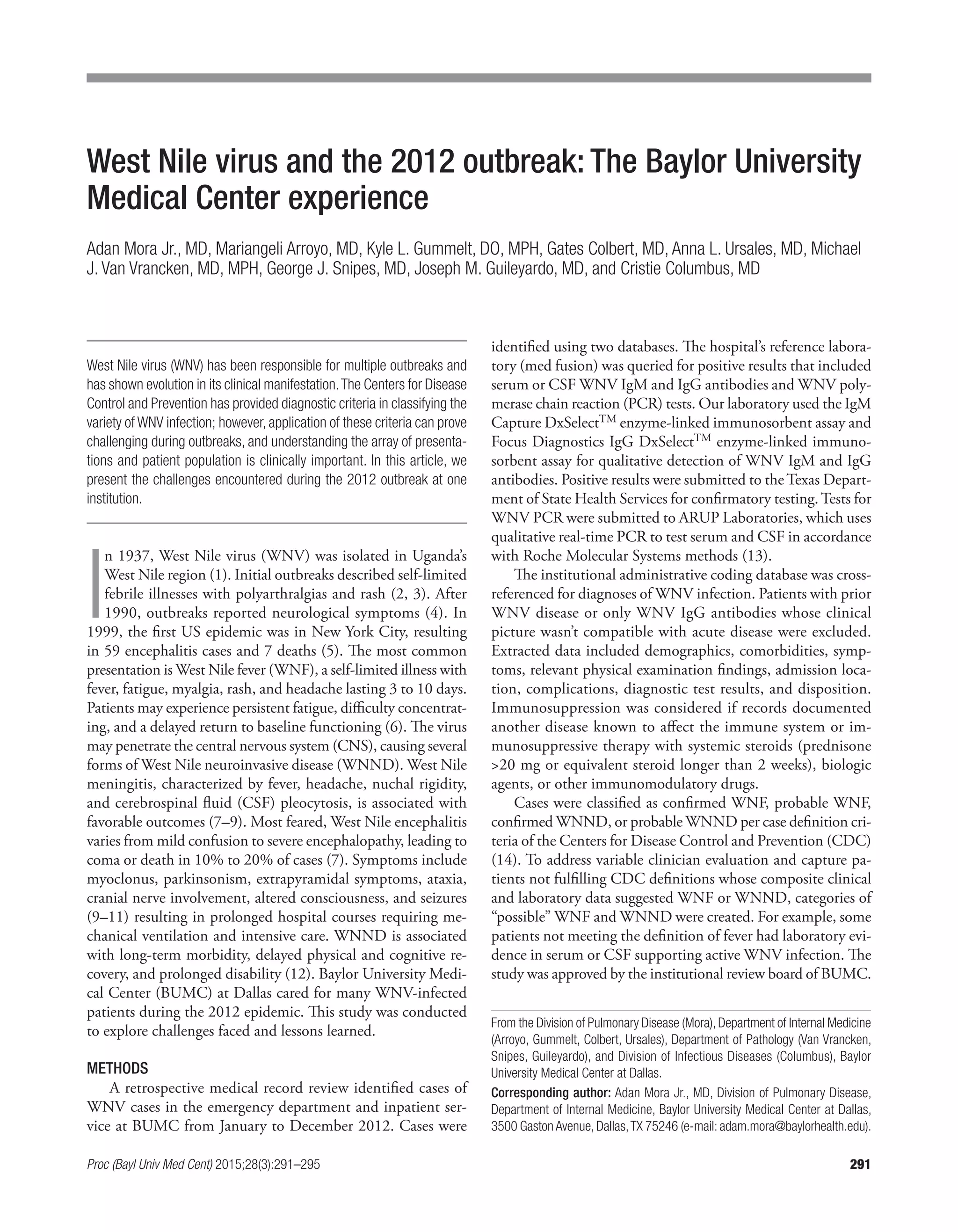
West Nile virus (WNV) has been responsible for multiple outbreaks and
has shown evolution in its clinical manifestation.The Centers for Disease
Control and Prevention has provided diagnostic criteria in classifying the
variety of WNV infection; however, application of these criteria can prove
challenging during outbreaks, and understanding the array of presenta-
tions and patient population is clinically important. In this article, we
present the challenges encountered during the 2012 outbreak at one
institution.
I
n 1937, West Nile virus (WNV) was isolated in Uganda’s
West Nile region (1). Initial outbreaks described self-limited
febrile illnesses with polyarthralgias and rash (2, 3). After
1990, outbreaks reported neurological symptoms (4). In
1999, the first US epidemic was in New York City, resulting
in 59 encephalitis cases and 7 deaths (5). The most common
presentation is West Nile fever (WNF), a self-limited illness with
fever, fatigue, myalgia, rash, and headache lasting 3 to 10 days.
Patients may experience persistent fatigue, difficulty concentrat-
ing, and a delayed return to baseline functioning (6). The virus
may penetrate the central nervous system (CNS), causing several
forms of West Nile neuroinvasive disease (WNND). West Nile
meningitis, characterized by fever, headache, nuchal rigidity,
and cerebrospinal fluid (CSF) pleocytosis, is associated with
favorable outcomes (7–9). Most feared, West Nile encephalitis
varies from mild confusion to severe encephalopathy, leading to
coma or death in 10% to 20% of cases (7). Symptoms include
myoclonus, parkinsonism, extrapyramidal symptoms, ataxia,
cranial nerve involvement, altered consciousness, and seizures
(9–11) resulting in prolonged hospital courses requiring me-
chanical ventilation and intensive care. WNND is associated
with long-term morbidity, delayed physical and cognitive re-
covery, and prolonged disability (12). Baylor University Medi-
cal Center (BUMC) at Dallas cared for many WNV-infected
patients during the 2012 epidemic. This study was conducted
to explore challenges faced and lessons learned.
METHODS
A retrospective medical record review identified cases of
WNV cases in the emergency department and inpatient ser-
vice at BUMC from January to December 2012. Cases were
From the Division of Pulmonary Disease (Mora), Department of Internal Medicine
(Arroyo, Gummelt, Colbert, Ursales), Department of Pathology (Van Vrancken,
Snipes, Guileyardo), and Division of Infectious Diseases (Columbus), Baylor
University Medical Center at Dallas.
Corresponding author: Adan Mora Jr., MD, Division of Pulmonary Disease,
Department of Internal Medicine, Baylor University Medical Center at Dallas,
3500 Gaston Avenue, Dallas,TX 75246 (e-mail: adam.mora@baylorhealth.edu).
identified using two databases. The hospital’s reference labora-
tory (med fusion) was queried for positive results that included
serum or CSF WNV IgM and IgG antibodies and WNV poly-
merase chain reaction (PCR) tests. Our laboratory used the IgM
Capture DxSelectTM enzyme-linked immunosorbent assay and
Focus Diagnostics IgG DxSelectTM enzyme-linked immuno-
sorbent assay for qualitative detection of WNV IgM and IgG
antibodies. Positive results were submitted to theTexas Depart-
ment of State Health Services for confirmatory testing.Tests for
WNV PCR were submitted to ARUP Laboratories, which uses
qualitative real-time PCR to test serum and CSF in accordance
with Roche Molecular Systems methods (13).
The institutional administrative coding database was cross-
referenced for diagnoses of WNV infection. Patients with prior
WNV disease or only WNV IgG antibodies whose clinical
picture wasn’t compatible with acute disease were excluded.
Extracted data included demographics, comorbidities, symp-
toms, relevant physical examination findings, admission loca-
tion, complications, diagnostic test results, and disposition.
Immunosuppression was considered if records documented
another disease known to affect the immune system or im-
munosuppressive therapy with systemic steroids (prednisone
>20 mg or equivalent steroid longer than 2 weeks), biologic
agents, or other immunomodulatory drugs.
Cases were classified as confirmed WNF, probable WNF,
confirmed WNND, or probable WNND per case definition cri-
teria of the Centers for Disease Control and Prevention (CDC)
(14). To address variable clinician evaluation and capture pa-
tients not fulfilling CDC definitions whose composite clinical
and laboratory data suggested WNF or WNND, categories of
“possible” WNF and WNND were created. For example, some
patients not meeting the definition of fever had laboratory evi-
dence in serum or CSF supporting active WNV infection. The
study was approved by the institutional review board of BUMC.
West Nile virus and the 2012 outbreak: The Baylor University
Medical Center experience
Adan Mora Jr., MD, Mariangeli Arroyo, MD, Kyle L. Gummelt, DO, MPH, Gates Colbert, MD, Anna L. Ursales, MD, Michael
J. Van Vrancken, MD, MPH, George J. Snipes, MD, Joseph M. Guileyardo, MD, and Cristie Columbus, MD
Proc (Bayl Univ Med Cent) 2015;28(3):291–295
292292 Baylor University Medical Center Proceedings Volume 28, Number 3
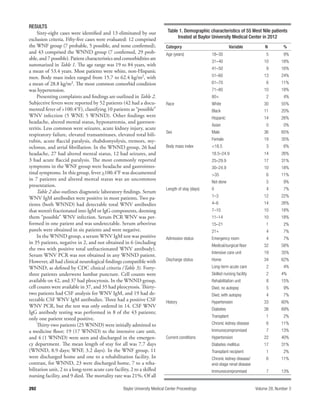
RESULTS
Sixty-eight cases were identified and 13 eliminated by our
exclusion criteria. Fifty-five cases were evaluated: 12 comprised
the WNF group (7 probable, 5 possible, and none confirmed),
and 43 comprised the WNND group (7 confirmed, 29 prob-
able, and 7 possible). Patient characteristics and comorbidities are
summarized in Table 1. The age range was 19 to 84 years, with
a mean of 53.4 years. Most patients were white, non-Hispanic
men. Body mass index ranged from 15.7 to 62.4 kg/m2, with
a mean of 28.8 kg/m2. The most common comorbid condition
was hypertension.
Presenting complaints and findings are outlined in Table 2.
Subjective fevers were reported by 52 patients (42 had a docu-
mented fever of >100.4°F), classifying 10 patients as “possible”
WNV infection (5 WNF, 5 WNND). Other findings were
headache, altered mental status, hyponatremia, and gastroen-
teritis. Less common were seizures, acute kidney injury, acute
respiratory failure, elevated transaminases, elevated total bili-
rubin, acute flaccid paralysis, rhabdomyolysis, tremors, my-
oclonus, and atrial fibrillation. In the WNND group, 26 had
headache, 27 had altered mental status, 12 had seizures, and
3 had acute flaccid paralysis. The most commonly reported
symptoms in the WNF group were headache and gastrointes-
tinal symptoms. In this group, fever >100.4°F was documented
in 7 patients and altered mental status was an uncommon
presentation.
Table 2 also outlines diagnostic laboratory findings. Serum
WNV IgM antibodies were positive in most patients. Two pa-
tients (both WNND) had detectable total WNV antibodies
that weren’t fractionated into IgM or IgG components, deeming
them “possible” WNV infection. Serum PCR WNV was per-
formed in one patient and was undetectable. Serum arbovirus
panels were obtained in six patients and were negative.
In the WNND group, a serum WNV IgM test was positive
in 35 patients, negative in 2, and not obtained in 6 (including
the two with positive total unfractionated WNV antibody).
Serum WNV PCR was not obtained in any WNND patient.
However, all had clinical neurological findings compatible with
WNND, as defined by CDC clinical criteria (Table 3). Forty-
three patients underwent lumbar puncture. Cell counts were
available on 42, and 37 had pleocytosis. In the WNND group,
cell counts were available in 37, and 35 had pleocytosis. Thirty-
two patients had CSF analysis for WNV IgM, and 19 had de-
tectable CSF WNV IgM antibodies. Three had a positive CSF
WNV PCR, but the test was only ordered in 14. CSF WNV
IgG antibody testing was performed in 8 of the 43 patients;
only one patient tested positive.
Thirty-two patients (25 WNND) were initially admitted to
a medicine floor; 19 (17 WNND) to the intensive care unit,
and 4 (1 WNND) were seen and discharged in the emergen-
cy department. The mean length of stay for all was 7.7 days
(WNND, 8.9 days; WNF, 3.2 days). In the WNF group, 11
were discharged home and one to a rehabilitation facility. In
contrast, for WNND, 23 were discharged home, 7 to a reha-
bilitation unit, 2 to a long-term acute care facility, 2 to a skilled
nursing facility, and 9 died. The mortality rate was 21%. Of all
Table 1. Demographic characteristics of 55 West Nile patients
treated at Baylor University Medical Center in 2012
Category Variable N %
Age (years) 18–30 5 9%
31–40 10 18%
41–50 9 16%
51–60 13 24%
61–70 6 11%
71–80 10 18%
80+ 2 4%
Race White 30 55%
Black 11 20%
Hispanic 14 26%
Asian 0 0%
Sex Male 36 65%
Female 19 35%
Body mass index <18.5 3 6%
18.5–24.9 14 26%
25–29.9 17 31%
30–24.9 10 18%
>35 6 11%
Not done 5 9%
Length of stay (days) 0 4 7%
1–3 12 22%
4–6 14 26%
7–10 10 18%
11–14 10 18%
15–21 1 2%
21+ 4 7%
Admission status Emergency room 4 7%
Medical/surgical floor 32 58%
Intensive care unit 19 35%
Discharge status Home 34 62%
Long-term acute care 2 4%
Skilled nursing facility 2 4%
Rehabilitation unit 8 15%
Died, no autopsy 5 9%
Died, with autopsy 4 7%
History Hypertension 33 60%
Diabetes 38 69%
Transplant 1 2%
Chronic kidney disease 6 11%
Immunocompromised 7 13%
Current conditions Hypertension 22 40%
Diabetes mellitus 17 31%
Transplant recipient 1 2%
Chronic kidney disease/
end-stage renal disease
6 11%
Immunocompromised 7 13%
293
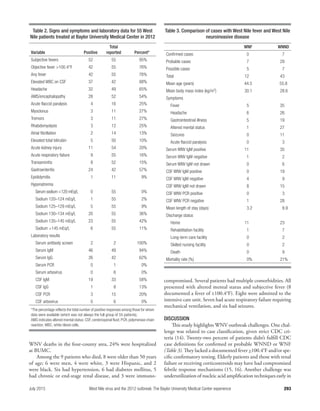
compromised. Several patients had multiple comorbidities. All
presented with altered mental status and subjective fever (8
documented a fever of ≥100.4°F). Eight were admitted to the
intensive care unit. Seven had acute respiratory failure requiring
mechanical ventilation, and six had seizures.
DISCUSSION
This study highlights WNV outbreak challenges. One chal-
lenge was related to case classification, given strict CDC cri-
teria (14). Twenty-two percent of patients didn’t fulfill CDC
case definitions for confirmed or probable WNND or WNF
(Table 3). They lacked a documented fever >100.4°F and/or spe-
cific confirmatory testing. Elderly patients and those with renal
failure or receiving corticosteroids may have had compromised
febrile response mechanisms (15, 16). Another challenge was
underutilization of nucleic acid amplification techniques early in
West Nile virus and the 2012 outbreak: The Baylor University Medical Center experienceJuly 2015
Table 2. Signs and symptoms and laboratory data for 55 West
Nile patients treated at Baylor University Medical Center in 2012
Variable Positive
Total
reported Percent*
Subjective fevers 52 55 95%
Objective fever >100.4°F 42 55 76%
Any fever 42 55 76%
Elevated WBC on CSF 37 42 88%
Headache 32 49 65%
AMS/encephalopathy 28 52 54%
Acute flaccid paralysis 4 16 25%
Myoclonus 3 11 27%
Tremors 3 11 27%
Rhabdomyolysis 3 12 25%
Atrial fibrillation 2 14 13%
Elevated total bilirubin 5 50 10%
Acute kidney injury 11 54 20%
Acute respiratory failure 9 55 16%
Transaminitis 8 52 15%
Gastroenteritis 24 42 57%
Epididymitis 1 11 9%
Hyponatremia
Serum sodium <120 mEq/L 0 55 0%
Sodium 120–124 mEq/L 1 55 2%
Sodium 125–129 mEq/L 5 55 9%
Sodium 130–134 mEq/L 20 55 36%
Sodium 135–145 mEq/L 23 55 42%
Sodium >145 mEq/L 6 55 11%
Laboratory results
Serum antibody screen 2 2 100%
Serum IgM 46 49 94%
Serum IgG 26 42 62%
Serum PCR 0 1 0%
Serum arbovirus 0 6 0%
CSF IgM 19 33 58%
CSF IgG 1 8 13%
CSF PCR 3 15 20%
CSF arbovirus 0 6 0%
*The percentage reflects the total number of positive responses among those for whom
data were available (which was not always the full group of 55 patients).
AMS indicates altered mental status; CSF, cerebrospinal fluid; PCR, polymerase chain
reaction; WBC, white blood cells.
WNV deaths in the four-county area, 24% were hospitalized
at BUMC.
Among the 9 patients who died, 8 were older than 50 years
of age; 6 were men, 4 were white, 3 were Hispanic, and 2
were black. Six had hypertension, 6 had diabetes mellitus, 5
had chronic or end-stage renal disease, and 3 were immuno-
Table 3. Comparison of cases with West Nile fever and West Nile
neuroinvasive disease
WNF WNND
Confirmed cases 0 7
Probable cases 7 29
Possible cases 5 7
Total 12 43
Mean age (years) 44.5 55.8
Mean body mass index (kg/m2) 30.1 28.6
Symptoms
Fever 5 35
Headache 6 26
Gastrointestinal illness 5 19
Altered mental status 1 27
Seizures 0 11
Acute flaccid paralysis 0 3
Serum WNV IgM positive 11 35
Serum WNV IgM negative 1 2
Serum WNV IgM not drawn 0 6
CSF WNV IgM positive 0 19
CSF WNV IgM negative 4 9
CSF WNV IgM not drawn 8 15
CSF WNV PCR positive 0 3
CSF WNV PCR negative 1 28
Mean length of stay (days) 3.2 8.9
Discharge status
Home 11 23
Rehabilitation facility 1 7
Long-term care facility 0 2
Skilled nursing facility 0 2
Death 0 9
Mortality rate (%) 0% 21%
294
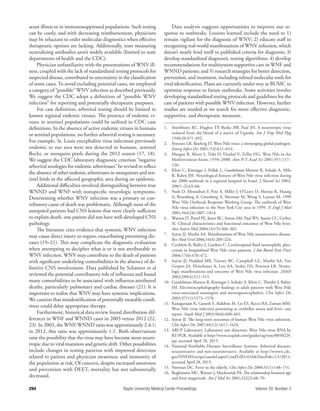
Data analysis suggests opportunities to improve our re-
sponse to outbreaks. Lessons learned include the need to 1)
remain vigilant for the diagnosis of WNV; 2) educate staff in
recognizing real-world manifestations of WNV infection, which
doesn’t neatly lend itself to published criteria for diagnosis; 3)
develop standardized diagnostic testing algorithms; 4) develop
recommendations for multisystem supportive care in WNF and
WNND patients; and 5) research strategies for better detection,
prevention, and treatment, including refined molecular tools for
viral identification. Plans are currently under way at BUMC to
optimize response to future outbreaks. Some activities involve
developing standardized testing protocols and guidelines for the
care of patients with possible WNV infection. However, further
studies are needed as we search for more effective diagnostic,
supportive, and therapeutic measures.
1. Smithburn KC, Hughes TP, Burke AW, Paul JH. A neurotropic virus
isolated from the blood of a native of Uganda. Am J Trop Med Hyg
1940;20:471–492.
2. Petersen LR, Roehrig JT. West Nile virus: a reemerging global pathogen.
Emerg Infect Dis 2001;7(4):611–614.
3. Murgue B, Murri S, Triki H, Deubel V, Zeller HG. West Nile in the
Mediterranean basin: 1950–2000. Ann N Y Acad Sci 2001;951:117–
126.
4. Klein C, Kimiagar I, Pollak L, Gandelman-Marton R, Itzhaki A, Milo
R, Rabey JM. Neurological features of West Nile virus infection during
the 2000 outbreak in a regional hospital in Israel. J Neurol Sci 2002;
200(1–2):63–66.
5. Nash D, Mostashari F, Fine A, Miller J, O’Leary D, Murray K, Huang
A, Rosenberg A, Greenberg A, Sherman M, Wong S, Layton M; 1999
West Nile Outbreak Response Working Group. The outbreak of West
Nile virus infection in the New York City area in 1999. N Engl J Med
2001;344(24):1807–1814.
6. Watson JT, Pertel PE, Jones RC, Siston AM, Paul WS, Austin CC, Gerber
SI. Clinical characteristics and functional outcomes of West Nile fever.
Ann Intern Med 2004;141(5):360–365.
7. Sejvar JJ, Marfin AA. Manifestations of West Nile neuroinvasive disease.
Rev Med Virol 2006;16(4):209–224.
8. Crichlow R, Bailey J, Gardner C. Cerebrospinal fluid neutrophilic pleo-
cytosis in hospitalized West Nile virus patients. J Am Board Fam Pract
2004;17(6):470–472.
9. Sejvar JJ, Haddad MB, Tierney BC, Campbell GL, Marfin AA, Van
Gerpen JA, Fleischauer A, Leis AA, Stokic DS, Petersen LR. Neuro-
logic manifestations and outcome of West Nile virus infection. JAMA
2003;290(4):511–515.
10. Gandelman-Marton R, Kimiagar I, Itzhaki A, Klein C, Theitler J, Rabey
JM. Electroencephalography findings in adult patients with West Nile
virus-associated meningitis and meningoencephalitis. Clin Infect Dis
2003;37(11):1573–1578.
11. Kanagarajan K, Ganesh S, Alakhras M, Go ES, Recco RA, Zaman MM.
West Nile virus infection presenting as cerebellar ataxia and fever: case
report. South Med J 2003;96(6):600–601.
12. Sejvar JJ. The long-term outcomes of human West Nile virus infection.
Clin Infect Dis 2007;44(12):1617–1624.
13. ARUP Laboratory. Laboratory test directory: West Nile virus RNA by
RT-PCR. Available at http://www.aruplab.com/guides/ug/tests/0050229.
jsp; accessed April 28, 2015.
14. National Notifiable Diseases Surveillance Systems. Arboviral diseases,
neuroinvasive and non-neuroinvasive. Available at http://wwwn.cdc.
gov/NNDSS/script/casedef.aspx?CondYrID=616&DatePub=1/1/2011;
accessed April 28, 2015.
15. Norman DC. Fever in the elderly. Clin Infect Dis 2000;31(1):148–151.
16. Roghmann MC, Warner J, Mackowiak PA. The relationship between age
and fever magnitude. Am J Med Sci 2001;322(2):68–70.
Baylor University Medical Center Proceedings Volume 28, Number 3
acute illness or in immunosuppressed populations. Such testing
can be costly, and with decreasing reimbursement, physicians
may be reluctant to order molecular diagnostics when effective
therapeutic options are lacking. Additionally, tests measuring
neutralizing antibodies aren’t widely available (limited to state
departments of health and the CDC).
Physician unfamiliarity with the presentations of WNV ill-
ness, coupled with the lack of standardized testing protocols for
suspected disease, contributed to uncertainty in the classification
of some cases. To avoid excluding potential cases, we employed
a category of “possible” WNV infection as described previously.
We suggest the CDC adopt a definition of “possible WNV
infection” for reporting and potentially therapeutic purposes.
For case definition, arboviral testing should be limited to
known regional endemic viruses. The presence of endemic vi-
ruses in sentinel populations could be utilized in CDC case
definitions. In the absence of active endemic viruses in humans
or sentinel populations, no further arboviral testing is necessary.
For example, St. Louis encephalitis virus infections previously
endemic to our area were not detected in humans, sentinel
flocks, or mosquito pools during the 2012 season (17, 18).
We suggest the CDC laboratory diagnostic criterion “negative
arboviral serologies for endemic arboviruses” be revised to reflect
the absence of other endemic arboviruses in mosquitoes and sen-
tinel birds in the affected geographic area during an epidemic.
Additional difficulties involved distinguishing between true
WNND and WNF with nonspecific neurologic symptoms.
Determining whether WNV infection was a primary or con-
tributory cause of death was problematic. Although most of the
autopsied patients had CNS lesions that were clearly sufficient
to explain death, one patient did not have well-developed CNS
pathology.
The literature cites evidence that systemic WNV infection
may cause direct injury to organs, exacerbating preexisting dis-
eases (19–21). This may complicate the diagnostic evaluation
when attempting to decipher what is or is not attributable to
WNV infection. WNV may contribute to the death of patients
with significant underlying comorbidities in the absence of de-
finitive CNS involvement. Data published by Schanzer et al
reviewed the potential contributory role of influenza and found
many comorbidities to be associated with influenza-attributed
deaths, particularly pulmonary and cardiac diseases (21). It is
important to realize that WNV may have systemic implications.
We caution that misidentification of potentially treatable condi-
tions could delay appropriate therapy.
Furthermore, historical data review found distribution dif-
ferences in WNF and WNND cases in 2003 versus 2012 (22,
23). In 2003, the WNF:WNND ratio was approximately 2.4:1;
in 2012, this ratio was approximately 1:1. Both observations
raise the possibility that the virus may have become more neuro-
tropic due to viral mutation and genetic drift. Other possibilities
include changes in testing patterns with improved detection
related to patient and physician awareness and immunity of
the population at risk. Of concern, despite increased awareness
and prevention with DEET, mortality has not substantially
decreased.
295
17. Unites States Geological Survey. St. Louis encephalitis, human, Texas,
2012. Available at http://diseasemaps.usgs.gov/2012/sle_tx_human.html;
retrieved April 28, 2015.
18. Unites States Geological Survey. St. Louis encephalitis, sentinel, Texas,
2012. Available at http://diseasemaps.usgs.gov/2012/sle_tx_sentinel.html;
retrieved April 28, 2015.
19. Pergam SA, DeLong CE, Echevarria L, Scully G, Goade DE. Myocarditis
in West Nile virus infection. Am JTrop Med Hyg 2006;75(6):1232–1233.
20. Georges AJ, Lesbordes JL, Georges-Courbot MC, Meunier DMY,
Gonzalez JP. Fatal hepatitis from West Nile virus. Ann Inst Pasteur Virol
1987;138(2):237–244.
21. Schanzer DL,TamTW, Langley JM, Winchester BT. Influenza-attributable
deaths, Canada 1990–1999. Epidemiol Infect 2007;135(7):1109–1116.
22. Centers for Disease Control and Prevention. West Nile virus disease cases
and presumptive viremic blood donors reported to ArboNET, United
States, 2003. Available at http://www.cdc.gov/westnile/statsMaps/final-
MapsData/data/2003WNVHumanInfectionsbyState.pdf; accessed April
28, 2015.
23. Centers for Disease Control and Prevention. West Nile virus disease cases
and presumptive viremic blood donors reported to ArboNET, United States,
2012. Available at http://www.cdc.gov/westnile/statsMaps/finalMapsData/
data/2012WNVHumanInfectionsbyState.pdf; accessed April 28, 2015.
West Nile virus and the 2012 outbreak: The Baylor University Medical Center experienceJuly 2015
Acknowledgment of contributors
B
aylor University Medical Center Proceedings couldn’t exist without writers or without readers, but it
also couldn’t exist without financial support. Here we wish to acknowledge our individual donors
who sent in gifts between August 7, 2014, and May 6, 2015.
Leadership Gifts ($500+)
Pierce M. Allman
James W. Choi
Roger S. Khetan
Göran B. Klintmalm
Michael A. Ramsay
William C. Roberts
Barbara Glazer Rosenblatt and
Randall Lee Rosenblatt Family
F. David Winter
Scott W. Yates
Benefactor ($250 to $499)
Evangeline T. Cayton
David L. Glancy
Zelig H. Lieberman
Marvin J. Stone
Carlos E. Velasco
Associate ($100 to $249)
Peter A. Alivizatos
Edward P. Allen
Gayle Allison
Anonymous
Larry J. Barker
Patricia L. Blanton
Christopher J. Bolton
Robert S. Capper
John C. Carson
Christ Medical Center DOM
Barry Cooper
Andrew Z. Fenves
Steve M. Frost
Gary N. Gross
Robert D. Gross
Joseph M. Guileyardo
H. A. T. Hein
D. M. Highbaugh
Ronald C. Jones
Kari M. Klaskin
John R. Krause
Millie H. Lathan
Harold M. Mims
John C. O’Brien
Steven J. Phillips
Daniel E. Polter
Patrick H. Pownell
Irving D. Prengler
Mrs. Maruf A. Razzuk
Stewart R. Roberts
Andrew C. Sambell
Robert F. Sanford
Steve P. Schoettle
Scruggs Family Charitable Fund
Craig A. Troop
Barry N. Wilcox
Friend (to $99)
Anonymous
Zaven H. Chakmakjian
John E. Eisenlohr
George P. Fosmire
Frisco Medical Center, LLP
Gabriele B. Gruschkus
Maria Kalman
Frederick J. Koberg
Marion Luecke
Thomas W. Newsome
Ali A. Shams
Curtis L. Studey
Joan Windmiller
Jean Woods
The total amount raised this period from indi-
vidual donors was $15,151. Any additional
donations can be sent to the editorial office
or the BHCS Foundation office and will be
acknowledged in the July 2016 issue.

bumc0028-0291

  • 1.
    291291 West Nile virus(WNV) has been responsible for multiple outbreaks and has shown evolution in its clinical manifestation.The Centers for Disease Control and Prevention has provided diagnostic criteria in classifying the variety of WNV infection; however, application of these criteria can prove challenging during outbreaks, and understanding the array of presenta- tions and patient population is clinically important. In this article, we present the challenges encountered during the 2012 outbreak at one institution. I n 1937, West Nile virus (WNV) was isolated in Uganda’s West Nile region (1). Initial outbreaks described self-limited febrile illnesses with polyarthralgias and rash (2, 3). After 1990, outbreaks reported neurological symptoms (4). In 1999, the first US epidemic was in New York City, resulting in 59 encephalitis cases and 7 deaths (5). The most common presentation is West Nile fever (WNF), a self-limited illness with fever, fatigue, myalgia, rash, and headache lasting 3 to 10 days. Patients may experience persistent fatigue, difficulty concentrat- ing, and a delayed return to baseline functioning (6). The virus may penetrate the central nervous system (CNS), causing several forms of West Nile neuroinvasive disease (WNND). West Nile meningitis, characterized by fever, headache, nuchal rigidity, and cerebrospinal fluid (CSF) pleocytosis, is associated with favorable outcomes (7–9). Most feared, West Nile encephalitis varies from mild confusion to severe encephalopathy, leading to coma or death in 10% to 20% of cases (7). Symptoms include myoclonus, parkinsonism, extrapyramidal symptoms, ataxia, cranial nerve involvement, altered consciousness, and seizures (9–11) resulting in prolonged hospital courses requiring me- chanical ventilation and intensive care. WNND is associated with long-term morbidity, delayed physical and cognitive re- covery, and prolonged disability (12). Baylor University Medi- cal Center (BUMC) at Dallas cared for many WNV-infected patients during the 2012 epidemic. This study was conducted to explore challenges faced and lessons learned. METHODS A retrospective medical record review identified cases of WNV cases in the emergency department and inpatient ser- vice at BUMC from January to December 2012. Cases were From the Division of Pulmonary Disease (Mora), Department of Internal Medicine (Arroyo, Gummelt, Colbert, Ursales), Department of Pathology (Van Vrancken, Snipes, Guileyardo), and Division of Infectious Diseases (Columbus), Baylor University Medical Center at Dallas. Corresponding author: Adan Mora Jr., MD, Division of Pulmonary Disease, Department of Internal Medicine, Baylor University Medical Center at Dallas, 3500 Gaston Avenue, Dallas,TX 75246 (e-mail: adam.mora@baylorhealth.edu). identified using two databases. The hospital’s reference labora- tory (med fusion) was queried for positive results that included serum or CSF WNV IgM and IgG antibodies and WNV poly- merase chain reaction (PCR) tests. Our laboratory used the IgM Capture DxSelectTM enzyme-linked immunosorbent assay and Focus Diagnostics IgG DxSelectTM enzyme-linked immuno- sorbent assay for qualitative detection of WNV IgM and IgG antibodies. Positive results were submitted to theTexas Depart- ment of State Health Services for confirmatory testing.Tests for WNV PCR were submitted to ARUP Laboratories, which uses qualitative real-time PCR to test serum and CSF in accordance with Roche Molecular Systems methods (13). The institutional administrative coding database was cross- referenced for diagnoses of WNV infection. Patients with prior WNV disease or only WNV IgG antibodies whose clinical picture wasn’t compatible with acute disease were excluded. Extracted data included demographics, comorbidities, symp- toms, relevant physical examination findings, admission loca- tion, complications, diagnostic test results, and disposition. Immunosuppression was considered if records documented another disease known to affect the immune system or im- munosuppressive therapy with systemic steroids (prednisone >20 mg or equivalent steroid longer than 2 weeks), biologic agents, or other immunomodulatory drugs. Cases were classified as confirmed WNF, probable WNF, confirmed WNND, or probable WNND per case definition cri- teria of the Centers for Disease Control and Prevention (CDC) (14). To address variable clinician evaluation and capture pa- tients not fulfilling CDC definitions whose composite clinical and laboratory data suggested WNF or WNND, categories of “possible” WNF and WNND were created. For example, some patients not meeting the definition of fever had laboratory evi- dence in serum or CSF supporting active WNV infection. The study was approved by the institutional review board of BUMC. West Nile virus and the 2012 outbreak: The Baylor University Medical Center experience Adan Mora Jr., MD, Mariangeli Arroyo, MD, Kyle L. Gummelt, DO, MPH, Gates Colbert, MD, Anna L. Ursales, MD, Michael J. Van Vrancken, MD, MPH, George J. Snipes, MD, Joseph M. Guileyardo, MD, and Cristie Columbus, MD Proc (Bayl Univ Med Cent) 2015;28(3):291–295
  • 2.
    292292 Baylor UniversityMedical Center Proceedings Volume 28, Number 3 RESULTS Sixty-eight cases were identified and 13 eliminated by our exclusion criteria. Fifty-five cases were evaluated: 12 comprised the WNF group (7 probable, 5 possible, and none confirmed), and 43 comprised the WNND group (7 confirmed, 29 prob- able, and 7 possible). Patient characteristics and comorbidities are summarized in Table 1. The age range was 19 to 84 years, with a mean of 53.4 years. Most patients were white, non-Hispanic men. Body mass index ranged from 15.7 to 62.4 kg/m2, with a mean of 28.8 kg/m2. The most common comorbid condition was hypertension. Presenting complaints and findings are outlined in Table 2. Subjective fevers were reported by 52 patients (42 had a docu- mented fever of >100.4°F), classifying 10 patients as “possible” WNV infection (5 WNF, 5 WNND). Other findings were headache, altered mental status, hyponatremia, and gastroen- teritis. Less common were seizures, acute kidney injury, acute respiratory failure, elevated transaminases, elevated total bili- rubin, acute flaccid paralysis, rhabdomyolysis, tremors, my- oclonus, and atrial fibrillation. In the WNND group, 26 had headache, 27 had altered mental status, 12 had seizures, and 3 had acute flaccid paralysis. The most commonly reported symptoms in the WNF group were headache and gastrointes- tinal symptoms. In this group, fever >100.4°F was documented in 7 patients and altered mental status was an uncommon presentation. Table 2 also outlines diagnostic laboratory findings. Serum WNV IgM antibodies were positive in most patients. Two pa- tients (both WNND) had detectable total WNV antibodies that weren’t fractionated into IgM or IgG components, deeming them “possible” WNV infection. Serum PCR WNV was per- formed in one patient and was undetectable. Serum arbovirus panels were obtained in six patients and were negative. In the WNND group, a serum WNV IgM test was positive in 35 patients, negative in 2, and not obtained in 6 (including the two with positive total unfractionated WNV antibody). Serum WNV PCR was not obtained in any WNND patient. However, all had clinical neurological findings compatible with WNND, as defined by CDC clinical criteria (Table 3). Forty- three patients underwent lumbar puncture. Cell counts were available on 42, and 37 had pleocytosis. In the WNND group, cell counts were available in 37, and 35 had pleocytosis. Thirty- two patients had CSF analysis for WNV IgM, and 19 had de- tectable CSF WNV IgM antibodies. Three had a positive CSF WNV PCR, but the test was only ordered in 14. CSF WNV IgG antibody testing was performed in 8 of the 43 patients; only one patient tested positive. Thirty-two patients (25 WNND) were initially admitted to a medicine floor; 19 (17 WNND) to the intensive care unit, and 4 (1 WNND) were seen and discharged in the emergen- cy department. The mean length of stay for all was 7.7 days (WNND, 8.9 days; WNF, 3.2 days). In the WNF group, 11 were discharged home and one to a rehabilitation facility. In contrast, for WNND, 23 were discharged home, 7 to a reha- bilitation unit, 2 to a long-term acute care facility, 2 to a skilled nursing facility, and 9 died. The mortality rate was 21%. Of all Table 1. Demographic characteristics of 55 West Nile patients treated at Baylor University Medical Center in 2012 Category Variable N % Age (years) 18–30 5 9% 31–40 10 18% 41–50 9 16% 51–60 13 24% 61–70 6 11% 71–80 10 18% 80+ 2 4% Race White 30 55% Black 11 20% Hispanic 14 26% Asian 0 0% Sex Male 36 65% Female 19 35% Body mass index <18.5 3 6% 18.5–24.9 14 26% 25–29.9 17 31% 30–24.9 10 18% >35 6 11% Not done 5 9% Length of stay (days) 0 4 7% 1–3 12 22% 4–6 14 26% 7–10 10 18% 11–14 10 18% 15–21 1 2% 21+ 4 7% Admission status Emergency room 4 7% Medical/surgical floor 32 58% Intensive care unit 19 35% Discharge status Home 34 62% Long-term acute care 2 4% Skilled nursing facility 2 4% Rehabilitation unit 8 15% Died, no autopsy 5 9% Died, with autopsy 4 7% History Hypertension 33 60% Diabetes 38 69% Transplant 1 2% Chronic kidney disease 6 11% Immunocompromised 7 13% Current conditions Hypertension 22 40% Diabetes mellitus 17 31% Transplant recipient 1 2% Chronic kidney disease/ end-stage renal disease 6 11% Immunocompromised 7 13%
  • 3.
    293 compromised. Several patientshad multiple comorbidities. All presented with altered mental status and subjective fever (8 documented a fever of ≥100.4°F). Eight were admitted to the intensive care unit. Seven had acute respiratory failure requiring mechanical ventilation, and six had seizures. DISCUSSION This study highlights WNV outbreak challenges. One chal- lenge was related to case classification, given strict CDC cri- teria (14). Twenty-two percent of patients didn’t fulfill CDC case definitions for confirmed or probable WNND or WNF (Table 3). They lacked a documented fever >100.4°F and/or spe- cific confirmatory testing. Elderly patients and those with renal failure or receiving corticosteroids may have had compromised febrile response mechanisms (15, 16). Another challenge was underutilization of nucleic acid amplification techniques early in West Nile virus and the 2012 outbreak: The Baylor University Medical Center experienceJuly 2015 Table 2. Signs and symptoms and laboratory data for 55 West Nile patients treated at Baylor University Medical Center in 2012 Variable Positive Total reported Percent* Subjective fevers 52 55 95% Objective fever >100.4°F 42 55 76% Any fever 42 55 76% Elevated WBC on CSF 37 42 88% Headache 32 49 65% AMS/encephalopathy 28 52 54% Acute flaccid paralysis 4 16 25% Myoclonus 3 11 27% Tremors 3 11 27% Rhabdomyolysis 3 12 25% Atrial fibrillation 2 14 13% Elevated total bilirubin 5 50 10% Acute kidney injury 11 54 20% Acute respiratory failure 9 55 16% Transaminitis 8 52 15% Gastroenteritis 24 42 57% Epididymitis 1 11 9% Hyponatremia Serum sodium <120 mEq/L 0 55 0% Sodium 120–124 mEq/L 1 55 2% Sodium 125–129 mEq/L 5 55 9% Sodium 130–134 mEq/L 20 55 36% Sodium 135–145 mEq/L 23 55 42% Sodium >145 mEq/L 6 55 11% Laboratory results Serum antibody screen 2 2 100% Serum IgM 46 49 94% Serum IgG 26 42 62% Serum PCR 0 1 0% Serum arbovirus 0 6 0% CSF IgM 19 33 58% CSF IgG 1 8 13% CSF PCR 3 15 20% CSF arbovirus 0 6 0% *The percentage reflects the total number of positive responses among those for whom data were available (which was not always the full group of 55 patients). AMS indicates altered mental status; CSF, cerebrospinal fluid; PCR, polymerase chain reaction; WBC, white blood cells. WNV deaths in the four-county area, 24% were hospitalized at BUMC. Among the 9 patients who died, 8 were older than 50 years of age; 6 were men, 4 were white, 3 were Hispanic, and 2 were black. Six had hypertension, 6 had diabetes mellitus, 5 had chronic or end-stage renal disease, and 3 were immuno- Table 3. Comparison of cases with West Nile fever and West Nile neuroinvasive disease WNF WNND Confirmed cases 0 7 Probable cases 7 29 Possible cases 5 7 Total 12 43 Mean age (years) 44.5 55.8 Mean body mass index (kg/m2) 30.1 28.6 Symptoms Fever 5 35 Headache 6 26 Gastrointestinal illness 5 19 Altered mental status 1 27 Seizures 0 11 Acute flaccid paralysis 0 3 Serum WNV IgM positive 11 35 Serum WNV IgM negative 1 2 Serum WNV IgM not drawn 0 6 CSF WNV IgM positive 0 19 CSF WNV IgM negative 4 9 CSF WNV IgM not drawn 8 15 CSF WNV PCR positive 0 3 CSF WNV PCR negative 1 28 Mean length of stay (days) 3.2 8.9 Discharge status Home 11 23 Rehabilitation facility 1 7 Long-term care facility 0 2 Skilled nursing facility 0 2 Death 0 9 Mortality rate (%) 0% 21%
  • 4.
    294 Data analysis suggestsopportunities to improve our re- sponse to outbreaks. Lessons learned include the need to 1) remain vigilant for the diagnosis of WNV; 2) educate staff in recognizing real-world manifestations of WNV infection, which doesn’t neatly lend itself to published criteria for diagnosis; 3) develop standardized diagnostic testing algorithms; 4) develop recommendations for multisystem supportive care in WNF and WNND patients; and 5) research strategies for better detection, prevention, and treatment, including refined molecular tools for viral identification. Plans are currently under way at BUMC to optimize response to future outbreaks. Some activities involve developing standardized testing protocols and guidelines for the care of patients with possible WNV infection. However, further studies are needed as we search for more effective diagnostic, supportive, and therapeutic measures. 1. Smithburn KC, Hughes TP, Burke AW, Paul JH. A neurotropic virus isolated from the blood of a native of Uganda. Am J Trop Med Hyg 1940;20:471–492. 2. Petersen LR, Roehrig JT. West Nile virus: a reemerging global pathogen. Emerg Infect Dis 2001;7(4):611–614. 3. Murgue B, Murri S, Triki H, Deubel V, Zeller HG. West Nile in the Mediterranean basin: 1950–2000. Ann N Y Acad Sci 2001;951:117– 126. 4. Klein C, Kimiagar I, Pollak L, Gandelman-Marton R, Itzhaki A, Milo R, Rabey JM. Neurological features of West Nile virus infection during the 2000 outbreak in a regional hospital in Israel. J Neurol Sci 2002; 200(1–2):63–66. 5. Nash D, Mostashari F, Fine A, Miller J, O’Leary D, Murray K, Huang A, Rosenberg A, Greenberg A, Sherman M, Wong S, Layton M; 1999 West Nile Outbreak Response Working Group. The outbreak of West Nile virus infection in the New York City area in 1999. N Engl J Med 2001;344(24):1807–1814. 6. Watson JT, Pertel PE, Jones RC, Siston AM, Paul WS, Austin CC, Gerber SI. Clinical characteristics and functional outcomes of West Nile fever. Ann Intern Med 2004;141(5):360–365. 7. Sejvar JJ, Marfin AA. Manifestations of West Nile neuroinvasive disease. Rev Med Virol 2006;16(4):209–224. 8. Crichlow R, Bailey J, Gardner C. Cerebrospinal fluid neutrophilic pleo- cytosis in hospitalized West Nile virus patients. J Am Board Fam Pract 2004;17(6):470–472. 9. Sejvar JJ, Haddad MB, Tierney BC, Campbell GL, Marfin AA, Van Gerpen JA, Fleischauer A, Leis AA, Stokic DS, Petersen LR. Neuro- logic manifestations and outcome of West Nile virus infection. JAMA 2003;290(4):511–515. 10. Gandelman-Marton R, Kimiagar I, Itzhaki A, Klein C, Theitler J, Rabey JM. Electroencephalography findings in adult patients with West Nile virus-associated meningitis and meningoencephalitis. Clin Infect Dis 2003;37(11):1573–1578. 11. Kanagarajan K, Ganesh S, Alakhras M, Go ES, Recco RA, Zaman MM. West Nile virus infection presenting as cerebellar ataxia and fever: case report. South Med J 2003;96(6):600–601. 12. Sejvar JJ. The long-term outcomes of human West Nile virus infection. Clin Infect Dis 2007;44(12):1617–1624. 13. ARUP Laboratory. Laboratory test directory: West Nile virus RNA by RT-PCR. Available at http://www.aruplab.com/guides/ug/tests/0050229. jsp; accessed April 28, 2015. 14. National Notifiable Diseases Surveillance Systems. Arboviral diseases, neuroinvasive and non-neuroinvasive. Available at http://wwwn.cdc. gov/NNDSS/script/casedef.aspx?CondYrID=616&DatePub=1/1/2011; accessed April 28, 2015. 15. Norman DC. Fever in the elderly. Clin Infect Dis 2000;31(1):148–151. 16. Roghmann MC, Warner J, Mackowiak PA. The relationship between age and fever magnitude. Am J Med Sci 2001;322(2):68–70. Baylor University Medical Center Proceedings Volume 28, Number 3 acute illness or in immunosuppressed populations. Such testing can be costly, and with decreasing reimbursement, physicians may be reluctant to order molecular diagnostics when effective therapeutic options are lacking. Additionally, tests measuring neutralizing antibodies aren’t widely available (limited to state departments of health and the CDC). Physician unfamiliarity with the presentations of WNV ill- ness, coupled with the lack of standardized testing protocols for suspected disease, contributed to uncertainty in the classification of some cases. To avoid excluding potential cases, we employed a category of “possible” WNV infection as described previously. We suggest the CDC adopt a definition of “possible WNV infection” for reporting and potentially therapeutic purposes. For case definition, arboviral testing should be limited to known regional endemic viruses. The presence of endemic vi- ruses in sentinel populations could be utilized in CDC case definitions. In the absence of active endemic viruses in humans or sentinel populations, no further arboviral testing is necessary. For example, St. Louis encephalitis virus infections previously endemic to our area were not detected in humans, sentinel flocks, or mosquito pools during the 2012 season (17, 18). We suggest the CDC laboratory diagnostic criterion “negative arboviral serologies for endemic arboviruses” be revised to reflect the absence of other endemic arboviruses in mosquitoes and sen- tinel birds in the affected geographic area during an epidemic. Additional difficulties involved distinguishing between true WNND and WNF with nonspecific neurologic symptoms. Determining whether WNV infection was a primary or con- tributory cause of death was problematic. Although most of the autopsied patients had CNS lesions that were clearly sufficient to explain death, one patient did not have well-developed CNS pathology. The literature cites evidence that systemic WNV infection may cause direct injury to organs, exacerbating preexisting dis- eases (19–21). This may complicate the diagnostic evaluation when attempting to decipher what is or is not attributable to WNV infection. WNV may contribute to the death of patients with significant underlying comorbidities in the absence of de- finitive CNS involvement. Data published by Schanzer et al reviewed the potential contributory role of influenza and found many comorbidities to be associated with influenza-attributed deaths, particularly pulmonary and cardiac diseases (21). It is important to realize that WNV may have systemic implications. We caution that misidentification of potentially treatable condi- tions could delay appropriate therapy. Furthermore, historical data review found distribution dif- ferences in WNF and WNND cases in 2003 versus 2012 (22, 23). In 2003, the WNF:WNND ratio was approximately 2.4:1; in 2012, this ratio was approximately 1:1. Both observations raise the possibility that the virus may have become more neuro- tropic due to viral mutation and genetic drift. Other possibilities include changes in testing patterns with improved detection related to patient and physician awareness and immunity of the population at risk. Of concern, despite increased awareness and prevention with DEET, mortality has not substantially decreased.
  • 5.
    295 17. Unites StatesGeological Survey. St. Louis encephalitis, human, Texas, 2012. Available at http://diseasemaps.usgs.gov/2012/sle_tx_human.html; retrieved April 28, 2015. 18. Unites States Geological Survey. St. Louis encephalitis, sentinel, Texas, 2012. Available at http://diseasemaps.usgs.gov/2012/sle_tx_sentinel.html; retrieved April 28, 2015. 19. Pergam SA, DeLong CE, Echevarria L, Scully G, Goade DE. Myocarditis in West Nile virus infection. Am JTrop Med Hyg 2006;75(6):1232–1233. 20. Georges AJ, Lesbordes JL, Georges-Courbot MC, Meunier DMY, Gonzalez JP. Fatal hepatitis from West Nile virus. Ann Inst Pasteur Virol 1987;138(2):237–244. 21. Schanzer DL,TamTW, Langley JM, Winchester BT. Influenza-attributable deaths, Canada 1990–1999. Epidemiol Infect 2007;135(7):1109–1116. 22. Centers for Disease Control and Prevention. West Nile virus disease cases and presumptive viremic blood donors reported to ArboNET, United States, 2003. Available at http://www.cdc.gov/westnile/statsMaps/final- MapsData/data/2003WNVHumanInfectionsbyState.pdf; accessed April 28, 2015. 23. Centers for Disease Control and Prevention. West Nile virus disease cases and presumptive viremic blood donors reported to ArboNET, United States, 2012. Available at http://www.cdc.gov/westnile/statsMaps/finalMapsData/ data/2012WNVHumanInfectionsbyState.pdf; accessed April 28, 2015. West Nile virus and the 2012 outbreak: The Baylor University Medical Center experienceJuly 2015 Acknowledgment of contributors B aylor University Medical Center Proceedings couldn’t exist without writers or without readers, but it also couldn’t exist without financial support. Here we wish to acknowledge our individual donors who sent in gifts between August 7, 2014, and May 6, 2015. Leadership Gifts ($500+) Pierce M. Allman James W. Choi Roger S. Khetan Göran B. Klintmalm Michael A. Ramsay William C. Roberts Barbara Glazer Rosenblatt and Randall Lee Rosenblatt Family F. David Winter Scott W. Yates Benefactor ($250 to $499) Evangeline T. Cayton David L. Glancy Zelig H. Lieberman Marvin J. Stone Carlos E. Velasco Associate ($100 to $249) Peter A. Alivizatos Edward P. Allen Gayle Allison Anonymous Larry J. Barker Patricia L. Blanton Christopher J. Bolton Robert S. Capper John C. Carson Christ Medical Center DOM Barry Cooper Andrew Z. Fenves Steve M. Frost Gary N. Gross Robert D. Gross Joseph M. Guileyardo H. A. T. Hein D. M. Highbaugh Ronald C. Jones Kari M. Klaskin John R. Krause Millie H. Lathan Harold M. Mims John C. O’Brien Steven J. Phillips Daniel E. Polter Patrick H. Pownell Irving D. Prengler Mrs. Maruf A. Razzuk Stewart R. Roberts Andrew C. Sambell Robert F. Sanford Steve P. Schoettle Scruggs Family Charitable Fund Craig A. Troop Barry N. Wilcox Friend (to $99) Anonymous Zaven H. Chakmakjian John E. Eisenlohr George P. Fosmire Frisco Medical Center, LLP Gabriele B. Gruschkus Maria Kalman Frederick J. Koberg Marion Luecke Thomas W. Newsome Ali A. Shams Curtis L. Studey Joan Windmiller Jean Woods The total amount raised this period from indi- vidual donors was $15,151. Any additional donations can be sent to the editorial office or the BHCS Foundation office and will be acknowledged in the July 2016 issue.