Yogic  Nutrition  101 Erli P. Mendoza Ayurveda Class 23 November 2008
Beloved Mother Nature You are here on our table as our food. You are endlessly bountiful, benefactress of all. Please grant us health and strength, wisdom and dispassion to find permanent peace  and joy. - Ancient Sanskrit Prayer
India is steeped in dietary wisdom.  Perhaps more than any other country, India’s great traditions and religions are filled with food celebrations and ceremonies, myths and magic: it is a journey into the yogic world of  Sanatana dharma , the Sanskrit expression for the underlying, eternal, true essence of all religions. By following such a philosophy, yogis do not separate food from Self, God, or Nature, and turn all eating into a potentially sacred activity, each encounter with food into an opportunity to meet the Higher Self.
Anna  Yoga: The Yoga of Food
Ayurveda  develops our pure inner nature, and nutrition or food management or yogic diet plays an important part in this process. The Yogic scriptures, especially the  Bhagavad Gita , divide food into three types:  sattvic , or pure;  rajasic , or stimulating; and  tamasic , or impure or rotten.
Loving Nourishment
Perhaps more than any other food philosophy, the yogic nutrition is a repository of love-filled wisdom, designed to calm the mind and prepare the body to receive nourishment. According to  O.M. Aivanhov ,
“ Eating is a magic rite during which the food becomes transformed into health, force, love, light. While you eat… think of … food with love, for that will make it open its treasures to you.”  [ Living Yoga: A Comprehensive Guide for Daily Life ]
In Sanskrit,  prana  is the word that describes this loving energy.  Prana  keeps us alive; it is the force of life that is in the food we eat, the air we breathe, everything. Given that food’s  prana  – its subtle, vital, life-giving quality – is a major consideration in yogic nutrition, the person cooking the food plays an important role.
“ The  Bhagavad Gita  tells us that if the cook who prepares the food is not of a loving, calm nature, the food won’t benefit you – spiritually, mentally, or physically.”   [ Dr. K. L. Chopra, cardiologist ]
To pursue the spiritual life,  “ the  Bhagavad Gita  tells us to honor all living things – including food – as part of an interdependent oneness. With this consciousness, we are doing something that brings peace, bliss, and a stress-free life..”  [ Dharmananda, ibid ]
Yogic Nutrition
What are “yogic foods”? One verse in the  Bhagavad Gita  tells us they are “ foods that promote life, mental strength, vitality, cheerfulness, and a loving nature” ( Chapter 17, verse 8 ).
The  Bhagavad Gita  is a repository of wise words, but what makes its nutrition philosophy a coherent whole is the concept of the three  gunas,  or the qualities of nature, mentioned throughout. “ It is written in our scriptures that the  gunas  are the three attributes of nature that reflect temperament, or inner life.” [ Dharmananda, ibid ]
Three Types of Food – and qualities – associated with the  Tri- Gunas
PURITY - SATTVA Foods that promote life, lucidity, strength, health, happiness, and satisfaction, and that are savory, rich in oil, firm, and heart-gladdening are agreeable to the sattva-natured person.
The Yogic nutrition or diet is based on pure,  sattvic  foods. Sattvic  foods calm the mind and sharpen the intellect. These are pure, wholesome, and naturally delicious, without preservatives or artificial flavorings. They include fresh and dried fruits and berries, pure fruit juices, raw or lightly cooked vegetables, salads, grains, legumes, nuts, seeds, whole-grain breads, honey, fresh herbs, herbal teas, and dairy products such as milk and butter.
A  sattvic  diet is easily digested and supplies maximum energy, increasing vitality, strength, and endurance. It will help eliminate fatigue, even for those who undertake strenuous and difficult work. Yogis believe that people’s food preferences reflect their level of mental purity and that these preferences alter as they develop spiritually.
A  sattvic  diet brings purity and calmness to the mind, and is both soothing and nourishing to the body. It promotes cheerfulness, serenity and mental clarity, and helps maintain mental poise and nervous equilibrium throughout the day.
OVERACTIVITY - RAJAS Foods that are pungent, sour, salty, spicy, sharp, harsh, and burning are covered by the rajas-natured person.
Yogic nutrition avoids substances that are overstimulating, or  rajasic . Onions, garlic, coffee, tea, and tobacco are  rajasic , as are heavily spiced and salted items, and many fast foods and snacks. Refined sugar, soft drinks, and chocolate are rajsic.  Rajasic  foods arouse animal passions, bring a restless state of mind, and make the person overactive.
Rajasic  foods destroy the mind/body balance that is essential for happiness. Rajasic  foods overstimulate the body and mind, cause physical and mental stress, and encourage circulatory and nervous disorders.
“ The foods that are bitter, sour, saline, excessively hot, pungent, dry, and burning, are liked by the  rajasic  and are productive of pain, grief, and disease.”
INERTIA - TAMAS That which is spoiled, tasteless, putrid, stale, left over, and unclean is food agreeable to the tamas-natured person.
Tamasic  substances are avoided in the Yogic diet because they produce feelings of heaviness and lethargy. Meat, fish, eggs, drugs, and alcohol are  tamasic , as are overcooked and packaged foods. Other  tamasic  items include those that have been fermented, burned, fried, barbecued, or reheated many times, as well as stale products or those containing preservatives. Mushrooms are considered  tamasic , since they grow in the dark.
A  tamasic  diet benefits neither body nor mind. It makes a person dull and lazy, lacking in high ideals, purpose and motivation.  Such individuals tend to suffer from chronic ailments and from depression. Overeating is  tamasic .
“ That food which is stale, tasteless,  putrid, rotten,  and impure refuse,  is the food  liked by the  tamasic .”
HIGHLIGHTS: It is the  sattva , or  sattvic  food, that constitute the yogic diet.  To the Western mind, it is  lacto-vegetarian , consisting mainly of fruits, vegetables, whole grains, beans and peas, nuts and seeds, and daily products, particularly milk and yogurt. Honey, pure water, and  ghee  (Indian clarified butter) are also believed to promote  sattva  aspect. Eggs, which are perceived as  rajasic , are avoided; because milk and yogurt are considered easy to digest, they are included.
As a contrast,  rajas , or  rajasic , stimulating foods, such as coffee, chili peppers, garlic, and onions, are said to agitate and stimulate the mind and body.  Tamas , the  tamasic  category, includes old or stale food, foods that are past their time that might have been in the pantry or refrigerator for a while, such as old crackers or frozen meat or poultry. According to the  Bhagavad Gita , these foods are believed to promote laziness, allergies, and fatigue.
 
Mending the Mind-Body
Along with creating food with loving energy, and recognizing that different foods promote different emotional states, the  sattvic  diet also places much importance on other of its mind-body benefits. “ Because  sattvic  nutrition is natural and easily digested, you get only the nutrients that help the body… and the soul. When we take  sattvic  food, we feel less anger, greed, or jealousy – all these [negative] things the mind creates.”
What happens when we eat  rajasic  or  tamasic  foods? The contention is that if we eat spicy,  rajasic  food, or  tamasic  food such as meat, fish, or poultry, digestion is more difficult. Then toxins have more of an opportunity to enter the bloodstream – not unlike the minerals from fruit that go inside the body, but now there are toxins. Organs can be affected by these impurities circulating in the blood. And if they are, we become ill.
With a focus on the digestive process, the  Bhagavad Gita  also suggests  when  to eat. “ One should eat only when one is hungry, not when one thinks one should.”
Eating when you’re not hungry places a strain on the digestive system; in turn, this creates two problems: First, if you overeat you can stretch the stomach, and digestive enzymes then won’t have room to digest the food with the result that the brain and heart get less nourishment.  Second, overeating impairs circulation, increasing the odds of becoming sleepy afterward.
The  mentality  we bring to food is yet another important component for creating spiritual and physical well-being. Try never to sit down to a meal without being thankful. If we don’t give respect to the food we are eating, it won’t heal and nurture us.
One unique way to honor and respect food is by savoring its colors. First, eat with your eyes. Food and natural colors should be arranged beautifully, so the eyes appreciate first. Then the nose smells the food and digestion has already begun.
Respect is given in part, by concentrating on the food: seeing it, then eating, chewing, and grinding it, making sure it’s ready to be swallowed and put into the stomach.
Roots of Spiritual Nutrition
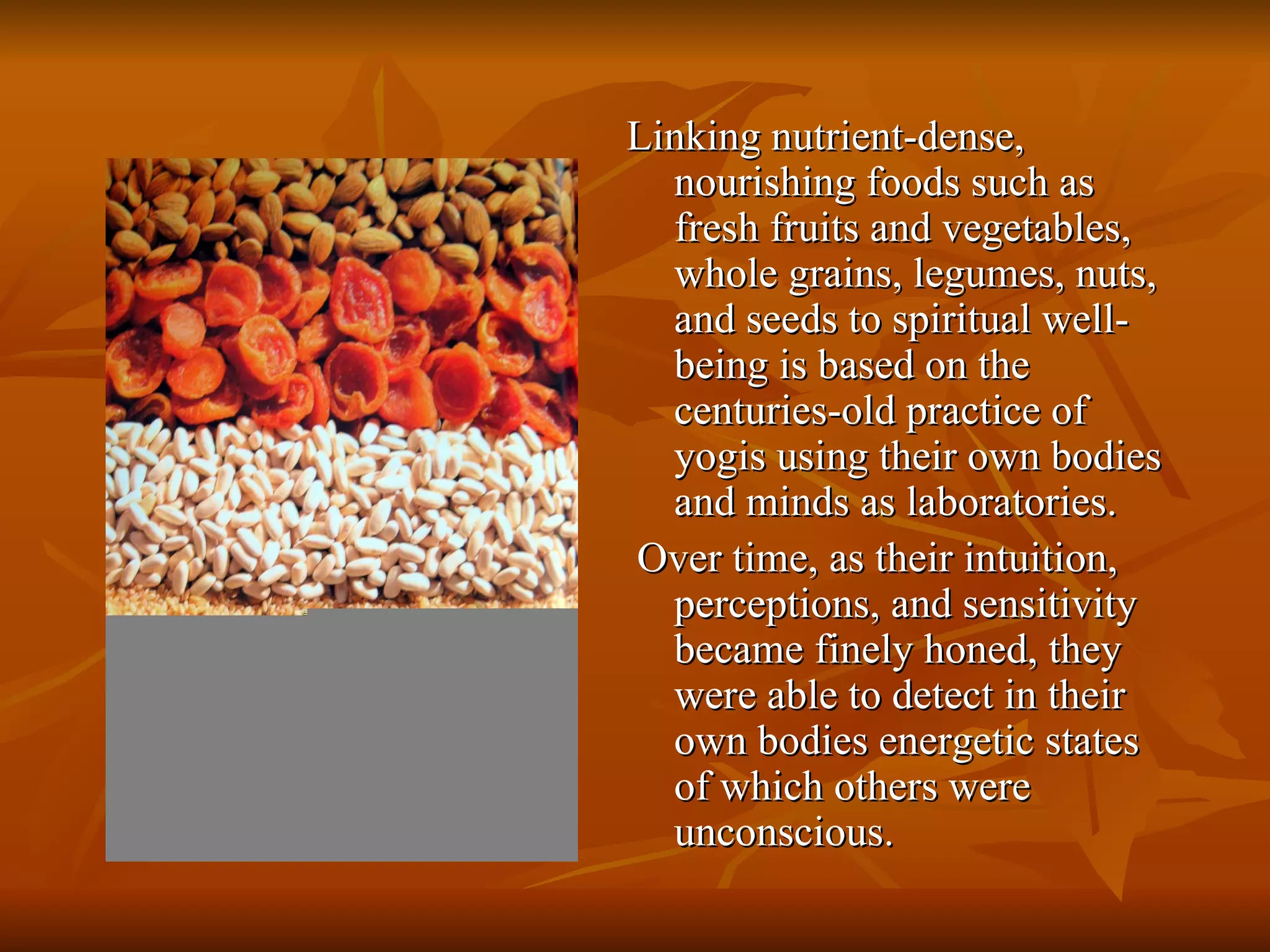
Linking nutrient-dense, nourishing foods such as fresh fruits and vegetables, whole grains, legumes, nuts, and seeds to spiritual well-being is based on the centuries-old practice of yogis using their own bodies and minds as laboratories. Over time, as their intuition, perceptions, and sensitivity became finely honed, they were able to detect in their own bodies energetic states of which others were unconscious.
Yogis found that certain foods would tend to deposit toxins in the body, making it difficult to be still, to sit quietly and meditate, or to maintain certain poses.  These ancient seers saw the  sattvic ,  rajasic , or  tamasic  nature of food as based on its  vibrational  quality ( prana ).  Vibrational quality  refers to the energy of the food.  How powerful is that energy?   Is it still life-giving?
For example: If you pick a peach fruit from a tree, it has a certain quality ( prana ), a certain energy within. If you take the same peach and cook or bake it, then its vibrational quality changes; it no longer has the same vitality.
For a yogi, the vitality and energy in food is important, especially when you consider the diet’s main purpose, which is to keep the body free from toxins and the mind quiet. Within the framework of  sattvic  nutrition, the vibrational qualities or the  prana  of food take on supreme importance.
Sattvic  food is believed to nurture and heal, to sustain life. In contrast,  tamasic  or  rajasic  food may offer inadequate energy, therefore taking – rather than giving – life-sustaining energy. While  information  about vitamins and minerals, etc., is the core of Western nutrition,  transformation  is the essence of India’s yogic-based nutrition philosophy.
Like all yoga practices, the  sattvic  diet is designed to keep the mind tranquil. For “only in a state of serenity,” the yogis tell us, “can our unique spirit emerge.” Indeed, by encouraging us to linger in that limitless space between thought and breath, the yogic diet holds the promise of spiritual, physical, and emotional well-being.
In Search of Spiritfood
What follows is a synthesis of dietary guidelines gleaned from India’s ancient scriptures: the  Upanishads ,  Bhagavad Gita , Patanjali’s  Yoga   Sutras , and others. They are designed to help transform meals into an opportunity for spiritual growth.
Consciousness While Eating Always have love and respect for your food. The consciousness, or mentality, we bring to food may be the most important ingredient in the meal. Think positive thoughts of peace and love when preparing food. Such a consciousness may be transferred into the food, enhancing digestion, and empowering it with the ability to nourish both mind-body and soul. Do not eat when angry. Negative thoughts are believed to create poisons that eventually are secreted by the glands. Like vitamins and minerals in life-giving foods foods, negative, angry thoughts may be metabolized, too, eventually producing toxins. Also, anger or stress may limit the production of digestive enzymes in our stomach, making it difficult for food to be adequately digested.
Take meals in a relaxed frame of mind.  A calm state of mind is ideal for preparing the body to receive nourishment. During meals, silence or warm conversation among family members or friends can create balanced, loving energy, enhancing digestion and, ultimately, food’s ability to nourish. Avoid eating when rushed.  Do not be a slave to any diet theory. Maintaining a mind that is tranquil and peaceful, pursuing union with the Absolute, is the purpose of all yoga. Following rigid dietary rules is more likely to produce the opposite: stress, anxiety, worry, and doubt. Like the yogis, use your own experience and intuition to create your own ideal eating style.
Remember the Absolute, the life-force, the in-dweller of all foods Brahman  is the Sanskrit word that attempts to describe the indescribable; “a supreme, blissful consciousness” only hints at its meaning. Such a noble frame of minds is believed to make all but poisonous food healing,  sattvic , and healthful.
What to Eat Choose foods that promote a balanced state. To pursue physical and psycho-spiritual well-being,  choose fresh, whole foods in their natural state as often as possible. Eat a natural diet that includes lots of fresh fruits, vegetables, whole grains, legumes, nuts, and seeds. Avoid fried food. Centuries before knowledge of health-robbing free-radicals and fear of fat, yogis believed that fried food caused injury to the body. They were right. We now know that too much fat can impair the immune system, and is linked with heart disease and other ailments. Another reason to avoid fried food: it’s considered  rajasic  and therefore hinders spirituality.
Select perfectly ripe fruit; avoid unripe fruits.  Fruit that hasn’t matured hasn’t reached its nutritional peak. Not only is it difficult for your body to digest and assimilate, you’ll also be cheating yourself nutritionally. Avoid drinking coffee or tea, especially at night.  Coffee and tea contain caffeine, making them stimulating and  rajasic . To maintain a serene state of mind – and sleep deeply – avoid beverages laced with caffeine.
Liquids.  Do not drink water or other liquids during, just before, or after meals. Though it is an unpopular idea in the West, liquids mixed with food are believed to dilute gastric juices, causing indigestion. The ideal: Drink liquids an hour or two before or after eating solid food.  (Note: If you experience thirst while eating, moisten food with saliva. Chew food until solids becomes liquefied in your mouth.)
When to Eat Beware of false hunger. Eat only when you are truly hungry. A sensation of hunger is the body’s built-in-clock, telling you it’s time to eat. If you “wait out” the desire to eat, and it leaves, then you’re probably not really hungry. More likely, you’re responding to eating cues or a habitual eating pattern. When you’re truly hungry, the desire to eat will not go away. Consume larger meals earlier in the day; eat lightly in the evening.  Not only do we need – and use more efficiently – food energy eaten earlier in the day, but heavy evening meals are likely to cause weight gain. Why? The body’s metabolism, including digestion, slows down as the day progresses, even more so as we sleep. Try to make lunch the calorie-dense meal.
Avoid eating between meals or late at night. When you are truly hungry, meaning you have a good appetite, it’s likely your stomach is “empty.” Eating between meals or before going to sleep increases the odds that food from a prior meal hasn’t been completely digested. The result: Food may ferment, become acidic, or cause gas and bloating. To avoid this, do not eat at least two hours after a meal or before going to sleep.
How to Eat Chew food thoroughly. The digestion of food begins in your mouth, when it mixes with enzymes in your saliva. Chew each mouthful slowly and thoroughly, until it is almost liquefied. Avoid gulping down food; instead, swallow it slowly. Stop eating when three-quarters of the stomach is full. Ancient scriptures tell us that stomach is about as large as what you can hold in your two hands; perhaps about the size of your fist. The belief: filling your stomach about three-quarters during a meal leaves enough room for digestive enzymes to break down food. Overeating  sattvic  foods can make them  tamasic .
Avoid eating foods you do not enjoy – or overeating food you especially like. The mentality you bring to food is believed to influence the mind-body. Eating food you like increases the odds of imbuing it with positive, loving energy; food you do not enjoy is more likely to produce negative, “life-taking” vibrations. But even with sattvic foods you enjoy, moderation and balance are the keys. Abandon too many food mixtures or combinations. Yogis place much importance on the stomach’s digestive capacity, and eating according to what it can easily metabolize. They believe it is difficult for the body’s digestive juices to digest complex food combinations. Eat only four or five kinds of food at any one meal.
Namaste.

Yogic Nutrition 101A (Erli)

  • 1.
    Yogic Nutrition 101 Erli P. Mendoza Ayurveda Class 23 November 2008
  • 2.
    Beloved Mother NatureYou are here on our table as our food. You are endlessly bountiful, benefactress of all. Please grant us health and strength, wisdom and dispassion to find permanent peace and joy. - Ancient Sanskrit Prayer
  • 3.
    India is steepedin dietary wisdom. Perhaps more than any other country, India’s great traditions and religions are filled with food celebrations and ceremonies, myths and magic: it is a journey into the yogic world of Sanatana dharma , the Sanskrit expression for the underlying, eternal, true essence of all religions. By following such a philosophy, yogis do not separate food from Self, God, or Nature, and turn all eating into a potentially sacred activity, each encounter with food into an opportunity to meet the Higher Self.
  • 4.
    Anna Yoga:The Yoga of Food
  • 5.
    Ayurveda developsour pure inner nature, and nutrition or food management or yogic diet plays an important part in this process. The Yogic scriptures, especially the Bhagavad Gita , divide food into three types: sattvic , or pure; rajasic , or stimulating; and tamasic , or impure or rotten.
  • 6.
  • 7.
    Perhaps more thanany other food philosophy, the yogic nutrition is a repository of love-filled wisdom, designed to calm the mind and prepare the body to receive nourishment. According to O.M. Aivanhov ,
  • 8.
    “ Eating isa magic rite during which the food becomes transformed into health, force, love, light. While you eat… think of … food with love, for that will make it open its treasures to you.” [ Living Yoga: A Comprehensive Guide for Daily Life ]
  • 9.
    In Sanskrit, prana is the word that describes this loving energy. Prana keeps us alive; it is the force of life that is in the food we eat, the air we breathe, everything. Given that food’s prana – its subtle, vital, life-giving quality – is a major consideration in yogic nutrition, the person cooking the food plays an important role.
  • 10.
    “ The Bhagavad Gita tells us that if the cook who prepares the food is not of a loving, calm nature, the food won’t benefit you – spiritually, mentally, or physically.” [ Dr. K. L. Chopra, cardiologist ]
  • 11.
    To pursue thespiritual life, “ the Bhagavad Gita tells us to honor all living things – including food – as part of an interdependent oneness. With this consciousness, we are doing something that brings peace, bliss, and a stress-free life..” [ Dharmananda, ibid ]
  • 12.
  • 13.
    What are “yogicfoods”? One verse in the Bhagavad Gita tells us they are “ foods that promote life, mental strength, vitality, cheerfulness, and a loving nature” ( Chapter 17, verse 8 ).
  • 14.
    The BhagavadGita is a repository of wise words, but what makes its nutrition philosophy a coherent whole is the concept of the three gunas, or the qualities of nature, mentioned throughout. “ It is written in our scriptures that the gunas are the three attributes of nature that reflect temperament, or inner life.” [ Dharmananda, ibid ]
  • 15.
    Three Types ofFood – and qualities – associated with the Tri- Gunas
  • 16.
    PURITY - SATTVAFoods that promote life, lucidity, strength, health, happiness, and satisfaction, and that are savory, rich in oil, firm, and heart-gladdening are agreeable to the sattva-natured person.
  • 17.
    The Yogic nutritionor diet is based on pure, sattvic foods. Sattvic foods calm the mind and sharpen the intellect. These are pure, wholesome, and naturally delicious, without preservatives or artificial flavorings. They include fresh and dried fruits and berries, pure fruit juices, raw or lightly cooked vegetables, salads, grains, legumes, nuts, seeds, whole-grain breads, honey, fresh herbs, herbal teas, and dairy products such as milk and butter.
  • 18.
    A sattvic diet is easily digested and supplies maximum energy, increasing vitality, strength, and endurance. It will help eliminate fatigue, even for those who undertake strenuous and difficult work. Yogis believe that people’s food preferences reflect their level of mental purity and that these preferences alter as they develop spiritually.
  • 19.
    A sattvic diet brings purity and calmness to the mind, and is both soothing and nourishing to the body. It promotes cheerfulness, serenity and mental clarity, and helps maintain mental poise and nervous equilibrium throughout the day.
  • 20.
    OVERACTIVITY - RAJASFoods that are pungent, sour, salty, spicy, sharp, harsh, and burning are covered by the rajas-natured person.
  • 21.
    Yogic nutrition avoidssubstances that are overstimulating, or rajasic . Onions, garlic, coffee, tea, and tobacco are rajasic , as are heavily spiced and salted items, and many fast foods and snacks. Refined sugar, soft drinks, and chocolate are rajsic. Rajasic foods arouse animal passions, bring a restless state of mind, and make the person overactive.
  • 22.
    Rajasic foodsdestroy the mind/body balance that is essential for happiness. Rajasic foods overstimulate the body and mind, cause physical and mental stress, and encourage circulatory and nervous disorders.
  • 23.
    “ The foodsthat are bitter, sour, saline, excessively hot, pungent, dry, and burning, are liked by the rajasic and are productive of pain, grief, and disease.”
  • 24.
    INERTIA - TAMASThat which is spoiled, tasteless, putrid, stale, left over, and unclean is food agreeable to the tamas-natured person.
  • 25.
    Tamasic substancesare avoided in the Yogic diet because they produce feelings of heaviness and lethargy. Meat, fish, eggs, drugs, and alcohol are tamasic , as are overcooked and packaged foods. Other tamasic items include those that have been fermented, burned, fried, barbecued, or reheated many times, as well as stale products or those containing preservatives. Mushrooms are considered tamasic , since they grow in the dark.
  • 26.
    A tamasic diet benefits neither body nor mind. It makes a person dull and lazy, lacking in high ideals, purpose and motivation. Such individuals tend to suffer from chronic ailments and from depression. Overeating is tamasic .
  • 27.
    “ That foodwhich is stale, tasteless, putrid, rotten, and impure refuse, is the food liked by the tamasic .”
  • 28.
    HIGHLIGHTS: It isthe sattva , or sattvic food, that constitute the yogic diet. To the Western mind, it is lacto-vegetarian , consisting mainly of fruits, vegetables, whole grains, beans and peas, nuts and seeds, and daily products, particularly milk and yogurt. Honey, pure water, and ghee (Indian clarified butter) are also believed to promote sattva aspect. Eggs, which are perceived as rajasic , are avoided; because milk and yogurt are considered easy to digest, they are included.
  • 29.
    As a contrast, rajas , or rajasic , stimulating foods, such as coffee, chili peppers, garlic, and onions, are said to agitate and stimulate the mind and body. Tamas , the tamasic category, includes old or stale food, foods that are past their time that might have been in the pantry or refrigerator for a while, such as old crackers or frozen meat or poultry. According to the Bhagavad Gita , these foods are believed to promote laziness, allergies, and fatigue.
  • 30.
  • 31.
  • 32.
    Along with creatingfood with loving energy, and recognizing that different foods promote different emotional states, the sattvic diet also places much importance on other of its mind-body benefits. “ Because sattvic nutrition is natural and easily digested, you get only the nutrients that help the body… and the soul. When we take sattvic food, we feel less anger, greed, or jealousy – all these [negative] things the mind creates.”
  • 33.
    What happens whenwe eat rajasic or tamasic foods? The contention is that if we eat spicy, rajasic food, or tamasic food such as meat, fish, or poultry, digestion is more difficult. Then toxins have more of an opportunity to enter the bloodstream – not unlike the minerals from fruit that go inside the body, but now there are toxins. Organs can be affected by these impurities circulating in the blood. And if they are, we become ill.
  • 34.
    With a focuson the digestive process, the Bhagavad Gita also suggests when to eat. “ One should eat only when one is hungry, not when one thinks one should.”
  • 35.
    Eating when you’renot hungry places a strain on the digestive system; in turn, this creates two problems: First, if you overeat you can stretch the stomach, and digestive enzymes then won’t have room to digest the food with the result that the brain and heart get less nourishment. Second, overeating impairs circulation, increasing the odds of becoming sleepy afterward.
  • 36.
    The mentality we bring to food is yet another important component for creating spiritual and physical well-being. Try never to sit down to a meal without being thankful. If we don’t give respect to the food we are eating, it won’t heal and nurture us.
  • 37.
    One unique wayto honor and respect food is by savoring its colors. First, eat with your eyes. Food and natural colors should be arranged beautifully, so the eyes appreciate first. Then the nose smells the food and digestion has already begun.
  • 38.
    Respect is givenin part, by concentrating on the food: seeing it, then eating, chewing, and grinding it, making sure it’s ready to be swallowed and put into the stomach.
  • 39.
  • 40.
    Linking nutrient-dense, nourishingfoods such as fresh fruits and vegetables, whole grains, legumes, nuts, and seeds to spiritual well-being is based on the centuries-old practice of yogis using their own bodies and minds as laboratories. Over time, as their intuition, perceptions, and sensitivity became finely honed, they were able to detect in their own bodies energetic states of which others were unconscious.
  • 41.
    Yogis found thatcertain foods would tend to deposit toxins in the body, making it difficult to be still, to sit quietly and meditate, or to maintain certain poses. These ancient seers saw the sattvic , rajasic , or tamasic nature of food as based on its vibrational quality ( prana ). Vibrational quality refers to the energy of the food. How powerful is that energy? Is it still life-giving?
  • 42.
    For example: Ifyou pick a peach fruit from a tree, it has a certain quality ( prana ), a certain energy within. If you take the same peach and cook or bake it, then its vibrational quality changes; it no longer has the same vitality.
  • 43.
    For a yogi,the vitality and energy in food is important, especially when you consider the diet’s main purpose, which is to keep the body free from toxins and the mind quiet. Within the framework of sattvic nutrition, the vibrational qualities or the prana of food take on supreme importance.
  • 44.
    Sattvic foodis believed to nurture and heal, to sustain life. In contrast, tamasic or rajasic food may offer inadequate energy, therefore taking – rather than giving – life-sustaining energy. While information about vitamins and minerals, etc., is the core of Western nutrition, transformation is the essence of India’s yogic-based nutrition philosophy.
  • 45.
    Like all yogapractices, the sattvic diet is designed to keep the mind tranquil. For “only in a state of serenity,” the yogis tell us, “can our unique spirit emerge.” Indeed, by encouraging us to linger in that limitless space between thought and breath, the yogic diet holds the promise of spiritual, physical, and emotional well-being.
  • 46.
    In Search ofSpiritfood
  • 47.
    What follows isa synthesis of dietary guidelines gleaned from India’s ancient scriptures: the Upanishads , Bhagavad Gita , Patanjali’s Yoga Sutras , and others. They are designed to help transform meals into an opportunity for spiritual growth.
  • 48.
    Consciousness While EatingAlways have love and respect for your food. The consciousness, or mentality, we bring to food may be the most important ingredient in the meal. Think positive thoughts of peace and love when preparing food. Such a consciousness may be transferred into the food, enhancing digestion, and empowering it with the ability to nourish both mind-body and soul. Do not eat when angry. Negative thoughts are believed to create poisons that eventually are secreted by the glands. Like vitamins and minerals in life-giving foods foods, negative, angry thoughts may be metabolized, too, eventually producing toxins. Also, anger or stress may limit the production of digestive enzymes in our stomach, making it difficult for food to be adequately digested.
  • 49.
    Take meals ina relaxed frame of mind. A calm state of mind is ideal for preparing the body to receive nourishment. During meals, silence or warm conversation among family members or friends can create balanced, loving energy, enhancing digestion and, ultimately, food’s ability to nourish. Avoid eating when rushed. Do not be a slave to any diet theory. Maintaining a mind that is tranquil and peaceful, pursuing union with the Absolute, is the purpose of all yoga. Following rigid dietary rules is more likely to produce the opposite: stress, anxiety, worry, and doubt. Like the yogis, use your own experience and intuition to create your own ideal eating style.
  • 50.
    Remember the Absolute,the life-force, the in-dweller of all foods Brahman is the Sanskrit word that attempts to describe the indescribable; “a supreme, blissful consciousness” only hints at its meaning. Such a noble frame of minds is believed to make all but poisonous food healing, sattvic , and healthful.
  • 51.
    What to EatChoose foods that promote a balanced state. To pursue physical and psycho-spiritual well-being, choose fresh, whole foods in their natural state as often as possible. Eat a natural diet that includes lots of fresh fruits, vegetables, whole grains, legumes, nuts, and seeds. Avoid fried food. Centuries before knowledge of health-robbing free-radicals and fear of fat, yogis believed that fried food caused injury to the body. They were right. We now know that too much fat can impair the immune system, and is linked with heart disease and other ailments. Another reason to avoid fried food: it’s considered rajasic and therefore hinders spirituality.
  • 52.
    Select perfectly ripefruit; avoid unripe fruits. Fruit that hasn’t matured hasn’t reached its nutritional peak. Not only is it difficult for your body to digest and assimilate, you’ll also be cheating yourself nutritionally. Avoid drinking coffee or tea, especially at night. Coffee and tea contain caffeine, making them stimulating and rajasic . To maintain a serene state of mind – and sleep deeply – avoid beverages laced with caffeine.
  • 53.
    Liquids. Donot drink water or other liquids during, just before, or after meals. Though it is an unpopular idea in the West, liquids mixed with food are believed to dilute gastric juices, causing indigestion. The ideal: Drink liquids an hour or two before or after eating solid food. (Note: If you experience thirst while eating, moisten food with saliva. Chew food until solids becomes liquefied in your mouth.)
  • 54.
    When to EatBeware of false hunger. Eat only when you are truly hungry. A sensation of hunger is the body’s built-in-clock, telling you it’s time to eat. If you “wait out” the desire to eat, and it leaves, then you’re probably not really hungry. More likely, you’re responding to eating cues or a habitual eating pattern. When you’re truly hungry, the desire to eat will not go away. Consume larger meals earlier in the day; eat lightly in the evening. Not only do we need – and use more efficiently – food energy eaten earlier in the day, but heavy evening meals are likely to cause weight gain. Why? The body’s metabolism, including digestion, slows down as the day progresses, even more so as we sleep. Try to make lunch the calorie-dense meal.
  • 55.
    Avoid eating betweenmeals or late at night. When you are truly hungry, meaning you have a good appetite, it’s likely your stomach is “empty.” Eating between meals or before going to sleep increases the odds that food from a prior meal hasn’t been completely digested. The result: Food may ferment, become acidic, or cause gas and bloating. To avoid this, do not eat at least two hours after a meal or before going to sleep.
  • 56.
    How to EatChew food thoroughly. The digestion of food begins in your mouth, when it mixes with enzymes in your saliva. Chew each mouthful slowly and thoroughly, until it is almost liquefied. Avoid gulping down food; instead, swallow it slowly. Stop eating when three-quarters of the stomach is full. Ancient scriptures tell us that stomach is about as large as what you can hold in your two hands; perhaps about the size of your fist. The belief: filling your stomach about three-quarters during a meal leaves enough room for digestive enzymes to break down food. Overeating sattvic foods can make them tamasic .
  • 57.
    Avoid eating foodsyou do not enjoy – or overeating food you especially like. The mentality you bring to food is believed to influence the mind-body. Eating food you like increases the odds of imbuing it with positive, loving energy; food you do not enjoy is more likely to produce negative, “life-taking” vibrations. But even with sattvic foods you enjoy, moderation and balance are the keys. Abandon too many food mixtures or combinations. Yogis place much importance on the stomach’s digestive capacity, and eating according to what it can easily metabolize. They believe it is difficult for the body’s digestive juices to digest complex food combinations. Eat only four or five kinds of food at any one meal.
  • 58.