22 WWW.MAXMUSCLE.COM ı APRIL 2015
MAX FITNESS
YOGA IRONIF YOU ARE A BODYBUILDER OR YOU
HIT THE WEIGHTS DAILY, YOU NEED
TO DO THIS YOGA WORKOUT.
BY KELLY GONZALEZ, MS
YOGA HAS BEEN around for thousands of years, but in
the last decade it has become more mainstream in America.
Recreational and professional athletes alike are rolling out
their mats on a regular basis for improvements in athletic
performance and so much more.
	 Scientifically, yoga has proven to provide numerous
benefits. Studies credit yoga with reduction of low back
pain, decreased risk of injuries, increased core strength and
flexibility, as well as neurological and hormonal changes that
elevate pain-tolerance levels, reduce anxiety and enhance
focus and concentration.
	 The word “yoga” literally means, “to yoke,” or “union.” It is
the connection of breath (prana or life force) to movement that
restores the body, calms the mind and illuminates the spirit.
	 For the competitive strength training athlete and even
recreational exercisers, injuries from repetitive movements such
as squats, overhead presses and even gripping iron dumbbells
and barbells can lead to pain and discomfort over time. Not
only that, but frequent intense training sessions can wreak
havoc on your endocrine system if not properly balanced with
stress-relief methods.
	 Here are eight yoga poses to help you not only feel
balanced in your body, but also awaken to the mental and
spiritual benefits yoga has to offer.
PHOTOGRAPHY BY PAUL JOYNER PHOTOGRAPHY
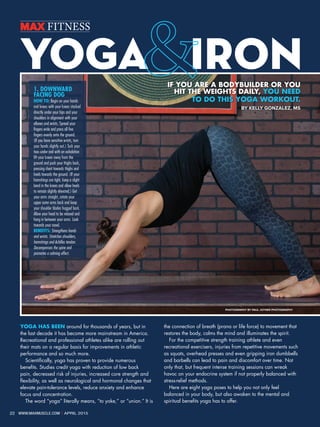
1. DOWNWARD
FACING DOG
HOW TO: Begin on your hands
and knees with your knees stacked
directly under your hips and your
shoulders in alignment with your
elbows and wrists. Spread your
fingers wide and press all five
fingers evenly onto the ground.
(If you have sensitive wrists, turn
your hands slightly out.) Tuck your
toes under and with an exhalation
lift your knees away from the
ground and push your thighs back,
pressing chest towards thighs and
heels towards the ground. (If your
hamstrings are tight, keep a slight
bend in the knees and allow heels
to remain slightly elevated.) Get
your arms straight, rotate your
upper outer arms back and keep
your shoulder blades hugged back.
Allow your head to be relaxed and
hang in between your arms. Look
towards your navel.
BENEFITS: Strengthens hands
and wrists. Stretches shoulders,
hamstrings and Achilles tendon.
Decompresses the spine and
promotes a calming effect.
23APRIL 2015 ı WWW.MAXSPORTSANDFITNESS.COM
6 REASONS
WHY STRENGTH
ATHLETES SHOULD
DO YOGA
1. FLEXIBILITY: Weight lifting can lead to
muscle imbalances that impair your range
of motion and power output. Stretching
helps you stay flexible and mobile.
2. FOCUS: The Sanskrit word, “drishti,”
translates to focus or gaze. Learning and
practicing this technique in yoga and
meditation can help you be more focused
in all of your workouts and life matters.  
3. REDUCE STRESS: Less stress equals a faster
recovery and improved immune function.
According to the International Journal
of Preventive Medicine, yoga stimulates
the down-regulation of the hypothalamic
pituitary adrenal (HPA) axis and the
sympathetic nervous system.
4. IMPROVE PAIN TOLERANCE: In order to reach
the next level, you must break free of
your comfort and safely push the limits.
Researchers found that “yoga practitioners
had greater gray matter volume in brain
regions related to pain processing, pain
regulation and attention.”
5. IMPROVE MENTAL HEALTH: Numerous studies
credit yoga as an effective method for
stress reduction. A study in the Journal
of Complementary Therapies in Medicine
discovered that 10 weekly 1-hour hatha
yoga classes reduced stress and anxiety
as much as relaxation and proved to
be more effective for improving mental
health.  
6. REDUCE LOW-BACK PAIN: A 2013 study in
the Clinical Journal of Pain found yoga to
be an effective method for short-term and
long-term relief for chronic low-back pain.
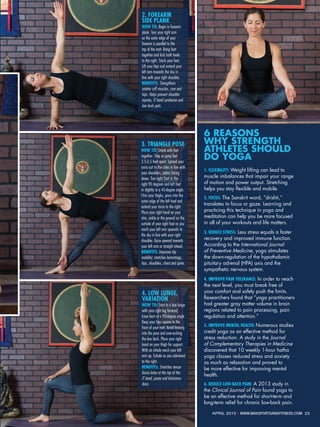
2. FOREARM
SIDE PLANK
HOW TO: Begin in forearm
plank. Turn your right arm
so the outer edge of your
forearm is parallel to the
top of the mat. Bring feet
together and kick both heels
to the right. Stack your feet.
Lift your hips and extend your
left arm towards the sky in
line with your right shoulder.
BENEFITS: Strengthens
rotator cuff muscles, core and
hips. Helps prevent shoulder
injuries, IT band syndrome and
low back pain.
3. TRIANGLE POSE
HOW TO: Stand with feet
together. Step or jump feet
2.5-3.5 feet apart. Spread your
arms out to the sides in line with
your shoulders, palms facing
down. Turn right foot to the
right 90 degrees and left foot
in slightly to a 45-degree angle.
Firm your thighs, press into the
outer edge of the left heel and
extend your torso to the right.
Place your right hand on your
shin, ankle or the ground on the
outside of your right foot as you
reach your left arm upwards to
the sky in line with your right
shoulder. Gaze upward towards
your left arm or straight ahead.
BENEFITS: Improves hip
mobility; stretches hamstrings,
hips, shoulders, chest and spine.
4. LOW LUNGE,
VARIATION
HOW TO: Start in a low lunge
with your right leg forward,
knee bent at a 90-degree angle.
Keep your hips square to the
front of your mat. Avoid leaning
into the pose and over-arching
the low back. Place your right
hand on your thigh for support.
With an inhale reach your left
arm up. Exhale as you side-bend
to the right.
BENEFITS: Stretches tensor
fascia latae at the top of the
IT band, psoas and latissimus
dorsi.
24 WWW.MAXMUSCLE.COM ı APRIL 2015
BREATHE
DEEPLY
What makes yoga a transformative practice is the
linking of breath to movement. The term “pranayama“
refers to the practice of controlling the breath. Prana
literally means “life force.” Our breath provides life
and energy and can also be used to calm the mind and
relieve stress. Breathing in through the nose stimulates
the olfactory nerve, which triggers the parasympathetic
nervous system providing stress relief.
	 Ujjayi means, “to become victorious.” Using
this breath during your yoga practice puts you in the
“flow” as it creates heat in the body, strengthens the
cardiorespiratory system, and promotes focus and
calmness. Try experimenting with Ujjayi breathing while
strength training or other demanding physical practices
to transform your workout into a moving meditation.
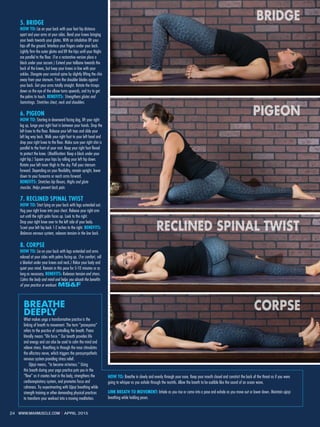
5. BRIDGE  
HOW TO: Lie on your back with your feet hip distance
apart and your arms at your sides. Bend your knees bringing
your heels towards your glutes. With an inhalation lift your
hips off the ground. Interlace your fingers under your back.
Lightly firm the outer glutes and lift the hips until your thighs
are parallel to the floor. (For a restorative version place a
block under your sacrum.) Extend your tailbone towards the
back of the knees, but keep your knees in line with your
ankles. Elongate your cervical spine by slightly lifting the chin
away from your sternum. Firm the shoulder blades against
your back. Get your arms totally straight. Rotate the triceps
down so the eye of the elbow turns upwards, and try to get
the palms to touch. BENEFITS: Strengthens glutes and
hamstrings. Stretches chest, neck and shoulders.
6. PIGEON
HOW TO: Starting in downward facing dog, lift your right
leg up, lunge your right foot in between your hands. Drop the
left knee to the floor. Release your left toes and slide your
left leg way back. Walk your right foot to your left hand and
drop your right knee to the floor. Make sure your right shin is
parallel to the front of your mat. Keep your right foot flexed
to protect the knee. (Modification: Keep a block under your
right hip.) Square your hips by rolling your left hip down.
Rotate your left inner thigh to the sky. Pull your sternum
forward. Depending on your flexibility, remain upright, lower
down to your forearms or reach arms forward.
BENEFITS: Stretches hip flexors, thighs and glute
muscles. Helps prevent back pain.
7. RECLINED SPINAL TWIST
HOW TO: Start lying on your back with legs extended out.
Hug your right knee into your chest. Release your right arm
out until the right palm faces up. Look to the right.
Drop your right knee over to the left side of your body.
Scoot your left hip back 1-2 inches to the right. BENEFITS:
Balances nervous system, releases tension in the low back.
8. CORPSE
HOW TO: Lie on your back with legs extended and arms
relaxed at your sides with palms facing up. (For comfort, roll
a blanket under your knees and neck.) Relax your body and
quiet your mind. Remain in this pose for 5-10 minutes or as
long as necessary. BENEFITS: Releases tension and stress.
Calms the body and mind and helps you absorb the benefits
of your practice or workout. MS&F
HOW TO: Breathe in slowly and evenly through your nose. Keep your mouth closed and constrict the back of the throat as if you were
going to whisper as you exhale through the nostrils. Allow the breath to be audible like the sound of an ocean wave.
LINK BREATH TO MOVEMENT: Inhale as you rise or come into a pose and exhale as you move out or lower down. Maintain ujjayi
breathing while holding poses.
BRIDGE
PIGEON
RECLINED SPINAL TWIST
CORPSE

YOGA & IRON_APRIL 2015

  • 1.
    22 WWW.MAXMUSCLE.COM ıAPRIL 2015 MAX FITNESS YOGA IRONIF YOU ARE A BODYBUILDER OR YOU HIT THE WEIGHTS DAILY, YOU NEED TO DO THIS YOGA WORKOUT. BY KELLY GONZALEZ, MS YOGA HAS BEEN around for thousands of years, but in the last decade it has become more mainstream in America. Recreational and professional athletes alike are rolling out their mats on a regular basis for improvements in athletic performance and so much more. Scientifically, yoga has proven to provide numerous benefits. Studies credit yoga with reduction of low back pain, decreased risk of injuries, increased core strength and flexibility, as well as neurological and hormonal changes that elevate pain-tolerance levels, reduce anxiety and enhance focus and concentration. The word “yoga” literally means, “to yoke,” or “union.” It is the connection of breath (prana or life force) to movement that restores the body, calms the mind and illuminates the spirit. For the competitive strength training athlete and even recreational exercisers, injuries from repetitive movements such as squats, overhead presses and even gripping iron dumbbells and barbells can lead to pain and discomfort over time. Not only that, but frequent intense training sessions can wreak havoc on your endocrine system if not properly balanced with stress-relief methods. Here are eight yoga poses to help you not only feel balanced in your body, but also awaken to the mental and spiritual benefits yoga has to offer. PHOTOGRAPHY BY PAUL JOYNER PHOTOGRAPHY 1. DOWNWARD FACING DOG HOW TO: Begin on your hands and knees with your knees stacked directly under your hips and your shoulders in alignment with your elbows and wrists. Spread your fingers wide and press all five fingers evenly onto the ground. (If you have sensitive wrists, turn your hands slightly out.) Tuck your toes under and with an exhalation lift your knees away from the ground and push your thighs back, pressing chest towards thighs and heels towards the ground. (If your hamstrings are tight, keep a slight bend in the knees and allow heels to remain slightly elevated.) Get your arms straight, rotate your upper outer arms back and keep your shoulder blades hugged back. Allow your head to be relaxed and hang in between your arms. Look towards your navel. BENEFITS: Strengthens hands and wrists. Stretches shoulders, hamstrings and Achilles tendon. Decompresses the spine and promotes a calming effect.
  • 2.
    23APRIL 2015 ıWWW.MAXSPORTSANDFITNESS.COM 6 REASONS WHY STRENGTH ATHLETES SHOULD DO YOGA 1. FLEXIBILITY: Weight lifting can lead to muscle imbalances that impair your range of motion and power output. Stretching helps you stay flexible and mobile. 2. FOCUS: The Sanskrit word, “drishti,” translates to focus or gaze. Learning and practicing this technique in yoga and meditation can help you be more focused in all of your workouts and life matters.   3. REDUCE STRESS: Less stress equals a faster recovery and improved immune function. According to the International Journal of Preventive Medicine, yoga stimulates the down-regulation of the hypothalamic pituitary adrenal (HPA) axis and the sympathetic nervous system. 4. IMPROVE PAIN TOLERANCE: In order to reach the next level, you must break free of your comfort and safely push the limits. Researchers found that “yoga practitioners had greater gray matter volume in brain regions related to pain processing, pain regulation and attention.” 5. IMPROVE MENTAL HEALTH: Numerous studies credit yoga as an effective method for stress reduction. A study in the Journal of Complementary Therapies in Medicine discovered that 10 weekly 1-hour hatha yoga classes reduced stress and anxiety as much as relaxation and proved to be more effective for improving mental health.   6. REDUCE LOW-BACK PAIN: A 2013 study in the Clinical Journal of Pain found yoga to be an effective method for short-term and long-term relief for chronic low-back pain. 2. FOREARM SIDE PLANK HOW TO: Begin in forearm plank. Turn your right arm so the outer edge of your forearm is parallel to the top of the mat. Bring feet together and kick both heels to the right. Stack your feet. Lift your hips and extend your left arm towards the sky in line with your right shoulder. BENEFITS: Strengthens rotator cuff muscles, core and hips. Helps prevent shoulder injuries, IT band syndrome and low back pain. 3. TRIANGLE POSE HOW TO: Stand with feet together. Step or jump feet 2.5-3.5 feet apart. Spread your arms out to the sides in line with your shoulders, palms facing down. Turn right foot to the right 90 degrees and left foot in slightly to a 45-degree angle. Firm your thighs, press into the outer edge of the left heel and extend your torso to the right. Place your right hand on your shin, ankle or the ground on the outside of your right foot as you reach your left arm upwards to the sky in line with your right shoulder. Gaze upward towards your left arm or straight ahead. BENEFITS: Improves hip mobility; stretches hamstrings, hips, shoulders, chest and spine. 4. LOW LUNGE, VARIATION HOW TO: Start in a low lunge with your right leg forward, knee bent at a 90-degree angle. Keep your hips square to the front of your mat. Avoid leaning into the pose and over-arching the low back. Place your right hand on your thigh for support. With an inhale reach your left arm up. Exhale as you side-bend to the right. BENEFITS: Stretches tensor fascia latae at the top of the IT band, psoas and latissimus dorsi.
  • 3.
    24 WWW.MAXMUSCLE.COM ıAPRIL 2015 BREATHE DEEPLY What makes yoga a transformative practice is the linking of breath to movement. The term “pranayama“ refers to the practice of controlling the breath. Prana literally means “life force.” Our breath provides life and energy and can also be used to calm the mind and relieve stress. Breathing in through the nose stimulates the olfactory nerve, which triggers the parasympathetic nervous system providing stress relief. Ujjayi means, “to become victorious.” Using this breath during your yoga practice puts you in the “flow” as it creates heat in the body, strengthens the cardiorespiratory system, and promotes focus and calmness. Try experimenting with Ujjayi breathing while strength training or other demanding physical practices to transform your workout into a moving meditation. 5. BRIDGE   HOW TO: Lie on your back with your feet hip distance apart and your arms at your sides. Bend your knees bringing your heels towards your glutes. With an inhalation lift your hips off the ground. Interlace your fingers under your back. Lightly firm the outer glutes and lift the hips until your thighs are parallel to the floor. (For a restorative version place a block under your sacrum.) Extend your tailbone towards the back of the knees, but keep your knees in line with your ankles. Elongate your cervical spine by slightly lifting the chin away from your sternum. Firm the shoulder blades against your back. Get your arms totally straight. Rotate the triceps down so the eye of the elbow turns upwards, and try to get the palms to touch. BENEFITS: Strengthens glutes and hamstrings. Stretches chest, neck and shoulders. 6. PIGEON HOW TO: Starting in downward facing dog, lift your right leg up, lunge your right foot in between your hands. Drop the left knee to the floor. Release your left toes and slide your left leg way back. Walk your right foot to your left hand and drop your right knee to the floor. Make sure your right shin is parallel to the front of your mat. Keep your right foot flexed to protect the knee. (Modification: Keep a block under your right hip.) Square your hips by rolling your left hip down. Rotate your left inner thigh to the sky. Pull your sternum forward. Depending on your flexibility, remain upright, lower down to your forearms or reach arms forward. BENEFITS: Stretches hip flexors, thighs and glute muscles. Helps prevent back pain. 7. RECLINED SPINAL TWIST HOW TO: Start lying on your back with legs extended out. Hug your right knee into your chest. Release your right arm out until the right palm faces up. Look to the right. Drop your right knee over to the left side of your body. Scoot your left hip back 1-2 inches to the right. BENEFITS: Balances nervous system, releases tension in the low back. 8. CORPSE HOW TO: Lie on your back with legs extended and arms relaxed at your sides with palms facing up. (For comfort, roll a blanket under your knees and neck.) Relax your body and quiet your mind. Remain in this pose for 5-10 minutes or as long as necessary. BENEFITS: Releases tension and stress. Calms the body and mind and helps you absorb the benefits of your practice or workout. MS&F HOW TO: Breathe in slowly and evenly through your nose. Keep your mouth closed and constrict the back of the throat as if you were going to whisper as you exhale through the nostrils. Allow the breath to be audible like the sound of an ocean wave. LINK BREATH TO MOVEMENT: Inhale as you rise or come into a pose and exhale as you move out or lower down. Maintain ujjayi breathing while holding poses. BRIDGE PIGEON RECLINED SPINAL TWIST CORPSE