HITARTH JAIN
B.TECH (CSE)-I
CONTENT
 YOGA
 INTRODUCTION TO YOGA
 HISTORY AND DEVELOPMENT OF YOGA
 TYPES OF YOGA
 BENEFITS OF YOGA
 YOGIC PRINCIPLES
 YOGA FOR WELLNESS
INTRODUCTION TO YOGA
 Yoga is a mind and body practice. Various styles of
yoga combine physical postures, breathing
techniques, and meditation or relaxation. Yoga is an
ancient practice that may have originated in India. It
involves movement, meditation, and breathing
techniques to promote mental and physical well-
being.
HISTORY AND DEVLOPMENT OF YOGA
 Yoga has a very long history and in terms of legacy it is as old
as human civilization. Its history is also linked with the vedas
and upanishads.
 Yoga had a special place during the Indus Valley
Civilization (2000 B.C). The stone seals restored from the
sites of the Indus Valley Civilization depict the practice of
Yoga during old days.
HISTORY AND DEVLOPMENT OF YOGA
 The word yoga is frequently referred in all the four Vedas
Rigveda, Yujurveda, Samveda and Atharvaveda.
Moksha is the ultimate goal of yoga, which is well
explained in the Upanishads. The teaching of Buddha (Arya
Asthangic Marga) and Jainism (five great vows) are the two
pillars of yoga tradition. These two had greatly contributed to
the development of yoga.
TYPES OF YOGA
 Padahastasana
 Ardh Matseyendrasana
 Trikonasana
 Pawanmuktasana
 Bhujangasana
 Shalabhasana
Padahastasana
 PROCEDURE
Bend forward until the fingers or palms of the hands touch the
floor on either side of the feet. Try to touch the knees with the
forehead. Do not strain. Keep the knees straight. Exhale while
bending forward. Try to contract the abdomen in the final
position to expel the maximum amount of air from the lungs.
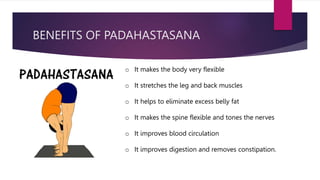
BENEFITS OF PADAHASTASANA
o It makes the body very flexible
o It stretches the leg and back muscles
o It helps to eliminate excess belly fat
o It makes the spine flexible and tones the nerves
o It improves blood circulation
o It improves digestion and removes constipation.
Ardh Matseyendrasana
 PROCEDURE
the left heel is kept under right thigh and the right leg is
crossed over the left thigh. After that hold the right toe with left
hand and turn your head and back to the right side. In this
position move the trunk sideways. Then Perform the same
asana in the reverse position.
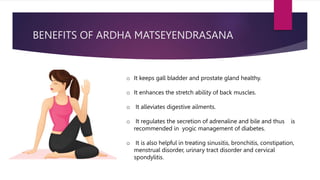
BENEFITS OF ARDHA MATSEYENDRASANA
o It keeps gall bladder and prostate gland healthy.
o It enhances the stretch ability of back muscles.
o It alleviates digestive ailments.
o It regulates the secretion of adrenaline and bile and thus is
recommended in yogic management of diabetes.
o It is also helpful in treating sinusitis, bronchitis, constipation,
menstrual disorder, urinary tract disorder and cervical
spondylitis.
Trikonasana
 PROCEDURE
First of all stand with your legs apart. Then raise the arm
sideways up to the shoulder level. Bend the trunk sideways and
raise the right hand upward. Touch the ground with left hand
behind left foot. After sometime, do the same asana with
opposite arm in the same way.
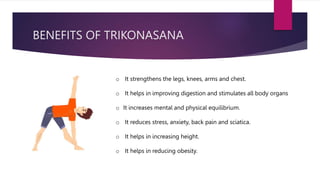
BENEFITS OF TRIKONASANA
o It strengthens the legs, knees, arms and chest.
o It helps in improving digestion and stimulates all body organs
o It increases mental and physical equilibrium.
o It reduces stress, anxiety, back pain and sciatica.
o It helps in increasing height.
o It helps in reducing obesity.
Pawanmuktasana
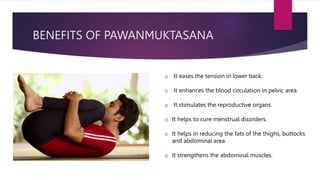
 PROCEDURE
Lie down on you back on a plain surface. Keep your feet
together and place your arms beside your body. Take a deep
breath. When you exhale bring your knees towards your chest.
At the same time press your thighs on your abdomen. Clasp
your hands around your legs. Hold the asana when you breathe
normally. Every time you inhale, ensure that you loosen the grip.
Exhale and release the pose after you rock and roll from side to
side three times.
BENEFITS OF PAWANMUKTASANA
o It eases the tension in lower back.
o It enhances the blood circulation in pelvic area.
o It stimulates the reproductive organs.
o It helps to cure menstrual disorders.
o It helps in reducing the fats of the thighs, buttocks
and abdominal area.
o It strengthens the abdominal muscles.
Bhujangasana
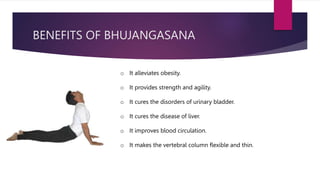
 PROCEDURE
In this asana the shape of the body remains like a snake that is
why it is called Bhujangasana. In order to perform this asana, lie
down on the belly on the ground. Keep your hands near the
shoulders. Keep your legs close together. Now straiten up your
arms slowly, raise the chest. Your head should turn backwards.
Keep the position for sometime. Then get back to the former
position. For good results, perform this asana for 4 to 5 times.
BENEFITS OF BHUJANGASANA
o It alleviates obesity.
o It provides strength and agility.
o It cures the disorders of urinary bladder.
o It cures the disease of liver.
o It improves blood circulation.
o It makes the vertebral column flexible and thin.
Shalabhasana
 PROCEDURE
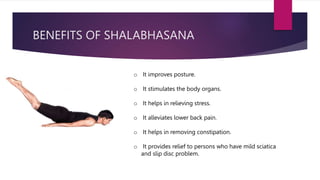
Lie down in prostate position. Spread the thigh backwards.
Hold your fists and extend arms. Keep your fists under the thigh
and then raise your legs slowly as high as you can. For best
results hold this position for 2 to 3 minutes and then lower your
legs slowly. Repeat the same action for 3 to 5 times.
BENEFITS OF SHALABHASANA
o It improves posture.
o It stimulates the body organs.
o It helps in relieving stress.
o It alleviates lower back pain.
o It helps in removing constipation.
o It provides relief to persons who have mild sciatica
and slip disc problem.
o Yoga improves strength, balance and flexibility.
o Yoga helps with back pain relief.
o Yoga can ease arthritis symptoms.
o Yoga benefits heart health.
o Yoga relaxes you, to help you sleep better
o Yoga can mean more energy and brighter moods.
o Yoga helps you manage stress.
o Yoga connects you with a supportive community.
o Yoga promotes better self-care
BENEFITS OF YOGA
YOGIC PRINCIPLES
o Yoga is an art and science of healthy living. It is a spiritual discipline based on an extremely
subtle science, which focuses on bringing harmony between body and mind.
o Adolescence is the time when an individual undergoes tremendous physical, emotional and
psychological changes. This brings stress.
o Regular practice of yoga amongst the students leads to improved concentration, reduced
blood pressure, better grades in the academics, improved interpersonal relationships, more
confidence, better sleep, calmness, sharper brains, relief from headache if any and decreased
absenteeism and aridness.
YOGA FOR WELLNESS
o Shodhana Kriyas cleanse the accumulated toxins through various shuddikriyas and
sukshmavyayama (simple movements for all body parts).
o Adoption of a yogic lifestyle with proper nourishing diet creates positive antioxidant enhancement
thus, neutralising the free radicals.
o Yogasana steadies the entire body through different physical postures. Physical balance and a
sense of ease with oneself enhance mental/emotional balance and enable all the physiological
processes to occur in a healthy manner.
o Pranayama helps to improve control over autonomic respiratory mechanisms, through breathing
patterns that generate energy and enhance emotional stability.
o Dharana helps to focus the mind positively on the activities being done, enhances energy flow
and results in healthy blood circulation to the different body parts and internal organs.
Thank you
Have a good day

YOGA PRESENTATION[1] [Read-Only].pptx

  • 1.
  • 2.
    CONTENT  YOGA  INTRODUCTIONTO YOGA  HISTORY AND DEVELOPMENT OF YOGA  TYPES OF YOGA  BENEFITS OF YOGA  YOGIC PRINCIPLES  YOGA FOR WELLNESS
  • 3.
    INTRODUCTION TO YOGA Yoga is a mind and body practice. Various styles of yoga combine physical postures, breathing techniques, and meditation or relaxation. Yoga is an ancient practice that may have originated in India. It involves movement, meditation, and breathing techniques to promote mental and physical well- being.
  • 4.
    HISTORY AND DEVLOPMENTOF YOGA  Yoga has a very long history and in terms of legacy it is as old as human civilization. Its history is also linked with the vedas and upanishads.  Yoga had a special place during the Indus Valley Civilization (2000 B.C). The stone seals restored from the sites of the Indus Valley Civilization depict the practice of Yoga during old days.
  • 5.
    HISTORY AND DEVLOPMENTOF YOGA  The word yoga is frequently referred in all the four Vedas Rigveda, Yujurveda, Samveda and Atharvaveda. Moksha is the ultimate goal of yoga, which is well explained in the Upanishads. The teaching of Buddha (Arya Asthangic Marga) and Jainism (five great vows) are the two pillars of yoga tradition. These two had greatly contributed to the development of yoga.
  • 6.
    TYPES OF YOGA Padahastasana  Ardh Matseyendrasana  Trikonasana  Pawanmuktasana  Bhujangasana  Shalabhasana
  • 7.
    Padahastasana  PROCEDURE Bend forwarduntil the fingers or palms of the hands touch the floor on either side of the feet. Try to touch the knees with the forehead. Do not strain. Keep the knees straight. Exhale while bending forward. Try to contract the abdomen in the final position to expel the maximum amount of air from the lungs.
  • 8.
    BENEFITS OF PADAHASTASANA oIt makes the body very flexible o It stretches the leg and back muscles o It helps to eliminate excess belly fat o It makes the spine flexible and tones the nerves o It improves blood circulation o It improves digestion and removes constipation.
  • 9.
    Ardh Matseyendrasana  PROCEDURE theleft heel is kept under right thigh and the right leg is crossed over the left thigh. After that hold the right toe with left hand and turn your head and back to the right side. In this position move the trunk sideways. Then Perform the same asana in the reverse position.
  • 10.
    BENEFITS OF ARDHAMATSEYENDRASANA o It keeps gall bladder and prostate gland healthy. o It enhances the stretch ability of back muscles. o It alleviates digestive ailments. o It regulates the secretion of adrenaline and bile and thus is recommended in yogic management of diabetes. o It is also helpful in treating sinusitis, bronchitis, constipation, menstrual disorder, urinary tract disorder and cervical spondylitis.
  • 11.
    Trikonasana  PROCEDURE First ofall stand with your legs apart. Then raise the arm sideways up to the shoulder level. Bend the trunk sideways and raise the right hand upward. Touch the ground with left hand behind left foot. After sometime, do the same asana with opposite arm in the same way.
  • 12.
    BENEFITS OF TRIKONASANA oIt strengthens the legs, knees, arms and chest. o It helps in improving digestion and stimulates all body organs o It increases mental and physical equilibrium. o It reduces stress, anxiety, back pain and sciatica. o It helps in increasing height. o It helps in reducing obesity.
  • 13.
    Pawanmuktasana  PROCEDURE Lie downon you back on a plain surface. Keep your feet together and place your arms beside your body. Take a deep breath. When you exhale bring your knees towards your chest. At the same time press your thighs on your abdomen. Clasp your hands around your legs. Hold the asana when you breathe normally. Every time you inhale, ensure that you loosen the grip. Exhale and release the pose after you rock and roll from side to side three times.
  • 14.
    BENEFITS OF PAWANMUKTASANA oIt eases the tension in lower back. o It enhances the blood circulation in pelvic area. o It stimulates the reproductive organs. o It helps to cure menstrual disorders. o It helps in reducing the fats of the thighs, buttocks and abdominal area. o It strengthens the abdominal muscles.
  • 15.
    Bhujangasana  PROCEDURE In thisasana the shape of the body remains like a snake that is why it is called Bhujangasana. In order to perform this asana, lie down on the belly on the ground. Keep your hands near the shoulders. Keep your legs close together. Now straiten up your arms slowly, raise the chest. Your head should turn backwards. Keep the position for sometime. Then get back to the former position. For good results, perform this asana for 4 to 5 times.
  • 16.
    BENEFITS OF BHUJANGASANA oIt alleviates obesity. o It provides strength and agility. o It cures the disorders of urinary bladder. o It cures the disease of liver. o It improves blood circulation. o It makes the vertebral column flexible and thin.
  • 17.
    Shalabhasana  PROCEDURE Lie downin prostate position. Spread the thigh backwards. Hold your fists and extend arms. Keep your fists under the thigh and then raise your legs slowly as high as you can. For best results hold this position for 2 to 3 minutes and then lower your legs slowly. Repeat the same action for 3 to 5 times.
  • 18.
    BENEFITS OF SHALABHASANA oIt improves posture. o It stimulates the body organs. o It helps in relieving stress. o It alleviates lower back pain. o It helps in removing constipation. o It provides relief to persons who have mild sciatica and slip disc problem.
  • 19.
    o Yoga improvesstrength, balance and flexibility. o Yoga helps with back pain relief. o Yoga can ease arthritis symptoms. o Yoga benefits heart health. o Yoga relaxes you, to help you sleep better o Yoga can mean more energy and brighter moods. o Yoga helps you manage stress. o Yoga connects you with a supportive community. o Yoga promotes better self-care BENEFITS OF YOGA
  • 20.
    YOGIC PRINCIPLES o Yogais an art and science of healthy living. It is a spiritual discipline based on an extremely subtle science, which focuses on bringing harmony between body and mind. o Adolescence is the time when an individual undergoes tremendous physical, emotional and psychological changes. This brings stress. o Regular practice of yoga amongst the students leads to improved concentration, reduced blood pressure, better grades in the academics, improved interpersonal relationships, more confidence, better sleep, calmness, sharper brains, relief from headache if any and decreased absenteeism and aridness.
  • 21.
    YOGA FOR WELLNESS oShodhana Kriyas cleanse the accumulated toxins through various shuddikriyas and sukshmavyayama (simple movements for all body parts). o Adoption of a yogic lifestyle with proper nourishing diet creates positive antioxidant enhancement thus, neutralising the free radicals. o Yogasana steadies the entire body through different physical postures. Physical balance and a sense of ease with oneself enhance mental/emotional balance and enable all the physiological processes to occur in a healthy manner. o Pranayama helps to improve control over autonomic respiratory mechanisms, through breathing patterns that generate energy and enhance emotional stability. o Dharana helps to focus the mind positively on the activities being done, enhances energy flow and results in healthy blood circulation to the different body parts and internal organs.
  • 22.