Tyrone O’Meally
   8th Grade
   Social Studies
   Average class size ( 25-30) students
   Heterogeneous mix of students
   Extension Activity of U.S imperialism
   Estimated class time: 6 class days or 6-40
    minute periods
Standards/Key Ideas/ Performance Indicators
     SS1: History of the United States and New York
          Students will use a variety of intellectual skills to demonstrate their
          understanding of major ideas, eras, themes, developments, and turning points in
          the history of the United States and New York

           Key Idea - SS1.2: History of the United States and New York
           Important ideas, social and cultural values, beliefs, and traditions from New
           York State and United States history illustrate the connections and
           interactions of people and events across time and from a variety of perspectives.

              Performance Indicator - SS1.I.2B:
              students investigate key turning points in New York State and United States
              history and and explain why these developments are significant

              Performance Indicator - SS1.I.2C:
              Students understand the relationship between the relative importance of
United                    States domestic and foreign policies over time.

             Performance Indicator - SS1.I.2D:
             Students analyze the role played by the United States in international politics,
             past and present
   1. Media Literacy Education requires inquiry and critical thinking
    about messages we receive and create
   2. Media Literacy Education expands the concept of literacy ( i.e.,
    reading and writing) to include all forms of media
   3. Media Literacy Education builds and reinforces learners of all
    ages. Like print literacy, those necessitate integrated, interactive, and
    repeated practices.
   6. Media Literacy Education affirms that people use their individual
    skills, beliefs, and experiences to construct their own meaning and
    media messages
   Prior to this lesson, students learned the
    reasons for U.S imperialism during the mid
    to late 19th century as well as different
    examples of imperialism.
   One example of imperialism was the United
    States involvement in the Spanish American
    War. There were several reasons for U.S
    involvement in the Spanish American War,
    but a major cause was Yellow Journalism.
   Students will define Yellow Journalism
   Students will use the dialogic approach to analyze
    three different types of media text: videos,
    newspaper headlines, images, political cartoons;
    that that can be categorized as Yellow Journalism
   When using the dialogic approach, students must
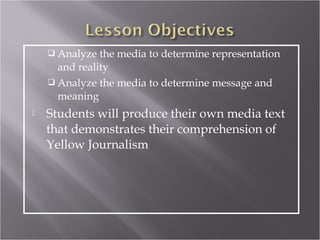
     Analyze the media to determine target audience
 Analyze  the media to determine representation
      and reality
     Analyze the media to determine message and
      meaning
   Students will produce their own media text
    that demonstrates their comprehension of
    Yellow Journalism
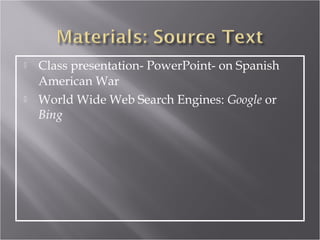
   Class presentation- PowerPoint- on Spanish
    American War
   World Wide Web Search Engines: Google or
    Bing
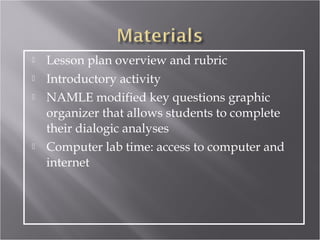
   Lesson plan overview and rubric
   Introductory activity
   NAMLE modified key questions graphic
    organizer that allows students to complete
    their dialogic analyses
   Computer lab time: access to computer and
    internet
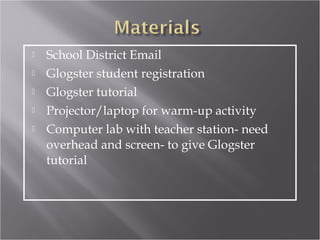
   School District Email
   Glogster student registration
   Glogster tutorial
   Projector/laptop for warm-up activity
   Computer lab with teacher station- need
    overhead and screen- to give Glogster
    tutorial
   Start class by googling tmz.com and choose one of
    the headlines that appear on the main page
       It is important that you choose a headline that students are
        familiar with ( i.e. Jennifer Lopez, Kanye West)
   After projecting the headline and the accompanying
    article, distribute the key questions graphic
    organizer.
   Explain to students that media has hidden
    messages that we, as consumers, need to critically
    analyze for their true meaning.
   Give students a 10-15 minutes to complete the
    dialogic analyses of tmz.com article or whatever
    media that you prefer.
   After students have completed their analyses, begin
    whole class discussion based on the key
    questions/ideas: who is the intended Audience;
    Messages and Meanings; and Representation and
    Reality.
     It is important that you select multiple students per
      question to reinforce the idea that there can be various
      interpretations of the same media text.
     When students are presenting their analyses to the class, it
      is important that ask students to question the accuracy of
      their original thoughts
   After completing the warm up activity, reintroduce
    the term yellow journalism and then have students
    recall it’s definition and how it was a catalyst to the
    Spanish American War.
•   Next, distribute project description and rubric to
    students and then begin discussion on assignment .
•   When discussing the assignment
     Inform students that they will be working with
       various media texts that they must analyze- this will
       be the same process as the warm up activity
     Inform students that must select three different types
       of media and it can be of any form: videos, articles,
       newspaper headlines, etc…
     Inform students that media text they select must
       demonstrate yellow journalism
   Bring students to the computer lab
     Ensure that they all have a copy of their rubric
   Inform students that they will spend the period
    searching on Bing or Google looking for different media
    that they could use as examples of yellow journalism
     Students are free to use any form of media they
      choose, but it must be appropriate for school
     As they select their media text that demonstrates
      yellow journalism, they must complete the key
      questions graphic organizer for each example
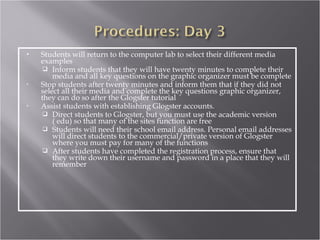
   Students will return to the computer lab to select their different media
    examples
      Inform students that they will have twenty minutes to complete their
        media and all key questions on the graphic organizer must be complete
•   Stop students after twenty minutes and inform them that if they did not
    select all their media and complete the key questions graphic organizer,
    they can do so after the Glogster tutorial
•   Assist students with establishing Glogster accounts.
      Direct students to Glogster, but you must use the academic version
        ( edu) so that many of the sites function are free
      Students will need their school email address. Personal email addresses
        will direct students to the commercial/private version of Glogster
        where you must pay for many of the functions
      After students have completed the registration process, ensure that
        they write down their username and password in a place that they will
        remember
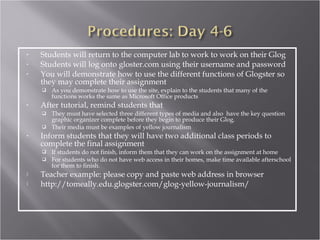
•   Students will return to the computer lab to work to work on their Glog
•   Students will log onto gloster.com using their username and password
•   You will demonstrate how to use the different functions of Glogster so
    they may complete their assignment
       As you demonstrate how to use the site, explain to the students that many of the
        functions works the same as Microsoft Office products
•   After tutorial, remind students that
       They must have selected three different types of media and also have the key question
        graphic organizer complete before they begin to produce their Glog.
       Their media must be examples of yellow journalism
•   Inform students that they will have two additional class periods to
    complete the final assignment
       If students do not finish, inform them that they can work on the assignment at home
       For students who do not have web access in their homes, make time available afterschool
        for them to finish.
   Teacher example: please copy and paste web address in browser
   http://tomeally.edu.glogster.com/glog-yellow-journalism/
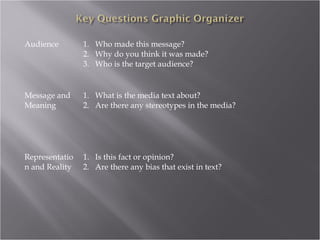
Audience        1. Who made this message?
                2. Why do you think it was made?
                3. Who is the target audience?


Message and     1. What is the media text about?
Meaning         2. Are there any stereotypes in the media?


Representatio   1. Is this fact or opinion?
n and Reality   2. Are there any bias that exist in text?
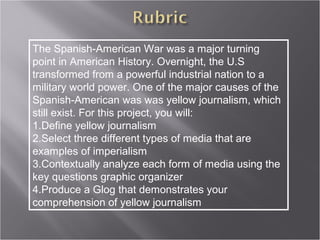
The Spanish-American War was a major turning
point in American History. Overnight, the U.S
transformed from a powerful industrial nation to a
military world power. One of the major causes of the
Spanish-American was was yellow journalism, which
still exist. For this project, you will:
1.Define yellow journalism
2.Select three different types of media that are
examples of imperialism
3.Contextually analyze each form of media using the
key questions graphic organizer
4.Produce a Glog that demonstrates your
comprehension of yellow journalism
•This lesson combines key social studies terms-
yellow journalism- with dialogic approach to tot
teaching media.
• As students work their way through this
assignment, they “make their existing knowledge
of media explicit” by completing the key questions
organizer ( Buckingham, 147).
•After students have completed their analyses of
their media, the creation of their Glog will be the
translation of the ideas that they have learned.
•After students have completed their
assignment, I hope that my they will
be more critical as they consume
media that they encounter in their
daily lives. That is, in absences of the
teacher, students will be able
understand media for what it truly is,
thus becoming critically autonomous
(Buckingham, 107)

Yellow journalism and dialogic approach

  • 1.
  • 2.
    8th Grade  Social Studies  Average class size ( 25-30) students  Heterogeneous mix of students  Extension Activity of U.S imperialism  Estimated class time: 6 class days or 6-40 minute periods
  • 3.
    Standards/Key Ideas/ PerformanceIndicators SS1: History of the United States and New York Students will use a variety of intellectual skills to demonstrate their understanding of major ideas, eras, themes, developments, and turning points in the history of the United States and New York Key Idea - SS1.2: History of the United States and New York Important ideas, social and cultural values, beliefs, and traditions from New York State and United States history illustrate the connections and interactions of people and events across time and from a variety of perspectives. Performance Indicator - SS1.I.2B: students investigate key turning points in New York State and United States history and and explain why these developments are significant Performance Indicator - SS1.I.2C: Students understand the relationship between the relative importance of United States domestic and foreign policies over time. Performance Indicator - SS1.I.2D: Students analyze the role played by the United States in international politics, past and present
  • 4.
    1. Media Literacy Education requires inquiry and critical thinking about messages we receive and create  2. Media Literacy Education expands the concept of literacy ( i.e., reading and writing) to include all forms of media  3. Media Literacy Education builds and reinforces learners of all ages. Like print literacy, those necessitate integrated, interactive, and repeated practices.  6. Media Literacy Education affirms that people use their individual skills, beliefs, and experiences to construct their own meaning and media messages
  • 5.
    Prior to this lesson, students learned the reasons for U.S imperialism during the mid to late 19th century as well as different examples of imperialism.  One example of imperialism was the United States involvement in the Spanish American War. There were several reasons for U.S involvement in the Spanish American War, but a major cause was Yellow Journalism.
  • 6.
    Students will define Yellow Journalism  Students will use the dialogic approach to analyze three different types of media text: videos, newspaper headlines, images, political cartoons; that that can be categorized as Yellow Journalism  When using the dialogic approach, students must  Analyze the media to determine target audience
  • 7.
     Analyze the media to determine representation and reality  Analyze the media to determine message and meaning  Students will produce their own media text that demonstrates their comprehension of Yellow Journalism
  • 8.
    Class presentation- PowerPoint- on Spanish American War  World Wide Web Search Engines: Google or Bing
  • 9.
    Lesson plan overview and rubric  Introductory activity  NAMLE modified key questions graphic organizer that allows students to complete their dialogic analyses  Computer lab time: access to computer and internet
  • 10.
    School District Email  Glogster student registration  Glogster tutorial  Projector/laptop for warm-up activity  Computer lab with teacher station- need overhead and screen- to give Glogster tutorial
  • 11.
    Start class by googling tmz.com and choose one of the headlines that appear on the main page  It is important that you choose a headline that students are familiar with ( i.e. Jennifer Lopez, Kanye West)  After projecting the headline and the accompanying article, distribute the key questions graphic organizer.  Explain to students that media has hidden messages that we, as consumers, need to critically analyze for their true meaning.  Give students a 10-15 minutes to complete the dialogic analyses of tmz.com article or whatever media that you prefer.
  • 12.
    After students have completed their analyses, begin whole class discussion based on the key questions/ideas: who is the intended Audience; Messages and Meanings; and Representation and Reality.  It is important that you select multiple students per question to reinforce the idea that there can be various interpretations of the same media text.  When students are presenting their analyses to the class, it is important that ask students to question the accuracy of their original thoughts  After completing the warm up activity, reintroduce the term yellow journalism and then have students recall it’s definition and how it was a catalyst to the Spanish American War.
  • 13.
    Next, distribute project description and rubric to students and then begin discussion on assignment . • When discussing the assignment  Inform students that they will be working with various media texts that they must analyze- this will be the same process as the warm up activity  Inform students that must select three different types of media and it can be of any form: videos, articles, newspaper headlines, etc…  Inform students that media text they select must demonstrate yellow journalism
  • 14.
    Bring students to the computer lab  Ensure that they all have a copy of their rubric  Inform students that they will spend the period searching on Bing or Google looking for different media that they could use as examples of yellow journalism  Students are free to use any form of media they choose, but it must be appropriate for school  As they select their media text that demonstrates yellow journalism, they must complete the key questions graphic organizer for each example
  • 15.
    Students will return to the computer lab to select their different media examples  Inform students that they will have twenty minutes to complete their media and all key questions on the graphic organizer must be complete • Stop students after twenty minutes and inform them that if they did not select all their media and complete the key questions graphic organizer, they can do so after the Glogster tutorial • Assist students with establishing Glogster accounts.  Direct students to Glogster, but you must use the academic version ( edu) so that many of the sites function are free  Students will need their school email address. Personal email addresses will direct students to the commercial/private version of Glogster where you must pay for many of the functions  After students have completed the registration process, ensure that they write down their username and password in a place that they will remember
  • 16.
    Students will return to the computer lab to work to work on their Glog • Students will log onto gloster.com using their username and password • You will demonstrate how to use the different functions of Glogster so they may complete their assignment  As you demonstrate how to use the site, explain to the students that many of the functions works the same as Microsoft Office products • After tutorial, remind students that  They must have selected three different types of media and also have the key question graphic organizer complete before they begin to produce their Glog.  Their media must be examples of yellow journalism • Inform students that they will have two additional class periods to complete the final assignment  If students do not finish, inform them that they can work on the assignment at home  For students who do not have web access in their homes, make time available afterschool for them to finish.  Teacher example: please copy and paste web address in browser  http://tomeally.edu.glogster.com/glog-yellow-journalism/
  • 17.
    Audience 1. Who made this message? 2. Why do you think it was made? 3. Who is the target audience? Message and 1. What is the media text about? Meaning 2. Are there any stereotypes in the media? Representatio 1. Is this fact or opinion? n and Reality 2. Are there any bias that exist in text?
  • 18.
    The Spanish-American Warwas a major turning point in American History. Overnight, the U.S transformed from a powerful industrial nation to a military world power. One of the major causes of the Spanish-American was was yellow journalism, which still exist. For this project, you will: 1.Define yellow journalism 2.Select three different types of media that are examples of imperialism 3.Contextually analyze each form of media using the key questions graphic organizer 4.Produce a Glog that demonstrates your comprehension of yellow journalism
  • 20.
    •This lesson combineskey social studies terms- yellow journalism- with dialogic approach to tot teaching media. • As students work their way through this assignment, they “make their existing knowledge of media explicit” by completing the key questions organizer ( Buckingham, 147). •After students have completed their analyses of their media, the creation of their Glog will be the translation of the ideas that they have learned.
  • 21.
    •After students havecompleted their assignment, I hope that my they will be more critical as they consume media that they encounter in their daily lives. That is, in absences of the teacher, students will be able understand media for what it truly is, thus becoming critically autonomous (Buckingham, 107)