Personal
Communication
System (PCS)
ABHISHEK H. PATIL 09-834
SAMIKSHA K. REDDY 09-819
RAHUL PATANKAR 09-832
JIGAR SALECHA 09-852
PROF SAURABH
MEHTA
What is Communication System?
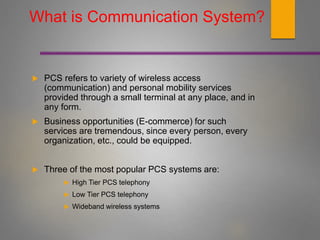
 PCS refers to variety of wireless access
(communication) and personal mobility services
provided through a small terminal at any place, and in
any form.
 Business opportunities (E-commerce) for such
services are tremendous, since every person, every
organization, etc., could be equipped.
 Three of the most popular PCS systems are:
 High Tier PCS telephony
 Low Tier PCS telephony
 Wideband wireless systems
Architecture of PCS
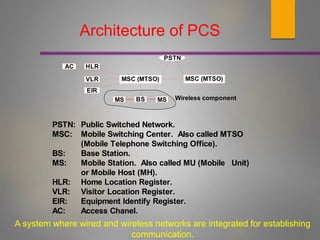
A system where wired and wireless networks are integrated for establishing
communication.
PSTN: Public Switched Network.
MSC: Mobile Switching Center. Also called MTSO
(Mobile Telephone Switching Office).
BS: Base Station.
MS: Mobile Station. Also called MU (Mobile Unit)
or Mobile Host (MH).
HLR: Home Location Register.
VLR: Visitor Location Register.
EIR: Equipment Identify Register.
AC: Access Chanel.
PSTN
BS
VLR
HLR
EIR
AC
MSC (MTSO)MSC (MTSO)
MSMS Wireless component
High-tier digital cellular systems
(mobile phone systems)
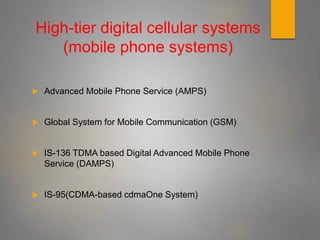
 Advanced Mobile Phone Service (AMPS)
 Global System for Mobile Communication (GSM)
 IS-136 TDMA based Digital Advanced Mobile Phone
Service (DAMPS)
 IS-95(CDMA-based cdmaOne System)
Cellular HIGH-TIER telephony
overview
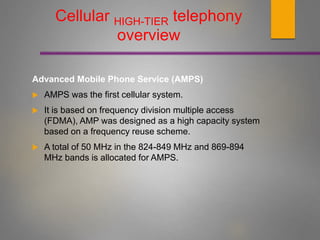
Advanced Mobile Phone Service (AMPS)
 AMPS was the first cellular system.
 It is based on frequency division multiple access
(FDMA), AMP was designed as a high capacity system
based on a frequency reuse scheme.
 A total of 50 MHz in the 824-849 MHz and 869-894
MHz bands is allocated for AMPS.
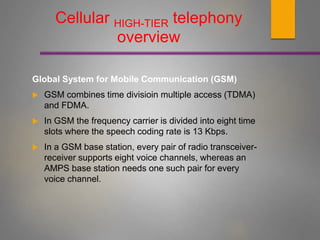
Global System for Mobile Communication (GSM)
 GSM combines time divisioin multiple access (TDMA)
and FDMA.
 In GSM the frequency carrier is divided into eight time
slots where the speech coding rate is 13 Kbps.
 In a GSM base station, every pair of radio transceiver-
receiver supports eight voice channels, whereas an
AMPS base station needs one such pair for every
voice channel.
Cellular HIGH-TIER telephony
overview
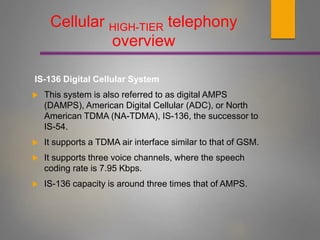
IS-136 Digital Cellular System
 This system is also referred to as digital AMPS
(DAMPS), American Digital Cellular (ADC), or North
American TDMA (NA-TDMA), IS-136, the successor to
IS-54.
 It supports a TDMA air interface similar to that of GSM.
 It supports three voice channels, where the speech
coding rate is 7.95 Kbps.
 IS-136 capacity is around three times that of AMPS.
Cellular HIGH-TIER telephony
overview
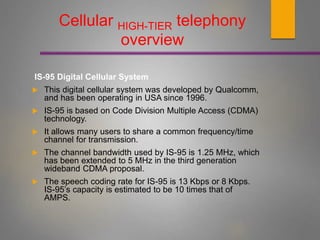
IS-95 Digital Cellular System
 This digital cellular system was developed by Qualcomm,
and has been operating in USA since 1996.
 IS-95 is based on Code Division Multiple Access (CDMA)
technology.
 It allows many users to share a common frequency/time
channel for transmission.
 The channel bandwidth used by IS-95 is 1.25 MHz, which
has been extended to 5 MHz in the third generation
wideband CDMA proposal.
 The speech coding rate for IS-95 is 13 Kbps or 8 Kbps.
IS-95’s capacity is estimated to be 10 times that of
AMPS.
Cellular HIGH-TIER telephony
overview
Low-tier digital cellular systems
(mobile phone systems)
 Cordless Telephone 2 (CT2)
 Digital Enhanced Cordless Telephone (DECT)
 Personal Handy Phone System (PHS)
 Personal Access Communications Systems (PACS)
Cellular LOW-TIER telephony
overview
Cordless Telephone, Second Generation (CT2)
 CT2 is allocated 40 FDMA channels with a 32-Kbps
speech coding rate.
 For a user, both base-to-handset signals and handset-
to-base signals are transmitted in the same frequency.
 CT2 also supports data transmission rates of up to 2.4
Kbps through the speech code and up to 4.8 Kbps with
an increased rate.
 CT2 does not support handoff and in a public CT2
system, call delivery is not supported.
Cellular LOW-TIER telephony
overview
Digital European Cordless Telephone (DECT)
 DECT supports high user density with a picocell
design.
 There are 12 voice channels per frequency carrier.
 Sleep mode is employed to converse handset power.
DECT also supports seamless handoff.
Cellular LOW-TIER telephony
overview
Personal Handy Phone System (PHS)
 PHS is a low-tier digital PCS system that offers
telecommunication services for homes, offices, and
outdoor environment, using radio access to the public
telephone network or other digital networks.
 PHS uses TDMA.
 Sleep mode enables PHS to support five hours of talk
time, or 150 hours of standby time.
 PHS operates in the 1895-1918.1 MHz band.
 The bandwidth is partitioned into 77 channels, each
with 300 KHz bandwidth.
Cellular LOW-TIER telephony
overview
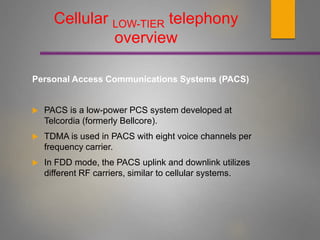
Personal Access Communications Systems (PACS)
 PACS is a low-power PCS system developed at
Telcordia (formerly Bellcore).
 TDMA is used in PACS with eight voice channels per
frequency carrier.
 In FDD mode, the PACS uplink and downlink utilizes
different RF carriers, similar to cellular systems.
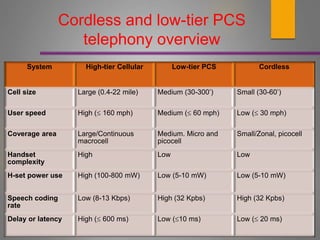
Cordless and low-tier PCS
telephony overview
System High-tier Cellular Low-tier PCS Cordless
Cell size Large (0.4-22 mile) Medium (30-300’) Small (30-60’)
User speed High ( 160 mph) Medium ( 60 mph) Low ( 30 mph)
Coverage area Large/Continuous
macrocell
Medium. Micro and
picocell
Small/Zonal, picocell
Handset
complexity
High Low Low
H-set power use High (100-800 mW) Low (5-10 mW) Low (5-10 mW)
Speech coding
rate
Low (8-13 Kbps) High (32 Kpbs) High (32 Kpbs)
Delay or latency High ( 600 ms) Low (10 ms) Low ( 20 ms)
[Year 2012-13] PCS

[Year 2012-13] PCS

  • 1.
    Personal Communication System (PCS) ABHISHEK H.PATIL 09-834 SAMIKSHA K. REDDY 09-819 RAHUL PATANKAR 09-832 JIGAR SALECHA 09-852 PROF SAURABH MEHTA
  • 2.
    What is CommunicationSystem?  PCS refers to variety of wireless access (communication) and personal mobility services provided through a small terminal at any place, and in any form.  Business opportunities (E-commerce) for such services are tremendous, since every person, every organization, etc., could be equipped.  Three of the most popular PCS systems are:  High Tier PCS telephony  Low Tier PCS telephony  Wideband wireless systems
  • 3.
    Architecture of PCS Asystem where wired and wireless networks are integrated for establishing communication. PSTN: Public Switched Network. MSC: Mobile Switching Center. Also called MTSO (Mobile Telephone Switching Office). BS: Base Station. MS: Mobile Station. Also called MU (Mobile Unit) or Mobile Host (MH). HLR: Home Location Register. VLR: Visitor Location Register. EIR: Equipment Identify Register. AC: Access Chanel. PSTN BS VLR HLR EIR AC MSC (MTSO)MSC (MTSO) MSMS Wireless component
  • 4.
    High-tier digital cellularsystems (mobile phone systems)  Advanced Mobile Phone Service (AMPS)  Global System for Mobile Communication (GSM)  IS-136 TDMA based Digital Advanced Mobile Phone Service (DAMPS)  IS-95(CDMA-based cdmaOne System)
  • 5.
    Cellular HIGH-TIER telephony overview AdvancedMobile Phone Service (AMPS)  AMPS was the first cellular system.  It is based on frequency division multiple access (FDMA), AMP was designed as a high capacity system based on a frequency reuse scheme.  A total of 50 MHz in the 824-849 MHz and 869-894 MHz bands is allocated for AMPS.
  • 6.
    Global System forMobile Communication (GSM)  GSM combines time divisioin multiple access (TDMA) and FDMA.  In GSM the frequency carrier is divided into eight time slots where the speech coding rate is 13 Kbps.  In a GSM base station, every pair of radio transceiver- receiver supports eight voice channels, whereas an AMPS base station needs one such pair for every voice channel. Cellular HIGH-TIER telephony overview
  • 7.
    IS-136 Digital CellularSystem  This system is also referred to as digital AMPS (DAMPS), American Digital Cellular (ADC), or North American TDMA (NA-TDMA), IS-136, the successor to IS-54.  It supports a TDMA air interface similar to that of GSM.  It supports three voice channels, where the speech coding rate is 7.95 Kbps.  IS-136 capacity is around three times that of AMPS. Cellular HIGH-TIER telephony overview
  • 8.
    IS-95 Digital CellularSystem  This digital cellular system was developed by Qualcomm, and has been operating in USA since 1996.  IS-95 is based on Code Division Multiple Access (CDMA) technology.  It allows many users to share a common frequency/time channel for transmission.  The channel bandwidth used by IS-95 is 1.25 MHz, which has been extended to 5 MHz in the third generation wideband CDMA proposal.  The speech coding rate for IS-95 is 13 Kbps or 8 Kbps. IS-95’s capacity is estimated to be 10 times that of AMPS. Cellular HIGH-TIER telephony overview
  • 9.
    Low-tier digital cellularsystems (mobile phone systems)  Cordless Telephone 2 (CT2)  Digital Enhanced Cordless Telephone (DECT)  Personal Handy Phone System (PHS)  Personal Access Communications Systems (PACS)
  • 10.
    Cellular LOW-TIER telephony overview CordlessTelephone, Second Generation (CT2)  CT2 is allocated 40 FDMA channels with a 32-Kbps speech coding rate.  For a user, both base-to-handset signals and handset- to-base signals are transmitted in the same frequency.  CT2 also supports data transmission rates of up to 2.4 Kbps through the speech code and up to 4.8 Kbps with an increased rate.  CT2 does not support handoff and in a public CT2 system, call delivery is not supported.
  • 11.
    Cellular LOW-TIER telephony overview DigitalEuropean Cordless Telephone (DECT)  DECT supports high user density with a picocell design.  There are 12 voice channels per frequency carrier.  Sleep mode is employed to converse handset power. DECT also supports seamless handoff.
  • 12.
    Cellular LOW-TIER telephony overview PersonalHandy Phone System (PHS)  PHS is a low-tier digital PCS system that offers telecommunication services for homes, offices, and outdoor environment, using radio access to the public telephone network or other digital networks.  PHS uses TDMA.  Sleep mode enables PHS to support five hours of talk time, or 150 hours of standby time.  PHS operates in the 1895-1918.1 MHz band.  The bandwidth is partitioned into 77 channels, each with 300 KHz bandwidth.
  • 13.
    Cellular LOW-TIER telephony overview PersonalAccess Communications Systems (PACS)  PACS is a low-power PCS system developed at Telcordia (formerly Bellcore).  TDMA is used in PACS with eight voice channels per frequency carrier.  In FDD mode, the PACS uplink and downlink utilizes different RF carriers, similar to cellular systems.
  • 14.
    Cordless and low-tierPCS telephony overview System High-tier Cellular Low-tier PCS Cordless Cell size Large (0.4-22 mile) Medium (30-300’) Small (30-60’) User speed High ( 160 mph) Medium ( 60 mph) Low ( 30 mph) Coverage area Large/Continuous macrocell Medium. Micro and picocell Small/Zonal, picocell Handset complexity High Low Low H-set power use High (100-800 mW) Low (5-10 mW) Low (5-10 mW) Speech coding rate Low (8-13 Kbps) High (32 Kpbs) High (32 Kpbs) Delay or latency High ( 600 ms) Low (10 ms) Low ( 20 ms)