Celluler Telephone Networks
Cellular telephone, sometimes called mobile telephone, is a type of short-wave analog or
digital telecommunication in which a subscriber has a wireless connection from a mobile
telephone to a relatively nearby transmitter.
Introduction:
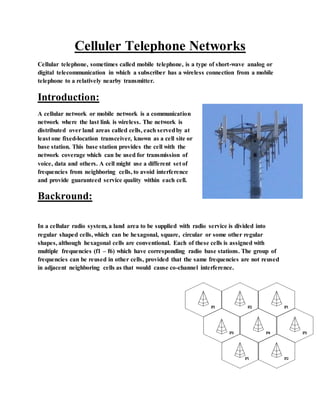
A cellular network or mobile network is a communication
network where the last link is wireless. The network is
distributed over land areas called cells, each servedby at
least one fixed-location transceiver, known as a cell site or
base station. This base station provides the cell with the
network coverage which can be used for transmission of
voice, data and others. A cell might use a different set of
frequencies from neighboring cells, to avoid interference
and provide guaranteed service quality within each cell.
Backround:
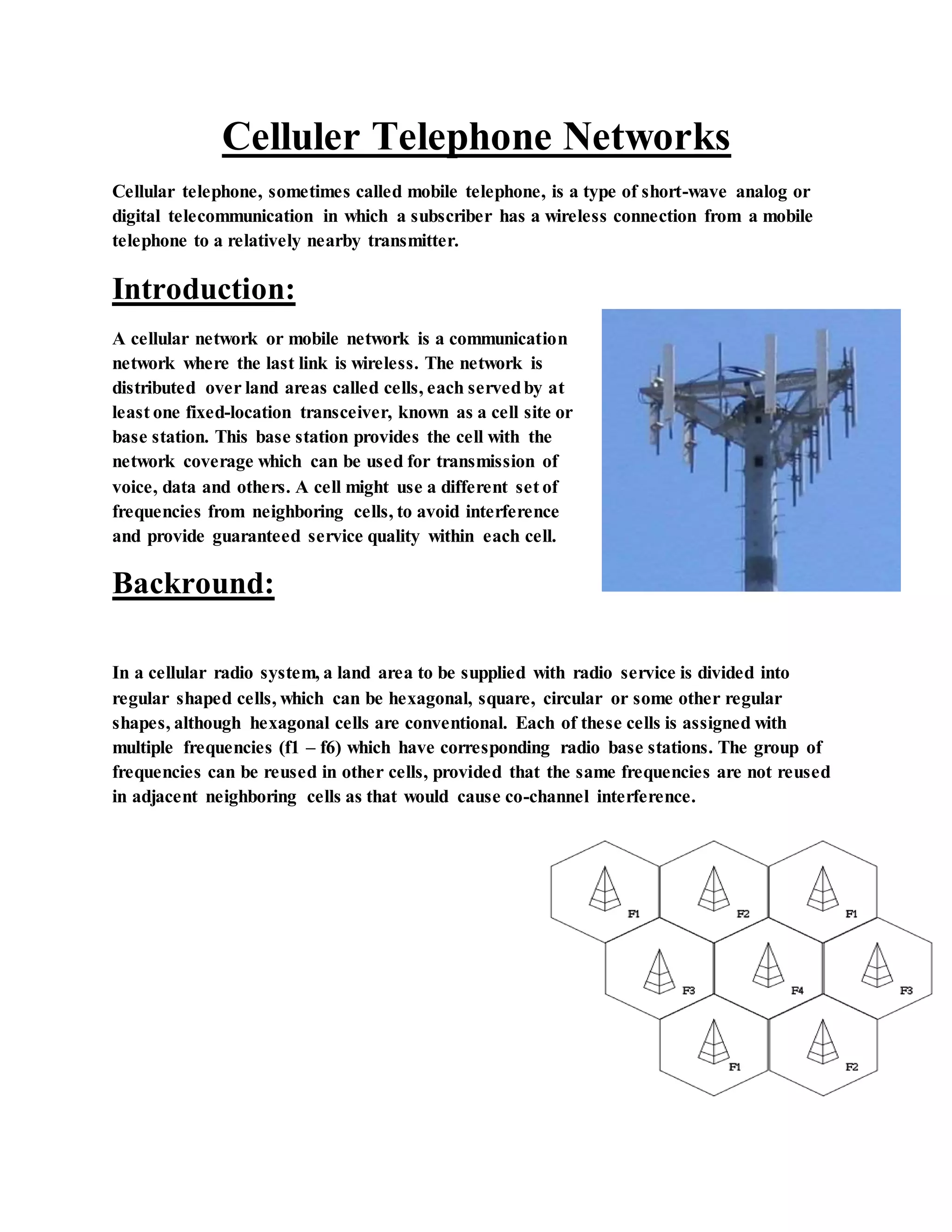
In a cellular radio system, a land area to be supplied with radio service is divided into
regular shaped cells, which can be hexagonal, square, circular or some other regular
shapes, although hexagonal cells are conventional. Each of these cells is assigned with
multiple frequencies (f1 – f6) which have corresponding radio base stations. The group of
frequencies can be reused in other cells, provided that the same frequencies are not reused
in adjacent neighboring cells as that would cause co-channel interference.
Services:
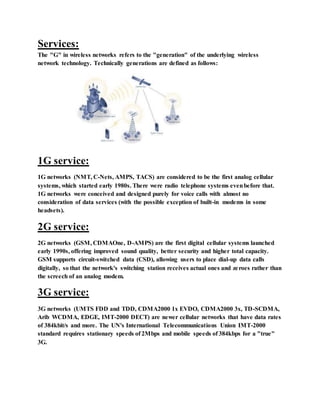
The "G" in wireless networks refers to the "generation" of the underlying wireless
network technology. Technically generations are defined as follows:
1G service:
1G networks (NMT, C-Nets, AMPS, TACS) are considered to be the first analog cellular
systems, which started early 1980s. There were radio telephone systems evenbefore that.
1G networks were conceived and designed purely for voice calls with almost no
consideration of data services (with the possible exception of built-in modems in some
headsets).
2G service:
2G networks (GSM, CDMAOne, D-AMPS) are the first digital cellular systems launched
early 1990s, offering improved sound quality, better security and higher total capacity.
GSM supports circuit-switched data (CSD), allowing users to place dial-up data calls
digitally, so that the network's switching station receives actual ones and zeroes rather than
the screech of an analog modem.
3G service:
3G networks (UMTS FDD and TDD, CDMA2000 1x EVDO, CDMA2000 3x, TD-SCDMA,
Arib WCDMA, EDGE, IMT-2000 DECT) are newer cellular networks that have data rates
of 384kbit/s and more. The UN's International Telecommunications Union IMT-2000
standard requires stationary speeds of 2Mbps and mobile speeds of 384kbps for a "true"
3G.
4G service:
4G technology refers to the fourth generation of mobile phone communication standards.
LTE and WIMAX are marketed as parts of this generation, eventhough they fall short of
the actual standard. The ITI has taken ownership of 4G, bundling into a specification
known as IMT-Advanced. The document calls for 4G technologies to deliver downlink
speeds of 1Gbps when stationary and 100Mbps when mobile, roughly 500-fold and 250-fold
increase over IMT-2000 respectively. Unfortunately, those specs are so aggressive that no
commercialized standard currently meets them.
Components:
There are some components of celluler telephone networks as
MSC,BSC,BTS,PSTN,VLR,HLR etc.
Mobile switching center (MSC):
The mobile switching center (MSC) is the primary service delivery node for GSM/CDMA,
responsible for routing voice calls and SMS as well as other services (such as conference
calls, FAX and circuit switched data). The MSC sets up and releases the end-to-end
connection, handles mobility and hand-over requirements during the call and takes care of
charging and real time pre-paid account monitoring.
The mobile switching center (MSC) is the primary service delivery node for GSM/CDMA,
responsible for routing voice calls and SMS as well as other services (such as conference
calls, FAX and circuit switched data). The MSC sets up and releases the end-to-end
connection, handles mobility and hand-over requirements during the call and takes care of
charging and real time pre-paid account monitoring.
The mobile switching center serveris a soft-switch variant (therefore it may be referred as
Mobile Soft Switch, MSS) of the mobile switching center, which provides circuit-switched
calling mobility management, and GSM services to the mobile phones roaming within the
area that it serves. MSS functionality enables split between control (signalling) and user
plane (bearer in network element called as media gateway/MG), which guarantees better
placement of network elements within the network.
Home locationregister (HLR):
The home location register (HLR) is a central database that contains details of each mobile
phone subscriber that is authorized to use the GSM core network. There can be several
logical, and physical, HLRs per public land mobile network (PLMN), though one
international mobile subscriber identity (IMSI)/MSISDN pair can be associatedwith only
one logical HLR (which can span several physical nodes) at a time.The HLRs store details
of every SIM card issued by the mobile phone operator. Each SIM has a unique identifier
called an IMSI which is the primary key to each HLR record.
Another important item of data associatedwith the SIM are the MSISDNs, which are the
telephone numbers used by mobile phones to make and receive calls. The primary
MSISDN is the number used for making and receiving voice calls and SMS, but it is
possible for a SIM to have other secondary MSISDNs associatedwith it for fax and data
calls. Each MSISDN is also a primary key to the HLR record. The HLR data is stored for
as long as a subscriber remains with the mobile phone operator.
Visitorlocationregister(VLR):
The Visitor Location Register(VLR) is a database of the subscribers who have roamed into
the jurisdiction of the MSC (Mobile Switching Center) which it serves. Each main base
station in the network is servedby exactly one VLR (one BTS may be servedby many
MSCs in case of MSC in pool), hence a subscriber cannot be present in more than one VLR
at a time.
The data stored in the VLR has either been received from the HLR, or collected from the
MS (Mobile station). In practice, for performance reasons, most vendors integrate the VLR
directly to the V-MSC and, where this is not done, the VLR is very tightly linked with the
MSC via a proprietary interface. Whenever an MSC detects a new MS in its network, in
addition to creating a new record in the VLR, it also updates the HLR of the mobile
subscriber, apprising it of the new location of that MS. If VLR data is corrupted it can lead
to serious issues with text messaging and call services.
Base StationController(BSC):
The base station controller (BSC) provides, classically, the intelligence behind the BTSs.
Typically a BSC has tens or evenhundreds of BTSs under its control. The BSC handles
allocation of radio channels, receives measurements from the mobile phones, and controls
handovers from BTS to BTS (except in the case of an inter-BSC handover in which case
control is in part the responsibility of the anchor MSC). A key function of the BSC is to act
as a concentrator where many different low capacity connections to BTSs (with relatively
low utilisation) become reduced to a smaller number of connections towards the mobile
switching center (MSC) (with a high level of utilisation).
A BSC is often based on a distributed computing architecture, with redundancy applied to
critical functional units to ensure availability in the event of fault conditions. Redundancy
often extends beyond the BSC equipment itself and is commonly used in the power supplies
and in the transmission equipment providing the A-ter interface to PCU.
Base transceiverStation(BTS):
The base transceiver station, or BTS, contains the equipment for transmitting and
receiving radio signals (transceivers), antennas, and equipment for encrypting and
decrypting communications with the base station controller (BSC). Typically a BTS for
anything other than a picocell will have several transceivers (TRXs) which allow it to
several different frequencies and different sectors of the cell (in the case of sectorisedbase
stations). The functions of a BTS vary depending on the cellular technology used and the
cellular telephone provider. There are vendors in which the BTS is a plain transceiver
which receives information from the MS (mobile station) through the Um air interface and
then converts it to a TDM (PCM) based interface, the Abis interface, and sends it towards
the BSC. There are vendors which build their BTSs so the information is preprocessed,
target cell lists are generated and evenintracell handover (HO) can be fully handled. The
advantage in this case is less load on the expensive Abis interface.
Publicswitched telephone network (PSTN)
PSTN (public switched telephone network) is the world's collection of interconnected voice-
oriented public telephone networks, both commercial and government-owned. It's also
referred to as the Plain Old Telephone Service (POTS). It's the aggregation of circuit-
switching telephone networks that has evolvedfrom the days of Alexander Graham Bell
("Doctor Watson, come here!"). Today, it is almost entirely digital in technology except for
the final link from the central (local) telephone office to the user.
In relation to the Internet, the PSTN actually furnishes much of the Internet's long-
distance infrastructure. Because Internet service providers ISPs pay the long-distance
providers for access to their infrastructure and share the circuits among many users
through packet-switching, Internet users avoid having to pay usage tolls to anyone other
than their ISPs.
Assignment
Submitted to: Ma’am Iqra Ilyas
Submitted by: Huma Tariq
Roll No: 14020204-050
Department:Computer Science
GC Women University Sialkot

Celluler telephone 2

  • 1.
    Celluler Telephone Networks Cellulartelephone, sometimes called mobile telephone, is a type of short-wave analog or digital telecommunication in which a subscriber has a wireless connection from a mobile telephone to a relatively nearby transmitter. Introduction: A cellular network or mobile network is a communication network where the last link is wireless. The network is distributed over land areas called cells, each servedby at least one fixed-location transceiver, known as a cell site or base station. This base station provides the cell with the network coverage which can be used for transmission of voice, data and others. A cell might use a different set of frequencies from neighboring cells, to avoid interference and provide guaranteed service quality within each cell. Backround: In a cellular radio system, a land area to be supplied with radio service is divided into regular shaped cells, which can be hexagonal, square, circular or some other regular shapes, although hexagonal cells are conventional. Each of these cells is assigned with multiple frequencies (f1 – f6) which have corresponding radio base stations. The group of frequencies can be reused in other cells, provided that the same frequencies are not reused in adjacent neighboring cells as that would cause co-channel interference.
  • 2.
    Services: The "G" inwireless networks refers to the "generation" of the underlying wireless network technology. Technically generations are defined as follows: 1G service: 1G networks (NMT, C-Nets, AMPS, TACS) are considered to be the first analog cellular systems, which started early 1980s. There were radio telephone systems evenbefore that. 1G networks were conceived and designed purely for voice calls with almost no consideration of data services (with the possible exception of built-in modems in some headsets). 2G service: 2G networks (GSM, CDMAOne, D-AMPS) are the first digital cellular systems launched early 1990s, offering improved sound quality, better security and higher total capacity. GSM supports circuit-switched data (CSD), allowing users to place dial-up data calls digitally, so that the network's switching station receives actual ones and zeroes rather than the screech of an analog modem. 3G service: 3G networks (UMTS FDD and TDD, CDMA2000 1x EVDO, CDMA2000 3x, TD-SCDMA, Arib WCDMA, EDGE, IMT-2000 DECT) are newer cellular networks that have data rates of 384kbit/s and more. The UN's International Telecommunications Union IMT-2000 standard requires stationary speeds of 2Mbps and mobile speeds of 384kbps for a "true" 3G.
  • 3.
    4G service: 4G technologyrefers to the fourth generation of mobile phone communication standards. LTE and WIMAX are marketed as parts of this generation, eventhough they fall short of the actual standard. The ITI has taken ownership of 4G, bundling into a specification known as IMT-Advanced. The document calls for 4G technologies to deliver downlink speeds of 1Gbps when stationary and 100Mbps when mobile, roughly 500-fold and 250-fold increase over IMT-2000 respectively. Unfortunately, those specs are so aggressive that no commercialized standard currently meets them. Components: There are some components of celluler telephone networks as MSC,BSC,BTS,PSTN,VLR,HLR etc. Mobile switching center (MSC): The mobile switching center (MSC) is the primary service delivery node for GSM/CDMA, responsible for routing voice calls and SMS as well as other services (such as conference calls, FAX and circuit switched data). The MSC sets up and releases the end-to-end connection, handles mobility and hand-over requirements during the call and takes care of charging and real time pre-paid account monitoring. The mobile switching center (MSC) is the primary service delivery node for GSM/CDMA, responsible for routing voice calls and SMS as well as other services (such as conference calls, FAX and circuit switched data). The MSC sets up and releases the end-to-end connection, handles mobility and hand-over requirements during the call and takes care of charging and real time pre-paid account monitoring. The mobile switching center serveris a soft-switch variant (therefore it may be referred as Mobile Soft Switch, MSS) of the mobile switching center, which provides circuit-switched calling mobility management, and GSM services to the mobile phones roaming within the area that it serves. MSS functionality enables split between control (signalling) and user plane (bearer in network element called as media gateway/MG), which guarantees better placement of network elements within the network.
  • 4.
    Home locationregister (HLR): Thehome location register (HLR) is a central database that contains details of each mobile phone subscriber that is authorized to use the GSM core network. There can be several logical, and physical, HLRs per public land mobile network (PLMN), though one international mobile subscriber identity (IMSI)/MSISDN pair can be associatedwith only one logical HLR (which can span several physical nodes) at a time.The HLRs store details of every SIM card issued by the mobile phone operator. Each SIM has a unique identifier called an IMSI which is the primary key to each HLR record. Another important item of data associatedwith the SIM are the MSISDNs, which are the telephone numbers used by mobile phones to make and receive calls. The primary MSISDN is the number used for making and receiving voice calls and SMS, but it is possible for a SIM to have other secondary MSISDNs associatedwith it for fax and data calls. Each MSISDN is also a primary key to the HLR record. The HLR data is stored for as long as a subscriber remains with the mobile phone operator. Visitorlocationregister(VLR): The Visitor Location Register(VLR) is a database of the subscribers who have roamed into the jurisdiction of the MSC (Mobile Switching Center) which it serves. Each main base station in the network is servedby exactly one VLR (one BTS may be servedby many MSCs in case of MSC in pool), hence a subscriber cannot be present in more than one VLR at a time. The data stored in the VLR has either been received from the HLR, or collected from the MS (Mobile station). In practice, for performance reasons, most vendors integrate the VLR directly to the V-MSC and, where this is not done, the VLR is very tightly linked with the MSC via a proprietary interface. Whenever an MSC detects a new MS in its network, in addition to creating a new record in the VLR, it also updates the HLR of the mobile subscriber, apprising it of the new location of that MS. If VLR data is corrupted it can lead to serious issues with text messaging and call services.
  • 5.
    Base StationController(BSC): The basestation controller (BSC) provides, classically, the intelligence behind the BTSs. Typically a BSC has tens or evenhundreds of BTSs under its control. The BSC handles allocation of radio channels, receives measurements from the mobile phones, and controls handovers from BTS to BTS (except in the case of an inter-BSC handover in which case control is in part the responsibility of the anchor MSC). A key function of the BSC is to act as a concentrator where many different low capacity connections to BTSs (with relatively low utilisation) become reduced to a smaller number of connections towards the mobile switching center (MSC) (with a high level of utilisation). A BSC is often based on a distributed computing architecture, with redundancy applied to critical functional units to ensure availability in the event of fault conditions. Redundancy often extends beyond the BSC equipment itself and is commonly used in the power supplies and in the transmission equipment providing the A-ter interface to PCU. Base transceiverStation(BTS): The base transceiver station, or BTS, contains the equipment for transmitting and receiving radio signals (transceivers), antennas, and equipment for encrypting and decrypting communications with the base station controller (BSC). Typically a BTS for anything other than a picocell will have several transceivers (TRXs) which allow it to several different frequencies and different sectors of the cell (in the case of sectorisedbase stations). The functions of a BTS vary depending on the cellular technology used and the cellular telephone provider. There are vendors in which the BTS is a plain transceiver which receives information from the MS (mobile station) through the Um air interface and then converts it to a TDM (PCM) based interface, the Abis interface, and sends it towards the BSC. There are vendors which build their BTSs so the information is preprocessed, target cell lists are generated and evenintracell handover (HO) can be fully handled. The advantage in this case is less load on the expensive Abis interface.
  • 6.
    Publicswitched telephone network(PSTN) PSTN (public switched telephone network) is the world's collection of interconnected voice- oriented public telephone networks, both commercial and government-owned. It's also referred to as the Plain Old Telephone Service (POTS). It's the aggregation of circuit- switching telephone networks that has evolvedfrom the days of Alexander Graham Bell ("Doctor Watson, come here!"). Today, it is almost entirely digital in technology except for the final link from the central (local) telephone office to the user. In relation to the Internet, the PSTN actually furnishes much of the Internet's long- distance infrastructure. Because Internet service providers ISPs pay the long-distance providers for access to their infrastructure and share the circuits among many users through packet-switching, Internet users avoid having to pay usage tolls to anyone other than their ISPs.
  • 7.
    Assignment Submitted to: Ma’amIqra Ilyas Submitted by: Huma Tariq Roll No: 14020204-050 Department:Computer Science GC Women University Sialkot