CODE
DIVISION
MULTIPLE
ACCESS(CDMA
)
Submitted by
MR.SUNNY D.BHOYAR
GOVT.POLYTECHNIC GONDIA
INTRODUCTION:-
Mobile communications are rapidly becoming more
and more necessary for everyday activities. With so
many more users to accommodate, more efficient use
of bandwidth is a priority among cellular phone system
operators. Equally important is the security and
reliability of these calls. One solution that has been
offered is a CODE DIVISION MULTIPLE ACCESS
SYSTEM
CDMA is one method for implementing a
multiple access communication system.
MULTIPLE ACCESS is a technique where many
subscribers or local stations can share the use
of the use of a communication channel at the
same time or nearly so despite the fact
originate from widely different locations.
A channel can be thought of as merely a
portion of the limited radio resource, which is
temporarily allocated for a specific purpose,
such as someone’s phone call. A multiple access
method is a definition of how the radio
spectrum is divided into channels and how the
channels are allocated to the many users of
the system.
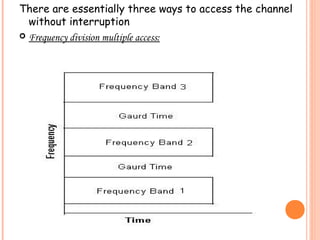
There are essentially three ways to access the channel
without interruption
 Frequency division multiple access:
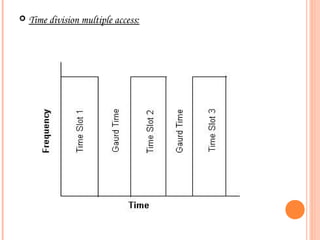
 Time division multiple access:
DRAWBACKS:
In both FDMA and TDMA, only one
subscriber at a time is assigned to a channel.
No other conversion can access this channel
until the subscriber’s call is finished or until
that original call to handed off to a different
channel by the system. Voice data tends to be
burst in nature. So much of the time, no data
is being sent over the channel. This
inefficiency tends to limit the capacity of the
system.
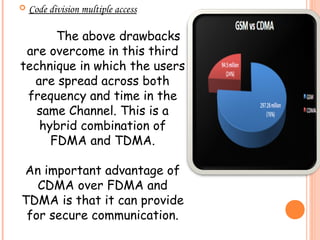
 Code division multiple access
The above drawbacks
are overcome in this third
technique in which the users
are spread across both
frequency and time in the
same Channel. This is a
hybrid combination of
FDMA and TDMA.
An important advantage of
CDMA over FDMA and
TDMA is that it can provide
for secure communication.
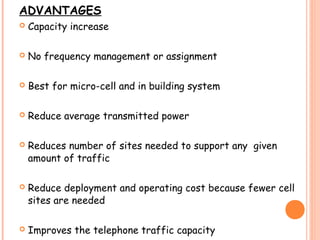
ADVANTAGES
 Capacity increase
 No frequency management or assignment
 Best for micro-cell and in building system
 Reduce average transmitted power
 Reduces number of sites needed to support any given
amount of traffic
 Reduce deployment and operating cost because fewer cell
sites are needed
 Improves the telephone traffic capacity
DISADVANTAGE
 Multi-user interference or multiple access interference
(MAI)
 Multi-path fading
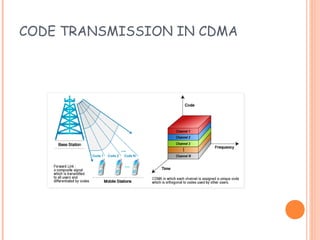
CODE TRANSMISSION IN CDMA
CONCLUSION
CDMA is radically new concept in
wireless communication. It has gained
widespread international acceptance by cellular
radio system operators as an upgrade that will
dramatically increase both their systems
capacity and the service quality. Moreover it
spread spectrum technology is both more
secure , less probable to intercept and jam,
highly private and offer higher transmission
quality than TDMA because of its increase
resistance to multipath distortion .
T A N Q !
ANY QUESTION ?
THANK YOU
FROM SUNNY

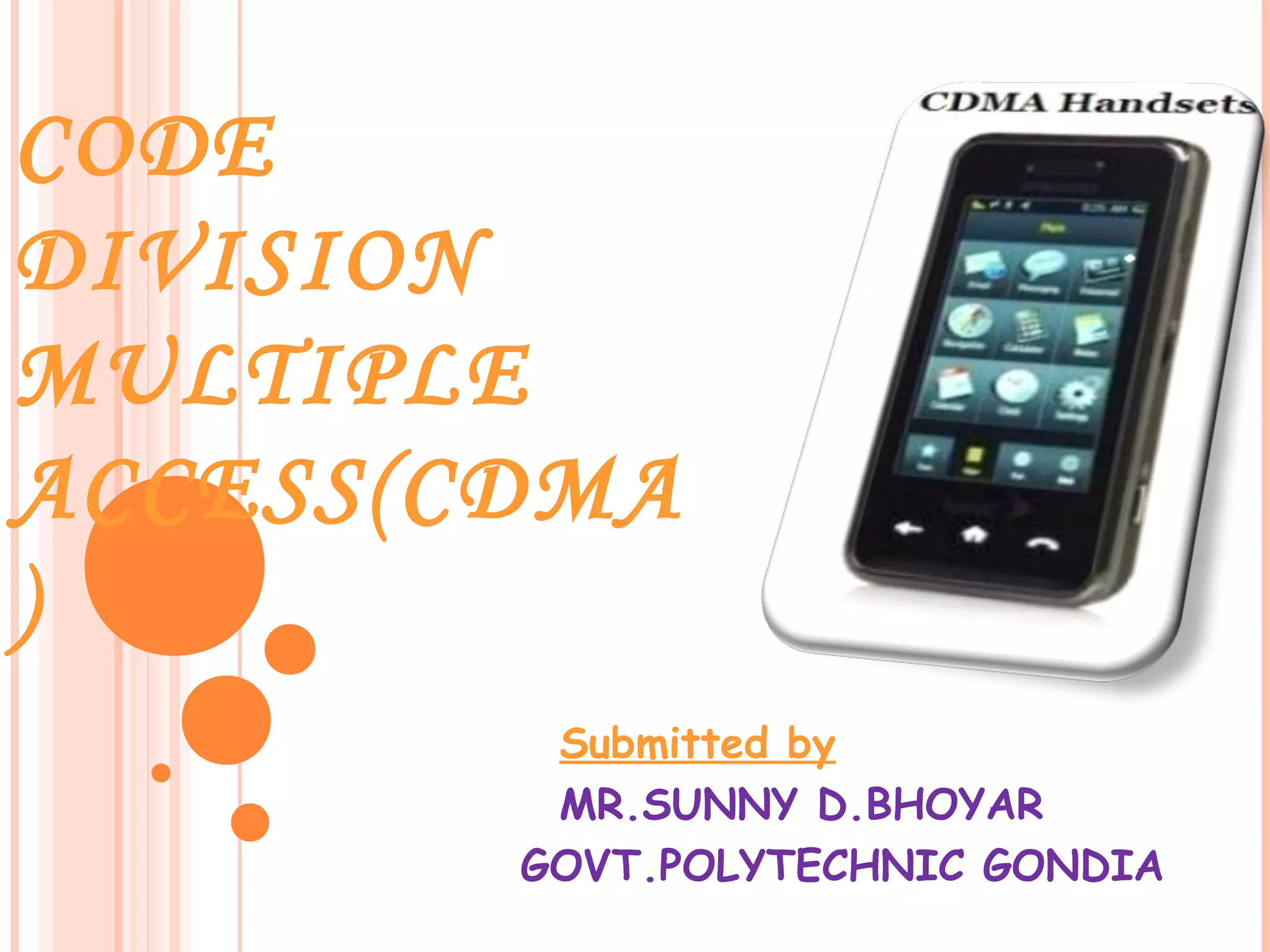
CDMA TECHNOLOGY

  • 1.
  • 2.
    INTRODUCTION:- Mobile communications arerapidly becoming more and more necessary for everyday activities. With so many more users to accommodate, more efficient use of bandwidth is a priority among cellular phone system operators. Equally important is the security and reliability of these calls. One solution that has been offered is a CODE DIVISION MULTIPLE ACCESS SYSTEM
  • 3.
    CDMA is onemethod for implementing a multiple access communication system. MULTIPLE ACCESS is a technique where many subscribers or local stations can share the use of the use of a communication channel at the same time or nearly so despite the fact originate from widely different locations. A channel can be thought of as merely a portion of the limited radio resource, which is temporarily allocated for a specific purpose, such as someone’s phone call. A multiple access method is a definition of how the radio spectrum is divided into channels and how the channels are allocated to the many users of the system.
  • 4.
    There are essentiallythree ways to access the channel without interruption  Frequency division multiple access:
  • 5.
     Time divisionmultiple access:
  • 6.
    DRAWBACKS: In both FDMAand TDMA, only one subscriber at a time is assigned to a channel. No other conversion can access this channel until the subscriber’s call is finished or until that original call to handed off to a different channel by the system. Voice data tends to be burst in nature. So much of the time, no data is being sent over the channel. This inefficiency tends to limit the capacity of the system.
  • 7.
     Code divisionmultiple access The above drawbacks are overcome in this third technique in which the users are spread across both frequency and time in the same Channel. This is a hybrid combination of FDMA and TDMA. An important advantage of CDMA over FDMA and TDMA is that it can provide for secure communication.
  • 8.
    ADVANTAGES  Capacity increase No frequency management or assignment  Best for micro-cell and in building system  Reduce average transmitted power  Reduces number of sites needed to support any given amount of traffic  Reduce deployment and operating cost because fewer cell sites are needed  Improves the telephone traffic capacity
  • 9.
    DISADVANTAGE  Multi-user interferenceor multiple access interference (MAI)  Multi-path fading
  • 10.
  • 11.
    CONCLUSION CDMA is radicallynew concept in wireless communication. It has gained widespread international acceptance by cellular radio system operators as an upgrade that will dramatically increase both their systems capacity and the service quality. Moreover it spread spectrum technology is both more secure , less probable to intercept and jam, highly private and offer higher transmission quality than TDMA because of its increase resistance to multipath distortion .
  • 12.
    T A NQ !
  • 13.
  • 14.