What is Wireless and Mobile
Communication?
• Transmitting voice and data using
electromagnetic waves in open space
• Electromagnetic waves
• Travel at speed of light (c = 3x10⁸ m/s)
• Has a frequency (f) and wavelength ( )
» c = f x
• Higher frequency means higher energy photons
• The higher the energy photon the more penetrating is
the radiation
3
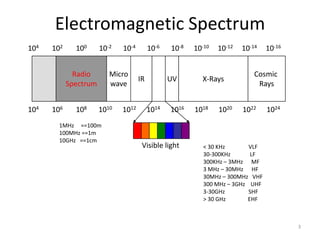
Electromagnetic Spectrum
104 102 100 10-2 10-4 10-6 10-8 10-10 10-12 10-14 10-16
104 106 108 1010 1012 1014 1016 1018 1020 1022 1024
IR UV X-Rays
Cosmic
Rays
Radio
Spectrum
1MHz ==100m
100MHz ==1m
10GHz ==1cm
< 30 KHz VLF
30-300KHz LF
300KHz – 3MHz MF
3 MHz – 30MHz HF
30MHz – 300MHz VHF
300 MHz – 3GHz UHF
3-30GHz SHF
> 30 GHz EHF
Micro
wave
Visible light
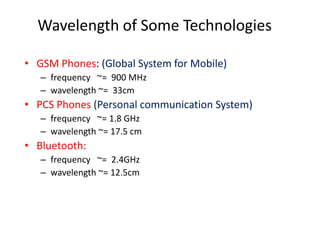
Wavelength of Some Technologies
• GSM Phones: (Global System for Mobile)
– frequency ~= 900 MHz
– wavelength ~= 33cm
• PCS Phones (Personal communication System)
– frequency ~= 1.8 GHz
– wavelength ~= 17.5 cm
• Bluetooth:
– frequency ~= 2.4GHz
– wavelength ~= 12.5cm
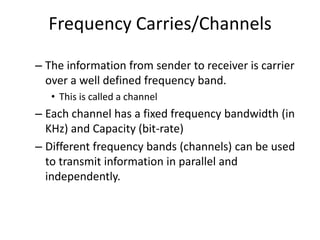
Frequency Carries/Channels
– The information from sender to receiver is carrier
over a well defined frequency band.
• This is called a channel
– Each channel has a fixed frequency bandwidth (in
KHz) and Capacity (bit-rate)
– Different frequency bands (channels) can be used
to transmit information in parallel and
independently.
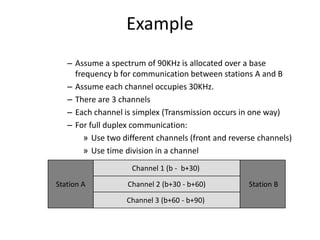
Example
– Assume a spectrum of 90KHz is allocated over a base
frequency b for communication between stations A and B
– Assume each channel occupies 30KHz.
– There are 3 channels
– Each channel is simplex (Transmission occurs in one way)
– For full duplex communication:
» Use two different channels (front and reverse channels)
» Use time division in a channel
Channel 1 (b - b+30)
Channel 2 (b+30 - b+60)
Channel 3 (b+60 - b+90)
Station A Station B
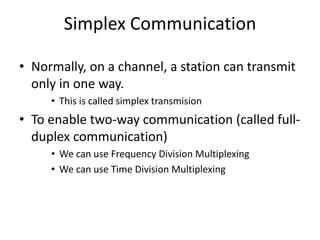
Simplex Communication
• Normally, on a channel, a station can transmit
only in one way.
• This is called simplex transmision
• To enable two-way communication (called full-
duplex communication)
• We can use Frequency Division Multiplexing
• We can use Time Division Multiplexing
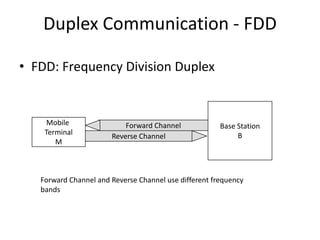
Duplex Communication - FDD
• FDD: Frequency Division Duplex
Base Station
B
Mobile
Terminal
M
Forward Channel
Reverse Channel
Forward Channel and Reverse Channel use different frequency
bands
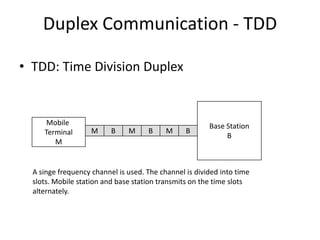
Duplex Communication - TDD
• TDD: Time Division Duplex
A singe frequency channel is used. The channel is divided into time
slots. Mobile station and base station transmits on the time slots
alternately.
Base Station
B
Mobile
Terminal
M
M B M B M B
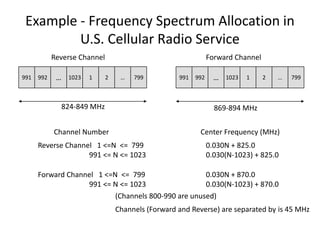
Example - Frequency Spectrum Allocation in
U.S. Cellular Radio Service
991 992 … 1023 1 2 … 799 991 992 … 1023 1 2 … 799
824-849 MHz 869-894 MHz
Reverse Channel Forward Channel
Channel Number Center Frequency (MHz)
Reverse Channel 1 <=N <= 799
991 <= N <= 1023
Forward Channel 1 <=N <= 799
991 <= N <= 1023
0.030N + 825.0
0.030(N-1023) + 825.0
0.030N + 870.0
0.030(N-1023) + 870.0
(Channels 800-990 are unused)
Channels (Forward and Reverse) are separated by is 45 MHz
What is Mobility
• Initially Internet and Telephone Networks is
designed assuming the user terminals are
static
• No change of location during a call/connection
• A user terminals accesses the network always from a
fixed location
• Mobility and portability
– Portability means changing point of attachment to
the network offline
– Mobility means changing point of attachment to
the network online
Degrees of Mobility
• Walking Users
• Low speed
• Small roaming area
• Usually uses high-bandwith/low-latency access
• Vehicles
• High speeds
• Large roaming area
• Usually uses low-bandwidth/high-latency access
• Uses sophisticated terminal equipment (cell phones)
The Need for Wireless/Mobile
Networking
• Demand for Ubiquitous Computing
– Anywhere, anytime computing and
communication
• You don’t have to go to the lab to check your email
– Pushing the computers more into background
• Focus on the task and life, not on the computer
• Use computers seamlessly to help you and to make
your life more easier.
– Computers should be location aware
• Adapt to the current location, discover services
Some Example Applications of
Ubiquitous Computing
• You walk into your office and your computer
automatically authenticates you through your
active badge and logs you into the Unix
system
• You go to a foreign building and your (Personal
Digital Assistant) PDA automatically discovers
the closest public printer where you can print
your schedule and give to your friend
What is PCS
• Personal Communication Services
– A wide variety of network services that includes
wireless access and personal mobility services
– Provided through a small terminal
– Enables communication at any time, at any place,
and in any form.
• The market for such services is tremendously
big
– Think of cell-phone market
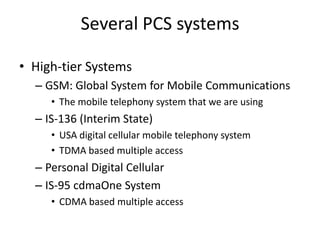
Several PCS systems
• High-tier Systems
– GSM: Global System for Mobile Communications
• The mobile telephony system that we are using
– IS-136 (Interim State)
• USA digital cellular mobile telephony system
• TDMA based multiple access
– Personal Digital Cellular
– IS-95 cdmaOne System
• CDMA based multiple access
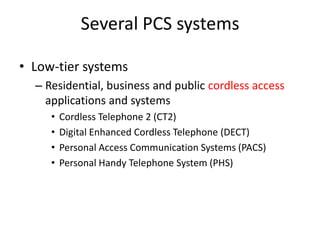
Several PCS systems
• Low-tier systems
– Residential, business and public cordless access
applications and systems
• Cordless Telephone 2 (CT2)
• Digital Enhanced Cordless Telephone (DECT)
• Personal Access Communication Systems (PACS)
• Personal Handy Telephone System (PHS)
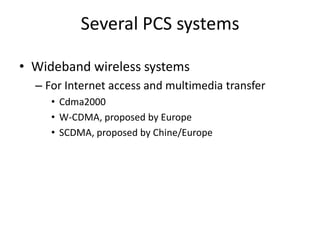
Several PCS systems
• Wideband wireless systems
– For Internet access and multimedia transfer
• Cdma2000
• W-CDMA, proposed by Europe
• SCDMA, proposed by Chine/Europe
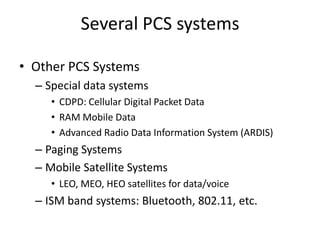
Several PCS systems
• Other PCS Systems
– Special data systems
• CDPD: Cellular Digital Packet Data
• RAM Mobile Data
• Advanced Radio Data Information System (ARDIS)
– Paging Systems
– Mobile Satellite Systems
• LEO, MEO, HEO satellites for data/voice
– ISM band systems: Bluetooth, 802.11, etc.
PCS Problems
• How to integrate mobile and wireless users to
the Public Switched Telephone Network
(PSTN) (Voice Network)
• Cellular mobile telephony system
• How to integrate mobile and wireless users to
the Internet (Data Network)
• Mobile IP, DHCP, Cellular IP
• How to integrate all of them together and also
add multimedia services (3G Systems)
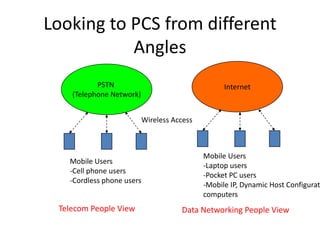
InternetPSTN
(Telephone Network)
Looking to PCS from different
Angles
Mobile Users
-Cell phone users
-Cordless phone users
Mobile Users
-Laptop users
-Pocket PC users
-Mobile IP, Dynamic Host Configurat
computers
Wireless Access
Telecom People View Data Networking People View
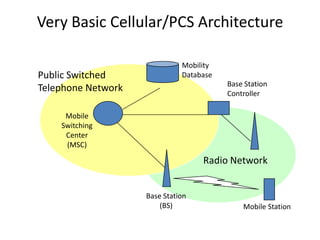
Very Basic Cellular/PCS Architecture
Base Station
(BS) Mobile Station
Base Station
Controller
Mobility
Database
Mobile
Switching
Center
(MSC)
Radio Network
Public Switched
Telephone Network
Wireless System Definitions
– Mobile Station
– A station in the cellular radio service intended for use while in
motion at unspecified locations. They can be either hand-held
personal units (portables) or installed on vehicles (mobiles)
– Base station
– A fixed station in a mobile radio system used for radio
communication with the mobile stations. Base stations are
located at the center or edge of a coverage region. They
consists of radio channels and transmitter and receiver
antennas mounted on top of a tower.
Wireless System Definitions
– Mobile Switching Center
– Switching center which coordinates the routing of calls in a
large service area. In a cellular radio system, the MSC
connections the cellular base stations and the mobiles to the
PSTN (telephone network). It is also called Mobile Telephone
Switching Office (MTSO)
– Subscriber
– A user who pays subscription charges for using a mobile
communication system
– Transceiver
– A device capable of simultaneously transmitting and receiving
radio signals
Wireless System Definitions
– Simplex Systems
– Communication systems which provide only one-way
communication
– Half Duplex Systems
– Communication Systems which allow two-way communication
by using the same radio channel for both transmission and
reception. At any given time, the user can either transmit or
receive information.
– Full Duplex Systems
– Communication systems which allow simultaneous two-way
communication. Transmission and reception is typically on
two different channels (FDD).
Wireless System Definitions
– Handoff
– The process of transferring a mobile station from one channel
or base station to an other.
– Roamer
– A mobile station which operates in a service area (market)
other than that from which service has been subscribed.
– Page
– A brief message which is broadcast over the entire service
area, usually in simulcast fashion by many base stations at the
same time.
PCS Systems Classification
• Cordless Telephones
• Cellular Telephony (High-tier)
• Wide Area Wireless Data Systems (High-tier)
• High Speed Local and Personal Area Networks
• Paging Messaging Systems
• Satellite Based Mobile Systems
• 3G Systems
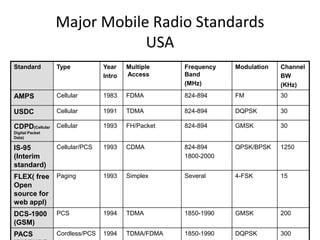
Major Mobile Radio Standards
USA
Standard Type Year
Intro
Multiple
Access
Frequency
Band
(MHz)
Modulation Channel
BW
(KHz)
AMPS Cellular 1983 FDMA 824-894 FM 30
USDC Cellular 1991 TDMA 824-894 DQPSK 30
CDPD(Cellular
Digital Packet
Data)
Cellular 1993 FH/Packet 824-894 GMSK 30
IS-95
(Interim
standard)
Cellular/PCS 1993 CDMA 824-894
1800-2000
QPSK/BPSK 1250
FLEX( free
Open
source for
web appl)
Paging 1993 Simplex Several 4-FSK 15
DCS-1900
(GSM)
PCS 1994 TDMA 1850-1990 GMSK 200
PACS Cordless/PCS 1994 TDMA/FDMA 1850-1990 DQPSK 300
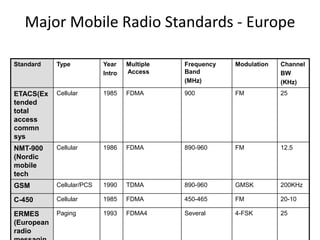
Major Mobile Radio Standards - Europe
Standard Type Year
Intro
Multiple
Access
Frequency
Band
(MHz)
Modulation Channel
BW
(KHz)
ETACS(Ex
tended
total
access
commn
sys
Cellular 1985 FDMA 900 FM 25
NMT-900
(Nordic
mobile
tech
Cellular 1986 FDMA 890-960 FM 12.5
GSM Cellular/PCS 1990 TDMA 890-960 GMSK 200KHz
C-450 Cellular 1985 FDMA 450-465 FM 20-10
ERMES
(European
radio
Paging 1993 FDMA4 Several 4-FSK 25
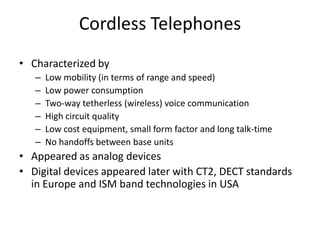
Cordless Telephones
• Characterized by
– Low mobility (in terms of range and speed)
– Low power consumption
– Two-way tetherless (wireless) voice communication
– High circuit quality
– Low cost equipment, small form factor and long talk-time
– No handoffs between base units
• Appeared as analog devices
• Digital devices appeared later with CT2, DECT standards
in Europe and ISM band technologies in USA
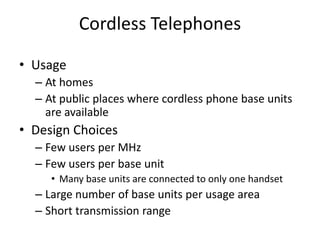
Cordless Telephones
• Usage
– At homes
– At public places where cordless phone base units
are available
• Design Choices
– Few users per MHz
– Few users per base unit
• Many base units are connected to only one handset
– Large number of base units per usage area
– Short transmission range
Cordless Phone
• Some more features
– 32 Kb/s adaptive differential pulse code
modulation (ADPCM) digital speech encoding
– Tx power <= 10 mW
– Low-complexity radio signal processing
– No forward error correction (FEC) or whatsoever.
– Low transmission delay < 50ms
– Simple Frequency Shift Modulation (FSK)
– Time Division Duplex (TDD)
Cellular Telephony
• Characterized by
– High mobility provision
– Wide-range
– Two-way tetherless voice communication
– Handoff and roaming support
– Integrated with sophisticated public switched
telephone network (PSTN)
– High transmit power requires at the handsets
(~2W)
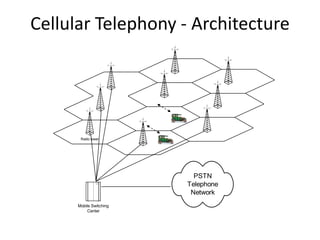
Cellular Telephony - Architecture
Radio tower
PSTN
Telephone
Network
Mobile Switching
Center
Cellular Telephony Systems
• Mobile users and handsets
– Very complex circuitry and design
• Base stations
– Provides gateway functionality between wireless
and wireline links
• Mobile switching centers
– Connect cellular system to the terrestrial
telephone network
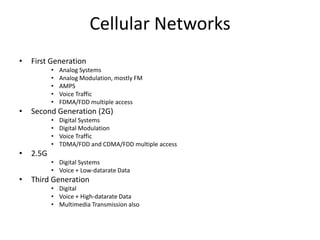
Cellular Networks
• First Generation
• Analog Systems
• Analog Modulation, mostly FM
• AMPS
• Voice Traffic
• FDMA/FDD multiple access
• Second Generation (2G)
• Digital Systems
• Digital Modulation
• Voice Traffic
• TDMA/FDD and CDMA/FDD multiple access
• 2.5G
• Digital Systems
• Voice + Low-datarate Data
• Third Generation
• Digital
• Voice + High-datarate Data
• Multimedia Transmission also
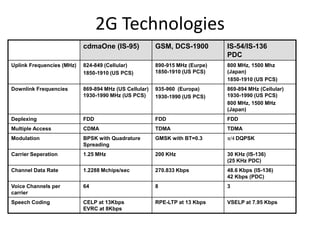
2G Technologies
cdmaOne (IS-95) GSM, DCS-1900 IS-54/IS-136
PDC
Uplink Frequencies (MHz) 824-849 (Cellular)
1850-1910 (US PCS)
890-915 MHz (Eurpe)
1850-1910 (US PCS)
800 MHz, 1500 Mhz
(Japan)
1850-1910 (US PCS)
Downlink Frequencies 869-894 MHz (US Cellular)
1930-1990 MHz (US PCS)
935-960 (Europa)
1930-1990 (US PCS)
869-894 MHz (Cellular)
1930-1990 (US PCS)
800 MHz, 1500 MHz
(Japan)
Deplexing FDD FDD FDD
Multiple Access CDMA TDMA TDMA
Modulation BPSK with Quadrature
Spreading
GMSK with BT=0.3 DQPSK
Carrier Seperation 1.25 MHz 200 KHz 30 KHz (IS-136)
(25 KHz PDC)
Channel Data Rate 1.2288 Mchips/sec 270.833 Kbps 48.6 Kbps (IS-136)
42 Kbps (PDC)
Voice Channels per
carrier
64 8 3
Speech Coding CELP at 13Kbps
EVRC at 8Kbps
RPE-LTP at 13 Kbps VSELP at 7.95 Kbps
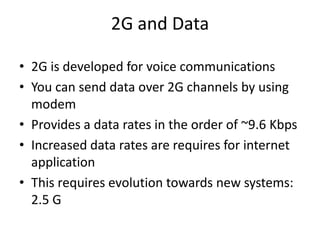
2G and Data
• 2G is developed for voice communications
• You can send data over 2G channels by using
modem
• Provides a data rates in the order of ~9.6 Kbps
• Increased data rates are requires for internet
application
• This requires evolution towards new systems:
2.5 G
2.5 Technologies
• Evolution of TDMA Systems
– HSCSD (High speed Circuit Switched Data) for 2.5G
GSM
– Up to 57.6 Kbps data-rate
– GPRS (General Packet Radio Services) for GSM and
IS-136
– Up to 171.2 Kbps data-rate
– EDGE (Enhanced Data For Global Evolution) for
2.5G GSM and IS-136
– Up to 384 Kbps data-rate
• Evolution of CDMA Systems
3G Systems
• Goals
– Voice and Data Transmission
• Simultanous voice and data access
– Multi-megabit Internet access
• Interactive web sessions
– Voice-activated calls
– Multimedia Content
• Live music
3G Systems
• Evolution of Systems
• CDMA sysystem evaolved to CDMA2000
» CDMA2000-1xRTT: Upto 307 Kbps
» CDMA2000-1xEV:
» CDMA2000-1xEVDO: upto 2.4 Mbps
» CDMA2000-1xEVDV: 144 Kbps datarate
• GSM, IS-136 and PDC evolved to W-CDMA (Wideband
CDMA) (also called UMTS)
» Up to 2.048 Mbps data-rates
» Future systems 8Mbps
» Expected to be fully deployed by 2010-2015
• New spectrum is allocated for these technologies
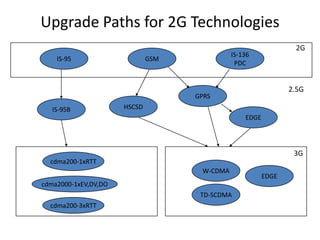
Upgrade Paths for 2G Technologies
IS-136
PDC
GSMIS-95
2G
IS-95B HSCSD
GPRS
EDGE
W-CDMA
EDGE
TD-SCDMA
cdma200-1xRTT
cdma2000-1xEV,DV,DO
cdma200-3xRTT
2.5G
3G
Issues related to 3G
High input fees for the 3G service licenses.
Inefficient to meet future need of the performance.
Require wide bandwidth.
Lack of coverage because it is still new.
Multiple standard.
4G
Proposed in ITU-2003
>4G- Magic
. Mobile multimedia anytime/anywhere global mobility support
integrated wireless and customized personal service
 Hardware-Smart Antennas-
Find tune and turn up signal information
Spectrum-UWB-(Ultra wide band)
Features
• Interactive multimedia
•User friendliness
•High speed-1 Gbps for still and 1000 Mbps for user in mobility.
•Network Heterogeneity
•Terminal Heterogeneity
Setting up a Call in Cellular Mobile System
When a cell phone is switched on, it scans for the FCC to determine
the strongest strength and monitors it till it drops below a usable level.
It again searches for the strongest signal available.
Control channels are defined and standardized over the entire
geographic area covered and typically it is about 5% of total available
channels in the system .
Due to the standardization, the same phone is capable to be used in
different markets.
MSC dispatches the request to all base stations.
MIN of subscriber is broadcasted as a paging message over all FCC.
The phone receives the message and acknowledges it on the RCC and base station
forwards it to MSC for handshake.
MSC instructs base station to move the call on unused voice channel.
Base station indicates the phone to change it to unused frequency pair and at this
time base station sends a data message to mobile station on the voice channel for
ringing.
(a) Call is made for mobile station
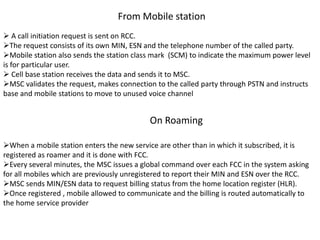
From Mobile station
 A call initiation request is sent on RCC.
The request consists of its own MIN, ESN and the telephone number of the called party.
Mobile station also sends the station class mark (SCM) to indicate the maximum power level
is for particular user.
 Cell base station receives the data and sends it to MSC.
MSC validates the request, makes connection to the called party through PSTN and instructs
base and mobile stations to move to unused voice channel
On Roaming
When a mobile station enters the new service are other than in which it subscribed, it is
registered as roamer and it is done with FCC.
Every several minutes, the MSC issues a global command over each FCC in the system asking
for all mobiles which are previously unregistered to report their MIN and ESN over the RCC.
MSC sends MIN/ESN data to request billing status from the home location register (HLR).
Once registered , mobile allowed to communicate and the billing is routed automatically to
the home service provider

Mobile communication

  • 1.
    What is Wirelessand Mobile Communication?
  • 2.
    • Transmitting voiceand data using electromagnetic waves in open space • Electromagnetic waves • Travel at speed of light (c = 3x10⁸ m/s) • Has a frequency (f) and wavelength ( ) » c = f x • Higher frequency means higher energy photons • The higher the energy photon the more penetrating is the radiation
  • 3.
    3 Electromagnetic Spectrum 104 102100 10-2 10-4 10-6 10-8 10-10 10-12 10-14 10-16 104 106 108 1010 1012 1014 1016 1018 1020 1022 1024 IR UV X-Rays Cosmic Rays Radio Spectrum 1MHz ==100m 100MHz ==1m 10GHz ==1cm < 30 KHz VLF 30-300KHz LF 300KHz – 3MHz MF 3 MHz – 30MHz HF 30MHz – 300MHz VHF 300 MHz – 3GHz UHF 3-30GHz SHF > 30 GHz EHF Micro wave Visible light
  • 4.
    Wavelength of SomeTechnologies • GSM Phones: (Global System for Mobile) – frequency ~= 900 MHz – wavelength ~= 33cm • PCS Phones (Personal communication System) – frequency ~= 1.8 GHz – wavelength ~= 17.5 cm • Bluetooth: – frequency ~= 2.4GHz – wavelength ~= 12.5cm
  • 5.
    Frequency Carries/Channels – Theinformation from sender to receiver is carrier over a well defined frequency band. • This is called a channel – Each channel has a fixed frequency bandwidth (in KHz) and Capacity (bit-rate) – Different frequency bands (channels) can be used to transmit information in parallel and independently.
  • 6.
    Example – Assume aspectrum of 90KHz is allocated over a base frequency b for communication between stations A and B – Assume each channel occupies 30KHz. – There are 3 channels – Each channel is simplex (Transmission occurs in one way) – For full duplex communication: » Use two different channels (front and reverse channels) » Use time division in a channel Channel 1 (b - b+30) Channel 2 (b+30 - b+60) Channel 3 (b+60 - b+90) Station A Station B
  • 7.
    Simplex Communication • Normally,on a channel, a station can transmit only in one way. • This is called simplex transmision • To enable two-way communication (called full- duplex communication) • We can use Frequency Division Multiplexing • We can use Time Division Multiplexing
  • 8.
    Duplex Communication -FDD • FDD: Frequency Division Duplex Base Station B Mobile Terminal M Forward Channel Reverse Channel Forward Channel and Reverse Channel use different frequency bands
  • 9.
    Duplex Communication -TDD • TDD: Time Division Duplex A singe frequency channel is used. The channel is divided into time slots. Mobile station and base station transmits on the time slots alternately. Base Station B Mobile Terminal M M B M B M B
  • 10.
    Example - FrequencySpectrum Allocation in U.S. Cellular Radio Service 991 992 … 1023 1 2 … 799 991 992 … 1023 1 2 … 799 824-849 MHz 869-894 MHz Reverse Channel Forward Channel Channel Number Center Frequency (MHz) Reverse Channel 1 <=N <= 799 991 <= N <= 1023 Forward Channel 1 <=N <= 799 991 <= N <= 1023 0.030N + 825.0 0.030(N-1023) + 825.0 0.030N + 870.0 0.030(N-1023) + 870.0 (Channels 800-990 are unused) Channels (Forward and Reverse) are separated by is 45 MHz
  • 11.
    What is Mobility •Initially Internet and Telephone Networks is designed assuming the user terminals are static • No change of location during a call/connection • A user terminals accesses the network always from a fixed location • Mobility and portability – Portability means changing point of attachment to the network offline – Mobility means changing point of attachment to the network online
  • 12.
    Degrees of Mobility •Walking Users • Low speed • Small roaming area • Usually uses high-bandwith/low-latency access • Vehicles • High speeds • Large roaming area • Usually uses low-bandwidth/high-latency access • Uses sophisticated terminal equipment (cell phones)
  • 13.
    The Need forWireless/Mobile Networking • Demand for Ubiquitous Computing – Anywhere, anytime computing and communication • You don’t have to go to the lab to check your email – Pushing the computers more into background • Focus on the task and life, not on the computer • Use computers seamlessly to help you and to make your life more easier. – Computers should be location aware • Adapt to the current location, discover services
  • 14.
    Some Example Applicationsof Ubiquitous Computing • You walk into your office and your computer automatically authenticates you through your active badge and logs you into the Unix system • You go to a foreign building and your (Personal Digital Assistant) PDA automatically discovers the closest public printer where you can print your schedule and give to your friend
  • 15.
    What is PCS •Personal Communication Services – A wide variety of network services that includes wireless access and personal mobility services – Provided through a small terminal – Enables communication at any time, at any place, and in any form. • The market for such services is tremendously big – Think of cell-phone market
  • 16.
    Several PCS systems •High-tier Systems – GSM: Global System for Mobile Communications • The mobile telephony system that we are using – IS-136 (Interim State) • USA digital cellular mobile telephony system • TDMA based multiple access – Personal Digital Cellular – IS-95 cdmaOne System • CDMA based multiple access
  • 17.
    Several PCS systems •Low-tier systems – Residential, business and public cordless access applications and systems • Cordless Telephone 2 (CT2) • Digital Enhanced Cordless Telephone (DECT) • Personal Access Communication Systems (PACS) • Personal Handy Telephone System (PHS)
  • 18.
    Several PCS systems •Wideband wireless systems – For Internet access and multimedia transfer • Cdma2000 • W-CDMA, proposed by Europe • SCDMA, proposed by Chine/Europe
  • 19.
    Several PCS systems •Other PCS Systems – Special data systems • CDPD: Cellular Digital Packet Data • RAM Mobile Data • Advanced Radio Data Information System (ARDIS) – Paging Systems – Mobile Satellite Systems • LEO, MEO, HEO satellites for data/voice – ISM band systems: Bluetooth, 802.11, etc.
  • 20.
    PCS Problems • Howto integrate mobile and wireless users to the Public Switched Telephone Network (PSTN) (Voice Network) • Cellular mobile telephony system • How to integrate mobile and wireless users to the Internet (Data Network) • Mobile IP, DHCP, Cellular IP • How to integrate all of them together and also add multimedia services (3G Systems)
  • 21.
    InternetPSTN (Telephone Network) Looking toPCS from different Angles Mobile Users -Cell phone users -Cordless phone users Mobile Users -Laptop users -Pocket PC users -Mobile IP, Dynamic Host Configurat computers Wireless Access Telecom People View Data Networking People View
  • 22.
    Very Basic Cellular/PCSArchitecture Base Station (BS) Mobile Station Base Station Controller Mobility Database Mobile Switching Center (MSC) Radio Network Public Switched Telephone Network
  • 23.
    Wireless System Definitions –Mobile Station – A station in the cellular radio service intended for use while in motion at unspecified locations. They can be either hand-held personal units (portables) or installed on vehicles (mobiles) – Base station – A fixed station in a mobile radio system used for radio communication with the mobile stations. Base stations are located at the center or edge of a coverage region. They consists of radio channels and transmitter and receiver antennas mounted on top of a tower.
  • 24.
    Wireless System Definitions –Mobile Switching Center – Switching center which coordinates the routing of calls in a large service area. In a cellular radio system, the MSC connections the cellular base stations and the mobiles to the PSTN (telephone network). It is also called Mobile Telephone Switching Office (MTSO) – Subscriber – A user who pays subscription charges for using a mobile communication system – Transceiver – A device capable of simultaneously transmitting and receiving radio signals
  • 25.
    Wireless System Definitions –Simplex Systems – Communication systems which provide only one-way communication – Half Duplex Systems – Communication Systems which allow two-way communication by using the same radio channel for both transmission and reception. At any given time, the user can either transmit or receive information. – Full Duplex Systems – Communication systems which allow simultaneous two-way communication. Transmission and reception is typically on two different channels (FDD).
  • 26.
    Wireless System Definitions –Handoff – The process of transferring a mobile station from one channel or base station to an other. – Roamer – A mobile station which operates in a service area (market) other than that from which service has been subscribed. – Page – A brief message which is broadcast over the entire service area, usually in simulcast fashion by many base stations at the same time.
  • 27.
    PCS Systems Classification •Cordless Telephones • Cellular Telephony (High-tier) • Wide Area Wireless Data Systems (High-tier) • High Speed Local and Personal Area Networks • Paging Messaging Systems • Satellite Based Mobile Systems • 3G Systems
  • 28.
    Major Mobile RadioStandards USA Standard Type Year Intro Multiple Access Frequency Band (MHz) Modulation Channel BW (KHz) AMPS Cellular 1983 FDMA 824-894 FM 30 USDC Cellular 1991 TDMA 824-894 DQPSK 30 CDPD(Cellular Digital Packet Data) Cellular 1993 FH/Packet 824-894 GMSK 30 IS-95 (Interim standard) Cellular/PCS 1993 CDMA 824-894 1800-2000 QPSK/BPSK 1250 FLEX( free Open source for web appl) Paging 1993 Simplex Several 4-FSK 15 DCS-1900 (GSM) PCS 1994 TDMA 1850-1990 GMSK 200 PACS Cordless/PCS 1994 TDMA/FDMA 1850-1990 DQPSK 300
  • 29.
    Major Mobile RadioStandards - Europe Standard Type Year Intro Multiple Access Frequency Band (MHz) Modulation Channel BW (KHz) ETACS(Ex tended total access commn sys Cellular 1985 FDMA 900 FM 25 NMT-900 (Nordic mobile tech Cellular 1986 FDMA 890-960 FM 12.5 GSM Cellular/PCS 1990 TDMA 890-960 GMSK 200KHz C-450 Cellular 1985 FDMA 450-465 FM 20-10 ERMES (European radio Paging 1993 FDMA4 Several 4-FSK 25
  • 30.
    Cordless Telephones • Characterizedby – Low mobility (in terms of range and speed) – Low power consumption – Two-way tetherless (wireless) voice communication – High circuit quality – Low cost equipment, small form factor and long talk-time – No handoffs between base units • Appeared as analog devices • Digital devices appeared later with CT2, DECT standards in Europe and ISM band technologies in USA
  • 31.
    Cordless Telephones • Usage –At homes – At public places where cordless phone base units are available • Design Choices – Few users per MHz – Few users per base unit • Many base units are connected to only one handset – Large number of base units per usage area – Short transmission range
  • 32.
    Cordless Phone • Somemore features – 32 Kb/s adaptive differential pulse code modulation (ADPCM) digital speech encoding – Tx power <= 10 mW – Low-complexity radio signal processing – No forward error correction (FEC) or whatsoever. – Low transmission delay < 50ms – Simple Frequency Shift Modulation (FSK) – Time Division Duplex (TDD)
  • 33.
    Cellular Telephony • Characterizedby – High mobility provision – Wide-range – Two-way tetherless voice communication – Handoff and roaming support – Integrated with sophisticated public switched telephone network (PSTN) – High transmit power requires at the handsets (~2W)
  • 34.
    Cellular Telephony -Architecture Radio tower PSTN Telephone Network Mobile Switching Center
  • 35.
    Cellular Telephony Systems •Mobile users and handsets – Very complex circuitry and design • Base stations – Provides gateway functionality between wireless and wireline links • Mobile switching centers – Connect cellular system to the terrestrial telephone network
  • 36.
    Cellular Networks • FirstGeneration • Analog Systems • Analog Modulation, mostly FM • AMPS • Voice Traffic • FDMA/FDD multiple access • Second Generation (2G) • Digital Systems • Digital Modulation • Voice Traffic • TDMA/FDD and CDMA/FDD multiple access • 2.5G • Digital Systems • Voice + Low-datarate Data • Third Generation • Digital • Voice + High-datarate Data • Multimedia Transmission also
  • 37.
    2G Technologies cdmaOne (IS-95)GSM, DCS-1900 IS-54/IS-136 PDC Uplink Frequencies (MHz) 824-849 (Cellular) 1850-1910 (US PCS) 890-915 MHz (Eurpe) 1850-1910 (US PCS) 800 MHz, 1500 Mhz (Japan) 1850-1910 (US PCS) Downlink Frequencies 869-894 MHz (US Cellular) 1930-1990 MHz (US PCS) 935-960 (Europa) 1930-1990 (US PCS) 869-894 MHz (Cellular) 1930-1990 (US PCS) 800 MHz, 1500 MHz (Japan) Deplexing FDD FDD FDD Multiple Access CDMA TDMA TDMA Modulation BPSK with Quadrature Spreading GMSK with BT=0.3 DQPSK Carrier Seperation 1.25 MHz 200 KHz 30 KHz (IS-136) (25 KHz PDC) Channel Data Rate 1.2288 Mchips/sec 270.833 Kbps 48.6 Kbps (IS-136) 42 Kbps (PDC) Voice Channels per carrier 64 8 3 Speech Coding CELP at 13Kbps EVRC at 8Kbps RPE-LTP at 13 Kbps VSELP at 7.95 Kbps
  • 38.
    2G and Data •2G is developed for voice communications • You can send data over 2G channels by using modem • Provides a data rates in the order of ~9.6 Kbps • Increased data rates are requires for internet application • This requires evolution towards new systems: 2.5 G
  • 39.
    2.5 Technologies • Evolutionof TDMA Systems – HSCSD (High speed Circuit Switched Data) for 2.5G GSM – Up to 57.6 Kbps data-rate – GPRS (General Packet Radio Services) for GSM and IS-136 – Up to 171.2 Kbps data-rate – EDGE (Enhanced Data For Global Evolution) for 2.5G GSM and IS-136 – Up to 384 Kbps data-rate • Evolution of CDMA Systems
  • 40.
    3G Systems • Goals –Voice and Data Transmission • Simultanous voice and data access – Multi-megabit Internet access • Interactive web sessions – Voice-activated calls – Multimedia Content • Live music
  • 41.
    3G Systems • Evolutionof Systems • CDMA sysystem evaolved to CDMA2000 » CDMA2000-1xRTT: Upto 307 Kbps » CDMA2000-1xEV: » CDMA2000-1xEVDO: upto 2.4 Mbps » CDMA2000-1xEVDV: 144 Kbps datarate • GSM, IS-136 and PDC evolved to W-CDMA (Wideband CDMA) (also called UMTS) » Up to 2.048 Mbps data-rates » Future systems 8Mbps » Expected to be fully deployed by 2010-2015 • New spectrum is allocated for these technologies
  • 42.
    Upgrade Paths for2G Technologies IS-136 PDC GSMIS-95 2G IS-95B HSCSD GPRS EDGE W-CDMA EDGE TD-SCDMA cdma200-1xRTT cdma2000-1xEV,DV,DO cdma200-3xRTT 2.5G 3G
  • 43.
    Issues related to3G High input fees for the 3G service licenses. Inefficient to meet future need of the performance. Require wide bandwidth. Lack of coverage because it is still new. Multiple standard.
  • 44.
    4G Proposed in ITU-2003 >4G-Magic . Mobile multimedia anytime/anywhere global mobility support integrated wireless and customized personal service  Hardware-Smart Antennas- Find tune and turn up signal information Spectrum-UWB-(Ultra wide band)
  • 45.
    Features • Interactive multimedia •Userfriendliness •High speed-1 Gbps for still and 1000 Mbps for user in mobility. •Network Heterogeneity •Terminal Heterogeneity
  • 46.
    Setting up aCall in Cellular Mobile System When a cell phone is switched on, it scans for the FCC to determine the strongest strength and monitors it till it drops below a usable level. It again searches for the strongest signal available. Control channels are defined and standardized over the entire geographic area covered and typically it is about 5% of total available channels in the system . Due to the standardization, the same phone is capable to be used in different markets. MSC dispatches the request to all base stations. MIN of subscriber is broadcasted as a paging message over all FCC. The phone receives the message and acknowledges it on the RCC and base station forwards it to MSC for handshake. MSC instructs base station to move the call on unused voice channel. Base station indicates the phone to change it to unused frequency pair and at this time base station sends a data message to mobile station on the voice channel for ringing. (a) Call is made for mobile station
  • 47.
    From Mobile station A call initiation request is sent on RCC. The request consists of its own MIN, ESN and the telephone number of the called party. Mobile station also sends the station class mark (SCM) to indicate the maximum power level is for particular user.  Cell base station receives the data and sends it to MSC. MSC validates the request, makes connection to the called party through PSTN and instructs base and mobile stations to move to unused voice channel On Roaming When a mobile station enters the new service are other than in which it subscribed, it is registered as roamer and it is done with FCC. Every several minutes, the MSC issues a global command over each FCC in the system asking for all mobiles which are previously unregistered to report their MIN and ESN over the RCC. MSC sends MIN/ESN data to request billing status from the home location register (HLR). Once registered , mobile allowed to communicate and the billing is routed automatically to the home service provider